

IEC 60086-2-2:2026
(Main)Primary batteries - Part 2-2: Physical and electrical specifications of lithium batteries
General Information
- Abstract
IEC 60086-2-2:2026 is applicable to primary batteries which are based on standardised lithium (non-aqueous) electrochemical systems.
It specifies:
- the physical dimensions,
- the discharge test conditions and discharge performance requirements.
This first edition cancels and replaces the fourteenth edition of IEC 60086-2 published in 2021. This edition constitutes a technical revision.
This edition includes the following significant technical changes with respect to the previous edition:
a) separation of batteries with aqueous electrolyte into a separate Part 2-1: Physical and electrical specifications;
b) maximum open circuit voltage of FR10G445 and FR14505 was changed from 1,83 to 1,90 V;
c) load of digital audio test for FR10G445 was changed from 50 mA to 75 mA and MAD was modified;
d) portable lighting test was added for FR10G445;
e) motor/toy and radio /clock /remote control test was added for FR14505;
f) in Clause 3, terms were reordered according their functions: electrochemical systems, electrochemical systems, electrical characteristics and specifications;
g) Annex D for common designation of IEC 60086 2:2021 was moved to IEC 60086 1:2026, as Annex H;
h) Annex E for Compliance checklist of IEC 60086 2:2021 was removed and merged into Annex J of IEC 60086 1:2026.
- Status
- Published
- Publication Date
- 01-Jun-2026
- Technical Committee
- TC 35 - Primary cells and batteries
- Drafting Committee
- MT 14 - TC 35/MT 14
- Current Stage
- PPUB - Publication issued
- Start Date
- 02-Jun-2026
- Completion Date
- 03-Apr-2026
Buy Documents
REDLINE IEC 60086-2-2:2026 CMV - Primary batteries - Part 2-2: Physical and electrical specifications of lithium batteries
iec60086-2-2{ed1.0}en - Primary batteries - Part 2-2: Physical and electrical specifications of lithium batteries
iec60086-2-2{ed1.0}fr - <p>Piles électriques - Partie 2-2: Spécifications physiques et électriques des piles au lithium</p>
Overview
IEC 60086-2-2:2026 is an internationally recognized standard published by the International Electrotechnical Commission (IEC) that specifies the physical and electrical requirements for primary batteries based on standardized lithium (non-aqueous) electrochemical systems. This first edition of IEC 60086-2-2 replaces the fourteenth edition of IEC 60086-2, expanding the scope with a technical revision that segregates lithium batteries’ specifications from those using aqueous electrolytes.
The standard provides essential guidelines on physical dimensions, test conditions, and discharge performance requirements for lithium primary batteries. It enables consistency, reliability, and quality across battery manufacturing, testing, and use worldwide, supporting device designers, manufacturers, and end-users.
Key Topics
IEC 60086-2-2:2026 covers several core subjects related to lithium primary battery standardization:
- Physical Dimensions: Specifies maximum and minimum measurements for critical battery features, facilitating accurate form and fit within devices.
- Electrical Specifications: Details the nominal voltage, open-circuit voltage (OCV), and end-point voltage (EV) of various lithium battery types.
- Discharge Test Conditions: Defines parameters for realistic battery life and performance simulations in common applications such as toys, cameras, clocks, and lighting.
- Discharge Performance Requirements: Establishes minimum average duration (MAD) criteria that batteries must meet for compliance.
- Battery Categories & Specifications: Categorizes lithium batteries by shape, size, and designation (e.g., cylindrical, coin).
- Updates from Previous Editions: Notable changes in this edition include:
- Separation of aqueous and non-aqueous (lithium) battery standards.
- Revisions to the maximum OCV and test loads for certain lithium battery models.
- Additions and modifications to application-specific tests for select battery types.
- Reorganization and migration of Annexes for improved document structure.
Applications
IEC 60086-2-2:2026 is directly applicable to a wide range of industries and products that rely on high-performance lithium primary batteries, such as:
- Consumer Electronics: Digital cameras, key fobs, portable lighting (including LED), radios, remote controls, and clocks.
- Industrial and Medical Devices: Measurement tools, sensors, memory backup, and diagnostic equipment requiring robust and reliable battery performance.
- Toys and Motorized Products: Ensuring consistent power delivery and safety in electronic toys and hobby devices.
- Wearables and IoT Devices: Coin cell lithium batteries are critical in compact, low-power designs.
The standard enhances manufacturing quality by ensuring batteries are interoperable across devices and can be safely and accurately tested for end-use conditions.
Related Standards
To ensure proper implementation and safety, IEC 60086-2-2:2026 should be used in conjunction with related international standards, including:
- IEC 60086-1:2026 - Primary batteries: General requirements and definitions for all primary battery systems.
- IEC 60086-4 - Safety standards for lithium batteries, providing guidelines for safe design, handling, and disposal.
- IEC 62281 - Safety requirements specific to transportation and handling of lithium batteries.
- IEC 60086-2-1 - Physical and electrical specifications of primary batteries with aqueous electrolyte (for non-lithium systems).
- ISO 1101 - Geometrical product specifications, referenced for dimensional tolerances.
Practical Value
IEC 60086-2-2:2026 delivers practical benefits by:
- Guaranteeing interchangeability and compatibility of lithium batteries across devices and brands.
- Providing standardized testing criteria for OEMs and battery makers to meet regulatory and performance benchmarks.
- Supporting safer battery usage by defining physical and electrical characteristics and drawing clear distinctions between different battery chemistries.
- Enabling innovation in electronics and portable devices through well-defined, updated technical requirements for lithium batteries.
Adherence to IEC 60086-2-2:2026 ensures quality, safety, and compatibility in applications where lithium primary batteries are essential.
Relations
- Effective Date
- 05-Jun-2026
Buy Documents
REDLINE IEC 60086-2-2:2026 CMV - Primary batteries - Part 2-2: Physical and electrical specifications of lithium batteries
iec60086-2-2{ed1.0}en - Primary batteries - Part 2-2: Physical and electrical specifications of lithium batteries
iec60086-2-2{ed1.0}fr - <p>Piles électriques - Partie 2-2: Spécifications physiques et électriques des piles au lithium</p>
Get Certified
Connect with accredited certification bodies for this standard

IMQ S.p.A. (Certification)
Italian electrical product certification.

SLG Prüf- und Zertifizierungs GmbH
German testing and certification body.

UL Solutions
Global safety science company with testing, inspection and certification.
Sponsored listings
Frequently Asked Questions
IEC 60086-2-2:2026 is a standard published by the International Electrotechnical Commission (IEC). Its full title is "Primary batteries - Part 2-2: Physical and electrical specifications of lithium batteries". This standard covers: IEC 60086-2-2:2026 is applicable to primary batteries which are based on standardised lithium (non-aqueous) electrochemical systems. It specifies: - the physical dimensions, - the discharge test conditions and discharge performance requirements. This first edition cancels and replaces the fourteenth edition of IEC 60086-2 published in 2021. This edition constitutes a technical revision. This edition includes the following significant technical changes with respect to the previous edition: a) separation of batteries with aqueous electrolyte into a separate Part 2-1: Physical and electrical specifications; b) maximum open circuit voltage of FR10G445 and FR14505 was changed from 1,83 to 1,90 V; c) load of digital audio test for FR10G445 was changed from 50 mA to 75 mA and MAD was modified; d) portable lighting test was added for FR10G445; e) motor/toy and radio /clock /remote control test was added for FR14505; f) in Clause 3, terms were reordered according their functions: electrochemical systems, electrochemical systems, electrical characteristics and specifications; g) Annex D for common designation of IEC 60086 2:2021 was moved to IEC 60086 1:2026, as Annex H; h) Annex E for Compliance checklist of IEC 60086 2:2021 was removed and merged into Annex J of IEC 60086 1:2026.
IEC 60086-2-2:2026 is applicable to primary batteries which are based on standardised lithium (non-aqueous) electrochemical systems. It specifies: - the physical dimensions, - the discharge test conditions and discharge performance requirements. This first edition cancels and replaces the fourteenth edition of IEC 60086-2 published in 2021. This edition constitutes a technical revision. This edition includes the following significant technical changes with respect to the previous edition: a) separation of batteries with aqueous electrolyte into a separate Part 2-1: Physical and electrical specifications; b) maximum open circuit voltage of FR10G445 and FR14505 was changed from 1,83 to 1,90 V; c) load of digital audio test for FR10G445 was changed from 50 mA to 75 mA and MAD was modified; d) portable lighting test was added for FR10G445; e) motor/toy and radio /clock /remote control test was added for FR14505; f) in Clause 3, terms were reordered according their functions: electrochemical systems, electrochemical systems, electrical characteristics and specifications; g) Annex D for common designation of IEC 60086 2:2021 was moved to IEC 60086 1:2026, as Annex H; h) Annex E for Compliance checklist of IEC 60086 2:2021 was removed and merged into Annex J of IEC 60086 1:2026.
IEC 60086-2-2:2026 is classified under the following ICS (International Classification for Standards) categories: 29.220.10 - Primary cells and batteries. The ICS classification helps identify the subject area and facilitates finding related standards.
IEC 60086-2-2:2026 has the following relationships with other standards: It is inter standard links to IEC 60086-2:2021. Understanding these relationships helps ensure you are using the most current and applicable version of the standard.
IEC 60086-2-2:2026 is available in PDF format for immediate download after purchase. The document can be added to your cart and obtained through the secure checkout process. Digital delivery ensures instant access to the complete standard document.
Standards Content (Sample)
IEC 60086-2-2 ®
Edition 1.0 2026-06
INTERNATIONAL
STANDARD
COMMENTED VERSION
Primary batteries -
Part 2-2: Physical and electrical specifications of lithium batteries
ICS 29.220.10 ISBN 978-2-8327-1297-9
All rights reserved. Unless otherwise specified, no part of this publication may be reproduced or utilized in any form or
by any means, electronic or mechanical, including photocopying and microfilm, without permission in writing from either
IEC or IEC's member National Committee in the country of the requester. If you have any questions about IEC copyright
or have an enquiry about obtaining additional rights to this publication, please contact the address below or your local
IEC member National Committee for further information.
IEC Secretariat Tel.: +41 22 919 02 11
3, rue de Varembé info@iec.ch
CH-1211 Geneva 20 www.iec.ch
Switzerland
About the IEC
The International Electrotechnical Commission (IEC) is the leading global organization that prepares and publishes
International Standards for all electrical, electronic and related technologies.
About IEC publications
The technical content of IEC publications is kept under constant review by the IEC. Please make sure that you have the
latest edition, a corrigendum or an amendment might have been published.
IEC publications search - IEC Products & Services Portal - products.iec.ch
webstore.iec.ch/advsearchform Discover our powerful search engine and read freely all the
The advanced search enables to find IEC publications by a publications previews, graphical symbols and the glossary.
variety of criteria (reference number, text, technical With a subscription you will always have access to up to date
committee, …). It also gives information on projects, content tailored to your needs.
replaced and withdrawn publications.
Electropedia - www.electropedia.org
The world's leading online dictionary on electrotechnology,
IEC Just Published - webstore.iec.ch/justpublished
Stay up to date on all new IEC publications. Just Published containing more than 22 500 terminological entries in English
details all new publications released. Available online and and French, with equivalent terms in 25 additional languages.
once a month by email. Also known as the International Electrotechnical Vocabulary
(IEV) online.
IEC Customer Service Centre - webstore.iec.ch/csc
If you wish to give us your feedback on this publication or
need further assistance, please contact the Customer
Service Centre: sales@iec.ch.
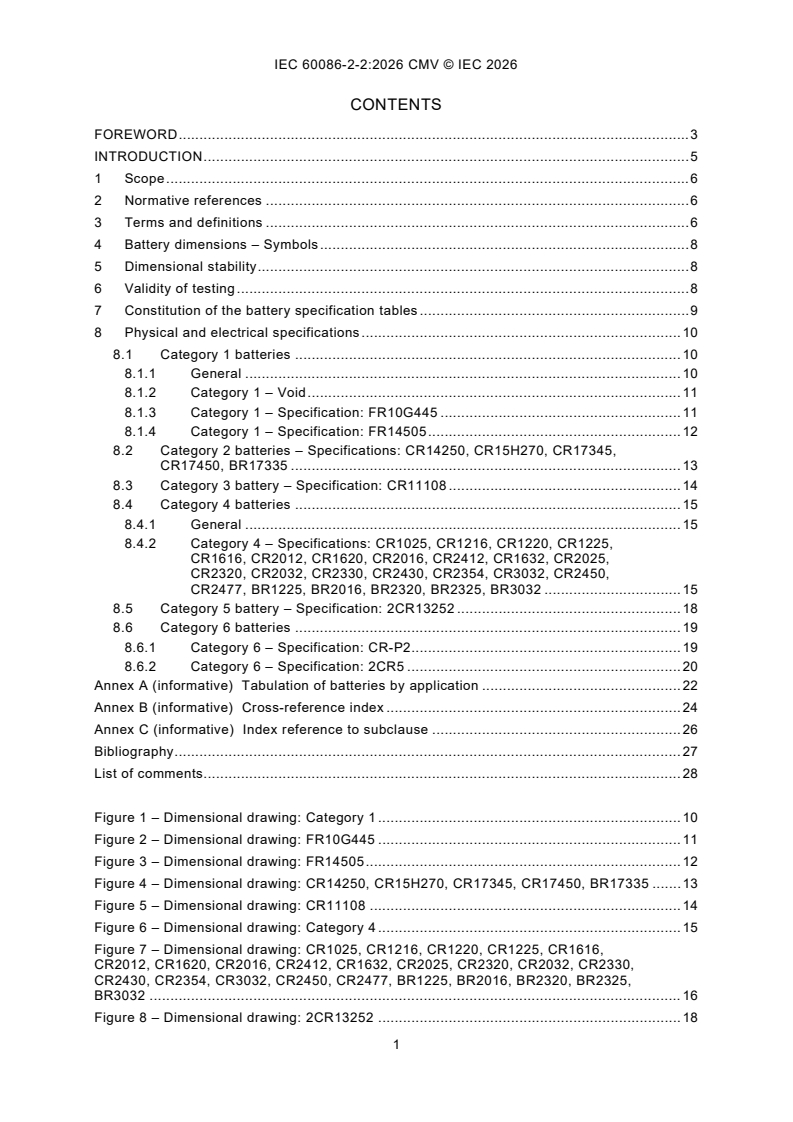
CONTENTS
FOREWORD . 3
INTRODUCTION . 5
1 Scope . 6
2 Normative references . 6
3 Terms and definitions . 6
4 Battery dimensions – Symbols . 8
5 Dimensional stability . 8
6 Validity of testing . 8
7 Constitution of the battery specification tables . 9
8 Physical and electrical specifications . 10
8.1 Category 1 batteries . 10
8.1.1 General . 10
8.1.2 Category 1 – Void . 11
8.1.3 Category 1 – Specification: FR10G445 . 11
8.1.4 Category 1 – Specification: FR14505 . 12
8.2 Category 2 batteries – Specifications: CR14250, CR15H270, CR17345,
CR17450, BR17335 . 13
8.3 Category 3 battery – Specification: CR11108 . 14
8.4 Category 4 batteries . 15
8.4.1 General . 15
8.4.2 Category 4 – Specifications: CR1025, CR1216, CR1220, CR1225,
CR1616, CR2012, CR1620, CR2016, CR2412, CR1632, CR2025,
CR2320, CR2032, CR2330, CR2430, CR2354, CR3032, CR2450,
CR2477, BR1225, BR2016, BR2320, BR2325, BR3032 . 15
8.5 Category 5 battery – Specification: 2CR13252 . 18
8.6 Category 6 batteries . 19
8.6.1 Category 6 – Specification: CR-P2 . 19
8.6.2 Category 6 – Specification: 2CR5 . 20
Annex A (informative) Tabulation of batteries by application . 22
Annex B (informative) Cross-reference index . 24
Annex C (informative) Index reference to subclause . 26
Bibliography . 27
List of comments. 28
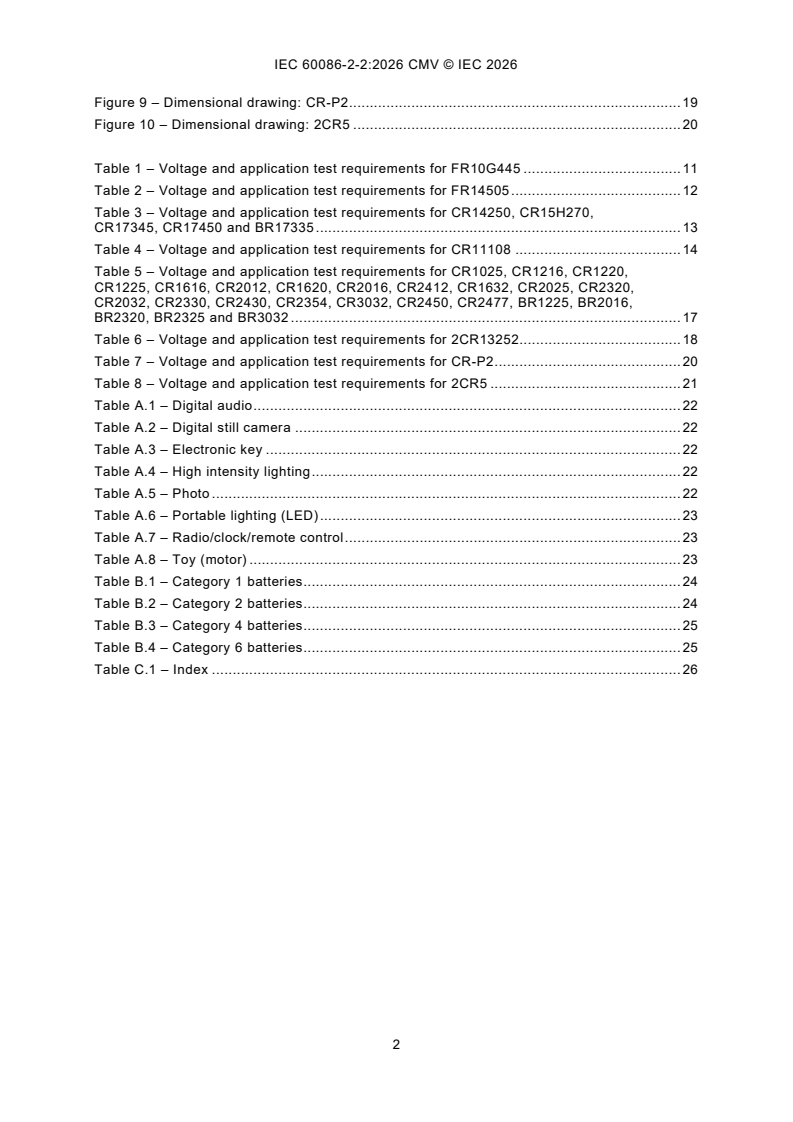
Figure 1 – Dimensional drawing: Category 1 . 10
Figure 2 – Dimensional drawing: FR10G445 . 11
Figure 3 – Dimensional drawing: FR14505 . 12
Figure 4 – Dimensional drawing: CR14250, CR15H270, CR17345, CR17450, BR17335 . 13
Figure 5 – Dimensional drawing: CR11108 . 14
Figure 6 – Dimensional drawing: Category 4 . 15
Figure 7 – Dimensional drawing: CR1025, CR1216, CR1220, CR1225, CR1616,
CR2012, CR1620, CR2016, CR2412, CR1632, CR2025, CR2320, CR2032, CR2330,
CR2430, CR2354, CR3032, CR2450, CR2477, BR1225, BR2016, BR2320, BR2325,
BR3032 . 16
Figure 8 – Dimensional drawing: 2CR13252 . 18
Figure 9 – Dimensional drawing: CR-P2 . 19
Figure 10 – Dimensional drawing: 2CR5 . 20
Table 1 – Voltage and application test requirements for FR10G445 . 11
Table 2 – Voltage and application test requirements for FR14505 . 12
Table 3 – Voltage and application test requirements for CR14250, CR15H270,
CR17345, CR17450 and BR17335 . 13
Table 4 – Voltage and application test requirements for CR11108 . 14
Table 5 – Voltage and application test requirements for CR1025, CR1216, CR1220,
CR1225, CR1616, CR2012, CR1620, CR2016, CR2412, CR1632, CR2025, CR2320,
CR2032, CR2330, CR2430, CR2354, CR3032, CR2450, CR2477, BR1225, BR2016,
BR2320, BR2325 and BR3032 . 17
Table 6 – Voltage and application test requirements for 2CR13252. 18
Table 7 – Voltage and application test requirements for CR-P2 . 20
Table 8 – Voltage and application test requirements for 2CR5 . 21
Table A.1 – Digital audio . 22
Table A.2 – Digital still camera . 22
Table A.3 – Electronic key . 22
Table A.4 – High intensity lighting . 22
Table A.5 – Photo . 22
Table A.6 – Portable lighting (LED) . 23
Table A.7 – Radio/clock/remote control . 23
Table A.8 – Toy (motor) . 23
Table B.1 – Category 1 batteries. 24
Table B.2 – Category 2 batteries. 24
Table B.3 – Category 4 batteries. 25
Table B.4 – Category 6 batteries. 25
Table C.1 – Index . 26
INTERNATIONAL ELECTROTECHNICAL COMMISSION
____________
Primary batteries -
Part 2-2: Physical and electrical specifications of lithium batteries
FOREWORD
1) The International Electrotechnical Commission (IEC) is a worldwide organization for standardization comprising
all national electrotechnical committees (IEC National Committees). The object of IEC is to promote international
co-operation on all questions concerning standardization in the electrical and electronic fields. To this end and
in addition to other activities, IEC publishes International Standards, Technical Specifications, Technical Reports,
Publicly Available Specifications (PAS) and Guides (hereafter referred to as “IEC Publication(s)”). Their
preparation is entrusted to technical committees; any IEC National Committee interested in the subject dealt with
may participate in this preparatory work. International, governmental and non-governmental organizations liaising
with the IEC also participate in this preparation. IEC collaborates closely with the International Organization for
Standardization (ISO) in accordance with conditions determined by agreement between the two organizations.
2) The formal decisions or agreements of IEC on technical matters express, as nearly as possible, an international
consensus of opinion on the relevant subjects since each technical committee has representation from all
interested IEC National Committees.
3) IEC Publications have the form of recommendations for international use and are accepted by IEC National
Committees in that sense. While all reasonable efforts are made to ensure that the technical content of IEC
Publications is accurate, IEC cannot be held responsible for the way in which they are used or for any
misinterpretation by any end user.
4) In order to promote international uniformity, IEC National Committees undertake to apply IEC Publications
transparently to the maximum extent possible in their national and regional publications. Any divergence between
any IEC Publication and the corresponding national or regional publication shall be clearly indicated in the latter.
5) IEC itself does not provide any attestation of conformity. Independent certification bodies provide conformity
assessment services and, in some areas, access to IEC marks of conformity. IEC is not responsible for any
services carried out by independent certification bodies.
6) All users should ensure that they have the latest edition of this publication.
7) No liability shall attach to IEC or its directors, employees, servants or agents including individual experts and
members of its technical committees and IEC National Committees for any personal injury, property damage or
other damage of any nature whatsoever, whether direct or indirect, or for costs (including legal fees) and
expenses arising out of the publication, use of, or reliance upon, this IEC Publication or any other IEC
Publications.
8) Attention is drawn to the Normative references cited in this publication. Use of the referenced publications is
indispensable for the correct application of this publication.
9) IEC draws attention to the possibility that the implementation of this document may involve the use of (a)
patent(s). IEC takes no position concerning the evidence, validity or applicability of any claimed patent rights in
respect thereof. As of the date of publication of this document, IEC had not received notice of (a) patent(s), which
may be required to implement this document. However, implementers are cautioned that this may not represent
the latest information, which may be obtained from the patent database available at https://patents.iec.ch. IEC
shall not be held responsible for identifying any or all such patent rights.
This commented version (CMV) of the official standard IEC 60086-2-2:2026 edition 1.0 provides
the user with comments from IEC TC 35 experts explaining the reasons for the most relevant
changes made to IEC 60086-2:2021. These changes are listed in the Foreword.
Experts' comments are identified by a blue-background number. Mouse over a number to
display a pop-up note containing the comment.
This publication contains both the CMV and the official standard. The full list of comments is
available at the end of the CMV.
IEC 60086-2-2 has been prepared by IEC technical committee 35: Primary cells and batteries.
It is an International Standard.
This first edition cancels and replaces the fourteenth edition of IEC 60086-2 published in 2021.
This edition constitutes a technical revision.
This edition includes the following significant technical changes with respect to the previous
edition:
a) the physical and electrical specifications of IEC 60086-2:2021 were divided into two new
standards based on their electrolyte types. IEC 60086-2-1 provides specifications for
standardized primary batteries containing aqueous electrolyte. IEC 60086-2-2 covers
specifications for standardized lithium-based primary batteries; 1
b) maximum open circuit voltage of FR10G445 and FR14505 was changed from 1,83 to 1,90 V; 2
c) load of digital audio test for FR10G445 was changed from 50 mA to 75 mA and MAD was
modified;
d) portable lighting test was added for FR10G445; 3
e) motor/toy and radio /clock /remote control test was added for FR14505; 4
f) in Clause 3, terms were reordered according to their functions: basic terms, electrochemical
systems, electrical characteristics and specifications; 5
g) Annex D for common designation of IEC 60086-2:2021 was moved to IEC 60086-1:2026, as
Annex H; 6
h) Annex E for Compliance checklist of IEC 60086-2:2021 was removed and merged into
Annex J of IEC 60086-1:2026. 7
The text of this International Standard is based on the following documents:
Draft Report on voting
35/1592/FDIS 35/1598/RVD
Full information on the voting for its approval can be found in the report on voting indicated in
the above table.
The language used for the development of this International Standard is English.
This document was drafted in accordance with ISO/IEC Directives, Part 2, and developed in
accordance with ISO/IEC Directives, Part 1 and ISO/IEC Directives, IEC Supplement, available
at www.iec.ch/members_experts/refdocs. The main document types developed by IEC are
described in greater detail at www.iec.ch/publications.
A list of all parts in the IEC 60086 series, under the general title Primary batteries, can be found
on the IEC website.
The committee has decided that the contents of this document will remain unchanged until the
stability date indicated on the IEC website under webstore.iec.ch in the data related to the
specific document. At this date, the document will be
– reconfirmed,
– withdrawn, or
– revised.
INTRODUCTION
The technical content of this part of IEC 60086 provides physical dimensions, discharge test
conditions and discharge performance requirements. IEC 60086-2-1 and IEC 60086-2-2
complement the general information and requirements of IEC 60086-1. Safety information of
IEC 60086-2-2 is available in IEC 60086-4 and IEC 62281.
This document was prepared to benefit primary battery users, device designers and battery
manufacturers by furnishing the specifics of form, fit and function for individual standardized
primary cells and batteries. Over the years, this document has been changed to improve its
contents and might again be revised in due course in the light of comments made by national
committees and experts on the basis of practical experience and changing technology.
1 Scope
This part of IEC 60086 is applicable to primary batteries which are based on standardised
lithium (non-aqueous) electrochemical systems.
It specifies
– the physical dimensions,
– the discharge test conditions and discharge performance requirements.
2 Normative references
The following documents are referred to in the text in such a way that some or all of their content
constitutes requirements of this document. For dated references, only the edition cited applies.
For undated references, the latest edition of the referenced document (including any
amendments) applies.
IEC 60086-1:2026, Primary batteries - Part 1: General
ISO 1101, Geometrical product specifications (GPS) - Geometrical tolerancing - Tolerances of
form, orientation, location and run-out
3 Terms and definitions
For the purposes of this document, the terms and definitions given in IEC 60086-1:2026 and
the following apply.
ISO and IEC maintain terminology databases for use in standardization at the following
addresses:
– IEC Electropedia: available at https://www.electropedia.org/
– ISO Online browsing platform: available at https://www.iso.org/obp
3.1
primary cell
primary battery
cell or battery that is not designed to be electrically recharged
3.2
round cell
round battery
cell or battery with circular cross section
3.3
button cell
button battery
small round cell or battery where the overall height is less than the diameter, containing
aqueous electrolyte
Note 1 to entry: For the specifications, refer to IEC 60086-2-1.
3.4
coin cell
coin battery
lithium button cell
lithium button battery
small round cell or battery where the overall height is less than the diameter, containing non-
aqueous electrolyte
Note 1 to entry: The nominal voltage of lithium batteries is typically greater than 2 V.
3.5
nominal voltage
U
n
suitable approximate value of the voltage used to designate or identify a cell, a battery or an
electrochemical system
[SOURCE: IEC 60050-482:2004, 482-03-31, modified – addition of U ]
n
3.6
open-circuit voltage
OCV
voltage across the terminals of a cell or battery when it is off discharge
3.7
end-point voltage
EV
specified voltage of a battery at which the battery discharge is terminated
[SOURCE: IEC 60050-482:2004, 482-03-30]
3.8
minimum average duration
MAD
acceptable minimum average time on discharge, which is met by testing a sample of batteries
according to specified methods, to be deemed compliant
Note 1 to entry: The discharge test is carried out according to the specified methods or standards and designed to
show conformity with the standard applicable to the battery types.
3.9
application test
simulation of the actual use of a battery in a specific application
3.10
service output
service life, or capacity, or energy output of a battery under specified conditions of discharge
3.11
service output test
test designed to measure the service output of a battery
Note 1 to entry: A service output test can be prescribed, for example, when
a) an application test is too complex to replicate;
b) the duration of an application test would make it impractical for routine testing purposes.
3.12
terminal
conductive parts of a battery providing connection to an external circuit
[SOURCE: IEC 60050-482:2004, 482-02-22, modified – “conductive part of a device, electric
circuit or electric network, provided” replaced by to “conductive parts of a battery providing” and
“device, electric circuit or electric network to one or more external conductor” replaced by “an
external circuit”]
4 Battery dimensions – Symbols
The symbols used to denote the various dimensions are as follows:
maximum overall height of the battery;
h
h minimum distance between the flats of the positive and negative contacts;
h minimum projection of the flat positive contact;
h maximum recess of the negative flat contact surface;
h minimum projection of the flat negative contact;
d maximum and minimum diameters of the battery;
d minimum diameter of the flat positive contact;
d maximum diameter of the positive contact within the specified projection height;
d minimum diameter of the flat negative contact;
d maximum diameter of the negative contact within the specified projection height;
d minimum outer diameter of the negative flat contact surface;
d maximum inner diameter of the negative flat contact surface;
øP concentricity of the positive contact.
5 Dimensional stability
Refer to IEC 60086-1 for dimensional stability.
6 Validity of testing
Portable primary batteries shall be subjected to the tests, as required in the IEC 60086 series.
Testing remains valid until a design change or requirement revision has been made. Retesting
is required when:
a) a battery specification changes by more than 0,1 g or 20 % mass, whichever is greater, for
the cathode, anode or electrolyte;
b) a battery specification changes that would lead to a failure of any of the tests;
c) there is an addition of new tests or requirements; or
d) there is a requirement change that would lead to a failure on any of the tests.
7 Constitution of the battery specification tables
– Batteries are categorized into several groups according to their shapes.
– In each category, batteries having the same shape but belonging to a different
electrochemical system are grouped together and shown in succession.
– Batteries are always listed in ascending order of nominal voltage and, within each nominal
voltage, in ascending order of volume.
– One common shape drawing of these batteries which fall in the same group is exhibited.
– Designation, nominal voltage, dimensions, discharge conditions, minimum average duration
and application for these batteries which fall into the same group are summarized in one
table.
– When a drawing represents only one type of battery, the dimensions of the relevant battery
may be directly shown on the drawing.
– Batteries are categorized into the following groups:
• Category 1: Round batteries according to Figure 1
FR10G445, FR14505
• Category 2: Round batteries according to Figure 4
CR14250, CR15H270, CR17345, CR17450, BR17335
• Category 3: Round battery according to Figure 5
CR11108
• Category 4: Round batteries according to Figure 6
CR1025, CR1216, CR1220, CR1225, CR1616, CR1632, CR2012, CR1620, CR2016,
CR2025, CR2320, CR2032, CR2330, CR2412, CR2430, CR2477, CR2354, CR3032,
CR2450, BR1225, BR2016, BR2320, BR2325, BR3032
• Category 5: Other round battery – Miscellaneous
2CR13252
• Category 6: Non-round batteries – Miscellaneous
CR-P2
2CR5
– The specification drawings show the shape of the relevant batteries. Dimensions for each
battery are shown in Figure 1 to Figure 10.
NOTE 1 See Annex A, Annex B and Annex C for ease of locating battery sizes.
NOTE 2 For batteries with aqueous electrolyte, see IEC 60086-2-1: Physical and electrical specifications of
batteries with aqueous electrolyte.
8 Physical and electrical specifications
8.1 Category 1 batteries
8.1.1 General
For the definition of the dimensions, see Clause 4.
The cylindrical surface is insulated from the contacts.
Terminals: flat/cap and base.
For general information, see IEC 60086-1.
Figure 1a): negative contact surface might not be flat
over the whole area.
Figure 1b): negative contact surface shall be
essentially flat over the whole surface area.
For batteries complying with Figure 1a) and
Figure 1b), flat negative contact is not necessarily
recessed.
When the flat negative contact surface forms the
lower part of the battery, dimensions "h " and "h "
1 2
are both measured from the surface and dimension
"h " is zero.
Dimensions "⌀P" to be measured in accordance with
ISO 1101.
The profile over the dotted lines is not specified.
1 Positive contact
2 Optional pip (dimension "h " for batteries having
the pip is 0,4 mm max.)
3 Negative contact area
Recesses are permitted in the negative flat contact
a)
surface defined by dimensions d and d for batteries
6 7
having the shape shown in Figure 1a), provided that
batteries placed end to end in series make electrical
contact with each other and that the contact
separation is an integral multiple of the contact
separation for one battery. The following conditions
shall be satisfied:
d > d
6 3
d > d
2 7
h > h
3 4
b)
Figure 1 – Dimensional drawing: Category 1
8.1.2 Category 1 – Void
8.1.3 Category 1 – Specification: FR10G445
Figure 2 shows the dimensional drawing and Table 1 shows the voltage and application test
requirements for FR10G445.
Dimensions in millimetres
Dimensions FR10G445
h 44,5
max.
h 43,5
min.
h
0,8
min.
h 0,5
max.
max. 10,5
d
min. 9,8
d
3,8
max.
d 4,3
min.
⌀P max. 0,25
Figure 2 – Dimensional drawing: FR10G445
Table 1 – Voltage and application test requirements for FR10G445
Electrochemical system letter F
IEC designation FR10G445
Common designation AAA, FR03
U (V)
1,5
n
OCV max. (V) 1,90
Delayed discharge performance after 12 months (% of MAD) 95
a
Applications Load Daily Period EV (V) MAD (Initial)
1 200 mW
b
Digital still camera 1,05 100 pulses
650 mW
High intensity lighting 400 mW 4 min on, 11 min off for 8 h per day 1,0 140 min
c
5,1 Ω 4 min on, 56 min off for 8 h per day 0,9 170 min
Portable lighting
c
Digital audio 75 mA 1 h on, 11 hr off for 24 h 0,9 11 h
a
Standard conditions (see IEC 60086-1: 2026, Table 3, Initial discharge test).
b
Repeat 10 times per hour: 1 200 mW for 2 s, then 650 mW for 28 s, then 0 mW for 55 min.
c
Test conditions shall be kept identical for battery designations FR10G445, and LR03, TR03, R03 in
IEC 60086-2-1 (see also I.6.1 and Table I.2 in IEC 60086-1:2026)
8.1.4 Category 1 – Specification: FR14505
Figure 3 shows the dimensional drawing and Table 2 shows the voltage and application test
requirements for FR1450.
Dimensions in millimetres
Dimensions FR14505
h 50,5
max.
h 49,5
min.
h 1,0
min.
h
0,5
max.
max. 14,5
d
min. 13,7
d 5,5
max.
d
7,0
min.
0,25
øP max.
Figure 3 – Dimensional drawing: FR14505
Table 2 – Voltage and application test requirements for FR14505
Electrochemical system letter F
IEC designation FR14505
Common designation AA, FR6
U (V)
1,5
n
OCV max. (V) 1,90
Delayed discharge performance after 12 months (% of MAD) 95
a
Applications Load Daily Period EV (V)
MAD (initial)
1 500 mW
b
High drain application 1,05 370 pulses
650 mW
High intensity lighting 1 000 mW 4 min on, 11 min off for 8 h per day 1,0 120 min
c
Motor/toy 3,9 Ω 1 h 0,8 5,5 h
c
Radio /clock /remote control 50 mA 1 h on, 7 h off for 24 h per day 1,0 34 h
a
Standard conditions (see IEC 60086-1:2026, Table 3, Initial discharge test).
b
Repeat 10 times per hour: 1 500 mW for 2 s, then 650 mW for 28 s, then 0 mW for 55 min.
c
Test conditions shall be kept identical for battery designations FR14505, and LR6, TR6, R6P, R6S, in
IEC 60086-2-1 (see also I.6.1 and Table I.2 in IEC 60086-1:2026)
8.2 Category 2 batteries – Specifications: CR14250, CR15H270, CR17345, CR17450,
BR17335
Figure 4 shows the dimensional drawing and Table 3 shows the voltage and application test
requirements for CR14250, CR15H270, CR17345, CR17450 and BR17335.
Dimensions in millimetres
Dimensions CR14250 CR15H270 CR17345 CR17450 BR17335
a
max. 25,0 34,5 45,0 33,5
27,0
h / h
1 2
a
min. 23,5 33,5 43,5 32,0
26,0
h
min. 0,4 0,6 1,0 0,4 0,1
max. - 0,4 0,9 - -
h
min. - 0,05 0,5 - -
max. 14,5 15,6 17,0 17,0 17,0
d
min. 13,5 15,0 16,0 16,0 16,0
d
max. 8,0 7,0 9,6 8,0 8,0
d
min. 5,0 8,5 11,0 5,0 5,0
For the definition of the dimensions, see Clause 4.
The cylindrical surface is insulated from the contacts.
Terminals: flat/cap and base.
For general information, see IEC 60086-1.
a
The h /h dimensions shall be measured on the label overlap.
1 2
Figure 4 – Dimensional drawing: CR14250, CR15H270, CR17345, CR17450, BR17335
Table 3 – Voltage and application test requirements for CR14250, CR15H270, CR17345,
CR17450 and BR17335
Electrochemical system letter C B
IEC designation CR14250 CR15H270 CR17345 CR17450 BR17335
123,
Common designation CR-1/2AA CR2 CR-A BR-2/3A
CR123A
U (V)
3,0 3,0 3,0 3,0 3,0
n
OCV max. (V) 3,7 3,7 3,7 3,7 3,7
Delayed discharge performance after 12 months (% of
98 98 98 98 98
MAD)
EV
a
Applications Load Daily Period
MAD (initial)
(V)
Current drain 3 s on, 27 s off 1 400 pul
Photo 1,55 No test 840 pulses No test No test
900 mA for 24 h per day ses
Repeated cycles
High intensity of 4 min on,
750 mA 1,8 No test No test 80 min No test No test
lighting 11 min off for
1 h; then 3 h off
Service output test 0,1 kΩ 24 h 2,0 No test 22 h 40 h No test No test
Service output test 1 kΩ 24 h 1,8 No test No test No test No test 380 h
Service output test 1 kΩ 24 h 2,0 No test No test No test 710 h No test
Service output test 3 kΩ 24 h 2,0 750 h No test No test No test No test
a
Standard conditions (see IEC 60086-1:2026, Table 3, Initial discharge test).
8.3 Category 3 battery – Specification: CR11108
Figure 5 shows the dimensional drawing and Table 4 shows the voltage and application test
requirements for CR11108.
Dimensions in millimetres
Dimensions CR11108
h
max. 10,8
h
min. 10,4
h
min. 0,2
max. 11,6
d
min. 11,4
d
min. 9,0
d
min. 3,0
d
max. 9,0
For the definition of the dimensions, see Clause 4.
The cylindrical surface is connected to the positive
terminal.
Terminals: flat/cap and case.
For general information, see IEC 60086-1.
No part of the battery shall project beyond the positive
contact area.
Marking: 4.1.6.2 of IEC 60086-1:2021 is applicable.
1 Optional pip
Figure 5 – Dimensional drawing: CR11108
Table 4 – Voltage and application test requirements for CR11108
Electrochemical system letter C
IEC designation CR11108
Common designation 1/3N
U (V)
3,0
n
OCV max. (V) 3,7
Delayed discharge performance after 12 months (% of MAD) 98
a
Applications Load Daily period EV (V)
MAD (initial)
Service output test 15 kΩ 24 h 2,0 620 h
a
Standard conditions (see IEC 60086-1:2026, Table 3, Initial discharge test).
8.4 Category 4 batteries
8.4.1 General
For the definition of the dimensions, see Clause 4.
The cylindrical surface is connected to the positive
terminal. Positive contact should be made to the side of
the battery but may be made to the base.
Terminals: flat/cap and case.
The flat negative contact shall project.
Contact pressure resistance, see 4.1.3.2 of
IEC 60086-1:2021.
For general information see IEC 60086-1.
Any difference between the height of the battery and the
distance between the contacts shall not exceed 0,1 mm.
No part of the battery shall project beyond the positive
contact.
Marking: 4.1.6.2 of IEC 60086-1:2021 is applicable.
Figure 6 – Dimensional drawing: Category 4
8.4.2 Category 4 – Specifications: CR1025, CR1216, CR1220, CR1225, CR1616,
CR2012, CR1620, CR2016, CR2412, CR1632, CR2025, CR2320, CR2032, CR2330,
CR2430, CR2354, CR3032, CR2450, CR2477, BR1225, BR2016, BR2320, BR2325,
BR3032
Figure 7 shows the dimensional drawing and Table 5 shows the voltage and application test
requirements for CR1025, CR1216, CR1220, CR1225, CR1616, CR2012, CR1620, CR2016,
CR2412, CR1632, CR2025, CR2320, CR2032, CR2330, CR2430, CR2354, CR3032, CR2450,
CR2477, BR1225, BR2016, BR2320, BR2325 and BR3032.
Dimensions in millimetres
h /h d d d
1 2 1 2 4
Designation
max. min. max. min. min. min.
CR1025 2,5 2,2 10,0 9,7 - 3,0
CR1216 1,6 1,4 12,5 12,2 - 4,0
CR1220 2,0 1,8 12,5 12,2 - 4,0
CR1225 2,5 2,2 12,5 12,2 - 4,0
CR1616 1,6 1,4 16,0 15,7 - 5,0
CR2012 1,2 1,0 20,0 19,7 - 8,0
CR1620 2,0 1,8 16,0 15,7 - 5,0
CR2016 1,6 1,4 20,0 19,7 - 8,0
CR2412 1,25 1,1 24,5 24,25 - 8,0
CR1632 3,2 2,9 16,0 15,7 - 5,0
CR2025 2,5 2,2 20,0 19,7 - 8,0
CR2320 2,0 1,8 23,0 22,6 - 8,0
CR2032 3,2 2,9 20,0 19,7 - 8,0
CR2330 3,0 2,7 23,0 22,6 - 8,0
CR2430 3,0 2,7 24,5 24,2 - 8,0
CR2354 5,4 5,1 23,0 22,6 - 8,0
CR3032 3,2 2,9 30,0 29,6 - 8,0
CR2450 5,0 4,6 24,5 24,2 - 8,0
CR2477 7,7 7,3 24,5 24,2 - 8,0
BR1225 2,5 2,2 12,5 12,2 - 4,0
BR2016 1,6 1,4 20,0 19,7 - 8,0
BR2320 2,0 1,8 23,0 22,6 - 8,0
BR2325 2,5 2,2 23,0 22,6 - 8,0
BR3032 3,2 2,9 30,0 29,6 - 8,0
Figure 7 – Dimensional drawing: CR1025, CR1216, CR1220, CR1225, CR1616, CR2012,
CR1620, CR2016, CR2412, CR1632, CR2025, CR2320, CR2032, CR2330, CR2430, CR2354,
CR3032, CR2450, CR2477, BR1225, BR2016, BR2320, BR2325, BR3032
Table 5 – Voltage and application test requirements for CR1025, CR1216, CR1220,
CR1225, CR1616, CR2012, CR1620, CR2016, CR2412, CR1632, CR2025, CR2320, CR2032,
CR2330, CR2430, CR2354, CR3032, CR2450, CR2477, BR1225, BR2016, BR2320, BR2325
and BR3032
Electrochemical system letter C B
U (V) 3,0
3,0
n
OCV max. (V) 3,7 3,7
Delayed discharge performance after 12 months (% of MAD) 98 98
a
Designation Test Load Daily period EV (V)
MAD (initial)
CR1025 Service output test 68 kΩ 24 h 2,0 600 h No test
CR1216 Service output test 62 kΩ 24 h 2,0 480 h No test
CR1220 Service output test 62 kΩ 24 h 2,0 700 h No test
CR1225 Service output test 30 kΩ 24 h 2,0 395 h No test
CR1616 Service output test 30 kΩ 24 h 2,0 480 h No test
CR2012 Service output test 30 kΩ 24 h 2,0 530 h No test
CR1620 Service output test 30 kΩ 24 h 2,0 540 h No test
CR2016 Service output test 30 kΩ 24 h 2,0 675 h No test
CR2412 Service output test 15 kΩ 24 h 2,0 420 h No test
CR1632 Service output test 15 kΩ 24 h 2,0 540 h No test
Service output test 15 kΩ 24 h 2,0 540 h No test
5 s on, 55 s
CR2025
Electronic key test 10 mA off 24 h per 1,8 8,5 h No test
day
CR2320 Service output test 15 kΩ 24 h 2,0 590 h No test
Service output test 15 kΩ 24 h 2,0 920 h No test
5 s on, 55 s
CR2032
10 mA
Electronic key test off 24 h per 1,8 12,5 h No test
day
CR2330 Service output test 15 kΩ 24 h 2,0 1 320 h No test
CR2430 Service output test 15 kΩ 24 h 2,0 1 300 h No test
CR2354 Service output test 7,5 kΩ 24 h 2,0 1 260 h No test
CR3032 Service output test 7,5 kΩ 24 h 2,0 1 250 h No test
CR2450 Service output test 7,5 kΩ 24 h 2,0 1 200 h No test
CR2477 Service output test 5,1 kΩ 24 h 2,0 1 250 h No test
BR1225 Service output test 30 kΩ 24 h 2,0 No test 395 h
BR2016 Service output test 30 kΩ 24 h 2,0 No test 636 h
BR2320 Service output test 15 kΩ 24 h 2,0 No test 468 h
BR2325 Service output test 15 kΩ 24 h 2,0 No test 696 h
BR3032 Service output test 7,5 kΩ 24 h 2,0 No test 1 310 h
a
Standard conditions (see IEC 60086-1:2026, Table 3, Initial discharge test).
8.5 Category 5 battery – Specification: 2CR13252
Figure 8 shows the dimensional drawing and Table 6 shows the voltage and application test
requirements for 2CR13252.
Dimensions in millimetres
Dimensions 2CR13252
max. 25,2
h
min. 23,9
h
min. 0,7
max. 0,4
h
min. 0,05
max. 13
d
min. 12
d
min. 5,0
d
max. 6,5
d
min. 5,0
The cylindrical surface is insulated from the contacts.
Terminals: flat.
For general information see IEC 60086-1.
Figure 8 – Dimensional drawing: 2CR13252
Table 6 – Voltage and application test requirements for 2CR13252
Electrochemical system letter C
IEC designation 2CR13252
Common designation 2CR-1/3N, 28L
U (V)
6,0
n
OCV max. (V) 7,4
Delayed discharge performance after 12 months (% of MAD) 98
a
Applications Load Daily period EV (V)
MAD (initial)
Service output test 30 kΩ 24 h 4,0 620 h
a
Standard conditions (see IEC 60086-1:2026, Table 3, Initial discharge test).
8.6 Category 6 batteries
8.6.1 Category 6 – Specification: CR-P2
Figure 9 shows the dimensional drawing and Table 7 shows the voltage and application test
requirements for CR-P2.
Dimensions in millimetres
Dimensions CR-P2
max. 36,0
h
min. 34,5
max. 1,5
h
min. 0,7
max. 1,0
h
min. 0,1
max. 35,0
l
min. 32,5
max. 19,5
l
min. 18,5
l
- 16,8
l
- 8,4
max. 16,2
l
min. 15,3
max. 9,8
l
min. 9,2
max. 8,7
l
min. 7,5
max. -
l
min. 1,3
max. 10,0
r
min. 7,4
Terminals: flat contacts.
Contacts are recessed.
For general information, see IEC 60086-1.
1 Round sides are also acceptable.
Figure 9 – Dimensional drawing: CR-P2
Table 7 – Voltage and application test requirements for CR-P2
Electrochemical system letter C
IEC designation CR-P2
Common designation 223
U (V)
6,0
n
OCV max. (V) 7,4
Delayed discharge performance after 12 months (% of MAD) 98
a
Applications Load Daily period EV (V)
MAD (initial)
Photo test Current drain 900 mA 3 s on, 27 s off for 24 h per day. 3,1 1 400 pulses
Service output test 200 Ω 24 h 4,0 40 h
a
Standard conditions (See IEC 60086-1:2026, Table 3, Initial discharge test).
8.6.2 Category 6 – Specification: 2CR5
Figure 10 shows the dimensional drawing and Table 8 shows the voltage and application test
requirements for 2CR5.
Dimensions in millimetres
Dimensions 2CR5
max. 45,0
h
min. 43,0
max. 0,9
h
min. 0,1
max. 4,5
h
min. 3,5
max. 34,0
l
min. 32,5
max. 17,0
l
min. 16,0
l
- 16,0
l
- 8,0
max. 15,5
l
min. -
max. 1,0
l
min. 0,2
max. 4,5
l
min. 3,5
max. 4,6
l
min. 3,5
max. 9,0
r
min. 8,0
Terminals: flat contacts.
For general information, see IEC 60086-1.
Figure 10 – Dimensional drawing: 2CR5
Table 8 – Voltage and application test requirements for 2CR5
Electrochemical system letter C
IEC designation 2CR5
Common designation 245
U (V)
6,0
n
OCV max. (V) 7,4
Delayed discharge performance after 12 months (% of MAD) 98
a
Applications Load Daily period EV (V)
MAD (initial)
Photo test Current drain 900 mA 3 s on, 27 s off for 24 h per day. 3,1 1 400 pulses
Service output test 200 Ω 24 h 4,0 40 h
a
Standard conditions (see IEC 60086-1:2026, Table 3, Initial discharge test).
Annex A
(informative)
Tabulation of batteries by application
Each of Table A.1 to Table A.8 lists all the batteries for which there is a discharge test given in
this specification for that application.
Within each table the batteries are listed in ascending order of nominal voltage and, within each
nominal voltage, in ascending order of volume.
Table A.1 – Digital audio
Designation Nominal voltage
V
FR10G445 1,5
Table A.2 – Digital still camera
Designation Nominal voltage
V
FR14505 1,5
FR10G445 1,5
Table A.3 – Electronic key
Designation Nominal voltage
V
CR2025 3,0
CR2032 3,0
Table A.4 – High intensity lighting
Designation Nominal voltage
V
CR17345 3,0
FR10G445 1,5
FR14505 1,5
Table A.5 – Photo
Nominal voltage
Designation
V
3,0
CR15H270
3,0
CR17345
6,0
CR-P2
6,0
2CR5
Table A.6 – Portable lighting (LED)
Designation Nominal voltage
V
FR10G445 1,5
Table A.7 – Radio/clock/remote control
Designation Nominal voltage
V
FR14505 1,5
Table A.8 – Toy (motor)
Designation Nominal voltage
V
FR14505 1,5
Annex B
(informative)
Cross-reference index
Batteries having the same physical dimensions may belong to a different electrochemical
system.
In order to allow physically interchangeable batteries from different electrochemical systems to
be compared in terms of electrical performance, a cross-reference is given in Table B.1 to
Table B.4.
Batteries are ordered per category and in each category by chemistry and by shape/size.
Batteries are always ordered by voltage and in each voltage by volume.
Table B.1 – Category 1 batteries
Round batteries according to Figure 1 to Figure 3
Ordered by electrochemical system Ordered by shape/volume
FR10G445, FR10G445
FR14505 FR14505
Table B.2 – Category 2 batteries
Round batteries according to Figure 4
Ordered by electrochemical system Ordered by shape/volume
CR14250, CR15H270, CR17345, CR17450 CR14250
BR17335 CR15H270
BR17335
CR17345
CR17450
Table B.3 – Category 4 batteries
Round batteries according to Figure 6 to Figure 7
Ordered by electrochemical system Ordered by shape/volume
...
IEC 60086-2-2 ®
Edition 1.0 2026-06
INTERNATIONAL
STANDARD
Primary batteries -
Part 2-2: Physical and electrical specifications of lithium batteries
ICS 29.220.10 ISBN 978-2-8327-1108-8
All rights reserved. Unless otherwise specified, no part of this publication may be reproduced or utilized in any form or
by any means, electronic or mechanical, including photocopying and microfilm, without permission in writing from either
IEC or IEC's member National Committee in the country of the requester. If you have any questions about IEC copyright
or have an enquiry about obtaining additional rights to this publication, please contact the address below or your local
IEC member National Committee for further information.
IEC Secretariat Tel.: +41 22 919 02 11
3, rue de Varembé info@iec.ch
CH-1211 Geneva 20 www.iec.ch
Switzerland
About the IEC
The International Electrotechnical Commission (IEC) is the leading global organization that prepares and publishes
International Standards for all electrical, electronic and related technologies.
About IEC publications
The technical content of IEC publications is kept under constant review by the IEC. Please make sure that you have the
latest edition, a corrigendum or an amendment might have been published.
IEC publications search - IEC Products & Services Portal - products.iec.ch
webstore.iec.ch/advsearchform Discover our powerful search engine and read freely all the
The advanced search enables to find IEC publications by a publications previews, graphical symbols and the glossary.
variety of criteria (reference number, text, technical With a subscription you will always have access to up to date
committee, …). It also gives information on projects, content tailored to your needs.
replaced and withdrawn publications.
Electropedia - www.electropedia.org
The world's leading online dictionary on electrotechnology,
IEC Just Published - webstore.iec.ch/justpublished
Stay up to date on all new IEC publications. Just Published containing more than 22 500 terminological entries in English
details all new publications released. Available online and and French, with equivalent terms in 25 additional languages.
once a month by email. Also known as the International Electrotechnical Vocabulary
(IEV) online.
IEC Customer Service Centre - webstore.iec.ch/csc
If you wish to give us your feedback on this publication or
need further assistance, please contact the Customer
Service Centre: sales@iec.ch.
CONTENTS
FOREWORD . 3
INTRODUCTION . 5
1 Scope . 6
2 Normative references . 6
3 Terms and definitions . 6
4 Battery dimensions – Symbols . 8
5 Dimensional stability . 8
6 Validity of testing . 8
7 Constitution of the battery specification tables . 9
8 Physical and electrical specifications . 10
8.1 Category 1 batteries . 10
8.1.1 General . 10
8.1.2 Category 1 – Void . 11
8.1.3 Category 1 – Specification: FR10G445 . 11
8.1.4 Category 1 – Specification: FR14505 . 12
8.2 Category 2 batteries – Specifications: CR14250, CR15H270, CR17345,
CR17450, BR17335 . 13
8.3 Category 3 battery – Specification: CR11108 . 14
8.4 Category 4 batteries . 15
8.4.1 General . 15
8.4.2 Category 4 – Specifications: CR1025, CR1216, CR1220, CR1225,
CR1616, CR2012, CR1620, CR2016, CR2412, CR1632, CR2025,
CR2320, CR2032, CR2330, CR2430, CR2354, CR3032, CR2450,
CR2477, BR1225, BR2016, BR2320, BR2325, BR3032 . 15
8.5 Category 5 battery – Specification: 2CR13252 . 18
8.6 Category 6 batteries . 19
8.6.1 Category 6 – Specification: CR-P2 . 19
8.6.2 Category 6 – Specification: 2CR5 . 20
Annex A (informative) Tabulation of batteries by application . 22
Annex B (informative) Cross-reference index . 24
Annex C (informative) Index reference to subclause . 26
Bibliography . 27
Figure 1 – Dimensional drawing: Category 1 . 10
Figure 2 – Dimensional drawing: FR10G445 . 11
Figure 3 – Dimensional drawing: FR14505 . 12
Figure 4 – Dimensional drawing: CR14250, CR15H270, CR17345, CR17450, BR17335 . 13
Figure 5 – Dimensional drawing: CR11108 . 14
Figure 6 – Dimensional drawing: Category 4 . 15
Figure 7 – Dimensional drawing: CR1025, CR1216, CR1220, CR1225, CR1616,
CR2012, CR1620, CR2016, CR2412, CR1632, CR2025, CR2320, CR2032, CR2330,
CR2430, CR2354, CR3032, CR2450, CR2477, BR1225, BR2016, BR2320, BR2325,
BR3032 . 16
Figure 8 – Dimensional drawing: 2CR13252 . 18
Figure 9 – Dimensional drawing: CR-P2 . 19
Figure 10 – Dimensional drawing: 2CR5 . 20
Table 1 – Voltage and application test requirements for FR10G445 . 11
Table 2 – Voltage and application test requirements for FR14505 . 12
Table 3 – Voltage and application test requirements for CR14250, CR15H270,
CR17345, CR17450 and BR17335 . 13
Table 4 – Voltage and application test requirements for CR11108 . 14
Table 5 – Voltage and application test requirements for CR1025, CR1216, CR1220,
CR1225, CR1616, CR2012, CR1620, CR2016, CR2412, CR1632, CR2025, CR2320,
CR2032, CR2330, CR2430, CR2354, CR3032, CR2450, CR2477, BR1225, BR2016,
BR2320, BR2325 and BR3032 . 17
Table 6 – Voltage and application test requirements for 2CR13252. 18
Table 7 – Voltage and application test requirements for CR-P2 . 20
Table 8 – Voltage and application test requirements for 2CR5 . 21
Table A.1 – Digital audio . 22
Table A.2 – Digital still camera . 22
Table A.3 – Electronic key . 22
Table A.4 – High intensity lighting . 22
Table A.5 – Photo . 22
Table A.6 – Portable lighting (LED) . 23
Table A.7 – Radio/clock/remote control . 23
Table A.8 – Toy (motor) . 23
Table B.1 – Category 1 batteries. 24
Table B.2 – Category 2 batteries. 24
Table B.3 – Category 4 batteries. 25
Table B.4 – Category 6 batteries. 25
Table C.1 – Index . 26
INTERNATIONAL ELECTROTECHNICAL COMMISSION
____________
Primary batteries -
Part 2-2: Physical and electrical specifications of lithium batteries
FOREWORD
1) The International Electrotechnical Commission (IEC) is a worldwide organization for standardization comprising
all national electrotechnical committees (IEC National Committees). The object of IEC is to promote international
co-operation on all questions concerning standardization in the electrical and electronic fields. To this end and
in addition to other activities, IEC publishes International Standards, Technical Specifications, Technical Reports,
Publicly Available Specifications (PAS) and Guides (hereafter referred to as “IEC Publication(s)”). Their
preparation is entrusted to technical committees; any IEC National Committee interested in the subject dealt with
may participate in this preparatory work. International, governmental and non-governmental organizations liaising
with the IEC also participate in this preparation. IEC collaborates closely with the International Organization for
Standardization (ISO) in accordance with conditions determined by agreement between the two organizations.
2) The formal decisions or agreements of IEC on technical matters express, as nearly as possible, an international
consensus of opinion on the relevant subjects since each technical committee has representation from all
interested IEC National Committees.
3) IEC Publications have the form of recommendations for international use and are accepted by IEC National
Committees in that sense. While all reasonable efforts are made to ensure that the technical content of IEC
Publications is accurate, IEC cannot be held responsible for the way in which they are used or for any
misinterpretation by any end user.
4) In order to promote international uniformity, IEC National Committees undertake to apply IEC Publications
transparently to the maximum extent possible in their national and regional publications. Any divergence between
any IEC Publication and the corresponding national or regional publication shall be clearly indicated in the latter.
5) IEC itself does not provide any attestation of conformity. Independent certification bodies provide conformity
assessment services and, in some areas, access to IEC marks of conformity. IEC is not responsible for any
services carried out by independent certification bodies.
6) All users should ensure that they have the latest edition of this publication.
7) No liability shall attach to IEC or its directors, employees, servants or agents including individual experts and
members of its technical committees and IEC National Committees for any personal injury, property damage or
other damage of any nature whatsoever, whether direct or indirect, or for costs (including legal fees) and
expenses arising out of the publication, use of, or reliance upon, this IEC Publication or any other IEC
Publications.
8) Attention is drawn to the Normative references cited in this publication. Use of the referenced publications is
indispensable for the correct application of this publication.
9) IEC draws attention to the possibility that the implementation of this document may involve the use of (a)
patent(s). IEC takes no position concerning the evidence, validity or applicability of any claimed patent rights in
respect thereof. As of the date of publication of this document, IEC had not received notice of (a) patent(s), which
may be required to implement this document. However, implementers are cautioned that this may not represent
the latest information, which may be obtained from the patent database available at https://patents.iec.ch. IEC
shall not be held responsible for identifying any or all such patent rights.
IEC 60086-2-2 has been prepared by IEC technical committee 35: Primary cells and batteries.
It is an International Standard.
This first edition cancels and replaces the fourteenth edition of IEC 60086-2 published in 2021.
This edition constitutes a technical revision.
This edition includes the following significant technical changes with respect to the previous
edition:
a) the physical and electrical specifications of IEC 60086-2:2021 were divided into two new
standards based on their electrolyte types. IEC 60086-2-1 provides specifications for
standardized primary batteries containing aqueous electrolyte. IEC 60086-2-2 covers
specifications for standardized lithium-based primary batteries;
b) maximum open circuit voltage of FR10G445 and FR14505 was changed from 1,83 to 1,90 V;
c) load of digital audio test for FR10G445 was changed from 50 mA to 75 mA and MAD was
modified;
d) portable lighting test was added for FR10G445;
e) motor/toy and radio /clock /remote control test was added for FR14505;
f) in Clause 3, terms were reordered according to their functions: basic terms, electrochemical
systems, electrical characteristics and specifications;
g) Annex D for common designation of IEC 60086-2:2021 was moved to IEC 60086-1:2026, as
Annex H;
h) Annex E for Compliance checklist of IEC 60086-2:2021 was removed and merged into
Annex J of IEC 60086-1:2026.
The text of this International Standard is based on the following documents:
Draft Report on voting
35/1592/FDIS 35/1598/RVD
Full information on the voting for its approval can be found in the report on voting indicated in
the above table.
The language used for the development of this International Standard is English.
This document was drafted in accordance with ISO/IEC Directives, Part 2, and developed in
accordance with ISO/IEC Directives, Part 1 and ISO/IEC Directives, IEC Supplement, available
at www.iec.ch/members_experts/refdocs. The main document types developed by IEC are
described in greater detail at www.iec.ch/publications.
A list of all parts in the IEC 60086 series, under the general title Primary batteries, can be found
on the IEC website.
The committee has decided that the contents of this document will remain unchanged until the
stability date indicated on the IEC website under webstore.iec.ch in the data related to the
specific document. At this date, the document will be
– reconfirmed,
– withdrawn, or
– revised.
INTRODUCTION
The technical content of this part of IEC 60086 provides physical dimensions, discharge test
conditions and discharge performance requirements. IEC 60086-2-1 and IEC 60086-2-2
complement the general information and requirements of IEC 60086-1. Safety information of
IEC 60086-2-2 is available in IEC 60086-4 and IEC 62281.
This document was prepared to benefit primary battery users, device designers and battery
manufacturers by furnishing the specifics of form, fit and function for individual standardized
primary cells and batteries. Over the years, this document has been changed to improve its
contents and might again be revised in due course in the light of comments made by national
committees and experts on the basis of practical experience and changing technology.
1 Scope
This part of IEC 60086 is applicable to primary batteries which are based on standardised
lithium (non-aqueous) electrochemical systems.
It specifies
– the physical dimensions,
– the discharge test conditions and discharge performance requirements.
2 Normative references
The following documents are referred to in the text in such a way that some or all of their content
constitutes requirements of this document. For dated references, only the edition cited applies.
For undated references, the latest edition of the referenced document (including any
amendments) applies.
IEC 60086-1:2026, Primary batteries - Part 1: General
ISO 1101, Geometrical product specifications (GPS) - Geometrical tolerancing - Tolerances of
form, orientation, location and run-out
3 Terms and definitions
For the purposes of this document, the terms and definitions given in IEC 60086-1:2026 and
the following apply.
ISO and IEC maintain terminology databases for use in standardization at the following
addresses:
– IEC Electropedia: available at https://www.electropedia.org/
– ISO Online browsing platform: available at https://www.iso.org/obp
3.1
primary cell
primary battery
cell or battery that is not designed to be electrically recharged
3.2
round cell
round battery
cell or battery with circular cross section
3.3
button cell
button battery
small round cell or battery where the overall height is less than the diameter, containing
aqueous electrolyte
Note 1 to entry: For the specifications, refer to IEC 60086-2-1.
3.4
coin cell
coin battery
lithium button cell
lithium button battery
small round cell or battery where the overall height is less than the diameter, containing non-
aqueous electrolyte
Note 1 to entry: The nominal voltage of lithium batteries is typically greater than 2 V.
3.5
nominal voltage
U
n
suitable approximate value of the voltage used to designate or identify a cell, a battery or an
electrochemical system
[SOURCE: IEC 60050-482:2004, 482-03-31, modified – addition of U ]
n
3.6
open-circuit voltage
OCV
voltage across the terminals of a cell or battery when it is off discharge
3.7
end-point voltage
EV
specified voltage of a battery at which the battery discharge is terminated
[SOURCE: IEC 60050-482:2004, 482-03-30]
3.8
minimum average duration
MAD
acceptable minimum average time on discharge, which is met by testing a sample of batteries
according to specified methods, to be deemed compliant
Note 1 to entry: The discharge test is carried out according to the specified methods or standards and designed to
show conformity with the standard applicable to the battery types.
3.9
application test
simulation of the actual use of a battery in a specific application
3.10
service output
service life, or capacity, or energy output of a battery under specified conditions of discharge
3.11
service output test
test designed to measure the service output of a battery
Note 1 to entry: A service output test can be prescribed, for example, when
a) an application test is too complex to replicate;
b) the duration of an application test would make it impractical for routine testing purposes.
3.12
terminal
conductive parts of a battery providing connection to an external circuit
[SOURCE: IEC 60050-482:2004, 482-02-22, modified – “conductive part of a device, electric
circuit or electric network, provided” replaced by to “conductive parts of a battery providing” and
“device, electric circuit or electric network to one or more external conductor” replaced by “an
external circuit”]
4 Battery dimensions – Symbols
The symbols used to denote the various dimensions are as follows:
maximum overall height of the battery;
h
h minimum distance between the flats of the positive and negative contacts;
h minimum projection of the flat positive contact;
h maximum recess of the negative flat contact surface;
h minimum projection of the flat negative contact;
d maximum and minimum diameters of the battery;
d minimum diameter of the flat positive contact;
d maximum diameter of the positive contact within the specified projection height;
d minimum diameter of the flat negative contact;
d maximum diameter of the negative contact within the specified projection height;
d minimum outer diameter of the negative flat contact surface;
d maximum inner diameter of the negative flat contact surface;
øP concentricity of the positive contact.
5 Dimensional stability
Refer to IEC 60086-1 for dimensional stability.
6 Validity of testing
Portable primary batteries shall be subjected to the tests, as required in the IEC 60086 series.
Testing remains valid until a design change or requirement revision has been made. Retesting
is required when:
a) a battery specification changes by more than 0,1 g or 20 % mass, whichever is greater, for
the cathode, anode or ele
...
IEC 60086-2-2 ®
Edition 1.0 2026-06
NORME
INTERNATIONALE
Piles électriques -
Partie 2-2: Spécifications physiques et électriques des piles au lithium
ICS 29.220.10 ISBN 978-2-8327-1108-8
Droits de reproduction réservés. Sauf indication contraire, aucune partie de cette publication ne peut être reproduite ni
utilisée sous quelque forme que ce soit et par aucun procédé, électronique ou mécanique, y compris la photocopie et
les microfilms, sans l'accord écrit de l'IEC ou du Comité national de l'IEC du pays du demandeur. Si vous avez des
questions sur le copyright de l'IEC ou si vous désirez obtenir des droits supplémentaires sur cette publication, utilisez
les coordonnées ci-après ou contactez le Comité national de l'IEC de votre pays de résidence.
IEC Secretariat Tel.: +41 22 919 02 11
3, rue de Varembé info@iec.ch
CH-1211 Geneva 20 www.iec.ch
Switzerland
A propos de l'IEC
La Commission Electrotechnique Internationale (IEC) est la première organisation mondiale qui élabore et publie des
Normes internationales pour tout ce qui a trait à l'électricité, à l'électronique et aux technologies apparentées.
A propos des publications IEC
Le contenu technique des publications IEC est constamment revu. Veuillez vous assurer que vous possédez l’édition la
plus récente, un corrigendum ou amendement peut avoir été publié.
Recherche de publications IEC - IEC Products & Services Portal - products.iec.ch
webstore.iec.ch/advsearchform Découvrez notre puissant moteur de recherche et consultez
La recherche avancée permet de trouver des publications gratuitement tous les aperçus des publications, symboles
IEC en utilisant différents critères (numéro de référence, graphiques et le glossaire. Avec un abonnement, vous aurez
texte, comité d’études, …). Elle donne aussi des toujours accès à un contenu à jour adapté à vos besoins.
informations sur les projets et les publications remplacées
ou retirées. Electropedia - www.electropedia.org
Le premier dictionnaire d'électrotechnologie en ligne au
IEC Just Published - webstore.iec.ch/justpublished monde, avec plus de 22 500 articles terminologiques en
Restez informé sur les nouvelles publications IEC. Just anglais et en français, ainsi que les termes équivalents
dans 25 langues additionnelles. Egalement appelé
Published détaille les nouvelles publications parues.
Disponible en ligne et une fois par mois par email. Vocabulaire Electrotechnique International (IEV) en ligne.
Service Clients - webstore.iec.ch/csc
Si vous désirez nous donner des commentaires sur cette
publication ou si vous avez des questions contactez-
nous: sales@iec.ch.
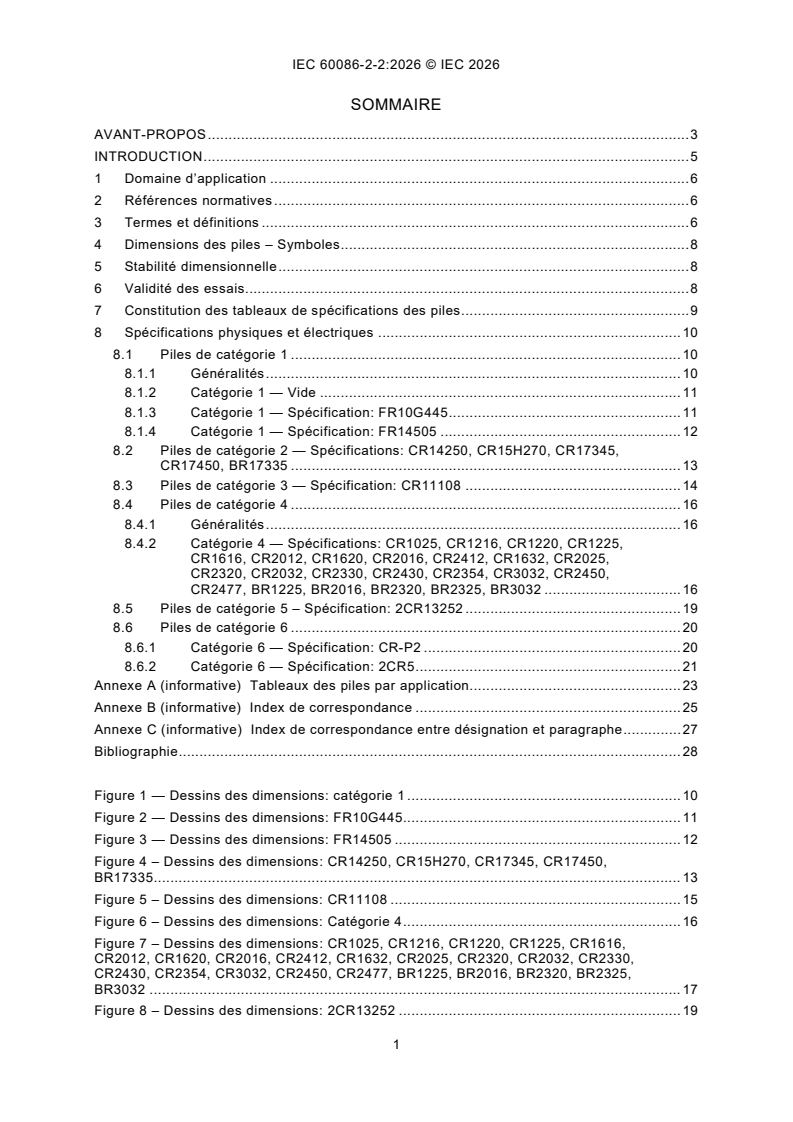
SOMMAIRE
AVANT-PROPOS . 3
INTRODUCTION . 5
1 Domaine d’application . 6
2 Références normatives . 6
3 Termes et définitions . 6
4 Dimensions des piles – Symboles . 8
5 Stabilité dimensionnelle . 8
6 Validité des essais. 8
7 Constitution des tableaux de spécifications des piles . 9
8 Spécifications physiques et électriques . 10
8.1 Piles de catégorie 1 . 10
8.1.1 Généralités . 10
8.1.2 Catégorie 1 — Vide . 11
8.1.3 Catégorie 1 — Spécification: FR10G445 . 11
8.1.4 Catégorie 1 — Spécification: FR14505 . 12
8.2 Piles de catégorie 2 — Spécifications: CR14250, CR15H270, CR17345,
CR17450, BR17335 . 13
8.3 Piles de catégorie 3 — Spécification: CR11108 . 14
8.4 Piles de catégorie 4 . 16
8.4.1 Généralités . 16
8.4.2 Catégorie 4 — Spécifications: CR1025, CR1216, CR1220, CR1225,
CR1616, CR2012, CR1620, CR2016, CR2412, CR1632, CR2025,
CR2320, CR2032, CR2330, CR2430, CR2354, CR3032, CR2450,
CR2477, BR1225, BR2016, BR2320, BR2325, BR3032 . 16
8.5 Piles de catégorie 5 – Spécification: 2CR13252 . 19
8.6 Piles de catégorie 6 . 20
8.6.1 Catégorie 6 — Spécification: CR-P2 . 20
8.6.2 Catégorie 6 — Spécification: 2CR5 . 21
Annexe A (informative) Tableaux des piles par application. 23
Annexe B (informative) Index de correspondance . 25
Annexe C (informative) Index de correspondance entre désignation et paragraphe . 27
Bibliographie . 28
Figure 1 — Dessins des dimensions: catégorie 1 . 10
Figure 2 — Dessins des dimensions: FR10G445. 11
Figure 3 — Dessins des dimensions: FR14505 . 12
Figure 4 – Dessins des dimensions: CR14250, CR15H270, CR17345, CR17450,
BR17335. 13
Figure 5 – Dessins des dimensions: CR11108 . 15
Figure 6 – Dessins des dimensions: Catégorie 4 . 16
Figure 7 – Dessins des dimensions: CR1025, CR1216, CR1220, CR1225, CR1616,
CR2012, CR1620, CR2016, CR2412, CR1632, CR2025, CR2320, CR2032, CR2330,
CR2430, CR2354, CR3032, CR2450, CR2477, BR1225, BR2016, BR2320, BR2325,
BR3032 . 17
Figure 8 – Dessins des dimensions: 2CR13252 . 19
Figure 9 — Dessins des dimensions: CR-P2 . 20
Figure 10 – Dessins des dimensions: 2CR5 . 21
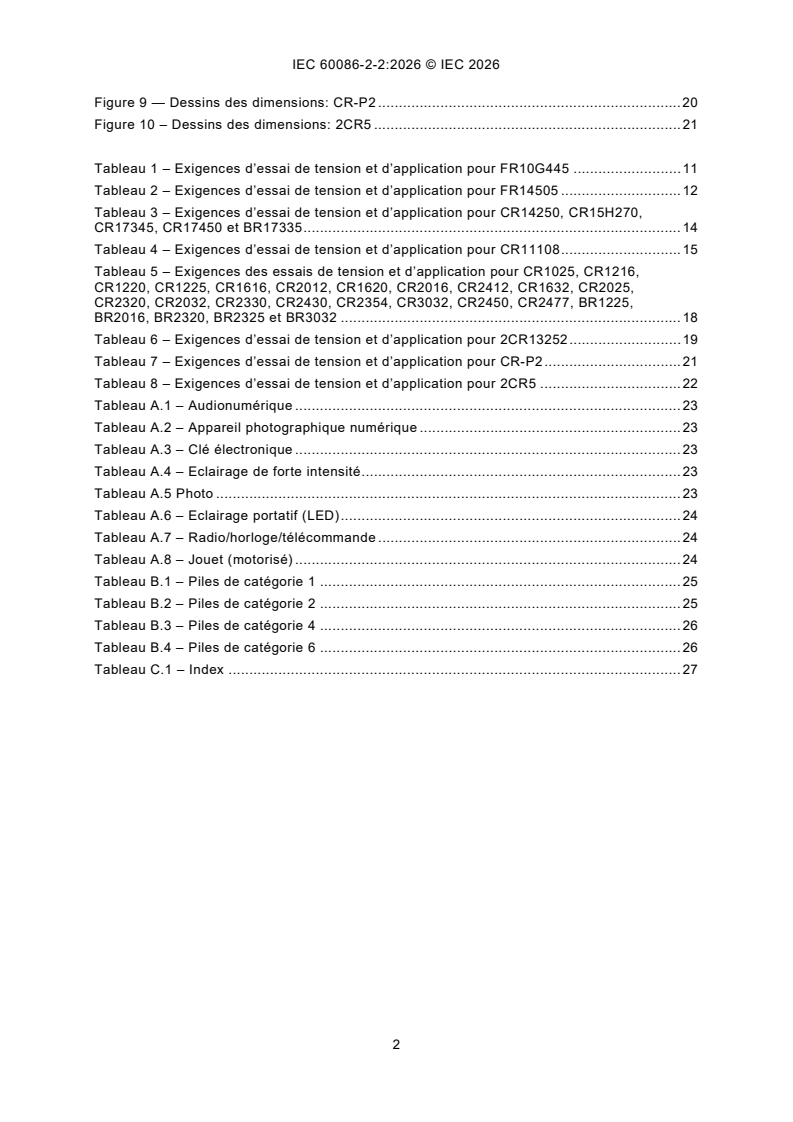
Tableau 1 – Exigences d’essai de tension et d’application pour FR10G445 . 11
Tableau 2 – Exigences d’essai de tension et d’application pour FR14505 . 12
Tableau 3 – Exigences d’essai de tension et d’application pour CR14250, CR15H270,
CR17345, CR17450 et BR17335 . 14
Tableau 4 – Exigences d’essai de tension et d’application pour CR11108 . 15
Tableau 5 – Exigences des essais de tension et d’application pour CR1025, CR1216,
CR1220, CR1225, CR1616, CR2012, CR1620, CR2016, CR2412, CR1632, CR2025,
CR2320, CR2032, CR2330, CR2430, CR2354, CR3032, CR2450, CR2477, BR1225,
BR2016, BR2320, BR2325 et BR3032 . 18
Tableau 6 – Exigences d’essai de tension et d’application pour 2CR13252 . 19
Tableau 7 – Exigences d’essai de tension et d’application pour CR-P2 . 21
Tableau 8 – Exigences d’essai de tension et d’application pour 2CR5 . 22
Tableau A.1 – Audionumérique . 23
Tableau A.2 – Appareil photographique numérique . 23
Tableau A.3 – Clé électronique . 23
Tableau A.4 – Eclairage de forte intensité . 23
Tableau A.5 Photo . 23
Tableau A.6 – Eclairage portatif (LED) . 24
Tableau A.7 – Radio/horloge/télécommande . 24
Tableau A.8 – Jouet (motorisé) . 24
Tableau B.1 – Piles de catégorie 1 . 25
Tableau B.2 – Piles de catégorie 2 . 25
Tableau B.3 – Piles de catégorie 4 . 26
Tableau B.4 – Piles de catégorie 6 . 26
Tableau C.1 – Index . 27
COMMISSION ÉLECTROTECHNIQUE INTERNATIONALE
____________
Piles électriques -
Partie 2-2: Spécifications physiques et électriques des piles au lithium
AVANT-PROPOS
1) La Commission Électrotechnique Internationale (IEC) est une organisation mondiale de normalisation composée
de l’ensemble des comités électrotechniques nationaux (Comités nationaux de l’IEC). L’IEC a pour objet de
favoriser la coopération internationale pour toutes les questions de normalisation dans les domaines de
l’électricité et de l’électronique. À cet effet, l’IEC – entre autres activités – publie des Normes internationales,
des Spécifications techniques, des Rapports techniques, des Spécifications accessibles au public (PAS) et des
Guides (ci-après dénommés "Publication(s) de l’IEC"). Leur élaboration est confiée à des comités d’études,
aux travaux desquels tout Comité national intéressé par le sujet traité peut participer. Les organisations
internationales, gouvernementales et non gouvernementales, en liaison avec l’IEC, participent également aux
travaux. L’IEC collabore étroitement avec l’Organisation Internationale de Normalisation (ISO), selon des
conditions fixées par accord entre les deux organisations.
2) Les décisions ou accords officiels de l’IEC concernant les questions techniques représentent, dans la mesure du
possible, un accord international sur les sujets étudiés, étant donné que les Comités nationaux de l’IEC intéressés
sont représentés dans chaque comité d’études.
3) Les Publications de l’IEC se présentent sous la forme de recommandations internationales et sont agréées
comme telles par les Comités nationaux de l’IEC. Tous les efforts raisonnables sont entrepris afin que l’IEC
s’assure de l’exactitude du contenu technique de ses publications; l’IEC ne peut pas être tenue responsable de
l’éventuelle mauvaise utilisation ou interprétation qui en est faite par un quelconque utilisateur final.
4) Dans le but d’encourager l’uniformité internationale, les Comités nationaux de l’IEC s’engagent, dans toute la
mesure possible, à appliquer de façon transparente les Publications de l’IEC dans leurs publications nationales
et régionales. Toutes divergences entre toutes Publications de l’IEC et toutes publications nationales ou
régionales correspondantes doivent être indiquées en termes clairs dans ces dernières.
5) L’IEC elle-même ne fournit aucune attestation de conformité. Des organismes de certification indépendants
fournissent des services d’évaluation de conformité et, dans certains secteurs, accèdent aux marques de
conformité de l’IEC. L’IEC n’est responsable d’aucun des services effectués par les organismes de certification
indépendants.
6) Tous les utilisateurs doivent s’assurer qu’ils sont en possession de la dernière édition de cette publication.
7) Aucune responsabilité ne doit être imputée à l’IEC, à ses administrateurs, employés, auxiliaires ou mandataires,
y compris ses experts particuliers et les membres de ses comités d’études et des Comités nationaux de l’IEC,
pour tout préjudice causé en cas de dommages corporels et matériels, ou de tout autre dommage de quelque
nature que ce soit, directe ou indirecte, ou pour supporter les coûts (y compris les frais de justice) et les dépenses
découlant de la publication ou de l’utilisation de cette Publication de l’IEC ou de toute autre Publication de l’IEC,
ou au crédit qui lui est accordé.
8) L’attention est attirée sur les références normatives citées dans cette publication. L’utilisation de publications
référencées est obligatoire pour une application correcte de la présente publication.
9) L’IEC attire l’attention sur le fait que la mise en application du présent document peut entraîner l’utilisation d’un
ou de plusieurs brevets. L’IEC ne prend pas position quant à la preuve, à la validité et à l’applicabilité de tout
droit de brevet revendiqué à cet égard. À la date de publication du présent document, l’IEC n’avait pas reçu
notification qu’un ou plusieurs brevets pouvaient être nécessaires à sa mise en application. Toutefois, il y a lieu
d’avertir les responsables de la mise en application du présent document que des informations plus récentes
sont susceptibles de figurer dans la base de données de brevets, disponible à l’adresse https://patents.iec.ch.
L’IEC ne saurait être tenue pour responsable de ne pas avoir identifié de tels droits de brevet.
L’IEC 60086-2-2 a été établie par le comité d’études 35 de l’IEC: Piles. Il s’agit d’une
Norme internationale.
Cette première édition annule et remplace la quatorzième édition de l’IEC 60086-2 parue
en 2021. Cette édition constitue une révision technique.
Cette édition inclut les modifications techniques majeures suivantes par rapport à l’édition
précédente:
a) les spécifications physiques et électriques de l'IEC 60086-2:2021 ont été divisées en deux
nouvelles normes en fonction du type d'électrolyte. L'IEC 60086-2-1 définit les spécifications
des piles électriques normalisées à électrolyte aqueux. L'IEC 60086-2-2 définit les
spécifications des piles électriques normalisées au lithium;
b) modification de 1,83 V à 1,90 V de la tension en circuit ouvert maximale des désignations
FR10G445 et FR14505;
c) modification de 50 mA à 75 mA de la charge de l’essai audio numérique pour la désignation
FR10G445, et modification de la MAD;
d) ajout de l’essai d’éclairage portatif pour la désignation FR10G445;
e) ajout de l’essai jouet (motorisé) et de l’essai radio/horloge/télécommande pour la
désignation FR14505;
f) dans l’Article 3, les termes ont été réorganisés selon leurs fonctions: termes de base,
systèmes électrochimiques, caractéristiques électriques et spécifications;
g) déplacement dans l’IEC 60086-1:2026, en qualité d’Annexe H, de l’Annexe D de
l’IEC 60086-2:2021 donnant les désignations communes;
h) suppression de l’Annexe E Liste de contrôle de conformité de l’IEC 60086-2:2021 et fusion
avec l’Annexe J de l’IEC 60086-1:2026.
Le texte de cette Norme internationale est issu des documents suivants:
Projet Rapport de vote
35/1592/FDIS 35/1598/RVD
Le rapport de vote indiqué dans le tableau ci-dessus donne toute information sur le vote ayant
abouti à son approbation.
La langue employée pour l’élaboration de cette Norme internationale est l’anglais.
Ce document a été rédigé selon les Directives ISO/IEC, Partie 2, il a été développé selon les
Directives ISO/IEC, Partie 1 et les Directives ISO/IEC, Supplément IEC, disponibles sous
www.iec.ch/members_experts/refdocs. Les principaux types de documents développés par
l’IEC sont décrits plus en détail sous www.iec.ch/publications.
Une liste de toutes les parties de la série IEC 60086, publiées sous le titre général
Piles électriques, se trouve sur le site Web de l’IEC.
Le comité a décidé que le contenu de ce document ne sera pas modifié avant la date de stabilité
indiquée sur le site web de l’IEC sous webstore.iec.ch dans les données relatives au document
recherché. À cette date, le document sera
– reconduit,
– supprimé, ou
– révisé.
INTRODUCTION
Le contenu technique de la présente partie de l’IEC 60086 donne les dimensions physiques,
les conditions d’essai de décharge et les exigences de performance en décharge.
L’IEC 60086-2-1 et l’IEC 60086-2-2 complètent les informations générales et les exigences de
l’IEC 60086-1. Les informations de sécurité de l’IEC 60086-2-2 sont disponibles dans
l’IEC 60086-4 et l’IEC 62281.
Le présent document a été établi au bénéfice des utilisateurs de piles, des concepteurs de
dispositifs et des fabricants de piles pour donner les caractéristiques de forme, de montage et
de fonction des différents types de piles et éléments normalisés. Au cours des années,
le présent document a été modifié pour en améliorer le contenu et il peut être de nouveau révisé
en temps utile à la lumière des commentaires des comités nationaux et des experts sur la base
de la pratique et des évolutions technologiques.
1 Domaine d’application
La présente partie de l’IEC 60086 s’applique aux piles électriques qui sont basées sur des
systèmes électrochimiques normalisés au lithium (électrolyte non aqueux).
Elle spécifie:
– les dimensions physiques;
– les conditions d’essai de décharge et les exigences relatives aux performances de
décharge.
2 Références normatives
Les documents suivants sont cités dans le texte de sorte qu’ils constituent, pour tout ou partie
de leur contenu, des exigences du présent document. Pour les références datées,
seule l’édition citée s’applique. Pour les références non datées, la dernière édition du document
de référence s’applique (y compris les éventuels amendements).
IEC 60086-1:2026, Piles électriques - Partie 1: Généralités
ISO 1101, Spécification géométrique des produits (GPS) - Tolérancement géométrique -
Tolérancement de forme, orientation, position et battement
3 Termes et définitions
Pour les besoins du présent document, les termes et les définitions de l’IEC 60086-1:2026
ainsi que les suivants s’appliquent.
L’ISO et l’IEC tiennent à jour des bases de données terminologiques destinées à être utilisées
en normalisation, consultables aux adresses suivantes:
– IEC Electropedia: disponible à l’adresse https://www.electropedia.org/
– ISO Online browsing platform: disponible à l’adresse https://www.iso.org/obp
3.1
pile
pile électrique
élément ou pile qui n’est pas conçu pour être rechargé électriquement
3.2
élément rond
pile ronde
élément ou pile de section circulaire
3.3
élément bouton
pile bouton
petit élément ou petite pile de forme ronde dont la hauteur totale est inférieure au diamètre,
contenant un électrolyte aqueux
Note 1 à l’article: Pour les spécifications, voir l’IEC 60086-2-1.
3.4
élément bouton
pile bouton
élément bouton au lithium
pile bouton au lithium
petit élément ou petite pile de forme ronde dont la hauteur totale est inférieure au diamètre,
contenant un électrolyte non aqueux
Note 1 à l’article: Typiquement, la tension nominale des piles au lithium est supérieure à 2 V.
3.5
tension nominale
U
n
valeur approchée appropriée d’une tension utilisée pour désigner ou identifier un élément,
une pile ou un système électrochimique
[SOURCE: IEC 60050-482:2004, 482-03-31, modifiée – ajout de U ]
n
3.6
tension en circuit ouvert
OCV
tension électrique aux bornes d’un élément ou d’une pile lorsque le courant de décharge est
nul
3.7
tension d’arrêt
EV
tension spécifiée pour laquelle la décharge de la pile est terminée
[SOURCE: IEC 60050-482:2004, 482-03-30]
3.8
durée moyenne minimale
MAD
temps de décharge moyen minimal acceptable obtenu à partir d’un échantillon de piles soumis
à essai selon les méthodes spécifiées, considérées comme conformes
Note 1 à l’article: L’essai de décharge est réalisé conformément aux méthodes ou normes spécifiées et il est conçu
afin de démontrer la conformité à la norme applicable aux types de piles.
3.9
essai d’application
simulation de l’utilisation réelle d’une pile dans une application spécifique
3.10
capacité
durée utile ou capacité ou puissance d’une pile dans des conditions de décharge définies
3.11
essai de capacité
essai conçu pour mesurer la capacité d’une pile
Note 1 à l’article: Un essai de capacité peut être prescrit, par exemple, lorsque:
a) un essai d’application est trop complexe à reproduire;
b) la durée d’un essai d’application le rend infaisable en pratique à des fins d’essais individuels de série.
3.12
borne
parties conductrices d’une pile destinées au raccordement à un circuit externe
[SOURCE: IEC 60050-482:2004, 482-02-22, modifiée – L’expression "partie conductrice d’un
dispositif, d’un circuit électrique ou d’un réseau électrique, destinée à le connecter" a été
remplacée par "parties conductrices d’une pile destinées au raccordement" et l’expression
"un ou plusieurs conducteurs extérieurs" a été remplacée par "un circuit externe".]
4 Dimensions des piles – Symboles
Les symboles utilisés pour définir les différentes dimensions sont les suivants:
hauteur maximale hors tout de la pile;
h
h distance minimale entre les parties planes des contacts positif et négatif;
h dépassement minimal de la partie plane du contact positif;
h retrait maximal de la surface plane négative de contact;
h dépassement minimal de la partie plane du contact négatif;
d diamètres maximal et minimal de la pile;
d diamètre minimal de la partie plane du contact positif;
d diamètre maximal du contact positif à l’intérieur de la hauteur du dépassement spécifiée;
d diamètre minimal de la partie plane du contact négatif;
d diamètre maximal du contact négatif à l’intérieur de la hauteur du dépassement spécifiée;
d diamètre extérieur minimal de la surface plane négative de contact;
d diamètre intérieur maximal de la surface plane négative de contact;
øP concentricité du contact positif.
5 Stabilité dimensionnelle
Voir l’IEC 60086-1 pour la stabilité dimensionnelle.
6 Validité des essais
Les piles électriques portables doivent être soumises aux essais, comme exigé dans la série
IEC 60086. Les essais restent valides jusqu’à ce qu’une modification de la conception ou une
révision des exigences ait été effectuée. De nouveaux essais sont exigés lorsque:
a) une spécification de masse de pile varie de plus de 0,1 g ou de 20 %, la plus grande des
valeurs, pour la cathode, l’anode ou l’électrolyte;
b) la modification d’une spécification d’une pile entraînerait un échec des essais;
c) de nouveaux essais ou de nouvelles exigences sont ajoutés; ou
d) la modification d’une exigence entraînerait un échec des essais.
--------------------
...