

IEC 62561-2:2012
(Main)Lightning protection system components (LPSC) - Part 2: Requirements for conductors and earth electrodes
General Information
- Abstract
IEC 62561-2:2012 specifies the requirements and tests for:
- metallic conductors (other than "natural" conductors) that form part of the air termination system and down conductors;
- metallic earth electrodes that form part of the earth termination system.
- Status
- Published
- Publication Date
- 09-Feb-2012
- Technical Committee
- TC 81 - Lightning protection
- Drafting Committee
- WG 11 - TC 81/WG 11
- Current Stage
- DELPUB - Deleted Publication
- Start Date
- 25-Jan-2018
- Completion Date
- 28-Aug-2026
Buy Documents
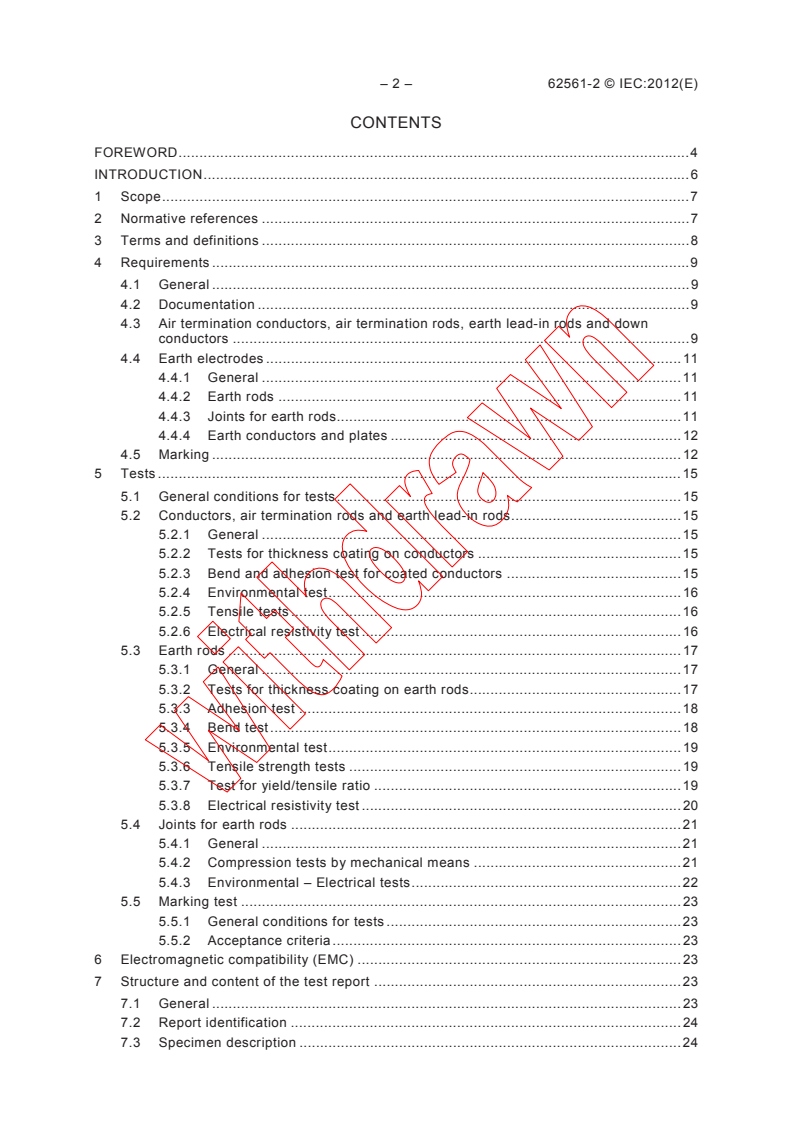
IEC 62561-2:2012 - Lightning protection system components (LPSC) - Part 2: Requirements for conductors and earth electrodes Released:2/10/2012
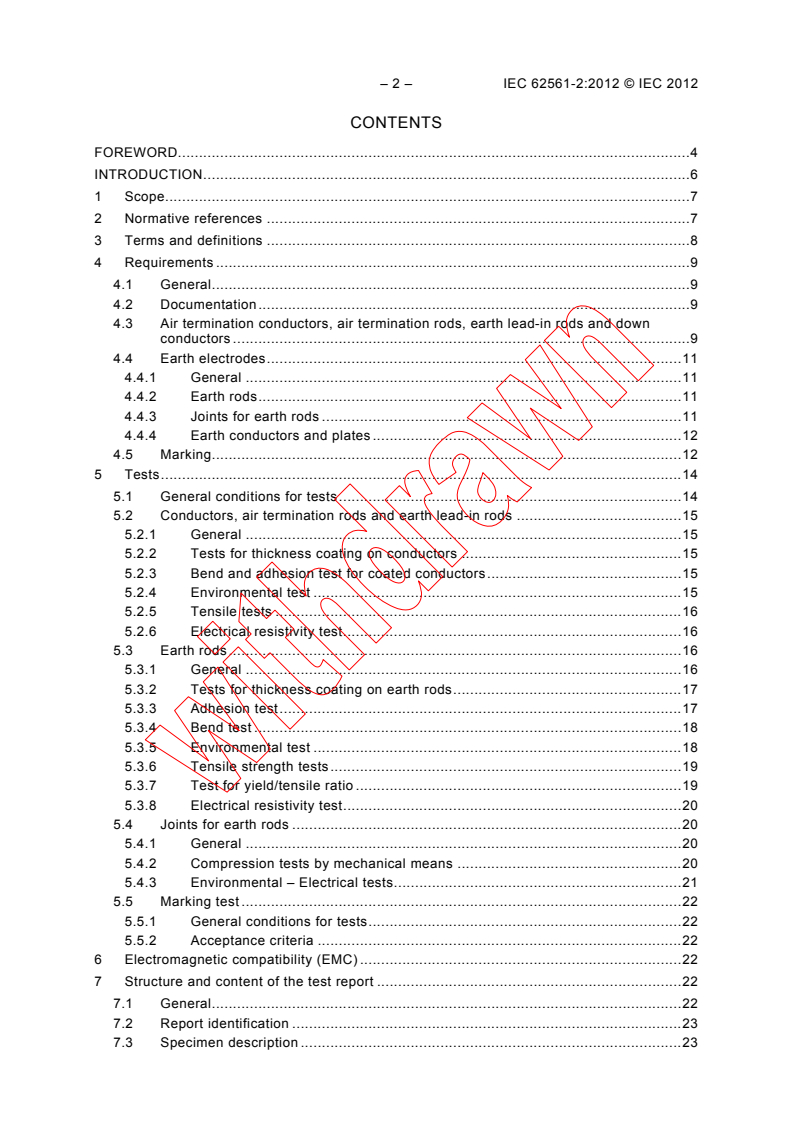
IEC 62561-2:2012 - Lightning protection system components (LPSC) - Part 2: Requirements for conductors and earth electrodes Released:2/10/2012
Overview
IEC 62561-2:2012 - Lightning protection system components (LPSC) Part 2 defines requirements and test methods for metallic conductors and earth electrodes used in lightning protection systems (LPS). The standard covers manufactured conductors (not “natural” conductors) that form the air termination system, down conductors, and the metallic earth electrodes that make up the earth termination system. IEC 62561-2:2012 supports implementation of LPS designed in accordance with the IEC 62305 series.
Key topics and technical requirements
IEC 62561-2 organizes requirements and testing around product performance, traceability and durability. Principal technical topics include:
- Scope and documentation: required product documentation, drawings and material descriptions for conductors and electrodes.
- Materials and geometry: permitted metallic materials, configurations and cross‑sectional area requirements for air termination conductors, rods and earth electrodes.
- Coating and corrosion protection: tests and measurement for protective coatings (thickness and adhesion) for conductors and earth rods.
- Mechanical properties: tensile tests, bend tests and yield/tensile assessments to ensure mechanical robustness.
- Electrical characteristics: resistivity measurements and related tests to confirm suitability for conductive lightning discharge paths.
- Environmental testing: salt‑mist and other environmental endurance tests to validate long‑term performance in corrosive conditions.
- Joints and connections: mechanical compression and environmental/electrical tests for joints used with earth rods.
- Marking, EMC and reporting: marking requirements, electromagnetic compatibility considerations and structure/content required in test reports.
- Normative and informative annexes: test flow charts, calculation examples and tabulated requirements for quick reference.
Note: IEC 62561-2 lists referenced test standards (e.g., IEC 60068 series, ISO and IEC tensile and coating tests) that are indispensable for correct application.
Practical applications and users
IEC 62561-2:2012 is essential for:
- LPS designers and consultants specifying conductors and earth termination systems.
- Manufacturers of lightning conductors, rods, earth electrodes and related components to establish compliant product design and QC programs.
- Installers and contractors verifying materials and joints on site meet standardized requirements.
- Test laboratories and certification bodies executing the specified mechanical, electrical and environmental tests and producing formal test reports.
- Asset owners and facility managers seeking assurance that installed lightning protection components will perform reliably under environmental and lightning stress.
Related standards
- IEC 62305 series (Protection against lightning)
- IEC 62561-1 (Requirements for connection components)
- IEC 60068 environmental test standards and relevant ISO standards referenced within IEC 62561-2
Keywords: IEC 62561-2:2012, lightning protection, LPS, conductors, earth electrodes, air termination, down conductor, earth termination, lightning protection components.
Relations
- Effective Date
- 05-Sep-2023
Buy Documents
IEC 62561-2:2012 - Lightning protection system components (LPSC) - Part 2: Requirements for conductors and earth electrodes Released:2/10/2012
IEC 62561-2:2012 - Lightning protection system components (LPSC) - Part 2: Requirements for conductors and earth electrodes Released:2/10/2012
Get Certified
Connect with accredited certification bodies for this standard

DIBt (Deutsches Institut für Bautechnik)
German Institute for Building Technology.
DIN CERTCO
DIN Group product certification.

IMQ S.p.A. (Certification)
Italian electrical product certification.
Sponsored listings
Frequently Asked Questions
IEC 62561-2:2012 is a standard published by the International Electrotechnical Commission (IEC). Its full title is "Lightning protection system components (LPSC) - Part 2: Requirements for conductors and earth electrodes". This standard covers: IEC 62561-2:2012 specifies the requirements and tests for: - metallic conductors (other than "natural" conductors) that form part of the air termination system and down conductors; - metallic earth electrodes that form part of the earth termination system.
IEC 62561-2:2012 specifies the requirements and tests for: - metallic conductors (other than "natural" conductors) that form part of the air termination system and down conductors; - metallic earth electrodes that form part of the earth termination system.
IEC 62561-2:2012 is classified under the following ICS (International Classification for Standards) categories: 29.020 - Electrical engineering in general; 91.120.40 - Lightning protection. The ICS classification helps identify the subject area and facilitates finding related standards.
IEC 62561-2:2012 has the following relationships with other standards: It is inter standard links to IEC 62561-2:2018. Understanding these relationships helps ensure you are using the most current and applicable version of the standard.
IEC 62561-2:2012 is available in PDF format for immediate download after purchase. The document can be added to your cart and obtained through the secure checkout process. Digital delivery ensures instant access to the complete standard document.
Standards Content (Sample)
IEC 62561-2 ®
Edition 1.0 2012-02
INTERNATIONAL
STANDARD
Lightning protection system components (LPSC) –
Part 2: Requirements for conductors and earth electrodes
All rights reserved. Unless otherwise specified, no part of this publication may be reproduced or utilized in any form
or by any means, electronic or mechanical, including photocopying and microfilm, without permission in writing from
either IEC or IEC's member National Committee in the country of the requester.
If you have any questions about IEC copyright or have an enquiry about obtaining additional rights to this publication,
please contact the address below or your local IEC member National Committee for further information.
IEC Central Office Tel.: +41 22 919 02 11
3, rue de Varembé Fax: +41 22 919 03 00
CH-1211 Geneva 20 info@iec.ch
Switzerland www.iec.ch
About the IEC
The International Electrotechnical Commission (IEC) is the leading global organization that prepares and publishes
International Standards for all electrical, electronic and related technologies.
About IEC publications
The technical content of IEC publications is kept under constant review by the IEC. Please make sure that you have the
latest edition, a corrigenda or an amendment might have been published.
Useful links:
IEC publications search - www.iec.ch/searchpub Electropedia - www.electropedia.org
The advanced search enables you to find IEC publications The world's leading online dictionary of electronic and
by a variety of criteria (reference number, text, technical electrical terms containing more than 30 000 terms and
committee,…). definitions in English and French, with equivalent terms in
It also gives information on projects, replaced and additional languages. Also known as the International
withdrawn publications. Electrotechnical Vocabulary (IEV) on-line.
IEC Just Published - webstore.iec.ch/justpublished Customer Service Centre - webstore.iec.ch/csc
Stay up to date on all new IEC publications. Just Published If you wish to give us your feedback on this publication
details all new publications released. Available on-line and or need further assistance, please contact the
also once a month by email. Customer Service Centre: csc@iec.ch.
IEC 62561-2 ®
Edition 1.0 2012-02
INTERNATIONAL
STANDARD
Lightning protection system components (LPSC) –
Part 2: Requirements for conductors and earth electrodes
INTERNATIONAL
ELECTROTECHNICAL
COMMISSION
PRICE CODE
V
ICS 29.020; 91.120.40 ISBN 978-2-88912-924-9
– 2 – 62561-2 © IEC:2012(E)
CONTENTS
FO R EW O RD . 4
INT R O D UCT IO N . 6
1 Sc op e . 7
2 Normative references . 7
3 Terms and definitions . 8
4 Requirements . 9
4.1 General . 9
4.2 Documentation . 9
4.3 Air termination conductors, air termination rods, earth lead-in rods and down
conductors . 9
4.4 Earth electrodes . 11
4.4.1 General . 11
4.4.2 Earth rods . 11
4.4.3 Joints for earth rods. 11
4.4.4 Earth conductors and plates . 12
4.5 Marking . 12
5 Tests . 15
5.1 General conditions for tests . 15
5.2 Conductors, air termination rods and earth lead-in rods . 15
5.2.1 General . 15
5.2.2 Tests for thickness coating on conductors . 15
5.2.3 Bend and adhesion test for coated conductors . 15
5.2.4 Environmental test . 16
5.2.5 Tensile tests . 16
5.2.6 Electrical resistivity test . 16
5.3 Earth rods . 17
5.3.1 General . 17
5.3.2 Tests for thickness coating on earth rods . 17
5.3.3 Adhesion test . 18
5.3.4 Bend test . 18
5.3.5 Environmental test . 19
5.3.6 Tensile strength tests . 19
5.3.7 Test for yield/tensile ratio . 19
5.3.8 Electrical resistivity test . 20
5.4 Joints for earth rods . 21
5.4.1 General . 21
5.4.2 Compression tests by mechanical means . 21
5.4.3 Environmental – Electrical tests . 22
5.5 Marking test . 23
5.5.1 General conditions for tests . 23
5.5.2 Acceptance criteria . 23
6 Electromagnetic compatibility (EMC) . 23
7 Structure and content of the test report . 23
7.1 General . 23
7.2 Report identification . 24
7.3 Specimen description . 24
62561-2 © IEC:2012(E) – 3 –
7.4 Conductor . 24
7.5 Standards and references . 24
7.6 Test procedure . 24
7.7 Testing equipment, description . 24
7.8 Measuring instruments description . 24
7.9 Results and parameters recorded . 25
7.10 Statement of pass/fail . 25
Annex A (normative) Environmental test for conductors, air termination rods and earth
lead-in rods. 26
Annex B (normative) Requirements for the cross sectional area, mechanical and
electrical characteristics, tests to be applied . 27
Annex C (normative) Requirements for dimensions, mechanical and electrical
characteristics, tests to be applied . 28
Annex D (informative) Typical example calculation of conductor resistivity . 29
Annex E (informative) Typical example of calculation of the tensile strength of a
coated material . 30
Annex F (normative) Flow chart of tests for air termination conductors, air termination
rods, earth lead-in rods and down conductors . 31
Annex G (normative) Flow chart of tests for earth rods . 32
Annex H (normative) Flow chart of tests of joints for earth rods . 33
Bibliography . 34
Figure 1 – Coating measurements around the circumference of the rod . 17
Figure 2 – Typical test arrangement for adhesion test . 18
Figure 3 – Definitions of upper yield strength R (Mpa) and tensile strength R (Mpa) . 20
eH m
Figure 4 – Typical test arrangement for the compression test by mechanical means . 22
Table 1 – Material, configuration and cross sectional area of air termination
conductors, air termination rods, earth lead-in rods and down conductors . 10
Table 2 – Mechanical and electrical characteristics of air termination conductors, air
termination rods, earth lead-in rods and down conductors . 11
Table 3 – Material, configuration and cross sectional area of earth electrodes . 13
Table 4 – Mechanical and electrical characteristics of earth electrodes . 14
Table B.1 – Summary of requirements for various elements tested according to Table 1
and Table 2 . 27
Table C.1 – Summary of requirements for various elements tested according to Table 3
and Table 4 . 28
– 4 – 62561-2 © IEC:2012(E)
INTERNATIONAL ELECTROTECHNICAL COMMISSION
____________
LIGHTNING PROTECTION SYSTEM COMPONENTS (LPSC) –
Part 2: Requirements for conductors and earth electrodes
FOREWORD
1) The International Electrotechnical Commission (IEC) is a worldwide organization for standardization comprising
all national electrotechnical committees (IEC National Committees). The object of IEC is to promote
international co-operation on all questions concerning standardization in the electrical and electronic fields. To
this end and in addition to other activities, IEC publishes International Standards, Technical Specifications,
Technical Reports, Publicly Available Specifications (PAS) and Guides (hereafter referred to as “IEC
Publication(s)”). Their preparation is entrusted to technical committees; any IEC National Committee interested
in the subject dealt with may participate in this preparatory work. International, governmental and non-
governmental organizations liaising with the IEC also participate in this preparation. IEC collaborates closely
with the International Organization for Standardization (ISO) in accordance with conditions determined by
agreement between the two organizations.
2) The formal decisions or agreements of IEC on technical matters express, as nearly as possible, an international
consensus of opinion on the relevant subjects since each technical committee has representation from all
interested IEC National Committees.
3) IEC Publications have the form of recommendations for international use and are accepted by IEC National
Committees in that sense. While all reasonable efforts are made to ensure that the technical content of IEC
Publications is accurate, IEC cannot be held responsible for the way in which they are used or for any
misinterpretation by any end user.
4) In order to promote international uniformity, IEC National Committees undertake to apply IEC Publications
transparently to the maximum extent possible in their national and regional publications. Any divergence
between any IEC Publication and the corresponding national or regional publication shall be clearly indicated in
the latter.
5) IEC itself does not provide any attestation of conformity. Independent certification bodies provide conformity
assessment services and, in some areas, access to IEC marks of conformity. IEC is not responsible for any
services carried out by independent certification bodies.
6) All users should ensure that they have the latest edition of this publication.
7) No liability shall attach to IEC or its directors, employees, servants or agents including individual experts and
members of its technical committees and IEC National Committees for any personal injury, property damage or
other damage of any nature whatsoever, whether direct or indirect, or for costs (including legal fees) and
expenses arising out of the publication, use of, or reliance upon, this IEC Publication or any other IEC
Publications.
8) Attention is drawn to the Normative references cited in this publication. Use of the referenced publications is
indispensable for the correct application of this publication.
9) Attention is drawn to the possibility that some of the elements of this IEC Publication may be the subject of
patent rights. IEC shall not be held responsible for identifying any or all such patent rights.
International Standard IEC 62561-2 has been prepared by IEC technical committee 81:
Lightning protection.
The text of this standard is based on the following documents:
FDIS Report on voting
81/417/FDIS 81/423/RVD
Full information on the voting for the approval of this standard can be found in the report on
voting indicated in the above table.
This publication has been drafted in accordance with the ISO/IEC Directives, Part 2.
The content of this document is taken from the European Standard EN 50164-2.
62561-2 © IEC:2012(E) – 5 –
A list of all the parts in the IEC 62561 series, published under the general title Lightning
protection system components (LPSC), can be found on the IEC website.
The committee has decided that the contents of this publication will remain unchanged until
the stability date indicated on the IEC web site under "http://webstore.iec.ch" in the data
related to the specific publication. At this date, the publication will be
‡ reconfirmed,
‡ withdrawn,
‡ replaced by a revised edition, or
‡ amended.
A bilingual version of this publication may be issued at a later date.
– 6 – 62561-2 © IEC:2012(E)
INTRODUCTION
This part of IEC 62561 deals with the requirements and tests for lightning protection system
components (LPSC) used for the installation of a lightning protection system (LPS) designed
and implemented according to the IEC 62305 series of standards.
62561-2 © IEC:2012(E) – 7 –
LIGHTNING PROTECTION SYSTEM COMPONENTS (LPSC) –
Part 2: Requirements for conductors and earth electrodes
1 Scope
This part of IEC 62561 specifies the requirements and tests for:
– metallic conductors (other than “natural” conductors) that form part of the air termination
system and down conductors;
– metallic earth electrodes that form part of the earth termination system.
2 Normative references
The following documents, in whole or in part, are normatively referenced in this document and
are indispensable for its application. For dated references, only the edition cited applies. For
undated references, the latest edition of the referenced document (including any
amendments) applies.
IEC 60068-2-52:1996, Environmental testing – Part 2-52: Tests – Test Kb: Salt mist, cyclic
(sodium chloride solution)
IEC 60228, Conductors of insulated cables
IEC 62305-3, Protection against lightning – Part 3: Physical damage to structures and life
hazard
IEC 62305-4, Protection against lightning – Part 4: Electrical and electronic systems within
structures
IEC 62561-1, Lightning protection system components (LPSC) – Part 1: Requirements for
connection components
ISO 1460, Metallic coatings – Hot dip galvanized coatings on ferrous materials – Gravimetric
determination of the mass per unit area
ISO 1461, Hot dip galvanized coatings on fabricated iron and steel articles – Specifications
and test methods
ISO 2178, Non-magnetic coatings on magnetic substrates – Measurement of coating
thickness – Magnetic method
ISO 6892-1:2009, Metallic materials – Tensile testing – Part 1: Method of test at room
temperature
ISO 6957:1988, Copper alloys – Ammonia test for stress corrosion resistance
ISO 6988:1985, Metallic and other non-organic coatings – Sulphur dioxide test with general
condensation of moisture
– 8 – 62561-2 © IEC:2012(E)
3 Terms and definitions
For the purpose of this document, the following terms and definitions apply.
3.1
air termination system
part of an external LPS using metallic elements such as rods, mesh conductors or catenary
wires intended to intercept lightning flashes
3.2
air termination rod
air termination conductor
part of the air termination system for intercepting and conducting direct lightning flashes to
the structure
3.3
down conductor
part of an external lightning protection system which is intended to conduct lightning current
from the air termination system to the earth termination system
3.4
earth termination system
part of an external lightning protection system which is intended to conduct and disperse
lightning current to the earth
3.5
earth electrode
part or group of parts of the earth termination system which provides direct electrical contact
with and disperses the lightning current to the earth
Note 1 to entry Typical examples are earth rod, earth conductor and earth plate.
3.6
earth rod
an earth electrode consisting of a metal rod driven into the ground
[IEC 60050-604:1987, 604-04-09]
3.7
earth conductor
earth electrode consisting of a conductor buried in the ground
3.8
earth plate
an earth electrode consisting of a metal plate buried in the ground
[IEC 60050-604:1987, 604-04-10]
3.9
joint for earth rod
part of the earth termination system that facilitates the coupling of one section of an earth rod
to another for the purpose of deep driving
3.10
driving head
tool used in those applications where it is necessary to drive the earth rod
62561-2 © IEC:2012(E) – 9 –
3.11
earth lead-in rod
rod installed between the down conductor/test joint and the earth electrode
Note 1 to entry Earth lead-in rods are used to improve mechanical stability.
4 Requirements
4.1 General
Conductors and earth electrodes shall be so designed and constructed that in normal use
their performance is reliable and without danger to persons and surrounding equipment.
The choice of a material depends on its ability to match the particular application
requirements.
A summary of the requirements and their corresponding tests are given in Annex F, Annex G
and Annex H.
4.2 Documentation
The manufacturer or supplier of the conductors and earth electrodes shall provide adequate
information in their literature to ensure that the installer of the conductors and earth
electrodes can select and install the materials in a suitable and safe manner, in accordance
with IEC 62305-3 and IEC 62305-4.
Compliance is checked by inspection.
4.3 Air termination conductors, air termination rods, earth lead-in rods and down
conductors
The material, configuration and cross sectional area of the conductors and rods shall be in
accordance with Table 1. Their mechanical and electrical characteristics shall be in
accordance with Table 2.
Other materials may be used if they possess equivalent mechanical and electrical
characteristics and corrosion resistance properties for the intended application.
Other configurations may be used if the relevant dimensions are met.
Coated conductors and rods shall be corrosion resistant and the coating shall exhibit good
adherence to the base material.
Compliance is checked by the tests described in 5.2.2, 5.2.3 and 5.2.4.
NOTE A summary of the requirements for the cross sectional area, mechanical and electrical characteristics as
well as tests is given in Annex B.
– 10 – 62561-2 © IEC:2012(E)
Table 1 – Material, configuration and cross sectional area of air termination conductors,
air termination rods, earth lead-in rods and down conductors
a
Cross sectional area
Material Configuration Recommended dimensions
mm
Copper, Solid tape 2 mm thickness
≥ 50
b
d
Tin plated copper
Solid round 8 mm diameter
≥ 50
d, g
f
Stranded 1,7 mm diameter of each strand
≥ 50
Solid round 15 mm diameter
≥ 176
Aluminium Solid tape 3 mm thickness
≥ 70
Solid round ≥ 50 8 mm diameter
g
Stranded ≥ 50 1,63 mm diameter of each strand
Copper coated
Solid round ≥ 50 8 mm diameter
e
aluminium alloy
Aluminium alloy Solid tape ≥ 50 2,5 mm thickness
Solid round ≥ 50 8 mm diameter
g
Stranded ≥ 50 1,7 mm diameter of each strand
Solid round 15 mm diameter
≥ 176
Hot dipped galvanized Solid tape 2,5 mm thickness
≥ 50
steel
Solid round 8 mm diameter
≥ 50
g
Stranded 1,7 mm diameter of each strand
≥ 50
Solid round 15 mm diameter
≥ 176
e
Copper coated steel Solid round 8 mm diameter
≥ 50
Solid tape 2,5 mm thickness
≥ 50
c
Stainless steel Solid tape ≥ 50 2 mm thickness
Solid round ≥ 50 8 mm diameter
g
Stranded ≥ 70 1,7 mm diameter of each strand
Solid round ≥ 176 15 mm diameter
NOTE For the application of the conductors, see IEC 62305-3.
a
Manufacturing tolerance: –3 %.
b
Hot dipped or electroplated; minimum thickness coating of 1 μm. Tin plating is for aesthetic reasons only.
c
Chromium ≥ 16 %; nickel ≥ 8 %; carbon ≤ 0,08 %.
d
2 2
50 mm (8 mm diameter) may be reduced to 25 mm (6 mm diameter) in certain applications where mechanical
strength is not an essential requirement.
e
Minimum 70 μm radial copper coating of 99,9 % copper content.
f
In some countries 1,14 mm diameter of each strand may be used.
g
The cross sectional area of stranded conductors is determined by the resistance of the conductor according to
IEC 60228.
62561-2 © IEC:2012(E) – 11 –
Table 2 – Mechanical and electrical characteristics of air termination conductors, air
termination rods, earth lead-in rods and down conductors
Maximum electrical
Tensile strength
resistivity
Material
N/mm
μΩm
Copper 0,019 200 to 450
Aluminium 0,03 ≤ 150
Aluminium alloy 0,036 120 to 280
Steel 0,15 290 to 510
Stainless steel 0,80 400 to 770
4.4 Earth electrodes
4.4.1 General
The cross sectional area of earth electrodes, its material and its configuration shall be in
accordance with Table 3. Its mechanical and electrical characteristics shall be in accordance
with Table 4.
Other materials may be used if they possess equivalent mechanical and electrical
characteristics and corrosion resistance properties for the intended application.
Other configurations may be used if the relevant dimensions are met.
NOTE A summary of the requirements for dimensions, mechanical and electrical characteristics as well as tests is
given in Annex C.
4.4.2 Earth rods
Earth rods shall be mechanically robust to ensure correct installation. The choice of material
shall be sufficiently malleable to ensure no cracking of the rod takes place during installation.
The threads on the rods, if any, shall be smooth and fully formed. For coated rods, the coating
shall extend over the threads. A lead-in chamfer or point is recommended to facilitate driving.
For electroplated rods such as copper coated rods, it is desirable to thread roll the thread
profile to ensure no copper is removed from the steel.
Compliance is checked by inspection and by the test according to 5.3.
4.4.3 Joints for earth rods
Earth rods can be extended to drive deeper into the ground. This can be achieved by means
of a joint/coupling device.
The choice of material shall be compatible with that of the earth rod being joined.
It shall be mechanically robust, sufficient to withstand the driving forces generated during
installation.
It shall also exhibit good corrosion resistance.
– 12 – 62561-2 © IEC:2012(E)
Threaded external joints/couplers shall be of a sufficient length to ensure no threads on the
earth rod are exposed when installed.
Threaded internal joints/couplers shall ensure that the mating faces of the earth rods come in
contact after assembly.
Compliance is checked by the test of 5.4.2 and 5.4.3.
4.4.4 Earth conductors and plates
Earth electrode conductors and plates shall be corrosion resistant and any coating shall
exhibit good adherence to the base material.
Compliance is checked by the test of 5.2.2, 5.2.3 and 5.2.4.
4.5 Marking
All products complying with this standard shall be marked at least with the following:
a) manufacturer's or responsible vendor's name or trade mark;
b) identifying symbol.
Where this proves to be impractical, the marking in accordance with the identifying symbol
may be given on the smallest packing unit.
NOTE Marking can be applied for example by moulding, pressing, engraving, printing adhesive labels or water
slide transfers.
Compliance is checked in accordance with 5.5.
62561-2 © IEC:2012(E) – 13 –
Table 3 – Material, configuration and cross sectional area of earth electrodes
a
Cross sectional area
Material Configuration Recommended dimensions
Earth Earth Earth
rod conductor plate
2 2 2
mm mm cm
i
Stranded ≥ 50 1,7 mm diameter of each strand
Solid round ≥ 50 8 mm diameter
Solid tape ≥ 50 2 mm thick
Copper,
Solid round ≥ 176 15 mm diameter
tin plated
Pipe ≥ 110 20 mm diameter with 2 mm wall thickness
f
copper
g
Solid plate ≥ 2 500 500 mm × 500 mm with 1,5 mm thickness
600 mm × 600 mm consisted of
g
Lattice plate ≥ 3 600 25 mm × 2 mm section for tape or 8 mm
diameter for round conductor
Solid round ≥ 78 10 mm diameter
b
Solid round ≥ 150 14 mm diameter
b
Pipe ≥ 140 25 mm diameter with 2 mm wall thickness
Hot dipped Solid tape ≥ 90 3 mm thick
galvanized
Solid plate ≥ 2 500 500 mm × 500 mm with 3 mm thickness
steel
600 mm × 600 mm consisted of
d
Lattice plate ≥ 3 600 30 mm × 3 mm section for tape or 10 mm
diameter for round conductor
e
Profile 3 mm thick
Stranded ≥ 70 1,7 mm diameter of each strand
Bare steel Solid round ≥ 78 10 mm diameter
Solid tape ≥ 75 3 mm thick
14 mm diameter, if 250 μm minimum radial
h
Solid round ≥ 150
copper coating, with 99,9 % copper content
8 mm diameter, if 250 μm minimum radial
Solid rou
...
IEC 62561-2 ®
Edition 1.0 2012-02
INTERNATIONAL
STANDARD
NORME
INTERNATIONALE
Lightning protection system components (LPSC) –
Part 2: Requirements for conductors and earth electrodes
Composants des systèmes de protection contre la foudre (CSPF) –
Partie 2: Exigences pour les conducteurs et les électrodes de terre
All rights reserved. Unless otherwise specified, no part of this publication may be reproduced or utilized in any form
or by any means, electronic or mechanical, including photocopying and microfilm, without permission in writing from
either IEC or IEC's member National Committee in the country of the requester. If you have any questions about IEC
copyright or have an enquiry about obtaining additional rights to this publication, please contact the address below or
your local IEC member National Committee for further information.
Droits de reproduction réservés. Sauf indication contraire, aucune partie de cette publication ne peut être reproduite
ni utilisée sous quelque forme que ce soit et par aucun procédé, électronique ou mécanique, y compris la photocopie
et les microfilms, sans l'accord écrit de l'IEC ou du Comité national de l'IEC du pays du demandeur. Si vous avez des
questions sur le copyright de l'IEC ou si vous désirez obtenir des droits supplémentaires sur cette publication, utilisez
les coordonnées ci-après ou contactez le Comité national de l'IEC de votre pays de résidence.
IEC Central Office Tel.: +41 22 919 02 11
3, rue de Varembé Fax: +41 22 919 03 00
CH-1211 Geneva 20 info@iec.ch
Switzerland www.iec.ch
About the IEC
The International Electrotechnical Commission (IEC) is the leading global organization that prepares and publishes
International Standards for all electrical, electronic and related technologies.
About IEC publications
The technical content of IEC publications is kept under constant review by the IEC. Please make sure that you have the
latest edition, a corrigenda or an amendment might have been published.
IEC Catalogue - webstore.iec.ch/catalogue Electropedia - www.electropedia.org
The stand-alone application for consulting the entire The world's leading online dictionary of electronic and
bibliographical information on IEC International Standards, electrical terms containing more than 30 000 terms and
Technical Specifications, Technical Reports and other definitions in English and French, with equivalent terms in 15
documents. Available for PC, Mac OS, Android Tablets and additional languages. Also known as the International
iPad. Electrotechnical Vocabulary (IEV) online.
IEC publications search - www.iec.ch/searchpub IEC Glossary - std.iec.ch/glossary
The advanced search enables to find IEC publications by a More than 60 000 electrotechnical terminology entries in
variety of criteria (reference number, text, technical English and French extracted from the Terms and Definitions
committee,…). It also gives information on projects, replaced clause of IEC publications issued since 2002. Some entries
and withdrawn publications. have been collected from earlier publications of IEC TC 37,
77, 86 and CISPR.
IEC Just Published - webstore.iec.ch/justpublished
Stay up to date on all new IEC publications. Just Published IEC Customer Service Centre - webstore.iec.ch/csc
details all new publications released. Available online and If you wish to give us your feedback on this publication or
also once a month by email. need further assistance, please contact the Customer Service
Centre: csc@iec.ch.
A propos de l'IEC
La Commission Electrotechnique Internationale (IEC) est la première organisation mondiale qui élabore et publie des
Normes internationales pour tout ce qui a trait à l'électricité, à l'électronique et aux technologies apparentées.
A propos des publications IEC
Le contenu technique des publications IEC est constamment revu. Veuillez vous assurer que vous possédez l’édition la
plus récente, un corrigendum ou amendement peut avoir été publié.
Catalogue IEC - webstore.iec.ch/catalogue Electropedia - www.electropedia.org
Application autonome pour consulter tous les renseignements
Le premier dictionnaire en ligne de termes électroniques et
bibliographiques sur les Normes internationales,
électriques. Il contient plus de 30 000 termes et définitions en
Spécifications techniques, Rapports techniques et autres
anglais et en français, ainsi que les termes équivalents dans
documents de l'IEC. Disponible pour PC, Mac OS, tablettes
15 langues additionnelles. Egalement appelé Vocabulaire
Android et iPad.
Electrotechnique International (IEV) en ligne.
Recherche de publications IEC - www.iec.ch/searchpub
Glossaire IEC - std.iec.ch/glossary
La recherche avancée permet de trouver des publications IEC Plus de 60 000 entrées terminologiques électrotechniques, en
en utilisant différents critères (numéro de référence, texte, anglais et en français, extraites des articles Termes et
comité d’études,…). Elle donne aussi des informations sur les Définitions des publications IEC parues depuis 2002. Plus
projets et les publications remplacées ou retirées. certaines entrées antérieures extraites des publications des
CE 37, 77, 86 et CISPR de l'IEC.
IEC Just Published - webstore.iec.ch/justpublished
Service Clients - webstore.iec.ch/csc
Restez informé sur les nouvelles publications IEC. Just
Published détaille les nouvelles publications parues. Si vous désirez nous donner des commentaires sur cette
Disponible en ligne et aussi une fois par mois par email. publication ou si vous avez des questions contactez-nous:
csc@iec.ch.
IEC 62561-2 ®
Edition 1.0 2012-02
INTERNATIONAL
STANDARD
NORME
INTERNATIONALE
Lightning protection system components (LPSC) –
Part 2: Requirements for conductors and earth electrodes
Composants des systèmes de protection contre la foudre (CSPF) –
Partie 2: Exigences pour les conducteurs et les électrodes de terre
INTERNATIONAL
ELECTROTECHNICAL
COMMISSION
COMMISSION
ELECTROTECHNIQUE
INTERNATIONALE
ICS 29.020; 91.120.40 ISBN 978-2-8322-2982-8
– 2 – IEC 62561-2:2012 © IEC 2012
CONTENTS
FOREWORD. 4
INTRODUCTION . 6
1 Scope . 7
2 Normative references . 7
3 Terms and definitions . 8
4 Requirements . 9
4.1 General . 9
4.2 Documentation . 9
4.3 Air termination conductors, air termination rods, earth lead-in rods and down
conductors . 9
4.4 Earth electrodes . 11
4.4.1 General . 11
4.4.2 Earth rods . 11
4.4.3 Joints for earth rods . 11
4.4.4 Earth conductors and plates . 12
4.5 Marking . 12
5 Tests . 14
5.1 General conditions for tests . 14
5.2 Conductors, air termination rods and earth lead-in rods . 15
5.2.1 General . 15
5.2.2 Tests for thickness coating on conductors . 15
5.2.3 Bend and adhesion test for coated conductors . 15
5.2.4 Environmental test . 15
5.2.5 Tensile tests . 16
5.2.6 Electrical resistivity test . 16
5.3 Earth rods . 16
5.3.1 General . 16
5.3.2 Tests for thickness coating on earth rods . 17
5.3.3 Adhesion test . 17
5.3.4 Bend test . 18
5.3.5 Environmental test . 18
5.3.6 Tensile strength tests . 19
5.3.7 Test for yield/tensile ratio . 19
5.3.8 Electrical resistivity test . 20
5.4 Joints for earth rods . 20
5.4.1 General . 20
5.4.2 Compression tests by mechanical means . 20
5.4.3 Environmental – Electrical tests . 21
5.5 Marking test . 22
5.5.1 General conditions for tests . 22
5.5.2 Acceptance criteria . 22
6 Electromagnetic compatibility (EMC) . 22
7 Structure and content of the test report . 22
7.1 General . 22
7.2 Report identification . 23
7.3 Specimen description . 23
7.4 Conductor . 23
7.5 Standards and references . 23
7.6 Test procedure . 23
7.7 Testing equipment, description . 23
7.8 Measuring instruments description . 23
7.9 Results and parameters recorded . 24
7.10 Statement of pass/fail . 24
Annex A (normative) Environmental test for conductors, air termination rods and earth
lead-in rods . 25
Annex B (normative) Requirements for the cross sectional area, mechanical and
electrical characteristics, tests to be applied . 26
Annex C (normative) Requirements for dimensions, mechanical and electrical
characteristics, tests to be applied . 27
Annex D (informative) Typical example calculation of conductor resistivity . 28
Annex E (informative) Typical example of calculation of the tensile strength of a
coated material . 29
Annex F (normative) Flow chart of tests for air termination conductors, air termination
rods, earth lead-in rods and down conductors . 30
Annex G (normative) Flow chart of tests for earth rods . 31
Annex H (normative) Flow chart of tests of joints for earth rods . 32
Bibliography . 33
Figure 1 – Coating measurements around the circumference of the rod . 17
Figure 2 – Typical test arrangement for adhesion test . 18
Figure 3 – Definitions of upper yield strength R (Mpa) and tensile strength R (Mpa) . 19
eH m
Figure 4 – Typical test arrangement for the compression test by mechanical means . 21
Table 1 – Material, configuration and cross sectional area of air termination
conductors, air termination rods, earth lead-in rods and down conductors . 10
Table 2 – Mechanical and electrical characteristics of air termination conductors, air
termination rods, earth lead-in rods and down conductors . 11
Table 3 – Material, configuration and cross sectional area of earth electrodes . 13
Table 4 – Mechanical and electrical characteristics of earth electrodes . 14
Table B.1 – Summary of requirements for various elements tested according to Table 1
and Table 2 . 26
Table C.1 – Summary of requirements for various elements tested according to Table 3
and Table 4 . 27
– 4 – IEC 62561-2:2012 © IEC 2012
INTERNATIONAL ELECTROTECHNICAL COMMISSION
____________
LIGHTNING PROTECTION SYSTEM COMPONENTS (LPSC) –
Part 2: Requirements for conductors and earth electrodes
FOREWORD
1) The International Electrotechnical Commission (IEC) is a worldwide organization for standardization comprising
all national electrotechnical committees (IEC National Committees). The object of IEC is to promote
international co-operation on all questions concerning standardization in the electrical and electronic fields. To
this end and in addition to other activities, IEC publishes International Standards, Technical Specifications,
Technical Reports, Publicly Available Specifications (PAS) and Guides (hereafter referred to as “IEC
Publication(s)”). Their preparation is entrusted to technical committees; any IEC National Committee interested
in the subject dealt with may participate in this preparatory work. International, governmental and non-
governmental organizations liaising with the IEC also participate in this preparation. IEC collaborates closely
with the International Organization for Standardization (ISO) in accordance with conditions determined by
agreement between the two organizations.
2) The formal decisions or agreements of IEC on technical matters express, as nearly as possible, an international
consensus of opinion on the relevant subjects since each technical committee has representation from all
interested IEC National Committees.
3) IEC Publications have the form of recommendations for international use and are accepted by IEC National
Committees in that sense. While all reasonable efforts are made to ensure that the technical content of IEC
Publications is accurate, IEC cannot be held responsible for the way in which they are used or for any
misinterpretation by any end user.
4) In order to promote international uniformity, IEC National Committees undertake to apply IEC Publications
transparently to the maximum extent possible in their national and regional publications. Any divergence
between any IEC Publication and the corresponding national or regional publication shall be clearly indicated in
the latter.
5) IEC itself does not provide any attestation of conformity. Independent certification bodies provide conformity
assessment services and, in some areas, access to IEC marks of conformity. IEC is not responsible for any
services carried out by independent certification bodies.
6) All users should ensure that they have the latest edition of this publication.
7) No liability shall attach to IEC or its directors, employees, servants or agents including individual experts and
members of its technical committees and IEC National Committees for any personal injury, property damage or
other damage of any nature whatsoever, whether direct or indirect, or for costs (including legal fees) and
expenses arising out of the publication, use of, or reliance upon, this IEC Publication or any other IEC
Publications.
8) Attention is drawn to the Normative references cited in this publication. Use of the referenced publications is
indispensable for the correct application of this publication.
9) Attention is drawn to the possibility that some of the elements of this IEC Publication may be the subject of
patent rights. IEC shall not be held responsible for identifying any or all such patent rights.
International Standard IEC 62561-2 has been prepared by IEC technical committee 81:
Lightning protection.
This bilingual version (2015-10) corresponds to the English version, published in 2012-02.
The text of this standard is based on the following documents:
FDIS Report on voting
81/417/FDIS 81/423/RVD
Full information on the voting for the approval of this standard can be found in the report on
voting indicated in the above table.
The French version of this standard has not been voted upon.
This publication has been drafted in accordance with the ISO/IEC Directives, Part 2.
The content of this document is taken from the European Standard EN 50164-2.
A list of all the parts in the IEC 62561 series, published under the general title Lightning
protection system components (LPSC), can be found on the IEC website.
The committee has decided that the contents of this publication will remain unchanged until
the stability date indicated on the IEC web site under "http://webstore.iec.ch" in the data
related to the specific publication. At this date, the publication will be
• reconfirmed,
• withdrawn,
• replaced by a revised edition, or
• amended.
– 6 – IEC 62561-2:2012 © IEC 2012
INTRODUCTION
This part of IEC 62561 deals with the requirements and tests for lightning protection system
components (LPSC) used for the installation of a lightning protection system (LPS) designed
and implemented according to the IEC 62305 series of standards.
LIGHTNING PROTECTION SYSTEM COMPONENTS (LPSC) –
Part 2: Requirements for conductors and earth electrodes
1 Scope
This part of IEC 62561 specifies the requirements and tests for:
– metallic conductors (other than “natural” conductors) that form part of the air termination
system and down conductors;
– metallic earth electrodes that form part of the earth termination system.
2 Normative references
The following documents, in whole or in part, are normatively referenced in this document and
are indispensable for its application. For dated references, only the edition cited applies. For
undated references, the latest edition of the referenced document (including any
amendments) applies.
IEC 60068-2-52:1996, Environmental testing – Part 2-52: Tests – Test Kb: Salt mist, cyclic
(sodium chloride solution)
IEC 60228, Conductors of insulated cables
IEC 62305-3, Protection against lightning – Part 3: Physical damage to structures and life
hazard
IEC 62305-4, Protection against lightning – Part 4: Electrical and electronic systems within
structures
IEC 62561-1, Lightning protection system components (LPSC) – Part 1: Requirements for
connection components
ISO 1460, Metallic coatings – Hot dip galvanized coatings on ferrous materials – Gravimetric
determination of the mass per unit area
ISO 1461, Hot dip galvanized coatings on fabricated iron and steel articles – Specifications
and test methods
ISO 2178, Non-magnetic coatings on magnetic substrates – Measurement of coating
thickness – Magnetic method
ISO 6892-1:2009, Metallic materials – Tensile testing – Part 1: Method of test at room
temperature
ISO 6957:1988, Copper alloys – Ammonia test for stress corrosion resistance
ISO 6988:1985, Metallic and other non-organic coatings – Sulphur dioxide test with general
condensation of moisture
– 8 – IEC 62561-2:2012 © IEC 2012
3 Terms and definitions
For the purpose of this document, the following terms and definitions apply.
3.1
air termination system
part of an external LPS using metallic elements such as rods, mesh conductors or catenary
wires intended to intercept lightning flashes
3.2
air termination rod
air termination conductor
part of the air termination system for intercepting and conducting direct lightning flashes to
the structure
3.3
down conductor
part of an external lightning protection system which is intended to conduct lightning current
from the air termination system to the earth termination system
3.4
earth termination system
part of an external lightning protection system which is intended to conduct and disperse
lightning current to the earth
3.5
earth electrode
part or group of parts of the earth termination system which provides direct electrical contact
with and disperses the lightning current to the earth
Note 1 to entry Typical examples are earth rod, earth conductor and earth plate.
3.6
earth rod
an earth electrode consisting of a metal rod driven into the ground
[IEC 60050-604:1987, 604-04-09]
3.7
earth conductor
earth electrode consisting of a conductor buried in the ground
3.8
earth plate
an earth electrode consisting of a metal plate buried in the ground
[IEC 60050-604:1987, 604-04-10]
3.9
joint for earth rod
part of the earth termination system that facilitates the coupling of one section of an earth rod
to another for the purpose of deep driving
3.10
driving head
tool used in those applications where it is necessary to drive the earth rod
3.11
earth lead-in rod
rod installed between the down conductor/test joint and the earth electrode
Note 1 to entry Earth lead-in rods are used to improve mechanical stability.
4 Requirements
4.1 General
Conductors and earth electrodes shall be so designed and constructed that in normal use
their performance is reliable and without danger to persons and surrounding equipment.
The choice of a material depends on its ability to match the particular application
requirements.
A summary of the requirements and their corresponding tests are given in Annex F, Annex G
and Annex H.
4.2 Documentation
The manufacturer or supplier of the conductors and earth electrodes shall provide adequate
information in their literature to ensure that the installer of the conductors and earth
electrodes can select and install the materials in a suitable and safe manner, in accordance
with IEC 62305-3 and IEC 62305-4.
Compliance is checked by inspection.
4.3 Air termination conductors, air termination rods, earth lead-in rods and down
conductors
The material, configuration and cross sectional area of the conductors and rods shall be in
accordance with Table 1. Their mechanical and electrical characteristics shall be in
accordance with Table 2.
Other materials may be used if they possess equivalent mechanical and electrical
characteristics and corrosion resistance properties for the intended application.
Other configurations may be used if the relevant dimensions are met.
Coated conductors and rods shall be corrosion resistant and the coating shall exhibit good
adherence to the base material.
Compliance is checked by the tests described in 5.2.2, 5.2.3 and 5.2.4.
NOTE A summary of the requirements for the cross sectional area, mechanical and electrical characteristics as
well as tests is given in Annex B.
– 10 – IEC 62561-2:2012 © IEC 2012
Table 1 – Material, configuration and cross sectional area of air termination conductors,
air termination rods, earth lead-in rods and down conductors
a
Cross sectional area
Material Configuration Recommended dimensions
mm
Copper, Solid tape 2 mm thickness
≥ 50
b
d
Tin plated copper
Solid round ≥ 50 8 mm diameter
d, g f
Stranded 1,7 mm diameter of each strand
≥ 50
Solid round 15 mm diameter
≥ 176
Aluminium Solid tape ≥ 70 3 mm thickness
Solid round ≥ 50 8 mm diameter
g
Stranded 1,63 mm diameter of each strand
≥ 50
Copper coated
Solid round ≥ 50 8 mm diameter
e
aluminium alloy
Aluminium alloy Solid tape 2,5 mm thickness
≥ 50
Solid round ≥ 50 8 mm diameter
g
Stranded 1,7 mm diameter of each strand
≥ 50
Solid round 15 mm diameter
≥ 176
Hot dipped galvanized Solid tape ≥ 50 2,5 mm thickness
steel
Solid round ≥ 50 8 mm diameter
g
Stranded 1,7 mm diameter of each strand
≥ 50
Solid round ≥ 176 15 mm diameter
e
Copper coated steel Solid round ≥ 50 8 mm diameter
Solid tape 2,5 mm thickness
≥ 50
c
Stainless steel Solid tape 2 mm thickness
≥ 50
Solid round ≥ 50 8 mm diameter
g
Stranded 1,7 mm diameter of each strand
≥ 70
Solid round 15 mm diameter
≥ 176
NOTE For the application of the conductors, see IEC 62305-3.
a
Manufacturing tolerance: –3 %.
b
Hot dipped or electroplated; minimum thickness coating of 1 mm. Tin plating is for aesthetic reasons only.
c
Chromium ≥ 16 %; nickel ≥ 8 %; carbon ≤ 0,08 %.
d 2 2
50 mm (8 mm diameter) may be reduced to 25 mm (6 mm diameter) in certain applications where mechanical
strength is not an essential requirement.
e
Minimum 70 mm radial copper coating of 99,9 % copper content.
f
In some countries 1,14 mm diameter of each strand may be used.
g
The cross sectional area of stranded conductors is determined by the resistance of the conductor according to
IEC 60228.
Table 2 – Mechanical and electrical characteristics of air termination conductors, air
termination rods, earth lead-in rods and down conductors
Maximum electrical
Tensile strength
resistivity
Material
N/mm
mΩm
Copper 0,019 200 to 450
Aluminium 0,03
≤ 150
Aluminium alloy 0,036 120 to 280
Steel 0,15 290 to 510
Stainless steel 0,80 400 to 770
4.4 Earth electrodes
4.4.1 General
The cross sectional area of earth electrodes, its material and its configuration shall be in
accordance with Table 3. Its mechanical and electrical characteristics shall be in accordance
with Table 4.
Other materials may be used if they possess equivalent mechanical and electrical
characteristics and corrosion resistance properties for the intended application.
Other configurations may be used if the relevant dimensions are met.
NOTE A summary of the requirements for dimensions, mechanical and electrical characteristics as well as tests is
given in Annex C.
4.4.2 Earth rods
Earth rods shall be mechanically robust to ensure correct installation. The choice of material
shall be sufficiently malleable to ensure no cracking of the rod takes place during installation.
The threads on the rods, if any, shall be smooth and fully formed. For coated rods, the coating
shall extend over the threads. A lead-in chamfer or point is recommended to facilitate driving.
For electroplated rods such as copper coated rods, it is desirable to thread roll the thread
profile to ensure no copper is removed from the steel.
Compliance is checked by inspection and by the test according to 5.3.
4.4.3 Joints for earth rods
Earth rods can be extended to drive deeper into the ground. This can be achieved by means
of a joint/coupling device.
The choice of material shall be compatible with that of the earth rod being joined.
It shall be mechanically robust, sufficient to withstand the driving forces generated during
installation.
It shall also exhibit good corrosion resistance.
– 12 – IEC 62561-2:2012 © IEC 2012
Threaded external joints/couplers shall be of a sufficient length to ensure no threads on the
earth rod are exposed when installed.
Threaded internal joints/couplers shall ensure that the mating faces of the earth rods come in
contact after assembly.
Compliance is checked by the test of 5.4.2 and 5.4.3.
4.4.4 Earth conductors and plates
Earth electrode conductors and plates shall be corrosion resistant and any coating shall
exhibit good adherence to the base material.
Compliance is checked by the test of 5.2.2, 5.2.3 and 5.2.4.
4.5 Marking
All products complying with this standard shall be marked at least with the following:
a) manufacturer's or responsible vendor's name or trade mark;
b) identifying symbol.
Where this proves to be impractical, the marking in accordance with the identifying symbol
may be given on the smallest packing unit.
NOTE Marking can be applied for example by moulding, pressing, engraving, printing adhesive labels or water
slide transfers.
Compliance is checked in accordance with 5.5.
Table 3 – Material, configuration and cross sectional area of earth electrodes
a
Cross sectional area
Material Configuration Recommended dimensions
Earth Earth Earth
rod conductor plate
2 2 2
mm mm cm
i
Stranded ≥ 50 1,7 mm diameter of each strand
Solid round ≥ 50 8 mm diameter
Solid tape ≥ 50 2 mm thick
Copper,
Solid round 15 mm diameter
≥ 176
tin plated
Pipe ≥ 110 20 mm diameter with 2 mm wall thickness
f
copper
g
Solid plate ≥ 2 500 500 mm × 500 mm with 1,5 mm thickness
600 mm × 600 mm consisted of
g
Lattice plate ≥ 3 600
25 mm × 2 mm section for tape or 8 mm
diameter for round conductor
Solid round ≥ 78 10 mm diameter
b
Solid round ≥ 150 14 mm diameter
b
Pipe 25 mm diameter with 2 mm wall thickness
≥ 140
Hot dipped Solid tape ≥ 90 3 mm thick
galvanized
Solid plate ≥ 2 500 500 mm × 500 mm with 3 mm thickness
steel
600 mm × 600 mm consisted of
d
Lattice plate ≥ 3 600 30 mm × 3 mm section for tape or 10 mm
diameter for round conductor
e
Profile 3 mm thick
Stranded 1,7 mm diameter of each strand
≥ 70
Bare steel Solid round 10 mm diameter
≥ 78
Solid tape ≥ 75 3 mm thick
14 mm diameter, if 250 mm minimum radial
h
Solid round
≥ 150
copper coating, with 99,9 % copper content
8 mm diameter, if 250 mm minimum radial
Solid round ≥ 50
copper coating, with 99,9 % copper content
Copper coated
c
steel
10 mm diameter, if 70 mm minimum radial
Solid round
≥ 78
copper coating, with 99,9 % copper content
3 mm thickness, if 70 mm minimum radial
Solid tape ≥ 90
copper coating, with 99,9 % copper content
Solid round ≥ 78 10 mm diameter
h
Stainless steel Solid round ≥ 176 15 mm diameter
Solid tape 2 mm thick
≥ 100
NOTE For the application of the conductors, see IEC 62305-3.
a
Manufacturing tolerance: –3 %.
b
Threads, where utilized, shall be machined prior to galvanizing.
c
The copper shall be intrinsically bonded to the steel. The coating can be measured using an electronic coating
measuring thickness instrument.
d
Lattice plate constructed with a minimum total conductor length of 4,8 m.
e 2
Different profiles are permitted with a cross sectional area of 290 mm and a minimum thickness of 3 mm, e.g. cross
profile.
f
Hot dipped or electroplated; minimum thickness coating of 1 mm. Tin plating is for aesthetic reasons only.
g 2
In some countries, the cross sectional area may be reduced to ≥ 1 800 cm and the thickness to ≥ 0,8 mm.
h 2
In some countries, the cross sectional area may be reduced to 125 mm .
i
The cross sectional area of stranded conductors is determined by the resistance of the conductor according to
IEC 60228.
– 14 – IEC 62561-2:2012 © IEC 2012
Table 4 – Mechanical and electrical characteristics of earth electrodes
Tensile strength Maximum
N/mm electrical
Material Configuration
resistivity
Earth rod Earth conductor Earth plate
mΩm
Stranded N/A 200 to 450 N/A
Solid round 200 to 450 200 to 450 N/A
Solid tape N/A 200 to 450 N/A
Copper 0,019
Pipe 200 to 450 N/A N/A
Solid plate N/A N/A 200 to 450
Lattice plate N/A N/A 200 to 450
Galvanized solid
350 to 770 290 to 510 N/A
round
Galvanized pipe 350 to 770 N/A N/A
Galvanized solid
N/A 290 to 510 N/A
tape
Galvanized solid
N/A N/A 290 to 510
plate
Galvanized
N/A N/A 290 to 510
lattice plate
0,25
Steel
Bare solid round N/A 290 to 510 N/A
Bare or
galvanized solid N/A 290 to 510 N/A
tape
Galvanized
N/A 290 to 510 N/A
stranded
Galvanized cross
300 to 770 N/A N/A
profile
Copper coated
a, c c
600 to 770 290 to 510 N/A
solid round
b
Solid round 500 to 770 400 to 730 N/A
Stainless
0,80
steel b
Solid tape N/A 400 to 730 N/A
a
Yield/tensile ratio 0,80 to 0,95.
b
Chromium ≥ 16 %, nickel ≥ 5 %, molybdenum ≥ 2 %, carbon ≤ 0,08 %.
c
Calculated on full diameter (copper coating included). See Annex E.
N/A = not applicable
5 Tests
5.1 General conditions for tests
Tests according to this standard are type tests.
• Unless otherwise specified all tests are carried out on new specimens.
• Unless otherwise specified, three specimens are subjected to the tests and the
requirements are satisfied if all the tests are met.
• If only one of the specimens does not satisfy a test due to an assembly or a manufacturing
fault, that test and any preceding one which may have influenced the results of the test
shall be repeated. The tests which follow shall also be carried out in the required
sequence on another full set of specimens, all of which shall comply with the
requirements.
The applicant, when submitting a set of specimens, may also submit an additional set of
specimens which may be necessary should one specimen fail. The testing station will then,
without further request, test the additional set of specimens and will reject only if a further
failure occurs. If the additional set of specimens is not submitted at the same time, the failure
of one specimen will entail rejection.
5.2 Conductors, air termination rods and earth lead-in rods
5.2.1 General
Air termination conductors, air termination rods, earth lead-in rods, down conductors and
earth conductors shall be subjected to the following tests to confirm their suitability for the
intended application.
5.2.2 Tests for thickness coating on conductors
5.2.2.1 General conditions for tests
Specimens each approximately 200 mm long shall be subjected to a test for galvanized and
copper coated coating thickness.
The zinc and copper coating on a steel conductor shall be measured in accordance with
ISO 1460. It can also be measured in accordance with ISO 1461 or ISO 2178.
There is no requirement to measure the tin plated copper due to the very small coating
thickness. Only a visual inspection is required.
5.2.2.2 Acceptance criteria
The specimens are deemed to have passed the tests if they comply with the requirements of
Table 1 for air termination conductors, air termination rods, earth lead-in rods, down
conductors and Table 3 for earth electrodes. Additionally, the zinc galvanizing coating shall
be smooth, continuous and free from flux stains with a minimum weight of 350 g/m for solid
round material and 500 g/m for solid tape material.
5.2.3 Bend and adhesion test for coated conductors
5.2.3.1 General conditions for tests
+5
Coated conductors each approximately 500 mm long shall be bent to an angle of 90 ° ( ):
• for round conductors, the bending radius shall be equal to 5 times (±1 mm) its diameter;
• for tape conductors, the bending radius shall be equal to 5 times (±1 mm) its thickness.
5.2.3.2 Acceptance criteria
After the test, the specimens shall show no sharp edges, cracks or peeling when inspected
with normal or corrected vision without magnification.
5.2.4 Environmental test
5.2.4.1 General conditions for tests
The specimens used in and complying with 5.2.3, air termination rods, earth lead-in rods,
down conductors and earth conductors, shall be subjected to an environmental test as
specified in A.1, followed by a humid sulphurous atmosphere test as specified in A.2.
– 16 – IEC 62561-2:2012 © IEC 2012
5.2.4.2 Acceptance criteria
After the tests, the base metal of the specimens shall not exhibit any visual corrosive
deterioration when inspected with normal or corrected vision without magnification.
5.2.5 Tensile tests
5.2.5.1 General conditions for tests
For the methodology of carrying out tensile strength (R ), see ISO 6892-1. For the testing of
m
air termination rods and earth lead-in rods, the test specimens should be tested un-machined
as per D.1 of ISO 6892-1:2009.
5.2.5.2 Acceptance criteria
The specimens are deemed to have passed the tests if they comply with the requirements of
Table 2 and Table 4 for the earth conductors.
5.2.6 Electrical resistivity test
5.2.6.1 General conditions for tests
A sample length of conductor, approximately 1,2 m long should be used for the test. The
resistance measurement should be taken over a 1 m (± 1 mm) distance, using a
micro-ohmmeter, and the reading corrected to 20 °C using appropriate correction factors.
The sample shall be weighed.
The resistivity of the sample length of conductor can then be found by the formula:
R×a
Resistivity ρ = (Ωm)
where
R is the resistance in Ω over 1 m length;
a is the cross sectional area (m );
ℓ is the unit length (m).
See Annex D for a typical example calculation.
The dimensions of the conductor should be measured at three equally distributed points along
1 m length and its cross sectional area should be within a (± 5 %) tolerance.
5.2.6.2 Acceptance criteria
The specimens are deemed to have passed the tests if they comply with the requirements of
Table 2 and Table 4.
5.3 Earth rods
5.3.1 General
Copper coated steel earth rods shall be subjected to the tests according to 5.3. Other earth
rods shall be subjected to the test according to 5.3, except the test of 5.3.3 and 5.3.4.
5.3.2 Tests for thickness coating on earth rods
5.3.2.1 General conditions for tests
Specimens each approximately 500 mm long shall be subjected to a test for copper or
galvanized coating thickness.
The copper or the zinc coating on a steel cored earth rod should be measured using a
magnetic method instrument complying with ISO 2178.
NOTE Zinc coating can also be measured in accordance with ISO 1460 or ISO 1461.
Measurements should be taken at three positions along the length of the rod: one
measurement at 50 mm in from the top of the rod, one at 50 mm in from the bottom of the rod
and one at the mid-point of the rod.
At each position detailed above, two additional measurements should be taken around the
circumference of the rod, separated approximately by 120° (see Key of Figure 1).
IEC 184/12
Key
1, 2, 3 measurements
Figure 1 – Coating measurements around the circumference of the rod
5.3.2.2 Acceptance criteria
The specimens are deemed to have passed the tests if they comply with the requirements of
Table 3.
Additionally, for the zinc coated earth rods, the coating shall be smooth, continuous and free
from flux stains with a minimum weight of 350 g/m .
5.3.3 Adhesion test
5.3.3.1 General conditions for tests
The copper coated steel earth rods specimens used in and complying with 5.3.2, with one end
cut to an angle of approximately 45° chamfer, shall be subjected to the following test.
The specimens are driven through two steel clamping plates or the jaws of a vice set
0,00
) mm less than the diameter of the specimens, so as to shear off sufficient metal to
1 (
-0,25
expose the bond between the coating and the parent metal. A test arrangement for the
adhesion test is shown in Figure 2.
– 18 – IEC 62561-2:2012 © IEC 2012
IEC 185/12
Key
dms direction of mechanical stress
Figure 2 – Typical test arrangement for adhesion test
5.3.3.2 Acceptance criteria
After the test, the coating of the specimens shall show adherence to the parent metal.
Separation of the copper from the steel is not acceptable.
NOTE Adhesion test for galvanized steel is under consideration.
5.3.4 Bend test
5.3.4.1 General conditions for tests
The copper coated steel earth rods specimens used in and complying with 5.3.3 shall be bent
through a radius equal to 5 times (± 1 mm) its diameter to an angle of 90 ° (± 5 °).
5.3.4.2 Acceptance criteria
After the test, the specimens shall show no sharp edges, cracks or peeling around the
bending area when inspected with normal or corrected vision without magnification.
5.3.5 Environmental test
5.3.5.1 General conditions for tests
The copper coated steel earth rods specim
...