

IEC 62153-4-10:2015
(Main)Metallic communication cable test methods - Part 4-10: Electromagnetic compatibility (EMC) - Transfer impedance and screening attenuation of feed-throughs and electromagnetic gaskets - Double coaxial test method
General Information
- Abstract
IEC 62153-4-10:2015 details a coaxial method suitable for determining the transfer impedance and/or screening attenuation of feed-throughs and electromagnetic gaskets. The shielded screening attenuation test set-up according to IEC 62153-4-4 (triaxial method) has been modified to take into account the particularities of feed-throughs and gaskets. This second edition cancels and replaces the first edition published in 2009. It constitutes a technical revision. The main technical changes with regard to the previous edition are as follows:
- addition of a new clause that describes a procedure for verification of the measurement set-up and further information regarding sample preparation;
- addition of a new Annex that describes how to improve measurement certainty in the very low frequency area.
- Status
- Published
- Publication Date
- 23-Jul-2020
- Technical Committee
- TC 46 - Cables, wires, waveguides, RF connectors, RF and microwave passive components and accessories
- Drafting Committee
- WG 5 - TC 46/WG 5
- Current Stage
- PPUB - Publication issued
- Start Date
- 04-Nov-2015
- Completion Date
- 30-Nov-2015
Buy Documents
IEC 62153-4-10:2015 - Metallic communication cable test methods - Part 4-10: Electromagnetic compatibility (EMC) - Transfer impedance and screening attenuation of feed-throughs and electromagnetic gaskets - Double coaxial test method Released:11/4/2015
IEC 62153-4-10:2015 - Metallic communication cable test methods - Part 4-10: Electromagnetic compatibility (EMC) - Transfer impedance and screening attenuation of feed-throughs and electromagnetic gaskets - Double coaxial test method Released:11/4/2015

IEC 62153-4-10:2015+AMD1:2020 CSV - Metallic communication cable test methods - Part 4-10: Electromagnetic compatibility (EMC) - Transfer impedance and screening attenuation of feed-throughs and electromagnetic gaskets - Double coaxial test method Released:7/24/2020
Overview
IEC 62153-4-10:2015 is an IEC international standard that specifies a double coaxial (coaxial) test method for measuring the electromagnetic compatibility (EMC) performance of feed‑throughs and electromagnetic gaskets. The method is intended to determine transfer impedance and/or screening attenuation of feed‑throughs and gaskets over a wide dynamic and frequency range (up to the transverse‑wave limit in the coaxial circuits, approximately 4 GHz). This second edition updates the 2009 version by adding a verification procedure for the measurement set‑up, expanded sample preparation guidance, and an informative annex on improving measurement certainty at very low frequencies.
Key Topics and Requirements
- Double coaxial test method: a coaxial measurement fixture adapted from the triaxial setup (IEC 62153‑4‑4) to address the specific geometry and contact issues of feed‑throughs and gaskets.
- Measured quantities:
- Transfer impedance (ZT) - electrical coupling between primary and secondary circuits through a screen or gasket.
- Screening attenuation (a) - attenuation of an incident electromagnetic signal through the feed‑through/gasket assembly.
- Measurement range and dynamic range: designed to test highly screened components using standard instrumentation (e.g., network analyzers) from low frequencies up to ≈4 GHz.
- Verification and sample preparation: new clause describing procedures to verify the test fixture and reduce measurement uncertainty, plus practical preparation steps for representative samples.
- Low‑frequency uncertainty control: informative annex with recommendations (e.g., grounding and isolation measures, use of ferrites) to improve measurement certainty in the very low frequency region.
- Result expression: clear definitions for reporting transfer impedance and screening attenuation and pass/fail requirements where applicable.
Applications and Who Uses It
Practical applications of IEC 62153‑4‑10:2015 include:
- Design validation and R&D for electromagnetic gaskets, conductive O‑rings, feed‑throughs and connector panels.
- Manufacturing quality control and acceptance testing to ensure consistent shielding performance.
- EMC compliance testing for enclosures, telecommunication racks, automotive and aerospace bulkhead feed‑throughs, and industrial equipment.
- Test laboratories and certification bodies seeking a standardized method to compare shielding performance across products.
Typical users: EMC engineers, test lab technicians, product designers, quality assurance teams, and certification specialists.
Related Standards
- IEC 62153‑4‑4 - shielded screening attenuation test set‑up (triaxial method) - forms the basis for the modified coaxial approach.
- IEC TR 62152:2009 - referenced for transfer function/scattering parameter definitions and background EMC theory.
- Other parts of the IEC 62153 series covering metallic communication cable test methods.
Keywords: IEC 62153‑4‑10:2015, transfer impedance, screening attenuation, double coaxial test method, EMC, feed‑throughs, electromagnetic gaskets, coaxial measurement, network analyzer, low‑frequency measurement uncertainty.
Relations
- Effective Date
- 05-Sep-2023
- Effective Date
- 05-Sep-2023
Buy Documents
IEC 62153-4-10:2015 - Metallic communication cable test methods - Part 4-10: Electromagnetic compatibility (EMC) - Transfer impedance and screening attenuation of feed-throughs and electromagnetic gaskets - Double coaxial test method Released:11/4/2015
IEC 62153-4-10:2015 - Metallic communication cable test methods - Part 4-10: Electromagnetic compatibility (EMC) - Transfer impedance and screening attenuation of feed-throughs and electromagnetic gaskets - Double coaxial test method Released:11/4/2015
IEC 62153-4-10:2015+AMD1:2020 CSV - Metallic communication cable test methods - Part 4-10: Electromagnetic compatibility (EMC) - Transfer impedance and screening attenuation of feed-throughs and electromagnetic gaskets - Double coaxial test method Released:7/24/2020
Get Certified
Connect with accredited certification bodies for this standard

ANCE
Mexican certification and testing association.

Intertek Slovenia
Intertek testing, inspection, and certification services in Slovenia.

LNE (Laboratoire National de Métrologie et d'Essais)
French national laboratory for metrology and testing.
Sponsored listings
Frequently Asked Questions
IEC 62153-4-10:2015 is a standard published by the International Electrotechnical Commission (IEC). Its full title is "Metallic communication cable test methods - Part 4-10: Electromagnetic compatibility (EMC) - Transfer impedance and screening attenuation of feed-throughs and electromagnetic gaskets - Double coaxial test method". This standard covers: IEC 62153-4-10:2015 details a coaxial method suitable for determining the transfer impedance and/or screening attenuation of feed-throughs and electromagnetic gaskets. The shielded screening attenuation test set-up according to IEC 62153-4-4 (triaxial method) has been modified to take into account the particularities of feed-throughs and gaskets. This second edition cancels and replaces the first edition published in 2009. It constitutes a technical revision. The main technical changes with regard to the previous edition are as follows: - addition of a new clause that describes a procedure for verification of the measurement set-up and further information regarding sample preparation; - addition of a new Annex that describes how to improve measurement certainty in the very low frequency area.
IEC 62153-4-10:2015 details a coaxial method suitable for determining the transfer impedance and/or screening attenuation of feed-throughs and electromagnetic gaskets. The shielded screening attenuation test set-up according to IEC 62153-4-4 (triaxial method) has been modified to take into account the particularities of feed-throughs and gaskets. This second edition cancels and replaces the first edition published in 2009. It constitutes a technical revision. The main technical changes with regard to the previous edition are as follows: - addition of a new clause that describes a procedure for verification of the measurement set-up and further information regarding sample preparation; - addition of a new Annex that describes how to improve measurement certainty in the very low frequency area.
IEC 62153-4-10:2015 is classified under the following ICS (International Classification for Standards) categories: 33.100.10 - Emission; 33.120.10 - Coaxial cables. Waveguides. The ICS classification helps identify the subject area and facilitates finding related standards.
IEC 62153-4-10:2015 has the following relationships with other standards: It is inter standard links to IEC 62153-4-10:2015/AMD1:2020, IEC 62153-4-10:2009. Understanding these relationships helps ensure you are using the most current and applicable version of the standard.
IEC 62153-4-10:2015 is available in PDF format for immediate download after purchase. The document can be added to your cart and obtained through the secure checkout process. Digital delivery ensures instant access to the complete standard document.
Standards Content (Sample)
IEC 62153-4-10 ®
Edition 2.0 2015-11
INTERNATIONAL
STANDARD
colour
inside
Metallic communication cable test methods –
Part 4-10: Electromagnetic compatibility (EMC) – Transfer impedance and
screening attenuation of feed-throughs and electromagnetic gaskets – Double
coaxial test method
All rights reserved. Unless otherwise specified, no part of this publication may be reproduced or utilized in any form
or by any means, electronic or mechanical, including photocopying and microfilm, without permission in writing from
either IEC or IEC's member National Committee in the country of the requester. If you have any questions about IEC
copyright or have an enquiry about obtaining additional rights to this publication, please contact the address below or
your local IEC member National Committee for further information.
IEC Central Office Tel.: +41 22 919 02 11
3, rue de Varembé Fax: +41 22 919 03 00
CH-1211 Geneva 20 info@iec.ch
Switzerland www.iec.ch
About the IEC
The International Electrotechnical Commission (IEC) is the leading global organization that prepares and publishes
International Standards for all electrical, electronic and related technologies.
About IEC publications
The technical content of IEC publications is kept under constant review by the IEC. Please make sure that you have the
latest edition, a corrigenda or an amendment might have been published.
IEC Catalogue - webstore.iec.ch/catalogue Electropedia - www.electropedia.org
The stand-alone application for consulting the entire The world's leading online dictionary of electronic and
bibliographical information on IEC International Standards, electrical terms containing more than 30 000 terms and
Technical Specifications, Technical Reports and other definitions in English and French, with equivalent terms in 15
documents. Available for PC, Mac OS, Android Tablets and additional languages. Also known as the International
iPad. Electrotechnical Vocabulary (IEV) online.
IEC publications search - www.iec.ch/searchpub IEC Glossary - std.iec.ch/glossary
The advanced search enables to find IEC publications by a More than 60 000 electrotechnical terminology entries in
variety of criteria (reference number, text, technical English and French extracted from the Terms and Definitions
committee,…). It also gives information on projects, replaced clause of IEC publications issued since 2002. Some entries
and withdrawn publications. have been collected from earlier publications of IEC TC 37,
77, 86 and CISPR.
IEC Just Published - webstore.iec.ch/justpublished
Stay up to date on all new IEC publications. Just Published IEC Customer Service Centre - webstore.iec.ch/csc
details all new publications released. Available online and If you wish to give us your feedback on this publication or
also once a month by email. need further assistance, please contact the Customer Service
Centre: csc@iec.ch.
IEC 62153-4-10 ®
Edition 2.0 2015-11
INTERNATIONAL
STANDARD
colour
inside
Metallic communication cable test methods –
Part 4-10: Electromagnetic compatibility (EMC) – Transfer impedance and
screening attenuation of feed-throughs and electromagnetic gaskets – Double
coaxial test method
INTERNATIONAL
ELECTROTECHNICAL
COMMISSION
ICS 33.100; 33.120.10 ISBN 978-2-8322-2993-4
– 2 – IEC 62153-4-10:2015 IEC 2015
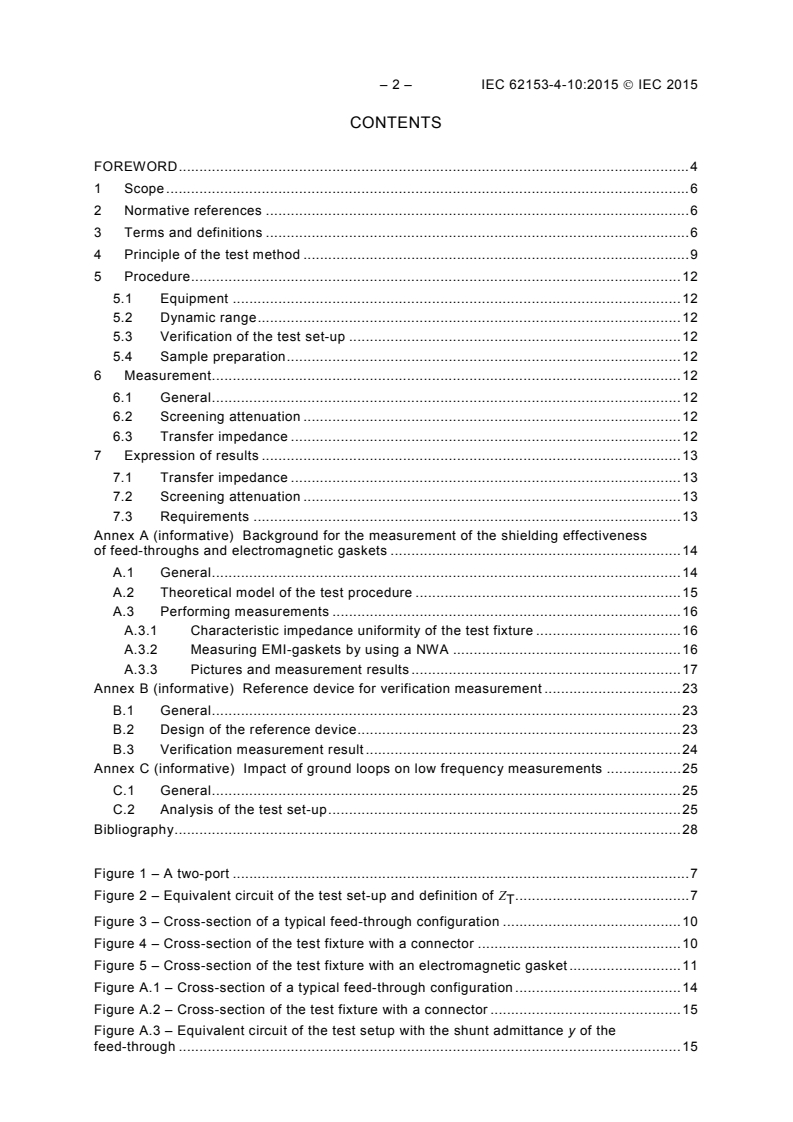
CONTENTS
FOREWORD . 4
1 Scope . 6
2 Normative references . 6
3 Terms and definitions . 6
4 Principle of the test method . 9
5 Procedure . 12
5.1 Equipment . 12
5.2 Dynamic range . 12
5.3 Verification of the test set-up . 12
5.4 Sample preparation . 12
6 Measurement . 12
6.1 General . 12
6.2 Screening attenuation . 12
6.3 Transfer impedance . 12
7 Expression of results . 13
7.1 Transfer impedance . 13
7.2 Screening attenuation . 13
7.3 Requirements . 13
Annex A (informative) Background for the measurement of the shielding effectiveness
of feed-throughs and electromagnetic gaskets . 14
A.1 General . 14
A.2 Theoretical model of the test procedure . 15
A.3 Performing measurements . 16
A.3.1 Characteristic impedance uniformity of the test fixture . 16
A.3.2 Measuring EMI-gaskets by using a NWA . 16
A.3.3 Pictures and measurement results . 17
Annex B (informative) Reference device for verification measurement . 23
B.1 General . 23
B.2 Design of the reference device . 23
B.3 Verification measurement result . 24
Annex C (informative) Impact of ground loops on low frequency measurements . 25
C.1 General . 25
C.2 Analysis of the test set-up . 25
Bibliography . 28
Figure 1 – A two-port . 7
Figure 2 – Equivalent circuit of the test set-up and definition of Z . 7
T
Figure 3 – Cross-section of a typical feed-through configuration . 10
Figure 4 – Cross-section of the test fixture with a connector . 10
Figure 5 – Cross-section of the test fixture with an electromagnetic gasket . 11
Figure A.1 – Cross-section of a typical feed-through configuration . 14
Figure A.2 – Cross-section of the test fixture with a connector . 15
Figure A.3 – Equivalent circuit of the test setup with the shunt admittance y of the
feed-through . 15
Figure A.4 – TDR step response at input-port of test fixture . 16
Figure A.5 – View of the test fixture connected to a network analyzer . 18
Figure A.6 – Top view of the test fixture . 18
Figure A.7 – Detailed view of the contact area . 18
Figure A.8 – Detailed view of the captivation for the conductive O-ring test. 19
Figure A.9 – Isolation of the network analyzer . 20
Figure A.10 – Isolation of the test fixture when characterizing an ideal short (metal
plate) . 20
Figure A.11 – Measured operational screening transmission when characterizing a
typical conductive O-ring. 21
Figure A.12 – Transfer impedance Z of a typical conductive O-ring . 21
T
Figure A.13 – Screening attenuation a of a typical conductive O-ring . 22
s
Figure B.1 – Reference device, e.g. resistors soldered onto a PCB . 23
Figure B.2 – Typical verification measurement result . 24
Figure C.1 – Double coaxial test set-up . 25
Figure C.2 – Equivalent circuits of the double coaxial test set-up . 26
Figure C.3 – Results obtained with (green) and without ferrites on the test leads (blue) . 27
– 4 – IEC 62153-4-10:2015 IEC 2015
INTERNATIONAL ELECTROTECHNICAL COMMISSION
____________
METALLIC COMMUNICATION CABLE TEST METHODS –
Part 4-10: Electromagnetic compatibility (EMC) – Transfer impedance
and screening attenuation of feed-throughs and electromagnetic
gaskets – Double coaxial test method
FOREWORD
1) The International Electrotechnical Commission (IEC) is a worldwide organization for standardization comprising
all national electrotechnical committees (IEC National Committees). The object of IEC is to promote
international co-operation on all questions concerning standardization in the electrical and electronic fields. To
this end and in addition to other activities, IEC publishes International Standards, Technical Specifications,
Technical Reports, Publicly Available Specifications (PAS) and Guides (hereafter referred to as “IEC
Publication(s)”). Their preparation is entrusted to technical committees; any IEC National Committee interested
in the subject dealt with may participate in this preparatory work. International, governmental and non-
governmental organizations liaising with the IEC also participate in this preparation. IEC collaborates closely
with the International Organization for Standardization (ISO) in accordance with conditions determined by
agreement between the two organizations.
2) The formal decisions or agreements of IEC on technical matters express, as nearly as possible, an international
consensus of opinion on the relevant subjects since each technical committee has representation from all
interested IEC National Committees.
3) IEC Publications have the form of recommendations for international use and are accepted by IEC National
Committees in that sense. While all reasonable efforts are made to ensure that the technical content of IEC
Publications is accurate, IEC cannot be held responsible for the way in which they are used or for any
misinterpretation by any end user.
4) In order to promote international uniformity, IEC National Committees undertake to apply IEC Publications
transparently to the maximum extent possible in their national and regional publications. Any divergence
between any IEC Publication and the corresponding national or regional publication shall be clearly indicated in
the latter.
5) IEC itself does not provide any attestation of conformity. Independent certification bodies provide conformity
assessment services and, in some areas, access to IEC marks of conformity. IEC is not responsible for any
services carried out by independent certification bodies.
6) All users should ensure that they have the latest edition of this publication.
7) No liability shall attach to IEC or its directors, employees, servants or agents including individual experts and
members of its technical committees and IEC National Committees for any personal injury, property damage or
other damage of any nature whatsoever, whether direct or indirect, or for costs (including legal fees) and
expenses arising out of the publication, use of, or reliance upon, this IEC Publication or any other IEC
Publications.
8) Attention is drawn to the Normative references cited in this publication. Use of the referenced publications is
indispensable for the correct application of this publication.
9) Attention is drawn to the possibility that some of the elements of this IEC Publication may be the subject of
patent rights. IEC shall not be held responsible for identifying any or all such patent rights.
International Standard IEC 62153-4-10 has been prepared by IEC technical committee 46:
Cables, wires, waveguides, R.F. connectors, R.F. and microwave passive components and
accessories.
This second edition cancels and replaces the first edition published in 2009. It constitutes a
technical revision.
The main technical changes with regard to the previous edition are as follows:
– addition of a new clause that describes a procedure for verification of the measurement set-
up and further information regarding sample preparation;
– addition of a new Annex that describes how to improve measurement certainty in the very
low frequency area.
The text of this standard is based on the following documents:
FDIS Report on voting
46/563/FDIS 46/580/RVD
Full information on the voting for the approval of this standard can be found in the report on
voting indicated in the above table.
This publication has been drafted in accordance with the ISO/IEC Directives, Part 2.
A list of all parts of the IEC 62153 series, under the general title: Metallic communication
cable test methods, can be found on the IEC website.
The committee has decided that the contents of this publication will remain unchanged until
the stability date indicated on the IEC website under "http://webstore.iec.ch" in the data
related to the specific publication. At this date, the publication will be
• reconfirmed,
• withdrawn,
• replaced by a revised edition, or
• amended.
A bilingual version of this publication may be issued at a later date.
IMPORTANT – The 'colour inside' logo on the cover page of this publication indicates
that it contains colours which are considered to be useful for the correct
understanding of its contents. Users should therefore print this document using a
colour printer.
– 6 – IEC 62153-4-10:2015 IEC 2015
METALLIC COMMUNICATION CABLE TEST METHODS –
Part 4-10: Electromagnetic compatibility (EMC) – Transfer impedance
and screening attenuation of feed-throughs and electromagnetic
gaskets – Double coaxial test method
1 Scope
This part of IEC 62153 details a coaxial method suitable for determining the transfer
impedance and/or screening attenuation of feed-throughs and electromagnetic gaskets.
The shielded screening attenuation test set-up according to IEC 62153-4-4 (triaxial method)
has been modified to take into account the particularities of feed-throughs and gaskets.
A wide dynamic and frequency range can be applied to test even super screened
feed-throughs and gaskets with normal instrumentation from low frequencies up to the limit of
defined transversal waves in the coaxial circuits at approximately 4 GHz.
2 Normative references
The following documents, in whole or in part, are normatively referenced in this document and
are indispensable for its application. For dated references, only the edition cited applies. For
undated references, the latest edition of the referenced document (including any
amendments) applies.
Void.
3 Terms and definitions
For the purposes of this document, the following terms and definitions apply.
3.1
operational (Betriebs) transfer function in the forward direction H
B21
operational (Betriebs) scattering parameter S
quotient of the reflected square root of power wave fed into the reference impedance of the
output of the two-port and the unreflected square root of the power wave consumed at the
input of the two-port
EXAMPLE (see Figure 1)
Z Z
A B
I I
1 2
Two-port
Z Z
U 1 2 U
E 1 2 E
1 2
V V
i1 i2
V V
r1 r2
IEC
Key
E , E network analyzer at input, output V , V incident square root of complex power waves
1 2 i1 i2
respectively (see note) at input and output, respectively
Z Z reference impedance at input and output V , V reflected square root of complex power
,
A B r1 r2
respectively waves (see note) at input and output,
respectively
I , I current at input and output, respectively Z , Z impedance at input and output, respectively
1 2 1 2
U , U voltage at input and output, respectively
1 2
Figure 1 – A two-port
∗
Note 1 to entry: Complex power is the product U⋅ I . Apparent power is the product U⋅ I , which is used in
∗
electrical power technique, where the angle between the voltage and current is of interest. I Is the complex
conjugate of the current I .
S or H is the operational (Betriebs) transfer function in the forward direction defined as follows:
21 B21
V 2U Z
r2 2 A
S = = = H
21 B21
V E Z
i1 V =0 1 B
i2
See Annex C of IEC TR 62152:2009.
3.2
transfer impedance
equivalent circuit of the measurement of a feed-through or gasket, shunt impedance Z
T
between the primary and secondary circuit
EXAMPLE The transfer impedance of an electrically short screen is defined as the quotient of the open circuit
voltage U induced to the secondary circuit by the current I fed into the primary circuit or vice versa. See
2 1
Figure 2.
Z of an electrically short screen is expressed in Ω or decibels in relation to 1 Ω.
T
I
Z , l Z U Z , l
o T 2 o
IEC
Figure 2 – Equivalent circuit of the test set-up and definition of Z
T
U
Z =
T
(1)
I
– 8 – IEC 62153-4-10:2015 IEC 2015
Z
T
Z =+20×log
T 10
(2)
1Ω
3.3
operational (Betriebs) attenuation
the quotient of the unreflected square root of power wave fed into the reference impedance of
the input of the two-port and the square root of the power wave consumed by the load of the
two-port expressed in dB and radians
Note 1 to entry: See IEC TR 62152.
3.4
screening attenuation
a
s
logarithmic ratio of the incident (unreflected) square root of power wave fed into the nominal
impedance of the primary circuit of the test set-up and the periodic maximum values of the
square root of power wave V coupled into the secondary circuit of the test set-up when
r2
, max
its characteristic impedance Z is normalized to 150 Ω
o
EXAMPLE
V 150 Ω
r2, max
a =−20×log Env + 20×log =
s 10 10
V
Z
i1
o
150 Ω
= 20×log + 20×log =
10 10
(3)
Env(S )
Z
21,max
o
150 Ω
= Min. Env (A )+ 20×log
B21 10
Z
o
where
a is the screening attenuation expressed in dB;
s
Env ( A ) is the operational attenuation recorded as the envelope curve of the measured values in dB (See
B21
7.1);
Min.Env ( A ) is the operational attenuation recorded as the minimum envelope curve of the measured values
B21
in dB (See 7.1);
150 Ω is the standardized impedance of the secondary (“outer” or disturbed) circuit.
The screening attenuation, expressed in dB of an electrically short device is:
50Ω
a ≈ 20×log
s 10
(4)
Z
T
where
is the screening attenuation expressed in Ω;
a
s
Z is the transfer impedance of the device under test.
T
Note 1 to entry: Formula (4) may be deduced from Formulas (3) and (5) as follows, assuming an electrically short
device:
Z ×150Ω
o
a = 20×log
. If we assume that 150Ω≈ 3× Z , then
s 10 o
2× Z
T
150Ω 50Ω
a = 20×log and approximate 2 3 ≈ 3 then a ≈ 20×log and Formula (4) is valid.
s 10 s 10
Z
2 3× Z
T
T
In the measurement, both primary and secondary circuits are low impedance. This leads to a 6 dB lower A than
B21
in e.g. the tube measurement of connectors; see IEC 62153-4-7.
3.5
device under test
DUT
connector’s body or screen, intended to be mounted to a shielding or screening wall (or box),
or an electromagnetic gasket
3.6
triaxial test method
method for measuring the transfer impedance and screening attenuation of passive
transmission components like cables and connectors in an triaxial arrangement
Note 1 to entry: Primarily used for components with elongated dimensions and therefore distributed coupling over
the transfer impedance along the components.
See also IEC TS 62153-4-1.
3.7
double coaxial test method
method for measuring the transfer impedance and screening attenuation of passive
transmission components like connector feed-throughs and electro magnetical gaskets in an
cascaded arrangement
Note 1 to entry: Primarily used for short components with concentrated transfer impedance.
See also IEC TS 62153-4-1.
4 Principle of the test method
Figure 3 shows a typical feed-through construction where a coaxial connection is brought into
a screened housing to a printed circuit board. Important are the coaxial connector body’s and
electromagnetic gasket’s reliable connection to the screening or shielding box.
The electromagnetic tightness of a connector body’s mounting or a gasket is measured as
transfer impedance and/or screening attenuation.
The test set-up consists of two RF-tight coaxial systems separated by a metallic wall to which
the DUT is mounted. The feed-through test set-up is shown in Figure 4. The gasket test set-
up is shown in Figure 5. Here the gasket is pressed between two metallic plates.
The nominal impedances of both sides of the coaxial fixture should be the same as that of the
test equipment. The generator side is called the primary circuit or inner circuit and the
receiver side is called the secondary circuit or outer circuit.
The set-up is the same for measuring the transfer impedance and the screening attenuation.
Annex A gives a theoretical model of the test set-up. Useful information concerning the triaxial
measurement technique is given in [3] .
___________
Figures in square brackets refer to the Bibliography.
– 10 – IEC 62153-4-10:2015 IEC 2015
Wall of shielding box
Contact spring
Plug body
Connector body
Cable
Printed circuit board
IEC
Figure 3 – Cross-section of a typical feed-through configuration
Primary circuit Secondary circuit
Inner
conductor
Inner
conductor
Connector Plug body
body
Outer
Outer
condutor
conductor
Contact
Shielding
spring
wall
IEC
NOTE It is important that the coupled voltage is measured without any disturbing extra coupling voltage not
coming from the feed-through under test (compare with Figure 5).
Figure 4 – Cross-section of the test fixture with a connector
Gasket under test
Primary circuit Secondary circuit
Voltage measurement
Inner
Inner
conduc
...
IEC 62153-4-10 ®
Edition 2.0 2015-11
INTERNATIONAL
STANDARD
NORME
INTERNATIONALE
colour
inside
Metallic communication cable test methods –
Part 4-10: Electromagnetic compatibility (EMC) – Transfer impedance and
screening attenuation of feed-throughs and electromagnetic gaskets – Double
coaxial test method
Méthodes d’essai des câbles métalliques de communication –
Partie 4-10: Compatibilité électromagnétique (CEM) – Impédance de transfert et
affaiblissement d'écran des traversées et des joints d’étanchéité
électromagnétiques – Méthode d'essai coaxiale double
All rights reserved. Unless otherwise specified, no part of this publication may be reproduced or utilized in any form
or by any means, electronic or mechanical, including photocopying and microfilm, without permission in writing from
either IEC or IEC's member National Committee in the country of the requester. If you have any questions about IEC
copyright or have an enquiry about obtaining additional rights to this publication, please contact the address below or
your local IEC member National Committee for further information.
Droits de reproduction réservés. Sauf indication contraire, aucune partie de cette publication ne peut être reproduite
ni utilisée sous quelque forme que ce soit et par aucun procédé, électronique ou mécanique, y compris la photocopie
et les microfilms, sans l'accord écrit de l'IEC ou du Comité national de l'IEC du pays du demandeur. Si vous avez des
questions sur le copyright de l'IEC ou si vous désirez obtenir des droits supplémentaires sur cette publication, utilisez
les coordonnées ci-après ou contactez le Comité national de l'IEC de votre pays de résidence.
IEC Central Office Tel.: +41 22 919 02 11
3, rue de Varembé info@iec.ch
CH-1211 Geneva 20 www.iec.ch
Switzerland
About the IEC
The International Electrotechnical Commission (IEC) is the leading global organization that prepares and publishes
International Standards for all electrical, electronic and related technologies.
About IEC publications
The technical content of IEC publications is kept under constant review by the IEC. Please make sure that you have the
latest edition, a corrigendum or an amendment might have been published.
IEC publications search - webstore.iec.ch/advsearchform Electropedia - www.electropedia.org
The advanced search enables to find IEC publications by a The world's leading online dictionary on electrotechnology,
variety of criteria (reference number, text, technical containing more than 22 000 terminological entries in English
committee,…). It also gives information on projects, replaced and French, with equivalent terms in 16 additional languages.
and withdrawn publications. Also known as the International Electrotechnical Vocabulary
(IEV) online.
IEC Just Published - webstore.iec.ch/justpublished
Stay up to date on all new IEC publications. Just Published IEC Glossary - std.iec.ch/glossary
details all new publications released. Available online and 67 000 electrotechnical terminology entries in English and
once a month by email. French extracted from the Terms and Definitions clause of
IEC publications issued since 2002. Some entries have been
IEC Customer Service Centre - webstore.iec.ch/csc collected from earlier publications of IEC TC 37, 77, 86 and
If you wish to give us your feedback on this publication or CISPR.
need further assistance, please contact the Customer Service
Centre: sales@iec.ch.
A propos de l'IEC
La Commission Electrotechnique Internationale (IEC) est la première organisation mondiale qui élabore et publie des
Normes internationales pour tout ce qui a trait à l'électricité, à l'électronique et aux technologies apparentées.
A propos des publications IEC
Le contenu technique des publications IEC est constamment revu. Veuillez vous assurer que vous possédez l’édition la
plus récente, un corrigendum ou amendement peut avoir été publié.
Recherche de publications IEC - Electropedia - www.electropedia.org
webstore.iec.ch/advsearchform Le premier dictionnaire d'électrotechnologie en ligne au
La recherche avancée permet de trouver des publications IEC monde, avec plus de 22 000 articles terminologiques en
en utilisant différents critères (numéro de référence, texte, anglais et en français, ainsi que les termes équivalents dans
comité d’études,…). Elle donne aussi des informations sur les 16 langues additionnelles. Egalement appelé Vocabulaire
projets et les publications remplacées ou retirées. Electrotechnique International (IEV) en ligne.
IEC Just Published - webstore.iec.ch/justpublished Glossaire IEC - std.iec.ch/glossary
Restez informé sur les nouvelles publications IEC. Just 67 000 entrées terminologiques électrotechniques, en anglais
Published détaille les nouvelles publications parues. et en français, extraites des articles Termes et Définitions des
Disponible en ligne et une fois par mois par email. publications IEC parues depuis 2002. Plus certaines entrées
antérieures extraites des publications des CE 37, 77, 86 et
Service Clients - webstore.iec.ch/csc CISPR de l'IEC.
Si vous désirez nous donner des commentaires sur cette
publication ou si vous avez des questions contactez-nous:
sales@iec.ch.
IEC 62153-4-10 ®
Edition 2.0 2015-11
INTERNATIONAL
STANDARD
NORME
INTERNATIONALE
colour
inside
Metallic communication cable test methods –
Part 4-10: Electromagnetic compatibility (EMC) – Transfer impedance and
screening attenuation of feed-throughs and electromagnetic gaskets – Double
coaxial test method
Méthodes d’essai des câbles métalliques de communication –
Partie 4-10: Compatibilité électromagnétique (CEM) – Impédance de transfert et
affaiblissement d'écran des traversées et des joints d’étanchéité
électromagnétiques – Méthode d'essai coaxiale double
INTERNATIONAL
ELECTROTECHNICAL
COMMISSION
COMMISSION
ELECTROTECHNIQUE
INTERNATIONALE
ICS 33.100.10; 33.120.10 ISBN 978-2-8322-7626-6
– 2 – IEC 62153-4-10:2015 IEC 2015
CONTENTS
FOREWORD . 4
1 Scope . 6
2 Normative references . 6
3 Terms and definitions . 6
4 Principle of the test method . 9
5 Procedure . 12
5.1 Equipment . 12
5.2 Dynamic range . 12
5.3 Verification of the test set-up . 12
5.4 Sample preparation . 12
6 Measurement . 12
6.1 General . 12
6.2 Screening attenuation . 12
6.3 Transfer impedance . 12
7 Expression of results . 13
7.1 Transfer impedance . 13
7.2 Screening attenuation . 13
7.3 Requirements . 13
Annex A (informative) Background for the measurement of the shielding effectiveness
of feed-throughs and electromagnetic gaskets . 14
A.1 General . 14
A.2 Theoretical model of the test procedure . 15
A.3 Performing measurements . 16
A.3.1 Characteristic impedance uniformity of the test fixture . 16
A.3.2 Measuring EMI-gaskets by using a NWA . 16
A.3.3 Pictures and measurement results . 17
Annex B (informative) Reference device for verification measurement . 23
B.1 General . 23
B.2 Design of the reference device . 23
B.3 Verification measurement result . 24
Annex C (informative) Impact of ground loops on low frequency measurements . 25
C.1 General . 25
C.2 Analysis of the test set-up . 25
Bibliography . 28
Figure 1 – A two-port . 7
Figure 2 – Equivalent circuit of the test set-up and definition of Z . 7
T
Figure 3 – Cross-section of a typical feed-through configuration . 10
Figure 4 – Cross-section of the test fixture with a connector . 10
Figure 5 – Cross-section of the test fixture with an electromagnetic gasket . 11
Figure A.1 – Cross-section of a typical feed-through configuration . 14
Figure A.2 – Cross-section of the test fixture with a connector . 15
Figure A.3 – Equivalent circuit of the test setup with the shunt admittance y of the
feed-through . 15
Figure A.4 – TDR step response at input-port of test fixture . 16
Figure A.5 – View of the test fixture connected to a network analyzer . 18
Figure A.6 – Top view of the test fixture . 18
Figure A.7 – Detailed view of the contact area . 18
Figure A.8 – Detailed view of the captivation for the conductive O-ring test. 19
Figure A.9 – Isolation of the network analyzer . 20
Figure A.10 – Isolation of the test fixture when characterizing an ideal short (metal
plate) . 20
Figure A.11 – Measured operational screening transmission when characterizing a
typical conductive O-ring. 21
Figure A.12 – Transfer impedance Z of a typical conductive O-ring . 21
T
Figure A.13 – Screening attenuation a of a typical conductive O-ring . 22
s
Figure B.1 – Reference device, e.g. resistors soldered onto a PCB . 23
Figure B.2 – Typical verification measurement result . 24
Figure C.1 – Double coaxial test set-up . 25
Figure C.2 – Equivalent circuits of the double coaxial test set-up . 26
Figure C.3 – Results obtained with (green) and without ferrites on the test leads (blue) . 27
– 4 – IEC 62153-4-10:2015 IEC 2015
INTERNATIONAL ELECTROTECHNICAL COMMISSION
____________
METALLIC COMMUNICATION CABLE TEST METHODS –
Part 4-10: Electromagnetic compatibility (EMC) – Transfer impedance
and screening attenuation of feed-throughs and electromagnetic
gaskets – Double coaxial test method
FOREWORD
1) The International Electrotechnical Commission (IEC) is a worldwide organization for standardization comprising
all national electrotechnical committees (IEC National Committees). The object of IEC is to promote
international co-operation on all questions concerning standardization in the electrical and electronic fields. To
this end and in addition to other activities, IEC publishes International Standards, Technical Specifications,
Technical Reports, Publicly Available Specifications (PAS) and Guides (hereafter referred to as “IEC
Publication(s)”). Their preparation is entrusted to technical committees; any IEC National Committee interested
in the subject dealt with may participate in this preparatory work. International, governmental and non-
governmental organizations liaising with the IEC also participate in this preparation. IEC collaborates closely
with the International Organization for Standardization (ISO) in accordance with conditions determined by
agreement between the two organizations.
2) The formal decisions or agreements of IEC on technical matters express, as nearly as possible, an international
consensus of opinion on the relevant subjects since each technical committee has representation from all
interested IEC National Committees.
3) IEC Publications have the form of recommendations for international use and are accepted by IEC National
Committees in that sense. While all reasonable efforts are made to ensure that the technical content of IEC
Publications is accurate, IEC cannot be held responsible for the way in which they are used or for any
misinterpretation by any end user.
4) In order to promote international uniformity, IEC National Committees undertake to apply IEC Publications
transparently to the maximum extent possible in their national and regional publications. Any divergence
between any IEC Publication and the corresponding national or regional publication shall be clearly indicated in
the latter.
5) IEC itself does not provide any attestation of conformity. Independent certification bodies provide conformity
assessment services and, in some areas, access to IEC marks of conformity. IEC is not responsible for any
services carried out by independent certification bodies.
6) All users should ensure that they have the latest edition of this publication.
7) No liability shall attach to IEC or its directors, employees, servants or agents including individual experts and
members of its technical committees and IEC National Committees for any personal injury, property damage or
other damage of any nature whatsoever, whether direct or indirect, or for costs (including legal fees) and
expenses arising out of the publication, use of, or reliance upon, this IEC Publication or any other IEC
Publications.
8) Attention is drawn to the Normative references cited in this publication. Use of the referenced publications is
indispensable for the correct application of this publication.
9) Attention is drawn to the possibility that some of the elements of this IEC Publication may be the subject of
patent rights. IEC shall not be held responsible for identifying any or all such patent rights.
International Standard IEC 62153-4-10 has been prepared by IEC technical committee 46:
Cables, wires, waveguides, R.F. connectors, R.F. and microwave passive components and
accessories.
This bilingual version (2020-01) corresponds to the monolingual English version, published
in 2015-11.
This second edition cancels and replaces the first edition published in 2009. It constitutes a
technical revision.
The main technical changes with regard to the previous edition are as follows:
– addition of a new clause that describes a procedure for verification of the measurement
set-up and further information regarding sample preparation;
– addition of a new Annex that describes how to improve measurement certainty in the very
low frequency area.
The text of this standard is based on the following documents:
FDIS Report on voting
46/563/FDIS 46/580/RVD
Full information on the voting for the approval of this standard can be found in the report on
voting indicated in the above table.
The French version of this standard has not been voted upon.
This publication has been drafted in accordance with the ISO/IEC Directives, Part 2.
A list of all parts of the IEC 62153 series, under the general title: Metallic communication
cable test methods, can be found on the IEC website.
The committee has decided that the contents of this publication will remain unchanged until
the stability date indicated on the IEC website under "http://webstore.iec.ch" in the data
related to the specific publication. At this date, the publication will be
• reconfirmed,
• withdrawn,
• replaced by a revised edition, or
• amended.
IMPORTANT – The 'colour inside' logo on the cover page of this publication indicates
that it contains colours which are considered to be useful for the correct
understanding of its contents. Users should therefore print this document using a
colour printer.
– 6 – IEC 62153-4-10:2015 IEC 2015
METALLIC COMMUNICATION CABLE TEST METHODS –
Part 4-10: Electromagnetic compatibility (EMC) – Transfer impedance
and screening attenuation of feed-throughs and electromagnetic
gaskets – Double coaxial test method
1 Scope
This part of IEC 62153 details a coaxial method suitable for determining the transfer
impedance and/or screening attenuation of feed-throughs and electromagnetic gaskets.
The shielded screening attenuation test set-up according to IEC 62153-4-4 (triaxial method)
has been modified to take into account the particularities of feed-throughs and gaskets.
A wide dynamic and frequency range can be applied to test even super screened
feed-throughs and gaskets with normal instrumentation from low frequencies up to the limit of
defined transversal waves in the coaxial circuits at approximately 4 GHz.
2 Normative references
The following documents, in whole or in part, are normatively referenced in this document and
are indispensable for its application. For dated references, only the edition cited applies. For
undated references, the latest edition of the referenced document (including any
amendments) applies.
Void.
3 Terms and definitions
For the purposes of this document, the following terms and definitions apply.
3.1
operational (Betriebs) transfer function in the forward direction H
B21
operational (Betriebs) scattering parameter S
quotient of the reflected square root of power wave fed into the reference impedance of the
output of the two-port and the unreflected square root of the power wave consumed at the
input of the two-port
EXAMPLE (see Figure 1)
Z Z
A B
I I
1 2
Two-port
Z Z
U 1 2 U
E 1 2 E
1 2
V V
i1 i2
V V
r1 r2
IEC
Key
E , E network analyzer at input, output V , V incident square root of complex power waves
1 2 i1 i2
respectively (see note) at input and output, respectively
Z Z reference impedance at input and output V , V reflected square root of complex power
,
A B r1 r2
respectively waves (see note) at input and output,
respectively
I , I current at input and output, respectively Z , Z impedance at input and output, respectively
1 2 1 2
U , U voltage at input and output, respectively
1 2
Figure 1 – A two-port
∗
Note 1 to entry: Complex power is the product U⋅ I . Apparent power is the product , which is used in
U⋅ I
∗
electrical power technique, where the angle between the voltage and current is of interest. I Is the complex
conjugate of the current I .
S or H is the operational (Betriebs) transfer function in the forward direction defined as follows:
21 B21
V 2U Z
r2 2 A
S = = = H
21 B21
V E Z
i1 V =0 1 B
i2
See Annex C of IEC TR 62152:2009.
3.2
transfer impedance
equivalent circuit of the measurement of a feed-through or gasket, shunt impedance Z
T
between the primary and secondary circuit
EXAMPLE The transfer impedance of an electrically short screen is defined as the quotient of the open circuit
voltage U induced to the secondary circuit by the current I fed into the primary circuit or vice versa. See
2 1
Figure 2.
Z of an electrically short screen is expressed in Ω or decibels in relation to 1 Ω.
T
I
Z , l Z U Z , l
o T 2 o
IEC
Figure 2 – Equivalent circuit of the test set-up and definition of Z
T
U
Z =
T
(1)
I
– 8 – IEC 62153-4-10:2015 IEC 2015
Z
T
Z =+20×log
T 10
(2)
1Ω
3.3
operational (Betriebs) attenuation
the quotient of the unreflected square root of power wave fed into the reference impedance of
the input of the two-port and the square root of the power wave consumed by the load of the
two-port expressed in dB and radians
Note 1 to entry: See IEC TR 62152.
3.4
screening attenuation
a
s
logarithmic ratio of the incident (unreflected) square root of power wave fed into the nominal
impedance of the primary circuit of the test set-up and the periodic maximum values of the
square root of power wave V coupled into the secondary circuit of the test set-up when
r2 , max
its characteristic impedance Z is normalized to 150 Ω
o
EXAMPLE
V 150 Ω
r2, max
a =−20×log Env + 20×log =
s 10 10
V
Z
i1
o
150 Ω
= 20×log + 20×log =
10 10 (3)
Env(S )
Z
21,max
o
150 Ω
= Min. Env (A )+ 20×log
B21 10
Z
o
where
a is the screening attenuation expressed in dB;
s
Env ( A ) is the operational attenuation recorded as the envelope curve of the measured values in dB (See
B21
7.1);
Min.Env ( A ) is the operational attenuation recorded as the minimum envelope curve of the measured values
B21
in dB (See 7.1);
150 Ω is the standardized impedance of the secondary (“outer” or disturbed) circuit.
The screening attenuation, expressed in dB of an electrically short device is:
50Ω
a ≈ 20×log
s 10
(4)
Z
T
where
a is the screening attenuation expressed in Ω;
s
Z is the transfer impedance of the device under test.
T
Note 1 to entry: Formula (4) may be deduced from Formulas (3) and (5) as follows, assuming an electrically short
device:
Z ×150Ω
o
a = 20×log
. If we assume that 150Ω≈ 3× Z , then
s 10 o
2× Z
T
150Ω 50Ω
a = 20×log and approximate 2 3 ≈ 3 then a ≈ 20×log and Formula (4) is valid.
s 10 s 10
Z
2 3× Z
T
T
In the measurement, both primary and secondary circuits are low impedance. This leads to a 6 dB lower A than
B21
in e.g. the tube measurement of connectors; see IEC 62153-4-7.
3.5
device under test
DUT
connector’s body or screen, intended to be mounted to a shielding or screening wall (or box),
or an electromagnetic gasket
3.6
triaxial test method
method for measuring the transfer impedance and screening attenuation of passive
transmission components like cables and connectors in an triaxial arrangement
Note 1 to entry: Primarily used for components with elongated dimensions and therefore distributed coupling over
the transfer impedance along the components.
See also IEC TS 62153-4-1.
3.7
double coaxial test method
method for measuring the transfer impedance and screening attenuation of passive
transmission components like connector feed-throughs and electro magnetical gaskets in an
cascaded arrangement
Note 1 to entry: Primarily used for short components with concentrated transfer impedance.
See also IEC TS 62153-4-1.
4 Principle of the test method
Figure 3 shows a typical feed-through construction where a coaxial connection is brought into
a screened housing to a printed circuit board. Important are the coaxial connector body’s and
electromagnetic gasket’s reliable connection to the screening or shielding box.
The electromagnetic tightness of a connector body’s mounting or a gasket is measured as
transfer impedance and/or screening attenuation.
The test set-up consists of two RF-tight coaxial systems separated by a metallic wall to which
the DUT is mounted. The feed-through test set-up is shown in Figure 4. The gasket test set-
up is shown in Figure 5. Here the gasket is pressed between two metallic plates.
The nominal impedances of both sides of the coaxial fixture should be the same as that of the
test equipment. The generator side is called the primary circuit or inner circuit and the
receiver side is called the secondary circuit or outer circuit.
The set-up is the same for measuring the transfer impedance and the screening attenuation.
Annex A gives a theoretical model of the test set-up. Useful information concerning the triaxial
measurement technique is given in [3] .
___________
Figures in square brackets refer to the Bibliography.
– 10 – IEC 62153-4-10:2015 IEC 2015
Wall of shielding box
Contact spring
Plug body
Connector body
Cable
Printed circuit board
IEC
Figure 3 – Cross-section of a typical feed-through configuration
Primary circuit Secondary circuit
Inner
conductor
Inner
conductor
Connector Plug body
body
Outer
Outer
condutor
conductor
Contact
Shielding
spring
wall
IEC
NOTE It is important that the coupled voltage is measured without any disturbing extra coupling voltage not
coming from the feed-through under test (compare with Figure 5).
Figure 4 – Cross-section of the test fixture with a connector
Gasket under test
Primary circuit Secondary circuit
Voltage measurement
Inner
Inner
conductor
conductor
Current flow
Mounting
Outer
support (metal)
conductor
Outer
condutor
Mounting ferrule
Shielding wall
IEC
(plastic)
In test rig design, care shall be taken that the disturbing current in the primary circuit cannot cause unwanted
transition voltages in the measuring secondary circuit. Separate voltage and current “contacts” are a must.
One should not end in a situation where transition or contact resistances of the test rig influence the test results.
Special care shall be taken to design the mounting of the test plate between the primary and secondary circuits or
systems. Figure 5 shows how to avoid bringing the transition resistance between the mounting plate and primary
circuit into the disturbing voltage measurement circuit formed by the secondary circuit of the test system.
It is important that the coupled voltage is measured without any disturbing extra coupling voltage not coming from
the gasket under test (compare with Figure 4).
Figure 5 – Cross-section of the test fixture with an electromagnetic gasket
– 12 – IEC 62153-4-10:2015 IEC 2015
5 Procedure
5.1 Equipment
The test fixture set-up is shown in Figures 3, 4 and 5 and consists of the following:
– a double coaxial test fixture where the sides are separated by metallic wall/walls for
mounting of the DUT (Figure 4) (feed-through) or the gasket pressed between two plates,
the first one belonging to the centre conductor and primary circuit and the second one to
the outer conductor and secondary circuit, Figure 5;
– the RF-tight double coaxial, test fixture which should have preferably a diameter such that
the characteristic impedance to the outer tube is 50 Ω respectively the nominal impedance
of the network analyzer or generator and receiver;
– a signal generator with the same characteristic impedance as the test fixture with the
mounted DUT or an impedance matching adapter, completed with a power amplifier if
necessary for very high screening attenuation;
– a receiver with a calibrated step attenuator or a network analyzer (NWA).
NOTE The generator and the receiver may be included in a network analyzer.
5.2 Dynamic range
The dynamic range (noise floor) of the test setup shall be tested by replacing the DUT by a
solid metallic plate.
5.3 Verification of the test set-up
In order to verify the proper function of the applied instrumentation and the calculation of the
transfer impedance according to 7.1, it is recommended to do a verification measurement by
use of a reference device with known characteristics. An example design of such a device is
given in Annex B.
5.4 Sample preparation
The feed-through connector or gasket shall be mounted into the fixture according to the
manufacturer’s instructions. The specification of the applied contact zones is of particular
interest since this defines the contact resistance as an integral part of the transfer impedance
of the DUT. Deviating test fixture contact characteristics will result in variations of the
measured transfer impedance and screening attenuation, respectively.
6 Measurement
6.1 General
The operational attenuation A ( Z = ∞) of the test fixture with an open circuited DUT
B21 T
( Z = ∞) shall be measured and recorded vs. frequency.
T
The operational attenuation A' with the feed-through connector mounted to the plate or the
B21
gasket inserted is measured and recorded vs. frequency.
The operational attenuation of the feed-through or gasket is then:
A = A′ − A (Z =∞)
B21 B21 B21 T
6.2 Screening attenuation
See 3.4.
6.3 Transfer impedance
See 3.2.
7 Expression of results
7.1 Transfer impedance
S Z H Z
21 o B21 o
Z = =
T
2 2
A
B21
(5)
−
Z
o
Z = ×10
T
where
Z is the nominal characteristic impedance of the primary and secondary circuits, equal to
o
the impedance of the generator and receiver.
NOTE Contrary to the measurement of the transfer impedance of cable screens, the transfer impedance of the
connector is not related to length.
7.2 Screening attenuation
The screening attenuation a has to be normalized to the agreed standard conditions where
s
the impedance of the “outer world” or secondary circuit is Z = 150 Ω:
S
Z = 150Ω
S
a = Min.Env(A )+10×log
s B21 10
(6)
Z
o
where
a is the screening attenuation related to a secondary or outer circuit
s
(“radiating”) impedance of 150 Ω in dB;
Min.Env ( A ) is the operational attenuation recorded as the minimum envelope curve of
B21
the measured values in dB (see 7.1);
Z is the characteristic impedance of the fixture in Ω.
o
NOTE At frequencies higher than the limit of the electrically short feed-through the measurement, results will be
similar to screening attenuation measurement of a long transmission line.
7.3 Requirements
The results of the transfer impedance and/or the screening attenuation shall comply with the
value indicated in a relevant specification.
– 14 – IEC 62153-4-10:2015 IEC 2015
Annex A
(informative)
Background for the measurement of the shielding effectiveness
of feed-throughs and electromagnetic gaskets
A.1 General
A reference for the measurement of the shielding or screening effectiveness of feed-throughs
and electromagnetic gaskets is given in [1]. The following is an excerpt of the main issues of
this paper as well as additional information regarding the practical measurement, the details
of DUT captivation and the obtained results.
The proper function of modern communication equipment is strongly influenced by the proper
EMI shielding of electrical components. Feed-throughs can contribute significantly to the
overall EMI level of communication equipment. A cross-section of the typical configuration of
a feed-through is shown in Figure A.1. The connector body is soldered onto the circuit board
and thus electrically connected to the ground potential of the electrical circuitry.
At higher frequencies, the potential of the circuit board’s ground plane is usually not equal to
that of the shielding box. A contact spring short-circuits this potential difference. If the contact
spring were not present in the setup of Figure A.1, excessive radiation of electromagnetic
waves along the cable’s outer conductor would be the result.
Contact spring
Shielding wall
Plug body
Cable
Connector body
Circuit board
IEC
Figure A.1 – Cross-section of a typical feed-through configuration
It is usually a very time-consuming task to evaluate the shielding or screening effectiveness of
a feed-through in a test configuration as is recommended in CISPR 25 [4]. The measurement
setups that are described therein are generally based on some kind of free space
measurement, which requires an anechoic chamber.
The introduction of well-defined electrically conducting boundaries in a test fixture would
greatly simplify the measurement procedure.
This is possible by application of a coaxial test setup. A cross-section view of the test fixture
is shown in Figure A.2. The section to the left of Figure A.2 represents the inner of a
component. A signal is fed to the outer conductor of the connector under test by means of the
coaxial line’s inner conductor. The amount of RF-leakage that can be detected on the
opposite side of the shielding wall is picked up by the centre conductor of the coaxial line to
the right. In the case of a two-port operational scattering (S ) parameter or operational
forward transfer function measurement, where the two ports of the network analyzer are
connected to both coaxial line sections, S is a direct measure for the shielding efficiency of
a feed-through or gasket tested in well defined circumstances that make repeatable and
comparable tests possible.
Inner Outer
Outer conductor Outer conductor
Contact spring
Shielding wall
Plug body
Inner Inner
Connector body
conductor conductor
IEC
Figure A.2 – Cross-section of the test fixture with a connector
A.2 Theoretical model of the test procedure
Figure A.3 shows an equivalent circuit of the test fixture. The characteristic impedance and
length on both sides of the feed-through under test are given by Z and l respectively. The
o
normalized, with respect to Z , shunt admittance y =1/z and shunt impedance z represents a
o
simple electrical model for the feed-through. This model is applicable, as long as the
wavelength at the frequency of interest is long compared to the dimensions of the structures.
Z , l y Z , l
o o
IEC
Figure A.3 – Equivalent circuit of the test setup with
the shunt admittance y of the feed-through
Following Hoffmann [2] and/or Halme et al. [1], the two-port network containing the
normalized shunt admittance y or normalized shunt impedance z can be described by the
operational S-parameter-matrix when placed between equal impedances which are the
normalizing or reference impedances, being Z = Z .
o L
− y 2
−1 2z
y+ 2 y+ 2
1+ 2z 1+ 2z
S= =
2 − y 2z −1 (A.1)
y+ 2 y+ 2 1+ 2z 1+ 2z
z and y are normalized to the reference impedance Z by:
o
1 Z 1
z= = =
(A.2)
y Z Y⋅ Z
o o
– 16 – IEC 62153-4-10:2015 IEC 2015
For the case of an ideal open circuit and a short circuit as an equivalent circuit for the feed-
through, the following S-matrices are calculated:
−1 0
z→ 0 : S=
for (A.3)
0 −1
0 1
z→∞ : S=
or
1 0
Formula (A.1) indicates that the shunt impedance equal to Z of the feed-through may be
T
estimated from the measured S-parameter S by:
S S
21 21
Z = z⋅ Z = ⋅ Z ≈ ⋅ Z for S << 1
T o o o 21
(A.4)
2(1− S ) 2
A.3 Performing measurements
A.3.1 Characteristic impedance uniformity of the test fixture
The uniformity of the characteristic impedances within the test fixture is important. Line
sections with deviations from the nominal characteristic impedance will cause impedance
transformations, resulting in measurements that will generate erroneous calculations of the
transfer impedance and the screening attenuation.
Cable measurements with the shielded screening effectiveness test method have shown that
to obtain test results, which correspond to the theory, unintended reflection points in the test
fixture shall be avoided. The time domain reflectometer (TDR) measurement performed on a
test fixture with a through connection shown in Figure A.4 verifies a suitable impedance
smoothness of the coaxial line section within the primary and secondary circuit.
Input-port Output-port
IEC IEC
Figure A.4a – Without filter, rise time is 17 ps Figure A.4b – With filter, rise time is 73 ps
NOTE The output-port is an open circuit. Test object “through-connection (Z =∞)“. (0,5 ns/div or 8,5 cm/div;
T
5 Ω/div). The filter is lowpass (4,8 GHz).
Figure A.4 – TDR step response at input-port of test fixture
= 50 Ω) with potential to cause
No substantial deviation from the system impedance ( Z
o
screening measurement errors can be observed.
A.3.2 Measuring EMI-gaskets by using a NWA
Screening measurements are performed with appropriate signal generators and receivers.
These instruments are included in modern network analyzers (NWA) that also provide easy
handling with useful internal functions and calibration procedures to ensure high
measurement certainties and simple operation.
An appropriate procedure for the use of a NWA to measure the screening attenuation of a
feed-through or an EMI-gasket according to the requirements in Clauses 5, 6 and 7 is given
by the following step-by-step procedure.
a) Ensure the capability of the test fixture, e.g. by TDR measurement of a through
connection.
b) Calibrate the NWA in order to reach sufficient measurement certainty and noise floor.
c) Measure through connection ( Z = ∞) with NWA and store S forward transmission
T 21
log magnitude (| S ( Z = ∞)| [dB], equivalent to – A ( Z = ∞)).
21 T B21 T
d) Ensure the needed dynamic range by replacing the through connection with a solid
metallic shielding wall and recording the measured noise floor. Enabling averaging
functions may help to reduce noise floor considerably.
e) Prepare a test captivation for the DUT according to applicable specification or
manufacturer’s instruction.
f) Replace the metallic shielding wall with the DUT mounted in the test captivation and
measure S forward transmission log magnitude (| S′ | in [dB], equivalent to – A′ ).
21 21 B21
g) Calculate the operational screening transmission S [dB] = S′ [dB] – S ( Z = ∞)[dB]
21 21 21 T
(easily done by applying NWA internal memory and calculation functions).
h) The operational attenuation of the feed-through or gasket is then A = – S [dB].
B21 21
i) Calculate the transfer impedance or screening attenuation according to 7.1 or 7.2
respectively.
A.3.3 Pictures and measurement results
Figure A.5 shows pictures of the applied test fixture connected to a NWA. Figures A.6 and A.7
are detailed views of the test fixture and of the contact areas. Figure A.8 shows detailed
pictures and depictions of the applied DUT-test captivation.
To investigate the noise level of the network analyzer, both ports were connected to shorting
elements to imitate the test fixture mounted with a low transfer impedance gasket. Results are
depicted in Figure A.9. The plot of Figure A.10 shows measurement results when a metal
plate is mounted in the test fixture representing the dynamic range. The measured amplitude
of S is comparable to the case where only the noise limit of the network analyzer was
measured. This leads to the assumption that even a higher dynamic range can be achieved
when a low noise amplifier, LNA, or a receiver with a lower noise floor is applied.
Figure A.11 shows a typical S measurement result of a conductive O-ring applied as an
EMI-gasket. This measurement serves as a basis for the calculation of the transfer impedance
Z (Figure A.12) or the screening attenuation a (Figure A.13) of the DUT according to 7.1
T s
and 7.2, respectively.
– 18 – IEC 62153-4-10:2015 IEC 2015
IEC
Figure A.5 – View of the test fixture connected to a network analyzer
IEC IEC
Figure A.6a – Assembled test fixture Figure A.6b – Open test fixture
Figure A.6 – Top view of the test fixture
IEC
IEC
Figure A.7a – De-mounted test captivation Figure A.7b – Mounted test captivation
Figure A.7 – Detailed view of the contact area
Screening wall
Contact element
Spring-loaded
Support bead PTFE
contacts
Plastic captivation PS DUT: EMI-gasket
IEC
Figure A.8a – Schematic drawing of test captivation
DUT: EMI-gaskets
IEC
IEC
Figure A.8b – De-assembled test captivation Figure A.8c – Pre-assembled test captivation
IEC
IEC
Figure A.8d – Front view (aiming at primary circuit) Figure A.8e – Rear view (aiming at secondary
circuit)
Figure A.8 – Detailed view of the captivation for the conductive O-ring test
– 20 – IEC 62153-4-10:2015 IEC 2015
S
–50
–60
–70
–80
–90
–100
–110
–120
–130
1E8 1E9
CH1 Start 10 MHz Pwr 0 dBm Stop 5 GHz
IEC
Figure A.9 – Isolation of the network analyzer
S
–50
–60
–70
–80
–90
–100
–110
–120
–130
1E8 1E9
CH1 Start 10 MHz Pwr 0 dBm Stop 5 GHz
IEC
Figure A.10 – Isolation of the test fixture when
characterizing an ideal short (metal plate)
S
–50
–60
–70
–80
–90
–100
–110
–120
–130
1E8 1E9
CH1 Start 10 MHz Pwr 0 dBm Stop 5 GHz
IEC
Figure A.11 – Measured operational screening transmission
when characterizing a typical conductive O-ring
0,01 0,1 1 5
Frequency (GHz)
IEC
Figure A.12 – Transfer impedance Z of a typical conductive O-ring
T
Z (mΩ)
T
– 22 – IEC 62153-4-10:2015 IEC 2015
Operational attenuation A
B21
Screening attenuation a
s
Min.Env (A )
B21
0,1 1
0,01
Frequency
...
IEC 62153-4-10 ®
Edition 2.1 2020-07
CONSOLIDATED VERSION
INTERNATIONAL
STANDARD
NORME
INTERNATIONALE
colour
inside
Metallic communication cable test methods –
Part 4-10: Electromagnetic compatibility (EMC) – Transfer impedance and
screening attenuation of feed-throughs and electromagnetic gaskets – Double
coaxial test method
Méthodes d’essai des câbles métalliques de communication –
Partie 4-10: Compatibilité électromagnétique (CEM) – Impédance de transfert et
affaiblissement d'écran des traversées et des joints d’étanchéité
électromagnétiques – Méthode d'essai coaxiale double
All rights reserved. Unless otherwise specified, no part of this publication may be reproduced or utilized in any form
or by any means, electronic or mechanical, including photocopying and microfilm, without permission in writing from
either IEC or IEC's member National Committee in the country of the requester. If you have any questions about IEC
copyright or have an enquiry about obtaining additional rights to this publication, please contact the address below or
your local IEC member National Committee for further information.
Droits de reproduction réservés. Sauf indication contraire, aucune partie de cette publication ne peut être reproduite
ni utilisée sous quelque forme que ce soit et par aucun procédé, électronique ou mécanique, y compris la photocopie
et les microfilms, sans l'accord écrit de l'IEC ou du Comité national de l'IEC du pays du demandeur. Si vous avez des
questions sur le copyright de l'IEC ou si vous désirez obtenir des droits supplémentaires sur cette publication, utilisez
les coordonnées ci-après ou contactez le Comité national de l'IEC de votre pays de résidence.
IEC Central Office Tel.: +41 22 919 02 11
3, rue de Varembé info@iec.ch
CH-1211 Geneva 20 www.iec.ch
Switzerland
About the IEC
The International Electrotechnical Commission (IEC) is the leading global organization that prepares and publishes
International Standards for all electrical, electronic and related technologies.
About IEC publications
The technical content of IEC publications is kept under constant review by the IEC. Please make sure that you have the
latest edition, a corrigendum or an amendment might have been published.
IEC publications search - webstore.iec.ch/advsearchform Electropedia - www.electropedia.org
The advanced search enables to find IEC publications by a The world's leading online dictionary on electrotechnology,
variety of criteria (reference number, text, technical containing more than 22 000 terminological entries in English
committee,…). It also gives information on projects, replaced and French, with equivalent terms in 16 additional languages.
and withdrawn publications. Also known as the International Electrotechnical Vocabulary
(IEV) online.
IEC Just Published - webstore.iec.ch/justpublished
Stay up to date on all new IEC publications. Just Published IEC Glossary - std.iec.ch/glossary
details all new publications released. Available online and 67 000 electrotechnical terminology entries in English and
once a month by email. French extracted from the Terms and definitions clause of
IEC publications issued between 2002 and 2015. Some
IEC Customer Service Centre - webstore.iec.ch/csc entries have been collected from earlier publications of IEC
If you wish to give us your feedback on this publication or TC 37, 77, 86 and CISPR.
need further assistance, please contact the Customer Service
Centre: sales@iec.ch.
A propos de l'IEC
La Commission Electrotechnique Internationale (IEC) est la première organisation mondiale qui élabore et publie des
Normes internationales pour tout ce qui a trait à l'électricité, à l'électronique et aux technologies apparentées.
A propos des publications IEC
Le contenu technique des publications IEC est constamment revu. Veuillez vous assurer que vous possédez l’édition la
plus récente, un corrigendum ou amendement peut avoir été publié.
Recherche de publications IEC - Electropedia - www.electropedia.org
webstore.iec.ch/advsearchform Le premier dictionnaire d'électrotechnologie en ligne au
La recherche avancée permet de trouver des publications IEC monde, avec plus de 22 000 articles terminologiques en
en utilisant différents critères (numéro de référence, texte, anglais et en français, ainsi que les termes équivalents dans
comité d’études,…). Elle donne aussi des informations sur les 16 langues additionnelles. Egalement appelé Vocabulaire
projets et les publications remplacées ou retirées. Electrotechnique International (IEV) en ligne.
IEC Just Published - webstore.iec.ch/justpublished Glossaire IEC - std.iec.ch/glossary
Restez informé sur les nouvelles publications IEC. Just 67 000 entrées terminologiques électrotechniques, en anglais
Published détaille les nouvelles publications parues. et en français, extraites des articles Termes et définitions des
Disponible en ligne et une fois par mois par email. publications IEC parues entre 2002 et 2015. Plus certaines
entrées antérieures extraites des publications des CE 37, 77,
Service Clients - webstore.iec.ch/csc 86 et CISPR de l'IEC.
Si vous désirez nous donner des commentaires sur cette
publication ou si vous avez des questions contactez-nous:
sales@iec.ch.
IEC 62153-4-10 ®
Edition 2.1 2020-07
CONSOLIDATED VERSION
INTERNATIONAL
STANDARD
NORME
INTERNATIONALE
colour
inside
Metallic communication cable test methods –
Part 4-10: Electromagnetic compatibility (EMC) – Transfer impedance and
screening attenuation of feed-throughs and electromagnetic gaskets – Double
coaxial test method
Méthodes d’essai des câbles métalliques de communication –
Partie 4-10: Compatibilité électromagnétique (CEM) – Impédance de transfert et
affaiblissement d'écran des traversées et des joints d’étanchéité
électromagnétiques – Méthode d'essai coaxiale double
INTERNATIONAL
ELECTROTECHNICAL
COMMISSION
COMMISSION
ELECTROTECHNIQUE
INTERNATIONALE
ICS 33.100.10; 33.120.10 ISBN 978-2-8322-8734-7
IEC 62153-4-10 ®
Edition 2.1 2020-07
REDLINE VERSION
VERSION REDLINE
colour
inside
Metallic communication cable test methods –
Part 4-10: Electromagnetic compatibility (EMC) – Transfer impedance and
screening attenuation of feed-throughs and electromagnetic gaskets – Double
coaxial test method
Méthodes d’essai des câbles métalliques de communication –
Partie 4-10: Compatibilité électromagnétique (CEM) – Impédance de transfert et
affaiblissement d'écran des traversées et des joints d’étanchéité
électromagnétiques – Méthode d'essai coaxiale double
– 2 – IEC 62153-4-10:2015+AMD1:2020 CSV
IEC 2020
CONTENTS
FOREWORD . 4
1 Scope . 6
2 Normative references . 6
3 Terms and definitions . 6
4 Principle of the test method . 9
5 Procedure . 12
5.1 Equipment . 12
5.2 Dynamic range . 12
5.3 Verification of the test set-up . 12
5.4 Sample preparation . 12
6 Measurement . 12
6.1 General . 12
6.2 Screening attenuation . 12
6.3 Transfer impedance . 12
7 Expression of results . 13
7.1 Transfer impedance . 13
7.2 Screening attenuation . 13
7.3 Requirements . 13
Annex A (informative) Background for the measurement of the shielding effectiveness
of feed-throughs and electromagnetic gaskets . 14
A.1 General . 14
A.2 Theoretical model of the test procedure . 15
A.3 Performing measurements . 16
A.3.1 Characteristic impedance uniformity of the test fixture . 16
A.3.2 Measuring EMI-gaskets by using a NWA . 16
A.3.3 Pictures and measurement results . 17
Annex B (informative) Reference device for verification measurement . 23
B.1 General . 23
B.2 Design of the reference device . 23
B.3 Verification measurement result . 24
Annex C (informative) Impact of ground loops on low frequency measurements . 25
C.1 General . 25
C.2 Analysis of the test set-up . 25
Annex D (informative) Measurement of the transfer impedance of conductive gaskets
with controlled contact pressure . 28
D.1 General . 28
D.2 Measuring equipment and auxiliary measuring devices . 28
D.3 Test setup . 28
D.4 Test specimen . 29
D.5 Measurement procedure . 30
D.5.1 Test method A: matched RF-generator and test receiver . 30
D.5.2 Test method B: un-matched NWA measurement . 30
D.5.3 Both methods . 30
D.6 Expression of results . 31
D.6.1 Method A: matched RF-generator and test receiver measurement . 31
IEC 2020
D.6.2 Method B: un-matched NWA measurement . 31
Bibliography . 32
Figure 1 – A two-port . 7
Figure 2 – Equivalent circuit of the test set-up and definition of Z . 7
T
Figure 3 – Cross-section of a typical feed-through configuration . 10
Figure 4 – Cross-section of the test fixture with a connector . 10
Figure 5 – Cross-section of the test fixture with an electromagnetic gasket . 11
Figure A.1 – Cross-section of a typical feed-through configuration . 14
Figure A.2 – Cross-section of the test fixture with a connector . 15
Figure A.3 – Equivalent circuit of the test setup with the shunt admittance y of the
feed-through . 15
Figure A.4 – TDR step response at input-port of test fixture . 16
Figure A.5 – View of the test fixture connected to a network analyzer . 18
Figure A.6 – Top view of the test fixture . 18
Figure A.7 – Detailed view of the contact area . 18
Figure A.8 – Detailed view of the captivation for the conductive O-ring test. 19
Figure A.9 – Isolation of the network analyzer . 20
Figure A.10 – Isolation of the test fixture when characterizing an ideal short (metal
plate) . 20
Figure A.11 – Measured operational screening transmission when characterizing a
typical conductive O-ring. 21
Figure A.12 – Transfer impedance Z of a typical conductive O-ring . 21
T
Figure A.13 – Screening attenuation a of a typical conductive O-ring . 22
s
Figure B.1 – Reference device, e.g. resistors soldered onto a PCB . 23
Figure B.2 – Typical verification measurement result . 24
Figure C.1 – Double coaxial test set-up . 25
Figure C.2 – Equivalent circuits of the double coaxial test set-up . 26
Figure C.3 – Results obtained with (green) and without ferrites on the test leads (blue) . 27
Figure D.1 – Test set-up . 28
Figure D.2 – Details of the test fixture . 29
Figure D.3 – Specimen size and shape . 30
Table D.1 – Specimen size . 29
– 4 – IEC 62153-4-10:2015+AMD1:2020 CSV
IEC 2020
INTERNATIONAL ELECTROTECHNICAL COMMISSION
____________
METALLIC COMMUNICATION CABLE TEST METHODS –
Part 4-10: Electromagnetic compatibility (EMC) – Transfer impedance
and screening attenuation of feed-throughs and electromagnetic
gaskets – Double coaxial test method
FOREWORD
1) The International Electrotechnical Commission (IEC) is a worldwide organization for standardization comprising
all national electrotechnical committees (IEC National Committees). The object of IEC is to promote
international co-operation on all questions concerning standardization in the electrical and electronic fields. To
this end and in addition to other activities, IEC publishes International Standards, Technical Specifications,
Technical Reports, Publicly Available Specifications (PAS) and Guides (hereafter referred to as “IEC
Publication(s)”). Their preparation is entrusted to technical committees; any IEC National Committee interested
in the subject dealt with may participate in this preparatory work. International, governmental and non-
governmental organizations liaising with the IEC also participate in this preparation. IEC collaborates closely
with the International Organization for Standardization (ISO) in accordance with conditions determined by
agreement between the two organizations.
2) The formal decisions or agreements of IEC on technical matters express, as nearly as possible, an international
consensus of opinion on the relevant subjects since each technical committee has representation from all
interested IEC National Committees.
3) IEC Publications have the form of recommendations for international use and are accepted by IEC National
Committees in that sense. While all reasonable efforts are made to ensure that the technical content of IEC
Publications is accurate, IEC cannot be held responsible for the way in which they are used or for any
misinterpretation by any end user.
4) In order to promote international uniformity, IEC National Committees undertake to apply IEC Publications
transparently to the maximum extent possible in their national and regional publications. Any divergence
between any IEC Publication and the corresponding national or regional publication shall be clearly indicated in
the latter.
5) IEC itself does not provide any attestation of conformity. Independent certification bodies provide conformity
assessment services and, in some areas, access to IEC marks of conformity. IEC is not responsible for any
services carried out by independent certification bodies.
6) All users should ensure that they have the latest edition of this publication.
7) No liability shall attach to IEC or its directors, employees, servants or agents including individual experts and
members of its technical committees and IEC National Committees for any personal injury, property damage or
other damage of any nature whatsoever, whether direct or indirect, or for costs (including legal fees) and
expenses arising out of the publication, use of, or reliance upon, this IEC Publication or any other IEC
Publications.
8) Attention is drawn to the Normative references cited in this publication. Use of the referenced publications is
indispensable for the correct application of this publication.
9) Attention is drawn to the possibility that some of the elements of this IEC Publication may be the subject of
patent rights. IEC shall not be held responsible for identifying any or all such patent rights.
This consolidated version of the official IEC Standard and its amendment has been
prepared for user convenience.
IEC 62153-4-10 edition 2.1 contains the second edition (2015-11) [documents
46/563/FDIS and 46/580/RVD] and its amendment 1 (2020-07) [documents 46/736/CDV
and 46/769/RVC].
In this Redline version, a vertical line in the margin shows where the technical content
is modified by amendment 1. Additions are in green text, deletions are in strikethrough
red text. A separate Final version with all changes accepted is available in this
publication.
IEC 2020
International Standard IEC 62153-4-10 has been prepared by IEC technical committee 46:
Cables, wires, waveguides, R.F. connectors, R.F. and microwave passive components and
accessories.
This second edition constitutes a technical revision.
The main technical changes with regard to the previous edition are as follows:
– addition of a new clause that describes a procedure for verification of the measurement
set-up and further information regarding sample preparation;
– addition of a new Annex that describes how to improve measurement certainty in the very
low frequency area.
This publication has been drafted in accordance with the ISO/IEC Directives, Part 2.
A list of all parts of the IEC 62153 series, under the general title: Metallic communication
cable test methods, can be found on the IEC website.
The committee has decided that the contents of the base publication and its amendment will
remain unchanged until the stability date indicated on the IEC web site under
"http://webstore.iec.ch" in the data related to the specific publication. At this date, the
publication will be
• reconfirmed,
• withdrawn,
• replaced by a revised edition, or
• amended.
IMPORTANT – The 'colour inside' logo on the cover page of this publication indicates
that it contains colours which are considered to be useful for the correct
understanding of its contents. Users should therefore print this document using a
colour printer.
– 6 – IEC 62153-4-10:2015+AMD1:2020 CSV
IEC 2020
METALLIC COMMUNICATION CABLE TEST METHODS –
Part 4-10: Electromagnetic compatibility (EMC) – Transfer impedance
and screening attenuation of feed-throughs and electromagnetic
gaskets – Double coaxial test method
1 Scope
This part of IEC 62153 details a coaxial method suitable for determining the transfer
impedance and/or screening attenuation of feed-throughs and electromagnetic gaskets.
The shielded screening attenuation test set-up according to IEC 62153-4-4 (triaxial method)
has been modified to take into account the particularities of feed-throughs and gaskets.
A wide dynamic and frequency range can be applied to test even super screened
feed-throughs and gaskets with normal instrumentation from low frequencies up to the limit of
defined transversal waves in the coaxial circuits at approximately 4 GHz.
2 Normative references
The following documents, in whole or in part, are normatively referenced in this document and
are indispensable for its application. For dated references, only the edition cited applies. For
undated references, the latest edition of the referenced document (including any
amendments) applies.
Void.
3 Terms and definitions
For the purposes of this document, the following terms and definitions apply.
3.1
operational (Betriebs) transfer function in the forward direction H
B21
operational (Betriebs) scattering parameter S
quotient of the reflected square root of power wave fed into the reference impedance of the
output of the two-port and the unreflected square root of the power wave consumed at the
input of the two-port
EXAMPLE (see Figure 1)
IEC 2020
Z Z
A B
I I
1 2
Two-port
Z Z
U 1 2 U
E 1 2 E
1 2
V V
i1 i2
V V
r1 r2
IEC
Key
E , E network analyzer at input, output V , V incident square root of complex power waves
1 2 i1 i2
respectively (see note) at input and output, respectively
Z Z reference impedance at input and output V , V reflected square root of complex power
,
A B r1 r2
respectively waves (see note) at input and output,
respectively
I , I current at input and output, respectively Z , Z impedance at input and output, respectively
1 2 1 2
U , U voltage at input and output, respectively
1 2
Figure 1 – A two-port
∗
Note 1 to entry: Complex power is the product U⋅ I . Apparent power is the product U⋅ I , which is used in
∗
electrical power technique, where the angle between the voltage and current is of interest. I Is the complex
conjugate of the current I .
S or H is the operational (Betriebs) transfer function in the forward direction defined as follows:
21 B21
V 2U Z
r2 2 A
S = = = H
21 B21
V E Z
i1 V =0 1 B
i2
See Annex C of IEC TR 62152:2009.
3.2
transfer impedance
equivalent circuit of the measurement of a feed-through or gasket, shunt impedance Z
T
between the primary and secondary circuit
EXAMPLE The transfer impedance of an electrically short screen is defined as the quotient of the open circuit
voltage U induced to the secondary circuit by the current I fed into the primary circuit or vice versa. See
2 1
Figure 2.
Z of an electrically short screen is expressed in Ω or decibels in relation to 1 Ω.
T
I
Z , l Z U Z , l
o T 2 o
IEC
Figure 2 – Equivalent circuit of the test set-up and definition of Z
T
U
Z =
T
(1)
I
– 8 – IEC 62153-4-10:2015+AMD1:2020 CSV
IEC 2020
Z
T
Z =+20×log
T 10
(2)
1Ω
3.3
operational (Betriebs) attenuation
the quotient of the unreflected square root of power wave fed into the reference impedance of
the input of the two-port and the square root of the power wave consumed by the load of the
two-port expressed in dB and radians
Note 1 to entry: See IEC TR 62152.
3.4
screening attenuation
a
s
logarithmic ratio of the incident (unreflected) square root of power wave fed into the nominal
impedance of the primary circuit of the test set-up and the periodic maximum values of the
square root of power wave V coupled into the secondary circuit of the test set-up when
r2
, max
its characteristic impedance Z is normalized to 150 Ω
o
EXAMPLE
V 150 Ω
r2, max
a =−20×log Env + 20×log =
s 10 10
V
Z
i1
o
150 Ω
= 20×log + 20×log =
10 10 (3)
Env(S )
Z
21,max
o
150 Ω
( )
= Min. Env A + 20×log
B21 10
Z
o
where
a is the screening attenuation expressed in dB;
s
Env ( A ) is the operational attenuation recorded as the envelope curve of the measured values in dB (See
B21
7.1);
Min.Env ( A ) is the operational attenuation recorded as the minimum envelope curve of the measured values
B21
in dB (See 7.1);
150 Ω is the standardized impedance of the secondary (“outer” or disturbed) circuit.
The screening attenuation, expressed in dB of an electrically short device is:
50Ω
a ≈ 20×log
s 10
(4)
Z
T
where
is the screening attenuation expressed in Ω;
a
s
Z is the transfer impedance of the device under test.
T
Note 1 to entry: Formula (4) may be deduced from Formulas (3) and (5) as follows, assuming an electrically short
device:
Z ×150Ω
o
a = 20×log . If we assume that 150Ω≈ 3× Z , then
s 10
o
2× Z
T
50Ω
150Ω
a = 20×log and approximate 2 3 ≈ 3 then a ≈ 20×log and Formula (4) is valid.
s 10
s 10
Z
2 3× Z
T
T
In the measurement, both primary and secondary circuits are low impedance. This leads to a 6 dB lower A than
B21
in e.g. the tube measurement of connectors; see IEC 62153-4-7.
IEC 2020
3.5
device under test
DUT
connector’s body or screen, intended to be mounted to a shielding or screening wall (or box),
or an electromagnetic gasket
3.6
triaxial test method
method for measuring the transfer impedance and screening attenuation of passive
transmission components like cables and connectors in an triaxial arrangement
Note 1 to entry: Primarily used for components with elongated dimensions and therefore distributed coupling over
the transfer impedance along the components.
See also IEC TS 62153-4-1.
3.7
double coaxial test method
method for measuring the transfer impedance and screening attenuation of passive
transmission components like connector feed-throughs and electro magnetical gaskets in an
cascaded arrangement
Note 1 to entry: Primarily used for short components with concentrated transfer impedance.
See also IEC TS 62153-4-1.
4 Principle of the test method
Figure 3 shows a typical feed-through construction where a coaxial connection is brought into
a screened housing to a printed circuit board. Important are the coaxial connector body’s and
electromagnetic gasket’s reliable connection to the screening or shielding box.
The electromagnetic tightness of a connector body’s mounting or a gasket is measured as
transfer impedance and/or screening attenuation.
The test set-up consists of two RF-tight coaxial systems separated by a metallic wall to which
the DUT is mounted. The feed-through test set-up is shown in Figure 4. The gasket test set-
up is shown in Figure 5. Here the gasket is pressed between two metallic plates.
The nominal impedances of both sides of the coaxial fixture should be the same as that of the
test equipment. The generator side is called the primary circuit or inner circuit and the
receiver side is called the secondary circuit or outer circuit.
The set-up is the same for measuring the transfer impedance and the screening attenuation.
Annex A gives a theoretical model of the test set-up. Useful information concerning the triaxial
measurement technique is given in [3] .
___________
Figures in square brackets refer to the Bibliography.
– 10 – IEC 62153-4-10:2015+AMD1:2020 CSV
IEC 2020
Wall of shielding box
Contact spring
Plug body
Connector body
Cable
Printed circuit board
IEC
Figure 3 – Cross-section of a typical feed-through configuration
Primary circuit Secondary circuit
Inner
conductor
Inner
conductor
Connector Plug body
body
Outer
Outer
condutor
conductor
Contact
Shielding
spring
wall
IEC
NOTE It is important that the coupled voltage is measured without any disturbing extra coupling voltage not
coming from the feed-through under test (compare with Figure 5).
Figure 4 – Cross-section of the test fixture with a connector
IEC 2020
Gasket under test
Primary circuit Secondary circuit
Voltage measurement
Inner
Inner
conductor
conductor
Current flow
Mounting
Outer
support (metal)
conductor
Outer
condutor
Mounting ferrule
Shielding wall
IEC
(plastic)
In test rig design, care shall be taken that the disturbing current in the primary circuit cannot cause unwanted
transition voltages in the measuring secondary circuit. Separate voltage and current “contacts” are a must.
One should not end in a situation where transition or contact resistances of the test rig influence the test results.
Special care shall be taken to design the mounting of the test plate between the primary and secondary circuits or
systems. Figure 5 shows how to avoid bringing the transition resistance between the mounting plate and primary
circuit into the disturbing voltage measurement circuit formed by the secondary circuit of the test system.
It is important that the coupled voltage is measured without any disturbing extra coupling voltage not coming from
the gasket under test (compare with Figure 4).
Figure 5 – Cross-section of the test fixture with an electromagnetic gasket
– 12 – IEC 62153-4-10:2015+AMD1:2020 CSV
IEC 2020
5 Procedure
5.1 Equipment
The test fixture set-up is shown in Figures 3, 4 and 5 and consists of the following:
– a double coaxial test fixture where the sides are separated by metallic wall/walls for
mounting of the DUT (Figure 4) (feed-through) or the gasket pressed between two plates,
the first one belonging to the centre conductor and primary circuit and the second one to
the outer conductor and secondary circuit, Figure 5;
– the RF-tight double coaxial, test fixture which should have preferably a diameter such that
the characteristic impedance to the outer tube is 50 Ω respectively the nominal impedance
of the network analyzer or generator and receiver;
– a signal generator with the same characteristic impedance as the test fixture with the
mounted DUT or an impedance matching adapter, completed with a power amplifier if
necessary for very high screening attenuation;
– a receiver with a calibrated step attenuator or a network analyzer (NWA).
NOTE The generator and the receiver may be included in a network analyzer.
5.2 Dynamic range
The dynamic range (noise floor) of the test setup shall be tested by replacing the DUT by a
solid metallic plate.
5.3 Verification of the test set-up
In order to verify the proper function of the applied instrumentation and the calculation of the
transfer impedance according to 7.1, it is recommended to do a verification measurement by
use of a reference device with known characteristics. An example design of such a device is
given in Annex B.
5.4 Sample preparation
The feed-through connector or gasket shall be mounted into the fixture according to the
manufacturer’s instructions. The specification of the applied contact zones is of particular
interest since this defines the contact resistance as an integral part of the transfer impedance
of the DUT. Deviating test fixture contact characteristics will result in variations of the
measured transfer impedance and screening attenuation, respectively.
6 Measurement
6.1 General
The operational attenuation A ( Z = ∞) of the test fixture with an open circuited DUT
B21 T
( Z = ∞) shall be measured and recorded vs. frequency.
T
The operational attenuation A' with the feed-through connector mounted to the plate or the
B21
gasket inserted is measured and recorded vs. frequency.
The operational attenuation of the feed-through or gasket is then:
′
A = A − A (Z =∞)
B21 B21 B21 T
6.2 Screening attenuation
See 3.4.
6.3 Transfer impedance
See 3.2.
IEC 2020
7 Expression of results
7.1 Transfer impedance
S Z H Z
21 o B21 o
Z = =
T
2 2
A
B21
(5)
Z −
o
Z = ×10
T
where
Z is the nominal characteristic impedance of the primary and secondary circuits, equal to
o
the impedance of the generator and receiver.
NOTE Contrary to the measurement of the transfer impedance of cable screens, the transfer impedance of the
connector is not related to length.
7.2 Screening attenuation
The screening attenuation a has to be normalized to the agreed standard conditions where
s
the impedance of the “outer world” or secondary circuit is Z = 150 Ω:
S
Z = 150Ω
S
a = Min.Env(A )+10×log
s B21 10
(6)
Z
o
where
a is the screening attenuation related to a secondary or outer circuit
s
(“radiating”) impedance of 150 Ω in dB;
Min.Env ( A ) is the operational attenuation recorded as the minimum envelope curve of
B21
the measured values in dB (see 7.1);
Z is the characteristic impedance of the fixture in Ω.
o
NOTE At frequencies higher than the limit of the electrically short feed-through the measurement, results will be
similar to screening attenuation measurement of a long transmission line.
7.3 Requirements
The results of the transfer impedance and/or the screening attenuation shall comply with the
value indicated in a relevant specification.
– 14 – IEC 62153-4-10:2015+AMD1:2020 CSV
IEC 2020
Annex A
(informative)
Background for the measurement of the shielding effectiveness
of feed-throughs and electromagnetic gaskets
A.1 General
A reference for the measurement of the shielding or screening effectiveness of feed-throughs
and electromagnetic gaskets is given in [1]. The following is an excerpt of the main issues of
this paper as well as additional information regarding the practical measurement, the details
of DUT captivation and the obtained results.
The proper function of modern communication equipment is strongly influenced by the proper
EMI shielding of electrical components. Feed-throughs can contribute significantly to the
overall EMI level of communication equipment. A cross-section of the typical configuration of
a feed-through is shown in Figure A.1. The connector body is soldered onto the circuit board
and thus electrically connected to the ground potential of the electrical circuitry.
At higher frequencies, the potential of the circuit board’s ground plane is usually not equal to
that of the shielding box. A contact spring short-circuits this potential difference. If the contact
spring were not present in the setup of Figure A.1, excessive radiation of electromagnetic
waves along the cable’s outer conductor would be the result.
Contact spring
Shielding wall
Plug body
Cable
Connector body
Circuit board
IEC
Figure A.1 – Cross-section of a typical feed-through configuration
It is usually a very time-consuming task to evaluate the shielding or screening effectiveness of
a feed-through in a test configuration as is recommended in CISPR 25 [4]. The measurement
setups that are described therein are generally based on some kind of free space
measurement, which requires an anechoic chamber.
The introduction of well-defined electrically conducting boundaries in a test fixture would
greatly simplify the measurement procedure.
This is possible by application of a coaxial test setup. A cross-section view of the test fixture
is shown in Figure A.2. The section to the left of Figure A.2 represents the inner of a
component. A signal is fed to the outer conductor of the connector under test by means of the
coaxial line’s inner conductor. The amount of RF-leakage that can be detected on the
opposite side of the shielding wall is picked up by the centre conductor of the coaxial line to
the right. In the case of a two-port operational scattering (S ) parameter or operational
forward transfer function measurement, where the two ports of the network analyzer are
connected to both coaxial line sections, S is a direct measure for the shielding efficiency of
a feed-through or gasket tested in well defined circumstances that make repeatable and
comparable tests possible.
IEC 2020
Inner Outer
Outer conductor Outer conductor
Contact spring
Shielding wall
Plug body
Inner Inner
Connector body
conductor conductor
IEC
Figure A.2 – Cross-section of the test fixture with a connector
A.2 Theoretical model of the test procedure
Figure A.3 shows an equivalent circuit of the test fixture. The characteristic impedance and
length on both sides of the feed-through under test are given by Z and l respectively. The
o
normalized, with respect to Z , shunt admittance y =1/z and shunt impedance z represents a
o
simple electrical model for the feed-through. This model is applicable, as long as the
wavelength at the frequency of interest is long compared to the dimensions of the structures.
Z , l y Z , l
o o
IEC
Figure A.3 – Equivalent circuit of the test setup with
the shunt admittance y of the feed-through
Following Hoffmann [2] and/or Halme et al. [1], the two-port network containing the
normalized shunt admittance y or normalized shunt impedance z can be described by the
operational S-parameter-matrix when placed between equal impedances which are the
normalizing or reference impedances, being Z = Z .
o L
− y 2
−1 2z
y+ 2 y+ 2
1+ 2z 1+ 2z
S= =
2 − y 2z −1 (A.1)
y+ 2 y+ 2 1+ 2z 1+ 2z
z and y are normalized to the reference impedance Z by:
o
1 Z 1
z= = =
(A.2)
y Z Y⋅ Z
o o
– 16 – IEC 62153-4-10:2015+AMD1:2020 CSV
IEC 2020
For the case of an ideal open circuit and a short circuit as an equivalent circuit for the feed-
through, the following S-matrices are calculated:
−1 0
z→ 0 : S=
(A.3)
for
0 −1
0 1
z→∞ : S=
or
1 0
Formula (A.1) indicates that the shunt impedance equal to Z of the feed-through may be
T
estimated from the measured S-parameter S by:
S S
21 21
Z = z⋅ Z = ⋅ Z ≈ ⋅ Z for S << 1
T o o o 21 (A.4)
2(1− S ) 2
A.3 Performing measurements
A.3.1 Characteristic impedance uniformity of the test fixture
The uniformity of the characteristic impedances within the test fixture is important. Line
sections with deviations from the nominal characteristic impedance will cause impedance
transformations, resulting in measurements that will generate erroneous calculations of the
transfer impedance and the screening attenuation.
Cable measurements with the shielded screening effectiveness test method have shown that
to obtain test results, which correspond to the theory, unintended reflection points in the test
fixture shall be avoided. The time domain reflectometer (TDR) measurement performed on a
test fixture with a through connection shown in Figure A.4 verifies a suitable impedance
smoothness of the coaxial line section within the primary and secondary circuit.
Figure A.4a – Without filter, rise time is 17 ps Figure A.4b – With filter, rise time is 73 ps
NOTE The output-port is an open circuit. Test object “through-connection (Z =∞)“. (0,5 ns/div or 8,5 cm/div;
T
5 Ω/div). The filter is lowpass (4,8 GHz).
Figure A.4 – TDR step response at input-port of test fixture
No substantial deviation from the system impedance ( Z = 50 Ω) with potential to cause
o
screening measurement errors can be observed.
A.3.2 Measuring EMI-gaskets by using a NWA
Screening measurements are performed with appropriate signal generators and receivers.
These instruments are included in modern network analyzers (NWA) that also provide easy
handling with useful internal functions and calibration procedures to ensure high
measurement certainties and simple operation.
IEC 2020
An appropriate procedure for the use of a NWA to measure the screening attenuation of a
feed-through or an EMI-gasket according to the requirements in Clauses 5, 6 and 7 is given
by the following step-by-step procedure.
a) Ensure the capability of the test fixture, e.g. by TDR measurement of a through
connection.
b) Calibrate the NWA in order to reach sufficient measurement certainty and noise floor.
c) Measure through connection ( Z = ∞) with NWA and store S forward transmission
T 21
log magnitude (| S ( Z = ∞)| [dB], equivalent to – A ( Z = ∞)).
21 T B21 T
d) Ensure the needed dynamic range by replacing the through connection with a solid
metallic shielding wall and recording the measured noise floor. Enabling averaging
functions may help to reduce noise floor considerably.
e) Prepare a test captivation for the DUT according to applicable specification or
manufacturer’s instruction.
f) Replace the metallic shielding wall with the DUT mounted in the test captivation and
measure S forward transmission log magnitude (| S′ | in [dB], equivalent to – A′ ).
21 21 B21
g) Calculate the operational screening transmission S [dB] = S′ [dB] – S ( Z = ∞)[dB]
21 21 21 T
(easily done by applying NWA internal memory and calculation functions).
h) The operational attenuation of the feed-through or gasket is then A = – S [dB].
B21 21
i) Calculate the transfer impedance or screening attenuation according to 7.1 or 7.2
respectively.
A.3.3 Pictures and measurement results
Figure A.5 shows pictures of the applied test fixture connected to a NWA. Figures A.6 and A.7
are detailed views of the test fixture and of the contact areas. Figure A.8 shows detailed
pictures and depictions of the applied DUT-test captivation.
To investigate the noise level of the
...