

IEC 62574:2020
(Main)Audio, video and multimedia systems - General channel assignment of multichannel audio
General Information
- Abstract
IEC 62574:2020 specifies the general channel assignment and the metadata for multichannel audio format. This document, with its channel mapping and labelling content, provides the unified usage of channel assignments for source devices, digital audio interfaces and sink devices. The general channel assignment excludes the specification of the exact position of each loudspeaker. The metadata has the exact position of each loudspeaker; however, since the position of the loudspeaker is different in various surround sound formats, the position information of the metadata is not standardized. It is aimed at consumer applications; it is not targeted at theatrical environments. Up to 65 labels for loudspeaker positions and 15 labels for loudspeakers on the display are specified, which can be used for all current multichannel audio formats. The channel assignment concept is room centric and listener centric. This general channel assignment specifies the position of the loudspeaker as seen from the listener.
IEC 62574:2020 cancels and replaces the first edition published in 2011. This edition constitutes a technical revision.
This edition includes the following significant technical changes with respect to the previous edition:
a) model of channel assignment spaces is changed;
b) definition of channel maps and labels is changed;
c) metadata is newly specified;
d) channel maps and labels from the first edition are included in Annex A.
- Status
- Published
- Publication Date
- 30-Jan-2020
- Technical Committee
- TC 100 - Audio, video and multimedia systems and equipment
- Drafting Committee
- MT 62574 - TC 100/TA 20/MT 62574
- Current Stage
- PPUB - Publication issued
- Start Date
- 31-Jan-2020
- Completion Date
- 21-Jan-2020
Buy Documents
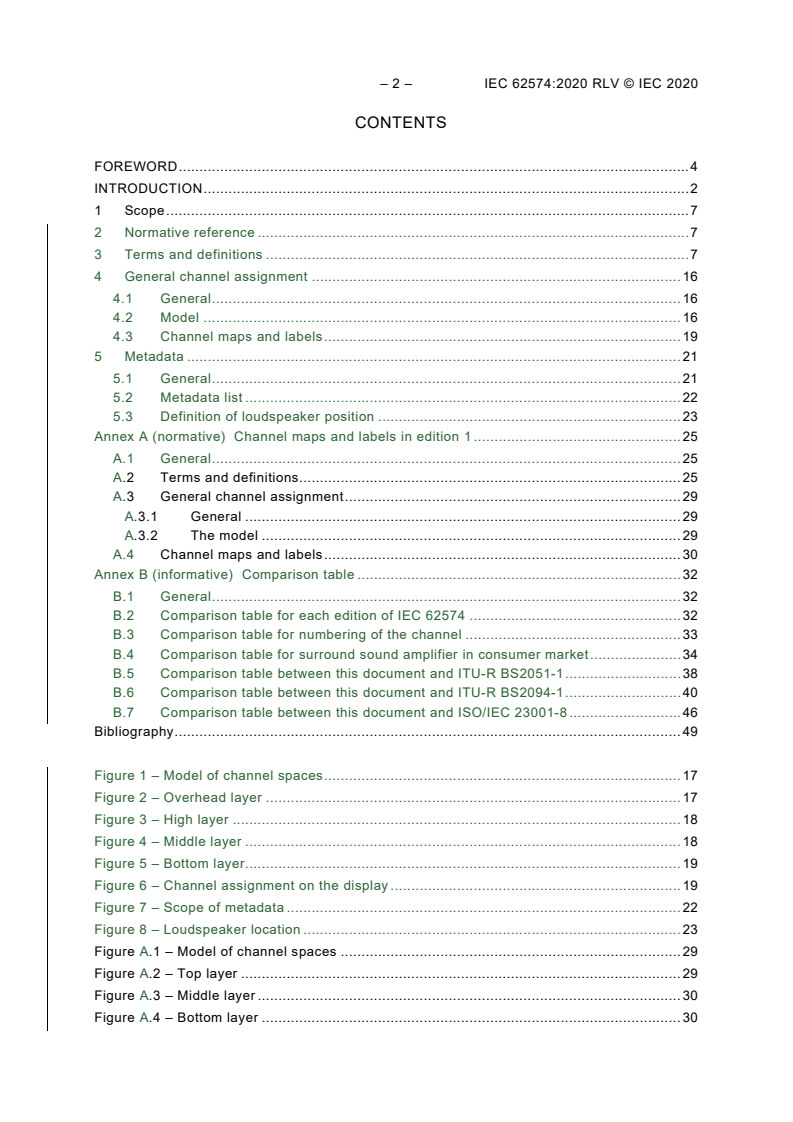
IEC 62574:2020 RLV - Audio, video and multimedia systems - General channel assignment of multichannel audio Released:1/31/2020
IEC 62574:2020 - Audio, video and multimedia systems - General channel assignment of multichannel audio Released:1/31/2020
Overview - IEC 62574:2020 (Multichannel Audio Channel Assignment)
IEC 62574:2020 defines a general channel assignment and associated metadata for multichannel audio used in consumer audio, video and multimedia systems. The standard unifies channel mapping and labelling for source devices, digital audio interfaces and sink devices (e.g., AV receivers, soundbars, source players). It is listener‑centric and room‑centric: channel positions are specified as seen from the listener. IEC 62574:2020 is a technical revision that cancels IEC 62574:2011 and introduces an updated model, revised channel maps/labels and newly specified metadata.
Key topics and technical requirements
- General channel assignment: a unified set of channel maps and labels to cover current multichannel audio formats without prescribing exact loudspeaker coordinates.
- Channel spaces (layers): conceptual layers such as overhead, high, middle, and bottom to describe vertical speaker placement relative to the listener.
- Channel maps and labels: revised definitions and numbering for consistent mapping between formats and devices. The document specifies up to 65 loudspeaker position labels and 15 display loudspeaker labels usable across formats.
- Metadata: newly specified in this edition - metadata can carry the exact position of each loudspeaker (scope and contents are defined), although the precise encoding of position values across surround formats is not itself standardized.
- Scope limitations: targeted at consumer applications (home AV, broadcast, streaming); not intended for theatrical/professional cinema positioning.
- Compatibility info: Annex A retains maps/labels from the 2011 edition; Annex B provides comparison tables with other standards.
Practical applications - who uses IEC 62574:2020
- Consumer electronics manufacturers: implement consistent channel labelling and mapping in AV receivers, soundbars, streaming devices and TVs.
- Digital audio interface developers: ensure interoperable channel ordering and metadata handling in connectors and codecs.
- Content creators & streaming services: tag multichannel content with standardized channel maps to improve reproducible playback across devices.
- AV integrators and system designers: apply a listener‑centric mapping to configure multichannel speaker systems in homes and small venues.
- Firmware and software engineers: parse and generate channel metadata to support automated speaker configuration and upmixer/downmixer behavior.
Related standards and interoperability
IEC 62574:2020 includes comparison tables (Annex B) referencing other specifications such as ITU-R BS.2051-1, ITU-R BS.2094-1 and ISO/IEC 23001-8, helping implementers map between differing channel conventions and achieve interoperability.
Keywords: IEC 62574:2020, multichannel audio, channel assignment, channel mapping, channel labels, audio metadata, loudspeaker labels, consumer audio, surround sound, digital audio interfaces.
Relations
- Effective Date
- 05-Sep-2023
Buy Documents
IEC 62574:2020 RLV - Audio, video and multimedia systems - General channel assignment of multichannel audio Released:1/31/2020
IEC 62574:2020 - Audio, video and multimedia systems - General channel assignment of multichannel audio Released:1/31/2020
Get Certified
Connect with accredited certification bodies for this standard

ANCE
Mexican certification and testing association.

Intertek Slovenia
Intertek testing, inspection, and certification services in Slovenia.

LNE (Laboratoire National de Métrologie et d'Essais)
French national laboratory for metrology and testing.
Sponsored listings
Frequently Asked Questions
IEC 62574:2020 is a standard published by the International Electrotechnical Commission (IEC). Its full title is "Audio, video and multimedia systems - General channel assignment of multichannel audio". This standard covers: IEC 62574:2020 specifies the general channel assignment and the metadata for multichannel audio format. This document, with its channel mapping and labelling content, provides the unified usage of channel assignments for source devices, digital audio interfaces and sink devices. The general channel assignment excludes the specification of the exact position of each loudspeaker. The metadata has the exact position of each loudspeaker; however, since the position of the loudspeaker is different in various surround sound formats, the position information of the metadata is not standardized. It is aimed at consumer applications; it is not targeted at theatrical environments. Up to 65 labels for loudspeaker positions and 15 labels for loudspeakers on the display are specified, which can be used for all current multichannel audio formats. The channel assignment concept is room centric and listener centric. This general channel assignment specifies the position of the loudspeaker as seen from the listener. IEC 62574:2020 cancels and replaces the first edition published in 2011. This edition constitutes a technical revision. This edition includes the following significant technical changes with respect to the previous edition: a) model of channel assignment spaces is changed; b) definition of channel maps and labels is changed; c) metadata is newly specified; d) channel maps and labels from the first edition are included in Annex A.
IEC 62574:2020 specifies the general channel assignment and the metadata for multichannel audio format. This document, with its channel mapping and labelling content, provides the unified usage of channel assignments for source devices, digital audio interfaces and sink devices. The general channel assignment excludes the specification of the exact position of each loudspeaker. The metadata has the exact position of each loudspeaker; however, since the position of the loudspeaker is different in various surround sound formats, the position information of the metadata is not standardized. It is aimed at consumer applications; it is not targeted at theatrical environments. Up to 65 labels for loudspeaker positions and 15 labels for loudspeakers on the display are specified, which can be used for all current multichannel audio formats. The channel assignment concept is room centric and listener centric. This general channel assignment specifies the position of the loudspeaker as seen from the listener. IEC 62574:2020 cancels and replaces the first edition published in 2011. This edition constitutes a technical revision. This edition includes the following significant technical changes with respect to the previous edition: a) model of channel assignment spaces is changed; b) definition of channel maps and labels is changed; c) metadata is newly specified; d) channel maps and labels from the first edition are included in Annex A.
IEC 62574:2020 is classified under the following ICS (International Classification for Standards) categories: 33.160.30 - Audio systems. The ICS classification helps identify the subject area and facilitates finding related standards.
IEC 62574:2020 has the following relationships with other standards: It is inter standard links to IEC 62574:2011. Understanding these relationships helps ensure you are using the most current and applicable version of the standard.
IEC 62574:2020 is available in PDF format for immediate download after purchase. The document can be added to your cart and obtained through the secure checkout process. Digital delivery ensures instant access to the complete standard document.
Standards Content (Sample)
IEC 62574 ®
Edition 2.0 2020-01
REDLINE VERSION
INTERNATIONAL
STANDARD
colour
inside
Audio, video and multimedia systems – General channel assignment
of multichannel audio
All rights reserved. Unless otherwise specified, no part of this publication may be reproduced or utilized in any form
or by any means, electronic or mechanical, including photocopying and microfilm, without permission in writing from
either IEC or IEC's member National Committee in the country of the requester. If you have any questions about IEC
copyright or have an enquiry about obtaining additional rights to this publication, please contact the address below or
your local IEC member National Committee for further information.
IEC Central Office Tel.: +41 22 919 02 11
3, rue de Varembé info@iec.ch
CH-1211 Geneva 20 www.iec.ch
Switzerland
About the IEC
The International Electrotechnical Commission (IEC) is the leading global organization that prepares and publishes
International Standards for all electrical, electronic and related technologies.
About IEC publications
The technical content of IEC publications is kept under constant review by the IEC. Please make sure that you have the
latest edition, a corrigendum or an amendment might have been published.
IEC publications search - webstore.iec.ch/advsearchform Electropedia - www.electropedia.org
The advanced search enables to find IEC publications by a The world's leading online dictionary on electrotechnology,
variety of criteria (reference number, text, technical containing more than 22 000 terminological entries in English
committee,…). It also gives information on projects, replaced and French, with equivalent terms in 16 additional languages.
and withdrawn publications. Also known as the International Electrotechnical Vocabulary
(IEV) online.
IEC Just Published - webstore.iec.ch/justpublished
Stay up to date on all new IEC publications. Just Published IEC Glossary - std.iec.ch/glossary
details all new publications released. Available online and 67 000 electrotechnical terminology entries in English and
once a month by email. French extracted from the Terms and Definitions clause of
IEC publications issued since 2002. Some entries have been
IEC Customer Service Centre - webstore.iec.ch/csc collected from earlier publications of IEC TC 37, 77, 86 and
If you wish to give us your feedback on this publication or CISPR.
need further assistance, please contact the Customer Service
Centre: sales@iec.ch.
IEC 62574 ®
Edition 2.0 2020-01
REDLINE VERSION
INTERNATIONAL
STANDARD
colour
inside
Audio, video and multimedia systems – General channel assignment
of multichannel audio
INTERNATIONAL
ELECTROTECHNICAL
COMMISSION
ICS 33.160.30 ISBN 978-2-8322-7839-0
– 2 – IEC 62574:2020 RLV © IEC 2020
CONTENTS
FOREWORD . 4
INTRODUCTION . 2
1 Scope . 7
2 Normative reference . 7
3 Terms and definitions . 7
4 General channel assignment . 16
4.1 General . 16
4.2 Model . 16
4.3 Channel maps and labels . 19
5 Metadata . 21
5.1 General . 21
5.2 Metadata list . 22
5.3 Definition of loudspeaker position . 23
Annex A (normative) Channel maps and labels in edition 1 . 25
A.1 General . 25
A.2 Terms and definitions. 25
A.3 General channel assignment . 29
A.3.1 General . 29
A.3.2 The model . 29
A.4 Channel maps and labels . 30
Annex B (informative) Comparison table . 32
B.1 General . 32
B.2 Comparison table for each edition of IEC 62574 . 32
B.3 Comparison table for numbering of the channel . 33
B.4 Comparison table for surround sound amplifier in consumer market . 34
B.5 Comparison table between this document and ITU-R BS2051-1 . 38
B.6 Comparison table between this document and ITU-R BS2094-1 . 40
B.7 Comparison table between this document and ISO/IEC 23001-8 . 46
Bibliography . 49
Figure 1 – Model of channel spaces . 17
Figure 2 – Overhead layer . 17
Figure 3 – High layer . 18
Figure 4 – Middle layer . 18
Figure 5 – Bottom layer. 19
Figure 6 – Channel assignment on the display . 19
Figure 7 – Scope of metadata . 22
Figure 8 – Loudspeaker location . 23
Figure A.1 – Model of channel spaces . 29
Figure A.2 – Top layer . 29
Figure A.3 – Middle layer . 30
Figure A.4 – Bottom layer . 30
Table 1 – General channel assignment . 20
Table 2 – Metadata . 23
Table 3 – Definition of loudspeaker angle . 24
Table A.1 – General channel assignment table in IEC 62574:2011 . 31
Table B.1 – Comparison table for each edition of IEC 62574 . 32
Table B.2 – Comparison table for numbering of the channel . 33
Table B.3 – Comparison table for surround sound amplifier in consumer market (1 of 3) . 34
Table B.4 – Comparison table between this document and ITU-R BS2051-1 (1 of 2) . 38
Table B.5 – Comparison table between this document and ITU-R BS2094-1 (1 of 6) . 40
Table B.6 – Comparison table between this document and ISO/IEC 23001-8 (1 of 3) . 46
– 4 – IEC 62574:2020 RLV © IEC 2020
INTERNATIONAL ELECTROTECHNICAL COMMISSION
____________
AUDIO, VIDEO AND MULTIMEDIA SYSTEMS –
GENERAL CHANNEL ASSIGNMENT OF MULTICHANNEL AUDIO
FOREWORD
1) The International Electrotechnical Commission (IEC) is a worldwide organization for standardization comprising all
national electrotechnical committees (IEC National Committees). The object of IEC is to promote international co-
operation on all questions concerning standardization in the electrical and electronic fields. To this end and in
addition to other activities, IEC publishes International Standards, Technical Specifications, Technical Reports,
Publicly Available Specifications (PAS) and Guides (hereafter referred to as “IEC Publication(s)”). Their preparation
is entrusted to technical committees; any IEC National Committee interested in the subject dealt with may
participate in this preparatory work. International, governmental and non-governmental organizations liaising with
the IEC also participate in this preparation. IEC collaborates closely with the International Organization for
Standardization (ISO) in accordance with conditions determined by agreement between the two organizations.
2) The formal decisions or agreements of IEC on technical matters express, as nearly as possible, an international
consensus of opinion on the relevant subjects since each technical committee has representation from all interested
IEC National Committees.
3) IEC Publications have the form of recommendations for international use and are accepted by IEC National
Committees in that sense. While all reasonable efforts are made to ensure that the technical content of IEC
Publications is accurate, IEC cannot be held responsible for the way in which they are used or for any
misinterpretation by any end user.
4) In order to promote international uniformity, IEC National Committees undertake to apply IEC Publications
transparently to the maximum extent possible in their national and regional publications. Any divergence between
any IEC Publication and the corresponding national or regional publication shall be clearly indicated in the latter.
5) IEC itself does not provide any attestation of conformity. Independent certification bodies provide conformity
assessment services and, in some areas, access to IEC marks of conformity. IEC is not responsible for any services
carried out by independent certification bodies.
6) All users should ensure that they have the latest edition of this publication.
7) No liability shall attach to IEC or its directors, employees, servants or agents including individual experts and
members of its technical committees and IEC National Committees for any personal injury, property damage or
other damage of any nature whatsoever, whether direct or indirect, or for costs (including legal fees) and expenses
arising out of the publication, use of, or reliance upon, this IEC Publication or any other IEC Publications.
8) Attention is drawn to the Normative references cited in this publication. Use of the referenced publications is
indispensable for the correct application of this publication.
9) Attention is drawn to the possibility that some of the elements of this IEC Publication may be the subject of patent
rights. IEC shall not be held responsible for identifying any or all such patent rights.
This redline version of the official IEC Standard allows the user to identify the changes
made to the previous edition. A vertical bar appears in the margin wherever a change has
been made. Additions are in green text, deletions are in strikethrough red text.
International Standard IEC 62574 has been prepared by technical area 20 of IEC technical
committee 100: Audio, video and multimedia systems and equipment.
This second edition cancels and replaces the first edition published in 2011. This edition
constitutes a technical revision.
This edition includes the following significant technical changes with respect to the previous
edition:
a) model of channel assignment spaces is changed;
b) definition of channel maps and labels is changed;
c) metadata is newly specified;
d) channel maps and labels from the first edition are included in Annex A.
The text of this International Standard is based on the following documents:
CDV Report on voting
100/3198/CDV 100/3246/RVC
Full information on the voting for the approval of this International Standard can be found in the
report on voting indicated in the above table.
This document has been drafted in accordance with the ISO/IEC Directives, Part 2.
The committee has decided that the contents of this document will remain unchanged until the
stability date indicated on the IEC website under "http://webstore.iec.ch" in the data related to
the specific document. At this date, the document will be
• reconfirmed,
• withdrawn,
• replaced by a revised edition, or
• amended.
IMPORTANT – The 'colour inside' logo on the cover page of this publication indicates
that it contains colours which are considered to be useful for the correct understanding
of its contents. Users should therefore print this document using a colour printer.
– 6 – IEC 62574:2020 RLV © IEC 2020
INTRODUCTION
There are many multichannel audio formats and there will be new formats. These formats have
a specific channel assignment, such as a channel mapping and channel labels, but the basic
channel assignments are not so different from each other. These can be unified to one common
channel assignment as the general channel assignment. This general channel assignment
provides audio devices and digital audio interfaces with the usage of unified channel assignments
for any multichannel audio formats. This second edition provides consistency with various
standards. The channel names have changed in this second edition; the differences are shown
in Annex B. Since there are standards that refer to the first edition of this document (see
Clause A.1), IEC 62574:2011 (the first edition) is cited at length in Annex A. The first edition
(IEC 62574:2011) and the second edition (this document) can be distinguished by the numbering
of the channels.
AUDIO, VIDEO AND MULTIMEDIA SYSTEMS –
GENERAL CHANNEL ASSIGNMENT OF MULTICHANNEL AUDIO
1 Scope
This document specifies the general channel assignment and the metadata for multichannel
audio formats. The general channel assignment as a This document, with its channel mapping
and labelling content, provides the unified usage of channel assignments for source devices,
digital audio interfaces and sink devices. This standard The general channel assignment
excludes the specification of the exact position of each loudspeaker. The metadata has the exact
position of each loudspeaker; however, since the position of the loudspeaker is different in
various surround sound formats, the position information of the metadata is not standardized. It
is aimed at consumer applications, but; it is not targeted at theatrical environments. Up to 32 65
labels for loudspeaker positions and 15 labels for loudspeakers on the display are specified,
which can be used for all current multichannel audio formats. The channel assignment concept
is room centric and listener centric. This general channel assignment specifies the position of the
loudspeaker as seen from the listener.
2 Normative reference
There are no normative references in this document.
3 Terms and definitions
For the purposes of this document, the following terms and definitions apply.
ISO and IEC maintain terminological databases for use in standardization at the following
addresses:
• IEC Electropedia: available at http://www.electropedia.org/
• ISO Online browsing platform: available at http://www.iso.org/obp
3.1
overhead layer
loudspeaker-layer located vertically above the high layer, nominally near or on the ceiling
(overhead), labelled beginning with the letter designation "Oh"
3.2
high layer
loudspeaker-layer located vertically below the overhead layer and above the middle layer,
nominally located above the screen, or near the ceiling, labelled beginning with the letter
designation "H"
3.3
middle layer
loudspeaker-layer located nominally in the vertical plane at height of the listeners ears, or
alternatively at the centre of the screen, whose labels do not carry a letter designation
3.4
bottom layer
loudspeaker-layer located nominally below the screen, or near the floor, labelled beginning with
the letter designation "Bt"
– 8 – IEC 62574:2020 RLV © IEC 2020
3.5
front left
FL
loudspeaker position located at the front left in the middle layer
Note 1 to entry: This note applies to the French language only.
3.6
front right
FR
loudspeaker position located at the front right in the middle layer
Note 1 to entry: This note applies to the French language only.
3.7
front centre
FC
loudspeaker position located at frontal centre in the middle layer, or alternatively corresponding
to the centre of the screen, as viewed from the seating area
Note 1 to entry: This note applies to the French language only.
3.8
low-frequency effects
LFE
sound effects in the low-frequency band, generally below 120 Hz; the LFE channel is not used
as a subwoofer channel to compensate for the low-frequency band of each loudspeaker
Note 1 to entry: When mono LFE is used, it is conveyed in the LFE channel and the LFE loudspeaker's position at
the bottom layer is not defined.
Note 2 to entry: This note applies to the French language only.
3.9
left surround
LS
loudspeaker position located at the left side slightly behind the listener in the middle layer
Note 1 to entry: This note applies to the French language only.
3.10
right surround
RS
loudspeaker position located at the right side slightly behind the listener in the middle layer
Note 1 to entry: This note applies to the French language only.
3.11
front left centre
FLc
loudspeaker position located at the front left of centre in the middle layer
Note 1 to entry: This note applies to the French language only.
3.12
front right centre
FRc
loudspeaker position located at the front right of centre in the middle layer
Note 1 to entry: This note applies to the French language only.
3.13
back centre
BC
loudspeaker position located at centre back in the middle layer
Note 1 to entry: This note applies to the French language only.
3.14
low-frequency effects 1
LFE1
LFE loudspeaker position located at the bottom layer and normally far left front
Note 1 to entry: This note applies to the French language only.
3.15
side left
SiL
loudspeaker position located on the left side in the middle layer
Note 1 to entry: This note applies to the French language only.
3.16
side right
SiR
loudspeaker position located on the right side in the middle layer
Note 1 to entry: This note applies to the French language only.
3.17
high front left
HFL
loudspeaker position located at the front left in the high layer
Note 1 to entry: This note applies to the French language only.
3.18
high front right
HFR
loudspeaker position located at the front right in the high layer
Note 1 to entry: This note applies to the French language only.
3.19
high front centre
HFC
loudspeaker position located at front centre in the high layer
Note 1 to entry: This note applies to the French language only.
3.20
overhead centre
OhC
loudspeaker position located at the centre in the overhead layer directly above the seating area
Note 1 to entry: This note applies to the French language only.
3.21
high left surround
HLS
loudspeaker position located at the left slightly behind the listener in the high layer
Note 1 to entry: This note applies to the French language only.
– 10 – IEC 62574:2020 RLV © IEC 2020
3.22
high right surround
HRS
loudspeaker position located at the right slightly behind the listener in the high layer
Note 1 to entry: This note applies to the French language only.
3.23
high side left
HSiL
loudspeaker position located on the left side in the high layer
Note 1 to entry: This note applies to the French language only.
3.24
high side right
HSiR
loudspeaker position located on the right side in the high layer
Note 1 to entry: This note applies to the French language only.
3.25
high back centre
HBC
loudspeaker position located at centre back in the high layer
Note 1 to entry: This note applies to the French language only.
3.26
bottom front centre
BtFC
loudspeaker position located at centre front in the bottom layer
Note 1 to entry: This note applies to the French language only.
3.27
bottom front left middle
BtFLmid
loudspeaker position located at the front left in the bottom layer
Note 1 to entry: This note applies to the French language only.
3.28
bottom front right middle
BtFRmid
loudspeaker position located at the front right in the bottom layer
Note 1 to entry: This note applies to the French language only.
3.29
front left wide
FLw
loudspeaker position located at the front far left in the middle layer
Note 1 to entry: This note applies to the French language only.
3.30
front right wide
FRw
loudspeaker position located at the far front right in the middle layer
Note 1 to entry: This note applies to the French language only.
3.31
back left
BL
loudspeaker position located at the back left in the middle layer
Note 1 to entry: This note applies to the French language only.
3.32
back right
BR
loudspeaker position located at the back right in the middle layer
Note 1 to entry: This note applies to the French language only.
3.33
left back surround
LBS
loudspeaker position located halfway between LS and BL in the middle layer
Note 1 to entry: This note applies to the French language only.
3.34
right back surround
RBS
loudspeaker position located halfway between RS and BR in the middle layer
Note 1 to entry: This note applies to the French language only.
3.35
high back left
HBL
loudspeaker position located at the back left in the high layer
Note 1 to entry: This note applies to the French language only.
3.36
high back right
HBR
loudspeaker position located at the back right in the high layer
Note 1 to entry: This note applies to the French language only.
3.37
high front left wide
HFLw
loudspeaker position located at the front far left in the high layer
Note 1 to entry: This note applies to the French language only.
3.38
high front Right wide
HFRw
loudspeaker position located at the far front right in the high layer
Note 1 to entry: This note applies to the French language only.
3.39
overhead front left
OhFL
loudspeaker position located at the front left in the overhead layer
Note 1 to entry: This note applies to the French language only.
– 12 – IEC 62574:2020 RLV © IEC 2020
3.40
overhead front right
OhFR
loudspeaker position located at the front right in the overhead layer
Note 1 to entry: This note applies to the French language only.
3.41
overhead side left
OhSiL
loudspeaker position located on the left side in the overhead layer
Note 1 to entry: This note applies to the French language only.
3.42
overhead side right
OhSiR
loudspeaker position located on the right side in the overhead layer
Note 1 to entry: This note applies to the French language only.
3.43
overhead back left
OhBL
loudspeaker position located at the back left in the overhead layer
Note 1 to entry: This note applies to the French language only.
3.44
overhead back right
OhBR
loudspeaker position located at the back right in the overhead layer
Note 1 to entry: This note applies to the French language only.
3.45
high front left middle
HFLmid
loudspeaker position located at the front left middle in the high layer
Note 1 to entry: This note applies to the French language only.
3.46
high front right middle
HFRmid
loudspeaker position located at the front right middle in the high layer
Note 1 to entry: This note applies to the French language only.
3.47
high back left middle
HBLmid
loudspeaker position located at the back left middle in the high layer
Note 1 to entry: This note applies to the French language only.
3.48
high back right middle
HBRmid
loudspeaker position located at the back right middle in the high layer
Note 1 to entry: This note applies to the French language only.
3.49
front left middle
FLmid
loudspeaker position located at the front left middle in the middle layer
Note 1 to entry: This note applies to the French language only.
3.50
front right middle
FRmid
loudspeaker position located at the front right middle in the middle layer
Note 1 to entry: This note applies to the French language only.
3.51
back left middle
BLmid
loudspeaker position located at the back left middle in the middle layer
Note 1 to entry: This note applies to the French language only.
3.52
back right middle
BRmid
loudspeaker position located at the back right middle in the middle layer
Note 1 to entry: This note applies to the French language only.
3.53
low frequency effects 2
LFE2
LFE loudspeaker position located at the bottom layer and normally far right front, when LFE1 is
used
Note 1 to entry: This note applies to the French language only.
3.54
overhead back centre
OhBC
loudspeaker position located at the back centre in the overhead layer
Note 1 to entry: This note applies to the French language only.
3.55
display left
DL
loudspeaker position located at the left edge of the middle level on display
Note 1 to entry: This note applies to the French language only.
3.56
display right
DR
loudspeaker position located at the right edge of the middle level on display
Note 1 to entry: This note applies to the French language only.
3.57
display left centre
DLc
loudspeaker position located halfway between the centre of the display and the left edge of the
middle level on display
– 14 – IEC 62574:2020 RLV © IEC 2020
Note 1 to entry: This note applies to the French language only.
3.58
display right centre
DRc
loudspeaker position located halfway between the centre of the display and the right edge of the
middle level on display
Note 1 to entry: This note applies to the French language only.
3.59
display centre
DC
loudspeaker position located at the centre of the display
Note 1 to entry: This note applies to the French language only.
3.60
high display left
HDL
loudspeaker position located at the left edge of the high level on the display
Note 1 to entry: This note applies to the French language only.
3.61
high display right
HDR
loudspeaker position located at the right edge of the high level on the display
Note 1 to entry: This note applies to the French language only.
3.62
high display left centre
HDLc
loudspeaker position located halfway between the centre of the display and the left edge of the
high level on the display
Note 1 to entry: This note applies to the French language only.
3.63
high display right centre
HDRc
loudspeaker position located halfway between the centre of the display and the right edge of the
high level on the display
Note 1 to entry: This note applies to the French language only.
3.64
high display centre
HDC
loudspeaker position located at the centre of the high level on the display
Note 1 to entry: This note applies to the French language only.
3.65
bottom display left
BtDL
loudspeaker position located at the left edge of the bottom level on the display
Note 1 to entry: This note applies to the French language only.
3.66
bottom display right
BtDR
loudspeaker position located at the right edge of the bottom level on the display
Note 1 to entry: This note applies to the French language only.
3.67
bottom display left centre
BtDLc
loudspeaker position located halfway between the centre of the display and left edge of the
bottom level on display
Note 1 to entry: This note applies to the French language only.
3.68
bottom display right centre
BtDRc
loudspeaker position located halfway between the centre of the display and the right edge of the
bottom level on the display
Note 1 to entry: This note applies to the French language only.
3.69
bottom display centre
BtDC
loudspeaker position located at the centre of the bottom level on the display
Note 1 to entry: This note applies to the French language only.
3.70
channel assignment
assignment of multichannel audio format including speaker configuration, loudspeaker setup,
channel name, channel label, channel ID, and channel order for transmission and recording
Note 1 to entry: The channel assignment excludes the specification of the exact position of each loudspeaker.
3.71
channel assignment on display
channel assignment for loudspeakers on the screen
Note 1 to entry: "Loudpeaker on screen" is defined as "on display".
3.72
channel number
numbering of each channel
3.73
channel label ID
label of ID
3.74
speaker configuration
information about number of overhead speakers, number of high speakers, number of middle
speakers, number of bottom speakers and number of LFE speakers
Note 1 to entry: "Speaker” and "speaker configuration" both mean loudspeaker.
Note 2 to entry: Examples of speaker configuration: stereo is described as 0.0.2.0.0, 5.1ch as 0.0.5.0.1 and 22.2ch
as 1.8.10.3.2.
– 16 – IEC 62574:2020 RLV © IEC 2020
3.75
loudspeaker position
information of loudspeaker position shown by azimuth, elevation and distance
3.76
direction of loudspeaker
centre direction of response pattern indicated by azimuth and tilt
3.77
directional response pattern
directional response pattern for loudspeaker
Note 1 to entry: Refer to IEC 60268-5.
3.78
frequency range
span from the lowest frequency to the highest frequency over which a loudspeaker is, or should
be, capable of satisfactory sound reproduction
3.79
subwoofer
loudspeaker for low-frequency sound reproduction
3.80
dialogue
information for commentary (speech)
3.81
screen
surface on which a picture appears, located in front of the listener in the middle layer
4 General channel assignment
4.1 General
The channel assignment specifies the channels of multichannel audio; the loudspeaker
assignment specifies the geometrical positions of the loudspeaker.
4.2 Model
Figure 1 shows the model of channel assignment spaces with the four layers, and a listener is
located in the centre of the bottom layer. The middle layer is located at the vertical centre of the
picture screen or, alternatively, at the same height as the height of a listener’s ear.
This model specifies the general channel assignments in these four layers, which are the
overhead layer, the high layer, the middle layer and the bottom layer. Each layer specifies
channels in its layer.
Figure 1 – Model of channel spaces
Figure 2 shows the overhead layer with its channel assignments, Figure 3 shows the high layer
with its channel assignments, Figure 4 shows the middle layer with its channel assignments,
Figure 5 shows the bottom layer with its channel assignments, and Figure 6 shows the channel
assignments on the display.
Figure 2 – Overhead layer
– 18 – IEC 62574:2020 RLV © IEC 2020
Figure 3 – High layer
Figure 4 – Middle layer
Figure 5 – Bottom layer
Figure 6 – Channel assignment on the display
4.3 Channel maps and labels
Table 1 shows the definition of channel maps and labels of the general channel assignments.
The channel label has an ID name as an abbreviation label for each channel label. Each name
is case sensitive.
– 20 – IEC 62574:2020 RLV © IEC 2020
Table 1 – General channel assignment
Channel Channel label ID
Layer Full name of ID
number name
Middle 65 FL Front left
Middle 66 FR Front right
Middle 67 FC Front centre
Bottom 68 LFE Low frequency effects
Middle 69 LS Left surround
Middle 70 RS Right surround
Middle 71 FLc Front left centre
Middle 72 FRc Front right centre
Middle 73 BC Back centre
Bottom 74 LFE1 Low frequency effects-1
Middle 75 SiL Side left
Middle 76 SiR Side right
High 77 HFL High front left
High 78 HFR High front right
High 79 HFC High front centre
Overhead 80 OhC Overhead centre
High 81 HLS High left surround
High 82 HRS High right surround
High 83 HSiL High side left
High 84 HSiR High side right
High 85 HBC High back centre
Bottom 86 BtFC Bottom front centre
Bottom 87 BtFLmid Bottom front left middle
Bottom 88 BtFRmid Bottom front right middle
Middle 89 FLw Front left wide
Middle 90 FRw Front right wide
Middle 91 BL Back left
Middle 92 BR Back right
Middle 93 LBS Left back surround
Middle 94 RBS Right back surround
High 95 HBL High back left
High 96 HBR High back right
High 97 HFLw High front left wide
High 98 HFRw High front right wide
Overhead 99 OhFL Overhead front left
Overhead 100 OhFR Overhead front right
Overhead 101 OhSiL Overhead side left
Overhead 102 OhSiR Overhead side right
Overhead 103 OhBL Overhead back left
Overhead 104 OhBR Overhead back right
High 105 HFLmid High front left middle
High 106 HFRmid High front right middle
Channel Channel label ID
Layer Full name of ID
number name
High 107 HBLmid High Back left middle
High 108 HBRmid High front right wide
Middle 109 FLmid Front left middle
Middle 110 FRmid Front right middle
Middle 111 BLmid Back left middle
Middle 112 BRmid Back right middle
Bottom 113 LFE2 Low frequency effects-2
Overhead 114 OhBC Overhead back centre
Channel assignment on the display
Display 151 DL Display left
Display 152 DR Display right
Display 153 DLc Display left centre
Display 154 DRc Display right centre
Display 155 DC Display centre
Display 156 HDL High display left
Display 157 HDR High display right
Display 158 HDLc High display left centre
Display 159 HDRc High display right centre
Display 160 HDC High display centre
Display 161 BtDL Bottom display left
Display 162 BtDR Bottom display right
Display 163 BtDLc Bottom display left centre
Display 164 BtDRc Bottom display right centre
Display 165 BtDC Bottom display centre
NOTE Many multichannel audio formats have the original channel name. They are not
same as each format. Table B.1 shows a comparison chart with the channel name
of IEC 62574:2011.
5 Metadata
5.1 General
Metadata carries information on the speaker configuration of the multichannel audio format and
other necessary information to reproduce its audio signal properly. The scope of metadata does
not include the information of the rendering and the broadcast. If the manufacturer adds metadata
to the rendered signal, it is possible to obtain correct channel information for post processing.
For example, if the optional virtual surround system can obtain correct speaker information for
the rendered signal, correct compatibility is obtained (see Figure 7a). If there is accurate speaker
position information, the ideal reproduced sound can be rendered (see Figure 7b).
– 22 – IEC 62574:2020 RLV © IEC 2020
a) Information for channel assignment
b) Information of the location for loudspeaker
Figure 7 – Scope of metadata
5.2 Metadata list
The specification of metadata is shown in Table 2.
Table 2 – Metadata
Metadata Contents Unit
Channel number Number number
Channel label ID Name ASCII
Speaker configuration Overhead speaker Quantity
e.g. Stereo is described as
High speakers Quantity
0.0.2.0.0, 5.1ch as 0.0.5.0.1 and
22.2ch as 1.8.10.3.2
Middle speakers Quantity
Bottom speakers Quantity
Subwoofer (LFE) Quantity
Loudspeaker position Azimuth degree
Elevation degree
Distance cm
Source or Sink ASCII
Direction of loudspeaker Rotation degree
Tilt degree
Directional response pattern degree
Frequency range Low-end frequency Hz
High-end frequency Hz
Dialogue Source Commentary
LFE LFE playback level dB
5.3 Definition of loudspeaker position
Measurement of loudspeaker shall be done as shown in Figure 8. The actual loudspeaker
position is indicated by azimuth, elevation and tilt. The value shows metadata in loudspeaker
position and direction of loudspeaker. Definition of loudspeaker angle is shown in Table 3, and
this table shows the range of each angle.
Figure 8 – Loudspeaker location
– 24 – IEC 62574:2020 RLV © IEC 2020
Table 3 – Definition of loudspeaker angle
Loudspeaker position Direction of loudspeaker
right→plus 0 → +180° right → plus 0 → +90°
Azimuth Rotation
left → minus 0 → −180° left → minus 0 → −90°
up → plus 0 → +180° push → plus 0 → +90°
Elevation Tilt
down → minus 0 → −90° pull → minus 0 → −90°
Annex A
(normative)
Channel maps and labels in edition 1
A.1 General
Many standards used the channel maps and labels in IEC 62574:2011. However, there are cases
where BL, BR and LS, RS are used in reverse from other standards. Channel numbers 1 to 32
are referred to in IEC 62574:2011. Clauses A.2 and A.3 are copied from IEC 62574:2011.
NOTE 1 This document is consistent with 5.1 specified by ITU-R BS.775-3 and maintains legacy compatibility. BL,
BR and LS, LR of IEC 62574:2011 are different from ITU-R BS.775-3. In this document, BL, BR and LS, LR were
placed in the same position as ITU-R BS.775-3.
NOTE 2 The following standards refer to IEC 62574:2011.
– ARIB STD-B59, ISO/IEC 23001-8, ITU-R BS.2159-7
– The Institute of Image Information and Television Engineers; Standard test materials for three-dimensional
multichannel stereophonic sound system - Series A
A.2 Terms and definitions
For the purposes of this document, the following terms and definitions apply.
NOTE The general sequence of position labels is used: height, front/back, left/centre/right. Absence of a height letter
indicates the middle layer. The other two planes are always indicated. See also Table A.1.
A.2.1
top layer
top (highest) layer of three loudspeaker layers located at the top of the screen, alternatively at
the top of the room; loudspeaker channels of the top layer are annotated with the letters Tp
A.2.2
middle layer
middle layer of three loudspeaker layers located at the vertical centre of the TV screen,
alternatively at the same height as the height of viewer’s ear
A.2.3
bottom layer
bottom (lowest) layer of three loudspeaker layers located at the bottom of the TV screen,
alternatively at floor level of the room; loudspeaker channels of the bottom layer are annotated
with the letters Bt
A.2.4
front left
FL
loudspeaker position located at far left and centred vertically of the middle layer
A.2.5
front right
FR
loudspeaker position located at far right and centred vertically of the middle layer
– 26 – IEC 62574:2020 RLV © IEC 2020
A.2.6
front centre
FC
loudspeaker position located in the middle layer corresponding to the centre of the TV screen,
as viewed from the seating area
A.2.7
low frequency effects
LFE
carry only sound effects in low-frequency band, generally below 120 Hz; the LFE channel is not
used as a subwoofer channel to compesate for the low-frequency band of each loudspeaker
A.2.8
low frequency effects 1
LFE1
LFE loudspeaker position located at the bottom layer
Note 1 to entry: When mono LFE is used, it is conveyed in the LFE1 channel and the LFE1 loudspeaker position at
the bottom layer is not defined. When LFE2 is also used, the LFE1 loudspeaker position is normally located far left
front at the bottom layer.
A.2.9
back left
BL
loudspeaker position located at far left back of the middle layer
A.2.10
back right
BR
loudspeaker position located at far right back of the middle layer
A.2.11
front left centre
FLc
loudspeaker position located mid-way between the front centre and front left of the middle layer
A.2.12
front right centre
FRc
loudspeaker position located mid-way between the front centre and front right of the middle layer
A.2.13
back centre
BC
loudspeaker position located at centre back of the middle layer
A.2.14
low frequency effects 2
LFE2
LFE loudspeaker position located at the bottom layer and normally far right front, when LFE1 is
used
A.2.15
side left
SiL
loudspeaker position located on the left of the middle layer
A.2.16
side right
SiR
loudspeaker position located on the right of the middle layer
A.2.17
top front left
TpFL
loudspeaker position located at far left front of the top layer
A.2.18
top front right
TpFR
loudspeaker position located at far right front of the top layer
A.2.19
top front centre
TpFC
loudspeaker position located at centre front of the top layer
A.2.20
top centre
TpC
loudspeaker position located at the centre of the top layer directly above the seating area
A.2.21
top back left
TpBL
loudspeaker position located at far left back of the top layer
A.2.22
top back right
TpBR
loudspeaker position located at far right back of the top layer
A.2.23
top side left
TpSiL
loudspeaker position located on the left of the top layer
A.2.24
top side right
TpSiR
loudspeaker position located on the right of the top layer
A.2.25
top back centre
TpBC
loudspeaker position located at centre back of the top layer
A.2.26
bottom front centre
BtFC
loudspeaker position located at centre front of the bottom layer
– 28 – IEC 62574:2020 RLV © IEC 2020
A
...
IEC 62574 ®
Edition 2.0 2020-01
INTERNATIONAL
STANDARD
NORME
INTERNATIONALE
Audio, video and multimedia systems – General channel assignment
of multichannel audio
Systèmes audio, vidéo et multimédia – Affectation générale des voies
des systèmes audio à voies multiples
All rights reserved. Unless otherwise specified, no part of this publication may be reproduced or utilized in any form
or by any means, electronic or mechanical, including photocopying and microfilm, without permission in writing from
either IEC or IEC's member National Committee in the country of the requester. If you have any questions about IEC
copyright or have an enquiry about obtaining additional rights to this publication, please contact the address below or
your local IEC member National Committee for further information.
Droits de reproduction réservés. Sauf indication contraire, aucune partie de cette publication ne peut être reproduite
ni utilisée sous quelque forme que ce soit et par aucun procédé, électronique ou mécanique, y compris la photocopie
et les microfilms, sans l'accord écrit de l'IEC ou du Comité national de l'IEC du pays du demandeur. Si vous avez des
questions sur le copyright de l'IEC ou si vous désirez obtenir des droits supplémentaires sur cette publication, utilisez
les coordonnées ci-après ou contactez le Comité national de l'IEC de votre pays de résidence.
IEC Central Office Tel.: +41 22 919 02 11
3, rue de Varembé info@iec.ch
CH-1211 Geneva 20 www.iec.ch
Switzerland
About the IEC
The International Electrotechnical Commission (IEC) is the leading global organization that prepares and publishes
International Standards for all electrical, electronic and related technologies.
About IEC publications
The technical content of IEC publications is kept under constant review by the IEC. Please make sure that you have the
latest edition, a corrigendum or an amendment might have been published.
IEC publications search - webstore.iec.ch/advsearchform Electropedia - www.electropedia.org
The advanced search enables to find IEC publications by a The world's leading online dictionary on electrotechnology,
variety of criteria (reference number, text, technical containing more than 22 000 terminological entries in English
committee,…). It also gives information on projects, replaced and French, with equivalent terms in 16 additional languages.
and withdrawn publications. Also known as the International Electrotechnical Vocabulary
(IEV) online.
IEC Just Published - webstore.iec.ch/justpublished
Stay up to date on all new IEC publications. Just Published IEC Glossary - std.iec.ch/glossary
details all new publications released. Available online and 67 000 electrotechnical terminology entries in English and
once a month by email. French extracted from the Terms and Definitions clause of
IEC publications issued since 2002. Some entries have been
IEC Customer Service Centre - webstore.iec.ch/csc collected from earlier publications of IEC TC 37, 77, 86 and
If you wish to give us your feedback on this publication or CISPR.
need further assistance, please contact the Customer Service
Centre: sales@iec.ch.
A propos de l'IEC
La Commission Electrotechnique Internationale (IEC) est la première organisation mondiale qui élabore et publie des
Normes internationales pour tout ce qui a trait à l'électricité, à l'électronique et aux technologies apparentées.
A propos des publications IEC
Le contenu technique des publications IEC est constamment revu. Veuillez vous assurer que vous possédez l’édition la
plus récente, un corrigendum ou amendement peut avoir été publié.
Recherche de publications IEC - Electropedia - www.electropedia.org
webstore.iec.ch/advsearchform Le premier dictionnaire d'électrotechnologie en ligne au
La recherche avancée permet de trouver des publications IEC monde, avec plus de 22 000 articles terminologiques en
en utilisant différents critères (numéro de référence, texte, anglais et en français, ainsi que les termes équivalents dans
comité d’études,…). Elle donne aussi des informations sur les 16 langues additionnelles. Egalement appelé Vocabulaire
projets et les publications remplacées ou retirées. Electrotechnique International (IEV) en ligne.
IEC Just Published - webstore.iec.ch/justpublished Glossaire IEC - std.iec.ch/glossary
Restez informé sur les nouvelles publications IEC. Just 67 000 entrées terminologiques électrotechniques, en anglais
Published détaille les nouvelles publications parues. et en français, extraites des articles Termes et Définitions des
Disponible en ligne et une fois par mois par email. publications IEC parues depuis 2002. Plus certaines entrées
antérieures extraites des publications des CE 37, 77, 86 et
Service Clients - webstore.iec.ch/csc CISPR de l'IEC.
Si vous désirez nous donner des commentaires sur cette
publication ou si vous avez des questions contactez-nous:
sales@iec.ch.
IEC 62574 ®
Edition 2.0 2020-01
INTERNATIONAL
STANDARD
NORME
INTERNATIONALE
Audio, video and multimedia systems – General channel assignment
of multichannel audio
Systèmes audio, vidéo et multimédia – Affectation générale des voies
des systèmes audio à voies multiples
INTERNATIONAL
ELECTROTECHNICAL
COMMISSION
COMMISSION
ELECTROTECHNIQUE
INTERNATIONALE
ICS 33.160.30 ISBN 978-2-8322-7762-1
– 2 – IEC 62574:2020 © IEC 2020
CONTENTS
FOREWORD . 4
INTRODUCTION . 6
1 Scope . 7
2 Normative reference . 7
3 Terms and definitions . 7
4 General channel assignment . 16
4.1 General . 16
4.2 Model . 16
4.3 Channel maps and labels . 19
5 Metadata . 21
5.1 General . 21
5.2 Metadata list . 22
5.3 Definition of loudspeaker position . 23
Annex A (normative) Channel maps and labels in edition 1 . 25
A.1 General . 25
A.2 Terms and definitions. 25
A.3 General channel assignment . 29
A.3.1 General . 29
A.3.2 The model . 29
A.4 Channel maps and labels . 30
Annex B (informative) Comparison table . 32
B.1 General . 32
B.2 Comparison table for each edition of IEC 62574 . 32
B.3 Comparison table for numbering of the channel . 33
B.4 Comparison table for surround sound amplifier in consumer market . 34
B.5 Comparison table between this document and ITU-R BS2051-1 . 38
B.6 Comparison table between this document and ITU-R BS2094-1 . 40
B.7 Comparison table between this document and ISO/IEC 23001-8 . 46
Bibliography . 49
Figure 1 – Model of channel spaces . 17
Figure 2 – Overhead layer . 17
Figure 3 – High layer . 18
Figure 4 – Middle layer . 18
Figure 5 – Bottom layer. 19
Figure 6 – Channel assignment on the display . 19
Figure 7 – Scope of metadata . 22
Figure 8 – Loudspeaker location . 23
Figure A.1 – Model of channel spaces . 29
Figure A.2 – Top layer . 29
Figure A.3 – Middle layer . 30
Figure A.4 – Bottom layer . 30
Table 1 – General channel assignment . 20
Table 2 – Metadata . 23
Table 3 – Definition of loudspeaker angle . 24
Table A.1 – General channel assignment table in IEC 62574:2011 . 31
Table B.1 – Comparison table for each edition of IEC 62574 . 32
Table B.2 – Comparison table for numbering of the channel . 33
Table B.3 – Comparison table for surround sound amplifier in consumer market (1 of 3) . 34
Table B.4 – Comparison table between this document and ITU-R BS2051-1 (1 of 2) . 38
Table B.5 – Comparison table between this document and ITU-R BS2094-1 (1 of 6) . 40
Table B.6 – Comparison table between this document and ISO/IEC 23001-8 (1 of 3) . 46
– 4 – IEC 62574:2020 © IEC 2020
INTERNATIONAL ELECTROTECHNICAL COMMISSION
____________
AUDIO, VIDEO AND MULTIMEDIA SYSTEMS –
GENERAL CHANNEL ASSIGNMENT OF MULTICHANNEL AUDIO
FOREWORD
1) The International Electrotechnical Commission (IEC) is a worldwide organization for standardization comprising all
national electrotechnical committees (IEC National Committees). The object of IEC is to promote international co-
operation on all questions concerning standardization in the electrical and electronic fields. To this end and in
addition to other activities, IEC publishes International Standards, Technical Specifications, Technical Reports,
Publicly Available Specifications (PAS) and Guides (hereafter referred to as “IEC Publication(s)”). Their preparation
is entrusted to technical committees; any IEC National Committee interested in the subject dealt with may
participate in this preparatory work. International, governmental and non-governmental organizations liaising with
the IEC also participate in this preparation. IEC collaborates closely with the International Organization for
Standardization (ISO) in accordance with conditions determined by agreement between the two organizations.
2) The formal decisions or agreements of IEC on technical matters express, as nearly as possible, an international
consensus of opinion on the relevant subjects since each technical committee has representation from all interested
IEC National Committees.
3) IEC Publications have the form of recommendations for international use and are accepted by IEC National
Committees in that sense. While all reasonable efforts are made to ensure that the technical content of IEC
Publications is accurate, IEC cannot be held responsible for the way in which they are used or for any
misinterpretation by any end user.
4) In order to promote international uniformity, IEC National Committees undertake to apply IEC Publications
transparently to the maximum extent possible in their national and regional publications. Any divergence between
any IEC Publication and the corresponding national or regional publication shall be clearly indicated in the latter.
5) IEC itself does not provide any attestation of conformity. Independent certification bodies provide conformity
assessment services and, in some areas, access to IEC marks of conformity. IEC is not responsible for any services
carried out by independent certification bodies.
6) All users should ensure that they have the latest edition of this publication.
7) No liability shall attach to IEC or its directors, employees, servants or agents including individual experts and
members of its technical committees and IEC National Committees for any personal injury, property damage or
other damage of any nature whatsoever, whether direct or indirect, or for costs (including legal fees) and expenses
arising out of the publication, use of, or reliance upon, this IEC Publication or any other IEC Publications.
8) Attention is drawn to the Normative references cited in this publication. Use of the referenced publications is
indispensable for the correct application of this publication.
9) Attention is drawn to the possibility that some of the elements of this IEC Publication may be the subject of patent
rights. IEC shall not be held responsible for identifying any or all such patent rights.
International Standard IEC 62574 has been prepared by technical area 20 of IEC technical
committee 100: Audio, video and multimedia systems and equipment.
This second edition cancels and replaces the first edition published in 2011. This edition
constitutes a technical revision.
This edition includes the following significant technical changes with respect to the previous
edition:
a) model of channel assignment spaces is changed;
b) definition of channel maps and labels is changed;
c) metadata is newly specified;
d) channel maps and labels from the first edition are included in Annex A.
The text of this International Standard is based on the following documents:
CDV Report on voting
100/3198/CDV 100/3246/RVC
Full information on the voting for the approval of this International Standard can be found in the
report on voting indicated in the above table.
This document has been drafted in accordance with the ISO/IEC Directives, Part 2.
The committee has decided that the contents of this document will remain unchanged until the
stability date indicated on the IEC website under "http://webstore.iec.ch" in the data related to
the specific document. At this date, the document will be
• reconfirmed,
• withdrawn,
• replaced by a revised edition, or
• amended.
– 6 – IEC 62574:2020 © IEC 2020
INTRODUCTION
There are many multichannel audio formats and there will be new formats. These formats have
a specific channel assignment, such as a channel mapping and channel labels, but the basic
channel assignments are not so different from each other. These can be unified to one common
channel assignment as the general channel assignment. This general channel assignment
provides audio devices and digital audio interfaces with the usage of unified channel assignments
for any multichannel audio formats. This second edition provides consistency with various
standards. The channel names have changed in this second edition; the differences are shown
in Annex B. Since there are standards that refer to the first edition of this document (see
Clause A.1), IEC 62574:2011 (the first edition) is cited at length in Annex A. The first edition
(IEC 62574:2011) and the second edition (this document) can be distinguished by the numbering
of the channels.
AUDIO, VIDEO AND MULTIMEDIA SYSTEMS –
GENERAL CHANNEL ASSIGNMENT OF MULTICHANNEL AUDIO
1 Scope
This document specifies the general channel assignment and the metadata for multichannel
audio format. This document, with its channel mapping and labelling content, provides the unified
usage of channel assignments for source devices, digital audio interfaces and sink devices. The
general channel assignment excludes the specification of the exact position of each loudspeaker.
The metadata has the exact position of each loudspeaker; however, since the position of the
loudspeaker is different in various surround sound formats, the position information of the
metadata is not standardized. It is aimed at consumer applications; it is not targeted at theatrical
environments. Up to 65 labels for loudspeaker positions and 15 labels for loudspeakers on the
display are specified, which can be used for all current multichannel audio formats. The channel
assignment concept is room centric and listener centric. This general channel assignment
specifies the position of the loudspeaker as seen from the listener.
2 Normative reference
There are no normative references in this document.
3 Terms and definitions
For the purposes of this document, the following terms and definitions apply.
ISO and IEC maintain terminological databases for use in standardization at the following
addresses:
• IEC Electropedia: available at http://www.electropedia.org/
• ISO Online browsing platform: available at http://www.iso.org/obp
3.1
overhead layer
loudspeaker-layer located vertically above the high layer, nominally near or on the ceiling
(overhead), labelled beginning with the letter designation "Oh"
3.2
high layer
loudspeaker-layer located vertically below the overhead layer and above the middle layer,
nominally located above the screen, or near the ceiling, labelled beginning with the letter
designation "H"
3.3
middle layer
loudspeaker-layer located nominally in the vertical plane at height of the listeners ears, or
alternatively at the centre of the screen, whose labels do not carry a letter designation
3.4
bottom layer
loudspeaker-layer located nominally below the screen, or near the floor, labelled beginning with
the letter designation "Bt"
– 8 – IEC 62574:2020 © IEC 2020
3.5
front left
FL
loudspeaker position located at the front left in the middle layer
Note 1 to entry: This note applies to the French language only.
3.6
front right
FR
loudspeaker position located at the front right in the middle layer
Note 1 to entry: This note applies to the French language only.
3.7
front centre
FC
loudspeaker position located at frontal centre in the middle layer, or alternatively corresponding
to the centre of the screen, as viewed from the seating area
Note 1 to entry: This note applies to the French language only.
3.8
low-frequency effects
LFE
sound effects in the low-frequency band, generally below 120 Hz; the LFE channel is not used
as a subwoofer channel to compensate for the low-frequency band of each loudspeaker
Note 1 to entry: When mono LFE is used, it is conveyed in the LFE channel and the LFE loudspeaker's position at
the bottom layer is not defined.
Note 2 to entry: This note applies to the French language only.
3.9
left surround
LS
loudspeaker position located at the left side slightly behind the listener in the middle layer
Note 1 to entry: This note applies to the French language only.
3.10
right surround
RS
loudspeaker position located at the right side slightly behind the listener in the middle layer
Note 1 to entry: This note applies to the French language only.
3.11
front left centre
FLc
loudspeaker position located at the front left of centre in the middle layer
Note 1 to entry: This note applies to the French language only.
3.12
front right centre
FRc
loudspeaker position located at the front right of centre in the middle layer
Note 1 to entry: This note applies to the French language only.
3.13
back centre
BC
loudspeaker position located at centre back in the middle layer
Note 1 to entry: This note applies to the French language only.
3.14
low-frequency effects 1
LFE1
LFE loudspeaker position located at the bottom layer and normally far left front
Note 1 to entry: This note applies to the French language only.
3.15
side left
SiL
loudspeaker position located on the left side in the middle layer
Note 1 to entry: This note applies to the French language only.
3.16
side right
SiR
loudspeaker position located on the right side in the middle layer
Note 1 to entry: This note applies to the French language only.
3.17
high front left
HFL
loudspeaker position located at the front left in the high layer
Note 1 to entry: This note applies to the French language only.
3.18
high front right
HFR
loudspeaker position located at the front right in the high layer
Note 1 to entry: This note applies to the French language only.
3.19
high front centre
HFC
loudspeaker position located at front centre in the high layer
Note 1 to entry: This note applies to the French language only.
3.20
overhead centre
OhC
loudspeaker position located at the centre in the overhead layer directly above the seating area
Note 1 to entry: This note applies to the French language only.
3.21
high left surround
HLS
loudspeaker position located at the left slightly behind the listener in the high layer
Note 1 to entry: This note applies to the French language only.
– 10 – IEC 62574:2020 © IEC 2020
3.22
high right surround
HRS
loudspeaker position located at the right slightly behind the listener in the high layer
Note 1 to entry: This note applies to the French language only.
3.23
high side left
HSiL
loudspeaker position located on the left side in the high layer
Note 1 to entry: This note applies to the French language only.
3.24
high side right
HSiR
loudspeaker position located on the right side in the high layer
Note 1 to entry: This note applies to the French language only.
3.25
high back centre
HBC
loudspeaker position located at centre back in the high layer
Note 1 to entry: This note applies to the French language only.
3.26
bottom front centre
BtFC
loudspeaker position located at centre front in the bottom layer
Note 1 to entry: This note applies to the French language only.
3.27
bottom front left middle
BtFLmid
loudspeaker position located at the front left in the bottom layer
Note 1 to entry: This note applies to the French language only.
3.28
bottom front right middle
BtFRmid
loudspeaker position located at the front right in the bottom layer
Note 1 to entry: This note applies to the French language only.
3.29
front left wide
FLw
loudspeaker position located at the front far left in the middle layer
Note 1 to entry: This note applies to the French language only.
3.30
front right wide
FRw
loudspeaker position located at the far front right in the middle layer
Note 1 to entry: This note applies to the French language only.
3.31
back left
BL
loudspeaker position located at the back left in the middle layer
Note 1 to entry: This note applies to the French language only.
3.32
back right
BR
loudspeaker position located at the back right in the middle layer
Note 1 to entry: This note applies to the French language only.
3.33
left back surround
LBS
loudspeaker position located halfway between LS and BL in the middle layer
Note 1 to entry: This note applies to the French language only.
3.34
right back surround
RBS
loudspeaker position located halfway between RS and BR in the middle layer
Note 1 to entry: This note applies to the French language only.
3.35
high back left
HBL
loudspeaker position located at the back left in the high layer
Note 1 to entry: This note applies to the French language only.
3.36
high back right
HBR
loudspeaker position located at the back right in the high layer
Note 1 to entry: This note applies to the French language only.
3.37
high front left wide
HFLw
loudspeaker position located at the front far left in the high layer
Note 1 to entry: This note applies to the French language only.
3.38
high front Right wide
HFRw
loudspeaker position located at the far front right in the high layer
Note 1 to entry: This note applies to the French language only.
3.39
overhead front left
OhFL
loudspeaker position located at the front left in the overhead layer
Note 1 to entry: This note applies to the French language only.
– 12 – IEC 62574:2020 © IEC 2020
3.40
overhead front right
OhFR
loudspeaker position located at the front right in the overhead layer
Note 1 to entry: This note applies to the French language only.
3.41
overhead side left
OhSiL
loudspeaker position located on the left side in the overhead layer
Note 1 to entry: This note applies to the French language only.
3.42
overhead side right
OhSiR
loudspeaker position located on the right side in the overhead layer
Note 1 to entry: This note applies to the French language only.
3.43
overhead back left
OhBL
loudspeaker position located at the back left in the overhead layer
Note 1 to entry: This note applies to the French language only.
3.44
overhead back right
OhBR
loudspeaker position located at the back right in the overhead layer
Note 1 to entry: This note applies to the French language only.
3.45
high front left middle
HFLmid
loudspeaker position located at the front left middle in the high layer
Note 1 to entry: This note applies to the French language only.
3.46
high front right middle
HFRmid
loudspeaker position located at the front right middle in the high layer
Note 1 to entry: This note applies to the French language only.
3.47
high back left middle
HBLmid
loudspeaker position located at the back left middle in the high layer
Note 1 to entry: This note applies to the French language only.
3.48
high back right middle
HBRmid
loudspeaker position located at the back right middle in the high layer
Note 1 to entry: This note applies to the French language only.
3.49
front left middle
FLmid
loudspeaker position located at the front left middle in the middle layer
Note 1 to entry: This note applies to the French language only.
3.50
front right middle
FRmid
loudspeaker position located at the front right middle in the middle layer
Note 1 to entry: This note applies to the French language only.
3.51
back left middle
BLmid
loudspeaker position located at the back left middle in the middle layer
Note 1 to entry: This note applies to the French language only.
3.52
back right middle
BRmid
loudspeaker position located at the back right middle in the middle layer
Note 1 to entry: This note applies to the French language only.
3.53
low frequency effects 2
LFE2
LFE loudspeaker position located at the bottom layer and normally far right front, when LFE1 is
used
Note 1 to entry: This note applies to the French language only.
3.54
overhead back centre
OhBC
loudspeaker position located at the back centre in the overhead layer
Note 1 to entry: This note applies to the French language only.
3.55
display left
DL
loudspeaker position located at the left edge of the middle level on display
Note 1 to entry: This note applies to the French language only.
3.56
display right
DR
loudspeaker position located at the right edge of the middle level on display
Note 1 to entry: This note applies to the French language only.
3.57
display left centre
DLc
loudspeaker position located halfway between the centre of the display and the left edge of the
middle level on display
– 14 – IEC 62574:2020 © IEC 2020
Note 1 to entry: This note applies to the French language only.
3.58
display right centre
DRc
loudspeaker position located halfway between the centre of the display and the right edge of the
middle level on display
Note 1 to entry: This note applies to the French language only.
3.59
display centre
DC
loudspeaker position located at the centre of the display
Note 1 to entry: This note applies to the French language only.
3.60
high display left
HDL
loudspeaker position located at the left edge of the high level on the display
Note 1 to entry: This note applies to the French language only.
3.61
high display right
HDR
loudspeaker position located at the right edge of the high level on the display
Note 1 to entry: This note applies to the French language only.
3.62
high display left centre
HDLc
loudspeaker position located halfway between the centre of the display and the left edge of the
high level on the display
Note 1 to entry: This note applies to the French language only.
3.63
high display right centre
HDRc
loudspeaker position located halfway between the centre of the display and the right edge of the
high level on the display
Note 1 to entry: This note applies to the French language only.
3.64
high display centre
HDC
loudspeaker position located at the centre of the high level on the display
Note 1 to entry: This note applies to the French language only.
3.65
bottom display left
BtDL
loudspeaker position located at the left edge of the bottom level on the display
Note 1 to entry: This note applies to the French language only.
3.66
bottom display right
BtDR
loudspeaker position located at the right edge of the bottom level on the display
Note 1 to entry: This note applies to the French language only.
3.67
bottom display left centre
BtDLc
loudspeaker position located halfway between the centre of the display and left edge of the
bottom level on display
Note 1 to entry: This note applies to the French language only.
3.68
bottom display right centre
BtDRc
loudspeaker position located halfway between the centre of the display and the right edge of the
bottom level on the display
Note 1 to entry: This note applies to the French language only.
3.69
bottom display centre
BtDC
loudspeaker position located at the centre of the bottom level on the display
Note 1 to entry: This note applies to the French language only.
3.70
channel assignment
assignment of multichannel audio format including speaker configuration, loudspeaker setup,
channel name, channel label, channel ID, and channel order for transmission and recording
Note 1 to entry: The channel assignment excludes the specification of the exact position of each loudspeaker.
3.71
channel assignment on display
channel assignment for loudspeakers on the screen
Note 1 to entry: "Loudpeaker on screen" is defined as "on display".
3.72
channel number
numbering of each channel
3.73
channel label ID
label of ID
3.74
speaker configuration
information about number of overhead speakers, number of high speakers, number of middle
speakers, number of bottom speakers and number of LFE speakers
Note 1 to entry: "Speaker” and "speaker configuration" both mean loudspeaker.
Note 2 to entry: Examples of speaker configuration: stereo is described as 0.0.2.0.0, 5.1ch as 0.0.5.0.1 and 22.2ch
as 1.8.10.3.2.
– 16 – IEC 62574:2020 © IEC 2020
3.75
loudspeaker position
information of loudspeaker position shown by azimuth, elevation and distance
3.76
direction of loudspeaker
centre direction of response pattern indicated by azimuth and tilt
3.77
directional response pattern
directional response pattern for loudspeaker
Note 1 to entry: Refer to IEC 60268-5.
3.78
frequency range
span from the lowest frequency to the highest frequency over which a loudspeaker is, or should
be, capable of satisfactory sound reproduction
3.79
subwoofer
loudspeaker for low-frequency sound reproduction
3.80
dialogue
information for commentary (speech)
3.81
screen
surface on which a picture appears, located in front of the listener in the middle layer
4 General channel assignment
4.1 General
The channel assignment specifies the channels of multichannel audio; the loudspeaker
assignment specifies the geometrical positions of the loudspeaker.
4.2 Model
Figure 1 shows the model of channel assignment spaces with the four layers, and a listener is
located in the centre of the bottom layer. The middle layer is located at the vertical centre of the
picture screen or, alternatively, at the same height as the height of a listener’s ear.
This model specifies the general channel assignments in these four layers, which are the
overhead layer, the high layer, the middle layer and the bottom layer. Each layer specifies
channels in its layer.
Figure 1 – Model of channel spaces
Figure 2 shows the overhead layer with its channel assignments, Figure 3 shows the high layer
with its channel assignments, Figure 4 shows the middle layer with its channel assignments,
Figure 5 shows the bottom layer with its channel assignments, and Figure 6 shows the channel
assignments on the display.
Figure 2 – Overhead layer
– 18 – IEC 62574:2020 © IEC 2020
Figure 3 – High layer
Figure 4 – Middle layer
Figure 5 – Bottom layer
Figure 6 – Channel assignment on the display
4.3 Channel maps and labels
Table 1 shows the definition of channel maps and labels of the general channel assignments.
The channel label has an ID name as an abbreviation label for each channel label. Each name
is case sensitive.
– 20 – IEC 62574:2020 © IEC 2020
Table 1 – General channel assignment
Channel Channel label ID
Layer Full name of ID
number name
Middle 65 FL Front left
Middle 66 FR Front right
Middle 67 FC Front centre
Bottom 68 LFE Low frequency effects
Middle 69 LS Left surround
Middle 70 RS Right surround
Middle 71 FLc Front left centre
Middle 72 FRc Front right centre
Middle 73 BC Back centre
Bottom 74 LFE1 Low frequency effects-1
Middle 75 SiL Side left
Middle 76 SiR Side right
High 77 HFL High front left
High 78 HFR High front right
High 79 HFC High front centre
Overhead 80 OhC Overhead centre
High 81 HLS High left surround
High 82 HRS High right surround
High 83 HSiL High side left
High 84 HSiR High side right
High 85 HBC High back centre
Bottom 86 BtFC Bottom front centre
Bottom 87 BtFLmid Bottom front left middle
Bottom 88 BtFRmid Bottom front right middle
Middle 89 FLw Front left wide
Middle 90 FRw Front right wide
Middle 91 BL Back left
Middle 92 BR Back right
Middle 93 LBS Left back surround
Middle 94 RBS Right back surround
High 95 HBL High back left
High 96 HBR High back right
High 97 HFLw High front left wide
High 98 HFRw High front right wide
Overhead 99 OhFL Overhead front left
Overhead 100 OhFR Overhead front right
Overhead 101 OhSiL Overhead side left
Overhead 102 OhSiR Overhead side right
Overhead 103 OhBL Overhead back left
Overhead 104 OhBR Overhead back right
High 105 HFLmid High front left middle
High 106 HFRmid High front right middle
Channel Channel label ID
Layer Full name of ID
number name
High 107 HBLmid High Back left middle
High 108 HBRmid High front right wide
Middle 109 FLmid Front left middle
Middle 110 FRmid Front right middle
Middle 111 BLmid Back left middle
Middle 112 BRmid Back right middle
Bottom 113 LFE2 Low frequency effects-2
Overhead 114 OhBC Overhead back centre
Channel assignment on the display
Display 151 DL Display left
Display 152 DR Display right
Display 153 DLc Display left centre
Display 154 DRc Display right centre
Display 155 DC Display centre
Display 156 HDL High display left
Display 157 HDR High display right
Display 158 HDLc High display left centre
Display 159 HDRc High display right centre
Display 160 HDC High display centre
Display 161 BtDL Bottom display left
Display 162 BtDR Bottom display right
Display 163 BtDLc Bottom display left centre
Display 164 BtDRc Bottom display right centre
Display 165 BtDC Bottom display centre
NOTE Many multichannel audio formats have the original channel name. They are not
same as each format. Table B.1 shows a comparison chart with the channel name
of IEC 62574:2011.
5 Metadata
5.1 General
Metadata carries information on the speaker configuration of the multichannel audio format and
other necessary information to reproduce its audio signal properly. The scope of metadata does
not include the information of the rendering and the broadcast. If the manufacturer adds metadata
to the rendered signal, it is possible to obtain correct channel information for post processing.
For example, if the optional virtual surround system can obtain correct speaker information for
the rendered signal, correct compatibility is obtained (see Figure 7a). If there is accurate speaker
position information, the ideal reproduced sound can be rendered (see Figure 7b).
– 22 – IEC 62574:2020 © IEC 2020
a) Information for channel assignment
b) Information of the location for loudspeaker
Figure 7 – Scope of metadata
5.2 Metadata list
The specification of metadata is shown in Table 2.
Table 2 – Metadata
Metadata Contents Unit
Channel number Number number
Channel label ID Name ASCII
Speaker configuration Overhead speaker Quantity
e.g. Stereo is described as
High speakers Quantity
0.0.2.0.0, 5.1ch as 0.0.5.0.1 and
22.2ch as 1.8.10.3.2
Middle speakers Quantity
Bottom speakers Quantity
Subwoofer (LFE) Quantity
Loudspeaker position Azimuth degree
Elevation degree
Distance cm
Source or Sink ASCII
Direction of loudspeaker Rotation degree
Tilt degree
Directional response pattern degree
Frequency range Low-end frequency Hz
High-end frequency Hz
Dialogue Source Commentary
LFE LFE playback level dB
5.3 Definition of loudspeaker position
Measurement of loudspeaker shall be done as shown in Figure 8. The actual loudspeaker
position is indicated by azimuth, elevation and tilt. The value shows metadata in loudspeaker
position and direction of loudspeaker. Definition of loudspeaker angle is shown in Table 3, and
this table shows the range of each angle.
Figure 8 – Loudspeaker location
– 24 – IEC 62574:2020 © IEC 2020
Table 3 – Definition of loudspeaker angle
Loudspeaker position Direction of loudspeaker
right→plus 0 → +180° right → plus 0 → +90°
Azimuth Rotation
left → minus 0 → −180° left → minus 0 → −90°
up → plus 0 → +180° push → plus 0 → +90°
Elevation Tilt
down → minus 0 → −90° pull → minus 0 → −90°
Annex A
(normative)
Channel maps and labels in edition 1
A.1 General
Many standards used the channel maps and labels in IEC 62574:2011. However, there are cases
where BL, BR and LS, RS are used in reverse from other standards. Channel numbers 1 to 32
are referred to in IEC 62574:2011. Clauses A.2 and A.3 are copied from IEC 62574:2011.
NOTE 1 This document is consistent with 5.1 specified by ITU-R BS.775-3 and maintains legacy compatibility. BL,
BR and LS, LR of IEC 62574:2011 are different from ITU-R BS.775-3. In this document, BL, BR and LS, LR were
placed in the same position as ITU-R BS.775-3.
NOTE 2 The following standards refer to IEC 62574:2011.
– ARIB STD-B59, ISO/IEC 23001-8, ITU-R BS.2159-7
– The Institute of Image Information and Television Engineers; Standard test materials for three-dimensional
multichannel stereophonic sound system - Series A
A.2 Terms and definitions
For the purposes of this document, the following terms and definitions apply.
NOTE The general sequence of position labels is used: height, front/back, left/centre/right. Absence of a height letter
indicates the middle layer. The other two planes are always indicated. See also Table A.1.
A.2.1
top layer
top (highest) layer of three loudspeaker layers located at the top of the screen, alternatively at
the top of the room; loudspeaker channels of the top layer are annotated with the letters Tp
A.2.2
middle layer
middle layer of three loudspeaker layers located at the vertical centre of the TV screen,
alternatively at the same height as the height of viewer’s ear
A.2.3
bottom layer
bottom (lowest) layer of three loudspeaker layers located at the bottom of the TV screen,
alternatively at floor level of the room; loudspeaker channels of the bottom layer are annotated
with the letters Bt
A.2.4
front left
FL
loudspeaker position located at far left and centred vertically of the middle layer
A.2.5
front right
FR
loudspeaker position located at far right and centred vertically of the middle layer
– 26 – IEC 62574:2020 © IEC 2020
A.2.6
front centre
FC
loudspeaker position located in the middle layer corresponding to the centre of the TV screen,
as viewed from the seating area
A.2.7
low frequency effects
LFE
carry only sound effects in low-frequency band, generally below 120 Hz; the LFE channel is not
used as a subwoofer channel to compesate for the low-frequency band of each loudspeaker
A.2.8
low frequency effects 1
LFE1
LFE loudspeaker position located at the bottom layer
Note 1 to entry: When mono LFE is used, it is conveyed in the LFE1 channel and the LFE1 loudspeaker position at
the bottom layer is not defined. When LFE2 is also used, the LFE1 loudspeaker positi
...