

ISO/IEC 29341-8-20:2008
(Main)Information technology - UPnP Device Architecture - Part 8-20: Internet Gateway Device Control Protocol - Wide Area Network Point-to-Point Protocol Connection Service
General Information
- Abstract
Ingrid Glavich Ingrid Glavich 2 12 1995-11-10T13:27:00Z 2008-11-17T15:15:00Z 2008-11-17T15:15:00Z 1 94 536 4 1 629 10.6845 Clean 21 0 0 MicrosoftInternetExplorer4 /* Style Definitions */ table.MsoNormalTable {mso-style-name:"Table Normal"; mso-tstyle-rowband-size:0; mso-tstyle-colband-size:0; mso-style-noshow:yes; mso-style-parent:""; mso-padding-alt:0cm 5.4pt 0cm 5.4pt; mso-para-margin:0cm; mso-para-margin-bottom:.0001pt; mso-pagination:widow-orphan; font-size:10.0pt; font-family:"Times New Roman";}
ISO/IEC 29341-8-20:2008(E) enables a UPnP control point to configure and control Point-to-Point Protocol (PPP) connections on the WAN interface of a UPnP compliant Internet Gateway Device. Any type of WAN interface that can support a PPP connection can use this service. The series of ISO/IEC 29341 publications defines an architecture for pervasive peer-to-peer network connectivity of intelligent appliances, wireless devices and PCs. It is designed to bring easy to use, flexible, standards-based connectivity to ad-hoc or unmanaged networks whether in the home, in a small business, public spaces or attached to the Internet.
- Status
- Published
- Publication Date
- 27-Nov-2008
- Technical Committee
- ISO/IEC JTC 1 - Information technology
- Current Stage
- PPUB - Publication issued
- Start Date
- 18-Nov-2008
- Completion Date
- 30-Nov-2008
Buy Documents
ISO/IEC 29341-8-20:2008 - Information technology - UPnP Device Architecture - Part 8-20: Internet Gateway Device Control Protocol - Wide Area Network Point-to-Point Protocol Connection Service
ISO/IEC 29341-8-20:2008 - Information technology - UPnP Device Architecture - Part 8-20: Internet Gateway Device Control Protocol - Wide Area Network Point-to-Point Protocol Connection Service
Overview
ISO/IEC 29341-8-20:2008 specifies the UPnP Internet Gateway Device (IGD) control protocol for the Wide Area Network (WAN) Point-to-Point Protocol (PPP) Connection Service. Published in 2008 as part of the ISO/IEC 29341 UPnP Device Architecture series, this standard enables a UPnP control point to configure and manage PPP connections on the WAN interface of a UPnP-compliant IGD. Any WAN interface capable of supporting PPP can implement this service to provide dynamic connection control for homes, small businesses and public networks.
Key Topics
- UPnP IGD control model for WAN PPP connections: service-type, state variables and actions.
- State variables (examples defined in the standard): ConnectionType, PossibleConnectionTypes, ConnectionStatus, Uptime, UpstreamMaxBitRate, DownstreamMaxBitRate, LastConnectionError, AutoDisconnectTime, IdleDisconnectTime, WarnDisconnectDelay, RSIPAvailable, NATEnabled, UserName, Password, PPPEncryptionProtocol, PPPCompressionProtocol, PPPAuthenticationProtocol, ExternalIPAddress, and multiple PortMapping-related variables.
- Actions and control operations: SetConnectionType, GetConnectionTypeInfo, ConfigureConnection, RequestConnection, RequestTermination, ForceTermination, SetAutoDisconnectTime, GetStatusInfo, GetExternalIPAddress, AddPortMapping, DeletePortMapping, GetSpecific/GenericPortMappingEntry, and other management operations.
- Port mapping and NAT/RSIP management: adding, deleting and querying port mappings; retrieving external IP address and NAT/RSIP status.
- Eventing and moderation: subscription/event model for notifying control points of state changes and recommended event moderation practices.
- Theory of operation and test guidelines: connection initiation/termination behavior, connection scenarios (including non-UPnP clients and VPN notes), XML service description and conformance tests.
Applications
- Router and gateway manufacturers: implement UPnP IGD WAN PPP service to expose PPP control (dial-up, DSL, cellular PPP links) to control points and management software.
- Software developers and middleware vendors: build UPnP control points (PC, smart-home hubs, mobile apps) that configure WAN PPP connections, manage NAT and automate port forwarding.
- Internet Service Providers (ISPs) and integrators: validate device compliance and interoperate with customer premises equipment that relies on UPnP for dynamic connection setup.
- Network/security testers and auditors: verify correct handling of connection lifecycle, authentication, PPP options, port mappings and event notifications.
Related standards
- ISO/IEC 29341 series (UPnP Device Architecture) - other parts that define the IGD control protocol and broader UPnP architecture and device/service descriptions.
- UPnP/IGD vendor documentation and the XML Service Description contained in Part 8-20 for implementation and testing.
Keywords: UPnP, ISO/IEC 29341-8-20, Internet Gateway Device, IGD, PPP, WAN, point-to-point protocol, port mapping, NAT, RSIP, external IP, UPnP control point.
Buy Documents
ISO/IEC 29341-8-20:2008 - Information technology - UPnP Device Architecture - Part 8-20: Internet Gateway Device Control Protocol - Wide Area Network Point-to-Point Protocol Connection Service
ISO/IEC 29341-8-20:2008 - Information technology - UPnP Device Architecture - Part 8-20: Internet Gateway Device Control Protocol - Wide Area Network Point-to-Point Protocol Connection Service
Get Certified
Connect with accredited certification bodies for this standard

BSI Group
BSI (British Standards Institution) is the business standards company that helps organizations make excellence a habit.

NYCE
Mexican standards and certification body.
Sponsored listings
Frequently Asked Questions
ISO/IEC 29341-8-20:2008 is a standard published by the International Electrotechnical Commission (IEC). Its full title is "Information technology - UPnP Device Architecture - Part 8-20: Internet Gateway Device Control Protocol - Wide Area Network Point-to-Point Protocol Connection Service". This standard covers: Ingrid Glavich Ingrid Glavich 2 12 1995-11-10T13:27:00Z 2008-11-17T15:15:00Z 2008-11-17T15:15:00Z 1 94 536 4 1 629 10.6845 Clean 21 0 0 MicrosoftInternetExplorer4 /* Style Definitions */ table.MsoNormalTable {mso-style-name:"Table Normal"; mso-tstyle-rowband-size:0; mso-tstyle-colband-size:0; mso-style-noshow:yes; mso-style-parent:""; mso-padding-alt:0cm 5.4pt 0cm 5.4pt; mso-para-margin:0cm; mso-para-margin-bottom:.0001pt; mso-pagination:widow-orphan; font-size:10.0pt; font-family:"Times New Roman";} ISO/IEC 29341-8-20:2008(E) enables a UPnP control point to configure and control Point-to-Point Protocol (PPP) connections on the WAN interface of a UPnP compliant Internet Gateway Device. Any type of WAN interface that can support a PPP connection can use this service. The series of ISO/IEC 29341 publications defines an architecture for pervasive peer-to-peer network connectivity of intelligent appliances, wireless devices and PCs. It is designed to bring easy to use, flexible, standards-based connectivity to ad-hoc or unmanaged networks whether in the home, in a small business, public spaces or attached to the Internet.
Ingrid Glavich Ingrid Glavich 2 12 1995-11-10T13:27:00Z 2008-11-17T15:15:00Z 2008-11-17T15:15:00Z 1 94 536 4 1 629 10.6845 Clean 21 0 0 MicrosoftInternetExplorer4 /* Style Definitions */ table.MsoNormalTable {mso-style-name:"Table Normal"; mso-tstyle-rowband-size:0; mso-tstyle-colband-size:0; mso-style-noshow:yes; mso-style-parent:""; mso-padding-alt:0cm 5.4pt 0cm 5.4pt; mso-para-margin:0cm; mso-para-margin-bottom:.0001pt; mso-pagination:widow-orphan; font-size:10.0pt; font-family:"Times New Roman";} ISO/IEC 29341-8-20:2008(E) enables a UPnP control point to configure and control Point-to-Point Protocol (PPP) connections on the WAN interface of a UPnP compliant Internet Gateway Device. Any type of WAN interface that can support a PPP connection can use this service. The series of ISO/IEC 29341 publications defines an architecture for pervasive peer-to-peer network connectivity of intelligent appliances, wireless devices and PCs. It is designed to bring easy to use, flexible, standards-based connectivity to ad-hoc or unmanaged networks whether in the home, in a small business, public spaces or attached to the Internet.
ISO/IEC 29341-8-20:2008 is classified under the following ICS (International Classification for Standards) categories: 01 - GENERALITIES. TERMINOLOGY. STANDARDIZATION. DOCUMENTATION; 35.200 - Interface and interconnection equipment. The ICS classification helps identify the subject area and facilitates finding related standards.
ISO/IEC 29341-8-20:2008 is available in PDF format for immediate download after purchase. The document can be added to your cart and obtained through the secure checkout process. Digital delivery ensures instant access to the complete standard document.
Standards Content (Sample)
ISO/IEC 29341-8-20
Edition 1.0 2008-11
INTERNATIONAL
STANDARD
Information technology – UPnP Device Architecture –
Part 8-20: Internet Gateway Device Control Protocol – Wide Area Network Point-
to-Point Protocol Connection Service
All rights reserved. Unless otherwise specified, no part of this publication may be reproduced or utilized in any form
or by any means, electronic or mechanical, including photocopying and microfilm, without permission in writing from
either IEC or IEC's member National Committee in the country of the requester.
If you have any questions about ISO/IEC copyright or have an enquiry about obtaining additional rights to this
publication, please contact the address below or your local IEC member National Committee for further information.
IEC Central Office
3, rue de Varembé
CH-1211 Geneva 20
Switzerland
Email: inmail@iec.ch
Web: www.iec.ch
About the IEC
The International Electrotechnical Commission (IEC) is the leading global organization that prepares and publishes
International Standards for all electrical, electronic and related technologies.
About IEC publications
The technical content of IEC publications is kept under constant review by the IEC. Please make sure that you have the
latest edition, a corrigenda or an amendment might have been published.
ƒ Catalogue of IEC publications: www.iec.ch/searchpub
The IEC on-line Catalogue enables you to search by a variety of criteria (reference number, text, technical committee,…).
It also gives information on projects, withdrawn and replaced publications.
ƒ IEC Just Published: www.iec.ch/online_news/justpub
Stay up to date on all new IEC publications. Just Published details twice a month all new publications released. Available
on-line and also by email.
ƒ Electropedia: www.electropedia.org
The world's leading online dictionary of electronic and electrical terms containing more than 20 000 terms and definitions
in English and French, with equivalent terms in additional languages. Also known as the International Electrotechnical
Vocabulary online.
ƒ Customer Service Centre: www.iec.ch/webstore/custserv
If you wish to give us your feedback on this publication or need further assistance, please visit the Customer Service
Centre FAQ or contact us:
Email: csc@iec.ch
Tel.: +41 22 919 02 11
Fax: +41 22 919 03 00
ISO/IEC 29341-8-20
Edition 1.0 2008-11
INTERNATIONAL
STANDARD
Information technology – UPnP Device Architecture –
Part 8-20: Internet Gateway Device Control Protocol – Wide Area Network Point-
to-Point Protocol Connection Service
INTERNATIONAL
ELECTROTECHNICAL
COMMISSION
PRICE CODE
X
ICS 35.200 ISBN 978-2-88910-890-9
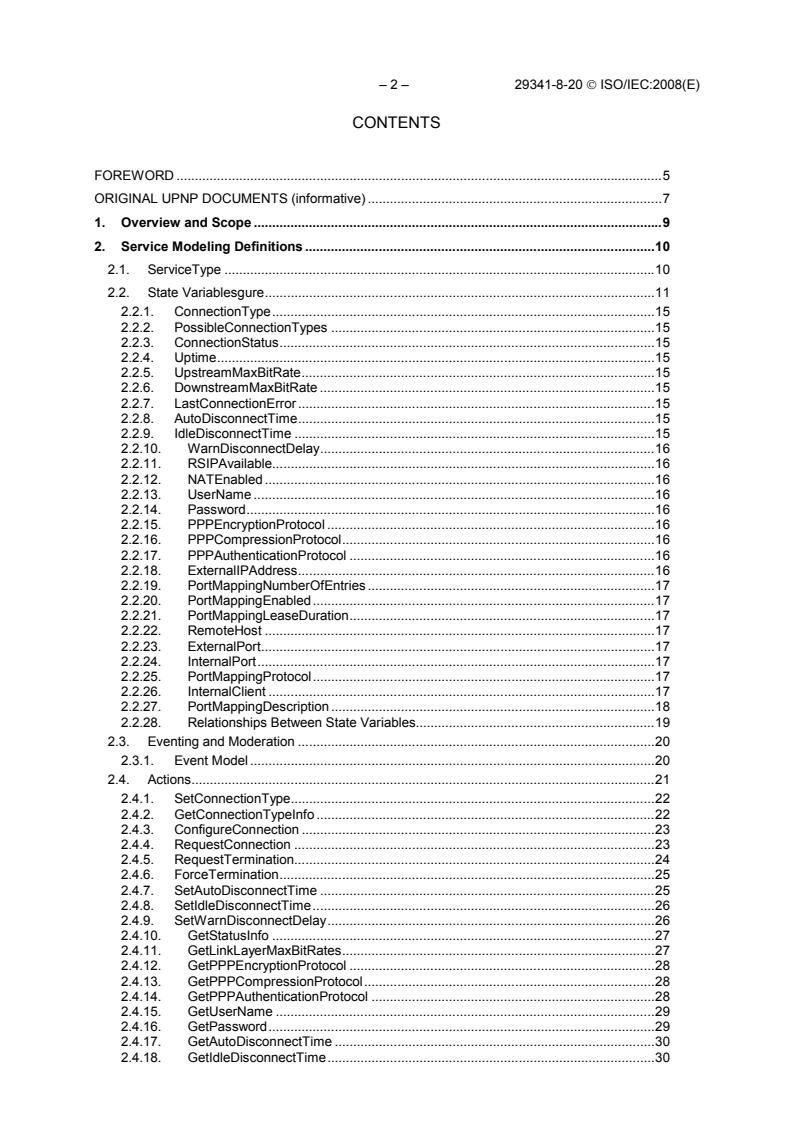
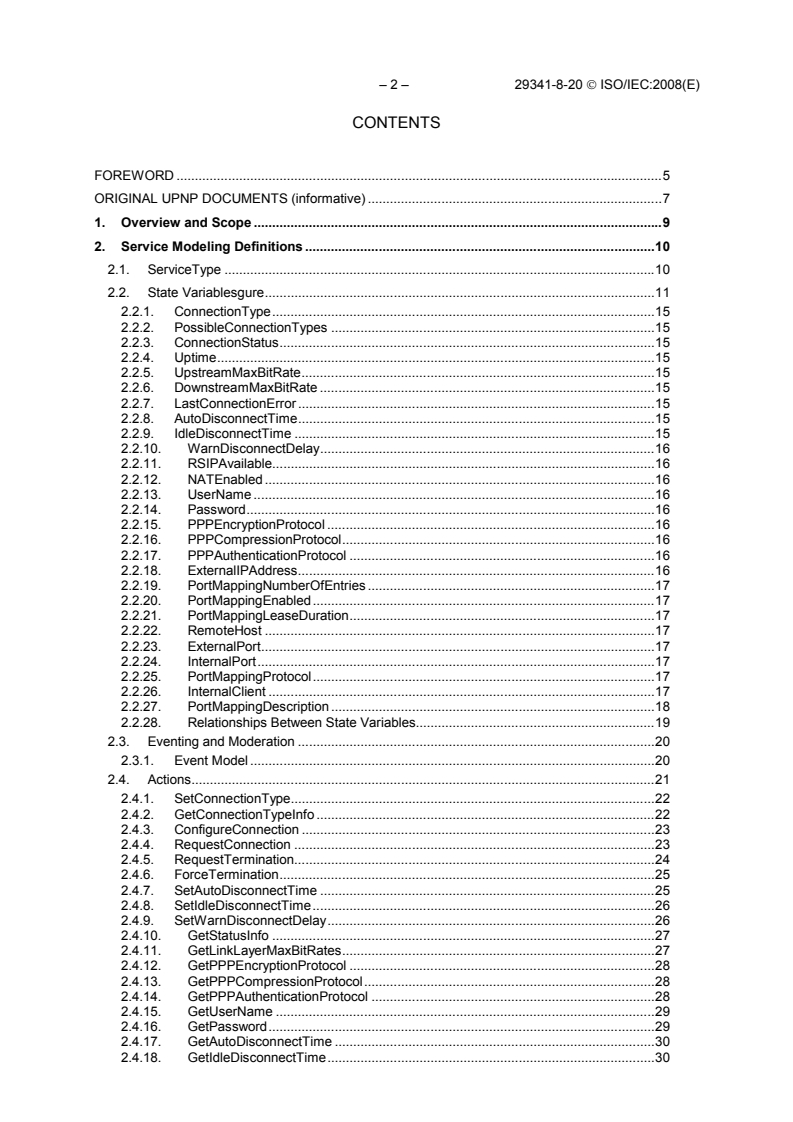
– 2 – 29341-8-20 © ISO/IEC:2008(E)
CONTENTS
FOREWORD .5
ORIGINAL UPNP DOCUMENTS (informative) .7
1. Overview and Scope .9
2. Service Modeling Definitions .10
2.1. ServiceType .10
2.2. State Variablesgure.11
2.2.1. ConnectionType.15
2.2.2. PossibleConnectionTypes .15
2.2.3. ConnectionStatus.15
2.2.4. Uptime.15
2.2.5. UpstreamMaxBitRate.15
2.2.6. DownstreamMaxBitRate .15
2.2.7. LastConnectionError.15
2.2.8. AutoDisconnectTime.15
2.2.9. IdleDisconnectTime .15
2.2.10. WarnDisconnectDelay.16
2.2.11. RSIPAvailable.16
2.2.12. NATEnabled .16
2.2.13. UserName .16
2.2.14. Password.16
2.2.15. PPPEncryptionProtocol .16
2.2.16. PPPCompressionProtocol.16
2.2.17. PPPAuthenticationProtocol .16
2.2.18. ExternalIPAddress.16
2.2.19. PortMappingNumberOfEntries .17
2.2.20. PortMappingEnabled.17
2.2.21. PortMappingLeaseDuration.17
2.2.22. RemoteHost .17
2.2.23. ExternalPort.17
2.2.24. InternalPort.17
2.2.25. PortMappingProtocol.17
2.2.26. InternalClient .17
2.2.27. PortMappingDescription .18
2.2.28. Relationships Between State Variables.19
2.3. Eventing and Moderation .20
2.3.1. Event Model .20
2.4. Actions.21
2.4.1. SetConnectionType.22
2.4.2. GetConnectionTypeInfo .22
2.4.3. ConfigureConnection .23
2.4.4. RequestConnection .23
2.4.5. RequestTermination.24
2.4.6. ForceTermination.25
2.4.7. SetAutoDisconnectTime .25
2.4.8. SetIdleDisconnectTime.26
2.4.9. SetWarnDisconnectDelay.26
2.4.10. GetStatusInfo .27
2.4.11. GetLinkLayerMaxBitRates.27
2.4.12. GetPPPEncryptionProtocol .28
2.4.13. GetPPPCompressionProtocol.28
2.4.14. GetPPPAuthenticationProtocol .28
2.4.15. GetUserName .29
2.4.16. GetPassword.29
2.4.17. GetAutoDisconnectTime .30
2.4.18. GetIdleDisconnectTime.30
29341-8-20 © ISO/IEC:2008(E) – 3 –
2.4.19. GetWarnDisconnectDelay.31
2.4.20. GetNATRSIPStatus.31
2.4.21. GetGenericPortMappingEntry .32
2.4.22. GetSpecificPortMappingEntry .33
2.4.23. AddPortMapping.33
2.4.24. DeletePortMapping.35
2.4.25. GetExternalIPAddress.35
2.4.26. Non-Standard Actions Implemented by a UPnP Vendor.36
2.4.27. Relationships Between Actions .36
2.4.28. Common Error Codes .36
2.5. Theory of Operation .37
2.5.1. Connection Initiation.38
2.5.2. Connection Termination.40
2.5.3. Connection Scenarios.41
2.5.4. Non-UPnP compliant clients .42
2.5.5. VPN connections .42
3. XML Service Description .44
4. Test .53
– 4 – 29341-8-20 © ISO/IEC:2008(E)
LIST OF TABLES
Table 1: State Variables .11
Table 1.1: AllowedValueList for PossibleConnectionTypes .12
Table 1.2: AllowedValueList for ConnectionStatus .13
Table 1.3: AllowedValueList for LastConnectionError.14
Table 1.4: AllowedValueList for PortMappingProtocol .14
Table 2: Event Moderation.20
Table 3: Actions.21
Table 4: Arguments for SetConnectionType .22
Table 5: Arguments for GetConnectionTypeInfo .22
Table 6: Arguments for ConfigureConnection.23
Table 7: Arguments for SetAutoDisconnectTime .25
Table 8: Arguments for SetIdleDisconnectTime .26
Table 9: Arguments for SetWarnDisconnectDelay .26
Table 10: Arguments for GetStatusInfo.27
Table 11: Arguments for GetLinkLayerMaxBitRates.27
Table 12: Arguments for GetPPPEncryptionProtocol.28
Table 13: Arguments for GetPPPCompressionProtocol.28
Table 14: Arguments for GetPPPAuthenticationProtocol .29
Table 15: Arguments for GetuserName .29
Table 16: Arguments for GetPassword .29
Table 17: Arguments for GetAutoDisconnectTime .30
Table 18: Arguments for GetIdleDisconnectTime .30
Table 19: Arguments for GetWarnDisconnectDelay .31
Table 20: Arguments for GetNATRSIPStatus .31
Table 21: Arguments for GetGenericPortMappingEntry .32
Table 22: Arguments for GetSpecificPortMappingEntry .33
Table 23: Arguments for AddPortMapping.34
Table 24: Arguments for DeletePortMapping .35
Table 25: Arguments for GetExternalIPAddress.35
Table 26: Common Error Codes.36
29341-8-20 © ISO/IEC:2008(E) – 5 –
INFORMATION TECHNOLOGY –
UPNP DEVICE ARCHITECTURE –
Part 8-20: Internet Gateway Device Control Protocol –
Wide Area Network Point-to-Point Protocol Connection Service
FOREWORD
1) ISO (International Organization for Standardization) and IEC (International Electrotechnical Commission) form
the specialized system for worldwide standardization. National bodies that are members of ISO or IEC
participate in the development of International Standards. Their preparation is entrusted to technical
committees; any ISO and IEC member body interested in the subject dealt with may participate in this
preparatory work. International governmental and non-governmental organizations liaising with ISO and IEC
also participate in this preparation.
2) In the field of information technology, ISO and IEC have established a joint technical committee, ISO/IEC JTC
1. Draft International Standards adopted by the joint technical committee are circulated to national bodies for
voting. Publication as an International Standard requires approval by at least 75 % of the national bodies
casting a vote.
3) The formal decisions or agreements of IEC and ISO on technical matters express, as nearly as possible, an
international consensus of opinion on the relevant subjects since each technical committee has representation
from all interested IEC and ISO member bodies.
4) IEC, ISO and ISO/IEC publications have the form of recommendations for international use and are accepted
by IEC and ISO member bodies in that sense. While all reasonable efforts are made to ensure that the
technical content of IEC, ISO and ISO/IEC publications is accurate, IEC or ISO cannot be held responsible for
the way in which they are used or for any misinterpretation by any end user.
5) In order to promote international uniformity, IEC and ISO member bodies undertake to apply IEC, ISO and
ISO/IEC publications transparently to the maximum extent possible in their national and regional publications.
Any divergence between any ISO/IEC publication and the corresponding national or regional publication should
be clearly indicated in the latter.
6) ISO and IEC provide no marking procedure to indicate their approval and cannot be rendered responsible for
any equipment declared to be in conformity with an ISO/IEC publication.
7) All users should ensure that they have the latest edition of this publication.
8) No liability shall attach to IEC or ISO or its directors, employees, servants or agents including individual
experts and members of their technical committees and IEC or ISO member bodies for any personal injury,
property damage or other damage of any nature whatsoever, whether direct or indirect, or for costs (including
legal fees) and expenses arising out of the publication of, use of, or reliance upon, this ISO/IEC publication or
any other IEC, ISO or ISO/IEC publications.
9) Attention is drawn to the normative references cited in this publication. Use of the referenced publications is
indispensable for the correct application of this publication.
IEC and ISO draw attention to the fact that it is claimed that compliance with this document may involve the use of
patents as indicated below.
ISO and IEC take no position concerning the evidence, validity and scope of the putative patent rights. The holders
of the putative patent rights have assured IEC and ISO that they are willing to negotiate free licences or licences
under reasonable and non-discriminatory terms and conditions with applicants throughout the world. In this respect,
the statements of the holders of the putative patent rights are registered with IEC and ISO.
Intel Corporation has informed IEC and ISO that it has patent applications or granted patents.
Information may be obtained from:
Intel Corporation
Standards Licensing Department
5200 NE Elam Young Parkway
MS: JFS-98
USA – Hillsboro, Oregon 97124
Microsoft Corporation has informed IEC and ISO that it has patent applications or granted patents as listed below:
– 6 – 29341-8-20 © ISO/IEC:2008(E)
6101499 / US; 6687755 / US; 6910068 / US; 7130895 / US; 6725281 / US; 7089307 / US; 7069312 / US;
10/783 524 /US
Information may be obtained from:
Microsoft Corporation
One Microsoft Way
USA – Redmond WA 98052
Philips International B.V. has informed IEC and ISO that it has patent applications or granted patents.
Information may be obtained from:
Philips International B.V. – IP&S
High Tech campus, building 44 3A21
NL – 5656 Eindhoven
NXP B.V. (NL) has informed IEC and ISO that it has patent applications or granted patents.
Information may be obtained from:
NXP B.V. (NL)
High Tech campus 60
NL – 5656 AG Eindhoven
Matsushita Electric Industrial Co. Ltd. has informed IEC and ISO that it has patent applications or granted patents.
Information may be obtained from:
Matsushita Electric Industrial Co. Ltd.
1-3-7 Shiromi, Chuoh-ku
JP – Osaka 540-6139
Hewlett Packard Company has informed IEC and ISO that it has patent applications or granted patents as listed
below:
5 956 487 / US; 6 170 007 / US; 6 139 177 / US; 6 529 936 / US; 6 470 339 / US; 6 571 388 / US; 6 205
466 / US
Information may be obtained from:
Hewlett Packard Company
1501 Page Mill Road
USA – Palo Alto, CA 94304
Samsung Electronics Co. Ltd. has informed IEC and ISO that it has patent applications or granted patents.
Information may be obtained from:
Digital Media Business, Samsung Electronics Co. Ltd.
416 Maetan-3 Dong, Yeongtang-Gu,
KR – Suwon City 443-742
Attention is drawn to the possibility that some of the elements of this document may be the subject of patent rights
other than those identified above. IEC and ISO shall not be held responsible for identifying any or all such patent
rights.
ISO/IEC 29341-8-20 was prepared by UPnP Implementers Corporation and adopted, under the PAS procedure, by
joint technical committee ISO/IEC JTC 1, Information technology, in parallel with its approval by national bodies of
ISO and IEC.
The list of all currently available parts of the ISO/IEC 29341 series, under the general title Universal plug and play
(UPnP) architecture, can be found on the IEC web site.
This International Standard has been approved by vote of the member bodies, and the voting results may be
obtained from the address given on the second title page.
29341-8-20 © ISO/IEC:2008(E) – 7 –
ORIGINAL UPNP DOCUMENTS
(informative)
Reference may be made in this document to original UPnP documents. These references are retained in order to
maintain consistency between the specifications as published by ISO/IEC and by UPnP Implementers Corporation.
The following table indicates the original UPnP document titles and the corresponding part of ISO/IEC 29341:
UPnP Document Title ISO/IEC 29341 Part
UPnP Device Architecture 1.0 ISO/IEC 29341-1
UPnP Basic:1 Device ISO/IEC 29341-2
UPnP AV Architecture:1 ISO/IEC 29341-3-1
UPnP MediaRenderer:1 Device ISO/IEC 29341-3-2
UPnP MediaServer:1 Device ISO/IEC 29341-3-3
UPnP AVTransport:1 Service ISO/IEC 29341-3-10
UPnP ConnectionManager:1 Service ISO/IEC 29341-3-11
UPnP ContentDirectory:1 Service ISO/IEC 29341-3-12
UPnP RenderingControl:1 Service ISO/IEC 29341-3-13
UPnP MediaRenderer:2 Device ISO/IEC 29341-4-2
UPnP MediaServer:2 Device ISO/IEC 29341-4-3
UPnP AV Datastructure Template:1 ISO/IEC 29341-4-4
UPnP AVTransport:2 Service ISO/IEC 29341-4-10
UPnP ConnectionManager:2 Service ISO/IEC 29341-4-11
UPnP ContentDirectory:2 Service ISO/IEC 29341-4-12
UPnP RenderingControl:2 Service ISO/IEC 29341-4-13
UPnP ScheduledRecording:1 ISO/IEC 29341-4-14
UPnP DigitalSecurityCamera:1 Device ISO/IEC 29341-5-1
UPnP DigitalSecurityCameraMotionImage:1 Service ISO/IEC 29341-5-10
UPnP DigitalSecurityCameraSettings:1 Service ISO/IEC 29341-5-11
UPnP DigitalSecurityCameraStillImage:1 Service ISO/IEC 29341-5-12
UPnP HVAC_System:1 Device ISO/IEC 29341-6-1
UPnP HVAC_ZoneThermostat:1 Device ISO/IEC 29341-6-2
UPnP ControlValve:1 Service ISO/IEC 29341-6-10
UPnP HVAC_FanOperatingMode:1 Service ISO/IEC 29341-6-11
UPnP FanSpeed:1 Service ISO/IEC 29341-6-12
UPnP HouseStatus:1 Service ISO/IEC 29341-6-13
UPnP HVAC_SetpointSchedule:1 Service ISO/IEC 29341-6-14
UPnP TemperatureSensor:1 Service ISO/IEC 29341-6-15
UPnP TemperatureSetpoint:1 Service ISO/IEC 29341-6-16
UPnP HVAC_UserOperatingMode:1 Service ISO/IEC 29341-6-17
UPnP BinaryLight:1 Device ISO/IEC 29341-7-1
UPnP DimmableLight:1 Device ISO/IEC 29341-7-2
UPnP Dimming:1 Service ISO/IEC 29341-7-10
UPnP SwitchPower:1 Service ISO/IEC 29341-7-11
UPnP InternetGatewayDevice:1 Device ISO/IEC 29341-8-1
UPnP LANDevice:1 Device ISO/IEC 29341-8-2
UPnP WANDevice:1 Device ISO/IEC 29341-8-3
UPnP WANConnectionDevice:1 Device ISO/IEC 29341-8-4
UPnP WLANAccessPointDevice:1 Device ISO/IEC 29341-8-5
UPnP LANHostConfigManagement:1 Service ISO/IEC 29341-8-10
UPnP Layer3Forwarding:1 Service ISO/IEC 29341-8-11
UPnP LinkAuthentication:1 Service ISO/IEC 29341-8-12
UPnP RadiusClient:1 Service ISO/IEC 29341-8-13
UPnP WANCableLinkConfig:1 Service ISO/IEC 29341-8-14
UPnP WANCommonInterfaceConfig:1 Service ISO/IEC 29341-8-15
UPnP WANDSLLinkConfig:1 Service ISO/IEC 29341-8-16
UPnP WANEthernetLinkConfig:1 Service ISO/IEC 29341-8-17
UPnP WANIPConnection:1 Service ISO/IEC 29341-8-18
UPnP WANPOTSLinkConfig:1 Service ISO/IEC 29341-8-19
UPnP WANPPPConnection:1 Service ISO/IEC 29341-8-20
UPnP WLANConfiguration:1 Service ISO/IEC 29341-8-21
UPnP Printer:1 Device ISO/IEC 29341-9-1
UPnP Scanner:1.0 Device ISO/IEC 29341-9-2
UPnP ExternalActivity:1 Service ISO/IEC 29341-9-10
UPnP Feeder:1.0 Service ISO/IEC 29341-9-11
UPnP PrintBasic:1 Service ISO/IEC 29341-9-12
UPnP Scan:1 Service ISO/IEC 29341-9-13
UPnP QoS Architecture:1.0 ISO/IEC 29341-10-1
UPnP QosDevice:1 Service ISO/IEC 29341-10-10
UPnP QosManager:1 Service ISO/IEC 29341-10-11
UPnP QosPolicyHolder:1 Service ISO/IEC 29341-10-12
UPnP QoS Architecture:2 ISO/IEC 29341-11-1
UPnP QOS v2 Schema Files ISO/IEC 29341-11-2
– 8 – 29341-8-20 © ISO/IEC:2008(E)
UPnP Document Title ISO/IEC 29341 Part
UPnP QosDevice:2 Service ISO/IEC 29341-11-10
UPnP QosManager:2 Service ISO/IEC 29341-11-11
UPnP QosPolicyHolder:2 Service ISO/IEC 29341-11-12
UPnP RemoteUIClientDevice:1 Device ISO/IEC 29341-12-1
UPnP RemoteUIServerDevice:1 Device ISO/IEC 29341-12-2
UPnP RemoteUIClient:1 Service ISO/IEC 29341-12-10
UPnP RemoteUIServer:1 Service ISO/IEC 29341-12-11
UPnP DeviceSecurity:1 Service ISO/IEC 29341-13-10
UPnP SecurityConsole:1 Service ISO/IEC 29341-13-11
29341-8-20 © ISO/IEC:2008(E) – 9 –
1. Overview and Scope
This service definition is compliant with the UPnP Device Architecture version 1.0.
This service-type enables a UPnP control point to configure and control PPP connections on the WAN interface
*
of a UPnP compliant InternetGatewayDevice . Any type of WAN interface (for e.g., DSL or POTS) that can
support a PPP connection can use this service.
The service is REQUIRED if a PPP connection is used for WAN access, and is specified in
urn:schemas-upnp-org:device:WANConnectionDevice
one or more instances of which are specified under the device
urn:schemas-upnp-org:device:WANDevice
An instance of WANDevice is specified under the root device
urn:schemas-upnp-org:device:InternetGatewayDevice
Generally, Internet connections are set up from a WAN interface of the InternetGatewayDevice to Internet
Service Providers (ISPs). However, an implementation MAY support PPP connections that are bridged or
relayed (as in the case of some DSL modems) through the gateway device. WANDevice is a container for all
UPnP services associated with a physical WAN device. It is assumed that clients are connected to
InternetGatewayDevice via a LAN (IP-based network).
An instance of a WANPPPConnection service is activated (refer to SST below) for each actual Internet
Connection instance on a WANConnectionDevice. WANPPPConnection service provides PPP-level
connectivity with an ISP for networked clients on the LAN. More than one instance of WANPPPConnection
service may be defined on a WANConnectionDevice – representing multiple user accounts using the same link
(username / password) to an ISP.
Multiple instances of this service will be distinguished based on the ServiceID for each service instance.
In accordance with UPnP Architecture version 1.0, the maximum number of WANPPPConnection service
instances is static and specified in the InternetGatewayDevice description document.
A WANConnectionDevice MAY include a WAN{POTS/DSL/Cable/Ethernet}LinkConfig service that
encapsulates Internet access properties pertaining to the physical link of a particular WAN access type. These
properties are common to all instances of WANPPPConnection in a WANConnectionDevice.
A WANDevice provides a WANCommonInterfaceConfig service that encapsulates Internet access properties
common across all WANConnectionDevice instances.
*
Refer to companion documents defined by the UPnP Internet Gateway working committee for more details on
specific devices and services referenced in this document.
– 10 – 29341-8-20 © ISO/IEC:2008(E)
2. Service Modeling Definitions
2.1. ServiceType
The following service type identifies a service that is compliant with this template:
urn:schemas-upnp-org:service:WANPPPConnection:1.
29341-8-20 © ISO/IEC:2008(E) – 11 –
2.2. State Variables
Table 1: State Variables
Variable Name Req. Data Allowed Value Default Value Eng. Units
1 2
or Type
Opt.
ConnectionType
R string Depends on Not specified N/A
PossibleConne
ctionTypes
PossibleConnectionTypes
R string See Table 1.1 Not specified N/A
ConnectionStatus
R string See Table 1.2 Not specified N/A
Uptime
R ui4 Undefined Not specified seconds
UpstreamMaxBitRate
R ui4 >= 0 Not specified bitspersecond
DownstreamMaxBitRate
R ui4 >= 0 Not specified bitspersecond
LastConnectionError
R string See Table 1.3 Not specified N/A
AutoDisconnectTime
O ui4 >= 0 Not specified seconds
IdleDisconnectTime
O ui4 >= 0 Not specified seconds
WarnDisconnectDelay
O ui4 >= 0 Not specified seconds
RSIPAvailable
R boolean 0, 1 Not specified N/A
NATEnabled
R boolean 0,1 Not specified N/A
UserName
O string Undefined Empty string N/A
Password
O string Undefined Empty string N/A
PPPEncryptionProtocol
O string Undefined Empty string N/A
PPPCompressionProtocol
O string Undefined Empty string N/A
PPPAuthenticationProtocol
O string Undefined Empty string N/A
ExternalIPAddress
R string String of the Empty string N/A
type “x.x.x.x”
PortMappingNumberOfEntries
R ui2 >=0 Not specified N/A
PortMappingEnabled
R boolean 0,1 Not specified N/A
PortMappingLeaseDuration
R ui4 0 to maximum Not specified seconds
value of ui4
RemoteHost
R string String of the Empty string N/A
type “x.x.x.x” or
empty string
ExternalPort
R ui2 Between 0 and Not specified N/A
65535 inclusive
InternalPort
R ui2 Between 1 and Not specified N/A
65535 inclusive
PortMappingProtocol
R string See Table 1.4 Empty string N/A
InternalClient
R string String of the Empty string N/A
type “x.x.x.x”
PortMappingDescription
R string Undefined Empty string N/A
Non-standard state variables X TBD TBD TBD TBD
implemented by an UPnP vendor go
here.
R = Required, O = Optional, X = Non-standard.
Values listed in this column are required. To specify standard optional values or to delegate assignment of
values to the vendor, you must reference a specific instance of an appropriate table below.
– 12 – 29341-8-20 © ISO/IEC:2008(E)
NOTE: Default values are not specified in the DCP. A vendor may however choose to provide default values for
SST variables where appropriate.
Table 1.1: AllowedValueList for PossibleConnectionTypes
PLEASE NOTE: PossibleConnectionTypes is defined as a comma-separated string. However, the values within
the string are restricted to the list given in the table below. We have used the allowedValueList table format only
as a convenience to represent these values.
Value Req. or Opt. Description
Unconfigured R Valid connection types cannot be identified. This may be due to the
fact that the LinkType variable (if specified in the
WAN*LinkConfig service) is unspecified. THIS VALUE IS
DEPENDENT ON THE DEPLOYMENT AND TESTING
SHOULD BE DEFERED TO THE VENDOR.
IP_Routed R The Internet Gateway is an IP router between the LAN and the
WAN connection. THIS VALUE IS ONLY APPLICABLE FOR
AN IGD DEVICE SUPPORTING NAT. SHOULD NOT BE
TESTED IN OTHER DEVICE CONFIGURATIONS.
DHCP_Spoofed R The Internet Gateway is an IP router with a DHCP spoofer. This
DHCP spoofer is a proxy between IPCP (the IP configuration
mechanism used by PPP) or DHCP on the WAN connection and
DHCP on the LAN. The IP address obtained via IPCP or DHCP
from the ISP is relayed back as a DHCP response to a CP on the
LAN.
PPPoE_Bridged R The Internet Gateway is an Ethernet bridge between the LAN and
the WAN connection. A PPPoE RAS server at the end of the WAN
connection terminates PPPoE connections initiated by control
points on the LAN. ONLY VALID IF IGD SUPPORTS THE
CONFIGURATION AS DESCRIBED.
PPTP_Relay R The Internet Gateway relays PPP sessions originating via PPTP on
the LAN over the WAN configured as PPPoA. The gateway hosts a
PPTP PNS to terminate the PPTP connection. ONLY VALID IF
IGD SUPPORTS THE CONFIGURATION AS DESCRIBED.
L2TP_Relay R The Internet Gateway relays PPP sessions originating via L2TP on
the LAN over the WAN configured as PPPoA. The gateway hosts a
L2TP LNS to terminate the L2TP connection. ONLY VALID IF
IGD SUPPORTS THE CONFIGURATION AS DESCRIBED.
PPPoE_Relay R The Internet Gateway relays a PPPoE tunnel on the LAN over the
WAN configured as PPPoA. The gateway hosts a PPPoE server /
access concentrator to terminate the PPPoE connection on the LAN.
ONLY VALID IF IGD SUPPORTS THE CONFIGURATION
AS DESCRIBED.
NOTE: Refer to the WANConnectionDevice specification for valid combinations of LinkType and
PossibleConnectionTypes for different modems that can support PPP based connections.
The expected behavior of connection related actions for the different connection types is described in the Theory
of Operation section.
29341-8-20 © ISO/IEC:2008(E) – 13 –
Table 1.2: AllowedValueList for ConnectionStatus
Value Req. or Opt. Description
Unconfigured R This value indicates that other variables in the service table are
either uninitialized or in an invalid state. Examples of such
variables include PossibleConnectionTypes,
ConnectionType, UserName and Password.
Connecting O The WANConnectionDevice is in the process of initiating a
connection for the first time after the connection became
disconnected.
Authenticating O The gateway is in the process of authenticating to the ISP for
establishing the connection.
Connected R At least one client has successfully initiated an Internet connection
using this instance.
PendingDisconnect O The connection is active (packets are allowed to flow through), but
will transition to Disconnecting state after a certain period
(indicated by WarnDisconnectDelay).
Disconnecting O The WANConnectionDevice is in the process of terminating a
connection. On successful termination, ConnectionStatus
transitions to Disconnected.
Disconnected R No ISP connection is active (or being activated) from this
connection instance. No packets are transiting the gateway.
NOTE: Whether or not a control point gets notified of the intermediary states of a connection transition may
depend on the gateway implementation.
– 14 – 29341-8-20 © ISO/IEC:2008(E)
Table 1.3: AllowedValueList for LastConnectionError
Value Req. or Opt.
ERROR_NONE R
ERROR_ISP_TIME_OUT O
ERROR_COMMAND_ABORTED O
ERROR_ NOT_ENABLED_FOR_INTERNET O
ERROR_BAD_PHONE_NUMBER O
ERROR_USER_DISCONNECT O
ERROR_ISP_DISCONNECT O
ERROR_IDLE_DISCONNECT O
ERROR_FORCED_DISCONNECT O
ERROR_SERVER_OUT_OF_RESOURCES O
ERROR_RESTRICTED_LOGON_HOURS O
ERROR_ACCOUNT_DISABLED O
ERROR_ACCOUNT_EXPIRED O
ERROR_PASSWORD_EXPIRED O
ERROR_AUTHENTICATION_FAILURE O
ERROR_NO_DIALTONE O
ERROR_NO_CARRIER O
ERROR_NO_ANSWER O
ERROR_LINE_BUSY O
ERROR_UNSUPPORTED_BITSPERSECOND O
ERROR_TOO_MANY_LINE_ERRORS O
ERROR_IP_CONFIGURATION O
ERROR_UNKNOWN O
Table 1.4: AllowedValueList for PortMappingProtocol
Value Req. or Opt.
TCP R
UDP R
29341-8-20 © ISO/IEC:2008(E) – 15 –
2.2.1. ConnectionType
This variable is set to specify the connection type for a specific active connection. The value selected
must be one from the list specified in PossibleConnectionTypes.
2.2.2. PossibleConnectionTypes
This variable represents a comma-separated string indicating the types of connections possible in the
context of a specific modem and link type. Possible values are a subset or proper subset of values
listed in table 1.1
2.2.3. ConnectionStatus
This variable represents current status of an Internet connection. Possible string values are specified in
table 1.2
2.2.4. Uptime
This variable represents the time in seconds that this connection has stayed up.
2.2.5. UpstreamMaxBitRate
This variable represents the maximum upstream bit rate available to this connection instance. This
variable has a static value once a connection is setup.
2.2.6. DownstreamMaxBitRate
This variable represents the maximum downstream bit rate available to this connection instance. This
variable has a static value once a connection is setup.
2.2.7. LastConnectionError
This variable is a string that provides information about the cause of failure for the last connection
setup attempt. The restricted list of enumeration values are listed in table 1.3
2.2.8. AutoDisconnectTime
This variable represents time in seconds (since the establishment of the connection – measured from
the time ConnectionStatus transitions to Connected), after which connection termination is
automatically initiated by the gateway. This occurs irrespective of whether the connection is being used
or not. A value of zero for AutoDisconnectTime indicates that the connection is not to be turned off
automatically. However, this may be overridden by –
- An implementation specific WAN/Gateway device policy
*
) being set to 0 by a
- EnabledForInternet variable (see WANCommonInterfaceConfig
user control point
- Connection termination initiated by ISP.
If WarnDisconnectDelay is non-zero, the connection state is changed to PendingDisconnect. It stays
in this state for WarnDisconnectDelay seconds (if no connection requests are made) before
switching to Disconnected.
2.2.9. IdleDisconnectTime
It represents the idle time of a connection in seconds (since the establishment of the connection), after
which connection termination is initiated by the gateway. A value of zero for this variable allows infinite
idle time – connection will not be terminated due to idle time.
*
Refer to companion document defined by the UPnP Internet Gateway working committee for more details on
this variable
– 16 – 29341-8-20 © ISO/IEC:2008(E)
Note: Layer 2 heartbeat packets are included as part of an idle state i.e., they do not reset the idle
timer
If WarnDisconnectDelay is non-zero, the connection state is changed to PendingDisconnect. It stays
in this state for WarnDisconnectDelay seconds (if no connection requests are made) before
switching to Disconnected.
2.2.10.WarnDisconnectDelay
This variable represents time in seconds the ConnectionStatus remains in the PendingDisconnect
state before transitioning to Disconnecting state to drop the connection. For example, if this variable
was set to 5 seconds, and one of the clients terminates an active connection, the gateway will wait
(with ConnectionStatus as PendingDisconnect) for 5 seconds before actual termination of the
connection.
A value of zero for this variable indicates that no warning will be given to clients before terminating the
connection.
2.2.11.RSIPAvailable
This variable indicates if Realm-specific IP (RSIP) is available as a feature on the
InternetGatewayDevice. RSIP is being defined in the NAT working group in the IETF to allow host-
NATing using a standard set of message exchanges. It also allows end-to-end applications that
otherwise break if NAT is introduced (e.g. IPsec-based VPNs).
A gateway that does not support RSIP should set this variable to 0.
2.2.12.NATEnabled
This variable indicates if Network Address Translation (NAT) is enabled for this connection.
2.2.13.UserName
This variable refers to the User name used to login to the Internet Service Provider
2.2.14.Password
This variable represents the Authentication token used to login to the ISP.
NOTE: A vendor may have to implement an encryption protocol to carry the Password over the wire
from a control point to an InternetGatewayDevice. UPnP does not formalize a mechanism to do so at
this time.
2.2.15.PPPEncryptionProtocol
This variable describes the PPP encryption protocol used between the WAN device and the ISP POP.
It is a read-only variable. An example of a PPP encryption protocol is MPPE.
2.2.16.PPPCompressionProtocol
This variable describes the PPP compression protocol used between the WAN device and the ISP
POP. It is a read-only variable. An example of a PPP compression protocol would be VanJacobsen.
2.2.17.PPPAuthenticationProtocol
This variable describes the PPP authentication protocol used between the WAN device and the ISP
POP. It is a read-only variable. Some examples of authentication protocols are PAP, CHAP, MSCHAP.
2.2.18.ExternalIPAddress
This is the external IP address used by NAT for the connection.
29341-8-20 © ISO/IEC:2008(E) – 17 –
2.2.19.PortMappingNumberOfEntries
This variable indicates the number of NAT port mapping entries (number of elements in the array)
configured on this connection.
2.2.20.PortMappingEnabled
This variable allows security conscious users to disable and enable dynamic and static NAT port
mappings on the IGD.
2.2.21.PortMappingLeaseDuration
This variable determines the time to live in seconds of a port-mapping lease. A value of 0 means the
port mapping is static. Non-zero values will allow support for dynamic port mappings. Note that static
port mappings do not necessarily mean persistence of these mappings across device resets or
reboots. It is up to a gateway vendor to implement persistence as appropriate for their IGD device.
2.2.22.RemoteHost
This variable represents the source of inbound IP packets. This will be a wildcard in most cases (i.e. an
empty string). NAT vendors are only required to support wildcards. A non-wildcard value will allow for
“narrow” port mappings, which may be desirable in some usage scenarios.When RemoteHost is a
wildcard, all traffic sent to the ExternalPort on the WAN interface of the gateway is forwarded to the
InternalClient on the InternalPort. When RemoteHost is specified as one external IP
address as opposed to a wildcard, the NAT will only forward inbound packets from this RemoteHost to
the InternalClient, all other packets will be dropped.
2.2.23.ExternalPort
This variable represents the external port that the NAT gateway would “listen” on for connection
requests to a corresponding InternalPort on an InternalClient. Inbound packets to this
external port on the WAN interface of the gateway should be forwarded to InternalClient on the
InternalPort on which the message was received. If this value is specified as a wildcard (i.e. 0),
connection request on all external ports (that are not otherwise mapped) will be forwarded to
InternalClient. In the wildcard case, the value(s) of InternalPort on InternalClient are
ignored by the IGD for those connections that are forwarded to InternalClient. Obviously only one
such entry can exist in the NAT at any time and conflicts are handled with a “first write wins” behavior.
2.2.24.InternalPort
This variable represents the port on InternalClient
...
ISO/IEC 29341-8-20
Edition 1.0 2008-11
INTERNATIONAL
STANDARD
Information technology – UPnP Device Architecture –
Part 8-20: Internet Gateway Device Control Protocol – Wide Area Network Point-
to-Point Protocol Connection Service
All rights reserved. Unless otherwise specified, no part of this publication may be reproduced or utilized in any form
or by any means, electronic or mechanical, including photocopying and microfilm, without permission in writing from
either IEC or IEC's member National Committee in the country of the requester.
If you have any questions about ISO/IEC copyright or have an enquiry about obtaining additional rights to this
publication, please contact the address below or your local IEC member National Committee for further information.
IEC Central Office
3, rue de Varembé
CH-1211 Geneva 20
Switzerland
Email: inmail@iec.ch
Web: www.iec.ch
About the IEC
The International Electrotechnical Commission (IEC) is the leading global organization that prepares and publishes
International Standards for all electrical, electronic and related technologies.
About IEC publications
The technical content of IEC publications is kept under constant review by the IEC. Please make sure that you have the
latest edition, a corrigenda or an amendment might have been published.
ƒ Catalogue of IEC publications: www.iec.ch/searchpub
The IEC on-line Catalogue enables you to search by a variety of criteria (reference number, text, technical committee,…).
It also gives information on projects, withdrawn and replaced publications.
ƒ IEC Just Published: www.iec.ch/online_news/justpub
Stay up to date on all new IEC publications. Just Published details twice a month all new publications released. Available
on-line and also by email.
ƒ Electropedia: www.electropedia.org
The world's leading online dictionary of electronic and electrical terms containing more than 20 000 terms and definitions
in English and French, with equivalent terms in additional languages. Also known as the International Electrotechnical
Vocabulary online.
ƒ Customer Service Centre: www.iec.ch/webstore/custserv
If you wish to give us your feedback on this publication or need further assistance, please visit the Customer Service
Centre FAQ or contact us:
Email: csc@iec.ch
Tel.: +41 22 919 02 11
Fax: +41 22 919 03 00
ISO/IEC 29341-8-20
Edition 1.0 2008-11
INTERNATIONAL
STANDARD
Information technology – UPnP Device Architecture –
Part 8-20: Internet Gateway Device Control Protocol – Wide Area Network Point-
to-Point Protocol Connection Service
INTERNATIONAL
ELECTROTECHNICAL
COMMISSION
PRICE CODE
X
ICS 35.200 ISBN 2-8318-1010-7
– 2 – 29341-8-20 © ISO/IEC:2008(E)
CONTENTS
FOREWORD .5
ORIGINAL UPNP DOCUMENTS (informative) .7
1. Overview and Scope .9
2. Service Modeling Definitions .10
2.1. ServiceType .10
2.2. State Variablesgure.11
2.2.1. ConnectionType.15
2.2.2. PossibleConnectionTypes .15
2.2.3. ConnectionStatus.15
2.2.4. Uptime.15
2.2.5. UpstreamMaxBitRate.15
2.2.6. DownstreamMaxBitRate .15
2.2.7. LastConnectionError.15
2.2.8. AutoDisconnectTime.15
2.2.9. IdleDisconnectTime .15
2.2.10. WarnDisconnectDelay.16
2.2.11. RSIPAvailable.16
2.2.12. NATEnabled .16
2.2.13. UserName .16
2.2.14. Password.16
2.2.15. PPPEncryptionProtocol .16
2.2.16. PPPCompressionProtocol.16
2.2.17. PPPAuthenticationProtocol .16
2.2.18. ExternalIPAddress.16
2.2.19. PortMappingNumberOfEntries .17
2.2.20. PortMappingEnabled.17
2.2.21. PortMappingLeaseDuration.17
2.2.22. RemoteHost .17
2.2.23. ExternalPort.17
2.2.24. InternalPort.17
2.2.25. PortMappingProtocol.17
2.2.26. InternalClient .17
2.2.27. PortMappingDescription .18
2.2.28. Relationships Between State Variables.19
2.3. Eventing and Moderation .20
2.3.1. Event Model .20
2.4. Actions.21
2.4.1. SetConnectionType.22
2.4.2. GetConnectionTypeInfo .22
2.4.3. ConfigureConnection .23
2.4.4. RequestConnection .23
2.4.5. RequestTermination.24
2.4.6. ForceTermination.25
2.4.7. SetAutoDisconnectTime .25
2.4.8. SetIdleDisconnectTime.26
2.4.9. SetWarnDisconnectDelay.26
2.4.10. GetStatusInfo .27
2.4.11. GetLinkLayerMaxBitRates.27
2.4.12. GetPPPEncryptionProtocol .28
2.4.13. GetPPPCompressionProtocol.28
2.4.14. GetPPPAuthenticationProtocol .28
2.4.15. GetUserName .29
2.4.16. GetPassword.29
2.4.17. GetAutoDisconnectTime .30
2.4.18. GetIdleDisconnectTime.30
29341-8-20 © ISO/IEC:2008(E) – 3 –
2.4.19. GetWarnDisconnectDelay.31
2.4.20. GetNATRSIPStatus.31
2.4.21. GetGenericPortMappingEntry .32
2.4.22. GetSpecificPortMappingEntry .33
2.4.23. AddPortMapping.33
2.4.24. DeletePortMapping.35
2.4.25. GetExternalIPAddress.35
2.4.26. Non-Standard Actions Implemented by a UPnP Vendor.36
2.4.27. Relationships Between Actions .36
2.4.28. Common Error Codes .36
2.5. Theory of Operation .37
2.5.1. Connection Initiation.38
2.5.2. Connection Termination.40
2.5.3. Connection Scenarios.41
2.5.4. Non-UPnP compliant clients .42
2.5.5. VPN connections .42
3. XML Service Description .44
4. Test .53
– 4 – 29341-8-20 © ISO/IEC:2008(E)
LIST OF TABLES
Table 1: State Variables .11
Table 1.1: AllowedValueList for PossibleConnectionTypes .12
Table 1.2: AllowedValueList for ConnectionStatus .13
Table 1.3: AllowedValueList for LastConnectionError.14
Table 1.4: AllowedValueList for PortMappingProtocol .14
Table 2: Event Moderation.20
Table 3: Actions.21
Table 4: Arguments for SetConnectionType .22
Table 5: Arguments for GetConnectionTypeInfo .22
Table 6: Arguments for ConfigureConnection.23
Table 7: Arguments for SetAutoDisconnectTime .25
Table 8: Arguments for SetIdleDisconnectTime .26
Table 9: Arguments for SetWarnDisconnectDelay .26
Table 10: Arguments for GetStatusInfo.27
Table 11: Arguments for GetLinkLayerMaxBitRates.27
Table 12: Arguments for GetPPPEncryptionProtocol.28
Table 13: Arguments for GetPPPCompressionProtocol.28
Table 14: Arguments for GetPPPAuthenticationProtocol .29
Table 15: Arguments for GetuserName .29
Table 16: Arguments for GetPassword .29
Table 17: Arguments for GetAutoDisconnectTime .30
Table 18: Arguments for GetIdleDisconnectTime .30
Table 19: Arguments for GetWarnDisconnectDelay .31
Table 20: Arguments for GetNATRSIPStatus .31
Table 21: Arguments for GetGenericPortMappingEntry .32
Table 22: Arguments for GetSpecificPortMappingEntry .33
Table 23: Arguments for AddPortMapping.34
Table 24: Arguments for DeletePortMapping .35
Table 25: Arguments for GetExternalIPAddress.35
Table 26: Common Error Codes.36
29341-8-20 © ISO/IEC:2008(E) – 5 –
INFORMATION TECHNOLOGY –
UPNP DEVICE ARCHITECTURE –
Part 8-20: Internet Gateway Device Control Protocol –
Wide Area Network Point-to-Point Protocol Connection Service
FOREWORD
1) ISO (International Organization for Standardization) and IEC (International Electrotechnical Commission) form
the specialized system for worldwide standardization. National bodies that are members of ISO or IEC
participate in the development of International Standards. Their preparation is entrusted to technical
committees; any ISO and IEC member body interested in the subject dealt with may participate in this
preparatory work. International governmental and non-governmental organizations liaising with ISO and IEC
also participate in this preparation.
2) In the field of information technology, ISO and IEC have established a joint technical committee, ISO/IEC JTC
1. Draft International Standards adopted by the joint technical committee are circulated to national bodies for
voting. Publication as an International Standard requires approval by at least 75 % of the national bodies
casting a vote.
3) The formal decisions or agreements of IEC and ISO on technical matters express, as nearly as possible, an
international consensus of opinion on the relevant subjects since each technical committee has representation
from all interested IEC and ISO member bodies.
4) IEC, ISO and ISO/IEC publications have the form of recommendations for international use and are accepted
by IEC and ISO member bodies in that sense. While all reasonable efforts are made to ensure that the
technical content of IEC, ISO and ISO/IEC publications is accurate, IEC or ISO cannot be held responsible for
the way in which they are used or for any misinterpretation by any end user.
5) In order to promote international uniformity, IEC and ISO member bodies undertake to apply IEC, ISO and
ISO/IEC publications transparently to the maximum extent possible in their national and regional publications.
Any divergence between any ISO/IEC publication and the corresponding national or regional publication should
be clearly indicated in the latter.
6) ISO and IEC provide no marking procedure to indicate their approval and cannot be rendered responsible for
any equipment declared to be in conformity with an ISO/IEC publication.
7) All users should ensure that they have the latest edition of this publication.
8) No liability shall attach to IEC or ISO or its directors, employees, servants or agents including individual
experts and members of their technical committees and IEC or ISO member bodies for any personal injury,
property damage or other damage of any nature whatsoever, whether direct or indirect, or for costs (including
legal fees) and expenses arising out of the publication of, use of, or reliance upon, this ISO/IEC publication or
any other IEC, ISO or ISO/IEC publications.
9) Attention is drawn to the normative references cited in this publication. Use of the referenced publications is
indispensable for the correct application of this publication.
IEC and ISO draw attention to the fact that it is claimed that compliance with this document may involve the use of
patents as indicated below.
ISO and IEC take no position concerning the evidence, validity and scope of the putative patent rights. The holders
of the putative patent rights have assured IEC and ISO that they are willing to negotiate free licences or licences
under reasonable and non-discriminatory terms and conditions with applicants throughout the world. In this respect,
the statements of the holders of the putative patent rights are registered with IEC and ISO.
Intel Corporation has informed IEC and ISO that it has patent applications or granted patents.
Information may be obtained from:
Intel Corporation
Standards Licensing Department
5200 NE Elam Young Parkway
MS: JFS-98
USA – Hillsboro, Oregon 97124
Microsoft Corporation has informed IEC and ISO that it has patent applications or granted patents as listed below:
– 6 – 29341-8-20 © ISO/IEC:2008(E)
6101499 / US; 6687755 / US; 6910068 / US; 7130895 / US; 6725281 / US; 7089307 / US; 7069312 / US;
10/783 524 /US
Information may be obtained from:
Microsoft Corporation
One Microsoft Way
USA – Redmond WA 98052
Philips International B.V. has informed IEC and ISO that it has patent applications or granted patents.
Information may be obtained from:
Philips International B.V. – IP&S
High Tech campus, building 44 3A21
NL – 5656 Eindhoven
NXP B.V. (NL) has informed IEC and ISO that it has patent applications or granted patents.
Information may be obtained from:
NXP B.V. (NL)
High Tech campus 60
NL – 5656 AG Eindhoven
Matsushita Electric Industrial Co. Ltd. has informed IEC and ISO that it has patent applications or granted patents.
Information may be obtained from:
Matsushita Electric Industrial Co. Ltd.
1-3-7 Shiromi, Chuoh-ku
JP – Osaka 540-6139
Hewlett Packard Company has informed IEC and ISO that it has patent applications or granted patents as listed
below:
5 956 487 / US; 6 170 007 / US; 6 139 177 / US; 6 529 936 / US; 6 470 339 / US; 6 571 388 / US; 6 205
466 / US
Information may be obtained from:
Hewlett Packard Company
1501 Page Mill Road
USA – Palo Alto, CA 94304
Samsung Electronics Co. Ltd. has informed IEC and ISO that it has patent applications or granted patents.
Information may be obtained from:
Digital Media Business, Samsung Electronics Co. Ltd.
416 Maetan-3 Dong, Yeongtang-Gu,
KR – Suwon City 443-742
Attention is drawn to the possibility that some of the elements of this document may be the subject of patent rights
other than those identified above. IEC and ISO shall not be held responsible for identifying any or all such patent
rights.
ISO/IEC 29341-8-20 was prepared by UPnP Implementers Corporation and adopted, under the PAS procedure, by
joint technical committee ISO/IEC JTC 1, Information technology, in parallel with its approval by national bodies of
ISO and IEC.
The list of all currently available parts of the ISO/IEC 29341 series, under the general title Universal plug and play
(UPnP) architecture, can be found on the IEC web site.
This International Standard has been approved by vote of the member bodies, and the voting results may be
obtained from the address given on the second title page.
29341-8-20 © ISO/IEC:2008(E) – 7 –
ORIGINAL UPNP DOCUMENTS
(informative)
Reference may be made in this document to original UPnP documents. These references are retained in order to
maintain consistency between the specifications as published by ISO/IEC and by UPnP Implementers Corporation.
The following table indicates the original UPnP document titles and the corresponding part of ISO/IEC 29341:
UPnP Document Title ISO/IEC 29341 Part
UPnP Device Architecture 1.0 ISO/IEC 29341-1
UPnP Basic:1 Device ISO/IEC 29341-2
UPnP AV Architecture:1 ISO/IEC 29341-3-1
UPnP MediaRenderer:1 Device ISO/IEC 29341-3-2
UPnP MediaServer:1 Device ISO/IEC 29341-3-3
UPnP AVTransport:1 Service ISO/IEC 29341-3-10
UPnP ConnectionManager:1 Service ISO/IEC 29341-3-11
UPnP ContentDirectory:1 Service ISO/IEC 29341-3-12
UPnP RenderingControl:1 Service ISO/IEC 29341-3-13
UPnP MediaRenderer:2 Device ISO/IEC 29341-4-2
UPnP MediaServer:2 Device ISO/IEC 29341-4-3
UPnP AV Datastructure Template:1 ISO/IEC 29341-4-4
UPnP AVTransport:2 Service ISO/IEC 29341-4-10
UPnP ConnectionManager:2 Service ISO/IEC 29341-4-11
UPnP ContentDirectory:2 Service ISO/IEC 29341-4-12
UPnP RenderingControl:2 Service ISO/IEC 29341-4-13
UPnP ScheduledRecording:1 ISO/IEC 29341-4-14
UPnP DigitalSecurityCamera:1 Device ISO/IEC 29341-5-1
UPnP DigitalSecurityCameraMotionImage:1 Service ISO/IEC 29341-5-10
UPnP DigitalSecurityCameraSettings:1 Service ISO/IEC 29341-5-11
UPnP DigitalSecurityCameraStillImage:1 Service ISO/IEC 29341-5-12
UPnP HVAC_System:1 Device ISO/IEC 29341-6-1
UPnP HVAC_ZoneThermostat:1 Device ISO/IEC 29341-6-2
UPnP ControlValve:1 Service ISO/IEC 29341-6-10
UPnP HVAC_FanOperatingMode:1 Service ISO/IEC 29341-6-11
UPnP FanSpeed:1 Service ISO/IEC 29341-6-12
UPnP HouseStatus:1 Service ISO/IEC 29341-6-13
UPnP HVAC_SetpointSchedule:1 Service ISO/IEC 29341-6-14
UPnP TemperatureSensor:1 Service ISO/IEC 29341-6-15
UPnP TemperatureSetpoint:1 Service ISO/IEC 29341-6-16
UPnP HVAC_UserOperatingMode:1 Service ISO/IEC 29341-6-17
UPnP BinaryLight:1 Device ISO/IEC 29341-7-1
UPnP DimmableLight:1 Device ISO/IEC 29341-7-2
UPnP Dimming:1 Service ISO/IEC 29341-7-10
UPnP SwitchPower:1 Service ISO/IEC 29341-7-11
UPnP InternetGatewayDevice:1 Device ISO/IEC 29341-8-1
UPnP LANDevice:1 Device ISO/IEC 29341-8-2
UPnP WANDevice:1 Device ISO/IEC 29341-8-3
UPnP WANConnectionDevice:1 Device ISO/IEC 29341-8-4
UPnP WLANAccessPointDevice:1 Device ISO/IEC 29341-8-5
UPnP LANHostConfigManagement:1 Service ISO/IEC 29341-8-10
UPnP Layer3Forwarding:1 Service ISO/IEC 29341-8-11
UPnP LinkAuthentication:1 Service ISO/IEC 29341-8-12
UPnP RadiusClient:1 Service ISO/IEC 29341-8-13
UPnP WANCableLinkConfig:1 Service ISO/IEC 29341-8-14
UPnP WANCommonInterfaceConfig:1 Service ISO/IEC 29341-8-15
UPnP WANDSLLinkConfig:1 Service ISO/IEC 29341-8-16
UPnP WANEthernetLinkConfig:1 Service ISO/IEC 29341-8-17
UPnP WANIPConnection:1 Service ISO/IEC 29341-8-18
UPnP WANPOTSLinkConfig:1 Service ISO/IEC 29341-8-19
UPnP WANPPPConnection:1 Service ISO/IEC 29341-8-20
UPnP WLANConfiguration:1 Service ISO/IEC 29341-8-21
UPnP Printer:1 Device ISO/IEC 29341-9-1
UPnP Scanner:1.0 Device ISO/IEC 29341-9-2
UPnP ExternalActivity:1 Service ISO/IEC 29341-9-10
UPnP Feeder:1.0 Service ISO/IEC 29341-9-11
UPnP PrintBasic:1 Service ISO/IEC 29341-9-12
UPnP Scan:1 Service ISO/IEC 29341-9-13
UPnP QoS Architecture:1.0 ISO/IEC 29341-10-1
UPnP QosDevice:1 Service ISO/IEC 29341-10-10
UPnP QosManager:1 Service ISO/IEC 29341-10-11
UPnP QosPolicyHolder:1 Service ISO/IEC 29341-10-12
UPnP QoS Architecture:2 ISO/IEC 29341-11-1
UPnP QOS v2 Schema Files ISO/IEC 29341-11-2
– 8 – 29341-8-20 © ISO/IEC:2008(E)
UPnP Document Title ISO/IEC 29341 Part
UPnP QosDevice:2 Service ISO/IEC 29341-11-10
UPnP QosManager:2 Service ISO/IEC 29341-11-11
UPnP QosPolicyHolder:2 Service ISO/IEC 29341-11-12
UPnP RemoteUIClientDevice:1 Device ISO/IEC 29341-12-1
UPnP RemoteUIServerDevice:1 Device ISO/IEC 29341-12-2
UPnP RemoteUIClient:1 Service ISO/IEC 29341-12-10
UPnP RemoteUIServer:1 Service ISO/IEC 29341-12-11
UPnP DeviceSecurity:1 Service ISO/IEC 29341-13-10
UPnP SecurityConsole:1 Service ISO/IEC 29341-13-11
29341-8-20 © ISO/IEC:2008(E) – 9 –
1. Overview and Scope
This service definition is compliant with the UPnP Device Architecture version 1.0.
This service-type enables a UPnP control point to configure and control PPP connections on the WAN interface
*
of a UPnP compliant InternetGatewayDevice . Any type of WAN interface (for e.g., DSL or POTS) that can
support a PPP connection can use this service.
The service is REQUIRED if a PPP connection is used for WAN access, and is specified in
urn:schemas-upnp-org:device:WANConnectionDevice
one or more instances of which are specified under the device
urn:schemas-upnp-org:device:WANDevice
An instance of WANDevice is specified under the root device
urn:schemas-upnp-org:device:InternetGatewayDevice
Generally, Internet connections are set up from a WAN interface of the InternetGatewayDevice to Internet
Service Providers (ISPs). However, an implementation MAY support PPP connections that are bridged or
relayed (as in the case of some DSL modems) through the gateway device. WANDevice is a container for all
UPnP services associated with a physical WAN device. It is assumed that clients are connected to
InternetGatewayDevice via a LAN (IP-based network).
An instance of a WANPPPConnection service is activated (refer to SST below) for each actual Internet
Connection instance on a WANConnectionDevice. WANPPPConnection service provides PPP-level
connectivity with an ISP for networked clients on the LAN. More than one instance of WANPPPConnection
service may be defined on a WANConnectionDevice – representing multiple user accounts using the same link
(username / password) to an ISP.
Multiple instances of this service will be distinguished based on the ServiceID for each service instance.
In accordance with UPnP Architecture version 1.0, the maximum number of WANPPPConnection service
instances is static and specified in the InternetGatewayDevice description document.
A WANConnectionDevice MAY include a WAN{POTS/DSL/Cable/Ethernet}LinkConfig service that
encapsulates Internet access properties pertaining to the physical link of a particular WAN access type. These
properties are common to all instances of WANPPPConnection in a WANConnectionDevice.
A WANDevice provides a WANCommonInterfaceConfig service that encapsulates Internet access properties
common across all WANConnectionDevice instances.
*
Refer to companion documents defined by the UPnP Internet Gateway working committee for more details on
specific devices and services referenced in this document.
– 10 – 29341-8-20 © ISO/IEC:2008(E)
2. Service Modeling Definitions
2.1. ServiceType
The following service type identifies a service that is compliant with this template:
urn:schemas-upnp-org:service:WANPPPConnection:1.
29341-8-20 © ISO/IEC:2008(E) – 11 –
2.2. State Variables
Table 1: State Variables
Variable Name Req. Data Allowed Value Default Value Eng. Units
1 2
or Type
Opt.
ConnectionType
R string Depends on Not specified N/A
PossibleConne
ctionTypes
PossibleConnectionTypes
R string See Table 1.1 Not specified N/A
ConnectionStatus
R string See Table 1.2 Not specified N/A
Uptime
R ui4 Undefined Not specified seconds
UpstreamMaxBitRate
R ui4 >= 0 Not specified bitspersecond
DownstreamMaxBitRate
R ui4 >= 0 Not specified bitspersecond
LastConnectionError
R string See Table 1.3 Not specified N/A
AutoDisconnectTime
O ui4 >= 0 Not specified seconds
IdleDisconnectTime
O ui4 >= 0 Not specified seconds
WarnDisconnectDelay
O ui4 >= 0 Not specified seconds
RSIPAvailable
R boolean 0, 1 Not specified N/A
NATEnabled
R boolean 0,1 Not specified N/A
UserName
O string Undefined Empty string N/A
Password
O string Undefined Empty string N/A
PPPEncryptionProtocol
O string Undefined Empty string N/A
PPPCompressionProtocol
O string Undefined Empty string N/A
PPPAuthenticationProtocol
O string Undefined Empty string N/A
ExternalIPAddress
R string String of the Empty string N/A
type “x.x.x.x”
PortMappingNumberOfEntries
R ui2 >=0 Not specified N/A
PortMappingEnabled
R boolean 0,1 Not specified N/A
PortMappingLeaseDuration
R ui4 0 to maximum Not specified seconds
value of ui4
RemoteHost
R string String of the Empty string N/A
type “x.x.x.x” or
empty string
ExternalPort
R ui2 Between 0 and Not specified N/A
65535 inclusive
InternalPort
R ui2 Between 1 and Not specified N/A
65535 inclusive
PortMappingProtocol
R string See Table 1.4 Empty string N/A
InternalClient
R string String of the Empty string N/A
type “x.x.x.x”
PortMappingDescription
R string Undefined Empty string N/A
Non-standard state variables X TBD TBD TBD TBD
implemented by an UPnP vendor go
here.
R = Required, O = Optional, X = Non-standard.
Values listed in this column are required. To specify standard optional values or to delegate assignment of
values to the vendor, you must reference a specific instance of an appropriate table below.
– 12 – 29341-8-20 © ISO/IEC:2008(E)
NOTE: Default values are not specified in the DCP. A vendor may however choose to provide default values for
SST variables where appropriate.
Table 1.1: AllowedValueList for PossibleConnectionTypes
PLEASE NOTE: PossibleConnectionTypes is defined as a comma-separated string. However, the values within
the string are restricted to the list given in the table below. We have used the allowedValueList table format only
as a convenience to represent these values.
Value Req. or Opt. Description
Unconfigured R Valid connection types cannot be identified. This may be due to the
fact that the LinkType variable (if specified in the
WAN*LinkConfig service) is unspecified. THIS VALUE IS
DEPENDENT ON THE DEPLOYMENT AND TESTING
SHOULD BE DEFERED TO THE VENDOR.
IP_Routed R The Internet Gateway is an IP router between the LAN and the
WAN connection. THIS VALUE IS ONLY APPLICABLE FOR
AN IGD DEVICE SUPPORTING NAT. SHOULD NOT BE
TESTED IN OTHER DEVICE CONFIGURATIONS.
DHCP_Spoofed R The Internet Gateway is an IP router with a DHCP spoofer. This
DHCP spoofer is a proxy between IPCP (the IP configuration
mechanism used by PPP) or DHCP on the WAN connection and
DHCP on the LAN. The IP address obtained via IPCP or DHCP
from the ISP is relayed back as a DHCP response to a CP on the
LAN.
PPPoE_Bridged R The Internet Gateway is an Ethernet bridge between the LAN and
the WAN connection. A PPPoE RAS server at the end of the WAN
connection terminates PPPoE connections initiated by control
points on the LAN. ONLY VALID IF IGD SUPPORTS THE
CONFIGURATION AS DESCRIBED.
PPTP_Relay R The Internet Gateway relays PPP sessions originating via PPTP on
the LAN over the WAN configured as PPPoA. The gateway hosts a
PPTP PNS to terminate the PPTP connection. ONLY VALID IF
IGD SUPPORTS THE CONFIGURATION AS DESCRIBED.
L2TP_Relay R The Internet Gateway relays PPP sessions originating via L2TP on
the LAN over the WAN configured as PPPoA. The gateway hosts a
L2TP LNS to terminate the L2TP connection. ONLY VALID IF
IGD SUPPORTS THE CONFIGURATION AS DESCRIBED.
PPPoE_Relay R The Internet Gateway relays a PPPoE tunnel on the LAN over the
WAN configured as PPPoA. The gateway hosts a PPPoE server /
access concentrator to terminate the PPPoE connection on the LAN.
ONLY VALID IF IGD SUPPORTS THE CONFIGURATION
AS DESCRIBED.
NOTE: Refer to the WANConnectionDevice specification for valid combinations of LinkType and
PossibleConnectionTypes for different modems that can support PPP based connections.
The expected behavior of connection related actions for the different connection types is described in the Theory
of Operation section.
29341-8-20 © ISO/IEC:2008(E) – 13 –
Table 1.2: AllowedValueList for ConnectionStatus
Value Req. or Opt. Description
Unconfigured R This value indicates that other variables in the service table are
either uninitialized or in an invalid state. Examples of such
variables include PossibleConnectionTypes,
ConnectionType, UserName and Password.
Connecting O The WANConnectionDevice is in the process of initiating a
connection for the first time after the connection became
disconnected.
Authenticating O The gateway is in the process of authenticating to the ISP for
establishing the connection.
Connected R At least one client has successfully initiated an Internet connection
using this instance.
PendingDisconnect O The connection is active (packets are allowed to flow through), but
will transition to Disconnecting state after a certain period
(indicated by WarnDisconnectDelay).
Disconnecting O The WANConnectionDevice is in the process of terminating a
connection. On successful termination, ConnectionStatus
transitions to Disconnected.
Disconnected R No ISP connection is active (or being activated) from this
connection instance. No packets are transiting the gateway.
NOTE: Whether or not a control point gets notified of the intermediary states of a connection transition may
depend on the gateway implementation.
– 14 – 29341-8-20 © ISO/IEC:2008(E)
Table 1.3: AllowedValueList for LastConnectionError
Value Req. or Opt.
ERROR_NONE R
ERROR_ISP_TIME_OUT O
ERROR_COMMAND_ABORTED O
ERROR_ NOT_ENABLED_FOR_INTERNET O
ERROR_BAD_PHONE_NUMBER O
ERROR_USER_DISCONNECT O
ERROR_ISP_DISCONNECT O
ERROR_IDLE_DISCONNECT O
ERROR_FORCED_DISCONNECT O
ERROR_SERVER_OUT_OF_RESOURCES O
ERROR_RESTRICTED_LOGON_HOURS O
ERROR_ACCOUNT_DISABLED O
ERROR_ACCOUNT_EXPIRED O
ERROR_PASSWORD_EXPIRED O
ERROR_AUTHENTICATION_FAILURE O
ERROR_NO_DIALTONE O
ERROR_NO_CARRIER O
ERROR_NO_ANSWER O
ERROR_LINE_BUSY O
ERROR_UNSUPPORTED_BITSPERSECOND O
ERROR_TOO_MANY_LINE_ERRORS O
ERROR_IP_CONFIGURATION O
ERROR_UNKNOWN O
Table 1.4: AllowedValueList for PortMappingProtocol
Value Req. or Opt.
TCP R
UDP R
29341-8-20 © ISO/IEC:2008(E) – 15 –
2.2.1. ConnectionType
This variable is set to specify the connection type for a specific active connection. The value selected
must be one from the list specified in PossibleConnectionTypes.
2.2.2. PossibleConnectionTypes
This variable represents a comma-separated string indicating the types of connections possible in the
context of a specific modem and link type. Possible values are a subset or proper subset of values
listed in table 1.1
2.2.3. ConnectionStatus
This variable represents current status of an Internet connection. Possible string values are specified in
table 1.2
2.2.4. Uptime
This variable represents the time in seconds that this connection has stayed up.
2.2.5. UpstreamMaxBitRate
This variable represents the maximum upstream bit rate available to this connection instance. This
variable has a static value once a connection is setup.
2.2.6. DownstreamMaxBitRate
This variable represents the maximum downstream bit rate available to this connection instance. This
variable has a static value once a connection is setup.
2.2.7. LastConnectionError
This variable is a string that provides information about the cause of failure for the last connection
setup attempt. The restricted list of enumeration values are listed in table 1.3
2.2.8. AutoDisconnectTime
This variable represents time in seconds (since the establishment of the connection – measured from
the time ConnectionStatus transitions to Connected), after which connection termination is
automatically initiated by the gateway. This occurs irrespective of whether the connection is being used
or not. A value of zero for AutoDisconnectTime indicates that the connection is not to be turned off
automatically. However, this may be overridden by –
- An implementation specific WAN/Gateway device policy
*
) being set to 0 by a
- EnabledForInternet variable (see WANCommonInterfaceConfig
user control point
- Connection termination initiated by ISP.
If WarnDisconnectDelay is non-zero, the connection state is changed to PendingDisconnect. It stays
in this state for WarnDisconnectDelay seconds (if no connection requests are made) before
switching to Disconnected.
2.2.9. IdleDisconnectTime
It represents the idle time of a connection in seconds (since the establishment of the connection), after
which connection termination is initiated by the gateway. A value of zero for this variable allows infinite
idle time – connection will not be terminated due to idle time.
*
Refer to companion document defined by the UPnP Internet Gateway working committee for more details on
this variable
– 16 – 29341-8-20 © ISO/IEC:2008(E)
Note: Layer 2 heartbeat packets are included as part of an idle state i.e., they do not reset the idle
timer
If WarnDisconnectDelay is non-zero, the connection state is changed to PendingDisconnect. It stays
in this state for WarnDisconnectDelay seconds (if no connection requests are made) before
switching to Disconnected.
2.2.10.WarnDisconnectDelay
This variable represents time in seconds the ConnectionStatus remains in the PendingDisconnect
state before transitioning to Disconnecting state to drop the connection. For example, if this variable
was set to 5 seconds, and one of the clients terminates an active connection, the gateway will wait
(with ConnectionStatus as PendingDisconnect) for 5 seconds before actual termination of the
connection.
A value of zero for this variable indicates that no warning will be given to clients before terminating the
connection.
2.2.11.RSIPAvailable
This variable indicates if Realm-specific IP (RSIP) is available as a feature on the
InternetGatewayDevice. RSIP is being defined in the NAT working group in the IETF to allow host-
NATing using a standard set of message exchanges. It also allows end-to-end applications that
otherwise break if NAT is introduced (e.g. IPsec-based VPNs).
A gateway that does not support RSIP should set this variable to 0.
2.2.12.NATEnabled
This variable indicates if Network Address Translation (NAT) is enabled for this connection.
2.2.13.UserName
This variable refers to the User name used to login to the Internet Service Provider
2.2.14.Password
This variable represents the Authentication token used to login to the ISP.
NOTE: A vendor may have to implement an encryption protocol to carry the Password over the wire
from a control point to an InternetGatewayDevice. UPnP does not formalize a mechanism to do so at
this time.
2.2.15.PPPEncryptionProtocol
This variable describes the PPP encryption protocol used between the WAN device and the ISP POP.
It is a read-only variable. An example of a PPP encryption protocol is MPPE.
2.2.16.PPPCompressionProtocol
This variable describes the PPP compression protocol used between the WAN device and the ISP
POP. It is a read-only variable. An example of a PPP compression protocol would be VanJacobsen.
2.2.17.PPPAuthenticationProtocol
This variable describes the PPP authentication protocol used between the WAN device and the ISP
POP. It is a read-only variable. Some examples of authentication protocols are PAP, CHAP, MSCHAP.
2.2.18.ExternalIPAddress
This is the external IP address used by NAT for the connection.
29341-8-20 © ISO/IEC:2008(E) – 17 –
2.2.19.PortMappingNumberOfEntries
This variable indicates the number of NAT port mapping entries (number of elements in the array)
configured on this connection.
2.2.20.PortMappingEnabled
This variable allows security conscious users to disable and enable dynamic and static NAT port
mappings on the IGD.
2.2.21.PortMappingLeaseDuration
This variable determines the time to live in seconds of a port-mapping lease. A value of 0 means the
port mapping is static. Non-zero values will allow support for dynamic port mappings. Note that static
port mappings do not necessarily mean persistence of these mappings across device resets or
reboots. It is up to a gateway vendor to implement persistence as appropriate for their IGD device.
2.2.22.RemoteHost
This variable represents the source of inbound IP packets. This will be a wildcard in most cases (i.e. an
empty string). NAT vendors are only required to support wildcards. A non-wildcard value will allow for
“narrow” port mappings, which may be desirable in some usage scenarios.When RemoteHost is a
wildcard, all traffic sent to the ExternalPort on the WAN interface of the gateway is forwarded to the
InternalClient on the InternalPort. When RemoteHost is specified as one external IP
address as opposed to a wildcard, the NAT will only forward inbound packets from this RemoteHost to
the InternalClient, all other packets will be dropped.
2.2.23.ExternalPort
This variable represents the external port that the NAT gateway would “listen” on for connection
requests to a corresponding InternalPort on an InternalClient. Inbound packets to this
external port on the WAN interface of the gateway should be forwarded to InternalClient on the
InternalPort on which the message was received. If this value is specified as a wildcard (i.e. 0),
connection request on all external ports (that are not otherwise mapped) will be forwarded to
InternalClient. In the wildcard case, the value(s) of InternalPort on InternalClient are
ignored by the IGD for those connections that are forwarded to InternalClient. Obviously only one
such entry can exist in the NAT at any time and conflicts are handled with a “first write wins” behavior.
2.2.24.InternalPort
This variable represents the port on InternalClient tha
...