


IEC 61970-452:2017
(Main)Energy management system application program interface (EMS-API) - Part 452: CIM static transmission network model profiles
Energy management system application program interface (EMS-API) - Part 452: CIM static transmission network model profiles
IEC 61970-452:2017 defines the subset of classes, class attributes, and roles from the CIM necessary to execute state estimation and power flow applications. This standard is intended for two distinct audiences, data producers and data recipients, and may be read from two perspectives. From the standpoint of model export software used by a data producer, the document describes a minimum subset of CIM classes, attributes, and associations which must be present in an XML formatted data file for model exchange. This new edition includes the following significant technical changes with respect to the previous edition: the Equipment profile has been split into three separate profiles, CoreEquipment, Operation and ShortCircuit; the HVDC model has been replaced with the new model defined in Edition 6 of 61970‑301.
Interface de programmation d'application pour système de gestion d'énergie (EMS-API) - Partie 452: Profils du modèle de réseau de transport statique CIM
L'IEC 61970-452:2017 définit le sous-ensemble des classes, des attributs de classe et des rôles du CIM nécessaires à l’exécution des applications d’estimation d’état et de flux d’énergie. La présente norme s'adresse à deux destinataires distincts, les producteurs de données et les destinataires de données, et peut être interprété selon deux points de vue. Cette nouvelle édition inclut les modifications techniques majeures suivantes par rapport à l'édition précédente: division du profil Equipment en trois profils distincts: CoreEquipment, Operation et ShortCircuit; remplacement du modèle CCHT par un nouveau modèle défini dans l'Édition 6 de l’IEC 61970-301.
General Information
- Status
- Published
- Publication Date
- 25-Jul-2017
- Technical Committee
- TC 57 - Power systems management and associated information exchange
- Drafting Committee
- WG 13 - TC 57/WG 13
- Current Stage
- DELPUB - Deleted Publication
- Start Date
- 27-Oct-2021
- Completion Date
- 05-Apr-2019
Relations
- Effective Date
- 05-Sep-2023
- Effective Date
- 05-Sep-2023
Overview
IEC 61970-452:2017 is an international standard developed by the International Electrotechnical Commission (IEC) that defines the Energy Management System Application Program Interface (EMS-API) focusing on Common Information Model (CIM) static transmission network model profiles. The standard specifies a subset of CIM classes, attributes, and roles necessary to support critical power system applications such as state estimation and power flow analysis.
This third edition introduces significant technical updates, including dividing the Equipment profile into three distinct profiles-CoreEquipment, Operation, and ShortCircuit-and updating the High Voltage Direct Current (HVDC) model in line with IEC 61970-301 Edition 6.
IEC 61970-452:2017 serves two main user groups-data producers and data recipients-by establishing a minimum data model for XML-based model exchange. This facilitates interoperability and consistent data sharing within energy management systems and across different organizations.
Key Topics
CIM Static Transmission Network Model Profiles
The standard specifies structured profiles that define the static transmission network elements needed for power system modeling, split into three profiles to accommodate different aspects of equipment and operation.CoreEquipment Profile
Defines the essential equipment classes and attributes representing network components such as transformers, lines, and breakers required for baseline power system models.Operation Profile
Focuses on dynamic and operational parameters, enabling support for real-time monitoring, control, and state estimation functions.ShortCircuit Profile
Details elements necessary for short circuit analysis, including fault current calculations essential for reliability and safety studies.Transformer Modeling
The standard addresses detailed modeling of two-winding and three-winding transformers including their impedance representation.Use of Measurement Classes
IEC 61970-452 defines the application of measurement data with ICCP data exchange considerations to maintain consistency and accuracy in data sharing.Voltage and Power Regulation
The profiles incorporate rules for modeling voltage and active power regulation equipment to support grid stability.XML Data Exchange Requirements
A key focus is on ensuring XML-formatted data files adhere to the defined CIM profiles, guaranteeing interoperability between systems and vendors.
Applications
IEC 61970-452:2017 is pivotal in several practical contexts within electric power systems:
Energy Management Systems (EMS)
Enables standardized data exchange for static network models vital for EMS applications like state estimation and contingency analysis.State Estimation and Power Flow Analysis
Provides a precise data framework required to accurately calculate system states and power flows, improving grid reliability.Inter-regional Model Exchange
Facilitates sharing of power system models between different control centers, regional security coordinators, and operators by using a common standardized format.Grid Operation and Planning
Enhances planning accuracy and operational decision-making through consistent and detailed network data representation.Short Circuit and Fault Analysis
Supports detailed fault current calculations critical for protective device settings and system resilience.
Related Standards
IEC 61970-452:2017 is part of a broader series of standards that collectively support power system management and data exchange:
IEC 61970 series
Focuses on energy management system interfaces, including various parts that specify models and protocols to enable comprehensive EMS functions.IEC 61970-301
Defines the Common Information Model (CIM) for network modeling, providing the foundation CIM classes updated in this edition.IEC 61968 series
Complements IEC 61970 by covering distribution management system (DMS) interfaces and related CIM profiles.ICCP (IEC 60870-6)
Standard for inter-control center communication used alongside CIM profiles to exchange operational data securely and reliably.ENTSO-E Common Grid Model Exchange Specification (CGMES)
Implements CIM profiles for synchronized grid model exchange across European transmission system operators, aligned with IEC 61970-452 profiles.
Keywords: IEC 61970-452, EMS-API, CIM, static transmission network model, energy management system, state estimation, power flow analysis, CoreEquipment profile, Operation profile, ShortCircuit profile, transformer modeling, XML data exchange, power system modeling, inter-regional data exchange, HVDC modeling, ICCP data exchange.
Get Certified
Connect with accredited certification bodies for this standard

TL 9000 QuEST Forum
Telecommunications quality management system.

ANCE
Mexican certification and testing association.

Intertek Slovenia
Intertek testing, inspection, and certification services in Slovenia.
Sponsored listings
Frequently Asked Questions
IEC 61970-452:2017 is a standard published by the International Electrotechnical Commission (IEC). Its full title is "Energy management system application program interface (EMS-API) - Part 452: CIM static transmission network model profiles". This standard covers: IEC 61970-452:2017 defines the subset of classes, class attributes, and roles from the CIM necessary to execute state estimation and power flow applications. This standard is intended for two distinct audiences, data producers and data recipients, and may be read from two perspectives. From the standpoint of model export software used by a data producer, the document describes a minimum subset of CIM classes, attributes, and associations which must be present in an XML formatted data file for model exchange. This new edition includes the following significant technical changes with respect to the previous edition: the Equipment profile has been split into three separate profiles, CoreEquipment, Operation and ShortCircuit; the HVDC model has been replaced with the new model defined in Edition 6 of 61970‑301.
IEC 61970-452:2017 defines the subset of classes, class attributes, and roles from the CIM necessary to execute state estimation and power flow applications. This standard is intended for two distinct audiences, data producers and data recipients, and may be read from two perspectives. From the standpoint of model export software used by a data producer, the document describes a minimum subset of CIM classes, attributes, and associations which must be present in an XML formatted data file for model exchange. This new edition includes the following significant technical changes with respect to the previous edition: the Equipment profile has been split into three separate profiles, CoreEquipment, Operation and ShortCircuit; the HVDC model has been replaced with the new model defined in Edition 6 of 61970‑301.
IEC 61970-452:2017 is classified under the following ICS (International Classification for Standards) categories: 33.200 - Telecontrol. Telemetering. The ICS classification helps identify the subject area and facilitates finding related standards.
IEC 61970-452:2017 has the following relationships with other standards: It is inter standard links to IEC 61970-452:2021, IEC 61970-452:2015. Understanding these relationships helps ensure you are using the most current and applicable version of the standard.
IEC 61970-452:2017 is available in PDF format for immediate download after purchase. The document can be added to your cart and obtained through the secure checkout process. Digital delivery ensures instant access to the complete standard document.
Standards Content (Sample)
IEC 61970-452 ®
Edition 3.0 2017-07
INTERNATIONAL
STANDARD
NORME
INTERNATIONALE
colour
inside
Energy management system application program interface (EMS-API) –
Part 452: CIM static transmission network model profiles
Interface de programmation d'application pour système de gestion d'énergie
(EMS-API) –
Partie 452: Profils du modèle de réseau de transport statique CIM
All rights reserved. Unless otherwise specified, no part of this publication may be reproduced or utilized in any form
or by any means, electronic or mechanical, including photocopying and microfilm, without permission in writing from
either IEC or IEC's member National Committee in the country of the requester. If you have any questions about IEC
copyright or have an enquiry about obtaining additional rights to this publication, please contact the address below or
your local IEC member National Committee for further information.
Droits de reproduction réservés. Sauf indication contraire, aucune partie de cette publication ne peut être reproduite
ni utilisée sous quelque forme que ce soit et par aucun procédé, électronique ou mécanique, y compris la photocopie
et les microfilms, sans l'accord écrit de l'IEC ou du Comité national de l'IEC du pays du demandeur. Si vous avez des
questions sur le copyright de l'IEC ou si vous désirez obtenir des droits supplémentaires sur cette publication, utilisez
les coordonnées ci-après ou contactez le Comité national de l'IEC de votre pays de résidence.
IEC Central Office Tel.: +41 22 919 02 11
3, rue de Varembé Fax: +41 22 919 03 00
CH-1211 Geneva 20 info@iec.ch
Switzerland www.iec.ch
About the IEC
The International Electrotechnical Commission (IEC) is the leading global organization that prepares and publishes
International Standards for all electrical, electronic and related technologies.
About IEC publications
The technical content of IEC publications is kept under constant review by the IEC. Please make sure that you have the
latest edition, a corrigenda or an amendment might have been published.
IEC Catalogue - webstore.iec.ch/catalogue Electropedia - www.electropedia.org
The stand-alone application for consulting the entire The world's leading online dictionary of electronic and
bibliographical information on IEC International Standards, electrical terms containing 20 000 terms and definitions in
Technical Specifications, Technical Reports and other English and French, with equivalent terms in 16 additional
documents. Available for PC, Mac OS, Android Tablets and languages. Also known as the International Electrotechnical
iPad. Vocabulary (IEV) online.
IEC publications search - www.iec.ch/searchpub IEC Glossary - std.iec.ch/glossary
The advanced search enables to find IEC publications by a 65 000 electrotechnical terminology entries in English and
variety of criteria (reference number, text, technical French extracted from the Terms and Definitions clause of
committee,…). It also gives information on projects, replaced IEC publications issued since 2002. Some entries have been
and withdrawn publications. collected from earlier publications of IEC TC 37, 77, 86 and
CISPR.
IEC Just Published - webstore.iec.ch/justpublished
Stay up to date on all new IEC publications. Just Published IEC Customer Service Centre - webstore.iec.ch/csc
details all new publications released. Available online and If you wish to give us your feedback on this publication or
also once a month by email. need further assistance, please contact the Customer Service
Centre: csc@iec.ch.
A propos de l'IEC
La Commission Electrotechnique Internationale (IEC) est la première organisation mondiale qui élabore et publie des
Normes internationales pour tout ce qui a trait à l'électricité, à l'électronique et aux technologies apparentées.
A propos des publications IEC
Le contenu technique des publications IEC est constamment revu. Veuillez vous assurer que vous possédez l’édition la
plus récente, un corrigendum ou amendement peut avoir été publié.
Catalogue IEC - webstore.iec.ch/catalogue Electropedia - www.electropedia.org
Application autonome pour consulter tous les renseignements
Le premier dictionnaire en ligne de termes électroniques et
bibliographiques sur les Normes internationales,
électriques. Il contient 20 000 termes et définitions en anglais
Spécifications techniques, Rapports techniques et autres
et en français, ainsi que les termes équivalents dans 16
documents de l'IEC. Disponible pour PC, Mac OS, tablettes
langues additionnelles. Egalement appelé Vocabulaire
Android et iPad.
Electrotechnique International (IEV) en ligne.
Recherche de publications IEC - www.iec.ch/searchpub
Glossaire IEC - std.iec.ch/glossary
65 000 entrées terminologiques électrotechniques, en anglais
La recherche avancée permet de trouver des publications IEC
en utilisant différents critères (numéro de référence, texte, et en français, extraites des articles Termes et Définitions des
comité d’études,…). Elle donne aussi des informations sur les publications IEC parues depuis 2002. Plus certaines entrées
projets et les publications remplacées ou retirées. antérieures extraites des publications des CE 37, 77, 86 et
CISPR de l'IEC.
IEC Just Published - webstore.iec.ch/justpublished
Service Clients - webstore.iec.ch/csc
Restez informé sur les nouvelles publications IEC. Just
Published détaille les nouvelles publications parues. Si vous désirez nous donner des commentaires sur cette
Disponible en ligne et aussi une fois par mois par email. publication ou si vous avez des questions contactez-nous:
csc@iec.ch.
IEC 61970-452 ®
Edition 3.0 2017-07
INTERNATIONAL
STANDARD
NORME
INTERNATIONALE
colour
inside
Energy management system application program interface (EMS-API) –
Part 452: CIM static transmission network model profiles
Interface de programmation d'application pour système de gestion d'énergie
(EMS-API) –
Partie 452: Profils du modèle de réseau de transport statique CIM
INTERNATIONAL
ELECTROTECHNICAL
COMMISSION
COMMISSION
ELECTROTECHNIQUE
INTERNATIONALE
ICS 33.200 ISBN 978-2-8322-4506-4
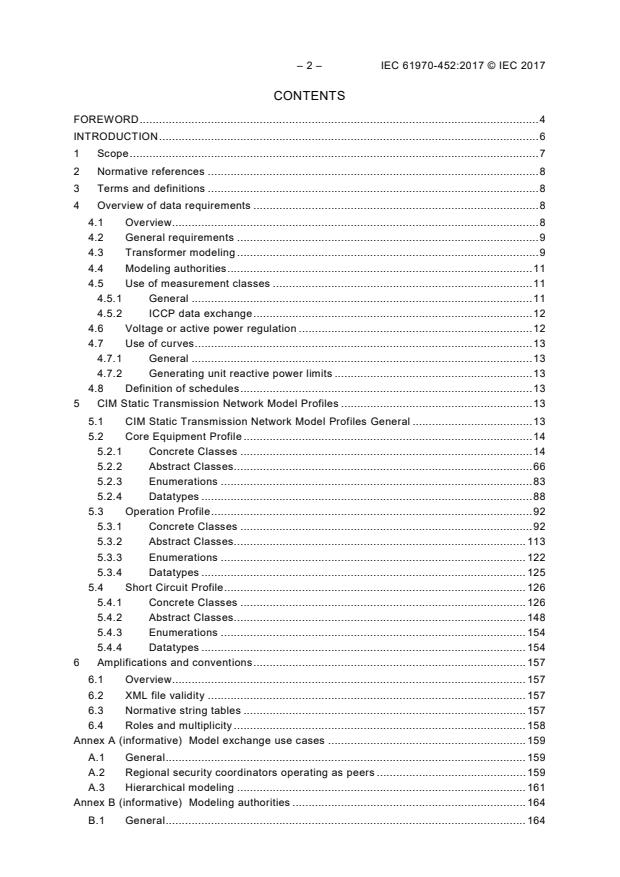
– 2 – IEC 61970-452:2017 © IEC 2017
CONTENTS
FOREWORD . 4
INTRODUCTION . 6
1 Scope . 7
2 Normative references . 8
3 Terms and definitions . 8
4 Overview of data requirements . 8
4.1 Overview. 8
4.2 General requirements . 9
4.3 Transformer modeling . 9
4.4 Modeling authorities . 11
4.5 Use of measurement classes . 11
4.5.1 General . 11
4.5.2 ICCP data exchange . 12
4.6 Voltage or active power regulation . 12
4.7 Use of curves . 13
4.7.1 General . 13
4.7.2 Generating unit reactive power limits . 13
4.8 Definition of schedules . 13
5 CIM Static Transmission Network Model Profiles . 13
5.1 CIM Static Transmission Network Model Profiles General . 13
5.2 Core Equipment Profile . 14
5.2.1 Concrete Classes . 14
5.2.2 Abstract Classes. 66
5.2.3 Enumerations . 83
5.2.4 Datatypes . 88
5.3 Operation Profile . 92
5.3.1 Concrete Classes . 92
5.3.2 Abstract Classes. 113
5.3.3 Enumerations . 122
5.3.4 Datatypes . 125
5.4 Short Circuit Profile . 126
5.4.1 Concrete Classes . 126
5.4.2 Abstract Classes. 148
5.4.3 Enumerations . 154
5.4.4 Datatypes . 154
6 Amplifications and conventions . 157
6.1 Overview. 157
6.2 XML file validity . 157
6.3 Normative string tables . 157
6.4 Roles and multiplicity . 158
Annex A (informative) Model exchange use cases . 159
A.1 General . 159
A.2 Regional security coordinators operating as peers . 159
A.3 Hierarchical modeling . 161
Annex B (informative) Modeling authorities . 164
B.1 General . 164
B.2 The ModelingAuthority Class and ModelingAuthoritySets . 164
B.3 Full Model Exchange. 164
B.4 Benefits of this approach . 164
B.4.1 Generality . 164
B.4.2 Naming & MRIDs . 165
B.4.3 Processing efficiency . 165
B.4.4 Verification of authority . 165
Annex C (informative) Boundary definition . 166
Annex D (informative) Multiple profile processing . 167
Annex E (informative) Common power system model (CPSM) minimum data
requirements . 168
E.1 Overview. 168
E.2 Scope of the ENTSO-E Common Grid Model Exchange (CGMES)
specification . 168
E.3 Glossary of the ENTSO-E Common Grid Model Exchange (CGMES)
specification . 169
E.4 Recommended data model exchange attributes . 170
Bibliography . 174
Figure 1 – Two winding transformer impedance . 10
Figure 2 – Three winding transformer impedance . 10
Figure A.1 – Security coordinators . 159
Figure A.2 – CIM model exchange . 160
Figure A.3 – Revised CIM model exchange . 161
Figure A.4 – Hierarchical modeling . 162
Figure E.1 – Example model configuration . 172
Table 1 – Valid measurementTypes . 12
Table 2 – Profiles defined in this document . 14
Table 3 – Valid attribute values . 158
– 4 – IEC 61970-452:2017 © IEC 2017
INTERNATIONAL ELECTROTECHNICAL COMMISSION
____________
ENERGY MANAGEMENT SYSTEM APPLICATION
PROGRAM INTERFACE (EMS-API) –
Part 452: CIM static transmission network model profiles
FOREWORD
1) The International Electrotechnical Commission (IEC) is a worldwide organization for standardization comprising
all national electrotechnical committees (IEC National Committees). The object of IEC is to promote
international co-operation on all questions concerning standardization in the electrical and electronic fields. To
this end and in addition to other activities, IEC publishes International Standards, Technical Specifications,
Technical Reports, Publicly Available Specifications (PAS) and Guides (hereafter referred to as “IEC
Publication(s)”). Their preparation is entrusted to technical committees; any IEC National Committee interested
in the subject dealt with may participate in this preparatory work. International, governmental and non-
governmental organizations liaising with the IEC also participate in this preparation. IEC collaborates closely
with the International Organization for Standardization (ISO) in accordance with conditions determined by
agreement between the two organizations.
2) The formal decisions or agreements of IEC on technical matters express, as nearly as possible, an international
consensus of opinion on the relevant subjects since each technical committee has representation from all
interested IEC National Committees.
3) IEC Publications have the form of recommendations for international use and are accepted by IEC National
Committees in that sense. While all reasonable efforts are made to ensure that the technical content of IEC
Publications is accurate, IEC cannot be held responsible for the way in which they are used or for any
misinterpretation by any end user.
4) In order to promote international uniformity, IEC National Committees undertake to apply IEC Publications
transparently to the maximum extent possible in their national and regional publications. Any divergence
between any IEC Publication and the corresponding national or regional publication shall be clearly indicated in
the latter.
5) IEC itself does not provide any attestation of conformity. Independent certification bodies provide conformity
assessment services and, in some areas, access to IEC marks of conformity. IEC is not responsible for any
services carried out by independent certification bodies.
6) All users should ensure that they have the latest edition of this publication.
7) No liability shall attach to IEC or its directors, employees, servants or agents including individual experts and
members of its technical committees and IEC National Committees for any personal injury, property damage or
other damage of any nature whatsoever, whether direct or indirect, or for costs (including legal fees) and
expenses arising out of the publication, use of, or reliance upon, this IEC Publication or any other IEC
Publications.
8) Attention is drawn to the Normative references cited in this publication. Use of the referenced publications is
indispensable for the correct application of this publication.
9) Attention is drawn to the possibility that some of the elements of this IEC Publication may be the subject of
patent rights. IEC shall not be held responsible for identifying any or all such patent rights.
International Standard IEC 61970-452 has been prepared by IEC technical committee 57:
Power systems management and associated information exchange.
This third edition cancels and replaces the second edition published in 2015. This edition
constitutes a technical revision.
This edition includes the following significant technical changes with respect to the previous
edition:
a) The Equipment profile has been split into three separate profiles, CoreEquipment,
Operation and ShortCircuit.
b) The HVDC model has been replaced with the new model defined in Edition 6 of
61970-301.
c) Added attribute IdentifiedObject.mRID.
d) Added class BusNameMarker.
e) Added attribute HydroPowerPlant.hydroPlantType.
f) Removed attribute HydroGeneratingUnit.energyConversionCapability.
g) Added classes related to grounding (PetersenCoil, GroundImpedance,
GroundDisconnector, GroundSwitch, and Ground).
h) A number of changes have been made to whether specific attributes and associations are
required or optional.
The text of this International Standard is based on the following documents:
FDIS Report on voting
57/1868/FDIS 57/1892/RVD
Full information on the voting for the approval of this International Standard can be found in
the report on voting indicated in the above table.
This document has been drafted in accordance with the ISO/IEC Directives, Part 2.
A list of all parts in the IEC 61970 series, published under the general title Energy
management system application program interface (EMS-API), can be found on the IEC
website.
The committee has decided that the contents of this document will remain unchanged until the
stability date indicated on the IEC website under "http://webstore.iec.ch" in the data related to
the specific document. At this date, the document will be
• reconfirmed,
• withdrawn,
• replaced by a revised edition, or
• amended.
IMPORTANT – The 'colour inside' logo on the cover page of this publication indicates
that it contains colours which are considered to be useful for the correct
understanding of its contents. Users should therefore print this document using a
colour printer.
– 6 – IEC 61970-452:2017 © IEC 2017
INTRODUCTION
This part of IEC 61970 is part of the IEC 61970 series that define an application program
interface (API) for an energy management system (EMS).
The IEC 61970-3x series specifies a Common Information Model (CIM). The CIM is an
abstract model that represents all of the major objects in an electric utility enterprise typically
needed to model the operational aspects of a utility. It provides the semantics for the
IEC 61970 APIs specified in the IEC 61970-4x series of Component Interface Standards
(CIS). The IEC 61970-3x series includes IEC 61970-301, Common Information Model (CIM)
base and draft standard IEC 61970-302 , Common Information Model (CIM) for Dynamics.
This document is one of the IEC 61970-4x series of Compoment Interface Standards that
specify the functional requirements for interfaces that a component (or application) shall
implement to exchange information with other components (or applications) and/or to access
publicly available data in a standard way. The component interfaces describe the specific
message contents and services that can be used by applications for this purpose. The
implementation of these messages in a particular technology is described in the IEC 61970-5x
series.
This document specifies the specific profiles (or subsets) of the CIM for exchange of static
power system data between utilities, security coordinators and other entities participating in a
interconnected power system, such that all parties have access to the modeling of their
neighbor’s systems that is necessary to execute state estimation or power flow applications.
Currently three profiles, the CoreEquipment Profile, the Operation Profile and the Short Circuit
Profile, have been defined. A companion standard, IEC 61970-552, defines the CIM XML
Model Exchange Format based on the Resource Description Framework (RDF) Schema
specification language. IEC 61970-552 is the common industry approach and is recommended
to be used to transfer power system model data for the IEC 61970-452 profile.
___________
1 Under preparation. Stage at the time of publication: IEC/AFDIS 61970-302:2017.
ENERGY MANAGEMENT SYSTEM APPLICATION
PROGRAM INTERFACE (EMS-API) –
Part 452: CIM static transmission network model profiles
1 Scope
This IEC document is one of the IEC 61970-450 to 499 series that, taken as a whole, defines
at an abstract level the content and exchange mechanisms used for data transmitted between
control centers and/or control center components, such as power systems applications.
The purpose of this document is to define the subset of classes, class attributes, and roles
from the CIM necessary to execute state estimation and power flow applications. The North
American Electric Reliability Council (NERC) Data Exchange Working Group (DEWG)
Common Power System Modeling group (CPSM) produced the original data requirements,
which are shown in Annex E. These requirements are based on prior industry practices for
exchanging power system model data for use primarily in planning studies. However, the list
of required data has been extended to facilitate a model exchange that includes parameters
common to breaker-oriented applications. Where necessary this document establishes
conventions, shown in Clause 6, with which an XML data file must comply in order to be
considered valid for exchange of models.
This document is intended for two distinct audiences, data producers and data recipients, and
may be read from two perspectives.
From the standpoint of model export software used by a data producer, the document
describes a minimum subset of CIM classes, attributes, and associations which must be
present in an XML formatted data file for model exchange. This standard does not dictate how
the network is modelled, however. It only dictates what classes, attributes, and associations
are to be used to describe the source model as it exists.
Optional and required classes, attributes and associations must be imported if they are in the
model file prior to import. If an optional attribute does not exist in the imported file, it does not
have to be exported in case exactly the same data set is exported, i.e. the tool is not obliged
to automatically provide this attribute. If any mandatory attribute or association is missing, the
exchanged data is considered invalid. Specific business processes may relax restrictions of
the profile, but such exchanges would not be considered to be compliant with the standard.
Business processes governing different exchanges can also require mandatory exchange of
certain optional attributes or associations.
Furthermore, an exporter may, at his or her discretion, produce an XML data file containing
additional class data described by the CIM RDF Schema but not required by this document
provided these data adhere to the conventions established in Clause 6.
From the standpoint of the model import used by a data recipient, the document describes a
subset of the CIM that importing software must be able to interpret in order to import exported
models. As mentioned above, data providers are free to exceed the minimum requirements
described herein as long as their resulting data files are compliant with the CIM RDF Schema
and the conventions established in Clause 6. The document, therefore, describes additional
classes and class data that, although not required, exporters will, in all likelihood, choose to
include in their data files. The additional classes and data are labeled as required (cardinality
1.1) or as optional (cardinality 0.1) to distinguish them from their required counterparts.
Please note, however, that data importers could potentially receive data containing instances
of any and all classes described by the CIM RDF Schema.
– 8 – IEC 61970-452:2017 © IEC 2017
2 Normative references
The following documents are referred to in the text in such a way that some or all of their
content constitutes requirements of this document. For dated references, only the edition
cited applies. For undated references, the latest edition of the referenced document (including
any amendments) applies.
NOTE For general glossary definitions, see IEC 60059, International Electrotechnical Vocabulary.
IEC 61968-13, Application integration at electric utilities – System interfaces for distribution
management – Part 13: CIM RDF Model exchange format for distribution
IEC 61970-301:2016, Energy management system application program interface (EMS-API) –
Part 301: Common information model (CIM) base
IEC 61970-456, Energy management system application program interface (EMS-API) –
Part 456: Solved power system state profiles
IEC 61970-501, Energy management system application program interface (EMS-API) –
Part 501: Common Information Model Resource Description Framework (CIM RDF) schema
IEC 61970-552, Energy management system application program interface (EMS-API) –
Part 552: CIMXML Model exchange format
Extensible Markup Language (XML) 1.0 (Second Edition), http://www.w3.org/TR/REC-xml
3 Terms and definitions
No terms and definitions are listed in this document.
ISO and IEC maintain terminological databases for use in standardization at the following
addresses:
• IEC Electropedia: available at http://www.electropedia.org/
• ISO Online browsing platform: available at http://www.iso.org/obp
4 Overview of data requirements
4.1 Overview
An extensive discussion of the model exchange use cases can be found in Annex A. In all
cases, the purposes of this document are:
• To improve the accuracy of power system models used in critical systems, particularly the
representation of parts of the network outside the primary domain of the system in
question.
• To achieve consistency among the models used by the various systems that play a role in
operating or planning the interconnection.
• To reduce the overall cost of maintaining critical models used in operating or planning an
interconnection.
The classes, attributes, and associations identified in this document and specified in
IEC 61970-456 represent the minimum subset of the full CIM model necessary to exchange
sufficient power system data to support state estimation and power flow for HV(high voltage)
and MV (medium voltage) networks. IEC 61968-13 describes the profiles used to exchange
distribution MV/LV (low voltage) network models.
4.2 General requirements
The following requirements are general in nature or involve multiple classes. Additional
requirements are defined in Subclauses 5.2.1 and 5.2.2 for the individual classes.
• The cardinality defined in the CIM model shall be followed, unless a different cardinality is
explicitly defined in this document. For instance, the cardinality on the association
between VoltageLevel and BaseVoltage indicates that a VoltageLevel shall be associated
with one and only one BaseVoltage, but a BaseVoltage can be associated with zero to
many VoltageLevels.
• Associations between classes referenced in this document and classes not referenced
here are not required regardless of cardinality.
• The attribute “name” inherited by many classes from the abstract class IdentifiedObject is
not required to be unique. The RDF ID defined in the data exchange format is the only
unique and persistent identifier used for this data exchange. The attribute
IdentifiedObject.name is, however, always required. The additional attribute of
IdentifiedObject, aliasName, is not required.
• The IdentifiedObject.mRID attribute should be used as the RDF ID. The RDF ID can not
begin with a number. An underscore should be added as the first character if necessary.
The RDF ID shall be globally unique. A prefix may be added, if necessary, to ensure
global uniqueness, but the RDF ID including the prefix shall be within the maximum
character limit specified below.
• The maximum character length of names and identifiers are listed below.
– rdf:ID – 60 characters maximum
– IdentifiedObject.name – 32 characters maximum
– IdentifiedObject.aliasname – 40 characters maximum
• To maintain a consistent naming hierarchy, each Substation shall be contained by a
SubGeographicalRegion and each SubGeographicalRegion shall be contained by one and
only one GeographicalRegion.
• Equipment defined without connectivity, because the associated Terminal(s) are not
connected to ConnectivityNodes is allowed, for instance a ShuntCompensator whose
Terminal is not associated to a ConnectivityNode.
• UTF-8 is the standard for file encoding. UTF-16 is not supported.
• Instance data to be exchanged shall make use of the most detailed class possible. The
classes GeneratingUnit, Switch, and EnergyConsumer should only be used if the
information to determine the more detailed class (ThermalGeneratingUnit,
HydroGeneratingUnit, Breaker, Disconnector, etc.) is not available.
• All Equipment must be within a VoltageLevel except PowerTransformer, GeneratingUnit,
HydroPump, Conductor, Switch and DCConductingEquipment. A PowerTransformer,
GeneratingUnit or HydroPump should be contained in a substation; a Switch may be in a
VoltageLevel or a Bay; and Conductor should be contained in a Line. For networks with
HVDC the ACDCConverter will be in a DCConverterUnit and the associated
PowerTransformer, Switches and SeriesCompensators will also be contained in a
DCConverterUnit.
4.3 Transformer modeling
A two winding PowerTransformer has two PowerTransformerEnds. This gives the option to
specify the impedance values for the equivalent pi-model completely at one end or split them
between the two ends. The impedances shall be specified at the primary voltage side as
shown in Figure 1.
– 10 – IEC 61970-452:2017 © IEC 2017
r + jx
g + jb
u
IEC
Figure 1 – Two winding transformer impedance
A three winding PowerTransformer has three PowerTransformerEnds. The equivalent pi-
model corresponds to three ends connected in wye configuration as shown below. The
impedance values for a three winding transformer are specified on each of the three
TransformerWindings. Each of the ends has series impedances rn+jxn and shunt gn+jbn
where n is: p for primary, s for secondary and t for tertiary as shown in Figure 2.
rs + jxs
Secondary
rp + jxp rt + jxt
Primary Tertiary
gs + jbs
gp + jbp gt + jbt
IEC
Figure 2 – Three winding transformer impedance
Additional requirements related to transformer modeling are listed below.
• Each PowerTransformer and its associated PowerTransformerEnds and tap changers
(RatioTapChanger, PhaseTapChangerLinear, PhaseTapChangerSymetrical, and
PhaseTapChangerAsymetrical) shall be contained within one substation. For the case of a
transformer that connects two substations, however, the terminal of one of the
PowerTransformerEnds can be connected to a ConnectivityNode defined in another
substation. In this case, the PowerTransformer, the PowerTransformerEnds, the tap
changers are still all defined in one substation.
• A PowerTransformer shall be contained by a Substation. A PowerTransformerEnd shall be
contained by a PowerTransformer. A RatioTapChanger, PhaseTapChangerLinear,
PhaseTapChangerSymetrical, and PhaseTapChangerAsymetrical shall be contained by a
PowerTransformerEnd.
• Each PowerTransformer shall have at least two and no more than three
PowerTransformerEnds. Each PowerTransformerEnd can have at most one tap changer
(RatioTapChanger, PhaseTapChangerLinear, PhaseTapChangerSymetrical, or
PhaseTapChangerAsymetrical). If a PowerTransformerEnd does not have an associated
tap changer, the end should be considered to have a fixed tap.
Multiple types of regulating transformers are supported by the CIM model. Depending on the
regulation capabilities, the effects of tap movement will be defined using the
RatioTapChanger class, PhaseTapChangerLinear class, PhaseTapChangerSymetrical class,
or PhaseTapChangerAsymetrical class. Each of these classes are subtypes of the
TapChanger class. The use of the various subtypes is explained in IEC 61970-301.
4.4 Modeling authorities
From the use cases for model exchange detailed in Annex A, it is clear that most situations
involve multiple entities that shall cooperate. In these situations, it is very important to
establish which entity has the authority for modeling each region or set of data objects. For
this purpose we use the concepts of ModelingAuthority and ModelingAuthoritySet.
ModelingAuthority and ModelingAuthoritySet are not defined as classes in the normative
portion of the CIM. When multiple modeling entities are involved, each modeled object is
assigned to a ModelingAuthoritySet. A ModelingAuthority can be responsible for one or more
ModelingAuthoritySets. A more detailed description of the use ModelingAuthorities and
ModelingAuthoritySets can be found in Annex B. When using the concept of
ModelingAuthoritySets, a single file shall contain only data objects associated with a single
ModelingAuthoritySet.
4.5 Use of measurement classes
4.5.1 General
Use of the CIM Measurement classes (Analog, Accumulator, and Discrete) is frequently
misunderstood and has changed over time. Previously in addition to the use representing
points in the system where telemetry is available, the classes had been used to associate
Limits with a piece of Equipment and to define regulated points. Measurements are now only
used to define where telemetry is available and to facilitate exchange of ICCP data.
A Measurement shall be associated with a PowerSystemResource to convey containment
information for the Measurement. Transmission line measurements should be associated with
an ACLineSegment, not with a Line. Transformer measurements should be associated with a
PowerTransformer, not with a Transformer Winding. Voltage measurements should be
associated with a piece of equipment, not with a VoltageLevel. A TapPosition measurement
shall be associated with a tap changer (RatioTapChanger, PhaseTapChangerLinear,
PhaseTapChangerSymetrical or PhaseTapChangerAsymetrical). A SwitchPosition
measurement shall be associated with a Switch or a subtype of Switch.
The Measurement may also be associated with one of the Terminals associated with a piece
of equipment. For measurements representing actual telemetered points, it is especially
important that the association to a Terminal defines the specific topological point in the
network that is measured. A Measurement can be associated with at most one Terminal. Each
flow measurement (active power, reactive power, or current) shall be associated with a
terminal. This association is particularly important for State Estimation. The measurement
shall be associated with the correct terminal of the piece of conducting equipment that is
being measured (SynchronousMachine, EnergyConsumer, ACLineSegment,
PowerTransformer, etc.). Associating the measurement with a terminal of the wrong
equipment or the terminal on the wrong end of the correct piece of equipment will cause
problems for State Estimation. Only two types of measurement, TapPosition and
SwitchPosition, do not require an association to a Terminal.
Three subtypes of Measurement are included in this profile, Analog, Accumulator, and
Discrete. To describe what is being measured, the attribute Measurement.measurementType
is used, but only particular measurementTypes are valid for each of the subtypes of
Measurement. The valid associations are defined in Table 1.
– 12 – IEC 61970-452:2017 © IEC 2017
Table 1 – Valid measurementTypes
Measurement Subclass measurementType
ThreePhasePower
ThreePhaseActivePower
ThreePhaseReactivePower
LineCurrent
Analog
PhaseVoltage
LineToLineVoltage
Angle
TapPosition
ApparentEnergy
ReactiveEnergy
Accumulator
ActiveEnergy
SwitchPosition
Discrete
4.5.2 ICCP data exchange
In the context of this data exchange profile, ICCP Data Exchange is only for the purpose of
defining input measurements for use by State Estimator. It is not meant to be used to
configure bidirectional ICCP exchange.
ICCP (known officially as IEC 60870-6 TASE.2) data is exchanged using the Measurement
classes (Analog, Discrete, and Accumulator), the MeasurementValue classes (AnalogValue,
DiscreteValue, and AccumulatorValue), and the MeasurementValueSource class. The
MeasurementValueSource class is used to define the control center supplying the ICCP data.
The MeasurementValueSource shall be associated with an instance of Name where the
attribute Name.name holds the name of the supplying control center. The instance of
NameType associated with the control center Name shall have the NameType.name attribute
set to “ICCP Provider ID”.
The MeasurementValue classes are used to specify the ICCP ID. The MeasurementValue
shall be associated with an instance of Name where the attribute Name.name holds the ICCP
ID. The instance of NameType associated with the ICCP ID Name shall have the
NameType.name attribute set to “ICCP ID”. The MeasurementValue.name attribute holds the
SCADA point name. Each MeasurementValue will be associated with one Measurement. Each
MeasurementValue being supplied via ICCP shall also have an association to a
MeasurementValueSource.
To clearly specify the point in the system being measured, the Measurement should be
associated with a Terminal. For a switch status measurement, however, the association to the
appropriate PowerSystemResource representing the switch would be sufficient.
4.6 Voltage or active power regulation
To use CIM to define how a piece of equipment regulates a point in the system, an
association is defined between the regulating conducting equipment (SynchronousMachine,
LinearShuntCompensator, NonLinearShuntCompensator, StaticVarCompensator,
RatioTapChanger, PhaseTapChangerLinear, PhaseTapChangerSymetrical,
PhaseTapChangerAsymetrical, PhaseTapChangerTabular or ExternalNetworkInjection) and
an instance of RegulatingControl or TapChangerControl. The RegulatingControl or
TapChangerControl shall be associated with a Terminal. The control for a piece of regulating
equipment can refer to a Terminal associated with another PowerSystemResource. For
instance, for voltage regulation purposes the control for a SynchronousMachine could refer to
a Terminal associated with a BusbarSection. The Terminal defines the point of regulation. The
association between RegulatingControl or TapChangerControl and Terminal is required to
define regulation of voltage or active power. For a piece of equipment that is not regulating,
the association to RegulatingControl or TapChangerControl is not required.
4.7 Use of curves
4.7.1 General
The use of the Curve and CurveData attributes will differ for the different types of curves
derived from Curve. To define a Y value that does not change, the curveStyle attribute should
be set to “constantYValue”. In this case, only one instance of CurveData should be included
defining the single point for the curve. Because the Y value is constant, the CurveData.xvalue
value will be ignored, if it is supplied at all. A curve should never have multiple instances of
CurveData where the xvalue value is repeated.
4.7.2 Generating unit reactive power limits
Generating unit reactive power limits shall be included in data exchange, but may be specified
differently depending on the characteristics of the generating unit being represented. In most
cases, a SynchronousMachine should be associated with a default ReactiveCapabilityCurve
using the SynchronousMachine.InitialReactiveCapabilityCurve association.
If the reactive power limits of the generating unit do not vary with the real power output, the
reactive power limit attributes on the SynchronousMachine class, minQ and maxQ, can be
used. If the reactive power output of the generating unit is fixed, the reactive power limits
should both be set to the fixed reactive output value.
4.8 Definition of schedules
The use of the RegularIntervalSchedule and RegularTimePoint attributes will differ for the
different types of schedules derived from RegularIntervalSchedule. To specify a relative time
for a schedule, the date portion of the dateTime format can be eliminated, which leaves the
ISO 8601 time of day format “hh:mm:ss”. In this format, hh is the number of complete hours
that have passed since midnight, mm is the number of complete minutes since the start of the
hour, and ss is the number of complete seconds since the start of the minute.
The earliest allowed time used in a schedule (BasicIntervalSchedule.startTime) is “00:00:00”.
The latest allowe
...
Questions, Comments and Discussion
Ask us and Technical Secretary will try to provide an answer. You can facilitate discussion about the standard in here.
Loading comments...