


IEC TS 63542:2024
(Main)Refrigerant detection systems for flammable refrigerants
Refrigerant detection systems for flammable refrigerants
IEC TS 63542:2024 applies to refrigerant detection systems for use in appliances complying with a relevant standard of the IEC 60335 series using flammable refrigerants.
Relevant standards of the IEC 60335-series include:
– IEC 60335-2-40, Household and similar electrical appliances – Safety – Part 2-40: Particular requirements for electrical heat pumps, air-conditioners and dehumidifiers
– IEC 60335-2-89, Household and similar electrical appliances – Safety – Part 2-89: Particular requirements for commercial refrigerating appliances and ice-makers with an incorporated or remote refrigerant unit or motor-compressor
– IEC 60335-2-104, Household and similar electrical appliances – Safety – Part 2-104: Particular requirements for appliances to recover and/or recycle refrigerant from air conditioning and refrigeration equipment
– IEC 60335-2-118, Household and similar electrical appliances – Safety – Part 2-118: Particular requirements for professional ice-cream makers
This document does not take into account refrigerants other than group A2L, A2 and A3 as defined by ISO 817.
General Information
- Status
- Published
- Publication Date
- 12-Aug-2024
- Technical Committee
- SC 61D - Appliances for air-conditioning for household and similar purposes
- Drafting Committee
- WG 22 - TC 61/SC 61D/WG 22
- Current Stage
- PPUB - Publication issued
- Start Date
- 13-Aug-2024
- Completion Date
- 13-Sep-2024
Overview - IEC TS 63542:2024 (Refrigerant detection systems for flammable refrigerants)
IEC TS 63542:2024 defines technical requirements and test methods for refrigerant detection systems used in appliances that employ flammable refrigerants (safety groups A2L, A2 and A3 as defined by ISO 817). The Technical Specification targets detection systems integrated into household and similar electrical appliances covered by relevant IEC 60335 series standards (for example, heat pumps, air‑conditioners, commercial refrigeration, refrigerant recovery and professional ice‑cream makers).
This document specifies how sensors must detect leaked refrigerant, how alarm set points relate to the refrigerant’s lower flammability limit (LFL), and the environmental, durability and safety tests the detection system must pass.
Key topics and technical requirements
- Scope and applicability: Applies only to refrigerants in ISO 817 groups A2L, A2 and A3 and to appliances covered by relevant IEC 60335 parts.
- Detection performance: Systems must give an output signal at a predetermined alarm set point and detect concentrations above that set point across the appliance’s full operating temperature and humidity range.
- Detection principle: Systems may detect refrigerant directly or detect gases displaced by leaked refrigerant.
- Test program and sample requirements: Specific clauses define tests for response time, calibration, selectivity, poisoning, oil spray, long‑term stability, humidity, temperature, vibration and ignition. Some tests are conducted on separate sets of three samples; all samples must pass.
- Calibration & stability: Requirements for short‑term calibration, drift, and demonstrating long‑term stability under expected operating conditions.
- Environmental and mechanical robustness: Includes humidity, temperature cycling and vibration tests, plus oil spray and refrigerant poisoning evaluations.
- Safety features: Self‑test routines, serviceability (sensor replacement notifications) and refrigerant sensor identification are required to support safe maintenance and lifecycle management.
- Reference to LFL: Where LFL is used, the appliance’s nominal refrigerant composition (per the application standard) is used for testing and set‑point selection.
Practical applications - who uses this standard
- Appliance manufacturers (heat pumps, air conditioners, commercial refrigeration, refrigerant recovery units, professional ice‑cream makers) integrating detection into products
- Sensor and detector OEMs designing refrigerant sensors for flammable refrigerants
- Test laboratories and certification bodies performing compliance testing to IEC 60335 application standards
- Safety and compliance engineers responsible for appliance design, risk assessment and user notification strategies
Related standards
- IEC 60335‑2‑40, IEC 60335‑2‑89, IEC 60335‑2‑104, IEC 60335‑2‑118 (application standards for appliances)
- ISO 817 (refrigerant designation and safety classification)
- IEC 60079‑29‑1 (sensor terminology reference)
- ISO 7000 (graphical symbols referenced)
By following IEC TS 63542:2024, manufacturers and test labs can ensure refrigerant detection systems meet harmonized performance, durability and safety expectations for appliances using flammable refrigerants.
Get Certified
Connect with accredited certification bodies for this standard

Institut za varilstvo d.o.o. (Welding Institute)
Slovenia's leading welding institute since 1952. ISO 3834, EN 1090, pressure equipment certification, NDT personnel, welder qualification. Only IIW Au
Sponsored listings
Frequently Asked Questions
IEC TS 63542:2024 is a technical specification published by the International Electrotechnical Commission (IEC). Its full title is "Refrigerant detection systems for flammable refrigerants". This standard covers: IEC TS 63542:2024 applies to refrigerant detection systems for use in appliances complying with a relevant standard of the IEC 60335 series using flammable refrigerants. Relevant standards of the IEC 60335-series include: – IEC 60335-2-40, Household and similar electrical appliances – Safety – Part 2-40: Particular requirements for electrical heat pumps, air-conditioners and dehumidifiers – IEC 60335-2-89, Household and similar electrical appliances – Safety – Part 2-89: Particular requirements for commercial refrigerating appliances and ice-makers with an incorporated or remote refrigerant unit or motor-compressor – IEC 60335-2-104, Household and similar electrical appliances – Safety – Part 2-104: Particular requirements for appliances to recover and/or recycle refrigerant from air conditioning and refrigeration equipment – IEC 60335-2-118, Household and similar electrical appliances – Safety – Part 2-118: Particular requirements for professional ice-cream makers This document does not take into account refrigerants other than group A2L, A2 and A3 as defined by ISO 817.
IEC TS 63542:2024 applies to refrigerant detection systems for use in appliances complying with a relevant standard of the IEC 60335 series using flammable refrigerants. Relevant standards of the IEC 60335-series include: – IEC 60335-2-40, Household and similar electrical appliances – Safety – Part 2-40: Particular requirements for electrical heat pumps, air-conditioners and dehumidifiers – IEC 60335-2-89, Household and similar electrical appliances – Safety – Part 2-89: Particular requirements for commercial refrigerating appliances and ice-makers with an incorporated or remote refrigerant unit or motor-compressor – IEC 60335-2-104, Household and similar electrical appliances – Safety – Part 2-104: Particular requirements for appliances to recover and/or recycle refrigerant from air conditioning and refrigeration equipment – IEC 60335-2-118, Household and similar electrical appliances – Safety – Part 2-118: Particular requirements for professional ice-cream makers This document does not take into account refrigerants other than group A2L, A2 and A3 as defined by ISO 817.
IEC TS 63542:2024 is classified under the following ICS (International Classification for Standards) categories: 23.120 - Ventilators. Fans. Air-conditioners. The ICS classification helps identify the subject area and facilitates finding related standards.
IEC TS 63542:2024 is available in PDF format for immediate download after purchase. The document can be added to your cart and obtained through the secure checkout process. Digital delivery ensures instant access to the complete standard document.
Standards Content (Sample)
IEC TS 63542 ®
Edition 1.0 2024-08
TECHNICAL
SPECIFICATION
Refrigerant detection systems for flammable refrigerants
All rights reserved. Unless otherwise specified, no part of this publication may be reproduced or utilized in any form
or by any means, electronic or mechanical, including photocopying and microfilm, without permission in writing from
either IEC or IEC's member National Committee in the country of the requester. If you have any questions about IEC
copyright or have an enquiry about obtaining additional rights to this publication, please contact the address below or
your local IEC member National Committee for further information.
IEC Secretariat Tel.: +41 22 919 02 11
3, rue de Varembé info@iec.ch
CH-1211 Geneva 20 www.iec.ch
Switzerland
About the IEC
The International Electrotechnical Commission (IEC) is the leading global organization that prepares and publishes
International Standards for all electrical, electronic and related technologies.
About IEC publications
The technical content of IEC publications is kept under constant review by the IEC. Please make sure that you have the
latest edition, a corrigendum or an amendment might have been published.
IEC publications search - webstore.iec.ch/advsearchform IEC Products & Services Portal - products.iec.ch
The advanced search enables to find IEC publications by a Discover our powerful search engine and read freely all the
variety of criteria (reference number, text, technical publications previews, graphical symbols and the glossary.
committee, …). It also gives information on projects, replaced With a subscription you will always have access to up to date
and withdrawn publications. content tailored to your needs.
IEC Just Published - webstore.iec.ch/justpublished
Electropedia - www.electropedia.org
Stay up to date on all new IEC publications. Just Published
The world's leading online dictionary on electrotechnology,
details all new publications released. Available online and once
containing more than 22 500 terminological entries in English
a month by email.
and French, with equivalent terms in 25 additional languages.
Also known as the International Electrotechnical Vocabulary
IEC Customer Service Centre - webstore.iec.ch/csc
(IEV) online.
If you wish to give us your feedback on this publication or need
further assistance, please contact the Customer Service
Centre: sales@iec.ch.
IEC TS 63542 ®
Edition 1.0 2024-08
TECHNICAL
SPECIFICATION
Refrigerant detection systems for flammable refrigerants
INTERNATIONAL
ELECTROTECHNICAL
COMMISSION
ICS 23.120 ISBN 978-2-8322-9545-8
– 2 – IEC TS 63542:2024 © IEC 2024
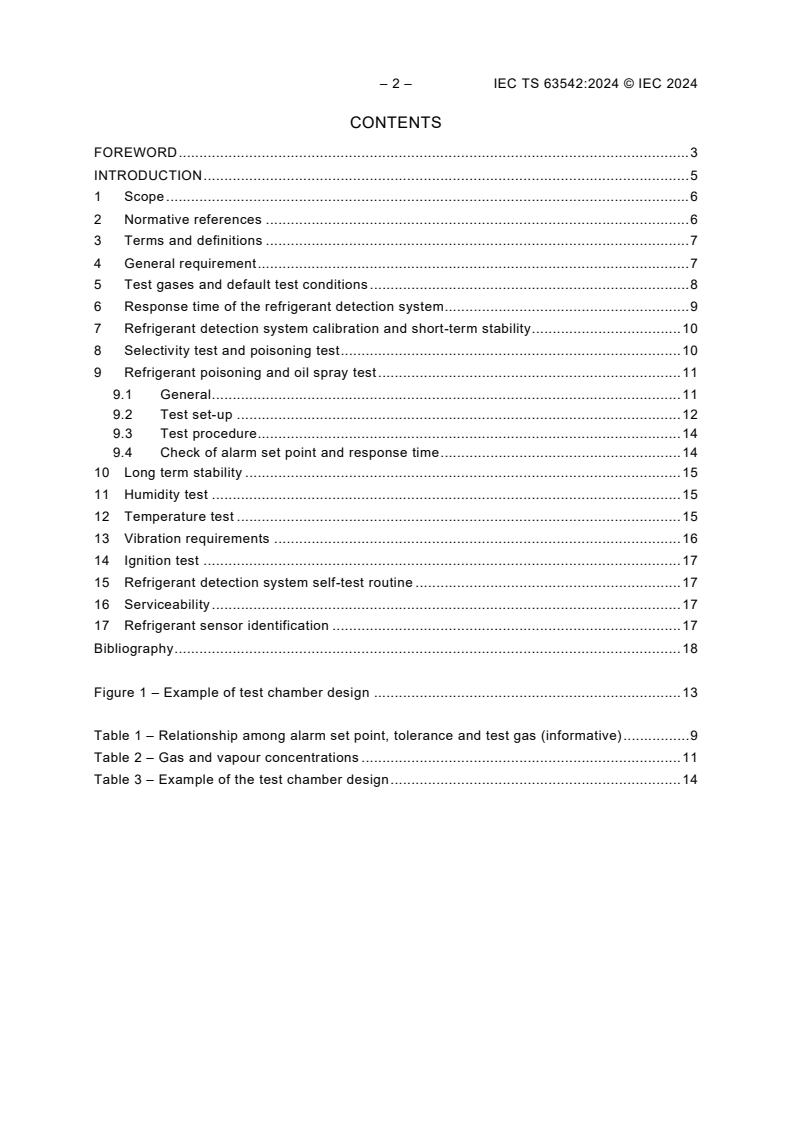
CONTENTS
FOREWORD . 3
INTRODUCTION . 5
1 Scope . 6
2 Normative references . 6
3 Terms and definitions . 7
4 General requirement . 7
5 Test gases and default test conditions . 8
6 Response time of the refrigerant detection system . 9
7 Refrigerant detection system calibration and short-term stability . 10
8 Selectivity test and poisoning test . 10
9 Refrigerant poisoning and oil spray test . 11
9.1 General . 11
9.2 Test set-up . 12
9.3 Test procedure . 14
9.4 Check of alarm set point and response time . 14
10 Long term stability . 15
11 Humidity test . 15
12 Temperature test . 15
13 Vibration requirements . 16
14 Ignition test . 17
15 Refrigerant detection system self-test routine . 17
16 Serviceability . 17
17 Refrigerant sensor identification . 17
Bibliography . 18
Figure 1 – Example of test chamber design . 13
Table 1 – Relationship among alarm set point, tolerance and test gas (informative) . 9
Table 2 – Gas and vapour concentrations . 11
Table 3 – Example of the test chamber design . 14
INTERNATIONAL ELECTROTECHNICAL COMMISSION
____________
REFRIGERANT DETECTION SYSTEMS
FOR FLAMMABLE REFRIGERANTS
FOREWORD
1) The International Electrotechnical Commission (IEC) is a worldwide organization for standardization comprising
all national electrotechnical committees (IEC National Committees). The object of IEC is to promote international
co-operation on all questions concerning standardization in the electrical and electronic fields. To this end and
in addition to other activities, IEC publishes International Standards, Technical Specifications, Technical Reports,
Publicly Available Specifications (PAS) and Guides (hereafter referred to as "IEC Publication(s)"). Their
preparation is entrusted to technical committees; any IEC National Committee interested in the subject dealt with
may participate in this preparatory work. International, governmental and non-governmental organizations liaising
with the IEC also participate in this preparation. IEC collaborates closely with the International Organization for
Standardization (ISO) in accordance with conditions determined by agreement between the two organizations.
2) The formal decisions or agreements of IEC on technical matters express, as nearly as possible, an international
consensus of opinion on the relevant subjects since each technical committee has representation from all
interested IEC National Committees.
3) IEC Publications have the form of recommendations for international use and are accepted by IEC National
Committees in that sense. While all reasonable efforts are made to ensure that the technical content of IEC
Publications is accurate, IEC cannot be held responsible for the way in which they are used or for any
misinterpretation by any end user.
4) In order to promote international uniformity, IEC National Committees undertake to apply IEC Publications
transparently to the maximum extent possible in their national and regional publications. Any divergence between
any IEC Publication and the corresponding national or regional publication shall be clearly indicated in the latter.
5) IEC itself does not provide any attestation of conformity. Independent certification bodies provide conformity
assessment services and, in some areas, access to IEC marks of conformity. IEC is not responsible for any
services carried out by independent certification bodies.
6) All users should ensure that they have the latest edition of this publication.
7) No liability shall attach to IEC or its directors, employees, servants or agents including individual experts and
members of its technical committees and IEC National Committees for any personal injury, property damage or
other damage of any nature whatsoever, whether direct or indirect, or for costs (including legal fees) and
expenses arising out of the publication, use of, or reliance upon, this IEC Publication or any other IEC
Publications.
8) Attention is drawn to the Normative references cited in this publication. Use of the referenced publications is
indispensable for the correct application of this publication.
9) IEC draws attention to the possibility that the implementation of this document may involve the use of (a)
patent(s). IEC takes no position concerning the evidence, validity or applicability of any claimed patent rights in
respect thereof. As of the date of publication of this document, IEC had not received notice of (a) patent(s), which
may be required to implement this document. However, implementers are cautioned that this may not represent
the latest information, which may be obtained from the patent database available at https://patents.iec.ch. IEC
shall not be held responsible for identifying any or all such patent rights.
IEC TS 63542 has been prepared by subcommittee 61D: Appliances for air-conditioning for
household and similar purposes, of IEC technical committee 61: Safety of household and similar
electrical appliances. It is a Technical Specification.
This first edition is based on Annex LL of IEC 60335-2-40:2022:
– Clause 4 – based on Clause LL.1, but without the 1st paragraph. An additional last
paragraph has been added to link to relevant application standards;
– Clause 5 – based on Clause LL.2. An introductory sentence has been added to link to test
conditions in the relevant application standard;
– Clause 6 – based on Clause LL.3;
– Clause 7 – based on Clause LL.4;
– Clause 8 – based on Clause LL.5;
– Clause 9 – based on Clause LL.6;
– 4 – IEC TS 63542:2024 © IEC 2024
– Clause 10 – based on Clause LL.7;
– Clause 11 – based on Clause LL.8;
– Clause 12 – based on Clause LL.9;
– Clause 13 – based on Clause LL.10;
– Clause 14 – based on Clause LL.11;
– Clause 15 – based on Clause LL.12;
– Clause 16 – based on Clause LL.13;
– Clause 17 – based on Clause LL.14.
The text of this Technical Specification is based on the following documents:
Draft Report on voting
61D/531/DTS 61D/534/RVDTS
Full information on the voting for its approval can be found in the report on voting indicated in
the above table.
The language used for the development of this Technical Specification is English.
This document was drafted in accordance with ISO/IEC Directives, Part 2, and developed in
accordance with ISO/IEC Directives, Part 1 and ISO/IEC Directives, IEC Supplement, available
at www.iec.ch/members_experts/refdocs. The main document types developed by IEC are
described in greater detail at www.iec.ch/publications.
NOTE The following print types are used:
• requirements: in roman type;
• test specifications: in italic type;
• notes: in small roman type.
Words in bold in the text are defined in Clause 3. When a definition concerns an adjective, the adjective and
associated noun are also in bold.
The committee has decided that the contents of this document will remain unchanged until the
stability date indicated on the IEC website under webstore.iec.ch in the data related to the
specific document. At this date, the document will be
• reconfirmed,
• withdrawn, or
• revised.
IMPORTANT – The "colour inside" logo on the cover page of this document indicates
that it contains colours which are considered to be useful for the correct understanding
of its contents. Users should therefore print this document using a colour printer.
INTRODUCTION
It has been assumed in the drafting of this document that the execution of its provisions is
entrusted to appropriately qualified and experienced persons.
A refrigerant detection systems that complies with the text of this document will not necessarily
be considered to comply with the safety principles of the document if, when examined and
tested, it is found to have other features that impair the level of safety covered by these
requirements.
A refrigerant detection systems employing materials or having forms of construction differing
from those detailed in the requirements of this document may be examined and tested according
to the intent of the requirements and, if found to be substantially equivalent, may be considered
to comply with this document.
– 6 – IEC TS 63542:2024 © IEC 2024
REFRIGERANT DETECTION SYSTEMS
FOR FLAMMABLE REFRIGERANTS
1 Scope
This document applies to refrigerant detection systems for use in appliances complying with
a relevant standard of the IEC 60335 series using flammable refrigerants.
Relevant standards of the IEC 60335-series include:
– IEC 60335-2-40, Household and similar electrical appliances – Safety – Part 2-40: Particular
requirements for electrical heat pumps, air-conditioners and dehumidifiers
– IEC 60335-2-89, Household and similar electrical appliances – Safety – Part 2-89: Particular
requirements for commercial refrigerating appliances and ice-makers with an incorporated
or remote refrigerant unit or motor-compressor
– IEC 60335-2-104, Household and similar electrical appliances – Safety – Part 2-104:
Particular requirements for appliances to recover and/or recycle refrigerant from air
conditioning and refrigeration equipment
– IEC 60335-2-118, Household and similar electrical appliances – Safety – Part 2-118:
Particular requirements for professional ice-cream makers
This document does not take into account refrigerants other than group A2L, A2 and A3 as
defined by ISO 817.
2 Normative references
The following documents are referred to in the text in such a way that some or all of their content
constitutes requirements of this document. For dated references, only the edition cited applies.
For undated references, the latest edition of the referenced document (including any
amendments) applies.
IEC 60335-2-40:2022, Household and similar electrical appliances – Safety – Part 2-40:
Particular requirements for electrical heat pumps, air-conditioners and dehumidifiers
IEC 60335-2-89, Household and similar electrical appliances – Safety – Part 2-89: Particular
requirements for commercial refrigerating appliances and ice-makers with an incorporated or
remote refrigerant unit or motor-compressor
IEC 60335-2-104, Household and similar electrical appliances – Safety – Part 2-104: Particular
requirements for appliances to recover and/or recycle refrigerant from air conditioning and
refrigeration equipment
IEC 60335-2-118, Household and similar electrical appliances – Safety – Part 2-118: Particular
requirements for professional ice-cream makers
ISO 817, Refrigerants – Designation and safety classification
ISO 7000:2004, Graphical symbols for use on equipment – Registered symbols
3 Terms and definitions
For the purposes of this document, the following terms and definitions apply.
ISO and IEC maintain terminology databases for use in standardization at the following
addresses:
• IEC Electropedia: available at https://www.electropedia.org/
• ISO Online browsing platform: available at https://www.iso.org/obp
3.1
flammable refrigerant
refrigerant classified as safety group A2L, A2 or A3 according to ISO 817
3.2
refrigerant detection system
sensing system which gives an output signal in response to a pre-set concentration of
refrigerant in the environment
Note 1 to entry: A refrigerant detection system can have multiple refrigerant sensors.
3.3
lower flammability limit
LFL
minimum concentration of the refrigerant that is capable of propagating a flame through a
homogeneous mixture of the refrigerant and air
[SOURCE: ISO 817:2014, 3.1.24, modified – "under the specified test conditions at 23,0 °C and
101,3 kPa" and Notes to entry deleted.]
3.4
refrigerant sensor
assembly in which the sensing element is housed and that may also contain associated circuit
components
[SOURCE: IEC 60079-29-1:2016, 3.3.2, modified – "sensor" replaced by "refrigerant sensor"]
3.5
limited life refrigerant sensor
refrigerant sensor which is expected to fail within the life of the appliance
4 General requirement
Refrigerant detection systems shall give an output signal at a predetermined alarm set point
in response to leaked refrigerant.
Refrigerant detection systems may respond directly to the refrigerant concentration or may
respond to gases being displaced by the refrigerant.
In this document, where LFL is referenced and for refrigerant used for all tests, the composition
shall be the nominal composition as specified in the relevant appliance standard.
The refrigerant detection systems shall be capable of detecting refrigerant concentration
above the alarm set point, for the refrigerant marked on the appliance, over the full range of
operating temperature and humidity as specified by the appliance manufacturer. Worst case
combined effects of declared manufacturing tolerances and drift shall be considered.
– 8 – IEC TS 63542:2024 © IEC 2024
The tests of Clause 8, Clause 9, Clause 10, and Clause 14 are carried out on 3 separate
samples for each clause; these samples shall not be used for other tests. All samples shall pass
the tests.
The tests in other clauses of this document shall be done with 3 samples and the tests are
carried out in the following order: Clause 7, Clause 11, Clause 12, Clause 13, Clause 6. All
samples shall pass the tests.
Where this document requires a notification to the user that replacement of the refrigerant
sensor is required, this may be implemented as a signal to the appliance, which the appliance
relays to the user.
NOTE IEC 60335-2-40 is an example of how an application standard sets requirements to forward such a signal.
5 Test gases and default test conditions
Where test conditions are not defined in this document, the test conditions of the relevant
application standard applies.
For the test in Clause 6, the test gas shall be 24 % to 25 % of LFL.
For the test in Clause 7, the low ratio test gas shall be (3 ± 0,3) % of LFL below the alarm set
point declared by the manufacturer, but no lower than (1,1 ± 0,1) % of LFL.
For the test in Clause 7, the high ratio test gas shall be (3 ± 0,3) % of LFL above the alarm set
point declared by the manufacturer, but no higher than (24,7 ± 0,3) % of LFL.
For the tests in 8.9, Clause 9, Clause 10, Clause 11, Clause 12, and Clause 13, the low ratio
test gas shall be (6 ± 0,6) % of LFL below the alarm set point declared by the manufacturer,
but no lower than (1,1 ± 0,1) % of LFL.
For the tests in 8.9, Clause 9, Clause 10, Clause 11, Clause 12, and Clause 13, the high ratio
test gas shall be (6 ± 0,6) % of LFL above the alarm set point declared by the manufacturer,
but no higher than (24,7 ± 0,3) % of LFL
Table 1 illustrates the relationship between alarm set point, tolerances, and test gas
concentrations.
For the test in Clause 14, the test gas shall be (110 ± 0,5) % of the stoichiometric concentration.
The test shall be made in a test gas chamber whose construction shall be such as to ensure
that the apparatus is exposed to a specific volume ratio of test gas in a reproducible manner.
Unless otherwise specified, the following conditions shall be maintained within the test gas
chamber:
– at constant temperature ±2 °C within the range 15 °C to 25 °C throughout the duration of
each test;
– at constant relative humidity ±10 % RH within the range 30 % RH to 70 % RH throughout
the duration of ea
...
Questions, Comments and Discussion
Ask us and Technical Secretary will try to provide an answer. You can facilitate discussion about the standard in here.
Loading comments...