

IEC 60335-2-40:2018
(Main)Household and similar electrical appliances - Safety - Part 2-40: Particular requirements for electrical heat pumps, air-conditioners and dehumidifiers
General Information
- Abstract
IEC 60335-2-40:2018 deals with the safety of electric heat pumps, including sanitary hot water heat pumps, air conditioners, and dehumidifiers incorporating motor-compressors and hydronic fan coils units, their maximum rated voltages being not more than 250 V for single phase appliances and 600 V for all other appliances. Partial units are within the scope of this International Standard.
Appliances not intended for normal household use but which nevertheless may be a source of danger to the public, such as appliances intended to be used by laymen in shops, in light industry and on farms, are within the scope of this standard. The appliances referenced above may consist of one or more factory-made assemblies. If provided in more than one assembly, the separate assemblies are to be used together, and the requirements are based on the use of matched assemblies. This standard does not take into account refrigerants other than group A1, A2L, A2 and A3 as defined by ISO 817 classification, A2L refrigerants are limited to those of a molar mass of more than or equal to 42 kg/kmol based on WCF – Worst Case Formulation as specified in ISO 817. This standard specifies particular requirements for the use of flammable refrigerants. Unless specifications are covered by this standard, including the annexes, requirements for refrigerating safety are covered by ISO 5149. Supplementary heaters, or a provision for their separate installation, are within the scope of this standard, but only heaters which are designed as a part of the appliance package, the controls being incorporated in the appliance. For appliances intended to be used in vehicles or on board ships or aircraft, additional requirements may be necessary; for appliances subjected to pressure, additional requirements may be necessary; This standard does not apply to: humidifiers intended for use with heating and cooling equipment (IEC 60335-2-88); appliances designed exclusively for industrial processing or appliances intended to be used in locations where special conditions prevail, such as the presence of a corrosive or explosive atmosphere (dust, vapour or gas). This sixth edition cancels and replaces the fifth edition published in 2013 and its Amendment 1:2016. This edition constitutes a technical revision. This edition includes the following significant technical changes with respect to the previous edition:
- Clause 1 – limiting A2L refrigerants to those of a molar mass of more than or equal to 42 kg/kmol;
- Clause 7 – added requirements for A2L refrigerants,
- Clause 7 – added requirement for pre-charge pipe sets, detection systems, ventilation and the resulting charge;
- Clause 7 – added requirements for UV-C systems;
- Clause 7 – added requirements for transcritical refrigerating systems;
- Subclause 19.7 – amended text to match the intention of the subclause;
- Clause 21 – added requirements for transcritical refrigerating systems;
- Subclause 22 – added requirements for A2L refrigerants;
- Subclause 22– added detection systems;
- Subclause 22 – added new requirements for enhanced tightness refrigerating systems;
- Subclause 22 – added new requirements for UV-C;
- Clause 23 – added new requirements for UV-C;Clause
- Clause 24 – added requirements for transcritical refrigerating systems;
- Subclause 24 – added requirements for detection systems and airflow;
- Clause 32 added new requirements for UV-C;
- Annex BB – revised to add surface temperatures;
- Annex DD – added requirements for A2L refrigerants and amended requirements for flammable refrigerants to exempt A2L refrigerants;
- Annex GG – added requirements for A2L refrigerants;
- Annex GG.1 – amended Table GG.1 and related wording
- Annex GG.7 – added requirement to test;
- Annex GG.8 to GG.13 – new coverage for A2L refrigerants;
- Annex HH – revised to take into account A2L refrigerants;
- Annex JJ – new coverage of allowable opening of relays and similar components to prevent ignition of A2L r
- Status
- Published
- Publication Date
- 25-Jan-2018
- Technical Committee
- SC 61D - Appliances for air-conditioning for household and similar purposes
- Drafting Committee
- WG 9 - TC 61/SC 61D/WG 9
- Current Stage
- DELPUB - Deleted Publication
- Start Date
- 25-May-2022
- Completion Date
- 31-Mar-2020
Buy Documents
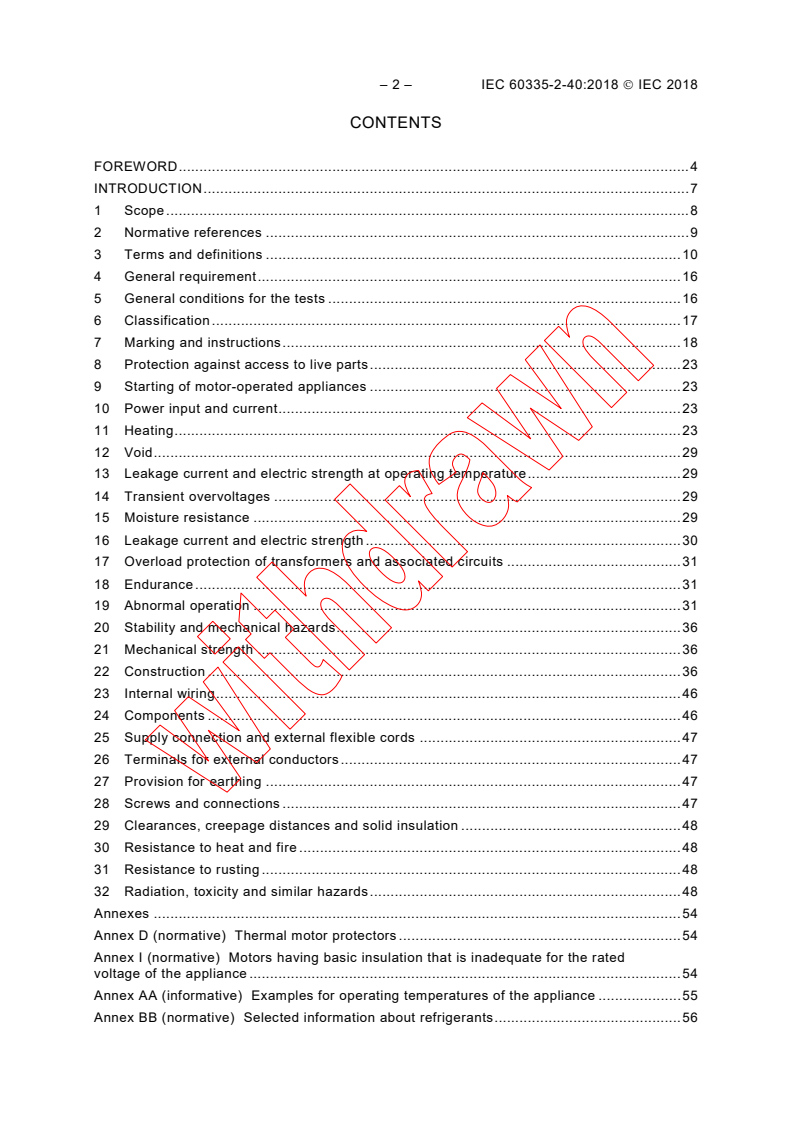
IEC 60335-2-40:2018 - Household and similar electrical appliances - Safety - Part 2-40: Particular requirements for electrical heat pumps, air-conditioners and dehumidifiers Released:1/26/2018
IEC 60335-2-40:2018 RLV - Household and similar electrical appliances - Safety - Part 2-40: Particular requirements for electrical heat pumps, air-conditioners and dehumidifiers Released:1/26/2018
IEC 60335-2-40:2018 - Household and similar electrical appliances - Safety - Part 2-40: Particular requirements for electrical heat pumps, air-conditioners and dehumidifiers Released:1/26/2018
Overview
IEC 60335-2-40:2018 is the sixth-edition safety standard from the IEC for household and similar electrical appliances - specifically electrical heat pumps (including sanitary hot water heat pumps), air‑conditioners and dehumidifiers that incorporate motor‑compressors and hydronic fan coil units. It applies to appliances with maximum rated voltages of ≤ 250 V single‑phase and ≤ 600 V for other appliances, and covers partial units and multi‑assembly matched sets intended for use by laymen in homes, shops, light industry and farms.
This 2018 edition is a technical revision that adds and refines requirements for the use of flammable and mildly flammable refrigerants (A2, A2L, A3), transcritical systems, UV‑C systems, detection and ventilation measures, and enhanced tightness and testing aspects.
Key topics and technical requirements
- Scope & voltage limits: Single‑phase ≤250 V, other appliances ≤600 V; partial units included.
- Refrigerants: Limits and specific provisions for refrigerant groups A1, A2L, A2 and A3 per ISO 817; A2L refrigerants are limited to molar mass ≥ 42 kg/kmol (WCF basis). Particular requirements for use of flammable refrigerants are specified.
- Safety features added/updated: requirements for A2L refrigerants, pre‑charge pipe sets, refrigerant detection systems, ventilation and resulting charge limits, and enhanced tightness systems.
- Transcritical systems: New/expanded clauses addressing design, testing and safe operation.
- UV‑C systems: Requirements for appliances that include UV‑C sources (radiation conditioning, safety, testing).
- Testing & verification: New and revised annexes covering charge limits, ventilation (Annex GG), service and installation manual requirements for flammable refrigerants (Annex DD), leak simulation and pressure tests (Annexes FF, EE), detection sensor tests (Annex MM), and tests to prevent ignition of A2L refrigerants (Annex JJ, KK, NN, LL).
- Other safety aspects: motor protection, electrical insulation, mechanical strength, abnormal operation, and limits on relay/openings to avoid ignition sources.
Applications and who uses it
IEC 60335-2-40:2018 is used by:
- Appliance manufacturers and design engineers for compliant product design (heat pumps, AC units, dehumidifiers)
- Compliance and test laboratories for type testing and certification
- Certification bodies and national regulators assessing market access and safety compliance
- Installation and service organizations (installation, commissioning and servicing guidance)
- Safety managers specifying equipment for commercial/residential HVAC systems
Related standards
- ISO 817 - refrigerant classification (referenced for A1/A2/A2L/A3 groups)
- ISO 5149 - refrigerating safety (where refrigerant specifications are not covered by IEC 60335‑2‑40)
- IEC 60335‑2‑88 - humidifiers (appliances excluded from this standard)
Keywords: IEC 60335-2-40:2018, electrical heat pumps, air-conditioners, dehumidifiers, A2L refrigerants, flammable refrigerants, safety standard, refrigerant detection, transcritical systems, UV‑C.
Relations
- Effective Date
- 05-Sep-2023
- Effective Date
- 05-Sep-2023
- Effective Date
- 05-Sep-2023
Buy Documents
IEC 60335-2-40:2018 - Household and similar electrical appliances - Safety - Part 2-40: Particular requirements for electrical heat pumps, air-conditioners and dehumidifiers Released:1/26/2018
IEC 60335-2-40:2018 RLV - Household and similar electrical appliances - Safety - Part 2-40: Particular requirements for electrical heat pumps, air-conditioners and dehumidifiers Released:1/26/2018
IEC 60335-2-40:2018 - Household and similar electrical appliances - Safety - Part 2-40: Particular requirements for electrical heat pumps, air-conditioners and dehumidifiers Released:1/26/2018
Get Certified
Connect with accredited certification bodies for this standard

Institut za varilstvo d.o.o. (Welding Institute)
Slovenia's leading welding institute since 1952. ISO 3834, EN 1090, pressure equipment certification, NDT personnel, welder qualification. Only IIW Au
Sponsored listings
Frequently Asked Questions
IEC 60335-2-40:2018 is a standard published by the International Electrotechnical Commission (IEC). Its full title is "Household and similar electrical appliances - Safety - Part 2-40: Particular requirements for electrical heat pumps, air-conditioners and dehumidifiers". This standard covers: IEC 60335-2-40:2018 deals with the safety of electric heat pumps, including sanitary hot water heat pumps, air conditioners, and dehumidifiers incorporating motor-compressors and hydronic fan coils units, their maximum rated voltages being not more than 250 V for single phase appliances and 600 V for all other appliances. Partial units are within the scope of this International Standard. Appliances not intended for normal household use but which nevertheless may be a source of danger to the public, such as appliances intended to be used by laymen in shops, in light industry and on farms, are within the scope of this standard. The appliances referenced above may consist of one or more factory-made assemblies. If provided in more than one assembly, the separate assemblies are to be used together, and the requirements are based on the use of matched assemblies. This standard does not take into account refrigerants other than group A1, A2L, A2 and A3 as defined by ISO 817 classification, A2L refrigerants are limited to those of a molar mass of more than or equal to 42 kg/kmol based on WCF – Worst Case Formulation as specified in ISO 817. This standard specifies particular requirements for the use of flammable refrigerants. Unless specifications are covered by this standard, including the annexes, requirements for refrigerating safety are covered by ISO 5149. Supplementary heaters, or a provision for their separate installation, are within the scope of this standard, but only heaters which are designed as a part of the appliance package, the controls being incorporated in the appliance. For appliances intended to be used in vehicles or on board ships or aircraft, additional requirements may be necessary; for appliances subjected to pressure, additional requirements may be necessary; This standard does not apply to: humidifiers intended for use with heating and cooling equipment (IEC 60335-2-88); appliances designed exclusively for industrial processing or appliances intended to be used in locations where special conditions prevail, such as the presence of a corrosive or explosive atmosphere (dust, vapour or gas). This sixth edition cancels and replaces the fifth edition published in 2013 and its Amendment 1:2016. This edition constitutes a technical revision. This edition includes the following significant technical changes with respect to the previous edition: - Clause 1 – limiting A2L refrigerants to those of a molar mass of more than or equal to 42 kg/kmol; - Clause 7 – added requirements for A2L refrigerants, - Clause 7 – added requirement for pre-charge pipe sets, detection systems, ventilation and the resulting charge; - Clause 7 – added requirements for UV-C systems; - Clause 7 – added requirements for transcritical refrigerating systems; - Subclause 19.7 – amended text to match the intention of the subclause; - Clause 21 – added requirements for transcritical refrigerating systems; - Subclause 22 – added requirements for A2L refrigerants; - Subclause 22– added detection systems; - Subclause 22 – added new requirements for enhanced tightness refrigerating systems; - Subclause 22 – added new requirements for UV-C; - Clause 23 – added new requirements for UV-C;Clause - Clause 24 – added requirements for transcritical refrigerating systems; - Subclause 24 – added requirements for detection systems and airflow; - Clause 32 added new requirements for UV-C; - Annex BB – revised to add surface temperatures; - Annex DD – added requirements for A2L refrigerants and amended requirements for flammable refrigerants to exempt A2L refrigerants; - Annex GG – added requirements for A2L refrigerants; - Annex GG.1 – amended Table GG.1 and related wording - Annex GG.7 – added requirement to test; - Annex GG.8 to GG.13 – new coverage for A2L refrigerants; - Annex HH – revised to take into account A2L refrigerants; - Annex JJ – new coverage of allowable opening of relays and similar components to prevent ignition of A2L r
IEC 60335-2-40:2018 deals with the safety of electric heat pumps, including sanitary hot water heat pumps, air conditioners, and dehumidifiers incorporating motor-compressors and hydronic fan coils units, their maximum rated voltages being not more than 250 V for single phase appliances and 600 V for all other appliances. Partial units are within the scope of this International Standard. Appliances not intended for normal household use but which nevertheless may be a source of danger to the public, such as appliances intended to be used by laymen in shops, in light industry and on farms, are within the scope of this standard. The appliances referenced above may consist of one or more factory-made assemblies. If provided in more than one assembly, the separate assemblies are to be used together, and the requirements are based on the use of matched assemblies. This standard does not take into account refrigerants other than group A1, A2L, A2 and A3 as defined by ISO 817 classification, A2L refrigerants are limited to those of a molar mass of more than or equal to 42 kg/kmol based on WCF – Worst Case Formulation as specified in ISO 817. This standard specifies particular requirements for the use of flammable refrigerants. Unless specifications are covered by this standard, including the annexes, requirements for refrigerating safety are covered by ISO 5149. Supplementary heaters, or a provision for their separate installation, are within the scope of this standard, but only heaters which are designed as a part of the appliance package, the controls being incorporated in the appliance. For appliances intended to be used in vehicles or on board ships or aircraft, additional requirements may be necessary; for appliances subjected to pressure, additional requirements may be necessary; This standard does not apply to: humidifiers intended for use with heating and cooling equipment (IEC 60335-2-88); appliances designed exclusively for industrial processing or appliances intended to be used in locations where special conditions prevail, such as the presence of a corrosive or explosive atmosphere (dust, vapour or gas). This sixth edition cancels and replaces the fifth edition published in 2013 and its Amendment 1:2016. This edition constitutes a technical revision. This edition includes the following significant technical changes with respect to the previous edition: - Clause 1 – limiting A2L refrigerants to those of a molar mass of more than or equal to 42 kg/kmol; - Clause 7 – added requirements for A2L refrigerants, - Clause 7 – added requirement for pre-charge pipe sets, detection systems, ventilation and the resulting charge; - Clause 7 – added requirements for UV-C systems; - Clause 7 – added requirements for transcritical refrigerating systems; - Subclause 19.7 – amended text to match the intention of the subclause; - Clause 21 – added requirements for transcritical refrigerating systems; - Subclause 22 – added requirements for A2L refrigerants; - Subclause 22– added detection systems; - Subclause 22 – added new requirements for enhanced tightness refrigerating systems; - Subclause 22 – added new requirements for UV-C; - Clause 23 – added new requirements for UV-C;Clause - Clause 24 – added requirements for transcritical refrigerating systems; - Subclause 24 – added requirements for detection systems and airflow; - Clause 32 added new requirements for UV-C; - Annex BB – revised to add surface temperatures; - Annex DD – added requirements for A2L refrigerants and amended requirements for flammable refrigerants to exempt A2L refrigerants; - Annex GG – added requirements for A2L refrigerants; - Annex GG.1 – amended Table GG.1 and related wording - Annex GG.7 – added requirement to test; - Annex GG.8 to GG.13 – new coverage for A2L refrigerants; - Annex HH – revised to take into account A2L refrigerants; - Annex JJ – new coverage of allowable opening of relays and similar components to prevent ignition of A2L r
IEC 60335-2-40:2018 is classified under the following ICS (International Classification for Standards) categories: 23.120 - Ventilators. Fans. Air-conditioners. The ICS classification helps identify the subject area and facilitates finding related standards.
IEC 60335-2-40:2018 has the following relationships with other standards: It is inter standard links to IEC 60335-2-40:2013, IEC 60335-2-40:2022, IEC 60335-2-40:2013/AMD1:2016. Understanding these relationships helps ensure you are using the most current and applicable version of the standard.
IEC 60335-2-40:2018 is available in PDF format for immediate download after purchase. The document can be added to your cart and obtained through the secure checkout process. Digital delivery ensures instant access to the complete standard document.
Standards Content (Sample)
IEC 60335-2-40 ®
Edition 6.0 2018-01
INTERNATIONAL
STANDARD
colour
inside
Household and similar electrical appliances – Safety –
Part 2-40: Particular requirements for electrical heat pumps, air-conditioners and
dehumidifiers
All rights reserved. Unless otherwise specified, no part of this publication may be reproduced or utilized in any form
or by any means, electronic or mechanical, including photocopying and microfilm, without permission in writing from
either IEC or IEC's member National Committee in the country of the requester. If you have any questions about IEC
copyright or have an enquiry about obtaining additional rights to this publication, please contact the address below or
your local IEC member National Committee for further information.
IEC Central Office Tel.: +41 22 919 02 11
3, rue de Varembé info@iec.ch
CH-1211 Geneva 20 www.iec.ch
Switzerland
About the IEC
The International Electrotechnical Commission (IEC) is the leading global organization that prepares and publishes
International Standards for all electrical, electronic and related technologies.
About IEC publications
The technical content of IEC publications is kept under constant review by the IEC. Please make sure that you have the
latest edition, a corrigenda or an amendment might have been published.
IEC Catalogue - webstore.iec.ch/catalogue Electropedia - www.electropedia.org
The stand-alone application for consulting the entire The world's leading online dictionary of electronic and
bibliographical information on IEC International Standards, electrical terms containing 21 000 terms and definitions in
Technical Specifications, Technical Reports and other English and French, with equivalent terms in 16 additional
documents. Available for PC, Mac OS, Android Tablets and languages. Also known as the International Electrotechnical
iPad. Vocabulary (IEV) online.
IEC publications search - webstore.iec.ch/advsearchform IEC Glossary - std.iec.ch/glossary
The advanced search enables to find IEC publications by a 67 000 electrotechnical terminology entries in English and
variety of criteria (reference number, text, technical French extracted from the Terms and Definitions clause of
committee,…). It also gives information on projects, replaced IEC publications issued since 2002. Some entries have been
and withdrawn publications. collected from earlier publications of IEC TC 37, 77, 86 and
CISPR.
IEC Just Published - webstore.iec.ch/justpublished
Stay up to date on all new IEC publications. Just Published IEC Customer Service Centre - webstore.iec.ch/csc
details all new publications released. Available online and If you wish to give us your feedback on this publication or
also once a month by email. need further assistance, please contact the Customer Service
Centre: sales@iec.ch.
IEC 60335-2-40 ®
Edition 6.0 2018-01
INTERNATIONAL
STANDARD
colour
inside
Household and similar electrical appliances – Safety –
Part 2-40: Particular requirements for electrical heat pumps, air-conditioners
and dehumidifiers
INTERNATIONAL
ELECTROTECHNICAL
COMMISSION
ICS 23.120 ISBN 978-2-8322-5253-6
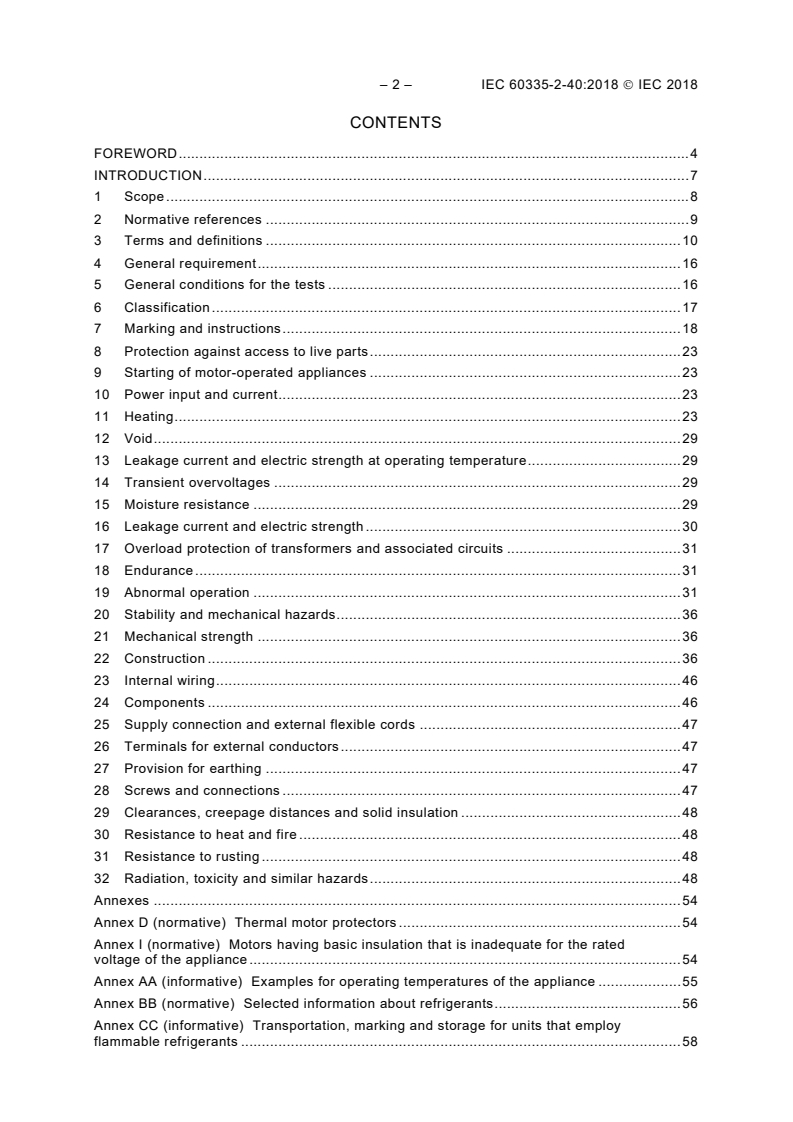
– 2 – IEC 60335-2-40:2018 IEC 2018
CONTENTS
FOREWORD . 4
INTRODUCTION . 7
1 Scope . 8
2 Normative references . 9
3 Terms and definitions . 10
4 General requirement . 16
5 General conditions for the tests . 16
6 Classification . 17
7 Marking and instructions . 18
8 Protection against access to live parts . 23
9 Starting of motor-operated appliances . 23
10 Power input and current . 23
11 Heating . 23
12 Void . 29
13 Leakage current and electric strength at operating temperature . 29
14 Transient overvoltages . 29
15 Moisture resistance . 29
16 Leakage current and electric strength . 30
17 Overload protection of transformers and associated circuits . 31
18 Endurance . 31
19 Abnormal operation . 31
20 Stability and mechanical hazards . 36
21 Mechanical strength . 36
22 Construction . 36
23 Internal wiring . 46
24 Components . 46
25 Supply connection and external flexible cords . 47
26 Terminals for external conductors . 47
27 Provision for earthing . 47
28 Screws and connections . 47
29 Clearances, creepage distances and solid insulation . 48
30 Resistance to heat and fire . 48
31 Resistance to rusting . 48
32 Radiation, toxicity and similar hazards . 48
Annexes . 54
Annex D (normative) Thermal motor protectors . 54
Annex I (normative) Motors having basic insulation that is inadequate for the rated
voltage of the appliance . 54
Annex AA (informative) Examples for operating temperatures of the appliance . 55
Annex BB (normative) Selected information about refrigerants . 56
Annex CC (informative) Transportation, marking and storage for units that employ
flammable refrigerants . 58
Annex DD (normative) Requirements for operation, service and installation manuals of
appliances using flammable refrigerants . 59
Annex EE (normative) Pressure tests . 68
Annex FF (normative) Leak simulation tests . 71
Annex GG (normative) Charge limits, ventilation requirements and requirements for
secondary circuits . 73
Annex HH (informative) Competence of service personnel . 99
Annex II (Void) . 102
Annex JJ (normative) Allowable opening of relays and similar components to prevent
ignition of A2L refrigerants . 103
Annex KK (normative) Test method for hot surface ignition temperature for A2L . 105
Annex LL (normative) Refrigerant detection systems for A2L refrigerants . 109
Annex MM (normative) Refrigerant sensor location confirmation test . 111
Annex NN (normative) Flame arrest enclosure verification test for A2L refrigerants . 113
Annex OO (normative) UV radiation conditioning . 115
Bibliography . 116
Figure 101 – Example of label for field charged units . 50
Figure 102 – Arrangement for heating test of appliances with supplementary heater . 52
Figure 103 – Supply circuit for locked-rotor test of a motor of the single-phase type –
Revise as needed for three-phase test . 53
Figure GG.1 – Unventilated area. 95
Figure GG.2 – Mechanical ventilation . 96
Figure GG.3 – Isosceles triangle arrow test gauge . 96
Figure GG.4 – Measurement of vibration amplitude. 96
Figure GG.5 – Relevant heights h , h and h for calculation of A and m . 97
inst 0 rel min max
Figure GG.6 – Airflow direction . 98
Figure KK.1 – Front view of test apparatus labels . 105
Figure KK.2 – Test apparatus with dimensions . 106
Figure KK.3 – Top view of test apparatus . 107
Table 3 – Temperature limits . 27
Table 101 – UVC irradiance measurement location . 49
Table AA.1 – Examples for operating temperatures of the appliance . 55
Table BB.1 – Selected information about refrigerants. 56
Table DD.1 – Mandatory clauses in each manual . 59
Table GG.1 – Outline of Annex GG (informative). 74
Table GG.2 – Circulation airflow . 78
Table GG.3 – Appliance with packaging . 83
Table GG.4 – Appliance without packaging . 83
Table GG.5 – Minimum airflow . 94
– 4 – IEC 60335-2-40:2018 IEC 2018
INTERNATIONAL ELECTROTECHNICAL COMMISSION
____________
HOUSEHOLD AND SIMILAR ELECTRICAL APPLIANCES – SAFETY –
Part 2-40: Particular requirements for electrical heat pumps,
air-conditioners and dehumidifiers
FOREWORD
1) The International Electrotechnical Commission (IEC) is a worldwide organization for standardization comprising
all national electrotechnical committees (IEC National Committees). The object of IEC is to promote
international co-operation on all questions concerning standardization in the electrical and electronic fields. To
this end and in addition to other activities, IEC publishes International Standards, Technical Specifications,
Technical Reports, Publicly Available Specifications (PAS) and Guides (hereafter referred to as “IEC
Publication(s)”). Their preparation is entrusted to technical committees; any IEC National Committee interested
in the subject dealt with may participate in this preparatory work. International, governmental and non-
governmental organizations liaising with the IEC also participate in this preparation. IEC collaborates closely
with the International Organization for Standardization (ISO) in accordance with conditions determined by
agreement between the two organizations.
2) The formal decisions or agreements of IEC on technical matters express, as nearly as possible, an international
consensus of opinion on the relevant subjects since each technical committee has representation from all
interested IEC National Committees.
3) IEC Publications have the form of recommendations for international use and are accepted by IEC National
Committees in that sense. While all reasonable efforts are made to ensure that the technical content of IEC
Publications is accurate, IEC cannot be held responsible for the way in which they are used or for any
misinterpretation by any end user.
4) In order to promote international uniformity, IEC National Committees undertake to apply IEC Publications
transparently to the maximum extent possible in their national and regional publications. Any divergence
between any IEC Publication and the corresponding national or regional publication shall be clearly indicated in
the latter.
5) IEC itself does not provide any attestation of conformity. Independent certification bodies provide conformity
assessment services and, in some areas, access to IEC marks of conformity. IEC is not responsible for any
services carried out by independent certification bodies.
6) All users should ensure that they have the latest edition of this publication.
7) No liability shall attach to IEC or its directors, employees, servants or agents including individual experts and
members of its technical committees and IEC National Committees for any personal injury, property damage or
other damage of any nature whatsoever, whether direct or indirect, or for costs (including legal fees) and
expenses arising out of the publication, use of, or reliance upon, this IEC Publication or any other IEC
Publications.
8) Attention is drawn to the Normative references cited in this publication. Use of the referenced publications is
indispensable for the correct application of this publication.
9) Attention is drawn to the possibility that some of the elements of this IEC Publication may be the subject of
patent rights. IEC shall not be held responsible for identifying any or all such patent rights.
International Standard IEC 60335-2-40 has been prepared by subcommittee 61D: Appliances
for air-conditioning for household and similar purposes, of IEC technical committee 61: Safety
of household and similar electrical appliances.
The text of this International Standard is based on the following documents:
FDIS Report on voting
61D/386/FDIS 61D/391/RVD
Full information on the voting for the approval of this International Standard can be found in
the report on voting indicated in the above table.
This sixth edition cancels and replaces the fifth edition published in 2013 and its
Amendment 1:2016. This edition constitutes a technical revision.
This edition includes the following significant technical changes with respect to the previous
edition:
– Clause 1 – limiting A2L refrigerants to those of a molar mass of more than or equal to
42 kg/kmol;
– Clause 7 – added requirements for A2L refrigerants,
– Clause 7 – added requirement for pre-charge pipe sets, detection systems, ventilation and
the resulting charge;
– Clause 7 – added requirements for UV-C systems;
– Clause 7 – added requirements for transcritical refrigerating systems;
– Subclause 19.7 – amended text to match the intention of the subclause;
– Clause 21 – added requirements for transcritical refrigerating systems;
– Subclause 22 – added requirements for A2L refrigerants;
– Subclause 22– added detection systems;
– Subclause 22 – added new requirements for enhanced tightness refrigerating systems;
– Subclause 22 – added new requirements for UV-C;
– Clause 23 – added new requirements for UV-C;Clause
– Clause 24 – added requirements for transcritical refrigerating systems;
– Subclause 24 – added requirements for detection systems and airflow;
– Clause 32 added new requirements for UV-C;
– Annex BB – revised to add surface temperatures;
– Annex DD – added requirements for A2L refrigerants and amended requirements for
flammable refrigerants to exempt A2L refrigerants;
– Annex GG – added requirements for A2L refrigerants;
– Annex GG.1 – amended Table GG.1 and related wording
– Annex GG.7 – added requirement to test;
– Annex GG.8 to GG.13 – new coverage for A2L refrigerants;
– Annex HH – revised to take into account A2L refrigerants;
– Annex JJ – new coverage of allowable opening of relays and similar components to
prevent ignition of A2L refrigerants;
– Annex KK – new coverage of test method for hot surface ignition temperature for A2L;
– Annex LL – new coverage of refrigerant detection systems for A2L Refrigerants;
– Annex MM – new coverage of refrigerant sensor location confirmation test;
– Annex NN – new coverage of flame arrest enclosure verification test for A2L refrigerants;
– Annex OO – new coverage of UV radiation conditioning
– Bibliography – added new references.
This publication has been drafted in accordance with the ISO/IEC Directives, Part 2.
This part 2-40 is to be used in conjunction with the latest edition of IEC 60335-1 and its
amendments. It was established on the basis of IEC 60335-1:2010, its Amendment 1:2013
and its Amendment 2:2016.
NOTE 1 When “Part 1” is mentioned in this standard, it refers to IEC 60335-1.
This part 2-40 supplements or modifies the corresponding clauses in IEC 60335-1, so as to
convert that publication into the IEC standard: Safety requirements for electrical heat pumps,
air-conditioners and dehumidifiers.
– 6 – IEC 60335-2-40:2018 IEC 2018
When a particular subclause of Part 1 is not mentioned in this part 2, that subclause applies
as far as is reasonable. When this standard states "addition", "modification" or "replacement",
the relevant text in Part 1 is to be adapted accordingly.
NOTE 2 The following numbering system is used:
• subclauses, tables and figures that are numbered starting from 101 are additional to those in Part 1;
• unless notes are in a new subclause or involve notes in Part 1, they are numbered starting from 101, including
those in a replaced clause or subclause;
• additional annexes are lettered AA, BB, etc.
NOTE 3 The following print types are used:
• requirements: in roman type;
• test specifications: in italic type;
• notes: in small roman type.
Words in bold in the text are defined in Clause 3. When a definition concerns an adjective, the adjective and
associated noun are also in bold.
The following differences exist in the countries indicated below:
• 6.1: Class 0I appliances are allowed (Japan).
• 11.8: The temperature of the wooden walls in the test casing is limited to 85 °C (Sweden).
A list of all parts of the IEC 60335 series, under the general title: Household and similar
electrical appliances – Safety, can be found on the IEC website.
The committee has decided that the contents of this document will remain unchanged until the
stability date indicated on the IEC website under "http://webstore.iec.ch" in the data related to
the specific document. At this date, the document will be
• reconfirmed,
• withdrawn,
• replaced by a revised edition, or
• amended.
A bilingual version of this publication may be issued at a later date.
IMPORTANT – The 'colour inside' logo on the cover page of this publication indicates
that it contains colours which are considered to be useful for the correct
understanding of its contents. Users should therefore print this document using a
colour printer.
INTRODUCTION
It has been assumed in the drafting of this International Standard that the execution of its
provisions is entrusted to appropriately qualified and experienced persons.
This standard recognizes the internationally accepted level of protection against hazards such
as electrical, mechanical, thermal, fire and radiation of appliances when operated as in
normal use taking into account the instructions. It also covers abnormal situations that can be
expected in practice.
This standard takes into account the requirements of IEC 60364 as far as possible so that
there is compatibility with the wiring rules when the appliance is connected to the supply
mains. However, national wiring rules may differ.
If an appliance within the scope of this standard also incorporates functions that are covered
by another part 2 of IEC 60335, the relevant part 2 is applied to each function separately, as
far as is reasonable. If applicable, the influence of one function on the other is taken into
account.
When a part 2 standard does not include additional requirements to cover hazards dealt with
in Part 1, Part 1 applies.
NOTE 1 This means that the technical committees responsible for the part 2 standards have determined that it is
not necessary to specify particular requirements for the appliance in question over and above the general
requirements.
This standard is a product family standard dealing with the safety of appliances and takes
precedence over horizontal and generic standards covering the same subject.
NOTE 2 Horizontal and generic standards covering a hazard are not applicable since they have been taken into
consideration when developing the general and particular requirements for the IEC 60335 series of standards. For
example, in the case of temperature requirements for surfaces on many appliances, generic standards, such as
ISO 13732-1 for hot surfaces, are not applicable in addition to Part 1 or part 2 standards.
An appliance that complies with the text of this standard will not necessarily be considered to
comply with the safety principles of the standard if, when examined and tested, it is found to
have other features that impair the level of safety covered by these requirements.
An appliance employing materials or having forms of construction differing from those detailed
in the requirements of this standard may be examined and tested according to the intent of
the requirements and, if found to be substantially equivalent, may be considered to comply
with the standard.
– 8 – IEC 60335-2-40:2018 IEC 2018
HOUSEHOLD AND SIMILAR ELECTRICAL APPLIANCES – SAFETY –
Part 2-40: Particular requirements for electrical heat pumps,
air-conditioners and dehumidifiers
1 Scope
This clause of Part 1 is replaced by the following.
This part of IEC 60335 deals with the safety of electric heat pumps, including sanitary hot
water heat pumps, air conditioners, and dehumidifiers incorporating motor-compressors
and hydronic fan coils units, their maximum rated voltages being not more than 250 V for
single phase appliances and 600 V for all other appliances. Partial units are within the scope
of this International Standard.
Appliances not intended for normal household use but which nevertheless may be a source of
danger to the public, such as appliances intended to be used by laymen in shops, in light
industry and on farms, are within the scope of this standard.
The appliances referenced above may consist of one or more factory-made assemblies. If
provided in more than one assembly, the separate assemblies are to be used together, and
the requirements are based on the use of matched assemblies.
NOTE 101 A definition of ‘motor-compressor’ is given in IEC 60335-2-34, which includes the statement that the
term motor-compressor is used to designate either a hermetic motor-compressor or semi-hermetic motor-
compressor.
NOTE 102 Requirements for refrigerating safety are covered by ISO 5149-1, ISO 5149-2, and ISO 5149-3.
Requirements for containers intended for storage of the heated water included in sanitary hot water heat pumps
are, in addition, covered by IEC 60335-2-21.
This standard does not take into account refrigerants other than group A1, A2L, A2 and A3 as
defined by ISO 817 classification, A2L refrigerants are limited to those of a molar mass of
more than or equal to 42 kg/kmol based on WCF – Worst Case Formulation as specified in
ISO 817.
This standard specifies particular requirements for the use of flammable refrigerants. Unless
specifications are covered by this standard, including the annexes, requirements for
refrigerating safety are covered by ISO 5149.
The parts of ISO 5149 of particular concern to this standard are as follows:
• ISO 5149-1:2014, Refrigerating systems and heat pumps – Safety and environmental
requirements – Part 1: Definitions, classification and selection criteria.
• ISO 5149-2, Refrigerating systems and heat pumps – Safety and environmental
requirements – Part 2: Design, construction, testing, marking and documentation;
• ISO 5149-3:2014, Refrigerating systems and heat pumps – Safety and environmental
requirements – Part 3: Installation site.
Supplementary heaters, or a provision for their separate installation, are within the scope of
this standard, but only heaters which are designed as a part of the appliance package, the
controls being incorporated in the appliance.
NOTE 103 Attention is drawn to the fact that
• for appliances intended to be used in vehicles or on board ships or aircraft, additional requirements may be
necessary;
• for appliances subjected to pressure, additional requirements may be necessary;
• in many countries, additional requirements are specified, for example, by the national health authorities
responsible for the protection of labour and the national authorities responsible for storage, transportation,
building constructions and installations.
NOTE 104 This standard does not apply to
• humidifiers intended for use with heating and cooling equipment (IEC 60335-2-88);
• appliances designed exclusively for industrial processing;
• appliances intended to be used in locations where special conditions prevail, such as the presence of a
corrosive or explosive atmosphere (dust, vapour or gas).
2 Normative references
This clause of Part 1 is applicable except as follows.
Addition:
IEC 60068-2-52, Environmental testing – Part 2: Tests – Test Kb: Salt mist, cyclic (sodium,
chloride solution)
IEC 60079-14, Explosive atmospheres – Part 14: Electrical installations design, selection and
erection
IEC 60079-15:2010, Explosive atmospheres – Part 15: Equipment protection by type of
protection "n"
IEC 60335-2-34:2012, Household and similar electrical appliances – Safety – Part 2-34:
Particular requirements for motor-compressors
IEC 60335-2-51, Household and similar electrical appliances – Safety – Part 2-51: Particular
requirements for stationary circulation pumps for heating and service water installations
IEC 60730-2-6, Automatic electrical controls – Part 2-6: Particular requirements for automatic
electrical pressure sensing controls including mechanical requirements
IEC 61032, Protection of persons and equipment by enclosures – Probes for verification
IEC 62471:2006, Photobiological safety of lamps and lamp systems
ISO 817, Refrigerants – Designation and safety classification
ISO 1302, Geometrical Product Specifications (GPS) – Indication of surface texture in
technical product documentation
ISO 4892-2, Plastics – Methods of exposure to laboratory light sources – Part 2: Xenon-arc
lamps
ISO 4892-4, Plastics – Methods of exposure to laboratory light sources – Part 4: Open-flame
carbon-arc lamps
ISO 5149-1:2014, Refrigerating systems and heat pumps – Safety and environmental
requirements – Part 1: Definitions, classification and selection criteria
– 10 – IEC 60335-2-40:2018 IEC 2018
ISO 5149-2, Refrigerating systems and heat pumps – Safety and environmental requirements –
Part 2: Design, construction, testing, marking and documentation
ISO 5149-3:2014, Refrigerating systems and heat pumps – Safety and environmental
requirements – Part 3: Installation site
ISO 5151, Non-ducted air conditioners and heat pumps – Testing and rating for performance
ISO 7010:2011, Graphic symbols – Safety colours and safety signs – Registered safety signs
ISO 13253, Ducted air-conditioners and air-to-air heat pumps – Testing and rating for
performance
ISO 13256 (all parts), Water-source heat pumps – Testing and rating for performance
ISO 14903, Refrigerating systems and heat pumps – Qualification of tightness of components
and joints
ISO 15042, Multiple split-system air-conditioners and air-to-air heat pumps – Testing and
rating for performance
ASTM D4728-06:2012, Standard Test Method for Random Vibration Testing of Shipping
Containers
CAN/CSA-C22.2 No. 0.17, Evaluation of Properties of Polymeric Materials
UL 746A, Standard for Polymeric Materials – Short Term Property Evaluations
UL 746B, Standard for Polymeric Materials – Long Term Property Evaluations
3 Terms and definitions
This clause of Part 1 is applicable except as follows.
3.1.4 Addition:
Note 101 to entry: If the appliance comprises electrical accessories, including fans, the rated power input is
based upon the total maximum electrical power input with all accessories energized, when operating continuously
under the appropriate environmental conditions. If the heat pump can be operated in the heating or cooling mode,
the rated power input is based upon the input in the heating or in the cooling mode, whichever is the greater.
3.1.9 Replacement:
normal operation
conditions that apply when the appliance is mounted as in normal use and is operating under
the most severe operating conditions specified by the manufacturer
3.101
heat pump
appliance which takes up heat at a certain temperature and releases heat at a higher
temperature
Note 1 to entry: When operated to provide heat (e.g., for space heating or water heating), the appliance is said to
operate in the heating mode; when operated to remove heat (for example, for space cooling), it is said to operate in
the cooling mode.
Note 2 to entry: A heat pump can contain a combination of condensing unit or condenser unit and an
evaporating unit or evaporator unit and can be equipped to operate in a reverse cycle mode.
3.102
sanitary hot water heat pump
heat pump intended to transfer heat to water suitable for human consumption
3.103
air conditioner
encased assembly or assemblies designed as an appliance to provide delivery of conditioned
air to an enclosed space, room or zone
Note 1 to entry: It includes an electrically operated refrigerating system for cooling and possibly dehumidifying
the air.
Note 2 to entry: It may have means for heating, circulating, cleaning and humidifying the air.
Note 3 to entry: An air conditioner can contain a combination of condensing unit or condenser unit and an
evaporating unit or evaporator unit.
3.104
dehumidifier
encased assembly designed to remove moisture from its surrounding atmosphere
Note 1 to entry: It includes an electrically operated refrigerating system and the means to circulate air. It also
includes a drain arrangement for collecting and storing and/or disposing of the condensate.
3.108
wet-bulb temperature
WB
temperature indicated when the temperature-sensitive element in a wetted wick has reached a
state of constant temperature (evaporative equilibrium)
3.109
dry-bulb temperature
DB
temperature indicated by a dry, temperature-sensitive element shielded from the effects of
radiation
3.110
evaporator
heat exchanger in which refrigerant liquid is vaporized by absorption of heat
3.111
heat exchanger
device specifically designed to transfer heat between two physically separated fluids
3.112
indoor heat exchanger
heat exchanger designed to transfer heat to the indoor parts of the building or to the indoor
hot water supplies (e.g. sanitary water) or to remove heat therefrom
3.113
outdoor heat exchanger
heat exchanger designed to remove or release heat from the heat source (for example,
ground water, outdoor air, exhaust air, water or brine)
3.114
supplementary heater
electric heater provided as part of the appliance to supplement or replace the output of the
refrigerant circuit of the appliance by operation in conjunction with, or instead of, the
refrigerating circuit
– 12 – IEC 60335-2-40:2018 IEC 2018
3.115
pressure-limiting device
mechanism that automatically responds to a predetermined pressure by stopping the
operation of the pressure-imposing element
3.116
pressure-relief device
pressure actuated valve or rupture member which functions to relieve excessive pressure
automatically
3.117
appliances accessible to the general public
appliances intended to be located in residential buildings or in commercial buildings
3.118
appliances not accessible to the general public
appliances which are located either in a secured location with restricted access (e.g. machine
rooms, rooftop and the like) or at a level not less than 2,5 m or in secured rooftop areas
3.119
hydronic fan coil unit
factory-made assembly which provides the function of forced circulation of air for heating
and/or cooling, which may also include the function of dehumidification and/or filtering of air,
but which does not include the source of cooling or heating
Note 1 to entry: Hydronic fan coil units can include provision for electric resistance heating. Heat exchanger
coils are intended for hydronic heating and cooling only.
3.120
flammable refrigerant
refrigerant classified as class A2L, A2 or A3 according to ISO 817
3.121
refrigerating system
combination of interconnected refrigerant containing parts constituting one closed refrigerant
circuit in which refrigerant is circulated for the purpose of extracting heat at the low
temperature side to reject heat at the high temperature side by changing the state of the
refrigerant
3.122
maximum allowable pressure
limit to the refrigerating system operating pressure, generally the maximum pressure for
which the equipment is designed, as specified by the manufacturer
Note 1 to entry: Maximum allowable pressure constitutes a limit to the operating pressure whether the
equipment is working or not, see Clause 21.
3.123
low-pressure side
part(s) of a refrigerating system operating at the evaporator pressure
3.124
high-pressure side
part(s) of a refrigerating system operating at the condenser pressure
3.125
service port
means to access the refrigerant in a refrigerating system for the purpose of charging or
servicing the system, typically a valve, tube extension or entry location
3.126
factory sealed single package unit
factory assembly of components of refrigerating system fixed on a common mounting to
form a discrete unit in which all refrigerating system parts have been sealed tight by
welding, brazing or a similar permanent connection during the manufacturing process
3.127
pre-charged pipe sets
interconnecting refrigerant lines which are supplied with the unit and supplied with a
refrigerant charge for the purpose of completing the refrigerating system in the field for
appliances that are made up of more than one subassembly and are assembled in the field to
complete the refrigerating system
3.128
condenser
heat exchanger in which refrigerant vapour is condensed by removal of heat
3.129
condensing unit
factory-made assembly that includes one or more motor-compressors, condenser in cooling
mode and motor-driven fan, blower or pump to circulate the heat transfer fluid through the
condenser with associated operational controls in addition to the necessary wiring
Note 1 to entry: These units are intended for field connection to an evaporator unit. A condensing unit can also
be equipped to operate in the reverse cycle mode. A condensing unit can include expansion device(s).
3.130
condenser unit
factory-made assembly that includes one or more condensers in cooling mode and motor-
driven fan, blower or pump to circulate the heat transfer fluid through the condenser with
associated operational controls in addition to the necessary wiring
Note 1 to entry: These units are intended for field connection to an evaporating unit. A condenser unit can also
be equipped to operate in the reverse cycle mode.
Note 2 to entry: A condenser unit does not include a motor compressor or expansion device.
3.131
evaporating unit
factory-made assembly that includes one or more motor-compressors, evaporator in cooling
mode, expansion device(s), and motor-driven fan, blower or pump to circulate fluid through
the evaporator with associated operational controls in addition to the necessary wiring
Note 1 to entry: These units are intended for field connection to a condenser unit. An evaporating unit can also
be equipped to operate in the reverse cycle mode and can include provision for electric resistance heating or
similar sources of auxiliary heat.
3.132
evaporator unit
factory-made assembly that includes one or more evaporators in cooling mode, and may
include a motor-driven fan, blower or pump to circulate fluid through the evaporator with
associated operational controls in addition to the necessary wiring
Note 1 to entry: These units are intended for field connection to a condensing unit. An evaporator unit can also
be equipped to operate in the reverse cycle mode and can include provision for electric resistance heating or
similar sources of auxiliary heat. An evaporator unit can include expansion device(s).
Note 2 to entry: An evaporator unit does not include a motor compressor.
– 14 – IEC 60335-2-40:2018 IEC 2018
3.133
partial unit
condensing unit, evaporating unit, condenser unit, or evaporator unit which are part of a
total assembly of a heat pump, air-conditioner, or sanitary hot water heat pumps where not
all assemblies to create the complete refrigerating system are specified by the manufacturer
Note 1 to entry: Partial units are evaluated for safety as stand-alone.
3.134
installed height
h
inst
height of the bottom of the appliance relative to the floor of the room after installation
Note 1 to entry: The installed height is given in metres.
3.135
release offset
h
rel
distance from the bottom of the appliance to an opening where refrigerant can leave the
appliance in the event of a refrigerant leak
Note 1 to entry: The release offset is given in metres.
3.136
refrigerant charge
m
c
actual refrigerant charge of a single refrigerating system
Note 1 to entry: The refrigerant charge is expressed in kg.
3.137
maximum refrigerant charge
m
max
maximum refrigerant charge for a single refrigerating system as result from a calculation
for room area or similar
Note 1 to entry: The maximum refrigerant charge is expressed in kg.
3.138
refrigerant detection system
sensing system which responds to a pre-set concentration of refrigerant in the environment
Note 1 to entry: A refrigerant detection system may have multiple sensing elements.
3.139
auto ignition temperature
AIT
lowest temperature at or above which a chemical can spontaneously ignite in a normal
atmosphere, without an external source of ignition, such as a flame or spark
[SOURCE: ISO 5149-1:2014, definition 3.7.7]
3.140
hot surface ignition temperature
HSIT
highest temperature at which a refrigerant does not ignite when tested in accordance with
Annex KK
3.141
A2L refrigerant
refrigerant classed as A2L according to ISO 817
3.142
lower flammability limit
LFL
lower flammability limit according to ISO 817
3.143
enhanced tightness refrigerating system
refrigerating system in which the indoor units are designed and fabricated to ensure a high
level of confidence that large refrigerant leak rates will not occur in normal and abnormal
operation
3.144
refrigerant distribution assembly
separate refrigerant assembly which is installed in the interconnecting refrigerant lines for the
purpose of distributing refrigerant flow to one or more indoor units
3.145
potential ignition source
PIS
hot surfaces, flames and current carrying devices which can be the source of arcing or
sparking
Note 1 to entry: Examples of potential ignition sources are UV lights, electric heaters, pilot flames, brushed
motors and similar devices.
3.146
circulation airflow
mechanically induced airflow movement within the space or duct connected spaces
3.147
ultraviolet radiation
optical radiation for which the wavelengths are shorter than those for visible radiation
Note 1 to entry: For ultraviolet (UV) radiation, the range between 100 nm and 400 nm is commonly subdivided
into: UV-A, from 315 nm to 400 nm; UV-B, from 280 nm to 315 nm; and UV-C, from 100 nm to 280 nm.
[SOURCE: IEC 60050-845:1987, 845-01-05]
3.148
optica
...
IEC 60335-2-40 ®
Edition 6.0 2018-01
REDLINE VERSION
INTERNATIONAL
STANDARD
colour
inside
Household and similar electrical appliances – Safety –
Part 2-40: Particular requirements for electrical heat pumps, air-conditioners
and dehumidifiers
All rights reserved. Unless otherwise specified, no part of this publication may be reproduced or utilized in any form
or by any means, electronic or mechanical, including photocopying and microfilm, without permission in writing from
either IEC or IEC's member National Committee in the country of the requester. If you have any questions about IEC
copyright or have an enquiry about obtaining additional rights to this publication, please contact the address below or
your local IEC member National Committee for further information.
IEC Central Office Tel.: +41 22 919 02 11
3, rue de Varembé info@iec.ch
CH-1211 Geneva 20 www.iec.ch
Switzerland
About the IEC
The International Electrotechnical Commission (IEC) is the leading global organization that prepares and publishes
International Standards for all electrical, electronic and related technologies.
About IEC publications
The technical content of IEC publications is kept under constant review by the IEC. Please make sure that you have the
latest edition, a corrigenda or an amendment might have been published.
IEC Catalogue - webstore.iec.ch/catalogue Electropedia - www.electropedia.org
The stand-alone application for consulting the entire The world's leading online dictionary of electronic and
bibliographical information on IEC International Standards, electrical terms containing 21 000 terms and definitions in
Technical Specifications, Technical Reports and other English and French, with equivalent terms in 16 additional
documents. Available for PC, Mac OS, Android Tablets and languages. Also known as the International Electrotechnical
iPad. Vocabulary (IEV) online.
IEC publications search - webstore.iec.ch/advsearchform IEC Glossary - std.iec.ch/glossary
The advanced search enables to find IEC publications by a 67 000 electrotechnical terminology entries in English and
variety of criteria (reference number, text, technical French extracted from the Terms and Definitions clause of
committee,…). It also gives information on projects, replaced IEC publications issued since 2002. Some entries have been
and withdrawn publications. collected from earlier publications of IEC TC 37, 77, 86 and
CISPR.
IEC Just Published - webstore.iec.ch/justpublished
Stay up to date on all new IEC publications. Just Published IEC Customer Service Centre - webstore.iec.ch/csc
details all new publications released. Available online and If you wish to give us your feedback on this publication or
also once a month by email. need further assistance, please contact the Customer Service
Centre: sales@iec.ch.
IEC 60335-2-40 ®
Edition 6.0 2018-01
REDLINE VERSION
INTERNATIONAL
STANDARD
colour
inside
Household and similar electrical appliances – Safety –
Part 2-40: Particular requirements for electrical heat pumps, air-conditioners
and dehumidifiers
INTERNATIONAL
ELECTROTECHNICAL
COMMISSION
ICS 23.120 ISBN 978-2-8322-5333-5
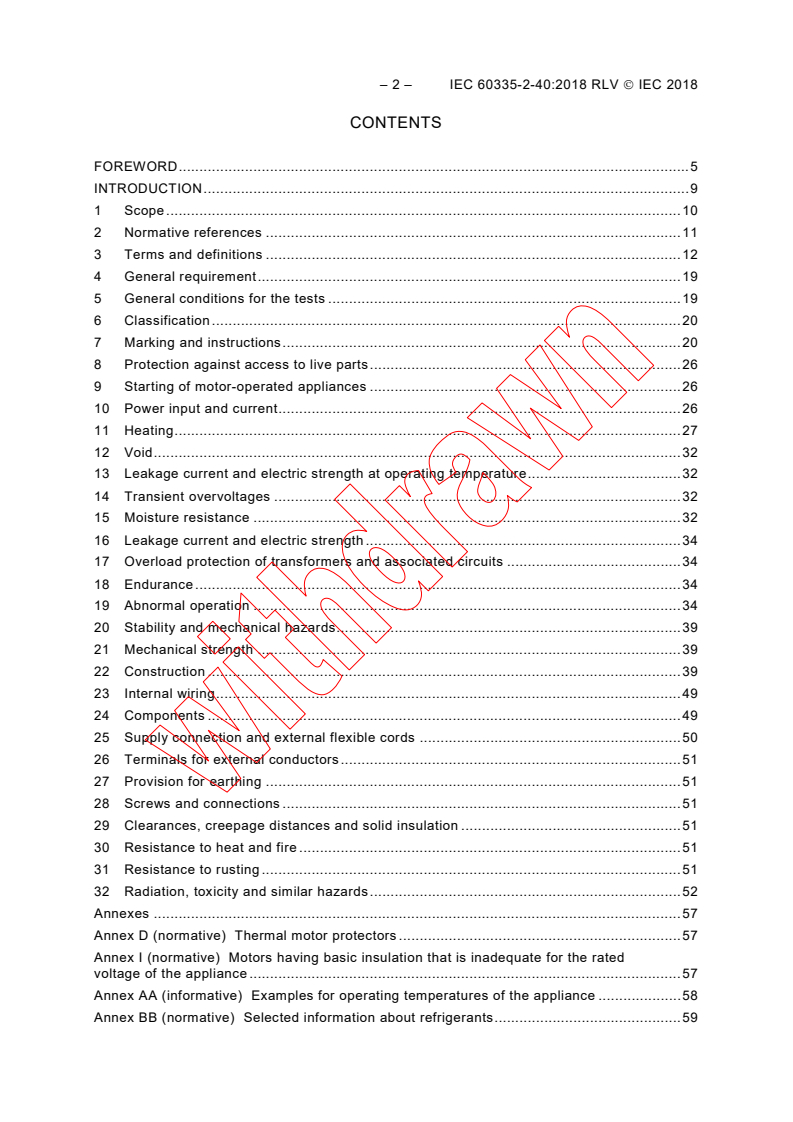
– 2 – IEC 60335-2-40:2018 RLV IEC 2018
CONTENTS
FOREWORD . 5
INTRODUCTION . 9
1 Scope . 10
2 Normative references . 11
3 Terms and definitions . 12
4 General requirement . 19
5 General conditions for the tests . 19
6 Classification . 20
7 Marking and instructions . 20
8 Protection against access to live parts . 26
9 Starting of motor-operated appliances . 26
10 Power input and current . 26
11 Heating . 27
12 Void . 32
13 Leakage current and electric strength at operating temperature . 32
14 Transient overvoltages . 32
15 Moisture resistance . 32
16 Leakage current and electric strength . 34
17 Overload protection of transformers and associated circuits . 34
18 Endurance . 34
19 Abnormal operation . 34
20 Stability and mechanical hazards . 39
21 Mechanical strength . 39
22 Construction . 39
23 Internal wiring . 49
24 Components . 49
25 Supply connection and external flexible cords . 50
26 Terminals for external conductors . 51
27 Provision for earthing . 51
28 Screws and connections . 51
29 Clearances, creepage distances and solid insulation . 51
30 Resistance to heat and fire . 51
31 Resistance to rusting . 51
32 Radiation, toxicity and similar hazards . 52
Annexes . 57
Annex D (normative) Thermal motor protectors . 57
Annex I (normative) Motors having basic insulation that is inadequate for the rated
voltage of the appliance . 57
Annex AA (informative) Examples for operating temperatures of the appliance . 58
Annex BB (normative) Selected information about refrigerants . 59
Annex CC (informative) Transportation, marking and storage for units that employ
flammable refrigerants . 62
Annex DD (normative) Instruction manual for servicing refrigerant containing
appliances Requirements for operation, service and installation manuals
of appliances using flammable refrigerants . 63
Annex EE (normative) Pressure tests . 72
Annex FF (normative) Leak simulation tests . 75
Annex GG (normative) Charge limits, ventilation requirements and requirements for
secondary circuits . 77
Annex HH (informative) Competence of service personnel . 106
Annex II (Void) . 109
Annex JJ (normative) Allowable opening of relays and similar components to prevent
ignition of A2L refrigerants . 110
Annex KK (normative) Test method for hot surface ignition temperature for A2L . 112
Annex LL (normative) Refrigerant detection systems for A2L refrigerants . 116
Annex MM (normative) Refrigerant sensor location confirmation test . 118
Annex NN (normative) Flame arrest enclosure verification test for A2L refrigerants . 120
Annex OO (normative) UV radiation conditioning . 122
Bibliography . 123
Figure 101 – Example of label for field charged units . 53
Figure 101 102 – Arrangement for heating test of appliances with supplementary
heater . 55
Figure 102 103 – Supply circuit for locked-rotor test of a motor of the single-phase
type – Revise as needed for three-phase test . 56
Figure GG.1 – Unventilated area. 102
Figure GG.2 – Mechanical ventilation . 103
Figure GG.3 – Isosceles triangle arrow test gauge . 103
Figure GG.4 – Measurement of vibration amplitude. 103
Figure GG.5 – Relevant heights h , h and h for calculation of A and m . 104
inst 0 rel min max
Figure GG.6 – Airflow direction . 105
Figure KK.1 – Front view of test apparatus labels . 112
Figure KK.2 – Test apparatus with dimensions . 113
Figure KK.3 – Top view of test apparatus . 114
Table – Minimum room area (m ) (see Note 2 of Clause GG.2) .
Table – Maximum charge (kg) (see Note 2 of Clause GG.2) .
Table – Mass of refrigerants .
Table 3 – Temperature limits . 30
Table 101 – UVC irradiance measurement location . 52
Table AA.1 – Examples for operating temperatures of the appliance . 58
Table BB.1 – Selected information about refrigerants. 59
Table DD.1 – Mandatory clauses in each manual . 63
Table GG.1 – Outline of Annex GG (informative). 78
Table GG.2 – Circulation airflow . 83
– 4 – IEC 60335-2-40:2018 RLV IEC 2018
Table GG.3 – Appliance with packaging . 88
Table GG.4 – Appliance without packaging . 89
Table GG.5 – Minimum airflow . 101
INTERNATIONAL ELECTROTECHNICAL COMMISSION
____________
HOUSEHOLD AND SIMILAR ELECTRICAL APPLIANCES – SAFETY –
Part 2-40: Particular requirements for electrical heat pumps,
air-conditioners and dehumidifiers
FOREWORD
1) The International Electrotechnical Commission (IEC) is a worldwide organization for standardization comprising
all national electrotechnical committees (IEC National Committees). The object of IEC is to promote
international co-operation on all questions concerning standardization in the electrical and electronic fields. To
this end and in addition to other activities, IEC publishes International Standards, Technical Specifications,
Technical Reports, Publicly Available Specifications (PAS) and Guides (hereafter referred to as “IEC
Publication(s)”). Their preparation is entrusted to technical committees; any IEC National Committee interested
in the subject dealt with may participate in this preparatory work. International, governmental and non-
governmental organizations liaising with the IEC also participate in this preparation. IEC collaborates closely
with the International Organization for Standardization (ISO) in accordance with conditions determined by
agreement between the two organizations.
2) The formal decisions or agreements of IEC on technical matters express, as nearly as possible, an international
consensus of opinion on the relevant subjects since each technical committee has representation from all
interested IEC National Committees.
3) IEC Publications have the form of recommendations for international use and are accepted by IEC National
Committees in that sense. While all reasonable efforts are made to ensure that the technical content of IEC
Publications is accurate, IEC cannot be held responsible for the way in which they are used or for any
misinterpretation by any end user.
4) In order to promote international uniformity, IEC National Committees undertake to apply IEC Publications
transparently to the maximum extent possible in their national and regional publications. Any divergence
between any IEC Publication and the corresponding national or regional publication shall be clearly indicated in
the latter.
5) IEC itself does not provide any attestation of conformity. Independent certification bodies provide conformity
assessment services and, in some areas, access to IEC marks of conformity. IEC is not responsible for any
services carried out by independent certification bodies.
6) All users should ensure that they have the latest edition of this publication.
7) No liability shall attach to IEC or its directors, employees, servants or agents including individual experts and
members of its technical committees and IEC National Committees for any personal injury, property damage or
other damage of any nature whatsoever, whether direct or indirect, or for costs (including legal fees) and
expenses arising out of the publication, use of, or reliance upon, this IEC Publication or any other IEC
Publications.
8) Attention is drawn to the Normative references cited in this publication. Use of the referenced publications is
indispensable for the correct application of this publication.
9) Attention is drawn to the possibility that some of the elements of this IEC Publication may be the subject of
patent rights. IEC shall not be held responsible for identifying any or all such patent rights.
This redline version of the official IEC Standard allows the user to identify the changes
made to the previous edition. A vertical bar appears in the margin wherever a change
has been made. Additions are in green text, deletions are in strikethrough red text.
– 6 – IEC 60335-2-40:2018 RLV IEC 2018
International Standard IEC 60335-2-40 has been prepared by subcommittee 61D: Appliances
for air-conditioning for household and similar purposes, of IEC technical committee 61: Safety
of household and similar electrical appliances.
The text of this International Standard is based on the following documents:
FDIS Report on voting
61D/386/FDIS 61D/391/RVD
Full information on the voting for the approval of this International Standard can be found in
the report on voting indicated in the above table.
This sixth edition cancels and replaces the fifth edition published in 2013 and its
Amendment 1:2016. This edition constitutes a technical revision.
This edition includes the following significant technical changes with respect to the previous
edition:
– Clause 1 – limiting A2L refrigerants to those of a molar mass of more than or equal to
42 kg/kmol;
– Clause 7 – added requirements for A2L refrigerants,
– Clause 7 – added requirement for pre-charge pipe sets, detection systems, ventilation and
the resulting charge;
– Clause 7 – added requirements for UV-C systems;
– Clause 7 – added requirements for transcritical refrigerating systems;
– Subclause 19.7 – amended text to match the intention of the subclause;
– Clause 21 – added requirements for transcritical refrigerating systems;
– Subclause 22 – added requirements for A2L refrigerants;
– Subclause 22– added detection systems;
– Subclause 22 – added new requirements for enhanced tightness refrigerating systems;
– Subclause 22 – added new requirements for UV-C;
– Clause 23 – added new requirements for UV-C;Clause
– Clause 24 – added requirements for transcritical refrigerating systems;
– Subclause 24 – added requirements for detection systems and airflow;
– Clause 32 added new requirements for UV-C;
– Annex BB – revised to add surface temperatures;
– Annex DD – added requirements for A2L refrigerants and amended requirements for
flammable refrigerants to exempt A2L refrigerants;
– Annex GG – added requirements for A2L refrigerants;
– Annex GG.1 – amended Table GG.1 and related wording
– Annex GG.7 – added requirement to test;
– Annex GG.8 to GG.13 – new coverage for A2L refrigerants;
– Annex HH – revised to take into account A2L refrigerants;
– Annex JJ – new coverage of allowable opening of relays and similar components to
prevent ignition of A2L refrigerants;
– Annex KK – new coverage of test method for hot surface ignition temperature for A2L;
– Annex LL – new coverage of refrigerant detection systems for A2L Refrigerants;
– Annex MM – new coverage of refrigerant sensor location confirmation test;
– Annex NN – new coverage of flame arrest enclosure verification test for A2L refrigerants;
– Annex OO – new coverage of UV radiation conditioning
– Bibliography – added new references.
This publication has been drafted in accordance with the ISO/IEC Directives, Part 2.
This part 2-40 is to be used in conjunction with the latest edition of IEC 60335-1 and its
amendments. It was established on the basis of IEC 60335-1:2010, its Amendment 1:2013
and its Amendment 2:2016.
NOTE 1 When “Part 1” is mentioned in this standard, it refers to IEC 60335-1.
This part 2-40 supplements or modifies the corresponding clauses in IEC 60335-1, so as to
convert that publication into the IEC standard: Safety requirements for electrical heat pumps,
air-conditioners and dehumidifiers.
When a particular subclause of Part 1 is not mentioned in this part 2, that subclause applies
as far as is reasonable. When this standard states "addition", "modification" or "replacement",
the relevant text in Part 1 is to be adapted accordingly.
NOTE 2 The following numbering system is used:
• subclauses, tables and figures that are numbered starting from 101 are additional to those in Part 1;
• unless notes are in a new subclause or involve notes in Part 1, they are numbered starting from 101, including
those in a replaced clause or subclause;
• additional annexes are lettered AA, BB, etc.
NOTE 3 The following print types are used:
• requirements: in roman type;
• test specifications: in italic type;
• notes: in small roman type.
Words in bold in the text are defined in Clause 3. When a definition concerns an adjective, the adjective and
associated noun are also in bold.
The following differences exist in the countries indicated below:
• 6.1: Class 0I appliances are allowed (Japan).
• 11.8: The temperature of the wooden walls in the test casing is limited to 85 °C (Sweden).
A list of all parts of the IEC 60335 series, under the general title: Household and similar
electrical appliances – Safety, can be found on the IEC website.
– 8 – IEC 60335-2-40:2018 RLV IEC 2018
The committee has decided that the contents of this document will remain unchanged until the
stability date indicated on the IEC website under "http://webstore.iec.ch" in the data related to
the specific document. At this date, the document will be
• reconfirmed,
• withdrawn,
• replaced by a revised edition, or
• amended.
A bilingual version of this publication may be issued at a later date.
IMPORTANT – The 'colour inside' logo on the cover page of this publication indicates
that it contains colours which are considered to be useful for the correct
understanding of its contents. Users should therefore print this document using a
colour printer.
INTRODUCTION
It has been assumed in the drafting of this International Standard that the execution of its
provisions is entrusted to appropriately qualified and experienced persons.
This standard recognizes the internationally accepted level of protection against hazards such
as electrical, mechanical, thermal, fire and radiation of appliances when operated as in
normal use taking into account the manufacturer's instructions. It also covers abnormal
situations that can be expected in practice.
This standard takes into account the requirements of IEC 60364 as far as possible so that
there is compatibility with the wiring rules when the appliance is connected to the supply
mains. However, national wiring rules may differ.
If an appliance within the scope of this standard also incorporates functions that are covered
by another part 2 of IEC 60335, the relevant part 2 is applied to each function separately, as
far as is reasonable. If applicable, the influence of one function on the other is taken into
account.
When a part 2 standard does not include additional requirements to cover hazards dealt with
in Part 1, Part 1 applies.
NOTE 1 This means that the technical committees responsible for the part 2 standards have determined that it is
not necessary to specify particular requirements for the appliance in question over and above the general
requirements.
This standard is a product family standard dealing with the safety of appliances and takes
precedence over horizontal and generic standards covering the same subject.
NOTE 2 Horizontal and generic standards covering a hazard are not applicable since they have been taken into
consideration when developing the general and particular requirements for the IEC 60335 series of standards. For
example, in the case of temperature requirements for surfaces on many appliances, generic standards, such as
ISO 13732-1 for hot surfaces, are not applicable in addition to Part 1 or part 2 standards.
An appliance that complies with the text of this standard will not necessarily be considered to
comply with the safety principles of the standard if, when examined and tested, it is found to
have other features that impair the level of safety covered by these requirements.
An appliance employing materials or having forms of construction differing from those detailed
in the requirements of this standard may be examined and tested according to the intent of
the requirements and, if found to be substantially equivalent, may be considered to comply
with the standard.
– 10 – IEC 60335-2-40:2018 RLV IEC 2018
HOUSEHOLD AND SIMILAR ELECTRICAL APPLIANCES – SAFETY –
Part 2-40: Particular requirements for electrical heat pumps,
air-conditioners and dehumidifiers
1 Scope
This clause of Part 1 is replaced by the following.
This part of IEC 60335 deals with the safety of electric heat pumps, including sanitary hot
water heat pumps, air conditioners, and dehumidifiers incorporating motor-compressors
and hydronic room fan coils units, their maximum rated voltages being not more than 250
V for single phase appliances and 600 V for all other appliances. Partial units are within the
scope of this International Standard.
Appliances not intended for normal household use but which nevertheless may be a source of
danger to the public, such as appliances intended to be used by laymen in shops, in light
industry and on farms, are within the scope of this standard.
This standard also applies to electric heat pumps, air conditioners and dehumidifiers
containing flammable refrigerant. Flammable refrigerants are defined in 3.121.
The appliances referenced above may consist of one or more factory-made assemblies. If
provided in more than one assembly, the separate assemblies are to be used together, and
the requirements are based on the use of matched assemblies.
NOTE 101 A definition of ‘motor-compressor’ is given in IEC 60335-2-34, which includes the statement that the
term motor-compressor is used to designate either a hermetic motor-compressor or semi-hermetic motor-
compressor.
NOTE 102 Requirements for refrigeration refrigerating safety are covered by ISO 5149-1, ISO 5149-2, and
ISO 5149-3. Requirements for containers intended for storage of the heated water included in sanitary hot water
heat pumps are, in addition, covered by IEC 60335-2-21.
This standard does not take into account chemicals refrigerants other than group A1, A2L, A2
or and A3 as defined by ANSI/ASHRAE 34 [ ISO 817] classification, A2L refrigerants are
limited to those of a molar mass of more than or equal to 42 kg/kmol based on WCF – Worst
Case Formulation as specified in ISO 817.
This standard specifies particular requirements for the use of flammable refrigerants. Unless
specifications are covered by this standard, including the annexes, requirements for
refrigerating safety are covered by ISO 5149.
The parts of ISO 5149 of particular concern to this standard are as follows:
– Section 3: "Design and construction of equipment" applies to all appliances and systems.
– Section 4: "Requirements for utilization" applies to appliances and systems which are for
“similar electrical appliances”, i.e. commercial and light industrial.
– Section 5: "Operating procedures" applies to appliances and systems which are for
“similar electrical appliances”, i.e. commercial and light industrial.
• ISO 5149-1:2014, Refrigerating systems and heat pumps – Safety and environmental
requirements – Part 1: Definitions, classification and selection criteria.
• ISO 5149-2, Refrigerating systems and heat pumps – Safety and environmental
requirements – Part 2: Design, construction, testing, marking and documentation;
• ISO 5149-3:2014, Refrigerating systems and heat pumps – Safety and environmental
requirements – Part 3: Installation site.
Supplementary heaters, or a provision for their separate installation, are within the scope of
this standard, but only heaters which are designed as a part of the appliance package, the
controls being incorporated in the appliance.
NOTE 103 Attention is drawn to the fact that
• for appliances intended to be used in vehicles or on board ships or aircraft, additional requirements may be
necessary;
• for appliances subjected to pressure, additional requirements may be necessary;
• in many countries, additional requirements are specified, for example, by the national health authorities
responsible for the protection of labour and the national authorities responsible for storage, transportation,
building constructions and installations.
NOTE 104 This standard does not apply to
• humidifiers intended for use with heating and cooling equipment (IEC 60335-2-88);
• appliances designed exclusively for industrial processing;
• appliances intended to be used in locations where special conditions prevail, such as the presence of a
corrosive or explosive atmosphere (dust, vapour or gas).
2 Normative references
This clause of Part 1 is applicable except as follows.
Addition:
IEC 60068-2-52, Environmental testing – Part 2: Tests – Test Kb: Salt mist, cyclic (sodium,
chloride solution)
IEC 60079-14, Explosive atmospheres – Part 14: Electrical installations design, selection and
erection
IEC 60079-15:2010, Explosive atmospheres – Part 15: Equipment protection by type of
protection "n"
IEC 60335-2-34:2012, Household and similar electrical appliances – Safety – Part 2-34:
Particular requirements for motor-compressors
IEC 60335-2-51, Household and similar electrical appliances – Safety – Part 2-51: Particular
requirements for stationary circulation pumps for heating and service water installations
IEC 60730-2-6, Automatic electrical controls – Part 2-6: Particular requirements for automatic
electrical pressure sensing controls including mechanical requirements
IEC 61032, Protection of persons and equipment by enclosures – Probes for verification
IEC 62471:2006, Photobiological safety of lamps and lamp systems
ISO 817:2005, Refrigerants – Designation system and safety classification
ISO 1302, Geometrical Product Specifications (GPS) – Indication of surface texture in
technical product documentation
ISO 4892-2, Plastics – Methods of exposure to laboratory light sources – Part 2: Xenon-arc
lamps
– 12 – IEC 60335-2-40:2018 RLV IEC 2018
ISO 4892-4, Plastics – Methods of exposure to laboratory light sources – Part 4: Open-flame
carbon-arc lamps
ISO 5149:1993, Mechanical refrigerating systems used for cooling and heating – Safety
requirements
ISO 5149-1:2014, Refrigerating systems and heat pumps – Safety and environmental
requirements – Part 1: Definitions, classification and selection criteria
ISO 5149-2, Refrigerating systems and heat pumps – Safety and environmental requirements –
Part 2: Design, construction, testing, marking and documentation
ISO 5149-3:2014, Refrigerating systems and heat pumps – Safety and environmental
requirements – Part 3: Installation site
ISO 5151, Non-ducted air conditioners and heat pumps – Testing and rating for performance
ISO 7010:2011, Graphic symbols – Safety colours and safety signs – Registered safety signs
ISO 13253, Ducted air-conditioners and air-to-air heat pumps – Testing and rating for
performance
ISO 13256 (all parts), Water-source heat pumps – Testing and rating for performance
ISO 14903, Refrigerating systems and heat pumps – Qualification of tightness of components
and joints
ANSI/ASHRAE 34:2010, Designation and safety classification of refrigerants
ISO 15042, Multiple split-system air-conditioners and air-to-air heat pumps – Testing and
rating for performance
ASTM D4728-01:2001 D4728-06:2012, Standard Test Method for Random Vibration Testing
of Shipping Containers
CAN/CSA-C22.2 No. 0.17, Evaluation of Properties of Polymeric Materials
UL 746A, Standard for Polymeric Materials – Short Term Property Evaluations
UL 746B, Standard for Polymeric Materials – Long Term Property Evaluations
3 Terms and definitions
This clause of Part 1 is applicable except as follows.
3.1.4 Addition:
Note 101 to entry: If the appliance comprises electrical accessories, including fans, the rated power input is
based upon the total maximum electrical power input with all accessories energized, when operating continuously
under the appropriate environmental conditions. If the heat pump can be operated in the heating or cooling mode,
the rated power input is based upon the input in the heating or in the cooling mode, whichever is the greater.
3.1.9 Replacement:
normal operation
conditions that apply when the appliance is mounted as in normal use and is operating under
the most severe operating conditions specified by the manufacturer
3.101
heat pump
appliance which takes up heat at a certain temperature and releases heat at a higher
temperature
Note 1 to entry: When operated to provide heat (e.g., for space heating or water heating), the appliance is said to
operate in the heating mode; when operated to remove heat (for example, for space cooling), it is said to operate in
the cooling mode.
Note 2 to entry: A heat pump can contain a combination of condensing unit or condenser unit and an
evaporating unit or evaporator unit and can be equipped to operate in a reverse cycle mode.
3.102
sanitary hot water heat pump
heat pump intended to transfer heat to water suitable for human consumption
3.103
air conditioner
encased assembly or assemblies designed as an appliance to provide delivery of conditioned
air to an enclosed space, room or zone
Note 1 to entry: It includes an electrically operated refrigeration refrigerating system for cooling and possibly
dehumidifying the air.
Note 2 to entry: It may have means for heating, circulating, cleaning and humidifying the air.
Note 3 to entry: An air conditioner can contain a combination of condensing unit or condenser unit and an
evaporating unit or evaporator unit.
3.104
dehumidifier
encased assembly designed to remove moisture from its surrounding atmosphere
Note 1 to entry: It includes an electrically operated refrigeration refrigerating system and the means
to circulate air. It also includes a drain arrangement for collecting and storing and/or disposing of the condensate.
3.105
dehumidification – comfort
dehumidification to reduce the humidity within a space to a level to satisfy the requirements of
the occupants
3.106
dehumidification – process
dehumidification to reduce the humidity within a space to a level necessary for the process or
the storage of goods and/or materials or the drying out of the building fabric
3.107
dehumidification – heat recovery
dehumidification where the latent and sensitive heat removed from the space together with
the compressor heat is reused in another application rather than rejected outside to waste
3.108
wet-bulb temperature
WB
temperature indicated when the temperature-sensitive element in a wetted wick has reached a
state of constant temperature (evaporative equilibrium)
– 14 – IEC 60335-2-40:2018 RLV IEC 2018
3.109
dry-bulb temperature
DB
temperature indicated by a dry, temperature-sensitive element shielded from the effects of
radiation
3.110
evaporator
heat exchanger in which refrigerant liquid is vaporized by absorption of heat
3.111
heat exchanger
device specifically designed to transfer heat between two physically separated fluids
3.112
indoor heat exchanger
heat exchanger designed to transfer heat to the indoor parts of the building or to the indoor
hot water supplies (e.g. sanitary water) or to remove heat therefrom
3.113
outdoor heat exchanger
heat exchanger designed to remove or release heat from the heat source (for example,
ground water, outdoor air, exhaust air, water or brine)
3.114
supplementary heater
electric heater provided as part of the appliance to supplement or replace the output of the
refrigerant circuit of the appliance by operation in conjunction with, or instead of, the
refrigeration refrigerating circuit
3.115
pressure-limiting device
mechanism that automatically responds to a predetermined pressure by stopping the
operation of the pressure-imposing element
3.116
pressure-relief device
pressure actuated valve or rupture member which functions to relieve excessive pressure
automatically
3.117
self-contained unit
complete appliance, in suitable frame(s) or enclosure(s), that is fabricated and shipped in one
or more sections, and has no refrigerant containing parts connected in the field other than by
companion or block valves
Note 1 to entry: A self-contained unit in a single frame or enclosure is called a single package unit.
Note 2 to entry: A self-contained unit in more than one frame enclosure is called a split package unit.
3.117
appliances accessible to the general public
appliances intended to be located in residential buildings or in commercial buildings
3.118
appliances not accessible to the general public
appliances which are intended to be maintained by qualified service personnel and located
either in a secured location with restricted access (e.g. machine rooms, rooftop and the like)
or at a level not less than 2,5 m or in secured rooftop areas
3.119
hydronic fan coil unit
factory-made assembly which provides the function of forced circulation of air for heating
and/or cooling, which may also include the function of dehumidification and/or filtering of air,
but which does not include the source of cooling or heating
Note 1 to entry: Hydronic fan coil units can include provision for electric resistance heating. Heat exchanger
coils are intended for hydronic heating and cooling only.
3.120
fan coil
air handling unit
factory-made assembly which provides one or more of the functions of forced circulation of
air, heating, cooling, dehumidification and filtering of air, but which does not include the
source of cooling or heating
Note 1 to entry: The device is normally designed for free intake of air from a room and delivery of air into the same
room, but may be applied with duct work.
Note 2 to entry: This device may be designed for furred-in application or with an enclosure for application within
the conditioned space.
3.120
flammable refrigerant
refrigerant with a classification of class A2 or A3 in compliance with ANSI/ASHRAE 34
[ISO 817] classification classified as class A2L, A2 or A3 according to ISO 817
3.121
refrigerating system
combination of interconnected refrigerant containing parts constituting one closed refrigerant
circuit in which refrigerant is circulated for the purpose of extracting heat at the low
temperature side to reject heat at the high temperature side by changing the state of the
refrigerant
3.122
maximum allowable pressure
limit to the refrigerating system operating pressure, generally the maximum pressure for
which the equipment is designed, as specified by the manufacturer
Note 1 to entry: Maximum allowable pressure constitutes a limit to the operating pressure whether the
equipment is working or not, see Clause 21.
3.123
low-pressure side
part(s) of a refrigerating system operating at the evaporator pressure
3.124
high-pressure side
part(s) of a refrigerating system operating at the condenser pressure
3.125
service port
means to access the refrigerant in a refrigerating system for the purpose of charging or
servicing the system, typically a valve, tube extension or entry location
3.126
factory sealed appliance single package unit
appliance factory assembly of components of refrigerating system fixed on a common
mounting to form a discrete unit in which all refrigerating system parts have been sealed
tight by welding, brazing or a similar permanent connection during the manufacturing process
– 16 – IEC 60335-2-40:2018 RLV IEC 2018
3.127
pre-charged pipe sets
interconnecting refrigerant lines which are supplied with the unit and supplied with a
refrigerant charge for the purpose of completing the refrigerating system in the field for
appliances that are made up of more than one subassembly and are assembled in the field to
complete the refrigerating system
3.128
single package unit
factory assembly of components of refrigeration system fixed on a common mounting to form
a discrete unit
3.128
condenser
heat exchanger in which refrigerant vapour is condensed by removal of heat
3.129
condensing unit
factory-made assembly that includes one or more motor-compressors, condenser in cooling
mode and motor-driven fan, blower or pump to circulate the heat transfer fluid through the
condenser with associated operational controls in addition to the necessary wiring
Note 1 to entry: These units are intended for field connection to an evaporator unit. A condensing unit can also
be equipped to operate in the reverse cycle mode. A condensing unit can include expansion device(s).
3.130
condenser unit
factory-made assembly that includes one or more condensers in cooling mode and motor-
driven fan, blower or pump to circulate the heat transfer fluid through the condenser with
associated operational controls in addition to the necessary wiring
Note 1 to entry: These units are intended for field connection to an evaporating unit. A condenser unit can also
be equipped to operate in the reverse cycle mode.
Note 2 to entry: A condenser unit does not include a motor compressor or expansion device.
3.131
evaporating unit
factory-made assembly that includes one or more motor-compressors, evaporator in cooling
mode, expansion device(s), and motor-driven fan, blower or pump to circulate fluid through
the evaporator with associated operational controls in addition to the necessary wiring
Note 1 to entry: These units are intended for field connection to a condenser unit. An evaporating unit can also
be equipped to operate in the reverse cycle mode and can include provision for electric resistance heating or
similar sources of auxiliary heat.
3.13
...
IEC 60335-2-40 ®
Edition 6.0 2018-01
INTERNATIONAL
STANDARD
NORME
INTERNATIONALE
colour
inside
Household and similar electrical appliances – Safety –
Part 2-40: Particular requirements for electrical heat pumps, air-conditioners
and dehumidifiers
Appareils électrodomestiques et analogues – Sécurité –
Partie 2-40: Exigences particulières pour les pompes à chaleur électriques,
les climatiseurs et les déshumidificateurs
All rights reserved. Unless otherwise specified, no part of this publication may be reproduced or utilized in any form
or by any means, electronic or mechanical, including photocopying and microfilm, without permission in writing from
either IEC or IEC's member National Committee in the country of the requester. If you have any questions about IEC
copyright or have an enquiry about obtaining additional rights to this publication, please contact the address below or
your local IEC member National Committee for further information.
Droits de reproduction réservés. Sauf indication contraire, aucune partie de cette publication ne peut être reproduite
ni utilisée sous quelque forme que ce soit et par aucun procédé, électronique ou mécanique, y compris la photocopie
et les microfilms, sans l'accord écrit de l'IEC ou du Comité national de l'IEC du pays du demandeur. Si vous avez des
questions sur le copyright de l'IEC ou si vous désirez obtenir des droits supplémentaires sur cette publication, utilisez
les coordonnées ci-après ou contactez le Comité national de l'IEC de votre pays de résidence.
IEC Central Office Tel.: +41 22 919 02 11
3, rue de Varembé info@iec.ch
CH-1211 Geneva 20 www.iec.ch
Switzerland
About the IEC
The International Electrotechnical Commission (IEC) is the leading global organization that prepares and publishes
International Standards for all electrical, electronic and related technologies.
About IEC publications
The technical content of IEC publications is kept under constant review by the IEC. Please make sure that you have the
latest edition, a corrigendum or an amendment might have been published.
IEC publications search - webstore.iec.ch/advsearchform Electropedia - www.electropedia.org
The advanced search enables to find IEC publications by a The world's leading online dictionary on electrotechnology,
variety of criteria (reference number, text, technical containing more than 22 000 terminological entries in English
committee,…). It also gives information on projects, replaced and French, with equivalent terms in 16 additional languages.
and withdrawn publications. Also known as the International Electrotechnical Vocabulary
(IEV) online.
IEC Just Published - webstore.iec.ch/justpublished
Stay up to date on all new IEC publications. Just Published IEC Glossary - std.iec.ch/glossary
details all new publications released. Available online and 67 000 electrotechnical terminology entries in English and
once a month by email. French extracted from the Terms and Definitions clause of
IEC publications issued since 2002. Some entries have been
IEC Customer Service Centre - webstore.iec.ch/csc collected from earlier publications of IEC TC 37, 77, 86 and
If you wish to give us your feedback on this publication or CISPR.
need further assistance, please contact the Customer Service
Centre: sales@iec.ch.
A propos de l'IEC
La Commission Electrotechnique Internationale (IEC) est la première organisation mondiale qui élabore et publie des
Normes internationales pour tout ce qui a trait à l'électricité, à l'électronique et aux technologies apparentées.
A propos des publications IEC
Le contenu technique des publications IEC est constamment revu. Veuillez vous assurer que vous possédez l’édition la
plus récente, un corrigendum ou amendement peut avoir été publié.
Recherche de publications IEC - Electropedia - www.electropedia.org
webstore.iec.ch/advsearchform Le premier dictionnaire d'électrotechnologie en ligne au
La recherche avancée permet de trouver des publications IEC monde, avec plus de 22 000 articles terminologiques en
en utilisant différents critères (numéro de référence, texte, anglais et en français, ainsi que les termes équivalents dans
comité d’études,…). Elle donne aussi des informations sur les 16 langues additionnelles. Egalement appelé Vocabulaire
projets et les publications remplacées ou retirées. Electrotechnique International (IEV) en ligne.
IEC Just Published - webstore.iec.ch/justpublished Glossaire IEC - std.iec.ch/glossary
Restez informé sur les nouvelles publications IEC. Just 67 000 entrées terminologiques électrotechniques, en anglais
Published détaille les nouvelles publications parues. et en français, extraites des articles Termes et Définitions des
Disponible en ligne et une fois par mois par email. publications IEC parues depuis 2002. Plus certaines entrées
antérieures extraites des publications des CE 37, 77, 86 et
Service Clients - webstore.iec.ch/csc CISPR de l'IEC.
Si vous désirez nous donner des commentaires sur cette
publication ou si vous avez des questions contactez-nous:
sales@iec.ch.
IEC 60335-2-40 ®
Edition 6.0 2018-01
INTERNATIONAL
STANDARD
NORME
INTERNATIONALE
colour
inside
Household and similar electrical appliances – Safety –
Part 2-40: Particular requirements for electrical heat pumps, air-conditioners
and dehumidifiers
Appareils électrodomestiques et analogues – Sécurité –
Partie 2-40: Exigences particulières pour les pompes à chaleur électriques,
les climatiseurs et les déshumidificateurs
INTERNATIONAL
ELECTROTECHNICAL
COMMISSION
COMMISSION
ELECTROTECHNIQUE
INTERNATIONALE
ICS 23.120 ISBN 978-2-8322-7980-9
– 2 – IEC 60335-2-40:2018 IEC 2018
CONTENTS
FOREWORD . 4
INTRODUCTION . 7
1 Scope . 8
2 Normative references . 9
3 Terms and definitions . 10
4 General requirement . 16
5 General conditions for the tests . 16
6 Classification . 17
7 Marking and instructions . 18
8 Protection against access to live parts . 23
9 Starting of motor-operated appliances . 23
10 Power input and current . 23
11 Heating . 23
12 Void . 29
13 Leakage current and electric strength at operating temperature . 29
14 Transient overvoltages . 29
15 Moisture resistance . 29
16 Leakage current and electric strength . 30
17 Overload protection of transformers and associated circuits . 31
18 Endurance . 31
19 Abnormal operation . 31
20 Stability and mechanical hazards . 36
21 Mechanical strength . 36
22 Construction . 36
23 Internal wiring . 46
24 Components . 46
25 Supply connection and external flexible cords . 47
26 Terminals for external conductors . 47
27 Provision for earthing . 47
28 Screws and connections . 47
29 Clearances, creepage distances and solid insulation . 48
30 Resistance to heat and fire . 48
31 Resistance to rusting . 48
32 Radiation, toxicity and similar hazards . 48
Annexes . 54
Annex D (normative) Thermal motor protectors . 54
Annex I (normative) Motors having basic insulation that is inadequate for the rated
voltage of the appliance . 54
Annex AA (informative) Examples for operating temperatures of the appliance . 55
Annex BB (normative) Selected information about refrigerants . 56
Annex CC (informative) Transportation, marking and storage for units that employ
flammable refrigerants . 58
Annex DD (normative) Requirements for operation, service and installation manuals of
appliances using flammable refrigerants . 59
Annex EE (normative) Pressure tests . 68
Annex FF (normative) Leak simulation tests . 71
Annex GG (normative) Charge limits, ventilation requirements and requirements for
secondary circuits . 73
Annex HH (informative) Competence of service personnel . 99
Annex II (Void) . 102
Annex JJ (normative) Allowable opening of relays and similar components to prevent
ignition of A2L refrigerants . 103
Annex KK (normative) Test method for hot surface ignition temperature for A2L . 105
Annex LL (normative) Refrigerant detection systems for A2L refrigerants . 109
Annex MM (normative) Refrigerant sensor location confirmation test . 111
Annex NN (normative) Flame arrest enclosure verification test for A2L refrigerants . 113
Annex OO (normative) UV radiation conditioning . 115
Bibliography . 116
Figure 101 – Example of label for field charged units . 50
Figure 102 – Arrangement for heating test of appliances with supplementary heater . 52
Figure 103 – Supply circuit for locked-rotor test of a motor of the single-phase type –
Revise as needed for three-phase test . 53
Figure GG.1 – Unventilated area. 95
Figure GG.2 – Mechanical ventilation . 96
Figure GG.3 – Isosceles triangle arrow test gauge . 96
Figure GG.4 – Measurement of vibration amplitude. 96
Figure GG.5 – Relevant heights h , h and h for calculation of A and m . 97
inst 0 rel min max
Figure GG.6 – Airflow direction . 98
Figure KK.1 – Front view of test apparatus labels . 105
Figure KK.2 – Test apparatus with dimensions . 106
Figure KK.3 – Top view of test apparatus . 107
Table 3 – Temperature limits . 27
Table 101 – UVC irradiance measurement location . 49
Table AA.1 – Examples for operating temperatures of the appliance . 55
Table BB.1 – Selected information about refrigerants. 56
Table DD.1 – Mandatory clauses in each manual . 59
Table GG.1 – Outline of Annex GG (informative). 74
Table GG.2 – Circulation airflow . 78
Table GG.3 – Appliance with packaging . 83
Table GG.4 – Appliance without packaging . 83
Table GG.5 – Minimum airflow . 94
– 4 – IEC 60335-2-40:2018 IEC 2018
INTERNATIONAL ELECTROTECHNICAL COMMISSION
____________
HOUSEHOLD AND SIMILAR ELECTRICAL APPLIANCES – SAFETY –
Part 2-40: Particular requirements for electrical heat pumps,
air-conditioners and dehumidifiers
FOREWORD
1) The International Electrotechnical Commission (IEC) is a worldwide organization for standardization comprising
all national electrotechnical committees (IEC National Committees). The object of IEC is to promote
international co-operation on all questions concerning standardization in the electrical and electronic fields. To
this end and in addition to other activities, IEC publishes International Standards, Technical Specifications,
Technical Reports, Publicly Available Specifications (PAS) and Guides (hereafter referred to as “IEC
Publication(s)”). Their preparation is entrusted to technical committees; any IEC National Committee interested
in the subject dealt with may participate in this preparatory work. International, governmental and non-
governmental organizations liaising with the IEC also participate in this preparation. IEC collaborates closely
with the International Organization for Standardization (ISO) in accordance with conditions determined by
agreement between the two organizations.
2) The formal decisions or agreements of IEC on technical matters express, as nearly as possible, an international
consensus of opinion on the relevant subjects since each technical committee has representation from all
interested IEC National Committees.
3) IEC Publications have the form of recommendations for international use and are accepted by IEC National
Committees in that sense. While all reasonable efforts are made to ensure that the technical content of IEC
Publications is accurate, IEC cannot be held responsible for the way in which they are used or for any
misinterpretation by any end user.
4) In order to promote international uniformity, IEC National Committees undertake to apply IEC Publications
transparently to the maximum extent possible in their national and regional publications. Any divergence
between any IEC Publication and the corresponding national or regional publication shall be clearly indicated in
the latter.
5) IEC itself does not provide any attestation of conformity. Independent certification bodies provide conformity
assessment services and, in some areas, access to IEC marks of conformity. IEC is not responsible for any
services carried out by independent certification bodies.
6) All users should ensure that they have the latest edition of this publication.
7) No liability shall attach to IEC or its directors, employees, servants or agents including individual experts and
members of its technical committees and IEC National Committees for any personal injury, property damage or
other damage of any nature whatsoever, whether direct or indirect, or for costs (including legal fees) and
expenses arising out of the publication, use of, or reliance upon, this IEC Publication or any other IEC
Publications.
8) Attention is drawn to the Normative references cited in this publication. Use of the referenced publications is
indispensable for the correct application of this publication.
9) Attention is drawn to the possibility that some of the elements of this IEC Publication may be the subject of
patent rights. IEC shall not be held responsible for identifying any or all such patent rights.
International Standard IEC 60335-2-40 has been prepared by subcommittee 61D: Appliances
for air-conditioning for household and similar purposes, of IEC technical committee 61: Safety
of household and similar electrical appliances.
The text of this International Standard is based on the following documents:
FDIS Report on voting
61D/386/FDIS 61D/391/RVD
Full information on the voting for the approval of this International Standard can be found in
the report on voting indicated in the above table.
This sixth edition cancels and replaces the fifth edition published in 2013 and its
Amendment 1:2016. This edition constitutes a technical revision.
This edition includes the following significant technical changes with respect to the previous
edition:
– Clause 1 – limiting A2L refrigerants to those of a molar mass of more than or equal to
42 kg/kmol;
– Clause 7 – added requirements for A2L refrigerants,
– Clause 7 – added requirement for pre-charge pipe sets, detection systems, ventilation and
the resulting charge;
– Clause 7 – added requirements for UV-C systems;
– Clause 7 – added requirements for transcritical refrigerating systems;
– Subclause 19.7 – amended text to match the intention of the subclause;
– Clause 21 – added requirements for transcritical refrigerating systems;
– Subclause 22 – added requirements for A2L refrigerants;
– Subclause 22– added detection systems;
– Subclause 22 – added new requirements for enhanced tightness refrigerating systems;
– Subclause 22 – added new requirements for UV-C;
– Clause 23 – added new requirements for UV-C;Clause
– Clause 24 – added requirements for transcritical refrigerating systems;
– Subclause 24 – added requirements for detection systems and airflow;
– Clause 32 added new requirements for UV-C;
– Annex BB – revised to add surface temperatures;
– Annex DD – added requirements for A2L refrigerants and amended requirements for
flammable refrigerants to exempt A2L refrigerants;
– Annex GG – added requirements for A2L refrigerants;
– Annex GG.1 – amended Table GG.1 and related wording
– Annex GG.7 – added requirement to test;
– Annex GG.8 to GG.13 – new coverage for A2L refrigerants;
– Annex HH – revised to take into account A2L refrigerants;
– Annex JJ – new coverage of allowable opening of relays and similar components to
prevent ignition of A2L refrigerants;
– Annex KK – new coverage of test method for hot surface ignition temperature for A2L;
– Annex LL – new coverage of refrigerant detection systems for A2L Refrigerants;
– Annex MM – new coverage of refrigerant sensor location confirmation test;
– Annex NN – new coverage of flame arrest enclosure verification test for A2L refrigerants;
– Annex OO – new coverage of UV radiation conditioning
– Bibliography – added new references.
This publication has been drafted in accordance with the ISO/IEC Directives, Part 2.
This part 2-40 is to be used in conjunction with the latest edition of IEC 60335-1 and its
amendments. It was established on the basis of IEC 60335-1:2010, its Amendment 1:2013
and its Amendment 2:2016.
NOTE 1 When “Part 1” is mentioned in this standard, it refers to IEC 60335-1.
This part 2-40 supplements or modifies the corresponding clauses in IEC 60335-1, so as to
convert that publication into the IEC standard: Safety requirements for electrical heat pumps,
air-conditioners and dehumidifiers.
– 6 – IEC 60335-2-40:2018 IEC 2018
When a particular subclause of Part 1 is not mentioned in this part 2, that subclause applies
as far as is reasonable. When this standard states "addition", "modification" or "replacement",
the relevant text in Part 1 is to be adapted accordingly.
NOTE 2 The following numbering system is used:
• subclauses, tables and figures that are numbered starting from 101 are additional to those in Part 1;
• unless notes are in a new subclause or involve notes in Part 1, they are numbered starting from 101, including
those in a replaced clause or subclause;
• additional annexes are lettered AA, BB, etc.
NOTE 3 The following print types are used:
• requirements: in roman type;
• test specifications: in italic type;
• notes: in small roman type.
Words in bold in the text are defined in Clause 3. When a definition concerns an adjective, the adjective and
associated noun are also in bold.
The following differences exist in the countries indicated below:
• 6.1: Class 0I appliances are allowed (Japan).
• 11.8: The temperature of the wooden walls in the test casing is limited to 85 °C (Sweden).
A list of all parts of the IEC 60335 series, under the general title: Household and similar
electrical appliances – Safety, can be found on the IEC website.
The committee has decided that the contents of this document will remain unchanged until the
stability date indicated on the IEC website under "http://webstore.iec.ch" in the data related to
the specific document. At this date, the document will be
• reconfirmed,
• withdrawn,
• replaced by a revised edition, or
• amended.
IMPORTANT – The 'colour inside' logo on the cover page of this publication indicates
that it contains colours which are considered to be useful for the correct
understanding of its contents. Users should therefore print this document using a
colour printer.
INTRODUCTION
It has been assumed in the drafting of this International Standard that the execution of its
provisions is entrusted to appropriately qualified and experienced persons.
This standard recognizes the internationally accepted level of protection against hazards such
as electrical, mechanical, thermal, fire and radiation of appliances when operated as in
normal use taking into account the instructions. It also covers abnormal situations that can be
expected in practice.
This standard takes into account the requirements of IEC 60364 as far as possible so that
there is compatibility with the wiring rules when the appliance is connected to the supply
mains. However, national wiring rules may differ.
If an appliance within the scope of this standard also incorporates functions that are covered
by another part 2 of IEC 60335, the relevant part 2 is applied to each function separately, as
far as is reasonable. If applicable, the influence of one function on the other is taken into
account.
When a part 2 standard does not include additional requirements to cover hazards dealt with
in Part 1, Part 1 applies.
NOTE 1 This means that the technical committees responsible for the part 2 standards have determined that it is
not necessary to specify particular requirements for the appliance in question over and above the general
requirements.
This standard is a product family standard dealing with the safety of appliances and takes
precedence over horizontal and generic standards covering the same subject.
NOTE 2 Horizontal and generic standards covering a hazard are not applicable since they have been taken into
consideration when developing the general and particular requirements for the IEC 60335 series of standards. For
example, in the case of temperature requirements for surfaces on many appliances, generic standards, such as
ISO 13732-1 for hot surfaces, are not applicable in addition to Part 1 or part 2 standards.
An appliance that complies with the text of this standard will not necessarily be considered to
comply with the safety principles of the standard if, when examined and tested, it is found to
have other features that impair the level of safety covered by these requirements.
An appliance employing materials or having forms of construction differing from those detailed
in the requirements of this standard may be examined and tested according to the intent of
the requirements and, if found to be substantially equivalent, may be considered to comply
with the standard.
– 8 – IEC 60335-2-40:2018 IEC 2018
HOUSEHOLD AND SIMILAR ELECTRICAL APPLIANCES – SAFETY –
Part 2-40: Particular requirements for electrical heat pumps,
air-conditioners and dehumidifiers
1 Scope
This clause of Part 1 is replaced by the following.
This part of IEC 60335 deals with the safety of electric heat pumps, including sanitary hot
water heat pumps, air conditioners, and dehumidifiers incorporating motor-compressors
and hydronic fan coils units, their maximum rated voltages being not more than 250 V for
single phase appliances and 600 V for all other appliances. Partial units are within the scope
of this International Standard.
Appliances not intended for normal household use but which nevertheless may be a source of
danger to the public, such as appliances intended to be used by laymen in shops, in light
industry and on farms, are within the scope of this standard.
The appliances referenced above may consist of one or more factory-made assemblies. If
provided in more than one assembly, the separate assemblies are to be used together, and
the requirements are based on the use of matched assemblies.
NOTE 101 A definition of ‘motor-compressor’ is given in IEC 60335-2-34, which includes the statement that the
term motor-compressor is used to designate either a hermetic motor-compressor or semi-hermetic motor-
compressor.
NOTE 102 Requirements for refrigerating safety are covered by ISO 5149-1, ISO 5149-2, and ISO 5149-3.
Requirements for containers intended for storage of the heated water included in sanitary hot water heat pumps
are, in addition, covered by IEC 60335-2-21.
This standard does not take into account refrigerants other than group A1, A2L, A2 and A3 as
defined by ISO 817 classification, A2L refrigerants are limited to those of a molar mass of
more than or equal to 42 kg/kmol based on WCF – Worst Case Formulation as specified in
ISO 817.
This standard specifies particular requirements for the use of flammable refrigerants. Unless
specifications are covered by this standard, including the annexes, requirements for
refrigerating safety are covered by ISO 5149.
The parts of ISO 5149 of particular concern to this standard are as follows:
• ISO 5149-1:2014, Refrigerating systems and heat pumps – Safety and environmental
requirements – Part 1: Definitions, classification and selection criteria.
• ISO 5149-2, Refrigerating systems and heat pumps – Safety and environmental
requirements – Part 2: Design, construction, testing, marking and documentation;
• ISO 5149-3:2014, Refrigerating systems and heat pumps – Safety and environmental
requirements – Part 3: Installation site.
Supplementary heaters, or a provision for their separate installation, are within the scope of
this standard, but only heaters which are designed as a part of the appliance package, the
controls being incorporated in the appliance.
NOTE 103 Attention is drawn to the fact that
• for appliances intended to be used in vehicles or on board ships or aircraft, additional requirements may be
necessary;
• for appliances subjected to pressure, additional requirements may be necessary;
• in many countries, additional requirements are specified, for example, by the national health authorities
responsible for the protection of labour and the national authorities responsible for storage, transportation,
building constructions and installations.
NOTE 104 This standard does not apply to
• humidifiers intended for use with heating and cooling equipment (IEC 60335-2-88);
• appliances designed exclusively for industrial processing;
• appliances intended to be used in locations where special conditions prevail, such as the presence of a
corrosive or explosive atmosphere (dust, vapour or gas).
2 Normative references
This clause of Part 1 is applicable except as follows.
Addition:
IEC 60068-2-52, Environmental testing – Part 2: Tests – Test Kb: Salt mist, cyclic (sodium,
chloride solution)
IEC 60079-14, Explosive atmospheres – Part 14: Electrical installations design, selection and
erection
IEC 60079-15:2010, Explosive atmospheres – Part 15: Equipment protection by type of
protection "n"
IEC 60335-2-34:2012, Household and similar electrical appliances – Safety – Part 2-34:
Particular requirements for motor-compressors
IEC 60335-2-51, Household and similar electrical appliances – Safety – Part 2-51: Particular
requirements for stationary circulation pumps for heating and service water installations
IEC 60730-2-6, Automatic electrical controls – Part 2-6: Particular requirements for automatic
electrical pressure sensing controls including mechanical requirements
IEC 61032, Protection of persons and equipment by enclosures – Probes for verification
IEC 62471:2006, Photobiological safety of lamps and lamp systems
ISO 817, Refrigerants – Designation and safety classification
ISO 1302, Geometrical Product Specifications (GPS) – Indication of surface texture in
technical product documentation
ISO 4892-2, Plastics – Methods of exposure to laboratory light sources – Part 2: Xenon-arc
lamps
ISO 4892-4, Plastics – Methods of exposure to laboratory light sources – Part 4: Open-flame
carbon-arc lamps
ISO 5149-1:2014, Refrigerating systems and heat pumps – Safety and environmental
requirements – Part 1: Definitions, classification and selection criteria
– 10 – IEC 60335-2-40:2018 IEC 2018
ISO 5149-2, Refrigerating systems and heat pumps – Safety and environmental requirements –
Part 2: Design, construction, testing, marking and documentation
ISO 5149-3:2014, Refrigerating systems and heat pumps – Safety and environmental
requirements – Part 3: Installation site
ISO 5151, Non-ducted air conditioners and heat pumps – Testing and rating for performance
ISO 7010:2011, Graphic symbols – Safety colours and safety signs – Registered safety signs
ISO 13253, Ducted air-conditioners and air-to-air heat pumps – Testing and rating for
performance
ISO 13256 (all parts), Water-source heat pumps – Testing and rating for performance
ISO 14903, Refrigerating systems and heat pumps – Qualification of tightness of components
and joints
ISO 15042, Multiple split-system air-conditioners and air-to-air heat pumps – Testing and
rating for performance
ASTM D4728-06:2012, Standard Test Method for Random Vibration Testing of Shipping
Containers
CAN/CSA-C22.2 No. 0.17, Evaluation of Properties of Polymeric Materials
UL 746A, Standard for Polymeric Materials – Short Term Property Evaluations
UL 746B, Standard for Polymeric Materials – Long Term Property Evaluations
3 Terms and definitions
This clause of Part 1 is applicable except as follows.
3.1.4 Addition:
Note 101 to entry: If the appliance comprises electrical accessories, including fans, the rated power input is
based upon the total maximum electrical power input with all accessories energized, when operating continuously
under the appropriate environmental conditions. If the heat pump can be operated in the heating or cooling mode,
the rated power input is based upon the input in the heating or in the cooling mode, whichever is the greater.
3.1.9 Replacement:
normal operation
conditions that apply when the appliance is mounted as in normal use and is operating under
the most severe operating conditions specified by the manufacturer
3.101
heat pump
appliance which takes up heat at a certain temperature and releases heat at a higher
temperature
Note 1 to entry: When operated to provide heat (e.g., for space heating or water heating), the appliance is said to
operate in the heating mode; when operated to remove heat (for example, for space cooling), it is said to operate in
the cooling mode.
Note 2 to entry: A heat pump can contain a combination of condensing unit or condenser unit and an
evaporating unit or evaporator unit and can be equipped to operate in a reverse cycle mode.
3.102
sanitary hot water heat pump
heat pump intended to transfer heat to water suitable for human consumption
3.103
air conditioner
encased assembly or assemblies designed as an appliance to provide delivery of conditioned
air to an enclosed space, room or zone
Note 1 to entry: It includes an electrically operated refrigerating system for cooling and possibly dehumidifying
the air.
Note 2 to entry: It may have means for heating, circulating, cleaning and humidifying the air.
Note 3 to entry: An air conditioner can contain a combination of condensing unit or condenser unit and an
evaporating unit or evaporator unit.
3.104
dehumidifier
encased assembly designed to remove moisture from its surrounding atmosphere
Note 1 to entry: It includes an electrically operated refrigerating system and the means to circulate air. It also
includes a drain arrangement for collecting and storing and/or disposing of the condensate.
3.108
wet-bulb temperature
WB
temperature indicated when the temperature-sensitive element in a wetted wick has reached a
state of constant temperature (evaporative equilibrium)
3.109
dry-bulb temperature
DB
temperature indicated by a dry, temperature-sensitive element shielded from the effects of
radiation
3.110
evaporator
heat exchanger in which refrigerant liquid is vaporized by absorption of heat
3.111
heat exchanger
device specifically designed to transfer heat between two physically separated fluids
3.112
indoor heat exchanger
heat exchanger designed to transfer heat to the indoor parts of the building or to the indoor
hot water supplies (e.g. sanitary water) or to remove heat therefrom
3.113
outdoor heat exchanger
heat exchanger designed to remove or release heat from the heat source (for example,
ground water, outdoor air, exhaust air, water or brine)
3.114
supplementary heater
electric heater provided as part of the appliance to supplement or replace the output of the
refrigerant circuit of the appliance by operation in conjunction with, or instead of, the
refrigerating circuit
– 12 – IEC 60335-2-40:2018 IEC 2018
3.115
pressure-limiting device
mechanism that automatically responds to a predetermined pressure by stopping the
operation of the pressure-imposing element
3.116
pressure-relief device
pressure actuated valve or rupture member which functions to relieve excessive pressure
automatically
3.117
appliances accessible to the general public
appliances intended to be located in residential buildings or in commercial buildings
3.118
appliances not accessible to the general public
appliances which are located either in a secured location with restricted access (e.g. machine
rooms, rooftop and the like) or at a level not less than 2,5 m or in secured rooftop areas
3.119
hydronic fan coil unit
factory-made assembly which provides the function of forced circulation of air for heating
and/or cooling, which may also include the function of dehumidification and/or filtering of air,
but which does not include the source of cooling or heating
Note 1 to entry: Hydronic fan coil units can include provision for electric resistance heating. Heat exchanger
coils are intended for hydronic heating and cooling only.
3.120
flammable refrigerant
refrigerant classified as class A2L, A2 or A3 according to ISO 817
3.121
refrigerating system
combination of interconnected refrigerant containing parts constituting one closed refrigerant
circuit in which refrigerant is circulated for the purpose of extracting heat at the low
temperature side to reject heat at the high temperature side by changing the state of the
refrigerant
3.122
maximum allowable pressure
limit to the refrigerating system operating pressure, generally the maximum pressure for
which the equipment is designed, as specified by the manufacturer
Note 1 to entry: Maximum allowable pressure constitutes a limit to the operating pressure whether the
equipment is working or not, see Clause 21.
3.123
low-pressure side
part(s) of a refrigerating system operating at the evaporator pressure
3.124
high-pressure side
part(s) of a refrigerating system operating at the condenser pressure
3.125
service port
means to access the refrigerant in a refrigerating system for the purpose of charging or
servicing the system, typically a valve, tube extension or entry location
3.126
factory sealed single package unit
factory assembly of components of refrigerating system fixed on a common mounting to
form a discrete unit in which all refrigerating system parts have been sealed tight by
welding, brazing or a similar permanent connection during the manufacturing process
3.127
pre-charged pipe sets
interconnecting refrigerant lines which are supplied with the unit and supplied with a
refrigerant charge for the purpose of completing the refrigerating system in the field for
appliances that are made up of more than one subassembly and are assembled in the field to
complete the refrigerating system
3.128
condenser
heat exchanger in which refrigerant vapour is condensed by removal of heat
3.129
condensing unit
factory-made assembly that includes one or more motor-compressors, condenser in cooling
mode and motor-driven fan, blower or pump to circulate the heat transfer fluid through the
condenser with associated operational controls in addition to the necessary wiring
Note 1 to entry: These units are intended for field connection to an evaporator unit. A condensing unit can also
be equipped to operate in the reverse cycle mode. A condensing unit can include expansion device(s).
3.130
condenser unit
factory-made assembly that includes one or more condensers in cooling mode and motor-
driven fan, blower or pump to circulate the heat transfer fluid through the condenser with
associated operational controls in addition to the necessary wiring
Note 1 to entry: These units are intended for field connection to an evaporating unit. A condenser unit can also
be equipped to operate in the reverse cycle mode.
Note 2 to entry: A condenser unit does not include a motor compressor or expansion device.
3.131
evaporating unit
factory-made assembly that includes one or more motor-compressors, evaporator in cooling
mode, expansion device(s), and motor-driven fan, blower or pump to circulate fluid through
the evaporator with associated operational controls in addition to the necessary wiring
Note 1 to entry: These units are intended for field connection to a condenser unit. An evaporating unit can also
be equipped to operate in the reverse cycle mode and can include provision for electric resistance heating or
similar sources of auxiliary heat.
3.132
evaporator unit
factory-made assembly that includes one or more evaporators in cooling mode, and may
include a motor-driven fan, blower or pump to circulate fluid through the evaporator with
associated operational controls in addition to the necessary wiring
Note 1 to entry: These units are intended for field connection to a condensing unit. An evaporator unit can also
be equipped to operate in the reverse cycle mode and can include provision for electric resistance heating or
similar sources of auxiliary heat. An evaporator unit can include expansion device(s).
Note 2 to entry: An evaporator unit does not include a motor compressor.
– 14 – IEC 60335-2-40:2018 IEC 2018
3.133
partial unit
condensing unit, evaporating unit, condenser unit, or evaporator unit which are part of a
total assembly of a heat pump, air-conditioner, or sanitary hot water heat pumps where not
all assemblies to create the complete refrigerating system are specified by the manufacturer
Note 1 to entry: Partial units are evaluated for safety as stand-alone.
3.134
installed height
h
inst
height of the bottom of the appliance relative to the floor of the room after installation
Note 1 to entry: The installed height is given in metres.
3.135
release offset
h
rel
distance from the bottom of the appliance to an opening where refrigerant can leave the
appliance in the event of a refrigerant leak
Note 1 to entry: The release offset is given in metres.
3.136
refrigerant charge
m
c
actual refrigerant charge of a single refrigerating system
Note 1 to entry: The refrigerant charge is expressed in kg.
3.137
maximum refrigerant charge
m
max
maximum refrigerant charge for a single refrigerating system as result from a calculation
for room area
...