

IEC 60580:2000
(Main)Medical electrical equipment - Dose area product meters
General Information
- Abstract
Specifies the performance and testing of dose area product meters with ionization chambers intended to measure dose area product and/or dose area product rate to which the patient is exposed during medical radiological examinations. The object of this International Standard is 1) to establish requirements for a satisfactory level of performance for dose area product meters, and 2) to standardize the methods for the determination of compliance with this level of performance.
- Status
- Published
- Publication Date
- 13-Jan-2000
- Drafting Committee
- WG 3 - TC 62/SC 62C/WG 3
- Current Stage
- DELPUB - Deleted Publication
- Start Date
- 12-Nov-2019
- Completion Date
- 03-Mar-2017
Buy Documents
IEC 60580:2000 - Medical electrical equipment - Dose area product meters Released:1/14/2000
IEC 60580:2000 - Medical electrical equipment - Dose area product meters Released:1/14/2000
Overview
IEC 60580:2000 - Medical electrical equipment - Dose area product meters - specifies performance requirements and standardized test methods for dose area product (DAP) meters that use ionization chambers to measure DAP and DAP rate during medical radiological examinations. The standard establishes a satisfactory level of performance and prescribes how to determine compliance under defined standard test conditions. IEC 60580 (2nd edition, 2000) supports consistent, traceable measurements used for patient dose monitoring and radiation protection in diagnostic radiology.
Key topics and technical requirements
- Scope and objective: Defines requirements for DAP meters and standardized compliance testing to ensure reliable patient exposure measurements.
- Performance characteristics: Includes limits and tests for relative intrinsic error, repeatability, resolution, stabilization time, response time, drift and long‑term stability.
- Measurement geometry: Specifies the plane of measurement, minimum effective ranges, and field-size considerations for valid DAP readings.
- Ionization chamber behavior: Addresses chamber construction, recombination losses, air density effects, and stabilization procedures.
- Influence quantities: Defines acceptable limits for effects of energy dependence, DAP rate dependence, irradiation time, operating voltage, air pressure, temperature/humidity, and electromagnetic compatibility (EMC).
- Uncertainty and statistics: Requires assessment of combined standard uncertainty, statistical fluctuation limits, and guidance on number of readings for confidence levels.
- Construction and marking: Specifies display, failure indication (e.g., polarizing voltage), over‑range handling, reset indication, and required labeling and accompanying documentation.
- Testing and documentation: Standardizes test conditions, procedures, and the format of performance documentation.
Applications and who uses IEC 60580
- Manufacturers of DAP meters and ionization chamber assemblies - to design, test and certify products that meet international performance criteria.
- Medical physicists and clinical engineers - for acceptance testing, routine quality assurance (QA), device calibration checks and verifying measurement uncertainty in radiology departments.
- Accredited test laboratories and conformity assessment bodies - to perform standardized compliance testing and issue reports.
- Hospital procurement and regulatory agencies - to specify performance requirements for equipment purchases and maintain dose audit programs.
- Training and optimization - supports dose optimization, technique comparison, and staff training by ensuring reliable, comparable DAP readings.
Related standards
- IEC 60601‑1 (medical electrical equipment - safety)
- IEC 60601‑1‑2 (EMC)
- IEC 60731 (dosimeters with ionization chambers)
- ICRU Report 60 (quantities & units)
- ISO Guide to the expression of uncertainty in measurement (GUM)
Keywords: IEC 60580, dose area product meter, DAP meter, ionization chamber, medical radiology, patient dose, performance testing, uncertainty, EMC, quality assurance.
Relations
- Effective Date
- 05-Sep-2023
Buy Documents
IEC 60580:2000 - Medical electrical equipment - Dose area product meters Released:1/14/2000
IEC 60580:2000 - Medical electrical equipment - Dose area product meters Released:1/14/2000
Get Certified
Connect with accredited certification bodies for this standard

BSI Group
BSI (British Standards Institution) is the business standards company that helps organizations make excellence a habit.

TÜV Rheinland
TÜV Rheinland is a leading international provider of technical services.

TÜV SÜD
TÜV SÜD is a trusted partner of choice for safety, security and sustainability solutions.
Sponsored listings
Frequently Asked Questions
IEC 60580:2000 is a standard published by the International Electrotechnical Commission (IEC). Its full title is "Medical electrical equipment - Dose area product meters". This standard covers: Specifies the performance and testing of dose area product meters with ionization chambers intended to measure dose area product and/or dose area product rate to which the patient is exposed during medical radiological examinations. The object of this International Standard is 1) to establish requirements for a satisfactory level of performance for dose area product meters, and 2) to standardize the methods for the determination of compliance with this level of performance.
Specifies the performance and testing of dose area product meters with ionization chambers intended to measure dose area product and/or dose area product rate to which the patient is exposed during medical radiological examinations. The object of this International Standard is 1) to establish requirements for a satisfactory level of performance for dose area product meters, and 2) to standardize the methods for the determination of compliance with this level of performance.
IEC 60580:2000 is classified under the following ICS (International Classification for Standards) categories: 11.040.50 - Radiographic equipment. The ICS classification helps identify the subject area and facilitates finding related standards.
IEC 60580:2000 has the following relationships with other standards: It is inter standard links to IEC 60580:2019. Understanding these relationships helps ensure you are using the most current and applicable version of the standard.
IEC 60580:2000 is available in PDF format for immediate download after purchase. The document can be added to your cart and obtained through the secure checkout process. Digital delivery ensures instant access to the complete standard document.
Standards Content (Sample)
INTERNATIONAL IEC
STANDARD
Second edition
2000-01
Medical electrical equipment –
Dose area product meters
Appareils électromédicaux –
Radiamètres de produit exposition-surface
Reference number
Numbering
As from 1 January 1997 all IEC publications are issued with a designation in the
60000 series.
Consolidated publications
Consolidated versions of some IEC publications including amendments are
available. For example, edition numbers 1.0, 1.1 and 1.2 refer, respectively, to the
base publication, the base publication incorporating amendment 1 and the base
publication incorporating amendments 1 and 2.
Validity of this publication
The technical content of IEC publications is kept under constant review by the IEC,
thus ensuring that the content reflects current technology.
Information relating to the date of the reconfirmation of the publication is available
in the IEC catalogue.
Information on the subjects under consideration and work in progress undertaken
by the technical committee which has prepared this publication, as well as the list
of publications issued, is to be found at the following IEC sources:
• IEC web site*
• Catalogue of IEC publications
Published yearly with regular updates
(On-line catalogue)*
• IEC Bulletin
Available both at the IEC web site* and as a printed periodical
Terminology, graphical and letter symbols
For general terminology, readers are referred to IEC 60050: International
Electrotechnical Vocabulary (IEV).
For graphical symbols, and letter symbols and signs approved by the IEC for
general use, readers are referred to publications IEC 60027: Letter symbols to be
used in electrical technology, IEC 60417: Graphical symbols for use on equipment.
Index, survey and compilation of the single sheets and IEC 60617: Graphical symbols
for diagrams.
* See web site address on title page.
INTERNATIONAL IEC
STANDARD
Second edition
2000-01
Medical electrical equipment –
Dose area product meters
Appareils électromédicaux –
Radiamètres de produit exposition-surface
IEC 2000 Copyright - all rights reserved
No part of this publication may be reproduced or utilized in any form or by any means, electronic or
mechanical, including photocopying and microfilm, without permission in writing from the publisher.
International Electrotechnical Commission 3, rue de Varembé Geneva, Switzerland
Telefax: +41 22 919 0300 e-mail: inmail@iec.ch IEC web site http://www.iec.ch
Commission Electrotechnique Internationale
PRICE CODE
V
International Electrotechnical Commission
For price, see current catalogue
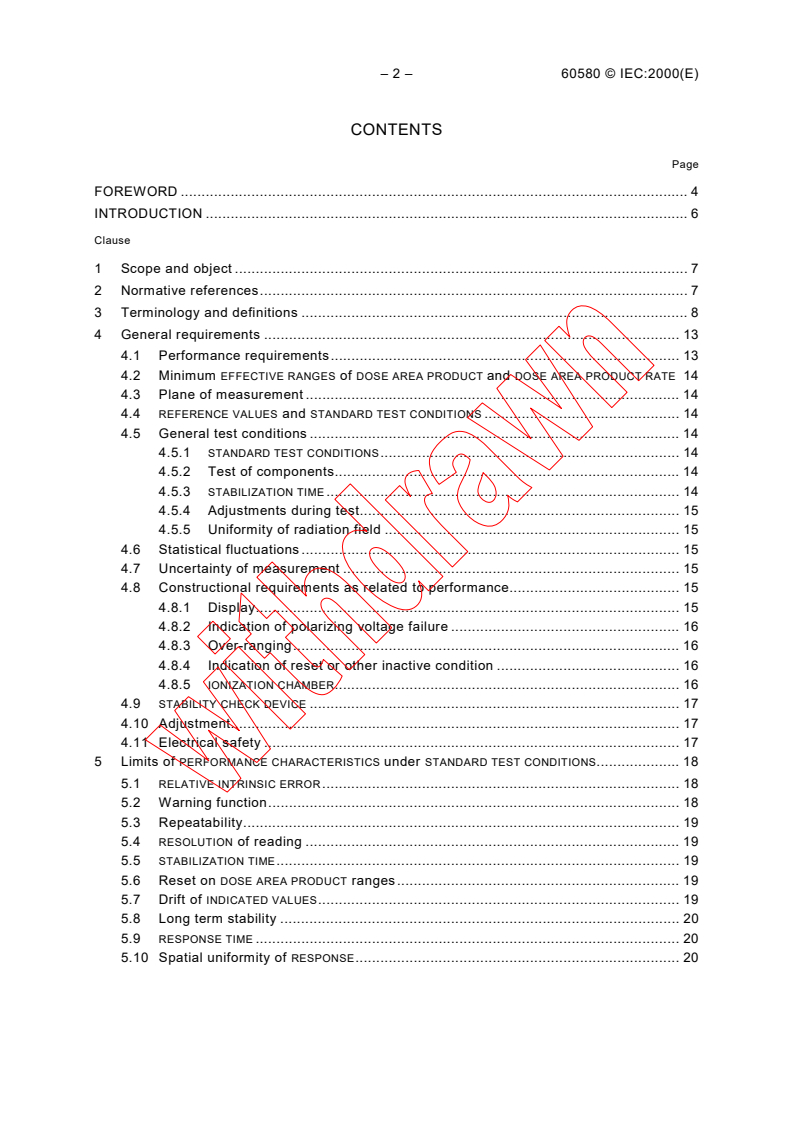
– 2 – 60580 © IEC:2000(E)
CONTENTS
Page
FOREWORD . 4
INTRODUCTION .6
Clause
1 Scope and object . 7
2 Normative references. 7
3 Terminology and definitions . 8
4 General requirements . 13
4.1 Performance requirements. 13
4.2 Minimum EFFECTIVE RANGES of DOSE AREA PRODUCT and DOSE AREA PRODUCT RATE 14
4.3 Plane of measurement . 14
4.4 REFERENCE VALUES and STANDARD TEST CONDITIONS . 14
4.5 General test conditions . 14
STANDARD TEST CONDITIONS
4.5.1 . 14
4.5.2 Test of components. 14
4.5.3 STABILIZATION TIME . 14
4.5.4 Adjustments during test. 15
4.5.5 Uniformity of radiation field . 15
4.6 Statistical fluctuations . 15
4.7 Uncertainty of measurement . 15
4.8 Constructional requirements as related to performance. 15
4.8.1 Display. 15
4.8.2 Indication of polarizing voltage failure . 16
4.8.3 Over-ranging. 16
4.8.4 Indication of reset or other inactive condition . 16
IONIZATION CHAMBER
4.8.5 . 16
4.9 STABILITY CHECK DEVICE . 17
4.10 Adjustment. 17
4.11 Electrical safety . 17
5 Limits of PERFORMANCE CHARACTERISTICS under STANDARD TEST CONDITIONS. 18
5.1 RELATIVE INTRINSIC ERROR. 18
5.2 Warning function. 18
5.3 Repeatability. 19
5.4 RESOLUTION of reading . 19
5.5 STABILIZATION TIME. 19
DOSE AREA PRODUCT
5.6 Reset on ranges. 19
5.7 Drift of INDICATED VALUES. 19
5.8 Long term stability . 20
5.9 RESPONSE TIME . 20
5.10 Spatial uniformity of RESPONSE. 20
60580 © IEC:2000(E) – 3 –
Clause Page
6 LIMITS OF VARIATION for effects of INFLUENCE QUANTITIES. 21
6.1 Energy dependence of RESPONSE. 21
6.2 DOSE AREA PRODUCT RATE dependence of DOSE AREA PRODUCT measurements . 21
MEASURING ASSEMBLY
6.2.1 . 21
6.2.2 IONIZATION CHAMBER – Recombination losses. 21
6.3 IRRADIATION TIME . 22
6.4 Field size . 22
6.5 Operating voltage . 22
6.6 Air pressure . 22
6.7 Temperature and humidity . 22
6.8 Air density fluctuation in the IONIZATION CHAMBER . 23
6.9 Electromagnetic compatibility. 23
6.9.1 General. 23
6.9.2 Electrostatic discharge. 23
6.9.3 Radiated electromagnetic fields . 24
6.9.4 Conducted disturbances induced by bursts and high frequencies . 24
6.9.5 Surges . 24
6.9.6 Voltage dips, short interruptions and voltage VARIATIONS. 24
6.10 COMBINED STANDARD UNCERTAINTY. 25
7 Marking. 25
7.1 MEASURING ASSEMBLY . 25
7.2 IONIZATION CHAMBER . 25
8ACCOMPANYING DOCUMENTS . 25
Table 1 – Minimum EFFECTIVE RANGES . 27
Table 2 – REFERENCE VALUES and STANDARD TEST CONDITIONS . 27
Table 3 – Number of readings required to detect true differences Δ
(95 % confidence level) between two sets of instrument readings. 28
Table 4 – RELATIVE INSTRINSIC ERROR, I. 28
Table 5 – Maximum values for the COEFFICIENT OF VARIATION, V . 28
max
Table 6 – LIMITS OF VARIATION for the effects of INFLUENCE QUANTITIES. 29
Table 7 – Example for assessment of the COMBINED STANDARD UNCERTAINTY. 30
Bibliography . 31
Index of defined terms.32
– 4 – 60580 © IEC:2000(E)
INTERNATIONAL ELECTROTECHNICAL COMMISSION
–––––––––––
MEDICAL ELECTRICAL EQUIPMENT –
DOSE AREA PRODUCT METERS
FOREWORD
1) The IEC (International Electrotechnical Commission) is a worldwide organization for standardization comprising
all national electrotechnical committees (IEC National Committees). The object of the IEC is to promote
international co-operation on all questions concerning standardization in the electrical and electronic fields. To
this end and in addition to other activities, the IEC publishes International Standards. Their preparation is
entrusted to technical committees; any IEC National Committee interested in the subject dealt with may
participate in this preparatory work. International, governmental and non-governmental organizations liaising
with the IEC also participate in this preparation. The IEC collaborates closely with the International
Organization for Standardization (ISO) in accordance with conditions determined by agreement between the
two organizations.
2) The formal decisions or agreements of the IEC on technical matters express, as nearly as possible, an
international consensus of opinion on the relevant subjects since each technical committee has representation
from all interested National Committees.
3) The documents produced have the form of recommendations for international use and are published in the form
of standards, technical reports or guides and they are accepted by the National Committees in that sense.
4) In order to promote international unification, IEC National Committees undertake to apply IEC International
Standards transparently to the maximum extent possible in their national and regional standards. Any
divergence between the IEC Standard and the corresponding national or regional standard shall be clearly
indicated in the latter.
5) The IEC provides no marking procedure to indicate its approval and cannot be rendered responsible for any
equipment declared to be in conformity with one of its standards.
6) Attention is drawn to the possibility that some of the elements of this International Standard may be the subject
of patent rights. The IEC shall not be held responsible for identifying any or all such patent rights.
International Standard IEC 60580 has been prepared by sub-committee 62C: Equipment for
radiotherapy, nuclear medicine and radiation dosimetry, of IEC technical committee 62:
Electrical equipment in medical practice.
This second edition cancels and replaces the first edition published in 1977, and constitutes a
technical revision.
The text of this standard is based on the following documents:
FDIS Report on voting
62C/272/FDIS 62C/275/RVD
Full information on the voting for the approval of this standard can be found in the report on
voting indicated in the above table.
This publication has been drafted in accordance with the ISO/IEC Directives, Part 3.
A bilingual version of this publication may be issued at a later date.
60580 © IEC:2000(E) – 5 –
In this standard, the following print types are used:
– requirements, compliance with which can be tested, and definitions: in roman type;
– explanations, advice, general statements, exceptions and references: small roman type;
– test specifications: italic type;
– TERMS USED THROUGHOUT THIS STANDARD WHICH HAVE BEEN DEFINED IN CLAUSE 3 OR LISTED IN
THE INDEX: SMALL CAPITALS.
The committee has decided that the contents of this publication will remain unchanged until
2004. At this date, the publication will be
reconfirmed;
withdrawn;
replaced by a revised edition, or
amended.
– 6 – 60580 © IEC:2000(E)
INTRODUCTION
Diagnostic radiology is the largest contributor to man-made ionizing radiation to which the
public is exposed. The reduction in the exposure received by PATIENTS undergoing MEDICAL
RADIOLOGICAL EXAMINATIONS or procedures has therefore become a central issue in recent
years. The purpose of routine measurement of DOSE AREA PRODUCT is to help in achieving an
overall reduction in the radiation received by PATIENTS undergoing MEDICAL RADIOLOGICAL
EXAMINATIONS. Provided adequate records are kept, it is possible to determine patient doses,
to compare different examination techniques, to establish a technique giving minimum
radiation to a PATIENT, and to ensure a maintenance of that technique; in this respect, such
measurements have a place of particular importance in training establishments. Examination
of records may also indicate a deterioration in the efficiency of the image-production system.
DOSE AREA PRODUCT METERS must be of satisfactory quality and must therefore fulfil the
special requirements laid down in this International Standard.
60580 © IEC:2000(E) – 7 –
MEDICAL ELECTRICAL EQUIPMENT –
DOSE AREA PRODUCT METERS
1 Scope and object
This International Standard specifies the performance and testing of DOSE AREA PRODUCT
METERS with IONIZATION CHAMBERS intended to measure DOSE AREA PRODUCT and/or DOSE AREA
PRODUCT RATE to which the PATIENT is exposed during MEDICAL RADIOLOGICAL EXAMINATIONS.
The object of this International Standard is
1) to establish requirements for a satisfactory level of performance for DOSE AREA PRODUCT
METERS, and
2) to standardize the methods for the determination of compliance with this level of
performance.
2 Normative references
The following normative documents contain provisions which, through reference in this text,
constitute provisions of this International Standard. For dated references, subsequent
amendments to, or revisions of, any of these publications do not apply. However, parties to
agreements based on this International Standard are encouraged to investigate the possibility
of applying the most recent editions of the normative documents indicated below. For undated
references, the latest edition of the normative document referred to applies. Members of IEC
and ISO maintain registers of currently valid International Standards.
IEC 60417 (all parts), Graphical symbols for use on equipment
IEC 60601-1:1988, Medical electrical equipment – Part 1: General requirements for safety
IEC 60601-1-1:1992, Medical electrical equipment – Part 1-1: General requirements for safety –
Collateral standard: Safety requirements for medical electrical systems
IEC 60601-1-2:1993, Medical electrical equipment – Part 1-2: General requirements for safety –
Collateral standard: Electromagnetic compatibility – Requirements and tests
IEC 60731:1997, Medical electrical equipment – Dosimeters with ionization chambers as used
in radiotherapy
IEC 60788:1984, Medical radiology – Terminology
IEC 60950:1999, Safety of information technology equipment
IEC 61000-4-2:1995, Electromagnetic compatibility (EMC) – Part 4-2: Testing and measure-
ment techniques – Electrostatic discharge immunity test
IEC 61000-4-3:1995, Electromagnetic compatibility (EMC) – Part 4-3: Testing and measure-
1)
ment techniques – Radiated, radio-frequency, electromagnetic field immunity test
–––––––––––
1)
There exists a consolidated edition 1.1 (1998) that includes IEC 61000-4-3 (1995) and its amendment 1 (1998).
– 8 – 60580 © IEC:2000(E)
IEC 61000-4-4:1995, Electromagnetic compatibility (EMC) – Part 4-4: Testing and measure-
ment techniques – Electrical fast transient/burst immunity test
IEC 61000-4-5:1995, Electromagnetic compatibility (EMC) – Part 4-5: Testing and measure-
ment techniques – Surge immunity test
IEC 61000-4-6:1996, Electromagnetic compatibility (EMC) – Part 4-6: Testing and measure-
ment techniques – Immunity to conducted disturbances induced by radio frequency fields
IEC 61000-4-11:1994, Electromagnetic compatibility (EMC) – Part 4-11: Testing and measure-
ment techniques – Voltage dips, short interruptions and voltage variations immunity tests
IEC 61187:1993, Electrical and electronic measuring equipment – Documentation
ICRU 60:1998, International Commission on Radiation Units and Measurements, Fundamental
Quantities and Units for Ionizing Radiation, Report 60, ICRU Publications, Bethesda MD
(1998)
ISO, International Organization for Standardization, International vocabulary of basic and
nd
general terms in metrology, 2 edition, Geneva (1993)
ISO, International Organization for Standardization, Guide to the expression of uncertainty in
st
measurement, 1 edition, Geneva (1993)
3 Terminology and definitions
In this International Standard the auxiliary verb
– "shall" implies that compliance with a requirement is mandatory for compliance with the
standard;
– "may" implies that compliance with a requirement is permitted to be accomplished in a
particular manner for compliance with the standard.
The definitions given in this International Standard are generally in agreement with those in
IEC 60788 and ISO: International vocabulary of basic and general terms in metrology;
uncertainties are evaluated in accordance with ISO: Guide to the expression of uncertainty in
measurement.
Terms not defined in this subclause or listed in the index of defined terms have the meanings
defined in the above publications or are assumed to be terms of general scientific usage. An
alphabetical list of defined terms is given in the index.
For the purposes of this International Standard the following definitions apply:
3.1
ACCOMPANYING DOCUMENTS
documents provided with an installation, equipment, associated equipment or accessory,
containing important information for the assembler, installer and user, particularly regarding
safety
60580 © IEC:2000(E) – 9 –
3.2
AIR KERMA (Letter symbol K)
quotient of dE by dm, where dE is the sum of the initial kinetic energies of all the charged
tr tr
particles in a mass dm of air, thus
dE
tr
=
K
dm
–1
Unit: J kg
The special name for the unit of AIR KERMA is gray (Gy) (ICRU 60)
3.3
�
AIR KERMA RATE (Letter symbol K )
quotient of dK by dt, where dK is the increment of AIR KERMA in the time interval dt, thus
dK
�
K =
dt
–1 –1
Unit: J kg s
–1
If the special name gray is used, the unit of AIR KERMA rate is gray per second (Gy s ) (ICRU 60)
3.4
COEFFICIENT OF VARIATION
standard deviation of a set of readings expressed as a percentage of the mean value of these
readings
3.5
CONVENTIONAL TRUE VALUE
value used instead of the TRUE VALUE when calibrating or determining the performance of an
instrument, since in practice the TRUE VALUE is unknown and unknowable (IEC 60731)
NOTE The CONVENTIONAL TRUE VALUE will usually be the value determined by the STANDARD with which the
instrument under test is compared.
3.6
CORRECTION FACTOR
dimensionless multiplier which corrects the INDICATED VALUE of an instrument from its value
when operated under particular conditions to its value when operated under stated REFERENCE
CONDITIONS (IEC 60731)
3.7
DOSE AREA PRODUCT (Letter symbol K·A)
product of the area of the USEFUL BEAM and the AIR KERMA over the cross-section of the USEFUL
BEAM, both quantities being measured at the same distance from the FOCAL SPOT. The unit of
DOSE AREA PRODUCT is Gym .
3.8
DOSE AREA PRODUCT METER
equipment which uses IONIZATION CHAMBERS for the measurement of DOSE AREA PRODUCT or
DOSE AREA PRODUCT RATE in the beam of an X-ray machine used for diagnostic MEDICAL
RADIOLOGICAL EXAMINATIONS
A DOSE AREA PRODUCT METER contains the following components:
– IONIZATION CHAMBER
– MEASURING ASSEMBLY
– STABILITY CHECK DEVICE
– 10 – 60580 © IEC:2000(E)
3.9
�
DOSE AREA PRODUCT RATE (Letter symbol K ·A)
quotient of an increment of DOSE AREA PRODUCT by the corresponding increment of time. The
unit of DOSE AREA PRODUCT RATE is Gym /s
3.10
EFFECTIVE RANGE (of INDICATED VALUES)
range of INDICATED VALUES for which an instrument complies with a stated performance; the
maximum (minimum) EFFECTIVE INDICATED VALUE is the highest (lowest) in this range
The concept of EFFECTIVE RANGE may, for example, also be applied to scale readings and to
related quantities that are not directly indicated by the instrument, e.g. input current
(IEC 60731)
NOTE The EFFECTIVE RANGE of INDICATED VALUES is referred to as EFFECTIVE RANGE in this standard.
3.11
EXPANDED UNCERTAINTY
quantity defining the interval about the result of a measurement within which the values that
could reasonably be attributed to the measurand may be expected to lie with a higher degree
of confidence (IEC 60731)
3.12
FILTRATION
modification of characteristics of ionizing radiation on passing through matter
NOTE FILTRATION includes:
– modification of the energy spectrum of ionizing radiation by preferential absorption of components;
– modification of the spatial distribution of radiation intensity over the cross section of a radiation beam, by
differential ATTENUATION.
3.13
HALF-VALUE LAYER
thickness of a specified material which under NARROW BEAM CONDITIONS attenuates photon
radiation according to its energy spectrum to an extent such that the AIR KERMA RATE is
reduced to one half of the value that is measured without the material
3.14
INDICATED VALUE
value of a quantity derived from the scale reading of an instrument together with any scale
factors indicated on the control panel of the instrument (IEC 60731)
3.15
INFLUENCE QUANTITY
any external quantity that may affect the performance of an instrument (e.g. ambient
temperature, RADIATION QUALITY etc.) (IEC 60731)
3.16
INSTRUMENT PARAMETER
any internal property of an instrument that may affect the performance of this instrument
(IEC 60731)
3.17
INTRINSIC ERROR
deviation of the MEASURED VALUE (i.e. the INDICATED VALUE, corrected to REFERENCE
CONDITIONS) from the CONVENTIONAL TRUE VALUE under STANDARD TEST CONDITIONS (IEC 60731)
60580 © IEC:2000(E) – 11 –
3.18
IONIZATION CHAMBER
detector consisting of a chamber filled with a suitable medium, usually gaseous, in which an
electric field, insufficient to induce charge multiplication, is provided for the collection at the
electrodes of charges associated with ions and the electrons produced in the SENSITIVE
VOLUME of the detector by ionizing radiation
NOTE For use with DOSE AREA PRODUCT METERS, IONIZATION CHAMBERS are constructed in such a way as to allow
the air inside the measuring volume to communicate freely with the atmosphere. Sealed chambers are not suitable
for use with DOSE AREA PRODUCT METERS, because the necessary wall thickness of a sealed chamber may cause an
unacceptable energy dependence of the RESPONSE and because the long term stability of sealed chambers is not
guaranteed.
3.19
IRRADIATION TIME
duration of irradiation determined according to specific methods, usually the time during which
the rate of a RADIATION quantity exceeds a specified level
3.20
LEAKAGE CURRENT
any current in the signal path arising in the detector and/or MEASURING ASSEMBLY which is not
produced by ionization in the IONIZATION CHAMBER
3.21
LIMITS OF VARIATION
maximum VARIATION of a PERFORMANCE CHARACTERISTIC, y, permitted by this standard. If LIMITS
OF VARIATION are stated as ±L %, the VARIATION, Δy/y, expressed as a percentage, shall
remain in the range from –L % to +L % (IEC 60731)
3.22
MANUFACTURER
organization or individual who produces an equipment
3.23
MEASURED VALUE
value of a physical quantity derived by applying all relevant corrections to an INDICATED VALUE
3.24
MEASURING ASSEMBLY
device to convert the output from the IONIZATION CHAMBER into a form suitable for the display
of the value(s) of DOSE AREA PRODUCT or DOSE AREA PRODUCT RATE
3.25
MEDICAL RADIOLOGICAL EXAMINATION
medical examination using effects of ionizing radiation
3.26
MINIMUM RATED RANGE
least range of an INFLUENCE QUANTITY or INSTRUMENT PARAMETER within which the instrument
shall operate within the specified LIMITS OF VARIATION in order to comply with this standard
(IEC 60731)
3.27
PATIENT
living being (person or animal) undergoing medical investigation or treatment (IEC 60601-1)
3.28
PERFORMANCE CHARACTERISTIC
one of the quantities used to define the performance of an instrument (e.g. RESPONSE,
LEAKAGE CURRENT) (IEC 60731)
– 12 – 60580 © IEC:2000(E)
3.29
QUALITY EQUIVALENT FILTRATION
quantity indicating for a material or an object the effect of its FILTRATION, expressed as the
thickness of a particular reference material, whose FILTRATION is found to have the same
effect on RADIATION QUALITY under specific conditions of measurement
3.30
RADIATION QUALITY
for a specific type of RADIATION, the description of any characteristic that depends on its
energy spectrum
NOTE For the purposes of this International Standard, a practical approximation of RADIATION QUALITY is
expressed as the quotient of the first HALF-VALUE LAYER and the second HALF-VALUE LAYER.
3.31
RATED FIELD SIZE
size of the USEFUL BEAM at the IONIZATION CHAMBER within which the IONIZATION CHAMBER
performs to its specification
3.32
RATED RANGE (of use)
range of values of an INFLUENCE QUANTITY or INSTRUMENT PARAMETER within which the
instrument will operate within the LIMITS OF VARIATION. Its limits are the maximum and MINIMUM
RATED VALUES (IEC 60731)
NOTE The EFFECTIVE RANGE of use is referred to as RATED RANGE in this standard.
3.33
REFERENCE CONDITIONS
conditions under which all INFLUENCE QUANTITIES and INSTRUMENT PARAMETERS have their
REFERENCE VALUES (IEC 60731)
3.34
REFERENCE VALUE
particular value of an INFLUENCE QUANTITY (or INSTRUMENT PARAMETER) chosen for the purpose
of reference, i.e. the value of an INFLUENCE QUANTITY (or INSTRUMENT PARAMETER) at which the
CORRECTION FACTOR for dependence on that INFLUENCE QUANTITY (or INSTRUMENT PARAMETER)
is unity (IEC 60731)
3.35
RELATIVE INTRINSIC ERROR
ratio of the INTRINSIC ERROR to the CONVENTIONAL TRUE VALUE (IEC 60731)
3.36
RESPONSE
quotient of the INDICATED VALUE by the CONVENTIONAL TRUE VALUE (IEC 60731)
3.37
RESPONSE TIME
the time taken for a scale reading to reach and remain within a specified deviation from its
final steady value, after a sudden change in the quantity being measured (IEC 60731)
3.38
RESOLUTION OF THE DISPLAY
smallest change of scale reading to which a numerical value can be assigned without further
interpolation:
– for an analogue display, the RESOLUTION is the smallest fraction of a scale interval that can
be determined by an observer under specified conditions;
– for a digital display, the RESOLUTION is the smallest significant increment of the reading
(IEC 60731)
60580 © IEC:2000(E) – 13 –
3.39
STABILITY CHECK DEVICE
device, either separate or integral part of the DOSE AREA PRODUCT METER, which enables the
stability of the RESPONSE of the IONIZATION CHAMBER and/or MEASURING ASSEMBLY to be
checked
NOTE The STABILITY CHECK DEVICE may be a purely electrical device.
3.40
STABILIZATION TIME
time taken for a stated PERFORMANCE CHARACTERISTIC to reach and remain within a specified
deviation from its final steady value, after the DOSE AREA PRODUCT METER has been switched
on and after the polarizing voltage has been applied to the IONIZATION CHAMBER (IEC 60731
modified)
3.41
STANDARD TEST CONDITIONS
conditions under which all INFLUENCE QUANTITIES and INSTRUMENT PARAMETERS have their
STANDARD TEST VALUES (IEC 60731)
3.42
STANDARD TEST VALUES
INFLUENCE QUANTITY INSTRUMENT PARAMETER
value(s), or range of values of an or which are
permitted when carrying out calibrations or tests on another INFLUENCE QUANTITY or INSTRUMENT
PARAMETER (IEC 60731)
3.43
TRUE VALUE
value of the physical quantity to be measured by an instrument (IEC 60731)
3.44
USEFUL BEAM
all X-rays which emerge through a cone defined by the focus point and the specified aperture
of its PROTECTIVE SHIELDING or of its BEAM-LIMITING DEVICE
3.45
USEFUL FIELD
USEFUL BEAM
cross section of the , perpendicular to its specified direction at a specified
distance from the focal spot or at a specified plane of measurement
3.46
VARIATION
relative difference, Δy/y, between the values of a PERFORMANCE CHARACTERISTIC, y, when one
INFLUENCE QUANTITY (or INSTRUMENT PARAMETER) successively assumes two specified values,
the other INFLUENCE QUANTITIES (and INSTRUMENT PARAMETERS) being kept constant at the
STANDARD TEST VALUES (unless other values are specified) (IEC 60731)
4 General requirements
4.1 Performance requirements
In clauses 5 and 6 the performance requirements are stated for a complete DOSE AREA
PRODUCT METER including both the IONIZATION CHAMBER and MEASURING ASSEMBLY. For a DOSE
AREA PRODUCT METER designed to operate with one or more IONIZATION CHAMBERS, each
combination of the MEASURING ASSEMBLY and IONIZATION CHAMBER shall comply with the
requirements in 4.6, and in Clauses 5 and 6 relevant to this combination.
– 14 – 60580 © IEC:2000(E)
4.2 Minimum EFFECTIVE RANGES of DOSE AREA PRODUCT and DOSE AREA PRODUCT RATE
The minimum EFFECTIVE RANGES of DOSE AREA PRODUCT and DOSE AREA PRODUCT RATE are
listed in Table 1.
4.3 Plane of measurement
The instrument shall be designed so as to indicate the DOSE AREA PRODUCT and/or the DOSE
AREA PRODUCT RATE in the USEFUL BEAM for the plane in which the radiation is incident on the
PATIENT, excluding, as far as practicable, the contribution of back-scattering to the MEASURED
VALUE.
4.4 REFERENCE VALUES and STANDARD TEST CONDITIONS
These values are as given in Table 2.
4.5 General test conditions
4.5.1 STANDARD TEST CONDITIONS
The STANDARD TEST CONDITIONS listed in Table 2 shall be met during the test procedure except
a) for the INFLUENCE QUANTITY under investigation;
b) where local conditions of temperature and relative humidity are outside the STANDARD TEST
CONDITIONS. In this case the tester shall demonstrate the validity of the test results.
4.5.2 Test of components
4.5.2.1 The preferred procedure for verifying that the performance requirements are met is
to test the components separately, in which case:
– tests on the IONIZATION CHAMBER shall be performed using a "high-precision" MEASURING
ASSEMBLY;
– tests on the MEASURING ASSEMBLY shall be carried out using a "high-precision" current or
charge source, as required, connected to the input.
In this context, "high precision" means that the PERFORMANCE CHARACTERISTICS of the test
equipment shall be such that they perturb the value of the particular PERFORMANCE
CHARACTERISTIC being measured by less than one-quarter of the LIMITS OF VARIATION.
4.5.2.2 Any tests may be carried out using the complete DOSE AREA PRODUCT METER; in
particular this is the preferred method for investigating the effects of high-frequency
electromagnetic fields and electrostatic discharges on a cable-connected IONIZATION CHAMBER
supplied with a MEASURING ASSEMBLY as a system. Some tests performed with the whole
system cannot give information as to whether the origin of the VARIATION lies in the IONIZATION
CHAMBER or in the MEASURING ASSEMBLY (e.g. LEAKAGE CURRENT and ZERO DRIFT). If a complete
system is tested and the relevant INFLUENCE QUANTITY affects both parts, the quadratic sum of
the separate LIMITS OF VARIATION may be taken as an overall LIMIT OF VARIATION.
4.5.3 STABILIZATION TIME
The instrument shall be switched on for at least the STABILIZATION TIME quoted by the
MANUFACTURER, before the start of the compliance test.
In addition, the IONIZATION CHAMBER should be allowed to attain thermal equilibrium with the
environment and it should have the polarizing voltage applied for a period of time equal to or
greater than the specified STABILIZATION TIME.
60580 © IEC:2000(E) – 15 –
4.5.4 Adjustments during test
Compliance tests shall be performed with the instrument ready for use, after the STABILIZATION
TIME and after making any necessary preliminary adjustments. During the tests, adjustments
may be repeated at intervals as long as they do not interfere with the effect to be verified. For
example, zero setting is not permitted during tests for measuring the LEAKAGE CURRENT.
4.5.5 Uniformity of radiation field
The uniformity over the part of the USEFUL FIELD used for the compliance test shall be
checked, for example, by scanning the radiation field with a small IONIZATION CHAMBER
compared with the size of the USEFUL FIELD. Appropriate corrections shall be made to ensure
an uncertainty of the test results of not more than one-fifth of the LIMITS OF VARIATION under
test.
NOTE The field uniformity of any X-RAY TUBE is subject to deterioration in use; regular checks should therefore be
made.
4.6 Statistical fluctuations
At low DOSE AREA PRODUCT and DOSE AREA PRODUCT RATES the magnitude of the statistical
fluctuations of the instrument’s reading due to the random nature of the radiation alone may
be a significant fraction of the VARIATION of the mean reading permitted in the test. A sufficient
number of readings shall be taken to ensure that the mean value of such readings may be
estimated with sufficient precision to demonstrate compliance or non-compliance with the test
requirements. Table 3 provides guidance on the number of readings required to determine
true differences between two sets of instrument readings at the 95 % confidence level. The
number of readings, n, and the COEFFICIENT OF VARIATION, v, of the sets of readings (assumed
to be equal for each set) is listed.
4.7 Uncertainty of measurement
When measurements of VARIATION are made to verify that an equipment complies with
specified LIMITS OF VARIATION, the COMBINED STANDARD UNCERTAINTY of these measurements of
VARIATION should be less than one-fifth of the LIMITS OF VARIATION.
If this is not possible, and if the COMBINED STANDARD UNCERTAINTY of the measurement is less
than one half of the LIMITS OF VARIATION, the COMBINED STANDARD UNCERTAINTY of the
measurement made in the compliance test procedures shall be taken into account in
the evaluation of the equipment under test by adding the COMBINED STANDARD UNCERTAINTY to
the LIMITS OF VARIATION allowed.
If the COMBINED STANDARD UNCERTAINTY exceeds one-fifth of the LIMITS OF VARIATION for any
PERFORMANCE CHARACTERISTIC, then this shall be stated.
NOTE For the purposes of this International Standard, the COMBINED STANDARD UNCERTAINTY may be taken as the
EXPANDED UNCERTAINTY
relative expanded with a coverage factor of two.
4.8 Constructional requirements as related to performance
4.8.1 Display
4.8.1.1 Units
2 2
The SI unit of DOSE AREA PRODUCT is Gym , the SI unit of DOSE AREA PRODUCT RATE is Gym /s.
The indicated unit shall be that of the measuring quantity: DOSE AREA PRODUCT or DOSE AREA
2 2
PRODUCT RATE (i.e. Gym or Gym /s, SI prefixes are allowed).
Compliance with the constructional requirement concerning display shall be checked by
inspection.
– 16 – 60580 © IEC:2000(E)
4.8.1.2 Digital displays
DOSE AREA PRODUCT METERS shall have a digital display. Digital displays whose improper
function can result in non-perceptible faults (e.g. no light emission from certain segments of a
segment display) shall be provided with a means of reliably checking their proper function.
Compliance with the constructional requirement concerning display shall be checked by
inspection.
4.8.2 Indication of polarizing voltage failure
DOSE AREA PRODUCT METERS shall be provided with a means of indicating if the polarizing
voltage does not meet the MANUFACTURER's requirement for satisfactory operation.
Compliance with the constructional requirement on polarizing voltage shall be checked by
inspection.
4.8.3 Over-ranging
4.8.3.1 On all DOSE AREA PRODUCT RATE ranges, the DOSE AREA PRODUCT METER shall clearly
indicate over-range when the full scale reading is exceeded.
Compliance shall be checked by increasing the DOSE AREA PRODUCT RATE slowly but
continuously until the display shows over-range. An equivalent electrical test can be made on
the MEASURING ASSEMBLY.
NOTE When testing for compliance with the requirement on over-ranging it is not necessary to use REFERENCE
CONDITIONS.
4.8.3.2 On all DOSE AREA PRODUCT ranges, the DOSE AREA PRODUCT METER shall clearly
indicate over-range when the full scale reading is exceeded.
Compliance shall be checked on each DOSE AREA PRODUCT range by exposing the relevant
DOSE AREA PRODUCT METER until the display reads just below the stated full scale. The
DOSE AREA PRODUCT
irradiation should then be continued in steps approximately equal to the
RESOLUTION of the display for the range in use, until the display shows over-range. An
equivalent electrical test can be made on the MEASURING ASSEMBLY.
NOTE When testing for compliance with the requirement on over-ranging it is not necessary to use REFERENCE
CONDITIONS
.
4.8.4 Indication of reset or other inactive condition
During any period of time when the DOSE AREA PRODUCT METER is inactive, e.g. following the
reset procedure, this state shall be indicated.
Compliance with this constructional requirement shall be checked by inspection.
4.8.5 IONIZATION CHAMBER
4.8.5.1 The IONIZATION CHAMBER shall be capable of being situated between the BEAM-
LIMITING DEVICE and the PATIENT (see 4.3).
4.8.5.2 The SENSITIVE VOLUME of the IONIZATION CHAMBER shall be capable of being
positioned so that for VARIATIONS in the area of a uniform USEFUL FIELD the output current of
the IONIZATION CHAMBER is proportional to the area of the USEFUL FIELD, all other conditions
being constant.
60580 © IEC:2000(E) – 17 –
4.8.5.3 If the IONIZATION CHAMBER is specified for use with a light beam diaphragm, the
transparency of the IONIZATION CHAMBER to visible light shall be such as to transmit at least
70 % of the luminous flux.
The presence of the IONIZATION CHAMBER shall not displace the edge of the indicated area in
the plane of the exit surface of the IONIZATION CHAMBER by more than 2 mm.
4.8.5.4 The QUALITY EQUIVALENT FILTRATION of the IONIZATION CHAMBER shall not exceed
0,5 mm aluminium of a purity of not less than 99 %.
The QUALITY EQUIVALENT FILTRATION shall be marked in thickness of aluminium on the outside
of the IONIZATION CHAMBER.
The QUALITY EQUIVALENT FILTRATION shall be measured using an X-radiation generated by an
X RAY TUBE VOLTAGE PERCENTAGE RIPPLE TOTAL
- of 70 kV, a not exceeding 10 % and a
FILTRATION of 2 mm aluminium.
4.9 STABILITY CHECK DEVICE
4.9.1 The MEASURING ASSEMBLY shall contain a STABILITY CHECK DEVICE which can be brought
into operation by a change-over switch and by means of which the user may check the
electrical stability of the MEASURING ASSEMBLY in a simple manner.
4.9.2 The VARIATION in the output signal from the STABILITY CHECK DEVICE shall be less than
±2 %. On a digital display the mean value of the readings created by the STABILITY CHECK
DEVICE shall be at least 50.
Compliance with this requirement shall be checked over the MINIMUM RATED RANGE of the
INFLUENCE QUANTITIES operating voltage, air pressure, temperature, relative humidity and
electromagnetic compatibility, as listed in Table 6.
4.10 Adjustment
4.10.1 A means of adjustment shall be provided so that the DOSE AREA PRODUCT for the plane
in which the radiation is incident on the PATIENT can be indicated with the accuracy required
by clauses 5 and 6 in cases where absorbing materials are permanently present between the
IONIZATION CHAMBER and the PATIENT; e.g. the backboard of a fluoroscopic stand or the table
X RAY TUBE
top of an equipment with under-table - .
4.10.2 This adjustment shall be capable of being locked to prevent inadvertent or
incompetent alteration and shall be described sufficiently in the ACCOMPANYING DOCUMENTS for
a necessary adjustment to be correctly made.
4.11 Electrical safety
DOSE AREA PRODUCT METERS shall comply with IEC 60601-1 and IEC 60601-1-1.
NOTE Connected peripheral devices (computers, printers) must comply with IEC 60601-1 if they are placed in the
patient environment, otherwise they must comply with IEC 60950.
– 18 – 60580 © IEC:2000(E)
5 Limits of PERFORMANCE CHARACTERISTICS under STANDARD TEST CONDITIONS
5.1 RELATIVE INTRINSIC ERROR
The RELATIVE INTRINSIC ERROR, I, for DOSE AREA PRODUCT K⋅A and DOSE AREA PRODUCT RATE
�
K ⋅ A measurements made under STANDARD TEST CONDITIONS (as defined in Table 2) shall not
exceed the values given in Table 4.
IONIZATION
Compliance with this performance requirement shall be checked by exposing the
CHAMBER in a radiation beam of reproducible geometry and field size. The RELATIVE INTRINSIC
ERROR EFFECTIVE RANGE
shall be measured for one or more points in each decade over the
(i.e. the whole stated measurement range) of DOSE AREA PRODUCT and/or DOSE AREA PRODUCT
RATE EFFECTIVE RANGE DOSE AREA PRODUCT METER
and at the limits of the . If the is designed to
measure DOSE AREA PRODUCT and DOSE AREA PRODUCT RATE, these measurements shall be
performed in both operating modes. It is allowed to make an equivalent electrical test on the
MEASURING ASSEMBLY and to compute recombination losses in the IONIZATION CHAMBE
...
IEC 60580
Edition 2.0 2000-01
INTERNATIONAL
STANDARD
NORME
INTERNATIONALE
Medical electrical equipment – Dose area product meters
Appareils électromédicaux – Radiamètres de produit exposition-surface
All rights reserved. Unless otherwise specified, no part of this publication may be reproduced or utilized in any form or by
any means, electronic or mechanical, including photocopying and microfilm, without permission in writing from either IEC or
IEC's member National Committee in the country of the requester.
If you have any questions about IEC copyright or have an enquiry about obtaining additional rights to this publication,
please contact the address below or your local IEC member National Committee for further information.
Droits de reproduction réservés. Sauf indication contraire, aucune partie de cette publication ne peut être reproduite
ni utilisée sous quelque forme que ce soit et par aucun procédé, électronique ou mécanique, y compris la photocopie
et les microfilms, sans l'accord écrit de la CEI ou du Comité national de la CEI du pays du demandeur.
Si vous avez des questions sur le copyright de la CEI ou si vous désirez obtenir des droits supplémentaires sur cette
publication, utilisez les coordonnées ci-après ou contactez le Comité national de la CEI de votre pays de résidence.
IEC Central Office
3, rue de Varembé
CH-1211 Geneva 20
Switzerland
Email: inmail@iec.ch
Web: www.iec.ch
About the IEC
The International Electrotechnical Commission (IEC) is the leading global organization that prepares and publishes
International Standards for all electrical, electronic and related technologies.
About IEC publications
The technical content of IEC publications is kept under constant review by the IEC. Please make sure that you have the
latest edition, a corrigenda or an amendment might have been published.
ƒ Catalogue of IEC publications: www.iec.ch/searchpub
The IEC on-line Catalogue enables you to search by a variety of criteria (reference number, text, technical committee,…).
It also gives information on projects, withdrawn and replaced publications.
ƒ IEC Just Published: www.iec.ch/online_news/justpub
Stay up to date on all new IEC publications. Just Published details twice a month all new publications released. Available
on-line and also by email.
ƒ Electropedia: www.electropedia.org
The world's leading online dictionary of electronic and electrical terms containing more than 20 000 terms and definitions
in English and French, with equivalent terms in additional languages. Also known as the International Electrotechnical
Vocabulary online.
ƒ Customer Service Centre: www.iec.ch/webstore/custserv
If you wish to give us your feedback on this publication or need further assistance, please visit the Customer Service
Centre FAQ or contact us:
Email: csc@iec.ch
Tel.: +41 22 919 02 11
Fax: +41 22 919 03 00
A propos de la CEI
La Commission Electrotechnique Internationale (CEI) est la première organisation mondiale qui élabore et publie des
normes internationales pour tout ce qui a trait à l'électricité, à l'électronique et aux technologies apparentées.
A propos des publications CEI
Le contenu technique des publications de la CEI est constamment revu. Veuillez vous assurer que vous possédez
l’édition la plus récente, un corrigendum ou amendement peut avoir été publié.
ƒ Catalogue des publications de la CEI: www.iec.ch/searchpub/cur_fut-f.htm
Le Catalogue en-ligne de la CEI vous permet d’effectuer des recherches en utilisant différents critères (numéro de référence,
texte, comité d’études,…). Il donne aussi des informations sur les projets et les publications retirées ou remplacées.
ƒ Just Published CEI: www.iec.ch/online_news/justpub
Restez informé sur les nouvelles publications de la CEI. Just Published détaille deux fois par mois les nouvelles
publications parues. Disponible en-ligne et aussi par email.
ƒ Electropedia: www.electropedia.org
Le premier dictionnaire en ligne au monde de termes électroniques et électriques. Il contient plus de 20 000 termes et
définitions en anglais et en français, ainsi que les termes équivalents dans les langues additionnelles. Egalement appelé
Vocabulaire Electrotechnique International en ligne.
ƒ Service Clients: www.iec.ch/webstore/custserv/custserv_entry-f.htm
Si vous désirez nous donner des commentaires sur cette publication ou si vous avez des questions, visitez le FAQ du
Service clients ou contactez-nous:
Email: csc@iec.ch
Tél.: +41 22 919 02 11
Fax: +41 22 919 03 00
IEC 60580
Edition 2.0 2000-01
INTERNATIONAL
STANDARD
NORME
INTERNATIONALE
Medical electrical equipment – Dose area product meters
Appareils électromédicaux – Radiamètres de produit exposition-surface
INTERNATIONAL
ELECTROTECHNICAL
COMMISSION
COMMISSION
ELECTROTECHNIQUE
PRICE CODE
INTERNATIONALE
V
CODE PRIX
ICS 11.040.50 ISBN 2-8318-7178-6
– 2 – 60580 © CEI:2000
SOMMAIRE
AVANT-PROPOS.6
INTRODUCTION.10
1 Domaine d’application et objet.12
2 Références normatives.12
3 Terminologie et définitions.14
4 Prescriptions générales.26
4.1 Prescriptions de performance.26
4.2 DOMAINES UTILES minimaux de PRODUIT EXPOSITION-SURFACE et de DÉBIT
DE PRODUIT EXPOSITION-SURFACE .26
4.3 Plan de mesurage .26
4.4 VALEURS DE RÉFÉRENCE et CONDITIONS D'ESSAI NORMALISÉES .26
4.5 Conditions générales d’essai.26
4.5.1 CONDITIONS D'ESSAI NORMALISÉES.26
4.5.2 Essai des composants.28
4.5.3 TEMPS DE STABILISATION.28
4.5.4 Réglages en cours d’essai.28
4.5.5 Uniformité du champ de rayonnement.28
4.6 Fluctuations statistiques.30
4.7 Incertitude de la mesure.30
4.8 Règles de construction liées aux performances .30
4.8.1 Affichage.30
4.8.2 Indication d’un défaut de tension de polarisation .32
4.8.3 Dépassement de l’étendue de mesure .32
4.8.4 Indication de réinitialisation ou autre état d’inactivité .32
4.8.5 CHAMBRE D’IONISATION .32
4.9 CONTROLEUR DE CONSTANCE .34
4.10 Réglage.34
4.11 Sécurité électrique.34
5 Limites des CARACTÉRISTIQUES DE PERFORMANCE sous CONDITIONS D'ESSAI
NORMALISÉES.34
5.1 ERREUR INTRINSÈQUE RELATIVE.34
5.2 Fonction d’alarme.36
5.3 Répétabilité.36
5.4 POUVOIR DE RÉSOLUTION de lecture .38
5.5 TEMPS DE STABILISATION.38
5.6 Réinitialisation des plages de PRODUIT EXPOSITION-SURFACE .38
5.7 Dérive des VALEUR INDIQUÉES.38
5.8 Stabilité à long terme .40
5.9 TEMPS DE RÉPONSE .40
5.10 Uniformité spatiale de la RÉPONSE .42
6 LIMITES DE VARIATION pour les effets des GRANDEURS D’INFLUENCE.42
6.1 Dépendance de l’énergie de la RÉPONSE.42
6.2 Dépendance des mesures de PRODUIT EXPOSITION-SURFACE du DÉBIT DE
PRODUIT EXPOSITION-SURFACE.42
6.2.1 ENSEMBLE DE MESURAGE .42
6.2.2 CHAMBRE D’IONISATION – pertes de recombinaison .42
60580 © IEC:2000 – 3 –
CONTENTS
FOREWORD.7
INTRODUCTION.11
1 Scope and object.13
2 Normative references.13
3 Terminology and definitions.15
4 General requirements .27
4.1 Performance requirements .27
4.2 Minimum EFFECTIVE RANGES of DOSE AREA PRODUCT and DOSE AREA PRODUCT
RATE .27
4.3 Plane of measurement.27
4.4 REFERENCE VALUES and STANDARD TEST CONDITIONS.27
4.5 General test conditions.27
4.5.1 STANDARD TEST CONDITIONS .27
4.5.2 Test of components.29
4.5.3 STABILIZATION TIME .29
4.5.4 Adjustments during test .29
4.5.5 Uniformity of radiation field.29
4.6 Statistical fluctuations .31
4.7 Uncertainty of measurement.31
4.8 Constructional requirements as related to performance .31
4.8.1 Display.31
4.8.2 Indication of polarizing voltage failure.33
4.8.3 Over-ranging.33
4.8.4 Indication of reset or other inactive condition.33
4.8.5 IONIZATION CHAMBER .33
4.9 STABILITY CHECK DEVICE.35
4.10 Adjustment.35
4.11 Electrical safety.35
5 Limits of PERFORMANCE CHARACTERISTICS under STANDARD TEST CONDITIONS .35
5.1 RELATIVE INTRINSIC ERROR .35
5.2 Warning function.37
5.3 Repeatability.37
5.4 RESOLUTION of reading.39
5.5 STABILIZATION TIME .39
5.6 Reset on DOSE AREA PRODUCT ranges .39
5.7 Drift of INDICATED VALUES .39
5.8 Long term stability.41
5.9 RESPONSE TIME.41
5.10 Spatial uniformity of RESPONSE .43
6 LIMITS of VARIATION for effects of INFLUENCE QUANTITIES .43
6.1 Energy dependence of RESPONSE .43
6.2 DOSE AREA PRODUCT RATE dependence of DOSE AREA PRODUCT measurements.43
6.2.1 MEASURING ASSEMBLY .43
6.2.2 IONIZATION CHAMBER – Recombination losses .43
– 4 – 60580 © CEI:2000
6.3 DURÉE D’IRRADIATION .44
6.4 Taille du champ.44
6.5 Tension de fonctionnement.44
6.6 Pression d’air .46
6.7 Température et humidité .46
6.8 Fluctuation de la densité de l’air dans la CHAMBRE D’IONISATION .46
6.9 Compatibilité électromagnétique.48
6.9.1 Généralités.48
6.9.2 Décharges électrostatiques.48
6.9.3 Champs électromagnétiques rayonnés .48
6.9.4 Perturbations conduites induites par les salves et les hautes
fréquences .50
6.9.5 Ondes de choc .50
6.9.6 Creux de tension, coupures brèves et VARIATIONS de tension.50
6.10 INCERTITUDE NORMALE COMBINÉE.50
7 Marquage.50
7.1 ENSEMBLE DE MESURAGE .50
7.2 CHAMBRE D’IONISATION.52
8 DOCUMENTS D’ACCOMPAGNEMENT.52
Bibliographie.62
Index des termes définis .64
Tableau 1 – PLAGES EFFECTIVES minimales .54
Tableau 2 – VALEURS DE RÉFÉRENCE et CONDITIONS D'ESSAI NORMALISÉES .56
Tableau 3 – Nombre de lectures requises pour détecter des différences vraies Δ
(niveau de confiance de 95 %) entre deux groupes de lectures de l’instrument .56
Tableau 4 – ERREUR INTRINSÈQUE RELATIVE, I.58
Tableau 5 – Valeurs maximales pour le COEFFICIENT DE VARIATION, V .58
max
Tableau 6 – LIMITES DE VARIATION pour les effets des GRANDEURS D’INFLUENCE.58
Tableau 7 – Exemple pour l’estimation de L’INCERTITUDE NORMALE COMBINÉE.60
60580 © IEC:2000 – 5 –
6.3 IRRADIATION TIME .45
6.4 Field size.45
6.5 Operating voltage.45
6.6 Air pressure.47
6.7 Temperature and humidity.47
6.8 Air density fluctuation in the IONIZATION CHAMBER.47
6.9 Electromagnetic compatibility.49
6.9.1 General.49
6.9.2 Electrostatic discharge.49
6.9.3 Radiated electromagnetic fields.49
6.9.4 Conducted disturbances induced by bursts and high frequencies .51
6.9.5 Surges.51
6.9.6 Voltage dips, short interruptions and voltage VARIATIONS .51
6.10 COMBINED STANDARD UNCERTAINTY .51
7 Marking.51
7.1 MEASURING ASSEMBLY .51
7.2 IONIZATION CHAMBER.53
8 ACCOMPANYING DOCUMENTS.53
Bibliography.63
Index of defined terms .65
Table 1 – Minimum EFFECTIVE RANGES.55
Table 2 – REFERENCE VALUES and STANDARD TEST CONDITIONS.57
Table 3 – Number of readings required to detect true differences Δ (95 % confidence
level) between two sets of instrument readings .57
Table 4 – RELATIVE INSTRINSIC ERROR, I.59
Table 5 – Maximum values for the COEFFICIENT OF VARIATION, V .59
max
Table 6 – LIMITS OF VARIATION for the effects of INFLUENCE QUANTITIES .59
Table 7 – Example for assessment of the COMBINED STANDARD UNCERTAINTY .61
– 6 – 60580 © CEI:2000
COMMISSION ÉLECTROTECHNIQUE INTERNATIONALE
–––––––––––
APPAREILS ELECTROMEDICAUX –
RADIAMETRES DE PRODUIT EXPOSITION-SURFACE
AVANT-PROPOS
1) La CEI (Commission Electrotechnique Internationale) est une organisation mondiale de normalisation
composée de l'ensemble des comités électrotechniques nationaux (Comités nationaux de la CEI). La CEI a
pour objet de favoriser la coopération internationale pour toutes les questions de normalisation dans les
domaines de l'électricité et de l'électronique. A cet effet, la CEI – entre autres activités – publie des Normes
internationales, des Spécifications techniques, des Rapports techniques et des Guides (ci-après dénommés
"Publication(s) de la CEI"). Leur élaboration est confiée à des comités d'études, aux travaux desquels tout
Comité national intéressé par le sujet traité peut participer. Les organisations internationales,
gouvernementales et non gouvernementales, en liaison avec la CEI, participent également aux travaux. La CEI
collabore étroitement avec l'Organisation Internationale de Normalisation (ISO), selon des conditions fixées par
accord entre les deux organisations.
2) Les décisions ou accords officiels de la CEI concernant les questions techniques représentent, dans la mesure
du possible, un accord international sur les sujets étudiés, étant donné que les Comités nationaux de la CEI
intéressés sont représentés dans chaque comité d’études.
3) Les Publications de la CEI se présentent sous la forme de recommandations internationales et sont agréées
comme telles par les Comités nationaux de la CEI. Tous les efforts raisonnables sont entrepris afin que la CEI
s'assure de l'exactitude du contenu technique de ses publications; la CEI ne peut pas être tenue responsable
de l'éventuelle mauvaise utilisation ou interprétation qui en est faite par un quelconque utilisateur final.
4) Dans le but d'encourager l'uniformité internationale, les Comités nationaux de la CEI s'engagent, dans toute la
mesure possible, à appliquer de façon transparente, les Publications de la CEI dans leurs publications
nationales et régionales. Toutes divergences entre toutes Publications de la CEI et toutes publications
nationales ou régionales correspondantes doivent être indiquées en termes clairs dans ces dernières.
5) La CEI n’a prévu aucune procédure de marquage valant indication d’approbation et n'engage pas sa
responsabilité pour les équipements déclarés conformes à une de ses Publications.
6) Tous les utilisateurs doivent s'assurer qu'ils sont en possession de la dernière édition de cette publication.
7) Aucune responsabilité ne doit être imputée à la CEI, à ses administrateurs, employés, auxiliaires ou
mandataires, y compris ses experts particuliers et les membres de ses comités d'études et des Comités
nationaux de la CEI, pour tout préjudice causé en cas de dommages corporels et matériels, ou de tout autre
dommage de quelque nature que ce soit, directe ou indirecte, ou pour supporter les coûts (y compris les frais
de justice) et les dépenses découlant de la publication ou de l'utilisation de cette Publication de la CEI ou de
toute autre Publication de la CEI, ou au crédit qui lui est accordé.
8) L'attention est attirée sur les références normatives citées dans cette publication. L'utilisation de publications
référencées est obligatoire pour une application correcte de la présente publication.
9) L’attention est attirée sur le fait que certains des éléments de la présente Publication de la CEI peuvent faire
l’objet de droits de propriété intellectuelle ou de droits analogues. La CEI ne saurait être tenue pour
responsable de ne pas avoir identifié de tels droits de propriété et de ne pas avoir signalé leur existence.
La Norme internationale CEI 60580 a été établie par le sous-comité 62C: Appareils de
radiothérapie, de médecine nucléaire et de dosimétrie du rayonnement, du comité d'études 62
de la CEI: Equipements électriques dans la pratique médicale.
Cette deuxième édition annule et remplace la première édition publiée en 1977, et constitue
une révision technique.
Cette version bilingue, publiée en 2003-09, correspond à la version anglaise.
Le texte anglais de cette norme est basé sur les documents 62C/272/FDIS et 62C/275/RVD.
Le rapport de vote 62C/275/RVD donne toute information sur le vote ayant abouti à
l’approbation de cette norme.
La version française de cette norme n’a pas été soumise au vote.
60580 © IEC:2000 – 7 –
INTERNATIONAL ELECTROTECHNICAL
___________
MEDICAL ELECTRICAL EQUIPMENT –
DOSE AREA PRODUCT METERS
FOREWORD
1) The International Electrotechnical Commission (IEC) is a worldwide organization for standardization comprising
all national electrotechnical committees (IEC National Committees). The object of IEC is to promote
international co-operation on all questions concerning standardization in the electrical and electronic fields. To
this end and in addition to other activities, IEC publishes International Standards, Technical Specifications,
Technical Reports, and Guides (hereafter referred to as “IEC Publication(s)”). Their preparation is entrusted to
technical committees; any IEC National Committee interested in the subject dealt with may participate in this
preparatory work. International, governmental and non-governmental organizations liaising with the IEC also
participate in this preparation. IEC collaborates closely with the International Organization for Standardization
(ISO) in accordance with conditions determined by agreement between the two organizations.
2) The formal decisions or agreements of IEC on technical matters express, as nearly as possible, an international
consensus of opinion on the relevant subjects since each technical committee has representation from all
interested IEC National Committees.
3) IEC Publications have the form of recommendations for international use and are accepted by IEC National
Committees in that sense. While all reasonable efforts are made to ensure that the technical content of IEC
Publications is accurate, IEC cannot be held responsible for the way in which they are used or for any
misinterpretation by any end user.
4) In order to promote international uniformity, IEC National Committees undertake to apply IEC Publications
transparently to the maximum extent possible in their national and regional publications. Any divergence
between any IEC Publication and the corresponding national or regional publication shall be clearly indicated in
the latter.
5) IEC provides no marking procedure to indicate its approval and cannot be rendered responsible for any
equipment declared to be in conformity with an IEC Publication.
6) All users should ensure that they have the latest edition of this publication.
7) No liability shall attach to IEC or its directors, employees, servants or agents including individual experts and
members of its technical committees and IEC National Committees for any personal injury, property damage or
other damage of any nature whatsoever, whether direct or indirect, or for costs (including legal fees) and
expenses arising out of the publication, use of, or reliance upon, this IEC Publication or any other IEC
Publications.
8) Attention is drawn to the Normative references cited in this publication. Use of the referenced publications is
indispensable for the correct application of this publication.
9) Attention is drawn to the possibility that some of the elements of this IEC Publication may be the subject of
patent rights. IEC shall not be held responsible for identifying any or all such patent rights.
International Standard IEC 60580 has been prepared by sub-committee 62C: Equipment for
radiotherapy, nuclear medicine and radiation dosimetry, of IEC technical committee 62:
Electrical equipment in medical practice.
This second edition cancels and replaces the first edition published in 1977, and constitutes a
technical revision.
This bilingual version, published in 2003-09, corresponds to the English version.
The text of this standard is based on the following documents:
FDIS Report on voting
62C/272/FDIS 62C/275/RVD
Full information on the voting for the approval of this standard can be found in the report on
voting indicated in the above table.
– 8 – 60580 © CEI:2000
En cas de divergence entre la version française et la version anglaise, l’anglais fait foi.
Cette publication a été rédigée selon les directives ISO/CEI, Partie 3.
Dans cette norme, les polices suivantes sont utilisées:
– prescriptions dont la conformité peut être vérifiée par un essai et définitions: caractères
romains;
– explications, conseils, énoncés de portée générale, exceptions et références: petits caractères romains;
– modalités d’essais : caractères italiques;
– TERMES EMPLOYES DANS CETTE NORME ET QUI SONT DÉFINIS A L'ARTICLE 3 OU LISTÉS DANS
L’INDEX: PETITES MAJUSCULES.
Le comité a décidé que le contenu de cette publication ne sera pas modifié avant 2004. A
cette date, la publication sera
• reconduite;
• supprimée;
• remplacée par une édition révisée, ou
• amendée.
60580 © IEC:2000 – 9 –
This publication has been drafted in accordance with the ISO/IEC Directives, Part 3.
In this standard, the following print types are used:
– requirements, compliance with which can be tested, and definitions: in roman type;
– explanations, advice, general statements, exceptions and references: small roman type;
– test specifications: italic type;
– TERMS USED THROUGHOUT THIS STANDARD WHICH HAVE BEEN DEFINED IN CLAUSE 3 OR LISTED IN
THE INDEX: SMALL CAPITALS.
The committee has decided that the contents of this publication will remain unchanged until
2004. At this date, the publication will be
• reconfirmed;
• withdrawn;
• replaced by a revised edition, or
• amended.
– 10 – 60580 © CEI:2000
INTRODUCTION
Le radiodiagnostic est la plus importante source de rayonnements ionisants produits par
l’homme à laquelle le public est exposé. Par conséquent, la réduction de l’exposition reçue
par les PATIENTS soumis à des procédures ou EXAMENS RADIOLOGIQUES MÉDICAUX est devenue
un problème central au cours de ces dernières années. L'objectif de la mesure par routine du
PRODUIT EXPOSITION-SURFACE est de contribuer à une réduction globale des rayonnements
reçus par les PATIENTS qui sont soumis à des EXAMENS RADIOLOGIQUES MÉDICAUX. Il est
possible de déterminer les doses reçues par le patient, de comparer les différentes
techniques d’examen, d’établir une technique exposant le PATIENT à un minimum de rayon-
nements, et d’assurer le suivi de cette technique, à condition de tenir des dossiers
appropriés; à ce sujet, de telles mesures occupent une place particulièrement importante
dans les établissements de formation. L’examen des dossiers pourrait aussi indiquer une
baisse de l’efficacité du système de production d’image. Il faut que les RADIAMÈTRES DE
PRODUIT EXPOSITION-SURFACE soient à un niveau de qualité satisfaisant et donc répondent aux
règles spéciales énoncées dans cette Norme internationale.
60580 © IEC:2000 – 11 –
INTRODUCTION
Diagnostic radiology is the largest contributor to man-made ionizing radiation to which the
public is exposed. The reduction in the exposure received by PATIENTS undergoing MEDICAL
RADIOLOGICAL EXAMINATIONS or procedures has therefore become a central issue in recent
years. The purpose of routine measurement of DOSE AREA PRODUCT is to help in achieving an
overall reduction in the radiation received by PATIENTS undergoing MEDICAL RADIOLOGICAL
EXAMINATIONS. Provided adequate records are kept, it is possible to determine patient doses,
to compare different examination techniques, to establish a technique giving minimum
radiation to a PATIENT, and to ensure a maintenance of that technique; in this respect, such
measurements have a place of particular importance in training establishments. Examination
of records may also indicate a deterioration in the efficiency of the image-production system.
DOSE AREA PRODUCT METERS must be of satisfactory quality and must therefore fulfil the
special requirements laid down in this International Standard.
– 12 – 60580 © CEI:2000
APPAREILS ELECTROMEDICAUX –
RADIAMETRES DE PRODUIT EXPOSITION-SURFACE
1 Domaine d’application et objet
La présente Norme internationale spécifie la performance et l'essai des RADIAMÈTRES DE
PRODUIT EXPOSITION-SURFACE avec CHAMBRES D'IONISATION destinés à la mesure du PRODUIT
EXPOSITION-SURFACE et/ou du DÉBIT DE PRODUIT EXPOSITION-SURFACE auquel le PATIENT est
exposé au cours des EXAMENS RADIOLOGIQUES MÉDICAUX.
L’objet de cette Norme internationale est
1) d'établir les critères pour assurer un niveau de performance satisfaisant des RADIAMÈTRES
DE PRODUIT EXPOSITION-SURFACE, et
2) de normaliser les méthodes pour déterminer la conformité à ce niveau de performance.
2 Références normatives
Les documents de référence suivants sont indispensables pour l'application du présent
document. Pour les références datées, seule l'édition citée s'applique. Pour les références
non datées, la dernière édition du document de référence s'applique (y compris les éventuels
amendements).
CEI 60417 (toutes les parties), Symboles graphiques utilisables sur le matériel
CEI 60601-1:1988, Appareils électromédicaux – Première partie: Règles générales de
sécurité
CEI 60601-1-1:1992, Appareils électromédicaux – Partie 1-1: Règles générales de sécurité –
Norme collatérale: Règles de sécurité pour systèmes électromédicaux
CEI 60601-1-2:1993, Appareils électromédicaux – Partie 1-2: Règles générales de sécurité –
Norme collatérale: Compatibilité électromagnétique – Prescriptions et essais
CEI 60731:1997, Appareils électromédicaux – Dosimètres à chambre d'ionisation utilisés en
radiothérapie
CEI 60788:1984, Radiologie médicale – Terminologie
CEI 60950:1999, Sécurité des matériels de traitement de l'information
CEI 61000-4-2:1995, Compatibilité électromagnétique (CEM) – Partie 4-2: Techniques d'essai
et de mesure – Essai d'immunité aux décharges électrostatiques
CEI 61000-4-3:1995, Compatibilité électromagnétique (CEM) – Partie 4-3: Techniques d'essai
et de mesure – Essai d'immunité aux champs électromagnétiques rayonnés aux fréquences
1)
radioélectriques
–––––––––––
1)
Une édition consolidée 1.1 existe (1998) comprenant la CEI 61000-4-3 (1995) et son amendement 1 (1998).
60580 © IEC:2000 – 13 –
MEDICAL ELECTRICAL EQUIPMENT –
DOSE AREA PRODUCT METERS
1 Scope and object
This International Standard specifies the performance and testing of DOSE AREA PRODUCT
METERS with IONIZATION CHAMBERS intended to measure DOSE AREA PRODUCT and/or DOSE AREA
PRODUCT RATE to which the PATIENT is exposed during MEDICAL RADIOLOGICAL EXAMINATIONS.
The object of this International Standard is
1) to establish requirements for a satisfactory level of performance for DOSE AREA PRODUCT
METERS, and
2) to standardize the methods for the determination of compliance with this level of
performance.
2 Normative references
The following referenced documents are indispensable for the application of this document.
For dated references, only the edition cited applies. For undated references, the latest edition
of the referenced document (including any amendments) applies.
IEC 60417 (all parts), Graphical symbols for use on equipment
IEC 60601-1:1988, Medical electrical equipment – Part 1: General requirements for safety
IEC 60601-1-1:1992, Medical electrical equipment – Part 1-1: General requirements for safety –
Collateral standard: Safety requirements for medical electrical systems
IEC 60601-1-2:1993, Medical electrical equipment – Part 1-2: General requirements for safety –
Collateral standard: Electromagnetic compatibility – Requirements and tests
IEC 60731:1997, Medical electrical equipment – Dosimeters with ionization chambers as used
in radiotherapy
IEC 60788:1984, Medical radiology – Terminology
IEC 60950:1999, Safety of information technology equipment
IEC 61000-4-2:1995, Electromagnetic compatibility (EMC) – Part 4-2: Testing and measure-
ment techniques – Electrostatic discharge immunity test
IEC 61000-4-3:1995, Electromagnetic compatibility (EMC) – Part 4-3: Testing and measure-
1)
ment techniques – Radiated, radio-frequency, electromagnetic field immunity test
–––––––––––
1)
There exists a consolidated edition 1.1 (1998) that includes IEC 61000-4-3 (1995) and its amendment 1 (1998).
– 14 – 60580 © CEI:2000
CEI 61000-4-4:1995, Compatibilité électromagnétique (CEM) – Partie 4-4: Techniques d'essai
et de mesure – Essais d'immunité aux transitoires électriques rapides en salves.
CEI 61000-4-5:1995, Compatibilité électromagnétique (CEM) – Partie 4-5: Techniques d'essai
et de mesure – Essai d'immunité aux ondes de choc
CEI 61000-4-6:1996, Compatibilité électromagnétique (CEM) – Partie 4-6: Techniques d'essai
et de mesure – Immunité aux perturbations conduites, induites par les champs
radioélectriques
CEI 61000-4-11:1994, Compatibilité électromagnétique (CEM) – Partie 4-11: Techniques
d'essai et de mesure – Essais d'immunité aux creux de tension, coupures brèves et variations
de tension
CEI 61187:1993, Équipement de mesures électriques et électroniques – Documentation
ICRU 60:1998, Commission internationale des unités et mesures de rayonnement, Quantités
et unités fondamentales des rayonnements ionisants, Rapport 60, ICRU Publications,
Bethesda MD (1998) Publié en anglais seulement
ISO, Organisation Internationale de normalisation, Vocabulaire international des termes
e
fondamentaux et généraux de métrologie, 2 édition, Genève (1993)
ISO, Organisation Internationale de normalisation, Guide pour l’expression de l’incertitude de
e
mesure, 1 édition, Genève (1993)
3 Terminologie et définitions
Dans la présente Norme internationale, l’auxiliaire
– «devoir» (doit/doivent) implique que la conformité à une exigence est obligatoire pour la
conformité à la norme;
– «pouvoir» (peut/peuvent) implique que la conformité à une exigence peut être réalisée
d’une manière particulière pour assurer la conformité à la norme.
Les définitions données dans cette Norme internationale sont généralement conformes à
celles données dans la CEI 60788 et dans l’ISO: Vocabulaire international des termes
fondamentaux et généraux de métrologie; les incertitudes sont évaluées en conformité avec
l’ISO: Guide pour l’expression de l’incertitude de mesure.
Les termes non définis dans ce paragraphe ou n’apparaissant pas dans l’index des termes
définis ont le sens défini dans les publications ci-dessus ou sont supposés être des termes
d’usage scientifique général. Une liste alphabétique des termes définis est donnée dans
l’index.
Pour les besoins de la présente Norme internationale, les définitions suivantes s’appliquent:
3.1
DOCUMENTS D’ACCOMPAGNEMENT
documents fournis avec une installation, un équipement, un équipement ou accessoire
associé, contenant des informations importantes pour l’assembleur, l’installateur et
l’utilisateur, concernant particulièrement la sécurité
60580 © IEC:2000 – 15 –
IEC 61000-4-4:1995, Electromagnetic compatibility (EMC) – Part 4-4: Testing and measure-
ment techniques – Electrical fast transient/burst immunity test
IEC 61000-4-5:1995, Electromagnetic compatibility (EMC) – Part 4-5: Testing and measure-
ment techniques – Surge immunity test
IEC 61000-4-6:1996, Electromagnetic compatibility (EMC) – Part 4-6: Testing and measure-
ment techniques – Immunity to conducted disturbances induced by radio frequency fields
IEC 61000-4-11:1994, Electromagnetic compatibility (EMC) – Part 4-11: Testing and measure-
ment techniques – Voltage dips, short interruptions and voltage variations immunity tests
IEC 61187:1993, Electrical and electronic measuring equipment – Documentation
ICRU 60:1998, International Commission on Radiation Units and Measurements, Fundamental
Quantities and Units for Ionizing Radiation, Report 60, ICRU Publications, Bethesda MD
(1998)
ISO, International Organization for Standardization, International vocabulary of basic and
nd
general terms in metrology, 2 edition, Geneva (1993)
ISO, International Organization for Standardization, Guide to the expression of uncertainty in
st
measurement, 1 edition, Geneva (1993)
3 Terminology and definitions
In this International Standard the auxiliary verb
– "shall" implies that compliance with a requirement is mandatory for compliance with the
standard;
– "may" implies that compliance with a requirement is permitted to be accomplished in a
particular manner for compliance with the standard.
The definitions given in this International Standard are generally in agreement with those in
IEC 60788 and ISO: International vocabulary of basic and general terms in metrology;
uncertainties are evaluated in accordance with ISO: Guide to the expression of uncertainty in
measurement.
Terms not defined in this subclause or listed in the index of defined terms have the meanings
defined in the above publications or are assumed to be terms of general scientific usage. An
alphabetical list of defined terms is given in the index.
For the purposes of this International Standard the following definitions apply:
3.1
ACCOMPANYING DOCUMENTS
documents provided with an installation, equipment, associated equipment or accessory,
containing important information for the assembler, installer and user, particularly regarding
safety
...