

IEC TS 61400-28-2:2026
(Main)Wind energy generation systems - Part 28‑2: Decommissioning and preparation for recycling
- Abstract
IEC TS 61400‑28-2:2026 addresses the decommissioning and preparation for recycling of wind turbines.
This scope includes all the tasks and on-site considerations of the different process steps, from the beginning of the dismantling phase, material preparation and arrangement, and preparation for shipment to re-using or recycling facilities. Wind turbines in the context of this document include blades, hubs, nacelles, towers, foundations, generators, gearboxes, cables, electrical equipment, transformers, and any other equipment that can be dismantled from wind turbines and not listed before.
The purpose of this document is to define the framework conditions of decommissioning and preparation for recycling of wind turbines, which includes the tasks and considerations of each of the steps of the process. The objective is to provide basic high-level information on the sustainable and efficient decommissioning and dismantling arrangements for wind turbines.
This document can be used by manufacturers, asset owners, governments, operators, recyclers and personnel involved in the decommissioning and preparation for recycling of wind turbines.
- Status
- Published
- Publication Date
- 13-Oct-2026
- Technical Committee
- TC 88 - Wind energy generation systems
- Drafting Committee
- PT 61400-28-2 - TC 88/PT 61400-28-2
- Current Stage
- PPUB - Publication issued
- Start Date
- 14-Oct-2026
- Completion Date
- 25-Sep-2026
IEC TS 61400-28-2:2026 is an IEC Technical Specification for wind energy generation systems that sets out decommissioning and preparation for recycling of wind turbines. It covers the on-site steps from dismantling through material preparation, storage, and shipment for reuse or recycling, and it is written for manufacturers, asset owners, governments, operators, recyclers, and the personnel who carry out the work.
What does IEC TS 61400-28-2:2026 specify?
IEC TS 61400-28-2:2026 specifies the framework for decommissioning wind turbines and preparing their parts and materials for circular use. The scope covers the tasks and on-site considerations from the start of dismantling through material arrangement and shipment to re-using or recycling facilities.
The standard applies to wind turbine parts such as blades, hubs, nacelles, towers, foundations, generators, gearboxes, cables, electrical equipment, transformers, and other dismantled equipment. It does not cover offshore wind farms, balance of wind plants, or the actual re-use or recycling methods themselves.
The document is organized into scope, normative references, terms and definitions, fundamental principles, dismantling, preparation for circularity, separation/storage/transport, site restoration, and an information management system.
| Annex | What it covers |
|---|---|
| Annex A | One example of the protective dismantling process |
| Annex B | Processes of circularity |
| Annex C | Project file |
| Annex D | Informative legislation or regulation source list |
What are the key requirements of IEC TS 61400-28-2:2026?
IEC TS 61400-28-2:2026 requires a controlled, documented process that prioritizes resource recovery, protects people and the site, and keeps the destination of dismantled materials traceable. In practice, the standard treats decommissioning as a project with planning, execution, acceptance, and records.
Fundamental principles, permits, and project control
Clause 4 requires participants to maximize resource utilization and prioritize reuse, repurpose, recycling, and recovery of dismantled components and materials. It also calls for environmental controls to reduce dust, noise, wastewater, waste lubricants, and other impacts, with monitoring and continual improvement where needed.
Clause 4.2 and 4.3 require the work to be carried out under the right permissions, qualifications, and project plans. The decommissioning plan should cover safety, contingency, dismantling, storage, transport, circularity, and site restoration, so the job is managed from planning to acceptance rather than handled as isolated tasks.
Health, safety, and environment
Clause 4.4 requires training, qualifications, personal protective equipment, hazard identification, and warning signs before work starts. It also requires approved safety planning, lockout-tagout for electrical, mechanical, and hydraulic parts, crane and lifting control, and stopping work in adverse weather.
The practical effect is that the turbine must be fully isolated, hazards must be identified in advance, and on-site conditions must stay within the limits of the lifting and safety plans. The clause also links safety and personal protection to IEC TS 61400-30:2023, crane and lifting requirements to IEC 61400-1, and safe stopping arrangements to ISO 13857:2019.
Dismantling sequence and method selection
Clause 5 sets the dismantling sequence and the checks needed before removal. The standard emphasizes disconnecting and de-energizing the turbine, inspecting the structure and its condition, and generally dismantling from the top down and from attached parts toward the main body.
A key requirement in Clause 5.1.12 is that destructive or protective dismantling methods must be chosen through a documented assessment of personnel safety, technical feasibility, environmental impact, and economic viability. In practice, this means the method is selected case by case, not by habit.
The subclauses then give specific controls for main electrical parts, rotor, blades, nacelle, generator, tower, foundation, and transformer. Common practical points include cable identification, keeping components secured during lowering, controlling lubricants and coolants, and using safe distances around cranes and towers.
Preparing parts for circularity
Clause 6 places circularity in a defined order: reuse, repurpose, recycling, then energy recovery, with harmless disposal for what cannot be recovered. It also gives priority to further use in the wind industry before considering other industries.
The standard requires performance and reliability testing, economic and social benefit analysis, and traceability across the process chain. For material control, Clause 6 separates requirements for metal material, composite material, lubricant, concrete, and other material.
This matters in practice because the project team must sort materials early, decide whether they can return to service, and document the route for each stream. Clause 6.1.6 also calls for a traceability system that can calculate recycling rates, with EN 45555:2019 used for the recycling rate approach.
Separation, storage, transport, site restoration, and records
Clause 7 requires dismantled equipment and waste to be classified, collected, and stored according to their function and storage needs. Hazardous waste must be handled separately by specialized equipment and authorized qualified disposal parties, while storage areas need fire protection, spill prevention, clear access, and suitable positioning for large components.
Clause 7.3 requires transport arrangements based on road surveys, dimensions, weights, and securing needs, with covered or enclosed vehicles where needed to prevent collision, leakage, or spillage. Clause 8 then requires the site to be cleaned, backfilled, compacted, and restored, with planting matched to the original conditions and without invasive species.
Clause 9 requires an information management system that tracks material information, process control information, and destination information. In practice, this creates a project record that can support verification after the job is finished.
What terms does IEC TS 61400-28-2:2026 define?
- Decommissioning - the administrative and technical actions taken to remove some or all regulatory controls from a facility.
- Dismantling - the disassembly and removal of a structure, system, or component during decommissioning.
- Circularity - the degree of alignment with the principles for a circular economy.
- Reuse - putting a product or its components back into use for the same purpose at end-of-life.
- Repurpose - using a product or its components for a role they were not originally designed to perform.
- Recycling - processing waste materials for the original purpose or for other purposes, excluding energy recovery.
- Recovery - processing waste material for the original purpose or for other purposes, including energy recovery.
- End-of-life - the point at which a product or component is taken out of the current use stage.
Who uses IEC TS 61400-28-2:2026?
IEC TS 61400-28-2:2026 is used by manufacturers, asset owners, governments, operators, recyclers, and personnel involved in decommissioning wind turbines. In practice, it supports project managers, HSE staff, site supervisors, and logistics teams who need to plan permits, dismantling, storage, transport, site restoration, and documentation.
It is also relevant to organizations that assess whether removed components can be reused, repurposed, recycled, recovered, or sent for harmless disposal.
Which standards are used with IEC TS 61400-28-2:2026?
IEC TS 61400-28-2:2026 uses several standards to support safety, environmental control, and circularity work:
- IEC 61400-1 - design requirements and lifting-related requirements referenced for crane operations.
- IEC TS 61400-28:2025 - through-life management and life extension context for wind power assets.
- IEC TS 61400-30:2023 - safety principles used for personal protection, fire protection, risk reduction, and contingency planning.
- IEC Guide 109:2012 - guidance for environmental aspects in electrotechnical product standards.
- ISO 13315-1:2024 - principles used for the end-of-life phase of concrete.
- ISO 13857:2019 - safety distances used when securing machinery after work.
- ISO 22450:2020 - information for recycling rare earth elements.
The body of the document also cites EN 45555:2019 for recyclability and recoverability assessment, and ISO 16290:2013 in Annex B for technology readiness level assessment.
What does the IEC TS 61400-28-2:2026 document contain?
IEC TS 61400-28-2:2026 contains clauses on planning, HSE controls, dismantling methods, circularity preparation, storage, transport, site restoration, and information management. It also includes a structured terms-and-definitions section and normative references that connect the document to wind turbine design, safety, environmental, and recycling standards.
Annex A gives an example of a protective dismantling process, including transformer placement cases. Annex B provides a circularity flow and a table of evaluation factors for reuse, repurpose, recycling, recovery, and disposal decisions.
Annex C lists the project file contents, including site data, layouts, equipment lists, technical documents, restrictions, and circularity records. Annex D collects informative legislation and regulation links from several countries for users who need jurisdiction-specific guidance.
Get Certified
Connect with accredited certification bodies for this standard

DNV
DNV is an independent assurance and risk management provider.

Lloyd's Register
Lloyd's Register is a global professional services organisation specialising in engineering and technology.
DNV Energy Systems
Energy and renewable energy certification.
Sponsored listings
Frequently Asked Questions
IEC TS 61400-28-2:2026 is a technical specification published by the International Electrotechnical Commission (IEC). Its full title is "Wind energy generation systems - Part 28‑2: Decommissioning and preparation for recycling". This standard covers: IEC TS 61400‑28-2:2026 addresses the decommissioning and preparation for recycling of wind turbines. This scope includes all the tasks and on-site considerations of the different process steps, from the beginning of the dismantling phase, material preparation and arrangement, and preparation for shipment to re-using or recycling facilities. Wind turbines in the context of this document include blades, hubs, nacelles, towers, foundations, generators, gearboxes, cables, electrical equipment, transformers, and any other equipment that can be dismantled from wind turbines and not listed before. The purpose of this document is to define the framework conditions of decommissioning and preparation for recycling of wind turbines, which includes the tasks and considerations of each of the steps of the process. The objective is to provide basic high-level information on the sustainable and efficient decommissioning and dismantling arrangements for wind turbines. This document can be used by manufacturers, asset owners, governments, operators, recyclers and personnel involved in the decommissioning and preparation for recycling of wind turbines.
IEC TS 61400‑28-2:2026 addresses the decommissioning and preparation for recycling of wind turbines. This scope includes all the tasks and on-site considerations of the different process steps, from the beginning of the dismantling phase, material preparation and arrangement, and preparation for shipment to re-using or recycling facilities. Wind turbines in the context of this document include blades, hubs, nacelles, towers, foundations, generators, gearboxes, cables, electrical equipment, transformers, and any other equipment that can be dismantled from wind turbines and not listed before. The purpose of this document is to define the framework conditions of decommissioning and preparation for recycling of wind turbines, which includes the tasks and considerations of each of the steps of the process. The objective is to provide basic high-level information on the sustainable and efficient decommissioning and dismantling arrangements for wind turbines. This document can be used by manufacturers, asset owners, governments, operators, recyclers and personnel involved in the decommissioning and preparation for recycling of wind turbines.
IEC TS 61400-28-2:2026 is classified under the following ICS (International Classification for Standards) categories: 27.180 - Wind turbine energy systems. The ICS classification helps identify the subject area and facilitates finding related standards.
IEC TS 61400-28-2:2026 is available in PDF format for immediate download after purchase. The document can be added to your cart and obtained through the secure checkout process. Digital delivery ensures instant access to the complete standard document.
Standards Content (Sample)
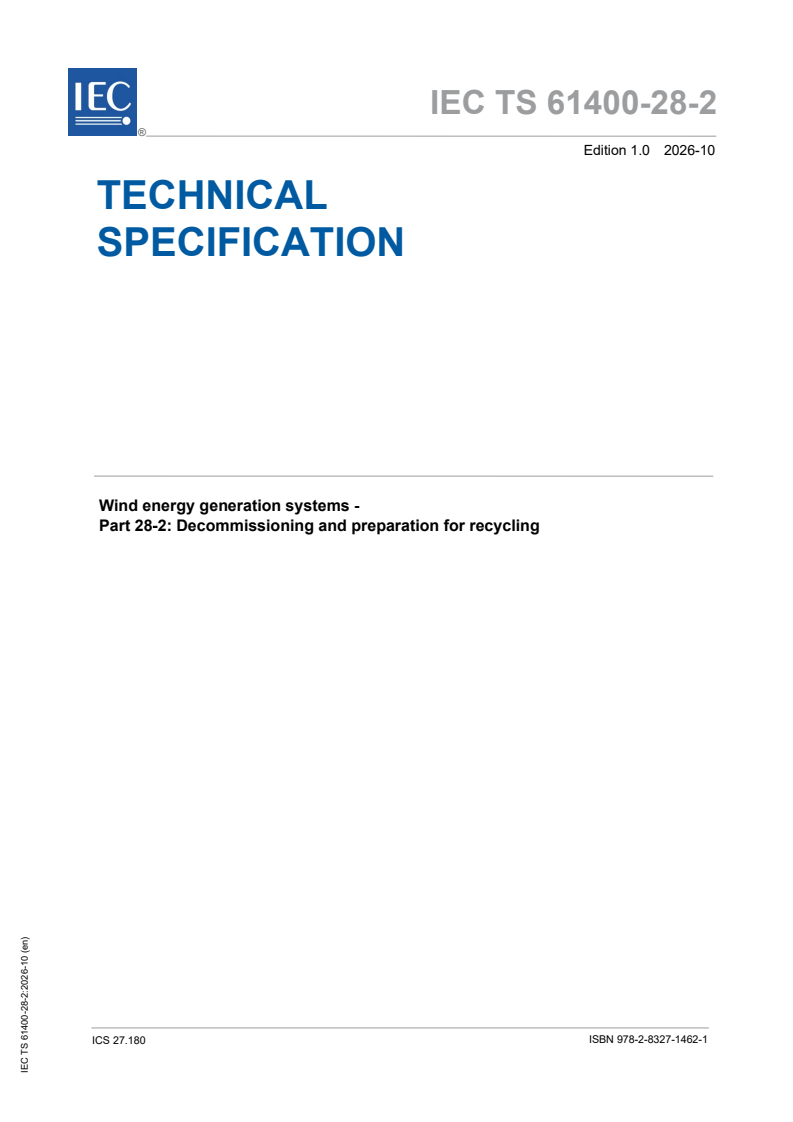
IEC TS 61400-28-2 ®
Edition 1.0 2026-10
TECHNICAL
SPECIFICATION
Wind energy generation systems -
Part 28‑2: Decommissioning and preparation for recycling
ICS 27.180 ISBN 978-2-8327-1462-1
All rights reserved. Unless otherwise specified, no part of this publication may be reproduced or utilized in any form or
by any means, electronic or mechanical, including photocopying and microfilm, without permission in writing from either
IEC or IEC's member National Committee in the country of the requester. If you have any questions about IEC copyright
or have an enquiry about obtaining additional rights to this publication, please contact the address below or your local
IEC member National Committee for further information.
IEC Secretariat Tel.: +41 22 919 02 11
3, rue de Varembé info@iec.ch
CH-1211 Geneva 20 www.iec.ch
Switzerland
About the IEC
The International Electrotechnical Commission (IEC) is the leading global organization that prepares and publishes
International Standards for all electrical, electronic and related technologies.
About IEC publications
The technical content of IEC publications is kept under constant review by the IEC. Please make sure that you have the
latest edition, a corrigendum or an amendment might have been published.
IEC publications search - IEC Products & Services Portal - products.iec.ch
webstore.iec.ch/advsearchform Discover our powerful search engine and read freely all the
The advanced search enables to find IEC publications by a publications previews, graphical symbols and the glossary.
variety of criteria (reference number, text, technical With a subscription you will always have access to up to date
committee, …). It also gives information on projects, content tailored to your needs.
replaced and withdrawn publications.
Electropedia - www.electropedia.org
The world's leading online dictionary on electrotechnology,
IEC Just Published - webstore.iec.ch/justpublished
Stay up to date on all new IEC publications. Just Published containing more than 22 500 terminological entries in English
details all new publications released. Available online and and French, with equivalent terms in 25 additional languages.
once a month by email. Also known as the International Electrotechnical Vocabulary
(IEV) online.
IEC Customer Service Centre - webstore.iec.ch/csc
If you wish to give us your feedback on this publication or
need further assistance, please contact the Customer
Service Centre: sales@iec.ch.
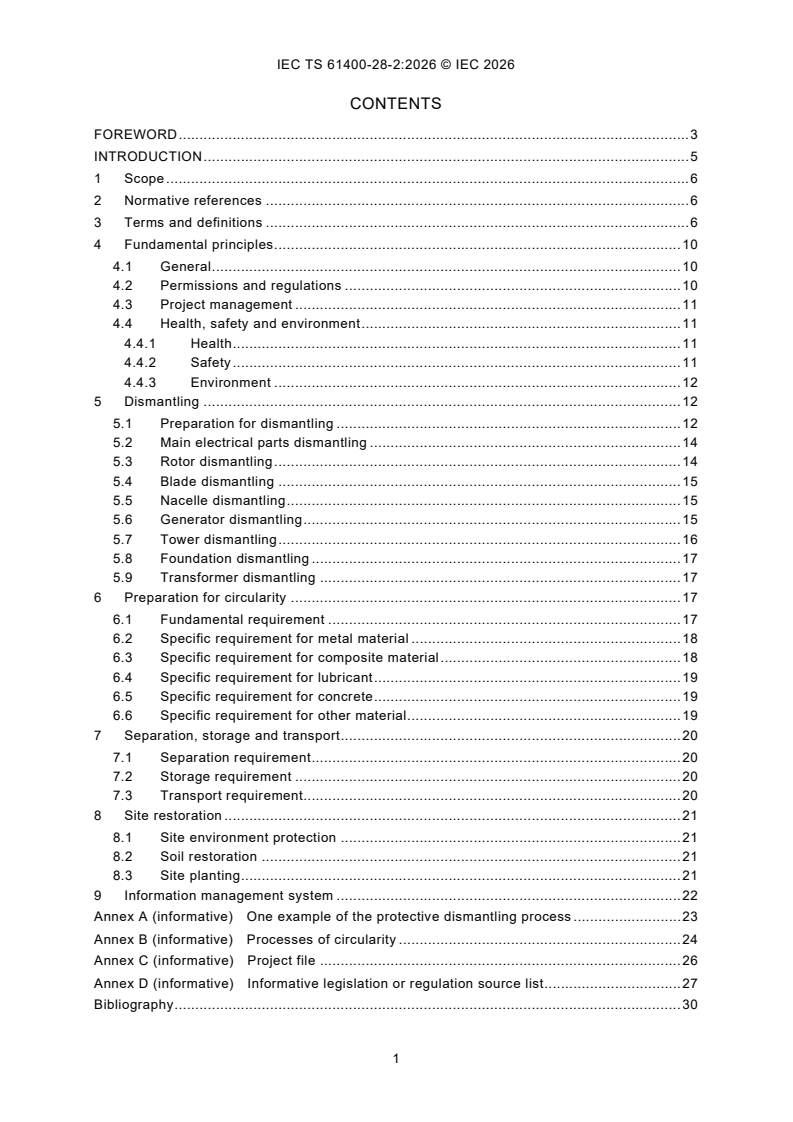
CONTENTS
FOREWORD . 3
INTRODUCTION . 5
1 Scope . 6
2 Normative references . 6
3 Terms and definitions . 6
4 Fundamental principles . 10
4.1 General . 10
4.2 Permissions and regulations . 10
4.3 Project management . 11
4.4 Health, safety and environment . 11
4.4.1 Health . 11
4.4.2 Safety . 11
4.4.3 Environment . 12
5 Dismantling . 12
5.1 Preparation for dismantling . 12
5.2 Main electrical parts dismantling . 14
5.3 Rotor dismantling . 14
5.4 Blade dismantling . 15
5.5 Nacelle dismantling . 15
5.6 Generator dismantling . 15
5.7 Tower dismantling . 16
5.8 Foundation dismantling . 17
5.9 Transformer dismantling . 17
6 Preparation for circularity . 17
6.1 Fundamental requirement . 17
6.2 Specific requirement for metal material . 18
6.3 Specific requirement for composite material . 18
6.4 Specific requirement for lubricant . 19
6.5 Specific requirement for concrete . 19
6.6 Specific requirement for other material . 19
7 Separation, storage and transport . 20
7.1 Separation requirement . 20
7.2 Storage requirement . 20
7.3 Transport requirement. 20
8 Site restoration . 21
8.1 Site environment protection . 21
8.2 Soil restoration . 21
8.3 Site planting . 21
9 Information management system . 22
Annex A (informative) One example of the protective dismantling process . 23
Annex B (informative) Processes of circularity . 24
Annex C (informative) Project file . 26
Annex D (informative) Informative legislation or regulation source list . 27
Bibliography . 30
Figure A.1 – One example of the protective dismantling process . 23
Figure B.1 – Processes of circularity . 24
Table B.1 – Description of circulation condition . 25
Table C.1 – Project file . 26
Table D.1 – Informative legislation or regulation source list. 27
INTERNATIONAL ELECTROTECHNICAL COMMISSION
____________
Wind energy generation systems –
Part 28-2: Decommissioning and preparation for recycling
FOREWORD
1) The International Electrotechnical Commission (IEC) is a worldwide organization for standardization comprising
all national electrotechnical committees (IEC National Committees). The object of IEC is to promote international
co-operation on all questions concerning standardization in the electrical and electronic fields. To this end and
in addition to other activities, IEC publishes International Standards, Technical Specifications, Technical Reports,
Publicly Available Specifications (PAS) and Guides (hereafter referred to as "IEC Publication(s)"). Their
preparation is entrusted to technical committees; any IEC National Committee interested in the subject dealt with
may participate in this preparatory work. International, governmental and non-governmental organizations liaising
with the IEC also participate in this preparation. IEC collaborates closely with the International Organization for
Standardization (ISO) in accordance with conditions determined by agreement between the two organizations.
2) The formal decisions or agreements of IEC on technical matters express, as nearly as possible, an international
consensus of opinion on the relevant subjects since each technical committee has representation from all
interested IEC National Committees.
3) IEC Publications have the form of recommendations for international use and are accepted by IEC National
Committees in that sense. While all reasonable efforts are made to ensure that the technical content of IEC
Publications is accurate, IEC cannot be held responsible for the way in which they are used or for any
misinterpretation by any end user.
4) In order to promote international uniformity, IEC National Committees undertake to apply IEC Publications
transparently to the maximum extent possible in their national and regional publications. Any divergence between
any IEC Publication and the corresponding national or regional publication shall be clearly indicated in the latter.
5) IEC itself does not provide any attestation of conformity. Independent certification bodies provide conformity
assessment services and, in some areas, access to IEC marks of conformity. IEC is not responsible for any
services carried out by independent certification bodies.
6) All users should ensure that they have the latest edition of this publication.
7) No liability shall attach to IEC or its directors, employees, servants or agents including individual experts and
members of its technical committees and IEC National Committees for any personal injury, property damage or
other damage of any nature whatsoever, whether direct or indirect, or for costs (including legal fees) and
expenses arising out of the publication, use of, or reliance upon, this IEC Publication or any other IEC
Publications.
8) Attention is drawn to the Normative references cited in this publication. Use of the referenced publications is
indispensable for the correct application of this publication.
9) IEC draws attention to the possibility that the implementation of this document may involve the use of (a)
patent(s). IEC takes no position concerning the evidence, validity or applicability of any claimed patent rights in
respect thereof. As of the date of publication of this document, IEC had not received notice of (a) patent(s), which
may be required to implement this document. However, implementers are cautioned that this may not represent
the latest information, which may be obtained from the patent database available at https://patents.iec.ch. IEC
shall not be held responsible for identifying any or all such patent rights.
IEC 61400-28-2 has been prepared by IEC technical committee 88: Wind energy generation
systems. It is a Technical Specification.
The text of this Technical Specification is based on the following documents:
Draft Report on voting
88/1182/DTS 88/1194/RVDTS
Full information on the voting for its approval can be found in the report on voting indicated in
the above table.
The language used for the development of this Technical Specification is English.
This document was drafted in accordance with ISO/IEC Directives, Part 2, and developed in
accordance with ISO/IEC Directives, Part 1 and ISO/IEC Directives, IEC Supplement, available
at www.iec.ch/members_experts/refdocs. The main document types developed by IEC are
described in greater detail at www.iec.ch/publications.
A list of all parts in the IEC 61400 series, published under the general title Wind energy
generation systems, can be found on the IEC website.
The committee has decided that the contents of this document will remain unchanged until the
stability date indicated on the IEC website under webstore.iec.ch in the data related to the
specific document. At this date, the document will be
– reconfirmed,
– withdrawn, or
– revised.
INTRODUCTION
The purpose of this document is to define the framework conditions of decommissioning and
preparation for recycling of wind turbines, which includes the tasks and considerations of each
of the steps of the process. The objective is to provide basic high-level information on the
sustainable and efficient decommissioning and dismantling arrangements for wind turbines.
This document can be used by manufacturers, asset owners, governments, operators, recyclers
and personnel involved in the decommissioning and preparation for recycling of wind turbines.
1 Scope
The scope of this part of IEC TS 61400-28-2 is the decommissioning and preparation for
recycling of wind turbines.
This scope includes all the tasks and on-site considerations of the different process steps, from
the beginning of the dismantling phase, material preparation and arrangement, and preparation
for shipment to re-using or recycling facilities. Wind turbines in the context of this document
include blades, hubs, nacelles, towers, foundations, generators, gearboxes, cables, electrical
equipment, transformers, and any other equipment that can be dismantled from wind turbines
and not listed before.
This document does not cover the offshore wind farms, balance of wind plants or actual re-use
or recycling methods, which will be an industry on its own and driven by its own legal,
environmental and economic forces. Balance of wind plants here includes roads, drainage,
cabling to substation and grid, maintenance/spare part facility, civil and electrical substation or
meteorological mast.
2 Normative references
The following documents are referred to in the text in such a way that some or all of their content
constitutes requirements of this document. For dated references, only the edition cited applies.
For undated references, the latest edition of the referenced document (including any
amendments) applies.
IEC 61400-1, Wind energy generation systems - Part 1: Design requirements
IEC TS 61400-28:2025, Through-life management and life extension of wind power assets
IEC TS 61400-30:2023, Safety of wind turbine generators - General principles for design
IEC Guide 109:2012, Environmental aspects - Inclusion in electrotechnical product standards
ISO 13315-1:2024, Environmental management for concrete and concrete structures - Part 1:
General principles
ISO 13857:2019, Safety of machinery - Safety distances to prevent hazard zones being reached
by upper and lower limbs
ISO 22450:2020, Recycling of rare earth elements - Requirements for providing information on
industrial waste and end-of-life products
3 Terms and definitions
For the purposes of this document, the following terms and definitions apply.
ISO and IEC maintain terminology databases for use in standardization at the following
addresses:
– IEC Electropedia: available at https://www.electropedia.org/
– ISO Online browsing platform: available at https://www.iso.org/obp
3.1
decommissioning
administrative and technical actions taken to allow the removal of some or all of the regulatory
controls from a facility
[SOURCE: IEC 60050-395:2014, 395-08-28, modified – Notes to entry have been deleted.]
3.2
recycling
processing of waste materials for the original purpose or for other purposes, excluding energy
recovery
[SOURCE: ISO 472:2013, 2.1706]
3.3
component
constituent part of equipment that cannot be physically divided into smaller parts without losing
its character
[SOURCE: ISO 8887-2:2023, 3.6, modified – Note 1 to entry has been deleted.]
3.4
recovery
processing waste material for the original purpose or for other purposes, including energy
recovery
[SOURCE: ISO 472:2013, 2.1704]
3.5
repurpose
utilize a product or its components in a role that it was not originally designed to perform
[SOURCE: ISO 8887-2:2023, 3.32, modified – Notes to entry have been deleted.]
3.6
reuse
operation by which a product or its components are put back into use for the same purpose at
end-of-life
[SOURCE: ISO 8887-2:2023, 3.33, modified – Note 1 to entry has been deleted.]
3.7
dismantling
disassembly and removal of any structure, system or component during decommissioning
[SOURCE: IEC 60050-395:2014, 395-08-30, modified – Notes to entry have been deleted.]
3.8
hazard
potential source of harm
[SOURCE: ISO/IEC Guide 51:2014, 3.4]
3.9
waste treatment
operations intended to benefit safety and/or economy by changing the characteristics of the
waste
[SOURCE: ISO 12749-3:2024, 3.6.8, modified – Notes to entry have been deleted.]
3.10
circularity
degree of alignment with the principles for a circular economy
[SOURCE: ISO 59020:2024, 3.1.3]
3.11
restoration
bringing an item back to its original appearance or state
[SOURCE: ISO 6707-1:2020, 3.5.1.39]
3.12
site
area of land or water where construction work or other development is undertaken
[SOURCE: ISO 6707-1:2020, 3.1.1.5]
3.13
storage
safekeeping of goods in a depository
[SOURCE: ISO/TS 22002-5:2019, 3.14]
3.14
contingency plan
emergency response and disaster recovery strategy for an unplanned event
[SOURCE: ISO 24419-1:2023, 3.10]
3.15
risk
combination of the probability of occurrence of harm and the severity of that harm
[SOURCE: IEC 60050-903:2013, 903-01-07, modified – Note 1 to entry has been deleted.]
3.16
protective measure
measure intended to achieve risk reduction
[SOURCE: ISO 13849-1:2015, 3.1.27]
3.17
environmental impact
change to the environment, whether adverse or beneficial, including possible consequences,
wholly or partially resulting from an organization`s environmental aspects
[SOURCE: ISO 14031:2021, 3.2.4]
3.18
disassembly
taking apart of an assembled product into constituent materials and/or components
[SOURCE: ISO 8887-2:2023, 3.10]
3.19
excavation
result of digging, lifting, and removing earth, fill, or other material from the ground
[SOURCE: ISO 6707-1:2020, 3.1.2.2]
3.20
social benefit
improved aesthetics, ecosystem services, new employment and capacity building, revitalized
regional areas and healthier communities
[SOURCE: ISO 24419-1:2023, 3.9]
3.21
disposal
any operation which is not recovery even where the operation has, as a secondary consequence,
the reclamation of substances or energy
[SOURCE: ISO 8887-2:2023, 3.11]
3.22
composite material
combination of materials different in composition or form on a macro scale
[SOURCE: ISO 10786:2025, 3.10, modified – Notes to entry have been deleted.]
3.23
collection
logistical process of moving wind turbine components from its source to a place where it can
be recovered
Note 1 to entry: Domain of application has been changed from "plastics waste" to "wind turbine components".
[SOURCE: ISO 472:2013, 2.1682, modified – "plastics waste" has been replaced by "wind
turbine components", Note 1 to entry has been added.]
3.24
end-of-life
point at which a product or component is taken out of the current use stage
[SOURCE: ISO 8887-2:2023, 3.12]
3.25
refurbish
restore an item, during its expected service life, to a useful condition for the same purpose with
at least similar quality and performance characteristics
[SOURCE: ISO 59004:2024, 3.5.18]
3.26
planting
putting trees or seedlings into the ground at their growing positions
[SOURCE: ISO 6814:2009, 2.1.7]
3.27
cost/benefit analysis
analysis contributing to decision-making on whether to adopt a project or a plan by quantifying
and comparing its costs and benefits
[SOURCE: ISO 13824:2020, 3.2]
4 Fundamental principles
4.1 General
4.1.1 Participants shall aim to maximize resource utilization, prioritizing the reuse, repurpose,
recycling and recovery of dismantled components and materials.
4.1.2 Operational activities shall be managed to minimize environmental impact, including
the mitigation of dust, noise, wastewater, and waste lubricants. Measures shall be taken to
protect existing vegetation. Non-recyclable waste shall be disposed of through established
waste management channels.
4.1.3 Participants should investigate and attempt to select highly productive, advanced,
energy-saving, water-saving, low-consumption, low-carbon and environmentally friendly
equipment, tools, techniques and technologies to carry out the decommissioning of wind
power generation equipment.
4.1.4 Participants engaged in the activities under the scope of this document shall, at all
stages, aim to select and adopt environmental protection-related technologies and equipment
in terms of environmental protection to effectively control all types of environmental impact
generated in their activities. Participants shall also monitor, measure, analyse, and evaluate
the effects of the measures taken to control the environmental impacts and make continuous
improvements if needed.
4.1.5 Participants should assess the technical solutions and environmental impact control
measures of the equipment identified for destructive, partially destructive, and non-destructive
dismantling or dismantling operations based on the subsequent determination of reuse,
repurpose, recycling, recovery of dismantled equipment and components.
4.1.6 Participants shall have the business qualifications and special operation qualifications,
including business licenses with clear business scope and qualification documents. Only
qualified personnel are allowed to start all the work.
4.1.7 Participants shall determine the decommissioning plan based on the properties of the
dismantled parts and materials, market demand, cost, and availability.
4.2 Permissions and regulations
4.2.1 Official building permits checklist including but not limited to land use permits,
including wind turbine location, access route, cable route, crane driving permits, road closures
permits, special and heavy components transport permits, transmission system operator
permits, concerning the grid connection, wind turbine owner or operator permits, local
authorities permits, including soil, water, noise, light regulations, waste management permits,
local latest technical norms, specifications, guidelines, directives.
4.2.2 Participants shall implement an environmental management system that ensures the
whole process of harmless treatment of toxic and hazardous substances is monitored and
recorded.
4.2.3 Some informative national legislation or regulation links are listed in Annex D.
4.3 Project management
4.3.1 The decommissioning project can consist of several phases: planning phase, tendering
and awarding phase, implementation work phase, acceptance phase.
4.3.2 In the planning phase, project scope including decommissioning, dismantling and
circularity scope should be determined. Existing restrictions, limitations and obligations shall
be checked. Decommissioning plan including safety plan, contingency plan, dismantling plan,
storage and transportation plan, preparation plan for circularity, site restoration plan and other
necessary plan shall be made, checked and approved.
4.3.3 In the implementation work phase, the preparation condition shall be checked. The
personnel safety shall be checked. Facilities, tools and equipment shall be checked for normal
operation. The dismantling can be implemented as in Clause 5. The preparation for circularity
can be implemented as in Clause 6. The separation, storage and transportation can be
implemented as in Clause 7. The site restoration can be implemented as in Clause 8.
4.3.4 In the acceptance phase, project performance acceptance can be carried out. The
documentation file should be finished and the site work can be inspected to the planned level.
4.4 Health, safety and environment
4.4.1 Health
4.4.1.1 Participants shall provide professional training or verify professional training has
been completed for personnel engaged in the activities under the scope of this document,
personnel shall be allowed to operate only after obtaining the appropriate qualifications, the
personal protective equipment shall be provided for them. When possible, personnel should be
appointed to manage the decommissioning project on a full-time or part-time basis.
4.4.1.2 Personnel with occupational contraindications shall not enter the site to engage in
related work.
4.4.1.3 Prior to commencing the system decommissioning, all hazardous materials shall be
identified and then a handling and disposal plan shall be developed for each identified
hazardous material. Identify and analyse occupational factors. Effective measures shall be
formulated and organized to mitigate occupational health hazards such as noise, dust pollution,
toxic and hazardous waste, and water pollution.
4.4.1.4 For workplaces that can cause occupational hazards, warning signs and
corresponding instructions shall be set up in appropriate positions.
4.4.2 Safety
4.4.2.1 The safety plan for the decommissioning project shall be approved before
implementation. When changes occur during the dismantling process, corresponding approval
shall be followed. The dismantling project shall be carried out in accordance with the
decommissioning and safety plan. Personal protection, working conditions, fire protection, risk
reduction and contingency plan shall be in accordance with IEC TS 61400-30:2023.
4.4.2.2 Crane assembly area safety plans including local soil property and available access
routes should be documented and followed. Hoists and lifting requirements shall be in
accordance with IEC 61400-1; personnel safety for operators shall be ensured during all crane
operations involving personnel working at height.
4.4.2.3 The hazardous areas shall be designated at the site, warning lines and safety
warning signs shall be set up, and dedicated personnel shall be assigned to supervise. All
lockout-tagout procedure(s) for electrical mechanical and hydraulic components shall be
followed.
4.4.2.4 The dismantling project should establish a fire management system and deliver hot
work permits, lifting operation safety systems, confined space operation safety systems, and
temporary construction electricity systems. Reasonable and effective preventive measures shall
be taken to prevent safety accidents from occurring in response to on-site safety hazards
according to IEC TS 61400-30:2023.
4.4.2.5 When encountering adverse weather conditions such as heavy rain, snow, fog, or
wind speed that are not in adequation with the lifting plan or construction safety, site operations
shall not be allowed.
4.4.2.6 After the construction is completed or suspended on the day, the mechanical
equipment shall be parked in a safe position and safety measures shall be taken for the
mechanical equipment in accordance with ISO 13857:2019.
4.4.3 Environment
4.4.3.1 Measures to control environmental impacts such as, but not limited to, water
conservation, dust control, waste management and noise reduction shall be taken during the
whole process. Environmental impacts shall be considered and taken into account according to
IEC Guide 109:2012.
4.4.3.2 Incineration or landfilling of waste should not be allowed on the site.
4.4.3.3 After the project is completed, the site should be returned to the state it was prior to
turbine installation. Disturbed areas should be covered, hardened, or greened. Temporarily
occupied venues should be vacated and restored to their original appearance in a timely manner.
4.4.3.4 Corresponding protective measures should be taken for the surrounding greenery,
and cutting down or damaging trees and vegetation should be avoided when possible.
5 Dismantling
5.1 Preparation for dismantling
5.1.1 The principle is first to focus on the upper part removing the attached parts first and
then the main body. After the upper part has been removed, the down part is then removed.
5.1.2 The road access for the decommissioning project shall be reviewed based on the
original wind farm road plan, the parameters of the wind turbines and large equipment
transportation vehicles, combined with terrain and geological data. If they do not meet the
requirements, road reconstruction shall be carried out adopting methods that require minimal
alteration.
5.1.3 If the dismantling area is surrounded by power, gas, water lines, special attention shall
be included in the dismantling plan.
5.1.4 Based on the site condition, the area for rotor dismantling, lifting and placing shall be
checked to see if these areas are compacted and flat. If the location is near lakes or rivers, the
dismantling plan should consider drainage of water. Methods should be adopted that require
minimal alteration of the area.
5.1.5 The position of the nacelle shall be checked for dismantling before disconnecting the
wind turbine from the grid considering the crane operation.
5.1.6 The wind turbine shall be disconnected from the grid, operation shall be carried out
only after confirming that the wind turbine is disconnected from the grid and completely de-
energized.
5.1.7 Dismantling tools and lifting machineries shall be inspected prior to use each day.
5.1.8 Before dismantling, the structural component and assembly relationship shall be
inspected. Any potential environmental impact and hazardous dismantling operations shall be
identified and corresponding effective measures shall be undertaken to ensure safety and
environmental protection.
5.1.9 Before dismantling, a comprehensive inspection of the wind turbine generator system
shall be conducted to identify any failure status of its components (including brittle fracture,
fatigue fracture, deformation, incompleteness, wear, and corrosion). After identifying and/or
predicting the failure status, the dismantling plan shall be developed which includes the analysis
of the stress location, stress relief plan and post-stress relief plan. A stress relief safety risk
assessment and preventive measures shall also be considered.
5.1.10 For dismantling that affects the whole structural safety, reinforcement shall be carried
out before dismantling.
5.1.11 The dismantling process can be based on the wind turbine installation instructions.
Normally the process of dismantling is the reverse of installation. One example of the protective
dismantling process is given in Annex A, which is informative, and not to be exhaustive. For
another kind of dismantling (such as collapsed, fire damaged, destructive, limited space,
waterside), the process is highly dependent on the different specific cases.
5.1.12 The selection of destructive or protective dismantling methods for wind turbine
components shall be based on a documented assessment of personnel safety, technical
feasibility, potential environmental impacts, and economic viability.
5.1.13 Blasting and dismantling of foundation/entire wind turbine/hybrid tower shall fully
consider the calculation of blasting vibration on surrounding unstable factors or foundations
close to buildings or infrastructures. Arrange the blasting points and location of explosives
ensures the safety of the surrounding environment. Post-blasting debris shall be cleared to
allow for site remediation. Oils shall be controlled before and after blasting to avoid polluting
surrounding soil and underground water.
5.1.14 Mechanical destructive demolition shall be executed according to a documented
sequence that ensures controlled structural failure. The falling direction shall be controllable
and safe distance from personnel and buildings shall be ensured. Proactively drain lubricants
and coolants from wind turbines to mitigate environmental risks of soil and water contamination
and fire risks. Debris shall be contained to prevent damage to the surrounding environment.
Dust and noise shall be controlled to an acceptable level.
5.2 Main electrical parts dismantling
5.2.1 Before dismantling the main electrical parts, ensure that the power supply from other
parts is disconnected. Before dismantling the main electrical, including the energy storage
components, the parts shall be de-energized.
5.2.2 Before cable dismantling, the sealing glue, fireproof mud and other sealing materials
at the cable hole should be removed.
5.2.3 Cable identification tags should be saved and retained.
5.2.4 The power cable and busbar can be dismantled one by one on each platform or
dismantled as a whole for reusing and transported out of the tower.
5.2.5 The dismantled items should be packed well and protected from exposure to insolation
or rain depending on the future purpose of usage. Cable terminals and cuts should be protected
for further use.
5.2.6 The dismantling of the incoming and outgoing cables and disconnection of the
grounding connection wire shall be completed before transformer(s) are dismantled.
5.2.7 Before dismantling the main electrical parts, connections with other parts including
cables, tubes and sensors should be dismantled and stored.
5.3 Rotor dismantling
5.3.1 There are two situations: the first as the rotor is dismantled as a whole (full rotor blade)
or the second as the three individual blades and the hub are dismantled one by one.
5.3.2 The wind speed at the hub height should be less than the allowed wind speed limit for
crane operation.
5.3.3 Before rotor dismantling, the hub should be yawed so that the rotor is facing the main
wind direction if possible.
5.3.4 Before rotor dismantling, all the parts between the nacelle and rotor including cables,
tubes, sensors should be dismantled first and the power supply to the rotor shall be
disconnected.
5.3.5 After all bolts are removed, the separation of the rotor from the nacelle shall be
completed as soon as possible.
5.3.6 During the process of lowering the rotor, a safe distance shall be maintained between
the rotor, the crane and tower, and the rotor shall be lowered steadily and uniformly, avoiding
touching the blade tip to the ground.
5.3.7 The dismantled rotor shall be lowered steadily at a uniform speed, and the guide rope
shall always be under stress during the lowering process. Accidents such as collision between
blades and tower shall be prevented. Protective measures such as support and traction for each
blade shall be taken to prevent accidents such as rotor tilting caused by sudden wind during
the process. The entire rotor shall be set down to avoid the blade tip touching the ground.
5.4 Blade dismantling
5.4.1 Before blade dismantling, the electrical and lightning connection shall be disconnected.
5.4.2 The installation and dismantling process of the lifting equipment shall be slow and
stable to prevent damage to the blades due to collisions.
5.4.3 Protective measures shall be taken to prevent accidents such as rotor tilting caused
by unbalanced rotor. In addition, measures shall be taken to prevent health hazards caused by
glass fibers scattered during the dismantling and crushing of wind turbine blades made mainly
of glass fiber reinforced plastic (GFRP).
5.4.4 The three blades shall be dismantled on the same day. If they cannot be dismantled
on the same day, measures shall be taken to prevent the rotor from overturning.
5.4.5 After the dismantling of the blades, they should be placed on transport supports and
securely fixed.
5.5 Nacelle dismantling
5.5.1 Before dismantling the nacelle, ensure that the power supply from the tower to the
nacelle is disconnected.
5.5.2 Before nacelle dismantling, all the parts between nacelle and tower including cables
and sensors should be dismantled.
5.5.3 Before nacelle dismantling, the wind measurement device and aviation lights should
be dismantled and stored.
5.5.4 Component and parts inside the nacelle shall be securely fixed.
5.5.5 Prior to dismantling the drivetrain, the lubricant and cooling systems shall be inspected
for seal integrity. Operating liquids shall be drained and collected in dedicated containers to
prevent leakage or soil contamination. Collected fluids shall be processed through established
waste treatment protocols.
5.5.6 During the process of lowering the nacelle, a safe distance shall be maintained
between the nacelle and the crane, the tower and the nacelle shall be lowered steadily and
uniformly.
5.5.7 Install the protection cover for dismantled components if needed.
5.6 Generator dismantling
5.6.1 Before dismantling the generator, ensure that the power supply from the nacelle to the
generator is disconnected. Before dismantling the generator lead wire, it shall be discharged
and tested for zero stored electrical energy.
5.6.2 Before generator dismantling, all the parts between nacelle and generator including
cables, tubes, sensors should be dismantled first.
5.6.3 The lubricant shall be controlled and avoid leakage.
5.6.4 During the process of lowering the generator, a safe distance shall be maintained
between the generator, the crane, the tower and the generator shall be lowered steadily and
uniformly.
5.6.5 After dismantling the generator, it shall be fixed on the fixture support horizontally,
packaged and protected.
5.6.6 For permanent magnet generators, demagnetization shall first be performed and
efforts made to recover the rare earth elements.
5.7 Tower dismantling
5.7.1 Dismantle from top to bottom in tower sections. The lower tower section shall not be
dismantled before the complete dismantling of the upper tower section.
5.7.2 Before separating the connected tower sections, ensure that all connecting units
between the tower sections are totally disconnected.
5.7.3 The damper if installed should be dismantled, the operating liquid should be
discharged and treated if it is a tuned liquid damper.
5.7.4 If the vortex induced resonance of the tower after rotor dismantling is determined to
be occurring, the tower spoiler shall be installed before nacelle dismantling or dismantle the
nacelle and upper tower at a time when there is no vortex induced resonance.
5.7.5 Before dismantling the tower bottom platform, the inverter, main control cabinet, etc.
should be dismantled first, and the connection with the foundation should be completely
disconnected.
5.7.6 During the process of lowering the tower, a safe distance shall be maintained between
the crane and tower, and the tower shall be lowered steadily and uniformly.
5.7.7 Each tower section shall be placed and fixed by measures to prevent rolling.
5.7.8 For the dismantling of collapsed tower, the cutting angle is selected based on the
degree of structural inclination. Before cutting, clean the flammable and combustible materials
around and inside the tower. During the cutting process, closely observe the position of the
tower.
5.7.9 For the dismantling of hybrid/concrete tower, the non-load bearing parts shall be
dismantled first. Then, the load bearing parts should be gradually dismantled. If the disassembly
of individual concrete segments is not allowed, they should be separated or dismantled with
approved methods. During the dismantling process, protective measures shall be prepared and
taken to prevent damage to the soil, surrounding buildings and facilities caused by splashing or
falling dismantled materials.
5.7.10 For the protective dismantling of lattice tower, remove auxiliary facilities on the tower,
such as ladders, platforms, lightning rods. Remove the external connecting bolts and
connectors of the tower structure and then use cranes or other lifting equipment to dismantle
the tower members level by level, segment by segment, and component by component,
following the sequence from top to bottom and from the cross-bracing system toward the main
columns. For the destructive dismantling of lattice tower, the site shall be thoroughly cleared
and inspected for safety, all personnel shall be evacuated to a secure area. When using cutting
equipment, care shall be taken to control temperature and deformation during the cutting
process to avoid excessive impact on surrounding structures to prevent safety accidents caused
by structural instability.
5.8 Foundation dismantling
5.8.1 The foundation dismantling plan should be safe and environmentally friendly according
to each wind turbine site condition. Ensure the stability of the surrounding slopes and foundation
pits and take necessary drainage measures for areas where water can potentially accumulate.
5.8.2 Reasonable dismantling machinery should be selected based on the foundation
structure. Dismantling machinery should be operated within its specified operational limits.
5.8.3 The dismantling machinery can move to work around the foundation on solid soil
surface.
5.8.4 The reinforcement steel and concrete should be separated on site and crushed to the
size for transportation as needed.
5.8.5 The depth of foundation down to excavation shall follow landowner specification.
5.9 Transformer dismantling
5.9.1 Before dismantling, the transformer shall be de-energized.
5.9.2 Before dismantling, it is necessary to remove lubricant from inside the transformer.
During and after the removal process, the waste shall be stored in a manner that ensures
containment and facilitates subsequent processing.
5.9.3 During dismantling, it is necessary to mark the fixed parts to avoid confusion. When
dismantling, support tools should be used to prevent damage to the fixed parts due to excessive
loa
...