

IEC 62488-3:2021
(Main)Power line communication systems for power utility applications - Part 3: Digital Power Line Carrier (DPLC) terminals and hybrid ADPLC terminals
General Information
- Abstract
IEC 62488-3:2021 applies to power line carrier terminals and networks used to transmit information over power networks including extra high, high and medium voltage (EHV/HV/MV) power lines using both digital and optionally analogue modulation systems in a frequency range between 16 kHz and 1 MHz (see also IEC 62488-1).
In many countries, power line carrier (PLC) channels represent a significant part of the utility-owned telecommunication system. A circuit normally routed via a PLC channel can also be routed via a channel using a different transmission medium such as point to point radio, optical fibre or open wire circuit.
It is therefore important that the input and output interfaces that are used between terminals in the communication system are standardised.
The issues requiring consideration of DPLC and/or APLC devices as parts of a telecommunication network can be found in IEC 62488-1.
The scope of this document also includes the description of I/O interfaces and test set-ups that are necessary to qualify characteristics of DPLC or ADPLC terminal at link level.
- Status
- Published
- Publication Date
- 25-Apr-2021
- Technical Committee
- TC 57 - Power systems management and associated information exchange
- Drafting Committee
- WG 20 - TC 57/WG 20
- Current Stage
- PPUB - Publication issued
- Start Date
- 26-Apr-2021
- Completion Date
- 14-May-2021
Buy Documents
IEC 62488-3:2021 - Power line communication systems for power utility applications - Part 3: Digital Power Line Carrier (DPLC) terminals and hybrid ADPLC terminals Released:4/26/2021
IEC 62488-3:2021 - Power line communication systems for power utility applications - Part 3: Digital Power Line Carrier (DPLC) terminals and hybrid ADPLC terminals Released:4/26/2021
Overview
IEC 62488-3:2021 - "Power line communication systems for power utility applications - Part 3: Digital Power Line Carrier (DPLC) terminals and hybrid ADPLC terminals" - defines the interfaces, performance criteria and test setups for power line carrier (PLC) terminals used on extra-high, high and medium voltage (EHV/HV/MV) power lines. The standard covers digital and optionally analogue modulation systems operating in the 16 kHz to 1 MHz frequency range and focuses on link‑level characteristics, I/O interfaces and qualification tests needed when DPLC or hybrid ADPLC devices form part of a utility telecommunication network.
Key topics and technical requirements
The standard specifies requirements and test methods across these technical areas:
- Generic terminal architecture and HF line interface requirements (frequency band/channeling, frequency accuracy, nominal impedance, return loss, tapping loss, spurious/in‑band emissions).
- Access side interfaces: digital (Ethernet IEEE 802.3), serial, analogue and teleprotection interfaces (frequency band, impedance, signal levels, control circuits).
- Quality and performance metrics: dynamic receiver range, sensitivity, selectivity, bit error rate (BER), start‑up and recovery times, LAN‑to‑LAN throughput/latency and voice/serial channel quality.
- Testing and test setups for link tests, S/N ratio, return loss, balance to earth, selectivity, BER, dynamic range and LAN performance.
- Configuration, management and cyber security: management interfaces, authentication, event logging and security‑related operational requirements.
- Safety, storage/transportation, operating conditions and power supply: classifications, environmental and mechanical tests.
- EMC: emission and immunity requirements relevant to utility environments.
Applications and who uses IEC 62488-3:2021
This standard is intended for professionals who design, manufacture, specify, test or operate utility communication systems, including:
- Utility engineers and planners integrating PLC into protection, SCADA, telemetering and voice networks.
- Equipment manufacturers and system integrators developing DPLC/ADPLC terminals and line coupling hardware.
- Test laboratories and compliance teams conducting link‑level qualification and EMC/safety testing.
- Network architects replacing or interworking PLC channels with radio, fibre or open‑wire links while ensuring standardized I/O behavior.
- Regulators and procurement teams specifying technical acceptance criteria for utility‑owned telecommunication assets.
Practical uses include teleprotection links, telemetry/SCADA over EHV/HV/MV lines, voice channels, serial/data transport and hybrid analogue/digital PLC deployments.
Related standards
- See also IEC 62488-1 for generic PLC system issues and broader network considerations referenced by Part 3.
- IEC 62488-3 also cross‑references applicable safety and EMC normative documents as part of terminal qualification and deployment.
Relations
- Effective Date
- 05-Sep-2023
Buy Documents
IEC 62488-3:2021 - Power line communication systems for power utility applications - Part 3: Digital Power Line Carrier (DPLC) terminals and hybrid ADPLC terminals Released:4/26/2021
IEC 62488-3:2021 - Power line communication systems for power utility applications - Part 3: Digital Power Line Carrier (DPLC) terminals and hybrid ADPLC terminals Released:4/26/2021
Get Certified
Connect with accredited certification bodies for this standard

ANCE
Mexican certification and testing association.

Intertek Slovenia
Intertek testing, inspection, and certification services in Slovenia.

LNE (Laboratoire National de Métrologie et d'Essais)
French national laboratory for metrology and testing.
Sponsored listings
Frequently Asked Questions
IEC 62488-3:2021 is a standard published by the International Electrotechnical Commission (IEC). Its full title is "Power line communication systems for power utility applications - Part 3: Digital Power Line Carrier (DPLC) terminals and hybrid ADPLC terminals". This standard covers: IEC 62488-3:2021 applies to power line carrier terminals and networks used to transmit information over power networks including extra high, high and medium voltage (EHV/HV/MV) power lines using both digital and optionally analogue modulation systems in a frequency range between 16 kHz and 1 MHz (see also IEC 62488-1). In many countries, power line carrier (PLC) channels represent a significant part of the utility-owned telecommunication system. A circuit normally routed via a PLC channel can also be routed via a channel using a different transmission medium such as point to point radio, optical fibre or open wire circuit. It is therefore important that the input and output interfaces that are used between terminals in the communication system are standardised. The issues requiring consideration of DPLC and/or APLC devices as parts of a telecommunication network can be found in IEC 62488-1. The scope of this document also includes the description of I/O interfaces and test set-ups that are necessary to qualify characteristics of DPLC or ADPLC terminal at link level.
IEC 62488-3:2021 applies to power line carrier terminals and networks used to transmit information over power networks including extra high, high and medium voltage (EHV/HV/MV) power lines using both digital and optionally analogue modulation systems in a frequency range between 16 kHz and 1 MHz (see also IEC 62488-1). In many countries, power line carrier (PLC) channels represent a significant part of the utility-owned telecommunication system. A circuit normally routed via a PLC channel can also be routed via a channel using a different transmission medium such as point to point radio, optical fibre or open wire circuit. It is therefore important that the input and output interfaces that are used between terminals in the communication system are standardised. The issues requiring consideration of DPLC and/or APLC devices as parts of a telecommunication network can be found in IEC 62488-1. The scope of this document also includes the description of I/O interfaces and test set-ups that are necessary to qualify characteristics of DPLC or ADPLC terminal at link level.
IEC 62488-3:2021 is classified under the following ICS (International Classification for Standards) categories: 33.200 - Telecontrol. Telemetering. The ICS classification helps identify the subject area and facilitates finding related standards.
IEC 62488-3:2021 has the following relationships with other standards: It is inter standard links to IEC TR 60663:1980. Understanding these relationships helps ensure you are using the most current and applicable version of the standard.
IEC 62488-3:2021 is available in PDF format for immediate download after purchase. The document can be added to your cart and obtained through the secure checkout process. Digital delivery ensures instant access to the complete standard document.
Standards Content (Sample)
IEC 62488-3 ®
Edition 1.0 2021-04
INTERNATIONAL
STANDARD
colour
inside
Power line communication systems for power utility applications –
Part 3: Digital Power Line Carrier (DPLC) Terminals and hybrid
ADPLC Terminals
All rights reserved. Unless otherwise specified, no part of this publication may be reproduced or utilized in any form
or by any means, electronic or mechanical, including photocopying and microfilm, without permission in writing from
either IEC or IEC's member National Committee in the country of the requester. If you have any questions about IEC
copyright or have an enquiry about obtaining additional rights to this publication, please contact the address below or
your local IEC member National Committee for further information.
IEC Central Office Tel.: +41 22 919 02 11
3, rue de Varembé info@iec.ch
CH-1211 Geneva 20 www.iec.ch
Switzerland
About the IEC
The International Electrotechnical Commission (IEC) is the leading global organization that prepares and publishes
International Standards for all electrical, electronic and related technologies.
About IEC publications
The technical content of IEC publications is kept under constant review by the IEC. Please make sure that you have the
latest edition, a corrigendum or an amendment might have been published.
IEC publications search - webstore.iec.ch/advsearchform IEC online collection - oc.iec.ch
The advanced search enables to find IEC publications by a Discover our powerful search engine and read freely all the
variety of criteria (reference number, text, technical publications previews. With a subscription you will always
committee, …). It also gives information on projects, replaced have access to up to date content tailored to your needs.
and withdrawn publications.
Electropedia - www.electropedia.org
IEC Just Published - webstore.iec.ch/justpublished
The world's leading online dictionary on electrotechnology,
Stay up to date on all new IEC publications. Just Published
containing more than 22 000 terminological entries in English
details all new publications released. Available online and
and French, with equivalent terms in 18 additional languages.
once a month by email.
Also known as the International Electrotechnical Vocabulary
(IEV) online.
IEC Customer Service Centre - webstore.iec.ch/csc
If you wish to give us your feedback on this publication or
need further assistance, please contact the Customer Service
Centre: sales@iec.ch.
IEC 62488-3 ®
Edition 1.0 2021-04
INTERNATIONAL
STANDARD
colour
inside
Power line communication systems for power utility applications –
Part 3: Digital Power Line Carrier (DPLC) Terminals and hybrid
ADPLC Terminals
INTERNATIONAL
ELECTROTECHNICAL
COMMISSION
ICS 33.200 ISBN 978-2-8322-9698-1
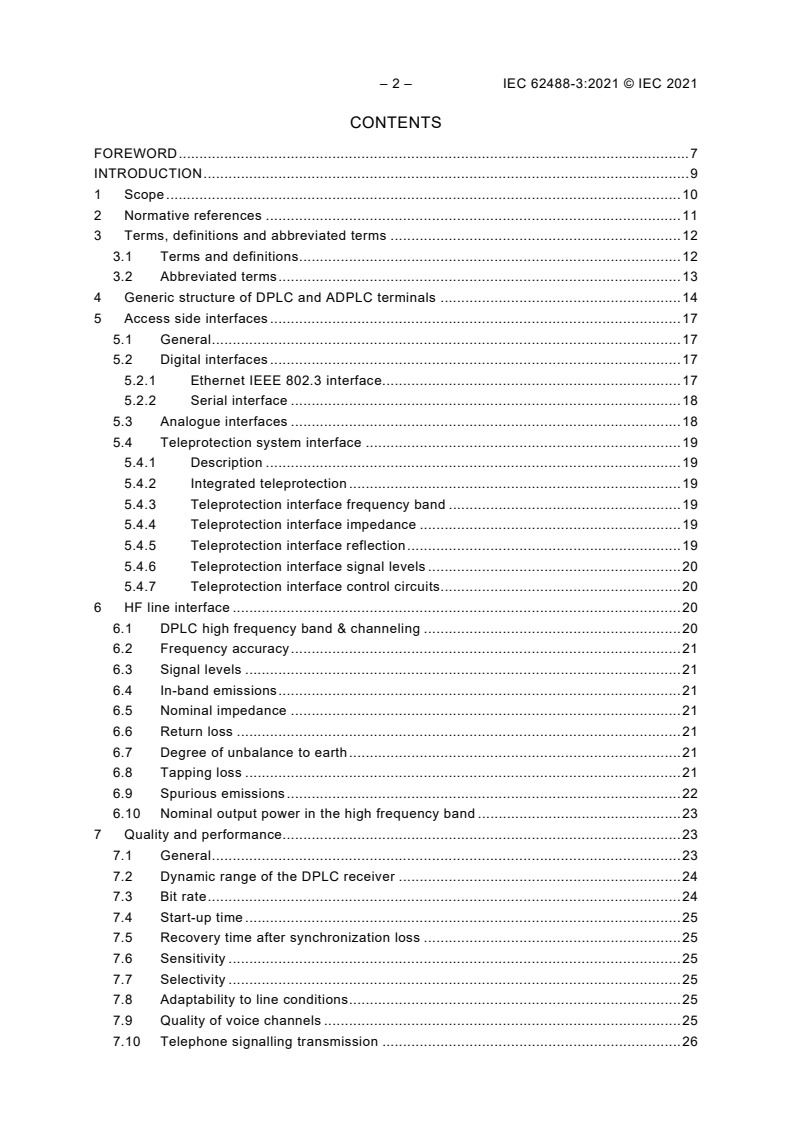
– 2 – IEC 62488-3:2021 © IEC 2021
CONTENTS
FOREWORD . 7
INTRODUCTION . 9
1 Scope . 10
2 Normative references . 11
3 Terms, definitions and abbreviated terms . 12
3.1 Terms and definitions . 12
3.2 Abbreviated terms . 13
4 Generic structure of DPLC and ADPLC terminals . 14
5 Access side interfaces . 17
5.1 General . 17
5.2 Digital interfaces . 17
5.2.1 Ethernet IEEE 802.3 interface. 17
5.2.2 Serial interface . 18
5.3 Analogue interfaces . 18
5.4 Teleprotection system interface . 19
5.4.1 Description . 19
5.4.2 Integrated teleprotection . 19
5.4.3 Teleprotection interface frequency band . 19
5.4.4 Teleprotection interface impedance . 19
5.4.5 Teleprotection interface reflection . 19
5.4.6 Teleprotection interface signal levels . 20
5.4.7 Teleprotection interface control circuits. 20
6 HF line interface . 20
6.1 DPLC high frequency band & channeling . 20
6.2 Frequency accuracy . 21
6.3 Signal levels . 21
6.4 In-band emissions . 21
6.5 Nominal impedance . 21
6.6 Return loss . 21
6.7 Degree of unbalance to earth . 21
6.8 Tapping loss . 21
6.9 Spurious emissions . 22
6.10 Nominal output power in the high frequency band . 23
7 Quality and performance. 23
7.1 General . 23
7.2 Dynamic range of the DPLC receiver . 24
7.3 Bit rate . 24
7.4 Start-up time . 25
7.5 Recovery time after synchronization loss . 25
7.6 Sensitivity . 25
7.7 Selectivity . 25
7.8 Adaptability to line conditions . 25
7.9 Quality of voice channels . 25
7.10 Telephone signalling transmission . 26
7.11 Quality on the serial DATA channels . 26
7.11.1 General . 26
7.11.2 Bit rate . 26
7.11.3 BER . 26
7.11.4 Nominal transmission link delay . 27
7.12 Quality of the frame transmission using Ethernet interfaces . 27
7.12.1 General . 27
7.12.2 LAN to LAN Speed . 27
7.12.3 LAN to LAN latency . 27
7.12.4 Packet loss on the LAN transfer . 27
8 Testing . 27
8.1 General . 27
8.2 Test setup for DPLC link tests . 28
8.3 Signal to noise ratio . 28
8.4 Return loss . 28
8.5 Degree of unbalance to earth . 30
8.5.1 General . 30
8.5.2 Longitudinal conversion loss . 30
8.5.3 Output signal balance . 31
8.6 Tapping loss . 31
8.7 Spurious and in-band emissions . 32
8.8 Selectivity . 33
8.9 Bit error rate . 35
8.10 Serial data transmission delay . 37
8.11 Dynamic range of the DPLC receiver . 38
8.12 LAN to LAN testing . 38
8.12.1 General . 38
8.12.2 Maximum LAN to LAN throughput . 39
8.12.3 LAN to LAN latency . 39
8.13 Start-up time . 39
8.14 Recovery time after synchronization loss . 39
9 Configuration and management . 40
9.1 General . 40
9.2 Configuration . 40
9.3 Network management system . 40
9.4 Local terminal alarms . 40
9.5 Event logging . 41
10 Cyber security . 41
10.1 General . 41
10.2 Transmitted payload . 41
10.3 Management interface . 41
10.3.1 General . 41
10.3.2 Legacy-style management interfaces / Manufacturer-specific
management interfaces . 42
10.3.3 LAN/WAN connected management interfaces . 42
10.3.4 Authentication and role-base model . 42
– 4 – IEC 62488-3:2021 © IEC 2021
10.4 Network management system interface . 42
10.5 Security-related event logging . 43
11 DPLC safety . 43
11.1 General . 43
11.2 Safety reference standard . 43
11.3 Classification of DPLC terminals . 43
11.4 Ingress protection . 44
11.5 Type and routine tests . 45
12 Storage and transportation, operating conditions, power supply. 47
12.1 Storage and transportation . 47
12.1.1 Climatic conditions . 47
12.1.2 Mechanical . 48
12.2 Operating conditions . 50
12.2.1 Climatic conditions . 50
12.2.2 Mechanical . 51
12.2.3 Operating conditions set of tests . 51
12.3 Power supply . 52
12.3.1 AC supply . 52
12.3.2 DC supply . 52
13 EMC . 53
13.1 Emission and immunity reference standards . 53
13.2 Emission . 53
13.2.1 Radiated and conducted emission . 53
13.2.2 Low frequency disturbance emission . 58
13.3 Immunity . 58
13.3.1 EMC environment . 58
13.3.2 Functional requirements . 60
13.3.3 Immunity test list . 60
Annex A (informative) HF modulated power signal for ADPLC . 63
A.1 General . 63
A.2 Computation model of ADPLC . 63
A.3 Distribution of E/U ratio of voice channels . 65
A.4 Distribution of E/U ratio of sinusoidal waves. 67
A.5 Example of E/U ratio of a digital signal . 68
A.6 Composite distribution of E/U ratios . 69
A.7 RMS power and load capacity of voice signals . 71
A.8 Comprehensive load capacity for ADPLC . 73
A.9 Simplified computation method for comprehensive load capacity . 74
Bibliography . 75
Figure 1 – Schematic representation of the elements needed to implement a PLC
system . 11
Figure 2 – Generic architecture of a DPLC terminal . 15
Figure 3 – Generic structure of an ADPLC terminal . 16
Figure 4 – ETH IEEE 802.3 RJ45 type connector . 17
Figure 5 – ETH IEEE 802.3 SC type connector . 18
Figure 6 – Tapping loss limits for DPLC terminals . 22
Figure 7 – Max level of spurious emissions outside the high frequency band . 23
Figure 8 – Reference points for measuring DPLC parameters . 24
Figure 9 – Block diagram of a serial data channel . 26
Figure 10 – Test circuit for return loss measurement . 29
Figure 11 – Test circuit for LCL measurement (transmission port) . 30
Figure 12 – Test circuit for OSB measurement (Rx port) . 31
Figure 13 – Test circuit for tapping loss measurement . 32
Figure 14 – Test circuit for spurious and in-band emissions measurement . 33
Figure 15 – Test circuit for selectivity measurement . 34
Figure 16 – Test circuit for bit error rate measurement . 36
Figure 17 – Test circuit for serial data transmission delay measurement with a data
tester . 37
Figure 18 – Test circuit for serial data transmission delay measurement . 37
Figure 19 – Test circuit for maximal throughput and latency measurement . 38
Figure 20 – LF disturbances measurement setup . 58
Figure A.1 – Calculation model of load capacity for ADPLC . 64
Figure A.2 – Cumulative distributions of E/U ratio of voice channels for positive half . 66
Figure A.3 – Probability density of combined sine waves . 67
Figure A.4 – Constellation diagram of 64 QAM . 68
Figure A.5 – Amplitude spectra of unmodulated OFDM sub-carriers . 68
Figure A.6 – Probability of constellation point power in 64 QAM . 69
Figure A.7 – Cumulative distribution of comprehensive E/U ratios . 70
Figure A.8 – Cumulative distribution of equivalent volume for N system channel . 72
Table 1 – Dependence of voice channel quality vs. DPLC capacity . 26
Table 2 – Basic insulation (Table C.6 of IEC 60255-27:2013) . 43
Table 3 – Double or reinforced insulation (Table C.10 of IEC 60255-27:2013) . 44
Table 4 – List of Type and Routine Tests (Table 12 of IEC 60255-27:2013) . 46
Table 5 – Classification of climatic conditions (Table 1 of IEC 60721-3-1:1997) . 47
Table 6 – Climatic tests for storage and transportation. 48
Table 7 – Classification of mechanical conditions for transportation (Table 5 of
IEC 60721-3-2:1997) . 49
Table 8 – Classification of climatic conditions from Table 1 of IEC 60721-3-3:2002 . 50
Table 9 – Classification of mechanical conditions from Table 6 of IEC 60721-3-3:2002 . 51
Table 10 – Climatic Tests . 51
Table 11 – Sinusoidal vibration test . 52
Table 12 – Non-repetitive shock test . 52
Table 13 – Emission – Enclosure port (Table 1 of IEC 61000-6-4:2011) . 54
Table 14 – Emission – Low voltage AC and DC mains port
(Table 2 of IEC 61000-6-4:2011) . 56
Table 15 – Emission – Telecommunications/network port
(Table 3 of IEC 61000-6-4:2011) . 57
Table 16 – Characterization of the electromagnetic phenomena
(Table 1 of IEC 61000-6-5:2015) . 59
Table 17 – Port classification . 59
– 6 – IEC 62488-3:2021 © IEC 2021
Table 18 – Performance criteria . 60
Table 19 – Immunity test list . 61
Table A.1 – Approximation formula for E/U cumulative distribution of speech . 66
Table A.2 – PDF of constellation point power in 64 QAM constellation diagram . 69
Table A.3 – Calculation of P (1 %) and load capacity . 73
RMS
INTERNATIONAL ELECTROTECHNICAL COMMISSION
____________
POWER LINE COMMUNICATION SYSTEMS
FOR POWER UTILITY APPLICATIONS –
Part 3: Digital Power Line Carrier (DPLC) Terminals
and hybrid ADPLC Terminals
FOREWORD
1) The International Electrotechnical Commission (IEC) is a worldwide organization for standardization comprising
all national electrotechnical committees (IEC National Committees). The object of IEC is to promote international
co-operation on all questions concerning standardization in the electrical and electronic fields. To this end and
in addition to other activities, IEC publishes International Standards, Technical Specifications, Technical Reports,
Publicly Available Specifications (PAS) and Guides (hereafter referred to as “IEC Publication(s)”). Their
preparation is entrusted to technical committees; any IEC National Committee interested in the subject dealt with
may participate in this preparatory work. International, governmental and non-governmental organizations liaising
with the IEC also participate in this preparation. IEC collaborates closely with the International Organization for
Standardization (ISO) in accordance with conditions determined by agreement between the two organizations.
2) The formal decisions or agreements of IEC on technical matters express, as nearly as possible, an international
consensus of opinion on the relevant subjects since each technical committee has representation from all
interested IEC National Committees.
3) IEC Publications have the form of recommendations for international use and are accepted by IEC National
Committees in that sense. While all reasonable efforts are made to ensure that the technical content of IEC
Publications is accurate, IEC cannot be held responsible for the way in which they are used or for any
misinterpretation by any end user.
4) In order to promote international uniformity, IEC National Committees undertake to apply IEC Publications
transparently to the maximum extent possible in their national and regional publications. Any divergence between
any IEC Publication and the corresponding national or regional publication shall be clearly indicated in the latter.
5) IEC itself does not provide any attestation of conformity. Independent certification bodies provide conformity
assessment services and, in some areas, access to IEC marks of conformity. IEC is not responsible for any
services carried out by independent certification bodies.
6) All users should ensure that they have the latest edition of this publication.
7) No liability shall attach to IEC or its directors, employees, servants or agents including individual experts and
members of its technical committees and IEC National Committees for any personal injury, property damage or
other damage of any nature whatsoever, whether direct or indirect, or for costs (including legal fees) and
expenses arising out of the publication, use of, or reliance upon, this IEC Publication or any other IEC Publications.
8) Attention is drawn to the normative references cited in this publication. Use of the referenced publications is
indispensable for the correct application of this publication.
9) Attention is drawn to the possibility that some of the elements of this IEC Publication may be the subject of patent
rights. IEC shall not be held responsible for identifying any or all such patent rights.
This International Standard has been prepared by IEC technical committee 57: Power systems
management and associated information exchange.
This first edition of IEC 62488-3 cancels and replaces the relevant parts of IEC TR 60663 and
IEC 60495, which will be withdrawn at a later date.
The text of this standard is based on the following documents:
FDIS Report on voting
57/2355/FDIS 57/2372/RVD
Full information on the voting for the approval of this standard can be found in the report on
voting indicated in the above table.
This publication has been drafted in accordance with the ISO/IEC Directives, Part 2.
– 8 – IEC 62488-3:2021 © IEC 2021
A list of all the parts in the IEC 62488 series, published under the general title Power line
communication systems for power utility applications can be found on the IEC website
The committee has decided that the contents of this publication will remain unchanged until the
stability date indicated on the IEC website under "http://webstore.iec.ch" in the data related to
the specific document. At this date, the document will be
• reconfirmed,
• withdrawn,
• replaced by a revised edition, or
• amended.
IMPORTANT – The 'colour inside' logo on the cover page of this publication indicates
that it contains colours which are considered to be useful for the correct understanding
of its contents. Users should therefore print this document using a colour printer.
INTRODUCTION
Since the first introduction of power line carrier communications in the power systems industry
this form of communication has become widely spread throughout the world. This worldwide
development will be covered by new standards reflecting the current state of the art in digital
PLC communications.
The communication services offered by modern digital power line carrier links and networks
enable a high efficiency of data transmission and therefore a low level of operational costs of
automation equipment especially for long high-voltage power transmission lines.
Analogue and digital PLC terminals may co-exist using principles of frequency division
multiplexing, allowing a successive digitalization of PLC based communications.
Digital PLC terminals may also be combined with traditional analogue PLC transmission paths
as hybrid analog & digital PLC equipment, offering reliable and seamless communication for
control and/or protection operating at extra high-, high- and medium-voltage levels of the
electrical transmission networks and at high-voltage electrical distribution networks.
IEC 62488 consists of four parts dealing with all aspects of power line communication systems
operating over electricity power lines.
IEC 62488 applies to power line carrier terminals and systems (PLC) used to transmit
information over power networks including extra high, high and medium voltage (EHV/HV/MV)
power lines.
Currently this standard series is organised as follows:
• IEC 62488-1, Planning of analogue and digital power line carrier systems operating over
EHV/HV/MV electricity grids
• IEC 62488-2, Analogue Power Line Carrier terminals or APLC
• IEC 62488-3, Digital Power Line Carrier terminals or DPLC and hybrid ADPLC Terminals
• IEC 62488-4, Broadband Power Line systems or BPL
NOTE IEC 62488-4 has not yet been published.
This document is the third part of IEC 62488 and is composed of the following Clauses:
• Clause 1 – Scope of IEC 62488-3
• Clause 2 – Normative references
• Clause 3 – Terms, definitions and abbreviation contains newly introduce in this document
additionally to IEC 62488-1 and IEC 62488-2
• Clause 4 – Introduces generic architectures of DPLC and hybrid ADPLC terminals.
• Clause 5 – Defines access side interfaces of DPLC and hybrid ADPLC terminals.
• Clause 6 – Describes transmission line side high frequency interface and defines related
parameters
• Clause 7 – Gives several requirements concerning quality and performance of a single or a
couple of interconnected DPLC terminals
• Clause 8 – Defines test setup and describes testing methodology
• Clause 9 – Describes configuration and management requirements for DPLC terminals
• Clause 10 – Describes general requirements regarding cyber security
• Clause 11 – Specifies safety requirements
• Clause 12 – Specifies requirements for storage and transportation, operating conditions,
power supply
• Clause 13 – Specifies EMC requirements
– 10 – IEC 62488-3:2021 © IEC 2021
POWER LINE COMMUNICATION SYSTEMS
FOR POWER UTILITY APPLICATIONS –
Part 3: Digital Power Line Carrier (DPLC) Terminals
and hybrid ADPLC Terminals
1 Scope
This part of IEC 62488 applies to power line carrier terminals and networks used to transmit
information over power networks including extra high, high and medium voltage (EHV/HV/MV)
power lines using both digital and optionally analogue modulation systems in a frequency range
between 16 kHz and 1 MHz (see also IEC 62488-1).
In many countries, power line carrier (PLC) channels represent a significant part of the utility-
owned telecommunication system. A circuit normally routed via a PLC channel can also be
routed via a channel using a different transmission medium such as point to point radio, optical
fibre or open wire circuit.
It is therefore important that the input and output interfaces that are used between terminals in
the communication system are standardised.
The issues requiring consideration of DPLC and/or APLC devices as parts of a
telecommunication network can be found in IEC 62488-1.
Figure 1 shows the correspondence between the elements needed to implement PLC systems
and the related International Standards.
Figure 1 – Schematic representation of the elements needed to implement a PLC system
The scope of this document also includes the description of I/O interfaces and test set-ups that
are necessary to qualify characteristics of DPLC or ADPLC terminal at link level.
2 Normative references
The following documents are referred to in the text in such a way that some or all of their content
constitutes requirements of this document. For dated references, only the edition cited applies.
For undated references, the latest edition of the referenced document (including any
amendments) applies.
IEC 60038, IEC standard voltages
IEC 60050-151:2001, International Electrotechnical Vocabulary (IEV) – Part 151: Electrical and
magnetic devices
IEC 60255-27:2013, Measuring relays and protection equipment – Part 27: Product safety
requirements
IEC 60529:1989, Degrees of protection provided by enclosures (IP Code)
IEC 61000-4-2, Electromagnetic compatibility (EMC) – Part 4-2: Testing and measurement
techniques – Electrostatic discharge immunity test
– 12 – IEC 62488-3:2021 © IEC 2021
IEC 61000-4-3, Electromagnetic compatibility (EMC) – Part 4-3: Testing and measurement
techniques – Radiated, radio-frequency, electromagnetic field immunity test
IEC 61000-4-4, Electromagnetic compatibility (EMC) – Part 4-4: Testing and measurement
techniques – Electrical fast transient/burst immunity test
IEC 61000-4-5, Electromagnetic compatibility (EMC) – Part 4-5: Testing and measurement
techniques – Surge immunity test
IEC 61000-6-2, Electromagnetic compatibility (EMC) – Part 6-2: Generic standards – Immunity
standard for industrial environments
IEC 60721-3-1:1997, Classification of environmental conditions – Part 3-1: Classification of
groups of environmental parameters and their severities – Storage
IEC 60721-3-3:2002, Classification of environmental conditions – Part 3: Classification of
groups of environmental parameters and their severities – Stationary use at weather protected
locations
IEC 60834-1:1999, Teleprotection equipment of power systems – Performance and testing –
Part 1: Command systems
IEC 61000-6-4:2018, Electromagnetic compatibility (EMC) – Part 6-4: Generic standards –
Emission standard for industrial environments
IEC 61000-6-5:2015, Electromagnetic compatibility (EMC) – Part 6-5: Generic standards –
Immunity for equipment used in power station and substation environment
IEC TS 62351-1:2007, Power systems management and associated information exchange –
Data and communications security – Part 1: Communication network and system security –
Introduction to security issues
IEC TS 62351-8:2011, Power systems management and associated information exchange –
Data and communications security – Part 8: Role-based access control
IEC 62488-1:2012, Power line communication systems for power utility applications – Part 1:
Planning of analogue and digital power line carrier systems operating over EHV/HV/MV
electricity grids
IEC 62488-2:2017, Power line communication systems for power utility applications – Part 2:
Analogue power line carrier terminals or APLC
CISPR 32:2015/AMD1:2019, Electromagnetic compatibility of multimedia equipment – Emission
requirements
3 Terms, definitions and abbreviated terms
3.1 Terms and definitions
For the purposes of this document, the terms and definitions given in IEC 62488-1, IEC 62488-2
and the following apply.
ISO and IEC maintain terminological databases for use in standardization at the following
addresses:
• IEC Electropedia: available at http://www.electropedia.org/
• ISO Online browsing platform: available at http://www.iso.org/obp
3.1.1
DPLC equipment
PLC equipment transmitting information such as digital data or digitized analog signals over the
power line using digital modulation techniques
3.1.2
HPLC
any combination of APLC, DPLC and BPLC elements in a single device
3.1.3
ADPLC
PLC equipment containing elements of APLC and DPLC. ADPLC is a sub-class of HPLC
3.1.4
nominal high frequency band for DPLC or HPLC
frequency band in which a particular DPLC or HPLC transmitter or receiver is operating within
the carrier frequency range
3.1.5
nominal output power in the high frequency band for DPLC or HPLC
output power of an DPLC or HPLC terminal in the nominal high frequency band (L )
nom
expressed as PEP for which the terminal has been designed, compatible with the requirements
for spurious emissions and inter-channel interference (for multi-channel PLC terminals),
available at the high frequency interface output across a resistive load equal to the nominal
impedance
3.2 Abbreviated terms
AC alternating current
AGC automatic gain control
APLC analogue PLC
ADPLC analogue and digital PLC
AWGN additive white Gaussian noise
BPLC broadband PLC
BLER block error rate
BER bit error rate
B nominal high frequency band for DPLC or HPLC
nom
CDF cumulative distribution function
CPF composite peak factor
DC direct current
DPLC digital PLC
DSP digital signal processing
HF high frequency
HPLC hybrid PLC
LAN local area network
LCL longitudinal conversion loss
– 14 – IEC 62488-3:2021 © IEC 2021
LED light-emitting diode
LF low frequency
L Output power of an DPLC or HPLC terminal in the nominal high frequency
nom
band
L Output power of an DPLC terminal in the nominal high frequency band
DPLC
MIB management information base
OFDM orthogonal frequency division multiplexing
OSB output signal balance
PEP peak envelope power
PDF probability density function
PLC power line carrier
QAM quadrature amplitude modulation
RMS root-mean-square
Rx receiver, receive
SNMP Simple Network Management Protocol
SNR signal-to-noise ratio
SSB single side band
TP twisted pair
Tx transmitter, transmit
UDP User Datagram Protocol
WAN wide area network
4 Generic structure of DPLC and ADPLC terminals
The generic structure describes the main building blocks of DPLC and ADPLC terminals. All
other building blocks which are necessary for proper functioning (e.g. power supply, device
control units) are not considered in Clause 4.
Figure 2 shows the block diagram of a DPLC terminal with the digital and analog interfaces on
the left side and the HF line interface on the right side. If only one interface is available, the
function of the time division multiplexer / demultiplexer and optional Ethernet switch may be
replaced by a simple direct connection to the digital PLC modem. The resulting pass band signal
is amplified and matched to the coupling device using the power line interface.
Figure 2 – Generic architecture of a DPLC terminal
Figure 3 shows the block diagram of an ADPLC terminal, which contains both a digital PLC
modem as well as an analogue SSB modem, compliant with IEC 62488-2, that shall be used to
convey signals coming from teleprotection or analogue I/O interfaces, with the digital and
analogue interfaces on the left side and the HF line interface on the right side. An ADPLC
terminal contains a digital PLC path, that was introduced above and shown in Figure 2, and
may contain a teleprotection path and/or an APLC path according to IEC 62488-2. The output
pass band signal of the digital PLC modem may be combined in the frequency domain with the
output pass band signals of the optional teleprotection and/or APLC paths. The resulting pass
band signal is amplified and matched to the coupling device using the power line interface.
– 16 – IEC 62488-3:2021 © IEC 2021
Figure 3 – Generic structure of an ADPLC terminal
NOTE Digital PLC modems use QAM-, OFDM-based digital modulation schemes or other types of digital modulation
methods. IEC 62488-1 contains more details.
For planning of a point-to-point DPLC links the manufacturer of the DPLC terminals shall specify
the following characteristic of the DPLC terminal:
• Set of transmission efficiency levels in bit/s/Hz under condition of equal bit-loading for all
used carriers in a transmission scheme (e. g. OFDM);
• A typical dependence of BER or BLER from SNR for each transmission efficiency level;
• Possible RMS output power of the DPLC terminal;
• Typical time delay of a point-to-point DPLC link.
• If applicable, a typical delay of the voice signal on interfaces B and/or V in a point-to-point
i
DPLC link.
5 Access side interfaces
5.1 General
Access side interfaces related to DPLC equipment are described in Clause 5.
5.2 Digital interfaces
5.2.1 Ethernet IEEE 802.3 interface
5.2.1.1 General
In some cases, it is required to interface DPLC links with local area networks in order to
implement switching or bridging functionalities.
This integrated interface often implements both the Ethernet 10/100BaseT (copper) as well as
100FX (optical) standard interfaces.
Ethernet frames are first serialized, elaborated and then transmitted through an internal
integrated high-speed data serial modem connected to the DPLC terminal.
5.2.1.2 Physical layer
For Ethernet interfaces, TP (twisted pair copper) or optical connectors are commonly used.
Possible examples of these connectors are given in Figure 4 and Figure 5.
Key
1 TX + 2 TX – 3 RX + 4 NC
5 NC 6 RX – 7 NC 8 NC
Figure 4 – ETH IEEE 802.3 RJ45 type connector
– 18 – IEC 62488-3:2021 © IEC 2021
Figure 5 – ETH IEEE 802.3 SC type connector
For the physical characteristics (voltage,
...
IEC 62488-3 ®
Edition 1.0 2021-04
INTERNATIONAL
STANDARD
NORME
INTERNATIONALE
colour
inside
Power line communication systems for power utility applications –
Part 3: Digital Power Line Carrier (DPLC) Terminals and hybrid ADPLC Terminals
Systèmes de communication sur lignes d'énergie pour les applications des
compagnies d'électricité –
Partie 3: Équipements terminaux à courants porteurs sur lignes d’énergie
numériques (DPLC) et équipements terminaux hybrides ADPLC
All rights reserved. Unless otherwise specified, no part of this publication may be reproduced or utilized in any form
or by any means, electronic or mechanical, including photocopying and microfilm, without permission in writing from
either IEC or IEC's member National Committee in the country of the requester. If you have any questions about IEC
copyright or have an enquiry about obtaining additional rights to this publication, please contact the address below or
your local IEC member National Committee for further information.
Droits de reproduction réservés. Sauf indication contraire, aucune partie de cette publication ne peut être reproduite
ni utilisée sous quelque forme que ce soit et par aucun procédé, électronique ou mécanique, y compris la photocopie
et les microfilms, sans l'accord écrit de l'IEC ou du Comité national de l'IEC du pays du demandeur. Si vous avez des
questions sur le copyright de l'IEC ou si vous désirez obtenir des droits supplémentaires sur cette publication, utilisez
les coordonnées ci-après ou contactez le Comité national de l'IEC de votre pays de résidence.
IEC Central Office Tel.: +41 22 919 02 11
3, rue de Varembé info@iec.ch
CH-1211 Geneva 20 www.iec.ch
Switzerland
About the IEC
The International Electrotechnical Commission (IEC) is the leading global organization that prepares and publishes
International Standards for all electrical, electronic and related technologies.
About IEC publications
The technical content of IEC publications is kept under constant review by the IEC. Please make sure that you have the
latest edition, a corrigendum or an amendment might have been published.
IEC publications search - webstore.iec.ch/advsearchform IEC online collection - oc.iec.ch
The advanced search enables to find IEC publications by a Discover our powerful search engine and read freely all the
variety of criteria (reference number, text, technical publications previews. With a subscription you will always
committee, …). It also gives information on projects, replaced have access to up to date content tailored to your needs.
and withdrawn publications.
Electropedia - www.electropedia.org
IEC Just Published - webstore.iec.ch/justpublished
The world's leading online dictionary on electrotechnology,
Stay up to date on all new IEC publications. Just Published
containing more than 22 000 terminological entries in English
details all new publications released. Available online and
and French, with equivalent terms in 18 additional languages.
once a month by email.
Also known as the International Electrotechnical Vocabulary
(IEV) online.
IEC Customer Service Centre - webstore.iec.ch/csc
If you wish to give us your feedback on this publication or
need further assistance, please contact the Customer Service
Centre: sales@iec.ch.
A propos de l'IEC
La Commission Electrotechnique Internationale (IEC) est la première organisation mondiale qui élabore et publie des
Normes internationales pour tout ce qui a trait à l'électricité, à l'électronique et aux technologies apparentées.
A propos des publications IEC
Le contenu technique des publications IEC est constamment revu. Veuillez vous assurer que vous possédez l’édition la
plus récente, un corrigendum ou amendement peut avoir été publié.
Recherche de publications IEC - IEC online collection - oc.iec.ch
webstore.iec.ch/advsearchform Découvrez notre puissant moteur de recherche et consultez
La recherche avancée permet de trouver des publications IEC gratuitement tous les aperçus des publications. Avec un
en utilisant différents critères (numéro de référence, texte, abonnement, vous aurez toujours accès à un contenu à jour
comité d’études, …). Elle donne aussi des informations sur adapté à vos besoins.
les projets et les publications remplacées ou retirées.
Electropedia - www.electropedia.org
IEC Just Published - webstore.iec.ch/justpublished
Le premier dictionnaire d'électrotechnologie en ligne au
Restez informé sur les nouvelles publications IEC. Just
monde, avec plus de 22 000 articles terminologiques en
Published détaille les nouvelles publications parues.
anglais et en français, ainsi que les termes équivalents dans
Disponible en ligne et une fois par mois par email.
16 langues additionnelles. Egalement appelé Vocabulaire
Electrotechnique International (IEV) en ligne.
Service Clients - webstore.iec.ch/csc
Si vous désirez nous donner des commentaires sur cette
publication ou si vous avez des questions contactez-nous:
sales@iec.ch.
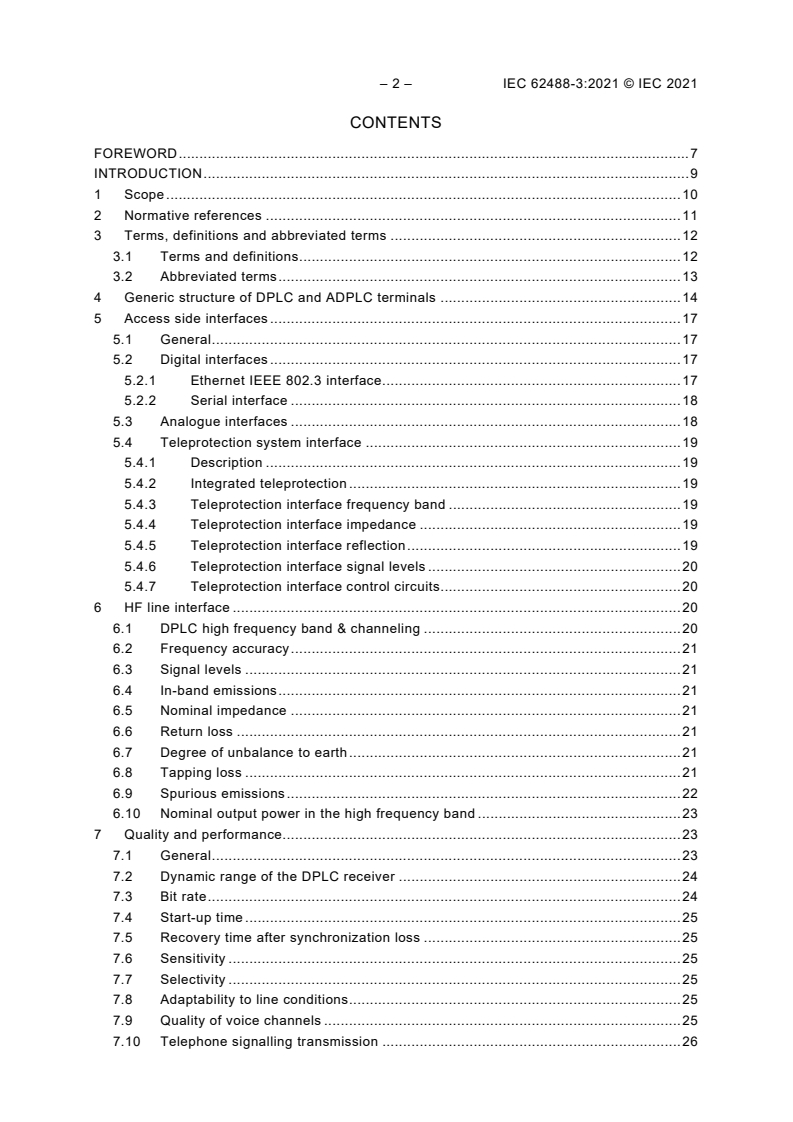
IEC 62488-3 ®
Edition 1.0 2021-04
INTERNATIONAL
STANDARD
NORME
INTERNATIONALE
colour
inside
Power line communication systems for power utility applications –
Part 3: Digital Power Line Carrier (DPLC) Terminals and hybrid ADPLC Terminals
Systèmes de communication sur lignes d'énergie pour les applications des
compagnies d'électricité –
Partie 3: Équipements terminaux à courants porteurs sur lignes d’énergie
numériques (DPLC) et équipements terminaux hybrides ADPLC
INTERNATIONAL
ELECTROTECHNICAL
COMMISSION
COMMISSION
ELECTROTECHNIQUE
INTERNATIONALE
ICS 33.200 ISBN 978-2-8322-1034-2
– 2 – IEC 62488-3:2021 © IEC 2021
CONTENTS
FOREWORD . 7
INTRODUCTION . 9
1 Scope . 10
2 Normative references . 11
3 Terms, definitions and abbreviated terms . 12
3.1 Terms and definitions . 12
3.2 Abbreviated terms . 13
4 Generic structure of DPLC and ADPLC terminals . 14
5 Access side interfaces . 17
5.1 General . 17
5.2 Digital interfaces . 17
5.2.1 Ethernet IEEE 802.3 interface. 17
5.2.2 Serial interface . 18
5.3 Analogue interfaces . 18
5.4 Teleprotection system interface . 19
5.4.1 Description . 19
5.4.2 Integrated teleprotection . 19
5.4.3 Teleprotection interface frequency band . 19
5.4.4 Teleprotection interface impedance . 19
5.4.5 Teleprotection interface reflection . 19
5.4.6 Teleprotection interface signal levels . 20
5.4.7 Teleprotection interface control circuits. 20
6 HF line interface . 20
6.1 DPLC high frequency band & channeling . 20
6.2 Frequency accuracy . 21
6.3 Signal levels . 21
6.4 In-band emissions . 21
6.5 Nominal impedance . 21
6.6 Return loss . 21
6.7 Degree of unbalance to earth . 21
6.8 Tapping loss . 21
6.9 Spurious emissions . 22
6.10 Nominal output power in the high frequency band . 23
7 Quality and performance. 23
7.1 General . 23
7.2 Dynamic range of the DPLC receiver . 24
7.3 Bit rate . 24
7.4 Start-up time . 25
7.5 Recovery time after synchronization loss . 25
7.6 Sensitivity . 25
7.7 Selectivity . 25
7.8 Adaptability to line conditions . 25
7.9 Quality of voice channels . 25
7.10 Telephone signalling transmission . 26
7.11 Quality on the serial DATA channels . 26
7.11.1 General . 26
7.11.2 Bit rate . 26
7.11.3 BER . 26
7.11.4 Nominal transmission link delay . 27
7.12 Quality of the frame transmission using Ethernet interfaces . 27
7.12.1 General . 27
7.12.2 LAN to LAN Speed . 27
7.12.3 LAN to LAN latency . 27
7.12.4 Packet loss on the LAN transfer . 27
8 Testing . 27
8.1 General . 27
8.2 Test setup for DPLC link tests . 28
8.3 Signal to noise ratio . 28
8.4 Return loss . 28
8.5 Degree of unbalance to earth . 30
8.5.1 General . 30
8.5.2 Longitudinal conversion loss . 30
8.5.3 Output signal balance . 31
8.6 Tapping loss . 31
8.7 Spurious and in-band emissions . 32
8.8 Selectivity . 33
8.9 Bit error rate . 35
8.10 Serial data transmission delay . 37
8.11 Dynamic range of the DPLC receiver . 38
8.12 LAN to LAN testing . 38
8.12.1 General . 38
8.12.2 Maximum LAN to LAN throughput . 39
8.12.3 LAN to LAN latency . 39
8.13 Start-up time . 39
8.14 Recovery time after synchronization loss . 39
9 Configuration and management . 40
9.1 General . 40
9.2 Configuration . 40
9.3 Network management system . 40
9.4 Local terminal alarms . 40
9.5 Event logging . 41
10 Cyber security . 41
10.1 General . 41
10.2 Transmitted payload . 41
10.3 Management interface . 41
10.3.1 General . 41
10.3.2 Legacy-style management interfaces / Manufacturer-specific
management interfaces . 42
10.3.3 LAN/WAN connected management interfaces . 42
10.3.4 Authentication and role-base model . 42
– 4 – IEC 62488-3:2021 © IEC 2021
10.4 Network management system interface . 42
10.5 Security-related event logging . 43
11 DPLC safety . 43
11.1 General . 43
11.2 Safety reference standard . 43
11.3 Classification of DPLC terminals . 43
11.4 Ingress protection . 44
11.5 Type and routine tests . 45
12 Storage and transportation, operating conditions, power supply. 47
12.1 Storage and transportation . 47
12.1.1 Climatic conditions . 47
12.1.2 Mechanical . 48
12.2 Operating conditions . 50
12.2.1 Climatic conditions . 50
12.2.2 Mechanical . 51
12.2.3 Operating conditions set of tests . 51
12.3 Power supply . 52
12.3.1 AC supply . 52
12.3.2 DC supply . 52
13 EMC . 53
13.1 Emission and immunity reference standards . 53
13.2 Emission . 53
13.2.1 Radiated and conducted emission . 53
13.2.2 Low frequency disturbance emission . 58
13.3 Immunity . 58
13.3.1 EMC environment . 58
13.3.2 Functional requirements . 60
13.3.3 Immunity test list . 60
Annex A (informative) HF modulated power signal for ADPLC . 63
A.1 General . 63
A.2 Computation model of ADPLC . 63
A.3 Distribution of E/U ratio of voice channels . 65
A.4 Distribution of E/U ratio of sinusoidal waves. 67
A.5 Example of E/U ratio of a digital signal . 68
A.6 Composite distribution of E/U ratios . 69
A.7 RMS power and load capacity of voice signals . 71
A.8 Comprehensive load capacity for ADPLC . 73
A.9 Simplified computation method for comprehensive load capacity . 74
Bibliography . 75
Figure 1 – Schematic representation of the elements needed to implement a PLC
system . 11
Figure 2 – Generic architecture of a DPLC terminal . 15
Figure 3 – Generic structure of an ADPLC terminal . 16
Figure 4 – ETH IEEE 802.3 RJ45 type connector . 17
Figure 5 – ETH IEEE 802.3 SC type connector . 18
Figure 6 – Tapping loss limits for DPLC terminals . 22
Figure 7 – Max level of spurious emissions outside the high frequency band . 23
Figure 8 – Reference points for measuring DPLC parameters . 24
Figure 9 – Block diagram of a serial data channel . 26
Figure 10 – Test circuit for return loss measurement . 29
Figure 11 – Test circuit for LCL measurement (transmission port) . 30
Figure 12 – Test circuit for OSB measurement (Rx port) . 31
Figure 13 – Test circuit for tapping loss measurement . 32
Figure 14 – Test circuit for spurious and in-band emissions measurement . 33
Figure 15 – Test circuit for selectivity measurement . 34
Figure 16 – Test circuit for bit error rate measurement . 36
Figure 17 – Test circuit for serial data transmission delay measurement with a data
tester . 37
Figure 18 – Test circuit for serial data transmission delay measurement . 37
Figure 19 – Test circuit for maximal throughput and latency measurement . 38
Figure 20 – LF disturbances measurement setup . 58
Figure A.1 – Calculation model of load capacity for ADPLC . 64
Figure A.2 – Cumulative distributions of E/U ratio of voice channels for positive half . 66
Figure A.3 – Probability density of combined sine waves . 67
Figure A.4 – Constellation diagram of 64 QAM . 68
Figure A.5 – Amplitude spectra of unmodulated OFDM sub-carriers . 68
Figure A.6 – Probability of constellation point power in 64 QAM . 69
Figure A.7 – Cumulative distribution of comprehensive E/U ratios . 70
Figure A.8 – Cumulative distribution of equivalent volume for N system channel . 72
Table 1 – Dependence of voice channel quality vs. DPLC capacity . 26
Table 2 – Basic insulation (Table C.6 of IEC 60255-27:2013) . 43
Table 3 – Double or reinforced insulation (Table C.10 of IEC 60255-27:2013) . 44
Table 4 – List of Type and Routine Tests (Table 12 of IEC 60255-27:2013) . 46
Table 5 – Classification of climatic conditions (Table 1 of IEC 60721-3-1:1997) . 47
Table 6 – Climatic tests for storage and transportation. 48
Table 7 – Classification of mechanical conditions for transportation (Table 5 of
IEC 60721-3-2:1997) . 49
Table 8 – Classification of climatic conditions from Table 1 of IEC 60721-3-3:2002 . 50
Table 9 – Classification of mechanical conditions from Table 6 of IEC 60721-3-3:2002 . 51
Table 10 – Climatic Tests . 51
Table 11 – Sinusoidal vibration test . 52
Table 12 – Non-repetitive shock test . 52
Table 13 – Emission – Enclosure port (Table 1 of IEC 61000-6-4:2011) . 54
Table 14 – Emission – Low voltage AC and DC mains port
(Table 2 of IEC 61000-6-4:2011) . 56
Table 15 – Emission – Telecommunications/network port
(Table 3 of IEC 61000-6-4:2011) . 57
Table 16 – Characterization of the electromagnetic phenomena
(Table 1 of IEC 61000-6-5:2015) . 59
Table 17 – Port classification . 59
– 6 – IEC 62488-3:2021 © IEC 2021
Table 18 – Performance criteria . 60
Table 19 – Immunity test list . 61
Table A.1 – Approximation formula for E/U cumulative distribution of speech . 66
Table A.2 – PDF of constellation point power in 64 QAM constellation diagram . 69
Table A.3 – Calculation of P (1 %) and load capacity . 73
RMS
INTERNATIONAL ELECTROTECHNICAL COMMISSION
____________
POWER LINE COMMUNICATION SYSTEMS
FOR POWER UTILITY APPLICATIONS –
Part 3: Digital Power Line Carrier (DPLC) Terminals
and hybrid ADPLC Terminals
FOREWORD
1) The International Electrotechnical Commission (IEC) is a worldwide organization for standardization comprising
all national electrotechnical committees (IEC National Committees). The object of IEC is to promote international
co-operation on all questions concerning standardization in the electrical and electronic fields. To this end and
in addition to other activities, IEC publishes International Standards, Technical Specifications, Technical Reports,
Publicly Available Specifications (PAS) and Guides (hereafter referred to as “IEC Publication(s)”). Their
preparation is entrusted to technical committees; any IEC National Committee interested in the subject dealt with
may participate in this preparatory work. International, governmental and non-governmental organizations liaising
with the IEC also participate in this preparation. IEC collaborates closely with the International Organization for
Standardization (ISO) in accordance with conditions determined by agreement between the two organizations.
2) The formal decisions or agreements of IEC on technical matters express, as nearly as possible, an international
consensus of opinion on the relevant subjects since each technical committee has representation from all
interested IEC National Committees.
3) IEC Publications have the form of recommendations for international use and are accepted by IEC National
Committees in that sense. While all reasonable efforts are made to ensure that the technical content of IEC
Publications is accurate, IEC cannot be held responsible for the way in which they are used or for any
misinterpretation by any end user.
4) In order to promote international uniformity, IEC National Committees undertake to apply IEC Publications
transparently to the maximum extent possible in their national and regional publications. Any divergence between
any IEC Publication and the corresponding national or regional publication shall be clearly indicated in the latter.
5) IEC itself does not provide any attestation of conformity. Independent certification bodies provide conformity
assessment services and, in some areas, access to IEC marks of conformity. IEC is not responsible for any
services carried out by independent certification bodies.
6) All users should ensure that they have the latest edition of this publication.
7) No liability shall attach to IEC or its directors, employees, servants or agents including individual experts and
members of its technical committees and IEC National Committees for any personal injury, property damage or
other damage of any nature whatsoever, whether direct or indirect, or for costs (including legal fees) and
expenses arising out of the publication, use of, or reliance upon, this IEC Publication or any other IEC Publications.
8) Attention is drawn to the normative references cited in this publication. Use of the referenced publications is
indispensable for the correct application of this publication.
9) Attention is drawn to the possibility that some of the elements of this IEC Publication may be the subject of patent
rights. IEC shall not be held responsible for identifying any or all such patent rights.
This International Standard has been prepared by IEC technical committee 57: Power systems
management and associated information exchange.
This first edition of IEC 62488-3 cancels and replaces the relevant parts of IEC TR 60663 and
IEC 60495, which will be withdrawn at a later date.
The text of this standard is based on the following documents:
FDIS Report on voting
57/2355/FDIS 57/2372/RVD
Full information on the voting for the approval of this standard can be found in the report on
voting indicated in the above table.
This publication has been drafted in accordance with the ISO/IEC Directives, Part 2.
– 8 – IEC 62488-3:2021 © IEC 2021
A list of all the parts in the IEC 62488 series, published under the general title Power line
communication systems for power utility applications can be found on the IEC website
The committee has decided that the contents of this publication will remain unchanged until the
stability date indicated on the IEC website under "http://webstore.iec.ch" in the data related to
the specific document. At this date, the document will be
• reconfirmed,
• withdrawn,
• replaced by a revised edition, or
• amended.
IMPORTANT – The 'colour inside' logo on the cover page of this publication indicates
that it contains colours which are considered to be useful for the correct understanding
of its contents. Users should therefore print this document using a colour printer.
INTRODUCTION
Since the first introduction of power line carrier communications in the power systems industry
this form of communication has become widely spread throughout the world. This worldwide
development will be covered by new standards reflecting the current state of the art in digital
PLC communications.
The communication services offered by modern digital power line carrier links and networks
enable a high efficiency of data transmission and therefore a low level of operational costs of
automation equipment especially for long high-voltage power transmission lines.
Analogue and digital PLC terminals may co-exist using principles of frequency division
multiplexing, allowing a successive digitalization of PLC based communications.
Digital PLC terminals may also be combined with traditional analogue PLC transmission paths
as hybrid analog & digital PLC equipment, offering reliable and seamless communication for
control and/or protection operating at extra high-, high- and medium-voltage levels of the
electrical transmission networks and at high-voltage electrical distribution networks.
IEC 62488 consists of four parts dealing with all aspects of power line communication systems
operating over electricity power lines.
IEC 62488 applies to power line carrier terminals and systems (PLC) used to transmit
information over power networks including extra high, high and medium voltage (EHV/HV/MV)
power lines.
Currently this standard series is organised as follows:
• IEC 62488-1, Planning of analogue and digital power line carrier systems operating over
EHV/HV/MV electricity grids
• IEC 62488-2, Analogue Power Line Carrier terminals or APLC
• IEC 62488-3, Digital Power Line Carrier terminals or DPLC and hybrid ADPLC Terminals
• IEC 62488-4, Broadband Power Line systems or BPL
NOTE IEC 62488-4 has not yet been published.
This document is the third part of IEC 62488 and is composed of the following Clauses:
• Clause 1 – Scope of IEC 62488-3
• Clause 2 – Normative references
• Clause 3 – Terms, definitions and abbreviation contains newly introduce in this document
additionally to IEC 62488-1 and IEC 62488-2
• Clause 4 – Introduces generic architectures of DPLC and hybrid ADPLC terminals.
• Clause 5 – Defines access side interfaces of DPLC and hybrid ADPLC terminals.
• Clause 6 – Describes transmission line side high frequency interface and defines related
parameters
• Clause 7 – Gives several requirements concerning quality and performance of a single or a
couple of interconnected DPLC terminals
• Clause 8 – Defines test setup and describes testing methodology
• Clause 9 – Describes configuration and management requirements for DPLC terminals
• Clause 10 – Describes general requirements regarding cyber security
• Clause 11 – Specifies safety requirements
• Clause 12 – Specifies requirements for storage and transportation, operating conditions,
power supply
• Clause 13 – Specifies EMC requirements
– 10 – IEC 62488-3:2021 © IEC 2021
POWER LINE COMMUNICATION SYSTEMS
FOR POWER UTILITY APPLICATIONS –
Part 3: Digital Power Line Carrier (DPLC) Terminals
and hybrid ADPLC Terminals
1 Scope
This part of IEC 62488 applies to power line carrier terminals and networks used to transmit
information over power networks including extra high, high and medium voltage (EHV/HV/MV)
power lines using both digital and optionally analogue modulation systems in a frequency range
between 16 kHz and 1 MHz (see also IEC 62488-1).
In many countries, power line carrier (PLC) channels represent a significant part of the utility-
owned telecommunication system. A circuit normally routed via a PLC channel can also be
routed via a channel using a different transmission medium such as point to point radio, optical
fibre or open wire circuit.
It is therefore important that the input and output interfaces that are used between terminals in
the communication system are standardised.
The issues requiring consideration of DPLC and/or APLC devices as parts of a
telecommunication network can be found in IEC 62488-1.
Figure 1 shows the correspondence between the elements needed to implement PLC systems
and the related International Standards.
Figure 1 – Schematic representation of the elements needed to implement a PLC system
The scope of this document also includes the description of I/O interfaces and test set-ups that
are necessary to qualify characteristics of DPLC or ADPLC terminal at link level.
2 Normative references
The following documents are referred to in the text in such a way that some or all of their content
constitutes requirements of this document. For dated references, only the edition cited applies.
For undated references, the latest edition of the referenced document (including any
amendments) applies.
IEC 60038, IEC standard voltages
IEC 60050-151:2001, International Electrotechnical Vocabulary (IEV) – Part 151: Electrical and
magnetic devices
IEC 60255-27:2013, Measuring relays and protection equipment – Part 27: Product safety
requirements
IEC 60529:1989, Degrees of protection provided by enclosures (IP Code)
IEC 61000-4-2, Electromagnetic compatibility (EMC) – Part 4-2: Testing and measurement
techniques – Electrostatic discharge immunity test
– 12 – IEC 62488-3:2021 © IEC 2021
IEC 61000-4-3, Electromagnetic compatibility (EMC) – Part 4-3: Testing and measurement
techniques – Radiated, radio-frequency, electromagnetic field immunity test
IEC 61000-4-4, Electromagnetic compatibility (EMC) – Part 4-4: Testing and measurement
techniques – Electrical fast transient/burst immunity test
IEC 61000-4-5, Electromagnetic compatibility (EMC) – Part 4-5: Testing and measurement
techniques – Surge immunity test
IEC 61000-6-2, Electromagnetic compatibility (EMC) – Part 6-2: Generic standards – Immunity
standard for industrial environments
IEC 60721-3-1:1997, Classification of environmental conditions – Part 3-1: Classification of
groups of environmental parameters and their severities – Storage
IEC 60721-3-3:2002, Classification of environmental conditions – Part 3: Classification of
groups of environmental parameters and their severities – Stationary use at weather protected
locations
IEC 60834-1:1999, Teleprotection equipment of power systems – Performance and testing –
Part 1: Command systems
IEC 61000-6-4:2018, Electromagnetic compatibility (EMC) – Part 6-4: Generic standards –
Emission standard for industrial environments
IEC 61000-6-5:2015, Electromagnetic compatibility (EMC) – Part 6-5: Generic standards –
Immunity for equipment used in power station and substation environment
IEC TS 62351-1:2007, Power systems management and associated information exchange –
Data and communications security – Part 1: Communication network and system security –
Introduction to security issues
IEC TS 62351-8:2011, Power systems management and associated information exchange –
Data and communications security – Part 8: Role-based access control
IEC 62488-1:2012, Power line communication systems for power utility applications – Part 1:
Planning of analogue and digital power line carrier systems operating over EHV/HV/MV
electricity grids
IEC 62488-2:2017, Power line communication systems for power utility applications – Part 2:
Analogue power line carrier terminals or APLC
CISPR 32:2015/AMD1:2019, Electromagnetic compatibility of multimedia equipment – Emission
requirements
3 Terms, definitions and abbreviated terms
3.1 Terms and definitions
For the purposes of this document, the terms and definitions given in IEC 62488-1, IEC 62488-2
and the following apply.
ISO and IEC maintain terminological databases for use in standardization at the following
addresses:
• IEC Electropedia: available at http://www.electropedia.org/
• ISO Online browsing platform: available at http://www.iso.org/obp
3.1.1
DPLC equipment
PLC equipment transmitting information such as digital data or digitized analog signals over the
power line using digital modulation techniques
3.1.2
HPLC
any combination of APLC, DPLC and BPLC elements in a single device
3.1.3
ADPLC
PLC equipment containing elements of APLC and DPLC. ADPLC is a sub-class of HPLC
3.1.4
nominal high frequency band for DPLC or HPLC
frequency band in which a particular DPLC or HPLC transmitter or receiver is operating within
the carrier frequency range
3.1.5
nominal output power in the high frequency band for DPLC or HPLC
output power of an DPLC or HPLC terminal in the nominal high frequency band (L )
nom
expressed as PEP for which the terminal has been designed, compatible with the requirements
for spurious emissions and inter-channel interference (for multi-channel PLC terminals),
available at the high frequency interface output across a resistive load equal to the nominal
impedance
3.2 Abbreviated terms
AC alternating current
AGC automatic gain control
APLC analogue PLC
ADPLC analogue and digital PLC
AWGN additive white Gaussian noise
BPLC broadband PLC
BLER block error rate
BER bit error rate
B nominal high frequency band for DPLC or HPLC
nom
CDF cumulative distribution function
CPF composite peak factor
DC direct current
DPLC digital PLC
DSP digital signal processing
HF high frequency
HPLC hybrid PLC
LAN local area network
LCL longitudinal conversion loss
– 14 – IEC 62488-3:2021 © IEC 2021
LED light-emitting diode
LF low frequency
L Output power of an DPLC or HPLC terminal in the nominal high frequency
nom
band
L Output power of an DPLC terminal in the nominal high frequency band
DPLC
MIB management information base
OFDM orthogonal frequency division multiplexing
OSB output signal balance
PEP peak envelope power
PDF probability density function
PLC power line carrier
QAM quadrature amplitude modulation
RMS root-mean-square
Rx receiver, receive
SNMP Simple Network Management Protocol
SNR signal-to-noise ratio
SSB single side band
TP twisted pair
Tx transmitter, transmit
UDP User Datagram Protocol
WAN wide area network
4 Generic structure of DPLC and ADPLC terminals
The generic structure describes the main building blocks of DPLC and ADPLC terminals. All
other building blocks which are necessary for proper functioning (e.g. power supply, device
control units) are not considered in Clause 4.
Figure 2 shows the block diagram of a DPLC terminal with the digital and analog interfaces on
the left side and the HF line interface on the right side. If only one interface is available, the
function of the time division multiplexer / demultiplexer and optional Ethernet switch may be
replaced by a simple direct connection to the digital PLC modem. The resulting pass band signal
is amplified and matched to the coupling device using the power line interface.
...