

IEC TS 62351-100-3:2020
(Main)Power systems management and associated information exchange - Data and communications security - Part 100-3: Conformance test cases for the IEC 62351-3, the secure communication extension for profiles including TCP/IP
General Information
- Abstract
IEC 62351-100-3:2020, which is a technical specification, describes test cases of data and communication security for telecontrol equipment, Substation Automation Systems [SAS] and telecontrol systems, including front-end functions of SCADA.
The goal of this document is to enable interoperability by providing a standard method of testing protocol implementations to verify that a device fulfils the requirement of IEC 62351-3. Note that conformity to IEC 62351-3 does not guarantee interoperability between devices using different implementations. It is expected that using this specification during testing will minimize the risk of non-interoperability. A basic condition for this interoperability is a passed conformance test of both devices.
The scope of this document is the specification of common available procedures and definitions for conformance and/or interoperability testing to ensure conformity to IEC 62351-3. The conformance test cases defined here are focused to verify the conformant integration of the underlying authentication/encryption protocol (TLS), as specified in IEC 62351-3, to protect TCP/IP based communications.
This document is not intended to test the underlying authentication/encryption protocol required by IEC 62351-3 to be implemented over TCP/IP (TLS). The conformance testing of the authentication/encryption protocol over TCP/IP is outside the scope of this document.
This document deals with data and communication security conformance testing; therefore, other requirements, such as safety or EMC are not covered. These requirements are covered by other standards (if applicable) and the proof of compliance for these topics is done according to these standards.
- Status
- Published
- Publication Date
- 09-Jan-2020
- Technical Committee
- TC 57 - Power systems management and associated information exchange
- Drafting Committee
- WG 15 - TC 57/WG 15
- Current Stage
- PPUB - Publication issued
- Start Date
- 10-Jan-2020
- Completion Date
- 23-Dec-2019
Buy Documents
IEC TS 62351-100-3:2020 - Power systems management and associated information exchange - Data and communications security - Part 100-3: Conformance test cases for the IEC 62351-3, the secure communication extension for profiles including TCP/IP Released:1/10/2020
Overview
IEC TS 62351-100-3:2020 is a technical specification developed by the International Electrotechnical Commission (IEC) focused on ensuring data and communications security in power systems management. This document describes standardized conformance test cases for verifying secure communication implementations according to IEC 62351-3, particularly for TCP/IP-based profiles. The primary aim is to promote interoperability and security for telecontrol equipment, Substation Automation Systems (SAS), and SCADA front-end systems by providing a consistent framework for conformance and interoperability testing.
By following IEC TS 62351-100-3, organizations can systematically ensure their devices implement the IEC 62351-3 security requirements, which address authentication, encryption, and communication integrity for critical infrastructure in the energy sector.
Key Topics
- Scope of Testing: The specification outlines structured test procedures to assess whether telecontrol and automation system devices meet the data and communications security requirements of IEC 62351-3. Safety and EMC aspects fall outside the scope of this document and are handled by other standards.
- Interoperability Assurance: While conformance to IEC 62351-3 does not guarantee interoperability among all devices, application of this specification reduces the risk of non-interoperability by standardizing the testing process for both client and server device types.
- Testing Framework:
- Configuration Parameter Verification: Testing includes verification of parameters like TCP/IP port usage, supported TLS versions, cipher suites, certificate revocation checks, and session renegotiation intervals.
- Normal Procedure and Resiliency Testing: Devices must pass both normal operating conditions and error-handling scenarios, covering session establishment, mutual authentication, certificate validation, and protocol response to faults.
- Test Logging and Reporting: Comprehensive logging of communication events, security status, and certificate checks is required for robust test result analysis.
- Testing Context: Test execution must be performed within the context of relevant application protocols in real-world configurations, ensuring tests reflect actual operational scenarios.
Applications
Organizations deploying telecontrol equipment, substation automation, and SCADA systems-especially vendors, utilities, and testing laboratories-benefit from adopting IEC TS 62351-100-3 as it:
- Ensures Security Compliance: Validates correct integration of authentication and encryption protocols (TLS) to protect critical infrastructure communications over TCP/IP.
- Supports Procurement and Acceptance: Provides utilities and operators with clear conformance criteria for evaluating products during procurement, commissioning, or periodic security assessments.
- Facilitates Type Testing and Certification: Standardized conformance criteria support independent testing, certification, and market acceptance for equipment suppliers.
- Mitigates Interoperability Issues: By applying common test procedures and configuration parameter verifications, the risk of integration problems between multi-vendor devices is minimized.
Key industries and settings include:
- Electrical utilities and energy suppliers
- Manufacturers of substation automation or teleprotection equipment
- Independent testing laboratories and certification bodies
- Cybersecurity compliance auditors in critical infrastructure
Related Standards
To ensure robust power systems security, IEC TS 62351-100-3 is used in conjunction with other standards, such as:
- IEC 62351-3: Specifies security requirements and mechanisms (e.g., TLS) for communications networks in power system management, forming the base for conformance testing.
- IEC TS 62351-2: Provides a glossary of terms and abbreviations essential for understanding security-related concepts across IEC 62351 standards.
- IEC 62351-8: Addresses Role-Based Access Control (RBAC) extensions for enhanced certificate profile testing.
- IEC 62351-9: Specifies certificate management for power system communications.
- Relevant Application Protocol Standards: Protocol standards referencing IEC 62351-3 for secure data exchange.
Implementing IEC TS 62351-100-3 as part of a security testing program helps organizations demonstrate due diligence and commitment to international best practices in securing electrical power systems and associated information exchange.
Buy Documents
IEC TS 62351-100-3:2020 - Power systems management and associated information exchange - Data and communications security - Part 100-3: Conformance test cases for the IEC 62351-3, the secure communication extension for profiles including TCP/IP Released:1/10/2020
Get Certified
Connect with accredited certification bodies for this standard

ANCE
Mexican certification and testing association.

Intertek Slovenia
Intertek testing, inspection, and certification services in Slovenia.

LNE (Laboratoire National de Métrologie et d'Essais)
French national laboratory for metrology and testing.
Sponsored listings
Frequently Asked Questions
IEC TS 62351-100-3:2020 is a technical specification published by the International Electrotechnical Commission (IEC). Its full title is "Power systems management and associated information exchange - Data and communications security - Part 100-3: Conformance test cases for the IEC 62351-3, the secure communication extension for profiles including TCP/IP". This standard covers: IEC 62351-100-3:2020, which is a technical specification, describes test cases of data and communication security for telecontrol equipment, Substation Automation Systems [SAS] and telecontrol systems, including front-end functions of SCADA. The goal of this document is to enable interoperability by providing a standard method of testing protocol implementations to verify that a device fulfils the requirement of IEC 62351-3. Note that conformity to IEC 62351-3 does not guarantee interoperability between devices using different implementations. It is expected that using this specification during testing will minimize the risk of non-interoperability. A basic condition for this interoperability is a passed conformance test of both devices. The scope of this document is the specification of common available procedures and definitions for conformance and/or interoperability testing to ensure conformity to IEC 62351-3. The conformance test cases defined here are focused to verify the conformant integration of the underlying authentication/encryption protocol (TLS), as specified in IEC 62351-3, to protect TCP/IP based communications. This document is not intended to test the underlying authentication/encryption protocol required by IEC 62351-3 to be implemented over TCP/IP (TLS). The conformance testing of the authentication/encryption protocol over TCP/IP is outside the scope of this document. This document deals with data and communication security conformance testing; therefore, other requirements, such as safety or EMC are not covered. These requirements are covered by other standards (if applicable) and the proof of compliance for these topics is done according to these standards.
IEC 62351-100-3:2020, which is a technical specification, describes test cases of data and communication security for telecontrol equipment, Substation Automation Systems [SAS] and telecontrol systems, including front-end functions of SCADA. The goal of this document is to enable interoperability by providing a standard method of testing protocol implementations to verify that a device fulfils the requirement of IEC 62351-3. Note that conformity to IEC 62351-3 does not guarantee interoperability between devices using different implementations. It is expected that using this specification during testing will minimize the risk of non-interoperability. A basic condition for this interoperability is a passed conformance test of both devices. The scope of this document is the specification of common available procedures and definitions for conformance and/or interoperability testing to ensure conformity to IEC 62351-3. The conformance test cases defined here are focused to verify the conformant integration of the underlying authentication/encryption protocol (TLS), as specified in IEC 62351-3, to protect TCP/IP based communications. This document is not intended to test the underlying authentication/encryption protocol required by IEC 62351-3 to be implemented over TCP/IP (TLS). The conformance testing of the authentication/encryption protocol over TCP/IP is outside the scope of this document. This document deals with data and communication security conformance testing; therefore, other requirements, such as safety or EMC are not covered. These requirements are covered by other standards (if applicable) and the proof of compliance for these topics is done according to these standards.
IEC TS 62351-100-3:2020 is classified under the following ICS (International Classification for Standards) categories: 33.200 - Telecontrol. Telemetering. The ICS classification helps identify the subject area and facilitates finding related standards.
IEC TS 62351-100-3:2020 is available in PDF format for immediate download after purchase. The document can be added to your cart and obtained through the secure checkout process. Digital delivery ensures instant access to the complete standard document.
Standards Content (Sample)
IEC TS 62351-100-3 ®
Edition 1.0 2020-01
TECHNICAL
SPECIFICATION
colour
inside
Power systems management and associated information exchange – Data and
communications security –
Part 100-3: Conformance test cases for IEC 62351-3, the secure communication
extension for profiles including TCP/IP
All rights reserved. Unless otherwise specified, no part of this publication may be reproduced or utilized in any form
or by any means, electronic or mechanical, including photocopying and microfilm, without permission in writing from
either IEC or IEC's member National Committee in the country of the requester. If you have any questions about IEC
copyright or have an enquiry about obtaining additional rights to this publication, please contact the address below or
your local IEC member National Committee for further information.
IEC Central Office Tel.: +41 22 919 02 11
3, rue de Varembé info@iec.ch
CH-1211 Geneva 20 www.iec.ch
Switzerland
About the IEC
The International Electrotechnical Commission (IEC) is the leading global organization that prepares and publishes
International Standards for all electrical, electronic and related technologies.
About IEC publications
The technical content of IEC publications is kept under constant review by the IEC. Please make sure that you have the
latest edition, a corrigendum or an amendment might have been published.
IEC publications search - webstore.iec.ch/advsearchform Electropedia - www.electropedia.org
The advanced search enables to find IEC publications by a The world's leading online dictionary on electrotechnology,
variety of criteria (reference number, text, technical containing more than 22 000 terminological entries in English
committee,…). It also gives information on projects, replaced and French, with equivalent terms in 16 additional languages.
and withdrawn publications. Also known as the International Electrotechnical Vocabulary
(IEV) online.
IEC Just Published - webstore.iec.ch/justpublished
Stay up to date on all new IEC publications. Just Published IEC Glossary - std.iec.ch/glossary
details all new publications released. Available online and 67 000 electrotechnical terminology entries in English and
once a month by email. French extracted from the Terms and Definitions clause of
IEC publications issued since 2002. Some entries have been
IEC Customer Service Centre - webstore.iec.ch/csc collected from earlier publications of IEC TC 37, 77, 86 and
If you wish to give us your feedback on this publication or CISPR.
need further assistance, please contact the Customer Service
Centre: sales@iec.ch.
IEC TS 62351-100-3 ®
Edition 1.0 2020-01
TECHNICAL
SPECIFICATION
colour
inside
Power systems management and associated information exchange – Data and
communications security –
Part 100-3: Conformance test cases for IEC 62351-3, the secure communication
extension for profiles including TCP/IP
INTERNATIONAL
ELECTROTECHNICAL
COMMISSION
ICS 33.200 ISBN 978-2-8322-7644-0
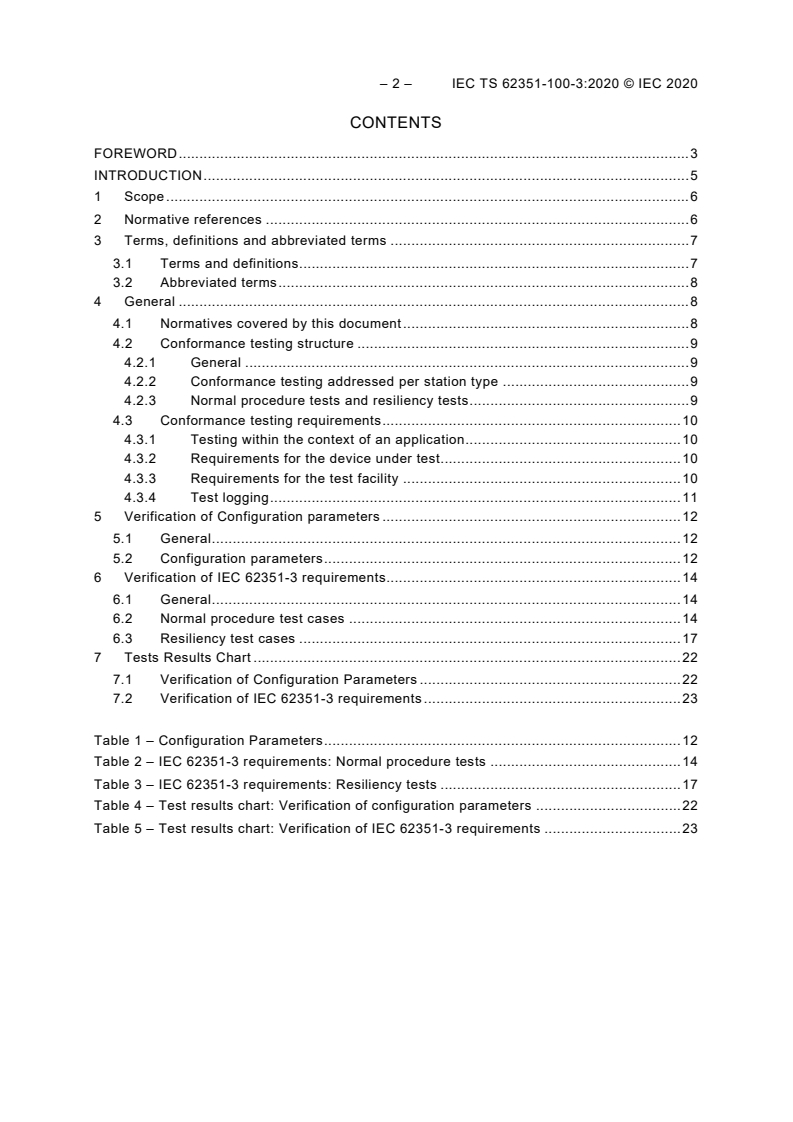
– 2 – IEC TS 62351-100-3:2020 © IEC 2020
CONTENTS
FOREWORD . 3
INTRODUCTION . 5
1 Scope . 6
2 Normative references . 6
3 Terms, definitions and abbreviated terms . 7
3.1 Terms and definitions . 7
3.2 Abbreviated terms . 8
4 General . 8
4.1 Normatives covered by this document . 8
4.2 Conformance testing structure . 9
4.2.1 General . 9
4.2.2 Conformance testing addressed per station type . 9
4.2.3 Normal procedure tests and resiliency tests . 9
4.3 Conformance testing requirements . 10
4.3.1 Testing within the context of an application . 10
4.3.2 Requirements for the device under test. 10
4.3.3 Requirements for the test facility . 10
4.3.4 Test logging . 11
5 Verification of Configuration parameters . 12
5.1 General . 12
5.2 Configuration parameters . 12
6 Verification of IEC 62351-3 requirements. 14
6.1 General . 14
6.2 Normal procedure test cases . 14
6.3 Resiliency test cases . 17
7 Tests Results Chart . 22
7.1 Verification of Configuration Parameters . 22
7.2 Verification of IEC 62351-3 requirements . 23
Table 1 – Configuration Parameters . 12
Table 2 – IEC 62351-3 requirements: Normal procedure tests . 14
Table 3 – IEC 62351-3 requirements: Resiliency tests . 17
Table 4 – Test results chart: Verification of configuration parameters . 22
Table 5 – Test results chart: Verification of IEC 62351-3 requirements . 23
INTERNATIONAL ELECTROTECHNICAL COMMISSION
____________
POWER SYSTEMS MANAGEMENT AND ASSOCIATED INFORMATION
EXCHANGE – DATA AND COMMUNICATIONS SECURITY –
Part 100-3: Conformance test cases for IEC 62351-3, the secure
communication extension for profiles including TCP/IP
FOREWORD
1) The International Electrotechnical Commission (IEC) is a worldwide organization for standardization comprising
all national electrotechnical committees (IEC National Committees). The object of IEC is to promote
international co-operation on all questions concerning standardization in the electrical and electronic fields. To
this end and in addition to other activities, IEC publishes International Standards, Technical Specifications,
Technical Reports, Publicly Available Specifications (PAS) and Guides (hereafter referred to as “IEC
Publication(s)”). Their preparation is entrusted to technical committees; any IEC National Committee interested
in the subject dealt with may participate in this preparatory work. International, governmental and non-
governmental organizations liaising with the IEC also participate in this preparation. IEC collaborates closely
with the International Organization for Standardization (ISO) in accordance with conditions determined by
agreement between the two organizations.
2) The formal decisions or agreements of IEC on technical matters express, as nearly as possible, an international
consensus of opinion on the relevant subjects since each technical committee has representation from all
interested IEC National Committees.
3) IEC Publications have the form of recommendations for international use and are accepted by IEC National
Committees in that sense. While all reasonable efforts are made to ensure that the technical content of IEC
Publications is accurate, IEC cannot be held responsible for the way in which they are used or for any
misinterpretation by any end user.
4) In order to promote international uniformity, IEC National Committees undertake to apply IEC Publications
transparently to the maximum extent possible in their national and regional publications. Any divergence
between any IEC Publication and the corresponding national or regional publication shall be clearly indicated in
the latter.
5) IEC itself does not provide any attestation of conformity. Independent certification bodies provide conformity
assessment services and, in some areas, access to IEC marks of conformity. IEC is not responsible for any
services carried out by independent certification bodies.
6) All users should ensure that they have the latest edition of this publication.
7) No liability shall attach to IEC or its directors, employees, servants or agents including individual experts and
members of its technical committees and IEC National Committees for any personal injury, property damage or
other damage of any nature whatsoever, whether direct or indirect, or for costs (including legal fees) and
expenses arising out of the publication, use of, or reliance upon, this IEC Publication or any other IEC
Publications.
8) Attention is drawn to the Normative references cited in this publication. Use of the referenced publications is
indispensable for the correct application of this publication.
9) Attention is drawn to the possibility that some of the elements of this IEC Publication may be the subject of
patent rights. IEC shall not be held responsible for identifying any or all such patent rights.
The main task of IEC technical committees is to prepare International Standards. In
exceptional circumstances, a technical committee may propose the publication of a technical
specification when
• the required support cannot be obtained for the publication of an International Standard,
despite repeated efforts, or
• the subject is still under technical development or where, for any other reason, there is the
future but no immediate possibility of an agreement on an International Standard.
Technical specifications are subject to review within three years of publication to decide
whether they can be transformed into International Standards.
IEC TS 62351-100-3, which is a technical specification, has been prepared by IEC technical
committee 57: Power systems management and associated information exchange.
– 4 – IEC TS 62351-100-3:2020 © IEC 2020
The text of this technical specification is based on the following documents:
Enquiry draft Report on voting
57/2090/DTS 57/2130/RVDTS
Full information on the voting for the approval of this technical specification can be found in
the report on voting indicated in the above table.
This document has been drafted in accordance with the ISO/IEC Directives, Part 2.
This document is to be read in conjunction with IEC 62351-3:2014, IEC 62351-3/AMD1:2018
and IEC 62351-3/AMD2:2020.
A list of all parts in the IEC 62351 series, published under the general title Power systems
management and associated information exchange – Data and communications security, can
be found on the IEC website.
The committee has decided that the contents of this document will remain unchanged until the
stability date indicated on the IEC website under "http://webstore.iec.ch" in the data related to
the specific document. At this date, the document will be
• reconfirmed,
• withdrawn,
• replaced by a revised edition, or
• amended.
IMPORTANT – The 'colour inside' logo on the cover page of this publication indicates
that it contains colours which are considered to be useful for the correct
understanding of its contents. Users should therefore print this document using a
colour printer.
INTRODUCTION
This technical specification describes test cases for conformance testing of telecontrol
equipment or systems integrating the IEC 62351-3 security extension for profiles including
TCP/IP.
– 6 – IEC TS 62351-100-3:2020 © IEC 2020
POWER SYSTEMS MANAGEMENT AND ASSOCIATED INFORMATION
EXCHANGE – DATA AND COMMUNICATIONS SECURITY –
Part 100-3: Conformance test cases for IEC 62351-3, the secure
communication extension for profiles including TCP/IP
1 Scope
This part of IEC 62351, which is a technical specification, describes test cases of data and
communication security for telecontrol equipment, Substation Automation Systems [SAS] and
telecontrol systems, including front-end functions of SCADA.
The goal of this document is to enable interoperability by providing a standard method of
testing protocol implementations to verify that a device fulfils the requirement of IEC 62351-3.
Note that conformity to IEC 62351-3 does not guarantee interoperability between devices
using different implementations. It is expected that using this specification during testing will
minimize the risk of non-interoperability. A basic condition for this interoperability is a passed
conformance test of both devices.
The scope of this document is the specification of common available procedures and
definitions for conformance and/or interoperability testing to ensure conformity to
IEC 62351-3. The conformance test cases defined here are focused to verify the conformant
integration of the underlying authentication/encryption protocol (TLS), as specified in
IEC 62351-3, to protect TCP/IP based communications.
This document is not intended to test the underlying authentication/encryption protocol
required by IEC 62351-3 to be implemented over TCP/IP (TLS). The conformance testing of
the authentication/encryption protocol over TCP/IP is outside the scope of this document.
This document deals with data and communication security conformance testing; therefore,
other requirements, such as safety or EMC are not covered. These requirements are covered
by other standards (if applicable) and the proof of compliance for these topics is done
according to these standards.
2 Normative references
The following documents are referred to in the text in such a way that some or all of their
content constitutes requirements of this document. For dated references, only the edition
cited applies. For undated references, the latest edition of the referenced document (including
any amendments) applies.
IEC TS 62351-2:2008, Power systems management and associated information exchange -
Data and communications security - Part 2: Glossary of terms
IEC 62351-3:2014, Power systems management and associated information exchange – Data
and communications security – Part 3: Communication network and system security – Profiles
—————————
The base standard always takes precedence. In case of ambiguity between this technical specification and the
base standards (IEC 62351-3), this part of IEC 62351 needs to be clarified or amended.
When testing, negative behavior is not described in the base standard, the behavior described in this document
prevails and should be observed. The conformance statement produced after testing indicates any lack of
conformance to either the test plan or the base standard.
including TCP/IP
IEC 62351-3:2014/AMD1:2018, IEC 62351-3:2014/AMD2:2019
3 Terms, definitions and abbreviated terms
For the purposes of this document, the terms and definitions given in IEC TS 62351-2 and the
following apply.
ISO and IEC maintain terminological databases for use in standardization at the following
addresses:
• IEC Electropedia: available at http://www.electropedia.org/
• ISO Online browsing platform: available at http://www.iso.org/obp
3.1 Terms and definitions
3.1.1
client
device receiving or requesting services or information from server devices
Note 1 to entry: In some specifications, a device is commonly called "controlling station" or "master" or "master
station".
3.1.2
interoperability
ability of two or more telecontrol devices from the same vendor, or different vendors, to
exchange information and use that information for correct cooperation
3.1.3
Message Authentication Code (MAC)
calculated value used by a receiving station to authenticate and check the integrity of an
information
3.1.4
normal procedure tests
set of test cases to verify that the device fulfils the requirements of IEC 62351-3 in the
expected (normal) conditions
3.1.5
Protocol Implementation Conformance Statement (PICS)
summary of the referencing standard capabilities of the system to be tested
3.1.6
Protocol Implementation Document (PID)
document which describes complete functionalities and system specific information
Note 1 to entry: The PID consists of the PICS and the PIXIT.
3.1.7
protocol Implementation eXtra Information for Testing (PIXIT)
system specific information contained in the PIXIT document regarding the capabilities of the
system to be tested, which specifies which items are optional
3.1.8
resiliency tests
set of test cases to verify that the device fulfils the requirements of IEC 62351-3 in reacting to
the unexpected (error) conditions
– 8 – IEC TS 62351-100-3:2020 © IEC 2020
3.1.9
server
device that provides information or services to client devices
Note 1 to entry: In some specifications, a server is commonly called "controlled station" or "outstation" or "slave".
3.1.10
test equipment
all tools and instruments which simulate and verify the communication traffic, inputs and/or
outputs of the system under test
3.1.11
test initiator
party initiating a conformance test of a device that is executed by a test facility
3.1.12
test facility
supplier-independent organization which is able to provide appropriate test equipment and
trained staff for conformance testing
3.2 Abbreviated terms
Refer to IEC 62351-2 for a list of applicable abbreviated terms. The abbreviations listed below
are included here because they are specific to IEC 62351-3 and they may be useful for
reading this document as an independent document.
CRL Certificate Revocation List
DUT Device Under Test
IP Inter-Networking Protocol
MAC Message Authentication Code
OCSP Online Certificate Status Protocol
PICS Protocol Implementation Conformance Statement
PID Protocol Implementation Document (=PICS + PIXIT)
PIXIT Protocol Implementation eXtra Information for Testing
SAS Substation Automation System
SCADA Supervisory Control And Data Acquisition
TCP Transport Control Protocol
4 General
4.1 Normatives covered by this document
This document defines the conformance test cases for the requirements defined in
IEC 62351-3:2014, IEC 62351-3:2014/AMD1:2018, IEC 62351-3:2014/AMD2:2019 and the
parts of the series requiring conformance to IEC 62351-3.
In addition to the test cases described in this document there are further test cases necessary
for TLS base protocol RFC as well as test cases depending on the content provided in the
certificates. An example may be the RBAC extension specified in IEC 62351-8 or certificate
profiles defined in IEC 62351-9.
4.2 Conformance testing structure
4.2.1 General
IEC 62351-3 defines the requirements related to the authentication/encryption protocol,
procedures and methods to be implemented at TCP/IP (transport) level.
The conformance test cases are divided into three clauses:
• Clause 5: Verification of configuration parameters. This clause contains the parameters
specified by the standards referencing IEC 62351-3 (see IEC 62351-3:2014/AMD1:2018,
Clause 7) and affecting the protocol behavior.
• Clause 6: Verification of IEC 62351-3 requirements. The goal of this clause is to verify that
DUT is conformant to the requirements of the IEC 62351-3.
• Clause 7: Test result chart. This clause contains the results of the test cases listed in
Clause 6 for each supported value of the configuration parameters listed in Clause 5.
The test cases are organized in tables. They are numbered, their numbering syntax is:
Subclause number (where the table is located) + test case number.
In the column ‘Reference’ each test case has a direct reference to IEC 62351-3 where the
clause under test is defined. PICS or PIXIT could be found in the “Reference” column for
some test cases whenever the execution of the test case shall take into account specific
parameter values declared in the PICS or PIXIT of the DUT.
Test cases are mandatory depending on the description in the column ‘Required’. The
following situations are possible:
M = Mandatory test case. The test is referencing to a clause that is mandatory in
IEC 62351-3.
PICS
or
PIXIT = Mandatory test case if the functionality is enabled in the PICS or PIXIT by marking
the applicable check box or declaring the applicable value.
4.2.2 Conformance testing addressed per station type
The test cases in Clause 6 to verify the requirements defined in IEC 62351-3 are addressed
per station type (client and server).
4.2.3 Normal procedure tests and resiliency tests
IEC 62351-3 specifies how each station (client and server) shall execute the procedures in
normal conditions (expected behavior) and also how it shall behave when unexpected or fault
events occur during their execution (negative behaviors). So, for each procedure in Clause 6
the test cases are also divided in two sections: the normal procedures test cases addressing
the expected behaviors and the resiliency test cases addressing unexpected or fault events.
Normal Procedure tests and Resiliency tests shall be performed according to the parameters
values supported by the DUT as defined in Clause 6, declared in the PICS and in the PIXIT of
the DUT.
All the tests defined in this technical specification shall be executed for client stations and
server stations unless otherwise specified in the test cases.
– 10 – IEC TS 62351-100-3:2020 © IEC 2020
4.3 Conformance testing requirements
4.3.1 Testing within the context of an application
The test cases listed in this document shall be executed within the context of an application.
The DUT claiming conformance to IEC 62351-3 shall execute an application protocol defined
in a standard requiring conformance to IEC 62351-3.
4.3.2 Requirements for the device under test
The entity submitting the device for testing shall provide the following:
a) The device ready for testing;
b) The Protocol Implementation Document (PID);
c) Instruction manuals detailing the installation and operation of the device or assistance for
operating the DUT during the test.
A device is ready for testing when the following requisites are satisfied:
d) The DUT is able to operate as a client or server station according to the PID (depending
on the type of DUT).
e) The DUT must be fully configured according to the PID and shall be able to execute all the
functionality of the protocol implementation as described in the PID.
f) The functionality described in the PID related to data points such as parameter loading,
read procedure, command transmission, etc. is implemented with a representative sub-set
of data points.
g) Verification of the data points shall be possible in a human readable way or format, and
the verification of analogue and digital status changes is possible.
4.3.3 Requirements for the test facility
The following requirements shall be satisfied by the test facility:
The documentation provided with the DUT shall be inspected for correctness and
completeness. Also, the software and hardware versions of the DUT shall be verified.
• Conformance testing shall be customized for the DUT based on the capabilities identified
in the PID (=PICS+PIXIT). Upon this customization, the test facility shall communicate
what the tailored test plan will cover.
• The test cases listed in Clauses 5 and 6 shall be performed with no errors detected during
testing.
• The test cases in Clause 6 should be performed in the order listed and the steps in each
test case shall be followed, which means that the DUT is able to function as described in
the specific test case.
• For each test case listed in Clauses 5 and 6 the test results need to be marked in the
appropriate column of the test result chart in Clause 7. Each test case can either pass
(Passed), or fail (Failed), or be not applicable (NA) when the configuration value is not
supported by the device, or the test case cannot be performed (Empty). Ideally, there
should be no empty boxes when the conformance testing is completed.
• Release a conformance test report of the DUT to the test initiator.
All test cases listed in Clause 7 should be verified automatically by a testing software or
verified manually by review of the test history log after execution of the test procedures. The
simulator is preferably flexible in adding or changing test cases in order to be adaptable to
changes in the protocol standard and the PID provided with the DUT. In all cases, the test
shall be reproducible over time by test engineers in the test facility.
In operational use, the device may show communication and/or behavior errors, which forces
the supplier to reproduce the complete conformance test (for example for verification
afterwards) or for reproducing only the tests that were shown to have errors.
The test focuses only on the protocol elements and functions as described in the PID; the test
does not include the application logic and the operation of the tested system.
4.3.4 Test logging
During the execution of conformance testing the following information should be logged by the
DUT in a readable format for test results analysis:
• communication events (first handshake, session renegotiation, session resumption);
• certificate check results (e.g. valid, expired, revoked, invalid key length, invalid signature);
• change cipher result (e.g. unsupported).
• The security events raised by the DUT (defined in IEC 62351-3) whenever a negative
behavior occurs while performing resiliency tests.
If the specific test logging defined herein and IEC 62351-3 is not supported by the DUT, the
DUT shall provide the means by which the tester can verify the proper execution of the test
cases.
– 12 – IEC TS 62351-100-3:2020 © IEC 2020
5 Verification of Configuration parameters
5.1 General
The scope of this clause is to verify the configuration of all the parameters that affect security extension procedures and protocol behavior so that
the whole or part of conformance testing shall be executed (and the tests result chart in Clause 7 shall be filled accordingly) for each value of these
parameters as indicated in 5.2. Basically, the DUT must be tested to verify that the whole functionality and behavior are correct according to the
configuration(s) defined in Table 1.
5.2 Configuration parameters
Table 1 – Configuration Parameters
No. Test Definition Reference Required
5.2.1 Station Type Client, Server PICS M
All conformance tests listed in Clause 6 shall be performed for each station type supported.
5.2.2 TCP IP Port to be All conformance tests listed in Clause 6 shall be performed for the value of this parameter. IEC 62351-3:2014, Clause 7 M
used for secure
PICS
communication
5.2.3 TLS Versions TLS protocol versions supported. IEC 62351-3:2014, 5.2 M
PICS, PIXIT
All conformance tests listed in Clause 6 shall be performed for each value (mandatory and optional)
supported in this parameter.
5.2.4 TLS Cipher Suites Set of cipher suites supported in TLS protocol. IEC 62351-3:2014, Clause 7 M
PICS, PIXIT
All conformance tests listed in Clause 6 shall be performed at least for the minimum mandatory value
supported in this parameter.
5.2.5 Public Key Lengths Public Key lengths supported in certificate signing and TLS session key exchange. IEC 62351-3:2014, 5.6.4.6 M
IEC 62351-3:2014, 5.6.4.7
PIXIT
All conformance tests listed in Clause 6 shall be performed at least for the minimum mandatory value
supported in this parameter.
No. Test Definition Reference Required
5.2.6 Certificates Methods to verify the Certificate Revocation Status (CRL/OCSP). IEC 62351-3:2014, 5.6.4.4 M
Revocation Check
PIXIT
methods
All conformance tests listed in Clause 6 shall be performed for each value supported in this
parameter.
5.2.7 Certificate Revocation Configured interval for Certificate Revocation check. IEC 62351-3:2014, 5.6.4.4 M
Check Interval
NOTE During conformance testing, to facilitate the execution of the test cases involving this IEC 62351-3:2014, Clause 7
parameter, this value can be decreased.
PIXIT
All conformance tests listed in Clause 6 shall be performed at least for the minimum mandatory value
supported in this parameter.
5.2.8 TLS Session Configured interval for Session Renegotiation IEC 62351-3:2014, 5.4 M
Renegotiation Interval
NOTE During conformance testing, to facilitate the execution of the test cases involving this IEC 62351-3:2014, Clause 7
parameter, this value can be decreased.
PIXIT
All conformance tests listed in Clause 6 shall be performed at least for the minimum mandatory value
supported in this parameter.
TLS Session
5.2.9 Configured interval for Session Resumption IEC 62351-3:2014, 5.3 M
Resumption Interval
Note: During conformance testing, to facilitate the execution of the test cases involved by this IEC 62351-3:2014, Clause 7
parameter, this value can be decreased.
PIXIT
All conformance tests listed in Clause 6 shall be performed at least for the minimum mandatory value
supported in this parameter.
5.2.10 Number of CA Recommended minimum number of Certification Authority supported IEC 62351-3:2014, 5.6 M
supported
IEC 62351-3:2014, Clause 7
PIXIT
All conformance tests listed in Clause 6 shall be performed at least for the minimum mandatory value
supported in this parameter.
5.2.11 Maximum certificate Maximum public key certificate size supported IEC 62351-3:2014, 5.6.2 M
size
IEC 62351-3:2014, Clause 7
PIXIT
All conformance tests listed in Clause 6 shall be performed for the maximum mandatory value
supported in this parameter
– 14 – IEC TS 62351-100-3:2020 © IEC 2020
6 Verification of IEC 62351-3 requirements
6.1 General
This clause defines the conformance test procedure to be performed to verify that the DUT correctly implements the requirements defined in the
IEC 62351-3. To proceed with the execution of conformance tests listed in this clause, a valid PKI certificate for TLS shall be pre-installed on the
DUT.
6.2 Normal procedure test cases
Table 2 describes the normal procedures test cases to verify the behavior of the DUT in normal (expected) conditions.
Table 2 – IEC 62351-3 requirements: Normal procedure tests
No. Test Reference Required
6.2.1 The DUT (Client only) initiates the TCP/IP connection to the Server using remote station TCP/IP port specified for secure IEC 62351-3:2014, Clause 7 M
communication.
PICS
6.2.2 The DUT (Server only) accepts the TCP/IP connection on TCP/IP port specified for secure communication. IEC 62351-3:2014, Clause 7 M
PICS
6.2.3 The DUT (Client only) performs the Initial TLS Handshake upon the connection is established and no previous TLS Session IEC 62351-3:2014, 5.4 M
was established.
6.2.4 The DUT (Server only) performs Session Renegotiation at the configured interval for Session Renegotiation, in an ongoing IEC 62351-3:2014, 5.4 M
TLS Session by sending the HelloRequest to the client.
IEC 62351-3:2014, Clause 7
PICS
6.2.5 If the DUT (Client only) does not receive a TLS session renegotiation request (HelloRequest) from the Server at the expected IEC 62351-3:2014, 5.4 M
interval, the DUT initiates the TLS session renegotiation by sending the ClientHello to the Server.
IEC 62351-3:2014, Clause 7
PICS
6.2.6 If CRL certificate check method is used, at least one TLS renegotiation is synchronized with (performed immediately after) IEC 62351-3:2014, 5.4 PIXIT
the CRL update.
IEC 62351-3:2014, Clause 7
(see Note 1)
6.2.7 If OCSP certificate check method is supported, the TLS Session Renegotiation is performed at the Configured interval for IEC 62351-3:2014, 5.4 PICS
Certificate Revocation check.
IEC 62351-3:2014, Clause 7
No. Test Reference Required
6.2.8 The DUT supports at least minimum number of root CAs (has the corresponding number of root CA certificates installed IEC 62351-3:2014, 5.6.1 M
locally).
IEC 62351-3:2014, Clause 7
PICS
6.2.9 The DUT accepts any Remote Station certificate from one or more authorized CA locally configured, after successful IEC 62351-3:2014, 5.6.4.2 M
validation.
PICS
6.2.10 The DUT accepts one or more specific Remote Station certificate (locally configured) from one or more authorized CA (locally IEC 62351-3:2014, 5.6.4.3 M
configured).
PICS
6.2.11 During the initial handshake IEC 62351-3:2014, 5.6.1 PICS
the DUT (Client only) provides the Trusted CA Indication in the ClientHello message. IEC 62351-3:2014, Clause 7
6.2.12 During the initial handshake, IEC 62351-3:2014, 5.6.1 PICS
the DUT (Server only), in the Server Certificate message, provides a certificate selected from the Certificate Chain specified IEC 62351-3:2014, Clause 7
in the Trusted CA Indication of the last ClientHello message received.
6.2.13 During the initial handshake, IEC 62351-3:2014, 5.6.3 M
the DUT performs Mutual Authentication with the Remote Station.
6.2.14 During the initial handshake, IEC 62351-3:2014, 5.5 M
the Message Authentication Code (MAC) option, with the specific algorithm indicated in the cipher suites selected, is
supported.
6.2.15 During the initial handshake, IEC 62351-3:2014, 5.4 M
the TLS Session Extension defined in RFC5746 is supported.
6.2.16 During the initial handshake, IEC 62351-3:2014, 5.6.2 M
the DUT accept remote certificates having size limited to the maximum certificate size supported. IEC 62351-3:2014, Clause 7
6.2.17 During the initial handshake, IEC 62351-3:2014, 5.6.4.4 PIXIT
the process of accessing the CRL to check the status of the received certificate, does not cause the established TCP/IP (see Note 1)
connection or the initial handshake to be terminated, if the received certificate is valid.
6.2.18 During the initial handshake, IEC 62351-3:2014, 5.6.4.4 PICS
the process of accessing the OCSP responder to check the status of the received certificate, does not cause the established
TCP/IP connection or the initial handshake to be terminated, if the received certificate is valid.
6.2.19 During the session renegotiation, IEC 62351-3:2014, 5.6.1 PICS
the DUT (Client only) provides the Trusted CA Indication in the ClientHello message. IEC 62351-3:2014, Clause 7
– 16 – IEC TS 62351-100-3:2020 © IEC 2020
No. Test Reference Required
6.2.20 During the session renegotiation, IEC 62351-3:2014, 5.6.1 PICS
the DUT (Server only), in the Server Certificate message, provides a certificate selected from the Certificate Chain specified
in the Trusted CA Indication of the last ClientHello message received.
6.2.21 During the session renegotiation, IEC 62351-3:2014, 5.6.3 M
the DUT performs Mutual Authentication with the Remote Station.
6.2.22 During the session renegotiation, IEC 62351-3:2014, 5.5 M
the Message Authentication Code (MAC) option, with the specific algorithm indicated in the cipher suites selected, is
supported.
6.2.23 During the session renegotiation, IEC 62351-3:2014, 5.4 M
the TLS Session Extension defined in RFC5746 is supported.
6.2.24 During the session renegotiation, IEC 62351-3:2014 5.6.2 M
The DUT accept remote certificates having size limited to the maximum certificate size supported. PIXIT
6.2.25 During the session renegotiation, IEC 62351-3:2014, 5.6.4.4 PIXIT
the process of accessing the CRL to check the status of the received certificate, does not cause the established TCP/IP (see Note 1)
connection or the TLS session to be terminated, if the received certificate is valid.
6.2.26 During the session renegotiation, IEC 62351-3:2014, 5.6.4.4 PICS
the process of accessing the OCSP responder to check the status of the received certificate, does not cause the established
TCP/IP connection or the TLS session to be terminated, if the received certificate is valid.
6.2.27 The DUT (Client only) is able to perform the TLS Session Resumption (initiated by sending the ClientHello message to the IEC 62351-3:2014, 5.3 M
Server) upon the TCP/IP connection is re-established, if a previous TLS Session was dropped within the Configured interval
IEC 62351-3:2014, Clause 7
for Session Renegotiation.
PIXIT
6.2.28 The DUT (Client only) is able to perform the TLS Session Resumption (initiated by sending the ClientHello message to the IEC 62351-3:2014, 5.3 M
Server) at the Configured interval for Session Resumption, in an ongoing TLS Session.
IEC 62351-3:2014, Clause 7
PIXIT
6.2.29 The DUT (Server only) is able to perform the TLS Session Resumption (by sending the HelloRequest message to the Client) IEC 62351-3:2014, 5.3 M
at the Configured interval for Session Resumption, in an ongoing TLS Session.
IEC 62351-3:2014, Clause 7
PIXIT
6.3 Resiliency test cases
Table 3 describes the resiliency procedures test cases to verify the behavior of the DUT when unexpected or fault events occur.
Table 3 – IEC 62351-3 requirements: Resiliency tests
No. Test Action Reference Required
6.3.1 During the initial handshake, The DUT shall perform the following actions: IEC 62351-3:2014, 5.2 PICS
- Raise the security event “Warning: Insecure TLS version”
the Remote Station proposes TLS version 1.1 and this IEC 62351-3:2014, Clause 7
version is supported by the DUT. - Maintain the TCP/IP connection and continue the TLS
PICS
handshake procedure
6.3.2 During the initial handshake, The DUT shall perform the following actions: IEC 62351-3:2014, 5.2 PICS
- Raise the security event “Warning: Insecure TLS version”
the Remote Station proposes TLS version 1.0 and this IEC 62351-3:2014, Clause 7
version is supported by the DUT. - Maintain the TCP/IP connection and continue the TLS
PICS
handshake procedure
6.3.3 During the initial handshake, The DUT shall perform the following actions: IEC 62351-3:2014, 5.2 M
- Raise the security event “Alarm: Unsecure
the Remote Station proposes TLS version prior to 1.2 and IEC 62351-3:2014, Clause 7
communication”
not supported by the DUT.
PICS
- Close the TCP/IP connection.
6.3.4 During the initial handshake, The DUT shall perform the following actions: IEC 62351-3:2014, 5.6.4.4 PIXIT
- Raise a security event “Warning: CRL not accessible”.
the DUT is not able to access to the CRL and the certificate (see Note 1)
received is valid. - Maintain the TCP/IP connection and continue the TLS
handshake procedure.
6.3.5 During the initial handshake, The DUT shall perform the following actions: IEC 62351-3:2014, 5.6.4.4 PIXIT
- Raise a security event “Warning: CRL expired”.
the CRL is not updated (validity time expired) and the (see Note 1)
certificate received is valid. - Maintain the TCP/IP connection and continue the TLS
handshake procedure.
6.3.6 During the initial handshake, The DUT shall perform the following actions: IEC 62351-3:2014, 5.6.4.4 PICS
- Raise a security event “Warning: OCSP responder not
The DUT is not able to access to the OCSP responder and (see Note 2)
accessible”.
the certificate received is valid.
- Maintain the TCP/IP connection and continue the TLS
handshake procedure.
6.3.7 During the initial handshake, The DUT shall perform the following actions: IEC 62351-3:2014 5.6.4.4 PICS
- Raise a security event “Warning: OCSP response
The DUT is able to access to the OCSP responder but the
expired”.
OCSP response expired and the certificate received is valid.
- Maintain the TCP/IP connection and continue the TLS
handshake procedure.
– 18 – IEC TS 62351-100-3:2020 © IEC 2020
No. Test Action Reference Required
6.3.8 During the initial handshake, The DUT shall perform the following actions: IEC 62351-3:2014, 5.1 M
- Raise the security event “Alarm: No matching TLS cipher
the Remote Station proposes none of the mandatory TLS IEC 62351-3:2014, Clause 7
suites”
cipher suites and none implemented in the DUT.
PICS
- Close the TCP/IP connection
6.3.9 During the initial handshake, The DUT shall perform the following actions: IEC 62351-3:2014, 5.6.3 M
- Raise the security event “Alarm: certificate unavailable”
the Remote Station does not provide the certificate.
- Close the TCP/IP connection
6.3.10 During the initial handshake, The DUT shall perform the following actions: IEC 62351-3:2014, 5.6.2 M
- Raise the security event “Alarm: TLS certificate size
the DUT receives a Remote Station’s certificate having size IEC 62351-3:2014, Clause 7
exceeded”
longer than the maximum certificate size supported.
PICS
- Close the TCP/IP connection
6.3.11 During the initial handshake, The DUT shall perform the following actions: IEC 62351-3:2014, 5.6.4.2 M
- Raise the security event “Alarm: certificate validation: CA
the DUT receives a Remote Station’s certificate referring to a
certificate not available”
CA for which the certificate is not installed in the DUT.
- Close the TCP/IP connection
6.3.12 During the initial handshake, The DUT shall perform the following actions: IEC 62351-3:2014, 5.6.4.3 M
- Raise the security event “Alarm: certificate validation:
the DUT receives a Remote Station’s certificate referring to a IEC 62351-3:2014, Clause 7
trusted individual certificate not available”
CA for which the certificate is installed in the DUT, but the
Remote Station’s individual certificate is not specifically - Close the TCP/IP connection
configured in the DUT.
6.3.13 During the initial handshake, The DUT (Server only) shall perform the following actions: IEC 62351-3:2014, 5.6.1 PICS
- Raise the security event “Alarm: CA certificate not found”
the DUT (Server only) is NOT able to provide a certificate IEC 62351-3:2014, Clause 7
selected from the Certificate Chain specified in the Trusted - Close the TCP/IP connection
CA Indication of the last ClientHello message received.
6.3.14 During the initial handshake, The DUT (Client only) shall perform the following actions: IEC 62351-3:2014, 5.6.1 PICS
- Raise the security ev
...