

IEC 60870-5-101:1995/AMD2:2001
(Amendment)Amendment 2 - Telecontrol equipment and systems - Part 5-101: Transmission protocols - Companion standard for basic telecontrol tasks
General Information
- Abstract
- Status
- Published
- Publication Date
- 24-Oct-2001
- Technical Committee
- TC 57 - Power systems management and associated information exchange
- Drafting Committee
- WG 3 - TC 57/WG 3
- Current Stage
- DELPUB - Deleted Publication
- Start Date
- 07-Feb-2003
- Completion Date
- 28-Aug-2026
Buy Documents
iec60870-5-101-amd2{ed1.0}en - IEC 60870-5-101:1995/AMD2:2001 - Amendment 2 - Telecontrol equipment and systems - Part 5-101: Transmission protocols - Companion standard for basic telecontrol tasks Released:10/25/2001
Overview - IEC 60870-5-101:1995/AMD2:2001 (Amendment 2)
IEC 60870-5-101 Amendment 2 updates the companion standard for basic telecontrol tasks (Part 5-101: Transmission protocols). Prepared by IEC TC 57 (Power system control and associated communications), this amendment clarifies physical- and link-layer behavior, adds state-transition diagram conventions, and refines interoperability guidance for telecontrol/SCADA communications in power systems and related infrastructure.
Key topics and technical requirements
- Scope and interoperability: The amendment reiterates that the companion standard defines core user functions but does not guarantee full interoperability between different vendors - additional mutual agreements between users and vendors are normally required.
- Normative references added: IEC 60870-5-103 (protection equipment interface) and ISO/IEC 8824-1 (ASN.1 basic notation) are explicitly cited.
- Physical layer flexibility: Other compatible physical interfaces may be used by agreement; responsibility for proving functionality and interoperability lies with the user and vendor.
- Transmission rule R3 relaxed: R3’s prohibition on idle intervals between characters is relaxed - idle gaps up to one transmitted bit time are permissible without reducing frame integrity. The amendment notes this can affect time-critical information (e.g., clock synchronization) and that receivers need not measure these gaps (UART-only implementations remain feasible).
- Link layer enhancements: Detailed state transition diagrams (Grady Booch/Harel notation) are introduced to precisely define link transmission procedures and improve cross-vendor interoperability.
- Balanced vs. unbalanced procedures: The amendment defines permissible combinations of function codes and services for both unbalanced and balanced link layers, clarifies logical primary/secondary processes for combined stations, and documents allowed use of single control characters (e.g., E5 allowed in certain cases; A2 must not be used).
- Operational notes: Definitions for bits like DIR (physical transmission direction), PRM (primary/secondary message), FCB/FCV, DFC, ACD and timing/timeout behaviors are emphasized to ensure correct implementation of link services.
Applications - practical value
- Standardizes telecontrol and SCADA communications in electrical power systems, substation automation, distribution control, and telemetry.
- Guides implementation of reliable, interoperable link-layer and frame-level transmission for remote terminals, RTUs, IEDs and master stations.
- Useful for vendors implementing IEC 60870-5-101 protocol stacks and system integrators specifying inter-device behavior and timing constraints.
Who should use this standard
- Utility engineers and SCADA system architects
- RTU/IED manufacturers and firmware developers
- System integrators and test laboratories validating protocol conformity
- Standards and compliance teams involved in power system communications
Related standards
- IEC 60870-5-101 (base publication)
- IEC 60870-5-103 (protection equipment interface)
- IEC 60870-5-1 / -2 (frame formats and link procedures referenced)
- ISO/IEC 8824-1 (ASN.1 basic notation)
Keywords: IEC 60870-5-101, telecontrol, transmission protocols, SCADA, link layer, physical layer, state transition diagrams, interoperability, ASN.1.
Relations
- Effective Date
- 05-Sep-2023
- Effective Date
- 05-Sep-2023
Buy Documents
iec60870-5-101-amd2{ed1.0}en - IEC 60870-5-101:1995/AMD2:2001 - Amendment 2 - Telecontrol equipment and systems - Part 5-101: Transmission protocols - Companion standard for basic telecontrol tasks Released:10/25/2001
Get Certified
Connect with accredited certification bodies for this standard

ANCE
Mexican certification and testing association.

Intertek Slovenia
Intertek testing, inspection, and certification services in Slovenia.

LNE (Laboratoire National de Métrologie et d'Essais)
French national laboratory for metrology and testing.
Sponsored listings
Frequently Asked Questions
IEC 60870-5-101:1995/AMD2:2001 is a standard published by the International Electrotechnical Commission (IEC). Its full title is "Amendment 2 - Telecontrol equipment and systems - Part 5-101: Transmission protocols - Companion standard for basic telecontrol tasks". This standard covers: Amendment 2 - Telecontrol equipment and systems - Part 5-101: Transmission protocols - Companion standard for basic telecontrol tasks
Amendment 2 - Telecontrol equipment and systems - Part 5-101: Transmission protocols - Companion standard for basic telecontrol tasks
IEC 60870-5-101:1995/AMD2:2001 is classified under the following ICS (International Classification for Standards) categories: 33.200 - Telecontrol. Telemetering. The ICS classification helps identify the subject area and facilitates finding related standards.
IEC 60870-5-101:1995/AMD2:2001 has the following relationships with other standards: It is inter standard links to IEC 60870-5-101:1995, IEC 60870-5-101:2003. Understanding these relationships helps ensure you are using the most current and applicable version of the standard.
IEC 60870-5-101:1995/AMD2:2001 is available in PDF format for immediate download after purchase. The document can be added to your cart and obtained through the secure checkout process. Digital delivery ensures instant access to the complete standard document.
Standards Content (Sample)
INTERNATIONAL IEC
STANDARD
60870-5-101
AMENDMENT 2
2001-10
Amendment 2
Telecontrol equipment and systems –
Part 5-101:
Transmission protocols –
Companion standard for basic telecontrol tasks
IEC 2001 Copyright - all rights reserved
International Electrotechnical Commission 3, rue de Varembé Geneva, Switzerland
Telefax: +41 22 919 0300 e-mail: inmail@iec.ch IEC web site http://www.iec.ch
Commission Electrotechnique Internationale
PRICE CODE
XC
International Electrotechnical Commission
For price, see current catalogue
– 2 – 60870-5-101 Amend. 2 © IEC:2001(E)
FOREWORD
This amendment has been prepared by IEC technical committee 57: Power system control and
associated communications.
The text of this amendment is based on the following documents:
FDIS Report on voting
57/535/FDIS 57/551/RVD
Full information on the voting for the approval of this amendment can be found in the report on
voting indicated in the above table.
The committee has decided that the contents of the base publication and its amendments will
remain unchanged until 2003. At this date, the publication will be
• reconfirmed;
• withdrawn;
• replaced by a revised edition, or
• amended.
_____________
Page 7
1 Scope and object
Add, after the third paragraph, the following new text:
Although this companion standard defines the most important user functions, other than the
actual communication functions, it cannot guarantee complete compatibility and interoperability
between equipment of different vendors. An additional mutual agreement is normally required
between concerned parties regarding the methods of use of the defined communication
functions, taking into account the operation of the entire telecontrol equipment.
2 Normative references
Insert, in the list, the titles of the following standards:
IEC 60870-5-103:1997, Telecontrol equipment and systems – Part 5-103: Transmission
protocols – Companion standard for the informative interface of protection equipment
ISO/IEC 8824-1:2000, Information technology – Abstract Syntax Notation One (ASN.1):
Specification of basic notation
Page 17
5 Physical layer
5.1 Selections from ISO and ITU-T standards
Add, on page 19, after 5.1.3, the following new subclause:
5.1.4 Other compatible interfaces
Physical interfaces other than those which are recommended in the IEC 60870-5 series may be
used, according to agreement between user and vendor. However, if other interfaces are used,
it is the responsibility of the user and the vendor to prove their functionality and interoperability.
60870-5-101 Amend. 2 © IEC:2001(E) – 3 –
Page 21
6 Link layer
6.1 Selections from IEC 60870-5-1: Transmission frame formats
Add, after the notes, the following new text:
Transmission rule R3 states that no idle line intervals are admitted between characters. This
may not be possible to achieve in some practical implementations, particularly with high bit rate
transmission, because of unavoidable hardware or software delays.
However, annex B demonstrates that a line idle interval between characters that has a duration
not longer than one transmitted bit time does not reduce the frame integrity. Therefore,
transmission rule R3 may be relaxed to allow line idle intervals of up to one transmitted bit time
duration between characters. The line idle intervals between characters extend the
transmission time of time critical information (for example, clock synchronization) which may
reduce the accuracy of clocks in controlled stations.
There is no requirement for the receiver to measure line idle intervals between characters. For
example, the receiver may be implemented using an industry standard UART circuit alone,
without any special hardware or software concerned with the duration of gaps between
characters in a received frame.
6.2 Selections from IEC 60870-5-2: Link transmission procedures
Add, after the third paragraph, the following new subclause:
6.2.1 State transition diagrams
This subclause adds more detail to the base definitions of link transmission procedures given
in IEC 60870-5-2. State transition diagrams are used to define the procedures more exactly so
that link layers implemented by different manufacturers can be made fully interoperable. State
transition diagrams represent the states (in this case of the link layer defined in IEC 60870-5-2)
and the transitions from one state into another. The actions (send Tx and receive Rx) are
included. In addition to the states, important internal processes are described.
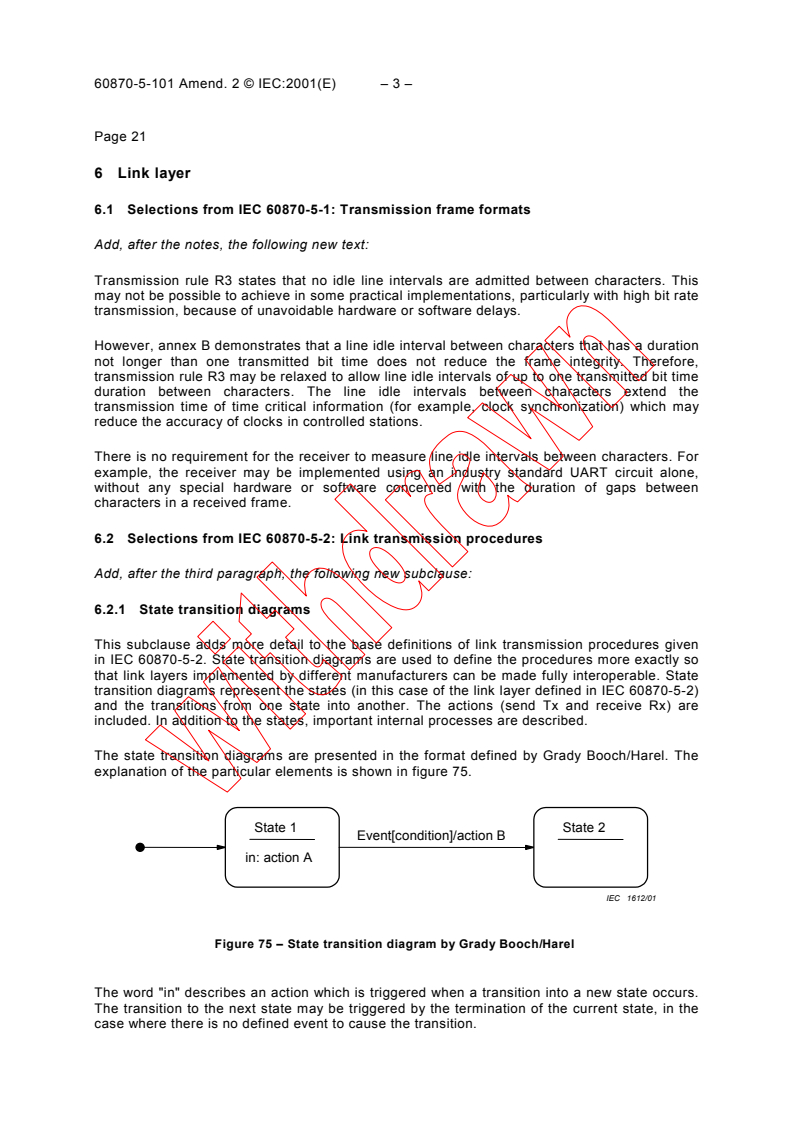
The state transition diagrams are presented in the format defined by Grady Booch/Harel. The
explanation of the particular elements is shown in figure 75.
State 1 State 2
Event[condition]/action B
in: action A
IEC 1612/01
Figure 75 – State transition diagram by Grady Booch/Harel
The word "in" describes an action which is triggered when a transition into a new state occurs.
The transition to the next state may be triggered by the termination of the current state, in the
case where there is no defined event to cause the transition.
– 4 – 60870-5-101 Amend. 2 © IEC:2001(E)
The notation used in the following state transition diagrams is:
FC0 to FC15 = function code number 0 to 15, see tables 1 to 4 of IEC 60870-5-2
FCB = frame count bit
FCV = frame count bit valid
DFC = data flow control
ACD = access demand
PRM = primary message
SC = single character
Replace the heading "UNBALANCED TRANSMISSION" by:
6.2.1.1 Unbalanced transmission procedures
Add, after the fourth paragraph of 6.2.1.1, the following new text:
The SEND/NO REPLY service is used when issuing a user data message to all stations
(broadcast address).
Add, after the second sentence of the sixth paragraph, the following new text:
The assignment of the causes of transmission to the two classes is defined in 7.4.2.
Add, after the sixth paragraph, the following new text:
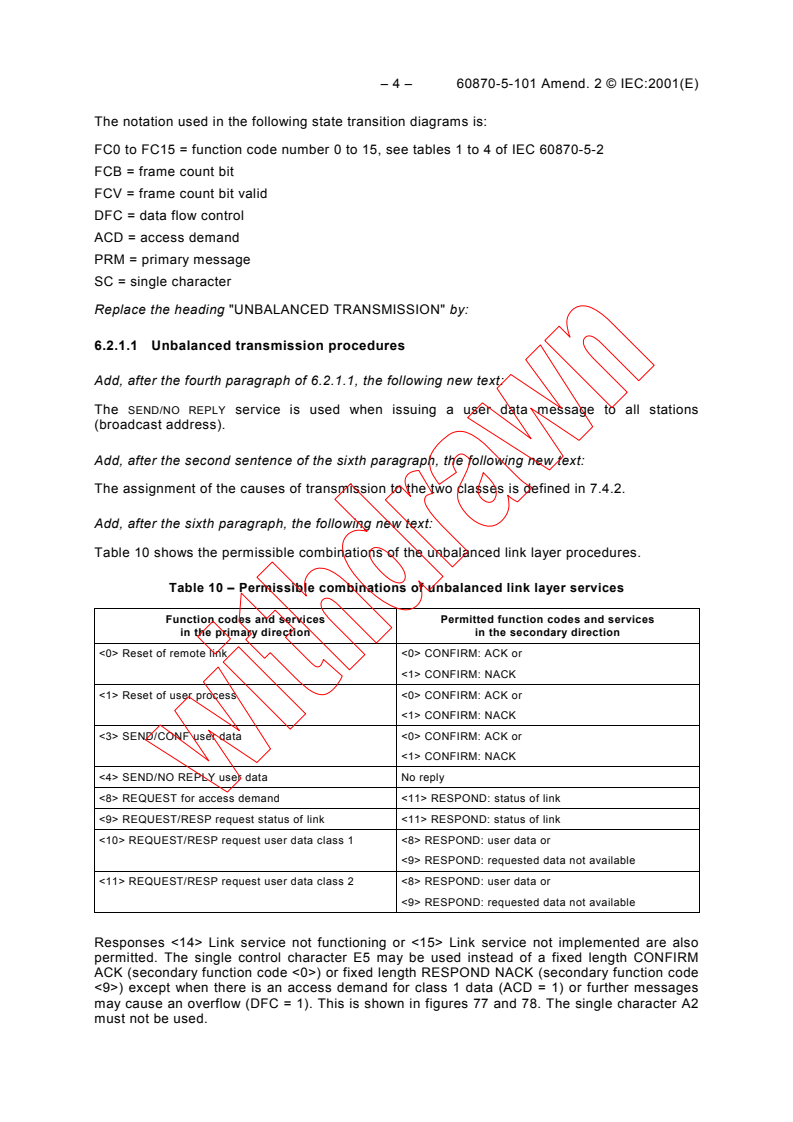
Table 10 shows the permissible combinations of the unbalanced link layer procedures.
Table 10 – Permissible combinations of unbalanced link layer services
Function codes and services Permitted function codes and services
in the primary direction in the secondary direction
<0> Reset of remote link <0> CONFIRM: ACK or
<1> CONFIRM: NACK
<1> Reset of user process <0> CONFIRM: ACK or
<1> CONFIRM: NACK
<3> SEND/CONF user data <0> CONFIRM: ACK or
<1> CONFIRM: NACK
<4> SEND/NO REPLY user data No reply
<8> REQUEST for access demand <11> RESPOND: status of link
<9> REQUEST/RESP request status of link <11> RESPOND: status of link
<10> REQUEST/RESP request user data class 1 <8> RESPOND: user data or
<9> RESPOND: requested data not available
<11> REQUEST/RESP request user data class 2 <8> RESPOND: user data or
<9> RESPOND: requested data not available
Responses <14> Link service not functioning or <15> Link service not implemented are also
permitted. The single control character E5 may be used instead of a fixed length CONFIRM
ACK (secondary function code <0>) or fixed length RESPOND NACK (secondary function code
<9>) except when there is an access demand for class 1 data (ACD = 1) or further messages
may cause an overflow (DFC = 1). This is shown in figures 77 and 78. The single character A2
must not be used.
60870-5-101 Amend. 2 © IEC:2001(E) – 5 –
For unbalanced transmission procedures: The primary station contains only a primary link layer
and the secondary station contains only a secondary link layer (see figure 76). More than one
secondary station may be connected to one primary station. Compatible communication
between the primary station and a particular secondary station relies on these two stations
alone. The polling procedure for requesting data from multiple secondary stations is a local
internal function of the primary station and need not be shown in figures 76 to 78.
Consequently, these diagrams only show the primary station and a single secondary station. In
the case of more than one secondary station, the primary station has to remember the current
state of each secondary station.
STATION A
Link layer is primary only
Link layer
primary
PRM = 0 PRM = 1
Receiver Transmitter
Transmitter Receiver
PRM = 1
PRM = 0
Link layer
secondary
STATION B
Link layer is secondary only
IEC 1613/01
Figure 76 – Unbalanced transmission procedures, primary and secondary stations
Figure 77 shows the state transition diagram of the primary station, figure 78 that of the
secondary station.
– 6 – 60870-5-101 Amend. 2 © IEC:2001(E)
NOTE 1 The primary link layer NOTE 4 The service FC1 (sent from
refers to a particular station primary) is not presented,
A, the secondary link layer since the use has to be
Reset of the
refers to the partner station
defined according to the
B in this figure. primary link
specific application.
layer
NOTE 2 IND means an indication to
NOTE 5 T0 is the time out
the service user.
for repetition of
frames, Trp is the
NOTE 3 The single character may
repetition timer or
be used instead of a FC0
retry mechanism.
or FC9 except ACD=1 or
[]/
DFC=1.
A
Waiting for a REQ
from the service
user
REQ[]/start Trp
Execute
request status of link
in: Tx: FC9
Rx[error]/ and Trp not time out T0 time out[]/CON(error status)
(request status of link)
or: Rx[FC14 or FC15]/ or: Trp time out[]/CON(error status)
or: Rx[FC11,DFC=1]/
Rx[FC11,DFC=0]/
Execute
reset secondary link
A
T0 time out[]/CON(error status)
in: Tx: FC0
or: Trp time out[]/CON(error status)
Rx[error]/and Trp not time out
(reset of remote link)
or: Rx[FC1(NACK)]/
or: Rx[FC14 or FC15]/
Rx[FC0(Ack)]/IND("station responds again")
Link layer primary
REQ[send data with no reply]/
and secondary
Tx: FC4(send/no reply)
available
REQ[send/confirm]/start of timer Trp
REQ[request class 1 or class 2
or status of link]/start of timer Trp
Execute service Execute service
request/respond send/confirm
Rx[FC8]/CON(data)
Rx[FC0]/
or: Rx[FC9]/
or: Rx[FC1]/ IND("data not
in: Tx: FC9 or in: Tx: FC3
or: Rx[FC11]/
accepted") *
FC10 or FC11
or: Rx[FC14 or FC15]/
or: Rx[FC14 or FC15]/ IND("data
CON("error status")
not accepted") *
* Number of repetitions is
defined by the service user
A
T0 time out[Trp time out]/ IND("station does
not respond")
A
or: Rx[error, Trp time out]/ IND("station not
T0 time out[Trp time out]/ IND("station
responding correctly")
T0 time out[Trp not time out]/
does not respond")
T0 time out[Trp not time out]/
or: Rx[error]/ Trp not time out/
or: Rx[error, Trp time out]/IND("station
or: Rx[error]/ Trp not time out/
not responding correctly")
IEC 1614/01
Figure 77 – State transition diagram for unbalanced transmission primary to secondary
60870-5-101 Amend. 2 © IEC:2001(E) – 7 –
NOTE 1 The secondary link layer
NOTE 2 IND means an indication to
refers to a particular station
the service user.
Link layer secondary
B, the primary link layer
NOTE 3 The single character may
not reset
refers to the partner station
be used instead of a FC0
A in this figure.
or FC9 except ACD=1 or
DFC=1.
Rx[FC0 to 15 except 9
and 0]/no reply
Rx[FC9]/Tx FC11
Rx[FC0]/Tx FC0
Execute reset of
secondary link layer
in: FCB=0
Monitor line idle
between frames
[]/
A
Sufficient time idle
Link layer Rx[FC0]/Tx FC0
available
Rx[error]/
Rx[FC9]/Tx:FC11
or: Rx[FC not implemented]/Tx:FC15
Rx[FC4]/
IND(data)
Evaluate
Rx[FC3]/
request/respond
[further messages
[FCB not changed]/
are acceptable] Rx[FC10 or FC11]/
Tx(last message)
[changed FCB]/IND("request")
Waiting on RESP
Evaluate
of the service user
send/no reply
Evaluate
send/confirm
A
RESP[data]/Tx:FC8
[further messages
or: RESP[no data]/Tx:FC9
cause overflow]
A
[FCB not changed]/Tx FC0
[FCB changed, further messages [FCB changed, further messages are
cause overflow]/ TxFC0,DFC=1, acceptable]/ Tx:FC0, IND(Data)
IND(data)
Secondary link layer
A
busy
[further messages are acceptable again]/
Rx[error]
Rx[FC0]/Tx FC1, DFC=1
Monitor line idle
or: Rx[FC3]/Tx FC1, DFC=1
between frames
or: Rx[FC4]/IND("error")
or: Rx[FC10 or FC11, user data]/Tx FC8, DFC=1 *)
[sufficient time idle]
or: Rx[FC10 or FC11, requested data not available]/
Tx FC9, DFC=1 *
or: Rx[FC not implemented]/Tx FC15, DFC=1
* as evaluate request/respond after "link layer
available"
IEC 1615/01
Figure 78 – State transition diagram for unbalanced transmission secondary to primary
– 8 – 60870-5-101 Amend. 2 © IEC:2001(E)
Replace the heading "BALANCED TRANSMISSION" by:
6.2.1.2 Balanced transmission procedures
Add, after the first paragraph of 6.2.1.2, the following:
The following table shows the permissible combinations of the balanced link layer procedures
Table 11 – Permissible combinations of balanced link layer services
Function codes and services Permitted function codes and services
in the primary direction in the secondary direction
<0> Reset of remote link <0> CONFIRM: ACK or
<1> CONFIRM: NACK
<1> Reset of user process <0> CONFIRM: ACK or
<1> CONFIRM: NACK
<2>SEND/CONF test function for link <0> CONFIRM: ACK or
<1> CONFIRM: NACK
<3> SEND/CONF user data <0> CONFIRM: ACK or
<1> CONFIRM: NACK
<4> SEND/NO REPLY user data No reply
<9> REQUEST/RESP request status of link <11> RESPOND: status of link
Responses <14> link service not functioning or <15> link service not implemented are also
permitted. The single control character E5 may be used instead of a fixed length CONFIRM ACK
(secondary function code <0>) except when further messages may cause an overflow (DFC = 1).
Add, after the second paragraph, the following new text:
The link layers for balanced transmission procedures consist of two decoupled logical
processes, one logical process represents station A as the primary station and station B as the
secondary station and the other logical process represents station B as the primary station and
station A as the secondary station (each station is a combined station). Thus, two independent
processes exist in each station to control the link layer in the logical primary and in the
secondary direction. Figure 79 shows the typical arrangement of the link layer using balanced
transmission procedures.
NOTE The physical transmission direction is fixed defined by the bit DIR. The logical processes primary or
secondary may change from station A to B and vice versa. The primary message is defined by the bit PRM = 1, the
secondary message by the bit PRM = 0 (see 6.1.2 of IEC 60870-5-2).
60870-5-101 Amend. 2 © IEC:2001(E) – 9 –
STATION A
Link layer Link layer
secondary
primary
PRM = 0
PRM = 0
PRM = 1 PRM = 1
Receiver Transmitter
DIR = 0 DIR = 1
Transmitter Receiver
PRM = 1 PRM = 1
PRM = 0
PRM = 0
Link layer
Link layer
secondary
primary
STATION B
IEC 1616/01
Figure 79 – Balanced transmission procedures, primary and secondary link layers
Figures 80 and 81 do not show the reactions of the link layer in the case of receiving corrupted
frames. These frames are already rejected by a process which is not shown in the following.
This process is also responsible for the control of the time out interval. Figure 80 shows the
state transition diagram of the primary link layer using balanced transmission procedures.
Figure 81 shows the secondary link layer.
– 10 – 60870-5-101 Amend. 2 © IEC:2001(E)
NOTE 1 The primary link layer refers to a
NOTE 4 The service FC1 (sent from
particular station A, the secondary
primary) is not presented, since
link layer refers to the partner station
the use has to be defined
B in this figure. according to the specific
Reset of the
application.
NOTE 2 IND means an indication to the
primary link layer
service user.
NOTE 5 T0 is the time out for repetition
of frames.
NOTE 3 The single character may be used
Trp is the repetition timer or retry
instead of an FC0 or FC9 except
mechanism.
ACD=1 or DFC=1.
[]/
Status after reset: FCB = 0, receiver buffer empty
Execute request
Rx[FC11, DFC=1]/ or:
A
status of link
Rx[FC14 or FC15]/
IND("secondary link service not
in: Tx: FC9
functioning or implemented")
(request status of link)
T0 time out []/
Rx[FC11, DFC=0]/
Execute reset of
Rx[FC1(Nack)]/ or:
remote link
Rx[FC14 or FC15]/
A
IND("secondary link service not
in: Tx: FC0 T0 time out[]/
functioning or implemented")
(reset of remote link)
Rx[FC0(Ack)]/ IND("further
messages are acceptable")
REQ of the service user[execute
Link layer primary
request status of link]/
and secondary
A
REQ of the service user[execute available
send no reply]/ Tx: FC4
(send/no reply)
REQ of the service user[execute test REQ of the service user[execute
function for link]/ start of timer Trp, FC2 send/confirm]/ start of timer Trp,
(test function for link)
FC3 (user data)
Execute service
send/confirm
Rx[FC0 ,DFC=0]/
T0 time out [Trp not time out]/
in: Tx: FC
A
T0 time out[Trp time out]/
IND("no response")
Rx[FC14 or FC15]/IND("link
service not functioning or
implemented") Rx[FC1]/IND("message not
Rx[FC0, DFC=1]/IND("no
accepted, no further data
further messages accepted"),
accepted"), start of timer Trp
start of timer Trp
Secondary link
layer busy
in: Tx: FC9
(request status of link)
T0 time out[Trp not time out]/
Rx[FC11,DFC=0]/IND("further messages accepted")
Rx[FC11,DFC=1]/start of timer Trp
A
T0 time out[Trp time out]/IND("no response")
IEC 1617/01
Figure 80 – State transition diagram for balanced transmission primary to secondary
60870-5-101 Amend. 2 © IEC:2001(E) – 11 –
NOTE 1 The primary link layer refers to a
NOTE 4 The service FC1 (sent from primary)
particular station A, the secondary
is not presented, since the use has to
link layer refers to the partner station
be defined according to the specific
B in this figure.
application.
NOTE 2 IND means an indication
to the service user.
Status of secondary
NOTE 3 The single character
link layer not reset
may be used instead
of a FC0 or FC9
Rx[FC9]/
except ACD=1 or
Rx[FC0 to 15 except FC9 and FC0]/no reply
Tx FC11
DFC=1.
Rx[FC0]/Tx FC0
Execute reset of the
secondary link layer
in: FCB = 0
[]/
Primary and Rx[FC0]/Tx FC0
secondary link layer
available
Rx[FC9]/Tx FC11
or: Rx[FC2]/Tx FC0
or: Rx[FC not implemented]/Tx FC15
or: Rx[FC not functioning]/Tx FC14
[FCB not changed]/Tx FC0
or: [FCB changed, further
Rx[FC4]/IND(data) Rx[FC3]/
messages are acceptable]/
Tx FC0, IND(Data)
Evaluate Evaluate
send/no reply send/confirm
[further messages
are acceptable]
[FCB changed, further
messages cause data overflow]/
[further messages cause Tx(FC0,DFC=1), IND(Data)
data overflow]/
Secondary link
layer busy
[Secondary link
layer available
again]/
Rx[FC0]/Tx(FC1,DFC=1)
or: Rx[FC2]/Tx(FC0,DFC=1)
or: Rx[FC3]/Tx(FC1,DFC=1)
or: Rx[FC4]/IND("Error")
or: Rx[FC9]/Tx(FC11,DFC=1)
or: Rx[FC not implemented]/
Tx(FC15,DFC=1)
IEC 1618/01
Figure 81 – State transition diagram for balanced transmission secondary to primary
– 12 – 60870-5-101 Amend. 2 © IEC:2001(E)
Add, at the end of the last paragraph, the following new text:
DIR defines the physical transmission direction (see 6.1.2 of IEC 60870-5-2):
1 = station A (controlling station) to station B (controlled station)
0 = station B (controlled station) to station A (controlling station)
All messages sent by the controlling station will have the data link control field DIR bit set to 1.
All messages sent by the controlled station will have the data link control field DIR bit set to 0.
In the case of two equivalent stations (for example, two control centres) the DIR is defined by
agreement.
If defined, the balanced mode address field will contain the destination address for both
primary and secondary messages.
Replace the heading "TIME OUT INTERVAL FOR REPEATED FRAME TRANSMISSION" by:
6.2.2 Definitions of time out interval for repeated frame transmission
Add, at the beginning of the first paragraph, the following new text:
Formulae are given in annex A of IEC 60870-5-2 for calculating the time out interval for
repeated transmissions, assuming two cases and a variety of project-specific parameters.
Add, after the first paragraph, the following new text:
This present subclause clarifies the use of the formulae by calculating two tables which give
examples of time out intervals for a number of typical conditions for both balanced and
unbalanced transmission.
Reference: IEC 60870-5-2, annex A – figure A.2, case 1 (unbalanced transmission procedures);
IEC 60870-5-2, annex A – figure A.4, case 1 (balanced transmission procedures).
Abbreviations not defined in IEC 60870-5-2:
BAB transmission speed from station A to station B
BBA transmission speed from station B to station A
LBAmax number of octets of the longest frame from B to A
LADDR length of the link address field
BAB, BBA, LBAmax, LADDR, t and t are project-specific parameters.
R RB
6.2.2.1 Unbalanced transmission
The following condition is valid for the time out interval T :
O
T > t + T
O LD LBA
where t = t + t + t
LD DAB R DBA
and t is the reaction time of station B (specific per equipment)
R
t = 0,5/BAB (see note below)
DAB
t = 0,5/BBA (see note below)
DBA
T = 11 × LBAmax/BBA
LBA
Examples for the specification of the time out interval
60870-5-101 Amend. 2 © IEC:2001(E) – 13 –
Definitions: station B = controlled station,
equal transmission speed in both directions,
reaction time of station B t = 50 ms.
R
NOTE The signal delays t and t (see IEC 60870-5-2, annex A) are assumed to be half the transmission time
DAB DBA
of a data bit.
Table 12 – Time out intervals (T ) depending on frame length, transmission speed
O
and project specific parameters (examples)
Transmission t T T
LD LBA O
speed
LBAmax
bit/s ms ms ms
100 60,0 2 200,0 2 260,0
600 51,7 366,7 418,4
1 200 50,8 183,3 234,1
9 600 50,1 22,9 73,0
19 200 50,0 11,4 61,4
64 000 50,0 3,4 53,4
100 60,0 26 400,0 26 460,0
600 51,7 4 400,0 4 451,7
1 200 50,8 2 200,0 2 250,8
9 600 50,1 275,0 325,1
19 200 50,0 137,5 187,5
64 000 50,0 41,3 91,3
6.2.2.2 Balanced transmission
The following condition is valid for the time out interval T :
O
T > t + T + t + T
O LDA LSPBA GB LPSBA
where t =t + t + t
LDA DAB RB DBA
and t is the reaction time of station B (specific per equipment)
RB
t = 0,5/BAB (see note below)
DAB
t = 0,5/BBA (see note below)
DBA
1)
t = 33/BBA
GB
T = 11 × LBAmax/BBA
LPSBA
T = 11(LADDR + 4)/BBA
LSPBA
NOTE The signal delays t and t (see IEC 60870-5-2, annex A) are assumed to be half the transmission time
DAB DBA
of a data bit.
________
1)
t = 33 bit is the critical case for the definition of T .
GB O
t is a system specific parameter which may be significantly less than 33 bit (for example, 0,5 bit).
GB
– 14 – 60870-5-101 Amend. 2 © IEC:2001(E)
Examples for the specification of the time out interval
Definitions: station B = controlled station,
equal transmission speed in both directions,
reaction time of station B t = 50 ms
R
length of address field LADDR = 1
Table 13 – Time out intervals (T ) depending on frame length, transmission speed and
O
project specific parameters (examples)
Transmission t t T T T
LDA GB LSPBA LPSBA O
speed
LBAmax
bit/s ms ms ms ms ms
100 60,0 330,0 550,0 2 200,0 3 140,0
600 51,7 55,0 91,7 366,7 565,1
1 200 50,8 27,5 45,8 183,3 307,4
9 600 50,1 3,4 5,7 22,9 82,1
19 200 50,0 1,7 2,9 11,4 66,0
64 000 50,0 0,5 0,9 3,4 54,8
100 60,0 330,0 550,0 26 400,0 27 340,0
600 51,7 55,0 91,7 4 400,0 4 598,4
1200 50,8 27,5 45,8 2 200,0 2 324,1
9 600 50,1 3,4 5,7 275,0 334,2
19 200 50,0 1,7 2,9 137,5 192,1
64 000 50,0 0,5 0,9 41,3 92,7
6.2.3 The use of the different resets
IEC 60870-5-2 defines the services FC0 reset of remote link and FC1 reset of user process.
Additionally, IEC 60870-5-5 and this standard define the remote initialization procedure which
uses the reset process command C_RP_NA_1 type identification number <105>.
The use of the different resets is specified in table 14.
Table 14 – Effects of the different resets
Controlling station Primary link Secondary link Controlled station
layer 7 and user layer 7 and user
Reset of remote link (FC0) Secondary link reset –
Reset of user process Reset Reset
(FC1)
Reset process command – – Reset
Reset of remote link is used when the secondary link is reset independently from the layers
above the link. In this case, the frame count bit of the control field is always set to zero.
A pending secondary link layer message is deleted.
Reset of user process as a link function is used if the link layer is still working but the process
functions of the controlled station are not available. In this case, a reset of the user process via
a link service might put the user process into operation. This service can only be used if the
link layer is able to reset the user process via a separate signal.
60870-5-101 Amend. 2 © IEC:2001(E) – 15 –
The use of the reset process command is defined in detail in 6.1.4 and 6.1.7 of IEC 60870-5-5.
Page 27
7 Application layer and user process
Replace, on page 27, "j" in the formula for the INFORMATION OBJECT by "d".
Replace, on page 27, "Variable parameter j" by: "Variable parameter d".
Page 29
7.2.1 Type identification
Replace the existing text of the last paragraph by the following new text:
ASDUs with undefined values of TYPE IDENTIFICATION are discarded by controlling stations.
7.2.1.1 Definition of the semantics of the values of the type identification field
Add, to the second paragraph, the following new text:
In standard operations, there is a vertical flow of information between stations in a network.
Commands are sent down from the central controlling station to one of several controlled
stations and events/measurements are sent up from a controlled station to the central
controlling station.
In some installations, there may be an additional need for information to flow laterally between
stations of equal rank. This may be done using a dual-mode option so that both commands and
event/measurements may be sent in both directions. A common link layer may support both
standard direction operation and reverse direction operation. Individual application functions
and ASDUs may be chosen for standard direction use, reverse direction use or for both uses
as required.
A dual-mode station may be run on top of either a balanced or an unbalanced link layer. When
an unbalanced link is used to connect to a dual-mode station, the role of the primary link layer
must be established during system design and does not change during communications. In the
case of an unbalanced link, the command ASDUs in reverse direction are requested by the
unbalanced link layer request/respond service.
A dual-mode station must set the Common Address of ASDU in each transmitted message
corresponding to the station currently acting as a controlled station. The receiving station may
use the Common Address of ASDU to determine if the message should be interpreted as a
request or a response.
Type identification 7, 8, 33 and 51 (bitstring of 32 bits in monitor and command direction) shall
only be used when no other appropriate data types are defined. These types must not include
data that appear in single- or double-point information (whether packed or unpacked).
– 16 – 60870-5-101 Amend. 2 © IEC:2001(E)
Page 31
Replace, at the end of table 3, "<22.44>" by "<22.29>".
Add the following:
<30> := single-point information with time tag CP56Time2a M_SP_TB_1
<31> := double-point information with time tag CP56Time2a M_DP_TB_1
<32> := step position information with time tag CP56Time2a M_ST_TB_1
<33> := bitstring of 32 bits with time tag CP56Time2a M_BO_TB_1
<34> := measured value, normalized value with time tag CP56Time2a M_ME_TD_1
<35> := measured value, scaled value with time tag CP56Time2a M_ME_TE_1
<36> := measured value, short floating point number with time tag CP56Time2a M_ME_TF_1
<37> := integrated totals with time tag CP56Time2a M_IT_TB_1
<38> := event of protection equipment with time tag CP56Time2a M_EP_TD_1
<39> := packed start events of protection equipment with time tag CP56Time2a M_EP_TE_1
<40> := packed output circuit information of protection equipment with time tag CP56Time2a M_EP_TF_1
<41.44> := reserved for further compatible definitions
Page 33
Table 6 – Semantics of TYPE IDENTIFICATION
Insert "CON" in front of "<102>"
Page 35
7.2.2 Variable structure qualifier
7.2.2.1 Definition of the semantics of the values of the VARIABLE STRUCTURE QUALIFIER field
Replace "SQ<0> and N<0.127> = number of INFORMATION OBJECTS" by
"SQ<0> and N<0.127> = number of INFORMATION OBJECTs i"
and
"SQ<1> and N<0.127> = number of INFORMATION ELEMENTS of a single object per ASDU" by
"SQ<1> and N<0.127> = number of INFORMATION ELEMENTS j of a single object per ASDU".
60870-5-101 Amend. 2 © IEC:2001(E) – 17 –
Add, after 7.2.2.1, the following new subclause:
7.2.2.2 Requirements for the transmission of information objects in chronological order
For information objects to be correctly transmitted in chronological order while preserving
priority classes specified by the controlled station’s priority control manager, the following
specifications are valid.
Monitored information objects may be transmitted with the following causes of transmission:
• cyclic/periodic,
• background scan,
• spontaneous,
• requested,
• return information caused by a remote command,
• return information caused by a local command,
• interrogated by station and group interrogation,
• interrogated by general and counter request
Each ASDU always contains a single type identification and a single cause of transmission.
Transmission of values from a single information object must always be in the chronological
order in which those values were measured.
NOTE To ensure that the transmission of values from a single information object is always in the correct
chronological order, it may be necessary to ensure that all values from that information object use a single priority
buffer, or that there is coordination between values of the object that may be placed in different priority buffers.
For the transmission of objects buffered in priority buffers, the conditions shown in figure 82
are valid.
Transmission-
buffer
Priority control manager
Priority 1 Priority 2 Priority n
Type A1
Type A2
Type B1
Type B2
Type A3
Type A4
Type C1
Type C2
IEC 1619/01
Figure 82 – Presentation of types of ASDUs in priority buffers
– 18 – 60870-5-101 Amend. 2 © IEC:2001(E)
To transmit correct chronological sets of information objects from a priority buffer, the following
procedure should be implemented. In the example in figure 82, the information objects having
type identifications A, B and C are shown in a randomly buffered order in the priority buffer 1.
For the transmission of the information objects from this buffer, the first two objects of type
identification A, namely A1 and A2, are packed in one ASDU. The objects B1 and B2 are
packed in a second ASDU, then the objects A3 and A4 follow in a third ASDU, etc. In general,
the priority buffer is examined closely for objects having a single type identification and cause
of transmission that are buffered in chronologically correct order without any intermediate
objects having a different identification. Only these homogeneous groups of objects are
transmitted together in one ASDU. When an object having a different type identification is
encountered in the buffer, that object is transmitted in the next following ASDU, which may
consist again of packed objects with a single type identification. The packed objects
transmitted in one ASDU always have the same transmission priority class.
The maximum length of the transmission frame is a fixed parameter. Since the lengths of
objects of different type identification are not all the same, the maximum number of objects of
a given type that may be sent in an ASDU may vary. The ASDUs are automatically filled with
the objects up to the maximum length specified, if there is a sufficient number of sequential
buffered objects with the same type identification and cause of transmission available in one
priority buffer.
It is not permissible to delay the transmission of an ASDU while waiting for further buffered
objects which could be used to fill that ASDU to the maximum possible length.
Best efficiency can be achieved by defining objects with only a single type identification in each
priority buffer. This is normally performed by configuration parameters.
This subclause refers to the spontaneous transmission of events and does not specify the
construction of sequences of information elements which are used in ASDUs with unstructured
information object addresses, such as responses to a station interrogation. However, the
requirement that all values reported for a single information object are in correct chronological
order must be observed.
When implementing the priority buffers and priority control manager defined in this subclause,
it is necessary to ensure that an information object without a time tag is not transmitted to the
controlling station before all versions of the same object, generated before the present version,
have been transmitted.
Care must be taken for a number of reasons including
a) the time taken to generate an object for different causes of transmission (for example, as a
sample for background scan or an event for spontaneous transmission) may not be exactly
the same. Thus, two versions of the same object may not be entered into the priority
buffers in the correct chronological order, when their times of generation are very close
together;
b) the streams of objects in different priority buffers are unlikely to progress through the buffers
at the same speed. This means that objects entered into the buffers in the correct chrono-
logical order may not be presented to the priority control manager still in that correct order;
c) objects within ASDUs waiting in the transmission buffer may not be transmitted in the same
order as they were entered, when unbalanced mode link procedures are being used. This is
because the controlled station has no control over the order in which requests for class 1
and requests for class 2 data are received.
60870-5-101 Amend. 2 © IEC:2001(E) – 19 –
The method used to maintain the correct chronological order in any implementation is a local
matter (internal to the particular controlled station) and is not defined in this standard.
NOTE When using structured information object addresses, the ASDUs that are defined for sequences of
information elements in a single information object might not be completed to optimal lengths due to possible gaps
in the address numbering. Typically this reduces the packing efficiency for station interrogation procedures.
Page 37
7.2.3 Cause of transmission
7.2.3.1 Definition of the semantics of the values of the CAUSE OF TRANSMISSION field
Add, after "<1.255> := number of originator address", the following new text:
ASDUs with undefined values of CAUSE OF TRANSMISSION are discarded by controlling stations.
Add, after the last paragraph and before table 9, the following new text:
If the originator address is used, the following definitions are valid.
<0> = default
<0> is used to define process information as return information, events, etc. that are stored in
network images and which have to be transmitted to all parts of a distributed system.
<1.255>
This range may be used to address the specific part of the system to which the corresponding
information in the monitor direction is returned.
Within a system, parts of the system can be information sources which may initiate station
interrogations, requests for integrated totals, commands, etc. The returned information is only
of importance for the source which initiated the request or the command. In these systems, the
information source should set the originator address of the ASDUs in the command direction,
and the controlled station should echo this originator address in the response in the monitor
direction.
EXAMPLE 1
The station interrogation initiated by a specific source (controlling station A in figure 83) returns
interrogated information in monitor direction which are exclusively directed to the particular
source and not to other parts of the system (for example, controlling station B in figure 83).
The ASDUs which are used for this station interrogation are marked with a specific originator
address (of range <1.255>) which is used to route the interrogated information in monitor
direction (for example, via a concentrator station in figure 83) to the initiating source.
– 20 – 60870-5-101 Amend. 2 © IEC:2001(E)
Controlling station A
Controlling station B
System
System
source A
source B
Link system A Link system B
Interrogated
Information of Z
Station interrogation
with originator
to controlled station
address A
Z with originator
address A
Link to A
Link to B
The returned originator address A
Concentrator
enables the concentrator station
station
to direct the interrogated
information of Z exclusively to the
Station interrogation
system source A
Link system C
to controlled station
Z with originator
address A
Interrogated
information of Z
with originator
Link to C
address A
Controlled
station Z
IEC 1620/01
Figure 83 – Station interrogation via a concentrator station using the originator address
EXAMPLE 2
The command initiated by a specific source (cause of transmission = act, controlling station A
in figure 84) returns acknowledges (cause of transmission = actcon, actterm) that are only of
importance for the source which initiated the command. Therefore, the actcon and actterm
should be routed (for example, via a concentrator station in figure 84) via the originator
address to this specific point only. However, the corresponding return information (cause of
transmission 11 or 12) represents process information which is memorized and controlled in
different network images of the whole system (controlling stations A and B in figure 84) and
which has to carry the originator address = 0 to be distributed to all parts of the equipment
where it is needed.
60870-5-101 Amend. 2 © IEC:2001(E) – 21 –
Controlling station A Controlling station B
System
System
source A source B
Link system A Link system B
Returned S_SC
con actcon and
actterm of Z with
originator address
Command S_SC act
Return information
A
to controlled station
M of Z with
Z with originator
originator address 0
Return
address A
information M
of Z with
originator
address 0
The returned originator address A
enables the concentrator station
Link to A
Link to B
to direct the act, actcon and
actterm of Z exclusively to the
Concentrator
system source A. The return
station
information M of Z with the
originator address 0 is directed to
Command S_SC act
Link system C
both system sources A and B
to controlled station
Z with originator
Returned S_SC
address A
actcon and actterm
of Z with originator
address A
Link to C
Return information
Controlled
M of Z with
station Z
originator address
IEC 1621/01
Figure 84 – Command transmission via a concentrator station using the originator address
Page 39
Table 9 – Semantics of CAUSE OF TRANSMISSION
Replace the term "general interrogation" by "station interrogation".
Replace "<42.47> := reserved for further compatible definitions" by "<42.43> := reserved for
further compatible definitions".
Add to table 9:
<44> := unknown type identification
<45> := unknown cause of transmission
<46> := unknown common address of ASDU
<47> := unknown information object address
– 22 – 60870-5-101 Amend. 2 © IEC:2001(E)
Add, after table 9, the following new text:
ASDUs in control direction with undefined values in the data unit identifier (except the variable
structure qualifier) and the information object address are mirrored by the controlled station
with bit "P/N := <1> negative confirm" and the following causes of transmission:
Unknown Cause of transmission
type identification 44
cause of transmission 45
common address of ASDU 46
information object address 47
A controlling station may monitor for and maintain a communications error log reporting each
time that the following ASDUs are received:
• ASDUs in the monitor direction with undefined values in the data unit identifier (except the
variable structure qualifier);
• ASDUs in the monitor direction with undefined values of information object address;
• mirrored ASDUs due to unknown numbers in control direction (type identifiers 45 to 51).
Receipt of one of these ASDUs does not affect the processing of subsequent messages.
Page 41
7.2.4 COMMON ADDRESS OF ASDUs
Add, after "<65535> := global address", the following new text:
ASDUs with undefined values of COMMON ADDRESS are discarded by controlling stations.
Add, at the end of 7.2.4, the following new text:
When using the common address FF or FFFF (broadcast address, request of all), ACTCON,
ACTTERM and the interrogated information objects (if any) are returned with the specific
common addresses of the controlled stations as they would be when caused by commands to
specific controlled stations.
The use of the common address FF or FFFF is restricted to the following ASDUs in the control
direction:
type Identification <100> := interrogation command C_IC_NA_1
type Identification <101> := counter interrogation command C_CI_NA_1
type Identification <103> := clock synchronization command C_CS_NA_1
type Identification <105> := reset process command C_RP_NA_1
The common address FF or FFFF may be used when the same application function in all
stations of a specific system have to be initiated at the same time, for example, to synchronize
the local clocks by a clock synchronization command or to freeze the integrated totals by a
counter interrogation command.
60870-5-101 Amend. 2 © IEC:2001(E) – 23 –
Page 43
7.2.5 INFORMATION OBJECT ADDRESS
Add, after "<1.16777215> := INFORMATION OBJECT ADDRESS", the following new text:
ASDUs with undefined values of INFORMATION OBJECT ADDRESS are discarded by controlling
stations.
Add, at the end of this subclause, the following new text:
An information object is a well-defined piece of information which requires a name (information
object address) in order to identify its use in an instance of communication (see 3.31 of
ISO/IEC 8824-1 and 3.3 of IEC 60870-5-3). As defined, the information objects carry
information elements that identify single information points which are unambiguously
addressed by the information object addresses. Example: An information object which
transmits return information must have a different information object address to the information
object which transmits the belonging command.
The read command C_RD_NA_1 is a general exception since its information object address
serves to address available information objects which are returned in the monitor direction.
The information object address may be specified independently from the ASDU (type
identification) which transmits the particular information object. Information objects may be
transmitted with the same information object addresses using different ASDUs, for example, as
a single-point information with or without time tag.
Table 15 – ASDUs in the monitor direction which may transmit objects
with equal information object addresses
Type identification Type identification with time tag Alternative format type identification
1 2 or 30 20
3 4 or 31 17 or 38
5 6 or 32
7 8 or 33
9 10 or 34 21
11 12 or 35
13 14 or 36
15 16 or 37
There are no other combinations of ASDUs of specific common addr
...