


IEC TS 62351-4:2007
(Main)Power systems management and associated information exchange - Data and communications security - Part 4: Profiles including MMS
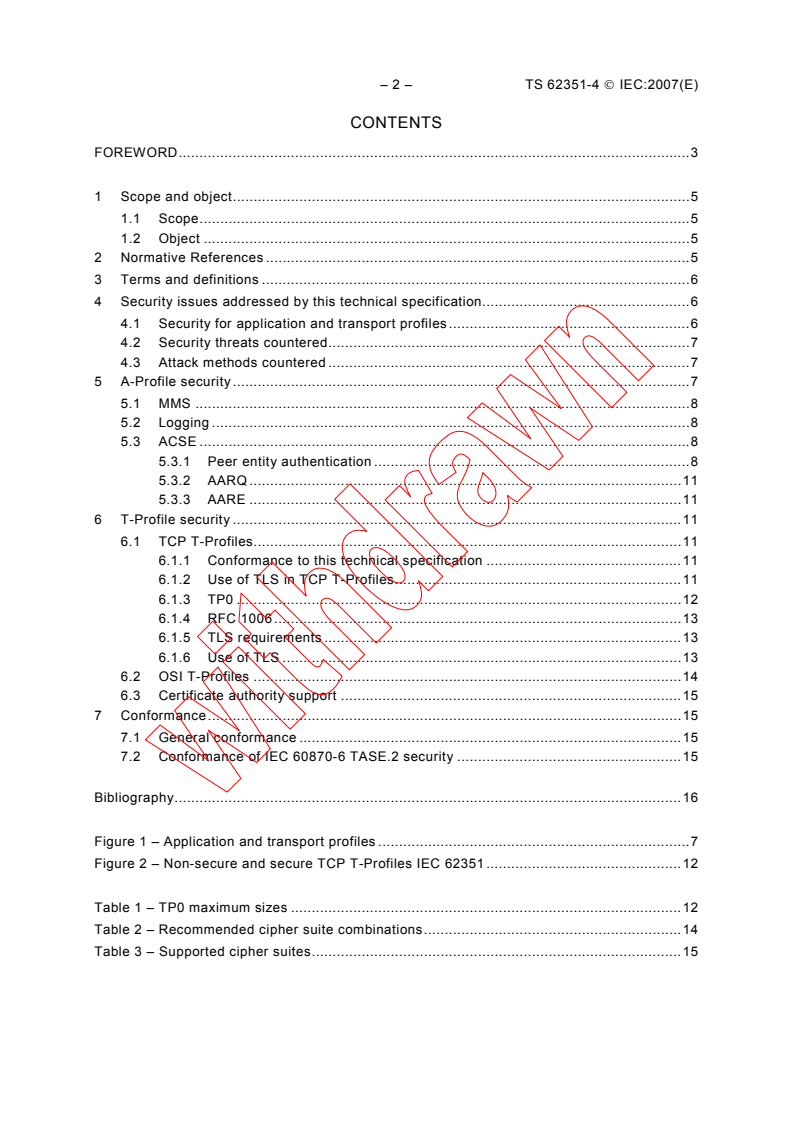
General Information
- Abstract
Specifies procedures, protocol extensions, and algorithms to facilitate securing ISO 9506 - Manufacturing Message Specification (MMS) based applications. It is intended that this technical specification be referenced as a normative part of other IEC TC 57 standards that have the need for using MMS in a secure manner.
This publication is of core relevance for Smart Grid.
- Status
- Replaced
- Publication Date
- 21-Jun-2007
- Technical Committee
- TC 57 - Power systems management and associated information exchange
- Drafting Committee
- WG 15 - TC 57/WG 15
- Current Stage
- DELPUB - Deleted Publication
- Start Date
- 19-Nov-2018
- Completion Date
- 28-Aug-2026
Relations
- Effective Date
- 05-Sep-2023
- Effective Date
- 10-Feb-2026
- Effective Date
- 10-Feb-2026
Get Certified
Connect with accredited certification bodies for this standard

ANCE
Mexican certification and testing association.

Intertek Slovenia
Intertek testing, inspection, and certification services in Slovenia.

LNE (Laboratoire National de Métrologie et d'Essais)
French national laboratory for metrology and testing.
Sponsored listings
Frequently Asked Questions
IEC TS 62351-4:2007 is a technical specification published by the International Electrotechnical Commission (IEC). Its full title is "Power systems management and associated information exchange - Data and communications security - Part 4: Profiles including MMS". This standard covers: Specifies procedures, protocol extensions, and algorithms to facilitate securing ISO 9506 - Manufacturing Message Specification (MMS) based applications. It is intended that this technical specification be referenced as a normative part of other IEC TC 57 standards that have the need for using MMS in a secure manner. This publication is of core relevance for Smart Grid.
Specifies procedures, protocol extensions, and algorithms to facilitate securing ISO 9506 - Manufacturing Message Specification (MMS) based applications. It is intended that this technical specification be referenced as a normative part of other IEC TC 57 standards that have the need for using MMS in a secure manner. This publication is of core relevance for Smart Grid.
IEC TS 62351-4:2007 is classified under the following ICS (International Classification for Standards) categories: 33.200 - Telecontrol. Telemetering. The ICS classification helps identify the subject area and facilitates finding related standards.
IEC TS 62351-4:2007 has the following relationships with other standards: It is inter standard links to IEC 62351-4:2018, EN 60870-6-702:2014, EN 60870-6-503:2014. Understanding these relationships helps ensure you are using the most current and applicable version of the standard.
IEC TS 62351-4:2007 is available in PDF format for immediate download after purchase. The document can be added to your cart and obtained through the secure checkout process. Digital delivery ensures instant access to the complete standard document.
Standards Content (Sample)
TECHNICAL IEC
SPECIFICATION TS 62351-4
First edition
2007-06
Power systems management and
associated information exchange –
Data and communications security –
Part 4:
Profiles including MMS
Reference number
IEC/TS 62351-4:2007(E)
All rights reserved. Unless otherwise specified, no part of this publication may be reproduced or utilized in any form
or by any means, electronic or mechanical, including photocopying and microfilm, without permission in writing from
either IEC or IEC's member National Committee in the country of the requester.
If you have any questions about IEC copyright or have an enquiry about obtaining additional rights to this publication,
please contact the address below or your local IEC member National Committee for further information.
IEC Central Office
3, rue de Varembé
CH-1211 Geneva 20
Switzerland
Email: inmail@iec.ch
Web: www.iec.ch
About the IEC
The International Electrotechnical Commission (IEC) is the leading global organization that prepares and publishes
International Standards for all electrical, electronic and related technologies.
About IEC publications
The technical content of IEC publications is kept under constant review by the IEC. Please make sure that you have the
latest edition, a corrigenda or an amendment might have been published.
ƒ Catalogue of IEC publications: www.iec.ch/searchpub
The IEC on-line Catalogue enables you to search by a variety of criteria (reference number, text, technical committee,…).
It also gives information on projects, withdrawn and replaced publications.
ƒ IEC Just Published: www.iec.ch/online_news/justpub
Stay up to date on all new IEC publications. Just Published details twice a month all new publications released. Available
on-line and also by email.
ƒ Customer Service Centre: www.iec.ch/webstore/custserv
If you wish to give us your feedback on this publication or need further assistance, please visit the Customer Service
Centre FAQ or contact us:
Email:
csc@iec.ch
Tel.: +41 22 919 02 11
Fax: +41 22 919 03 00
TECHNICAL IEC
SPECIFICATION TS 62351-4
First edition
2007-06
Power systems management and
associated information exchange –
Data and communications security –
Part 4:
Profiles including MMS
PRICE CODE
Commission Electrotechnique Internationale P
International Electrotechnical Commission
МеждународнаяЭлектротехническаяКомиссия
For price, see current catalogue
– 2 – TS 62351-4 © IEC:2007(E)
CONTENTS
FOREWORD.3
1 Scope and object.5
1.1 Scope.5
1.2 Object .5
2 Normative References .5
3 Terms and definitions .6
4 Security issues addressed by this technical specification.6
4.1 Security for application and transport profiles .6
4.2 Security threats countered.7
4.3 Attack methods countered .7
5 A-Profile security.7
5.1 MMS .8
5.2 Logging .8
5.3 ACSE .8
5.3.1 Peer entity authentication .8
5.3.2 AARQ .11
5.3.3 AARE .11
6 T-Profile security .11
6.1 TCP T-Profiles.11
6.1.1 Conformance to this technical specification .11
6.1.2 Use of TLS in TCP T-Profiles.11
6.1.3 TP0 .12
6.1.4 RFC 1006 .13
6.1.5 TLS requirements .13
6.1.6 Use of TLS .13
6.2 OSI T-Profiles .14
6.3 Certificate authority support .15
7 Conformance.15
7.1 General conformance .15
7.2 Conformance of IEC 60870-6 TASE.2 security .15
Bibliography.16
Figure 1 – Application and transport profiles .7
Figure 2 – Non-secure and secure TCP T-Profiles IEC 62351 .12
Table 1 – TP0 maximum sizes .12
Table 2 – Recommended cipher suite combinations.14
Table 3 – Supported cipher suites.15
TS 62351-4 © IEC:2007(E) – 3 –
INTERNATIONAL ELECTROTECHNICAL COMMISSION
_____________
POWER SYSTEMS MANAGEMENT AND ASSOCIATED
INFORMATION EXCHANGE –
DATA AND COMMUNICATIONS SECURITY –
Part 4: Profiles including MMS
FOREWORD
1) The International Electrotechnical Commission (IEC) is a worldwide organization for standardization comprising
all national electrotechnical committees (IEC National Committees). The object of IEC is to promote
international co-operation on all questions concerning standardization in the electrical and electronic fields. To
this end and in addition to other activities, IEC publishes International Standards, Technical Specifications,
Technical Reports, Publicly Available Specifications (PAS) and Guides (hereafter referred to as “IEC
Publication(s)”). Their preparation is entrusted to technical committees; any IEC National Committee interested
in the subject dealt with may participate in this preparatory work. International, governmental and non-
governmental organizations liaising with the IEC also participate in this preparation. IEC collaborates closely
with the International Organization for Standardization (ISO) in accordance with conditions determined by
agreement between the two organizations.
2) The formal decisions or agreements of IEC on technical matters express, as nearly as possible, an international
consensus of opinion on the relevant subjects since each technical committee has representation from all
interested IEC National Committees.
3) IEC Publications have the form of recommendations for international use and are accepted by IEC National
Committees in that sense. While all reasonable efforts are made to ensure that the technical content of IEC
Publications is accurate, IEC cannot be held responsible for the way in which they are used or for any
misinterpretation by any end user.
4) In order to promote international uniformity, IEC National Committees undertake to apply IEC Publications
transparently to the maximum extent possible in their national and regional publications. Any divergence
between any IEC Publication and the corresponding national or regional publication shall be clearly indicated in
the latter.
5) IEC provides no marking procedure to indicate its approval and cannot be rendered responsible for any
equipment declared to be in conformity with an IEC Publication.
6) All users should ensure that they have the latest edition of this publication.
7) No liability shall attach to IEC or its directors, employees, servants or agents including individual experts and
members of its technical committees and IEC National Committees for any personal injury, property damage or
other damage of any nature whatsoever, whether direct or indirect, or for costs (including legal fees) and
expenses arising out of the publication, use of, or reliance upon, this IEC Publication or any other IEC
Publications.
8) Attention is drawn to the Normative references cited in this publication. Use of the referenced publications is
indispensable for the correct application of this publication.
9) Attention is drawn to the possibility that some of the elements of this IEC Publication may be the subject of
patent rights. IEC shall not be held responsible for identifying any or all such patent rights.
The main task of IEC technical committees is to prepare International Standards. In
exceptional circumstances, a technical committee may propose the publication of a technical
specification when
• the required support cannot be obtained for the publication of an International Standard,
despite repeated efforts, or
• the subject is still under technical development or where, for any other reason, there is the
future but no immediate possibility of an agreement on an International Standard.
Technical specifications are subject to review within three years of publication to decide
whether they can be transformed into International Standards.
IEC 62351-4, which is a technical specification, has been prepared by IEC technical
committee 57: Power systems management and associated information exchange.
– 4 – TS 62351-4 © IEC:2007(E)
The text of this technical specification is based on the following documents:
Enquiry draft Report on voting
57/804/DTS 57/858/RVC
Full information on the voting for the approval of this technical specification can be found in
the report on voting indicated in the above table.
This publication has been drafted in accordance with the ISO/IEC Directives, Part 2.
A list of all parts of the IEC 62351 series, published under the general title Power systems
management and associated information exchange – Data and communications security, can
be found on the IEC website.
The committee has decided that the contents of this publication will remain unchanged until
the maintenance result date indicated on the IEC web site under "http://webstore.iec.ch" in the
data related to the specific publication. At this date, the publication will be
• transformed into an International standard,
• reconfirmed,
• withdrawn,
• replaced by a revised edition, or
• amended.
A bilingual version of this publication may be issued at a later date.
TS 62351-4 © IEC:2007(E) – 5 –
POWER SYSTEMS MANAGEMENT AND ASSOCIATED
INFORMATION EXCHANGE –
DATA AND COMMUNICATIONS SECURITY –
Part 4: Profiles including MMS
1 Scope and object
1.1 Scope
This part of IEC 62351 specifies procedures, protocol extensions, and algorithms to facilitate
securing ISO 9506 – Manufacturing Message Specification (MMS) based applications. It is
intended that this technical specification be referenced as a normative part of other IEC TC 57
standards that have the need for using MMS in a secure manner.
This technical specification represents a set of mandatory and optional security specifications
to be implemented for applications when using ISO/IEC 9506 (Manufacturing Automation
Specification).
NOTE Within the scope of IEC TC 57, there are two identified standards that may be impacted: IEC 61850-8-1
and IEC 60870-6.
This specification contains a set of specifications that are to be used by referencing standards
in order to secure information transferred when using MMS. The recommendations are based
upon specific communication profile protocols used in order to convey MMS information.
IEC 61850-8-1 and IEC 60870-6 make use of MMS in a 7-layer connection-oriented
mechanism. Each of these standards is used over either the OSI or TCP profiles.
1.2 Object
The initial audience for this specification is intended to be the members of the working groups
developing or making use of the protocols within IEC TC 57. For the measures described in
this specification to take effect, they must be accepted and referenced by the specifications
for the protocols themselves, where the protocols make use of ISO 9506. This document is
written to enable that process.
The subsequent audience for this specification is intended to be the developers of products
that implement these protocols.
Portions of this specification may also be of use to managers and executives in order to
understand the purpose and requirements of the work.
2 Normative References
IEC 60870-6 (all parts), Telecontrol equipment and systems
IEC 62351-1, Power systems management and associated information exchange – Data and
communications security – Part 1: Communication network and system security – Introduction
to security issues
– 6 – TS 62351-4 © IEC:2007(E)
IEC 62351-3, Power systems management and associated information exchange – Data and
communications security – Part 3: Communication network and system security – Profiles
including TCP/IP
ISO/IEC 9594-8:2005 /ITU-T Recommendation X.509:2005, Information technology – Open
Systems Interconnection – The Directory: Public-key and attribute certificate frameworks
ISO 9506 (all parts), Industrial automation systems – Manufacturing Message Specification
RFC 1006, ISO Transport Service on top of the TCP Version: 3
RFC 2313, PKCS #1: RSA Encryption Version 1.5
RFC 2246, The TLS Protocol, Version 1.0
RFC 3447, Public-Key Cryptography Standards (PKCS) #1: RSA Cryptography Specifications
Version 2.1
3 Terms and definitions
For the purposes of this document, the terms and definitions contained in IEC 62351-2 as well
as the following terms and definitions apply.
3.3
bilateral agreement
agreement between two control centres which includes the data elements to be accessed and
the means to access them.
[IEC 60870-6-503:2002, definition 3.3 ]
3.4
bilateral table
computer representation of the bilateral agreement. The representation used is a local matter
[IEC 60870-6-503:2002, definition 3.4]
4 Security issues addressed by this technical specification
4.1 Security for application and transport profiles
The communication security, specified in this specification, shall be discussed in terms of:
• application profiles: an A-Profile defines the set of protocols and requirements for layers
5-7 of the OSI Reference Model;
• transport profiles: a T-Profile defines the set of protocols and requirements for layers 1-4
of the OSI Reference Model.
There have been one (1) A-Profile and two (2) T-Profiles identified within the TC 57 context.
This specification shall specify security extensions for all of the identified profiles. (See Figure
1.)
TS 62351-4 © IEC:2007(E) – 7 –
OSI Reference
Model
Application MMS, ACSE
A-Profile
ISO Presentation
Presentation
OSI
T-Profile
ISO Session
Session
Transport ISO TP4
ISO TP0
RFC 1006
Network
ISO CLNP
TCP
TCP
T-Profile
IP
Datalink
IEEE 802.3
Physical
IEC 1048/07
Figure 1 – Application and transport profiles
4.2 Security threats countered
See IEC 62351-1 for a discussion of security threats and attack methods.
If encryption is not employed, then the specific threats countered in this part include:
• unauthorized access to information.
If IEC 62351-3 is employed, then the specific threats countered in this part include:
• unauthorized access to information through message level authentication and
encryption of the messages;
• unauthorized modification (tampering) or theft of information through message level
authentication and encryption of the messages.
4.3 Attack methods countered
The following security attack methods are intended to be countered through the appropriate
implementation of the specification/recommendations found within this document. The
following list is exclusive of the attack methods countered through IEC 62351-3. In the case
that IEC 62351-3 is not employed, the threats countered are restricted to protection during
association establishment:
• man-in-the-middle: this threat will be countered through the use of a Message
Authentication Code mechanism specified within this document;
• tamper detection/message integrity: these threats will be countered through the
algorithm used to create the authentication mechanism as specified within this
document;
• replay: this threat will be countered through the use of specialized processing state
machines specified within this specification.
5 A-Profile security
The following clauses specify the application profiles (A-Profiles) that shall be supported for
implementations claiming conformance to this specification.
– 8 – TS 62351-4 © IEC:2007(E)
5.1 MMS
The implementation of MMS must provide some mechanism for configuring and making use of
the capabilities of the secure profile. In general, the following needs to be provided.
• A mechanism for configuration of certificate information and the binding of that information
to access authentication (e.g., the bilateral tables).
• A mechanism for configuration of the acceptable incoming association profile for the
implementation’s access control mechanism. It is suggested that the following choices be
provided:
– DON’T_CARE: would indicate either a secure or non-secure profile would be allowed
to establish a MMS association.
– NON_SECURE: would indicate that the non-secure profile must be used in order to
allow establishment of a MMS association.
– SECURE: would indicate that the secure profile must be used in order to allow
establishment of a MMS association.
• A mechanism for configuration of the profile to use in order to initiate a MMS association.
It is suggested that the following choices be provided:
– NON_SECURE: would indicate that the non-secure profile must be used in order to
allow establishment of a MMS association.
...