

IEC TR 61292-4:2004
(Main)Optical amplifiers - Part 4: Maximum permissible optical power for the damage-free and safe use of optical amplifiers, including Raman amplifiers
General Information
- Abstract
Applies to all commercially available optical amplifiers (OAs), including optical fibre amplifiers (OFAs) using active fibres, as well as Raman amplifiers. Semiconductor optical amplifiers (SOAs) using semiconductor gain media are also included. Also provides a simple informative guideline on the threshold of high optical power that causes high-temperature damage of fibre. Optical safety for manufactures and users of optical amplifiers by reiterating substantial parts of existing standards and agreements on eye and skin safety are also discussed.
- Status
- Published
- Publication Date
- 23-Aug-2004
- Technical Committee
- SC 86C - Fibre optic systems, sensing and active devices
- Current Stage
- DELPUB - Deleted Publication
- Start Date
- 10-Mar-2010
- Completion Date
- 28-Aug-2026
Overview
IEC TR 61292-4:2004 is a technical report published by the International Electrotechnical Commission (IEC) addressing the maximum permissible optical power for the damage-free and safe use of optical amplifiers, including Raman amplifiers. This standard applies to all commercially available optical amplifiers (OAs), such as optical fibre amplifiers (OFAs) using active fibres, Raman amplifiers, and semiconductor optical amplifiers (SOAs) using semiconductor gain media. Its purpose is to provide industry stakeholders with practical guidelines to ensure both the physical integrity of optical systems and the safety of personnel when dealing with high-power optical amplifiers.
The document consolidates best practices, guidelines, and references to existing standards to help prevent fibre and equipment damage, as well as eye and skin hazards associated with high-power optical transmissions in amplifiers.
Key Topics
Thresholds for Fibre Damage:
The report outlines the optical power levels that can cause damage to optical fibres and associated equipment. Specific phenomena covered include:- Fibre fuse propagation
- Connector and splice heating due to misalignment or contamination
- Connector end-face damage from dust, skin oils, or metallic debris
- Coating damage and fibre-coat burns/melts due to tight bending
Safety for Eyes and Skin:
Guidance is provided on maximum permissible exposure (MPE) for humans, referencing values from IEC 60825-1 and IEC 60825-2. These set the maximum safe exposure limits for optical radiation to avoid eye or skin injury during normal operation as well as in fault conditions.Operational Guidelines:
Recommendations are included for cleaning procedures, inspection, and handling of connections to minimize risk, especially under high optical power conditions. The use of automatic power reduction (APR) mechanisms is emphasized, especially in Raman amplifiers, to bring power levels within safe margins during system faults.Mitigating Damage and Hazards:
The importance of optical connector cleanliness, proper fibre management (e.g., avoiding excessive bending), and monitoring power densities at connection points is highlighted to prevent overheating, burning, and unintentional emissions.
Applications
IEC TR 61292-4:2004 has practical relevance in industries deploying and maintaining high-speed, long-haul, or dense wavelength-division multiplexed (DWDM) optical transmission systems, where powerful amplifiers are commonplace. Key applications include:
Telecommunications:
Design, installation, and maintenance of fibre optic networks, especially those using high-powered Raman amplifiers or distributed amplification schemes.Data Centers and Enterprise Networks:
Ensuring safe practices when integrating optical amplifiers in high-capacity backbone and metro area networks.Optical Equipment Manufacturing:
Setting internal safety standards and product test criteria for optical amplifier components and subsystems.Field Service and Network Operations:
Providing actionable safety and maintenance guidelines for technicians who service live fibre optic systems.
The standard helps users avoid fibre system outages and expensive repairs due to physical damage while ensuring compliance with occupational health regulations related to optical radiation.
Related Standards
IEC TR 61292-4:2004 references and aligns with several essential standards to ensure a comprehensive approach to optical amplifier safety:
- IEC 60825-1: Safety of laser products - Part 1: Equipment classification and requirements
- IEC 60825-2: Safety of laser products - Part 2: Safety of optical fibre communication systems
- IEC 60825-14: Safety of laser products - Part 14: Safety guidance for users
- ITU-T G.664: Optical safety procedures and requirements for optical transport systems
These documents provide the framework for hazard classification, power measurement, labelling, and procedures required to mitigate risks in optical communication systems.
Keywords:
IEC TR 61292-4, optical amplifier safety, maximum permissible optical power, Raman amplifier safety, fibre fuse, connector heating, eye safety, skin safety, optical fibre damage, IEC standards for optical systems, MPE, power reduction, optical network maintenance.
Relations
- Effective Date
- 10-Feb-2026
- Effective Date
- 05-Sep-2023
Get Certified
Connect with accredited certification bodies for this standard

ANCE
Mexican certification and testing association.

Intertek Slovenia
Intertek testing, inspection, and certification services in Slovenia.

LNE (Laboratoire National de Métrologie et d'Essais)
French national laboratory for metrology and testing.
Sponsored listings
Frequently Asked Questions
IEC TR 61292-4:2004 is a technical report published by the International Electrotechnical Commission (IEC). Its full title is "Optical amplifiers - Part 4: Maximum permissible optical power for the damage-free and safe use of optical amplifiers, including Raman amplifiers". This standard covers: Applies to all commercially available optical amplifiers (OAs), including optical fibre amplifiers (OFAs) using active fibres, as well as Raman amplifiers. Semiconductor optical amplifiers (SOAs) using semiconductor gain media are also included. Also provides a simple informative guideline on the threshold of high optical power that causes high-temperature damage of fibre. Optical safety for manufactures and users of optical amplifiers by reiterating substantial parts of existing standards and agreements on eye and skin safety are also discussed.
Applies to all commercially available optical amplifiers (OAs), including optical fibre amplifiers (OFAs) using active fibres, as well as Raman amplifiers. Semiconductor optical amplifiers (SOAs) using semiconductor gain media are also included. Also provides a simple informative guideline on the threshold of high optical power that causes high-temperature damage of fibre. Optical safety for manufactures and users of optical amplifiers by reiterating substantial parts of existing standards and agreements on eye and skin safety are also discussed.
IEC TR 61292-4:2004 is classified under the following ICS (International Classification for Standards) categories: 33.160.10 - Amplifiers; 33.180.30 - Optic amplifiers. The ICS classification helps identify the subject area and facilitates finding related standards.
IEC TR 61292-4:2004 has the following relationships with other standards: It is inter standard links to EN 61290-10-5:2014, IEC TR 61292-4:2010. Understanding these relationships helps ensure you are using the most current and applicable version of the standard.
IEC TR 61292-4:2004 is available in PDF format for immediate download after purchase. The document can be added to your cart and obtained through the secure checkout process. Digital delivery ensures instant access to the complete standard document.
Standards Content (Sample)
TECHNICAL IEC
REPORT TR 61292-4
First edition
2004-08
Optical amplifiers –
Part 4:
Maximum permissible optical power
for the damage-free and safe use
of optical amplifiers, including
Raman amplifiers
Reference number
IEC/TR 61292-4:2004(E)
Publication numbering
As from 1 January 1997 all IEC publications are issued with a designation in the
60000 series. For example, IEC 34-1 is now referred to as IEC 60034-1.
Consolidated editions
The IEC is now publishing consolidated versions of its publications. For example,
edition numbers 1.0, 1.1 and 1.2 refer, respectively, to the base publication, the
base publication incorporating amendment 1 and the base publication incorporating
amendments 1 and 2.
Further information on IEC publications
The technical content of IEC publications is kept under constant review by the IEC,
thus ensuring that the content reflects current technology. Information relating to
this publication, including its validity, is available in the IEC Catalogue of
publications (see below) in addition to new editions, amendments and corrigenda.
Information on the subjects under consideration and work in progress undertaken
by the technical committee which has prepared this publication, as well as the list
of publications issued, is also available from the following:
• IEC Web Site (www.iec.ch)
• Catalogue of IEC publications
The on-line catalogue on the IEC web site (www.iec.ch/searchpub) enables you to
search by a variety of criteria including text searches, technical committees
and date of publication. On-line information is also available on recently issued
publications, withdrawn and replaced publications, as well as corrigenda.
• IEC Just Published
This summary of recently issued publications (www.iec.ch/online_news/ justpub)
is also available by email. Please contact the Customer Service Centre (see
below) for further information.
• Customer Service Centre
If you have any questions regarding this publication or need further assistance,
please contact the Customer Service Centre:
Email: custserv@iec.ch
Tel: +41 22 919 02 11
Fax: +41 22 919 03 00
TECHNICAL IEC
REPORT TR 61292-4
First edition
2004-08
Optical amplifiers –
Part 4:
Maximum permissible optical power
for the damage-free and safe use
of optical amplifiers, including
Raman amplifiers
” IEC 2004 Copyright - all rights reserved
No part of this publication may be reproduced or utilized in any form or by any means, electronic or
mechanical, including photocopying and microfilm, without permission in writing from the publisher.
International Electrotechnical Commission, 3, rue de Varembé, PO Box 131, CH-1211 Geneva 20, Switzerland
Telephone: +41 22 919 02 11 Telefax: +41 22 919 03 00 E-mail: inmail@iec.ch Web: www.iec.ch
PRICE CODE
Commission Electrotechnique Internationale
R
International Electrotechnical Commission
ɆɟɠɞɭɧɚɪɨɞɧɚɹɗɥɟɤɬɪɨɬɟɯɧɢɱɟɫɤɚɹɄɨɦɢɫɫɢɹ
For price, see current catalogue
– 2 – TR 61292-4 ” IEC:2004(E)
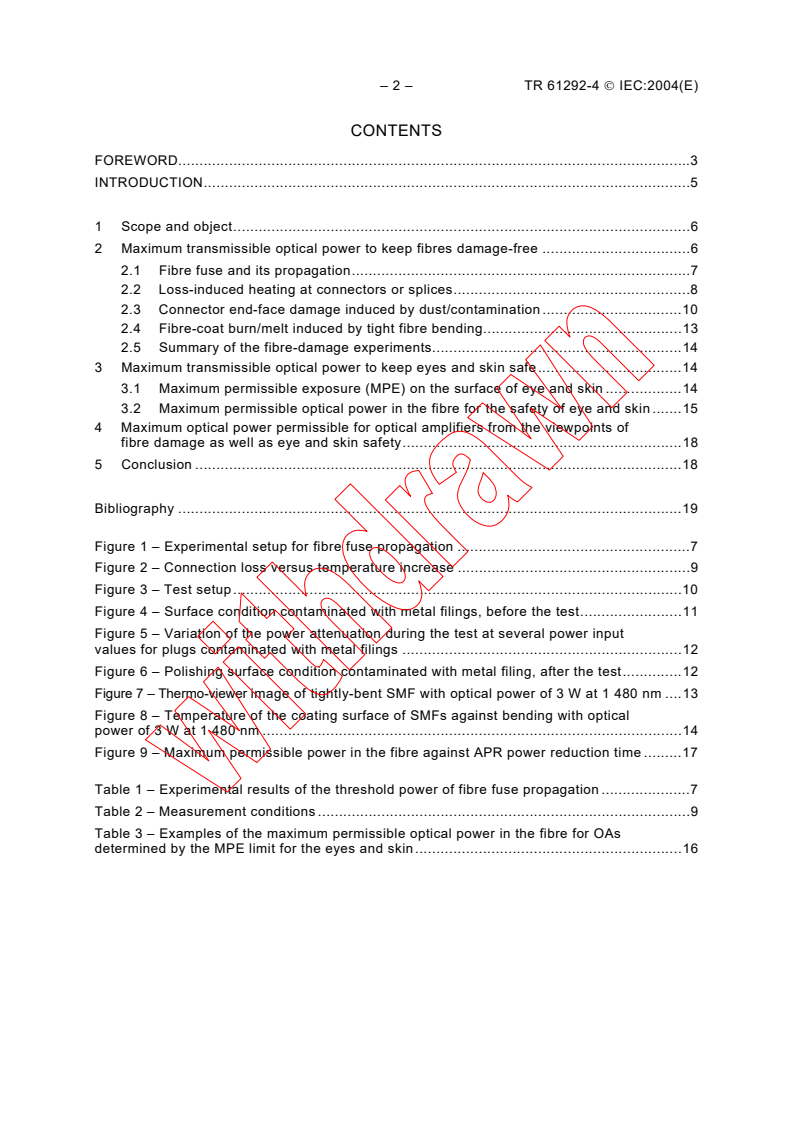
CONTENTS
FOREWORD.3
INTRODUCTION.5
1 Scope and object.6
2 Maximum transmissible optical power to keep fibres damage-free .6
2.1 Fibre fuse and its propagation.7
2.2 Loss-induced heating at connectors or splices.8
2.3 Connector end-face damage induced by dust/contamination .10
2.4 Fibre-coat burn/melt induced by tight fibre bending.13
2.5 Summary of the fibre-damage experiments.14
3 Maximum transmissible optical power to keep eyes and skin safe.14
3.1 Maximum permissible exposure (MPE) on the surface of eye and skin .14
3.2 Maximum permissible optical power in the fibre for the safety of eye and skin .15
4 Maximum optical power permissible for optical amplifiers from the viewpoints of
fibre damage as well as eye and skin safety.18
5 Conclusion.18
Bibliography .19
Figure 1 – Experimental setup for fibre fuse propagation .7
Figure 2 – Connection loss versus temperature increase .9
Figure 3 – Test setup.10
Figure 4 – Surface condition contaminated with metal filings, before the test.11
Figure 5 – Variation of the power attenuation during the test at several power input
values for plugs contaminated with metal filings .12
Figure 6 – Polishing surface condition contaminated with metal filing, after the test.12
Figure 7 – Thermo-viewer image of tightly-bent SMF with optical power of 3 W at 1 480 nm .13
Figure 8 – Temperature of the coating surface of SMFs against bending with optical
power of 3 W at 1 480 nm .14
Figure 9 – Maximum permissible power in the fibre against APR power reduction time .17
Table 1 – Experimental results of the threshold power of fibre fuse propagation .7
Table 2 – Measurement conditions .9
Table 3 – Examples of the maximum permissible optical power in the fibre for OAs
determined by the MPE limit for the eyes and skin.16
TR 61292-4 ” IEC:2004(E) – 3 –
INTERNATIONAL ELECTROTECHNICAL COMMISSION
____________
OPTICAL AMPLIFIERS –
Part 4: Maximum permissible optical power
for the damage-free and safe use of optical amplifiers,
including Raman amplifiers
FOREWORD
1) The International Electrotechnical Commission (IEC) is a worldwide organization for standardization comprising
all national electrotechnical committees (IEC National Committees). The object of IEC is to promote
international co-operation on all questions concerning standardization in the electrical and electronic fields. To
this end and in addition to other activities, IEC publishes International Standards, Technical Specifications,
Technical Reports, Publicly Available Specifications (PAS) and Guides (hereafter referred to as “IEC
Publication(s)”). Their preparation is entrusted to technical committees; any IEC National Committee interested
in the subject dealt with may participate in this preparatory work. International, governmental and non-
governmental organizations liaising with the IEC also participate in this preparation. IEC collaborates closely
with the International Organization for Standardization (ISO) in accordance with conditions determined by
agreement between the two organizations.
2) The formal decisions or agreements of IEC on technical matters express, as nearly as possible, an international
consensus of opinion on the relevant subjects since each technical committee has representation from all
interested IEC National Committees.
3) IEC Publications have the form of recommendations for international use and are accepted by IEC National
Committees in that sense. While all reasonable efforts are made to ensure that the technical content of IEC
Publications is accurate, IEC cannot be held responsible for the way in which they are used or for any
misinterpretation by any end user.
4) In order to promote international uniformity, IEC National Committees undertake to apply IEC Publications
transparently to the maximum extent possible in their national and regional publications. Any divergence
between any IEC Publication and the corresponding national or regional publication shall be clearly indicated in
the latter.
5) IEC provides no marking procedure to indicate its approval and cannot be rendered responsible for any
equipment declared to be in conformity with an IEC Publication.
6) All users should ensure that they have the latest edition of this publication.
7) No liability shall attach to IEC or its directors, employees, servants or agents including individual experts and
members of its technical committees and IEC National Committees for any personal injury, property damage or
other damage of any nature whatsoever, whether direct or indirect, or for costs (including legal fees) and
expenses arising out of the publication, use of, or reliance upon, this IEC Publication or any other IEC
Publications.
8) Attention is drawn to the Normative references cited in this publication. Use of the referenced publications is
indispensable for the correct application of this publication.
9) Attention is drawn to the possibility that some of the elements of this IEC Publication may be the subject of
patent rights. IEC shall not be held responsible for identifying any or all such patent rights.
The main task of IEC technical committees is to prepare International Standards. However, a
technical committee may propose the publication of a technical report when it has collected
data of a different kind from that which is normally published as an International Standard, for
example "state of the art".
IEC 61292-4, which is a technical report, has been prepared by subcommittee 86C: Fibre
optic systems and active devices, of IEC technical committee 86: Fibre optics.
The text of this technical report is based on the following documents:
Enquiry draft Report on voting
86C/593/DTR 86C/629/RVC
Full information on the voting for the approval of this technical report can be found in the
report on voting indicated in the above table.
– 4 – TR 61292-4 ” IEC:2004(E)
This publication has been drafted in accordance with the ISO/IEC Directives, Part 2.
IEC 61292 consists of the following parts, under the new general title Optical amplifiers:
Part 1: Parameters of amplifier components
Part 2: Theoretical background for noise figure evaluation using the electrical spectrum
analyzer
Part 3: Classification, characteristics and applications
Part 4: Maximum permissible optical power for the damage-free and safe use of optical
amplifiers, including Raman amplifiers
Part 5: Polarization mode dispersion parameter – General parameter
Future standards in this series will carry the new general title as cited above. Titles of existing
standards in this series will be updated at the time of the next edition.
The committee has decided that the contents of this publication will remain unchanged until
the maintenance result date indicated on the IEC web site under "http://webstore.iec.ch" in
the data related to the specific publication. At this date, the publication will be
reconfirmed;
withdrawn;
replaced by a revised edition, or
amended.
A bilingual version of this publication may be issued at a later date.
㩷
TR 61292-4 ” IEC:2004(E) – 5 –
INTRODUCTION
This technical report is dedicated to the subject of maximum permissible optical power for
damage-free and safe use of optical amplifiers, including Raman amplifiers. Since the
technology is quite new and still evolving, amendments and new editions to this document can
be expected.
Many new types of optical amplifiers are entering the marketplace and research on this
subject is also stimulating many new types of fibre and non-fibre based optical amplifier
research. With the introduction of such technologies as long-haul, 40Gb/s, WDM transmission
and Raman amplification, some optical amplifiers may involve optical pump sources with
extremely high optical power – up to, possibly, several watts.
Excessively high optical power may cause physical damage to the fibres/optical
components/equipment as well as present medical danger to the human eye and skin.
The possibility of fibre damage caused by high optical intensity has recently been discussed
at some technical conferences. IEC Technical Committee 31 (Electrical apparatus for
explosive atmospheres) is also discussing the risk of ignition of hazardous environments by
radiation from optical equipment.
The medical aspects have long been discussed at standards groups. IEC Technical
Committee 76 (Optical radiation safety and laser equipment) precisely describes in
IEC 60825-2 the concept of hazard level and labelling and addresses the safety aspects of
lasers specifically in relation to tissue damage.
ITU-T Study Group 15 (Optical and other transport networks) has published Recommendation
G.664, which primarily discusses the automatic laser power reduction functionality for safety.
With the recent growth of interest in fibre Raman amplifiers, however, some difficulties have
been identified among optical amplifier users and manufacturers in fully understanding the
technical details and requirements across all such standards and agreements.
This technical report, therefore, provides a simple informative guideline on the maximum
optical power permissible for optical amplifiers. To the best of our knowledge, this is the first
international guideline on the maximum optical power permissible in optical fibre devices that
takes both physical and medical viewpoints into consideration.
– 6 – TR 61292-4 ” IEC:2004(E)
OPTICAL AMPLIFIERS –
Part 4: Maximum permissible optical power
for the damage-free and safe use of optical amplifiers,
including Raman amplifiers
1 Scope and object
This technical report applies to all commercially available optical amplifiers (OAs), including
optical fibre amplifiers (OFAs) using active fibres, as well as Raman amplifiers.
Semiconductor optical amplifiers (SOAs) using semiconductor gain media are also included.
This technical report provides a simple informative guideline on the threshold of high optical
power that causes high-temperature damage of fibre. Also discussed is optical safety for
manufacturers and users of optical amplifiers by reiterating substantial parts of existing
standards and agreements on eye and skin safety.
To identify the maximum permissible optical power in the optical amplifier from damage-free
and safety viewpoints, this technical report identifies the following values:
– the optical power limit that causes thermal damage to the fibre, such as fibre fuse and
fibre-coat burning;
– the maximum permissible exposure (MPE) to which the eyes/skin can be exposed without
consequential injury;
– the optical power limit in the fibre that causes MPE on the eyes/skin after free-space
propagation from the fibre;
– the absolute allowable damage-free and safe level of optical power of the optical amplifier
by comparing (a) and (c).
The objective of this technical report is to minimize potential confusion and misunderstanding
in the industry that might cause unnecessary alarm and hinder the progress and acceptance
of advancing optical amplifier technologies and markets.
It is important to point out that the reader should always refer to the latest international
standards and agreements, because the technologies concerned are rapidly evolving. In fact,
the concept of hazard level and labelling is still evolving: more rigorous labelling requirements
are under discussion in IEC Technical Committee 76 as of October 2003.
The technical report will be frequently reviewed and will be updated by incorporating the
results of various studies related to OAs and OA-supported optical systems in a timely
manner.
2 Maximum transmissible optical power to keep fibres damage-free
The use and reasonably foreseeable misuse of high intensity optical amplifiers may cause
problems in the fibre such as:
a) fibre fuse and its propagation;
b) heating in the splice point/connection point;
c) fibre end-face damage due to dust and other contamination;
d) fibre coat burning and ignition of hazardous environments due to tight fibre bending or
breakage.
TR 61292-4 ” IEC:2004(E) – 7 –
This clause introduces the experiments and their results concerning the above issues to give
guidelines for the damage-free use of optical amplifiers. However, it must be noted that the
following results are only valid under the conditions tested and that a higher power might be
allowed under different conditions.
2.1 Fibre fuse and its propagation
2.1.1 Introduction
The safety of optical amplifiers should be discussed from the viewpoint of laser hazard to the
eyes and skin as well as fibre damage such as fibre-coat burning and fibre fusing. This
document experimentally analyzes the fibre fuse and its propagation caused by high optical
power and discusses the threshold of optical power.
2.1.2 Experiment and results
The experimental setup is shown in Figure 1, in which the fibre fuse was initiated by heating
the optical fibre from outside of the fibre by using an independent heat source, while a high
optical power was continuously launched into the fibre. The wavelength of the high-power
optical source was 1 467 nm, which is a typical pump wavelength for distributed Raman
amplification.
Sample 10 m - 20 m
SMF SMF
1 467 nm
Optical power
6 W Max.
meter
SMF/DSF
Splicing
Heating
(initiation for fibre fuse)
IEC 1218/04
Figure 1 – Experimental setup for fibre fuse propagation
It was confirmed that the temperature of the fibre portion heated when the fuse initiated was
greater than 1 000 °C. Once the fibre fuse began propagating, the optical source power was
continuously reduced until the fuse propagation stopped. The threshold power for the fuse
propagation was 1,4 W and 1,2 W for standard single mode fibre (SMF) and dispersion shifted
fibre (DSF) respectively, as shown in Table 1. The results for three trials are shown.
Table 1 – Experimental results of the threshold power
of fibre fuse propagation
Standard single mode fibre 1,41 W, 1,45 W, 1,51 W
Dispersion shifter fibre 1,19 W, 1,19 W, 1,20 W
The difference in the fibre mode-field diameter might have been the major reason for the
1)
difference in the threshold powers, because the fibre fuse depends on the power density [1] .
The threshold power for the fibre fuse propagation was quite reproducible.
On the other hand, it was difficult to identify the threshold power for the fibre fuse initiation
based on the above experiments, because it varied significantly.
___________
1)
Figures in square brackets refer to the Bibliography.
– 8 – TR 61292-4 ” IEC:2004(E)
Although the mechanism of fibre fuse initiation is not yet well understood, the threshold
seems to depend on the conditions, i.e., clean or dirty, of the fibre end faces where the very
first fibre fuse takes place.
It was confirmed through repeated experiments, however, that the initiation threshold well
exceeded 1,2 W and 1,4 W for various fibre end-face conditions.
The above information was made available from Furukawa Electric (Japan in Oct. 2002) and
was reported [1] at the 2003 International Laser Safety Conference in Jacksonville, FL, USA.
This issue was also discussed in other literature [3] as follows.
The main physical mechanism responsible for the fibre fuse phenomenon and its propagation
is optical discharge propagation due to thermal conductivity. It can be initiated in most fibre
types by launching a CW laser into a fibre and ensuring contact of the fibre output end face
with some absorbing surface or by heating a section of the fibre.
The temperature of the optical discharge plasma is about 5 000° to 10 000 °K. The speed of
its propagation is about 1m/s in typical single mode fibres at a laser power of approximately
1 W. Examination of the fibre core after such discharge reveals extensive damage in the form
of voids which have the form of bubbles (sometimes periodic) or long non-periodic filaments.
Because the most probable reason for optical discharge is a contaminated end face, fusion
splicing is the most reliable way to reduce the risk of high-power damage. Optical isolators
used in some schemes can also be damaged. Unfortunately, their survivability at high power
is an open question.
The literature [3] includes a figure reporting the measured dependencies of threshold intensity
for the propagation of optical discharge through the fibre (the power at which such
propagation is terminated) on the mode field diameter of single-mode fibres of different core
compositions.
The figure includes 21 data points for the mode field diameter (MFD) between 2 Pm and
14 Pm and identifies that the mean values of the threshold intensity I were 3,6 MW/cm ,
th
2 2
2,5 MW/cm and 1,2 MW/cm for the MFD of 4 Pm, 6ҏPm and 8 Pm , respectively. I was
th
constant at 1,2 MW/cm for MFD over 8 Pm.
2 2
The I varied between +0,3 MW/cm and –0,6 MW/cm , depending on the core compositions
th
under the conditions tested, except in one extraordinary case. Here, the mean thresholds for
the MFD of 8 Pm and 10 Pm respectively corresponded to 2,5 W and 1,6 W, if the entire
intensity is assumed to be within the mode field
2.1.3 Conclusion
The threshold optical powers of fibre fuse propagation reported in Figure 1 and Table 1 were
found to be 1,4 W and 1,2 W for SMF and DSF respectively under the conditions tested. On
the other hand, the fuse-initiation threshold varied significantly, although they well exceeded
1,4 W and 1,2 W. Another report identified that a little more power than the above experiment
could be allowed, although the information available on the fibre was limited.
2.2 Loss-induced heating at connectors or splices
2.2.1 Introduction
In extremely high power optical amplifiers, the loss-induced heating at fibres and connectors
or splices could lead to damage, including fibre-coat burning, fibre fuse, etc. This subclause
provides experimental data [1] and considerations for information.
TR 61292-4 ” IEC:2004(E) – 9 –
2.2.2 Experiment on the connector
Table 2 summarizes the measurement conditions. The experiment used MU type optical
connectors for standard single mode fibre (SMF) and dispersion shifted fibre (DSF), where
loss was increased by optical fibre misalignment. The optical source used was a 2-W Raman
pump at 1 480 nm. The connector temperature was measured by a thermocouple placed on
the sleeve. Since the MU ferrule diameter was only 1,25 mm, the sleeve temperature was
almost the same as that of the ferrule; ferrule temperature is the most important factor
determining the long-term reliability of optical connectors [2].
Table 2 – Measurement conditions
Parameter Conditions
Fibre SMF, DSF
Connec
...