


IEC TS 62796:2013
(Main)Energy efficiency in electroheating installations
General Information
- Abstract
IEC/TS 62693:2013(E) is applicable to industrial electroheating installations using electric energy as input, alone or in combination with other kinds of energy. However, external combustible fuel energy input is not dealt with, and all considerations begin at the electric only mains frequency source to which the installation is connected. Any external voltage transformation from the supply network to the plant into a special voltage which is fed into the installation is not dealt with in this Technical Specification, since it is not considered a responsibility of the manufacturer of the installation.
- Status
- Replaced
- Publication Date
- 29-May-2013
- Technical Committee
- TC 27 - Industrial electroheating and electromagnetic processing
- Drafting Committee
- MT 18 - TC 27/MT 18
- Current Stage
- DELPUB - Deleted Publication
- Start Date
- 09-Apr-2015
- Completion Date
- 28-Aug-2026
Buy Documents

IEC TS 62796:2013 - Energy efficiency in electroheating installations Released:5/30/2013

IEC TS 62796:2013 - Energy efficiency in electroheating installations
Relations
- Effective Date
- 05-Sep-2023
Buy Documents
IEC TS 62796:2013 - Energy efficiency in electroheating installations Released:5/30/2013
IEC TS 62796:2013 - Energy efficiency in electroheating installations
Get Certified
Connect with accredited certification bodies for this standard

DVS-ZERT GmbH
German welding certification society.
CARES (UK Certification Authority for Reinforcing Steels)
UK certification for reinforcing steels and construction.
EWF/IIW (European/International Welding Federation)
International welding personnel certification.
Sponsored listings
Frequently Asked Questions
IEC TS 62796:2013 is a technical specification published by the International Electrotechnical Commission (IEC). Its full title is "Energy efficiency in electroheating installations". This standard covers: IEC/TS 62693:2013(E) is applicable to industrial electroheating installations using electric energy as input, alone or in combination with other kinds of energy. However, external combustible fuel energy input is not dealt with, and all considerations begin at the electric only mains frequency source to which the installation is connected. Any external voltage transformation from the supply network to the plant into a special voltage which is fed into the installation is not dealt with in this Technical Specification, since it is not considered a responsibility of the manufacturer of the installation.
IEC/TS 62693:2013(E) is applicable to industrial electroheating installations using electric energy as input, alone or in combination with other kinds of energy. However, external combustible fuel energy input is not dealt with, and all considerations begin at the electric only mains frequency source to which the installation is connected. Any external voltage transformation from the supply network to the plant into a special voltage which is fed into the installation is not dealt with in this Technical Specification, since it is not considered a responsibility of the manufacturer of the installation.
IEC TS 62796:2013 is classified under the following ICS (International Classification for Standards) categories: 25.180.10 - Electric furnaces. The ICS classification helps identify the subject area and facilitates finding related standards.
IEC TS 62796:2013 has the following relationships with other standards: It is inter standard links to IEC 60398:2015. Understanding these relationships helps ensure you are using the most current and applicable version of the standard.
IEC TS 62796:2013 is available in PDF format for immediate download after purchase. The document can be added to your cart and obtained through the secure checkout process. Digital delivery ensures instant access to the complete standard document.
Standards Content (Sample)
IEC/TS 62796 ®
Edition 1.0 2013-05
TECHNICAL
SPECIFICATION
Energy efficiency in electroheating installations
IEC/TS 62796:2013(E)
All rights reserved. Unless otherwise specified, no part of this publication may be reproduced or utilized in any form
or by any means, electronic or mechanical, including photocopying and microfilm, without permission in writing from
either IEC or IEC's member National Committee in the country of the requester.
If you have any questions about IEC copyright or have an enquiry about obtaining additional rights to this publication,
please contact the address below or your local IEC member National Committee for further information.
IEC Central Office Tel.: +41 22 919 02 11
3, rue de Varembé Fax: +41 22 919 03 00
CH-1211 Geneva 20 info@iec.ch
Switzerland www.iec.ch
About the IEC
The International Electrotechnical Commission (IEC) is the leading global organization that prepares and publishes
International Standards for all electrical, electronic and related technologies.
About IEC publications
The technical content of IEC publications is kept under constant review by the IEC. Please make sure that you have the
latest edition, a corrigenda or an amendment might have been published.
Useful links:
IEC publications search - www.iec.ch/searchpub Electropedia - www.electropedia.org
The advanced search enables you to find IEC publications The world's leading online dictionary of electronic and
by a variety of criteria (reference number, text, technical electrical terms containing more than 30 000 terms and
committee,…). definitions in English and French, with equivalent terms in
It also gives information on projects, replaced and additional languages. Also known as the International
withdrawn publications. Electrotechnical Vocabulary (IEV) on-line.
IEC Just Published - webstore.iec.ch/justpublished Customer Service Centre - webstore.iec.ch/csc
Stay up to date on all new IEC publications. Just Published If you wish to give us your feedback on this publication
details all new publications released. Available on-line and or need further assistance, please contact the
also once a month by email. Customer Service Centre: csc@iec.ch.
IEC/TS 62796 ®
Edition 1.0 2013-05
TECHNICAL
SPECIFICATION
Energy efficiency in electroheating installations
INTERNATIONAL
ELECTROTECHNICAL
COMMISSION
PRICE CODE
Q
ICS 25.180.10 ISBN 978-2-83220-855-7
– 2 – TS 62796 © IEC:2013(E)
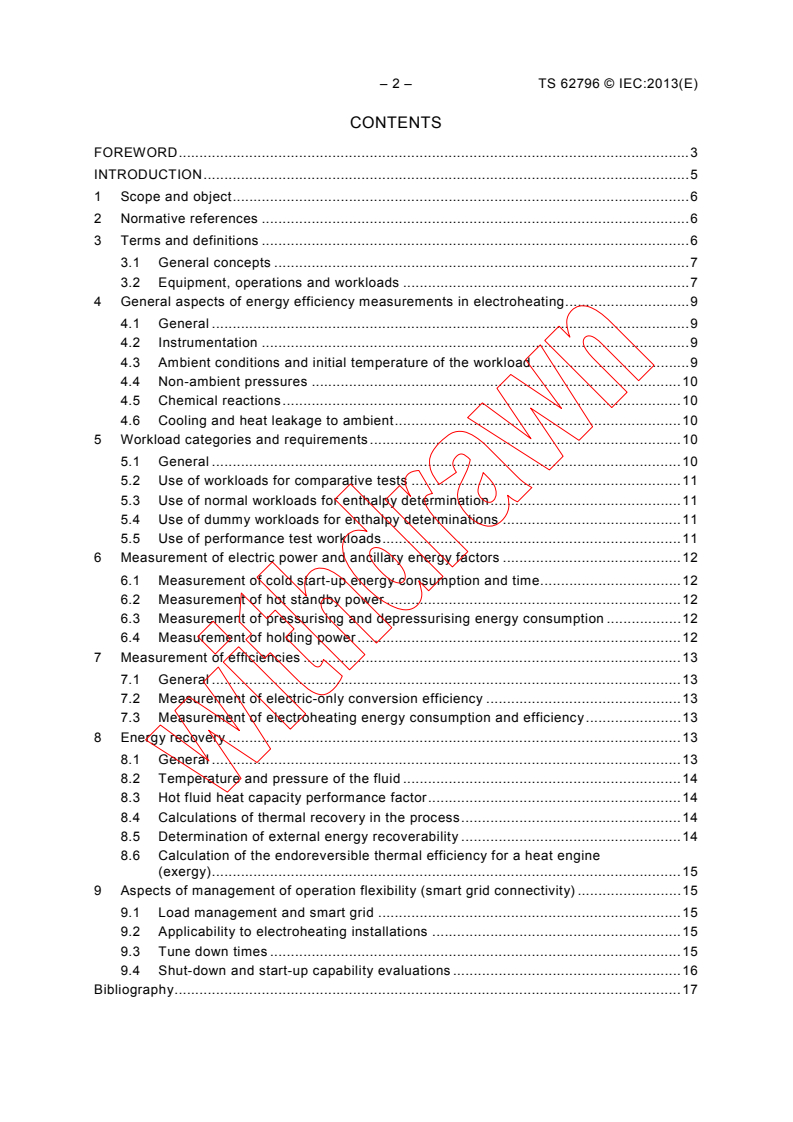
CONTENTS
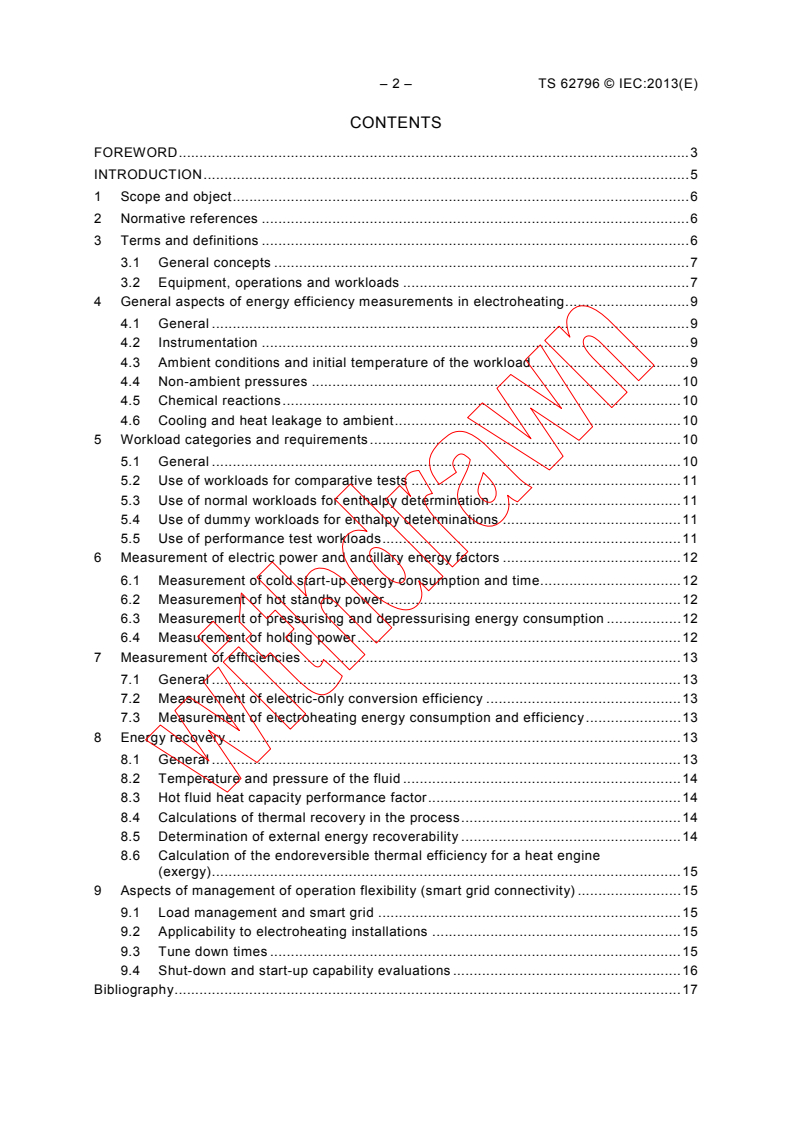
FOREWORD . 3
INTRODUCTION . 5
1 Scope and object . 6
2 Normative references . 6
3 Terms and definitions . 6
3.1 General concepts . 7
3.2 Equipment, operations and workloads . 7
4 General aspects of energy efficiency measurements in electroheating . 9
4.1 General . 9
4.2 Instrumentation . 9
4.3 Ambient conditions and initial temperature of the workload . 9
4.4 Non-ambient pressures . 10
4.5 Chemical reactions . 10
4.6 Cooling and heat leakage to ambient . 10
5 Workload categories and requirements . 10
5.1 General . 10
5.2 Use of workloads for comparative tests . 11
5.3 Use of normal workloads for enthalpy determination . 11
5.4 Use of dummy workloads for enthalpy determinations . 11
5.5 Use of performance test workloads . 11
6 Measurement of electric power and ancillary energy factors . 12
6.1 Measurement of cold start-up energy consumption and time . 12
6.2 Measurement of hot standby power . 12
6.3 Measurement of pressurising and depressurising energy consumption . 12
6.4 Measurement of holding power . 12
7 Measurement of efficiencies . 13
7.1 General . 13
7.2 Measurement of electric-only conversion efficiency . 13
7.3 Measurement of electroheating energy consumption and efficiency . 13
8 Energy recovery . 13
8.1 General . 13
8.2 Temperature and pressure of the fluid . 14
8.3 Hot fluid heat capacity performance factor . 14
8.4 Calculations of thermal recovery in the process . 14
8.5 Determination of external energy recoverability . 14
8.6 Calculation of the endoreversible thermal efficiency for a heat engine
(exergy) . 15
9 Aspects of management of operation flexibility (smart grid connectivity) . 15
9.1 Load management and smart grid . 15
9.2 Applicability to electroheating installations . 15
9.3 Tune down times . 15
9.4 Shut-down and start-up capability evaluations . 16
Bibliography . 17
TS 62796 © IEC:2013(E) – 3 –
INTERNATIONAL ELECTROTECHNICAL COMMISSION
____________
ENERGY EFFICIENCY IN ELECTROHEATING INSTALLATIONS
FOREWORD
1) The International Electrotechnical Commission (IEC) is a worldwide organization for standardization comprising
all national electrotechnical committees (IEC National Committees). The object of IEC is to promote
international co-operation on all questions concerning standardization in the electrical and electronic fields. To
this end and in addition to other activities, IEC publishes International Standards, Technical Specifications,
Technical Reports, Publicly Available Specifications (PAS) and Guides (hereafter referred to as “IEC
Publication(s)”). Their preparation is entrusted to technical committees; any IEC National Committee interested
in the subject dealt with may participate in this preparatory work. International, governmental and non-
governmental organizations liaising with the IEC also participate in this preparation. IEC collaborates closely
with the International Organization for Standardization (ISO) in accordance with conditions determined by
agreement between the two organizations.
2) The formal decisions or agreements of IEC on technical matters express, as nearly as possible, an international
consensus of opinion on the relevant subjects since each technical committee has representation from all
interested IEC National Committees.
3) IEC Publications have the form of recommendations for international use and are accepted by IEC National
Committees in that sense. While all reasonable efforts are made to ensure that the technical content of IEC
Publications is accurate, IEC cannot be held responsible for the way in which they are used or for any
misinterpretation by any end user.
4) In order to promote international uniformity, IEC National Committees undertake to apply IEC Publications
transparently to the maximum extent possible in their national and regional publications. Any divergence
between any IEC Publication and the corresponding national or regional publication shall be clearly indicated in
the latter.
5) IEC itself does not provide any attestation of conformity. Independent certification bodies provide conformity
assessment services and, in some areas, access to IEC marks of conformity. IEC is not responsible for any
services carried out by independent certification bodies.
6) All users should ensure that they have the latest edition of this publication.
7) No liability shall attach to IEC or its directors, employees, servants or agents including individual experts and
members of its technical committees and IEC National Committees for any personal injury, property damage or
other damage of any nature whatsoever, whether direct or indirect, or for costs (including legal fees) and
expenses arising out of the publication, use of, or reliance upon, this IEC Publication or any other IEC
Publications.
8) Attention is drawn to the Normative references cited in this publication. Use of the referenced publications is
indispensable for the correct application of this publication.
9) Attention is drawn to the possibility that some of the elements of this IEC Publication may be the subject of
patent rights. IEC shall not be held responsible for identifying any or all such patent rights.
The main task of IEC technical committees is to prepare International Standards. In
exceptional circumstances, a technical committee may propose the publication of a technical
specification when
• the required support cannot be obtained for the publication of an International Standard,
despite repeated efforts, or
• the subject is still under technical development or where, for any other reason, there is the
future but no immediate possibility of an agreement on an International Standard.
Technical specifications are subject to review within three years of publication to decide
whether they can be transformed into International Standards.
IEC 62796, which is a technical specification, has been prepared by IEC technical
committee 27: Industrial electroheating and electromagnetic processing.
– 4 – TS 62796 © IEC:2013(E)
The text of this technical specification is based on the following documents:
Enquiry draft Report on voting
27/882/DTS 27/903/RVC
Full information on the voting for the approval of this technical specification can be found in
the report on voting indicated in the above table.
This publication has been drafted in accordance with the ISO/IEC Directives, Part 2.
The committee has decided that the contents of this publication will remain unchanged until
the stability date indicated on the IEC web site under "http://webstore.iec.ch" in the data
related to the specific publication. At this date, the publication will be
• transformed into an International Standard,
• reconfirmed,
• withdrawn,
• replaced by a revised edition, or
• amended.
TS 62796 © IEC:2013(E) – 5 –
INTRODUCTION
This Technical Specification (TS) was prepared by a working group of IEC TC 27, whose
overall intent was to develop guidelines for the classification of industrial electroheating
systems, which allow for the determination of the performance/efficiency of a given system
and a comparison with other systems of that class.
The initial technical considerations suggested that TC 27 should at first limit its focus on
determination of energy consumption for a defined output of processed workload. The next
step should then be consideration of performance characteristics influencing the energy
efficiency, such as metallurgical or thermal processing particulars. However, during the
course of the work, it turned out that comparisons of performance can best be made by
specifying different workloads for different kinds of comparisons.
Measurements of efficiencies are split into two main categories: electrical-only and of the
electroheating in normal operation. The latter has a relationship to other performance aspects
which are also dealt with.
Testing requires specification limits on workload and three kinds are defined:
– normal workloads – i.e. such within the specifications provided by the manufacturer;
– dummy workloads – artificial items specially designed to very efficiently absorb the
available output power without being processed or modified as the normal workload, and
by that promoting the accuracy of enthalpy increase measurements;
– performance test workloads – artificial or partially artificial workloads specially designed
for discrimination of processing results.
The TS provides general methods for determination of the efficiency of electroheating
systems and is intended to assist in creating a consistent terminology and structure in various
TC 27 test standards dealing with specific equipment types. The TS material is to be covered
.
by the future third edition of IEC 60398 [3]
___________
Numbers in square brackets refer to the Bibliography.
– 6 – TS 62796 © IEC:2013(E)
ENERGY EFFICIENCY IN ELECTROHEATING INSTALLATIONS
1 Scope and object
This Technical Specification is applicable to industrial electroheating installations using
electric energy as input, alone or in combination with other kinds of energy. However, external
combustible fuel energy input is not dealt with, and all considerations begin at the electric
only mains frequency source to which the installation is connected. Any external voltage
transformation from the supply network to the plant into a special voltage which is fed into the
installation is not dealt with in this Technical Specification, since it is not considered a
responsibility of the manufacturer of the installation.
The object of this Technical Specification is to provide methods for determination of the
efficiency of a given system as well as enabling comparisons with other equipment using the
same principle for processing of the workload.
For satisfactory comparisons to be possible, differences in end product quality and influences
of environmental factors on heat recovery are included.
Heat recovery aspects are dealt with but limited to the temperature changes, the specific heat
capacity characteristics, and the physical properties of the usually fluidic substance obtained
from the installation and employed for energy recovery use. Conversion into mechanical
energy is dealt with.
Adaptation to the needs of operation and performance management as might be necessary
for the implementation or application of smart grid technologies, is addressed but no test
methods are given.
A guideline is provided for the development of the detailed electroheating efficiency tests for
the particular test method standards. The different principles of electroheating for processing
a workload, and types of equipment, are given in Clause 1 of IEC 60519-1:2010.
If energy from combustible gases or liquids is used in addition to electric energy, the
measurement and calculation of the energy efficiency contribution of combustion in the
installation are made according to the relevant ISO standards. These may deal with the
electric energy input in other ways than in this Technical Specification.
NOTE The relevant standards in the ISO 13579 series are listed in the Bibliography [4 – 7].
2 Normative references
The following documents, in whole or in part, are normatively referenced in this document and
are indispensable for its application. For dated references, only the edition cited applies. For
undated references, the latest edition of the referenced document (including any
amendments) applies.
IEC 60519-1:2010, Safety in electroheating installations – Part 1: General requirements
3 Terms and definitions
For the purposes of this document, terms and definitions given in IEC 60519-1:2010 and the
following apply.
TS 62796 © IEC:2013(E) – 7 –
NOTE General definitions are given in IEC 60050, International Electrotechnical Vocabulary [1]. Terms relating to
industrial electroheat are defined in IEC 60050-841.
3.1 General concepts
3.1.1
enthalpy increase
sum of energy added through heating of an object and the mechanical work of expansion of it
done in pushing against the ambient (atmospheric) pressure
Note 1 to entry: The energy of the mechanical work of expansion is stored in the surroundings and can be
recovered if the system collapses back to its initial state.
3.1.2
exergy
maximum fraction of energy in a system including a medium at an initial temperature T which
can be converted into useful work during a process at the end of which the system
temperature is T
Note 1 to entry: This is the theoretical quantity related to the endoreversible thermal efficiency of a heat engine.
3.1.3
heat engine
system that performs the conversion of thermal energy into mechanical work by bringing a
working medium from a high temperature state to a lower temperature state
Note 1 to entry: In the context of this document, the mechanical work is either used directly with an external
generator to create electricity, or with a second external heat engine operating in the heating mode for increasing
the temperature of a part of the hot medium, for further use.
3.1.4
energy recoverability
usefulness of a hot substance obtained in or from a process for providing energy back into the
process or to an external purpose
Note 1 to entry: The usefulness depends on the temperature and ease of handling of the hot substance, and on
the temperature of the recipient.
Note 2 to entry: Transformation into mechanical energy by heat engines is a separate item.
Note 3 to entry: Transformation into chemical energy is not included.
Note 4 to entry: Any heat of combustion of the substance is excluded.
3.2 Equipment, operations and workloads
3.2.1
ambient conditions
environmental conditions
characteristics of the environment which may affect performance of a device or system
EXAMPLE Pressure, temperature, humidity, radiation, vibration.
3.2.2
equipment capacity
measure of the production rate capability of equipment in normal operation
EXAMPLE Flow, mass or volume.
Note 1 to entry: The equipment capacity does not refer to the volume of the working space.
– 8 – TS 62796 © IEC:2013(E)
3.2.3
equipment class
group within a type of equipment, using the same principle for processing of the workload and
the size of this as well as the equipment capacity
Note 1 to entry: An example of type is equipment for induction heating, and a class example is such equipment
for metal wire heating in a specified capacity interval, using medium frequency.
3.2.4
efficiency,
ratio of the usable enthalpy increase in the workload to the electric energy supplied to it at the
location of the equipment, during a cycle of batch operation or stationary operation during a
suitable time period for measurements
[SOURCE: IEC 60050-841:2004, 841-22-70, modified – Enthalpy increase in the workload is
specified instead of useful energy, and measurement time limits have been added.]
3.2.5
performance,
degree to which the intended functions, including energy or power consumption and output as
well as the result of the treatment of the workload are accomplished
3.2.6
end product quality
degree to which a set of inherent characteristics of a processed workload fulfils requirements
3.2.7
power factor
under periodic conditions, ratio of the absolute value of the active power P to the apparent
power S
Note 1 to entry: This is applied to the supply network under normal operation.
[SOURCE: IEC/TS 62257-12-1:2007 [2], 3.4, modified – Note 1 to entry has been added.]
3.2.8
cold start-up
process by which the equipment is energised into hot standby operation from the cold state,
including all other start-up operations which enable the equipment to run under normal
operation
Note 1 to entry: This mode of operation applies to cases where there is a significant energy consumption needed
for obtaining a state of the equipment allowing the actual processing of the workload, see 6.1.
3.2.9
holding power
electric power consumption during which the workload is kept in the treatment chamber at a
specified temperature
Note 1 to entry: The temperature is typically maintained during a time intended to equalize the workload
temperature.
Note 2 to entry: This mode of operation is not applicable for certain types of electroheating equipment.
3.2.10
hot standby operation
mode of operation of the installation occurring immediately after normal operation
Note 1 to entry: This mode of operation of the equipment is with its hot state remaining, without workload, and
with the means of operation ready for prompt normal operation.
TS 62796 © IEC:2013(E) – 9 –
3.2.11
normal operation
range of output settings with the normal workload in allowable working conditions of the
equipment, as specified in the manufacturer’s documentation
3.2.12
normal workload
object being processed at nominal output power, as specified in the manufacturer’s
documentation
Note 1 to entry: The workload is called charge in some electroheating contexts.
Note 2 to entry: The workload includes any container, holder or other device necessary for the processing and
which is directly or indirectly subjected to the output power. The processed object/material as such is also called
load.
3.2.13
dummy workload
artificial item with known th
...
IEC/TS 62796 ®
Edition 1.0 2013-05
TECHNICAL
SPECIFICATION
Energy efficiency in electroheating installations
IEC/TS 62796:2013(E)
All rights reserved. Unless otherwise specified, no part of this publication may be reproduced or utilized in any form
or by any means, electronic or mechanical, including photocopying and microfilm, without permission in writing from
either IEC or IEC's member National Committee in the country of the requester.
If you have any questions about IEC copyright or have an enquiry about obtaining additional rights to this publication,
please contact the address below or your local IEC member National Committee for further information.
IEC Central Office Tel.: +41 22 919 02 11
3, rue de Varembé Fax: +41 22 919 03 00
CH-1211 Geneva 20 info@iec.ch
Switzerland www.iec.ch
About the IEC
The International Electrotechnical Commission (IEC) is the leading global organization that prepares and publishes
International Standards for all electrical, electronic and related technologies.
About IEC publications
The technical content of IEC publications is kept under constant review by the IEC. Please make sure that you have the
latest edition, a corrigenda or an amendment might have been published.
Useful links:
IEC publications search - www.iec.ch/searchpub Electropedia - www.electropedia.org
The advanced search enables you to find IEC publications The world's leading online dictionary of electronic and
by a variety of criteria (reference number, text, technical electrical terms containing more than 30 000 terms and
committee,…). definitions in English and French, with equivalent terms in
It also gives information on projects, replaced and additional languages. Also known as the International
withdrawn publications. Electrotechnical Vocabulary (IEV) on-line.
IEC Just Published - webstore.iec.ch/justpublished Customer Service Centre - webstore.iec.ch/csc
Stay up to date on all new IEC publications. Just Published If you wish to give us your feedback on this publication
details all new publications released. Available on-line and or need further assistance, please contact the
also once a month by email. Customer Service Centre: csc@iec.ch.
IEC/TS 62796 ®
Edition 1.0 2013-05
TECHNICAL
SPECIFICATION
Energy efficiency in electroheating installations
INTERNATIONAL
ELECTROTECHNICAL
COMMISSION
PRICE CODE
Q
ICS 25.180.10 ISBN 978-2-83220-855-7
– 2 – TS 62796 © IEC:2013(E)
CONTENTS
FOREWORD . 3
INTRODUCTION . 5
1 Scope and object . 6
2 Normative references . 6
3 Terms and definitions . 6
3.1 General concepts . 7
3.2 Equipment, operations and workloads . 7
4 General aspects of energy efficiency measurements in electroheating . 9
4.1 General . 9
4.2 Instrumentation . 9
4.3 Ambient conditions and initial temperature of the workload . 9
4.4 Non-ambient pressures . 10
4.5 Chemical reactions . 10
4.6 Cooling and heat leakage to ambient . 10
5 Workload categories and requirements . 10
5.1 General . 10
5.2 Use of workloads for comparative tests . 11
5.3 Use of normal workloads for enthalpy determination . 11
5.4 Use of dummy workloads for enthalpy determinations . 11
5.5 Use of performance test workloads . 11
6 Measurement of electric power and ancillary energy factors . 12
6.1 Measurement of cold start-up energy consumption and time . 12
6.2 Measurement of hot standby power . 12
6.3 Measurement of pressurising and depressurising energy consumption . 12
6.4 Measurement of holding power . 12
7 Measurement of efficiencies . 13
7.1 General . 13
7.2 Measurement of electric-only conversion efficiency . 13
7.3 Measurement of electroheating energy consumption and efficiency . 13
8 Energy recovery . 13
8.1 General . 13
8.2 Temperature and pressure of the fluid . 14
8.3 Hot fluid heat capacity performance factor . 14
8.4 Calculations of thermal recovery in the process . 14
8.5 Determination of external energy recoverability . 14
8.6 Calculation of the endoreversible thermal efficiency for a heat engine
(exergy) . 15
9 Aspects of management of operation flexibility (smart grid connectivity) . 15
9.1 Load management and smart grid . 15
9.2 Applicability to electroheating installations . 15
9.3 Tune down times . 15
9.4 Shut-down and start-up capability evaluations . 16
Bibliography . 17
TS 62796 © IEC:2013(E) – 3 –
INTERNATIONAL ELECTROTECHNICAL COMMISSION
____________
ENERGY EFFICIENCY IN ELECTROHEATING INSTALLATIONS
FOREWORD
1) The International Electrotechnical Commission (IEC) is a worldwide organization for standardization comprising
all national electrotechnical committees (IEC National Committees). The object of IEC is to promote
international co-operation on all questions concerning standardization in the electrical and electronic fields. To
this end and in addition to other activities, IEC publishes International Standards, Technical Specifications,
Technical Reports, Publicly Available Specifications (PAS) and Guides (hereafter referred to as “IEC
Publication(s)”). Their preparation is entrusted to technical committees; any IEC National Committee interested
in the subject dealt with may participate in this preparatory work. International, governmental and non-
governmental organizations liaising with the IEC also participate in this preparation. IEC collaborates closely
with the International Organization for Standardization (ISO) in accordance with conditions determined by
agreement between the two organizations.
2) The formal decisions or agreements of IEC on technical matters express, as nearly as possible, an international
consensus of opinion on the relevant subjects since each technical committee has representation from all
interested IEC National Committees.
3) IEC Publications have the form of recommendations for international use and are accepted by IEC National
Committees in that sense. While all reasonable efforts are made to ensure that the technical content of IEC
Publications is accurate, IEC cannot be held responsible for the way in which they are used or for any
misinterpretation by any end user.
4) In order to promote international uniformity, IEC National Committees undertake to apply IEC Publications
transparently to the maximum extent possible in their national and regional publications. Any divergence
between any IEC Publication and the corresponding national or regional publication shall be clearly indicated in
the latter.
5) IEC itself does not provide any attestation of conformity. Independent certification bodies provide conformity
assessment services and, in some areas, access to IEC marks of conformity. IEC is not responsible for any
services carried out by independent certification bodies.
6) All users should ensure that they have the latest edition of this publication.
7) No liability shall attach to IEC or its directors, employees, servants or agents including individual experts and
members of its technical committees and IEC National Committees for any personal injury, property damage or
other damage of any nature whatsoever, whether direct or indirect, or for costs (including legal fees) and
expenses arising out of the publication, use of, or reliance upon, this IEC Publication or any other IEC
Publications.
8) Attention is drawn to the Normative references cited in this publication. Use of the referenced publications is
indispensable for the correct application of this publication.
9) Attention is drawn to the possibility that some of the elements of this IEC Publication may be the subject of
patent rights. IEC shall not be held responsible for identifying any or all such patent rights.
The main task of IEC technical committees is to prepare International Standards. In
exceptional circumstances, a technical committee may propose the publication of a technical
specification when
• the required support cannot be obtained for the publication of an International Standard,
despite repeated efforts, or
• the subject is still under technical development or where, for any other reason, there is the
future but no immediate possibility of an agreement on an International Standard.
Technical specifications are subject to review within three years of publication to decide
whether they can be transformed into International Standards.
IEC 62796, which is a technical specification, has been prepared by IEC technical
committee 27: Industrial electroheating and electromagnetic processing.
– 4 – TS 62796 © IEC:2013(E)
The text of this technical specification is based on the following documents:
Enquiry draft Report on voting
27/882/DTS 27/903/RVC
Full information on the voting for the approval of this technical specification can be found in
the report on voting indicated in the above table.
This publication has been drafted in accordance with the ISO/IEC Directives, Part 2.
The committee has decided that the contents of this publication will remain unchanged until
the stability date indicated on the IEC web site under "http://webstore.iec.ch" in the data
related to the specific publication. At this date, the publication will be
• transformed into an International Standard,
• reconfirmed,
• withdrawn,
• replaced by a revised edition, or
• amended.
TS 62796 © IEC:2013(E) – 5 –
INTRODUCTION
This Technical Specification (TS) was prepared by a working group of IEC TC 27, whose
overall intent was to develop guidelines for the classification of industrial electroheating
systems, which allow for the determination of the performance/efficiency of a given system
and a comparison with other systems of that class.
The initial technical considerations suggested that TC 27 should at first limit its focus on
determination of energy consumption for a defined output of processed workload. The next
step should then be consideration of performance characteristics influencing the energy
efficiency, such as metallurgical or thermal processing particulars. However, during the
course of the work, it turned out that comparisons of performance can best be made by
specifying different workloads for different kinds of comparisons.
Measurements of efficiencies are split into two main categories: electrical-only and of the
electroheating in normal operation. The latter has a relationship to other performance aspects
which are also dealt with.
Testing requires specification limits on workload and three kinds are defined:
– normal workloads – i.e. such within the specifications provided by the manufacturer;
– dummy workloads – artificial items specially designed to very efficiently absorb the
available output power without being processed or modified as the normal workload, and
by that promoting the accuracy of enthalpy increase measurements;
– performance test workloads – artificial or partially artificial workloads specially designed
for discrimination of processing results.
The TS provides general methods for determination of the efficiency of electroheating
systems and is intended to assist in creating a consistent terminology and structure in various
TC 27 test standards dealing with specific equipment types. The TS material is to be covered
.
by the future third edition of IEC 60398 [3]
___________
Numbers in square brackets refer to the Bibliography.
– 6 – TS 62796 © IEC:2013(E)
ENERGY EFFICIENCY IN ELECTROHEATING INSTALLATIONS
1 Scope and object
This Technical Specification is applicable to industrial electroheating installations using
electric energy as input, alone or in combination with other kinds of energy. However, external
combustible fuel energy input is not dealt with, and all considerations begin at the electric
only mains frequency source to which the installation is connected. Any external voltage
transformation from the supply network to the plant into a special voltage which is fed into the
installation is not dealt with in this Technical Specification, since it is not considered a
responsibility of the manufacturer of the installation.
The object of this Technical Specification is to provide methods for determination of the
efficiency of a given system as well as enabling comparisons with other equipment using the
same principle for processing of the workload.
For satisfactory comparisons to be possible, differences in end product quality and influences
of environmental factors on heat recovery are included.
Heat recovery aspects are dealt with but limited to the temperature changes, the specific heat
capacity characteristics, and the physical properties of the usually fluidic substance obtained
from the installation and employed for energy recovery use. Conversion into mechanical
energy is dealt with.
Adaptation to the needs of operation and performance management as might be necessary
for the implementation or application of smart grid technologies, is addressed but no test
methods are given.
A guideline is provided for the development of the detailed electroheating efficiency tests for
the particular test method standards. The different principles of electroheating for processing
a workload, and types of equipment, are given in Clause 1 of IEC 60519-1:2010.
If energy from combustible gases or liquids is used in addition to electric energy, the
measurement and calculation of the energy efficiency contribution of combustion in the
installation are made according to the relevant ISO standards. These may deal with the
electric energy input in other ways than in this Technical Specification.
NOTE The relevant standards in the ISO 13579 series are listed in the Bibliography [4 – 7].
2 Normative references
The following documents, in whole or in part, are normatively referenced in this document and
are indispensable for its application. For dated references, only the edition cited applies. For
undated references, the latest edition of the referenced document (including any
amendments) applies.
IEC 60519-1:2010, Safety in electroheating installations – Part 1: General requirements
3 Terms and definitions
For the purposes of this document, terms and definitions given in IEC 60519-1:2010 and the
following apply.
TS 62796 © IEC:2013(E) – 7 –
NOTE General definitions are given in IEC 60050, International Electrotechnical Vocabulary [1]. Terms relating to
industrial electroheat are defined in IEC 60050-841.
3.1 General concepts
3.1.1
enthalpy increase
sum of energy added through heating of an object and the mechanical work of expansion of it
done in pushing against the ambient (atmospheric) pressure
Note 1 to entry: The energy of the mechanical work of expansion is stored in the surroundings and can be
recovered if the system collapses back to its initial state.
3.1.2
exergy
maximum fraction of energy in a system including a medium at an initial temperature T which
can be converted into useful work during a process at the end of which the system
temperature is T
Note 1 to entry: This is the theoretical quantity related to the endoreversible thermal efficiency of a heat engine.
3.1.3
heat engine
system that performs the conversion of thermal energy into mechanical work by bringing a
working medium from a high temperature state to a lower temperature state
Note 1 to entry: In the context of this document, the mechanical work is either used directly with an external
generator to create electricity, or with a second external heat engine operating in the heating mode for increasing
the temperature of a part of the hot medium, for further use.
3.1.4
energy recoverability
usefulness of a hot substance obtained in or from a process for providing energy back into the
process or to an external purpose
Note 1 to entry: The usefulness depends on the temperature and ease of handling of the hot substance, and on
the temperature of the recipient.
Note 2 to entry: Transformation into mechanical energy by heat engines is a separate item.
Note 3 to entry: Transformation into chemical energy is not included.
Note 4 to entry: Any heat of combustion of the substance is excluded.
3.2 Equipment, operations and workloads
3.2.1
ambient conditions
environmental conditions
characteristics of the environment which may affect performance of a device or system
EXAMPLE Pressure, temperature, humidity, radiation, vibration.
3.2.2
equipment capacity
measure of the production rate capability of equipment in normal operation
EXAMPLE Flow, mass or volume.
Note 1 to entry: The equipment capacity does not refer to the volume of the working space.
– 8 – TS 62796 © IEC:2013(E)
3.2.3
equipment class
group within a type of equipment, using the same principle for processing of the workload and
the size of this as well as the equipment capacity
Note 1 to entry: An example of type is equipment for induction heating, and a class example is such equipment
for metal wire heating in a specified capacity interval, using medium frequency.
3.2.4
efficiency,
ratio of the usable enthalpy increase in the workload to the electric energy supplied to it at the
location of the equipment, during a cycle of batch operation or stationary operation during a
suitable time period for measurements
[SOURCE: IEC 60050-841:2004, 841-22-70, modified – Enthalpy increase in the workload is
specified instead of useful energy, and measurement time limits have been added.]
3.2.5
performance,
degree to which the intended functions, including energy or power consumption and output as
well as the result of the treatment of the workload are accomplished
3.2.6
end product quality
degree to which a set of inherent characteristics of a processed workload fulfils requirements
3.2.7
power factor
under periodic conditions, ratio of the absolute value of the active power P to the apparent
power S
Note 1 to entry: This is applied to the supply network under normal operation.
[SOURCE: IEC/TS 62257-12-1:2007 [2], 3.4, modified – Note 1 to entry has been added.]
3.2.8
cold start-up
process by which the equipment is energised into hot standby operation from the cold state,
including all other start-up operations which enable the equipment to run under normal
operation
Note 1 to entry: This mode of operation applies to cases where there is a significant energy consumption needed
for obtaining a state of the equipment allowing the actual processing of the workload, see 6.1.
3.2.9
holding power
electric power consumption during which the workload is kept in the treatment chamber at a
specified temperature
Note 1 to entry: The temperature is typically maintained during a time intended to equalize the workload
temperature.
Note 2 to entry: This mode of operation is not applicable for certain types of electroheating equipment.
3.2.10
hot standby operation
mode of operation of the installation occurring immediately after normal operation
Note 1 to entry: This mode of operation of the equipment is with its hot state remaining, without workload, and
with the means of operation ready for prompt normal operation.
TS 62796 © IEC:2013(E) – 9 –
3.2.11
normal operation
range of output settings with the normal workload in allowable working conditions of the
equipment, as specified in the manufacturer’s documentation
3.2.12
normal workload
object being processed at nominal output power, as specified in the manufacturer’s
documentation
Note 1 to entry: The workload is called charge in some electroheating contexts.
Note 2 to entry: The workload includes any container, holder or other device necessary for the processing and
which is directly or indirectly subjected to the output power. The processed object/material as such is also called
load.
3.2.13
dummy workload
artificial item with known th
...