

IEC TR 62001-2:2016
(Main)High-voltage direct current (HVDC) systems - Guidance to the specification and design evaluation of AC filters - Part 2: Performance
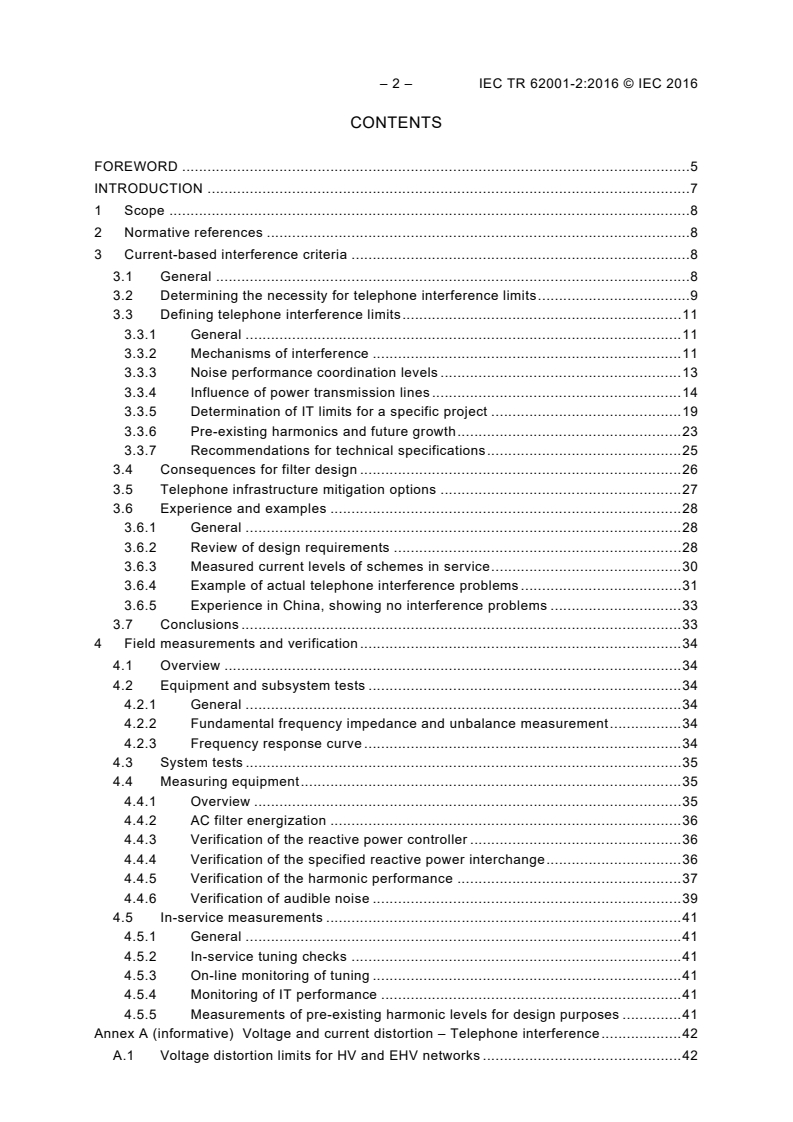
General Information
- Abstract
IEC TR 62001-2:2016(E), which is a Technical Report, provides guidance on the performance aspects and verification of performance of harmonic filters. The scope of this document covers AC side filtering for the frequency range of interest in terms of harmonic distortion and audible frequency disturbances. It excludes filters designed to be effective in the PLC and radio interference spectra. This document concerns the "conventional" AC filter technology and line-commutated high-voltage direct current (HVDC) converters. This first edition of IEC TR 62001-2, together with IEC TR 62001-1, IEC TR 62001-3 and IEC TR 62001-4, cancels and replaces IEC TR 62001 published in 2009. This edition constitutes a technical revision. This edition includes the following significant technical changes with respect to IEC TR 62001:
a) expanded and supplemented Clause 19, and Annex B;
b) new Clause 3 on current-based interference criteria;
c) new annexes on induced noise calculation with Dubanton equations;
d) addition of a TIF requirement in a technical specification;
e) specification of IT limits dependent on network impedance and on the impact of AC network harmonic impedance; and
f) specification of voltage level on the filter design necessary to fulfil an IT criterion.
- Status
- Replaced
- Publication Date
- 20-Jul-2016
- Drafting Committee
- MT 21 - TC 22/SC 22F/MT 21
Overview
IEC TR 62001-2:2016 is a Technical Report from the IEC that provides guidance on the performance and verification of AC harmonic filters used on the AC side of line‑commutated HVDC converters. It covers the frequency range relevant to harmonic distortion and audible‑frequency disturbances for conventional AC filter technology. The report excludes filters intended specifically for power‑line carrier (PLC) or radio‑frequency interference spectra. This edition (2016) is a technical revision that, together with Parts 1, 3 and 4, replaces the earlier IEC TR 62001 (2009).
Key topics and technical requirements
- Performance guidance for harmonic filters - criteria and methods to evaluate AC filter effectiveness against converter harmonics and network interaction.
- Current‑based interference criteria (Clause 3) - procedures to assess telephone interference risk and determine when telephone interference limits are required.
- Telephone interference limits and TIF - guidance on defining IT/TIF requirements, including a new recommendation to include a TIF requirement in technical specifications.
- Verification and field testing - recommended equipment, subsystem tests, system tests, commissioning checks, and in‑service monitoring for harmonic performance, reactive power control and audible noise.
- Network impedance and IT limits - specification of IT limits that depend on AC network harmonic impedance and the impact of voltage level on filter design needed to meet an IT criterion.
- Induced noise calculations - informative annexes (including Dubanton equations) for estimating induced telephone noise and assessing residual/balanced interference.
- Practical design implications - examples and annexes illustrating how pre‑existing harmonics, future growth, filter Mvar sizing, and line characteristics affect required filter performance.
Practical applications and who uses this standard
IEC TR 62001-2:2016 is essential for:
- HVDC project engineers and system designers specifying AC filters and assessing converter‑to‑network interactions.
- Utilities and transmission planners evaluating compatibility with existing networks and setting interference limits.
- Filter manufacturers and consultants developing filter designs, performance tests and commissioning procedures.
- Test & commissioning teams performing field verification, harmonic measurements and audible‑noise checks.
- Regulators and permitting authorities who need objective criteria for telephone interference and harmonic compatibility.
Use cases include specification of AC filter performance in tender documents, design evaluation studies, commissioning test plans, telephone‑interference risk assessments, and ongoing monitoring strategies.
Related standards
- IEC TR 62001‑1, IEC TR 62001‑3, IEC TR 62001‑4 (companion parts)
- References and related guidance cited within the report include IEC TR 61000‑3‑6 and IEEE 519 (for voltage distortion and planning levels).
Keywords: IEC TR 62001-2:2016, HVDC, AC filters, harmonic filters, telephone interference, TIF, IT limits, harmonic impedance, Dubanton equations, filter performance, commissioning.
Relations
- Effective Date
- 05-Sep-2023
- Effective Date
- 05-Jun-2026
Get Certified
Connect with accredited certification bodies for this standard

IMQ S.p.A. (Certification)
Italian electrical product certification.

SLG Prüf- und Zertifizierungs GmbH
German testing and certification body.

UL Solutions
Global safety science company with testing, inspection and certification.
Sponsored listings
Frequently Asked Questions
IEC TR 62001-2:2016 is a technical report published by the International Electrotechnical Commission (IEC). Its full title is "High-voltage direct current (HVDC) systems - Guidance to the specification and design evaluation of AC filters - Part 2: Performance". This standard covers: IEC TR 62001-2:2016(E), which is a Technical Report, provides guidance on the performance aspects and verification of performance of harmonic filters. The scope of this document covers AC side filtering for the frequency range of interest in terms of harmonic distortion and audible frequency disturbances. It excludes filters designed to be effective in the PLC and radio interference spectra. This document concerns the "conventional" AC filter technology and line-commutated high-voltage direct current (HVDC) converters. This first edition of IEC TR 62001-2, together with IEC TR 62001-1, IEC TR 62001-3 and IEC TR 62001-4, cancels and replaces IEC TR 62001 published in 2009. This edition constitutes a technical revision. This edition includes the following significant technical changes with respect to IEC TR 62001: a) expanded and supplemented Clause 19, and Annex B; b) new Clause 3 on current-based interference criteria; c) new annexes on induced noise calculation with Dubanton equations; d) addition of a TIF requirement in a technical specification; e) specification of IT limits dependent on network impedance and on the impact of AC network harmonic impedance; and f) specification of voltage level on the filter design necessary to fulfil an IT criterion.
IEC TR 62001-2:2016(E), which is a Technical Report, provides guidance on the performance aspects and verification of performance of harmonic filters. The scope of this document covers AC side filtering for the frequency range of interest in terms of harmonic distortion and audible frequency disturbances. It excludes filters designed to be effective in the PLC and radio interference spectra. This document concerns the "conventional" AC filter technology and line-commutated high-voltage direct current (HVDC) converters. This first edition of IEC TR 62001-2, together with IEC TR 62001-1, IEC TR 62001-3 and IEC TR 62001-4, cancels and replaces IEC TR 62001 published in 2009. This edition constitutes a technical revision. This edition includes the following significant technical changes with respect to IEC TR 62001: a) expanded and supplemented Clause 19, and Annex B; b) new Clause 3 on current-based interference criteria; c) new annexes on induced noise calculation with Dubanton equations; d) addition of a TIF requirement in a technical specification; e) specification of IT limits dependent on network impedance and on the impact of AC network harmonic impedance; and f) specification of voltage level on the filter design necessary to fulfil an IT criterion.
IEC TR 62001-2:2016 is classified under the following ICS (International Classification for Standards) categories: 29.200 - Rectifiers. Convertors. Stabilized power supply. The ICS classification helps identify the subject area and facilitates finding related standards.
IEC TR 62001-2:2016 has the following relationships with other standards: It is inter standard links to IEC TR 62001:2009, IEC TS 62001-2:2026. Understanding these relationships helps ensure you are using the most current and applicable version of the standard.
IEC TR 62001-2:2016 is available in PDF format for immediate download after purchase. The document can be added to your cart and obtained through the secure checkout process. Digital delivery ensures instant access to the complete standard document.
Standards Content (Sample)
IEC TR 62001-2 ®
Edition 1.0 2016-07
TECHNICAL
REPORT
colour
inside
High-voltage direct current (HVDC) systems – Guidance to the specification and
design evaluation of AC filters –
Part 2: Performance
All rights reserved. Unless otherwise specified, no part of this publication may be reproduced or utilized in any form
or by any means, electronic or mechanical, including photocopying and microfilm, without permission in writing from
either IEC or IEC's member National Committee in the country of the requester. If you have any questions about IEC
copyright or have an enquiry about obtaining additional rights to this publication, please contact the address below or
your local IEC member National Committee for further information.
IEC Central Office Tel.: +41 22 919 02 11
3, rue de Varembé Fax: +41 22 919 03 00
CH-1211 Geneva 20 info@iec.ch
Switzerland www.iec.ch
About the IEC
The International Electrotechnical Commission (IEC) is the leading global organization that prepares and publishes
International Standards for all electrical, electronic and related technologies.
About IEC publications
The technical content of IEC publications is kept under constant review by the IEC. Please make sure that you have the
latest edition, a corrigenda or an amendment might have been published.
IEC Catalogue - webstore.iec.ch/catalogue Electropedia - www.electropedia.org
The stand-alone application for consulting the entire The world's leading online dictionary of electronic and
bibliographical information on IEC International Standards, electrical terms containing 20 000 terms and definitions in
Technical Specifications, Technical Reports and other English and French, with equivalent terms in 15 additional
documents. Available for PC, Mac OS, Android Tablets and languages. Also known as the International Electrotechnical
iPad. Vocabulary (IEV) online.
IEC publications search - www.iec.ch/searchpub IEC Glossary - std.iec.ch/glossary
The advanced search enables to find IEC publications by a 65 000 electrotechnical terminology entries in English and
variety of criteria (reference number, text, technical French extracted from the Terms and Definitions clause of
committee,…). It also gives information on projects, replaced IEC publications issued since 2002. Some entries have been
and withdrawn publications. collected from earlier publications of IEC TC 37, 77, 86 and
CISPR.
IEC Just Published - webstore.iec.ch/justpublished
Stay up to date on all new IEC publications. Just Published IEC Customer Service Centre - webstore.iec.ch/csc
details all new publications released. Available online and If you wish to give us your feedback on this publication or
also once a month by email. need further assistance, please contact the Customer Service
Centre: csc@iec.ch.
IEC TR 62001-2 ®
Edition 1.0 2016-07
TECHNICAL
REPORT
colour
inside
High-voltage direct current (HVDC) systems – Guidance to the specification and
design evaluation of AC filters –
Part 2: Performance
INTERNATIONAL
ELECTROTECHNICAL
COMMISSION
ICS 29.200 ISBN 978-2-8322-3540-9
– 2 – IEC TR 62001-2:2016 © IEC 2016
CONTENTS
FOREWORD .5
INTRODUCTION .7
1 Scope .8
2 Normative references .8
3 Current-based interference criteria .8
3.1 General .8
3.2 Determining the necessity for telephone interference limits .9
3.3 Defining telephone interference limits . 11
3.3.1 General . 11
3.3.2 Mechanisms of interference . 11
3.3.3 Noise performance coordination levels . 13
3.3.4 Influence of power transmission lines . 14
3.3.5 Determination of IT limits for a specific project . 19
3.3.6 Pre-existing harmonics and future growth . 23
3.3.7 Recommendations for technical specifications . 25
3.4 Consequences for filter design . 26
3.5 Telephone infrastructure mitigation options . 27
3.6 Experience and examples . 28
3.6.1 General . 28
3.6.2 Review of design requirements . 28
3.6.3 Measured current levels of schemes in service . 30
3.6.4 Example of actual telephone interference problems . 31
3.6.5 Experience in China, showing no interference problems . 33
3.7 Conclusions . 33
4 Field measurements and verification . 34
4.1 Overview . 34
4.2 Equipment and subsystem tests . 34
4.2.1 General . 34
4.2.2 Fundamental frequency impedance and unbalance measurement . 34
4.2.3 Frequency response curve . 34
4.3 System tests . 35
4.4 Measuring equipment . 35
4.4.1 Overview . 35
4.4.2 AC filter energization . 36
4.4.3 Verification of the reactive power controller . 36
4.4.4 Verification of the specified reactive power interchange . 36
4.4.5 Verification of the harmonic performance . 37
4.4.6 Verification of audible noise . 39
4.5 In-service measurements . 41
4.5.1 General . 41
4.5.2 In-service tuning checks . 41
4.5.3 On-line monitoring of tuning . 41
4.5.4 Monitoring of IT performance . 41
4.5.5 Measurements of pre-existing harmonic levels for design purposes . 41
Annex A (informative) Voltage and current distortion – Telephone interference . 42
A.1 Voltage distortion limits for HV and EHV networks . 42
A.1.1 General . 42
A.1.2 Recommended limits for HV or EHV networks . 43
A.2 Harmonic current in generators . 45
A.3 Causes of telephone interference . 45
A.4 Definition of telephone interference parameters . 47
A.5 Discussion . 50
A.6 Coupling mechanism from power-line current to telephone disturbance
voltage . 51
Annex B (informative) Example of induced noise calculation with Dubanton equations . 52
B.1 General . 52
B.2 Residual IT . 52
B.3 Balanced IT . 53
Annex C (informative) Illustration of the benefit of including a TIF requirement in the
technical specification. 54
Annex D (informative) Specification of IT limits dependent on network impedance . 56
Annex E (informative) The impact of AC network harmonic impedance and voltage
level on the filter design necessary to fulfil an IT criterion . 60
E.1 General . 60
E.2 Assumptions and pre-conditions . 61
E.3 Harmonic impedance of AC network . 63
E.4 Filter design . 65
E.5 Explanation of the difference in impact of relative and absolute performance
criteria on required filter Mvar . 67
Bibliography . 68
Figure 1 – Conversion factor from positive sequence current at the sending end to
positive sequence current at the receiving end, and input impedance of a 230 kV line,
124 km long, 1000 Ω-m . 21
Figure 2 – Conversion factor from positive sequence current to residual current, and
input impedance of a 230 kV line, 124 km long, 1 000 Ω-m . 21
Figure 3 – Simple circuit for calculation of harmonic performance taking into account
pre-existing harmonics . 23
Figure 4 – Converter variables for harmonic performance tests . 37
Figure 5 – Example of measurements made during a ramp of the converters . 40
Figure A.1 – Contributions of harmonic voltages at different voltage levels in a simple
network . 42
Figure A.2 – C-message and psophometric weighting factors . 46
Figure A.3 – Flow-chart describing the basic telephone interference mechanism . 51
Figure D.1 – Simplification of the detailed network used for telephone interference
simulation . 56
Figure D.2 – Induced voltage in telephone circuit vs. network impedance, for unitary
current injected . 57
Figure D.3 – IT limits as defined for different network impedances . 58
Figure E.1 – Converter harmonics un-weighted (A) and IT weighted (kA) on 240 kV
base . 62
Figure E.2 – Converter Mvar absorption versus load . 63
Figure E.3 – Impedance sector diagram and RL-equivalent circuit . 64
Figure E.4 – Simplified converter/system topology . 64
Figure E.5 – Simplified circuit including overhead transmission line . 65
– 4 – IEC TR 62001-2:2016 © IEC 2016
Table 1 – Performance thresholds for metallic noise . 14
Table 2 – Performance thresholds for longitudinal noise . 14
Table 3 – Performance thresholds for balance . 14
Table 4 – Illustrative maximum telephone line length to achieve the North American
recommended longitudinal N level, as a function of balanced IT level, earth
g
resistivity and separation distance . 17
Table 5 – Illustrative maximum telephone line length to achieve the North American
recommended longitudinal N level as a function of residual IT level, earth resistivity
g
and separation distance . 18
Table 6 – Some HVDC schemes – Specified telephone interference criteria . 29
Table 7 – Measured 95 % values of THFF and I of a 600 MW scheme (3 phases) . 31
pe
Table 8 – Measured 95 % values of THFF and I of a 300 MW scheme (3 phases) . 31
pe
Table A.1 – Voltage distortion limits from IEEE 519-1992 . 43
Table A.2 – Compatibility levels for harmonic voltages (in percent of the nominal
voltage) in LV and MV power systems [based on Table 1 of IEC TR 61000-3-6:2008] . 44
Table A.3 – Indicative values of planning levels for harmonic voltages in HV and EHV
power systems [based on Table 2 of IEC TR 61000-3-6:2008] . 44
Table E.1 – Required total amount of installed filter Mvars to meet a IT limit of 25 kA
for 600 MW transmission . 61
INTERNATIONAL ELECTROTECHNICAL COMMISSION
____________
HIGH-VOLTAGE DIRECT CURRENT (HVDC) SYSTEMS –
GUIDANCE TO THE SPECIFICATION AND
DESIGN EVALUATION OF AC FILTERS –
Part 2: Performance
FOREWORD
1) The International Electrotechnical Commission (IEC) is a worldwide organization for standardization comprising
all national electrotechnical committees (IEC National Committees). The object of IEC is to promote
international co-operation on all questions concerning standardization in the electrical and electronic fields. To
this end and in addition to other activities, IEC publishes International Standards, Technical Specifications,
Technical Reports, Publicly Available Specifications (PAS) and Guides (hereafter referred to as “IEC
Publication(s)”). Their preparation is entrusted to technical committees; any IEC National Committee interested
in the subject dealt with may participate in this preparatory work. International, governmental and non-
governmental organizations liaising with the IEC also participate in this preparation. IEC collaborates closely
with the International Organization for Standardization (ISO) in accordance with conditions determined by
agreement between the two organizations.
2) The formal decisions or agreements of IEC on technical matters express, as nearly as possible, an
international consensus of opinion on the relevant subjects since each technical committee has representation
from all interested IEC National Committees.
3) IEC Publications have the form of recommendations for international use and are accepted by IEC National
Committees in that sense. While all reasonable efforts are made to ensure that the technical content of IEC
Publications is accurate, IEC cannot be held responsible for the way in which they are used or for any
misinterpretation by any end user.
4) In order to promote international uniformity, IEC National Committees undertake to apply IEC Publications
transparently to the maximum extent possible in their national and regional publications. Any divergence
between any IEC Publication and the corresponding national or regional publication shall be clearly indicated in
the latter.
5) IEC itself does not provide any attestation of conformity. Independent certification bodies provide conformity
assessment services and, in some areas, access to IEC marks of conformity. IEC is not responsible for any
services carried out by independent certification bodies.
6) All users should ensure that they have the latest edition of this publication.
7) No liability shall attach to IEC or its directors, employees, servants or agents including individual experts and
members of its technical committees and IEC National Committees for any personal injury, property damage or
other damage of any nature whatsoever, whether direct or indirect, or for costs (including legal fees) and
expenses arising out of the publication, use of, or reliance upon, this IEC Publication or any other IEC
Publications.
8) Attention is drawn to the Normative references cited in this publication. Use of the referenced publications is
indispensable for the correct application of this publication.
9) Attention is drawn to the possibility that some of the elements of this IEC Publication may be the subject of
patent rights. IEC shall not be held responsible for identifying any or all such patent rights.
The main task of IEC technical committees is to prepare International Standards. However, a
technical committee may propose the publication of a Technical Report when it has collected
data of a different kind from that which is normally published as an International Standard, for
example "state of the art".
IEC TR 62001-2, which is a Technical Report, has been prepared by subcommittee 22F:
Power electronics for electrical transmission and distribution systems, of IEC technical
committee 22: Power electronic systems and equipment.
This first edition of IEC TR 62001-2, together with IEC TR 62001-1, IEC TR 62001-3 and IEC
TR 62001-4, cancels and replaces IEC TR 62001 published in 2009. This edition constitutes
a technical revision.
– 6 – IEC TR 62001-2:2016 © IEC 2016
This edition includes the following significant technical changes with respect to
IEC TR 62001:
a) expanded and supplemented Clause 19, and Annex B;
b) new Clause 3 on current-based interference criteria;
c) new annexes on induced noise calculation with Dubanton equations;
d) addition of a TIF requirement in a technical specification,
e) specification of IT limits dependent on network impedance and on the impact of AC
network harmonic impedance; and
f) specification of voltage level on the filter design necessary to fulfil an IT criterion.
The text of this Technical Report is based on the following documents:
Enquiry draft Report on voting
22F/410/DTR 22F/414/RVC
Full information on the voting for the approval of this document can be found in the report on
voting indicated in the above table.
This publication has been drafted in accordance with the ISO/IEC Directives, Part 2.
A list of all parts in the IEC 62001 series, published under the general title High-voltage direct
current (HVDC) systems – Guidance to the specification and design evaluation of AC filters,
can be found on the IEC website.
The committee has decided that the contents of this publication will remain unchanged until
the stability date indicated on the IEC web site under "http://webstore.iec.ch" in the data
related to the specific publication. At this date, the publication will be
• reconfirmed,
• withdrawn,
• replaced by a revised edition, or
• amended.
A bilingual version of this publication may be issued at a later date.
IMPORTANT – The 'colour inside' logo on the cover page of this publication indicates
that it contains colours which are considered to be useful for the correct
understanding of its contents. Users should therefore print this document using a
colour printer.
INTRODUCTION
The IEC 62001 series is structured in four parts:
Part 1 – Overview
This part concerns specifications of AC filters for high-voltage direct current (HVDC)
systems with line-commutated converters, permissible distortion limits, harmonic
generation, filter arrangements, filter performance calculation, filter switching and reactive
power management and customer specified parameters and requirements.
Part 2 – Performance
This part deals with current-based interference criteria, design issues and special
applications, field measurements and verification.
Part 3 – Modelling
This part addresses the harmonic interaction across converters, pre-existing harmonics,
AC network impedance modelling, simulation of AC filter performance.
Part 4 – Equipment
This part concerns steady-state and transient ratings of AC filters and their components,
power losses, audible noise, design issues and special applications, filter protection,
audible noise, seismic requirements, equipment design and test parameters.
– 8 – IEC TR 62001-2:2016 © IEC 2016
HIGH-VOLTAGE DIRECT CURRENT (HVDC) SYSTEMS –
GUIDANCE TO THE SPECIFICATION AND
DESIGN EVALUATION OF AC FILTERS –
Part 2: Performance
1 Scope
This part of IEC 62001, which is a Technical Report, provides guidance on the performance
aspects and verification of performance of harmonic filters.
The scope of this document covers AC side filtering for the frequency range of interest in
terms of harmonic distortion and audible frequency disturbances. It excludes filters designed
to be effective in the PLC and radio interference spectra.
This document concerns the "conventional" AC filter technology and line-commutated high-
voltage direct current (HVDC) converters.
2 Normative references
The following documents are referred to in the text in such a way that some or all of their
content constitutes requirements of this document. For dated references, only the edition
cited applies. For undated references, the latest edition of the referenced document
(including any amendments) applies.
IEC TR 62001-1:2016, High-voltage direct current (HVDC) systems – Guidebook to the
specification and design evaluation of AC filters – Part 1: Overview
IEC TR 62001-4:2016, High-voltage direct current (HVDC) systems – Guidebook to the
specification and design evaluation of AC filters – Part 4: Equipment
3 Current-based interference criteria
3.1 General
Permissible distortion limits and performance measures for limiting telephone interference,
such as telephone interference factor (TIF), product of RMS current (A) and TIF (IT), (the
definitions of these criteria are shown in 3.3.4.1 and Clause A.4), are discussed in details and
summarized in IEC TR 62001-1:2016, Clause 4. Where these measures are applied with
strict limits, particularly current-based criteria such as IT, they can be a decisive or limiting
factor for filter design. Thus, these measures can directly affect the costs of filters and the
concomitant effects of larger filters (extra station space, shunt reactors to compensate
excess reactive power produced by the filters, etc.). On the other hand, a few HVDC projects
have experienced high levels of telephone interference that caused problems during
considers basic interference criteria,
commissioning and early operation. Reference [1]
defines telephone interference limits and discusses consequences of the telephone
interference for filter design.
Because these criteria, based on psophometric or C-message weighting of harmonics, are
specific to evaluation of noise induced on telephone circuits electromagnetically coupled to
AC lines, they should only be specified where significant coupling between AC transmission
_____________
Numbers in square brackets refer to the Bibliography.
lines and analogue telephone circuits can be reasonably anticipated. This document provides
guidance for discriminating those situations where risk of telephone interference exists.
However, there are many factors that affect the potential for telephone interference and it is
not possible to provide definitive, quantitative guidelines. One of the most elusive factors is
the propagation of harmonic currents through the AC system. Experience has shown that
significant harmonic HVDC-created current flow can exist in lines that are remote from the
converter station and beyond transformations to other transmission voltage levels. A full
inductive coordination study, which involves the calculation of harmonic current flow in the
system in order to determine the problematic transmission lines and the assessment of their
actual coupling with the adjacent telephone lines, is the only mean to assess the interference
potential with any certainty.
The specification of telephone interference should also take into account local particularities,
as discussed in 3.2.
A valuable paper produced by the Joint Task Force 02 of WG14.03/CC.02 [2] gives a very
complete description of the inductive coordination process and the main parameters affecting
telephone interference. The IT limits are based on experience from the Finnish telephone
system, while making use of some approximations for the network characteristics. This
document will focus on North American practice for IT limits, although the principles and
calculation methods are applicable worldwide and will indicate the important system
parameters that need to be defined in a technical specification.
In systems where telephone interference potential can be judged to exist, proper specification
of harmonic current- and voltage-based performance criteria are of great importance to
protect the interests of the HVDC system owner. If not sufficiently addressed by the
specifications, and should telephone interference problems arise, the consequences to the
HVDC owner can be severe. Resolution of telephone interference after the HVDC system is
placed into service can be highly expensive and time consuming. Post-commissioning
resolution of telephone interference is complicated by the fact that the interference directly
affects parties other than the HVDC owner, i.e. the telephone system operator and its
subscriber customers. It is possible that the HVDC system can be forced to cease operation
by legal or regulatory action until the HVDC filtering system is redesigned and modified or
telephone system mitigation measures are applied. When the whole process of inductive
coordination is done correctly, it is much easier to face a problem at the initiation of the
project.
If not used with consideration, the requirements, and equally important how to evaluate them,
can lead to an unduly complex and costly design. Clause 3 attempts to clarify many aspects
of the subject, presenting the theory, assessing practical experience and providing
guidelines.
3.2 Determining the necessity for telephone interference limits
While voltage distortion control is a common concern for any electrical network, telephone
interference is highly project-dependent. Interference can occur when harmonic currents flow
in an AC transmission line which runs parallel to telephone lines. The harmonic currents
induce a disturbing voltage in the telephone lines which is proportional to the length of
exposure and the per unit mutual impedance between the two circuits. 3.2 specifically deals
with harmonic limits related to telephone interference such as IT, TIF, I and THFF. These
eq
criteria aim to control the interference induced in cable wire telephone lines transmitting
signals in the (vocal) audible frequency band, i.e. approximately between 200 Hz and
3 500 Hz.
There is no easy way to give quantitative guidance as to the conditions where telephone
interference has the potential to be of significance for a project, or where specific telephone-
interference oriented specifications are needed to protect the buyer. Qualitative guidelines
are provided below. If there is concern that a project can have susceptibility to one or more of
these factors, an inductive coordination study is desirable to guide the development of
specifications.
– 10 – IEC TR 62001-2:2016 © IEC 2016
Conditions known to increase the susceptibility to AC-side telephone interference are the
following:
• Long sections of exposure between AC lines carrying converter harmonic currents and
telephone lines.
• Close proximity of AC transmission lines and parallel telephone lines.
• Even moderate separation distances and longitudinal exposures if combined with very
high earth resistivity.
• Open-wire telephone lines. However, shielded twisted-pair telephone circuits provide only
a partial reduction of coupling potential, and such circuits are by no means exempt from
potential interference issues.
• Radial transmission line(s) to the converter station, where all converter harmonics are
forced into the one single-circuit or double-circuit line.
• AC transmission systems having a hybrid overhead/underground design, with overhead
lines interspersed with underground cable sections.
• AC transmission systems with a large number of capacitor banks in electrical proximity to
the converter station, causing numerous resonances in the AC network. Analysis is
complicated in these systems because all combinations and permutations of capacitor
bank status can need to be considered.
Converter harmonic currents are not limited to the AC lines terminating at the converter
station. Harmonic currents can penetrate several tiers into the transmission network and can
cross over transformers to other voltage levels. This can be problematic when lower-voltage
transmission lines are more closely coupled to telephone circuits. There is a general
tendency for harmonic currents to diminish for tiers remote from the converter station, but this
general trend can be offset by resonance conditions to produce greater harmonic current
levels at second and higher tier lines than on first-tier lines connected to the converter station.
The following conditions can be assumed to indicate non-existence of telephone interference
issues at vocal frequency, and thus no need for psophometric or C-message weighted
specifications:
• all exposed telephone circuits are fibre optic cable;
• multiplex systems (time or frequency multiplexing):
• no telephone circuits exposed.
Worldwide experience of HVDC has shown that in some places, telephone interference limits
have not been specified, yet no problems have been experienced. Indeed, telephone systems
are very similar from country to country but others parameters affecting the potential for
interference can be quite different. In North America for instance, telephone interference is a
big concern because of the structure of the telephone and transmission systems in rural
areas favouring long exposures and close proximity. There is also powerful legal protection
for consumers and utilities with a risk of serious economical consequences for an HVDC
project causing excessive telephone interference. On the other hand, in China for example,
most telephone lines are generally remote from HV transmission lines. Huge HVDC
infrastructure projects can have a “national interest” dimension which means that in terms of
the overall effect on society it is more important to build them quickly and economically, and
to address possible telephone noise problems as a separate issue.
Nearly all homes and small businesses in North America and many other parts of the world
are still connected to the phone network by the same pair of twisted copper wires that have
been in use for decades. Given the continued hurdles to fibre deployment and the
increasingly high transmission speeds available over the existing copper network, it is likely
that copper will continue to be the industry’s standard for many years to come. This is
especially true in rural areas due to the economics of installing fibre optic cabling or coaxial
cabling through low density areas. However, in many countries the cellular phone digital
technologies are tending to leapfrog analogue landline telephone system. Furthermore,
telecom operators’ tariffs in these countries are guiding people to use mobile phones only.
Past experience within the utility and the telephone company with telephone interference
from existing facilities would be the best reference since it is likely to reflect the particular
situation where the new HVDC project will have to operate.
3.3 Defining telephone interference limits
3.3.1 General
IEC TR 62001-1:2016, Clause 4 gives general recommendations for determination of limits
without detailed studies due to possible short time schedule, lack of computational tool, lack
of telephone system data or if no serious interference problems are expected because of
harmonic distortion. It refers to IEEE Std 368-1977 [3] which gives a table suggesting range
of limits applicable to HV and EHV transmission lines, with a clear warning that telephone
interference should be carefully studied on a case-by-case basis. The table of values was
merely illustrative and its derivation is not given. Successive standards (IEEE Std 519-1992
[4] and CAN/CSA-C22.3 No. 3-98 [5]) have copied this table with no apparent verification of
its validity. On the other hand, experience shows that some HVDC schemes with a specified
IT emanating from a converter bus of between 25 000 A and 50 000 A function with no
problems of telephone interference. Applying these previous limits without any study is
therefore not recommended.
If it has been established that there is a significant risk of telephone interference related to a
particular HVDC project, a detailed study is required to assess the limits for the AC filter
performance specifications. 3.3 gives a general description of the procedure to calculate the
influence of a given transmission line on adjacent telephone lines. The method presented is
based on the North American practice because interference problems appear to be more
acute in that part of the world, and focuses on telephone cable systems, but the same basic
principles apply to other systems with different susceptibility levels. Tables of illustrative
values of coupling are provided.
It is also necessary to assess the harmonic current flow in transmission lines adjacent to the
HVDC project in order to identify the ones that need to be considered for the telephone
interference requirement of the HVDC project, and their possible level of interference.
Recommendations are given on the required information about the AC system that needs to
be included in a specification to achieve an adequate AC filter design.
3.3.2 Mechanisms of interference
Harmonic currents flowing in a transmission line induce harmonic voltages and currents in
nearby installations. This voltage can be measured between one end of the telephone
conductor and ground, with the remote end grounded, and is called the longitudinal voltage.
The longitudinal voltage induced in any parallel conductor can be calculated as follows:
k
Vg = (I × Zm ) (1)
n ∑ jn jn
j=1
where
n is the harmonic number;
j is the conductor number;
k is the number of conductors on the transmission line;
Vg is the longitudinal voltage at harmonic n;
n
I is the phasor current in conductor j at harmonic n;
jn
Zm is the mutual impedance between conductor j and telephone line at harmonic n,
jn
including the screening effect of the ground wires and any other nearby grounded
conductors.
– 12 – IEC TR 62001-2:2016 © IEC 2016
In Equation (1), the harmonic currents flowing in the transmission line are calculated by the
HVDC converter contractor according to the method defined in the technical specifications.
The mutual impedance depends mainly on earth resistivity, separation between transmission
and telephone lines, transmission line configuration and frequency. Inductive coordination
studies require the calculation of mutual impedances for a large number of exposures
between AC transmission lines and telephone lines. The calculation usually includes the
effect of screening conductors like shield wires or any other extended conductive installation
close by. This calculation is generally done by specialised computer programs such as
EMTP, CORRIDOR, MathCAD, CDEGS . However, for simple cases, Dubanton equations [6]
can be used with satisfactory results for a typical range of values of exposures. In addition,
the calculation of coupling for irregular exposures involves breaking down the exposures into
a series of parallel sections and adding these together to obtain the total coupling [7, 8].
Some computer programs have the capacity to calculate mutual impedances for irregular
exposures (Crinoline toolbox in EMTP, CDEGS).
Modern telephone lines use shielded cables to transmit the voice signal to each customer via
a twisted conductor pair. The shield supports the same harmonic induced voltages as the
conductor pair but allows current flow through its grounded ends which cancels out part of
the induced voltage in the conductor pair and is very effective at higher frequencies to reduce
the longitudinal voltage. The resulting interference voltage is the difference between both
conductor longitudinal voltages, which is called the metallic or transverse voltage, and is the
voltage which appears across a telephone receiver.
NOTE The terms "common mode" for longitudinal and "differential mode" for transverse are also used.
The ratio between metallic and longitudinal voltage is called the balance of the circuit and is
frequency dependent. The metallic voltage is then weighted to reflect the frequency response
of the ear and the telephone system. The C-message weighting is used in North America
while psophometric weighting is used in Europe. Other parts of the world adopt one or other
of these methods.
The total effective noise will be calculated by the root of the squares of these weighted
components for each harmonic to be considered. The total weighted metallic noise voltage is
given by:
n=m j=k
Vm = I × Zm K × B × C (2)
jn jn n n n
∑ ∑
n=1 j=1
where
m is the maximum order of harmonic to be considered;
C is the C-message or psophometric weighting of harmonic n;
n
K is the telephone circuit shielding factor at harmonic n;
n
B is the telephone circuit balance at harmonic n.
n
The telephone circuit shielding and balance factors are generally provided by the telephone
companies. In practice, the shielding improves with frequency while the balance gets worse
as frequency increases. The combined factor is almost constant over the frequency range of
interest.
_____________
EMTP, CORRIDOR, MathCAD, CDEGS are examples of suitable products available commercially. This
information is given for the convenience of users of this document and does not constitute an endorsement by
IEC of these products.
IEEE Std 1124-2003 [9] provides a great deal of information about the calculation of mutual
impedances and the characteristics of the different parameters relevant to an inductive
coordination study. The methodology of inductive coordination for a DC transmission line is
basically the same as for an AC line. Useful information on the management of
electromagnetic interference by power systems on telecommunication systems can also be
found in [10]. Influence of voltage and current distortion on telephone interference level is
considered in Annex A.
3.3.3 Noise performance coordination levels
ITU-T EMC-1.6 [11] used in Europe and elsewhere states that the psophometric voltage
measured across a resistance of 600 Ω at one end of the line with the remote end terminated
with its characteristic impedance should not exceed 0,5 mV.
The North American standards ([12], [13]) recommend limiting the noise contribution on the
customer loop to 20 dBrnC. The telephone circuit noise is defined relative to 1 pW in 600 Ω,
i.e. relative to an applied voltage of 24,5 mV, and is expressed in dB above this level.
-6
N (dBrnC) = 20 log (V /(24,5 × 10 )) (3)
m m
where
N is the metallic (transverse) noise expressed in dB above 24,5 mV.
m
The corresponding metallic noise voltage is 0,245 mV, which is therefore stricter than the ITU
counterpart (0,5 mV).
Since the influence of transmission lines on telephone interference is more predominant in
North America, the following discussion will focus on the American practice.
The basic quantities in the characterization of interference between HV transmission lines
and telephone lines are:
N (dBrnC) = N (dBrnC) – B (dB) (4)
m g al
where
N is the longitudinal noise to ground expressed in dB above 24,5 mV;
g
B is the balance of the telephone circuit in dB (ratio of disturbing longitudinal voltage and
al
the resulting metallic voltage).
Noise to ground is the result of power influence from the HV transmission line and the
coupling between this transmission line and a telephone line. This value is related to the level
of harmonic current in the transmission line and thus under the network owner’s control. The
balance measures the susceptibility of the telephone system and as such is the responsibility
of the telephone company.
Electrical coordination standards ([5], [13], [19]) define performance thresholds for metallic
noise, longitudinal noise and balance on normal business or residential lines which are cable
lines as described in Tables 1 to 3.
– 14 – IEC TR 62001-2:2016 © IEC 2016
Table 1 – Performance thresholds for metallic noise
Metallic noise thresholds Noise level performance category
dBrnC
recommended
≤ 20
> 20 ≤ 30 accep
...