

IEC 61340-4-1:2003
(Main)Electrostatics - Part 4-1: Standard test methods for specific applications - Electrical resistance of floor coverings and installed floors
General Information
- Abstract
Specifies test methods for determining the electrical resistance of all types of floor coverings and installed floors with resistance to ground, point-to-point resistance and vertical resistance of between 104 W and 1013 W. Laboratory evaluations carried out under controlled environmental conditions can be used for classification or quality control purposes. Tests on installed floors under uncontrolled ambient conditions can be used to determine correct installation or as part of an ongoing system verification. The important changes refer only to the specification of test methods but do not contain classification or performance requirements; the test methods refer to resistance measurement, and the specified equipment comply more with those of the other parts of IEC 61340
- Status
- Published
- Publication Date
- 28-Apr-2015
- Technical Committee
- TC 101 - Electrostatics
- Drafting Committee
- MT 9 - TC 101/MT 9
- Current Stage
- PPUB - Publication issued
- Start Date
- 11-Dec-2003
- Completion Date
- 30-Apr-2004
Buy Documents
IEC 61340-4-1:2003 - Electrostatics - Part 4-1: Standard test methods for specific applications - Electrical resistance of floor coverings and installed floors Released:12/11/2003

IEC 61340-4-1:2003+AMD1:2015 CSV - Electrostatics - Part 4-1: Standard test methods for specific applications - Electrical resistance of floor coverings and installed floors Released:4/29/2015
Overview
IEC 61340-4-1:2003 is an international standard developed by the International Electrotechnical Commission (IEC) that defines standard test methods for measuring the electrical resistance of floor coverings and installed floors. This standard is specifically tailored to evaluate resistance in the range of 10⁴ Ω to 10¹³ Ω under both controlled laboratory and ambient conditions. It plays a crucial role in ensuring the proper functioning of floor coverings designed to control electrostatic discharge (ESD) and related electrostatic phenomena.
The test methods specified include resistance to ground, point-to-point resistance, and vertical resistance measurements. These assessments support classification, quality control, and system verification of floor installations, helping to maintain safety, performance, and compliance with relevant electrostatics requirements.
Key Topics
Scope and Applications
The standard applies to various types of floor coverings and installed floors. It covers resistance testing under:- Controlled laboratory conditions for classification and quality control
- Uncontrolled ambient conditions for acceptance testing and ongoing verification
Test Methods
- Point-to-Point Resistance: Measures electrical resistance across the floor surface, indicating how well a floor covering can conduct surface charges or act as a charge sink.
- Resistance to Ground: Measures resistance from a groundable point through the floor to ground, assessing how effectively the floor can dissipate charge.
- Vertical Resistance: Measures resistance perpendicular through the floor material, useful in laboratory evaluations to simulate charge conduction from surface to ground.
Apparatus Requirements
- High-accuracy resistance meters (ohmmeters) with voltage and range variations suitable for measuring high resistance values from 10⁴ Ω to 10¹³ Ω.
- Specialized electrodes, counter-electrodes, and support plates designed to ensure consistent and repeatable measurements.
Environmental Considerations
- Testing procedures specify conditioning under controlled atmospheres (temperature and humidity) during laboratory evaluations.
- Acceptance testing may take place under uncontrolled ambient conditions to reflect real installation environments.
Procedures and Reporting
- Includes detailed cleaning and preparation of electrodes and test specimens before measurement.
- Clear guidelines for calculating and expressing test results numerically.
- Emphasis on accurate and comprehensive test reports for quality assurance and compliance documentation.
Applications
IEC 61340-4-1 serves multiple practical purposes in industries and environments where electrostatic control is critical, such as:
Manufacturing Facilities
Ensuring floor coverings meet ESD safety requirements to protect sensitive electronic components and equipment.Cleanrooms and Laboratories
Verifying that installed floors maintain required electrical resistance properties for contamination and static charge control.Quality Control in Flooring Production
Facilitating systematic laboratory evaluations to classify and verify flooring materials before market release.Installation Verification
Allowing on-site testing under ambient conditions to confirm correct installation practices and ongoing system integrity.Occupational Safety Compliance
Assisting organizations in meeting local and international safety regulations addressing electrostatic hazards in the workplace.
Related Standards
To fully implement electrostatic control measures in flooring and related systems, IEC 61340-4-1 is often used in conjunction with:
- IEC 61340-5-1: Protection of electronic devices from electrostatic phenomena-General requirements
- IEC 61340-2-3: Electrostatics-Applications-Floor materials-Electrical resistance measurement methods
- ISO 1957: Machine-made textile floor coverings - Selection and cutting of specimens for physical tests
Using IEC 61340-4-1 alongside these standards ensures a comprehensive approach to assessing and managing electrostatic properties in floor coverings and installed flooring systems.
By adhering to IEC 61340-4-1:2003, organizations achieve reliable, standardized resistance measurements that contribute significantly to effective electrostatic control, operational safety, and product quality assurance in electrically sensitive environments.
Relations
- Effective Date
- 05-Sep-2023
Buy Documents
IEC 61340-4-1:2003 - Electrostatics - Part 4-1: Standard test methods for specific applications - Electrical resistance of floor coverings and installed floors Released:12/11/2003
IEC 61340-4-1:2003+AMD1:2015 CSV - Electrostatics - Part 4-1: Standard test methods for specific applications - Electrical resistance of floor coverings and installed floors Released:4/29/2015
Get Certified
Connect with accredited certification bodies for this standard

BSMI (Bureau of Standards, Metrology and Inspection)
Taiwan's standards and inspection authority.
Sponsored listings
Frequently Asked Questions
IEC 61340-4-1:2003 is a standard published by the International Electrotechnical Commission (IEC). Its full title is "Electrostatics - Part 4-1: Standard test methods for specific applications - Electrical resistance of floor coverings and installed floors". This standard covers: Specifies test methods for determining the electrical resistance of all types of floor coverings and installed floors with resistance to ground, point-to-point resistance and vertical resistance of between 104 W and 1013 W. Laboratory evaluations carried out under controlled environmental conditions can be used for classification or quality control purposes. Tests on installed floors under uncontrolled ambient conditions can be used to determine correct installation or as part of an ongoing system verification. The important changes refer only to the specification of test methods but do not contain classification or performance requirements; the test methods refer to resistance measurement, and the specified equipment comply more with those of the other parts of IEC 61340
Specifies test methods for determining the electrical resistance of all types of floor coverings and installed floors with resistance to ground, point-to-point resistance and vertical resistance of between 104 W and 1013 W. Laboratory evaluations carried out under controlled environmental conditions can be used for classification or quality control purposes. Tests on installed floors under uncontrolled ambient conditions can be used to determine correct installation or as part of an ongoing system verification. The important changes refer only to the specification of test methods but do not contain classification or performance requirements; the test methods refer to resistance measurement, and the specified equipment comply more with those of the other parts of IEC 61340
IEC 61340-4-1:2003 is classified under the following ICS (International Classification for Standards) categories: 17.220.99 - Other standards related to electricity and magnetism. The ICS classification helps identify the subject area and facilitates finding related standards.
IEC 61340-4-1:2003 has the following relationships with other standards: It is inter standard links to IEC 61340-4-1:2003/AMD1:2015. Understanding these relationships helps ensure you are using the most current and applicable version of the standard.
IEC 61340-4-1:2003 is available in PDF format for immediate download after purchase. The document can be added to your cart and obtained through the secure checkout process. Digital delivery ensures instant access to the complete standard document.
Standards Content (Sample)
NORME CEI
INTERNATIONALE
IEC
61340-4-1
INTERNATIONAL
Deuxième édition
STANDARD
Second edition
2003-12
Electrostatique –
Partie 4-1:
Méthodes d'essai normalisées
pour des applications spécifiques –
Résistance électrique des revêtements
de sol et des sols finis
Electrostatics –
Part 4-1:
Standard test methods for specific applications –
Electrical resistance of floor coverings
and installed floors
Numéro de référence
Reference number
CEI/IEC 61340-4-1:2003
Numérotation des publications Publication numbering
Depuis le 1er janvier 1997, les publications de la CEI As from 1 January 1997 all IEC publications are
sont numérotées à partir de 60000. Ainsi, la CEI 34-1 issued with a designation in the 60000 series. For
devient la CEI 60034-1. example, IEC 34-1 is now referred to as IEC 60034-1.
Editions consolidées Consolidated editions
Les versions consolidées de certaines publications de la The IEC is now publishing consolidated versions of its
CEI incorporant les amendements sont disponibles. Par publications. For example, edition numbers 1.0, 1.1
exemple, les numéros d’édition 1.0, 1.1 et 1.2 indiquent and 1.2 refer, respectively, to the base publication,
respectivement la publication de base, la publication de the base publication incorporating amendment 1 and
base incorporant l’amendement 1, et la publication de the base publication incorporating amendments 1
base incorporant les amendements 1 et 2. and 2.
Informations supplémentaires Further information on IEC publications
sur les publications de la CEI
Le contenu technique des publications de la CEI est The technical content of IEC publications is kept
constamment revu par la CEI afin qu'il reflète l'état under constant review by the IEC, thus ensuring that
actuel de la technique. Des renseignements relatifs à the content reflects current technology. Information
cette publication, y compris sa validité, sont dispo- relating to this publication, including its validity, is
nibles dans le Catalogue des publications de la CEI available in the IEC Catalogue of publications
(voir ci-dessous) en plus des nouvelles éditions, (see below) in addition to new editions, amendments
amendements et corrigenda. Des informations sur les and corrigenda. Information on the subjects under
sujets à l’étude et l’avancement des travaux entrepris consideration and work in progress undertaken by the
par le comité d’études qui a élaboré cette publication, technical committee which has prepared this
ainsi que la liste des publications parues, sont publication, as well as the list of publications issued,
également disponibles par l’intermédiaire de: is also available from the following:
• Site web de la CEI (www.iec.ch) • IEC Web Site (www.iec.ch)
• Catalogue des publications de la CEI • Catalogue of IEC publications
Le catalogue en ligne sur le site web de la CEI The on-line catalogue on the IEC web site
(www.iec.ch/searchpub) vous permet de faire des (www.iec.ch/searchpub) enables you to search by a
recherches en utilisant de nombreux critères, variety of criteria including text searches,
comprenant des recherches textuelles, par comité technical committees and date of publication. On-
d’études ou date de publication. Des informations en line information is also available on recently
ligne sont également disponibles sur les nouvelles issued publications, withdrawn and replaced
publications, les publications remplacées ou retirées, publications, as well as corrigenda.
ainsi que sur les corrigenda.
• IEC Just Published • IEC Just Published
Ce résumé des dernières publications parues This summary of recently issued publications
(www.iec.ch/online_news/justpub) est aussi dispo- (www.iec.ch/online_news/justpub) is also available
nible par courrier électronique. Veuillez prendre by email. Please contact the Customer Service
contact avec le Service client (voir ci-dessous) Centre (see below) for further information.
pour plus d’informations.
• Service clients • Customer Service Centre
Si vous avez des questions au sujet de cette If you have any questions regarding this
publication ou avez besoin de renseignements publication or need further assistance, please
supplémentaires, prenez contact avec le Service contact the Customer Service Centre:
clients:
Email: custserv@iec.ch Email: custserv@iec.ch
Tél: +41 22 919 02 11 Tel: +41 22 919 02 11
Fax: +41 22 919 03 00 Fax: +41 22 919 03 00
.
NORME CEI
INTERNATIONALE
IEC
61340-4-1
INTERNATIONAL
Deuxième édition
STANDARD
Second edition
2003-12
Electrostatique –
Partie 4-1:
Méthodes d'essai normalisées
pour des applications spécifiques –
Résistance électrique des revêtements
de sol et des sols finis
Electrostatics –
Part 4-1:
Standard test methods for specific applications –
Electrical resistance of floor coverings
and installed floors
IEC 2003 Droits de reproduction réservés Copyright - all rights reserved
Aucune partie de cette publication ne peut être reproduite ni No part of this publication may be reproduced or utilized in any
utilisée sous quelque forme que ce soit et par aucun procédé, form or by any means, electronic or mechanical, including
électronique ou mécanique, y compris la photocopie et les photocopying and microfilm, without permission in writing from
microfilms, sans l'accord écrit de l'éditeur. the publisher.
International Electrotechnical Commission, 3, rue de Varembé, PO Box 131, CH-1211 Geneva 20, Switzerland
Telephone: +41 22 919 02 11 Telefax: +41 22 919 03 00 E-mail: inmail@iec.ch Web: www.iec.ch
CODE PRIX
M
PRICE CODE
Commission Electrotechnique Internationale
International Electrotechnical Commission
МеждународнаяЭлектротехническаяКомиссия
Pour prix, voir catalogue en vigueur
For price, see current catalogue
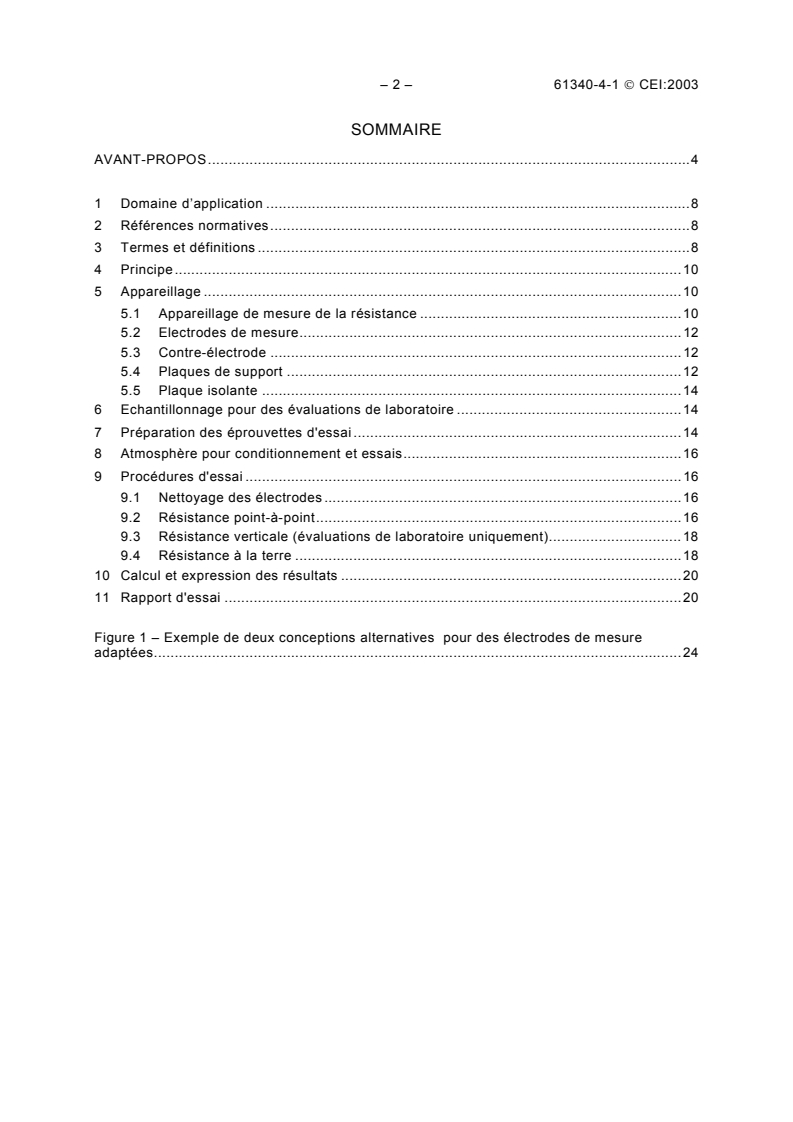
– 2 – 61340-4-1 CEI:2003
SOMMAIRE
AVANT-PROPOS.4
1 Domaine d’application.8
2 Références normatives.8
3 Termes et définitions .8
4 Principe.10
5 Appareillage.10
5.1 Appareillage de mesure de la résistance .10
5.2 Electrodes de mesure.12
5.3 Contre-électrode.12
5.4 Plaques de support.12
5.5 Plaque isolante.14
6 Echantillonnage pour des évaluations de laboratoire .14
7 Préparation des éprouvettes d'essai .14
8 Atmosphère pour conditionnement et essais.16
9 Procédures d'essai.16
9.1 Nettoyage des électrodes.16
9.2 Résistance point-à-point.16
9.3 Résistance verticale (évaluations de laboratoire uniquement).18
9.4 Résistance à la terre .18
10 Calcul et expression des résultats .20
11 Rapport d'essai.20
Figure 1 – Exemple de deux conceptions alternatives pour des électrodes de mesure
adaptées.24
61340-4-1 IEC:2003 – 3 –
CONTENTS
FOREWORD.5
1 Scope.9
2 Normative references.9
3 Terms and definitions .9
4 Principle.11
5 Apparatus.11
5.1 Resistance measuring apparatus.11
5.2 Measuring electrodes.13
5.3 Counter-electrode.13
5.4 Support plates.13
5.5 Insulating plate.15
6 Sampling for laboratory evaluations.15
7 Preparation of test specimens .15
8 Atmosphere for conditioning and testing .17
9 Test procedures.17
9.1 Cleaning electrodes.17
9.2 Point-to-point resistance.17
9.3 Vertical resistance (laboratory evaluations only).19
9.4 Resistance to ground.19
10 Calculation and expression of results .21
11 Test report.21
Figure 1 – Example of two alternative designs for suitable measuring electrodes.25
– 4 – 61340-4-1 CEI:2003
COMMISSION ÉLECTROTECHNIQUE INTERNATIONALE
___________
ELECTROSTATIQUE –
Partie 4-1: Méthodes d'essai normalisées
pour des applications spécifiques –
Résistance électrique des revêtements de sol et des sols finis
AVANT-PROPOS
1) La Commission Electrotechnique Internationale (CEI) est une organisation mondiale de normalisation
composée de l'ensemble des comités électrotechniques nationaux (Comités nationaux de la CEI). La CEI a
pour objet de favoriser la coopération internationale pour toutes les questions de normalisation dans les
domaines de l'électricité et de l'électronique. A cet effet, la CEI – entre autres activités – publie des Normes
internationales, des Spécifications techniques, des Rapports techniques, des Spécifications accessibles au
public (PAS) et des Guides (ci-après dénommés "Publication(s) de la CEI"). Leur élaboration est confiée à des
comités d'études, aux travaux desquels tout Comité national intéressé par le sujet traité peut participer. Les
organisations internationales, gouvernementales et non gouvernementales, en liaison avec la CEI, participent
également aux travaux. La CEI collabore étroitement avec l'Organisation Internationale de Normalisation (ISO),
selon des conditions fixées par accord entre les deux organisations.
2) Les décisions ou accords officiels de la CEI concernant les questions techniques représentent, dans la mesure
du possible, un accord international sur les sujets étudiés, étant donné que les Comités nationaux de la CEI
intéressés sont représentés dans chaque comité d’études.
3) Les Publications de la CEI se présentent sous la forme de recommandations internationales et sont agréées
comme telles par les Comités nationaux de la CEI. Tous les efforts raisonnables sont entrepris afin que la CEI
s'assure de l'exactitude du contenu technique de ses publications; la CEI ne peut pas être tenue responsable
de l'éventuelle mauvaise utilisation ou interprétation qui en est faite par un quelconque utilisateur final.
4) Dans le but d'encourager l'uniformité internationale, les Comités nationaux de la CEI s'engagent, dans toute la
mesure possible, à appliquer de façon transparente les Publications de la CEI dans leurs publications
nationales et régionales. Toutes divergences entre toutes Publications de la CEI et toutes publications
nationales ou régionales correspondantes doivent être indiquées en termes clairs dans ces dernières.
5) La CEI n’a prévu aucune procédure de marquage valant indication d’approbation et n'engage pas sa
responsabilité pour les équipements déclarés conformes à une de ses Publications.
6) Tous les utilisateurs doivent s'assurer qu'ils sont en possession de la dernière édition de cette publication.
7) Aucune responsabilité ne doit être imputée à la CEI, à ses administrateurs, employés, auxiliaires ou
mandataires, y compris ses experts particuliers et les membres de ses comités d'études et des Comités
nationaux de la CEI, pour tout préjudice causé en cas de dommages corporels et matériels, ou de tout autre
dommage de quelque nature que ce soit, directe ou indirecte, ou pour supporter les coûts (y compris les frais
de justice) et les dépenses découlant de la publication ou de l'utilisation de cette Publication de la CEI ou de
toute autre Publication de la CEI, ou au crédit qui lui est accordé.
8) L'attention est attirée sur les références normatives citées dans cette publication. L'utilisation de publications
référencées est obligatoire pour une application correcte de la présente publication.
9) L’attention est attirée sur le fait que certains des éléments de la présente Publication de la CEI peuvent faire
l’objet de droits de propriété intellectuelle ou de droits analogues. La CEI ne saurait être tenue pour
responsable de ne pas avoir identifié de tels droits de propriété et de ne pas avoir signalé leur existence.
La Norme internationale CEI 61340-4-1 a été établie par le comité d'études 101 de la CEI:
Electrostatique.
Cette deuxième édition annule et remplace la première édition publiée en 1995, et constitue
une révision technique. Les modifications significatives concernent uniquement la
spécification de méthodes d’essai mais ne contiennent pas de prescriptions de classification
ou de performance; les méthodes d’essai concernent les mesures de résistances et les
appareillages spécifiés se conforment davantage à ceux des autres parties de la CEI 61340.
61340-4-1 IEC:2003 – 5 –
INTERNATIONAL ELECTROTECHNICAL COMMISSION
____________
ELECTROSTATICS –
Part 4-1: Standard test methods for specific applications –
Electrical resistance of floor coverings and installed floors
FOREWORD
1) The International Electrotechnical Commission (IEC) is a worldwide organization for standardization comprising
all national electrotechnical committees (IEC National Committees). The object of IEC is to promote
international co-operation on all questions concerning standardization in the electrical and electronic fields. To
this end and in addition to other activities, IEC publishes International Standards, Technical Specifications,
Technical Reports, Publicly Available Specifications (PAS) and Guides (hereafter referred to as “IEC
Publication(s)”). Their preparation is entrusted to technical committees; any IEC National Committee interested
in the subject dealt with may participate in this preparatory work. International, governmental and non-
governmental organizations liaising with the IEC also participate in this preparation. IEC collaborates closely
with the International Organization for Standardization (ISO) in accordance with conditions determined by
agreement between the two organizations.
2) The formal decisions or agreements of IEC on technical matters express, as nearly as possible, an international
consensus of opinion on the relevant subjects since each technical committee has representation from all
interested IEC National Committees.
3) IEC Publications have the form of recommendations for international use and are accepted by IEC National
Committees in that sense. While all reasonable efforts are made to ensure that the technical content of IEC
Publications is accurate, IEC cannot be held responsible for the way in which they are used or for any
misinterpretation by any end user.
4) In order to promote international uniformity, IEC National Committees undertake to apply IEC Publications
transparently to the maximum extent possible in their national and regional publications. Any divergence
between any IEC Publication and the corresponding national or regional publication shall be clearly indicated in
the latter.
5) IEC provides no marking procedure to indicate its approval and cannot be rendered responsible for any
equipment declared to be in conformity with an IEC Publication.
6) All users should ensure that they have the latest edition of this publication.
7) No liability shall attach to IEC or its directors, employees, servants or agents including individual experts and
members of its technical committees and IEC National Committees for any personal injury, property damage or
other damage of any nature whatsoever, whether direct or indirect, or for costs (including legal fees) and
expenses arising out of the publication, use of, or reliance upon, this IEC Publication or any other IEC
Publications.
8) Attention is drawn to the Normative references cited in this publication. Use of the referenced publications is
indispensable for the correct application of this publication.
9) Attention is drawn to the possibility that some of the elements of this IEC Publication may be the subject of
patent rights. IEC shall not be held responsible for identifying any or all such patent rights.
International Standard IEC 61340-4-1 has been prepared by IEC technical committee
101:Electrostatics.
This second edition cancels and replaces the first edition published in 1995 and constitutes a
technical revision. The important changes refer only to the specification of test methods but
do not contain classification or performance requirements; the test methods refer to
resistance measurement, and the specified equipment comply more with those of the other
parts of IEC 61340.
– 6 – 61340-4-1 CEI:2003
Le texte de cette norme est issu des documents suivants:
FDIS Rapport de vote
101/162/FDIS 101/170/RVD
Le rapport de vote indiqué dans le tableau ci-dessus donne toute information sur le vote ayant
abouti à l'approbation de cette norme.
Cette publication a été rédigée selon les directives ISO/CEI, Partie 2.
Le comité a décidé que le contenu de cette publication ne sera pas modifié avant 2008.
A cette date, la publication sera
• reconduite;
• supprimée;
• remplacée par une édition révisée, ou
• amendée.
61340-4-1 IEC:2003 – 7 –
The text of this standard is based on the following documents:
FDIS Report on voting
101/162/FDIS 101/170/RVD
Full information on the voting for the approval of this standard can be found in the report on
voting indicated in the above table.
This publication has been drafted in accordance with the ISO/IEC Directives, Part 2.
The committee has decided that the contents of this publication will remain unchanged until
2008. At this date, the publication will be
• reconfirmed;
• withdrawn;
• replaced by a revised edition, or
• amended.
– 8 – 61340-4-1 CEI:2003
ELECTROSTATIQUE –
Partie 4-1: Méthodes d'essai normalisées
pour des applications spécifiques –
Résistance électrique des revêtements de sol et des sols finis
1 Domaine d’application
La présente partie de la CEI 61340 spécifie les méthodes d'essai pour la détermination de la
résistance électrique de tous les types de revêtements de planchers et de sols finis avec une
résistance à la terre, une résistance point à point et une résistance verticale entre 10 Ω et
10 Ω. Les évaluations de laboratoire effectuées dans des conditions d'environnement
contrôlées peuvent être utilisées pour les besoins de la classification ou de contrôle de la
qualité. Les essais sur les sols finis dans des conditions ambiantes non contrôlées peuvent
être utilisés pour déterminer une installation correcte ou bien en tant que partie d'une
vérification de système en cours.
2 Références normatives
Les documents de référence suivants sont indispensables pour l'application du présent
document. Pour les références datées, seule l'édition citée s'applique. Pour les références
non datées, la dernière édition du document de référence s'applique (y compris les éventuels
amendements).
ISO 1957, Revêtements de sol textiles fabriqués à la machine – Sélection et prélèvement des
éprouvettes en vue des essais physiques
3 Termes et définitions
Pour les besoins du présent document, les termes et définitions suivants s’appliquent:
3.1
essais de réception
essais effectués sur le revêtement de sol immédiatement après l'installation, ou sur les
échantillons de production avant la réception initiale par le client
3.2
moyenne géométrique
n
la n-ième racine du produit de n nombres, yy⋅⋅Ky
12 n
3.3
point de mise à la terre
fixation à un revêtement de sol qui facilite sa connexion à la terre
3.4
matériau isolant
matériau ayant une résistance verticale supérieure à 10 Ω
61340-4-1 IEC:2003 – 9 –
ELECTROSTATICS –
Part 4-1: Standard test methods for specific applications –
Electrical resistance of floor coverings and installed floors
1 Scope
This part of IEC 61340 specifies test methods for determining the electrical resistance of all
types of floor coverings and installed floors with resistance to ground, point-to-point
4 13
resistance and vertical resistance of between 10 Ω and 10 Ω. Laboratory evaluations
carried out under controlled environmental conditions can be used for classification or quality
control purposes. Tests on installed floors under uncontrolled ambient conditions can be used
to determine correct installation or as part of an ongoing system verification.
2 Normative references
The following referenced documents are indispensable for the application of this document.
For dated references, only the edition cited applies. For undated references, the latest edition
of the referenced document (including any amendments) applies.
ISO 1957, Machine-made textile floor coverings – Selection and cutting of specimens for
physical tests
3 Terms and definitions
For the purposes of this document, the following terms and definitions apply.
3.1
acceptance testing
testing carried out on flooring immediately after installation or on production samples prior to
initial acceptance by the customer
3.2
geometric mean
n
nth root of the product of n numbers, yy⋅⋅Ky
12 n
3.3
groundable point
attachment to a floor covering that facilitates its connection to ground
3.4 insulating material
material having a vertical resistance greater than 10 Ω
– 10 – 61340-4-1 CEI:2003
3.5
évaluations de laboratoire
mesures effectuées dans des conditions de laboratoire contrôlées
3.6
résistance à la terre
résistance électrique mesurée entre la terre ou un point de mise à la terre et une électrode
unique placée sur la surface d'utilisation
3.7
résistance point-à-point
résistance électrique mesurée entre deux électrodes placées sur la surface d'utilisation
3.8
résistance verticale
résistance électrique mesurée entre l'arrière du matériau en essai et une électrode unique
placée sur la surface d'utilisation
4 Principe
La résistance à travers la surface d'utilisation du matériau d'essai et à travers le matériau
d'essai est mesurée en utilisant un appareil mesureur de résistance élevée ou un autre
équipement adapté. Les mesures de résistance point-à-point sont appropriées pour
l'évaluation de la capacité d'un revêtement de sol à conduire la charge à travers sa surface
d'utilisation ou pour servir d'écoulement de terre. Les mesures de résistance à travers les
revêtements de sol, à savoir, la résistance à la terre et la résistance verticale sont
appropriées pour évaluer leur capacité à conduire une charge de la surface d'utilisation ou
des conducteurs en contact avec la surface d'utilisation, vers un écoulement de terre au-
dessous du revêtement de sol. Une simulation de la mesure de résistance à la terre est
effectuée dans des conditions de laboratoire en fixant un point de mise à la terre à l'arrière du
revêtement de sol en essai.
5 Appareillage
5.1 Appareillage de mesure de la résistance
Cet appareillage consiste en un dispositif de mesure de résistance autonome (ohmmètre) ou
un appareil de mesure de l'alimentation et du courant dans la configuration appropriée pour la
mesure de résistance, avec une précision de ±10 %, et capable de remplir les exigences qui
suivent.
5.1.1 Evaluations de laboratoire
L'appareillage doit avoir une tension de circuit sous une charge de
Ω
– 10 V ± 0,5 V pour une résistance inférieure à 1,0 × 10
6 11
– 100 V ± 5 V pour une résistance entre 1,0 × 10 Ω et 1,0 × 10 Ω
– 500 V ± 25 V pour une résistance au-dessus de 1,0 × 10 Ω
La plage de mesure de l'appareillage doit être au moins d'un ordre de grandeur de chaque
côté de la plage prévue de résistance mesurée. L'appareillage doit être utilisé de manière à
assurer que des trajets de terre non intentionnels n'influencent pas les mesures.
61340-4-1 IEC:2003 – 11 –
3.5
laboratory evaluations
measurements carried out under controlled laboratory conditions
3.6
resistance to ground
electrical resistance measured between ground or a groundable point and a single electrode
placed on the use-surface
3.7
point-to-point resistance
electrical resistance measured between two electrodes placed on the use-surface
3.8
vertical resistance
electrical resistance measured between the back of the material under test and a single
electrode placed on the use-surface
4 Principle
The resistance across the use-surface of the test material and through the test material is
measured using a high-resistance meter, or other suitable equipment. Point-to-point
resistance measurements are appropriate for evaluating a floor covering’s ability to conduct
charge across its use-surface or to act as a charge sink. Measurements of resistance through
floor coverings, i.e. resistance to ground and vertical resistance, are appropriate for
evaluating their ability to conduct charge from the use-surface or from conductors in contact
with the use-surface, to a charge sink beneath the floor covering. A simulation of the
resistance-to-ground measurement is made under laboratory conditions by attaching a
groundable point to the back of the floor covering under test.
5 Apparatus
5.1 Resistance measuring apparatus
This apparatus consists of a self-contained resistance meter (ohmmeter) or power supply and
current meter in the appropriate configuration for resistance measurement, with a ±10 %
accuracy, and capable of the following requirements.
5.1.1 Laboratory evaluations
The apparatus shall have a circuit voltage while under load of
– 10 V ± 0,5 V for resistance below 1,0 × 10 Ω
6 11
– 100 V ± 5 V for resistance between 1,0 × 10 Ω and 1,0 × 10 Ω
– 500 V ± 25 V for resistance above 1,0 × 10 Ω
The measuring range of the apparatus shall be at least one order of magnitude on either side
of the expected range of resistance being measured. The apparatus shall be used in a
manner that ensures that unintended ground paths do not influence measurements.
– 12 – 61340-4-1 CEI:2003
5.1.2 Essais de réception
Un appareillage d’évaluation de laboratoire doit être utilisé pour les essais de réception ou un
appareillage ayant une tension de circuit ouvert de
– 10 V ± 0,5 V pour une résistance inférieure à 1,0 × 10 Ω
6 11
– 100 V ± 5 V pour une résistance entre 1,0 × 10 Ω et 1,0 × 10 Ω
– 500 V ± 25 V pour une résistance au-dessus de 1,0 × 10 Ω
La plage de mesures de l'appareillage doit être au moins d'un ordre d'amplitude de chaque
côté de la plage prévue de résistance mesurée. L'appareillage doit être utilisé de manière à
assurer que des trajets de terre non intentionnels n'influencent pas les mesures.
En cas de litige, l'appareillage d'évaluation de laboratoire doit être utilisé
5.2 Electrodes de mesure
Les électrodes de mesure consistent en deux électrodes en métal cylindriques (de préférence
en acier inoxydable) avec des bornes pour la connexion à l'appareillage de mesure. Des
exemples d'électrodes adaptées sont illustrés à la figure 1. Chaque électrode doit avoir une
zone de contact circulaire plate de 65 mm ± 5 mm de diamètre. Pour des mesures sur des
surfaces dures qui ne peuvent pas être mises en conformité, la zone de contact doit être un
coussin de caoutchouc conducteur avec une dureté au duromètre Shore A de 60 ± 10. La
résistance au contact de chaque électrode de mesure équipée d'un coussin de caoutchouc
conducteur doit être inférieure à 1 000 Ω, et mesurée en plaçant l'électrode de mesure
directement sur la contre-électrode (voir 5.3). Pour des surfaces qui peuvent être mises en
conformité, des revêtements de sol en textile par exemple, le coussin en caoutchouc
conducteur n'a pas besoin d'être utilisé, la zone de contact étant alors la surface inférieure de
l'électrode en métal. La masse totale de chaque électrode de mesure doit être soit
a) 2,5 kg ± 0,25 kg pour des mesures sur des surfaces dures, qui ne peuvent être mises en
conformité; soit
b) 5,0 kg
...
IEC 61340-4-1 ®
Edition 2.1 2015-04
CONSOLIDATED VERSION
INTERNATIONAL
STANDARD
NORME
INTERNATIONALE
colour
inside
Electrostatics –
Part 4-1: Standard test methods for specific applications – Electrical resistance
of floor coverings and installed floors
Electrostatique –
Partie 4-1: Méthodes d'essai normalisées pour des applications spécifiques –
Résistance électrique des revêtements de sol et des sols finis
All rights reserved. Unless otherwise specified, no part of this publication may be reproduced or utilized in any form
or by any means, electronic or mechanical, including photocopying and microfilm, without permission in writing from
either IEC or IEC's member National Committee in the country of the requester. If you have any questions about IEC
copyright or have an enquiry about obtaining additional rights to this publication, please contact the address below or
your local IEC member National Committee for further information.
Droits de reproduction réservés. Sauf indication contraire, aucune partie de cette publication ne peut être reproduite
ni utilisée sous quelque forme que ce soit et par aucun procédé, électronique ou mécanique, y compris la photocopie
et les microfilms, sans l'accord écrit de l'IEC ou du Comité national de l'IEC du pays du demandeur. Si vous avez des
questions sur le copyright de l'IEC ou si vous désirez obtenir des droits supplémentaires sur cette publication, utilisez
les coordonnées ci-après ou contactez le Comité national de l'IEC de votre pays de résidence.
IEC Central Office Tel.: +41 22 919 02 11
3, rue de Varembé Fax: +41 22 919 03 00
CH-1211 Geneva 20 info@iec.ch
Switzerland www.iec.ch
About the IEC
The International Electrotechnical Commission (IEC) is the leading global organization that prepares and publishes
International Standards for all electrical, electronic and related technologies.
About IEC publications
The technical content of IEC publications is kept under constant review by the IEC. Please make sure that you have the
latest edition, a corrigenda or an amendment might have been published.
IEC Catalogue - webstore.iec.ch/catalogue Electropedia - www.electropedia.org
The stand-alone application for consulting the entire The world's leading online dictionary of electronic and
bibliographical information on IEC International Standards, electrical terms containing more than 30 000 terms and
Technical Specifications, Technical Reports and other definitions in English and French, with equivalent terms in 15
documents. Available for PC, Mac OS, Android Tablets and additional languages. Also known as the International
iPad. Electrotechnical Vocabulary (IEV) online.
IEC publications search - www.iec.ch/searchpub IEC Glossary - std.iec.ch/glossary
The advanced search enables to find IEC publications by a More than 60 000 electrotechnical terminology entries in
variety of criteria (reference number, text, technical English and French extracted from the Terms and Definitions
committee,…). It also gives information on projects, replaced clause of IEC publications issued since 2002. Some entries
and withdrawn publications. have been collected from earlier publications of IEC TC 37,
77, 86 and CISPR.
IEC Just Published - webstore.iec.ch/justpublished
Stay up to date on all new IEC publications. Just Published IEC Customer Service Centre - webstore.iec.ch/csc
details all new publications released. Available online and If you wish to give us your feedback on this publication or
also once a month by email. need further assistance, please contact the Customer Service
Centre: csc@iec.ch.
A propos de l'IEC
La Commission Electrotechnique Internationale (IEC) est la première organisation mondiale qui élabore et publie des
Normes internationales pour tout ce qui a trait à l'électricité, à l'électronique et aux technologies apparentées.
A propos des publications IEC
Le contenu technique des publications IEC est constamment revu. Veuillez vous assurer que vous possédez l’édition la
plus récente, un corrigendum ou amendement peut avoir été publié.
Catalogue IEC - webstore.iec.ch/catalogue Electropedia - www.electropedia.org
Application autonome pour consulter tous les renseignements
Le premier dictionnaire en ligne de termes électroniques et
bibliographiques sur les Normes internationales,
électriques. Il contient plus de 30 000 termes et définitions en
Spécifications techniques, Rapports techniques et autres
anglais et en français, ainsi que les termes équivalents dans
documents de l'IEC. Disponible pour PC, Mac OS, tablettes
15 langues additionnelles. Egalement appelé Vocabulaire
Android et iPad.
Electrotechnique International (IEV) en ligne.
Recherche de publications IEC - www.iec.ch/searchpub
Glossaire IEC - std.iec.ch/glossary
La recherche avancée permet de trouver des publications IEC Plus de 60 000 entrées terminologiques électrotechniques, en
en utilisant différents critères (numéro de référence, texte, anglais et en français, extraites des articles Termes et
comité d’études,…). Elle donne aussi des informations sur les Définitions des publications IEC parues depuis 2002. Plus
projets et les publications remplacées ou retirées. certaines entrées antérieures extraites des publications des
CE 37, 77, 86 et CISPR de l'IEC.
IEC Just Published - webstore.iec.ch/justpublished
Service Clients - webstore.iec.ch/csc
Restez informé sur les nouvelles publications IEC. Just
Published détaille les nouvelles publications parues. Si vous désirez nous donner des commentaires sur cette
Disponible en ligne et aussi une fois par mois par email. publication ou si vous avez des questions contactez-nous:
csc@iec.ch.
IEC 61340-4-1 ®
Edition 2.1 2015-04
CONSOLIDATED VERSION
INTERNATIONAL
STANDARD
NORME
INTERNATIONALE
colour
inside
Electrostatics –
Part 4-1: Standard test methods for specific applications – Electrical resistance
of floor coverings and installed floors
Electrostatique –
Partie 4-1: Méthodes d'essai normalisées pour des applications spécifiques –
Résistance électrique des revêtements de sol et des sols finis
INTERNATIONAL
ELECTROTECHNICAL
COMMISSION
COMMISSION
ELECTROTECHNIQUE
INTERNATIONALE
ICS 17.220.99; 59.080.60 ISBN 978-2-8322-2657-5
IEC 61340-4-1 ®
Edition 2.1 2015-04
CONSOLIDATED VERSION
REDLINE VERSION
VERSION REDLINE
colour
inside
Electrostatics –
Part 4-1: Standard test methods for specific applications – Electrical resistance
of floor coverings and installed floors
Electrostatique –
Partie 4-1: Méthodes d'essai normalisées pour des applications spécifiques –
Résistance électrique des revêtements de sol et des sols finis
– 2 – IEC 61340-4-1:2003
+AMD1:2015 CSV IEC 2015
CONTENTS
FOREWORD . 3
1 Scope . 5
2 Normative references . 5
3 Terms and definitions . 5
4 Principle . 6
5 Apparatus . 6
5.1 Resistance measuring apparatus . 6
5.2 Measuring electrodes . 7
5.3 Counter-electrode . 7
5.4 Support plates . 7
5.5 Insulating plate . 7
6 Sampling for laboratory evaluations . 7
7 Preparation of test specimens . 8
8 Atmosphere for conditioning and testing . 8
9 Test procedures . 8
9.1 Cleaning electrodes . 8
9.2 Point-to-point resistance . 9
9.3 Vertical resistance (laboratory evaluations only) . 9
9.4 Resistance to ground . 10
10 Calculation and expression of results . 10
11 Test report. 10
Figure 1 – Example of two alternative designs for suitable measuring electrodes . 12
+AMD1:2015 CSV IEC 2015
INTERNATIONAL ELECTROTECHNICAL COMMISSION
____________
ELECTROSTATICS –
Part 4-1: Standard test methods for specific applications –
Electrical resistance of floor coverings and installed floors
FOREWORD
1) The International Electrotechnical Commission (IEC) is a worldwide organization for standardization comprising
all national electrotechnical committees (IEC National Committees). The object of IEC is to promote
international co-operation on all questions concerning standardization in the electrical and electronic fields. To
this end and in addition to other activities, IEC publishes International Standards, Technical Specifications,
Technical Reports, Publicly Available Specifications (PAS) and Guides (hereafter referred to as “IEC
Publication(s)”). Their preparation is entrusted to technical committees; any IEC National Committee interested
in the subject dealt with may participate in this preparatory work. International, governmental and non-
governmental organizations liaising with the IEC also participate in this preparation. IEC collaborates closely
with the International Organization for Standardization (ISO) in accordance with conditions determined by
agreement between the two organizations.
2) The formal decisions or agreements of IEC on technical matters express, as nearly as possible, an international
consensus of opinion on the relevant subjects since each technical committee has representation from all
interested IEC National Committees.
3) IEC Publications have the form of recommendations for international use and are accepted by IEC National
Committees in that sense. While all reasonable efforts are made to ensure that the technical content of IEC
Publications is accurate, IEC cannot be held responsible for the way in which they are used or for any
misinterpretation by any end user.
4) In order to promote international uniformity, IEC National Committees undertake to apply IEC Publications
transparently to the maximum extent possible in their national and regional publications. Any divergence
between any IEC Publication and the corresponding national or regional publication shall be clearly indicated in
the latter.
5) IEC itself does not provide any attestation of conformity. Independent certification bodies provide conformity
assessment services and, in some areas, access to IEC marks of conformity. IEC is not responsible for any
services carried out by independent certification bodies.
6) All users should ensure that they have the latest edition of this publication.
7) No liability shall attach to IEC or its directors, employees, servants or agents including individual experts and
members of its technical committees and IEC National Committees for any personal injury, property damage or
other damage of any nature whatsoever, whether direct or indirect, or for costs (including legal fees) and
expenses arising out of the publication, use of, or reliance upon, this IEC Publication or any other IEC
Publications.
8) Attention is drawn to the Normative references cited in this publication. Use of the referenced publications is
indispensable for the correct application of this publication.
9) Attention is drawn to the possibility that some of the elements of this IEC Publication may be the subject of
patent rights. IEC shall not be held responsible for identifying any or all such patent rights.
This consolidated version of the official IEC Standard and its amendment has been prepared
for user convenience.
IEC 61340-4-1 edition 2.1 contains the second edition (2003-12) [documents 101/162/FDIS and
101/170/RVD] and its amendment 1 (2015-04) [documents 101/461/FDIS and 101/469/RVD].
In this Redline version, a vertical line in the margin shows where the technical content is
modified by amendment 1. Additions and deletions are displayed in red, with deletions being
struck through. A separate Final version with all changes accepted is available in this
publication.
– 4 – IEC 61340-4-1:2003
+AMD1:2015 CSV IEC 2015
International Standard IEC 61340-4-1 has been prepared by IEC technical committee
101:Electrostatics.
This publication has been drafted in accordance with the ISO/IEC Directives, Part 2.
The committee has decided that the contents of the base publication and its amendment will
remain unchanged until the stability date indicated on the IEC web site under
"http://webstore.iec.ch" in the data related to the specific publication. At this date, the
publication will be
• reconfirmed,
• withdrawn,
• replaced by a revised edition, or
• amended.
IMPORTANT – The 'colour inside' logo on the cover page of this publication indicates
that it contains colours which are considered to be useful for the correct
understanding of its contents. Users should therefore print this document using a
colour printer.
+AMD1:2015 CSV IEC 2015
ELECTROSTATICS –
Part 4-1: Standard test methods for specific applications –
Electrical resistance of floor coverings and installed floors
1 Scope
This part of IEC 61340 specifies test methods for determining the electrical resistance of all
types of floor coverings and installed floors with resistance to ground, point-to-point
4 13
resistance and vertical resistance of between 10 Ω and 10 Ω. Laboratory evaluations
carried out under controlled environmental conditions can be used for classification or quality
control purposes. Tests on installed floors under uncontrolled ambient conditions can be used
to determine correct installation or as part of an ongoing system verification.
NOTE Although this standard does not include requirements for personal safety, attention is drawn to the fact that
all concerned might need to comply with the relevant local statutory requirements regarding the health and safety
of all persons in all places of work that use floor coverings defined by the test method of this standard.
2 Normative references
The following referenced documents are indispensable for the application of this document.
For dated references, only the edition cited applies. For undated references, the latest edition
of the referenced document (including any amendments) applies.
ISO 1957, Machine-made textile floor coverings – Selection and cutting of specimens for
physical tests
3 Terms and definitions
For the purposes of this document, the following terms and definitions apply.
3.1
acceptance testing
testing carried out on flooring immediately after installation or on production samples prior to
initial acceptance by the customer
3.2
geometric mean
n
nth root of the product of n numbers, y⋅y⋅y
1 2 n
3.3
groundable point
attachment to a floor covering that facilitates its connection to ground
3.4 insulating material
material having a vertical resistance greater than 10 Ω
3.5
laboratory evaluations
measurements carried out under controlled laboratory conditions
– 6 – IEC 61340-4-1:2003
+AMD1:2015 CSV IEC 2015
3.6
resistance to ground
electrical resistance measured between ground or a groundable point and a single electrode
placed on the use-surface
3.7
point-to-point resistance
electrical resistance measured between two electrodes placed on the use-surface
3.8
vertical resistance
electrical resistance measured between the counter-electrode on the back of the material
under test and a single electrode placed on the use-surface
4 Principle
The resistance across the use-surface of the test material and through the test material is
measured using a high-resistance meter, or other suitable equipment. Point-to-point
resistance measurements are appropriate for evaluating a floor covering’s ability to conduct
charge across its use-surface or to act as a charge sink. Measurements of resistance through
floor coverings, i.e. resistance to ground and vertical resistance, are appropriate for
evaluating their ability to conduct charge from the use-surface or from conductors in contact
with the use-surface, to a charge sink beneath the floor covering. A simulation of the
resistance-to-ground measurement is made under laboratory conditions by attaching a
groundable point to the back of the floor covering under test.
5 Apparatus
5.1 Resistance measuring apparatus
This apparatus consists of a self-contained resistance meter (ohmmeter) or power supply and
current meter in the appropriate configuration for resistance measurement, with a ±10 %
accuracy, and capable of the following requirements.
5.1.1 Laboratory evaluations
The apparatus shall have a circuit voltage while under load of
– 10 V ± 0,5 V for resistance below 1,0 × 10 Ω
6 11
– 100 V ± 5 V for resistance between 1,0 × 10 Ω and 1,0 × 10 Ω
– 500 V ± 25 V for resistance above 1,0 × 10 Ω
The measuring range of the apparatus shall be at least one order of magnitude on either side
of the expected range of resistance being measured. The apparatus shall be used in a
manner that ensures that unintended ground paths do not influence measurements.
5.1.2 Acceptance testing
A laboratory evaluation apparatus shall be used for acceptance testing or an apparatus with
an open-circuit voltage of
– 10 V ± 0,5 V for resistance below 1,0 × 10 Ω
6 11
– 100 V ± 5 V for resistance between 1,0 × 10 Ω and 1,0 × 10 Ω
– 500 V ± 25 V for resistance above 1,0 × 10 Ω.
+AMD1:2015 CSV IEC 2015
The measuring range of the apparatus shall be at least one order of magnitude on either side
of the expected range of resistance being measured. The apparatus shall be used in a
manner that ensures that unintended ground paths do not influence measurements.
In case of dispute, laboratory evaluation apparatus shall be used.
5.2 Measuring electrodes
The measuring electrodes consist of two cylindrical metal electrodes (preferably stainless
steel) with terminals for connecting to the resistance measuring apparatus. Examples of
suitable electrodes are shown in Figure 1. Each electrode shall have a flat circular contact
area of 65 mm ± 5 mm in diameter. For measurements on hard, non-conformable surfaces, the
contact area shall be a conductive rubber pad with a Shore A durometer hardness of 60 ± 10.
The contact resistance of each measuring electrode fitted with a conductive rubber pad shall
be less than 1 000 Ω, measured by placing the measuring electrode directly on the counter-
electrode (see 5.3). For conformable surfaces, textile floor coverings, for example, the
conductive rubber pad need not be used, the contact area then being the bottom surface of
the metal electrode. The total mass of each measuring electrode shall be either
a) 2,5 kg ± 0,25 kg for measurements on hard, non-conformable surfaces; or
b) 5,0 kg ± 0,25 kg for measurements on all other surfaces.
NOTE A circular disc of insulating material with vertical resistance greater than 10 Ω may be used as a support
platform for additional weights (see Figure 1).
5.3 Counter-electrode
The counter-electrode consists of a flat stainless steel plate, 600 mm ± 10 mm square and of
1 mm (nominal) thickness, with a terminal for connection to the resistance measuring
apparatus.
5.4 Support plates
For point-to-point resistance measurements, where required (see Clause 6) and resistance to
ground measurements: support plates shall be equal in area to the test specimens, of
sufficient rigidity to hold specimens together for testing, and made from insulating material
with a vertical resistance at least one order of magnitude greater than the expected value or if
the expected value is unknown, greater than 10 Ω.
For vertical resistance measurements, where required (see Clause 6): flat metal plates, equal
in area to the test specimens and of sufficient rigidity to hold specimens together for testing,
shall be used.
5.5 Insulating plate
For vertical resistance measurements: a flat plate 640 mm ± 10 mm square, 5 mm ± 1 mm
thick, made from insulating material with a vertical resistance greater than 10 Ω shall be
used. For point-to-point and resistance to ground measurements: a flat plate 1 300 mm ±
10 mm by 600 mm ± 10 mm, 5 mm ± 1 mm thick, made from insulating material with a vertical
resistance at least one order of magnitude greater than the expected value or if the expected
value is unknown, greater than 10 Ω shall be used.
6 Sampling for laboratory evaluations
Selection and sampling of test materials shall be carried out according to ISO 1957. Although
ISO 1957 is intended for textile floor coverings, its principles are relevant to other types of
floor covering.
– 8 – IEC 61340-4-1:2003
+AMD1:2015 CSV IEC 2015
For vertical resistance measurements, three specimens shall be tested, each being 500 mm ±
50 mm square.
For point-to-point and resistance to ground measurements, two specimens shall be tested,
each being 1 200 mm ± 50 mm by 500 mm ± 50 mm. Where directional differences may exist,
one specimen shall have its long side parallel to the machine direction and the other
specimen with its long side parallel to the cross-direction. For resistance to ground
measurements, a groundable point shall be attached to the underside of each specimen
according to the manufacturer’s instructions or as otherwise agreed.
It may be convenient to use the same specimens for both point-to-point and resistance to
ground measurements. If this is the case, the groundable points shall be attached to the
specimens but shall remain isolated from ground during point-to-point measurements.
For tiles smaller than the size required for testing, several tiles may be combined together,
cutting where necessary to achieve the required area. Support plates (see 5.4) may be
required. If so, they shall be attached to the tiles, and the edges of adjacent tiles joined
according to the manufacturer’s instructions or as otherwise agreed. If tiles are used to form
the test specimen, measurements shall include a test across a minimum of one joint.
Groundable points shall be attached to one or more tiles before application of the support
plates, bearing in mind the requirement for a minimum distance of 1 000 mm ± 50 mm
between a groundable point and the positions of measuring resistance to ground (see 9.4).
In some cases, it is required to test samples other than tiles fixed to metal support plates
using conductive adhesive. In such cases, mounting of the specimens to support plates shall
be done according to manufacturer’s instructions or as otherwise agreed.
7 Preparation of test specimens
If considered necessary, specimens shall be cleaned before conditioning and testing.
Cleaning shall be carried out according to the manufacturer’s instructions or as otherwise
agreed.
Mounting of specimens to support plates, where necessary, shall be done before conditioning
and testing.
8 Atmosphere for conditioning and testing
Unless otherwise agreed or specified, the atmosphere for conditioning and testing shall be
23 °C ± 2 °C and 12 % ± 3 % relative humidity. The conditioning time prior to testing shall be at
least 48 h. Textile floor coverings are preferably pre-conditioned for at least 24 h at 20 °C ± 2 °C
and 65 % ± 3 % relative humidity prior to conditioning and testing.
During pre-conditioning and conditioning, specimens shall be placed on a rack or other
suitable support that allows free circulation of air around them.
Whenever tests are made in uncontrolled conditions, for example, tests on installed floors, the
ambient temperature and relative humidity at the time of measurement shall be recorded.
9 Test procedures
9.1 Cleaning electrodes
Prior to each test sequence, clean the contact area of the measuring and counter-electrodes
using a low-linting cloth moistened with either ethanol or propan-2-ol (≥95 % concentration).
Allow the surfaces to dry before making measurements.
+AMD1:2015 CSV IEC 2015
NOTE Users of this standard should take account of any local regulations governing the handling of solvents.
9.2 Point-to-point resistance
For laboratory evaluations, place the test specimen with its use-surface uppermost on the
insulating plate (see 5.5). Place the two measuring electrodes (see 5.2) on the test specimen
300 mm ± 10 mm distance centre to centre. If tiles are used to form the test specimen, place
the measuring electrodes so that they do not contact joints between adjacent tiles. Ensure
that any groundable points attached to the test specimens remain isolated from ground.
For tests on installed floors, the electrodes shall be placed on the floor surface with the same
distance between them as for laboratory evaluations.
Connect the measuring electrodes to the resistance measuring apparatus (see 5.1). Starting
with the voltage set to 10 V, take a reading of the resistance 15 s ± 2 s after applying the test
voltage. If the value exceeds 10 Ω, select 100 V and repeat the measurement. If the value
for this second measurement exceeds 10 Ω, select 500 V and make a final measurement.
Record the reading which matches the voltage and resistance range specified in 5.1, unless
either of the following situations occur:
a) the measured resistance at 10 V is greater than 1,0 × 10 Ω and the measured resistance
at 100 V is less than 1,0 × 10 Ω; or
b) the measured resistance at 100 V is greater than 1,0 × 10 Ω and the measured
resistance at 500 V is less than 1,0 × 10 Ω.
In which case the resistance measurement made at the higher voltage level shall be recorded.
For laboratory evaluations, repeat the measurement procedure at other positions with the
electrodes no closer than 100 mm from any previous measurement position. Measurements
shall be made in rectilinear directions, i.e. measurements with the electrodes placed in line
parallel to the direction of manufacture and separate measurements with the electrodes in line
orthogonal to the direction of manufacture. A total of at least six measurements per specimen
shall be made.
For tests on installed floors, the number of measurements shall be chosen so as to be
representative of the floor in question, but in any case shall be at least six.
9.3 Vertical resistance (laboratory evaluations only)
Place the counter-electrode (see 5.3) on the insulating plate (see 5.5). Place the specimen
with its use-surface uppermost on the counter-electrode. Place one measuring electrode (see
5.2) on the test specimen with its centre no closer than 100 mm to the test specimen’s edges.
If tiles are used to form the test specimen, place the measuring electrode so that it does not
contact joints between adjacent tiles.
Connect the measuring and counter-electrode to the resistance measuring apparatus (see
5.1). Starting with the voltage set to 10 V, take a reading of the resistance 15 s ± 2 s after
applying the test voltage. If the value exceeds 10 Ω, select 100 V and repeat the
measurement. If the value for this second measurement exceeds 10 Ω, select 500 V and
make a final measurement. Record the reading which matches the voltage and resistance
range specified in 5.1, unless either of the following situations occur:
a) the measured resistance at 10 V is greater than 1,0 × 10 Ω and the measured resistance
at 100 V is less than 1,0 × 10 Ω; or
b) the measured resistance at 100 V is greater than 1,0 × 10 Ω and the measured
resistance at 500 V is less than 1,0 × 10 Ω.
In this case, the resistance measurement made at the higher voltage level shall be recorded.
– 10 – IEC 61340-4-1:2003
+AMD1:2015 CSV IEC 2015
Repeat the measurement procedure so that a total of at least six measurements are made on
each specimen. The position of the electrode shall be at least 100 mm from any previous
measurement position.
9.4 Resistance to ground
For laboratory evaluations, place the test specimen with its use-surface uppermost on the
insulating plate (see 5.5). Place one measuring electrode (see 5.2) on the test specimen with
its centre no closer than 100 mm to any of the test specimen’s edges. If tiles are used to form
the test specimen, place the measuring electrode so that it does not contact joints between
adjacent tiles.
Connect the measuring electrode and groundable point to the resistance measuring apparatus
(see 5.1). Starting with the voltage set to 10 V, take a reading of the resistance 15 s ± 2 s
after applying the test voltage. If the value exceeds 10 Ω, select 100 V and repeat the
measurement. If the value for this second measurement exceeds 10 Ω, select 500 V and
make a final measurement.
Record the reading which matches the voltage and resistance range specified in 5.1, unless
either of the following situations occur:
a) the measured resistance at 10 V is greater than 1,0 × 10 Ω and the measured resistance
at 100 V is less than 1,0 × 10 Ω; or
b) the measured resistance at 100 V is greater than 1,0 × 10 Ω and the measured
resistance at 500 V is less than 1,0 × 10 Ω.
In this case, the resistance measurement made at the higher voltage level shall be recorded.
Repeat the measurement procedure so that a total of at least six measurements are made on
each specimen. At least one measurement per specimen shall be made with the electrode
positioned directly above the groundable point and one measurement per specimen with the
electrode positioned 1 000 mm ± 50 mm from the groundable point. The position of the
electrode shall be at least 100 mm from any previous measurement position.
For measurements on installed floors, a measuring electrode is placed on the surface of the
floor covering and the resistance measuring apparatus is connected to the electrode and the
building ground or other suitable ground point. If the positions of groundable points are
known, make at least one measurement with the electrode positioned directly above the
groundable point and one measurement with the electrode positioned 1 000 mm ± 50 mm
from the groundable point.
The number of measurements shall be chosen so as to be representative of the floor in
question, but in any case shall be at least one measurement per 100 m with a minimum of
six measurements.
10 Calculation and expression of results
For each sample and each type of measurement, calculate the geometric mean of the
individual readings. Express both the individual results and the geometric means to two
significant figures.
11 Test report
The test report shall include at least the following information:
a) reference to this International Standard, i.e. IEC 61340-4-1;
b) all the information necessary for complete identification of test samples;
+AMD1:2015 CSV IEC 2015
c) date of testing;
d) the atmosphere for pre-conditioning, conditioning and testing as follows:
– for laboratory evaluations: temperature and relative humidity during pre-conditioning (if
used), conditioning and testing, and the duration of any pre-conditioning and
conditioning;
– for tests on installed floors: temperature and relative humidity during testing;
e) details of any cleaning or finishing procedures;
f) details of any procedures used to combine small specimens together;
g) details of any support plates used and procedures and materials used to fix samples to
support plates;
h) details of any procedures and materials used to fix groundable point(s) to samples;
i) type of measurement: point-to-point resistance, vertical resistance, resistance to ground;
j) the circuit voltage under load used when making measurements;
k) all individual results for each type of measurement on each specimen;
l) the geometric mean of all results for each type of measurement on each sample;
m) any operations not specified in this part of IEC 61340, or in any standard to which
normative reference is made, or regarded as optional, which might have affected the
results.
– 12 – IEC 61340-4-1:2003
+AMD1:2015 CSV IEC 2015
Key
1 flexible instrumentation cable
2 insulated wire connected to
metal electrode mounting base
3 insulating material
4 metal electrode mounting base
5 conductive rubber pad
6 disc of insulating material used
to support any additional
weights required to bring the
total mass to that specified in
5.2a) or 5.2b)
7 metal electrode
8 flat-head screw
9 electrical connector
10 flexible instrumentation cable
11 groove to accommodate instru-
mentation cable (apply epoxy
adhesive to bottom of groove to
hold cable in place)
Dimensions in millimetres
Figure 1 – Example of two alternative designs for suitable measuring electrodes
___________
– 14 – IEC 61340-4-1:2003
+AMD1:2015 CSV IEC 2015
SOMMAIRE
AVANT-PROPOS . 15
1 Domaine d’application . 17
2 Références normatives . 17
3 Termes et définitions . 17
4 Principe . 18
5 Appareillage . 18
5.1 Appareillage de mesure de la résistance . 18
5.2 Electrodes de mesure . 19
5.3 Contre-électrode . 19
5.4 Plaques de support . 19
5.5 Plaque isolante . 19
6 Echantillonnage pour des évaluations de laboratoire . 20
7 Préparation des éprouvettes d'essai . 20
8 Atmosphère pour conditionnement et essais . 20
9 Procédures d'essai . 21
9.1 Nettoyage des électrodes . 21
9.2 Résistance point-à-point . 21
9.3 Résistance verticale (évaluations de laboratoire uniquement) . 22
9.4 Résistance à la terre . 22
10 Calcul et expression des résultats . 23
11 Rapport d'essai . 23
Figure 1 – Exemple de deux conceptions alternatives pour des électrodes de mesure
adaptées . 24
+AMD1:2015 CSV IEC 2015
COMMISSION ÉLECTROTECHNIQUE INTERNATIONALE
___________
ELECTROSTATIQUE –
Partie 4-1: Méthodes d'essai normalisées
pour des applications spécifiques –
Résistance électrique des revêtements de sol et des sols finis
AVANT-PROPOS
1) La Commission Electrotechnique Internationale (IEC) est une organisation mondiale de normalisation
composée de l'ensemble des comités électrotechniques nationaux (Comités nationaux de l’IEC). L’IEC a pour
objet de favoriser la coopération internationale pour toutes les questions de normalisation dans les domaines
de l'électricité et de l'électronique. A cet effet, l’IEC – entre autres activités – publie des Normes
internationales, des Spécifications techniques, des Rapports techniques, des Spécifications accessibles au
public (PAS) et des Guides (ci-après dénommés "Publication(s) de l’IEC"). Leur élaboration est confiée à des
comités d'études, aux travaux desquels tout Comité national intéressé par le sujet traité peut participer. Les
organisations internationales, gouvernementales et non gouvernementales, en liaison avec l’IEC, participent
également aux travaux. L’IEC collabore étroitement avec l'Organisation Internationale de Normalisation (ISO),
selon des conditions fixées par accord entre les deux organisations.
2) Les décisions ou accords officiels de l’IEC concernant les questions techniques représentent, dans la mesure
du possible, un accord international sur les sujets étudiés, étant donné que les Comités nationaux de l’IEC
intéressés sont représentés dans chaque comité d’études.
3) Les Publications de l’IEC se présentent sous la forme de recommandations internationales et sont agréées
comme telles par les Comités nationaux de l’IEC. Tous les efforts raisonnables sont entrepris afin que l’IEC
s'assure de l'exactitude du contenu technique de ses publications; l’IEC ne peut pas être tenue responsable de
l'éventuelle mauvaise utilisation ou interprétation qui en est faite par un quelconque utilisateur final.
4) Dans le but d'encourager l'uniformité internationale, les Comités nationaux de l’IEC s'engagent, dans toute la
mesure possible, à appliquer de façon transparente les Publications de l’IEC dans leurs publications nationales
et régionales. Toutes divergences entre toutes Publications de l’IEC et toutes publications nationales ou
régionales correspondantes doivent être indiquées en termes clairs dans ces dernières.
5) L’IEC elle-même ne fournit aucune attestation de conformité. Des organismes de certification indépendants
fournissent des services d'évaluation de conformité et, dans certains secteurs, accèdent aux marques de
conformité de l’IEC. L’IEC n'est responsable d'aucun des services effectués par les organismes de certification
indépendants.
6) Tous les utilisateurs doivent s'assurer qu'ils sont en possession de la dernière édition de cette publication.
7) Aucune responsabilité ne doit être imputée à l’IEC, à ses administrateurs, employés, auxiliaires ou
mandataires, y compris ses experts particuliers et les membres de ses comités d'études et des Comités
nationaux de l’IEC, pour tout préjudice causé en cas de dommages corporels et matériels, ou de tout autre
dommage de quelque nature que ce soit, directe ou indirecte, ou pour supporter les coûts (y compris les frais
de justice) et les dépenses découlant de la publication ou de l'utilisation de cette Publication de l’IEC ou de
toute autre Publication de l’IEC, ou au crédit qui lui est accordé.
8) L'attention est attirée sur les références normatives citées dans cette publication. L'utilisation de publications
référencées est obligatoire pour une application correcte de la présente publication.
9) L’attention est attirée sur le fait que certains des éléments de la présente Publication de l’IEC peuvent faire
l’objet de droits de brevet. L’IEC ne saurait être tenue pour responsable de ne pas avoir identifié de tels droits
de brevets et de ne pas avoir signalé leur existence.
Cette version consolidée de la Norme IEC officielle et de son amendement a été préparée pour
la commodité de l'utilisateur.
L’IEC 61340-4-1 édition 2.1 contient la deuxième édition (2003-12) [documents 101/162/FDIS et
101/170/RVD] et son amendement 1 (2015-04) [documents 101/461/FDIS et 101/469/RVD].
Dans cette version Redline, une ligne verticale dans la marge indique où le contenu technique
est modifié par l’amendement 1. Les ajouts et les suppressions apparaissent en rouge, les
suppressions étant barrées. Une version Finale avec toutes les modifications acceptées est
disponible dans cette publication.
– 16 – IEC 61340-4-1:2003
+AMD1:2015 CSV IEC 2015
La Norme internationale IEC 61340-4-1 a été établie par le comité d'études 101 de l’IEC:
Electrostatique.
Cette publication a été rédigée selon les directives ISO/IEC, Partie 2.
Le comité a décidé que le contenu de la publication de base et de son amendement ne sera
pas modifié avant la date de stabilité indiquée sur le site web de l’IEC sous
"http://webstore.iec.ch" dans les données relatives à la publication recherchée. A cette date,
la publication sera
• reconduite,
• supprimée,
• remplacée par une édition révisée, ou
• amendée.
IMPORTANT – Le logo "colour inside" qui se trouve sur la page de couverture de cette
publication indique qu'elle contient des couleurs qui sont considérées comme utiles à
une bonne compréhension de son contenu. Les utilisateurs devraient, par conséquent,
imprimer cette publication en utilisant une imprimante couleur.
+AMD1:2015 CSV IEC 2015
ELECTROSTATIQUE –
Partie 4-1: Méthodes d'essai normalisées
pour des applications spécifiques –
Résistance électrique des revêtements de sol et des sols finis
1 Domaine d’application
La présente partie de l’IEC 61340 spécifie les méthodes d'essai pour la détermination de la
résistance électrique de tous les types de revêtements de planchers et de sols finis avec une
résistance à la terre, une résistance point à point et une résistance verticale ent
...