

IEC 60071-2:2023
(Main)Insulation co-ordination - Part 2: Application guidelines
General Information
- Abstract
IEC 60071-2:2023 constitutes application guidelines and deals with the selection of insulation levels of equipment or installations for three-phase AC systems. Its aim is to give guidance for the determination of the rated withstand voltages for ranges I and II of IEC 60071‑1 and to justify the association of these rated values with the standardized highest voltages for equipment. This association is for insulation co-ordination purposes only. The requirements for human safety are not covered by this document. This document covers three-phase AC systems with nominal voltages above 1 kV, phase-to-earth, phase-to-phase and longitudinal insulation. It has the status of a horizontal standard in accordance with IEC Guide 108. This edition includes the following significant technical changes with respect to the previous edition:
a) Clause 4 Concepts governing the insulation co-ordination has been added.
b) Subclause 5.3 has been revised, and Subclause 5.4 Detailed simulation has been added because it is widely applied in the recent practices of insulation coordination.
c) Special considerations for cable line and GIL/GIB have been added in Clause 9.
d) Annex K (informative) Application of line shunt reactor to limitation of TOV and SFO in high voltage overhead transmission lines has been added.
e) Annex L (informative) Calculation of lightning stroke rate and lightning outage rate has been added.
- Status
- Published
- Publication Date
- 23-May-2023
- Technical Committee
- TC 99 - Insulation co-ordination and system engineering of high voltage electrical power installations above 1,0 kV AC and 1,5 kV DC
- Drafting Committee
- MT 9 - TC 99/MT 9
- Current Stage
- PPUB - Publication issued
- Start Date
- 24-May-2023
- Completion Date
- 14-Jun-2023
Buy Documents
IEC 60071-2:2023 RLV - Insulation co-ordination - Part 2: Application guidelines Released:5/24/2023
IEC 60071-2:2023 - Insulation co-ordination - Part 2: Application guidelines Released:5/24/2023
Overview
IEC 60071-2:2023 - Insulation co‑ordination, Part 2: Application guidelines provides practical guidance for selecting insulation levels and rated withstand voltages for equipment and installations in three‑phase AC systems (nominal voltages > 1 kV). It supports the application of the voltage ranges I and II defined in IEC 60071‑1 and justifies association of rated values with standardized highest voltages for equipment for insulation‑co‑ordination purposes only (it does not address human safety requirements). IEC 60071‑2:2023 is a horizontal standard per IEC Guide 108 and includes several substantive updates to reflect modern practices such as detailed simulation and new line/cable considerations.
Key topics and technical requirements
- Representative voltage stresses in service: origin and classification of overvoltages (continuous, temporary, slow‑front, fast‑front, very‑fast‑front).
- Overvoltage protection devices: characteristics and application of metal‑oxide surge arresters (MOSA) and line surge arresters (LSA).
- Determination of representative voltages: procedures and models (including a new Subclause on detailed simulation) to derive realistic stress levels for insulation co‑ordination.
- Co‑ordination withstand voltage: insulation strength characteristics, influence of polarity and weather, probability of disruptive discharge, and performance criteria.
- Required and standard withstand voltages: atmospheric/altitude corrections, safety factors (ageing, manufacturing dispersion), and conversion to standard test voltages (switching and lightning impulse).
- Special considerations: dedicated guidance for overhead lines, cable lines, GIL/GIB (gas‑insulated transmission line / gas‑insulated busduct) and substations. New informative annexes cover practical calculations (temporary overvoltages, lightning stroke and outage rates, use of line shunt reactors, Weibull distributions, simplified lightning methods, and examples).
Practical applications
- Defining insulation levels and withstand voltage requirements for high‑voltage equipment design and selection.
- Specifying surge protection strategy and arrester sizing for transmission and substation projects.
- Performing insulation co‑ordination studies using both simplified methods and detailed simulations to quantify overvoltage risks.
- Guiding testing and type‑testing procedures for manufacturers and test laboratories (selection of standard impulse levels and conversion factors).
- Informing design choices for overhead lines, cable systems and GIL/GIB installations to reduce lightning and switching‑related outages.
Who should use this standard
- Transmission and distribution utilities, substation and line designers, equipment manufacturers, insulation/co‑ordination engineers, consulting engineers, testing laboratories and regulators involved in high‑voltage system design, protection and specification.
Related standards
- IEC 60071‑1 (insulation co‑ordination - definitions and principles) - referenced for voltage ranges and foundational principles.
- IEC Guide 108 - horizontal standard classification.
Keywords: insulation co‑ordination, IEC 60071‑2:2023, withstand voltage, overvoltage, surge arrester, three‑phase AC systems, GIL GIB, temporary overvoltage, lightning overvoltage.
Relations
- Effective Date
- 22-Apr-2026
- Effective Date
- 05-Sep-2023
Buy Documents
IEC 60071-2:2023 RLV - Insulation co-ordination - Part 2: Application guidelines Released:5/24/2023
IEC 60071-2:2023 - Insulation co-ordination - Part 2: Application guidelines Released:5/24/2023
Get Certified
Connect with accredited certification bodies for this standard

IMQ S.p.A. (Certification)
Italian electrical product certification.

SLG Prüf- und Zertifizierungs GmbH
German testing and certification body.

UL Solutions
Global safety science company with testing, inspection and certification.
Sponsored listings
Frequently Asked Questions
IEC 60071-2:2023 is a standard published by the International Electrotechnical Commission (IEC). Its full title is "Insulation co-ordination - Part 2: Application guidelines". This standard covers: IEC 60071-2:2023 constitutes application guidelines and deals with the selection of insulation levels of equipment or installations for three-phase AC systems. Its aim is to give guidance for the determination of the rated withstand voltages for ranges I and II of IEC 60071‑1 and to justify the association of these rated values with the standardized highest voltages for equipment. This association is for insulation co-ordination purposes only. The requirements for human safety are not covered by this document. This document covers three-phase AC systems with nominal voltages above 1 kV, phase-to-earth, phase-to-phase and longitudinal insulation. It has the status of a horizontal standard in accordance with IEC Guide 108. This edition includes the following significant technical changes with respect to the previous edition: a) Clause 4 Concepts governing the insulation co-ordination has been added. b) Subclause 5.3 has been revised, and Subclause 5.4 Detailed simulation has been added because it is widely applied in the recent practices of insulation coordination. c) Special considerations for cable line and GIL/GIB have been added in Clause 9. d) Annex K (informative) Application of line shunt reactor to limitation of TOV and SFO in high voltage overhead transmission lines has been added. e) Annex L (informative) Calculation of lightning stroke rate and lightning outage rate has been added.
IEC 60071-2:2023 constitutes application guidelines and deals with the selection of insulation levels of equipment or installations for three-phase AC systems. Its aim is to give guidance for the determination of the rated withstand voltages for ranges I and II of IEC 60071‑1 and to justify the association of these rated values with the standardized highest voltages for equipment. This association is for insulation co-ordination purposes only. The requirements for human safety are not covered by this document. This document covers three-phase AC systems with nominal voltages above 1 kV, phase-to-earth, phase-to-phase and longitudinal insulation. It has the status of a horizontal standard in accordance with IEC Guide 108. This edition includes the following significant technical changes with respect to the previous edition: a) Clause 4 Concepts governing the insulation co-ordination has been added. b) Subclause 5.3 has been revised, and Subclause 5.4 Detailed simulation has been added because it is widely applied in the recent practices of insulation coordination. c) Special considerations for cable line and GIL/GIB have been added in Clause 9. d) Annex K (informative) Application of line shunt reactor to limitation of TOV and SFO in high voltage overhead transmission lines has been added. e) Annex L (informative) Calculation of lightning stroke rate and lightning outage rate has been added.
IEC 60071-2:2023 is classified under the following ICS (International Classification for Standards) categories: 29.080.30 - Insulation systems. The ICS classification helps identify the subject area and facilitates finding related standards.
IEC 60071-2:2023 has the following relationships with other standards: It is inter standard links to EN ISO 8528-13:2026, IEC 60071-2:2018. Understanding these relationships helps ensure you are using the most current and applicable version of the standard.
IEC 60071-2:2023 is available in PDF format for immediate download after purchase. The document can be added to your cart and obtained through the secure checkout process. Digital delivery ensures instant access to the complete standard document.
Standards Content (Sample)
IEC 60071-2 ®
Edition 5.0 2023-05
REDLINE VERSION
INTERNATIONAL
STANDARD
colour
inside
HORIZONTAL PUBLICATION
Insulation co-ordination –
Part 2: Application guidelines
All rights reserved. Unless otherwise specified, no part of this publication may be reproduced or utilized in any form
or by any means, electronic or mechanical, including photocopying and microfilm, without permission in writing from
either IEC or IEC's member National Committee in the country of the requester. If you have any questions about IEC
copyright or have an enquiry about obtaining additional rights to this publication, please contact the address below or
your local IEC member National Committee for further information.
IEC Secretariat Tel.: +41 22 919 02 11
3, rue de Varembé info@iec.ch
CH-1211 Geneva 20 www.iec.ch
Switzerland
About the IEC
The International Electrotechnical Commission (IEC) is the leading global organization that prepares and publishes
International Standards for all electrical, electronic and related technologies.
About IEC publications
The technical content of IEC publications is kept under constant review by the IEC. Please make sure that you have the
latest edition, a corrigendum or an amendment might have been published.
IEC publications search - webstore.iec.ch/advsearchform IEC Products & Services Portal - products.iec.ch
The advanced search enables to find IEC publications by a Discover our powerful search engine and read freely all the
variety of criteria (reference number, text, technical publications previews. With a subscription you will always have
committee, …). It also gives information on projects, replaced access to up to date content tailored to your needs.
and withdrawn publications.
Electropedia - www.electropedia.org
IEC Just Published - webstore.iec.ch/justpublished
The world's leading online dictionary on electrotechnology,
Stay up to date on all new IEC publications. Just Published
containing more than 22 300 terminological entries in English
details all new publications released. Available online and once
and French, with equivalent terms in 19 additional languages.
a month by email.
Also known as the International Electrotechnical Vocabulary
(IEV) online.
IEC Customer Service Centre - webstore.iec.ch/csc
If you wish to give us your feedback on this publication or need
further assistance, please contact the Customer Service
Centre: sales@iec.ch.
IEC 60071-2 ®
Edition 5.0 2023-05
REDLINE VERSION
INTERNATIONAL
STANDARD
colour
inside
HORIZONTAL PUBLICATION
Insulation co-ordination –
Part 2: Application guidelines
INTERNATIONAL
ELECTROTECHNICAL
COMMISSION
ICS 29.080.30 ISBN 978-2-8322-7074-5
– 2 – IEC 60071-2:2023 RLV © IEC 2023
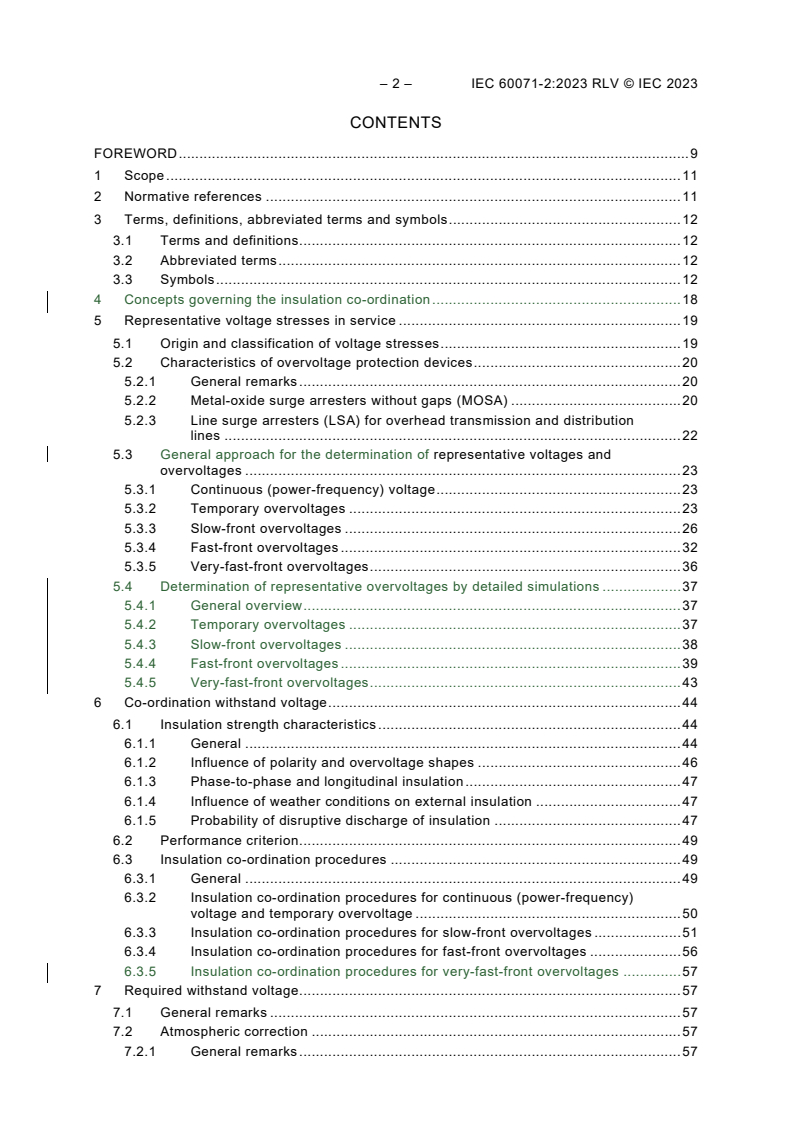
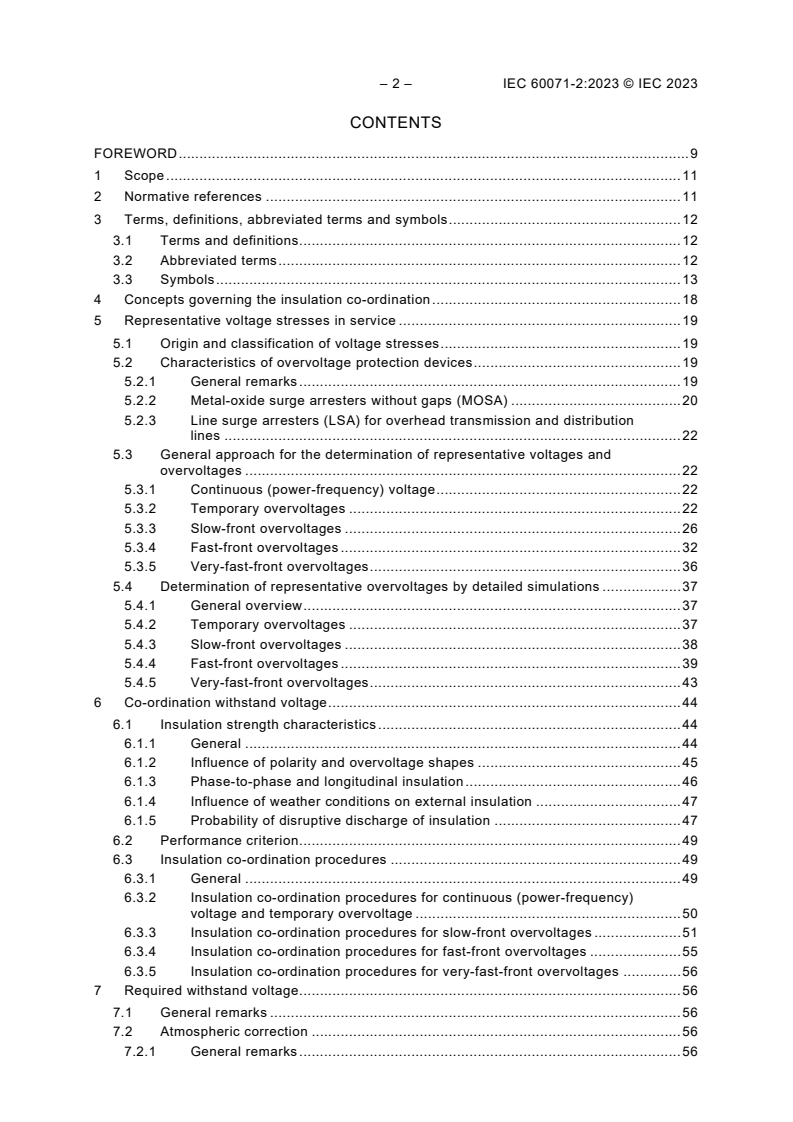
CONTENTS
FOREWORD . 9
1 Scope . 11
2 Normative references . 11
3 Terms, definitions, abbreviated terms and symbols . 12
3.1 Terms and definitions . 12
3.2 Abbreviated terms . 12
3.3 Symbols . 12
4 Concepts governing the insulation co-ordination . 18
5 Representative voltage stresses in service . 19
5.1 Origin and classification of voltage stresses . 19
5.2 Characteristics of overvoltage protection devices . 20
5.2.1 General remarks . 20
5.2.2 Metal-oxide surge arresters without gaps (MOSA) . 20
5.2.3 Line surge arresters (LSA) for overhead transmission and distribution
lines . 22
5.3 General approach for the determination of representative voltages and
overvoltages . 23
5.3.1 Continuous (power-frequency) voltage . 23
5.3.2 Temporary overvoltages . 23
5.3.3 Slow-front overvoltages . 26
5.3.4 Fast-front overvoltages . 32
5.3.5 Very-fast-front overvoltages . 36
5.4 Determination of representative overvoltages by detailed simulations . 37
5.4.1 General overview . 37
5.4.2 Temporary overvoltages . 37
5.4.3 Slow-front overvoltages . 38
5.4.4 Fast-front overvoltages . 39
5.4.5 Very-fast-front overvoltages . 43
6 Co-ordination withstand voltage . 44
6.1 Insulation strength characteristics . 44
6.1.1 General . 44
6.1.2 Influence of polarity and overvoltage shapes . 46
6.1.3 Phase-to-phase and longitudinal insulation . 47
6.1.4 Influence of weather conditions on external insulation . 47
6.1.5 Probability of disruptive discharge of insulation . 47
6.2 Performance criterion . 49
6.3 Insulation co-ordination procedures . 49
6.3.1 General . 49
6.3.2 Insulation co-ordination procedures for continuous (power-frequency)
voltage and temporary overvoltage . 50
6.3.3 Insulation co-ordination procedures for slow-front overvoltages . 51
6.3.4 Insulation co-ordination procedures for fast-front overvoltages . 56
6.3.5 Insulation co-ordination procedures for very-fast-front overvoltages . 57
7 Required withstand voltage . 57
7.1 General remarks . 57
7.2 Atmospheric correction . 57
7.2.1 General remarks . 57
7.2.2 Altitude correction . 58
7.3 Safety factors. 59
7.3.1 General . 59
7.3.2 Ageing . 60
7.3.3 Production and assembly dispersion . 60
7.3.4 Inaccuracy of the withstand voltage . 60
7.3.5 Recommended safety factors (K ) . 60
s
8 Standard withstand voltage and testing procedures . 61
8.1 General remarks . 61
8.1.1 Overview . 61
8.1.2 Standard switching impulse withstand voltage . 61
8.1.3 Standard lightning impulse withstand voltage . 61
8.2 Test conversion factors . 62
8.2.1 Range I. 62
8.2.2 Range II . 62
8.3 Determination of insulation withstand by type tests . 63
8.3.1 Test procedure dependency upon insulation type . 63
8.3.2 Non-self-restoring insulation . 63
8.3.3 Self-restoring insulation . 63
8.3.4 Mixed insulation . 64
8.3.5 Limitations of the test procedures . 65
8.3.6 Selection of the type test procedures . 65
8.3.7 Selection of the type test voltages . 65
9 Special considerations for overhead lines apparatus and transmission line . 66
9.1 Overhead line . 66
9.1.1 General remarks . 66
9.1.2 Insulation co-ordination for operating voltages and temporary
overvoltages . 67
9.1.3 Insulation co-ordination for slow-front overvoltages . 67
9.1.4 Insulation co-ordination for lightning fast-front overvoltages . 68
9.2 Cable line . 69
9.2.1 General . 69
9.2.2 Insulation co-ordination for operating voltages and temporary
overvoltages . 69
9.2.3 Insulation co-ordination for slow-front overvoltages . 69
9.2.4 Insulation co-ordination for fast-front overvoltages . 70
9.2.5 Overvoltage protection of cable lines . 70
9.3 GIL (gas insulated transmission line) / GIB (Gas-insulated busduct) . 71
9.3.1 General . 71
9.3.2 Insulation co-ordination for operating voltages and temporary
overvoltages . 71
9.3.3 Insulation co-ordination for slow-front overvoltages . 71
9.3.4 Insulation co-ordination for fast-front overvoltages . 72
9.3.5 Overvoltage protection of GIL/GIB lines . 72
9.4 Special considerations for substations Substation . 68
9.4.1 General remarks . 72
9.4.2 Insulation co-ordination for overvoltages. 73
Annex A (informative) Determination of temporary overvoltages due to earth faults . 76
Annex B (informative) Weibull probability distributions . 80
– 4 – IEC 60071-2:2023 RLV © IEC 2023
B.1 General remarks . 80
B.2 Disruptive discharge probability of external insulation . 81
B.3 Cumulative frequency distribution of overvoltages . 84
Annex C (informative) Determination of the representative slow-front overvoltage due
to line energization and re-energization . 86
C.1 General remarks . 86
C.2 Probability distribution of the representative amplitude of the prospective
overvoltage phase-to-earth . 86
C.3 Probability distribution of the representative amplitude of the prospective
overvoltage phase-to-phase . 89
C.4 Insulation characteristic . 91
C.5 Numerical example . 93
Annex D (informative) Transferred overvoltages in transformers . 100
D.1 General remarks . 100
D.2 Transferred temporary overvoltages . 101
D.3 Capacitively transferred surges . 101
D.4 Inductively transferred surges . 103
Annex E (informative) Determination of lightning overvoltages by simplified method . 107
E.1 General remarks . 107
E.2 Determination of the limit distance (X ) . 107
p
E.2.1 Protection with arresters in the substation . 107
E.2.2 Self-protection of substation . 108
E.3 Estimation of the representative lightning overvoltage amplitude. 109
E.3.1 General . 109
E.3.2 Shielding penetration . 109
E.3.3 Back flashovers . 110
E.4 Simplified method approach . 112
E.5 Assumed maximum value of the representative lightning overvoltage . 114
Annex F (informative) Calculation of air gap breakdown strength from experimental
data . 116
F.1 General . 116
F.2 Insulation response to power-frequency voltages . 116
F.3 Insulation response to slow-front overvoltages . 117
F.4 Insulation response to fast-front overvoltages . 118
Annex G (informative) Examples of insulation co-ordination procedure . 122
G.1 Overview. 122
G.2 Numerical example for a system in range I (with nominal voltage of 230 kV) . 122
G.2.1 General . 122
G.2.2 Part 1: no special operating conditions . 123
G.2.3 Part 2: influence of capacitor switching at station 2 . 130
G.2.4 Part 3: flow charts related to the example of Clause G.2 . 132
G.3 Numerical example for a system in range II (with nominal voltage of 735 kV) . 137
G.3.1 General . 137
G.3.2 Step 1: determination of the representative overvoltages –
values of U . 137
rp
G.3.3 Step 2: determination of the co-ordination withstand voltages –
values of U . 138
cw
G.3.4 Step 3: determination of the required withstand voltages – values of
U . 139
rw
G.3.5 Step 4: conversion to switching impulse withstand voltages (SIWV) . 140
G.3.6 Step 5: selection of standard insulation levels . 141
G.3.7 Considerations relative to phase-to-phase insulation co-ordination . 141
G.3.8 Phase-to-earth clearances . 142
G.3.9 Phase-to-phase clearances . 143
G.4 Numerical example for substations in distribution systems with U up to
m
36 kV in range I . 143
G.4.1 General . 143
G.4.2 Step 1: determination of the representative overvoltages –
values of U . 144
rp
G.4.3 Step 2: determination of the co-ordination withstand voltages –
values of U . 144
cw
G.4.4 Step 3: determination of required withstand voltages – values of U . 145
rw
G.4.5 Step 4: conversion to standard short-duration power-frequency and
lightning impulse withstand voltages . 146
G.4.6 Step 5: selection of standard withstand voltages . 147
G.4.7 Summary of insulation co-ordination procedure for the example of
Clause G.4 . 147
Annex H (informative) Atmospheric correction – Altitude correction application
example . 149
H.1 General principles . 149
H.1.1 Atmospheric correction in standard tests . 149
H.1.2 Task of atmospheric correction in insulation co-ordination . 150
H.2 Atmospheric correction in insulation co-ordination . 152
H.2.1 Factors for atmospheric correction . 152
H.2.2 General characteristics for moderate climates . 152
H.2.3 Special atmospheric conditions . 153
H.2.4 Altitude dependency of air pressure . 154
H.3 Altitude correction . 155
H.3.1 Definition of the altitude correction factor . 155
H.3.2 Principle of altitude correction . 156
H.3.3 Altitude correction for standard equipment operating at altitudes up to
1 000 m . 157
H.3.4 Altitude correction for standard equipment operating at altitudes above
1 000 m . 157
H.4 Selection of the exponent m . 158
H.4.1 General . 158
H.4.2 Derivation of exponent m for switching impulse voltage . 158
H.4.3 Derivation of exponent m for critical switching impulse voltage . 161
Annex I (informative) Evaluation method of non-standard lightning overvoltage shape
for representative voltages and overvoltages . 164
I.1 General remarks . 164
I.2 Lightning overvoltage shape . 164
I.3 Evaluation method for GIS . 164
I.3.1 Experiments . 164
I.3.2 Evaluation of overvoltage shape . 165
I.4 Evaluation method for transformer . 165
I.4.1 Experiments . 165
I.4.2 Evaluation of overvoltage shape . 166
– 6 – IEC 60071-2:2023 RLV © IEC 2023
Annex J (informative) Insulation co-ordination for very-fast-front overvoltages in UHV
substations . 171
J.1 General . 171
J.2 Influence of disconnector design . 171
J.3 Insulation co-ordination for VFFO . 172
Annex K (informative) Application of shunt reactors to limit TOV and SFO of high
voltage overhead transmission line . 174
K.1 General remarks . 174
K.2 Limitation of TOV and SFO . 174
K.3 Application of the neutral grounding reactor to limit resonance overvoltage
and secondary arc current . 174
K.4 SFO and Beat frequency overvoltage limited by neutral arrester . 175
K.5 SFO and FFO due to SR de-energization . 176
K.6 Limitation of TOV by Controllable SR . 176
K.7 Insulation coordination of the SR and neutral grounding reactor . 176
K.8 Self-excitation TOV of synchronous generator . 176
Annex L (informative) Calculation of lightning stroke rate and lightning outage rate . 177
L.1 General . 177
L.2 Description in CIGRE [37] . 177
L.3 Flash program in IEEE [49] . 178
L.4 [Case Study] Calculation of Lightning Stroke Rate and Lightning Outage
Rate (Appendix D in CIGRE TB 839 [37]) . 178
L.4.1 Basic flow of calculation method . 178
L.4.2 Comparison of Calculation Results with Observations . 181
Bibliography . 183
Figure 1 – Range of 2 % slow-front overvoltages at the receiving end due to line
energization and re-energization [27] . 28
Figure 2 – Ratio between the 2 % values of slow-front overvoltages phase-to-phase
and phase-to-earth [28], [29] . 29
Figure 3 – Diagram for surge arrester connection to the protected object . 36
Figure 4 – Modelling of transmission lines and substations/power stations . 42
Figure 5 – Distributive discharge probability of self-restoring insulation described on a
linear scale . 52
Figure 6 – Disruptive discharge probability of self-restoring insulation described on a
Gaussian scale . 52
Figure 7 – Evaluation of deterministic co-ordination factor K . 53
cd
Figure 8 – Evaluation of the risk of failure . 54
Figure 9 – Risk of failure of external insulation for slow-front overvoltages as a function
of the statistical co-ordination factor K . 56
cs
Figure 10 – Dependence of exponent m on the co-ordination switching impulse
withstand voltage . 59
Figure 11 – Probability P of an equipment to pass the test dependent on the difference
K between the actual and the rated impulse withstand voltage . 65
Figure 12 – Example of a schematic substation layout used for the overvoltage stress
location . 72
Figure A.1 – Earth fault factor k on a base of X /X for R /X = R = 0 . 77
0 1 1 1 f
Figure A.2 – Relationship between R /X and X /X for constant values of earth fault
0 1 0 1
factor k where R = 0 . 78
Figure A.3 – Relationship between R /X and X /X for constant values of earth fault
0 1 0 1
factor k where R = 0,5 X . 78
1 1
Figure A.4 – Relationship between R /X and X /X for constant values of earth fault
0 1 0 1
factor k where R = X . 79
1 1
Figure A.5 – Relationship between R /X and X /X for constant values of earth fault
0 1 0 1
factor k where R = 2X . 79
1 1
Figure B.1 – Conversion chart for the reduction of the withstand voltage due to placing
insulation configurations in parallel . 85
Figure C.1 – Probability density and cumulative distribution for derivation of the
representative overvoltage phase-to-earth . 87
Figure C.2 – Example for bivariate phase-to-phase overvoltage curves with constant
probability density and tangents giving the relevant 2 % values . 95
Figure C.3 – Principle of the determination of the representative phase-to-phase
overvoltage U . 97
pre
Figure C.4 – Schematic phase-phase-earth insulation configuration . 98
Figure C.5 – Description of the 50 % switching impulse flashover voltage of a phase-
phase-earth insulation . 98
Figure C.6 – Inclination angle of the phase-to-phase insulation characteristic in range
"b" dependent on the ratio of the phase-phase clearance D to the height H above
t
earth . 99
Figure D.1 – Distributed capacitances of the windings of a transformer and the
equivalent circuit describing the windings . 105
Figure D.2 – Values of factor J describing the effect of the winding connections on the
inductive surge transference . 106
Figure H.1 – Principle of the atmospheric correction during test of a specified
insulation level according to the procedure of IEC 60060-1 . 150
Figure H.2 – Principal task of the atmospheric correction in insulation co-ordination
according to IEC 60071-1 . 151
Figure H.3 – Comparison of atmospheric correction δ × k with relative air pressure
h
p/p for various weather stations around the world . 154
Figure H.4 – Deviation of simplified pressure calculation by exponential function in this
document from the temperature dependent pressure calculation of ISO 2533 . 155
Figure H.5 – Principle of altitude correction: decreasing withstand voltage U of
equipment with increasing altitude . 156
Figure H.6 – Sets of m-curves for standard switching impulse voltage including the
variations in altitude for each gap factor . 161
Figure H.7 – Exponent m for standard switching impulse voltage for selected gap
factors covering altitudes up to 4 000 m . 161
Figure H.8 – Sets of m-curves for critical switching impulse voltage including the
variations in altitude for each gap factor . 162
Figure H.9 – Exponent m for critical switching impulse voltage for selected gap factors
covering altitudes up to 4 000 m . 162
Figure H.10 – Accordance of m-curves from Figure 10 with determination of exponent
m by means of critical switching impulse voltage for selected gap factors and altitudes. 163
Figure I.1 – Examples of lightning overvoltage shapes . 166
– 8 – IEC 60071-2:2023 RLV © IEC 2023
Figure I.2 – Example of insulation characteristics with respect to lightning overvoltages
of the SF gas gap (Shape E) . 167
Figure I.3 – Calculation of duration time T . 167
d
Figure I.4 – Shape evaluation flow for GIS and transformer . 168
Figure I.5 – Application to GIS lightning overvoltage . 169
Figure I.6 – Example of insulation characteristics with respect to lightning overvoltage
of the turn-to-turn insulation (Shape C) . 169
Figure I.7 – Application to transformer lightning overvoltage . 170
Figure J.1 – Insulation co-ordination for very-fast-front overvoltages. 173
Figure L.1 – Outline of the CIGRE method for lightning performance of an overhead
line . 178
Figure L.2 – Flowchart to calculate lightning outage rate of transmission lines . 180
Figure L.3 – Typical conductor arrangements of large-scale transmission lines . 181
Figure L.4 – Lightning stroke rate to power lines -calculations and observations- . 181
Figure L.5 – Lightning outage rate -calculations and observations- . 182
Table 1 – Test conversion factors for range I, to convert required SIWV to SDWV and
LIWV . 62
Table 2 – Test conversion factors for range II to convert required SDWV to SIWV . 63
Table 3 – Selectivity of test procedures B and C of IEC 60060-1 . 64
Table B.1 – Breakdown voltage versus cumulative flashover probability – Single
insulation and 100 parallel insulations . 83
Table E.1 – Corona damping constant K . 108
co
Table E.2 – Factor A for various overhead lines . 114
Table F.1 – Typical gap factors K for switching impulse breakdown phase-to-earth
(according to [1] and [4]) . 120
Table F.2 – Gap factors for typical phase-to-phase geometries . 121
Table G.1 – Summary of minimum required withstand voltages obtained for the
example shown in G.2.2 . 129
Table G.2 – Summary of required withstand voltages obtained for the example shown
in G.2.3 . 131
Table G.3 – Values related to the insulation co-ordination procedure for the example
in G.4. 148
Table H.1 – Comparison of functional expressions of Figure 10 with the selected
parameters from the derivation of m-curves with critical switching impulse . 163
Table I.1 – Evaluation of the lightning overvoltage in the GIS of UHV system . 167
Table I.2 – Evaluation of lightning overvoltage in the transformer of 500 kV system . 170
INTERNATIONAL ELECTROTECHNICAL COMMISSION
____________
INSULATION CO-ORDINATION –
Part 2: Application guidelines
FOREWORD
1) The International Electrotechnical Commission (IEC) is a worldwide organization for standardization comprising
all national electrotechnical committees (IEC National Committees). The object of IEC is to promote international
co-operation on all questions concerning standardization in the electrical and electronic fields. To this end and
in addition to other activities, IEC publishes International Standards, Technical Specifications, Technical Reports,
Publicly Available Specifications (PAS) and Guides (hereafter referred to as “IEC Publication(s)”). Their
preparation is entrusted to technical committees; any IEC National Committee interested in the subject dealt with
may participate in this preparatory work. International, governmental and non-governmental organizations liaising
with the IEC also participate in this preparation. IEC collaborates closely with the International Organization for
Standardization (ISO) in accordance with conditions determined by agreement between the two organizations.
2) The formal decisions or agreements of IEC on technical matters express, as nearly as possible, an international
consensus of opinion on the relevant subjects since each technical committee has representation from all
interested IEC National Committees.
3) IEC Publications have the form of recommendations for international use and are accepted by IEC National
Committees in that sense. While all reasonable efforts are made to ensure that the technical content of IEC
Publications is accurate, IEC cannot be held responsible for the way in which they are used or for any
misinterpretation by any end user.
4) In order to promote international uniformity, IEC National Committees undertake to apply IEC Publications
transparently to the maximum extent possible in their national and regional publications. Any divergence between
any IEC Publication and the corresponding national or regional publication shall be clearly indicated in the latter.
5) IEC itself does not provide any attestation of conformity. Independent certification bodies provide conformity
assessment services and, in some areas, access to IEC marks of conformity. IEC is not responsible for any
services carried out by independent certification bodies.
6) All users should ensure that they have the latest edition of this publication.
7) No liability shall attach to IEC or its directors, employees, servants or agents including individual experts and
members of its technical committees and IEC National Committees for any personal injury, property damage or
other damage of any nature whatsoever, whether direct or indirect, or for costs (including legal fees) and
expenses arising out of the publication, use of, or reliance upon, this IEC Publication or any other IEC
Publications.
8) Attention is drawn to the Normative references cited in this publication. Use of the referenced publications is
indispensable for the correct application of this publication.
9) Attention is drawn to the possibility that some of the elements of this IEC Publication may be the subject of patent
rights. IEC shall not be held responsible for identifying any or all such patent rights.
This redline version of the official IEC Standard allows the user to identify the changes
made to the previous edition IEC 60071-2:2018. A vertical bar appears in the margin
wherever a change has been made. Additions are in green text, deletions are in
strikethrough red text.
– 10 – IEC 60071-2:2023 RLV © IEC 2023
IEC 60071-2 has been prepared by IEC technical committee 99: Insulation co-ordination and
system engineering of high voltage electrical power installations above 1,0 kV AC and
1,5 kV DC. It is an International Standard.
This fifth edition cancels and replaces the fourth edition published in 2018. This edition
constitutes a technical revision.
This edition includes the following significant technical changes with respect to the previous
edition:
a) Clause 4 Concepts governing the insulation co-ordination has been added.
b) Subclause 5.3 has been revised, and Subclause 5.4 Detailed simulation has been added
because it is widely applied in the recent practices of insulation coordination.
c) Special considerations for cable line and GIL/GIB have been added in Clause 9.
d) Annex K (informative) Application of line shunt reactor to limitation of TOV and SFO in high
voltage overhead transmission lines has been added.
e) Annex L (informative) Calculation of lightning stroke rate and lightning outage rate has been
added.
The text of this International Standard is based on the following documents:
Draft Report on voting
99/356/CDV 99/392/RVC
Full information on the voting for its approval can be found in the report on voting indicated in
the above table.
The language used for the development of this International Standard is English.
This document was drafted in accordance with ISO/IEC Directives, Part 2, and developed in
accordance with ISO/IEC Directives, Part 1 and ISO/IEC Directives, IEC Supplement, available
at www.iec.ch/members_experts/refdocs. The main document types developed by IEC are
described in greater detail at www.iec.ch/publications.
A list of all parts in the IEC 60071 series, published under the general title Insulation co-
ordination, can be found on the IEC website.
The committee has decided that the contents of this document will remain unchanged until the
stability date indicated on the IEC website under webstore.iec.ch in the data related to the
specific document. At this date, the document will be
• reconfirmed,
•
...
IEC 60071-2 ®
Edition 5.0 2023-05
INTERNATIONAL
STANDARD
NORME
INTERNATIONALE
colour
inside
HORIZONTAL PUBLICATION
PUBLICATION HORIZONTALE
Insulation co-ordination –
Part 2: Application guidelines
Coordination de l'isolement –
Partie 2: Lignes directrices en matière d'application
All rights reserved. Unless otherwise specified, no part of this publication may be reproduced or utilized in any form
or by any means, electronic or mechanical, including photocopying and microfilm, without permission in writing from
either IEC or IEC's member National Committee in the country of the requester. If you have any questions about IEC
copyright or have an enquiry about obtaining additional rights to this publication, please contact the address below or
your local IEC member National Committee for further information.
Droits de reproduction réservés. Sauf indication contraire, aucune partie de cette publication ne peut être reproduite ni
utilisée sous quelque forme que ce soit et par aucun procédé, électronique ou mécanique, y compris la photocopie et
les microfilms, sans l'accord écrit de l'IEC ou du Comité national de l'IEC du pays du demandeur. Si vous avez des
questions sur le copyright de l'IEC ou si vous désirez obtenir des droits supplémentaires sur cette publication, utilisez
les coordonnées ci-après ou contactez le Comité national de l'IEC de votre pays de résidence.
IEC Secretariat Tel.: +41 22 919 02 11
3, rue de Varembé info@iec.ch
CH-1211 Geneva 20 www.iec.ch
Switzerland
About the IEC
The International Electrotechnical Commission (IEC) is the leading global organization that prepares and publishes
International Standards for all electrical, electronic and related technologies.
About IEC publications
The technical content of IEC publications is kept under constant review by the IEC. Please make sure that you have the
latest edition, a corrigendum or an amendment might have been published.
IEC publications search - webstore.iec.ch/advsearchform IEC Products & Services Portal - products.iec.ch
The advanced search enables to find IEC publications by a Discover our powerful search engine and read freely all the
variety of criteria (reference number, text, technical publications previews. With a subscription you will always have
committee, …). It also gives information on projects, replaced access to up to date content tailored to your needs.
and withdrawn publications.
Electropedia - www.electropedia.org
IEC Just Published - webstore.iec.ch/justpublished
The world's leading online dictionary on electrotechnology,
Stay up to date on all new IEC publications. Just Published
containing more than 22 300 terminological entries in English
details all new publications released. Available online and once
and French, with equivalent terms in 19 additional languages.
a month by email.
Also known as the International Electrotechnical Vocabulary
(IEV) online.
IEC Customer Service Centre - webstore.iec.ch/csc
If you wish to give us your feedback on this publication or need
further assistance, please contact the Customer Service
Centre: sales@iec.ch.
A propos de l'IEC
La Commission Electrotechnique Internationale (IEC) est la première organisation mondiale qui élabore et publie des
Normes internationales pour tout ce qui a trait à l'électricité, à l'électronique et aux technologies apparentées.
A propos des publications IEC
Le contenu technique des publications IEC est constamment revu. Veuillez vous assurer que vous possédez l’édition la
plus récente, un corrigendum ou amendement peut avoir été publié.
Recherche de publications IEC - Découvrez notre puissant moteur de recherche et consultez
webstore.iec.ch/advsearchform gratuitement tous les aperçus des publications. Avec un
La recherche avancée permet de trouver des publications IEC abonnement, vous aurez toujours accès à un contenu à jour
en utilisant différents critères (numéro de référence, texte, adapté à vos besoins.
comité d’études, …). Elle donne aussi des informations sur les
projets et les publications remplacées ou retirées. Electropedia - www.electropedia.org
Le premier dictionnaire d'électrotechnologie en ligne au monde,
IEC Just Published - webstore.iec.ch/justpublished
avec plus de 22 300 articles terminologiques en anglais et en
Restez informé sur les nouvelles publications IEC. Just
français, ainsi que les termes équivalents dans 19 langues
Published détaille les nouvelles publications parues.
additionnelles. Egalement appelé Vocabulaire
Disponible en ligne et une fois par mois par email.
Electrotechnique International (IEV) en ligne.
Service Clients - webstore.iec.ch/csc
Si vous désirez nous donner des commentaires sur cette
publication ou si vous avez des questions contactez-nous:
sales@iec.ch.
IEC Products & Services Portal - products.iec.ch
IEC 60071-2 ®
Edition 5.0 2023-05
INTERNATIONAL
STANDARD
NORME
INTERNATIONALE
colour
inside
HORIZONTAL PUBLICATION
PUBLICATION HORIZONTALE
Insulation co-ordination –
Part 2: Application guidelines
Coordination de l'isolement –
Partie 2: Lignes directrices en matière d'application
INTERNATIONAL
ELECTROTECHNICAL
COMMISSION
COMMISSION
ELECTROTECHNIQUE
INTERNATIONALE
ICS 29.080.30 ISBN 978-2-8322-6988-6
– 2 – IEC 60071-2:2023 © IEC 2023
CONTENTS
FOREWORD . 9
1 Scope . 11
2 Normative references . 11
3 Terms, definitions, abbreviated terms and symbols . 12
3.1 Terms and definitions . 12
3.2 Abbreviated terms . 12
3.3 Symbols . 13
4 Concepts governing the insulation co-ordination . 18
5 Representative voltage stresses in service . 19
5.1 Origin and classification of voltage stresses . 19
5.2 Characteristics of overvoltage protection devices . 19
5.2.1 General remarks . 19
5.2.2 Metal-oxide surge arresters without gaps (MOSA) . 20
5.2.3 Line surge arresters (LSA) for overhead transmission and distribution
lines . 22
5.3 General approach for the determination of representative voltages and
overvoltages . 22
5.3.1 Continuous (power-frequency) voltage . 22
5.3.2 Temporary overvoltages . 22
5.3.3 Slow-front overvoltages . 26
5.3.4 Fast-front overvoltages . 32
5.3.5 Very-fast-front overvoltages . 36
5.4 Determination of representative overvoltages by detailed simulations . 37
5.4.1 General overview . 37
5.4.2 Temporary overvoltages . 37
5.4.3 Slow-front overvoltages . 38
5.4.4 Fast-front overvoltages . 39
5.4.5 Very-fast-front overvoltages . 43
6 Co-ordination withstand voltage . 44
6.1 Insulation strength characteristics . 44
6.1.1 General . 44
6.1.2 Influence of polarity and overvoltage shapes . 45
6.1.3 Phase-to-phase and longitudinal insulation . 46
6.1.4 Influence of weather conditions on external insulation . 47
6.1.5 Probability of disruptive discharge of insulation . 47
6.2 Performance criterion . 49
6.3 Insulation co-ordination procedures . 49
6.3.1 General . 49
6.3.2 Insulation co-ordination procedures for continuous (power-frequency)
voltage and temporary overvoltage . 50
6.3.3 Insulation co-ordination procedures for slow-front overvoltages . 51
6.3.4 Insulation co-ordination procedures for fast-front overvoltages . 55
6.3.5 Insulation co-ordination procedures for very-fast-front overvoltages . 56
7 Required withstand voltage . 56
7.1 General remarks . 56
7.2 Atmospheric correction . 56
7.2.1 General remarks . 56
7.2.2 Altitude correction . 57
7.3 Safety factors. 58
7.3.1 General . 58
7.3.2 Ageing . 59
7.3.3 Production and assembly dispersion . 59
7.3.4 Inaccuracy of the withstand voltage . 59
7.3.5 Recommended safety factors (K ) . 59
s
8 Standard withstand voltage and testing procedures . 60
8.1 General remarks . 60
8.1.1 Overview . 60
8.1.2 Standard switching impulse withstand voltage . 60
8.1.3 Standard lightning impulse withstand voltage . 60
8.2 Test conversion factors . 61
8.2.1 Range I. 61
8.2.2 Range II . 61
8.3 Determination of insulation withstand by type tests . 62
8.3.1 Test procedure dependency upon insulation type . 62
8.3.2 Non-self-restoring insulation . 62
8.3.3 Self-restoring insulation . 62
8.3.4 Mixed insulation . 63
8.3.5 Limitations of the test procedures . 64
8.3.6 Selection of the type test procedures . 64
8.3.7 Selection of the type test voltages . 64
9 Special considerations for apparatus and transmission line . 65
9.1 Overhead line . 65
9.1.1 General . 65
9.1.2 Insulation co-ordination for operating voltages and temporary
overvoltages . 66
9.1.3 Insulation co-ordination for slow-front overvoltages . 66
9.1.4 Insulation co-ordination for fast-front overvoltages . 67
9.2 Cable line . 68
9.2.1 General . 68
9.2.2 Insulation co-ordination for operating voltages and temporary
overvoltages . 68
9.2.3 Insulation co-ordination for slow-front overvoltages . 68
9.2.4 Insulation co-ordination for fast-front overvoltages . 69
9.2.5 Overvoltage protection of cable lines . 69
9.3 GIL (gas insulated transmission line) / GIB (Gas-insulated busduct) . 70
9.3.1 General . 70
9.3.2 Insulation co-ordination for operating voltages and temporary
overvoltages . 70
9.3.3 Insulation co-ordination for slow-front overvoltages . 70
9.3.4 Insulation co-ordination for fast-front overvoltages . 71
9.3.5 Overvoltage protection of GIL/GIB lines . 71
9.4 Substation . 71
9.4.1 General . 71
9.4.2 Insulation co-ordination for overvoltages. 72
Annex A (informative) Determination of temporary overvoltages due to earth faults . 75
Annex B (informative) Weibull probability distributions . 79
– 4 – IEC 60071-2:2023 © IEC 2023
B.1 General remarks . 79
B.2 Disruptive discharge probability of external insulation . 80
B.3 Cumulative frequency distribution of overvoltages . 83
Annex C (informative) Determination of the representative slow-front overvoltage due
to line energization and re-energization . 86
C.1 General remarks . 86
C.2 Probability distribution of the representative amplitude of the prospective
overvoltage phase-to-earth . 86
C.3 Probability distribution of the representative amplitude of the prospective
overvoltage phase-to-phase . 89
C.4 Insulation characteristic . 90
C.5 Numerical example . 93
Annex D (informative) Transferred overvoltages in transformers . 98
D.1 General remarks . 98
D.2 Transferred temporary overvoltages . 99
D.3 Capacitively transferred surges . 99
D.4 Inductively transferred surges . 101
Annex E (informative) Determination of lightning overvoltages by simplified method . 105
E.1 General remarks . 105
E.2 Determination of the limit distance (X ) . 105
p
E.2.1 Protection with arresters in the substation . 105
E.2.2 Self-protection of substation . 106
E.3 Estimation of the representative lightning overvoltage amplitude. 107
E.3.1 General . 107
E.3.2 Shielding penetration . 107
E.3.3 Back flashovers . 108
E.4 Simplified approach . 110
E.5 Assumed maximum value of the representative lightning overvoltage . 112
Annex F (informative) Calculation of air gap breakdown strength from experimental
data . 114
F.1 General . 114
F.2 Insulation response to power-frequency voltages . 114
F.3 Insulation response to slow-front overvoltages . 115
F.4 Insulation response to fast-front overvoltages . 116
Annex G (informative) Examples of insulation co-ordination procedure . 120
G.1 Overview. 120
G.2 Numerical example for a system in range I (with nominal voltage of 230 kV) . 120
G.2.1 General . 120
G.2.2 Part 1: no special operating conditions . 121
G.2.3 Part 2: influence of capacitor switching at station 2 . 128
G.2.4 Part 3: flow charts related to the example of Clause G.2 . 130
G.3 Numerical example for a system in range II (with nominal voltage of 735 kV) . 135
G.3.1 General . 135
G.3.2 Step 1: determination of the representative overvoltages –
values of U . 135
rp
G.3.3 Step 2: determination of the co-ordination withstand voltages –
values of U . 136
cw
G.3.4 Step 3: determination of the required withstand voltages – values of
U . 137
rw
G.3.5 Step 4: conversion to switching impulse withstand voltages (SIWV) . 138
G.3.6 Step 5: selection of standard insulation levels . 139
G.3.7 Considerations relative to phase-to-phase insulation co-ordination . 139
G.3.8 Phase-to-earth clearances . 140
G.3.9 Phase-to-phase clearances . 141
G.4 Numerical example for substations in distribution systems with U up to
m
36 kV in range I . 141
G.4.1 General . 141
G.4.2 Step 1: determination of the representative overvoltages –
values of U . 142
rp
G.4.3 Step 2: determination of the co-ordination withstand voltages –
values of U . 142
cw
G.4.4 Step 3: determination of required withstand voltages – values of U . 143
rw
G.4.5 Step 4: conversion to standard short-duration power-frequency and
lightning impulse withstand voltages . 144
G.4.6 Step 5: selection of standard withstand voltages . 145
G.4.7 Summary of insulation co-ordination procedure for the example of
Clause G.4 . 145
Annex H (informative) Atmospheric correction – Altitude correction application
example . 147
H.1 General principles . 147
H.1.1 Atmospheric correction in standard tests . 147
H.1.2 Task of atmospheric correction in insulation co-ordination . 148
H.2 Atmospheric correction in insulation co-ordination . 150
H.2.1 Factors for atmospheric correction . 150
H.2.2 General characteristics for moderate climates . 150
H.2.3 Special atmospheric conditions . 151
H.2.4 Altitude dependency of air pressure . 152
H.3 Altitude correction . 153
H.3.1 Definition of the altitude correction factor . 153
H.3.2 Principle of altitude correction . 154
H.3.3 Altitude correction for standard equipment operating at altitudes up to
1 000 m . 155
H.3.4 Altitude correction for standard equipment operating at altitudes above
1 000 m . 156
H.4 Selection of the exponent m . 156
H.4.1 General . 156
H.4.2 Derivation of exponent m for switching impulse voltage . 157
H.4.3 Derivation of exponent m for critical switching impulse voltage . 159
Annex I (informative) Evaluation method of non-standard lightning overvoltage shape
for representative voltages and overvoltages . 162
I.1 General remarks . 162
I.2 Lightning overvoltage shape . 162
I.3 Evaluation method for GIS . 162
I.3.1 Experiments . 162
I.3.2 Evaluation of overvoltage shape . 163
I.4 Evaluation method for transformer . 163
I.4.1 Experiments . 163
I.4.2 Evaluation of overvoltage shape . 164
– 6 – IEC 60071-2:2023 © IEC 2023
Annex J (informative) Insulation co-ordination for very-fast-front overvoltages in UHV
substations . 169
J.1 General . 169
J.2 Influence of disconnector design . 169
J.3 Insulation co-ordination for VFFO . 170
Annex K (informative) Application of shunt reactors to limit TOV and SFO of high
voltage overhead transmission line . 172
K.1 General remarks . 172
K.2 Limitation of TOV and SFO . 172
K.3 Application of the neutral grounding reactor to limit resonance overvoltage
and secondary arc current . 172
K.4 SFO and Beat frequency overvoltage limited by neutral arrester . 173
K.5 SFO and FFO due to SR de-energization . 174
K.6 Limitation of TOV by Controllable SR . 174
K.7 Insulation coordination of the SR and neutral grounding reactor . 174
K.8 Self-excitation TOV of synchronous generator . 174
Annex L (informative) Calculation of lightning stroke rate and lightning outage rate . 175
L.1 General . 175
L.2 Description in CIGRE [37] . 175
L.3 Flash program in IEEE [49] . 176
L.4 [Case Study] Calculation of Lightning Stroke Rate and Lightning Outage
Rate (Appendix D in CIGRE TB 839 [37]) . 176
L.4.1 Basic flow of calculation method . 176
L.4.2 Comparison of Calculation Results with Observations . 179
Bibliography . 181
Figure 1 – Range of 2 % slow-front overvoltages at the receiving end due to line
energization and re-energization [27] . 28
Figure 2 – Ratio between the 2 % values of slow-front overvoltages phase-to-phase
and phase-to-earth [28], [29] . 29
Figure 3 – Diagram for surge arrester connection to the protected object . 36
Figure 4 – Modelling of transmission lines and substations/power stations . 42
Figure 5 – Distributive discharge probability of self-restoring insulation described on a
linear scale . 51
Figure 6 – Disruptive discharge probability of self-restoring insulation described on a
Gaussian scale . 52
Figure 7 – Evaluation of deterministic co-ordination factor K . 52
cd
Figure 8 – Evaluation of the risk of failure . 53
Figure 9 – Risk of failure of external insulation for slow-front overvoltages as a function
of the statistical co-ordination factor K . 55
cs
Figure 10 – Dependence of exponent m on the co-ordination switching impulse
withstand voltage . 58
Figure 11 – Probability P of an equipment to pass the test dependent on the difference
K between the actual and the rated impulse withstand voltage . 64
Figure 12 – Example of a schematic substation layout used for the overvoltage stress
location . 71
Figure A.1 – Earth fault factor k on a base of X /X for R /X = R = 0 . 76
0 1 1 1 f
Figure A.2 – Relationship between R /X and X /X for constant values of earth fault
0 1 0 1
factor k where R = 0 . 76
Figure A.3 – Relationship between R /X and X /X for constant values of earth fault
0 1 0 1
factor k where R = 0,5 X . 77
1 1
Figure A.4 – Relationship between R /X and X /X for constant values of earth fault
0 1 0 1
factor k where R = X . 77
1 1
Figure A.5 – Relationship between R /X and X /X for constant values of earth fault
0 1 0 1
factor k where R = 2X . 78
1 1
Figure B.1 – Conversion chart for the reduction of the withstand voltage due to placing
insulation configurations in parallel . 85
Figure C.1 – Probability density and cumulative distribution for derivation of the
representative overvoltage phase-to-earth . 86
Figure C.2 – Example for bivariate phase-to-phase overvoltage curves with constant
probability density and tangents giving the relevant 2 % values . 94
Figure C.3 – Principle of the determination of the representative phase-to-phase
overvoltage U . 95
pre
Figure C.4 – Schematic phase-phase-earth insulation configuration . 96
Figure C.5 – Description of the 50 % switching impulse flashover voltage of a phase-
phase-earth insulation . 96
Figure C.6 – Inclination angle of the phase-to-phase insulation characteristic in range
"b" dependent on the ratio of the phase-phase clearance D to the height H above
t
earth . 97
Figure D.1 – Distributed capacitances of the windings of a transformer and the
equivalent circuit describing the windings . 103
Figure D.2 – Values of factor J describing the effect of the winding connections on the
inductive surge transference . 104
Figure H.1 – Principle of the atmospheric correction during test of a specified
insulation level according to the procedure of IEC 60060-1 . 148
Figure H.2 – Principal task of the atmospheric correction in insulation co-ordination
according to IEC 60071-1 . 149
Figure H.3 – Comparison of atmospheric correction δ × k with relative air pressure
h
p/p for various weather stations around the world . 152
Figure H.4 – Deviation of simplified pressure calculation by exponential function in this
document from the temperature dependent pressure calculation of ISO 2533 . 153
Figure H.5 – Principle of altitude correction: decreasing withstand voltage U of
equipment with increasing altitude . 155
Figure H.6 – Sets of m-curves for standard switching impulse voltage including the
variations in altitude for each gap factor . 159
Figure H.7 – Exponent m for standard switching impulse voltage for selected gap
factors covering altitudes up to 4 000 m . 159
Figure H.8 – Sets of m-curves for critical switching impulse voltage including the
variations in altitude for each gap factor . 160
Figure H.9 – Exponent m for critical switching impulse voltage for selected gap factors
covering altitudes up to 4 000 m . 160
Figure H.10 – Accordance of m-curves from Figure 10 with determination of exponent
m by means of critical switching impulse voltage for selected gap factors and altitudes. 161
Figure I.1 – Examples of lightning overvoltage shapes . 164
– 8 – IEC 60071-2:2023 © IEC 2023
Figure I.2 – Example of insulation characteristics with respect to lightning overvoltages
of the SF gas gap (Shape E) . 165
Figure I.3 – Calculation of duration time T . 165
d
Figure I.4 – Shape evaluation flow for GIS and transformer . 166
Figure I.5 – Application to GIS lightning overvoltage . 167
Figure I.6 – Example of insulation characteristics with respect to lightning overvoltage
of the turn-to-turn insulation (Shape C) . 167
Figure I.7 – Application to transformer lightning overvoltage . 168
Figure J.1 – Insulation co-ordination for very-fast-front overvoltages. 171
Figure L.1 – Outline of the CIGRE method for lightning performance of an overhead
line . 176
Figure L.2 – Flowchart to calculate lightning outage rate of transmission lines . 178
Figure L.3 – Typical conductor arrangements of large-scale transmission lines . 179
Figure L.4 – Lightning stroke rate to power lines -calculations and observations- . 179
Figure L.5 – Lightning outage rate -calculations and observations- . 180
Table 1 – Test conversion factors for range I, to convert required SIWV to SDWV and
LIWV . 61
Table 2 – Test conversion factors for range II to convert required SDWV to SIWV . 62
Table 3 – Selectivity of test procedures B and C of IEC 60060-1 . 63
Table B.1 – Breakdown voltage versus cumulative flashover probability – Single
insulation and 100 parallel insulations . 82
Table E.1 – Corona damping constant K . 106
co
Table E.2 – Factor A for various overhead lines . 112
Table F.1 – Typical gap factors K for switching impulse breakdown phase-to-earth
(according to [1] and [4]) . 118
Table F.2 – Gap factors for typical phase-to-phase geometries . 119
Table G.1 – Summary of minimum required withstand voltages obtained for the
example shown in G.2.2 . 127
Table G.2 – Summary of required withstand voltages obtained for the example shown
in G.2.3 . 129
Table G.3 – Values related to the insulation co-ordination procedure for the example
in G.4. 146
Table H.1 – Comparison of functional expressions of Figure 10 with the selected
parameters from the derivation of m-curves with critical switching impulse . 161
Table I.1 – Evaluation of the lightning overvoltage in the GIS of UHV system . 165
Table I.2 – Evaluation of lightning overvoltage in the transformer of 500 kV system . 168
INTERNATIONAL ELECTROTECHNICAL COMMISSION
____________
INSULATION CO-ORDINATION –
Part 2: Application guidelines
FOREWORD
1) The International Electrotechnical Commission (IEC) is a worldwide organization for standardization comprising
all national electrotechnical committees (IEC National Committees). The object of IEC is to promote international
co-operation on all questions concerning standardization in the electrical and electronic fields. To this end and
in addition to other activities, IEC publishes International Standards, Technical Specifications, Technical Reports,
Publicly Available Specifications (PAS) and Guides (hereafter referred to as “IEC Publication(s)”). Their
preparation is entrusted to technical committees; any IEC National Committee interested in the subject dealt with
may participate in this preparatory work. International, governmental and non-governmental organizations liaising
with the IEC also participate in this preparation. IEC collaborates closely with the International Organization for
Standardization (ISO) in accordance with conditions determined by agreement between the two organizations.
2) The formal decisions or agreements of IEC on technical matters express, as nearly as possible, an international
consensus of opinion on the relevant subjects since each technical committee has representation from all
interested IEC National Committees.
3) IEC Publications have the form of recommendations for international use and are accepted by IEC National
Committees in that sense. While all reasonable efforts are made to ensure that the technical content of IEC
Publications is accurate, IEC cannot be held responsible for the way in which they are used or for any
misinterpretation by any end user.
4) In order to promote international uniformity, IEC National Committees undertake to apply IEC Publications
transparently to the maximum extent possible in their national and regional publications. Any divergence between
any IEC Publication and the corresponding national or regional publication shall be clearly indicated in the latter.
5) IEC itself does not provide any attestation of conformity. Independent certification bodies provide conformity
assessment services and, in some areas, access to IEC marks of conformity. IEC is not responsible for any
services carried out by independent certification bodies.
6) All users should ensure that they have the latest edition of this publication.
7) No liability shall attach to IEC or its directors, employees, servants or agents including individual experts and
members of its technical committees and IEC National Committees for any personal injury, property damage or
other damage of any nature whatsoever, whether direct or indirect, or for costs (including legal fees) and
expenses arising out of the publication, use of, or reliance upon, this IEC Publication or
...