


IEC TR 61852:1998
(Main)Medical electrical equipment - Digital imaging and communications in medicine (DICOM) - Radiotherapy objects
General Information
- Abstract
This report is supplement 11 to the DICOM standard. It defines a number of information objects applicable to the domain of radiation oncology. The intent of these objects is to support the transfer of radiotherapy-related data between devices found within and outside a radiotherapy department.
- Status
- Withdrawn
- Publication Date
- 14-Apr-1998
- Withdrawal Date
- 29-Sep-2020
- Drafting Committee
- WG 1 - TC 62/SC 62C/WG 1
- Current Stage
- WPUB - Publication withdrawn
- Start Date
- 30-Sep-2020
- Completion Date
- 30-Sep-2020
Buy Documents

IEC TR 61852:1998 - Medical electrical equipment - Digital imaging and communications in medicine (DICOM) - Radiotherapy objects

IEC TR 61852:1998 - Medical electrical equipment - Digital imaging and communications in medicine (DICOM) - Radiotherapy objects Released:4/15/1998
Buy Documents
IEC TR 61852:1998 - Medical electrical equipment - Digital imaging and communications in medicine (DICOM) - Radiotherapy objects
IEC TR 61852:1998 - Medical electrical equipment - Digital imaging and communications in medicine (DICOM) - Radiotherapy objects Released:4/15/1998
Get Certified
Connect with accredited certification bodies for this standard

BSI Group
BSI (British Standards Institution) is the business standards company that helps organizations make excellence a habit.

TÜV Rheinland
TÜV Rheinland is a leading international provider of technical services.

TÜV SÜD
TÜV SÜD is a trusted partner of choice for safety, security and sustainability solutions.
Sponsored listings
Frequently Asked Questions
IEC TR 61852:1998 is a technical report published by the International Electrotechnical Commission (IEC). Its full title is "Medical electrical equipment - Digital imaging and communications in medicine (DICOM) - Radiotherapy objects". This standard covers: This report is supplement 11 to the DICOM standard. It defines a number of information objects applicable to the domain of radiation oncology. The intent of these objects is to support the transfer of radiotherapy-related data between devices found within and outside a radiotherapy department.
This report is supplement 11 to the DICOM standard. It defines a number of information objects applicable to the domain of radiation oncology. The intent of these objects is to support the transfer of radiotherapy-related data between devices found within and outside a radiotherapy department.
IEC TR 61852:1998 is classified under the following ICS (International Classification for Standards) categories: 11.040.50 - Radiographic equipment. The ICS classification helps identify the subject area and facilitates finding related standards.
IEC TR 61852:1998 is available in PDF format for immediate download after purchase. The document can be added to your cart and obtained through the secure checkout process. Digital delivery ensures instant access to the complete standard document.
Standards Content (Sample)
TECHNICAL
IEC
REPORT
First edition
1998-04
Medical electrical equipment –
Digital imaging and communications
in medicine (DICOM) –
Radiotherapy objects
Reference number
IEC 61852:1998(E)
Numbering
As from 1 January 1997 all IEC publications are issued with a designation in the
60000 series.
Consolidated publications
Consolidated versions of some IEC publications including amendments are
available. For example, edition numbers 1.0, 1.1 and 1.2 refer, respectively, to the
base publication, the base publication incorporating amendment 1 and the base
publication incorporating amendments 1 and 2.
Validity of this publication
The technical content of IEC publications is kept under constant review by the IEC,
thus ensuring that the content reflects current technology.
Information relating to the date of the reconfirmation of the publication is available
in the IEC catalogue.
Information on the subjects under consideration and work in progress undertaken by
the technical committee which has prepared this publication, as well as the list of
publications issued, is to be found at the following IEC sources:
• IEC web site*
• Catalogue of IEC publications
Published yearly with regular updates
(On-line catalogue)*
• IEC Bulletin
Available both at the IEC web site* and as a printed periodical
Terminology, graphical and letter
symbols
For general terminology, readers are referred to IEC 60050: International
Electrotechnical Vocabulary (IEV).
For graphical symbols, and letter symbols and signs approved by the IEC for
general use, readers are referred to publications IEC 60027: Letter symbols to be
used in electrical technology, IEC 60417: Graphical symbols for use on equipment.
Index, survey and compilation of the single sheets and IEC 60617: Graphical symbols
for diagrams.
* See web site address on title page.
TECHNICAL
IEC
REPORT – TYPE 3
First edition
1998-04
Medical electrical equipment –
Digital imaging and communications
in medicine (DICOM) –
Radiotherapy objects
IEC 1998 Copyright - all rights reserved
No part of this publication may be reproduced or utilized in any form or by any means, electronic or
mechanical, including photocopying and microfilm, without permission in writing from the publisher.
International Electrotechnical Commission 3, rue de Varembé Geneva, Switzerland
Telefax: +41 22 919 0300 e-mail: inmail@iec.ch IEC web site http: //www.iec.ch
Commission Electrotechnique Internationale
PRICE CODE
XC
International Electrotechnical Commission
For price, see current catalogue
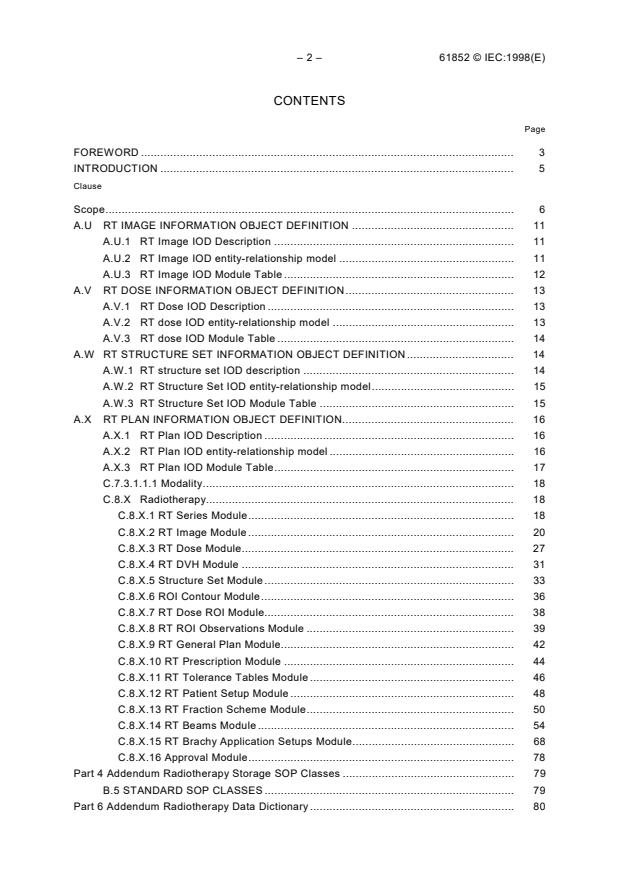
– 2 – 61852 © IEC:1998(E)
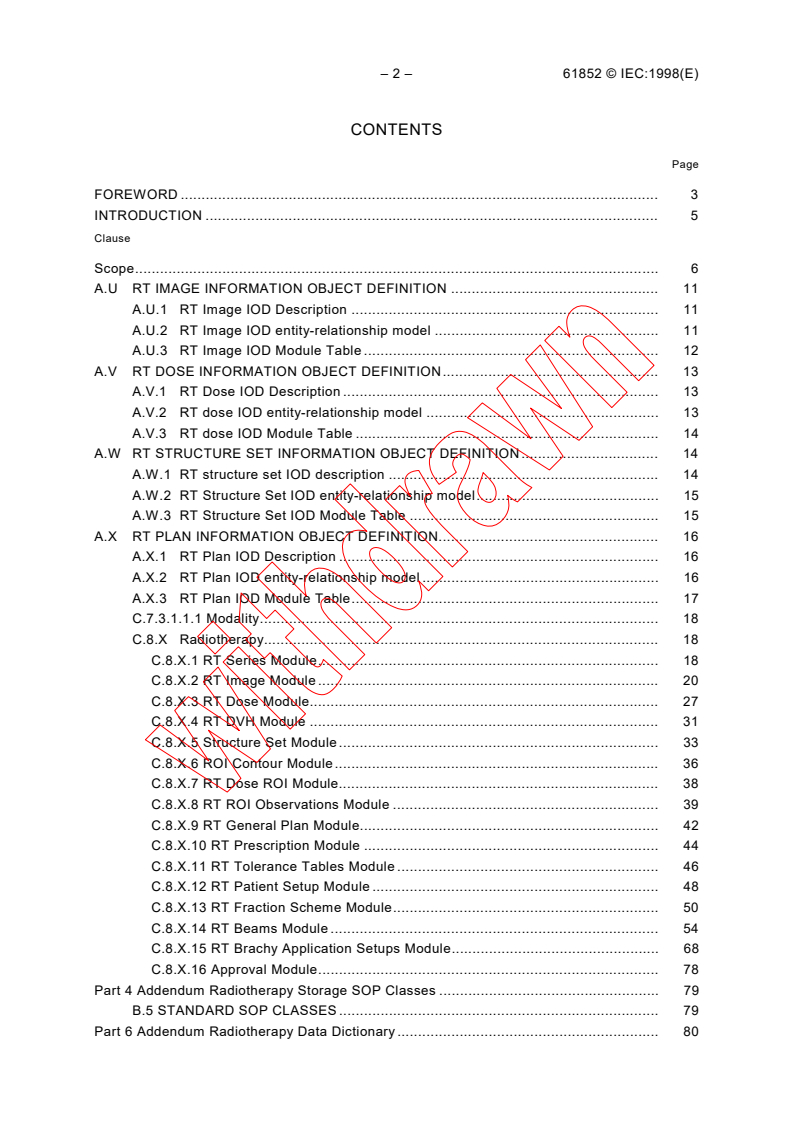
CONTENTS
Page
FOREWORD . 3
INTRODUCTION . 5
Clause
Scope. 6
A.U RT IMAGE INFORMATION OBJECT DEFINITION . 11
A.U.1 RT Image IOD Description . 11
A.U.2 RT Image IOD entity-relationship model . 11
A.U.3 RT Image IOD Module Table . 12
A.V RT DOSE INFORMATION OBJECT DEFINITION. 13
A.V.1 RT Dose IOD Description . 13
A.V.2 RT dose IOD entity-relationship model . 13
A.V.3 RT dose IOD Module Table . 14
A.W RT STRUCTURE SET INFORMATION OBJECT DEFINITION . 14
A.W.1 RT structure set IOD description . 14
A.W.2 RT Structure Set IOD entity-relationship model. 15
A.W.3 RT Structure Set IOD Module Table . 15
A.X RT PLAN INFORMATION OBJECT DEFINITION. 16
A.X.1 RT Plan IOD Description . 16
A.X.2 RT Plan IOD entity-relationship model . 16
A.X.3 RT Plan IOD Module Table. 17
C.7.3.1.1.1 Modality. 18
C.8.X Radiotherapy. 18
C.8.X.1 RT Series Module. 18
C.8.X.2 RT Image Module . 20
C.8.X.3 RT Dose Module. 27
C.8.X.4 RT DVH Module . 31
C.8.X.5 Structure Set Module. 33
C.8.X.6 ROI Contour Module. 36
C.8.X.7 RT Dose ROI Module. 38
C.8.X.8 RT ROI Observations Module . 39
C.8.X.9 RT General Plan Module. 42
C.8.X.10 RT Prescription Module . 44
C.8.X.11 RT Tolerance Tables Module . 46
C.8.X.12 RT Patient Setup Module . 48
C.8.X.13 RT Fraction Scheme Module. 50
C.8.X.14 RT Beams Module . 54
C.8.X.15 RT Brachy Application Setups Module. 68
C.8.X.16 Approval Module. 78
Part 4 Addendum Radiotherapy Storage SOP Classes . 79
B.5 STANDARD SOP CLASSES . 79
Part 6 Addendum Radiotherapy Data Dictionary . 80
61852 © IEC:1998(E) – 3 –
INTERNATIONAL ELECTROTECHNICAL COMMISSION
–––––––––––
MEDICAL ELECTRICAL EQUIPMENT –
DIGITAL IMAGING AND COMMUNICATIONS IN MEDICINE (DICOM) –
RADIOTHERAPY OBJECTS
FOREWORD
1) The IEC (International Electrotechnical Commission) is a worldwide organization for standardization comprising
all national electrotechnical committees (IEC National Committees). The object of the IEC is to promote
international co-operation on all questions concerning standardization in the electrical and electronic fields. To
this end and in addition to other activities, the IEC publishes International Standards. Their preparation is
entrusted to technical committees; any IEC National Committee interested in the subject dealt with may
participate in this preparatory work. International, governmental and non-governmental organizations liaising
with the IEC also participate in this preparation. The IEC collaborates closely with the International Organization
for Standardization (ISO) in accordance with conditions determined by agreement between the two
organizations.
2) The formal decisions or agreements of the IEC on technical matters express, as nearly as possible, an
international consensus of opinion on the relevant subjects since each technical committee has representation
from all interested National Committees.
3) The documents produced have the form of recommendations for international use and are published in the form
of standards, technical reports or guides and they are accepted by the National Committees in that sense.
4) In order to promote international unification, IEC National Committees undertake to apply IEC International
Standards transparently to the maximum extent possible in their national and regional standards. Any
divergence between the IEC Standard and the corresponding national or regional standard shall be clearly
indicated in the latter.
5) The IEC provides no marking procedure to indicate its approval and cannot be rendered responsible for any
equipment declared to be in conformity with one of its standards.
6) Attention is drawn to the possibility that some of the elements of this International Standard may be the subject
of patent rights. The IEC shall not be held responsible for identifying any or all such patent rights.
The main task of IEC technical committees is to prepare International Standards. In
exceptional circumstances, a technical committee may propose the publication of a technical
report of one of the following types:
• type 1, when the required support cannot be obtained for the publication of an
International Standard, despite repeated efforts;
• type 2, when the subject is still under technical development or where for any other
reason there is the future but no immediate possibility of an agreement on an International
Standard;
• type 3, when a technical committee has collected data of a different kind from that
which is normally published as an International Standard, for example "state of the art".
Technical reports of types 1 and 2 are subject to review within three years of publication to
decide whether they can be transformed into International Standards. Technical reports of
type 3 do not necessarily have to be reviewed until the data they provide are considered to be
no longer valid or useful.
IEC 61852, which is a technical report of type 3, has been prepared by subcommittee 62C:
Equipment for radiotherapy, nuclear medicine and radiation dosimetry, of IEC technical
committee 62: Electrical equipment in medical practice.
– 4 – 61852 © IEC:1998(E)
The text of this technical report is based on the following documents:
Committee draft Report on voting
62C/183/CDV 62C/201A/RVC
Full information on the voting for the approval of this technical report can be found in the report
on voting indicated in the above table.
This report has been developed in conjunction with IEC subcommittee 62C, CEN TC251 and
the AAPM.
ACR (the American College of Radiology) and NEMA (the National Electrical Manufacturers'
Association) formed a joint committee to develop a standard for digital imaging and
communications in medicine. This DICOM standard was developed according to the NEMA
Procedures.
This report is supplement 11 to the DICOM standard. It is an extension to Part 3, 4 and 6 of the
published DICOM standard which consists of the following parts:
Part 1 — Introduction and Overview
Part 2 — Conformance
Part 3 — Information Object Definitions
Part 4 — Service Class Specifications
Part 5 — Data Structures and Encoding
Part 6 — Data Dictionary
Part 7 — Message Exchange
Part 8 — Network Communication Support for Message Exchange
Part 9 — Point-to-Point Communication Support for Message Exchange
Part 10 — Media Storage and File Format
Part 11 — Media Storage Application Profiles
Part 12 — Media Formats and Physical Media
Part 13 — Print Management Point-to-Point Communication Support
These parts are independent but related documents. Their development level and approval
status may differ. Additional parts may be added to this multi-part standard. PS3.1 should be
used as the base reference for the current parts of this standard.
A bilingual version of this technical report may be issued at a later date.
61852 © IEC:1998(E) – 5 –
INTRODUCTION
This supplement to the DICOM Standard defines a number of information objects applicable to
the domain of radiation oncology. The intent of these objects is to support the transfer of
radiotherapy-related data between devices found within and outside a radiotherapy department.
They are not, however, intended to support the management of the transferred data, a function
which may be addressed in future revisions of the DICOM Standard.
This task of process management has not been addressed in the current draft due to the
absence of a consistent process model for a radiotherapy department, especially in an
international context. As a result, the radiotherapy information objects contain a large number
of conditional and optional data elements. Essentially the objects are intended to be used as
“containers” for related radiotherapy data, with data being added as the object flows through
the department.
– 6 – 61852 © IEC:1998(E)
MEDICAL ELECTRICAL EQUIPMENT –
DIGITAL IMAGING AND COMMUNICATIONS IN MEDICINE (DICOM) –
RADIOTHERAPY OBJECTS
The following text extends and/or amends Part 3 of DICOM.
Part 3: Addendum radiotherapy information object definitions
1 Scope
This report specifies the following information objects:
1) A DICOM Image Information Object for Radiotherapy. It specifies the semantic content of
RT Images. It is commonly abbreviated to the RT Image IOD. It also includes the
corresponding Storage SOP Class so that this IOD can be used in Network and Media
Storage exchanges. The scope of the RT Image IOD is radiotherapy images which have
been obtained on a conic imaging geometry, such as that found on conventional simulators
and portal imaging devices. It can also be used for calculated images using the same
geometry, such as digitally reconstructed radiographs (DRRs).
2) A DICOM Dose Information Object for Radiotherapy. It specifies the semantic content of RT
Doses. It is commonly abbreviated to the RT Dose IOD. It also includes the corresponding
Storage SOP Class so that this IOD can be used in Network and Media Storage exchanges.
The scope of the RT Dose IOD is radiotherapy dose distributions which have been
calculated on a radiotherapy treatment planning system, represented as two- or three-
dimensional dose grids, groups of named or unnamed dose points, isodose curves, and
dose-volume histograms (DVHs).
3) A DICOM Structure Set Information Object for Radiotherapy. It specifies the semantic
content of RT Structure Sets. It is commonly abbreviated to the RT Structure Set IOD. It
also includes the corresponding Storage SOP Class so that this IOD can be used in
Network and Media Storage exchanges. The scope of the RT Structure Set IOD is
radiotherapy patient-related structures which have been identified on devices such as CT
scanners, virtual simulation workstations, or treatment planning systems.
4) A DICOM Plan Information Object for Radiotherapy. It specifies the semantic content of RT
(Treatment) Plans. It is commonly abbreviated to the RT Plan IOD. It also includes the
corresponding Storage SOP Class so that this IOD can be used in Network and Media
Storage exchanges. The scope of the RT Plan IOD is geometric and dosimetric data
specifying a course of external beam and/or brachytherapy treatment.
This report includes a number of addenda to existing Parts of DICOM; therefore the reader
should have a working understanding of the Standard.
1. Part 3 Addenda (Extension to the body, Annex A, B, C and D)
2. Part 4 Addenda (Extension to Annex B)
3. Part 6 Addenda (Extension to Section 6 and Annex A)
Add to Section 2
2 Normative references
IEC 61217:1996, Radiotherapy equipment – Coordinates, movements and scales
ICRU Report 50, Prescribing, Recording, and Reporting Photon Beam Therapy, International
Commission on Radiation Units and Measurements, 1993
61852 © IEC:1998(E) – 7 –
After Section 3.8 add the following:
3.X Radiotherapy
This part of the standard is based on the concepts developed in IEC 61217 and makes use of
the following terms defined in it:
a) FIXED REFERENCE system
b) GANTRY system
c) BEAM LIMITING DEVICE system
d) WEDGE FILTER system
e) X-RAY IMAGE RECEPTOR system
f) PATIENT SUPPORT system
g) TABLE TOP ECCENTRIC system
h) TABLE TOP system
In Section 4 add the following:
4 Symbols and abbreviations
BEV Beam’s-eye view
Brachy Brachytherapy
CC Counter-clockwise
CTV Clinical target volume
CW Clockwise
DRR Digitally-reconstructed radiograph
DVH Dose-volume histogram
GTV Gross tumour volume
Gy Gray
ICRU International Commission on Radiation Units
IEC International Electrotechnical Commission
MeV Mega electron Volt
Multileaf (multi-element) collimator
MLC
MU Monitor unit
MV Megavolt
PTV Planning target volume
R&V Record and verify
ROI Region of interest
RT Radiotherapy
SAD Source-axis distance
SID Source-image distance
– 8 – 61852 © IEC:1998(E)
Add in figure 7-2
Patient IOD
ref
1-n
Study IOD
ref
0-n
Image IOD
0-n
ref
ref
ref
ref
ref
0-n
0-n 0-n 0-n
0-n
0-1 0-n
0-n 0-1
RT Structure
RT Image IOD
RT Dose IOD ref RTPlan IOD
ref
Set IOD
0-n
0-n 1
(reference images) ref 1
0-n 1
ref
IEC 639/98
0-n
Figure 7-2 – DICOM information model (RT extensions)
61852 © IEC:1998(E) – 9 –
Add in table A.1-1 – all modifications to existing table are in BOLD type
Table A.1-1– Composite Information Object Modules Overview
IODs RT Image RT Dose RT Struct RT Plan
Modules Set
Patient
MM MM
Patient Summary
General Study
MM MM
Patient Study UU UU
Study Content
General Series
CR Series
NM Series
RT Series MM MM
Frame Of Reference UM
US Frame of Ref.
General Equipment MM MM
NM Equipment
SC Equipment
General Image MC
Image Plane C
Image Pixel
MC
Contrast/Bolus C
Cine
C
Multi-frame CC
CR Image
CT Image
MR Image
NM Image
NM SPECT
NM Multi-Gated
US Region Calibration
US Image
SC Image
RT Image M
RT Dose M
RT DVH U
Structure Set C M
ROI Contour C M
RT Dose ROI C
RT ROI Observations M
RT General Plan M
RT Prescription U
RT Tolerance Tables U
RT Patient Setup U
RT Fraction Scheme U
RT Beams C
RT Brachy Application C
Setups
Approval U U U
Overlay Identification
Overlay Plane U
Multi-frame Overlay
U
– 10 – 61852 © IEC:1998(E)
IODs RT Image RT Dose RT Struct RT Plan
Modules Set
Curve Identification
Curve U
Audio UU UU
Modality LUT UU
VOI LUT
U
LUT Identification
SOP Common MM MM
* The notation next to M and U indicates a special condition for these modules. Refer to the
corresponding Information Object Definitions in this annex for details.
61852 © IEC:1998(E) – 11 –
After Section A.14 add the following:
A.U RT Image INFORMATION OBJECT DEFINITION
A.U.1 RT Image IOD Description
The focus for this Radiotherapy Image IOD (RT Image IOD) is to address the requirements for
image transfer found in general radiotherapy applications performed on conventional
simulators, virtual simulators, and portal imaging devices. Such images have a conical imaging
geometry and may either be acquired directly from the device, or digitized using a film digitizer.
They may or may not have superimposed curves describing beam limiting device (collimator)
openings, beam modifying devices, patient structures and target volumes. Numeric beam data
parameters may also be recorded with the image, indicating the parameter values at the time
the image was taken or created.
A.U.2 RT Image IOD entity-relationship model
The E-R model for the RT Image IOD is illustrated in figure A.U-1.
Patient
is
the subject
of
1,n
Study
contains
1,n
0,n
spatially
Series
defines
creates
1,n
1 1
contains
Frame of Reference Equipment
0,n
Image
IEC 640/98
Figure A.U-1 – DICOM RT Image IOD information model
– 12 – 61852 © IEC:1998(E)
A.U.3 RT Image IOD Module Table
Table A.U.3-1 – RT Image IOD Modules
IE Module Reference Usage
Patient Patient C.7.1.1 M
Study General Study C.7.2.1 M
Patient Study C.7.2.2 U
Series RT Series C.8.X.1 M
Frame of Frame of Reference C.7.4.1 U
Reference
Equipment General Equipment C.7.5.1 M
Image General Image C.7.6.1 M
Image Pixel C.7.6.3 M
Contrast/bolus C.7.6.4 C – Required if contrast
media was used in this image.
Cine C.7.6.5 C – Required if multi-frame
image is a cine image.
Multi-Frame C.7.6.6 C – Required if pixel data is
multi-frame data.
RT Image C.8.X.2 M
Modality LUT C.11.1 U
VOI LUT C.11.2 U
Approval C.8.X.16 U
Curve C.10.2 U
Audio C.10.3 U
SOP Common C.12.1 M
NOTE 1 – The inclusion of the Multi-Frame module allows for the expression of time-dependent image series or
multiple exposures of identical beam geometries (i.e. multiple exposure portal images). If a time-dependent series
of images (such as port images or DRRs) is represented the Cine module is used to indicate this. This would
subsequently allow analysis of patient movement during treatment. Multiple exposure images allow individual
images of treatment ports and open field ports to be grouped into a single multi-frame image.
NOTE 2 – The Modality LUT module has been included to allow the possibility of conversion between portal image
pixel values and dose transmitted through the patient. The VOI LUT module has been included to allow the
possibility of translation between stored pixel values (after the Modality LUT has been applied if specified) and
display levels.
NOTE 3 – The Curve module has been included to allow the possibility of storing one or more curves overlaid with a
given image. Generally these curves would represent patient structures, target volumes, or beam limiting device
(collimator) openings, although they could also be used to store other data such as axis information. Such curves
would be stored in pixel units (i.e. the coordinates would represent pixel indices in the image data). For example,
patient structures might have the following attribute assignments:
Curve Dimensions (50xx, 0005) = 2
Number of Points (50xx, 0010) = Number of data points in curve
Type of Data (50xx, 0020) = ROI
Data Value Representation (50xx, 0103) = US (unsigned short)
Curve Data (50xx, 3000) = (x,y) pixel coordinates
Curve Description (50xx,0022) = Structure/Target name
Note that there is no facility for representing multi-frame curves (i.e. all curves are interpreted as being related to
the first image frame in a multi-frame image). Curves other than patient structures might also be represented using
the HIST, POLY or TABL curve types (see P3.3, C.10.2.1).
NOTE 4 – The Equipment module contains information describing the equipment used to acquire or generate the
RT Image (such as a portal imager, conventional simulator or treatment planning system). However, the equipment
attributes in the RT Image module describe the equipment on which the treatment has been or will be given,
typically an electron accelerator.
NOTE 5 – For RT Images which contain no relevant pixel data, such as BEV images without DRR information, Pixel
Data (7FE0,0010) should be filled with a sequence of zeros.
NOTE 6 – The Frame of Reference module has been included to allow the indication of spatial association of two or
more RT Image instances (e.g. where the images have been acquired in the same frame of reference, or have been
resampled to share the same frame of reference). If the Frame of Reference occurs within a SOP Instance within a
given series, then all SOP Instances within that series will be spatially related. For example, two RT Images may
share the same Frame of Reference if they are located on the same physical plane, as determined by the treatment
machine Gantry Angle (300A,011E) and source-to-image plane distance specified by RT Image SID (3002,0026).
61852 © IEC:1998(E) – 13 –
A.V RT DOSE INFORMATION OBJECT DEFINITION
A.V.1 RT Dose IOD Description
The focus for this Radiotherapy Dose IOD (RT Dose IOD) is to address the requirements for
transfer of dose distributions calculated by radiotherapy treatment planning systems. These
distributions may be represented as 2D or 3D grids, as isodose curves, or as named or
unnamed dose points scattered throughout the volume. This IOD may also contain dose-
volume histogram data, single or multi-frame overlays, audio annotations, and application-
defined lookup tables. This IOD does not provide for definition of doses in beam or other
coordinate systems. The application is responsible for transforming data in other, non-patient-
based coordinate systems to the patient-based coordinate system described in C.7.6.2.1.1.
A.V.2 RT Dose IOD entity-relationship model
The E-R model for the RT Dose IOD is illustrated in figure A.V-1.
Patient
is
the subject
of
1,n
Study
contains
1,n
0,n
spatially
Series
defines
creates
1,n
1 1
contains
Frame of Reference Equipment
0,n
Dose
IEC 641/98
Figure A.V-1 – DICOM RT Dose IOD information model
– 14 – 61852 © IEC:1998(E)
A.V.3 RT Dose IOD Module Table
Table A.V.3-1 – RT Dose IOD Modules
IE Module Reference Usage
Patient Patient C.7.1.1 M
Study General Study C.7.2.1 M
Patient Study C.7.2.2 U
Series RT Series C.8.X.1 M
Frame of Frame of Reference C.7.4.1 M
Reference
Equipment General Equipment C.7.5.1 M
Dose General Image C.7.6.1 C – Required if dose data
contains grid-based doses.
Image Plane C.7.6.2 C – Required if dose data
contains grid-based doses.
Image Pixel C.7.6.3 C – Required if dose data
contains grid-based doses.
Multi-Frame C.7.6.6 C – Required if dose data
contains grid-based doses and
pixel data is multi-frame data.
Overlay Plane C.9.2 U
Multi-Frame Overlay C.9.3 U
Modality LUT C.11.1 U
RT Dose C.8.X.3 M
RT DVH C.8.X.4 U
Structure Set C.8.X.5 C – Required if dose data
contains dose points or
isodose curves
ROI Contour C.8.X.6 C – Required if dose data
contains dose points or
isodose curves
RT Dose ROI C.8.X.7 C – Required if dose data
contains dose points or
isodose curves
Audio C.10.3 U
SOP Common C.12.1 M
NOTE 1 – Within the RT Dose IOD, the RT Dose module supports 2D and 3D dose grids. The Structure Set, ROI
Contour and RT Dose ROI modules together support isodose curves and points, and the RT DVH module supports
dose-volume histogram data. They are not mutually exclusive: all four representations may be included in a single
instance of the object or they may be included in any combination. Product Conformance Statements should clearly
state which of these mechanisms is supported and under what conditions.
NOTE 2 – The RT Dose IOD has been defined as a composite IOD, separate from the RT Plan IOD. This has been
done for the following reasons.
– To allow for the multiplicity of possible dose calculations using beam models for the same basic plan.
– To avoid undesirable transmission of large amounts of data with the treatment plan.
– To accommodate the fact that CT Simulation and other “beam geometry” generating devices which use the RT
Plan IOD do not have or require access to this data, either for transmission or storage.
A.W RT STRUCTURE SET INFORMATION OBJECT DEFINITION
A.W.1 RT Structure Set IOD Description
The focus for this Radiotherapy Structure Set IOD (RT Structure Set IOD) is to address the
requirements for transfer of patient structures and related data defined on CT scanners, virtual
simulation workstations, treatment planning systems and similar devices. This IOD may also
contain audio curve annotations.
61852 © IEC:1998(E) – 15 –
A.W.2 RT Structure Set IOD entity-relationship model
The E-R model for the RT Structure Set IOD is illustrated in figure A.W-1.
Patient
is
the subject
of
1,n
Study
contains
1,n
Series
creates
1,n
contains
Equipment
0,n
Structure Set
IEC 642/98
Figure A.W-1 – DICOM RT Structure Set IOD information model
A.W.3 RT Structure Set IOD Module Table
Table A.W.3-1 – RT Structure Set IOD Modules
IE Module Reference Usage
Patient Patient C.7.1.1 M
Study General Study C.7.2.1 M
Patient Study C.7.2.2 U
Series RT Series C.8.X.1 M
Equipment General Equipment C.7.5.1 M
Structure Set Structure Set C.8.X.5 M
ROI Contour C.8.X.6 M
RT ROI Observations C.8.X.8 M
Approval C.8.X.16 U
Audio C.10.3 U
SOP Common C.12.1 M
– 16 – 61852 © IEC:1998(E)
A.X RT PLAN INFORMATION OBJECT DEFINITION
A.X.1 RT Plan IOD Description
The focus for this Radiotherapy Plan IOD (RT Plan IOD) is to address the requirements for
transfer of treatment plans generated by manual entry, a virtual simulation system, or a
treatment planning system before or during a course of treatment. Such plans may contain
fractionation information, and define external beams and/or brachytherapy application setups.
This IOD may also contain audio curve annotations.
A.X.2 RT Plan IOD entity-relationship model
The E-R model for the RT Plan IOD is illustrated in figure A.X-1.
Patient
is
the subject
of
1,n
Study
contains
1,n
Series
creates
1,n
contains
Equipment
0,n
Plan
IEC 643/98
Figure A.X-1 – DICOM RT Plan IOD information model
61852 © IEC:1998(E) – 17 –
A.X.3 RT Plan IOD Module Table
Table A.X.3-1 – RT Plan IOD Modules
IE Module Reference Usage
Patient Patient C.7.1.1 M
Study General Study C.7.2.1 M
Patient Study C.7.2.2 U
Series RT Series C.8.X.1 M
Equipment General Equipment C.7.5.1 M
Plan RT General Plan C.8.X.9 M
RT Prescription C.8.X.10 U
RT Tolerance Tables C.8.X.11 U
RT Patient Setup C.8.X.12 U
RT Fraction Scheme C.8.X.13 U
RT Beams C.8.X.14 C – Required if RT Fraction
Scheme Module exists and
Number of Beams
(300A,0080) is greater than
zero for one or more
fraction groups
RT Brachy Application C.8.X.15 C – Required if RT Fraction
Setups Scheme Module exists and
Number of Brachy
Application Setups
(300A,00A0) is greater than
zero for one or more
fraction groups
Approval C.8.X.16 U
Audio C.10.3 U
SOP Common C.12.1 M
A.X.3.1 RT FRACTION SCHEME MODULE
The RT Fraction Scheme module is structured to be used together with the RT Beams or RT
Brachy Application Setups module. If beams are referenced in the RT Fraction Scheme
module, all such beams shall be included in the RT Beams module if it is present. Similarly, if
brachy application setups are referenced in the RT Fraction Scheme module, all such setups
shall be included in the RT Brachy Application Setups module if it is present. However, the RT
Fraction Scheme module can be used without the RT Beams or RT Brachy Application Setups
modules if no beams or brachy application setups are referenced, and the RT Beams or RT
Brachy Application Setups modules can also be used without the RT Fraction Scheme module
if no fraction scheme information is available.
A.X.3.2 RT PRESCRIPTION MODULE
The RT Prescription module provides for the inclusion of dose prescription information
pertinent to the complete plan, which may comprise several fraction schemes, themselves
consisting of many beams.
A.X.3.3 RT TOLERANCE TABLES MODULE
The RT Tolerance Tables module provides information concerning machine tolerances as they
apply to the whole treatment plan. Tolerances are applied by reference to a tolerance table
within the RT Tolerance Tables module for beams contained within the RT Beams module.
– 18 – 61852 © IEC:1998(E)
A.X.3.4 RT PATIENT SETUP MODULE
The RT Patient Setup module provides information concerning patient setup parameters and
fixation devices as they apply to the whole treatment plan. Patient setup information within the
RT Patient Setup module is referenced by beams contained within the RT Beams module.
Add new Defined Terms to Section C.7.3.1.1.1
C.7.3.1.1.1 Modality
The following Defined Terms shall be added:
RTIMAGE = Radiotherapy Image
RTDOSE = Radiotherapy Dose
RTSTRUCT = Radiotherapy Structure Set
RTPLAN = Radiotherapy Plan
Add new Sections C.8.X and C.8.X.1 to C.8.X.16
C.8.X Radiotherapy
This section describes Radiotherapy-specific modules.
Modules defined here make reference to IEC coordinate systems and standards. These
standards are defined in IEC 61217.
Many of the dosimetry concepts referred to in this document can be found in ICRU Report 50.
C.8.X.1 RT Series Module
There exist significant differences in the manner in which RT objects compare to diagnostic
objects. An RT object can be one of several types, and a series of a given object type may be
created over a temporal span of several weeks. The RT Series Module has been created to
satisfy the requirements of the standard DICOM Query/Retrieve model while including only
those attributes relevant to the identification and selection of radiotherapy objects.
61852 © IEC:1998(E) – 19 –
Table C.8.X.1-1 – RT Series Module
Attribute Name Tag Type Attribute Description
Modality (0008,0060) 1 Type of equipment that originally
acquired the data. Enumerated Values:
RTIMAGE = RT Image
RTDOSE = RT Dose
RTSTRUCT = RT Structure Set
RTPLAN = RT Plan
See C.8.X.1.1.
Series Instance UID (0020,000E) 1 Unique identifier of the series.
Series Number (0020,0011) 2 A number that identifies this series.
Series Description (0008,103E) 3 User-provided description of the series.
Referenced Study Component (0008,1111) 3 Uniquely identifies the Study Component
Sequence SOP Instances to which the series is
related. One or more items may be
included in this sequence.
>Referenced SOP Class UID (0008,1150) 1C Uniquely identifies the referenced SOP
Class. Required if Referenced Study
Component (0008,1111) is sent.
>Referenced SOP Instance UID (0008,1155) 1C Uniquely identifies the referenced SOP
Instance. Required if Referenced Study
Component (0008,1111) is sent.
C.8.X.1.1 Modality
The Enumerated Value for Modality (0008,0060) shall be determined by the IOD.
RTIMAGE if RT Image IOD,
RTDOSE if RT Dose IOD,
RTSTRUCT if RT Structure Set IOD,
RTPLAN if RT Plan IOD.
NOTE – DICOM specifies that a given series shall contain objects of only one Modality, and shall be created by a
single device (described in the General Equipment Module). However, in general there may be many series defined
for a given modality/device pair. Note that a radiotherapy series is generally created over an extended time interval
(unlike in radiology, where all images in an image series are generally created together).
– 20 – 61852 © IEC:1998(E)
C.8.X.2 RT Image Module
Table C.8.X.2-1 contains attributes that describe RT-specific characteristics of a projection
image. The image described by these attributes must be a radiotherapy image acquired or
calculated using a conical imaging geometry.
Table C.8.X.2-1 – RT Image Module
Attribute Name Tag Type Attribute Description
Samples per Pixel (0028,0002) 1 Number of samples (planes) in this
image. See C.X.2.6.1 for
specialization.
Photometric Interpretation (0028,0004) 1 Specifies the intended interpretation
of the pixel data. See C.X.2.6.2 for
specialization.
Bits Allocated (0028,0100) 1 Number of bits allocated for each
pixel sample. Each sample shall have
the same number of bits allocated.
See C.X.2.6.3 for specialization.
Bits Stored (0028,0101) 1 Number of bits stored for each pixel
sample. Each sample shall have the
same number of bits stored. See
C.X.2.6.4 for specialization.
High Bit (0028,0102) 1 Most significant bit for each pixel
sample. Each sample shall have the
same high bit. See C.X.2.6.5 for
specialization.
Pixel Representation (0028,0103) 1 Data representation of the pixel
samples. Each sample shall have the
same pixel representation. See
C.X.2.6.6 for specialization.
RT Image Label (3002,0002) 1 User-defined label for RT Image.
RT Image Name (3002,0003) 3 User-defined name for RT Image.
RT Image Description (3002,0004) 3 User-defined description of RT Image.
Operators’ Name (0008,1070) 2 Name of operator(s) acquiring or
creating RT Image.
Image Type (0008,0008) 1 Image identification characteristics
(see DICOM Part 3 Section
C.7.6.1.1.2). RT Images shall use one
of the following Defined Terms for
Value 3:
DRR = digitally reconstructed
radiograph
PORTAL = digital portal image or
portal film image
SIMULATOR = conventional simulator
image
RADIOGRAPH = radiographic image
BLANK = image pixels set to
background value
Conversion Type (0008,0064) 2 Describes the kind of image
conversion. Defined Terms:
DV = Digitized Video
DI = Digital Interface
DF = Digitized Film
WSD = Workstation
61852 © IEC:1998(E) – 21 –
Reported Values Origin (3002,000A) 2C Describes the origin of the parameter
values reported in the image.
Required if Value 3 of Image Type
(0008,0008) is SIMULATOR or
PORTAL.
Enumerated Values:
OPERATOR = manually entered by
operator
PLAN = planned parameter values
ACTUAL = electronically recorded
RT Image Plane (3002, 000C) 1 Describes whether or not image plane
is normal to beam axis.
Enumerated Values:
NORMAL = image plane normal to
beam axis
NON_NORMAL = image plane non-
normal to beam axis
X-Ray Image Receptor Angle (3002,000E) 2 X-Ray Image Receptor Angle i.e.
orientation of IEC X-RAY IMAGE
RECEPTOR coordinate system with
respect to IEC GANTRY coordinate
system (degrees). See C.8.X.2.2.
RT Image Orientation (3002,0010) 2C The direction cosines of the first row
and the first column with respect to
the IEC X-RAY IMAGE RECEPTOR
coordinate system. Required if RT
Image Plane (3002,000C) is
NON_NORMAL.
Image Plane Pixel Spacing (3002,0011) 2 Physical distance (in mm) between
the centre of each image pixel,
specified by a numeric pair - adjacent
row spacing (delimiter) adjacent
column spacing. See C.8.X.2.3.
RT Image Position (3002,0012) 2 The x and y coordinates (in mm) of
the upper left-hand corner (first pixel
transmitted) of the image, in the IEC
X-RAY IMAGE RECEPTOR
coordinate system.
Radiation Machine Name (3002,0020) 2 User-defined name identifying
radiation machine used in acquiring or
computing image (i.e. name of
conventional simulator, electron
accelerator, X-ray device, or machine
modeled when calculating DRR).
Primary Dosimeter Unit (300A,00B3) 2 Measurement unit of machine
dosimeter.
Enumerated Values:
MU = Monitor Unit
MINUTE = minute
Radiation Machine SAD (3002,0022) 2 Radiation source to Gantry rotation
axis distance of radiation machine
used in acquiring or computing image
(mm).
Radiation Machine SSD (3002,0024) 3 Source to patient surface distance (in
mm) of radiation machine used in
acquiring or computing image.
RT Image SID (3002,0026) 2 Distance from radiation machine
source to image plane (in mm) along
radiation beam axis. See C.8.X.2.3.
– 22 – 61852 © IEC:1998(E)
Source to Reference Object (3002,0028) 3 Source to reference object distance
Distance (in mm), as used for magnification
calculation of RADIOGRAPH and
SIMULATOR images.
Referenced RT Plan Sequence (300C,0002) 3 Introduces sequence of one
Class/Instance pair describing RT
Plan associated with image. Only a
single item shall be permitted in this
sequence.
>Referenced SOP Class UID (0008,1150) 1C Uniquely identifies the referenced
SOP Class. Required if Referenced
RT Plan Sequence (300C,0002) is
sent.
>Referenced SOP Instance UID (0008,1155) 1C Uniquely identifies the referenced
SOP Instance. Required if Referenced
RT Plan Sequence (300C,0002) is
sent.
Referenced Beam Number (300C,0006) 3 Uniquely identifies the corresponding
N-segment treatment beam specified
by Beam Number (300A,00C0) within
Beam Sequence in RT Beams Module
within the RT Plan referenced in
Referenced RT Plan Sequence
(300C,0002).
Referenced Fraction Group (300C,0022) 3 Identifier of Fraction Group within RT
Number Plan referenced in Referenced RT
Plan Sequence (300C,0002).
Fraction Number (3002,0029) 3 Fraction Number of fraction during
which image was acquired, within
Fraction Group referenced by
Referenced Fraction Group Number
(300C,0022) within RT Plan
referenced in Referenced RT Plan
Sequence (300C,0002).
Start Cumulative Meterset (300C,0008) 3 Cumulative Meterset Weight within
Weight Beam referenced by Referenced
Beam Number (300C,0006) at which
image acquisition starts.
End Cumulative Meterset (300C,0009) 3 Cumulative Meterset Weight within
Weight Beam referenced by Referenced
Beam Number (300C,0006) at which
image acquisition ends.
Exposure Sequence (3002,0030) 3 Introduces sequence of Exposure
parameter sets, corresponding to
exposures used in generating the
image. One or more items may be
included in this sequence. See
C.8.X.2.4.
>Referenced Frame Number (0008,1160) 1C Identifies corresponding image frame
in multi-frame image. Required if
Exposure Sequence (3002,0030) is
sent, there is more than one item in
Exposure Sequence (3002,0030), and
image is a multi-frame image.
>KVP (0018,0060) 2C Peak kilo voltage output (kV) of X-ray
generator used to acquire image.
Required if Value 3 of Image Type
(0008,0008) is PORTAL, SIMULATOR
or RADIOGRAPH and Exposure
Sequence (3002,0030) is sent.
61852 © IEC:1998(E) – 23 –
>X-Ray Tube Current (0018,1151) 2C Imaging device X-ray Tube Current
(mA). Required if Value 3 of Image
Type (0008,0008) is SIMULATOR or
RADIOGRAPH and Exposure
Sequence (3002,0030) is sent.
>Exposure Time (0018,1150) 2C Time of X-ray exposure (msec).
Required if Value 3 of Image Type
(0008,0008) is SIMULATOR or
RADIOGRAPH and Exposure
Sequence (3002,0030) is sent.
>Meterset Exposure (3002,0032) 2C Treatment machine Meterset duration
over which image has been acquired,
specified in Monitor units (MU) or
minutes as defined by Primary
Dosimeter Unit (300A,00B3).
Required if Value 3 of Image Type
(0008,0008) is PORTAL and Exposure
Sequence (3002,0030) is sent.
>Beam Limiting Device (300A,00B6) 3 Introduces sequence of beam limiting
Sequence device (collimator) jaw or leaf
(element) positions for given
exposure. One or more items may be
included in this sequence.
>>RT Beam Limiting Device (300A,00B8) 1C Type of beam limiting device
Type (collimator). Required if Beam
Limiting Device Sequence
(300A,00B6) is sent.
Enumerated Values:
X = symmetric jaw pair in IEC X
direction
Y = symmetric jaw pair in IEC Y
direction
ASYMX = asymmetric jaw pair in IEC
X direction
ASYMY = asymmetric pair in IEC Y
direction
MLCX = multileaf (multi-element) jaw
pair in IEC X direction
MLCY = multileaf (multi-element) jaw
pair in IEC Y direction
>>Source to Beam Limiting (300A,00BA) 3 Radiation source to beam limiting
Device Distance device (collimator) distance (mm).
>>Number of Leaf/Jaw Pairs (300A,00BC) 1C Number of leaf (element) or jaw pairs
(equal to 1 for standard beam limiting
device jaws). Required if Beam
Limiting Device Sequence
(300A,00B6) is sent.
>>Leaf Position Boundaries (300A,00BE) 2C Boundaries (in mm) of beam limiting
device (collimator) leaves (elements)
in IEC BEAM LIMITING DEVICE
coordinate axis appropriate to RT
Beam Limiting Device Type
(300A,00B8), i.e. X-axis for MLCY,
Y-axis for MLCX. Contains N+1
values, where N is the Number of
Leaf/Jaw Pairs (300A,00BC), starting
from Leaf (Element) Pair 1. Required
if RT Beam Limiting Device Type
(300A,00B8) is MLCX or MLCY.
– 24 – 61852 © IEC:1998(E)
>>Leaf/Jaw Positions (300A,011C) 1C Positions of beam limiting device
(collimator) leaf or jaw (element) pairs
(in mm) in IEC BEAM LIMITING
DEVICE coordinate axis appropriate
to RT Beam Limiting Device Type
(300A,00B8), e.g. X-axis for MLCX,
Y-axis for MLCY). Contains 2N
values, where N is the Number of
Leaf/Jaw Pairs (300A,00BC), in IEC
leaf (element) subscript order 101,
102, . 1N, 201, 202, . 2N. Required
if Beam Limiting Device Sequence
(300A,00B6) is sent.
>Applicator Sequence (300A,0107) 3 Introduces sequence of Applicators
associated with Beam. Only a single
item shall be permitted in this
sequence.
>>Applicator ID (300A,0108) 1C User or machine supplied identifier for
Applicator. Required if Applicator
Sequence (300A,0107) is sent.
>>Applicator Type (300A,0109) 1C Type of Applicator. Required if
Applicator Sequence (300A,0107) is
sent.
Defined Terms:
ELECTRON_SQUARE = square
electron
...
TECHNICAL
IEC
REPORT
First edition
1998-04
Medical electrical equipment –
Digital imaging and communications
in medicine (DICOM) –
Radiotherapy objects
Reference number
IEC 61852:1998(E)
Numbering
As from 1 January 1997 all IEC publications are issued with a designation in the
60000 series.
Consolidated publications
Consolidated versions of some IEC publications including amendments are
available. For example, edition numbers 1.0, 1.1 and 1.2 refer, respectively, to the
base publication, the base publication incorporating amendment 1 and the base
publication incorporating amendments 1 and 2.
Validity of this publication
The technical content of IEC publications is kept under constant review by the IEC,
thus ensuring that the content reflects current technology.
Information relating to the date of the reconfirmation of the publication is available
in the IEC catalogue.
Information on the subjects under consideration and work in progress undertaken by
the technical committee which has prepared this publication, as well as the list of
publications issued, is to be found at the following IEC sources:
• IEC web site*
• Catalogue of IEC publications
Published yearly with regular updates
(On-line catalogue)*
• IEC Bulletin
Available both at the IEC web site* and as a printed periodical
Terminology, graphical and letter
symbols
For general terminology, readers are referred to IEC 60050: International
Electrotechnical Vocabulary (IEV).
For graphical symbols, and letter symbols and signs approved by the IEC for
general use, readers are referred to publications IEC 60027: Letter symbols to be
used in electrical technology, IEC 60417: Graphical symbols for use on equipment.
Index, survey and compilation of the single sheets and IEC 60617: Graphical symbols
for diagrams.
* See web site address on title page.
TECHNICAL
IEC
REPORT – TYPE 3
First edition
1998-04
Medical electrical equipment –
Digital imaging and communications
in medicine (DICOM) –
Radiotherapy objects
IEC 1998 Copyright - all rights reserved
No part of this publication may be reproduced or utilized in any form or by any means, electronic or
mechanical, including photocopying and microfilm, without permission in writing from the publisher.
International Electrotechnical Commission 3, rue de Varembé Geneva, Switzerland
Telefax: +41 22 919 0300 e-mail: inmail@iec.ch IEC web site http: //www.iec.ch
Commission Electrotechnique Internationale
PRICE CODE
XC
International Electrotechnical Commission
For price, see current catalogue
– 2 – 61852 © IEC:1998(E)
CONTENTS
Page
FOREWORD . 3
INTRODUCTION . 5
Clause
Scope. 6
A.U RT IMAGE INFORMATION OBJECT DEFINITION . 11
A.U.1 RT Image IOD Description . 11
A.U.2 RT Image IOD entity-relationship model . 11
A.U.3 RT Image IOD Module Table . 12
A.V RT DOSE INFORMATION OBJECT DEFINITION. 13
A.V.1 RT Dose IOD Description . 13
A.V.2 RT dose IOD entity-relationship model . 13
A.V.3 RT dose IOD Module Table . 14
A.W RT STRUCTURE SET INFORMATION OBJECT DEFINITION . 14
A.W.1 RT structure set IOD description . 14
A.W.2 RT Structure Set IOD entity-relationship model. 15
A.W.3 RT Structure Set IOD Module Table . 15
A.X RT PLAN INFORMATION OBJECT DEFINITION. 16
A.X.1 RT Plan IOD Description . 16
A.X.2 RT Plan IOD entity-relationship model . 16
A.X.3 RT Plan IOD Module Table. 17
C.7.3.1.1.1 Modality. 18
C.8.X Radiotherapy. 18
C.8.X.1 RT Series Module. 18
C.8.X.2 RT Image Module . 20
C.8.X.3 RT Dose Module. 27
C.8.X.4 RT DVH Module . 31
C.8.X.5 Structure Set Module. 33
C.8.X.6 ROI Contour Module. 36
C.8.X.7 RT Dose ROI Module. 38
C.8.X.8 RT ROI Observations Module . 39
C.8.X.9 RT General Plan Module. 42
C.8.X.10 RT Prescription Module . 44
C.8.X.11 RT Tolerance Tables Module . 46
C.8.X.12 RT Patient Setup Module . 48
C.8.X.13 RT Fraction Scheme Module. 50
C.8.X.14 RT Beams Module . 54
C.8.X.15 RT Brachy Application Setups Module. 68
C.8.X.16 Approval Module. 78
Part 4 Addendum Radiotherapy Storage SOP Classes . 79
B.5 STANDARD SOP CLASSES . 79
Part 6 Addendum Radiotherapy Data Dictionary . 80
61852 © IEC:1998(E) – 3 –
INTERNATIONAL ELECTROTECHNICAL COMMISSION
–––––––––––
MEDICAL ELECTRICAL EQUIPMENT –
DIGITAL IMAGING AND COMMUNICATIONS IN MEDICINE (DICOM) –
RADIOTHERAPY OBJECTS
FOREWORD
1) The IEC (International Electrotechnical Commission) is a worldwide organization for standardization comprising
all national electrotechnical committees (IEC National Committees). The object of the IEC is to promote
international co-operation on all questions concerning standardization in the electrical and electronic fields. To
this end and in addition to other activities, the IEC publishes International Standards. Their preparation is
entrusted to technical committees; any IEC National Committee interested in the subject dealt with may
participate in this preparatory work. International, governmental and non-governmental organizations liaising
with the IEC also participate in this preparation. The IEC collaborates closely with the International Organization
for Standardization (ISO) in accordance with conditions determined by agreement between the two
organizations.
2) The formal decisions or agreements of the IEC on technical matters express, as nearly as possible, an
international consensus of opinion on the relevant subjects since each technical committee has representation
from all interested National Committees.
3) The documents produced have the form of recommendations for international use and are published in the form
of standards, technical reports or guides and they are accepted by the National Committees in that sense.
4) In order to promote international unification, IEC National Committees undertake to apply IEC International
Standards transparently to the maximum extent possible in their national and regional standards. Any
divergence between the IEC Standard and the corresponding national or regional standard shall be clearly
indicated in the latter.
5) The IEC provides no marking procedure to indicate its approval and cannot be rendered responsible for any
equipment declared to be in conformity with one of its standards.
6) Attention is drawn to the possibility that some of the elements of this International Standard may be the subject
of patent rights. The IEC shall not be held responsible for identifying any or all such patent rights.
The main task of IEC technical committees is to prepare International Standards. In
exceptional circumstances, a technical committee may propose the publication of a technical
report of one of the following types:
• type 1, when the required support cannot be obtained for the publication of an
International Standard, despite repeated efforts;
• type 2, when the subject is still under technical development or where for any other
reason there is the future but no immediate possibility of an agreement on an International
Standard;
• type 3, when a technical committee has collected data of a different kind from that
which is normally published as an International Standard, for example "state of the art".
Technical reports of types 1 and 2 are subject to review within three years of publication to
decide whether they can be transformed into International Standards. Technical reports of
type 3 do not necessarily have to be reviewed until the data they provide are considered to be
no longer valid or useful.
IEC 61852, which is a technical report of type 3, has been prepared by subcommittee 62C:
Equipment for radiotherapy, nuclear medicine and radiation dosimetry, of IEC technical
committee 62: Electrical equipment in medical practice.
– 4 – 61852 © IEC:1998(E)
The text of this technical report is based on the following documents:
Committee draft Report on voting
62C/183/CDV 62C/201A/RVC
Full information on the voting for the approval of this technical report can be found in the report
on voting indicated in the above table.
This report has been developed in conjunction with IEC subcommittee 62C, CEN TC251 and
the AAPM.
ACR (the American College of Radiology) and NEMA (the National Electrical Manufacturers'
Association) formed a joint committee to develop a standard for digital imaging and
communications in medicine. This DICOM standard was developed according to the NEMA
Procedures.
This report is supplement 11 to the DICOM standard. It is an extension to Part 3, 4 and 6 of the
published DICOM standard which consists of the following parts:
Part 1 — Introduction and Overview
Part 2 — Conformance
Part 3 — Information Object Definitions
Part 4 — Service Class Specifications
Part 5 — Data Structures and Encoding
Part 6 — Data Dictionary
Part 7 — Message Exchange
Part 8 — Network Communication Support for Message Exchange
Part 9 — Point-to-Point Communication Support for Message Exchange
Part 10 — Media Storage and File Format
Part 11 — Media Storage Application Profiles
Part 12 — Media Formats and Physical Media
Part 13 — Print Management Point-to-Point Communication Support
These parts are independent but related documents. Their development level and approval
status may differ. Additional parts may be added to this multi-part standard. PS3.1 should be
used as the base reference for the current parts of this standard.
A bilingual version of this technical report may be issued at a later date.
61852 © IEC:1998(E) – 5 –
INTRODUCTION
This supplement to the DICOM Standard defines a number of information objects applicable to
the domain of radiation oncology. The intent of these objects is to support the transfer of
radiotherapy-related data between devices found within and outside a radiotherapy department.
They are not, however, intended to support the management of the transferred data, a function
which may be addressed in future revisions of the DICOM Standard.
This task of process management has not been addressed in the current draft due to the
absence of a consistent process model for a radiotherapy department, especially in an
international context. As a result, the radiotherapy information objects contain a large number
of conditional and optional data elements. Essentially the objects are intended to be used as
“containers” for related radiotherapy data, with data being added as the object flows through
the department.
– 6 – 61852 © IEC:1998(E)
MEDICAL ELECTRICAL EQUIPMENT –
DIGITAL IMAGING AND COMMUNICATIONS IN MEDICINE (DICOM) –
RADIOTHERAPY OBJECTS
The following text extends and/or amends Part 3 of DICOM.
Part 3: Addendum radiotherapy information object definitions
1 Scope
This report specifies the following information objects:
1) A DICOM Image Information Object for Radiotherapy. It specifies the semantic content of
RT Images. It is commonly abbreviated to the RT Image IOD. It also includes the
corresponding Storage SOP Class so that this IOD can be used in Network and Media
Storage exchanges. The scope of the RT Image IOD is radiotherapy images which have
been obtained on a conic imaging geometry, such as that found on conventional simulators
and portal imaging devices. It can also be used for calculated images using the same
geometry, such as digitally reconstructed radiographs (DRRs).
2) A DICOM Dose Information Object for Radiotherapy. It specifies the semantic content of RT
Doses. It is commonly abbreviated to the RT Dose IOD. It also includes the corresponding
Storage SOP Class so that this IOD can be used in Network and Media Storage exchanges.
The scope of the RT Dose IOD is radiotherapy dose distributions which have been
calculated on a radiotherapy treatment planning system, represented as two- or three-
dimensional dose grids, groups of named or unnamed dose points, isodose curves, and
dose-volume histograms (DVHs).
3) A DICOM Structure Set Information Object for Radiotherapy. It specifies the semantic
content of RT Structure Sets. It is commonly abbreviated to the RT Structure Set IOD. It
also includes the corresponding Storage SOP Class so that this IOD can be used in
Network and Media Storage exchanges. The scope of the RT Structure Set IOD is
radiotherapy patient-related structures which have been identified on devices such as CT
scanners, virtual simulation workstations, or treatment planning systems.
4) A DICOM Plan Information Object for Radiotherapy. It specifies the semantic content of RT
(Treatment) Plans. It is commonly abbreviated to the RT Plan IOD. It also includes the
corresponding Storage SOP Class so that this IOD can be used in Network and Media
Storage exchanges. The scope of the RT Plan IOD is geometric and dosimetric data
specifying a course of external beam and/or brachytherapy treatment.
This report includes a number of addenda to existing Parts of DICOM; therefore the reader
should have a working understanding of the Standard.
1. Part 3 Addenda (Extension to the body, Annex A, B, C and D)
2. Part 4 Addenda (Extension to Annex B)
3. Part 6 Addenda (Extension to Section 6 and Annex A)
Add to Section 2
2 Normative references
IEC 61217:1996, Radiotherapy equipment – Coordinates, movements and scales
ICRU Report 50, Prescribing, Recording, and Reporting Photon Beam Therapy, International
Commission on Radiation Units and Measurements, 1993
61852 © IEC:1998(E) – 7 –
After Section 3.8 add the following:
3.X Radiotherapy
This part of the standard is based on the concepts developed in IEC 61217 and makes use of
the following terms defined in it:
a) FIXED REFERENCE system
b) GANTRY system
c) BEAM LIMITING DEVICE system
d) WEDGE FILTER system
e) X-RAY IMAGE RECEPTOR system
f) PATIENT SUPPORT system
g) TABLE TOP ECCENTRIC system
h) TABLE TOP system
In Section 4 add the following:
4 Symbols and abbreviations
BEV Beam’s-eye view
Brachy Brachytherapy
CC Counter-clockwise
CTV Clinical target volume
CW Clockwise
DRR Digitally-reconstructed radiograph
DVH Dose-volume histogram
GTV Gross tumour volume
Gy Gray
ICRU International Commission on Radiation Units
IEC International Electrotechnical Commission
MeV Mega electron Volt
Multileaf (multi-element) collimator
MLC
MU Monitor unit
MV Megavolt
PTV Planning target volume
R&V Record and verify
ROI Region of interest
RT Radiotherapy
SAD Source-axis distance
SID Source-image distance
– 8 – 61852 © IEC:1998(E)
Add in figure 7-2
Patient IOD
ref
1-n
Study IOD
ref
0-n
Image IOD
0-n
ref
ref
ref
ref
ref
0-n
0-n 0-n 0-n
0-n
0-1 0-n
0-n 0-1
RT Structure
RT Image IOD
RT Dose IOD ref RTPlan IOD
ref
Set IOD
0-n
0-n 1
(reference images) ref 1
0-n 1
ref
IEC 639/98
0-n
Figure 7-2 – DICOM information model (RT extensions)
61852 © IEC:1998(E) – 9 –
Add in table A.1-1 – all modifications to existing table are in BOLD type
Table A.1-1– Composite Information Object Modules Overview
IODs RT Image RT Dose RT Struct RT Plan
Modules Set
Patient
MM MM
Patient Summary
General Study
MM MM
Patient Study UU UU
Study Content
General Series
CR Series
NM Series
RT Series MM MM
Frame Of Reference UM
US Frame of Ref.
General Equipment MM MM
NM Equipment
SC Equipment
General Image MC
Image Plane C
Image Pixel
MC
Contrast/Bolus C
Cine
C
Multi-frame CC
CR Image
CT Image
MR Image
NM Image
NM SPECT
NM Multi-Gated
US Region Calibration
US Image
SC Image
RT Image M
RT Dose M
RT DVH U
Structure Set C M
ROI Contour C M
RT Dose ROI C
RT ROI Observations M
RT General Plan M
RT Prescription U
RT Tolerance Tables U
RT Patient Setup U
RT Fraction Scheme U
RT Beams C
RT Brachy Application C
Setups
Approval U U U
Overlay Identification
Overlay Plane U
Multi-frame Overlay
U
– 10 – 61852 © IEC:1998(E)
IODs RT Image RT Dose RT Struct RT Plan
Modules Set
Curve Identification
Curve U
Audio UU UU
Modality LUT UU
VOI LUT
U
LUT Identification
SOP Common MM MM
* The notation next to M and U indicates a special condition for these modules. Refer to the
corresponding Information Object Definitions in this annex for details.
61852 © IEC:1998(E) – 11 –
After Section A.14 add the following:
A.U RT Image INFORMATION OBJECT DEFINITION
A.U.1 RT Image IOD Description
The focus for this Radiotherapy Image IOD (RT Image IOD) is to address the requirements for
image transfer found in general radiotherapy applications performed on conventional
simulators, virtual simulators, and portal imaging devices. Such images have a conical imaging
geometry and may either be acquired directly from the device, or digitized using a film digitizer.
They may or may not have superimposed curves describing beam limiting device (collimator)
openings, beam modifying devices, patient structures and target volumes. Numeric beam data
parameters may also be recorded with the image, indicating the parameter values at the time
the image was taken or created.
A.U.2 RT Image IOD entity-relationship model
The E-R model for the RT Image IOD is illustrated in figure A.U-1.
Patient
is
the subject
of
1,n
Study
contains
1,n
0,n
spatially
Series
defines
creates
1,n
1 1
contains
Frame of Reference Equipment
0,n
Image
IEC 640/98
Figure A.U-1 – DICOM RT Image IOD information model
– 12 – 61852 © IEC:1998(E)
A.U.3 RT Image IOD Module Table
Table A.U.3-1 – RT Image IOD Modules
IE Module Reference Usage
Patient Patient C.7.1.1 M
Study General Study C.7.2.1 M
Patient Study C.7.2.2 U
Series RT Series C.8.X.1 M
Frame of Frame of Reference C.7.4.1 U
Reference
Equipment General Equipment C.7.5.1 M
Image General Image C.7.6.1 M
Image Pixel C.7.6.3 M
Contrast/bolus C.7.6.4 C – Required if contrast
media was used in this image.
Cine C.7.6.5 C – Required if multi-frame
image is a cine image.
Multi-Frame C.7.6.6 C – Required if pixel data is
multi-frame data.
RT Image C.8.X.2 M
Modality LUT C.11.1 U
VOI LUT C.11.2 U
Approval C.8.X.16 U
Curve C.10.2 U
Audio C.10.3 U
SOP Common C.12.1 M
NOTE 1 – The inclusion of the Multi-Frame module allows for the expression of time-dependent image series or
multiple exposures of identical beam geometries (i.e. multiple exposure portal images). If a time-dependent series
of images (such as port images or DRRs) is represented the Cine module is used to indicate this. This would
subsequently allow analysis of patient movement during treatment. Multiple exposure images allow individual
images of treatment ports and open field ports to be grouped into a single multi-frame image.
NOTE 2 – The Modality LUT module has been included to allow the possibility of conversion between portal image
pixel values and dose transmitted through the patient. The VOI LUT module has been included to allow the
possibility of translation between stored pixel values (after the Modality LUT has been applied if specified) and
display levels.
NOTE 3 – The Curve module has been included to allow the possibility of storing one or more curves overlaid with a
given image. Generally these curves would represent patient structures, target volumes, or beam limiting device
(collimator) openings, although they could also be used to store other data such as axis information. Such curves
would be stored in pixel units (i.e. the coordinates would represent pixel indices in the image data). For example,
patient structures might have the following attribute assignments:
Curve Dimensions (50xx, 0005) = 2
Number of Points (50xx, 0010) = Number of data points in curve
Type of Data (50xx, 0020) = ROI
Data Value Representation (50xx, 0103) = US (unsigned short)
Curve Data (50xx, 3000) = (x,y) pixel coordinates
Curve Description (50xx,0022) = Structure/Target name
Note that there is no facility for representing multi-frame curves (i.e. all curves are interpreted as being related to
the first image frame in a multi-frame image). Curves other than patient structures might also be represented using
the HIST, POLY or TABL curve types (see P3.3, C.10.2.1).
NOTE 4 – The Equipment module contains information describing the equipment used to acquire or generate the
RT Image (such as a portal imager, conventional simulator or treatment planning system). However, the equipment
attributes in the RT Image module describe the equipment on which the treatment has been or will be given,
typically an electron accelerator.
NOTE 5 – For RT Images which contain no relevant pixel data, such as BEV images without DRR information, Pixel
Data (7FE0,0010) should be filled with a sequence of zeros.
NOTE 6 – The Frame of Reference module has been included to allow the indication of spatial association of two or
more RT Image instances (e.g. where the images have been acquired in the same frame of reference, or have been
resampled to share the same frame of reference). If the Frame of Reference occurs within a SOP Instance within a
given series, then all SOP Instances within that series will be spatially related. For example, two RT Images may
share the same Frame of Reference if they are located on the same physical plane, as determined by the treatment
machine Gantry Angle (300A,011E) and source-to-image plane distance specified by RT Image SID (3002,0026).
61852 © IEC:1998(E) – 13 –
A.V RT DOSE INFORMATION OBJECT DEFINITION
A.V.1 RT Dose IOD Description
The focus for this Radiotherapy Dose IOD (RT Dose IOD) is to address the requirements for
transfer of dose distributions calculated by radiotherapy treatment planning systems. These
distributions may be represented as 2D or 3D grids, as isodose curves, or as named or
unnamed dose points scattered throughout the volume. This IOD may also contain dose-
volume histogram data, single or multi-frame overlays, audio annotations, and application-
defined lookup tables. This IOD does not provide for definition of doses in beam or other
coordinate systems. The application is responsible for transforming data in other, non-patient-
based coordinate systems to the patient-based coordinate system described in C.7.6.2.1.1.
A.V.2 RT Dose IOD entity-relationship model
The E-R model for the RT Dose IOD is illustrated in figure A.V-1.
Patient
is
the subject
of
1,n
Study
contains
1,n
0,n
spatially
Series
defines
creates
1,n
1 1
contains
Frame of Reference Equipment
0,n
Dose
IEC 641/98
Figure A.V-1 – DICOM RT Dose IOD information model
– 14 – 61852 © IEC:1998(E)
A.V.3 RT Dose IOD Module Table
Table A.V.3-1 – RT Dose IOD Modules
IE Module Reference Usage
Patient Patient C.7.1.1 M
Study General Study C.7.2.1 M
Patient Study C.7.2.2 U
Series RT Series C.8.X.1 M
Frame of Frame of Reference C.7.4.1 M
Reference
Equipment General Equipment C.7.5.1 M
Dose General Image C.7.6.1 C – Required if dose data
contains grid-based doses.
Image Plane C.7.6.2 C – Required if dose data
contains grid-based doses.
Image Pixel C.7.6.3 C – Required if dose data
contains grid-based doses.
Multi-Frame C.7.6.6 C – Required if dose data
contains grid-based doses and
pixel data is multi-frame data.
Overlay Plane C.9.2 U
Multi-Frame Overlay C.9.3 U
Modality LUT C.11.1 U
RT Dose C.8.X.3 M
RT DVH C.8.X.4 U
Structure Set C.8.X.5 C – Required if dose data
contains dose points or
isodose curves
ROI Contour C.8.X.6 C – Required if dose data
contains dose points or
isodose curves
RT Dose ROI C.8.X.7 C – Required if dose data
contains dose points or
isodose curves
Audio C.10.3 U
SOP Common C.12.1 M
NOTE 1 – Within the RT Dose IOD, the RT Dose module supports 2D and 3D dose grids. The Structure Set, ROI
Contour and RT Dose ROI modules together support isodose curves and points, and the RT DVH module supports
dose-volume histogram data. They are not mutually exclusive: all four representations may be included in a single
instance of the object or they may be included in any combination. Product Conformance Statements should clearly
state which of these mechanisms is supported and under what conditions.
NOTE 2 – The RT Dose IOD has been defined as a composite IOD, separate from the RT Plan IOD. This has been
done for the following reasons.
– To allow for the multiplicity of possible dose calculations using beam models for the same basic plan.
– To avoid undesirable transmission of large amounts of data with the treatment plan.
– To accommodate the fact that CT Simulation and other “beam geometry” generating devices which use the RT
Plan IOD do not have or require access to this data, either for transmission or storage.
A.W RT STRUCTURE SET INFORMATION OBJECT DEFINITION
A.W.1 RT Structure Set IOD Description
The focus for this Radiotherapy Structure Set IOD (RT Structure Set IOD) is to address the
requirements for transfer of patient structures and related data defined on CT scanners, virtual
simulation workstations, treatment planning systems and similar devices. This IOD may also
contain audio curve annotations.
61852 © IEC:1998(E) – 15 –
A.W.2 RT Structure Set IOD entity-relationship model
The E-R model for the RT Structure Set IOD is illustrated in figure A.W-1.
Patient
is
the subject
of
1,n
Study
contains
1,n
Series
creates
1,n
contains
Equipment
0,n
Structure Set
IEC 642/98
Figure A.W-1 – DICOM RT Structure Set IOD information model
A.W.3 RT Structure Set IOD Module Table
Table A.W.3-1 – RT Structure Set IOD Modules
IE Module Reference Usage
Patient Patient C.7.1.1 M
Study General Study C.7.2.1 M
Patient Study C.7.2.2 U
Series RT Series C.8.X.1 M
Equipment General Equipment C.7.5.1 M
Structure Set Structure Set C.8.X.5 M
ROI Contour C.8.X.6 M
RT ROI Observations C.8.X.8 M
Approval C.8.X.16 U
Audio C.10.3 U
SOP Common C.12.1 M
– 16 – 61852 © IEC:1998(E)
A.X RT PLAN INFORMATION OBJECT DEFINITION
A.X.1 RT Plan IOD Description
The focus for this Radiotherapy Plan IOD (RT Plan IOD) is to address the requirements for
transfer of treatment plans generated by manual entry, a virtual simulation system, or a
treatment planning system before or during a course of treatment. Such plans may contain
fractionation information, and define external beams and/or brachytherapy application setups.
This IOD may also contain audio curve annotations.
A.X.2 RT Plan IOD entity-relationship model
The E-R model for the RT Plan IOD is illustrated in figure A.X-1.
Patient
is
the subject
of
1,n
Study
contains
1,n
Series
creates
1,n
contains
Equipment
0,n
Plan
IEC 643/98
Figure A.X-1 – DICOM RT Plan IOD information model
61852 © IEC:1998(E) – 17 –
A.X.3 RT Plan IOD Module Table
Table A.X.3-1 – RT Plan IOD Modules
IE Module Reference Usage
Patient Patient C.7.1.1 M
Study General Study C.7.2.1 M
Patient Study C.7.2.2 U
Series RT Series C.8.X.1 M
Equipment General Equipment C.7.5.1 M
Plan RT General Plan C.8.X.9 M
RT Prescription C.8.X.10 U
RT Tolerance Tables C.8.X.11 U
RT Patient Setup C.8.X.12 U
RT Fraction Scheme C.8.X.13 U
RT Beams C.8.X.14 C – Required if RT Fraction
Scheme Module exists and
Number of Beams
(300A,0080) is greater than
zero for one or more
fraction groups
RT Brachy Application C.8.X.15 C – Required if RT Fraction
Setups Scheme Module exists and
Number of Brachy
Application Setups
(300A,00A0) is greater than
zero for one or more
fraction groups
Approval C.8.X.16 U
Audio C.10.3 U
SOP Common C.12.1 M
A.X.3.1 RT FRACTION SCHEME MODULE
The RT Fraction Scheme module is structured to be used together with the RT Beams or RT
Brachy Application Setups module. If beams are referenced in the RT Fraction Scheme
module, all such beams shall be included in the RT Beams module if it is present. Similarly, if
brachy application setups are referenced in the RT Fraction Scheme module, all such setups
shall be included in the RT Brachy Application Setups module if it is present. However, the RT
Fraction Scheme module can be used without the RT Beams or RT Brachy Application Setups
modules if no beams or brachy application setups are referenced, and the RT Beams or RT
Brachy Application Setups modules can also be used without the RT Fraction Scheme module
if no fraction scheme information is available.
A.X.3.2 RT PRESCRIPTION MODULE
The RT Prescription module provides for the inclusion of dose prescription information
pertinent to the complete plan, which may comprise several fraction schemes, themselves
consisting of many beams.
A.X.3.3 RT TOLERANCE TABLES MODULE
The RT Tolerance Tables module provides information concerning machine tolerances as they
apply to the whole treatment plan. Tolerances are applied by reference to a tolerance table
within the RT Tolerance Tables module for beams contained within the RT Beams module.
– 18 – 61852 © IEC:1998(E)
A.X.3.4 RT PATIENT SETUP MODULE
The RT Patient Setup module provides information concerning patient setup parameters and
fixation devices as they apply to the whole treatment plan. Patient setup information within the
RT Patient Setup module is referenced by beams contained within the RT Beams module.
Add new Defined Terms to Section C.7.3.1.1.1
C.7.3.1.1.1 Modality
The following Defined Terms shall be added:
RTIMAGE = Radiotherapy Image
RTDOSE = Radiotherapy Dose
RTSTRUCT = Radiotherapy Structure Set
RTPLAN = Radiotherapy Plan
Add new Sections C.8.X and C.8.X.1 to C.8.X.16
C.8.X Radiotherapy
This section describes Radiotherapy-specific modules.
Modules defined here make reference to IEC coordinate systems and standards. These
standards are defined in IEC 61217.
Many of the dosimetry concepts referred to in this document can be found in ICRU Report 50.
C.8.X.1 RT Series Module
There exist significant differences in the manner in which RT objects compare to diagnostic
objects. An RT object can be one of several types, and a series of a given object type may be
created over a temporal span of several weeks. The RT Series Module has been created to
satisfy the requirements of the standard DICOM Query/Retrieve model while including only
those attributes relevant to the identification and selection of radiotherapy objects.
61852 © IEC:1998(E) – 19 –
Table C.8.X.1-1 – RT Series Module
Attribute Name Tag Type Attribute Description
Modality (0008,0060) 1 Type of equipment that originally
acquired the data. Enumerated Values:
RTIMAGE = RT Image
RTDOSE = RT Dose
RTSTRUCT = RT Structure Set
RTPLAN = RT Plan
See C.8.X.1.1.
Series Instance UID (0020,000E) 1 Unique identifier of the series.
Series Number (0020,0011) 2 A number that identifies this series.
Series Description (0008,103E) 3 User-provided description of the series.
Referenced Study Component (0008,1111) 3 Uniquely identifies the Study Component
Sequence SOP Instances to which the series is
related. One or more items may be
included in this sequence.
>Referenced SOP Class UID (0008,1150) 1C Uniquely identifies the referenced SOP
Class. Required if Referenced Study
Component (0008,1111) is sent.
>Referenced SOP Instance UID (0008,1155) 1C Uniquely identifies the referenced SOP
Instance. Required if Referenced Study
Component (0008,1111) is sent.
C.8.X.1.1 Modality
The Enumerated Value for Modality (0008,0060) shall be determined by the IOD.
RTIMAGE if RT Image IOD,
RTDOSE if RT Dose IOD,
RTSTRUCT if RT Structure Set IOD,
RTPLAN if RT Plan IOD.
NOTE – DICOM specifies that a given series shall contain objects of only one Modality, and shall be created by a
single device (described in the General Equipment Module). However, in general there may be many series defined
for a given modality/device pair. Note that a radiotherapy series is generally created over an extended time interval
(unlike in radiology, where all images in an image series are generally created together).
– 20 – 61852 © IEC:1998(E)
C.8.X.2 RT Image Module
Table C.8.X.2-1 contains attributes that describe RT-specific characteristics of a projection
image. The image described by these attributes must be a radiotherapy image acquired or
calculated using a conical imaging geometry.
Table C.8.X.2-1 – RT Image Module
Attribute Name Tag Type Attribute Description
Samples per Pixel (0028,0002) 1 Number of samples (planes) in this
image. See C.X.2.6.1 for
specialization.
Photometric Interpretation (0028,0004) 1 Specifies the intended interpretation
of the pixel data. See C.X.2.6.2 for
specialization.
Bits Allocated (0028,0100) 1 Number of bits allocated for each
pixel sample. Each sample shall have
the same number of bits allocated.
See C.X.2.6.3 for specialization.
Bits Stored (0028,0101) 1 Number of bits stored for each pixel
sample. Each sample shall have the
same number of bits stored. See
C.X.2.6.4 for specialization.
High Bit (0028,0102) 1 Most significant bit for each pixel
sample. Each sample shall have the
same high bit. See C.X.2.6.5 for
specialization.
Pixel Representation (0028,0103) 1 Data representation of the pixel
samples. Each sample shall have the
same pixel representation. See
C.X.2.6.6 for specialization.
RT Image Label (3002,0002) 1 User-defined label for RT Image.
RT Image Name (3002,0003) 3 User-defined name for RT Image.
RT Image Description (3002,0004) 3 User-defined description of RT Image.
Operators’ Name (0008,1070) 2 Name of operator(s) acquiring or
creating RT Image.
Image Type (0008,0008) 1 Image identification characteristics
(see DICOM Part 3 Section
C.7.6.1.1.2). RT Images shall use one
of the following Defined Terms for
Value 3:
DRR = digitally reconstructed
radiograph
PORTAL = digital portal image or
portal film image
SIMULATOR = conventional simulator
image
RADIOGRAPH = radiographic image
BLANK = image pixels set to
background value
Conversion Type (0008,0064) 2 Describes the kind of image
conversion. Defined Terms:
DV = Digitized Video
DI = Digital Interface
DF = Digitized Film
WSD = Workstation
61852 © IEC:1998(E) – 21 –
Reported Values Origin (3002,000A) 2C Describes the origin of the parameter
values reported in the image.
Required if Value 3 of Image Type
(0008,0008) is SIMULATOR or
PORTAL.
Enumerated Values:
OPERATOR = manually entered by
operator
PLAN = planned parameter values
ACTUAL = electronically recorded
RT Image Plane (3002, 000C) 1 Describes whether or not image plane
is normal to beam axis.
Enumerated Values:
NORMAL = image plane normal to
beam axis
NON_NORMAL = image plane non-
normal to beam axis
X-Ray Image Receptor Angle (3002,000E) 2 X-Ray Image Receptor Angle i.e.
orientation of IEC X-RAY IMAGE
RECEPTOR coordinate system with
respect to IEC GANTRY coordinate
system (degrees). See C.8.X.2.2.
RT Image Orientation (3002,0010) 2C The direction cosines of the first row
and the first column with respect to
the IEC X-RAY IMAGE RECEPTOR
coordinate system. Required if RT
Image Plane (3002,000C) is
NON_NORMAL.
Image Plane Pixel Spacing (3002,0011) 2 Physical distance (in mm) between
the centre of each image pixel,
specified by a numeric pair - adjacent
row spacing (delimiter) adjacent
column spacing. See C.8.X.2.3.
RT Image Position (3002,0012) 2 The x and y coordinates (in mm) of
the upper left-hand corner (first pixel
transmitted) of the image, in the IEC
X-RAY IMAGE RECEPTOR
coordinate system.
Radiation Machine Name (3002,0020) 2 User-defined name identifying
radiation machine used in acquiring or
computing image (i.e. name of
conventional simulator, electron
accelerator, X-ray device, or machine
modeled when calculating DRR).
Primary Dosimeter Unit (300A,00B3) 2 Measurement unit of machine
dosimeter.
Enumerated Values:
MU = Monitor Unit
MINUTE = minute
Radiation Machine SAD (3002,0022) 2 Radiation source to Gantry rotation
axis distance of radiation machine
used in acquiring or computing image
(mm).
Radiation Machine SSD (3002,0024) 3 Source to patient surface distance (in
mm) of radiation machine used in
acquiring or computing image.
RT Image SID (3002,0026) 2 Distance from radiation machine
source to image plane (in mm) along
radiation beam axis. See C.8.X.2.3.
– 22 – 61852 © IEC:1998(E)
Source to Reference Object (3002,0028) 3 Source to reference object distance
Distance (in mm), as used for magnification
calculation of RADIOGRAPH and
SIMULATOR images.
Referenced RT Plan Sequence (300C,0002) 3 Introduces sequence of one
Class/Instance pair describing RT
Plan associated with image. Only a
single item shall be permitted in this
sequence.
>Referenced SOP Class UID (0008,1150) 1C Uniquely identifies the referenced
SOP Class. Required if Referenced
RT Plan Sequence (300C,0002) is
sent.
>Referenced SOP Instance UID (0008,1155) 1C Uniquely identifies the referenced
SOP Instance. Required if Referenced
RT Plan Sequence (300C,0002) is
sent.
Referenced Beam Number (300C,0006) 3 Uniquely identifies the corresponding
N-segment treatment beam specified
by Beam Number (300A,00C0) within
Beam Sequence in RT Beams Module
within the RT Plan referenced in
Referenced RT Plan Sequence
(300C,0002).
Referenced Fraction Group (300C,0022) 3 Identifier of Fraction Group within RT
Number Plan referenced in Referenced RT
Plan Sequence (300C,0002).
Fraction Number (3002,0029) 3 Fraction Number of fraction during
which image was acquired, within
Fraction Group referenced by
Referenced Fraction Group Number
(300C,0022) within RT Plan
referenced in Referenced RT Plan
Sequence (300C,0002).
Start Cumulative Meterset (300C,0008) 3 Cumulative Meterset Weight within
Weight Beam referenced by Referenced
Beam Number (300C,0006) at which
image acquisition starts.
End Cumulative Meterset (300C,0009) 3 Cumulative Meterset Weight within
Weight Beam referenced by Referenced
Beam Number (300C,0006) at which
image acquisition ends.
Exposure Sequence (3002,0030) 3 Introduces sequence of Exposure
parameter sets, corresponding to
exposures used in generating the
image. One or more items may be
included in this sequence. See
C.8.X.2.4.
>Referenced Frame Number (0008,1160) 1C Identifies corresponding image frame
in multi-frame image. Required if
Exposure Sequence (3002,0030) is
sent, there is more than one item in
Exposure Sequence (3002,0030), and
image is a multi-frame image.
>KVP (0018,0060) 2C Peak kilo voltage output (kV) of X-ray
generator used to acquire image.
Required if Value 3 of Image Type
(0008,0008) is PORTAL, SIMULATOR
or RADIOGRAPH and Exposure
Sequence (3002,0030) is sent.
61852 © IEC:1998(E) – 23 –
>X-Ray Tube Current (0018,1151) 2C Imaging device X-ray Tube Current
(mA). Required if Value 3 of Image
Type (0008,0008) is SIMULATOR or
RADIOGRAPH and Exposure
Sequence (3002,0030) is sent.
>Exposure Time (0018,1150) 2C Time of X-ray exposure (msec).
Required if Value 3 of Image Type
(0008,0008) is SIMULATOR or
RADIOGRAPH and Exposure
Sequence (3002,0030) is sent.
>Meterset Exposure (3002,0032) 2C Treatment machine Meterset duration
over which image has been acquired,
specified in Monitor units (MU) or
minutes as defined by Primary
Dosimeter Unit (300A,00B3).
Required if Value 3 of Image Type
(0008,0008) is PORTAL and Exposure
Sequence (3002,0030) is sent.
>Beam Limiting Device (300A,00B6) 3 Introduces sequence of beam limiting
Sequence device (collimator) jaw or leaf
(element) positions for given
exposure. One or more items may be
included in this sequence.
>>RT Beam Limiting Device (300A,00B8) 1C Type of beam limiting device
Type (collimator). Required if Beam
Limiting Device Sequence
(300A,00B6) is sent.
Enumerated Values:
X = symmetric jaw pair in IEC X
direction
Y = symmetric jaw pair in IEC Y
direction
ASYMX = asymmetric jaw pair in IEC
X direction
ASYMY = asymmetric pair in IEC Y
direction
MLCX = multileaf (multi-element) jaw
pair in IEC X direction
MLCY = multileaf (multi-element) jaw
pair in IEC Y direction
>>Source to Beam Limiting (300A,00BA) 3 Radiation source to beam limiting
Device Distance device (collimator) distance (mm).
>>Number of Leaf/Jaw Pairs (300A,00BC) 1C Number of leaf (element) or jaw pairs
(equal to 1 for standard beam limiting
device jaws). Required if Beam
Limiting Device Sequence
(300A,00B6) is sent.
>>Leaf Position Boundaries (300A,00BE) 2C Boundaries (in mm) of beam limiting
device (collimator) leaves (elements)
in IEC BEAM LIMITING DEVICE
coordinate axis appropriate to RT
Beam Limiting Device Type
(300A,00B8), i.e. X-axis for MLCY,
Y-axis for MLCX. Contains N+1
values, where N is the Number of
Leaf/Jaw Pairs (300A,00BC), starting
from Leaf (Element) Pair 1. Required
if RT Beam Limiting Device Type
(300A,00B8) is MLCX or MLCY.
– 24 – 61852 © IEC:1998(E)
>>Leaf/Jaw Positions (300A,011C) 1C Positions of beam limiting device
(collimator) leaf or jaw (element) pairs
(in mm) in IEC BEAM LIMITING
DEVICE coordinate axis appropriate
to RT Beam Limiting Device Type
(30
...