


IEC TR 63479-1:2023
(Main)Infotainment Services for Public Vehicles (PVIS) - Part 1: General
Infotainment Services for Public Vehicles (PVIS) - Part 1: General
IEC TR 63479-1:2023 describes general considerations and system model for infotainment services for public vehicles (PVIS), with the relevant service examples.
General Information
- Status
- Published
- Publication Date
- 26-Nov-2023
- Technical Committee
- TA 17 - Multimedia systems and equipment for vehicles
- Drafting Committee
- PT 100-37 - TC 100/TA 17/PT 100-37
- Current Stage
- PPUB - Publication issued
- Start Date
- 27-Nov-2023
- Completion Date
- 08-Dec-2023
Overview
IEC TR 63479-1:2023 - Infotainment Services for Public Vehicles (PVIS) - Part 1: General provides a high‑level introduction to infotainment (multimedia) services designed specifically for terrestrial public vehicles such as buses, trams and trains. Published by the IEC (Technical Committee 100) in 2023, this Technical Report defines general considerations, a system model and illustrative service examples for PVIS. It clarifies the scope (excluding aeroplanes and ships) and positions PVIS work alongside related IEC efforts (for example the CCIS work in the IEC 63246 series for private vehicles).
Key topics and technical scope
- System model and functional entities: Describes the PVIS architecture and roles including Content provider, PVIS master, PVIS agent, PVIS device and Passenger device - key building blocks for service provisioning and management.
- Network environment: Differentiates between small‑scale public vehicles (e.g., buses) and large‑scale public vehicles (e.g., trains), with implications for connectivity, topology and service patterns.
- Functional services:
- Device management services for configuration, monitoring and lifecycle operations of in‑vehicle public devices.
- Content delivery services for multimedia distribution, passenger information and interworking with external networks.
- Service examples and flows: Illustrative scenarios and sequence flows for typical PVIS operations (device onboarding, content push, passenger access).
- Security and privacy considerations: Emphasizes higher privacy/security requirements for shared public‑vehicle environments versus private vehicles.
- Standards gap analysis: Annex A reviews how existing standards largely target private vehicles and identifies gaps that PVIS addresses.
Practical applications and users
IEC TR 63479-1 is practical for organizations planning, building or operating infotainment systems for public transport:
- Transit operators and authorities designing passenger multimedia and information services.
- System integrators and solution architects implementing onboard service platforms and network topologies.
- Device manufacturers of displays, cameras, speakers and other shared onboard equipment.
- Content providers and app developers targeting transient passenger experiences.
- Standards bodies and regulators seeking alignment between vehicle, network and service requirements.
Related standards
- IEC 63479 series - PVIS (Part 2: Requirements; Part 3: Framework)
- IEC TC100 work on in‑vehicle multimedia (reference to CCIS and IEC 63246 series)
- Annex A of IEC TR 63479-1 contains a gap analysis with existing vehicle and communications standards.
IEC TR 63479-1:2023 is a starting point for anyone needing a structured, standards‑based view of public‑vehicle infotainment architecture, use cases and system modeling to guide design, procurement and interoperability decisions.

Get Certified
Connect with accredited certification bodies for this standard

TÜV Rheinland
TÜV Rheinland is a leading international provider of technical services.

TÜV SÜD
TÜV SÜD is a trusted partner of choice for safety, security and sustainability solutions.

DEKRA Certification Inc.
DEKRA US certification services.
Sponsored listings
Frequently Asked Questions
IEC TR 63479-1:2023 is a technical report published by the International Electrotechnical Commission (IEC). Its full title is "Infotainment Services for Public Vehicles (PVIS) - Part 1: General". This standard covers: IEC TR 63479-1:2023 describes general considerations and system model for infotainment services for public vehicles (PVIS), with the relevant service examples.
IEC TR 63479-1:2023 describes general considerations and system model for infotainment services for public vehicles (PVIS), with the relevant service examples.
IEC TR 63479-1:2023 is classified under the following ICS (International Classification for Standards) categories: 43.040.15 - Car informatics. On board computer systems. The ICS classification helps identify the subject area and facilitates finding related standards.
IEC TR 63479-1:2023 is available in PDF format for immediate download after purchase. The document can be added to your cart and obtained through the secure checkout process. Digital delivery ensures instant access to the complete standard document.
Standards Content (Sample)
IEC TR 63479-1 ®
Edition 1.0 2023-11
TECHNICAL
REPORT
colour
inside
Infotainment Services for Public Vehicles (PVIS) –
Part 1: General
All rights reserved. Unless otherwise specified, no part of this publication may be reproduced or utilized in any form
or by any means, electronic or mechanical, including photocopying and microfilm, without permission in writing from
either IEC or IEC's member National Committee in the country of the requester. If you have any questions about IEC
copyright or have an enquiry about obtaining additional rights to this publication, please contact the address below or
your local IEC member National Committee for further information.
IEC Secretariat Tel.: +41 22 919 02 11
3, rue de Varembé info@iec.ch
CH-1211 Geneva 20 www.iec.ch
Switzerland
About the IEC
The International Electrotechnical Commission (IEC) is the leading global organization that prepares and publishes
International Standards for all electrical, electronic and related technologies.
About IEC publications
The technical content of IEC publications is kept under constant review by the IEC. Please make sure that you have the
latest edition, a corrigendum or an amendment might have been published.
IEC publications search - webstore.iec.ch/advsearchform IEC Products & Services Portal - products.iec.ch
The advanced search enables to find IEC publications by a Discover our powerful search engine and read freely all the
variety of criteria (reference number, text, technical publications previews. With a subscription you will always have
committee, …). It also gives information on projects, replaced access to up to date content tailored to your needs.
and withdrawn publications.
Electropedia - www.electropedia.org
IEC Just Published - webstore.iec.ch/justpublished
The world's leading online dictionary on electrotechnology,
Stay up to date on all new IEC publications. Just Published
containing more than 22 300 terminological entries in English
details all new publications released. Available online and once
and French, with equivalent terms in 19 additional languages.
a month by email.
Also known as the International Electrotechnical Vocabulary
(IEV) online.
IEC Customer Service Centre - webstore.iec.ch/csc
If you wish to give us your feedback on this publication or need
further assistance, please contact the Customer Service
Centre: sales@iec.ch.
IEC TR 63479-1 ®
Edition 1.0 2023-11
TECHNICAL
REPORT
colour
inside
Infotainment Services for Public Vehicles (PVIS) –
Part 1: General
INTERNATIONAL
ELECTROTECHNICAL
COMMISSION
ICS 43.040.15 ISBN 978-2-8322-7884-0
– 2 – IEC TR 63479-1:2023 © IEC 2023
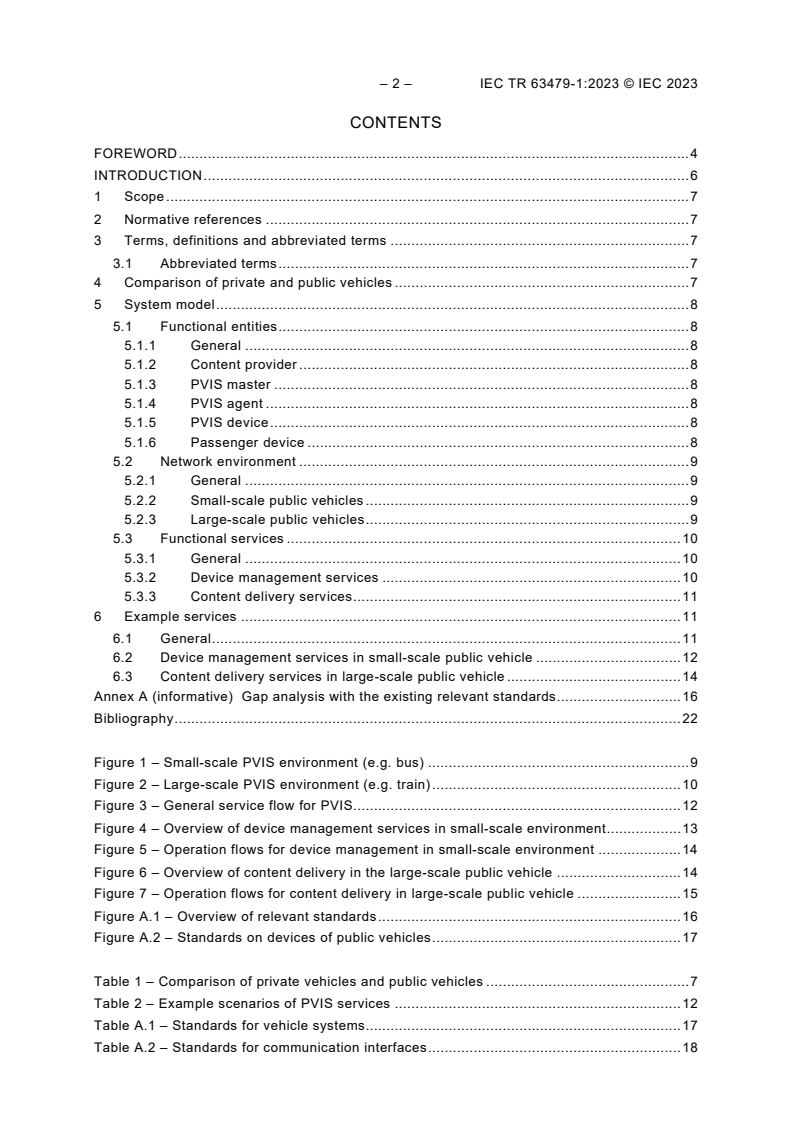
CONTENTS
FOREWORD . 4
INTRODUCTION . 6
1 Scope . 7
2 Normative references . 7
3 Terms, definitions and abbreviated terms . 7
3.1 Abbreviated terms . 7
4 Comparison of private and public vehicles . 7
5 System model . 8
5.1 Functional entities . 8
5.1.1 General . 8
5.1.2 Content provider . 8
5.1.3 PVIS master . 8
5.1.4 PVIS agent . 8
5.1.5 PVIS device . 8
5.1.6 Passenger device . 8
5.2 Network environment . 9
5.2.1 General . 9
5.2.2 Small-scale public vehicles . 9
5.2.3 Large-scale public vehicles . 9
5.3 Functional services . 10
5.3.1 General . 10
5.3.2 Device management services . 10
5.3.3 Content delivery services . 11
6 Example services . 11
6.1 General . 11
6.2 Device management services in small-scale public vehicle . 12
6.3 Content delivery services in large-scale public vehicle . 14
Annex A (informative) Gap analysis with the existing relevant standards . 16
Bibliography . 22
Figure 1 – Small-scale PVIS environment (e.g. bus) . 9
Figure 2 – Large-scale PVIS environment (e.g. train) . 10
Figure 3 – General service flow for PVIS. 12
Figure 4 – Overview of device management services in small-scale environment . 13
Figure 5 – Operation flows for device management in small-scale environment . 14
Figure 6 – Overview of content delivery in the large-scale public vehicle . 14
Figure 7 – Operation flows for content delivery in large-scale public vehicle . 15
Figure A.1 – Overview of relevant standards . 16
Figure A.2 – Standards on devices of public vehicles . 17
Table 1 – Comparison of private vehicles and public vehicles . 7
Table 2 – Example scenarios of PVIS services . 12
Table A.1 – Standards for vehicle systems. 17
Table A.2 – Standards for communication interfaces . 18
Table A.3 – Standards for in-vehicle devices . 19
Table A.4 – Standards for vehicle-related service . 20
– 4 – IEC TR 63479-1:2023 © IEC 2023
INTERNATIONAL ELECTROTECHNICAL COMMISSION
____________
INFOTAINMENT SERVICES FOR PUBLIC VEHICLES (PVIS) –
Part 1: General
FOREWORD
1) The International Electrotechnical Commission (IEC) is a worldwide organization for standardization comprising
all national electrotechnical committees (IEC National Committees). The object of IEC is to promote international
co-operation on all questions concerning standardization in the electrical and electronic fields. To this end and
in addition to other activities, IEC publishes International Standards, Technical Specifications, Technical Reports,
Publicly Available Specifications (PAS) and Guides (hereafter referred to as “IEC Publication(s)”). Their
preparation is entrusted to technical committees; any IEC National Committee interested in the subject dealt with
may participate in this preparatory work. International, governmental and non-governmental organizations liaising
with the IEC also participate in this preparation. IEC collaborates closely with the International Organization for
Standardization (ISO) in accordance with conditions determined by agreement between the two organizations.
2) The formal decisions or agreements of IEC on technical matters express, as nearly as possible, an international
consensus of opinion on the relevant subjects since each technical committee has representation from all
interested IEC National Committees.
3) IEC Publications have the form of recommendations for international use and are accepted by IEC National
Committees in that sense. While all reasonable efforts are made to ensure that the technical content of IEC
Publications is accurate, IEC cannot be held responsible for the way in which they are used or for any
misinterpretation by any end user.
4) In order to promote international uniformity, IEC National Committees undertake to apply IEC Publications
transparently to the maximum extent possible in their national and regional publications. Any divergence between
any IEC Publication and the corresponding national or regional publication shall be clearly indicated in the latter.
5) IEC itself does not provide any attestation of conformity. Independent certification bodies provide conformity
assessment services and, in some areas, access to IEC marks of conformity. IEC is not responsible for any
services carried out by independent certification bodies.
6) All users should ensure that they have the latest edition of this publication.
7) No liability shall attach to IEC or its directors, employees, servants or agents including individual experts and
members of its technical committees and IEC National Committees for any personal injury, property damage or
other damage of any nature whatsoever, whether direct or indirect, or for costs (including legal fees) and
expenses arising out of the publication, use of, or reliance upon, this IEC Publication or any other IEC
Publications.
8) Attention is drawn to the Normative references cited in this publication. Use of the referenced publications is
indispensable for the correct application of this publication.
9) IEC draws attention to the possibility that the implementation of this document may involve the use of (a)
patent(s). IEC takes no position concerning the evidence, validity or applicability of any claimed patent rights in
respect thereof. As of the date of publication of this document, IEC had not received notice of (a) patent(s), which
may be required to implement this document. However, implementers are cautioned that this may not represent
the latest information, which may be obtained from the patent database available at https://patents.iec.ch. IEC
shall not be held responsible for identifying any or all such patent rights.
IEC TR 63479-1 has been prepared by technical area 17: multimedia systems and equipment
for vehicles, of IEC technical committee 100: audio, video and multimedia systems and
equipment. It is a Technical Report.
The text of this Technical Report is based on the following documents:
Draft Report on voting
100/4032/DTR 100/4066/RVDTR
Full information on the voting for its approval can be found in the report on voting indicated in
the above table.
The language used for the development of this Technical Report is English.
This document was drafted in accordance with ISO/IEC Directives, Part 2, and developed in
accordance with ISO/IEC Directives, Part 1 and ISO/IEC Directives, IEC Supplement, available
at www.iec.ch/members_experts/refdocs. The main document types developed by IEC are
described in greater detail at www.iec.ch/publications.
A list of all parts in the IEC 63479 series, published under the general title Infotainment services
for public vehicles (PVIS), can be found on the IEC website.
The committee has decided that the contents of this document will remain unchanged until the
stability date indicated on the IEC website under webstore.iec.ch in the data related to the
specific document. At this date, the document will be
• reconfirmed,
• withdrawn, or
• revised.
IMPORTANT – The "colour inside" logo on the cover page of this document indicates
that it contains colours which are considered to be useful for the correct understanding
of its contents. Users should therefore print this document using a colour printer.
– 6 – IEC TR 63479-1:2023 © IEC 2023
INTRODUCTION
It is noted that the markets and industries on infotainment services for vehicles (as known as
in-vehicle infotainment services) have been growing rapidly. It is envisioned that a variety of
infotainment (or multimedia) devices and services will be newly developed for personal and
public vehicles in the future. Such devices include navigation systems, cameras, speakers,
headrest displays, air-conditioners, thermometers and heated seats, and lights.
IEC TC100 have so far developed a set of standards on Configurable Car Infotainment Services
(CCIS) with the IEC 63246 series. However, the CCIS standards have been basically designed
for personal users, such as car owners. In the meantime, there is also a crucial need to provide
a variety of infotainment services for public vehicles (PVIS), such as buses or trains.
PVISs have different requirements and features from CCISs. For user type, CCIS is targeted
for one or two users (such as car owner), whereas PVIS is for a large number of guests or
passengers within the public vehicle. For device type, CCIS deals with the personal devices
(property or belonging) in the car, whereas PVIS will be targeted for a variety of public devices
that are contained in a public vehicle. Some PVIS services can be provisioned by interworking
with the external networks, as shown in the bus information service. For service duration, CCIS
usually provide long-term services, whereas PVISs are intended to provide short-term service
during which a guest stays within a public vehicle.
From these observations, it is noted that there are many different features and requirements
between CCIS and PVIS. Accordingly, there is a need of standardization on PVISs. In particular,
PVISs needs to employ a set of agents to effectively manage a large number of users or devices.
The PVIS series (IEC 63479) describes infotainment (multimedia) services for terrestrial public
vehicles, such as buses, trains, or underground railways. It is not applicable to public vehicles,
such as aeroplanes or ships. For this purpose, the following issues are addressed:
1) identification of a variety of functional requirements for provisioning of PVISs;
2) designing of the PVIS framework, based on the identified requirements.
The PVIS standards are expected to provide guidelines on PVIS services for a large number of
users/devices, and to encourage development of new (enhanced) PVIS services (possibly by
interworking with the external systems).
The IEC 63479 series consists of the following parts:
– Part 1: General,
– Part 2: Requirements, and
– Part 3: Framework.
IEC 63479-1 (this document, Technical Report) describes general considerations and system
model for PVIS, with some examples of PVIS services.
IEC 63479-2 (International Standard) describes the functional requirements for PVISs.
IEC 63479-3 (International Standard) describes the framework, including the functional
information flows between functional entities.
INFOTAINMENT SERVICES FOR PUBLIC VEHICLES (PVIS) –
Part 1: General
1 Scope
This Technical Report describes general considerations and system model for infotainment
services for public vehicles (PVIS), with the relevant service examples.
2 Normative references
There are no normative references in this document.
3 Terms, definitions and abbreviated terms
No terms and definitions are listed in this document.
ISO and IEC maintain terminology databases for use in standardization at the following
addresses:
• IEC Electropedia: available at https://www.electropedia.org/
• ISO Online browsing platform: available at https://www.iso.org/obp
3.1 Abbreviated terms
PVIS infotainment services for public vehicles
4 Comparison of private and public vehicles
Table 1 shows the comparison of private vehicles and public vehicles.
Table 1 – Comparison of private vehicles and public vehicles
Category Private vehicle Public vehicle
Users Private users (owner) Public users (passengers)
Examples Car, van Bus, train, tram, subway
Number of users (Usually) less than 20 20 (bus) to 1,000 (train)
Device type Personal devices Public devices
(properties, belongings) (shared by many users)
Service duration (Usually) long-term (Usually) short-term
Security/privacy Moderate Crucial
Public vehicles for PVIS (e.g. bus, train) have different requirements and features from private
vehicles (e.g. car, van). A private vehicle is usually for a small number of users, whereas a
public vehicle is targeted for a large number of guests or passengers. For device type, a private
vehicle deals with the personal devices (property or belonging), whereas a public vehicle is
targeted for a variety of public devices that can be shared by many users in the public vehicle.
Some public services can be provisioned by interworking with the external networks, as shown
in bus information service. For service duration, the private vehicle usually provides long-term
services, whereas the public vehicle tends to provide short-term services during which guests
stay within the public vehicle. Security or privacy requirements are also strictly applied to the
public vehicle, compared to the private vehicle.
– 8 – IEC TR 63479-1:2023 © IEC 2023
As shown in Annex A of this document, most of the existing relevant standards have focused
on the personal vehicle. The multimedia services for public vehicles have not been addressed
so far. In particular, this document describes the system model to be considered to effectively
provide the PVIS services, which includes the target environment and functional entities. Some
examples of PVISs are also described.
5 System model
5.1 Functional entities
5.1.1 General
PVIS functional entities are classified into the five types: content provider, PVIS master, PVIS
agent, PVIS device, and passenger device.
5.1.2 Content provider
The content provider represents an external server or entity to provide multimedia infotainment
services for PVIS passengers, such as multimedia on-line game or over-the-top (OTT) services.
Content providers may deploy their contents as PVIS services with an appropriate negotiation.
Such contents include a variety of applications, such as games, utility programs, or media files
for OTT services. For this purpose, a content provider may give an interworking function with
the PVIS system for enhanced PVIS service provisioning.
5.1.3 PVIS master
The PVIS master performs overall management and control for PVIS system and services. In
initialization, the PVIS master needs to identify a set of PVIS functional entities within the public
vehicle, such as PVIS agents, PVIS devices and passenger devices. For service duration, the
PVIS master monitors these PVIS functional entities. The PVIS master is also responsible for
content delivery from the content provider to many passengers in the public vehicle.
5.1.4 PVIS agent
The PVIS agent is additionally employed for large-scale public vehicles, such as trains, to
provide scalable and effective PVIS services between the PVIS master and a large number of
passengers. It is expected that a PVIS agent is employed for each carriage in a large-scale
public vehicle. The PVIS agent is responsible for the management of PVIS devices in its
carriage. The PVIS agent is also responsible for service provisioning to PVIS passengers who
are in its carriage. For this purpose, the PVIS agent may temporally store multimedia contents
for passengers during communication between the PVIS master and passengers.
5.1.5 PVIS device
The PVIS device represents a device that is attached and dedicated to the public vehicle, such
as air conditioning, speakers, displays, lights, and sensors. The PVIS devices are used for a
variety of PVIS services. Each PVIS device needs to be controlled and managed by a PVIS
master or agent. PVIS devices support the interaction of users with the PVIS agent or PVIS
master.
5.1.6 Passenger device
A passenger device is a user device for PVIS services, such as a smartphone, for which
passengers use PVIS services via the passenger device. By using such a passenger device, a
passenger can request PVIS services to the PVIS device, PVIS agent, and further to the PVIS
master. How to implement the passenger device is outside the scope of this document.
5.2 Network environment
5.2.1 General
For description of PVIS services, the two types of public vehicles are considered: small-scale
public vehicles (e.g. buses), and large-scale public vehicles (e.g. trains).
It is expected that the communications between functional entities within a public vehicle (e. g.
PVIS master, PVIS device, passenger device) are performed by using wireless personal area
network (WPAN) technology, such as Bluetooth or Wi-Fi. In the meantime, the communications
between a content provider outside the public vehicle and the PVIS master within the public
vehicle can be done by using a mobile communication technology, such as 5G or 6G.
5.2.2 Small-scale public vehicles
Figure 1 shows a network model of a small-scale public vehicle environment, such as a bus.
The small-scale public vehicle consists of a PVIS master and a set of PVIS devices and
passenger devices. For PVIS service provisioning, all PVIS devices and passenger devices
need to be registered with the PVIS master. Passengers can control PVIS devices and enjoy
PVIS service through the associated passenger devices.
Figure 1 – Small-scale PVIS environment (e.g. bus)
5.2.3 Large-scale public vehicles
Figure 2 shows a network model of a large-scale public vehicle environment, such as a train.
In this case, a PVIS agent is employed for each carrige in the public vehicle. For PVIS service
provisioning, all PVIS agents, PVIS devices and passenger devices in the vehicle need to be
registered with the PVIS master.
– 10 – IEC TR 63479-1:2023 © IEC 2023
Figure 2 – Large-scale PVIS environment (e.g. train)
5.3 Functional services
5.3.1 General
PVIS provides a
...
Questions, Comments and Discussion
Ask us and Technical Secretary will try to provide an answer. You can facilitate discussion about the standard in here.
Loading comments...