


IEC 62003:2009
(Main)Nuclear power plants - Instrumentation and control important to safety - Requirements for electromagnetic compatibility testing
General Information
- Abstract
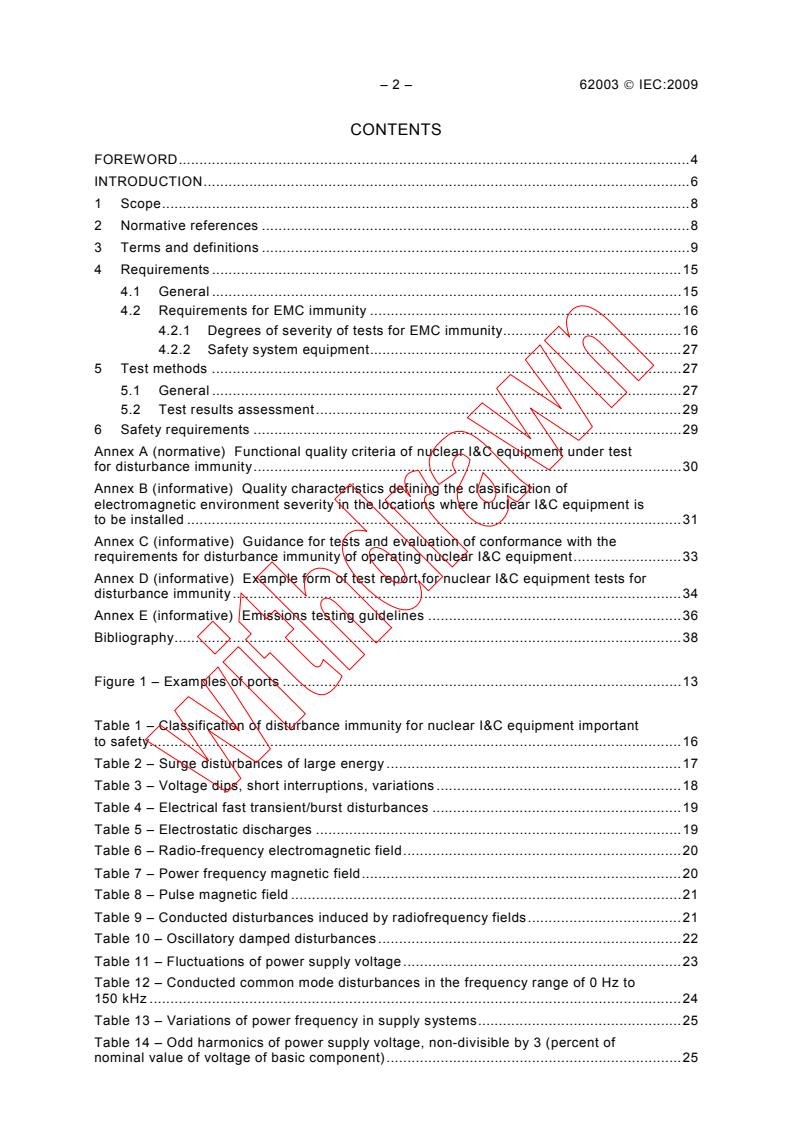
IEC 62003:2009 establishes requirements for electromagnetic compatibility testing of instrumentation and control equipment supplied for use in systems important to safety at nuclear power plants. Lists the applicable IEC standards (principally the IEC 61000 series) which define the general test methods, and provides the necessary application-specific parameters and criteria to ensure that nuclear safety requirements are met.
- Status
- Published
- Publication Date
- 09-Mar-2009
- Technical Committee
- SC 45A - Instrumentation, control and electrical power systems of nuclear facilities
- Drafting Committee
- WG 9 - TC 45/SC 45A/WG 9
- Current Stage
- DELPUB - Deleted Publication
- Start Date
- 11-Mar-2020
- Completion Date
- 28-Aug-2026
Overview
IEC 62003:2009 is an international standard developed by the International Electrotechnical Commission (IEC) that specifies requirements for electromagnetic compatibility (EMC) testing of instrumentation and control (I&C) equipment important to safety in nuclear power plants (NPPs). This standard ensures that I&C systems can withstand electromagnetic interference (EMI) and radio-frequency interference (RFI) without performance degradation, maintaining the safety and reliability crucial for nuclear facility operations.
The document references the IEC 61000 series, leveraging general EMC test methods and adapting them with nuclear-specific parameters and criteria. As a result, IEC 62003:2009 provides a tailored framework to address the unique electromagnetic environment experienced by safety-critical systems in nuclear reactors.
Key Topics
Scope and Applicability
The standard applies to electromagnetic compatibility testing of I&C equipment used in safety-related systems at NPPs. It ensures that these critical components comply with stringent immunity and emission criteria to prevent malfunctions caused by electromagnetic disturbances.EMC Immunity Requirements
IEC 62003 defines degrees of severity for EMC immunity tests relevant to nuclear safety systems, covering phenomena such as voltage dips, power frequency magnetic fields, electrostatic discharges, radio-frequency electromagnetic fields, and electrical fast transient bursts.Test Methods and Criteria
The standard details application-specific test methods and assessment procedures to evaluate equipment performance under disturbance conditions. This includes classifications for disturbance immunity levels necessary for nuclear I&C equipment and guidelines for test result evaluations.Safety and Functional Quality Criteria
Annexes provide functional quality criteria for disturbance immunity, a classification scheme for electromagnetic environments at nuclear sites, and guidance on test reporting. Emission testing guidelines limit the interference from nuclear I&C equipment to ensure it does not adversely affect other systems.Relationship with Other Standards
IEC 62003 fits within the hierarchy of IEC SC 45A standards focused on instrumentation and control in nuclear facilities. It complements the top-level IEC 61513 standard that outlines general I&C safety requirements and interfaces with other IEC 61000 series standards addressing industrial EMC conditions.
Applications
IEC 62003:2009 is critical for:
Nuclear Power Plant Operators and Utilities
Applies testing protocols to confirm that safety-related I&C systems meet electromagnetic immunity requirements, thereby supporting reliable plant operation and regulatory compliance.System Designers and Equipment Manufacturers
Offers clear guidelines for designing and qualifying I&C equipment that must operate accurately in the presence of diverse electromagnetic disturbances typical of nuclear environments.Regulatory Bodies and Licensing Authorities
Provides a benchmark for evaluating EMC qualifications in nuclear safety equipment, supporting consistent regulatory interpretation and enforcement worldwide.Certification and Testing Laboratories
Standardizes test methodologies and acceptance criteria to ensure reproducible and comprehensive assessment of equipment susceptibility to EMI/RFI.
Related Standards
IEC 61000 Series
A broad collection of standards defining general electromagnetic compatibility test methods and immunity requirements in industrial and commercial applications. IEC 62003 adapts these standards for nuclear-specific safety demands.IEC 61513
A high-level standard specifying general requirements for instrumentation and control systems important to safety in nuclear power plants. IEC 62003 serves as a complementary document focused on EMC testing.IEC SC 45A Standards
Include detailed standards on safety system classification, qualification, separation, and software/hardware aspects for nuclear I&C systems, providing a comprehensive regulatory framework alongside IEC 62003.IAEA Safety Guides and ISO Standards
International regulatory and quality standards that may reference IEC 62003 to ensure consistency in nuclear plant safety practices related to electromagnetic compatibility.
By applying IEC 62003:2009, nuclear facility operators and equipment suppliers can enhance the resilience of critical instrumentation and control systems, minimizing risks associated with electromagnetic interference and maintaining robust safety margins in nuclear power operations.
Relations
- Effective Date
- 10-Feb-2026
- Effective Date
- 10-Feb-2026
- Effective Date
- 10-Feb-2026
- Effective Date
- 10-Feb-2026
- Effective Date
- 10-Feb-2026
- Effective Date
- 05-Sep-2023
Get Certified
Connect with accredited certification bodies for this standard

DNV
DNV is an independent assurance and risk management provider.

Lloyd's Register
Lloyd's Register is a global professional services organisation specialising in engineering and technology.
DNV Energy Systems
Energy and renewable energy certification.
Sponsored listings
Frequently Asked Questions
IEC 62003:2009 is a standard published by the International Electrotechnical Commission (IEC). Its full title is "Nuclear power plants - Instrumentation and control important to safety - Requirements for electromagnetic compatibility testing". This standard covers: IEC 62003:2009 establishes requirements for electromagnetic compatibility testing of instrumentation and control equipment supplied for use in systems important to safety at nuclear power plants. Lists the applicable IEC standards (principally the IEC 61000 series) which define the general test methods, and provides the necessary application-specific parameters and criteria to ensure that nuclear safety requirements are met.
IEC 62003:2009 establishes requirements for electromagnetic compatibility testing of instrumentation and control equipment supplied for use in systems important to safety at nuclear power plants. Lists the applicable IEC standards (principally the IEC 61000 series) which define the general test methods, and provides the necessary application-specific parameters and criteria to ensure that nuclear safety requirements are met.
IEC 62003:2009 is classified under the following ICS (International Classification for Standards) categories: 27.120.20 - Nuclear power plants. Safety. The ICS classification helps identify the subject area and facilitates finding related standards.
IEC 62003:2009 has the following relationships with other standards: It is inter standard links to EN IEC 61500:2019, EN IEC 60709:2019, EN IEC 61225:2020, EN IEC 60964:2019, EN 62808:2016, IEC 62003:2020. Understanding these relationships helps ensure you are using the most current and applicable version of the standard.
IEC 62003:2009 is available in PDF format for immediate download after purchase. The document can be added to your cart and obtained through the secure checkout process. Digital delivery ensures instant access to the complete standard document.
Standards Content (Sample)
IEC 62003 ®
Edition 1.0 2009-03
INTERNATIONAL
STANDARD
NORME
INTERNATIONALE
Nuclear power plants – Instrumentation and control important to safety –
Requirements for electromagnetic compatibility testing
Centrales nucléaires de puissance – Instrumentation et contrôle-commande
importants pour la sûreté – Exigences relatives aux essais de compatibilité
électromagnétique
All rights reserved. Unless otherwise specified, no part of this publication may be reproduced or utilized in any form or by
any means, electronic or mechanical, including photocopying and microfilm, without permission in writing from either IEC or
IEC's member National Committee in the country of the requester.
If you have any questions about IEC copyright or have an enquiry about obtaining additional rights to this publication,
please contact the address below or your local IEC member National Committee for further information.
Droits de reproduction réservés. Sauf indication contraire, aucune partie de cette publication ne peut être reproduite
ni utilisée sous quelque forme que ce soit et par aucun procédé, électronique ou mécanique, y compris la photocopie
et les microfilms, sans l'accord écrit de la CEI ou du Comité national de la CEI du pays du demandeur.
Si vous avez des questions sur le copyright de la CEI ou si vous désirez obtenir des droits supplémentaires sur cette
publication, utilisez les coordonnées ci-après ou contactez le Comité national de la CEI de votre pays de résidence.
IEC Central Office
3, rue de Varembé
CH-1211 Geneva 20
Switzerland
Email: inmail@iec.ch
Web: www.iec.ch
About the IEC
The International Electrotechnical Commission (IEC) is the leading global organization that prepares and publishes
International Standards for all electrical, electronic and related technologies.
About IEC publications
The technical content of IEC publications is kept under constant review by the IEC. Please make sure that you have the
latest edition, a corrigenda or an amendment might have been published.
ƒ Catalogue of IEC publications: www.iec.ch/searchpub
The IEC on-line Catalogue enables you to search by a variety of criteria (reference number, text, technical committee,…).
It also gives information on projects, withdrawn and replaced publications.
ƒ IEC Just Published: www.iec.ch/online_news/justpub
Stay up to date on all new IEC publications. Just Published details twice a month all new publications released. Available
on-line and also by email.
ƒ Electropedia: www.electropedia.org
The world's leading online dictionary of electronic and electrical terms containing more than 20 000 terms and definitions
in English and French, with equivalent terms in additional languages. Also known as the International Electrotechnical
Vocabulary online.
ƒ Customer Service Centre: www.iec.ch/webstore/custserv
If you wish to give us your feedback on this publication or need further assistance, please visit the Customer Service
Centre FAQ or contact us:
Email: csc@iec.ch
Tel.: +41 22 919 02 11
Fax: +41 22 919 03 00
A propos de la CEI
La Commission Electrotechnique Internationale (CEI) est la première organisation mondiale qui élabore et publie des
normes internationales pour tout ce qui a trait à l'électricité, à l'électronique et aux technologies apparentées.
A propos des publications CEI
Le contenu technique des publications de la CEI est constamment revu. Veuillez vous assurer que vous possédez
l’édition la plus récente, un corrigendum ou amendement peut avoir été publié.
ƒ Catalogue des publications de la CEI: www.iec.ch/searchpub/cur_fut-f.htm
Le Catalogue en-ligne de la CEI vous permet d’effectuer des recherches en utilisant différents critères (numéro de référence,
texte, comité d’études,…). Il donne aussi des informations sur les projets et les publications retirées ou remplacées.
ƒ Just Published CEI: www.iec.ch/online_news/justpub
Restez informé sur les nouvelles publications de la CEI. Just Published détaille deux fois par mois les nouvelles
publications parues. Disponible en-ligne et aussi par email.
ƒ Electropedia: www.electropedia.org
Le premier dictionnaire en ligne au monde de termes électroniques et électriques. Il contient plus de 20 000 termes et
définitions en anglais et en français, ainsi que les termes équivalents dans les langues additionnelles. Egalement appelé
Vocabulaire Electrotechnique International en ligne.
ƒ Service Clients: www.iec.ch/webstore/custserv/custserv_entry-f.htm
Si vous désirez nous donner des commentaires sur cette publication ou si vous avez des questions, visitez le FAQ du
Service clients ou contactez-nous:
Email: csc@iec.ch
Tél.: +41 22 919 02 11
Fax: +41 22 919 03 00
IEC 62003 ®
Edition 1.0 2009-03
INTERNATIONAL
STANDARD
NORME
INTERNATIONALE
Nuclear power plants – Instrumentation and control important to safety –
Requirements for electromagnetic compatibility testing
Centrales nucléaires de puissance – Instrumentation et contrôle-commande
importants pour la sûreté – Exigences relatives aux essais de compatibilité
électromagnétique
INTERNATIONAL
ELECTROTECHNICAL
COMMISSION
COMMISSION
ELECTROTECHNIQUE
PRICE CODE
INTERNATIONALE
W
CODE PRIX
ICS 27.120.20 ISBN 978-2-88910-604-2
– 2 – 62003 © IEC:2009
CONTENTS
FOREWORD.4
INTRODUCTION.6
1 Scope.8
2 Normative references .8
3 Terms and definitions .9
4 Requirements .15
4.1 General .15
4.2 Requirements for EMC immunity .16
4.2.1 Degrees of severity of tests for EMC immunity.16
4.2.2 Safety system equipment.27
5 Test methods .27
5.1 General .27
5.2 Test results assessment.29
6 Safety requirements .29
Annex A (normative) Functional quality criteria of nuclear I&C equipment under test
for disturbance immunity.30
Annex B (informative) Quality characteristics defining the classification of
electromagnetic environment severity in the locations where nuclear I&C equipment is
to be installed .31
Annex C (informative) Guidance for tests and evaluation of conformance with the
requirements for disturbance immunity of operating nuclear I&C equipment.33
Annex D (informative) Example form of test report for nuclear I&C equipment tests for
disturbance immunity.34
Annex E (informative) Emissions testing guidelines .36
Bibliography.38
Figure 1 – Examples of ports .13
Table 1 – Classification of disturbance immunity for nuclear I&C equipment important
to safety.16
Table 2 – Surge disturbances of large energy .17
Table 3 – Voltage dips, short interruptions, variations .18
Table 4 – Electrical fast transient/burst disturbances .19
Table 5 – Electrostatic discharges .19
Table 6 – Radio-frequency electromagnetic field.20
Table 7 – Power frequency magnetic field.20
Table 8 – Pulse magnetic field .21
Table 9 – Conducted disturbances induced by radiofrequency fields.21
Table 10 – Oscillatory damped disturbances.22
Table 11 – Fluctuations of power supply voltage.23
Table 12 – Conducted common mode disturbances in the frequency range of 0 Hz to
150 kHz .24
Table 13 – Variations of power frequency in supply systems.25
Table 14 – Odd harmonics of power supply voltage, non-divisible by 3 (percent of
nominal value of voltage of basic component).25
62003 © IEC:2009 – 3 –
Table 15 – Odd harmonics of power supply voltage, divisible by 3 (percent of nominal
value of voltage of basic component) .26
Table 16 – Even harmonics of power supply voltage (percent of nominal value of
voltage of basic component) .26
Table 17 – Harmonic components with frequencies allocated between frequencies of
harmonics (percent of nominal value of voltage of basic component) .26
Table 18 – Damped oscillatory magnetic field .27
Table A.1 – Functional quality criteria of nuclear I&C equipment under test for
disturbance immunity.30
Table B.1 – Quality characteristics defining the classification of electromagnetic
environment severity in the locations where nuclear I&C equipment is to be installed
(see Note 1).31
Table E.1 – Limits for field strength of man-made interference from nuclear I&C
equipment not belonging to information technologies equipment at a distance of
measurement of 30 m .36
Table E.2 – Limits for voltage level of man-made interference from nuclear I&C
equipment not belonging to information technologies equipment.37
– 4 – 62003 © IEC:2009
INTERNATIONAL ELECTROTECHNICAL COMMISSION
____________
NUCLEAR POWER PLANTS –
INSTRUMENTATION AND CONTROL IMPORTANT TO SAFETY –
REQUIREMENTS FOR ELECTROMAGNETIC COMPATIBILITY TESTING
FOREWORD
1) The International Electrotechnical Commission (IEC) is a worldwide organization for standardization comprising
all national electrotechnical committees (IEC National Committees). The object of IEC is to promote
international co-operation on all questions concerning standardization in the electrical and electronic fields. To
this end and in addition to other activities, IEC publishes International Standards, Technical Specifications,
Technical Reports, Publicly Available Specifications (PAS) and Guides (hereafter referred to as “IEC
Publication(s)”). Their preparation is entrusted to technical committees; any IEC National Committee interested
in the subject dealt with may participate in this preparatory work. International, governmental and non-
governmental organizations liaising with the IEC also participate in this preparation. IEC collaborates closely
with the International Organization for Standardization (ISO) in accordance with conditions determined by
agreement between the two organizations.
2) The formal decisions or agreements of IEC on technical matters express, as nearly as possible, an international
consensus of opinion on the relevant subjects since each technical committee has representation from all
interested IEC National Committees.
3) IEC Publications have the form of recommendations for international use and are accepted by IEC National
Committees in that sense. While all reasonable efforts are made to ensure that the technical content of IEC
Publications is accurate, IEC cannot be held responsible for the way in which they are used or for any
misinterpretation by any end user.
4) In order to promote international uniformity, IEC National Committees undertake to apply IEC Publications
transparently to the maximum extent possible in their national and regional publications. Any divergence
between any IEC Publication and the corresponding national or regional publication shall be clearly indicated in
the latter.
5) IEC provides no marking procedure to indicate its approval and cannot be rendered responsible for any
equipment declared to be in conformity with an IEC Publication.
6) All users should ensure that they have the latest edition of this publication.
7) No liability shall attach to IEC or its directors, employees, servants or agents including individual experts and
members of its technical committees and IEC National Committees for any personal injury, property damage or
other damage of any nature whatsoever, whether direct or indirect, or for costs (including legal fees) and
expenses arising out of the publication, use of, or reliance upon, this IEC Publication or any other IEC
Publications.
8) Attention is drawn to the Normative references cited in this publication. Use of the referenced publications is
indispensable for the correct application of this publication.
9) Attention is drawn to the possibility that some of the elements of this IEC Publication may be the subject of
patent rights. IEC shall not be held responsible for identifying any or all such patent rights.
International Standard IEC 62003 has been prepared by subcommittee 45A: Instrumentation
and control of nuclear facilities, of IEC technical committee 45: Nuclear instrumentation.
The text of this standard is based on the following documents:
FDIS Report on voting
45A/725/FDIS 45A/732/RVD
Full information on the voting for the approval of this standard can be found in the report on
voting indicated in the above table.
This publication has been drafted in accordance with the ISO/IEC Directives, Part 2.
62003 © IEC:2009 – 5 –
The committee has decided that the contents of this publication will remain unchanged until
the maintenance result date indicated on the IEC web site under "http://webstore.iec.ch" in
the data related to the specific publication. At this date, the publication will be
• reconfirmed,
• withdrawn,
• replaced by a revised edition, or
• amended.
– 6 – 62003 © IEC:2009
INTRODUCTION
a) Technical background, main issues and organisation of the standard
This International Standard was prepared and based, to a very strong extent, on the current
application of the IEC 61000 series for commercial equipment qualification for
electromagnetic interference (EMI) and radio-frequency interference (RFI).
It is intended that this standard be used by operators of NPPs (utilities), systems evaluators
and by licensors.
b) Situation of the current standard in the structure of the SC 45A standard series
IEC 62003 is the third level SC 45A document dealing with the issue of qualification for
electromagnetic interference (EMI) and radio-frequency interference (RFI) applicable to I&C
systems important to safety in nuclear facilities.
For more details on the structure of the SC 45A standard series see item d) of this
introduction.
c) Recommendation and limitation regarding the application of this standard
It is important to note that this standard establishes no additional functional requirements for
safety systems but clarifies the criteria to be applied for qualification to EMI/RFI from the
commercial standards.
Aspects for which special requirements and recommendations have been produced, are:
1) IEC 61000 series with specific qualifications for nuclear applications around the world;
2) regulatory interpretations for requirements on level of qualification necessary and types of
recommended testing to address all potential environmental stressors, related to this type
of qualification;
3) IEC 61000-6-2, Electromagnetic compatibility (EMC) – Part 6-2: Generic Standards –
Immunity for industrial environments addresses requirements for all industrial
environments while this standard addresses environments in nuclear facilities specifically.
d) Description of the structure of the SC 45A standard series and relationships with
other IEC documents and other bodies documents (IAEA, ISO)
The top-level document of the IEC SC 45A standard series is IEC 61513. It provides general
requirements for I&C systems and equipment that are used to perform functions important to
safety in NPPs. IEC 61513 structures the IEC SC 45A standard series.
IEC 61513 refers directly to other IEC SC 45A standards for general topics related to
categorization of functions and classification of systems, qualification, separation of systems,
defence against common cause failure, software aspects of computer-based systems,
hardware aspects of computer-based systems, and control room design. The standards
referenced directly at this second level should be considered together with IEC 61513 as a
consistent document set.
At a third level, IEC SC 45A standards not directly referenced by IEC 61513 are standards
related to specific equipment, technical methods, or specific activities. Usually, these
documents, which make reference to second-level documents for general topics, can be used
on their own.
A fourth level extending the IEC SC 45A standard series, corresponds to the Technical
Reports which are not normative.
62003 © IEC:2009 – 7 –
IEC 61513 has adopted a presentation format similar to the basic safety publication
IEC 61508 with an overall safety life-cycle framework and a system life-cycle framework and
provides an interpretation of the general requirements of IEC 61508-1, IEC 61508-2 and
IEC 61508-4, for the nuclear application sector. Compliance with IEC 61513 will facilitate
consistency with the requirements of IEC 61508 as they have been interpreted for the nuclear
industry. In this framework, IEC 60880 and IEC 62138 correspond to IEC 61508-3 for the
nuclear application sector.
IEC 61513 refers to ISO as well as to IAEA 50-C-QA (now replaced by IAEA GS-R-3) for
topics related to quality assurance (QA).
The IEC SC 45A standards series consistently implements and details the principles and
basic safety aspects provided in the IAEA code on the safety of NPPs and in the IAEA safety
series, in particular the Requirements NS-R-1, establishing safety requirements related to the
design of Nuclear Power Plants, and the Safety Guide NS-G-1.3 dealing with instrumentation
and control systems important to safety in Nuclear Power Plants. The terminology and
definitions used by SC 45A standards are consistent with those used by the IAEA.
– 8 – 62003 © IEC:2009
NUCLEAR POWER PLANTS –
INSTRUMENTATION AND CONTROL IMPORTANT TO SAFETY –
REQUIREMENTS FOR ELECTROMAGNETIC COMPATIBILITY TESTING
1 Scope
This International Standard establishes requirements for electromagnetic compatibility testing
of instrumentation and control equipment supplied for use in systems important to safety at
nuclear power plants. The standard lists the applicable IEC standards (principally the
IEC 61000 series) which define the general test methods, and provides the necessary
application-specific parameters and criteria to ensure that nuclear safety requirements are
met.
The normative part of this standard is limited to the testing of equipment prior to installation in
a nuclear power plant to demonstrate immunity to electromagnetic disturbances. This
document includes informative annexes which provide additional guidance and describes
approaches to maintaining electromagnetic compatibility for installed equipment.
2 Normative references
The following referenced documents are indispensable for the application of this document.
For dated references, only the edition cited applies. For undated references, the latest edition
of the referenced document (including any amendments) applies.
IEC 61000-4-2:2001, Electromagnetic compatibility (EMC) – Part 4-2: Testing and
measurement techniques – Electrostatic discharge immunity test
IEC 61000-4-3:2008, Electromagnetic compatibility (EMC) – Part 4-3: Testing and
measurement techniques – Radiated, radio-frequency, electromagnetic field immunity test
IEC 61000-4-4:2004, Electromagnetic compatibility (EMC) – Part 4-4: Testing and
measurement techniques – Electrical fast transient/burst immunity test
IEC 61000-4-5:2005, Electromagnetic compatibility (EMC) – Part 4-5: Testing and
measurement techniques – Surge immunity test
IEC 61000-4-6:2008, Electromagnetic compatibility (EMC) – Part 4-6: Testing and
measurement techniques – Immunity to conducted disturbances, induced by radio-frequency
fields
IEC 61000-4-8:2001, Electromagnetic compatibility (EMC) – Part 4-8: Testing and
measurement techniques – Power frequency magnetic field immunity test
IEC 61000-4-9, Electromagnetic compatibility (EMC) – Part 4-9: Testing and measurement
techniques – Pulse magnetic field immunity test
IEC 61000-4-10, Electromagnetic compatibility (EMC) – Part 4-10: Testing and measurement
techniques – Damped oscillatory magnetic field immunity test
IEC 61000-4-11:2004, Electromagnetic compatibility (EMC) – Part 4-11: Testing and
measurement techniques – Voltage dips, short interruptions and voltage variations immunity
tests
62003 © IEC:2009 – 9 –
IEC 61000-4-12:2006, Electromagnetic compatibility (EMC) – Part 4-12: Testing and
measurement techniques – Ring wave immunity test
IEC 61000-4-13:2002, Electromagnetic compatibility (EMC) – Part 4-13: Testing and
measurements techniques – Harmonics and interharmonics including mains signalling at a.c.
power port, low frequency immunity tests
IEC 61000-4-14, Electromagnetic compatibility (EMC) – Part 4-14: Testing and measurement
techniques – Voltage fluctuation immunity test
IEC 61000-4-16, Electromagnetic compatibility (EMC) – Part 4-16: Testing and measurement
techniques – Test for immunity to conducted, common mode disturbances in the frequency
range 0 Hz to 150 kHz
IEC 61000-4-28, Electromagnetic compatibility (EMC) – Part 4-28: Testing and measurement
techniques – Variation of power frequency, immunity test
CISPR 11, Industrial, scientific and medical (ISM) radio-frequency equipment –
Electromagnetic disturbance characteristics – Limits and methods of measurement
CISPR 22, Information technology equipment – Radio disturbance characteristics – Limits and
methods of measurement
3 Terms and definitions
For the purposes of this document, the following terms and definitions are applicable.
Definitions and terms that can be found in the IEC International Electrotechnical Vocabulary
(IEV) and IEC standards have their sources indicated in brackets []. Any unreferenced
definitions and terms are related to the nuclear I&C equipment area and specific to this
standard.
3.1
acceptance criteria
specified bounds on the value of a functional indicator or condition indicator used to assess
the ability of a structure, system or component to perform its design function
[IAEA Safety Glossary:2007]
3.2
(cable) port
port at which a conductor or a cable is connected to the apparatus
[IEC 61000-6-2:2005]
3.3
common mode voltage
mean of the phasor voltages appearing between each conductor and a specified reference,
usually earth or frame
[IEV 161-04-09]
3.4
(communication) port
interface with a communication and/or control system, using low energy signals, permanently
connected to the EUT
[IEC 60255-22-5:2002]
– 10 – 62003 © IEC:2009
3.5
conducted emissions
transients and/or other disturbances observed on the external terminals of a device during its
normal operation
[IEC 61967-1:2002]
3.6
conducted susceptibility
susceptibility of a system to conducted signals on cables connected to the system
[IEC 61000-1-5:2004]
3.7
continuous wave
time waveform that has a fixed frequency and is continuous
[IEC 61000-2-13:2005]
3.8
(control) port
point at which a cable for the control signal is connected to the equipment
[IEC 60728-2:2002]
3.9
damped alternating (oscillatory) voltage
starting from a (negative or positive) charging voltage level and having damped sinusoidal
oscillation around the zero level
[IEC 60060-3:2006]
3.10
differential mode voltage
voltage between any two of a specified set of active conductors
[IEV 161-04-08]
3.11
electric field
r r
E which exerts on any charged particle at rest a force F equal to the
vector field quantity
r
product of E and the electric charge q of the particle:
r r
F =qE
where
r
F is the vector force acting on the particle in newtons;
q is the charge of the particle in coulombs;
r
E is the electric field in volts per metre.
[IEC 62209-1:2005]
3.12
electric field strength
magnitude of the electric field vector of an electromagnetic wave, or of a field created by an
electric charge distribution measured in volts per metre
[IEC 61000-4-23:2000]
62003 © IEC:2009 – 11 –
3.13
electromagnetic compatibility (EMC)
ability of an equipment or system to function satisfactorily in its electromagnetic environment
without introducing intolerable electromagnetic disturbances to anything in that environment
[IEV 161-01-07]
3.14
electromagnetic disturbance
any electromagnetic phenomenon which may degrade the performance of a device,
equipment or system, or adversely affect living or inert matter
[IEV 161-01-05]
3.15
electromagnetic environment
totality of electromagnetic phenomena existing at a given location
[IEV 161-01-01]
3.16
(electromagnetic) immunity (to a disturbance)
ability of a device, equipment or system to perform without degradation in the presence of an
electromagnetic disturbance
[IEV 161-01-20]
3.17
electromagnetic radiation
phenomenon by which energy in the form of electromagnetic waves emanates from a source
into space
[IEV 161-01-10]
3.18
electromagnetic wave
radiant energy produced by the oscillation of an electric charge characterized by oscillation of
the electric and magnetic fields
[IEC 61000-4-3:2006]
3.19
electrostatic discharge
transfer of electric charge between bodies of different electrostatic potential in proximity or
through direct contact
[IEV 161-01-22]
3.20
(EM surge) burst
sequence of a limited number of distinct pulses or an oscillation of limited duration
[IEV 161-02-07]
3.21
(enclosure) port
physical boundary of the apparatus which electromagnetic fields may radiate through or
impinge upon. The equipment case is normally considered the enclosure port
[IEC 61000-6-6:2003]
– 12 – 62003 © IEC:2009
3.22
EUT (equipment under test)
equipment under test can be a single unit or multiple units interconnected by cables, data
links, etc.
[IEC 61000-4-25:2001]
3.23
(functional earth) port
cable port other than signal, control or power port, intended for connection to earth for
purposes other than safety
[IEC 61000-6-6:2003]
3.24
harmonic components
components of the harmonic content as expressed in terms of the order and r.m.s. values of
the Fourier series terms describing the periodic function
[IEC 62310-2:2006]
3.25
harmonic distortion
non-linear distortion characterized by the generation of undesired spectral components
harmonically related to the desired signal frequency. Each harmonic component is usually
expressed as a power (in decibels) relative to the output power of the desired signal
[IEC 60679-1, definition 3.2.30]
3.26
immunity test level
value of an influencing electromagnetic quantity specified for an immunity test
[IEC 61000-4-25:2001]
3.27
interharmonic frequency
any frequency which is not an integer multiple of the fundamental frequency
[IEC 61000-2-2, definition 3.2.5]
3.28
interruption threshold;
r.m.s. value of the voltage on an electricity supply system specified as a boundary such that a
voltage dip in which the voltage on all phases falls below it is classified as a short interruption
[IEC 61000-2-8:2002]
3.29
magnetic field
r
M from the
vector quantity obtained at a given point by subtracting the magnetization
r
magnetic flux density B divided by the magnetic constant (permeability) μ :
r
r r
B
H = −M
μ
where
r
H is the magnetic field in amperes per metre;
62003 © IEC:2009 – 13 –
r
B is the magnetic flux density in teslas;
μ is the magnetic constant (permeability) of the vacuum in henries per metre;
r
M is the magnetization in amperes per metre.
[IEC 62209-1:2005]
3.30
magnetic field strength
magnitude of the magnetic field vector of an electromagnetic wave, or the field produced by a
current flowing in a wire, loop antenna, etc
[IEC 61000-4-23:2000]
3.31
port
particular interface of the Equipment Under Test (EUT) with the external electromagnetic
environment
[IEC 61000-4-12:2006]
Enclosure port
AC power port
Signal port
Apparatus
Functional earth port DC power port
IEC 892/03
Figure 1 – Examples of ports
3.32
(power) port
point at which a conductor or cable carrying the electrical power needed for the operation of
the equipment is connected to the apparatus
[IEC 61000-6-6:2003]
3.33
pulse
transient waveform that usually rises to a peak value and then decays, or a similar waveform
that is an envelope of an oscillating waveform
[IEC 61000-2-13:2005]
3.34
radiated emissions
any wanted or unwanted emission from an electrical device
[IEC 61000-4-21:2003]
3.35
radiated susceptibility
susceptibility of a system to radiated electromagnetic fields
[IEC 61000-1-5:2004]
– 14 – 62003 © IEC:2009
3.36
radiofrequency
RF
frequency of the electromagnetic spectrum that is between the audiofrequency portion and the
infrared portion
[IEC 61000-4-23:2000]
3.37
short interruption
disappearance of the supply voltage at a point of the low voltage d.c. distributed system for a
period of time typically not exceeding 1 min. In practice, a dip with amplitude at least 80 % of
the rated voltage may be considered as an interruption
[IEC 61000-4-29:2000]
3.38
(signal) port
cable port at which there is a cable carrying information for transferring data to or from the
apparatus. Examples are input/output (I/O) data ports, telecom ports, etc.
[IEC 61000-6-6:2003]
3.39
voltage surge
transient voltage wave propagating along a line or a circuit and characterized by a rapid
increase followed by a slower decrease of the voltage
[IEV 161-8-11]
3.40
transient
pertaining to or designating a phenomenon or a quantity which varies between two
consecutive steady states during a time interval that is short when compared with the time-
scale of interest
[IEV 161-02-01]
3.41
voltage dip
sudden reduction of the voltage at a point in the low voltage d.c. distribution system, followed
by voltage recovery after a short period of time, from a few milliseconds up to a few seconds
[IEV 161-08-10 modified]
3.42
voltage fluctuation
series of changes of r.m.s. voltage evaluated as a single value for each successive half-
period between zero-crossings of the source voltage
[IEC 61000-3-3:2008]
3.43
voltage variation
gradual change of the supply voltage to a higher or lower value than the rated voltage. The
duration of the change can be short or long
[IEC 61000-4-29:2000]
62003 © IEC:2009 – 15 –
4 Requirements
4.1 General
Nuclear I&C equipment important to the safety of a nuclear plant shall satisfy the
requirements for immunity to electromagnetic interference documented in this standard.
The establishment of immunity requirements shall address items a) to n), below. If an item is
deemed to be inappropriate for the equipment under test, exemption shall be justified by
consideration of operating conditions or other relevant factors. The immunity requirements
shall address:
a) surge disturbances of large energy;
b) voltage dips, short interruptions, voltage variations;
c) electrical fast transients/bursts;
d) electrostatic discharges;
e) radio-frequency electromagnetic field, radiated;
f) power frequency magnetic field;
g) pulse magnetic field;
h) conducted disturbances, induced by radio-frequency field;
i) oscillatory damped disturbances;
j) fluctuations of power supply voltage;
k) conducted common mode disturbances in the range of 0 Hz to 150 Hz;
l) variations of power frequency in supply systems;
m) harmonics and interharmonics distortion of power supply waveform;
n) damped oscillatory magnetic field.
Nuclear I&C equipment supplied for use in systems important to safety may also be required
to satisfy emission requirements. To provide guidance in this area, informative Annex E has
been included to address recommended emissions requirements and acceptance criteria.
The degrees of test severity and functional quality criteria are established for nuclear I&C
equipment immunity testing for electromagnetic disturbances, indicated in this subclause,
items a) to n).
Immunity levels for nuclear I&C equipment shall be established in accordance with Table 1,
based on the severity of the electromagnetic environment. Electromagnetic environments are
classified in accordance with the qualitative parameters in informative Annex B. Country-
specific clauses may require the application of higher immunity levels.
Depending on the installed location of nuclear I&C equipment, and the severity of
electromagnetic conditions during the operation, the following severity category on
disturbance immunity of nuclear I&C equipment should be established: I, II, III, and IV It is
expected that all testing on a specific component meets the requirements of the appropriate
severity category. Deviations are allowed if appropriately justified.
– 16 – 62003 © IEC:2009
Table 1 – Classification of disturbance immunity
for nuclear I&C equipment important to safety
Severity of electromagnetic environment of equipment location
Light EME Middle EME Harsh EME Severe EME
Immunity level I II III IV
NOTE Representative qualitative parameters for the classification of the severity of electromagnetic conditions in
location for the allocation of nuclear I&C equipment are given for guidance in Annex B.
For each item of nuclear I&C equipment, the immunity level shall be individually determined
for each of the disturbance types (items a) to n)).
Functional quality criteria for testing on disturbance immunity, as well as norms of industrial
disturbances, harmonic components of current consumed from electric mains and voltage
variations, induced in the electric mains, shall be indicated in standards on nuclear I&C
equipment of a specific type, in technical specifications and maintenance documentation on
nuclear I&C equipment. To support this, operational quality parameters of nuclear I&C
equipment at testing on disturbance immunity, corresponding to quality criteria A or B (C)
according to Annex A shall be specified. This shall take into account destination,
distinguished features of application and operation modes of nuclear I&C equipment of a
specific type.
4.2 Requirements for EMC immunity
4.2.1 Degrees of severity of tests for EMC immunity
4.2.1.1 General
Degrees of severity of tests for disturbance immunity and characteristics of types of these
disturbances, indicated in 4.1, items a) to n) and impacting different parts of nuclear I&C
equipment of I, II, III and IV arrangement groups, are given in 4.2.1.1 to 4.2.1.14.
The EMC practices and methodologies for testing included in this standard are only elements
of the total program that is needed to ensure EMC within nuclear power plants. In addition to
assessing the electromagnetic environment, plants should apply appropriate practices for
grounding, noise-minimization and emission control techniques for I&C systems as part of the
overall EMC program.
4.2.1.2 Immunity to surge disturbances of large energy according to IEC 61000-4-5
These phenomena correspond to switching transients and lightning transients. High currents
and voltages are induced in cables connected to the ground and in cables not connected to
ground.
Parameters for testing nuclear I&C equipment for disturbance immunity due to the impact of
surge disturbances of large energy according to IEC 61000-4-5 on input/output connectors,
including AC power supply, DC power supply, signal and control connectors are set up in
accordance with Table 2.
62003 © IEC:2009 – 17 –
Table 2 – Surge disturbances of large energy
Type of Arrangement group on disturbance immunity of nuclear I&C equipment
connector
I II III IV
Value of voltage Value of voltage Value of voltage pulse Value of voltage pulse
pulse at non-loaded pulse at non-loaded at non-loaded output at non-loaded output
output of test output of test of test oscillator of test oscillator
oscillator oscillator
a a a a
kV kV kV kV
Input/output
connectors for
AC power
supply:
disturbance is
– 0,5 1 2
applied in
line-to-line
mode;
disturbance is
applied in
0,5 1 2 4
line-to-ground
mode
Input/output
connectors for
DC power
supply:
disturbance is
b b
– – 0,5 1
applied in
line-to-line
mode;
disturbance is
applied in
b b
– – 1 2
line-to-ground
mode
Signal, control
information
c c c
– 0,5 1 2
input/output
connectors:
disturbance is
applied in
common mode
a
When disturbances are applied to connectors of AC and DC power supply, signal, control or input/output
connectors, which are not connected to wirelines or which are connected to wirelines laid inside the building, a
combined test oscillator of surge disturbances according to IEC 61000-4-5 shall be used.
When disturbances are applied to signal, control or input/output connectors connected to wirelines laid outside the
building, a test oscillator of surge disturbances according to IEC 61000-4-5 shall be used.
b
This requirement shall be established for connectors permanently connected with cables of which the length may
exceed 10 m.
c
This requirement shall be established for connectors permanently connected with cables of which the length may
exceed 3 m.
4.2.1.3 Immunity to voltage dips, short interruptions, voltage variations according to
IEC 61000-4-11
This standard addresses the disturbance due to the quality of the power supply.
Parameters for testing nuclear I&C equipment for disturbance immunity due to the impact of
voltage dips, short interruptions, voltage variations according to IEC 61000-4-11 on the input
connectors of AC power supply shall be established in accordance with the test requirements
and acceptance criteria of IEC 61000-4-11.
– 18 – 62003 © IEC:2009
Table 3 – Voltage dips, short interruptions, variations
Type of changes in Arrangement group on disturbance immunity
power supply voltage of nuclear I&C equipment
I II III IV
Voltage dips
a
Testing voltage (%Un ) 70 % 70 % 70 % 70 %
Duration (DC) 200 ms 500 ms 1 000 ms 2 000 ms
Cycles-50 Hz (AC) 10 25 50 100
Cycles-60 Hz (AC) 12 30 60 120
Voltage interruptions
a
)
Testing voltage (%Un 0 % 0 % 0 % 0 %
Duration (DC) 5 000 ms 5 000 ms 5 000 ms 5 000 ms
Cycles-50 Hz (AC) 250 250 250 250
Cycles-60 Hz (AC) 300 300 300 300
b
Voltage surges
a
Testing Voltage (%U ) 120 % 120 % 120 % 120 %
n
Duration (DC) 200 ms 500 ms 1 000 ms 2 000 ms
Cycles-50 Hz (AC) 10 25 50 100
Cycles-60 Hz (AC) 12 30 60 120
a
U – nominal power supply voltage of nuclear I&C equipment.
n
b
Optional testing based on country specific standards.
4.2.1.4 Immunity to electrical fast transient/burst according to IEC 61000-4-4
The phenomena correspond to transient disturbances of an I&C equipment such as switching
transients (interruption of inductive loads, relay contact bounce, etc.)
Parameters for testing nuclear I&C equipment for disturbance immunity due to the impact of
electrical fast transient/burst disturbances according to IEC 61000-4-4 on the input/output
connectors, including AC and DC power supply, signal and control connectors, shall be
established in accordance with Table 4.
62003 © IEC:2009 – 19 –
Table 4 – Electrical fast transient/burst disturbances
Type of Arrangement group on disturbance immunity of nuclear I&C equipment
connector
I II III IV
Output voltage of Output voltage of Output voltage of Output voltage of
testing oscillator testing oscillator testing oscillator testing oscillator under
under no-load under no-load under no-load no-load conditions
conditions conditions conditions
kV kV kV kV
Input/output
connectors
0,5 1 2 4
for AC power
supply
Input/output
connectors
for DC power
– 0,5 1 2
supply
Signal,
control
information
input/output
a
connectors
0,25 0,5 1 2
a
This requirement shall be established for connectors permanently connected with cables the length of which may
exceed 3 m.
4.2.1.5 Immunity to electrostatic dis
...