


IEC TR 61340-5-4:2019
(Main)Electrostatics - Part 5-4: Protection of electronic devices from electrostatic phenomena - Compliance verification
General Information
- Abstract
IEC TR 61340-5-4:2019(E) describes compliance verification testing for technical items that are included in ESD control programs, such as those specified in IEC 61340-5-1.
Test methods, in the main body of this document, are based on those specified in IEC 61340-5-1 and other parts of IEC 61340, and are simplified where necessary for the purposes of compliance verification, to be performed by competent personnel.
Additional compliance verification tests and procedures within the scope of this document are described in Annexes B to G.
Users can, by reference to this document in their compliance verification plan, adopt the necessary test methods described herein without change or addition. Alternatively, tests methods described in this document can be adapted to match the requirements of their own ESD control program, provided deviations in equipment or procedure are documented in their compliance verification plan.
Product qualification is excluded from the scope of this document.
- Status
- Replaced
- Publication Date
- 15-Aug-2019
- Technical Committee
- TC 101 - Electrostatics
- Drafting Committee
- WG 5 - TC 101/WG 5
- Current Stage
- DELPUB - Deleted Publication
- Start Date
- 30-Aug-2021
- Completion Date
- 28-Aug-2026
Relations
- Effective Date
- 05-Sep-2023
- Effective Date
- 12-Jun-2026
Get Certified
Connect with accredited certification bodies for this standard

IMQ S.p.A. (Certification)
Italian electrical product certification.

SLG Prüf- und Zertifizierungs GmbH
German testing and certification body.

UL Solutions
Global safety science company with testing, inspection and certification.
Sponsored listings
Frequently Asked Questions
IEC TR 61340-5-4:2019 is a technical report published by the International Electrotechnical Commission (IEC). Its full title is "Electrostatics - Part 5-4: Protection of electronic devices from electrostatic phenomena - Compliance verification". This standard covers: IEC TR 61340-5-4:2019(E) describes compliance verification testing for technical items that are included in ESD control programs, such as those specified in IEC 61340-5-1. Test methods, in the main body of this document, are based on those specified in IEC 61340-5-1 and other parts of IEC 61340, and are simplified where necessary for the purposes of compliance verification, to be performed by competent personnel. Additional compliance verification tests and procedures within the scope of this document are described in Annexes B to G. Users can, by reference to this document in their compliance verification plan, adopt the necessary test methods described herein without change or addition. Alternatively, tests methods described in this document can be adapted to match the requirements of their own ESD control program, provided deviations in equipment or procedure are documented in their compliance verification plan. Product qualification is excluded from the scope of this document.
IEC TR 61340-5-4:2019(E) describes compliance verification testing for technical items that are included in ESD control programs, such as those specified in IEC 61340-5-1. Test methods, in the main body of this document, are based on those specified in IEC 61340-5-1 and other parts of IEC 61340, and are simplified where necessary for the purposes of compliance verification, to be performed by competent personnel. Additional compliance verification tests and procedures within the scope of this document are described in Annexes B to G. Users can, by reference to this document in their compliance verification plan, adopt the necessary test methods described herein without change or addition. Alternatively, tests methods described in this document can be adapted to match the requirements of their own ESD control program, provided deviations in equipment or procedure are documented in their compliance verification plan. Product qualification is excluded from the scope of this document.
IEC TR 61340-5-4:2019 is classified under the following ICS (International Classification for Standards) categories: 17.220.99 - Other standards related to electricity and magnetism; 29.020 - Electrical engineering in general. The ICS classification helps identify the subject area and facilitates finding related standards.
IEC TR 61340-5-4:2019 has the following relationships with other standards: It is inter standard links to IEC TS 61340-5-4:2021, IEC TS 61340-5-4:2026. Understanding these relationships helps ensure you are using the most current and applicable version of the standard.
IEC TR 61340-5-4:2019 is available in PDF format for immediate download after purchase. The document can be added to your cart and obtained through the secure checkout process. Digital delivery ensures instant access to the complete standard document.
Standards Content (Sample)
IEC TR 61340-5-4 ®
Edition 1.0 2019-08
TECHNICAL
REPORT
colour
inside
Electrostatics –
Part 5-4: Protection of electronic devices from electrostatic phenomena –
Compliance verification
All rights reserved. Unless otherwise specified, no part of this publication may be reproduced or utilized in any form
or by any means, electronic or mechanical, including photocopying and microfilm, without permission in writing from
either IEC or IEC's member National Committee in the country of the requester. If you have any questions about IEC
copyright or have an enquiry about obtaining additional rights to this publication, please contact the address below or
your local IEC member National Committee for further information.
IEC Central Office Tel.: +41 22 919 02 11
3, rue de Varembé info@iec.ch
CH-1211 Geneva 20 www.iec.ch
Switzerland
About the IEC
The International Electrotechnical Commission (IEC) is the leading global organization that prepares and publishes
International Standards for all electrical, electronic and related technologies.
About IEC publications
The technical content of IEC publications is kept under constant review by the IEC. Please make sure that you have the
latest edition, a corrigendum or an amendment might have been published.
IEC publications search - webstore.iec.ch/advsearchform Electropedia - www.electropedia.org
The advanced search enables to find IEC publications by a The world's leading online dictionary on electrotechnology,
variety of criteria (reference number, text, technical containing more than 22 000 terminological entries in English
committee,…). It also gives information on projects, replaced and French, with equivalent terms in 16 additional languages.
and withdrawn publications. Also known as the International Electrotechnical Vocabulary
(IEV) online.
IEC Just Published - webstore.iec.ch/justpublished
Stay up to date on all new IEC publications. Just Published IEC Glossary - std.iec.ch/glossary
details all new publications released. Available online and 67 000 electrotechnical terminology entries in English and
once a month by email. French extracted from the Terms and Definitions clause of
IEC publications issued since 2002. Some entries have been
IEC Customer Service Centre - webstore.iec.ch/csc collected from earlier publications of IEC TC 37, 77, 86 and
If you wish to give us your feedback on this publication or CISPR.
need further assistance, please contact the Customer Service
Centre: sales@iec.ch.
IEC TR 61340-5-4 ®
Edition 1.0 2019-08
TECHNICAL
REPORT
colour
inside
Electrostatics –
Part 5-4: Protection of electronic devices from electrostatic phenomena –
Compliance verification
INTERNATIONAL
ELECTROTECHNICAL
COMMISSION
ICS 17.220.99; 29.020 ISBN 978-2-8322-7272-5
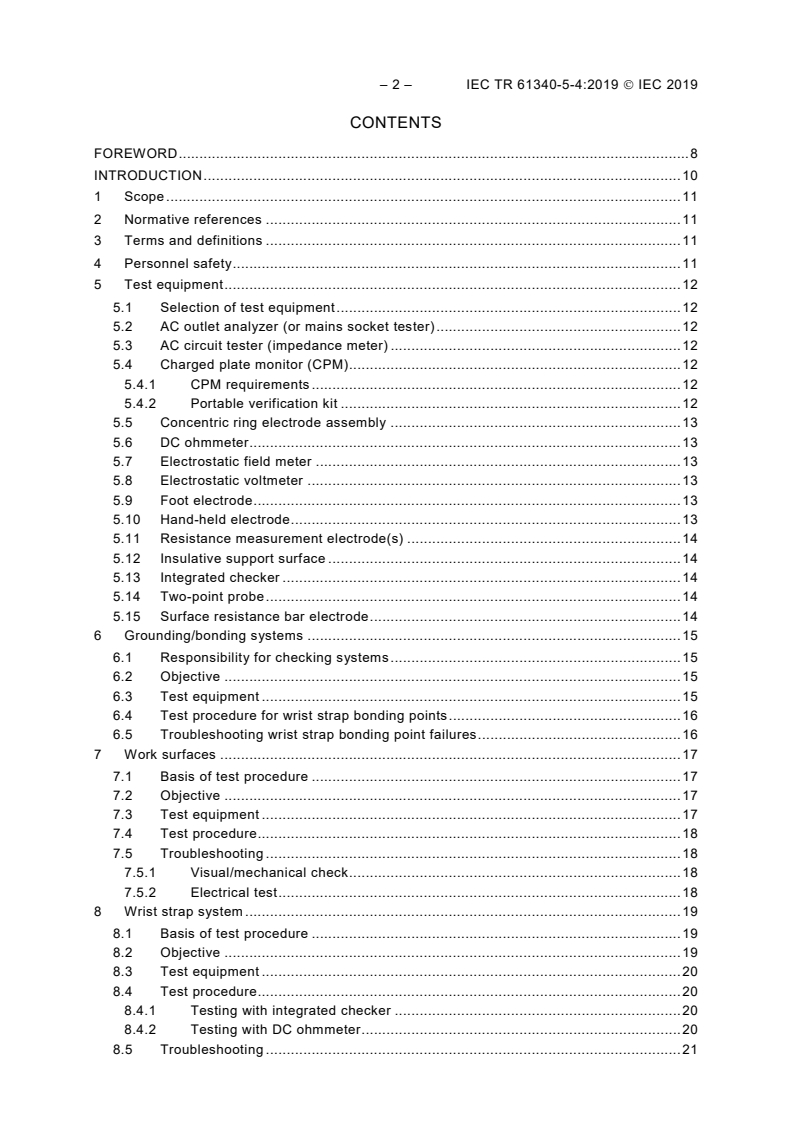
– 2 – IEC TR 61340-5-4:2019 IEC 2019
CONTENTS
FOREWORD . 8
INTRODUCTION . 10
1 Scope . 11
2 Normative references . 11
3 Terms and definitions . 11
4 Personnel safety . 11
5 Test equipment . 12
5.1 Selection of test equipment . 12
5.2 AC outlet analyzer (or mains socket tester) . 12
5.3 AC circuit tester (impedance meter) . 12
5.4 Charged plate monitor (CPM) . 12
5.4.1 CPM requirements . 12
5.4.2 Portable verification kit . 12
5.5 Concentric ring electrode assembly . 13
5.6 DC ohmmeter . 13
5.7 Electrostatic field meter . 13
5.8 Electrostatic voltmeter . 13
5.9 Foot electrode . 13
5.10 Hand-held electrode . 13
5.11 Resistance measurement electrode(s) . 14
5.12 Insulative support surface . 14
5.13 Integrated checker . 14
5.14 Two-point probe . 14
5.15 Surface resistance bar electrode . 14
6 Grounding/bonding systems . 15
6.1 Responsibility for checking systems . 15
6.2 Objective . 15
6.3 Test equipment . 15
6.4 Test procedure for wrist strap bonding points . 16
6.5 Troubleshooting wrist strap bonding point failures . 16
7 Work surfaces . 17
7.1 Basis of test procedure . 17
7.2 Objective . 17
7.3 Test equipment . 17
7.4 Test procedure . 18
7.5 Troubleshooting . 18
7.5.1 Visual/mechanical check . 18
7.5.2 Electrical test . 18
8 Wrist strap system . 19
8.1 Basis of test procedure . 19
8.2 Objective . 19
8.3 Test equipment . 20
8.4 Test procedure . 20
8.4.1 Testing with integrated checker . 20
8.4.2 Testing with DC ohmmeter . 20
8.5 Troubleshooting . 21
9 Person-footwear system . 22
9.1 Basis of test procedure . 22
9.2 Objective . 22
9.3 Test equipment . 22
9.4 Test procedure . 22
9.4.1 Testing with integrated checker . 22
9.4.2 Testing with DC ohmmeter . 22
9.5 Troubleshooting . 23
10 Flooring . 24
10.1 Basis of test procedure . 24
10.2 Objective . 24
10.3 Test equipment . 24
10.4 Test procedure . 25
10.5 Troubleshooting . 25
11 Person-footwear-flooring system . 25
11.1 Measurement of electrical resistance . 25
11.1.1 Basis of test procedure . 25
11.1.2 Objective . 26
11.1.3 Test equipment . 26
11.1.4 Test procedure . 26
11.1.5 Troubleshooting . 26
11.2 Measurement of body voltage . 27
11.2.1 Basis of test procedure . 27
11.2.2 Objective . 27
11.2.3 Test equipment . 28
11.2.4 Test procedure . 28
11.2.5 Troubleshooting . 28
12 Seating . 29
12.1 Basis of test procedure . 29
12.2 Objective . 29
12.3 Test equipment . 29
12.4 Test procedure . 29
12.5 Troubleshooting . 30
13 Air ionizers . 31
13.1 Basis of test procedure . 31
13.2 Objective . 31
13.3 Test equipment . 31
13.4 Test procedure . 31
13.4.1 Initial test setup . 31
13.4.2 Discharge time test . 31
13.4.3 Offset voltage test (balance) . 32
13.5 Troubleshooting . 32
14 Mobile equipment . 32
14.1 Basis of test procedure . 32
14.2 Objective . 33
14.3 Test equipment . 33
14.4 Test procedure . 33
14.5 Troubleshooting . 34
– 4 – IEC TR 61340-5-4:2019 IEC 2019
15 Groundable static control garment system . 35
15.1 Basis of test procedure . 35
15.2 Objective . 35
15.3 Test equipment . 35
15.4 Test procedure . 36
15.4.1 Testing with integrated checker . 36
15.4.2 Testing with DC ohmmeter . 36
15.5 Troubleshooting . 37
16 Static control garments and groundable static control garments point-to-point
method . 37
16.1 Basis of test procedure . 37
16.2 Objective . 38
16.3 Test equipment . 38
16.4 Test procedure . 38
16.5 Troubleshooting . 39
17 Static control garments and groundable static control garments hanging clamp
method . 40
17.1 Basis of test procedure . 40
17.2 Objective . 40
17.3 Test equipment . 40
17.4 Test procedure . 40
17.5 Troubleshooting . 42
18 Packaging . 42
18.1 Basis of test procedure . 42
18.2 Objective . 42
18.3 Test equipment . 42
18.4 Test procedure . 43
18.4.1 Surface resistance using an integrated measuring instrument . 43
18.4.2 Surface resistance using a concentric ring electrode assembly or two
SRBs . 43
18.4.3 Surface resistance using a DC ohmmeter and two-point probe . 44
18.4.4 Point-to-point using resistance measurement electrode(s) . 45
18.4.5 Volume resistance using an integrated checker or DC ohmmeter . 46
18.5 Troubleshooting (surface and volume resistance) . 47
19 Process required insulators . 47
19.1 Basis of test procedure . 47
19.2 Objective . 47
19.3 Test equipment . 47
19.4 Test procedure for measuring electrostatic field strength at the site of the
ESD sensitive device (ESDS) from electrostatic field source . 48
19.5 Measurement of surface voltage of a process required insulator . 48
19.6 Troubleshooting . 48
20 Process required isolated conductors . 49
20.1 Basis of test procedure . 49
20.2 Objective . 49
20.3 Test equipment . 49
20.4 Test procedures . 49
20.5 Troubleshooting . 50
Annex A (informative) Test frequency . 51
Annex B (informative) Other test methods for static control garments . 52
B.1 General considerations for other test methods . 52
B.2 Precautions to be observed when conducting tests . 52
B.3 Tribocharging tests for garments . 52
B.3.1 Objective . 52
B.3.2 Test equipment for body voltage measurements . 52
B.3.3 Test procedures for body voltage measurements . 53
B.3.4 Test equipment for measuring charge on garments . 56
B.3.5 Test procedure for measuring charge on garments . 57
B.3.6 Test equipment for measuring electrostatic field or surface voltage on
garments . 57
B.3.7 Test procedure for measuring electrostatic field or surface voltage on
garments . 58
B.3.8 Troubleshooting tribocharging tests . 58
B.4 Charge decay time tests for garments . 59
B.4.1 Objective . 59
B.4.2 Test equipment for measuring charge decay time after tribocharging . 59
B.4.3 Test procedure for measuring charge decay time after tribocharging . 59
B.4.4 Test equipment for measuring charge decay time after corona charging . 60
B.4.5 Test procedure for measuring charge decay time after corona charging . 60
B.4.6 Test equipment for measuring charge decay time after connection to a
DC high-voltage supply . 61
B.4.7 Test procedure for measuring charge decay time after connection to a
DC high-voltage supply . 61
B.5 Field suppression tests for garments . 62
B.6 Capacitance loading tests for garments . 62
Annex C (normative) Electrical soldering/desoldering hand tools . 63
C.1 Basis of test procedure . 63
C.2 Objective . 63
C.3 Test equipment . 63
C.4 Test procedure . 63
C.4.1 Soldering/desoldering hand tool tip voltage test procedure (hot iron)
using integrated tester or AC millivoltmeter . 63
C.4.2 Soldering/desoldering hand tools resistance to ground (hot iron) . 64
C.4.3 Soldering/desoldering hand tools resistance to ground (cold iron). 64
C.4.4 Soldering/desoldering hand tools resistance to ground (hot iron) using
low resistance meter . 65
C.5 Troubleshooting . 65
Annex D (normative) Hand tools . 66
D.1 Basis of test procedure . 66
D.2 Objective . 66
D.3 Test equipment . 66
D.3.1 Resistance measurements . 66
D.3.2 Charge decay time measurements . 66
D.3.3 Test procedure for hand tool resistance measurements . 66
D.3.4 Test procedure for hand tool resistance to ground measurements . 67
D.3.5 Test procedure for charge decay time measurements . 68
D.3.6 Troubleshooting . 69
Annex E (normative) Constant (continuous) monitors . 70
E.1 Basis of test procedure . 70
– 6 – IEC TR 61340-5-4:2019 IEC 2019
E.2 Objective . 70
E.3 Test equipment . 70
E.4 Test procedure . 70
E.5 Troubleshooting . 70
Annex F (normative) Gloves and finger cots – In use resistance . 71
F.1 Basis of test procedure . 71
F.2 Objective . 71
F.3 Test equipment . 71
F.4 Test procedure . 71
F.4.1 Integrated wrist strap checker with touch plate and wrist strap . 71
F.4.2 Hand-held electrode and DC ohmmeter via wrist strap . 72
F.4.3 Integrated footwear checker with foot plate and touch plate, and ESD
control footwear . 73
F.4.4 Constant area and force electrode (CAFE) with DC ohmmeter and wrist
strap . 73
F.5 Troubleshooting . 75
Annex G (informative) Grounding/bonding systems . 76
G.1 Objective . 76
G.2 Test equipment . 76
G.3 Test procedure . 76
G.4 Troubleshooting . 76
Bibliography . 77
Figure 1 – ESD control workstation . 16
Figure 2 – ESD control work surface test . 17
Figure 3 – Point-to-point measurement setup . 19
Figure 4 – Wrist strap test using integrated checker . 20
Figure 5 – Wrist strap test using DC ohmmeter . 21
Figure 6 – ESD control footwear test . 23
Figure 7 – ESD control flooring test . 24
Figure 8 – Person-footwear-flooring system test . 27
Figure 9 – ESD control chair test . 30
Figure 10 – ESD control mobile equipment test . 34
Figure 11 – Testing groundable static control garment system using integrated checker . 36
Figure 12 – Test setup – Groundable garment in combination with a person, hand-held
probe and DC ohmmeter . 37
Figure 13 – Garment (point-to-point) test . 39
Figure 14 – Electrodes for hanging garment test . 41
Figure 15 – Alternate point-to-point resistance measurement . 41
Figure 16 – Setup for test method using concentric ring electrode assembly and
surface resistance bar electrodes . 44
Figure 17 – Setup for test method using a DC ohmmeter and two-point probe . 45
Figure 18 – Setup for test method using two resistance measurement electrodes . 46
Figure 19 – Setup for test method using a resistance measurement electrode . 47
Figure B.1 – Example of a test setup for measuring body voltage whilst removing a
garment . 54
Figure B.2 – Example of a test setup for measuring body voltage whilst rubbing the
garment under test . 55
Figure B.3 – Example of a test setup for measuring body voltage on a person rising
from a seat . 56
Figure B.4 – Example of a test setup for measuring charge on garments . 57
Figure B.5 – Examples of test setups for measuring charge decay time on garments as
worn and on a bench-top after tribocharging . 60
Figure B.6 – Example of test setup for measuring charge decay time after connecting a
garment to a DC high-voltage supply . 62
Figure C.1 – Soldering iron resistance and tip voltage measurements . 64
Figure D.1 – Hand tool resistance measurement . 67
Figure D.2 – Hand tool resistance to ground measurement . 68
Figure D.3 – Hand tool charge decay time measurement . 69
Figure F.1 – Wrist strap test wearing a glove using integrated checker . 72
Figure F.2 – Glove test with hand-held electrode and DC ohmmeter via wrist strap . 73
Figure F.3 – Test wearing a glove using constant area and force electrode . 74
– 8 – IEC TR 61340-5-4:2019 IEC 2019
INTERNATIONAL ELECTROTECHNICAL COMMISSION
____________
ELECTROSTATICS –
Part 5-4: Protection of electronic devices from electrostatic phenomena –
Compliance verification
FOREWORD
1) The International Electrotechnical Commission (IEC) is a worldwide organization for standardization comprising
all national electrotechnical committees (IEC National Committees). The object of IEC is to promote
international co-operation on all questions concerning standardization in the electrical and electronic fields. To
this end and in addition to other activities, IEC publishes International Standards, Technical Specifications,
Technical Reports, Publicly Available Specifications (PAS) and Guides (hereafter referred to as “IEC
Publication(s)”). Their preparation is entrusted to technical committees; any IEC National Committee interested
in the subject dealt with may participate in this preparatory work. International, governmental and non-
governmental organizations liaising with the IEC also participate in this preparation. IEC collaborates closely
with the International Organization for Standardization (ISO) in accordance with conditions determined by
agreement between the two organizations.
2) The formal decisions or agreements of IEC on technical matters express, as nearly as possible, an international
consensus of opinion on the relevant subjects since each technical committee has representation from all
interested IEC National Committees.
3) IEC Publications have the form of recommendations for international use and are accepted by IEC National
Committees in that sense. While all reasonable efforts are made to ensure that the technical content of IEC
Publications is accurate, IEC cannot be held responsible for the way in which they are used or for any
misinterpretation by any end user.
4) In order to promote international uniformity, IEC National Committees undertake to apply IEC Publications
transparently to the maximum extent possible in their national and regional publications. Any divergence
between any IEC Publication and the corresponding national or regional publication shall be clearly indicated in
the latter.
5) IEC itself does not provide any attestation of conformity. Independent certification bodies provide conformity
assessment services and, in some areas, access to IEC marks of conformity. IEC is not responsible for any
services carried out by independent certification bodies.
6) All users should ensure that they have the latest edition of this publication.
7) No liability shall attach to IEC or its directors, employees, servants or agents including individual experts and
members of its technical committees and IEC National Committees for any personal injury, property damage or
other damage of any nature whatsoever, whether direct or indirect, or for costs (including legal fees) and
expenses arising out of the publication, use of, or reliance upon, this IEC Publication or any other IEC
Publications.
8) Attention is drawn to the Normative references cited in this publication. Use of the referenced publications is
indispensable for the correct application of this publication.
9) Attention is drawn to the possibility that some of the elements of this IEC Publication may be the subject of
patent rights. IEC shall not be held responsible for identifying any or all such patent rights.
The main task of IEC technical committees is to prepare International Standards. However, a
technical committee may propose the publication of a Technical Report when it has collected
data of a different kind from that which is normally published as an International Standard, for
example "state of the art".
IEC TR 61340-5-4, which is a Technical Report, has been prepared by IEC technical
committee 101: Electrostatics.
The text of this Technical Report is based on the following documents:
Draft TR Report on voting
101/581/DTR 101/586/RVDTR
Full information on the voting for the approval of this Technical Report can be found in the
report on voting indicated in the above table.
This document has been drafted in accordance with the ISO/IEC Directives, Part 2.
A list of all parts in the IEC 61340 series, published under the general title Electrostatics, can
be found on the IEC website.
The committee has decided that the contents of this document will remain unchanged until the
stability date indicated on the IEC web site under "http://webstore.iec.ch" in the data related
to the specific document. At this date, the document will be
• reconfirmed,
• withdrawn,
• replaced by a revised edition, or
• amended.
A bilingual version of this publication may be issued at a later date.
IMPORTANT – The 'colour inside' logo on the cover page of this publication indicates
nsidered to be useful for the correct
that it contains colours which are co
understanding of its contents. Users should therefore print this document using a
colour printer.
– 10 – IEC TR 61340-5-4:2019 IEC 2019
INTRODUCTION
Compliance verification is the process of monitoring and measuring all elements of an ESD
control program. Regular compliance checks and tests are an essential part of this process,
ensure that area precautions and equipment remain effective, and that an ESD control
program is correctly implemented in compliance with an ESD control program plan.
Qualification testing is typically carried out under controlled conditions, often in a laboratory
environment, and using industry recognized standards. Verification testing is carried out
under operational conditions using test methods that are appropriate to an organization’s
requirements. Although qualification test methods can be used, compliance verification testing
often uses simple equipment and procedures. Accuracy is still important, but of equal
importance is the ability to carry out non-destructive testing without interrupting the normal
business of the organization.
This document describes equipment and test methods that can be used for verification testing
of ESD control items and systems, and provides users with some guidance on how to carry
out the tests and take appropriate action to ensure continuous compliance.
The compliance verification test frequency is not described in this document. See Annex A for
test frequency considerations.
ELECTROSTATICS –
Part 5-4: Protection of electronic devices from electrostatic phenomena –
Compliance verification
1 Scope
This part of IEC 61340 describes compliance verification testing for technical items that are
included in ESD control programs, such as those specified in IEC 61340-5-1.
Test methods, in the main body of this document, are based on those specified in
IEC 61340-5-1 and other parts of IEC 61340, and are simplified where necessary for the
purposes of compliance verification, to be performed by competent personnel.
Additional compliance verification tests and procedures within the scope of this document are
described in Annexes B to G.
Users can, by reference to this document in their compliance verification plan, adopt the
necessary test methods described herein without change or addition. Alternatively, tests
methods described in this document can be adapted to match the requirements of their own
ESD control program, provided deviations in equipment or procedure are documented in their
compliance verification plan.
Product qualification is excluded from the scope of this document.
2 Normative references
There are no normative references in this document
3 Terms and definitions
For the purposes of this document, the terms and definitions given in the documents cited in
the bibliography apply.
ISO and IEC maintain terminological databases for use in standardization at the following
addresses:
• IEC Electropedia: available at http://www.electropedia.org/
• ISO Online browsing platform: available at http://www.iso.org/obp
4 Personnel safety
The procedures and equipment described in this document can expose personnel to
hazardous electrical conditions. Users of this document are responsible for selecting
equipment that complies with applicable laws, regulatory codes and both external and internal
policy. This document cannot replace or supersede any requirements for personnel safety.
Electrical hazard reduction practices should be exercised and proper grounding instructions
for equipment should be followed.
– 12 – IEC TR 61340-5-4:2019 IEC 2019
5 Test equipment
5.1 Selection of test equipment
If the specifications for test equipment described in Clause 5 do not match the range of
measurements required to be made in the ESD control program, other test equipment that
does match the range should be used and documented in the ESD control program plan.
Test equipment should be used and calibrated according to the manufacturer’s
recommendations.
5.2 AC outlet analyzer (or mains socket tester)
This is a device that plugs into an AC outlet and gives an indication, typically using lights, that
the outlet is correctly wired, or if a fault condition exists. For compliance verification testing,
an AC outlet analyzer can be used to indicate the correct wiring of the equipment grounding
conductor.
Please note that some AC outlet analyzers might not be able to differentiate ground (or earth)
and neutral wire reversals, line and neutral wire reversals, and line and ground wire reversals,
or determine if the impedance to ground of the equipment grounding conductor is within the
organization’s specification.
5.3 AC circuit tester (impedance meter)
The meter should be capable of measuring the impedance of the equipment grounding
conductor from a receptacle (power outlet used for establishing the AC equipment ground) to
the neutral bond at the main service equipment panel. The meter should also verify wiring
orientation.
5.4 Charged plate monitor (CPM)
5.4.1 CPM requirements
A CPM has a plate that measures (150 ± 1) mm x (150 ± 1) mm with a minimum capacitance
of 15 pF when it is mounted in the test fixture without electrical connections. The total
capacitance of the test circuit, with plate, is (20 ± 2) pF. A CPM as described in
IEC 61340-4-7 meets these requirements.
The electrostatic field meter or voltmeter should be capable of measuring voltage in such a
way that, in the absence of ionization, the CPM plate voltage does not decay more than 10 %
of the initial test voltage within five minutes. The response time should be less than 10 % of
the shortest discharge time expected to be measured.
5.4.2 Portable verification kit
Portable verification kits for compliance verification of ionizers are commercially available and
typically consist of four components: 1) electrostatic field meter or voltmeter, 2) CPM plate
separated from a ground plate on insulating standoffs, 3) plate charger, and 4) grou
...