

IEC 61834-10:2001
(Main)Recording - Helical-scan digital video cassette recording system using 6,35 mm magnetic tape for consumer use (525-60, 625-50, 1125-60 and 1250-50 systems) - Part 10: DTV format
General Information
- Abstract
Specifies the content, format and recording method for the data blocks forming the helical records on tape containing audio, video and system data. Describes the specifications for the recording of single DTV programmes. The contents of the corrigendum of June 2001 have been included in this copy.
- Status
- Published
- Publication Date
- 21-Feb-2001
- Technical Committee
- TC 100 - Audio, video and multimedia systems and equipment
- Current Stage
- PPUB - Publication issued
- Start Date
- 22-Feb-2001
- Completion Date
- 15-Apr-2001
Buy Documents

IEC 61834-10:2001 - Recording - Helical-scan digital video cassette recording system using 6,35 mm magnetic tape for consumer use (525-60, 625-50, 1125-60 and 1250-50 systems) - Part 10: DTV format Released:2/22/2001
Overview
IEC 61834-10:2001 is an international standard from the International Electrotechnical Commission (IEC) specifying the content, format, and recording method for helical-scan digital video cassette recording systems using 6.35 mm magnetic tape for consumer use. This part (Part 10: DTV format) focuses on recording single digital television (DTV) programs using MPEG2 transport streams. It is applicable to several video standards, including 525-60, 625-50, 1125-60, and 1250-50 systems, ensuring compatibility and efficiency in the recording of digital audio, video, and system data onto magnetic tape cassettes designed for consumer markets.
Key Topics
- Data Block Structure: Defines how audio, video, and system data are organized into data blocks that form helical records on magnetic tape.
- DTV Program Recording: Details the recording process and requirements for single DTV programs, delivered either via a digital interface or integrated tuner.
- MPEG2 Transport Streams: Specifies how MPEG2 streams, potentially containing several audio, video, or data streams, are handled for effective tape storage.
- Recording Modes: Explains various recording modes to accommodate the different bit rates of individual DTV programs, optimizing storage capacity.
- Trick Play Data: Outlines optional provisions for recording trick play data streams to enable advanced playback features.
- Compatibility References: Relies on other essential standards, such as IEC 61834-1 (general specifications) and IEC 61834-2 (SD format), to define foundational and complementary methods.
Applications
IEC 61834-10:2001 delivers practical value in several ways:
- Consumer Digital Video Recorders (DVRs): Provides manufacturers and developers with precise requirements for creating devices that support DTV recording on 6.35 mm tape, fostering interoperability and user reliability.
- Home Entertainment Systems: Enables the recording, storage, and playback of broadcast or digital TV content, supporting both video and audio data fidelity.
- Preservation of Digital Broadcasts: Establishes a reliable method to archive digital television signals for later use, ensuring media longevity and future playback compatibility.
- Playback Flexibility: Trick play data options allow users to benefit from advanced playback modes such as fast-forward, rewind, and slow motion without data loss or degradation.
- Standardized Data Handling: By specifying how MPEG2 transport streams are formatted, mapped, and error-corrected on tape, the standard ensures consistent and reproducible results across compliant devices.
Related Standards
IEC 61834-10:2001 is part of a broader family of international standards related to helical-scan digital video cassette systems. Key related standards include:
- IEC 61834-1: General specifications for helical-scan digital video cassette recording systems.
- IEC 61834-2: SD format specifications for 525-60 and 625-50 systems.
- IEC 61834-4: Pack header table and contents for all versions.
- IEC 61834-6: SDL format specifications for higher density recording.
- IEC 61883-1 & IEC 61883-4: General and MPEG2-TS digital interfaces for audio/video equipment.
- ETS 300 468: DVB Service Information specification.
- Part 9 of IEC 61834: DVB format, addressing another major digital television standard.
Summary
IEC 61834-10:2001 is a critical international standard for the digital video recording industry, defining how DTV content is efficiently and reliably recorded onto consumer-grade magnetic tape using helical-scan cassette systems. By specifying the handling of MPEG2 transport streams, diverse recording modes, and data organization, it underpins the development of robust home recording solutions and supports the preservation of digital television broadcasts in a standardized format.
Keywords: IEC 61834-10, DTV format, helical-scan, digital video cassette, MPEG2 transport stream, consumer video recording, magnetic tape, standardization, error correction, playback compatibility.
Relations
- Effective Date
- 05-Sep-2023
Buy Documents
IEC 61834-10:2001 - Recording - Helical-scan digital video cassette recording system using 6,35 mm magnetic tape for consumer use (525-60, 625-50, 1125-60 and 1250-50 systems) - Part 10: DTV format Released:2/22/2001
Get Certified
Connect with accredited certification bodies for this standard

ANCE
Mexican certification and testing association.

Intertek Slovenia
Intertek testing, inspection, and certification services in Slovenia.

LNE (Laboratoire National de Métrologie et d'Essais)
French national laboratory for metrology and testing.
Sponsored listings
Frequently Asked Questions
IEC 61834-10:2001 is a standard published by the International Electrotechnical Commission (IEC). Its full title is "Recording - Helical-scan digital video cassette recording system using 6,35 mm magnetic tape for consumer use (525-60, 625-50, 1125-60 and 1250-50 systems) - Part 10: DTV format". This standard covers: Specifies the content, format and recording method for the data blocks forming the helical records on tape containing audio, video and system data. Describes the specifications for the recording of single DTV programmes. The contents of the corrigendum of June 2001 have been included in this copy.
Specifies the content, format and recording method for the data blocks forming the helical records on tape containing audio, video and system data. Describes the specifications for the recording of single DTV programmes. The contents of the corrigendum of June 2001 have been included in this copy.
IEC 61834-10:2001 is classified under the following ICS (International Classification for Standards) categories: 33.160.40 - Video systems. The ICS classification helps identify the subject area and facilitates finding related standards.
IEC 61834-10:2001 has the following relationships with other standards: It is inter standard links to IEC 61834-10:2001/COR1:2001. Understanding these relationships helps ensure you are using the most current and applicable version of the standard.
IEC 61834-10:2001 is available in PDF format for immediate download after purchase. The document can be added to your cart and obtained through the secure checkout process. Digital delivery ensures instant access to the complete standard document.
Standards Content (Sample)
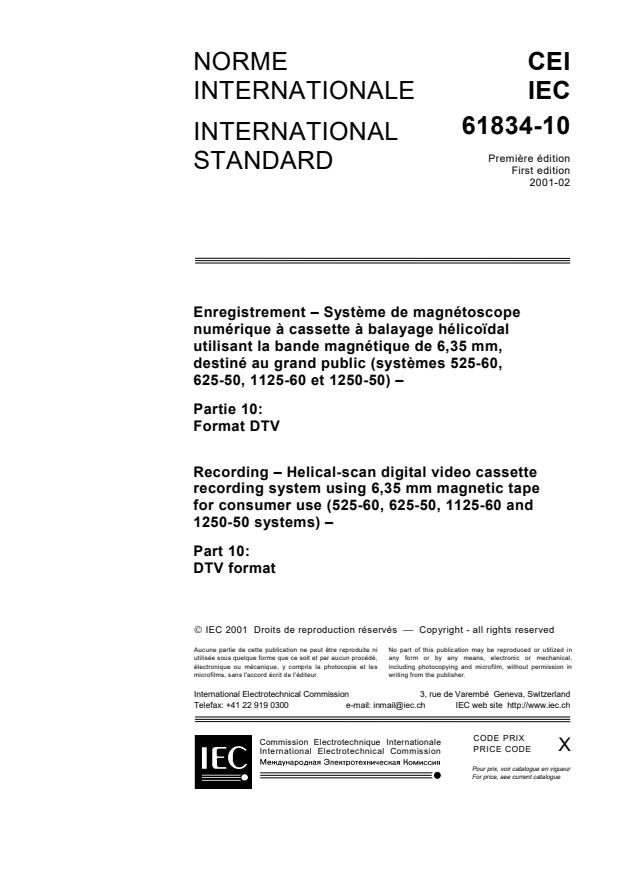
NORME CEI
INTERNATIONALE IEC
61834-10
INTERNATIONAL
Première édition
STANDARD
First edition
2001-02
Enregistrement – Système de magnétoscope
numérique à cassette à balayage hélicoïdal
utilisant la bande magnétique de 6,35 mm,
destiné au grand public (systèmes 525-60,
625-50, 1125-60 et 1250-50) –
Partie 10:
Format DTV
Recording – Helical-scan digital video cassette
recording system using 6,35 mm magnetic tape
for consumer use (525-60, 625-50, 1125-60 and
1250-50 systems) –
Part 10:
DTV format
Numéro de référence
Reference number
CEI/IEC 61834-10:2001
Numérotation des publications Publication numbering
Depuis le 1er janvier 1997, les publications de la CEI As from 1 January 1997 all IEC publications are
sont numérotées à partir de 60000. Ainsi, la CEI 34-1 issued with a designation in the 60000 series. For
devient la CEI 60034-1. example, IEC 34-1 is now referred to as IEC 60034-1.
Editions consolidées Consolidated editions
Les versions consolidées de certaines publications de la The IEC is now publishing consolidated versions of its
CEI incorporant les amendements sont disponibles. Par publications. For example, edition numbers 1.0, 1.1
exemple, les numéros d’édition 1.0, 1.1 et 1.2 indiquent and 1.2 refer, respectively, to the base publication,
respectivement la publication de base, la publication de the base publication incorporating amendment 1 and
base incorporant l’amendement 1, et la publication de the base publication incorporating amendments 1
base incorporant les amendements 1 et 2. and 2.
Informations supplémentaires Further information on IEC publications
sur les publications de la CEI
Le contenu technique des publications de la CEI est The technical content of IEC publications is kept
constamment revu par la CEI afin qu'il reflète l'état under constant review by the IEC, thus ensuring that
actuel de la technique. Des renseignements relatifs à the content reflects current technology. Information
cette publication, y compris sa validité, sont dispo- relating to this publication, including its validity, is
nibles dans le Catalogue des publications de la CEI available in the IEC Catalogue of publications
(voir ci-dessous) en plus des nouvelles éditions, (see below) in addition to new editions, amendments
amendements et corrigenda. Des informations sur les and corrigenda. Information on the subjects under
sujets à l’étude et l’avancement des travaux entrepris consideration and work in progress undertaken by the
par le comité d’études qui a élaboré cette publication, technical committee which has prepared this
ainsi que la liste des publications parues, sont publication, as well as the list of publications issued,
également disponibles par l’intermédiaire de: is also available from the following:
• Site web de la CEI (www.iec.ch) • IEC Web Site (www.iec.ch)
• Catalogue des publications de la CEI • Catalogue of IEC publications
Le catalogue en ligne sur le site web de la CEI The on-line catalogue on the IEC web site
(www.iec.ch/catlg-f.htm) vous permet de faire des (www.iec.ch/catlg-e.htm) enables you to search
recherches en utilisant de nombreux critères, by a variety of criteria including text searches,
comprenant des recherches textuelles, par comité technical committees and date of publication. On-
d’études ou date de publication. Des informations line information is also available on recently
en ligne sont également disponibles sur les issued publications, withdrawn and replaced
nouvelles publications, les publications rempla- publications, as well as corrigenda.
cées ou retirées, ainsi que sur les corrigenda.
• IEC Just Published
• IEC Just Published
Ce résumé des dernières publications parues
This summary of recently issued publications
(www.iec.ch/JP.htm) est aussi disponible par
(www.iec.ch/JP.htm) is also available by email.
courrier électronique. Veuillez prendre contact
Please contact the Customer Service Centre (see
avec le Service client (voir ci-dessous) pour plus
below) for further information.
d’informations.
• Service clients
• Customer Service Centre
Si vous avez des questions au sujet de cette
If you have any questions regarding this
publication ou avez besoin de renseignements
publication or need further assistance, please
supplémentaires, prenez contact avec le Service
contact the Customer Service Centre:
clients:
Email: custserv@iec.ch
Email: custserv@iec.ch
Tél: +41 22 919 02 11
Tel: +41 22 919 02 11
Fax: +41 22 919 03 00
Fax: +41 22 919 03 00
.
NORME CEI
INTERNATIONALE IEC
61834-10
INTERNATIONAL
Première édition
STANDARD
First edition
2001-02
Enregistrement – Système de magnétoscope
numérique à cassette à balayage hélicoïdal
utilisant la bande magnétique de 6,35 mm,
destiné au grand public (systèmes 525-60,
625-50, 1125-60 et 1250-50) –
Partie 10:
Format DTV
Recording – Helical-scan digital video cassette
recording system using 6,35 mm magnetic tape
for consumer use (525-60, 625-50, 1125-60 and
1250-50 systems) –
Part 10:
DTV format
IEC 2001 Droits de reproduction réservés Copyright - all rights reserved
Aucune partie de cette publication ne peut être reproduite ni No part of this publication may be reproduced or utilized in
utilisée sous quelque forme que ce soit et par aucun procédé, any form or by any means, electronic or mechanical,
électronique ou mécanique, y compris la photocopie et les including photocopying and microfilm, without permission in
microfilms, sans l'accord écrit de l'éditeur. writing from the publisher.
International Electrotechnical Commission 3, rue de Varembé Geneva, Switzerland
Telefax: +41 22 919 0300 e-mail: inmail@iec.ch IEC web site http://www.iec.ch
CODE PRIX
Commission Electrotechnique Internationale
X
PRICE CODE
International Electrotechnical Commission
Pour prix, voir catalogue en vigueur
For price, see current catalogue
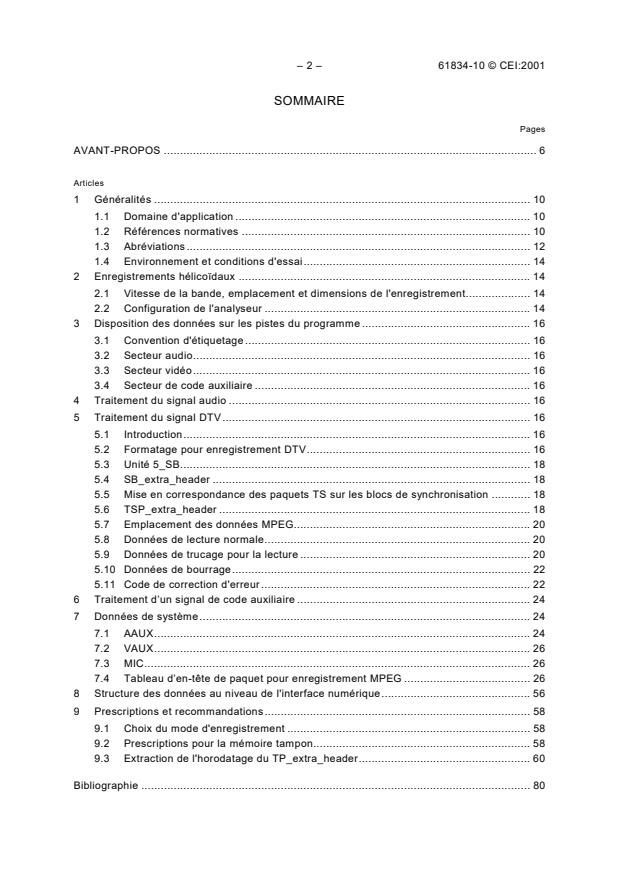
– 2 – 61834-10 © CEI:2001
SOMMAIRE
Pages
AVANT-PROPOS . 6
Articles
1 Généralités .10
1.1 Domaine d'application . 10
1.2 Références normatives . 10
1.3 Abréviations . 12
1.4 Environnement et conditions d'essai. 14
2 Enregistrements hélicoïdaux . 14
2.1 Vitesse de la bande, emplacement et dimensions de l'enregistrement. 14
2.2 Configuration de l'analyseur . 14
3 Disposition des données sur les pistes du programme . 16
3.1 Convention d'étiquetage . 16
3.2 Secteur audio. 16
3.3 Secteur vidéo. 16
3.4 Secteur de code auxiliaire . 16
4 Traitement du signal audio . 16
5 Traitement du signal DTV. 16
5.1 Introduction. 16
5.2 Formatage pour enregistrement DTV. 16
5.3 Unité 5_SB. 18
5.4 SB_extra_header . 18
5.5 Mise en correspondance des paquets TS sur les blocs de synchronisation . 18
5.6 TSP_extra_header . 18
5.7 Emplacement des données MPEG. 20
5.8 Données de lecture normale. 20
5.9 Données de trucage pour la lecture . 20
5.10 Données de bourrage. 22
5.11 Code de correction d'erreur . 22
6 Traitement d’un signal de code auxiliaire . 24
7 Données de système. 24
7.1 AAUX. 24
7.2 VAUX. 26
7.3 MIC. 26
7.4 Tableau d’en-tête de paquet pour enregistrement MPEG . 26
8 Structure des données au niveau de l'interface numérique. 56
9 Prescriptions et recommandations. 58
9.1 Choix du mode d'enregistrement . 58
9.2 Prescriptions pour la mémoire tampon. 58
9.3 Extraction de l'horodatage du TP_extra_header. 60
Bibliographie . 80
61834-10 © IEC:2001 – 3 –
CONTENTS
Page
FOREWORD . 7
Clause
1 General. 11
1.1 Scope . 11
1.2 Normative references. 11
1.3 Abbreviations . 13
1.4 Environment and test conditions. 15
2 Helical recordings . 15
2.1 Tape speed, recording location and dimensions. 15
2.2 Scanner configuration . 15
3 Programme track data arrangement . 17
3.1 Labelling convention. 17
3.2 Audio sector. 17
3.3 Video sector. 17
3.4 Subcode sector . 17
4 Audio signal processing. 17
5 DTV signal processing. 17
5.1 Introduction. 17
5.2 Formatting for DTV recording . 17
5.3 5_SB unit . 19
5.4 SB_extra_header . 19
5.5 Mapping TS packets onto sync blocks . 19
5.6 TSP_extra_header . 19
5.7 Location of MPEG data . 21
5.8 Normal play data. 21
5.9 Trick play data . 21
5.10 Stuffing data . 23
5.11 Error correction code. 23
6 Subcode signal processing. 25
7 System data . 25
7.1 AAUX. 25
7.2 VAUX. 27
7.3 MIC. 27
7.4 Pack header table for MPEG recording. 27
8 Data structure at digital interface . 57
9 Requirements and recommendations. 59
9.1 Selecting the recording mode . 59
9.2 Buffer requirements . 59
9.3 Deriving the timestamp from the TP_extra_header . 61
Bibliography . 81
– 4 – 61834-10 © CEI:2001
Pages
Figure 1 – SB_extra_header . 62
Figure 2 – Contenu du SB_extra_header. 64
Figure 3 – Unité 5_SB. 64
Figure 4 – TSP_extra_header . 66
Figure 5 – Format de piste de modes d'enregistrement 25/12,5/6,25 Mbps. 66
Figure 6 – Zones de données de trucage pour la lecture et le cycle de répétition . 68
Figure 7 – Bourrage en unités 5_SB. 70
Figure 8 – Bourrage du second paquet TS en unités 5_SB . 70
Figure 9 – Insertion d'un paquet TS nul. 70
Figure 10 – Bourrage dans le paquet TS . 70
Figure 11 – Mot de code ECC3 . 72
Figure 12 – Entrelacement sur une base de 10 pistes (bloc ECC3). 72
Figure 13 – Zone principale de VAUX . 74
Figure 14 – Schéma de bloc simplifié de la situation d'enregistrement. 76
Figure 15 – Schéma de bloc simplifié de la situation de lecture . 78
Figure 16 – Exemple de retard total constant . 78
Tableau 1 – Vitesse de la bande et angle de piste pour chaque mode d'enregistrement. 62
Tableau 2 – Configuration d'analyseur pour magnétoscope multi-modes . 62
Tableau 3 – ID d'application de la zone vidéo. 62
Tableau 4 – Relation entre le nombre de répétitions, les vitesses de recherche possibles
et les débits binaires maximaux . 68
Tableau 5 – Nombre de répétitions des données de trucage en lecture . 68
Tableau 6 – Durée des drapeaux de code auxiliaire . 72
Tableau 7 – Durée du paquet de commande de source MPEG . 74
Tableau 8 – Points de commutation recommandés pour le choix du mode d'enregistrement . 76
Tableau 9 – Débit binaire maximal NP pour différents modes d'enregistrement . 76
61834-10 © IEC:2001 – 5 –
Page
Figure 1 – SB_extra_header . 63
Figure 2 – Content of SB_extra_header . 65
Figure 3 – 5_SB unit . 65
Figure 4 – TSP_extra_header . 67
Figure 5 – Track format of 25/12,5/6,25 Mbps recording modes . 67
Figure 6 – Trick play data areas and repetition cycle . 69
Figure 7 – Stuffing in 5_SB units. 71
Figure 8 – Stuffing the second TS packet in 5_SB units . 71
Figure 9 – Insertion of null TS packet. 71
Figure 10 – Stuffing in the TS packet . 71
Figure 11 – ECC3 code word . 73
Figure 12 – Interleaving on a 10-track basis (ECC3 block) . 73
Figure 13 – Main area of VAUX. 75
Figure 14 – Simplified block diagram of record situation. 77
Figure 15 – Simplified block diagram of playback situation . 79
Figure 16 – Example of constant overall delay . 79
Table 1 – Tape speed and track angle for each recording mode . 63
Table 2 – Scanner configuration for multi-mode recorder . 63
Table 3 – Application ID of video area. 63
Table 4 – Relationship between number of repetitions, possible search speeds and
maximum bit rate. 69
Table 5 – Number of repetitions of trick play data. 69
Table 6 – Duration of subcode flags. 73
Table 7 – Duration of MPEG Source Control Pack. 75
Table 8 – Recommended switching points for selection of recording mode . 77
Table 9 – Maximum NP bit rates for different recording modes. 77
– 6 – 61834-10 © CEI:2001
COMMISSION ÉLECTROTECHNIQUE INTERNATIONALE
____________
ENREGISTREMENT –
SYSTÈME DE MAGNÉTOSCOPE NUMÉRIQUE À CASSETTE À BALAYAGE
HÉLICOÏDAL UTILISANT LA BANDE MAGNÉTIQUE DE 6,35 mm,
DESTINÉ AU GRAND PUBLIC
(systèmes 525-60, 625-50, 1125-60 et 1250-50) –
Partie 10: Format DTV
AVANT-PROPOS
1) La CEI (Commission Électrotechnique Internationale) est une organisation mondiale de normalisation composée
de l'ensemble des comités électrotechniques nationaux (Comités nationaux de la CEI). La CEI a pour objet de
favoriser la coopération internationale pour toutes les questions de normalisation dans les domaines de
l'électricité et de l'électronique. A cet effet, la CEI, entre autres activités, publie des Normes internationales.
Leur élaboration est confiée à des comités d'études, aux travaux desquels tout Comité national intéressé par le
sujet traité peut participer. Les organisations internationales, gouvernementales et non gouvernementales, en
liaison avec la CEI, participent également aux travaux. La CEI collabore étroitement avec l'Organisation
Internationale de Normalisation (ISO), selon des conditions fixées par accord entre les deux organisations.
2) Les décisions ou accords officiels de la CEI concernant les questions techniques représentent, dans la mesure
du possible, un accord international sur les sujets étudiés, étant donné que les Comités nationaux intéressés
sont représentés dans chaque comité d’études.
3) Les documents produits se présentent sous la forme de recommandations internationales. Ils sont publiés
comme normes, spécifications techniques, rapports techniques ou guides et agréés comme tels par les Comités
nationaux.
4) Dans le but d'encourager l'unification internationale, les Comités nationaux de la CEI s'engagent à appliquer de
façon transparente, dans toute la mesure possible, les Normes internationales de la CEI dans leurs normes
nationales et régionales. Toute divergence entre la norme de la CEI et la norme nationale ou régionale
correspondante doit être indiquée en termes clairs dans cette dernière.
5) La CEI n’a fixé aucune procédure concernant le marquage comme indication d’approbation et sa responsabilité
n’est pas engagée quand un matériel est déclaré conforme à l’une de ses normes.
6) L’attention est attirée sur le fait que certains des éléments de la présente Norme internationale peuvent faire
l’objet de droits de propriété intellectuelle ou de droits analogues. La CEI ne saurait être tenue pour
responsable de ne pas avoir identifié de tels droits de propriété et de ne pas avoir signalé leur existence.
La Norme internationale CEI 61834-10 a été établie par le sous-comité 100B: Systèmes de
stockage d'informations multimédia, vidéo et audio, du comité d'études 100 de la CEI:
Systèmes et appareils audio, vidéo et multimédia.
Le texte de cette norme est issu des documents suivants:
FDIS Rapport de vote
100B/282/FDIS 100B/288/RVD
Le rapport de vote indiqué dans le tableau ci-dessus donne toute information sur le vote ayant
abouti à l'approbation de cette norme.
Cette publication a été rédigée selon les Directives ISO/CEI, Partie 3.
Le contenu du corrigendum de juin 2001 a été pris en considération dans cet exemplaire.
61834-10 © IEC:2001 – 7 –
INTERNATIONAL ELECTROTECHNICAL COMMISSION
____________
RECORDING –
HELICAL-SCAN DIGITAL VIDEO CASSETTE RECORDING
SYSTEM USING 6,35 mm MAGNETIC TAPE FOR CONSUMER USE
(525-60, 625-50, 1125-60 and 1250-50 systems) –
Part 10: DTV format
FOREWORD
1) The IEC (International Electrotechnical Commission) is a worldwide organization for standardization comprising
all national electrotechnical committees (IEC National Committees). The object of the IEC is to promote
international co-operation on all questions concerning standardization in the electrical and electronic fields. To
this end and in addition to other activities, the IEC publishes International Standards. Their preparation is
entrusted to technical committees; any IEC National Committee interested in the subject dealt with may
participate in this preparatory work. International, governmental and non-governmental organizations liaising
with the IEC also participate in this preparation. The IEC collaborates closely with the International Organization
for Standardization (ISO) in accordance with conditions determined by agreement between the two
organizations.
2) The formal decisions or agreements of the IEC on technical matters express, as nearly as possible, an
international consensus of opinion on the relevant subjects since each technical committee has representation
from all interested National Committees.
3) The documents produced have the form of recommendations for international use and are published in the form
of standards, technical specifications, technical reports or guides and they are accepted by the National
Committees in that sense.
4) In order to promote international unification, IEC National Committees undertake to apply IEC International
Standards transparently to the maximum extent possible in their national and regional standards. Any
divergence between the IEC Standard and the corresponding national or regional standard shall be clearly
indicated in the latter.
5) The IEC provides no marking procedure to indicate its approval and cannot be rendered responsible for any
equipment declared to be in conformity with one of its standards.
6) Attention is drawn to the possibility that some of the elements of this International Standard may be the subject
of patent rights. The IEC shall not be held responsible for identifying any or all such patent rights.
International Standard IEC 61834-10 has been prepared by subcommittee 100B: Audio, video
and multimedia information storage systems, of IEC technical committee 100: Audio, video and
multimedia systems and equipment.
The text of this standard is based on the following documents:
FDIS Report on voting
100B/282/FDIS 100B/288/RVD
Full information on the voting for the approval of this standard can be found in the report on
voting indicated in the above table.
This publication has been drafted in accordance with the ISO/IEC Directives, Part 3.
The contents of the corrigendum of June 2001 have been included in this copy.
– 8 – 61834-10 © CEI:2001
La CEI 61834 est constituée des parties suivantes, présentées sous le titre général Enregis-
trement – Système de magnétoscope numérique à cassette à balayage hélicoïdal utilisant
la bande magnétique de 6,35 mm, destiné au grand public (systèmes 525-60, 625-50, 1125-60
et 1250-50):
– Partie 1: Spécifications générales;
– Partie 2: Format SD pour les systèmes 525-60 et 625-50;
– Partie 3: Format HD pour les systèmes 1125-60 et 1250-50;
– Partie 4: Tableaux des paquets en-tête et leur contenu;
– Partie 5: Système à caractères d'information;
– Partie 6: Format SDL;
– Partie 7: Format EDTV2;
– Partie 8: Format PALplus pour système 625-50;
– Partie 9: Format DVB;
– Partie 10: Format DTV.
La présente norme est la partie 10 de la CEI 61834 et décrit les spécifications pour une mise
en œuvre étendue du format SD, impliquant le codage et l’enregistrement d’une suite
d'éléments binaires DTV.
La partie 1 décrit les spécifications communes à toutes les versions du système de
magnétoscope numérique à cassette à balayage hélicoïdal, y compris cassettes, méthode
d'enregistrement hélicoïdal, méthode de modulation, magnétisation et données de base du
système.
La partie 2 décrit les spécifications pour les systèmes 525-60 et 625-50 qui ne sont pas
contenues dans la partie 1.
La partie 3 décrit les spécifications pour les systèmes 1125-60 et 1250-50 qui ne sont pas
contenues dans les parties 1 et 2.
La partie 4 décrit les tableaux des paquets en-tête et le contenu des paquets s'appliquant à
toutes les versions de systèmes de magnétoscope numérique à cassette à balayage hélicoïdal.
La partie 5 décrit la structure des jeux de caractères applicable à toutes les versions de
systèmes de magnétoscope numérique à cassette à balayage hélicoïdal.
La partie 6 décrit les spécifications pour une variante du format SD utilisant le taux de
compression double de la normale, qui ne sont pas contenues dans la partie 2.
La partie 7 décrit les spécifications pour l’extension d’une mise en œuvre du format SD,
pouvant enregistrer un signal EDTV2.
La partie 8 décrit les spécifications pour l’extension d’une mise en œuvre du format SD,
pouvant enregistrer un signal TVPAL plus.
La partie 9 décrit les spécifications pour l’extension d’une mise en œuvre du format SD,
pouvant coder et enregistrer une suite d'éléments binaires DVB.
Il est recommandé aux fabricants intéressés par la production de systèmes de magnétoscopes
numériques à cassette DTV de se reporter aux parties 1, 2, 4, 5 et 10.
Le comité a décidé que le contenu de cette publication ne sera pas modifié avant 2008. A cette
date, la publication sera
reconduite;
supprimée;
remplacée par une édition révisée, ou
amendée.
61834-10 © IEC:2001 – 9 –
IEC 61834 consists of the following parts, under the general title Recording – Helical-scan
digital video cassette recording system using 6,35 mm magnetic tape for consumer use
(525-60, 625-50, 1125-60 and 1250-50 systems):
– Part 1: General specifications;
– Part 2: SD format for 525-60 and 625-50 systems;
– Part 3: HD format for 1125-60 and 1250-50 systems;
– Part 4: Pack header table and contents;
– Part 5: The character information system;
– Part 6: SDL format;
– Part 7: EDTV2 format;
– Part 8: PALplus format for 625-50 system;
– Part 9: DVB format;
– Part 10: DTV format.
This standard is part 10 of IEC 61834 and contains the specifications for an extended
application of the SD format involving the coding and recording of the DTV bit stream.
Part 1 describes specifications which are common to all versions of the helical-scan digital
video cassette recording system, including cassettes, helical recording method, modulation
method, magnetization and basic system data.
Part 2 describes specifications for 525-60 and 625-50 systems not included in part 1.
Part 3 describes specifications for 1125-60 and 1250-50 systems not included in parts 1 and 2.
Part 4 describes the pack header table and the contents of packs which are applicable to all
versions of the helical-scan digital video cassette system.
Part 5 describes the character information system which is applicable to all versions of the
helical-scan digital video cassette system.
Part 6 describes the specifications for a variant of the SD format using twice the normal
compression ratio, which are not included in part 2.
Part 7 describes the specifications for an extended implementation of the SD format capable of
recording an EDTV2 signal.
Part 8 describes the specifications for an extended implementation of the SD format capable of
recording a PALplus TV signal.
Part 9 describes the specifications for an extended implementation of the SD format capable of
coding and recording a DVB bit stream.
Those interested in the manufacture of DTV digital video cassette recording systems are
advised to refer to parts 1, 2, 4, 5, and 10.
The committee has decided that the contents of this publication will remain unchanged
until 2008. At this date, the publication will be
reconfirmed;
withdrawn;
replaced by a revised edition, or
amended.
– 10 – 61834-10 © CEI:2001
ENREGISTREMENT –
SYSTÈME DE MAGNÉTOSCOPE NUMÉRIQUE À CASSETTE À BALAYAGE
HÉLICOÏDAL UTILISANT LA BANDE MAGNÉTIQUE DE 6,35 mm,
DESTINÉ AU GRAND PUBLIC
(systèmes 525-60, 625-50, 1125-60 et 1250-50) –
Partie 10: Format DTV
1 Généralités
1.1 Domaine d'application
La présente partie de la CEI 61834 spécifie le contenu, le format et la méthode
d'enregistrement des blocs de données formant les enregistrements à balayage hélicoïdal sur
les bandes contenant des données audio, vidéo et des données système. Cette partie décrit
les spécifications pour l'enregistrement de programmes DTV individuels. Les données DTV
sont fournies au magnétoscope à cassette numérique par l'intermédiaire d'une interface
numérique ou par un récepteur intégré (IRD). Les données DTV sont composées d'une suite
de transport MPEG2 contenant un ou plusieurs programmes.
En DTV, le codage du signal vidéo est basé sur MPEG2. Un programme peut être constitué d'une
suite binaire vidéo ou de plusieurs suites binaires audio et de suites binaires de données.
Compte tenu des différents débits binaires des programmes DTV individuels, plusieurs modes
d'enregistrement sont spécifiés afin d’utiliser de manière efficace la capacité de stockage du
magnétoscope numérique à cassette.
En plus de la suite de données en lecture normale de l'enregistrement DTV, une ou deux
suites de données spéciales de trucage pour la lecture peuvent, éventuellement, être produites
et enregistrées dans la zone vidéo.
Dans la présente partie, la structure des données d'une piste est définie par APT = 000b qui
comprend quatre zones conformes à la description du 4.3.2 de la CEI 61834-1, et AP1 = AP3
= 000b. La structure des données de MIC est la même que celle de l'article 10 de la
CEI 61834-2.
1.2 Références normatives
Les documents normatifs suivants contiennent des dispositions qui, par suite de la référence
qui y est faite, constituent des dispositions valables pour la présente partie de la CEI 61834.
Pour les références datées, les amendements ultérieurs ou les révisions de ces publications ne
s’appliquent pas. Toutefois, les parties prenantes aux accords fondés sur la présente partie de
la CEI 61834 sont invitées à rechercher la possibilité d'appliquer les éditions les plus récentes
des documents normatifs indiqués ci-après. Pour les références non datées, la dernière édition
du document normatif en référence s’applique. Les membres de la CEI et de l'ISO possèdent
le registre des Normes internationales en vigueur.
CEI 61834-1:1998, Enregistrement – Système de magnétoscope numérique à cassette à
balayage hélicoïdal utilisant la bande magnétique de 6,35 mm, destiné au grand public
(systèmes 525-60, 625-50, 1125-60 et 1250-50) – Partie 1: Spécifications générales
Amendement 1
61834-10 © IEC:2001 – 11 –
RECORDING –
HELICAL-SCAN DIGITAL VIDEO CASSETTE RECORDING
SYSTEM USING 6,35 mm MAGNETIC TAPE FOR CONSUMER USE
(525-60, 625-50, 1125-60 and 1250-50 systems) –
Part 10: DTV format
1 General
1.1 Scope
This part of IEC 61834 specifies the content, format and recording method for the data blocks
forming the helical records on the tape containing audio, video and system data. This part
describes the specifications for the recording of single DTV programmes. The DTV data is
delivered to the digital video cassette recorder via a digital interface or by a built-in tuner (IRD).
The DTV data consists of an MPEG2 transport stream containing one or more programmes.
In DTV, video signal coding is based on MPEG2. One programme may consist of one video bit
stream or several audio bit streams and data bit streams.
Due to the varied bit rates of single DTV programmes, several recording modes are specified
in order to make efficient use of the storage capacity of the digital video cassette recorder.
In addition to the normal play data stream of DTV recording, one or two special trick play data
streams may optionally be generated and recorded in the video area.
In this part, the data structure of a track is defined by APT = 000b which consists of four areas
as described in 4.3.2 of IEC 61834-1 and AP1 = AP3 = 000b. The data structure of MIC is the
same as in clause 10 of IEC 61834-2.
1.2 Normative references
The following normative documents contain provisions which, through reference in this text,
constitute provisions of this part of IEC 61834. For dated references, subsequent amendments
to, or revisions of, any of these publications do not apply. However, parties to agreements
based on this part of IEC 61834 are encouraged to investigate the possibility of applying the
most recent editions of the normative documents indicated below. For undated references, the
latest edition of the normative document referred to applies. Members of IEC and ISO maintain
registers of currently valid International Standards.
IEC 61834-1:1998, Recording – Helical-scan digital video cassette recording system using
6,35 mm magnetic tape for consumer use (525-60, 625-50, 1125-60 and 1250-50 systems) –
Part 1: General specifications
Amendment 1
– 12 – 61834-10 © CEI:2001
CEI 61834-2:1998, Enregistrement – Système de magnétoscope numérique à cassette à
balayage hélicoïdal utilisant la bande magnétique de 6,35 mm, destiné au grand public
(systèmes 525-60, 625-50, 1125-60 et 1250-50) – Partie 2: Format SD pour les systèmes
525-60 et 625-50
CEI 61834-4:1998, Enregistrement – Système d'enregistrement grand public vidéo à cassette à
défilement hélicoïdal pour bande magnétique de 6,35 mm (systèmes 525-60, 625-50, 1125-60
et 1250-50) – Partie 4: Tableaux des paquets en-tête et leur contenu
CEI 61834-6, Enregistrement – Système d'enregistrement grand public vidéo à cassette à
défilement hélicoïdal pour bande magnétique de 6,35 mm (systèmes 525-60, 625-50, 1125-60
1)
et 1250-50) – Partie 6: Format SDL
CEI 61883-1:1998, Matériel audio/vidéo grand public – Interface numérique – Partie 1:
Généralités
CEI 61883-4:1998, Matériel audio/vidéo grand public – Interface numérique – Partie 4: Trans-
mission de données MPEG2-TS
ETS 300 468:1998, Spécification pour Information de Service (SI) dans les systèmes DVB
EBU SPB 492:1992, Spécifications du télétexte
1.3 Abréviations
Pour les besoins de la présente partie de la CEI 61834, les abréviations suivantes s'appliquent.
AAUX: Données auxiliaires audio
Code BCH: Code Base-Chaudhuiri-Hocquenghem, un des codes de corrections d’erreurs bien
connu
CGMS: Système de gestion de génération de copies
DTV: Télévision numérique (transmission MPEG aux USA) (différent de ATV)
DVB: Radiodiffusion vidéo numérique (utilisé pour l'organisation et le signal)
DVCR: Magnétoscope numérique à cassette
DCT Transformé de cosinus discret
ECC: Code de correction d'erreur
ECC1: Correction d'erreur interne (à l'intérieur du SB)
ECC2: Correction d'erreur externe (à l'intérieur d'une piste)
ECC3: Correction d'erreur externe extra (plusieurs pistes)
EIT: Tableau d'Information d'événement
FEC: Correction d'erreur suivante (utilisée en transmission MPEG)
GF: Champ de Galois
IRD: Décodeur récepteur intégré
MIC: Mémoire en cassette
MP@ML: Profil principal au niveau principal
MP@HL: Profil principal au niveau élevé
MPEG: Groupe d'experts cinématographiques
________
1)
A publier.
61834-10 © IEC:2001 – 13 –
IEC 61834-2:1998, Recording – Helical-scan digital video cassette recording system using
6,35 mm magnetic tape for consumer use (525-60, 625-50, 1125-60 and 1250-50 systems) –
Part 2: SD format for 525-60 and 625-50 systems
IEC 61834-4:1998, Recording – Helical-scan digital video cassette recording system using
6,35 mm magnetic tape for consumer use (525-60, 625-50, 1125-60 and 1250-50 systems) –
Part 4: Pack header table and contents
IEC 61834-6, Recording – Helical-scan digital video cassette recording system using 6,35 mm
magnetic tape for consumer use (525-60, 625-50, 1125-60 and 1250-50 systems) – Part 6:
1)
SDL format
IEC 61883-1:1998, Consumer audio/video equipment – Digital interface – Part 1: General
IEC 61883-4:1998, Consumer audio/video equipment – Digital interface – Part 4: MPEG2-TS
data transmission
ETS 300 468:1998, Specification for Service Information (SI) in DVB systems
EBU SPB 492:1992, Teletext specifications
1.3 Abbreviations
For the purposes of this part of IEC 61834, the following abbreviations apply.
AAUX: Audio auxiliary data
BCH: Base-Chaudhuri-Hocquenghem code, one of the well-known error correction codes
CGMS: Copy Generation Management System
DTV: Digital Television (MPEG transmission in USA) (differs from ATV)
DVB: Digital Video Broadcast (used for organization and the signal)
DVCR: Digital Video Cassette Recorder
DCT Discrete cosine transform
ECC: Error Correction Code
ECC1: Inner error correction (within the SB)
ECC2: Outer error correction (within one track)
ECC3: Extra outer error correction (several tracks)
EIT: Event Information Table
FEC: Forward Error Correction (used in MPEG transmission)
GF: Galois field
IRD: Integrated Receiver Decoder
MIC: Memory in Cassette
MP@ML: Main Profile at Main Level
MP@HL: Main Profile at High Level
MPEG: Motion Pictures Expert Group
NP: Normal play
________
1)
To be published.
– 14 – 61834-10 © CEI:2001
NP: Lecture normale
PAT: Tableau d'association de programmes
PCR: Référence d'horloge de programme
PID: Identification de programmes
PMT: Tableau de mise en correspondance des programmes
PSI: Information spécifique de programme
SB: Bloc de synchronisation
SD/HD: Définition standard/Haute définition (modes d'enregistrement sur DVCR)
SI: Information de service
STB: Set-Top-Box
Tp: Pas de piste
TP: Trucage pour la lecture
TPH: Vitesse de trucage élevée pour la lecture
TPL: Faible vitesse de trucage pour la lecture
TS: Suite de transport
TSH: Partie la plus significative de la valeur timestamp_counter
TSL: Partie la moins significative de la valeur timestamp_counter
TSP: Paquet de suite de transport
VAUX: Données auxiliaires vidéo
1.4 Environnement et conditions d'essai
Identiques à la CEI 61834-2.
2 Enregistrements hélicoïdaux
2.1 Vitesse de la bande, emplacement et dimensions de l'enregistrement
Un des trois modes d'enregistrement peut être utilisé. La vitesse de la bande et l'angle de piste
dépendent du mode d'enregistrement comme cela est représenté au tableau 1. La tolérance
sur la vitesse de la bande doit être inférieure à ±0,5 %. L'emplacement et les dimensions des
enregistrements continus doivent être ceux spécifiés à la figure 1 de la CEI 61834-2. Pour
l'enregistrement, les dimensions des pistes hélicoïdales doivent s'inscrire dans les tolérances
spécifiées au tableau 3 de la CEI 61834-1, sauf que, lorsque cela est applicable, les para-
mètres du tableau 1 doivent remplacer ceux du tableau 3 de la CEI 61834-1.
Chaque emplacement de secteur du début de la zone SSA doit être comme cela est spécifié à
la figure 2 de la CEI 61834-2 et au tableau 1 (système 525-60) de la CEI 61834-2. Les lignes
centrales des pistes doivent servir comme référence de position pour la spécification du
schéma sur la bande.
Les valeurs du bord supérieur de la surface réelle, la garantie d'enregistrement et de lecture, la
marge de réécriture (Om) et la marge de commutation pour les amplificateurs d'enregistrement
doivent être les mêmes que dans la CEI 61834-2.
2.2 Configuration de l'analyseur
Si le magnétoscope accepte plus d'un mode d'enregistrement, la configuration de l'analyseur
doit être utilisée comme cela es
...