

IEC 60335-2-14:2016
(Main)Household and similar electrical appliances - Safety - Part 2-14: Particular requirements for kitchen machines
General Information
- Abstract
IEC 60335-2-14:2016 deals with the safety of electric kitchen machines for household and similar purposes, their rated voltage being not more than 250 V. See the scope of 60335-2-14 for a list of appliances that are within the scope of this standard. Appliances intended for normal household and similar use and that may also be used by laymen in shops, in light industry and on farms, are within the scope of this standard. However, if the appliance is intended to be used professionally to process food for commercial consumption, the appliance is not considered to be for household and similar use only. As far as is practicable, this standard deals with the common hazards presented by appliances which are encountered by all persons in and around the home. However, in general, it does not take into account persons (including children) whose physical, sensory or mental capabilities; or lack of experience and knowledge prevents them from using the appliance safely without supervision or instruction; children playing with the appliance. This standard does not apply to
- slicing machines having a circular knife the blade of which is inclined at an angle exceeding 45° to the vertical;
- food waste disposers;
- ice-cream appliances with incorporated motor compressors kitchen machines intended for commercial purposes;
- kitchen machines intended for industrial purposes;
- kitchen machines intended to be used in locations where special conditions prevail, such as the presence of a corrosive or explosive atmosphere (dust, vapour or gas). This sixth edition cancels and replaces the fifth edition published in 2006 including its Amendment 1 (2008) and its Amendment 2 (2012). This edition constitutes a technical revision. The principal changes in this edition as compared with the fifth edition of IEC 60335-2-14 are as follows (minor changes are not listed):
- requirements for noodle makers with a mixing function have been introduced (3.1.9.116, 11.7.118, 19.103);
- requirements for appliances having a feed screw or auger have been changed (20.106);
- the definition of normal operation has been changed (3.1.9);
- the method of carrying out the heating test has been changed (11.7);
- the requirement in 20.114 has been modified to align with the test specification;
- some notes in Subclauses 5.2, 11.7.107, 11.7.110, 11.7.116, 20.103, 20.107, 20.108, 20.117, 20.119, 25.14, and Annex AA were converted to normative text. This part 2 is to be used in conjunction with the latest edition of IEC 60335-1 and its amendments. It was established on the basis of the fifth edition (2010) of that standard. The attention of National Committees is drawn to the fact that equipment manufacturers and testing organizations may need a transitional period following publication of a new, amended or revised IEC publication in which to make products in accordance with the new requirements and to equip themselves for conducting new or revised tests. It is the recommendation of the committee that the content of this publication be adopted for implementation nationally not earlier than 12 months or later than 36 months from the date of its publication.
Key words: Appliances, Kitchen machines
- Status
- Published
- Publication Date
- 26-Mar-2019
- Technical Committee
- TC 61 - Safety of household and similar electrical appliances
- Current Stage
- DELPUB - Deleted Publication
- Start Date
- 07-Feb-2025
- Completion Date
- 02-Dec-2022
Buy Documents
IEC 60335-2-14:2016 RLV - Household and similar electrical appliances - Safety - Part 2-14: Particular requirements for kitchen machines Released:6/24/2016
IEC 60335-2-14:2016 - Household and similar electrical appliances - Safety - Part 2-14: Particular requirements for kitchen machines Released:6/24/2016

IEC 60335-2-14:2016+AMD1:2019 CSV - Household and similar electrical appliances - Safety - Part 2-14: Particular requirements for kitchen machines Released:3/27/2019
Overview
IEC 60335-2-14:2016 is the International Electrotechnical Commission (IEC) standard that specifies safety requirements for electric kitchen machines for household and similar purposes. The standard ensures that kitchen machines with rated voltages up to 250 V are safe for use in homes, small shops, light industry, and farms. It addresses common hazards associated with typical kitchen appliances encountered in domestic and similar settings, providing a globally recognized benchmark for both manufacturers and testing organizations.
This standard is part of the IEC 60335 series on household electrical appliance safety and is intended for use in conjunction with IEC 60335-1, General Requirements. The latest edition includes significant technical updates to address safety for new appliance types and usage scenarios.
Key Topics
Scope of Application: IEC 60335-2-14 covers household kitchen machines such as blenders, food mixers, juicers, food processors, mincers, noodle makers, potato peelers, shredders, and similar devices. It explicitly excludes industrial and commercial kitchen machines, food waste disposers, and certain specialized appliances.
Safety Provisions: The standard establishes requirements to protect users from electrical, mechanical, thermal, fire, and radiation hazards. It considers normal and reasonably foreseeable abnormal use, and includes provisions for mechanical strength, protection against electric shock, and safe construction.
Marking and Instructions: Manufacturers must provide clear markings for rated power input and clear user instructions, specifically including operating times, safe use of accessories, and safety warnings for sharp components and hot liquids.
Testing and Compliance: IEC 60335-2-14 outlines procedures for product testing, including methods for heating, overload protection, leakage current, and endurance. National authorities may require additional tests depending on local regulations.
Recent Updates: The 2016 edition introduces requirements for noodle makers, updates handling of appliances with feed screws or augers, revises the definition of normal operation, changes heating test methods, and upgrades several notes to normative requirements.
Applications
IEC 60335-2-14 is widely utilized by:
- Appliance Manufacturers: To design and produce safe kitchen machines compliant with international safety benchmarks, ensuring broader market access and lower risk of product recalls.
- Testing and Certification Bodies: As a basis for conformity assessments, certification, and regulatory approval of appliances before reaching consumers.
- Regulators and Importers: To verify that kitchen machines meet essential safety requirements for entry into national or regional markets.
- Retailers and Distributors: To ensure due diligence in product sourcing and to minimize liability associated with unsafe appliances.
Typical Appliances Covered
- Blenders and liquidizers
- Food processors
- Mixers and choppers
- Centrifugal and citrus juicers
- Electric knives and sharpeners
- Graters, shredders, and slicers
- Mincers and noodle makers
- Potato peelers
Appliances intended for professional, industrial, or hazardous locations (e.g., environments with explosive atmospheres) are outside the scope.
Related Standards
For complete compliance and broader context, reference the following related standards:
- IEC 60335-1: Safety of household and similar electrical appliances - General requirements (mandatory for use with Part 2-14)
- IEC 60335-2-16: Particular requirements for food waste disposers
- IEC 60335-2-24: Particular requirements for refrigerating appliances, ice-cream appliances with incorporated motor-compressors
- IEC 60335-2-64: Particular requirements for commercial electric kitchen machines
- IEC 60811 Series: Test methods for electric and optical fibre cables (for non-metallic materials used in appliances)
Summary
IEC 60335-2-14:2016 serves as a vital international standard for the safety of electric kitchen machines in household and similar settings. By adhering to this standard, manufacturers and stakeholders can ensure product safety, enhance consumer protection, and facilitate international trade in kitchen appliances. For full compliance, use this part of IEC 60335 in conjunction with Part 1 and remain attentive to relevant national regulations and amendments.
Relations
- Effective Date
- 05-Sep-2023
- Effective Date
- 05-Sep-2023
- Effective Date
- 05-Sep-2023
- Effective Date
- 05-Sep-2023
- Effective Date
- 05-Sep-2023
Buy Documents
IEC 60335-2-14:2016 RLV - Household and similar electrical appliances - Safety - Part 2-14: Particular requirements for kitchen machines Released:6/24/2016
IEC 60335-2-14:2016 - Household and similar electrical appliances - Safety - Part 2-14: Particular requirements for kitchen machines Released:6/24/2016
IEC 60335-2-14:2016+AMD1:2019 CSV - Household and similar electrical appliances - Safety - Part 2-14: Particular requirements for kitchen machines Released:3/27/2019
Get Certified
Connect with accredited certification bodies for this standard

CIS Institut d.o.o.
Personal Protective Equipment (PPE) certification body. Notified Body NB-2890 for EU Regulation 2016/425 PPE.

Kiwa BDA Testing
Building and construction product certification.
Kmetijski inštitut Slovenije
Agricultural Institute of Slovenia. Soil testing, plant health, agricultural product analysis.
Sponsored listings
Frequently Asked Questions
IEC 60335-2-14:2016 is a standard published by the International Electrotechnical Commission (IEC). Its full title is "Household and similar electrical appliances - Safety - Part 2-14: Particular requirements for kitchen machines". This standard covers: IEC 60335-2-14:2016 deals with the safety of electric kitchen machines for household and similar purposes, their rated voltage being not more than 250 V. See the scope of 60335-2-14 for a list of appliances that are within the scope of this standard. Appliances intended for normal household and similar use and that may also be used by laymen in shops, in light industry and on farms, are within the scope of this standard. However, if the appliance is intended to be used professionally to process food for commercial consumption, the appliance is not considered to be for household and similar use only. As far as is practicable, this standard deals with the common hazards presented by appliances which are encountered by all persons in and around the home. However, in general, it does not take into account persons (including children) whose physical, sensory or mental capabilities; or lack of experience and knowledge prevents them from using the appliance safely without supervision or instruction; children playing with the appliance. This standard does not apply to - slicing machines having a circular knife the blade of which is inclined at an angle exceeding 45° to the vertical; - food waste disposers; - ice-cream appliances with incorporated motor compressors kitchen machines intended for commercial purposes; - kitchen machines intended for industrial purposes; - kitchen machines intended to be used in locations where special conditions prevail, such as the presence of a corrosive or explosive atmosphere (dust, vapour or gas). This sixth edition cancels and replaces the fifth edition published in 2006 including its Amendment 1 (2008) and its Amendment 2 (2012). This edition constitutes a technical revision. The principal changes in this edition as compared with the fifth edition of IEC 60335-2-14 are as follows (minor changes are not listed): - requirements for noodle makers with a mixing function have been introduced (3.1.9.116, 11.7.118, 19.103); - requirements for appliances having a feed screw or auger have been changed (20.106); - the definition of normal operation has been changed (3.1.9); - the method of carrying out the heating test has been changed (11.7); - the requirement in 20.114 has been modified to align with the test specification; - some notes in Subclauses 5.2, 11.7.107, 11.7.110, 11.7.116, 20.103, 20.107, 20.108, 20.117, 20.119, 25.14, and Annex AA were converted to normative text. This part 2 is to be used in conjunction with the latest edition of IEC 60335-1 and its amendments. It was established on the basis of the fifth edition (2010) of that standard. The attention of National Committees is drawn to the fact that equipment manufacturers and testing organizations may need a transitional period following publication of a new, amended or revised IEC publication in which to make products in accordance with the new requirements and to equip themselves for conducting new or revised tests. It is the recommendation of the committee that the content of this publication be adopted for implementation nationally not earlier than 12 months or later than 36 months from the date of its publication. Key words: Appliances, Kitchen machines
IEC 60335-2-14:2016 deals with the safety of electric kitchen machines for household and similar purposes, their rated voltage being not more than 250 V. See the scope of 60335-2-14 for a list of appliances that are within the scope of this standard. Appliances intended for normal household and similar use and that may also be used by laymen in shops, in light industry and on farms, are within the scope of this standard. However, if the appliance is intended to be used professionally to process food for commercial consumption, the appliance is not considered to be for household and similar use only. As far as is practicable, this standard deals with the common hazards presented by appliances which are encountered by all persons in and around the home. However, in general, it does not take into account persons (including children) whose physical, sensory or mental capabilities; or lack of experience and knowledge prevents them from using the appliance safely without supervision or instruction; children playing with the appliance. This standard does not apply to - slicing machines having a circular knife the blade of which is inclined at an angle exceeding 45° to the vertical; - food waste disposers; - ice-cream appliances with incorporated motor compressors kitchen machines intended for commercial purposes; - kitchen machines intended for industrial purposes; - kitchen machines intended to be used in locations where special conditions prevail, such as the presence of a corrosive or explosive atmosphere (dust, vapour or gas). This sixth edition cancels and replaces the fifth edition published in 2006 including its Amendment 1 (2008) and its Amendment 2 (2012). This edition constitutes a technical revision. The principal changes in this edition as compared with the fifth edition of IEC 60335-2-14 are as follows (minor changes are not listed): - requirements for noodle makers with a mixing function have been introduced (3.1.9.116, 11.7.118, 19.103); - requirements for appliances having a feed screw or auger have been changed (20.106); - the definition of normal operation has been changed (3.1.9); - the method of carrying out the heating test has been changed (11.7); - the requirement in 20.114 has been modified to align with the test specification; - some notes in Subclauses 5.2, 11.7.107, 11.7.110, 11.7.116, 20.103, 20.107, 20.108, 20.117, 20.119, 25.14, and Annex AA were converted to normative text. This part 2 is to be used in conjunction with the latest edition of IEC 60335-1 and its amendments. It was established on the basis of the fifth edition (2010) of that standard. The attention of National Committees is drawn to the fact that equipment manufacturers and testing organizations may need a transitional period following publication of a new, amended or revised IEC publication in which to make products in accordance with the new requirements and to equip themselves for conducting new or revised tests. It is the recommendation of the committee that the content of this publication be adopted for implementation nationally not earlier than 12 months or later than 36 months from the date of its publication. Key words: Appliances, Kitchen machines
IEC 60335-2-14:2016 is classified under the following ICS (International Classification for Standards) categories: 13.120 - Domestic safety; 97.040.50 - Small kitchen appliances. The ICS classification helps identify the subject area and facilitates finding related standards.
IEC 60335-2-14:2016 has the following relationships with other standards: It is inter standard links to IEC 60335-2-14:2016/AMD1:2019, IEC 60335-2-14:2006/AMD1:2008, IEC 60335-2-14:2006, IEC 60335-2-14:2025, IEC 60335-2-14:2006/AMD2:2012. Understanding these relationships helps ensure you are using the most current and applicable version of the standard.
IEC 60335-2-14:2016 is available in PDF format for immediate download after purchase. The document can be added to your cart and obtained through the secure checkout process. Digital delivery ensures instant access to the complete standard document.
Standards Content (Sample)
IEC 60335-2-14 ®
Edition 6.0 2016-06
REDLINE VERSION
INTERNATIONAL
STANDARD
colour
inside
Household and similar electrical appliances – Safety –
Part 2-14: Particular requirements for kitchen machines
All rights reserved. Unless otherwise specified, no part of this publication may be reproduced or utilized in any form
or by any means, electronic or mechanical, including photocopying and microfilm, without permission in writing from
either IEC or IEC's member National Committee in the country of the requester. If you have any questions about IEC
copyright or have an enquiry about obtaining additional rights to this publication, please contact the address below or
your local IEC member National Committee for further information.
IEC Central Office Tel.: +41 22 919 02 11
3, rue de Varembé Fax: +41 22 919 03 00
CH-1211 Geneva 20 info@iec.ch
Switzerland www.iec.ch
About the IEC
The International Electrotechnical Commission (IEC) is the leading global organization that prepares and publishes
International Standards for all electrical, electronic and related technologies.
About IEC publications
The technical content of IEC publications is kept under constant review by the IEC. Please make sure that you have the
latest edition, a corrigenda or an amendment might have been published.
IEC Catalogue - webstore.iec.ch/catalogue Electropedia - www.electropedia.org
The stand-alone application for consulting the entire The world's leading online dictionary of electronic and
bibliographical information on IEC International Standards, electrical terms containing 20 000 terms and definitions in
Technical Specifications, Technical Reports and other English and French, with equivalent terms in 15 additional
documents. Available for PC, Mac OS, Android Tablets and languages. Also known as the International Electrotechnical
iPad. Vocabulary (IEV) online.
IEC publications search - www.iec.ch/searchpub IEC Glossary - std.iec.ch/glossary
The advanced search enables to find IEC publications by a 65 000 electrotechnical terminology entries in English and
variety of criteria (reference number, text, technical French extracted from the Terms and Definitions clause of
committee,…). It also gives information on projects, replaced IEC publications issued since 2002. Some entries have been
and withdrawn publications. collected from earlier publications of IEC TC 37, 77, 86 and
CISPR.
IEC Just Published - webstore.iec.ch/justpublished
Stay up to date on all new IEC publications. Just Published IEC Customer Service Centre - webstore.iec.ch/csc
details all new publications released. Available online and If you wish to give us your feedback on this publication or
also once a month by email. need further assistance, please contact the Customer Service
Centre: csc@iec.ch.
IEC 60335-2-14 ®
Edition 6.0 2016-06
REDLINE VERSION
INTERNATIONAL
STANDARD
colour
inside
Household and similar electrical appliances – Safety –
Part 2-14: Particular requirements for kitchen machines
INTERNATIONAL
ELECTROTECHNICAL
COMMISSION
ICS 13.120; 97.040.50 ISBN 978-2-8322-4057-1
– 2 – IEC 60335-2-14:2016 RLV © IEC 2016
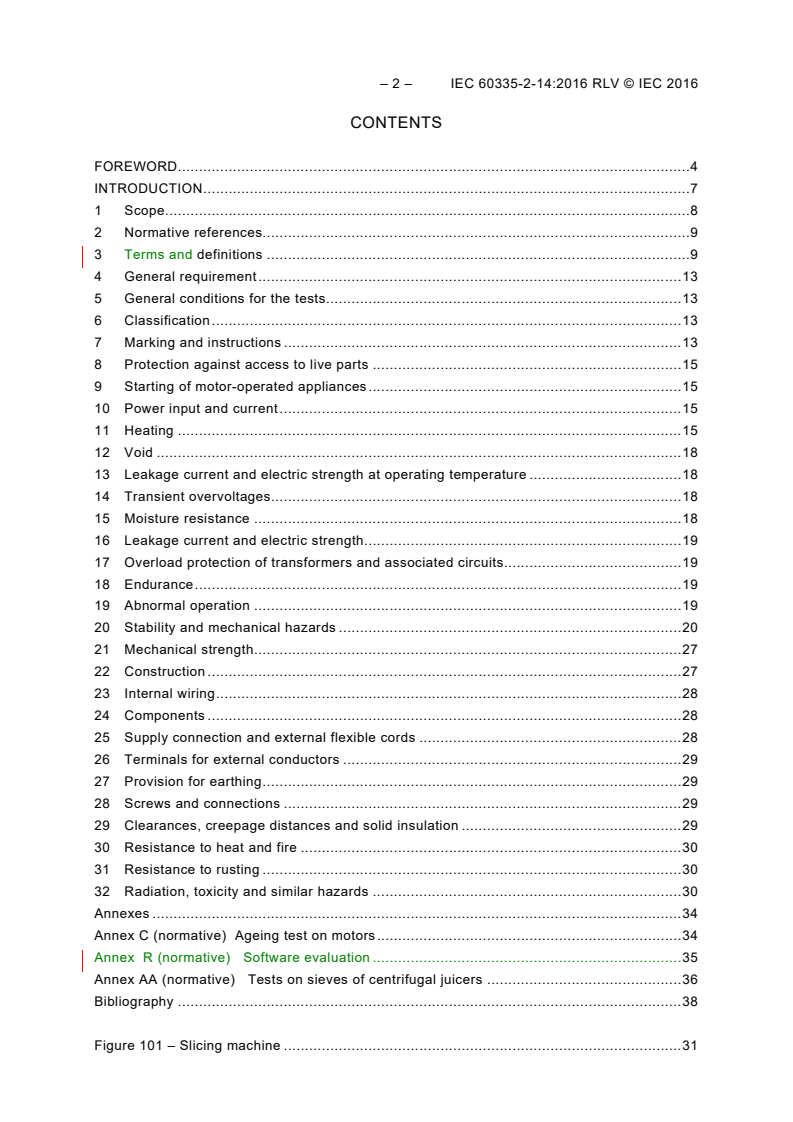
CONTENTS
FOREWORD . 4
INTRODUCTION . 7
1 Scope . 8
2 Normative references. 9
3 Terms and definitions . 9
4 General requirement . 13
5 General conditions for the tests . 13
6 Classification . 13
7 Marking and instructions . 13
8 Protection against access to live parts . 15
9 Starting of motor-operated appliances . 15
10 Power input and current . 15
11 Heating . 15
12 Void . 18
13 Leakage current and electric strength at operating temperature . 18
14 Transient overvoltages. 18
15 Moisture resistance . 18
16 Leakage current and electric strength . 19
17 Overload protection of transformers and associated circuits . 19
18 Endurance . 19
19 Abnormal operation . 19
20 Stability and mechanical hazards . 20
21 Mechanical strength . 27
22 Construction . 27
23 Internal wiring . 28
24 Components . 28
25 Supply connection and external flexible cords . 28
26 Terminals for external conductors . 29
27 Provision for earthing . 29
28 Screws and connections . 29
29 Clearances, creepage distances and solid insulation . 29
30 Resistance to heat and fire . 30
31 Resistance to rusting . 30
32 Radiation, toxicity and similar hazards . 30
Annexes . 34
Annex C (normative) Ageing test on motors . 34
Annex R (normative) Software evaluation . 35
Annex AA (normative) Tests on sieves of centrifugal juicers . 36
Bibliography . 38
Figure 101 – Slicing machine . 31
Figure 102 – Protecting devices for slicing machines . 32
Figure 103 – Schematic representation of the 30 ml spillage test . 33
– 4 – IEC 60335-2-14:2016 RLV © IEC 2016
INTERNATIONAL ELECTROTECHNICAL COMMISSION
____________
HOUSEHOLD AND SIMILAR ELECTRICAL APPLIANCES – SAFETY –
Part 2-14: Particular requirements for kitchen machines
FOREWORD
1) The International Electrotechnical Commission (IEC) is a worldwide organization for standardization comprising
all national electrotechnical committees (IEC National Committees). The object of IEC is to promote
international co-operation on all questions concerning standardization in the electrical and electronic fields. To
this end and in addition to other activities, IEC publishes International Standards, Technical Specifications,
Technical Reports, Publicly Available Specifications (PAS) and Guides (hereafter referred to as “IEC
Publication(s)”). Their preparation is entrusted to technical committees; any IEC National Committee interested
in the subject dealt with may participate in this preparatory work. International, governmental and non-
governmental organizations liaising with the IEC also participate in this preparation. IEC collaborates closely
with the International Organization for Standardization (ISO) in accordance with conditions determined by
agreement between the two organizations.
2) The formal decisions or agreements of IEC on technical matters express, as nearly as possible, an international
consensus of opinion on the relevant subjects since each technical committee has representation from all
interested IEC National Committees.
3) IEC Publications have the form of recommendations for international use and are accepted by IEC National
Committees in that sense. While all reasonable efforts are made to ensure that the technical content of IEC
Publications is accurate, IEC cannot be held responsible for the way in which they are used or for any
misinterpretation by any end user.
4) In order to promote international uniformity, IEC National Committees undertake to apply IEC Publications
transparently to the maximum extent possible in their national and regional publications. Any divergence
between any IEC Publication and the corresponding national or regional publication shall be clearly indicated in
the latter.
5) IEC itself does not provide any attestation of conformity. Independent certification bodies provide conformity
assessment services and, in some areas, access to IEC marks of conformity. IEC is not responsible for any
services carried out by independent certification bodies.
6) All users should ensure that they have the latest edition of this publication.
7) No liability shall attach to IEC or its directors, employees, servants or agents including individual experts and
members of its technical committees and IEC National Committees for any personal injury, property damage or
other damage of any nature whatsoever, whether direct or indirect, or for costs (including legal fees) and
expenses arising out of the publication, use of, or reliance upon, this IEC Publication or any other IEC
Publications.
8) Attention is drawn to the Normative references cited in this publication. Use of the referenced publications is
indispensable for the correct application of this publication.
9) Attention is drawn to the possibility that some of the elements of this IEC Publication may be the subject of
patent rights. IEC shall not be held responsible for identifying any or all such patent rights.
This redline version of the official IEC Standard allows the user to identify the changes
made to the previous edition. A vertical bar appears in the margin wherever a change
has been made. Additions are in green text, deletions are in strikethrough red text.
International Standard IEC 60335-2-14 has been prepared by IEC technical committee 61:
Safety of household and similar electrical appliances.
This sixth edition cancels and replaces the fifth edition published in 2006, its Amendment 1
(2008) and its Amendment 2 (2012). This edition constitutes a technical revision.
The principal changes in this edition as compared with the fifth edition of IEC 60335-2-14 are
as follows (minor changes are not listed):
• requirements for noodle makers with a mixing function have been introduced (3.1.9.116,
11.7.118, 19.103);
• requirements for appliances having a feed screw or auger have been changed (20.106);
• the definition of normal operation has been changed (3.1.9);
• the method of carrying out the heating test has been changed (11.7);
• the requirement in 20.114 has been modified to align with the test specification;
• some notes in Subclauses 5.2, 11.7.107, 11.7.110, 11.7.116, 20.103, 20.107, 20.108,
20.117, 20.119, 25.14, and Annex AA were converted to normative text.
The text of this standard is based on the following documents:
FDIS Report on voting
61/5136/FDIS 61/5172/RVD
Full information on the voting for the approval of this standard can be found in the report on
voting indicated in the above table.
This publication has been drafted in accordance with the ISO/IEC Directives, Part 2.
This part 2 is to be used in conjunction with the latest edition of IEC 60335-1 and its
amendments. It was established on the basis of the fifth edition (2010) of that standard.
NOTE 1 When “Part 1” is mentioned in this standard, it refers to IEC 60335-1.
This part 2 supplements or modifies the corresponding clauses in IEC 60335-1, so as to
convert that publication into the IEC standard: Safety requirements for electric kitchen
machines.
When a particular subclause of Part 1 is not mentioned in this part 2, that subclause applies
as far as is reasonable. When this standard states "addition", "modification" or "replacement",
the relevant text in Part 1 is to be adapted accordingly.
NOTE 2 The following numbering system is used:
– subclauses, tables and figures that are numbered starting from 101 are additional to those in Part 1;
– unless notes are in a new subclause or involve notes in Part 1, they are numbered starting from 101, including
those in a replaced clause or subclause;
– additional annexes are lettered AA, BB, etc.
NOTE 3 The following print types are used:
– requirements: in roman type;
– test specifications: in italic type;
– notes: in small roman type.
Words in bold in the text are defined in Clause 3. When a definition concerns an adjective,
the adjective and the associated noun are also in bold.
– 6 – IEC 60335-2-14:2016 RLV © IEC 2016
The committee has decided that the contents of this publication will remain unchanged until
the stability date indicated on the IEC website under "http://webstore.iec.ch" in the data
related to the specific publication. At this date, the publication will be
• reconfirmed,
• withdrawn,
• replaced by a revised edition, or
• amended.
NOTE 4 The attention of National Committees is drawn to the fact that equipment manufacturers and testing
organizations may need a transitional period following publication of a new, amended or revised IEC publication in
which to make products in accordance with the new requirements and to equip themselves for conducting new or
revised tests.
It is the recommendation of the committee that the content of this publication be adopted for implementation
nationally not earlier than 12 months or later than 36 months from the date of publication.
The following differences exist in the countries indicated below.
– 3.1.9: Different loads are used (USA).
– 11.7: The operating times are different (USA).
– 19.7: The test is applicable to all appliances and the tests of 19.101 and 19.102 are not
applicable (USA).
– Clause 20: Many of the tests are different (USA).
– 22.103: The test is not conducted (USA).
– 22.104: The specified probe is not applied to knife sharpeners (USA).
– 24.1.3: Switches are required to have 6000 cycles of operation (USA).
– 25.5: Type Z attachment is allowed for all appliances (USA).
– 25.14: The test is not conducted (USA).
IMPORTANT – The “colour inside” logo on the cover page of this publication indicates
that it contains colours which are considered to be useful for the correct understanding
of its contents. Users should therefore print this publication using a colour printer.
INTRODUCTION
It has been assumed in the drafting of this International Standard that the execution of its
provisions is entrusted to appropriately qualified and experienced persons.
This standard recognizes the internationally accepted level of protection against hazards such
as electrical, mechanical, thermal, fire and radiation of appliances when operated as in
normal use taking into account the manufacturer's instructions. It also covers abnormal
situations that can be expected in practice and takes into account the way in which
electromagnetic phenomena can affect the safe operation of appliances.
This standard takes into account the requirements of IEC 60364 as far as possible so that
there is compatibility with the wiring rules when the appliance is connected to the supply
mains. However, national wiring rules may differ.
If an appliance within the scope of this standard also incorporates functions that are covered
by another part 2 of IEC 60335, the relevant part 2 is applied to each function separately, as
far as is reasonable. If applicable, the influence of one function on the other is taken into
account.
When a part 2 standard does not include additional requirements to cover hazards dealt with
in Part 1, Part 1 applies.
NOTE 1 This means that the technical committees responsible for the part 2 standards have determined that it is
not necessary to specify particular requirements for the appliance in question over and above the general
requirements.
This standard is a product family standard dealing with the safety of appliances and takes
precedence over horizontal and generic standards covering the same subject.
NOTE 2 Horizontal and generic standards covering a hazard are not applicable since they have been taken into
consideration when developing the general and particular requirements for the IEC 60335 series of standards. For
example, in the case of temperature requirements for surfaces on many appliances, generic standards, such as
ISO 13732-1 for hot surfaces, are not applicable in addition to Part 1 or part 2 standards.
An appliance that complies with the text of this standard will not necessarily be considered to
comply with the safety principles of the standard if, when examined and tested, it is found to
have other features that impair the level of safety covered by these requirements.
An appliance employing materials or having forms of construction differing from those detailed
in the requirements of this standard may be examined and tested according to the intent of
the requirements and, if found to be substantially equivalent, may be considered to comply
with the standard.
– 8 – IEC 60335-2-14:2016 RLV © IEC 2016
HOUSEHOLD AND SIMILAR ELECTRICAL APPLIANCES – SAFETY –
Part 2-14: Particular requirements for kitchen machines
1 Scope
This clause of Part 1 is replaced by the following.
This part of IEC 60335 deals with the safety of electric kitchen machines for household and
similar purposes, their rated voltage being not more than 250 V.
NOTE 101 Examples of appliances that are within the scope of this standard are
– bean slicers;
– berry-juice extractors;
– blenders;
– can openers;
– centrifugal juicers;
– churns;
– citrus-fruit squeezers;
– coffee mills not exceeding 500 g hopper capacity;
– cream whippers;
– egg beaters;
– food mixers;
– food processors;
– grain grinders not exceeding 3 l hopper capacity;
– graters;
– ice-cream machines, including those for use in refrigerators and freezers;
– knife sharpeners;
– knives;
– mincers;
– noodle makers;
– potato peelers;
– shredders;
– sieving machines;
– slicing machines.
Appliances intended for normal household and similar use and that may also be used by
laymen in shops, in light industry and on farms, are within the scope of this standard.
However, if the appliance is intended to be used professionally to process food for
commercial consumption, the appliance is not considered to be for household and similar use
only.
NOTE 102 Use of a kitchen machine in bed and breakfast premises, for example, is considered to be household
use.
As far as is practicable, this standard deals with the common hazards presented by
appliances which are encountered by all persons in and around the home. However, in
general, it does not take into account
– the use of appliances by young children or infirm persons (including children) whose
• physical, sensory or mental capabilities; or
• lack of experience and knowledge
prevents them from using the appliance safely without supervision or instruction;
– children playing with the appliance by young children.
NOTE 103 Attention is drawn to the fact that
– for appliances intended to be used in vehicles or on board ships or aircraft, additional requirements may be
necessary;
– in many countries additional requirements are specified by the national health authorities, the national
authorities responsible for the protection of labour and similar authorities.
NOTE 104 This standard does not apply to
– slicing machines having a circular knife the blade of which is inclined at an angle exceeding 45° to the vertical;
– food waste disposers (IEC 60335-2-16);
– ice-cream appliances with incorporated motor compressors (IEC 60335-2-24);
– kitchen machines intended for commercial purposes (IEC 60335-2-64);
– kitchen machines intended for industrial purposes;
– kitchen machines intended to be used in locations where special conditions prevail, such as the presence of a
corrosive or explosive atmosphere (dust, vapour or gas).
2 Normative references
This clause of Part 1 is applicable except as follows.
Addition:
IEC 60811-1-4:1985, Common Test methods for insulating and sheathing materials of electric
cables – Part 1: Methods for general application – Section Four – tests at low temperature
Amendment 1 (1993)
Amendment 2 (2001)
IEC 60811-504:2012, Electric and optical fibre cables – Test methods for non-metallic
materials – Part 504: Mechanical tests – Bending tests at low temperature for insulation and
sheaths
IEC 60811-505:2012, Electric and optical fibre cables – Test methods for non-metallic
materials – Part 505: Mechanical tests – Elongation at low temperature for insulations and
sheaths
3 Terms and definitions
This clause of Part 1 is applicable except as follows.
3.1.9 Replacement:
normal operation
operation of the appliance under the conditions specified in 3.1.9.101 to 3.1.9.119, or at rated
power input if this is more unfavourable followed by operation with the most unfavourable
load indicated in the instructions.
NOTE 101 If the conditions are not specified, the appliance is operated with the most
unfavourable load indicated in the instructions.
NOTE 102 Rated power input is obtained by applying a constant torque to the appliance placed in its normal
position of use and without subjecting it to imbalance forces greater than those occurring in normal use.
NOTE 103 Operation at rated power input is considered to be more unfavourable if the power input determined
during the test of 10.1 differs from the rated power input by more than
– 10 – IEC 60335-2-14:2016 RLV © IEC 2016
– –20 % for appliances having a rated power input not exceeding 300 W;
– –15 % (or –60 W if greater) for appliances having a rated power input exceeding 300 W.
3.1.9.101 Berry-juice extractors are fed with 1 kg of berries, such as currants, gooseberries
or grapes. Pushers are pressed with a force of 5 N against the berries.
3.1.9.102 Food blenders are operated with the bowl filled to its maximum indicated level
with a mixture comprising two parts by mass of soaked carrots and three parts water. If this
level is not indicated, the bowl is filled to two-thirds of its total capacity. The carrots are
soaked in water for 24 h and cut so that the dimensions of the pieces do not exceed 15 mm. If
the bowl is not provided, a cylindrical bowl is used which has a capacity of approximately 1 l
and an inner diameter of approximately 110 mm.
Liquid blenders are operated with water instead of the mixture.
3.1.9.103 Can openers are operated with cans of tinned steel having a diameter of
approximately 100 mm.
3.1.9.104 Centrifugal Juicers are operated with carrots that have been soaked in water for
approximately 24 h. 5 kg of soaked carrots are gradually fed into juicers having separate
outlets for the juice and residue. Other juicers are fed with batches of 0,5 kg of carrots, unless
otherwise indicated in the instructions. Pushers are pressed with a force of 5 N against the
carrots.
3.1.9.105 Cheese graters are operated with a 250 g piece of hard Parmesan cheese
selected from a block of cheese about 16 months old and which has at least one plane
surface. A force of 10 N is applied to the cheese unless the force is applied automatically.
3.1.9.106 Churns are filled with a mixture of eight parts by mass of heavy cream and one
part of buttermilk. The quantity of the mixture is the maximum that allows the churn to operate
without spillage.
3.1.9.107 Citrus-fruit squeezers are operated with orange halves pressed against the reamer
with a force of 50 N.
3.1.9.108 Coffee mills having a separate container for collecting the ground coffee are
operated with the hopper filled with roasted coffee beans.
Other coffee mills are operated with the hopper filled with the maximum quantity of roasted
coffee beans stated in the instructions.
Note 1 to entry: If necessary, the coffee beans are conditioned for 24 h at a temperature of 30 °C ± 2 °C and a
relative humidity of (60 % ± 2) %.
Controls are set to the position resulting in the smallest grain size.
3.1.9.109 Cream whippers and egg beaters are operated in water with 80 % of the length of
the effective part immersed in a bowl of water.
3.1.9.110 Food mixers with beaters for mixing cake batter are operated with the beater
blades as close as possible to the bottom of a bowl containing dry sand having a grain size
between 170 µm and 250 µm. The height of the sand in the bowl is approximately 80 % of the
length of the effective part of the beater.
Food mixers with kneaders for mixing yeast dough are operated with the kneaders in a bowl
filled with a mixture of flour and water.
Note 1 to entry: The flour has a protein content of (10 % ± 1) %, based on a negligible water content of the flour
and without chemical additives.
Note 2 to entry: In case of doubt, the flour is more than two weeks but less than four months old. It is stored in
plastic bags with as little air as possible.
The bowl is filled with a mass of flour in grams equal to 35 % of its capacity in cm , 72 g of
water at a temperature of 25 °C ± 1 °C being added for each 100 g of flour.
Note 3 to entry: In case of doubt, the quantity of water is 1,2 times that necessary for the consistency of the
mixture to be 500 Brabender units at 29 °C ± 1 °C, measured using a farinograph.
For hand-held food mixers, the kneaders are moved in a figure-of-eight movement at a rate
of 10 to 15 movements per minute. The kneaders are to touch the wall of the bowl at opposite
points and be in contact with the bottom of the bowl. If a bowl is not provided, a bowl is used
that has a height of approximately 130 mm and an inner diameter of approximately 170 mm at
the top, tapering down to approximately 150 mm at the bottom. Its inner surface is smooth
and the wall and bottom blend smoothly.
3.1.9.111 Food processors are operated as specified for food mixers with kneaders for
mixing yeast dough. However, the quantity of the mixture is the maximum stated in the
instructions. If an accessory rotating at high speed is used to prepare the dough, only 60 g of
water is used for each 100 g of flour.
Note 1 to entry: In case of doubt when using an accessory rotating at high speed, the quantity of water is that
necessary for the consistency of the mixture to be 500 Brabender units at 29 °C ± 1 °C, measured using a
farinograph.
Note 2 to entry: If instructions for mixing yeast dough are not provided, the food processor is operated using the
recipe which results in the most unfavourable conditions.
3.1.9.112 Grain grinders are operated with the hopper filled with wheat, controls being set to
the position resulting in the smallest grain size.
Note 1 to entry: If necessary, the wheat is conditioned for 24 h at a temperature of 30 °C ± 2 °C and a relative
humidity of (60 % ± 2) %.
Note 2 to entry: Corn is used instead of wheat when instructions state that it can be ground.
3.1.9.113 Ice-cream machines are operated with a mixture of 60 % water, 30 % sugar, 5 %
lemon juice and 5 % beaten egg white by mass. The quantity of the mixture is the maximum
stated in the instructions. If there is no stated maximum, the container will be filled up to the
maximum capacity.
Removable elements for cooling ice cream are pre-cooled for 24 h at –20 °C ± 5 °C.
For appliances cooled by ice, the cooling container is filled with ice in accordance with the
instructions, 200 g of salt being added for each kg of ice.
Ice-cream machines for use in refrigerators and freezers are placed on thermal insulating
material approximately 20 mm thick. They are operated without load at an ambient
temperature of –4 °C ± 1 °C.
3.1.9.114 Knives are operated by slicing a length of hard sausage when measuring the
power input. The sausage is approximately 55 mm in diameter and cut into slices
approximately 5 mm thick, a force of approximately 10 N being applied to the knife. The
sausage is stored for at least 4 h at a temperature of 23 °C ± 2 °C before slicing.
Note 1 to entry: Salami is a suitable hard sausage.
For the other tests, knives are operated with the cutting edge of the blade pressed against a
length of soft wood having a cross-section approximately 50 mm × 100 mm. A force is
– 12 – IEC 60335-2-14:2016 RLV © IEC 2016
gradually applied to the knife until the power input measured when cutting the sausage is
obtained.
3.1.9.115 Mincers are fed with sinewless, boneless and fatless beef that has been cut into
pieces approximately 20 mm × 20 mm × 60 mm. Pushers are pressed with a force of 5 N
against the meat.
Note 1 to entry: A brake may be used to apply the mean value of the load that is determined by mincing the meat
for 2 min.
3.1.9.116 Noodle makers without a mixing function are fed with dough prepared from 225 g
wheat flour, 1 egg (approximately 55 g), 15 ml cooking oil and 45 ml water. Pushers are
pressed with a force of 5 N against the dough.
Noodle makers with a mixing function are fed with wheat flour and water in turn, 32 g water
being used for each 100 g of wheat flour unless the instructions specify a more severe
mixture. The quantity of the mixture is the maximum stated in the instructions.
3.1.9.117 Potato peelers of the container type are operated filled with water and potatoes.
5 kg of approximately spherical potatoes are used, each kilogram containing 12 to
15 potatoes.
Hand-held potato peelers are operated by peeling potatoes.
3.1.9.118 Vegetable graters and shredders are operated with carrots that have been soaked
in water for approximately 24 h and cut into suitable pieces. Five batches, each containing
0,5 kg of soaked carrots, are used. Pushers are pressed with a force of 5 N against the
carrots.
3.1.9.119 Bean slicers, knife sharpeners, sieving machines and slicing machines are
operated without load.
3.101
food mixer
appliance intended for mixing food ingredients
3.102
food processor
appliance intended to finely chop batches of meat, cheese, vegetables and other foods by
means of cutting blades rotating in a container
Note 1 to entry: Other functions may be performed by rotating blades, disks, paddles, or similar means used in
place of the cutting blades.
Note 2 to entry: Choppers are considered to be food processors.
3.103
mincer
appliance intended to finely cut meat and other foods by the action of a feed screw, knives
and perforated screens
3.104
biased-off switch
switch that automatically returns to the off position when its actuating member is released
3.105
blender
appliance intended to pulverise solids, such as ice, vegetables or fruit, and to combine them
into a blend, or to merge liquids and solids into a blend (food blenders) or to combine liquids
only (liquid blenders)
3.106
cordless blender
blender incorporating a motor and which is connected to the supply and operated only when
placed on its associated stand
3.107
noodle maker
appliance without a mixing function intended to make noodles by extrusion or other means or
an appliance with a mixing function intended to make noodles by extrusion only
4 General requirement
This clause of Part 1 is applicable.
5 General conditions for the tests
This clause of Part 1 is applicable except as follows.
5.2 Addition:
NOTE 101 Three additional coffee mills and grain grinders are required for the test of 19.102.
NOTE 102 The additional test of 25.14 is carried out on a separate appliance.
Modification:
Speed controls are adjusted in accordance with the instructions.
6 Classification
This clause of Part 1 is applicable except as follows.
6.1 Addition:
Hand-held kitchen machines shall be class II or class III. However, they may be class 0 or
class I if their rated voltage does not exceed 150 V.
7 Marking and instructions
This clause of Part 1 is applicable except as follows.
7.1 Modification:
Appliances shall be marked with their rated power input.
Addition:
– 14 – IEC 60335-2-14:2016 RLV © IEC 2016
Stands provided with cordless blenders shall be marked with
− the name, trademark or identification mark of the manufacturer or responsible vendor;
− the model or type reference.
7.12 Addition:
The instructions shall include the operating times and speed settings for accessories.
Accessories, other than those supplied with the appliance, shall include instructions for their
safe use.
The instructions for slicing machines with a base having a plane surface underneath the
sliding feed table shall include the substance of the following:
This appliance must be used with the sliding feed table and the piece holder in position
unless this is not possible due to the size or shape of the food.
The instructions for food processors and blenders shall warn of potential injury from misuse.
They shall state that care shall be taken when handling the sharp cutting blades, emptying the
bowl and during cleaning and they shall include the substance of the following:
Be careful if hot liquid is poured into the food processor or blender as it can be ejected out
of the appliance due to a sudden steaming.
The instructions for hand-held blenders shall include the substance of the following:
– always disconnect the blender from the supply if it is left unattended and before
assembling, disassembling or cleaning;
– do not allow children to use the blender without supervision.
The instructions for centrifugal juicers shall include the substance of the following:
Do not use the appliance if the rotating sieve or the protecting cover is damaged or has
visible cracks.
The instructions for cordless blenders shall state that the blender is only to be used with the
stand provided.
If the blender and stand of the cordless blender can be lifted together by gripping the handle
of the blender, the instructions shall include the substance of the following:
CAUTION Ensure that the blender is switched off before removing it from the stand.
The instructions shall include details on how to clean surfaces in contact with food.
The instructions for appliances incorporating a switch necessary for compliance with 22.40
shall include the substance of the following:
Switch off the appliance and disconnect from supply before changing accessories or
approaching parts that move in use.
The instructions for noodle makers with a mixing function shall state the maximum quantity of
ingredients that may be used.
The instructions shall include the substance of the following:
This appliance is intended to be used in household and similar applications such as:
– staff kitchen areas in shops, offices and other working environments;
– farm houses;
– by clients in hotels, motels and other residential type environments;
– bed and breakfast type environments.
If the manufacturer wants to limit the use of the appliance to less than the above, this has to
be clearly stated in the instructions.
8 Protection against access to live parts
This clause of Part 1 is applicable.
9 Starting of motor-operated appliances
This clause of Part 1 is not applicable.
10 Power input and current
This clause of Part 1 is applicable except as follows.
10.1 Addition:
Except for noodle makers with a mixing function, a representative period is 2 min or the time
specified in 11.7 for one cycle of operation, whichever is shorter.
11 Heating
This clause of Part 1 is applicable except as follows.
11.7 Replacement:
The appliance is subjected to the tests of 11.7.1 and 11.7.2 and if necessary the test of
11.7.3.
11.7.1 The appliance is operated for the period specified and where relevant the number of
cycles as specified in 11.7.101 to 11.7.118.
11.7.2 However, if this period exceeds that stated in the instructions and if the temperature
rise limits of Table 3 are exceeded, the test is carried out with the maximum quantity of
ingredients stated in the instructions The appliance is operated for the number of cycles
specified in 11.7.101 to 11.7.118 and using the maximum quantity of the load to be processed
stated in the instructions, with operating periods as follows:
– for operating periods specified in the instructions not exceeding 7 min, the maximum
period stated in the instructions plus 1 min or 7 min whichever is less;
– for operating periods specified in the instructions exceeding 7 min, the maximum period
stated in the instructions.
If it is necessary to perform a number of operations to obtain these periods, the rest periods
are equal to, where relevant, the time taken to empty and refill the container with the
maximum quantity of ingredients stated in the instructions.
Appliances incorporating a timer are operated for the maximum period allowed by the timer.
11.7.3 If none of the power inputs used for the tests in 11.7.1 or 11.7.2 are
– 16 – IEC 60335-2-14:2016 RLV © IEC 2016
– more than 80 % of rated power input for a rated power input not exceeding 300 W;
– more than rated power input minus 60 W for a rated power input between 300 W and
400 W;
– more than 85 % of rated power input for a rated power input exceeding 400 W,
then the following test is carried out.
Rated power input is obtained by applying a constant torque to the appliance placed in its
normal position of use and without subjecting it to imbalance forces greater than those
occurring in normal use. The appliance is run with the relevant time period specified in
11.7.101 to 11.7.118.
NOTE 101 For some functions of kitchen machines, the period for which rated power input is applied can be
determined by first applying the load detailed in 3.1.9. For example
• the period in 11.7.104 is obtained using the load in 3.1.9.103;
• the period in 11.7.106 is obtained using the load in 3.1.9.105;
• the period in 11.7.108 is obtained using the load in 3.1.9.108;
• the period in 11.7.111 is obtained using the load in 3.1.9.111 (for food processors when instructions for
mixing yeast dough are not provided);
• the period in 11.7.112 is obtained using the load in 3.1.9.112;
• the period in 11.7.116 is obtained using the load in 3.1.9.117 (for other than hand-held potato peelers);
• the period in 11.7.117 is obtained using the load in 3.1.9.118.
NOTE 102 When using rated power input as the load and if instructions for mixing yeast dough are provided, the
number of cycles to be applied in 11.7.111 is found by first ascertaining the number of cycles necessary to process
at least 1 kg of flour using the load in 3.1.9.111.
11.7.101 Bean slicers, churns, sieving machines and slicing machines are operated for
30 min.
11.7.102 Berry-juice extractors and mincers and noodle makers are operated for 15 min.
11.7.103 Blenders that have to be kept switched on by hand and hand-held blenders are
operated for 1 min with the control adjusted to the highest setting. The operation is carried out
five times with rest periods of 1 min during which the mixture is replaced.
For other blenders, the period of operation is 3 min, the operation being carried out 10 times.
11.7.104 Can openers are operated until the can is fully open. This operation is carried out
five times with rest periods of 15 s.
11.7.105 Centrifugal Juicers having separate outlets for the juice and residue are operated
for 30 15 min.
Other centrifugal juicers are operated for 2 min. The operation is carried out 10 times with rest
periods of 2 min.
11.7.106 Cheese graters are operated until the cheese is grated.
11.7.107 Citrus-fruit squeezers are operated for 15 s during which two halves of fruit are
squeezed. The operation is carried out 10 times with rest periods of 15 s.
NOTE 1 The appliance is left idling during the rest periods unless it switches off automatically.
NOTE 2 If necessary, fruit residue is removed during the rest periods.
11.7.108 Coffee mills having a separate container for collecting the ground coffee are
operated until the container is full, unless the hopper is emptied first. This operation is carried
out twice with a rest period of 1 min.
Other coffee mills are operated until the coffee beans are completely ground or for 30 s if this
is longer. The operation is carried out three times with rest periods of 1 min.
11.7.109 Cream whippers and egg beaters are operated for 10 min with the control adjusted
to the highest setting.
11.7.110 Food mixers with beaters for mixing cake batter are operated for 15 min unless
they incorporate a biased-off switch, in which case they are operated for 5 min.
Food mixers with kneaders for mixing yeast dough are operated for
– 5 min for hand-held food mixers;
– 10 min for other food mixers.
For the first 30 s, the control is adjusted to the lowest setting, after which the control is
adjusted to the position for mixing yeast dough stated in the instructions.
NOTE If the mixing action automatically stops when the dough is ready, the test is terminated.
11.7.111 Food processors
...
IEC 60335-2-14 ®
Edition 6.0 2016-06
INTERNATIONAL
STANDARD
NORME
INTERNATIONALE
Household and similar electrical appliances – Safety –
Part 2-14: Particular requirements for kitchen machines
Appareils électrodomestiques et analogues – Sécurité –
Partie 2-14: Exigences particulières pour les machines de cuisine
All rights reserved. Unless otherwise specified, no part of this publication may be reproduced or utilized in any form
or by any means, electronic or mechanical, including photocopying and microfilm, without permission in writing from
either IEC or IEC's member National Committee in the country of the requester. If you have any questions about IEC
copyright or have an enquiry about obtaining additional rights to this publication, please contact the address below or
your local IEC member National Committee for further information.
Droits de reproduction réservés. Sauf indication contraire, aucune partie de cette publication ne peut être reproduite
ni utilisée sous quelque forme que ce soit et par aucun procédé, électronique ou mécanique, y compris la photocopie
et les microfilms, sans l'accord écrit de l'IEC ou du Comité national de l'IEC du pays du demandeur. Si vous avez des
questions sur le copyright de l'IEC ou si vous désirez obtenir des droits supplémentaires sur cette publication, utilisez
les coordonnées ci-après ou contactez le Comité national de l'IEC de votre pays de résidence.
IEC Central Office Tel.: +41 22 919 02 11
3, rue de Varembé Fax: +41 22 919 03 00
CH-1211 Geneva 20 info@iec.ch
Switzerland www.iec.ch
About the IEC
The International Electrotechnical Commission (IEC) is the leading global organization that prepares and publishes
International Standards for all electrical, electronic and related technologies.
About IEC publications
The technical content of IEC publications is kept under constant review by the IEC. Please make sure that you have the
latest edition, a corrigenda or an amendment might have been published.
IEC Catalogue - webstore.iec.ch/catalogue Electropedia - www.electropedia.org
The stand-alone application for consulting the entire The world's leading online dictionary of electronic and
bibliographical information on IEC International Standards, electrical terms containing 20 000 terms and definitions in
Technical Specifications, Technical Reports and other English and French, with equivalent terms in 15 additional
documents. Available for PC, Mac OS, Android Tablets and languages. Also known as the International Electrotechnical
iPad. Vocabulary (IEV) online.
IEC publications search - www.iec.ch/searchpub IEC Glossary - std.iec.ch/glossary
The advanced search enables to find IEC publications by a 65 000 electrotechnical terminology entries in English and
variety of criteria (reference number, text, technical French extracted from the Terms and Definitions clause of
committee,…). It also gives information on projects, replaced IEC publications issued since 2002. Some entries have been
and withdrawn publications. collected from earlier publications of IEC TC 37, 77, 86 and
CISPR.
IEC Just Published - webstore.iec.ch/justpublished
Stay up to date on all new IEC publications. Just Published IEC Customer Service Centre - webstore.iec.ch/csc
details all new publications released. Available online and If you wish to give us your feedback on this publication or
also once a month by email. need further assistance, please contact the Customer Service
Centre: csc@iec.ch.
A propos de l'IEC
La Commission Electrotechnique Internationale (IEC) est la première organisation mondiale qui élabore et publie des
Normes internationales pour tout ce qui a trait à l'électricité, à l'électronique et aux technologies apparentées.
A propos des publications IEC
Le contenu technique des publications IEC est constamment revu. Veuillez vous assurer que vous possédez l’édition la
plus récente, un corrigendum ou amendement peut avoir été publié.
Catalogue IEC - webstore.iec.ch/catalogue Electropedia - www.electropedia.org
Application autonome pour consulter tous les renseignements
Le premier dictionnaire en ligne de termes électroniques et
bibliographiques sur les Normes internationales,
électriques. Il contient 20 000 termes et définitions en anglais
Spécifications techniques, Rapports techniques et autres
et en français, ainsi que les termes équivalents dans 15
documents de l'IEC. Disponible pour PC, Mac OS, tablettes
langues additionnelles. Egalement appelé Vocabulaire
Android et iPad.
Electrotechnique International (IEV) en ligne.
Recherche de publications IEC - www.iec.ch/searchpub
Glossaire IEC - std.iec.ch/glossary
La recherche avancée permet de trouver des publications IEC 65 000 entrées terminologiques électrotechniques, en anglais
en utilisant différents critères (numéro de référence, texte, et en français, extraites des articles Termes et Définitions des
comité d’études,…). Elle donne aussi des informations sur les publications IEC parues depuis 2002. Plus certaines entrées
projets et les publications remplacées ou retirées. antérieures extraites des publications des CE 37, 77, 86 et
CISPR de l'IEC.
IEC Just Published - webstore.iec.ch/justpublished
Service Clients - webstore.iec.ch/csc
Restez informé sur les nouvelles publications IEC. Just
Published détaille les nouvelles publications parues. Si vous désirez nous donner des commentaires sur cette
Disponible en ligne et aussi une fois par mois par email. publication ou si vous avez des questions contactez-nous:
csc@iec.ch.
IEC 60335-2-14 ®
Edition 6.0 2016-06
INTERNATIONAL
STANDARD
NORME
INTERNATIONALE
Household and similar electrical appliances – Safety –
Part 2-14: Particular requirements for kitchen machines
Appareils électrodomestiques et analogues – Sécurité –
Partie 2-14: Exigences particulières pour les machines de cuisine
INTERNATIONAL
ELECTROTECHNICAL
COMMISSION
COMMISSION
ELECTROTECHNIQUE
INTERNATIONALE
ICS 13.120; 97.040.50 ISBN 978-2-8322-3404-4
– 2 – IEC 60335-2-14:2016 © IEC 2016
CONTENTS
FOREWORD . 4
INTRODUCTION . 7
1 Scope . 8
2 Normative references. 9
3 Terms and definitions . 9
4 General requirement . 12
5 General conditions for the tests . 13
6 Classification . 13
7 Marking and instructions . 13
8 Protection against access to live parts . 14
9 Starting of motor-operated appliances . 14
10 Power input and current . 14
11 Heating . 15
12 Void . 17
13 Leakage current and electric strength at operating temperature . 17
14 Transient overvoltages. 17
15 Moisture resistance . 17
16 Leakage current and electric strength . 18
17 Overload protection of transformers and associated circuits . 18
18 Endurance . 18
19 Abnormal operation . 18
20 Stability and mechanical hazards . 20
21 Mechanical strength . 26
22 Construction . 26
23 Internal wiring . 27
24 Components . 27
25 Supply connection and external flexible cords . 27
26 Terminals for external conductors . 28
27 Provision for earthing . 28
28 Screws and connections . 28
29 Clearances, creepage distances and solid insulation . 28
30 Resistance to heat and fire . 29
31 Resistance to rusting . 29
32 Radiation, toxicity and similar hazards . 29
Annexes . 33
Annex C (normative) Ageing test on motors . 33
Annex R (normative) Software evaluation . 34
Annex AA (normative) Tests on sieves of centrifugal juicers . 35
Bibliography . 37
Figure 101 – Slicing machine . 30
Figure 102 – Protecting devices for slicing machines . 31
Figure 103 – Schematic representation of the 30 ml spillage test . 32
– 4 – IEC 60335-2-14:2016 © IEC 2016
INTERNATIONAL ELECTROTECHNICAL COMMISSION
____________
HOUSEHOLD AND SIMILAR ELECTRICAL APPLIANCES – SAFETY –
Part 2-14: Particular requirements for kitchen machines
FOREWORD
1) The International Electrotechnical Commission (IEC) is a worldwide organization for standardization comprising
all national electrotechnical committees (IEC National Committees). The object of IEC is to promote
international co-operation on all questions concerning standardization in the electrical and electronic fields. To
this end and in addition to other activities, IEC publishes International Standards, Technical Specifications,
Technical Reports, Publicly Available Specifications (PAS) and Guides (hereafter referred to as “IEC
Publication(s)”). Their preparation is entrusted to technical committees; any IEC National Committee interested
in the subject dealt with may participate in this preparatory work. International, governmental and non-
governmental organizations liaising with the IEC also participate in this preparation. IEC collaborates closely
with the International Organization for Standardization (ISO) in accordance with conditions determined by
agreement between the two organizations.
2) The formal decisions or agreements of IEC on technical matters express, as nearly as possible, an international
consensus of opinion on the relevant subjects since each technical committee has representation from all
interested IEC National Committees.
3) IEC Publications have the form of recommendations for international use and are accepted by IEC National
Committees in that sense. While all reasonable efforts are made to ensure that the technical content of IEC
Publications is accurate, IEC cannot be held responsible for the way in which they are used or for any
misinterpretation by any end user.
4) In order to promote international uniformity, IEC National Committees undertake to apply IEC Publications
transparently to the maximum extent possible in their national and regional publications. Any divergence
between any IEC Publication and the corresponding national or regional publication shall be clearly indicated in
the latter.
5) IEC itself does not provide any attestation of conformity. Independent certification bodies provide conformity
assessment services and, in some areas, access to IEC marks of conformity. IEC is not responsible for any
services carried out by independent certification bodies.
6) All users should ensure that they have the latest edition of this publication.
7) No liability shall attach to IEC or its directors, employees, servants or agents including individual experts and
members of its technical committees and IEC National Committees for any personal injury, property damage or
other damage of any nature whatsoever, whether direct or indirect, or for costs (including legal fees) and
expenses arising out of the publication, use of, or reliance upon, this IEC Publication or any other IEC
Publications.
8) Attention is drawn to the Normative references cited in this publication. Use of the referenced publications is
indispensable for the correct application of this publication.
9) Attention is drawn to the possibility that some of the elements of this IEC Publication may be the subject of
patent rights. IEC shall not be held responsible for identifying any or all such patent rights.
International Standard IEC 60335-2-14 has been prepared by IEC technical committee 61:
Safety of household and similar electrical appliances.
This sixth edition cancels and replaces the fifth edition published in 2006, its Amendment 1
(2008) and its Amendment 2 (2012). This edition constitutes a technical revision.
The principal changes in this edition as compared with the fifth edition of IEC 60335-2-14 are
as follows (minor changes are not listed):
• requirements for noodle makers with a mixing function have been introduced (3.1.9.116,
11.7.118, 19.103);
• requirements for appliances having a feed screw or auger have been changed (20.106);
• the definition of normal operation has been changed (3.1.9);
• the method of carrying out the heating test has been changed (11.7);
• the requirement in 20.114 has been modified to align with the test specification;
• some notes in Subclauses 5.2, 11.7.107, 11.7.110, 11.7.116, 20.103, 20.107, 20.108,
20.117, 20.119, 25.14, and Annex AA were converted to normative text.
The text of this standard is based on the following documents:
FDIS Report on voting
61/5136/FDIS 61/5172/RVD
Full information on the voting for the approval of this standard can be found in the report on
voting indicated in the above table.
This publication has been drafted in accordance with the ISO/IEC Directives, Part 2.
This part 2 is to be used in conjunction with the latest edition of IEC 60335-1 and its
amendments. It was established on the basis of the fifth edition (2010) of that standard.
NOTE 1 When “Part 1” is mentioned in this standard, it refers to IEC 60335-1.
This part 2 supplements or modifies the corresponding clauses in IEC 60335-1, so as to
convert that publication into the IEC standard: Safety requirements for electric kitchen
machines.
When a particular subclause of Part 1 is not mentioned in this part 2, that subclause applies
as far as is reasonable. When this standard states "addition", "modification" or "replacement",
the relevant text in Part 1 is to be adapted accordingly.
NOTE 2 The following numbering system is used:
– subclauses, tables and figures that are numbered starting from 101 are additional to those in Part 1;
– unless notes are in a new subclause or involve notes in Part 1, they are numbered starting from 101, including
those in a replaced clause or subclause;
– additional annexes are lettered AA, BB, etc.
NOTE 3 The following print types are used:
– requirements: in roman type;
– test specifications: in italic type;
– notes: in small roman type.
Words in bold in the text are defined in Clause 3. When a definition concerns an adjective,
the adjective and the associated noun are also in bold.
The committee has decided that the contents of this publication will remain unchanged until
the stability date indicated on the IEC website under "http://webstore.iec.ch" in the data
related to the specific publication. At this date, the publication will be
• reconfirmed,
• withdrawn,
• replaced by a revised edition, or
• amended.
NOTE 4 The attention of National Committees is drawn to the fact that equipment manufacturers and testing
organizations may need a transitional period following publication of a new, amended or revised IEC publication in
which to make products in accordance with the new requirements and to equip themselves for conducting new or
revised tests.
It is the recommendation of the committee that the content of this publication be adopted for implementation
nationally not earlier than 12 months or later than 36 months from the date of publication.
– 6 – IEC 60335-2-14:2016 © IEC 2016
The following differences exist in the countries indicated below.
– 3.1.9: Different loads are used (USA).
– 11.7: The operating times are different (USA).
– 19.7: The test is applicable to all appliances and the tests of 19.101 and 19.102 are not
applicable (USA).
– Clause 20: Many of the tests are different (USA).
– 22.103: The test is not conducted (USA).
– 22.104: The specified probe is not applied to knife sharpeners (USA).
– 24.1.3: Switches are required to have 6000 cycles of operation (USA).
– 25.5: Type Z attachment is allowed for all appliances (USA).
– 25.14: The test is not conducted (USA).
INTRODUCTION
It has been assumed in the drafting of this International Standard that the execution of its
provisions is entrusted to appropriately qualified and experienced persons.
This standard recognizes the internationally accepted level of protection against hazards such
as electrical, mechanical, thermal, fire and radiation of appliances when operated as in
normal use taking into account the manufacturer's instructions. It also covers abnormal
situations that can be expected in practice and takes into account the way in which
electromagnetic phenomena can affect the safe operation of appliances.
This standard takes into account the requirements of IEC 60364 as far as possible so that
there is compatibility with the wiring rules when the appliance is connected to the supply
mains. However, national wiring rules may differ.
If an appliance within the scope of this standard also incorporates functions that are covered
by another part 2 of IEC 60335, the relevant part 2 is applied to each function separately, as
far as is reasonable. If applicable, the influence of one function on the other is taken into
account.
When a part 2 standard does not include additional requirements to cover hazards dealt with
in Part 1, Part 1 applies.
NOTE 1 This means that the technical committees responsible for the part 2 standards have determined that it is
not necessary to specify particular requirements for the appliance in question over and above the general
requirements.
This standard is a product family standard dealing with the safety of appliances and takes
precedence over horizontal and generic standards covering the same subject.
NOTE 2 Horizontal and generic standards covering a hazard are not applicable since they have been taken into
consideration when developing the general and particular requirements for the IEC 60335 series of standards. For
example, in the case of temperature requirements for surfaces on many appliances, generic standards, such as
ISO 13732-1 for hot surfaces, are not applicable in addition to Part 1 or part 2 standards.
An appliance that complies with the text of this standard will not necessarily be considered to
comply with the safety principles of the standard if, when examined and tested, it is found to
have other features that impair the level of safety covered by these requirements.
An appliance employing materials or having forms of construction differing from those detailed
in the requirements of this standard may be examined and tested according to the intent of
the requirements and, if found to be substantially equivalent, may be considered to comply
with the standard.
– 8 – IEC 60335-2-14:2016 © IEC 2016
HOUSEHOLD AND SIMILAR ELECTRICAL APPLIANCES – SAFETY –
Part 2-14: Particular requirements for kitchen machines
1 Scope
This clause of Part 1 is replaced by the following.
This part of IEC 60335 deals with the safety of electric kitchen machines for household and
similar purposes, their rated voltage being not more than 250 V.
NOTE 101 Examples of appliances that are within the scope of this standard are
– bean slicers;
– berry-juice extractors;
– blenders;
– can openers;
– centrifugal juicers;
– churns;
– citrus-fruit squeezers;
– coffee mills not exceeding 500 g hopper capacity;
– cream whippers;
– egg beaters;
– food mixers;
– food processors;
– grain grinders not exceeding 3 l hopper capacity;
– graters;
– ice-cream machines, including those for use in refrigerators and freezers;
– knife sharpeners;
– knives;
– mincers;
– noodle makers;
– potato peelers;
– shredders;
– sieving machines;
– slicing machines.
Appliances intended for normal household and similar use and that may also be used by
laymen in shops, in light industry and on farms, are within the scope of this standard.
However, if the appliance is intended to be used professionally to process food for
commercial consumption, the appliance is not considered to be for household and similar use
only.
NOTE 102 Use of a kitchen machine in bed and breakfast premises, for example, is considered to be household
use.
As far as is practicable, this standard deals with the common hazards presented by
appliances which are encountered by all persons in and around the home. However, in
general, it does not take into account
– persons (including children) whose
• physical, sensory or mental capabilities; or
• lack of experience and knowledge
prevents them from using the appliance safely without supervision or instruction;
– children playing with the appliance.
NOTE 103 Attention is drawn to the fact that
– for appliances intended to be used in vehicles or on board ships or aircraft, additional requirements may be
necessary;
– in many countries additional requirements are specified by the national health authorities, the national
authorities responsible for the protection of labour and similar authorities.
NOTE 104 This standard does not apply to
– slicing machines having a circular knife the blade of which is inclined at an angle exceeding 45° to the vertical;
– food waste disposers (IEC 60335-2-16);
– ice-cream appliances with incorporated motor compressors (IEC 60335-2-24);
– kitchen machines intended for commercial purposes (IEC 60335-2-64);
– kitchen machines intended for industrial purposes;
– kitchen machines intended to be used in locations where special conditions prevail, such as the presence of a
corrosive or explosive atmosphere (dust, vapour or gas).
2 Normative references
This clause of Part 1 is applicable except as follows.
Addition:
IEC 60811-504:2012, Electric and optical fibre cables – Test methods for non-metallic
materials – Part 504: Mechanical tests – Bending tests at low temperature for insulation and
sheaths
IEC 60811-505:2012, Electric and optical fibre cables – Test methods for non-metallic
materials – Part 505: Mechanical tests – Elongation at low temperature for insulations and
sheaths
3 Terms and definitions
This clause of Part 1 is applicable except as follows.
3.1.9 Replacement:
normal operation
operation of the appliance under the conditions specified in 3.1.9.101 to 3.1.9.119 followed by
operation with the most unfavourable load indicated in the instructions. If the conditions are
not specified, the appliance is operated with the most unfavourable load indicated in the
instructions
3.1.9.101 Berry-juice extractors are fed with 1 kg of berries, such as currants, gooseberries
or grapes. Pushers are pressed with a force of 5 N against the berries.
3.1.9.102 Food blenders are operated with the bowl filled to its maximum indicated level
with a mixture comprising two parts by mass of soaked carrots and three parts water. If this
level is not indicated, the bowl is filled to two-thirds of its total capacity. The carrots are
soaked in water for 24 h and cut so that the dimensions of the pieces do not exceed 15 mm. If
the bowl is not provided, a cylindrical bowl is used which has a capacity of approximately 1 l
and an inner diameter of approximately 110 mm.
Liquid blenders are operated with water instead of the mixture.
– 10 – IEC 60335-2-14:2016 © IEC 2016
3.1.9.103 Can openers are operated with cans of tinned steel having a diameter of
approximately 100 mm.
3.1.9.104 Juicers are operated with carrots that have been soaked in water for
approximately 24 h. 5 kg of soaked carrots are gradually fed into juicers having separate
outlets for the juice and residue. Other juicers are fed with batches of 0,5 kg of carrots, unless
otherwise indicated in the instructions. Pushers are pressed with a force of 5 N against the
carrots.
3.1.9.105 Cheese graters are operated with a 250 g piece of hard Parmesan cheese
selected from a block of cheese about 16 months old and which has at least one plane
surface. A force of 10 N is applied to the cheese unless the force is applied automatically.
3.1.9.106 Churns are filled with a mixture of eight parts by mass of heavy cream and one
part of buttermilk. The quantity of the mixture is the maximum that allows the churn to operate
without spillage.
3.1.9.107 Citrus-fruit squeezers are operated with orange halves pressed against the reamer
with a force of 50 N.
3.1.9.108 Coffee mills having a separate container for collecting the ground coffee are
operated with the hopper filled with roasted coffee beans.
Other coffee mills are operated with the hopper filled with the maximum quantity of roasted
coffee beans stated in the instructions.
Note 1 to entry: If necessary, the coffee beans are conditioned for 24 h at a temperature of 30 °C ± 2 °C and a
relative humidity of 60 % ± 2 %.
Controls are set to the position resulting in the smallest grain size.
3.1.9.109 Cream whippers and egg beaters are operated in water with 80 % of the length of
the effective part immersed in a bowl of water.
3.1.9.110 Food mixers with beaters for mixing cake batter are operated with the beater
blades as close as possible to the bottom of a bowl containing dry sand having a grain size
between 170 µm and 250 µm. The height of the sand in the bowl is approximately 80 % of the
length of the effective part of the beater.
Food mixers with kneaders for mixing yeast dough are operated with the kneaders in a bowl
filled with a mixture of flour and water.
Note 1 to entry: The flour has a protein content of 10 % ± 1 %, based on a negligible water content of the flour
and without chemical additives.
Note 2 to entry: In case of doubt, the flour is more than two weeks but less than four months old. It is stored in
plastic bags with as little air as possible.
The bowl is filled with a mass of flour in grams equal to 35 % of its capacity in cm , 72 g of
water at a temperature of 25 °C ± 1 °C being added for each 100 g of flour.
Note 3 to entry: In case of doubt, the quantity of water is 1,2 times that necessary for the consistency of the
mixture to be 500 Brabender units at 29 °C ± 1 °C, measured using a farinograph.
For hand-held food mixers, the kneaders are moved in a figure-of-eight movement at a rate
of 10 to 15 movements per minute. The kneaders are to touch the wall of the bowl at opposite
points and be in contact with the bottom of the bowl. If a bowl is not provided, a bowl is used
that has a height of approximately 130 mm and an inner diameter of approximately 170 mm at
the top, tapering down to approximately 150 mm at the bottom. Its inner surface is smooth
and the wall and bottom blend smoothly.
3.1.9.111 Food processors are operated as specified for food mixers with kneaders for
mixing yeast dough. However, the quantity of the mixture is the maximum stated in the
instructions. If an accessory rotating at high speed is used to prepare the dough, only 60 g of
water is used for each 100 g of flour.
Note 1 to entry: In case of doubt when using an accessory rotating at high speed, the quantity of water is that
necessary for the consistency of the mixture to be 500 Brabender units at 29 °C ± 1 °C, measured using a
farinograph.
Note 2 to entry: If instructions for mixing yeast dough are not provided, the food processor is operated using the
recipe which results in the most unfavourable conditions.
3.1.9.112 Grain grinders are operated with the hopper filled with wheat, controls being set to
the position resulting in the smallest grain size.
Note 1 to entry: If necessary, the wheat is conditioned for 24 h at a temperature of 30 °C ± 2 °C and a relative
humidity of 60 % ± 2 %.
Note 2 to entry: Corn is used instead of wheat when instructions state that it can be ground.
3.1.9.113 Ice-cream machines are operated with a mixture of 60 % water, 30 % sugar, 5 %
lemon juice and 5 % beaten egg white by mass. The quantity of the mixture is the maximum
stated in the instructions. If there is no stated maximum, the container will be filled up to the
maximum capacity.
Removable elements for cooling ice cream are pre-cooled for 24 h at –20 °C ± 5 °C.
For appliances cooled by ice, the cooling container is filled with ice in accordance with the
instructions, 200 g of salt being added for each kg of ice.
Ice-cream machines for use in refrigerators and freezers are placed on thermal insulating
material approximately 20 mm thick. They are operated without load at an ambient
temperature of –4 °C ± 1 °C.
3.1.9.114 Knives are operated by slicing a length of hard sausage when measuring the
power input. The sausage is approximately 55 mm in diameter and cut into slices
approximately 5 mm thick, a force of approximately 10 N being applied to the knife. The
sausage is stored for at least 4 h at a temperature of 23 °C ± 2 °C before slicing.
Note 1 to entry: Salami is a suitable hard sausage.
For the other tests, knives are operated with the cutting edge of the blade pressed against a
length of soft wood having a cross-section approximately 50 mm × 100 mm. A force is
gradually applied to the knife until the power input measured when cutting the sausage is
obtained.
3.1.9.115 Mincers are fed with sinewless, boneless and fatless beef that has been cut into
pieces approximately 20 mm × 20 mm × 60 mm. Pushers are pressed with a force of 5 N
against the meat.
Note 1 to entry: A brake may be used to apply the mean value of the load that is determined by mincing the meat
for 2 min.
3.1.9.116 Noodle makers without a mixing function are fed with dough prepared from 225 g
wheat flour, 1 egg (approximately 55 g), 15 ml cooking oil and 45 ml water. Pushers are
pressed with a force of 5 N against the dough.
Noodle makers with a mixing function are fed with wheat flour and water in turn, 32 g water
being used for each 100 g of wheat flour unless the instructions specify a more severe
mixture. The quantity of the mixture is the maximum stated in the instructions.
– 12 – IEC 60335-2-14:2016 © IEC 2016
3.1.9.117 Potato peelers of the container type are operated filled with water and potatoes.
5 kg of approximately spherical potatoes are used, each kilogram containing 12 to
15 potatoes.
Hand-held potato peelers are operated by peeling potatoes.
3.1.9.118 Vegetable graters and shredders are operated with carrots that have been soaked
in water for approximately 24 h and cut into suitable pieces. Five batches, each containing
0,5 kg of soaked carrots, are used. Pushers are pressed with a force of 5 N against the
carrots.
3.1.9.119 Bean slicers, knife sharpeners, sieving machines and slicing machines are
operated without load.
3.101
food mixer
appliance intended for mixing food ingredients
3.102
food processor
appliance intended to finely chop batches of meat, cheese, vegetables and other foods by
means of cutting blades rotating in a container
Note 1 to entry: Other functions may be performed by rotating blades, disks, paddles, or similar means used in
place of the cutting blades.
Note 2 to entry: Choppers are considered to be food processors.
3.103
mincer
appliance intended to finely cut meat and other foods by the action of a feed screw, knives
and perforated screens
3.104
biased-off switch
switch that automatically returns to the off position when its actuating member is released
3.105
blender
appliance intended to pulverise solids, such as ice, vegetables or fruit, and to combine them
into a blend, or to merge liquids and solids into a blend (food blenders) or to combine liquids
only (liquid blenders)
3.106
cordless blender
blender incorporating a motor and which is connected to the supply and operated only when
placed on its associated stand
3.107
noodle maker
appliance without a mixing function intended to make noodles by extrusion or other means or
an appliance with a mixing function intended to make noodles by extrusion only
4 General requirement
This clause of Part 1 is applicable.
5 General conditions for the tests
This clause of Part 1 is applicable except as follows.
5.2 Addition:
Three additional coffee mills and grain grinders are required for the test of 19.102.
The additional test of 25.14 is carried out on a separate appliance.
6 Classification
This clause of Part 1 is applicable except as follows.
6.1 Addition:
Hand-held kitchen machines shall be class II or class III. However, they may be class 0 or
class I if their rated voltage does not exceed 150 V.
7 Marking and instructions
This clause of Part 1 is applicable except as follows.
7.1 Modification:
Appliances shall be marked with their rated power input.
Addition:
Stands provided with cordless blenders shall be marked with
− the name, trademark or identification mark of the manufacturer or responsible vendor;
− the model or type reference.
7.12 Addition:
The instructions shall include the operating times for accessories.
Accessories, other than those supplied with the appliance, shall include instructions for their
safe use.
The instructions for slicing machines with a base having a plane surface underneath the
sliding feed table shall include the substance of the following:
This appliance must be used with the sliding feed table and the piece holder in position
unless this is not possible due to the size or shape of the food.
The instructions for food processors and blenders shall warn of potential injury from misuse.
They shall state that care shall be taken when handling the sharp cutting blades, emptying the
bowl and during cleaning and they shall include the substance of the following:
Be careful if hot liquid is poured into the food processor or blender as it can be ejected out
of the appliance due to a sudden steaming.
The instructions for hand-held blenders shall include the substance of the following:
– 14 – IEC 60335-2-14:2016 © IEC 2016
– always disconnect the blender from the supply if it is left unattended and before
assembling, disassembling or cleaning;
– do not allow children to use the blender without supervision.
The instructions for centrifugal juicers shall include the substance of the following:
Do not use the appliance if the rotating sieve or the protecting cover is damaged or has
visible cracks.
The instructions for cordless blenders shall state that the blender is only to be used with the
stand provided.
If the blender and stand of the cordless blender can be lifted together by gripping the handle
of the blender, the instructions shall include the substance of the following:
CAUTION Ensure that the blender is switched off before removing it from the stand.
The instructions shall include details on how to clean surfaces in contact with food.
The instructions for appliances incorporating a switch necessary for compliance with 22.40
shall include the substance of the following:
Switch off the appliance and disconnect from supply before changing accessories or
approaching parts that move in use.
The instructions for noodle makers with a mixing function shall state the maximum quantity of
ingredients that may be used.
The instructions shall include the substance of the following:
This appliance is intended to be used in household and similar applications such as:
– staff kitchen areas in shops, offices and other working environments;
– farm houses;
– by clients in hotels, motels and other residential type environments;
– bed and breakfast type environments.
If the manufacturer wants to limit the use of the appliance to less than the above, this has to
be clearly stated in the instructions.
8 Protection against access to live parts
This clause of Part 1 is applicable.
9 Starting of motor-operated appliances
This clause of Part 1 is not applicable.
10 Power input and current
This clause of Part 1 is applicable except as follows.
10.1 Addition:
Except for noodle makers with a mixing function, a representative period is 2 min or the time
specified in 11.7 for one cycle of operation, whichever is shorter.
11 Heating
This clause of Part 1 is applicable except as follows.
11.7 Replacement:
The appliance is subjected to the tests of 11.7.1 and 11.7.2 and if necessary the test of
11.7.3.
11.7.1 The appliance is operated for the period specified and where relevant the number of
cycles as specified in 11.7.101 to 11.7.118.
11.7.2 The appliance is operated for the number of cycles specified in 11.7.101 to 11.7.118
and using the maximum quantity of the load to be processed stated in the instructions, with
operating periods as follows:
– for operating periods specified in the instructions not exceeding 7 min, the maximum
period stated in the instructions plus 1 min or 7 min whichever is less;
– for operating periods specified in the instructions exceeding 7 min, the maximum period
stated in the instructions.
If it is necessary to perform a number of operations to obtain these periods, the rest periods
are equal to, where relevant, the time taken to empty and refill the container with the
maximum quantity of ingredients stated in the instructions.
Appliances incorporating a timer are operated for the maximum period allowed by the timer.
11.7.3 If none of the power inputs used for the tests in 11.7.1 or 11.7.2 are
– more than 80 % of rated power input for a rated power input not exceeding 300 W;
– more than rated power input minus 60 W for a rated power input between 300 W and
400 W;
– more than 85 % of rated power input for a rated power input exceeding 400 W,
then the following test is carried out.
Rated power input is obtained by applying a constant torque to the appliance placed in its
normal position of use and without subjecting it to imbalance forces greater than those
occurring in normal use. The appliance is run with the relevant time period specified in
11.7.101 to 11.7.118.
NOTE 101 For some functions of kitchen machines, the period for which rated power input is applied can be
determined by first applying the load detailed in 3.1.9. For example
• the period in 11.7.104 is obtained using the load in 3.1.9.103;
• the period in 11.7.106 is obtained using the load in 3.1.9.105;
• the period in 11.7.108 is obtained using the load in 3.1.9.108;
• the period in 11.7.111 is obtained using the load in 3.1.9.111 (for food processors when instructions for
mixing yeast dough are not provided);
• the period in 11.7.112 is obtained using the load in 3.1.9.112;
• the period in 11.7.116 is obtained using the load in 3.1.9.117 (for other than hand-held potato peelers);
• the period in 11.7.117 is obtained using the load in 3.1.9.118.
– 16 – IEC 60335-2-14:2016 © IEC 2016
NOTE 102 When using rated power input as the load and if instructions for mixing yeast dough are provided, the
number of cycles to be applied in 11.7.111 is found by first ascertaining the number of cycles necessary to process
at least 1 kg of flour using the load in 3.1.9.111.
11.7.101 Bean slicers, churns, sieving machines and slicing machines are operated for
30 min.
11.7.102 Berry-juice extractors and mincers are operated for 15 min.
11.7.103 Blenders that have to be kept switched on by hand and hand-held blenders are
operated for 1 min with the control adjusted to the highest setting. The operation is carried out
five times with rest periods of 1 min during which the mixture is replaced.
For other blenders, the period of operation is 3 min, the operation being carried out 10 times.
11.7.104 Can openers are operated until the can is fully open. This operation is carried out
five times with rest periods of 15 s.
11.7.105 Juicers having separate outlets for the juice and residue are operated for 15 min.
Other juicers are operated for 2 min. The operation is carried out 10 times with rest periods of
2 min.
11.7.106 Cheese graters are operated until the cheese is grated.
11.7.107 Citrus-fruit squeezers are operated for 15 s during which two halves of fruit are
squeezed. The operation is carried out 10 times with rest periods of 15 s. The appliance is
left idling during the rest periods unless it switches off au
...
IEC 60335-2-14 ®
Edition 6.1 2019-03
CONSOLIDATED VERSION
INTERNATIONAL
STANDARD
NORME
INTERNATIONALE
colour
inside
Household and similar electrical appliances – Safety –
Part 2-14: Particular requirements for kitchen machines
Appareils électrodomestiques et analogues – Sécurité –
Partie 2-14: Exigences particulières pour les machines de cuisine
All rights reserved. Unless otherwise specified, no part of this publication may be reproduced or utilized in any form
or by any means, electronic or mechanical, including photocopying and microfilm, without permission in writing from
either IEC or IEC's member National Committee in the country of the requester. If you have any questions about IEC
copyright or have an enquiry about obtaining additional rights to this publication, please contact the address below or
your local IEC member National Committee for further information.
Droits de reproduction réservés. Sauf indication contraire, aucune partie de cette publication ne peut être reproduite
ni utilisée sous quelque forme que ce soit et par aucun procédé, électronique ou mécanique, y compris la photocopie
et les microfilms, sans l'accord écrit de l'IEC ou du Comité national de l'IEC du pays du demandeur. Si vous avez des
questions sur le copyright de l'IEC ou si vous désirez obtenir des droits supplémentaires sur cette publication, utilisez
les coordonnées ci-après ou contactez le Comité national de l'IEC de votre pays de résidence.
IEC Central Office Tel.: +41 22 919 02 11
3, rue de Varembé info@iec.ch
CH-1211 Geneva 20 www.iec.ch
Switzerland
About the IEC
The International Electrotechnical Commission (IEC) is the leading global organization that prepares and publishes
International Standards for all electrical, electronic and related technologies.
About IEC publications
The technical content of IEC publications is kept under constant review by the IEC. Please make sure that you have the
latest edition, a corrigendum or an amendment might have been published.
IEC publications search - webstore.iec.ch/advsearchform Electropedia - www.electropedia.org
The advanced search enables to find IEC publications by a The world's leading online dictionary on electrotechnology,
variety of criteria (reference number, text, technical containing more than 22 000 terminological entries in English
committee,…). It also gives information on projects, replaced and French, with equivalent terms in 16 additional languages.
and withdrawn publications. Also known as the International Electrotechnical Vocabulary
(IEV) online.
IEC Just Published - webstore.iec.ch/justpublished
Stay up to date on all new IEC publications. Just Published IEC Glossary - std.iec.ch/glossary
details all new publications released. Available online and 67 000 electrotechnical terminology entries in English and
once a month by email. French extracted from the Terms and Definitions clause of
IEC publications issued since 2002. Some entries have been
IEC Customer Service Centre - webstore.iec.ch/csc collected from earlier publications of IEC TC 37, 77, 86 and
If you wish to give us your feedback on this publication or CISPR.
need further assistance, please contact the Customer Service
Centre: sales@iec.ch.
A propos de l'IEC
La Commission Electrotechnique Internationale (IEC) est la première organisation mondiale qui élabore et publie des
Normes internationales pour tout ce qui a trait à l'électricité, à l'électronique et aux technologies apparentées.
A propos des publications IEC
Le contenu technique des publications IEC est constamment revu. Veuillez vous assurer que vous possédez l’édition la
plus récente, un corrigendum ou amendement peut avoir été publié.
Recherche de publications IEC - Electropedia - www.electropedia.org
webstore.iec.ch/advsearchform Le premier dictionnaire d'électrotechnologie en ligne au
La recherche avancée permet de trouver des publications IEC monde, avec plus de 22 000 articles terminologiques en
en utilisant différents critères (numéro de référence, texte, anglais et en français, ainsi que les termes équivalents dans
comité d’études,…). Elle donne aussi des informations sur les 16 langues additionnelles. Egalement appelé Vocabulaire
projets et les publications remplacées ou retirées. Electrotechnique International (IEV) en ligne.
IEC Just Published - webstore.iec.ch/justpublished Glossaire IEC - std.iec.ch/glossary
Restez informé sur les nouvelles publications IEC. Just 67 000 entrées terminologiques électrotechniques, en anglais
Published détaille les nouvelles publications parues. et en français, extraites des articles Termes et Définitions des
Disponible en ligne et une fois par mois par email. publications IEC parues depuis 2002. Plus certaines entrées
antérieures extraites des publications des CE 37, 77, 86 et
Service Clients - webstore.iec.ch/csc CISPR de l'IEC.
Si vous désirez nous donner des commentaires sur cette
publication ou si vous avez des questions contactez-nous:
sales@iec.ch.
IEC 60335-2-14 ®
Edition 6.1 2019-03
CONSOLIDATED VERSION
INTERNATIONAL
STANDARD
NORME
INTERNATIONALE
colour
inside
Household and similar electrical appliances – Safety –
Part 2-14: Particular requirements for kitchen machines
Appareils électrodomestiques et analogues – Sécurité –
Partie 2-14: Exigences particulières pour les machines de cuisine
INTERNATIONAL
ELECTROTECHNICAL
COMMISSION
COMMISSION
ELECTROTECHNIQUE
INTERNATIONALE
ICS 97.040.50; 13.120 ISBN 978-2-8322-6754-7
IEC 60335-2-14 ®
Edition 6.1 2019-03
CONSOLIDATED VERSION
REDLINE VERSION
VERSION REDLINE
colour
inside
Household and similar electrical appliances – Safety –
Part 2-14: Particular requirements for kitchen machines
Appareils électrodomestiques et analogues – Sécurité –
Partie 2-14: Exigences particulières pour les machines de cuisine
– 2 – IEC 60335-2-14:2016+AMD1:2019 CSV
© IEC 2019
CONTENTS
FOREWORD . 4
INTRODUCTION . 7
1 Scope . 8
2 Normative references . 9
3 Terms and definitions . 9
4 General requirement . 12
5 General conditions for the tests . 13
6 Classification . 13
7 Marking and instructions . 13
8 Protection against access to live parts . 14
9 Starting of motor-operated appliances . 14
10 Power input and current . 14
11 Heating . 15
12 Void . 17
13 Leakage current and electric strength at operating temperature . 17
14 Transient overvoltages . 17
15 Moisture resistance . 17
16 Leakage current and electric strength . 18
17 Overload protection of transformers and associated circuits . 18
18 Endurance . 18
19 Abnormal operation . 18
20 Stability and mechanical hazards . 20
21 Mechanical strength . 26
22 Construction . 26
23 Internal wiring . 27
24 Components . 27
25 Supply connection and external flexible cords . 28
26 Terminals for external conductors . 28
27 Provision for earthing . 28
28 Screws and connections . 29
29 Clearances, creepage distances and solid insulation . 29
30 Resistance to heat and fire . 29
31 Resistance to rusting . 29
32 Radiation, toxicity and similar hazards . 29
Annexes . 34
Annex C (normative) Ageing test on motors . 34
Annex R (normative) Software evaluation . 35
Annex AA (normative) Tests on sieves of centrifugal juicers . 36
Bibliography . 38
Figure 101 – Slicing machine . 30
© IEC 2019
Figure 102 – Protecting devices for slicing machines . 31
Figure 103 – Schematic representation of the 30 ml spillage test . 32
Figure 104 – Grinding screw with projections . 33
– 4 – IEC 60335-2-14:2016+AMD1:2019 CSV
© IEC 2019
INTERNATIONAL ELECTROTECHNICAL COMMISSION
____________
HOUSEHOLD AND SIMILAR ELECTRICAL APPLIANCES – SAFETY –
Part 2-14: Particular requirements for kitchen machines
FOREWORD
1) The International Electrotechnical Commission (IEC) is a worldwide organization for standardization comprising
all national electrotechnical committees (IEC National Committees). The object of IEC is to promote
international co-operation on all questions concerning standardization in the electrical and electronic fields. To
this end and in addition to other activities, IEC publishes International Standards, Technical Specifications,
Technical Reports, Publicly Available Specifications (PAS) and Guides (hereafter referred to as “IEC
Publication(s)”). Their preparation is entrusted to technical committees; any IEC National Committee interested
in the subject dealt with may participate in this preparatory work. International, governmental and non-
governmental organizations liaising with the IEC also participate in this preparation. IEC collaborates closely
with the International Organization for Standardization (ISO) in accordance with conditions determined by
agreement between the two organizations.
2) The formal decisions or agreements of IEC on technical matters express, as nearly as possible, an international
consensus of opinion on the relevant subjects since each technical committee has representation from all
interested IEC National Committees.
3) IEC Publications have the form of recommendations for international use and are accepted by IEC National
Committees in that sense. While all reasonable efforts are made to ensure that the technical content of IEC
Publications is accurate, IEC cannot be held responsible for the way in which they are used or for any
misinterpretation by any end user.
4) In order to promote international uniformity, IEC National Committees undertake to apply IEC Publications
transparently to the maximum extent possible in their national and regional publications. Any divergence
between any IEC Publication and the corresponding national or regional publication shall be clearly indicated in
the latter.
5) IEC itself does not provide any attestation of conformity. Independent certification bodies provide conformity
assessment services and, in some areas, access to IEC marks of conformity. IEC is not responsible for any
services carried out by independent certification bodies.
6) All users should ensure that they have the latest edition of this publication.
7) No liability shall attach to IEC or its directors, employees, servants or agents including individual experts and
members of its technical committees and IEC National Committees for any personal injury, property damage or
other damage of any nature whatsoever, whether direct or indirect, or for costs (including legal fees) and
expenses arising out of the publication, use of, or reliance upon, this IEC Publication or any other IEC
Publications.
8) Attention is drawn to the Normative references cited in this publication. Use of the referenced publications is
indispensable for the correct application of this publication.
9) Attention is drawn to the possibility that some of the elements of this IEC Publication may be the subject of
patent rights. IEC shall not be held responsible for identifying any or all such patent rights.
This consolidated version of the official IEC Standard and its amendment has been prepared
for user convenience.
IEC 60335-2-14 edition 6.1 contains the sixth edition (2016-06) [documents 61/5136/FDIS and
61/5172/RVD] and its amendment 1 (2019-03) [documents 61/5755/FDIS and 61/5792/RVD].
In this Redline version, a vertical line in the margin shows where the technical content
is modified by amendment 1. Additions are in green text, deletions are in strikethrough
red text. A separate Final version with all changes accepted is available in
this publication.
© IEC 2019
International Standard IEC 60335-2-14 has been prepared by IEC technical committee 61:
Safety of household and similar electrical appliances.
This sixth edition constitutes a technical revision.
The principal changes in this edition as compared with the fifth edition of IEC 60335-2-14 are
as follows (minor changes are not listed):
• requirements for noodle makers with a mixing function have been introduced (3.1.9.116,
11.7.118, 19.103);
• requirements for appliances having a feed screw or auger have been changed (20.106);
• the definition of normal operation has been changed (3.1.9);
• the method of carrying out the heating test has been changed (11.7);
• the requirement in 20.114 has been modified to align with the test specification;
• some notes in Subclauses 5.2, 11.7.107, 11.7.110, 11.7.116, 20.103, 20.107, 20.108,
20.117, 20.119, 25.14, and Annex AA were converted to normative text.
This publication has been drafted in accordance with the ISO/IEC Directives, Part 2.
This part 2 is to be used in conjunction with the latest edition of IEC 60335-1 and its
amendments. It was established on the basis of the fifth edition (2010) of that standard.
NOTE 1 When “Part 1” is mentioned in this standard, it refers to IEC 60335-1.
This part 2 supplements or modifies the corresponding clauses in IEC 60335-1, so as to
convert that publication into the IEC standard: Safety requirements for electric kitchen
machines.
When a particular subclause of Part 1 is not mentioned in this part 2, that subclause applies
as far as is reasonable. When this standard states "addition", "modification" or "replacement",
the relevant text in Part 1 is to be adapted accordingly.
NOTE 2 The following numbering system is used:
– subclauses, tables and figures that are numbered starting from 101 are additional to those in Part 1;
– unless notes are in a new subclause or involve notes in Part 1, they are numbered starting from 101, including
those in a replaced clause or subclause;
– additional annexes are lettered AA, BB, etc.
NOTE 3 The following print types are used:
– requirements: in roman type;
– test specifications: in italic type;
– notes: in small roman type.
Words in bold in the text are defined in Clause 3. When a definition concerns an adjective,
the adjective and the associated noun are also in bold.
– 6 – IEC 60335-2-14:2016+AMD1:2019 CSV
© IEC 2019
The committee has decided that the contents of this publication and its amendment will
remain unchanged until the stability date indicated on the IEC website under
"http://webstore.iec.ch" in the data related to the specific publication. At this date, the
publication will be
• reconfirmed,
• withdrawn,
• replaced by a revised edition, or
• amended.
NOTE 4 The attention of National Committees is drawn to the fact that equipment manufacturers and testing
organizations may need a transitional period following publication of a new, amended or revised IEC publication in
which to make products in accordance with the new requirements and to equip themselves for conducting new or
revised tests.
It is the recommendation of the committee that the content of this publication be adopted for implementation
nationally not earlier than 12 months or later than 36 months from the date of publication.
The following differences exist in the countries indicated below.
– 3.1.9: Different loads are used (USA).
– 11.7: The operating times are different (USA).
– 19.7: The test is applicable to all appliances and the tests of 19.101 and 19.102 are not
applicable (USA).
– Clause 20: Many of the tests are different (USA).
– 22.103: The test is not conducted (USA).
– 22.104: The specified probe is not applied to knife sharpeners (USA).
– 24.1.3: Switches are required to have 6000 cycles of operation (USA).
– 25.5: Type Z attachment is allowed for all appliances (USA).
– 25.14: The test is not conducted (USA).
IMPORTANT – The “colour inside” logo on the cover page of this publication indicates
that it contains colours which are considered to be useful for the correct understanding
of its contents. Users should therefore print this publication using a colour printer.
© IEC 2019
INTRODUCTION
It has been assumed in the drafting of this International Standard that the execution of its
provisions is entrusted to appropriately qualified and experienced persons.
This standard recognizes the internationally accepted level of protection against hazards such
as electrical, mechanical, thermal, fire and radiation of appliances when operated as in
normal use taking into account the manufacturer's instructions. It also covers abnormal
situations that can be expected in practice and takes into account the way in which
electromagnetic phenomena can affect the safe operation of appliances.
This standard takes into account the requirements of IEC 60364 as far as possible so that
there is compatibility with the wiring rules when the appliance is connected to the supply
mains. However, national wiring rules may differ.
If an appliance within the scope of this standard also incorporates functions that are covered
by another part 2 of IEC 60335, the relevant part 2 is applied to each function separately, as
far as is reasonable. If applicable, the influence of one function on the other is taken into
account.
When a part 2 standard does not include additional requirements to cover hazards dealt with
in Part 1, Part 1 applies.
NOTE 1 This means that the technical committees responsible for the part 2 standards have determined that it is
not necessary to specify particular requirements for the appliance in question over and above the general
requirements.
This standard is a product family standard dealing with the safety of appliances and takes
precedence over horizontal and generic standards covering the same subject.
NOTE 2 Horizontal and generic standards covering a hazard are not applicable since they have been taken into
consideration when developing the general and particular requirements for the IEC 60335 series of standards. For
example, in the case of temperature requirements for surfaces on many appliances, generic standards, such as
ISO 13732-1 for hot surfaces, are not applicable in addition to Part 1 or part 2 standards.
An appliance that complies with the text of this standard will not necessarily be considered to
comply with the safety principles of the standard if, when examined and tested, it is found to
have other features that impair the level of safety covered by these requirements.
An appliance employing materials or having forms of construction differing from those detailed
in the requirements of this standard may be examined and tested according to the intent of
the requirements and, if found to be substantially equivalent, may be considered to comply
with the standard.
– 8 – IEC 60335-2-14:2016+AMD1:2019 CSV
© IEC 2019
HOUSEHOLD AND SIMILAR ELECTRICAL APPLIANCES – SAFETY –
Part 2-14: Particular requirements for kitchen machines
1 Scope
This clause of Part 1 is replaced by the following.
This part of IEC 60335 deals with the safety of electric kitchen machines for household and
similar purposes, their rated voltage being not more than 250 V.
NOTE 101 Examples of appliances that are within the scope of this standard are
– bean slicers;
– berry-juice extractors;
– blenders;
– can openers;
– centrifugal juicers;
– churns;
– citrus-fruit squeezers;
– coffee mills not exceeding 500 g hopper capacity;
– cream whippers;
– egg beaters;
– food mixers;
– food processors;
– grain grinders not exceeding 3 l hopper capacity;
– graters;
– ice-cream machines, including those for use in refrigerators and freezers;
– knife sharpeners;
– knives;
– mincers;
– noodle makers;
– potato peelers;
– shredders;
– sieving machines;
– slicing machines.
Appliances intended for normal household and similar use and that may also be used by
laymen in shops, in light industry and on farms, are within the scope of this standard.
However, if the appliance is intended to be used professionally to process food for
commercial consumption, the appliance is not considered to be for household and similar use
only.
NOTE 102 Use of a kitchen machine in bed and breakfast premises, for example, is considered to be household
use.
As far as is practicable, this standard deals with the common hazards presented by
appliances which are encountered by all persons in and around the home. However, in
general, it does not take into account
– persons (including children) whose
• physical, sensory or mental capabilities; or
© IEC 2019
• lack of experience and knowledge
prevents them from using the appliance safely without supervision or instruction;
– children playing with the appliance.
NOTE 103 Attention is drawn to the fact that
– for appliances intended to be used in vehicles or on board ships or aircraft, additional requirements may be
necessary;
– in many countries additional requirements are specified by the national health authorities, the national
authorities responsible for the protection of labour and similar authorities.
NOTE 104 This standard does not apply to
– slicing machines having a circular knife the blade of which is inclined at an angle exceeding 45° to the vertical;
– food waste disposers (IEC 60335-2-16);
– ice-cream appliances with incorporated motor compressors (IEC 60335-2-24);
– kitchen machines intended for commercial purposes (IEC 60335-2-64);
– kitchen machines intended for industrial purposes;
– kitchen machines intended to be used in locations where special conditions prevail, such as the presence of a
corrosive or explosive atmosphere (dust, vapour or gas).
2 Normative references
This clause of Part 1 is applicable except as follows.
Addition:
IEC 60811-504:2012, Electric and optical fibre cables – Test methods for non-metallic
materials – Part 504: Mechanical tests – Bending tests at low temperature for insulation and
sheaths
IEC 60811-505:2012, Electric and optical fibre cables – Test methods for non-metallic
materials – Part 505: Mechanical tests – Elongation at low temperature for insulations and
sheaths
3 Terms and definitions
This clause of Part 1 is applicable except as follows.
3.1.9 Replacement:
normal operation
operation of the appliance under the conditions specified in 3.1.9.101 to 3.1.9.119 followed by
operation with the most unfavourable load indicated in the instructions. If the conditions are
not specified, the appliance is operated with the most unfavourable load indicated in the
instructions
3.1.9.101 Berry-juice extractors are fed with 1 kg of berries, such as currants, gooseberries
or grapes. Pushers are pressed with a force of 5 N against the berries.
3.1.9.102 Food blenders are operated with the bowl filled to its maximum indicated level
with a mixture comprising two parts by mass of soaked carrots and three parts water. If this
level is not indicated, the bowl is filled to two-thirds of its total capacity. The carrots are
soaked in water for 24 h and cut so that the dimensions of the pieces do not exceed 15 mm. If
the bowl is not provided, a cylindrical bowl is used which has a capacity of approximately 1 l
and an inner diameter of approximately 110 mm.
Liquid blenders are operated with water instead of the mixture.
– 10 – IEC 60335-2-14:2016+AMD1:2019 CSV
© IEC 2019
3.1.9.103 Can openers are operated with cans of tinned steel having a diameter of
approximately 100 mm.
3.1.9.104 Juicers are operated with carrots that have been soaked in water for
approximately 24 h. 5 kg of soaked carrots are gradually fed into juicers having separate
outlets for the juice and residue. Other juicers are fed with batches of 0,5 kg of carrots, unless
otherwise indicated in the instructions. Pushers are pressed with a force of 5 N against the
carrots.
3.1.9.105 Cheese graters are operated with a 250 g piece of hard Parmesan cheese
selected from a block of cheese about 16 months old and which has at least one plane
surface. A force of 10 N is applied to the cheese unless the force is applied automatically.
3.1.9.106 Churns are filled with a mixture of eight parts by mass of heavy cream and one
part of buttermilk. The quantity of the mixture is the maximum that allows the churn to operate
without spillage.
3.1.9.107 Citrus-fruit squeezers are operated with orange halves pressed against the reamer
with a force of 50 N.
3.1.9.108 Coffee mills having a separate container for collecting the ground coffee are
operated with the hopper filled with roasted coffee beans.
Other coffee mills are operated with the hopper filled with the maximum quantity of roasted
coffee beans stated in the instructions.
Note 1 to entry: If necessary, the coffee beans are conditioned for 24 h at a temperature of 30 °C ± 2 °C and a
relative humidity of 60 % ± 2 %.
Controls are set to the position resulting in the smallest grain size.
3.1.9.109 Cream whippers and egg beaters are operated in water with 80 % of the length of
the effective part immersed in a bowl of water.
3.1.9.110 Food mixers with beaters for mixing cake batter are operated with the beater
blades as close as possible to the bottom of a bowl containing dry sand having a grain size
between 170 µm and 250 µm. The height of the sand in the bowl is approximately 80 % of the
length of the effective part of the beater.
Food mixers with kneaders for mixing yeast dough are operated with the kneaders in a bowl
filled with a mixture of flour and water.
Note 1 to entry: The flour has a protein content of 10 % ± 1 %, based on a negligible water content of the flour
and without chemical additives.
Note 2 to entry: In case of doubt, the flour is more than two weeks but less than four months old. It is stored in
plastic bags with as little air as possible.
The bowl is filled with a mass of flour in grams equal to 35 % of its capacity in cm , 72 g of
water at a temperature of 25 °C ± 1 °C being added for each 100 g of flour.
Note 3 to entry: In case of doubt, the quantity of water is 1,2 times that necessary for the consistency of the
mixture to be 500 Brabender units at 29 °C ± 1 °C, measured using a farinograph.
For hand-held food mixers, the kneaders are moved in a figure-of-eight movement at a rate
of 10 to 15 movements per minute. The kneaders are to touch the wall of the bowl at opposite
points and be in contact with the bottom of the bowl. If a bowl is not provided, a bowl is used
that has a height of approximately 130 mm and an inner diameter of approximately 170 mm at
the top, tapering down to approximately 150 mm at the bottom. Its inner surface is smooth
and the wall and bottom blend smoothly.
© IEC 2019
3.1.9.111 Food processors are operated as specified for food mixers with kneaders for
mixing yeast dough. However, the quantity of the mixture is the maximum stated in the
instructions. If an accessory rotating at high speed is used to prepare the dough, only 60 g of
water is used for each 100 g of flour.
Note 1 to entry: In case of doubt when using an accessory rotating at high speed, the quantity of water is that
necessary for the consistency of the mixture to be 500 Brabender units at 29 °C ± 1 °C, measured using a
farinograph.
Note 2 to entry: If instructions for mixing yeast dough are not provided, the food processor is operated using the
recipe which results in the most unfavourable conditions.
3.1.9.112 Grain grinders are operated with the hopper filled with wheat, controls being set to
the position resulting in the smallest grain size.
Note 1 to entry: If necessary, the wheat is conditioned for 24 h at a temperature of 30 °C ± 2 °C and a relative
humidity of 60 % ± 2 %.
Note 2 to entry: Corn is used instead of wheat when instructions state that it can be ground.
3.1.9.113 Ice-cream machines are operated with a mixture of 60 % water, 30 % sugar, 5 %
lemon juice and 5 % beaten egg white by mass. The quantity of the mixture is the maximum
stated in the instructions. If there is no stated maximum, the container will be filled up to the
maximum capacity.
Removable elements for cooling ice cream are pre-cooled for 24 h at –20 °C ± 5 °C.
For appliances cooled by ice, the cooling container is filled with ice in accordance with the
instructions, 200 g of salt being added for each kg of ice.
Ice-cream machines for use in refrigerators and freezers are placed on thermal insulating
material approximately 20 mm thick. They are operated without load at an ambient
temperature of –4 °C ± 1 °C.
3.1.9.114 Knives are operated by slicing a length of hard sausage when measuring the
power input. The sausage is approximately 55 mm in diameter and cut into slices
approximately 5 mm thick, a force of approximately 10 N being applied to the knife. The
sausage is stored for at least 4 h at a temperature of 23 °C ± 2 °C before slicing.
Note 1 to entry: Salami is a suitable hard sausage.
For the other tests, knives are operated with the cutting edge of the blade pressed against a
length of soft wood having a cross-section approximately 50 mm × 100 mm. A force is
gradually applied to the knife until the power input measured when cutting the sausage is
obtained.
3.1.9.115 Mincers are fed with sinewless, boneless and fatless beef that has been cut into
pieces approximately 20 mm × 20 mm × 60 mm. Pushers are pressed with a force of 5 N
against the meat.
Note 1 to entry: A brake may be used to apply the mean value of the load that is determined by mincing the meat
for 2 min.
3.1.9.116 Noodle makers without a mixing function are fed with dough prepared from 225 g
wheat flour, 1 egg (approximately 55 g), 15 ml cooking oil and 45 ml water. Pushers are
pressed with a force of 5 N against the dough.
Noodle makers with a mixing function are fed with wheat flour and water in turn, 32 g water
being used for each 100 g of wheat flour unless the instructions specify a more severe
mixture. The quantity of the mixture is the maximum stated in the instructions.
– 12 – IEC 60335-2-14:2016+AMD1:2019 CSV
© IEC 2019
3.1.9.117 Potato peelers of the container type are operated filled with water and potatoes.
5 kg of approximately spherical potatoes are used, each kilogram containing 12 to
15 potatoes.
Hand-held potato peelers are operated by peeling potatoes.
3.1.9.118 Vegetable graters and shredders are operated with carrots that have been soaked
in water for approximately 24 h and cut into suitable pieces. Five batches, each containing
0,5 kg of soaked carrots, are used. Pushers are pressed with a force of 5 N against the
carrots.
3.1.9.119 Bean slicers, knife sharpeners, sieving machines and slicing machines are
operated without load.
3.101
food mixer
appliance intended for mixing food ingredients
3.102
food processor
appliance intended to finely chop batches of meat, cheese, vegetables and other foods by
means of cutting blades rotating in a container
Note 1 to entry: Other functions may be performed by rotating blades, disks, paddles, or similar means used in
place of the cutting blades.
Note 2 to entry: Choppers are considered to be food processors.
3.103
mincer
appliance intended to finely cut meat and other foods by the action of a feed screw, knives
and perforated screens
3.104
biased-off switch
switch that automatically returns to the off position when its actuating member is released
3.105
blender
appliance intended to pulverise solids, such as ice, vegetables or fruit, and to combine them
into a blend, or to merge liquids and solids into a blend (food blenders) or to combine liquids
only (liquid blenders)
3.106
cordless blender
blender incorporating a motor and which is connected to the supply and operated only when
placed on its associated stand
3.107
noodle maker
appliance without a mixing function intended to make noodles by extrusion or other means or
an appliance with a mixing function intended to make noodles by extrusion only
4 General requirement
This clause of Part 1 is applicable.
© IEC 2019
5 General conditions for the tests
This clause of Part 1 is applicable except as follows.
5.2 Addition:
Three additional coffee mills and grain grinders are required for the test of 19.102.
The additional test of 25.14 is carried out on a separate appliance.
6 Classification
This clause of Part 1 is applicable except as follows.
6.1 Addition:
Hand-held kitchen machines shall be class II or class III. However, they may be class 0 or
class I if their rated voltage does not exceed 150 V.
7 Marking and instructions
This clause of Part 1 is applicable except as follows.
7.1 Modification:
Appliances shall be marked with their rated power input.
Addition:
Stands provided with cordless blenders shall be marked with
− the name, trademark or identification mark of the manufacturer or responsible vendor;
− the model or type reference.
7.12 Addition:
The instructions shall include the operating times for accessories.
Accessories, other than those supplied with the appliance, shall include instructions for their
safe use.
The instructions for slicing machines with a base having a plane surface underneath the
sliding feed table shall include the substance of the following:
This appliance must be used with the sliding feed table and the piece holder in position
unless this is not possible due to the size or shape of the food.
The instructions for food processors and blenders shall warn of potential injury from misuse.
They shall state that care shall be taken when handling the sharp cutting blades, emptying the
bowl and during cleaning and they shall include the substance of the following:
Be careful if hot liquid is poured into the food processor or blender as it can be ejected out
of the appliance due to a sudden steaming.
The instructions for hand-held blenders shall include the substance of the following:
– 14 – IEC 60335-2-14:2016+AMD1:2019 CSV
© IEC 2019
– always disconnect the blender from the supply if it is left unattended and before
assembling, disassembling or cleaning;
– do not allow children to use the blender without supervision.
The instructions for centrifugal juicers shall include the substance of the following:
Do not use the appliance if the rotating sieve or the protecting cover is damaged or has
visible cracks.
The instructions for cordless blenders shall state that the blender is only to be used with the
stand provided.
If the blender and stand of the cordless blender can be lifted together by gripping the handle
of the blender, the instructions shall include the substance of the following:
CAUTION Ensure that the blender is switched off before removing it from the stand.
The instructions shall include details on how to clean surfaces in contact with food.
The instructions for appliances incorporating a switch necessary for compliance with 22.40
shall include the substance of the following:
Switch off the appliance and disconnect from supply before changing accessories or
approaching parts that move in use.
The instructions for noodle makers with a mixing function shall state the maximum quantity of
ingredients that may be used.
The instructions shall include the substance of the following:
This appliance is intended to be used in household and similar applications such as:
– staff kitchen areas in shops, offices and other working environments;
– farm houses;
– by clients in hotels, motels and other residential type environments;
– bed and breakfast type environments.
If the manufacturer wants to limit the use of the appliance to less than the above, this has to
be clearly stated in the instructions.
8 Protection against access to live parts
This clause of Part 1 is applicable.
9 Starting of motor-operated appliances
This clause of Part 1 is not applicable.
10 Power input and current
This clause of Part 1 is applicable except as follows.
10.1 Addition:
© IEC 2019
Except for noodle makers with a mixing function, a representative period is 2 min or the time
specified in 11.7 for one cycle of operation, whichever is shorter.
11 Heating
This clause of Part 1 is applicable except as follows.
11.7 Replacement:
The appliance is subjected to the tests of 11.7.1 and 11.7.2 and if necessary the test of
11.7.3.
11.7.1 The appliance is operated for the period specified and where relevant the number of
cycles as specified in 11.7.101 to 11.7.118.
11.7.2 The appliance is operated for the number of cycles specified in 11.7.101 to 11.7.118
and using the maximum quantity of the load to be processed stated in the instructions, with
operating periods as follows:
– for operating periods specified in the instructions not exceeding 7 min, the maximum
period stated in the instructions plus 1 min or 7 min whichever is less;
– for operating periods specified in the instructions exceeding 7 min, the maximum period
stated in the instructions.
If it is necessary to perform a number of operations to obtain these periods, the rest periods
are equal to, where relevant, the time taken to empty and refill the container with the
maximum quantity of ingredients stated in the instructions.
Appliances incorporating a timer are operated for the maximum period allowed by the timer.
11.7.3 If none of the power inputs used for the tests in 11.7.1 or 11.7.2 are
– more than 80 % of rated power input for a rated power input not exceeding 300 W;
– more than rated power input minus 60 W for a rated power input between 300 W and
400 W;
– more than 85 % of rated power input for a rated power input exceeding 400 W,
then the following test is carried out.
Rated power input is obtained by applying a constant torque to the appliance placed in its
normal position of use and without subjecting it to imbalance forces greater than those
occurring in normal use. The appliance is run with the relevant time period specified in
11.7.101 to 11.7.118.
NOTE 101 For some functions of kitchen machines, the period for which rated power input is applied can be
determined by first applying the load detailed in 3.1.9. For example
• the period in 11.7.104 is obtained using the load in 3.1.9.103;
• the period in 11.7.106 is obtained using the load in 3.1.9.105;
• the period in 11.7.108 is obtained using the load in 3.1.9.108;
• the period in 11.7.111 is obtained using the load in 3.1.9.111 (for food processors when instructions for
mixing yeast dough are not provided);
• the period in 11.7.112 is obtained using the load in 3.1.9.112;
• the period in 11.7.116 is obtained using the load in 3.1.9.117 (for other than hand-held potato peelers);
• the period in 11.7.117 is obtained using the load in 3.1.9.118.
– 16 – IEC 60335-2-14:2016+AMD1:2019 CSV
© IEC 2019
NOTE 102 When using rated power input as the load and if instructions for mixing yeast dough are provided, the
number of cycles to be applied in 11.7.111 is found by first ascertaining the number of cycles necessary to process
at least 1 kg of flour using the load in 3.1.9.111.
11.7.101 Bean slicers, churns, sieving machines and slicing machines are operated for
30 min.
11.7.102 Berry-juice extractors and mincers are operated for 15 min.
11.7.103 Blenders that have to be kept switched on by hand and hand-held blenders are
operated for 1 min with the control adjusted to the highest settin
...