

IEC 60062:2016
(Main)Marking codes for resistors and capacitors
General Information
- Abstract
IEC 60062:2016 specifies designation and marking codes for capacitors and resistors. It provides coding methods for the resistance or capacitance value and its tolerance, including colour coding for resistors. It also provides date code systems suitable for the marking of small components. This edition includes the following significant technical changes with respect to the previous edition:
- introduction of the new code colour pink for the coding of the multiplier 10-3;
- introduction of new subclauses, 3.2 Prescription of code colours, 3.3 Methods for marking resistance value and tolerance, 3.4 Methods for TCR marking, for improved clarity, the subjects of colour assignment, coding of R value and tolerance, and coding of TCR is dealt with in separate clauses;
- inclusion of illustrations for TCR marking by interrupted colour band;
- inclusion of a new subclause on a fixed length code marking, fixed length code marking of resistance values with up to 3 significant digits, hence a fixed code length of 4 digits, and fixed length code marking of capacitance values with up to 2 significant digits, hence a fixed code length of 3 digits;
- introduction of two new clauses, Clause 6, Coding of properties specific to capacitors and Clause 7, Coding of properties specific to resistors;
- introduction of Annex A, Special three character coding of resistance value with three significant numerals.
The contents of the corrigendum of December 2016 have been included in this copy.
- Status
- Published
- Publication Date
- 19-Aug-2019
- Technical Committee
- TC 40 - Capacitors and resistors for electronic equipment
- Drafting Committee
- MT 60062 - TC 40/MT 60062
- Current Stage
- PPUB - Publication issued
- Start Date
- 12-Jul-2016
- Completion Date
- 31-Aug-2016
Buy Documents
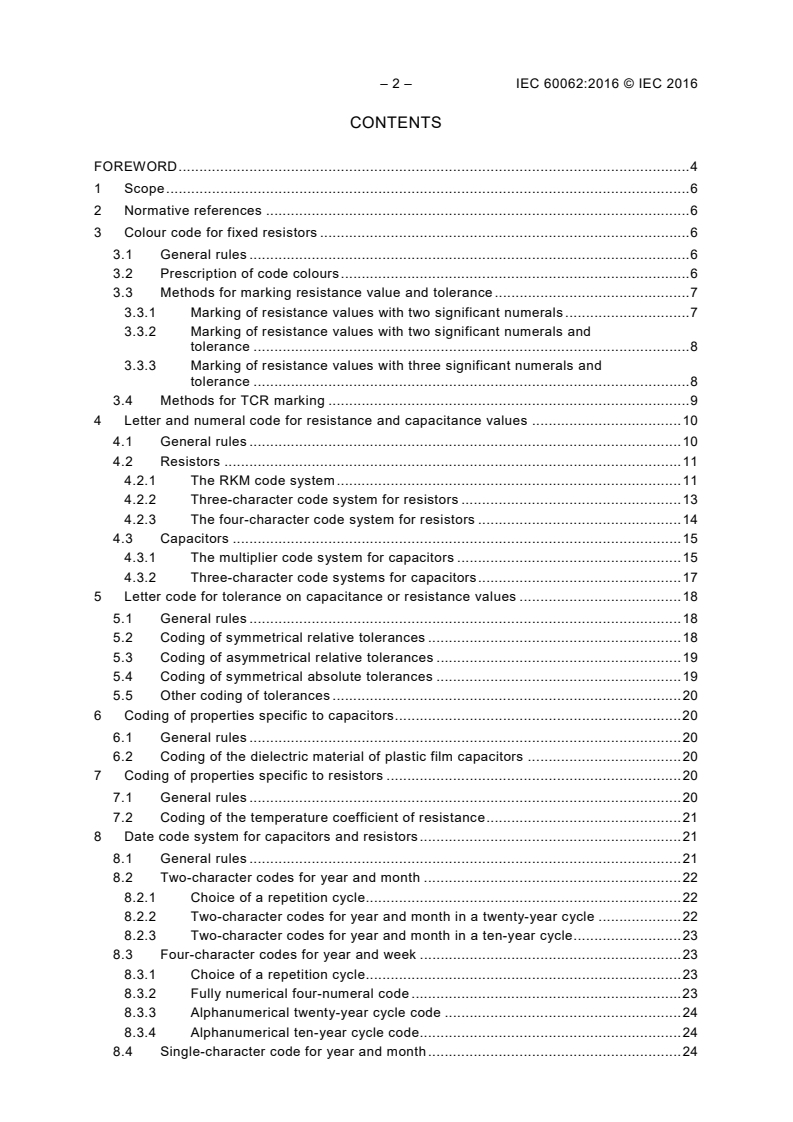
IEC 60062:2016 - Marking codes for resistors and capacitors Released:7/12/2016

IEC 60062:2016+AMD1:2019 CSV - Marking codes for resistors and capacitors Released:8/20/2019
Overview
IEC 60062:2016, titled Marking Codes for Resistors and Capacitors, is an essential international standard developed by the International Electrotechnical Commission (IEC). This standard specifies globally recognized designation and marking codes for capacitors and resistors, ensuring consistent identification of their electrical values, tolerances, and other critical properties.
The 2016 edition introduces several significant updates to improve clarity and extend coding methods. These advances include new color codes, fixed length coding systems, and detailed prescriptions for marking temperature coefficients and component-specific properties. By adopting IEC 60062:2016, manufacturers, engineers, and quality inspectors can uniformly mark and interpret small electronic components, facilitating assembly, testing, and maintenance.
Key Topics
Colour Coding for Resistors
The standard specifies precise colour codes for fixed resistors, including the introduction of the colour pink representing the multiplier 10^-3. It clarifies separate clauses on colour assignment, resistance value, tolerance marking, and Temperature Coefficient of Resistance (TCR) coding, enhancing readability and uniformity.Letter and Numeral Codes
IEC 60062 provides multiple coding systems:- RKM code system for resistors, using letters combined with numerals to denote resistance values and multipliers.
- Three- and four-character systems that allow coding significant digits with multipliers and tolerance information.
- Capacitor coding schemes detailing capacitance values and dielectric characteristics.
Tolerance Marking
The standard covers symmetrical and asymmetrical relative tolerances for resistance and capacitance values, specifying letter codes for uniform and absolute tolerance deviations.Temperature Coefficient of Resistance (TCR)
Includes instructions on marking TCR values with uninterrupted or interrupted colour bands and using inter-band colour dots, crucial for precision resistor applications.Date Code Systems
Defines compact and multi-character date coding for marking manufacturing year and month or week, supporting traceability of small components across industry supply chains.Component-Specific Properties
New clauses focus on coding properties unique to capacitors and resistors, such as dielectric materials for capacitors and resistor temperature coefficients for resistors, facilitating detailed component specifications.
Applications
Electronic Manufacturing
Enables consistent marking and identification of resistors and capacitors on PCBs and in component packaging, supporting automated assembly lines and inspection processes.Quality Control and Testing
Facilitates accurate recognition of component values, tolerances, and manufacturing dates for efficient quality assessment and traceability.Design and Engineering
Assists design engineers in selecting components with precise electrical properties marked clearly according to international standards.Inventory and Supply Chain Management
Simplifies cataloging and verification of electronic components by standardized marking, reducing errors and improving component compatibility.Educational and Reference Use
Serves as a fundamental reference for training on resistor and capacitor coding conventions within technical education and industry training programs.
Related Standards
IEC 60027 – Letter symbols to be used in electrical technology: Complements IEC 60062 by standardizing letter codes used in electrical engineering.
IEC 60189 – Capacitors for use in electronic equipment: Includes specifications related to capacitor characteristics that align with coding requirements.
IEC 60384 – Fixed capacitors for use in electronic equipment: Provides detailed capacitor standards, working alongside IEC 60062 codes for marking.
ISO 80000 – Quantities and units: Supports the use of consistent units and symbols critical for interpreting IEC coding standards.
By adhering to IEC 60062:2016, industries ensure universal understanding and compatibility for resistor and capacitor markings, advancing global harmonization in electrical and electronic component identification. This standard is vital for manufacturers, designers, and quality professionals engaged with electronic components.
Relations
- Effective Date
- 05-Sep-2023
- Effective Date
- 05-Sep-2023
- Effective Date
- 05-Sep-2023
Buy Documents
IEC 60062:2016 - Marking codes for resistors and capacitors Released:7/12/2016
IEC 60062:2016+AMD1:2019 CSV - Marking codes for resistors and capacitors Released:8/20/2019
Frequently Asked Questions
IEC 60062:2016 is a standard published by the International Electrotechnical Commission (IEC). Its full title is "Marking codes for resistors and capacitors". This standard covers: IEC 60062:2016 specifies designation and marking codes for capacitors and resistors. It provides coding methods for the resistance or capacitance value and its tolerance, including colour coding for resistors. It also provides date code systems suitable for the marking of small components. This edition includes the following significant technical changes with respect to the previous edition: - introduction of the new code colour pink for the coding of the multiplier 10-3; - introduction of new subclauses, 3.2 Prescription of code colours, 3.3 Methods for marking resistance value and tolerance, 3.4 Methods for TCR marking, for improved clarity, the subjects of colour assignment, coding of R value and tolerance, and coding of TCR is dealt with in separate clauses; - inclusion of illustrations for TCR marking by interrupted colour band; - inclusion of a new subclause on a fixed length code marking, fixed length code marking of resistance values with up to 3 significant digits, hence a fixed code length of 4 digits, and fixed length code marking of capacitance values with up to 2 significant digits, hence a fixed code length of 3 digits; - introduction of two new clauses, Clause 6, Coding of properties specific to capacitors and Clause 7, Coding of properties specific to resistors; - introduction of Annex A, Special three character coding of resistance value with three significant numerals. The contents of the corrigendum of December 2016 have been included in this copy.
IEC 60062:2016 specifies designation and marking codes for capacitors and resistors. It provides coding methods for the resistance or capacitance value and its tolerance, including colour coding for resistors. It also provides date code systems suitable for the marking of small components. This edition includes the following significant technical changes with respect to the previous edition: - introduction of the new code colour pink for the coding of the multiplier 10-3; - introduction of new subclauses, 3.2 Prescription of code colours, 3.3 Methods for marking resistance value and tolerance, 3.4 Methods for TCR marking, for improved clarity, the subjects of colour assignment, coding of R value and tolerance, and coding of TCR is dealt with in separate clauses; - inclusion of illustrations for TCR marking by interrupted colour band; - inclusion of a new subclause on a fixed length code marking, fixed length code marking of resistance values with up to 3 significant digits, hence a fixed code length of 4 digits, and fixed length code marking of capacitance values with up to 2 significant digits, hence a fixed code length of 3 digits; - introduction of two new clauses, Clause 6, Coding of properties specific to capacitors and Clause 7, Coding of properties specific to resistors; - introduction of Annex A, Special three character coding of resistance value with three significant numerals. The contents of the corrigendum of December 2016 have been included in this copy.
IEC 60062:2016 is classified under the following ICS (International Classification for Standards) categories: 31.020 - Electronic components in general. The ICS classification helps identify the subject area and facilitates finding related standards.
IEC 60062:2016 has the following relationships with other standards: It is inter standard links to IEC 60062:2016/AMD1:2019, IEC 60062:2016/COR1:2016, IEC 60062:2004. Understanding these relationships helps ensure you are using the most current and applicable version of the standard.
IEC 60062:2016 is available in PDF format for immediate download after purchase. The document can be added to your cart and obtained through the secure checkout process. Digital delivery ensures instant access to the complete standard document.
Standards Content (Sample)
IEC 60062 ®
Edition 6.0 2016-07
INTERNATIONAL
STANDARD
NORME
INTERNATIONALE
colour
inside
Marking codes for resistors and capacitors
Codes de marquage des résistances et des condensateurs
All rights reserved. Unless otherwise specified, no part of this publication may be reproduced or utilized in any form
or by any means, electronic or mechanical, including photocopying and microfilm, without permission in writing from
either IEC or IEC's member National Committee in the country of the requester. If you have any questions about IEC
copyright or have an enquiry about obtaining additional rights to this publication, please contact the address below or
your local IEC member National Committee for further information.
Droits de reproduction réservés. Sauf indication contraire, aucune partie de cette publication ne peut être reproduite
ni utilisée sous quelque forme que ce soit et par aucun procédé, électronique ou mécanique, y compris la photocopie
et les microfilms, sans l'accord écrit de l'IEC ou du Comité national de l'IEC du pays du demandeur. Si vous avez des
questions sur le copyright de l'IEC ou si vous désirez obtenir des droits supplémentaires sur cette publication, utilisez
les coordonnées ci-après ou contactez le Comité national de l'IEC de votre pays de résidence.
IEC Central Office Tel.: +41 22 919 02 11
3, rue de Varembé Fax: +41 22 919 03 00
CH-1211 Geneva 20 info@iec.ch
Switzerland www.iec.ch
About the IEC
The International Electrotechnical Commission (IEC) is the leading global organization that prepares and publishes
International Standards for all electrical, electronic and related technologies.
About IEC publications
The technical content of IEC publications is kept under constant review by the IEC. Please make sure that you have the
latest edition, a corrigenda or an amendment might have been published.
IEC Catalogue - webstore.iec.ch/catalogue Electropedia - www.electropedia.org
The stand-alone application for consulting the entire The world's leading online dictionary of electronic and
bibliographical information on IEC International Standards, electrical terms containing 20 000 terms and definitions in
Technical Specifications, Technical Reports and other English and French, with equivalent terms in 15 additional
documents. Available for PC, Mac OS, Android Tablets and languages. Also known as the International Electrotechnical
iPad. Vocabulary (IEV) online.
IEC publications search - www.iec.ch/searchpub IEC Glossary - std.iec.ch/glossary
The advanced search enables to find IEC publications by a 65 000 electrotechnical terminology entries in English and
variety of criteria (reference number, text, technical French extracted from the Terms and Definitions clause of
committee,…). It also gives information on projects, replaced IEC publications issued since 2002. Some entries have been
and withdrawn publications. collected from earlier publications of IEC TC 37, 77, 86 and
CISPR.
IEC Just Published - webstore.iec.ch/justpublished
Stay up to date on all new IEC publications. Just Published IEC Customer Service Centre - webstore.iec.ch/csc
details all new publications released. Available online and If you wish to give us your feedback on this publication or
also once a month by email. need further assistance, please contact the Customer Service
Centre: csc@iec.ch.
A propos de l'IEC
La Commission Electrotechnique Internationale (IEC) est la première organisation mondiale qui élabore et publie des
Normes internationales pour tout ce qui a trait à l'électricité, à l'électronique et aux technologies apparentées.
A propos des publications IEC
Le contenu technique des publications IEC est constamment revu. Veuillez vous assurer que vous possédez l’édition la
plus récente, un corrigendum ou amendement peut avoir été publié.
Catalogue IEC - webstore.iec.ch/catalogue Electropedia - www.electropedia.org
Application autonome pour consulter tous les renseignements
Le premier dictionnaire en ligne de termes électroniques et
bibliographiques sur les Normes internationales,
électriques. Il contient 20 000 termes et définitions en anglais
Spécifications techniques, Rapports techniques et autres
et en français, ainsi que les termes équivalents dans 15
documents de l'IEC. Disponible pour PC, Mac OS, tablettes
langues additionnelles. Egalement appelé Vocabulaire
Android et iPad.
Electrotechnique International (IEV) en ligne.
Recherche de publications IEC - www.iec.ch/searchpub
Glossaire IEC - std.iec.ch/glossary
La recherche avancée permet de trouver des publications IEC 65 000 entrées terminologiques électrotechniques, en anglais
en utilisant différents critères (numéro de référence, texte, et en français, extraites des articles Termes et Définitions des
comité d’études,…). Elle donne aussi des informations sur les publications IEC parues depuis 2002. Plus certaines entrées
projets et les publications remplacées ou retirées. antérieures extraites des publications des CE 37, 77, 86 et
CISPR de l'IEC.
IEC Just Published - webstore.iec.ch/justpublished
Service Clients - webstore.iec.ch/csc
Restez informé sur les nouvelles publications IEC. Just
Published détaille les nouvelles publications parues. Si vous désirez nous donner des commentaires sur cette
Disponible en ligne et aussi une fois par mois par email. publication ou si vous avez des questions contactez-nous:
csc@iec.ch.
IEC 60062 ®
Edition 6.0 2016-07
INTERNATIONAL
STANDARD
NORME
INTERNATIONALE
colour
inside
Marking codes for resistors and capacitors
Codes de marquage des résistances et des condensateurs
INTERNATIONAL
ELECTROTECHNICAL
COMMISSION
COMMISSION
ELECTROTECHNIQUE
INTERNATIONALE
ICS 31.020 ISBN 978-2-8322-3515-7
– 2 – IEC 60062:2016 © IEC 2016
CONTENTS
FOREWORD . 4
1 Scope . 6
2 Normative references . 6
3 Colour code for fixed resistors . 6
3.1 General rules . 6
3.2 Prescription of code colours . 6
3.3 Methods for marking resistance value and tolerance . 7
3.3.1 Marking of resistance values with two significant numerals . 7
3.3.2 Marking of resistance values with two significant numerals and
tolerance . 8
3.3.3 Marking of resistance values with three significant numerals and
tolerance . 8
3.4 Methods for TCR marking . 9
4 Letter and numeral code for resistance and capacitance values . 10
4.1 General rules . 10
4.2 Resistors . 11
4.2.1 The RKM code system . 11
4.2.2 Three-character code system for resistors . 13
4.2.3 The four-character code system for resistors . 14
4.3 Capacitors . 15
4.3.1 The multiplier code system for capacitors . 15
4.3.2 Three-character code systems for capacitors . 17
5 Letter code for tolerance on capacitance or resistance values . 18
5.1 General rules . 18
5.2 Coding of symmetrical relative tolerances . 18
5.3 Coding of asymmetrical relative tolerances . 19
5.4 Coding of symmetrical absolute tolerances . 19
5.5 Other coding of tolerances . 20
6 Coding of properties specific to capacitors . 20
6.1 General rules . 20
6.2 Coding of the dielectric material of plastic film capacitors . 20
7 Coding of properties specific to resistors . 20
7.1 General rules . 20
7.2 Coding of the temperature coefficient of resistance . 21
8 Date code system for capacitors and resistors . 21
8.1 General rules . 21
8.2 Two-character codes for year and month . 22
8.2.1 Choice of a repetition cycle . 22
8.2.2 Two-character codes for year and month in a twenty-year cycle . 22
8.2.3 Two-character codes for year and month in a ten-year cycle . 23
8.3 Four-character codes for year and week . 23
8.3.1 Choice of a repetition cycle . 23
8.3.2 Fully numerical four-numeral code . 23
8.3.3 Alphanumerical twenty-year cycle code . 24
8.3.4 Alphanumerical ten-year cycle code. 24
8.4 Single-character code for year and month . 24
Annex A (informative) Special three-character code system for resistors . 26
Annex X (informative) Cross-reference for references to the previous edition of this
standard . 28
Bibliography . 30
Figure 1 – Colour marking of a resistor 6,8 kΩ, tolerance ±20 % . 8
Figure 2 – Colour marking of a resistor 750 kΩ, tolerance ±5 % . 8
Figure 3 – Colour marking of a resistor 249 kΩ, tolerance ±1 % . 9
th
Figure 4 – Colour marking of a resistor with a 6 band for TCR marking . 9
th
Figure 5 – Colour marking of a resistor with an interrupted 6 band for TCR marking . 10
Figure 6 – Colour marking of a resistor using an alternative method of inter-band
colour dots for TCR coding . 10
Table 1 – Code colour prescriptions . 7
Table 2 – Coding of resistance values with up to 3 significant numerals . 12
Table 3 – Fixed length coding of resistance values with up to 3 significant numerals . 13
Table 4 – Coding of resistance values with 4 significant numerals . 13
Table 5 – Coding of resistance values in the three-character code system . 14
Table 6 – Coding of resistance values in the four-character code system . 15
Table 7 – Coding of capacitance values with up to 2 significant numerals . 16
Table 8 – Fixed length coding of capacitance values with up to 2 significant numerals . 16
Table 9 – Coding of capacitance values with 3 significant numerals . 17
Table 10 – Coding of capacitance values in the picofarad based three-character code
system . 17
Table 11 –Coding of capacitance values in the microfarad based three-character code
system . 18
Table 12 – Letter code for symmetrical relative tolerances . 19
Table 13 – Letter code for asymmetrical relative tolerances . 19
Table 14 – Letter code for symmetrical absolute tolerances of capacitors . 20
Table 15 – Letter code for the dielectric material of plastic film capacitors . 20
Table 16 – Letter code for the temperature coefficient of resistance. 21
Table 17 – Character code letters for the month . 22
Table 18 – Code letters for the year in a twenty-year cycle . 22
Table 19 – Code letters for the year in a ten-year cycle . 23
Table 20 – Single-character code for year and month at a 4-year cycle . 25
Table A.1 – Coding of the significant numerals of the E96 series . 26
Table A.2 – Coding of the multiplier . 27
Table X.1 – Cross-reference to Clauses . 28
Table X.2 – Cross-reference to Tables . 29
– 4 – IEC 60062:2016 © IEC 2016
INTERNATIONAL ELECTROTECHNICAL COMMISSION
____________
MARKING CODES FOR RESISTORS AND CAPACITORS
FOREWORD
1) The International Electrotechnical Commission (IEC) is a worldwide organization for standardization comprising
all national electrotechnical committees (IEC National Committees). The object of IEC is to promote
international co-operation on all questions concerning standardization in the electrical and electronic fields. To
this end and in addition to other activities, IEC publishes International Standards, Technical Specifications,
Technical Reports, Publicly Available Specifications (PAS) and Guides (hereafter referred to as “IEC
Publication(s)”). Their preparation is entrusted to technical committees; any IEC National Committee interested
in the subject dealt with may participate in this preparatory work. International, governmental and non-
governmental organizations liaising with the IEC also participate in this preparation. IEC collaborates closely
with the International Organization for Standardization (ISO) in accordance with conditions determined by
agreement between the two organizations.
2) The formal decisions or agreements of IEC on technical matters express, as nearly as possible, an international
consensus of opinion on the relevant subjects since each technical committee has representation from all
interested IEC National Committees.
3) IEC Publications have the form of recommendations for international use and are accepted by IEC National
Committees in that sense. While all reasonable efforts are made to ensure that the technical content of IEC
Publications is accurate, IEC cannot be held responsible for the way in which they are used or for any
misinterpretation by any end user.
4) In order to promote international uniformity, IEC National Committees undertake to apply IEC Publications
transparently to the maximum extent possible in their national and regional publications. Any divergence
between any IEC Publication and the corresponding national or regional publication shall be clearly indicated in
the latter.
5) IEC itself does not provide any attestation of conformity. Independent certification bodies provide conformity
assessment services and, in some areas, access to IEC marks of conformity. IEC is not responsible for any
services carried out by independent certification bodies.
6) All users should ensure that they have the latest edition of this publication.
7) No liability shall attach to IEC or its directors, employees, servants or agents including individual experts and
members of its technical committees and IEC National Committees for any personal injury, property damage or
other damage of any nature whatsoever, whether direct or indirect, or for costs (including legal fees) and
expenses arising out of the publication, use of, or reliance upon, this IEC Publication or any other IEC
Publications.
8) Attention is drawn to the Normative references cited in this publication. Use of the referenced publications is
indispensable for the correct application of this publication.
9) Attention is drawn to the possibility that some of the elements of this IEC Publication may be the subject of
patent rights. IEC shall not be held responsible for identifying any or all such patent rights.
International Standard IEC 60062 has been prepared by IEC technical committee 40:
Capacitors and resistors for electronic equipment.
This sixth edition cancels and replaces the fifth edition published in 2004 and constitutes a
technical revision.
This edition includes the following significant technical changes with respect to the previous
edition:
-3
• introduction of the new code colour pink for the coding of the multiplier 10 ;
• introduction of new subclauses, 3.2 Prescription of code colours, 3.3 Methods for marking
resistance value and tolerance, 3.4 Methods for TCR marking, for improved clarity, the
subjects of colour assignment, coding of R value and tolerance, and coding of TCR is
dealt with in separate clauses;
• inclusion of illustrations for TCR marking by interrupted colour band;
• inclusion of a new subclause on a fixed length code marking, fixed length code marking of
resistance values with up to 3 significant digits, hence a fixed code length of 4 digits, and
fixed length code marking of capacitance values with up to 2 significant digits, hence a
fixed code length of 3 digits;
• introduction of two new clauses, Clause 6, Coding of properties specific to capacitors and
Clause 7, Coding of properties specific to resistors;
• introduction of Annex A, Special three character coding of resistance value with three
significant numerals.
The text of this standard is based on the following documents:
FDIS Report on voting
40/2465/FDIS 40/2473/RVD
Full information on the voting for the approval of this standard can be found in the report on
voting indicated in the above table.
This publication has been drafted in accordance with the ISO/IEC Directives, Part 2.
The committee has decided that the contents of this publication will remain unchanged until
the stability date indicated on the IEC website under "http://webstore.iec.ch" in the data
related to the specific publication. At this date, the publication will be
• reconfirmed,
• withdrawn,
• replaced by a revised edition, or
• amended.
The contents of the corrigendum of December 2016 have been included in this copy.
IMPORTANT – The 'colour inside' logo on the cover page of this publication indicates
that it contains colours which are considered to be useful for the correct
understanding of its contents. Users should therefore print this document using a
colour printer.
– 6 – IEC 60062:2016 © IEC 2016
MARKING CODES FOR RESISTORS AND CAPACITORS
1 Scope
This International Standard specifies designation and marking codes for capacitors and
resistors.
It provides coding methods for the resistance or capacitance value and its tolerance, including
colour coding for resistors.
It provides coding for parameters specific either to capacitors, like e.g. the dielectric material,
or to resistors, like e.g. the temperature coefficient of resistance (TCR).
It also provides date code systems suitable for the marking of small components.
2 Normative references
The following documents, in whole or in part, are normatively referenced in this document and
are indispensable for its application. For dated references, only the edition cited applies. For
undated references, the latest edition of the referenced document (including any
amendments) applies.
IEC 60063, Preferred number series of resistors and capacitors
IEC 60757, Code for designation of colours
ISO 8601, Data elements and interchange formats – Information interchange –
Representation of dates and times
3 Colour code for fixed resistors
3.1 General rules
Colour code is applied in a sequence of individual solid colour bands.
Wherever possible, the first band shall be the one nearest to the end of the resistor and the
bands shall be so placed and spaced that there can be no confusion in reading the coding.
The design width of the band used for marking the tolerance shall be at least 1,5 times the
width of the other bands in order to avoid any confusion.
NOTE The design width is not intended to be measured.
Any additional coding shall be so applied as not to confuse the coding for value and tolerance.
Although colour bands are expected to be complete rings around the perimeter of a cylindrical
resistor body, incidental interruption of a band shall be permissible if at least two thirds of the
band is visible from any radial angle of view.
3.2 Prescription of code colours
The colours black, brown, red, orange, yellow, green, blue, violet, grey and white are used for
the coding of the figures 0 through 9 for each significant numeral. Complemented with the
colours silver, gold and pink, they are also used for the coding of the multiplier, the tolerance
and the temperature coefficient of resistance (TCR). Table 1 summarizes the colours with all
assigned parameters and their respective values.
Table 1 – Code colour prescriptions
Significant
Colour Multiplier Tolerance TCR
numeral
-6
Code Example % 10 /K
None — — — —
±20
-3
Pink PK — 10 — —
-2
Silver SR — 10 —
±10
-1
Gold GD — 10 ±5 —
Black BK 0 1 —
±250
Brown BN 1 10
±1 ±100
Red RD 2 10 ±2 ±50
Orange OG 3 10
±0,05 ±15
Yellow YE 4 10
±0,02 ±25
Green GN 5 10 ±0,5 ±20
Blue BU 6 10
±0,25 ±10
Violet VT 7 10
±0,1 ±5
Grey GY 8 10
±0,01 ±1
White WH 9 10 — —
NOTE 1 The code letters are as defined in IEC 60757.
NOTE 2 The colours shown here as example are not intended as normative reference, but are applied for the
purpose of consistent illustration only.
3.3 Methods for marking resistance value and tolerance
3.3.1 Marking of resistance values with two significant numerals
Resistors with a tolerance of ±20 %, whose resistance values are described with two
significant numerals, are marked with a three-band colour code, consisting of two bands for
the significant numerals, followed by one band for the multiplier. The absence of the fourth
band indicates the tolerance of ±20 %. Figure 1 illustrates this with a 6,8 kΩ resistor with a
tolerance of ±20 %.
– 8 – IEC 60062:2016 © IEC 2016
IEC
Key:
st st
1: 1 band 1 numeral Blue = 6
nd nd
2: 2 band 2 numeral Grey = 8
rd 2
3: 3 band Multiplier Red = × 10
Figure 1 – Colour marking of a resistor 6,8 kΩ, tolerance ±20 %
3.3.2 Marking of resistance values with two significant numerals and tolerance
Resistors with a tolerance tighter than ±20 %, whose resistance values are described with two
significant numerals, are marked with a four-band colour code, consisting of two bands for the
significant numerals, followed by one band for the multiplier, followed by the last and wider
band showing the tolerance. Figure 2 illustrates this with a 750 kΩ resistor with a tolerance of
±5 %.
IEC
Key:
st st
1: 1 band 1 numeral Violet = 7
nd nd
2: 2 band 2 numeral Green = 5
rd 4
3: 3 band Multiplier Yellow = × 10
th
4: 4 band Tolerance Gold = ±5 %
Figure 2 – Colour marking of a resistor 750 kΩ, tolerance ±5 %
3.3.3 Marking of resistance values with three significant numerals and tolerance
Resistors, whose resistance values are described with three significant numerals, are marked
with a five-band colour code, consisting of three bands for the significant numerals, followed
by one band for the multiplier, followed by the last and wider band showing the tolerance.
Figure 3 illustrates this with a 249 kΩ resistor with a tolerance of ±1 %.
IEC
Key:
st st
1: 1 band 1 numeral Red = 2
nd nd
2: 2 band 2 numeral Yellow = 4
rd rd
3: 3 band 3 numeral White = 9
th 3
4: 4 band Multiplier Orange = × 10
th
5: 5 band Tolerance Brown = ±1 %
Figure 3 – Colour marking of a resistor 249 kΩ, tolerance ±1 %
3.4 Methods for TCR marking
Colour-code marking of the temperature coefficient shall only be used in combination with a
resistance coding for three significant numerals and is additional to the marking of resistance
value and tolerance as prescribed in 3.3.3.
One of the following methods should be used for the indication of temperature coefficients
with a code colour as prescribed in Table 1, where the tolerance band is consistently
maintained as the single wider band.
a) The TCR is marked by means of a colour band as the sixth band, as shown in Figure 4.
IEC
Key:
st st
1: 1 band 1 numeral Red = 2
nd nd
2: 2 band 2 numeral Yellow = 4
rd rd
3: 3 band 3 numeral White = 9
th 3
4: 4 band Multiplier Orange = × 10
th
5: 5 band Tolerance Brown = ±1 %
th -6
6: 6 band TCR Red = ±50 × 10 /K
th
Figure 4 – Colour marking of a resistor with a 6 band for TCR marking
NOTE The prescription of prior revisions of this standard about the sixth band to be the wider band has been
changed here as it has been found to be a reason of confusion with component users about the tolerance
marking.
b) The TCR is marked by means of an interrupted colour band as the sixth band, as shown in
Figure 5.
– 10 – IEC 60062:2016 © IEC 2016
IEC
Key:
st st
1: 1 band 1 numeral Red = 2
nd nd
2: 2 band 2 numeral Yellow = 4
rd rd
3: 3 band 3 numeral White = 9
th 3
4: 4 band Multiplier Orange = × 10
th
5: 5 band Tolerance Brown = ±1 %
th -6
6: 6 band TCR Red = ±50 × 10 /K
Figure 5 – Colour marking of a resistor
th
with an interrupted 6 band for TCR marking
c) Other method of colour marking for TCR.
Other methods of colour marking for TCR may be used if they are clearly described by the
documentation and specification of the respective resistor, and if they do not risk
confusion with any of the methods given above.
An illustration of a possible similar method is given in Figure 6, adopting the general
principles of TCR marking for a situation with insufficient axial length for a dedicated 6th
solid or interrupted band.
IEC
Key:
st st
1: 1 band 1 numeral Red = 2
nd nd
2: 2 band 2 numeral Yellow = 4
rd rd
3: 3 band 3 numeral White = 9
th 3
4: 4 band Multiplier Orange = × 10
th
5: 5 band Tolerance Brown = ±1 %
th -6
6: 6 dots TCR Red = ±50 × 10 /K
Figure 6 – Colour marking of a resistor using an alternative
method of inter-band colour dots for TCR marking
4 Letter and numeral code for resistance and capacitance values
4.1 General rules
The value code shall use 3, 4 or 5 characters consisting of 2 figures and a letter, 3 figures
and a letter, or 4 figures and a letter, as required.
The code letters replace the decimal point as shown in the respective examples below.
The value code shall be written in succession, without any space in between.
The value code may be succeeded by a code letter for tolerance as specified in Clause 5.
Any additional code letter or numeral shall appear after the tolerance letter and shall be
applied in a way not confusing the coding for value and tolerance.
The codes given in Clause 4, 5, 6 and 7 are intended for the marking of components, and are
also suitable for the building of part numbers and component ordering codes.
4.2 Resistors
4.2.1 The RKM code system
4.2.1.1 General rule
The RKM code system has emerged from the coding of resistance values in the range of
single ohm through some mega ohm, which initially required the multiplier characters R, K and
M for coding.
-3 3 6 9
The letters L, R, K, M and G are used as multipliers for 10 , 1, 10 , 10 and 10 , respectively,
of the resistance value expressed in ohm.
The letters L, R, K, M and G are consistently written as capital letters in this coding,
regardless of the convention for SI prefixes using a lower-case k as the decimal multiplier for
10 , kilo.
NOTE The letter L is introduced as a code letter since the SI prefix using a lower-case m as the decimal multiplier
-3 6
for 10 , milli, is not applicable in light of the established use of the upper-case M for 10 , mega.
4.2.1.2 Coding of resistance values with up to 3 significant numerals
The resistance value expressed in ohm is identified by a code using L, R, K, M, or G as
multiplier and as decimal point at the same time, as shown in Table 2. The length of the code
depends on the actual number of significant numerals of the resistance value.
– 12 – IEC 60062:2016 © IEC 2016
Table 2 – Coding of resistance values with up to 3 significant numerals
Resistance Code Resistance Code Resistance Code
0,1 mΩ L10
– – L15
– – 0,15 mΩ
L332
0,332 mΩ
1 mΩ 1L0 10 mΩ 10L 0,1 Ω R10
1L5 15L R15
1,5 mΩ 15 mΩ 0,15 Ω
3L32 33L2 R332
3,32 mΩ 33,2 mΩ 0,332 Ω
1 Ω 1R0 10 Ω 10R 100 Ω 100R
1R5 15R 150R
1,5 Ω 15 Ω 150 Ω
3R32 33R2 332R
3,32 Ω 33,2 Ω 332 Ω
1K0 10K 100K
1 kΩ 10 kΩ 100 kΩ
1K5 15K 150K
1,5 kΩ 15 kΩ 150 kΩ
3K32 33K2 332K
3,32 kΩ 33,2 kΩ 332 kΩ
1M0 10M 100M
1 MΩ 10 MΩ 100 MΩ
1M5 15M 150M
1,5 MΩ 15 MΩ 150 MΩ
3M32 33M2 332M
3,32 MΩ 33,2 MΩ 332 MΩ
1G0 10G 100G
1 GΩ 10 GΩ 100 GΩ
1G5 15G 150G
1,5 GΩ 15 GΩ 150 GΩ
3,32 GΩ 3G32 33,2 GΩ 33G2 332 GΩ 332G
4.2.1.3 Fixed length coding of resistance values with up to 3 significant numerals
The use of the RKM code system for the identification of resistance values in a database
related application, like e.g. in a prescription for an ordering designation, may require the use
of a fixed length code. If the resistance values to be coded consist of up to three significant
numerals, such a fixed length RKM code system has a consistent length of 4 characters, as
shown in Table 3.
Table 3 – Fixed length coding of resistance
values with up to 3 significant numerals
Resistance Code Resistance Code Resistance Code
L100
0,1 mΩ
L150
– – – – 0,15 mΩ
0,332 mΩ L332
1L00 10L0 R100
1 mΩ 10 mΩ 0,1 Ω
1,5 mΩ 1L50 15 mΩ 15L0 0,15 Ω R150
3,32 mΩ 3L32 33,2 mΩ 33L2 0,332 Ω R332
1R00 10R0 100R
1 Ω 10 Ω 100 Ω
1,5 Ω 1R50 15 Ω 15R0 150 Ω 150R
3,32 Ω 3R32 33,2 Ω 33R2 332 Ω 332R
1K00 10K0 100K
1 kΩ 10 kΩ 100 kΩ
1,5 kΩ 1K50 15 kΩ 15K0 150 kΩ 150K
3,32 kΩ 3K32 33,2 kΩ 33K2 332 kΩ 332K
1 MΩ 1M00 10 MΩ 10M0 100 MΩ 100M
1,5 MΩ 1M50 15 MΩ 15M0 150 MΩ 150M
3M32 33M2 332M
3,32 MΩ 33,2 MΩ 332 MΩ
1 GΩ 1G00 10 GΩ 10G0 100 GΩ 100G
1,5 GΩ 1G50 15 GΩ 15G0 150 GΩ 150G
3G32 33G2 332G
3,32 GΩ 33,2 GΩ 332 GΩ
4.2.1.4 Coding of resistance values with more than 3 significant numerals
Resistance values expressed by four significant numerals should be coded as in the examples
shown in Table 4.
Table 4 – Coding of resistance values with 4 significant numerals
Resistance Code
59R04
59,04 Ω
590R4
590,4 Ω
5,904 kΩ 5K904
59,04 kΩ 59K04
For the benefit of a consistent coding style, coding of resistance values with four significant
numerals should preferably be presented at a fixed length of five characters.
The same principles should be applied for the coding of resistance values with more than four
significant numerals.
4.2.2 Three-character code system for resistors
The resistance value expressed in ohm is identified by a three-character code as in the
examples shown in Table 5.
Due to the possibility of expressing only two significant numerals of a resistance value, the
three character code system is applicable to values from an E series up to E24, as defined in
– 14 – IEC 60062:2016 © IEC 2016
IEC 60063, only. Therefore it should be used for the coding of resistors with a tolerance of
5 % or wider.
Table 5 – Coding of resistance values
in the three-character code system
Resistance Code
L10 to L91
0,1 mΩ to 0,91 mΩ
1 mΩ to 9,1 mΩ 1L0 to 9L1
10 mΩ to 91 mΩ 10L to 91L
R10 to R91
0,1 Ω to 0,91 Ω
1R0 to 9R1
1 Ω to 9,1 Ω
10 Ω to 91 Ω 100 to 910
101 to 911
100 Ω to 910 Ω
102 to 912
1 kΩ to 9,1 kΩ
10 kΩ to 91 kΩ 103 to 913
100 kΩ to 910 kΩ 104 to 914
105 to 915
1 MΩ to 9,1 MΩ
10 MΩ to 91 MΩ 106 to 916
100 MΩ to 910 MΩ 107 to 917
108 to 918
1 GΩ to 9,1 GΩ
109 to 919
10 GΩ to 91 GΩ
The three-character code system is not suitable for the coding of resistance values below
0,1 mΩ, or for resistance values above 99 GΩ.
4.2.3 The four-character code system for resistors
The resistance value expressed in ohm is identified by a four-character code as in the
examples shown in Table 6.
The four-character code expresses three significant numerals of a resistance value, which
makes it applicable for values from an E48, E96 or E192 series, as defined in IEC 60063.
Therefore it should be used for the coding of resistors with a tolerance of 2 %, 1 % or tighter.
Table 6 – Coding of resistance values
in the four-character code system
Resistance Code
L100 to L976
0,1 mΩ to 0,976 mΩ
1L00 to 9L76
1 mΩ to 9,76 mΩ
10 mΩ to 97,6 mΩ 10L0 to 97L6
R100 to R976
0,1 Ω to 0,976 Ω
1R00 to 9R76
1 Ω to 9,76 Ω
10 Ω to 97,6 Ω 10R0 to 97R6
1000 to 9760
100 Ω to 976 Ω
1001 to 9761
1 kΩ to 9,76 kΩ
10 kΩ to 97,6 kΩ 1002 to 9762
1003 to 9763
100 kΩ to 976 kΩ
1004 to 9764
1 MΩ to 9,76 MΩ
10 MΩ to 97,6 MΩ 1005 to 9765
100 MΩ to 976 MΩ 1006 to 9766
1007 to 9767
1 GΩ to 9,76 GΩ
1008 to 9768
10 GΩ to 97,6 GΩ
100 GΩ to 976 GΩ 1009 to 9769
The four-character code system is not suitable for the coding of resistance values below
0,1 mΩ, or for resistance values above 999 GΩ.
4.3 Capacitors
4.3.1 The multiplier code system for capacitors
4.3.1.1 General rule
-12 -9 -6 -3
The letters p, n, µ, m and F are used as multipliers for 10 , 10 , 10 , 10 and 1,
respectively, of the capacitance value expressed in farad.
The letters p, n, µ and m are consistently written in lower-case, while the unit farad is
expressed by the upper-case letter F.
NOTE 1 Where the lower case character p is not available, an upper case character P is a suitable replacement.
NOTE 2 Where the lower case character µ is not available, a character u in lower case or in upper case is a
suitable replacement.
4.3.1.2 Coding of capacitance values with up to 2 significant numerals
The capacitance value expressed in farad is identified by a code using p, n, µ, m, or F as
multiplier and as decimal point at the same time, as shown in Table 7. The length of the code
depends on the actual number of significant numerals of the capacitance value.
– 16 – IEC 60062:2016 © IEC 2016
Table 7 – Coding of capacitance values
with up to 2 significant numerals
Capacitance Code Capacitance Code Capacitance Code
0,1 pF p10
– – – –
0,15 pF p15
1 pF 1p0 10 pF 10p 100 pF 100p
1,5 pF 1p5 15 pF 15p 150 pF 150p
1 nF 1n0 10 nF 10n 100 nF 100n
1,5 nF 1n5 15 nF 15n 150 nF 150n
1 µF 1µ0 10 µF 10µ 100 µF 100µ
1,5 µF 1µ5 15 µF 15µ 150 µF 150µ
1 mF 1m0 10 mF 10m 100 mF 100m
1,5 mF 1m5 15 mF 15m 150 mF 150m
1 F 1F0 10 F 10F 100 F 100F
1,5 F 1F5 15 F 15F 150 F 150F
4.3.1.3 Fixed length coding of capacitance values with up to 2 significant numerals
The use of the code system for the identification of capacitance values in a database related
application, like e.g. in a prescription for an ordering designation, may require the use of a
fixed length code. If the capacitance values to be coded consist of up to two significant
numerals, such a fixed length code system has a consistent length of three characters, as
shown in Table 8.
Table 8 – Fixed length coding of capacitance
values with up to 2 significant numerals
Capacitance Code Capacitance Code Capacitance Code
0,1 pF p10
– – – –
0,15 pF p15
1 pF 1p0 10 pF 10p 100 pF n10
1,5 pF 1p5 15 pF 15p 150 pF n15
1 nF 1n0 10 nF 10n 100 nF
µ10
1,5 nF 1n5 15 nF 15n 150 nF
µ15
m10
1 µF 1µ0 10 µF 10µ 100 µF
m15
1,5 µF 1µ5 15 µF 15µ 150 µF
1 mF 1m0 10 mF 10m 100 mF F10
1,5 mF 1m5 15 mF 15m 150 mF F15
1 F 1F0 10 F 10F
– –
1,5 F 1F5 15 F 15F
4.3.1.4 Coding of capacitance values with more than 2 significant numerals
Capacitance values expressed by three significant numerals should be coded as in the
examples shown in Table 9.
Table 9 – Coding of capacitance values with 3 significant numerals
Capacitance Code
33,2 pF 33p2
332 pF 332p
3,32 nF 3n32
33,2 nF 33n2
For the benefit of a consistent coding style, coding of capacitance values with three significant
numerals should preferably be presented at a fixed length of four characters.
The same principles should be applied for the coding of capacitance values with more than
three significant numerals.
4.3.2 Three-character code systems for capacitors
4.3.2.1 The picofarad based three-character code system
The capacitance value expressed in picofarad is identified by a three-character code as
illustrated in Table 10.
NOTE The picofarad based three-character code system for low or medium capacitance is typically used for
ceramic capacitors and for film capacitors.
Table 10 – Coding of capacitance values in
the picofarad based three-character code system
Capacitance Code
a
0R1 to 0R9
0,1 pF to 0,9 pF
0p1 to 0p9
a
1R0 to 9R1
1 pF to 9,1 pF
1p0 to 9p1
10 pF to 91 pF 100 to 910
100 pF to 910 pF 101 to 911
1 nF to 9,1 nF 102 to 912
10 nF to 91 nF 103 to 913
100 nF to 910 nF 104 to 914
105 to 915
1 µF to 9,1 µF
10 µF to 91 µF 106 to 916
107 to 917
100 µF to 910 µF
a
The decimal point code with a letter R may be used for coding of capacitance
in light of its
values in the picofarad based three-character code system
introduction prior to establishing "p" marking code.
4.3.2.2 The microfarad based three-character code system
The capacitance value expressed in microfarad is identified by a three-character code as
illustrated in Table 11.
NOTE The microfarad based three-character code system for large capacitance is typically used for aluminium
electrolytic capacitors and for double layer capacitors.
– 18 – IEC 60062:2016 © IEC 2016
Table 11 –Coding of capacitance values in
the microfarad based three-character code system
Capacitance Code
a
0R1 to 0R9
0,1 µF to 0,9 µF
0µ1 to 0µ9
a
1R0 to 9R1
1 µF to 9,1 µF
1µ0 to 9µ1
100 to 910
10 µF to 91 µF
101 to 911
100 µF to 910 µF
1 mF to 9,1 mF 102 to 912
10 mF to 91 mF 103 to 913
100 mF to 910 mF 104 to 914
1 F to 9,1 F 105 to 915
10 F to 91 F 106 to 916
100 F to 910 F 107 to 917
a
The decimal point code with a letter R may be used for coding of capacitance
values in the microfarad based three-character code system in light of its
introduction prior to establishing "µ" marking code.
5 Letter code for tolerance on capacitance or resistance values
5.1 General rules
If tolerance coding is desired, the code letter for tolerance shall be placed after the coding of
the capacitance or resistance value.
The code letter for tolerance shall be applied in a way which cannot lead to confusion
between the coding of the capacitance or resistance value.
5.2 Coding of symmetrical relative tolerances
The letters given in Table 12 shall be used for indicating the symmetrical relative tolerance on
resistance and capacitance values.
Table 12 – Letter code for symmetrical relative tolerances
Tolerance Code letter
%
±0,005 E
±0,01 L
±0,02 P
W
±0,05
B
±0,1
±0,25 C
±0,5 D
±1 F
G
±2
H
±3
J
±5
±10 K
±20 M
N
±30
5.3 Coding of asymmetrical relative tolerances
For the coding of asymmetrical relative tolerances, the letters given in Table 13 shall be used.
Table 13 – Letter code for asymmetrical relative tolerances
Tolerance Code letter
%
Q
-10 +30
-10 +50 T
-20 +50 S
Z
-20 +80
Asymmetrical relative tolerances as given in Table 13 are common for some types of
capacitors.
5.4 Coding of symmetrical absolute tolerances
For tolerances on capacitance values below 10 pF, relative tolerances are no longer
applicable. Then absolute tolerances, i.e. fixed values, shall be used with code letters as
given in Table 14.
– 20 – IEC 60062:2016 © IEC 2016
Table 14 – Letter code for symmetrical absolute tolerances of capacitors
Tolerance Code letter
pF
±0,1 B
±0,25 C
±0,5 D
F
±1
G
±2
5.5 Other coding of tolerances
For tolerances for which no code letter has been laid down in the tables of Clause 5, the letter
A shall be used.
The letter A indicates that the tolerance is to be identified in other documents, like e.g. a
relevant component specification.
6 Coding of properties specific to capacitors
6.1 General rules
If the coding of other properties specific to capacitors is desired, the respective code letter(s)
shall be placed after the coding of the capacitance value and of the tolerance.
The code letter(s)
...
IEC 60062 ®
Edition 6.1 2019-08
CONSOLIDATED VERSION
INTERNATIONAL
STANDARD
NORME
INTERNATIONALE
colour
inside
Marking codes for resistors and capacitors
Codes de marquage des résistances et des condensateurs
All rights reserved. Unless otherwise specified, no part of this publication may be reproduced or utilized in any form
or by any means, electronic or mechanical, including photocopying and microfilm, without permission in writing from
either IEC or IEC's member National Committee in the country of the requester. If you have any questions about IEC
copyright or have an enquiry about obtaining additional rights to this publication, please contact the address below or
your local IEC member National Committee for further information.
Droits de reproduction réservés. Sauf indication contraire, aucune partie de cette publication ne peut être reproduite
ni utilisée sous quelque forme que ce soit et par aucun procédé, électronique ou mécanique, y compris la photocopie
et les microfilms, sans l'accord écrit de l'IEC ou du Comité national de l'IEC du pays du demandeur. Si vous avez des
questions sur le copyright de l'IEC ou si vous désirez obtenir des droits supplémentaires sur cette publication, utilisez
les coordonnées ci-après ou contactez le Comité national de l'IEC de votre pays de résidence.
IEC Central Office Tel.: +41 22 919 02 11
3, rue de Varembé info@iec.ch
CH-1211 Geneva 20 www.iec.ch
Switzerland
About the IEC
The International Electrotechnical Commission (IEC) is the leading global organization that prepares and publishes
International Standards for all electrical, electronic and related technologies.
About IEC publications
The technical content of IEC publications is kept under constant review by the IEC. Please make sure that you have the
latest edition, a corrigendum or an amendment might have been published.
IEC publications search - webstore.iec.ch/advsearchform Electropedia - www.electropedia.org
The advanced search enables to find IEC publications by a The world's leading online dictionary on electrotechnology,
variety of criteria (reference number, text, technical containing more than 22 000 terminological entries in English
committee,…). It also gives information on projects, replaced and French, with equivalent terms in 16 additional languages.
and withdrawn publications. Also known as the International Electrotechnical Vocabulary
(IEV) online.
IEC Just Published - webstore.iec.ch/justpublished
Stay up to date on all new IEC publications. Just Published IEC Glossary - std.iec.ch/glossary
details all new publications released. Available online and 67 000 electrotechnical terminology entries in English and
once a month by email. French extracted from the Terms and Definitions clause of
IEC publications issued since 2002. Some entries have been
IEC Customer Service Centre - webstore.iec.ch/csc collected from earlier publications of IEC TC 37, 77, 86 and
If you wish to give us your feedback on this publication or CISPR.
need further assistance, please contact the Customer Service
Centre: sales@iec.ch.
A propos de l'IEC
La Commission Electrotechnique Internationale (IEC) est la première organisation mondiale qui élabore et publie des
Normes internationales pour tout ce qui a trait à l'électricité, à l'électronique et aux technologies apparentées.
A propos des publications IEC
Le contenu technique des publications IEC est constamment revu. Veuillez vous assurer que vous possédez l’édition la
plus récente, un corrigendum ou amendement peut avoir été publié.
Recherche de publications IEC - Electropedia - www.electropedia.org
webstore.iec.ch/advsearchform Le premier dictionnaire d'électrotechnologie en ligne au
La recherche avancée permet de trouver des publications IEC monde, avec plus de 22 000 articles terminologiques en
en utilisant différents critères (numéro de référence, texte, anglais et en français, ainsi que les termes équivalents dans
comité d’études,…). Elle donne aussi des informations sur les 16 langues additionnelles. Egalement appelé Vocabulaire
projets et les publications remplacées ou retirées. Electrotechnique International (IEV) en ligne.
IEC Just Published - webstore.iec.ch/justpublished Glossaire IEC - std.iec.ch/glossary
Restez informé sur les nouvelles publications IEC. Just 67 000 entrées terminologiques électrotechniques, en anglais
Published détaille les nouvelles publications parues. et en français, extraites des articles Termes et Définitions des
Disponible en ligne et une fois par mois par email. publications IEC parues depuis 2002. Plus certaines entrées
antérieures extraites des publications des CE 37, 77, 86 et
Service Clients - webstore.iec.ch/csc CISPR de l'IEC.
Si vous désirez nous donner des commentaires sur cette
publication ou si vous avez des questions contactez-nous:
sales@iec.ch.
IEC 60062 ®
Edition 6.1 2019-08
CONSOLIDATED VERSION
INTERNATIONAL
STANDARD
NORME
INTERNATIONALE
colour
inside
Marking codes for resistors and capacitors
Codes de marquage des résistances et des condensateurs
INTERNATIONAL
ELECTROTECHNICAL
COMMISSION
COMMISSION
ELECTROTECHNIQUE
INTERNATIONALE
ICS 31.020 ISBN 978-2-8322-7319-7
IEC 60062 ®
Edition 6.1 2019-08
CONSOLIDATED VERSION
REDLINE VERSION
VERSION REDLINE
colour
inside
Marking codes for resistors and capacitors
Codes de marquage des résistances et des condensateurs
– 2 – IEC 60062:2016+AMD1:2019 CSV
© IEC 2019
CONTENTS
FOREWORD . 4
1 Scope . 6
2 Normative references . 6
3 Colour code for fixed resistors . 6
3.1 General rules . 6
3.2 Prescription of code colours . 6
3.3 Methods for marking resistance value and tolerance . 7
3.3.1 Marking of resistance values with two significant numerals . 7
3.3.2 Marking of resistance values with two significant numerals and
tolerance . 8
3.3.3 Marking of resistance values with three significant numerals and
tolerance . 8
3.4 Methods for TCR marking . 9
4 Letter and numeral code for resistance and capacitance values . 10
4.1 General rules . 10
4.2 Resistors . 11
4.2.1 The RKM code system . 11
4.2.2 Three-character code system for resistors . 13
4.2.3 The four-character code system for resistors . 14
4.3 Capacitors . 15
4.3.1 The multiplier code system for capacitors . 15
4.3.2 Three-character code systems for capacitors . 17
5 Letter code for tolerance on capacitance or resistance values . 18
5.1 General rules . 18
5.2 Coding of symmetrical relative tolerances . 18
5.3 Coding of asymmetrical relative tolerances . 19
5.4 Coding of symmetrical absolute tolerances . 19
5.5 Other coding of tolerances . 20
6 Coding of properties specific to capacitors . 20
6.1 General rules . 20
6.2 Coding of the dielectric material of plastic film capacitors . 20
7 Coding of properties specific to resistors . 20
7.1 General rules . 20
7.2 Coding of the temperature coefficient of resistance . 21
8 Date code system for capacitors and resistors . 21
8.1 General rules . 21
8.2 Two-character codes for year and month . 22
8.2.1 Choice of a repetition cycle . 22
8.2.2 Two-character codes for year and month in a twenty-year cycle . 22
8.2.3 Two-character codes for year and month in a ten-year cycle . 23
8.3 Four-character codes for year and week . 23
8.3.1 Choice of a repetition cycle . 23
8.3.2 Fully numerical four-numeral code . 23
8.3.3 Alphanumerical twenty-year cycle code . 24
8.3.4 Alphanumerical ten-year cycle code. 24
8.4 Single-character code for year and month . 24
© IEC 2019
Annex A (informative) Special three-character code system for resistors . 26
Annex B (informative) Special two-character code system for capacitors . 28
Annex X (informative) Cross-reference for references to the previous edition of this
standard . 31
Bibliography . 33
Figure 1 – Colour marking of a resistor 6,8 kΩ, tolerance ±20 % . 8
Figure 2 – Colour marking of a resistor 750 kΩ, tolerance ±5 % . 8
Figure 3 – Colour marking of a resistor 249 kΩ, tolerance ±1 % . 9
th
Figure 4 – Colour marking of a resistor with a 6 band for TCR marking . 9
th
Figure 5 – Colour marking of a resistor with an interrupted 6 band for TCR marking . 10
Figure 6 – Colour marking of a resistor using an alternative method of inter-band
colour dots for TCR coding . 10
Table 1 – Code colour prescriptions . 7
Table 2 – Coding of resistance values with up to 3 significant numerals . 12
Table 3 – Fixed length coding of resistance values with up to 3 significant numerals . 13
Table 4 – Coding of resistance values with 4 significant numerals . 13
Table 5 – Coding of resistance values in the three-character code system . 14
Table 6 – Coding of resistance values in the four-character code system . 15
Table 7 – Coding of capacitance values with up to 2 significant numerals . 16
Table 8 – Fixed length coding of capacitance values with up to 2 significant numerals . 16
Table 9 – Coding of capacitance values with 3 significant numerals . 17
Table 10 – Coding of capacitance values in the picofarad based three-character code
system . 17
Table 11 –Coding of capacitance values in the microfarad based three-character code
system . 18
Table 12 – Letter code for symmetrical relative tolerances . 19
Table 13 – Letter code for asymmetrical relative tolerances . 19
Table 14 – Letter code for symmetrical absolute tolerances of capacitors . 20
Table 15 – Letter code for the dielectric material of plastic film capacitors . 20
Table 16 – Letter code for the temperature coefficient of resistance. 21
Table 17 – Character code letters for the month . 22
Table 18 – Code letters for the year in a twenty-year cycle . 22
Table 19 – Code letters for the year in a ten-year cycle . 23
Table 20 – Single-character code for year and month at a 4-year cycle . 25
Table A.1 – Coding of the significant numerals of the E96 series . 26
Table A.2 – Coding of the multiplier . 27
Table B.1 – Coding of the significant numbers of the E24 series . 28
Table B.2 – Coding of the multiplier . 29
Table X.1 – Cross-reference to Clauses . 31
Table X.2 – Cross-reference to Tables . 32
– 4 – IEC 60062:2016+AMD1:2019 CSV
© IEC 2019
INTERNATIONAL ELECTROTECHNICAL COMMISSION
____________
MARKING CODES FOR RESISTORS AND CAPACITORS
FOREWORD
1) The International Electrotechnical Commission (IEC) is a worldwide organization for standardization comprising
all national electrotechnical committees (IEC National Committees). The object of IEC is to promote
international co-operation on all questions concerning standardization in the electrical and electronic fields. To
this end and in addition to other activities, IEC publishes International Standards, Technical Specifications,
Technical Reports, Publicly Available Specifications (PAS) and Guides (hereafter referred to as “IEC
Publication(s)”). Their preparation is entrusted to technical committees; any IEC National Committee interested
in the subject dealt with may participate in this preparatory work. International, governmental and non-
governmental organizations liaising with the IEC also participate in this preparation. IEC collaborates closely
with the International Organization for Standardization (ISO) in accordance with conditions determined by
agreement between the two organizations.
2) The formal decisions or agreements of IEC on technical matters express, as nearly as possible, an international
consensus of opinion on the relevant subjects since each technical committee has representation from all
interested IEC National Committees.
3) IEC Publications have the form of recommendations for international use and are accepted by IEC National
Committees in that sense. While all reasonable efforts are made to ensure that the technical content of IEC
Publications is accurate, IEC cannot be held responsible for the way in which they are used or for any
misinterpretation by any end user.
4) In order to promote international uniformity, IEC National Committees undertake to apply IEC Publications
transparently to the maximum extent possible in their national and regional publications. Any divergence
between any IEC Publication and the corresponding national or regional publication shall be clearly indicated in
the latter.
5) IEC itself does not provide any attestation of conformity. Independent certification bodies provide conformity
assessment services and, in some areas, access to IEC marks of conformity. IEC is not responsible for any
services carried out by independent certification bodies.
6) All users should ensure that they have the latest edition of this publication.
7) No liability shall attach to IEC or its directors, employees, servants or agents including individual experts and
members of its technical committees and IEC National Committees for any personal injury, property damage or
other damage of any nature whatsoever, whether direct or indirect, or for costs (including legal fees) and
expenses arising out of the publication, use of, or reliance upon, this IEC Publication or any other IEC
Publications.
8) Attention is drawn to the Normative references cited in this publication. Use of the referenced publications is
indispensable for the correct application of this publication.
9) Attention is drawn to the possibility that some of the elements of this IEC Publication may be the subject of
patent rights. IEC shall not be held responsible for identifying any or all such patent rights.
This consolidated version of the official IEC Standard and its amendment has been
prepared for user convenience.
IEC 60062 edition 6.1 contains the sixth edition (2016-07) [documents 40/2465/FDIS and
40/2473/RVD], its corrigendum (2016-12) and its amendment 1 (2019-08) [documents
40/2622/CDV and 40/2661/RVC].
In this Redline version, a vertical line in the margin shows where the technical content
is modified by amendment 1. Additions are in green text, deletions are in strikethrough
red text. A separate Final version with all changes accepted is available in this
publication.
© IEC 2019
International Standard IEC 60062 has been prepared by IEC technical committee 40:
Capacitors and resistors for electronic equipment.
This sixth edition constitutes a technical revision.
This edition includes the following significant technical changes with respect to the previous
edition:
-3
• introduction of the new code colour pink for the coding of the multiplier 10 ;
• introduction of new subclauses, 3.2 Prescription of code colours, 3.3 Methods for marking
resistance value and tolerance, 3.4 Methods for TCR marking, for improved clarity, the
subjects of colour assignment, coding of R value and tolerance, and coding of TCR is
dealt with in separate clauses;
• inclusion of illustrations for TCR marking by interrupted colour band;
• inclusion of a new subclause on a fixed length code marking, fixed length code marking of
resistance values with up to 3 significant digits, hence a fixed code length of 4 digits, and
fixed length code marking of capacitance values with up to 2 significant digits, hence a
fixed code length of 3 digits;
• introduction of two new clauses, Clause 6, Coding of properties specific to capacitors and
Clause 7, Coding of properties specific to resistors;
• introduction of Annex A, Special three character coding of resistance value with three
significant numerals.
• introduction of Annex B, Special two-character code system for capacitors.
This publication has been drafted in accordance with the ISO/IEC Directives, Part 2.
The committee has decided that the contents of the base publication and its amendment will
remain unchanged until the stability date indicated on the IEC web site under
"http://webstore.iec.ch" in the data related to the specific publication. At this date, the
publication will be
• reconfirmed,
• withdrawn,
• replaced by a revised edition, or
• amended.
IMPORTANT – The 'colour inside' logo on the cover page of this publication indicates
that it contains colours which are considered to be useful for the correct
understanding of its contents. Users should therefore print this document using a
colour printer.
– 6 – IEC 60062:2016+AMD1:2019 CSV
© IEC 2019
MARKING CODES FOR RESISTORS AND CAPACITORS
1 Scope
This International Standard specifies designation and marking codes for capacitors and
resistors.
It provides coding methods for the resistance or capacitance value and its tolerance, including
colour coding for resistors.
It provides coding for parameters specific either to capacitors, like e.g. the dielectric material,
or to resistors, like e.g. the temperature coefficient of resistance (TCR).
It also provides date code systems suitable for the marking of small components.
2 Normative references
The following documents, in whole or in part, are normatively referenced in this document and
are indispensable for its application. For dated references, only the edition cited applies. For
undated references, the latest edition of the referenced document (including any
amendments) applies.
IEC 60063, Preferred number series of resistors and capacitors
IEC 60757, Code for designation of colours
ISO 8601, Data elements and interchange formats – Information interchange –
Representation of dates and times
3 Colour code for fixed resistors
3.1 General rules
Colour code is applied in a sequence of individual solid colour bands.
Wherever possible, the first band shall be the one nearest to the end of the resistor and the
bands shall be so placed and spaced that there can be no confusion in reading the coding.
The design width of the band used for marking the tolerance shall be at least 1,5 times the
width of the other bands in order to avoid any confusion.
NOTE The design width is not intended to be measured.
Any additional coding shall be so applied as not to confuse the coding for value and tolerance.
Although colour bands are expected to be complete rings around the perimeter of a cylindrical
resistor body, incidental interruption of a band shall be permissible if at least two thirds of the
band is visible from any radial angle of view.
3.2 Prescription of code colours
The colours black, brown, red, orange, yellow, green, blue, violet, grey and white are used for
the coding of the figures 0 through 9 for each significant numeral. Complemented with the
© IEC 2019
colours silver, gold and pink, they are also used for the coding of the multiplier, the tolerance
and the temperature coefficient of resistance (TCR). Table 1 summarizes the colours with all
assigned parameters and their respective values.
Table 1 – Code colour prescriptions
Significant
Colour Multiplier Tolerance TCR
numeral
-6
Code Example % 10 /K
None — — — ±20 —
-3
Pink PK — 10 — —
-2
Silver SR — 10 ±10 —
-1
Gold GD — 10 —
±5
Black BK 0 1 —
±250
Brown BN 1 10 ±1 ±100
Red RD 2 10 ±2 ±50
Orange OG 3 10
±0,05 ±15
Yellow YE 4 10 ±0,02 ±25
Green GN 5 10 ±0,5 ±20
Blue BU 6 10
±0,25 ±10
Violet VT 7 10 ±0,1 ±5
Grey GY 8 10 ±0,01 ±1
White WH 9 10 — —
NOTE 1 The code letters are as defined in IEC 60757.
NOTE 2 The colours shown here as example are not intended as normative reference, but are applied for the
purpose of consistent illustration only.
3.3 Methods for marking resistance value and tolerance
3.3.1 Marking of resistance values with two significant numerals
Resistors with a tolerance of ±20 %, whose resistance values are described with two
significant numerals, are marked with a three-band colour code, consisting of two bands for
the significant numerals, followed by one band for the multiplier. The absence of the fourth
band indicates the tolerance of ±20 %. Figure 1 illustrates this with a 6,8 kΩ resistor with a
tolerance of ±20 %.
– 8 – IEC 60062:2016+AMD1:2019 CSV
© IEC 2019
IEC
Key:
st st
1: 1 band 1 numeral Blue = 6
nd nd
2: 2 band 2 numeral Grey = 8
rd 2
3: 3 band Multiplier Red = × 10
Figure 1 – Colour marking of a resistor 6,8 kΩ, tolerance ±20 %
3.3.2 Marking of resistance values with two significant numerals and tolerance
Resistors with a tolerance tighter than ±20 %, whose resistance values are described with two
significant numerals, are marked with a four-band colour code, consisting of two bands for the
significant numerals, followed by one band for the multiplier, followed by the last and wider
band showing the tolerance. Figure 2 illustrates this with a 750 kΩ resistor with a tolerance of
±5 %.
IEC
Key:
st st
1: 1 band 1 numeral Violet = 7
nd nd
2: 2 band 2 numeral Green = 5
rd 4
3: 3 band Multiplier Yellow = × 10
th
4: 4 band Tolerance Gold = ±5 %
Figure 2 – Colour marking of a resistor 750 kΩ, tolerance ±5 %
3.3.3 Marking of resistance values with three significant numerals and tolerance
Resistors, whose resistance values are described with three significant numerals, are marked
with a five-band colour code, consisting of three bands for the significant numerals, followed
by one band for the multiplier, followed by the last and wider band showing the tolerance.
Figure 3 illustrates this with a 249 kΩ resistor with a tolerance of ±1 %.
© IEC 2019
IEC
Key:
st st
1: 1 band 1 numeral Red = 2
nd nd
2: 2 band 2 numeral Yellow = 4
rd rd
3: 3 band 3 numeral White = 9
th 3
4: 4 band Multiplier Orange = × 10
th
5: 5 band Tolerance Brown = ±1 %
Figure 3 – Colour marking of a resistor 249 kΩ, tolerance ±1 %
3.4 Methods for TCR marking
Colour-code marking of the temperature coefficient shall only be used in combination with a
resistance coding for three significant numerals and is additional to the marking of resistance
value and tolerance as prescribed in 3.3.3.
One of the following methods should be used for the indication of temperature coefficients
with a code colour as prescribed in Table 1, where the tolerance band is consistently
maintained as the single wider band.
a) The TCR is marked by means of a colour band as the sixth band, as shown in Figure 4.
IEC
Key:
st st
1: 1 band 1 numeral Red = 2
nd nd
2: 2 band 2 numeral Yellow = 4
rd rd
3: 3 band 3 numeral White = 9
th 3
4: 4 band Multiplier Orange = × 10
th
5: 5 band Tolerance Brown = ±1 %
th -6
6: 6 band TCR Red = ±50 × 10 /K
th
Figure 4 – Colour marking of a resistor with a 6 band for TCR marking
NOTE The prescription of prior revisions of this standard about the sixth band to be the wider band has been
changed here as it has been found to be a reason of confusion with component users about the tolerance
marking.
b) The TCR is marked by means of an interrupted colour band as the sixth band, as shown in
Figure 5.
– 10 – IEC 60062:2016+AMD1:2019 CSV
© IEC 2019
IEC
Key:
st st
1: 1 band 1 numeral Red = 2
nd nd
2: 2 band 2 numeral Yellow = 4
rd rd
3: 3 band 3 numeral White = 9
th 3
4: 4 band Multiplier Orange = × 10
th
5: 5 band Tolerance Brown = ±1 %
th -6
6: 6 band TCR Red = ±50 × 10 /K
Figure 5 – Colour marking of a resistor
th
with an interrupted 6 band for TCR marking
c) Other method of colour marking for TCR.
Other methods of colour marking for TCR may be used if they are clearly described by the
documentation and specification of the respective resistor, and if they do not risk
confusion with any of the methods given above.
An illustration of a possible similar method is given in Figure 6, adopting the general
principles of TCR marking for a situation with insufficient axial length for a dedicated 6th
solid or interrupted band.
IEC
Key:
st st
1: 1 band 1 numeral Red = 2
nd nd
2: 2 band 2 numeral Yellow = 4
rd rd
3: 3 band 3 numeral White = 9
th 3
4: 4 band Multiplier Orange = × 10
th
5: 5 band Tolerance Brown = ±1 %
th -6
6: 6 dots TCR Red = ±50 × 10 /K
Figure 6 – Colour marking of a resistor using an alternative
method of inter-band colour dots for TCR marking
4 Letter and numeral code for resistance and capacitance values
4.1 General rules
The value code shall use 3, 4 or 5 characters consisting of 2 figures and a letter, 3 figures
and a letter, or 4 figures and a letter, as required.
The code letters replace the decimal point as shown in the respective examples below.
© IEC 2019
The value code shall be written in succession, without any space in between.
The value code may be succeeded by a code letter for tolerance as specified in Clause 5.
Any additional code letter or numeral shall appear after the tolerance letter and shall be
applied in a way not confusing the coding for value and tolerance.
The codes given in Clause 4, 5, 6 and 7 are intended for the marking of components, and are
also suitable for the building of part numbers and component ordering codes.
NOTE In addition to these general coding methods, special codes with reduced length have been established in
the market:
– a special three-character code system for resistors, see Annex A;
– a special two-character code system for capacitors, see Annex B.
4.2 Resistors
4.2.1 The RKM code system
4.2.1.1 General rule
The RKM code system has emerged from the coding of resistance values in the range of
single ohm through some mega ohm, which initially required the multiplier characters R, K and
M for coding.
-3 3 6 9
The letters L, R, K, M and G are used as multipliers for 10 , 1, 10 , 10 and 10 , respectively,
of the resistance value expressed in ohm.
The letters L, R, K, M and G are consistently written as capital letters in this coding,
regardless of the convention for SI prefixes using a lower-case k as the decimal multiplier for
10 , kilo.
NOTE The letter L is introduced as a code letter since the SI prefix using a lower-case m as the decimal multiplier
-3 6
for 10 , milli, is not applicable in light of the established use of the upper-case M for 10 , mega.
4.2.1.2 Coding of resistance values with up to 3 significant numerals
The resistance value expressed in ohm is identified by a code using L, R, K, M, or G as
multiplier and as decimal point at the same time, as shown in Table 2. The length of the code
depends on the actual number of significant numerals of the resistance value.
– 12 – IEC 60062:2016+AMD1:2019 CSV
© IEC 2019
Table 2 – Coding of resistance values with up to 3 significant numerals
Resistance Code Resistance Code Resistance Code
0,1 mΩ L10
– – L15
– – 0,15 mΩ
L332
0,332 mΩ
1 mΩ 1L0 10 mΩ 10L 0,1 Ω R10
1,5 mΩ 1L5 15 mΩ 15L 0,15 Ω R15
3L32 33L2 R332
3,32 mΩ 33,2 mΩ 0,332 Ω
1 Ω 1R0 10 Ω 10R 100 Ω 100R
1R5 15R 150R
1,5 Ω 15 Ω 150 Ω
3R32 33R2 332R
3,32 Ω 33,2 Ω 332 Ω
1 kΩ 1K0 10 kΩ 10K 100 kΩ 100K
1K5 15K 150K
1,5 kΩ 15 kΩ 150 kΩ
3K32 33K2 332K
3,32 kΩ 33,2 kΩ 332 kΩ
1 MΩ 1M0 10 MΩ 10M 100 MΩ 100M
1M5 15M 150M
1,5 MΩ 15 MΩ 150 MΩ
3M32 33M2 332M
3,32 MΩ 33,2 MΩ 332 MΩ
1G0 10G 100G
1 GΩ 10 GΩ 100 GΩ
1G5 15G 150G
1,5 GΩ 15 GΩ 150 GΩ
3,32 GΩ 3G32 33,2 GΩ 33G2 332 GΩ 332G
4.2.1.3 Fixed length coding of resistance values with up to 3 significant numerals
The use of the RKM code system for the identification of resistance values in a database
related application, like e.g. in a prescription for an ordering designation, may require the use
of a fixed length code. If the resistance values to be coded consist of up to three significant
numerals, such a fixed length RKM code system has a consistent length of 4 characters, as
shown in Table 3.
© IEC 2019
Table 3 – Fixed length coding of resistance
values with up to 3 significant numerals
Resistance Code Resistance Code Resistance Code
L100
0,1 mΩ
0,15 mΩ L150
– – – –
0,332 mΩ L332
1L00 10L0 R100
1 mΩ 10 mΩ 0,1 Ω
1L50 15L0 R150
1,5 mΩ 15 mΩ 0,15 Ω
3,32 mΩ 3L32 33,2 mΩ 33L2 0,332 Ω R332
1R00 10R0 100R
1 Ω 10 Ω 100 Ω
1,5 Ω 1R50 15 Ω 15R0 150 Ω 150R
3,32 Ω 3R32 33,2 Ω 33R2 332 Ω 332R
1K00 10K0 100K
1 kΩ 10 kΩ 100 kΩ
1,5 kΩ 1K50 15 kΩ 15K0 150 kΩ 150K
3,32 kΩ 3K32 33,2 kΩ 33K2 332 kΩ 332K
1 MΩ 1M00 10 MΩ 10M0 100 MΩ 100M
1,5 MΩ 1M50 15 MΩ 15M0 150 MΩ 150M
3,32 MΩ 3M32 33,2 MΩ 33M2 332 MΩ 332M
1 GΩ 1G00 10 GΩ 10G0 100 GΩ 100G
1,5 GΩ 1G50 15 GΩ 15G0 150 GΩ 150G
3G32 33G2 332G
3,32 GΩ 33,2 GΩ 332 GΩ
4.2.1.4 Coding of resistance values with more than 3 significant numerals
Resistance values expressed by four significant numerals should be coded as in the examples
shown in Table 4.
Table 4 – Coding of resistance values with 4 significant numerals
Resistance Code
59R04
59,04 Ω
590R4
590,4 Ω
5K904
5,904 kΩ
59,04 kΩ 59K04
For the benefit of a consistent coding style, coding of resistance values with four significant
numerals should preferably be presented at a fixed length of five characters.
The same principles should be applied for the coding of resistance values with more than four
significant numerals.
4.2.2 Three-character code system for resistors
The resistance value expressed in ohm is identified by a three-character code as in the
examples shown in Table 5.
Due to the possibility of expressing only two significant numerals of a resistance value, the
three character code system is applicable to values from an E series up to E24, as defined in
– 14 – IEC 60062:2016+AMD1:2019 CSV
© IEC 2019
IEC 60063, only. Therefore it should be used for the coding of resistors with a tolerance of
5 % or wider.
Table 5 – Coding of resistance values
in the three-character code system
Resistance Code
L10 to L91
0,1 mΩ to 0,91 mΩ
1 mΩ to 9,1 mΩ 1L0 to 9L1
10 mΩ to 91 mΩ 10L to 91L
R10 to R91
0,1 Ω to 0,91 Ω
1 Ω to 9,1 Ω 1R0 to 9R1
10 Ω to 91 Ω 100 to 910
101 to 911
100 Ω to 910 Ω
102 to 912
1 kΩ to 9,1 kΩ
10 kΩ to 91 kΩ 103 to 913
104 to 914
100 kΩ to 910 kΩ
105 to 915
1 MΩ to 9,1 MΩ
10 MΩ to 91 MΩ 106 to 916
100 MΩ to 910 MΩ 107 to 917
108 to 918
1 GΩ to 9,1 GΩ
10 GΩ to 91 GΩ 109 to 919
The three-character code system is not suitable for the coding of resistance values below
0,1 mΩ, or for resistance values above 99 GΩ.
4.2.3 The four-character code system for resistors
The resistance value expressed in ohm is identified by a four-character code as in the
examples shown in Table 6.
The four-character code expresses three significant numerals of a resistance value, which
makes it applicable for values from an E48, E96 or E192 series, as defined in IEC 60063.
Therefore it should be used for the coding of resistors with a tolerance of 2 %, 1 % or tighter.
© IEC 2019
Table 6 – Coding of resistance values
in the four-character code system
Resistance Code
L100 to L976
0,1 mΩ to 0,976 mΩ
1 mΩ to 9,76 mΩ 1L00 to 9L76
10 mΩ to 97,6 mΩ 10L0 to 97L6
R100 to R976
0,1 Ω to 0,976 Ω
1 Ω to 9,76 Ω 1R00 to 9R76
10 Ω to 97,6 Ω 10R0 to 97R6
1000 to 9760
100 Ω to 976 Ω
1001 to 9761
1 kΩ to 9,76 kΩ
10 kΩ to 97,6 kΩ 1002 to 9762
1003 to 9763
100 kΩ to 976 kΩ
1004 to 9764
1 MΩ to 9,76 MΩ
10 MΩ to 97,6 MΩ 1005 to 9765
100 MΩ to 976 MΩ 1006 to 9766
1007 to 9767
1 GΩ to 9,76 GΩ
10 GΩ to 97,6 GΩ 1008 to 9768
100 GΩ to 976 GΩ 1009 to 9769
The four-character code system is not suitable for the coding of resistance values below
0,1 mΩ, or for resistance values above 999 GΩ.
4.3 Capacitors
4.3.1 The multiplier code system for capacitors
4.3.1.1 General rule
-12 -9 -6 -3
The letters p, n, µ, m and F are used as multipliers for 10 , 10 , 10 , 10 and 1,
respectively, of the capacitance value expressed in farad.
The letters p, n, µ and m are consistently written in lower-case, while the unit farad is
expressed by the upper-case letter F.
NOTE 1 Where the lower case character p is not available, an upper case character P is a suitable replacement.
NOTE 2 Where the lower case character µ is not available, a character u in lower case or in upper case is a
suitable replacement.
4.3.1.2 Coding of capacitance values with up to 2 significant numerals
The capacitance value expressed in farad is identified by a code using p, n, µ, m, or F as
multiplier and as decimal point at the same time, as shown in Table 7. The length of the code
depends on the actual number of significant numerals of the capacitance value.
– 16 – IEC 60062:2016+AMD1:2019 CSV
© IEC 2019
Table 7 – Coding of capacitance values
with up to 2 significant numerals
Capacitance Code Capacitance Code Capacitance Code
0,1 pF p10
– – – –
0,15 pF p15
1 pF 1p0 10 pF 10p 100 pF 100p
1,5 pF 1p5 15 pF 15p 150 pF 150p
1 nF 1n0 10 nF 10n 100 nF 100n
1,5 nF 1n5 15 nF 15n 150 nF 150n
1 µF 1µ0 10 µF 10µ 100 µF 100µ
1,5 µF 1µ5 15 µF 15µ 150 µF 150µ
1 mF 1m0 10 mF 10m 100 mF 100m
1,5 mF 1m5 15 mF 15m 150 mF 150m
1 F 1F0 10 F 10F 100 F 100F
1,5 F 1F5 15 F 15F 150 F 150F
4.3.1.3 Fixed length coding of capacitance values with up to 2 significant numerals
The use of the code system for the identification of capacitance values in a database related
application, like e.g. in a prescription for an ordering designation, may require the use of a
fixed length code. If the capacitance values to be coded consist of up to two significant
numerals, such a fixed length code system has a consistent length of three characters, as
shown in Table 8.
Table 8 – Fixed length coding of capacitance
values with up to 2 significant numerals
Capacitance Code Capacitance Code Capacitance Code
0,1 pF p10
– – – –
0,15 pF p15
1 pF 1p0 10 pF 10p 100 pF n10
1,5 pF 1p5 15 pF 15p 150 pF n15
1 nF 1n0 10 nF 10n 100 nF
µ10
1,5 nF 1n5 15 nF 15n 150 nF
µ15
1 µF 1µ0 10 µF 10µ 100 µF m10
m15
1,5 µF 1µ5 15 µF 15µ 150 µF
1 mF 1m0 10 mF 10m 100 mF F10
1,5 mF 1m5 15 mF 15m 150 mF F15
1 F 1F0 10 F 10F
– –
1,5 F 1F5 15 F 15F
4.3.1.4 Coding of capacitance values with more than 2 significant numerals
Capacitance values expressed by three significant numerals should be coded as in the
examples shown in Table 9.
© IEC 2019
Table 9 – Coding of capacitance values with 3 significant numerals
Capacitance Code
33,2 pF 33p2
332 pF 332p
3,32 nF 3n32
33,2 nF 33n2
For the benefit of a consistent coding style, coding of capacitance values with three significant
numerals should preferably be presented at a fixed length of four characters.
The same principles should be applied for the coding of capacitance values with more than
three significant numerals.
4.3.2 Three-character code systems for capacitors
4.3.2.1 The picofarad based three-character code system
The capacitance value expressed in picofarad is identified by a three-character code as
illustrated in Table 10.
NOTE The picofarad based three-character code system for low or medium capacitance is typically used for
ceramic capacitors and for film capacitors.
Table 10 – Coding of capacitance values in
the picofarad based three-character code system
Capacitance Code
a
0R1 to 0R9
0,1 pF to 0,9 pF
0p1 to 0p9
a
1R0 to 9R1
1 pF to 9,1 pF
1p0 to 9p1
10 pF to 91 pF 100 to 910
100 pF to 910 pF 101 to 911
1 nF to 9,1 nF 102 to 912
10 nF to 91 nF 103 to 913
100 nF to 910 nF 104 to 914
1 µF to 9,1 µF 105 to 915
10 µF to 91 µF 106 to 916
107 to 917
100 µF to 910 µF
a
The decimal point code with a letter R may be used for coding of capacitance
values in the picofarad based three-character code system in light of its
introduction prior to establishing "p" marking code.
4.3.2.2 The microfarad based three-character code system
The capacitance value expressed in microfarad is identified by a three-character code as
illustrated in Table 11.
NOTE The microfarad based three-character code system for large capacitance is typically used for aluminium
electrolytic capacitors and for double layer capacitors.
– 18 – IEC 60062:2016+AMD1:2019 CSV
© IEC 2019
Table 11 –Coding of capacitance values in
the microfarad based three-character code system
Capacitance Code
a
0R1 to 0R9
0,1 µF to 0,9 µF
0µ1 to 0µ9
a
1R0 to 9R1
1 µF to 9,1 µF
1µ0 to 9µ1
100 to 910
10 µF to 91 µF
100 µF to 910 µF 101 to 911
1 mF to 9,1 mF 102 to 912
10 mF to 91 mF 103 to 913
100 mF to 910 mF 104 to 914
1 F to 9,1 F 105 to 915
10 F to 91 F 106 to 916
100 F to 910 F 107 to 917
a
The decimal point code with a letter R may be used for coding of capacitance
values in the microfarad based three-character code system in light of its
introduction prior to establishing "µ" marking code.
5 Letter code for tolerance on capacitance or resistance values
5.1 General rules
If tolerance coding is desired, the code letter for tolerance shall be placed after the coding of
the capacitance or resistance value.
The code letter for tolerance shall be applied in a way which cannot lead to confusion
between the coding of the capacitance or resistance value.
5.2 Coding of symmetrical relative tolerances
The letters given in Table 12 shall be used for indicating the symmetrical relative tolerance on
resistance and capacitance values.
© IEC 2019
Table 12 – Letter code for symmetrical relative tolerances
Tolerance Code letter
%
E
±0,005
±0,01 L
±0,02 P
W
±0,05
B
±0,1
C
±0,25
±0,5 D
±1 F
±2 G
H
±3
J
±5
±10 K
±20 M
N
±30
5.3 Coding of asymmetrical relative tolerances
For the coding of asymmetrical relative tolerances, the letters given in Table 13 shall be used.
Table 13 – Letter code for asymmetrical relative tolerances
Tolerance Code letter
%
Q
-10 +30
-10 +50 T
-20 +50 S
-20 +80 Z
Asymmetrical relative tolerances as given in Table 13 are common for some types of
capacitors.
5.4 Coding of symmetrical absolute tolerances
For tolerances on cap
...