


IEC TS 60519-5:2008
(Main)Safety in electroheat installations - Part 5: Specifications for safety in plasma installations
General Information
- Abstract
IEC/TS 60519-5 specifies safety requirements applicable to both plasma torch systems and installations using plasma torch systems. Determines safety requirements for all components, including the electrical equipment, the cooling circuits, the gas supply circuits, the furnace or reactor and more generally, all other equipment associated with the use of the furnace or reactor.
- Status
- Withdrawn
- Publication Date
- 10-Mar-2008
- Withdrawal Date
- 11-Mar-2018
- Technical Committee
- TC 27 - Industrial electroheating and electromagnetic processing
- Drafting Committee
- MT 25 - TC 27/MT 25
- Current Stage
- WPUB - Publication withdrawn
- Start Date
- 13-Mar-2018
- Completion Date
- 12-Mar-2018
Relations
- Effective Date
- 25-Aug-2026
Get Certified
Connect with accredited certification bodies for this standard

DVS-ZERT GmbH
German welding certification society.
CARES (UK Certification Authority for Reinforcing Steels)
UK certification for reinforcing steels and construction.
EWF/IIW (European/International Welding Federation)
International welding personnel certification.
Sponsored listings
Frequently Asked Questions
IEC TS 60519-5:2008 is a technical specification published by the International Electrotechnical Commission (IEC). Its full title is "Safety in electroheat installations - Part 5: Specifications for safety in plasma installations". This standard covers: IEC/TS 60519-5 specifies safety requirements applicable to both plasma torch systems and installations using plasma torch systems. Determines safety requirements for all components, including the electrical equipment, the cooling circuits, the gas supply circuits, the furnace or reactor and more generally, all other equipment associated with the use of the furnace or reactor.
IEC/TS 60519-5 specifies safety requirements applicable to both plasma torch systems and installations using plasma torch systems. Determines safety requirements for all components, including the electrical equipment, the cooling circuits, the gas supply circuits, the furnace or reactor and more generally, all other equipment associated with the use of the furnace or reactor.
IEC TS 60519-5:2008 is classified under the following ICS (International Classification for Standards) categories: 25.180.10 - Electric furnaces. The ICS classification helps identify the subject area and facilitates finding related standards.
IEC TS 60519-5:2008 has the following relationships with other standards: It is inter standard links to EN 746-1:1997+A1:2009. Understanding these relationships helps ensure you are using the most current and applicable version of the standard.
IEC TS 60519-5:2008 is available in PDF format for immediate download after purchase. The document can be added to your cart and obtained through the secure checkout process. Digital delivery ensures instant access to the complete standard document.
Standards Content (Sample)
IEC/TS 60519-5
Edition 1.0 2008-03
TECHNICAL
SPECIFICATION
SPÉCIFICATION
TECHNIQUE
Safety in electroheat installations –
Part 5: Specifications for safety in plasma installations
Sécurité dans les installations électrothermiques –
Partie 5: Spécifications pour la sécurité dans les installations plasma
IEC/TS 60519-5:2008
All rights reserved. Unless otherwise specified, no part of this publication may be reproduced or utilized in any form or by
any means, electronic or mechanical, including photocopying and microfilm, without permission in writing from either IEC or
IEC's member National Committee in the country of the requester.
If you have any questions about IEC copyright or have an enquiry about obtaining additional rights to this publication,
please contact the address below or your local IEC member National Committee for further information.
Droits de reproduction réservés. Sauf indication contraire, aucune partie de cette publication ne peut être reproduite
ni utilisée sous quelque forme que ce soit et par aucun procédé, électronique ou mécanique, y compris la photocopie
et les microfilms, sans l'accord écrit de la CEI ou du Comité national de la CEI du pays du demandeur.
Si vous avez des questions sur le copyright de la CEI ou si vous désirez obtenir des droits supplémentaires sur cette
publication, utilisez les coordonnées ci-après ou contactez le Comité national de la CEI de votre pays de résidence.
IEC Central Office
3, rue de Varembé
CH-1211 Geneva 20
Switzerland
Email: inmail@iec.ch
Web: www.iec.ch
About the IEC
The International Electrotechnical Commission (IEC) is the leading global organization that prepares and publishes
International Standards for all electrical, electronic and related technologies.
About IEC publications
The technical content of IEC publications is kept under constant review by the IEC. Please make sure that you have the
latest edition, a corrigenda or an amendment might have been published.
ƒ Catalogue of IEC publications: www.iec.ch/searchpub
The IEC on-line Catalogue enables you to search by a variety of criteria (reference number, text, technical committee,…).
It also gives information on projects, withdrawn and replaced publications.
ƒ IEC Just Published: www.iec.ch/online_news/justpub
Stay up to date on all new IEC publications. Just Published details twice a month all new publications released. Available
on-line and also by email.
ƒ Electropedia: www.electropedia.org
The world's leading online dictionary of electronic and electrical terms containing more than 20 000 terms and definitions
in English and French, with equivalent terms in additional languages. Also known as the International Electrotechnical
Vocabulary online.
ƒ Customer Service Centre: www.iec.ch/webstore/custserv
If you wish to give us your feedback on this publication or need further assistance, please visit the Customer Service
Centre FAQ or contact us:
Email: csc@iec.ch
Tel.: +41 22 919 02 11
Fax: +41 22 919 03 00
A propos de la CEI
La Commission Electrotechnique Internationale (CEI) est la première organisation mondiale qui élabore et publie des
normes internationales pour tout ce qui a trait à l'électricité, à l'électronique et aux technologies apparentées.
A propos des publications CEI
Le contenu technique des publications de la CEI est constamment revu. Veuillez vous assurer que vous possédez
l’édition la plus récente, un corrigendum ou amendement peut avoir été publié.
ƒ Catalogue des publications de la CEI: www.iec.ch/searchpub/cur_fut-f.htm
Le Catalogue en-ligne de la CEI vous permet d’effectuer des recherches en utilisant différents critères (numéro de référence,
texte, comité d’études,…). Il donne aussi des informations sur les projets et les publications retirées ou remplacées.
ƒ Just Published CEI: www.iec.ch/online_news/justpub
Restez informé sur les nouvelles publications de la CEI. Just Published détaille deux fois par mois les nouvelles
publications parues. Disponible en-ligne et aussi par email.
ƒ Electropedia: www.electropedia.org
Le premier dictionnaire en ligne au monde de termes électroniques et électriques. Il contient plus de 20 000 termes et
définitions en anglais et en français, ainsi que les termes équivalents dans les langues additionnelles. Egalement appelé
Vocabulaire Electrotechnique International en ligne.
ƒ Service Clients: www.iec.ch/webstore/custserv/custserv_entry-f.htm
Si vous désirez nous donner des commentaires sur cette publication ou si vous avez des questions, visitez le FAQ du
Service clients ou contactez-nous:
Email: csc@iec.ch
Tél.: +41 22 919 02 11
Fax: +41 22 919 03 00
IEC/TS 60519-5
Edition 1.0 2008-03
TECHNICAL
SPECIFICATION
SPÉCIFICATION
TECHNIQUE
Safety in electroheat installations –
Part 5: Specifications for safety in plasma installations
Sécurité dans les installations électrothermiques –
Partie 5: Spécifications pour la sécurité dans les installations plasma
INTERNATIONAL
ELECTROTECHNICAL
COMMISSION
COMMISSION
ELECTROTECHNIQUE
PRICE CODE
INTERNATIONALE
Q
CODE PRIX
ICS 25.180.10 ISBN 2-8318-9635-5
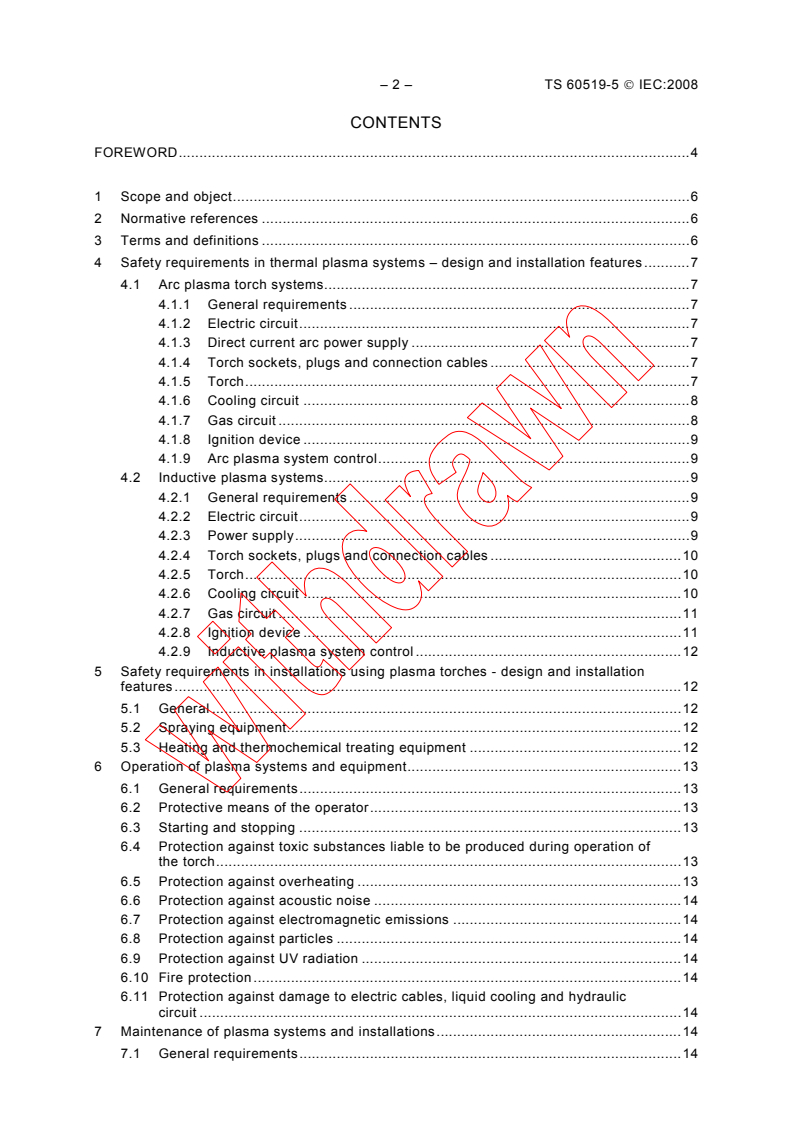
– 2 – TS 60519-5 © IEC:2008
CONTENTS
FOREWORD.4
1 Scope and object.6
2 Normative references .6
3 Terms and definitions .6
4 Safety requirements in thermal plasma systems – design and installation features .7
4.1 Arc plasma torch systems.7
4.1.1 General requirements .7
4.1.2 Electric circuit.7
4.1.3 Direct current arc power supply .7
4.1.4 Torch sockets, plugs and connection cables .7
4.1.5 Torch.7
4.1.6 Cooling circuit .8
4.1.7 Gas circuit .8
4.1.8 Ignition device .9
4.1.9 Arc plasma system control.9
4.2 Inductive plasma systems.9
4.2.1 General requirements .9
4.2.2 Electric circuit.9
4.2.3 Power supply.9
4.2.4 Torch sockets, plugs and connection cables .10
4.2.5 Torch.10
4.2.6 Cooling circuit .10
4.2.7 Gas circuit .11
4.2.8 Ignition device .11
4.2.9 Inductive plasma system control .12
5 Safety requirements in installations using plasma torches - design and installation
features.12
5.1 General .12
5.2 Spraying equipment.12
5.3 Heating and thermochemical treating equipment .12
6 Operation of plasma systems and equipment.13
6.1 General requirements.13
6.2 Protective means of the operator.13
6.3 Starting and stopping .13
6.4 Protection against toxic substances liable to be produced during operation of
the torch.13
6.5 Protection against overheating .13
6.6 Protection against acoustic noise .14
6.7 Protection against electromagnetic emissions .14
6.8 Protection against particles .14
6.9 Protection against UV radiation .14
6.10 Fire protection .14
6.11 Protection against damage to electric cables, liquid cooling and hydraulic
circuit .14
7 Maintenance of plasma systems and installations.14
7.1 General requirements.14
TS 60519-5 © IEC:2008 – 3 –
7.2 Specific requirements.14
8 Marking, labelling and technical documentation .14
Annex A (informative) Electromagnetic emission threshold values around the torch
system in operation.15
Bibliography.16
– 4 – TS 60519-5 © IEC:2008
INTERNATIONAL ELECTROTECHNICAL COMMISSION
____________
SAFETY IN ELECTROHEAT INSTALLATIONS –
Part 5: Specifications for safety
in plasma installations
FOREWORD
1) The International Electrotechnical Commission (IEC) is a worldwide organization for standardization comprising
all national electrotechnical committees (IEC National Committees). The object of IEC is to promote
international co-operation on all questions concerning standardization in the electrical and electronic fields. To
this end and in addition to other activities, IEC publishes International Standards, Technical Specifications,
Technical Reports, Publicly Available Specifications (PAS) and Guides (hereafter referred to as “IEC
Publication(s)”). Their preparation is entrusted to technical committees; any IEC National Committee interested
in the subject dealt with may participate in this preparatory work. International, governmental and non-
governmental organizations liaising with the IEC also participate in this preparation. IEC collaborates closely
with the International Organization for Standardization (ISO) in accordance with conditions determined by
agreement between the two organizations.
2) The formal decisions or agreements of IEC on technical matters express, as nearly as possible, an international
consensus of opinion on the relevant subjects since each technical committee has representation from all
interested IEC National Committees.
3) IEC Publications have the form of recommendations for international use and are accepted by IEC National
Committees in that sense. While all reasonable efforts are made to ensure that the technical content of IEC
Publications is accurate, IEC cannot be held responsible for the way in which they are used or for any
misinterpretation by any end user.
4) In order to promote international uniformity, IEC National Committees undertake to apply IEC Publications
transparently to the maximum extent possible in their national and regional publications. Any divergence
between any IEC Publication and the corresponding national or regional publication shall be clearly indicated in
the latter.
5) IEC provides no marking procedure to indicate its approval and cannot be rendered responsible for any
equipment declared to be in conformity with an IEC Publication.
6) All users should ensure that they have the latest edition of this publication.
7) No liability shall attach to IEC or its directors, employees, servants or agents including individual experts and
members of its technical committees and IEC National Committees for any personal injury, property damage or
other damage of any nature whatsoever, whether direct or indirect, or for costs (including legal fees) and
expenses arising out of the publication, use of, or reliance upon, this IEC Publication or any other IEC
Publications.
8) Attention is drawn to the Normative references cited in this publication. Use of the referenced publications is
indispensable for the correct application of this publication.
9) Attention is drawn to the possibility that some of the elements of this IEC Publication may be the subject of
patent rights. IEC shall not be held responsible for identifying any or all such patent rights.
The main task of IEC technical committees is to prepare International Standards. In
exceptional circumstances, a technical committee may propose the publication of a technical
specification when
• the required support cannot be obtained for the publication of an International Standard,
despite repeated efforts, or
• the subject is still under technical development or where, for any other reason, there is the
future but no immediate possibility of an agreement on an International Standard.
Technical specifications are subject to review within three years of publication to decide
whether they can be transformed into International Standards.
IEC 60519-5 which is a technical specification, has been prepared by IEC technical
committee 27: Industrial electroheating equipment.
This first edition of TS cancels and replaces the first edition of International Standard
IEC 60519-5 published in 1980. It constitutes a technical revision.
TS 60519-5 © IEC:2008 – 5 –
The significant changes with respect to the previous edition are as follows:
– the previous edition focused on arc heating means and on spraying applications – this TS
applies to all means of production of thermal plasma, i.e. arc and induction heating, and to
the equipment directly coupled to these means. Applications include both the spraying
plasma process, as well as the heating and/or thermochemical plasma treatment;
– new technical issues, such as those referring to the protection against electromagnetic
emissions have been introduced;
– IEC 60519-1:2003 has been taken into account;
– definitions have been brought into line with the second edition of IEC 60050-841.
This technical specification is to be used in conjunction with IEC 60519-1:2003.
The text of this technical specification is based on the following documents:
Enquiry draft Report on voting
27/579/DTS 27/604A/RVC
Full information on the voting for the approval of this technical specification can be found in
the report on voting indicated in the above table.
This publication has been drafted in accordance with the ISO/IEC Directives, Part 2.
The list of all parts of the IEC 60519 series, under the general title Safety in electroheat
installations, can be found on the IEC website.
The committee has decided that the contents of this publication will remain unchanged until
the maintenance result date indicated on the IEC web site under "http://webstore.iec.ch" in
the data related to the specific publication. At this date, the publication will be
• transformed into an International standard,
• reconfirmed,
• withdrawn,
• replaced by a revised edition, or
• amended.
– 6 – TS 60519-5 © IEC:2008
SAFETY IN ELECTROHEAT INSTALLATIONS –
Part 5: Specifications for safety
in plasma installations
1 Scope and object
This Technical Specification specifies safety requirements applicable to
a) thermal plasma torch systems:
– arc plasma systems,
– inductive plasma systems;
b) installations using plasma torch systems:
– spraying equipment,
– solid, liquid and gaseous charge heating and thermochemical treatment equipment.
For both plasma torch systems and installations using plasma torch systems, this
specification determines safety requirements for all components, including the electrical
equipment, the cooling circuits, the gas supply circuits, the furnace or reactor and more
generally, all other equipment associated with the use of the furnace or reactor.
Safety and construction requirements for plasma torches for welding, cutting and allied
processes are specified in IEC 60974-7.
2 Normative references
The following referenced documents are indispensable for the application of this document.
For dated references, only the edition cited applies. For undated references, the latest edition
of the referenced document (including any amendments) applies.
IEC 60050-841:2004, International Electrotechnical Vocabulary – Part 841: Industrial
electroheat
IEC 60519-1:2003, Safety in electroheat installations – Part 1: General requirements
IEC/TS 60680, Test methods of plasma equipment for electroheat and electrochemical
applications
CISPR 11, Industrial, scientific and medical (ISM) radio-frequency equipment –
Electromagnetic disturbance characteristics – Limits and methods of measurement
3 Terms and definitions
For the purposes of this document, the terms and definitions given in IEC 60050-841,
IEC 60519-1 and IEC/TS 60680 apply.
TS 60519-5 © IEC:2008 – 7 –
4 Safety requirements in thermal plasma systems – design and installation
features
4.1 Arc plasma torch systems
4.1.1 General requirements
See IEC 60519-1.
4.1.2 Electric circuit
See IEC 60519-1, Clause 6. In addition, 6.4.1 of IEC 60519-1 applies to the complete
installation.
4.1.3 Direct current arc power supply
The following specific requirements apply to systems with d.c. arc power supply.
4.1.3.1 Power supply grounding
One pole (positive or negative, depending on the torch polarity), on the d.c. side of the arc
power supply, shall be grounded using a separated earth from the main one of the system, so
as to avoid possible leakage currents towards electrical circuits such as those used for the
torch control.
4.1.3.2 Connection of the power supply to the torch
When the torch is off, the cables on the d.c. side shall be grounded through an earth
grounding switch, so as to safely handle the torch.
A specific procedure shall be performed before the arc ignition, through a manual
locking/unlocking device (generally operated with safety keys), authorizing in particular the
main breaker to be online and the earth grounding switch to be in the off position. Moreover, a
final clearance key may be used by the operator to start the ignition sequence. This procedure
shall meet the regulations in force in the country where the equipment is to be installed.
4.1.4 Torch sockets, plugs and connection cables
See IEC 60519-1, Clause 8.
4.1.5 Torch
An arc plasma torch of any design has the following characteristic features: a high
temperature gas, high voltage (in general) and liquid cooling (generally water). Consequently,
the design and construction shall satisfy the following criteria for safe operation:
a) electrical features:
– permanent electrical contact, during operation, between parts designed to be at the
same voltage, including the clamping of electrodes and pieces to be earth grounded, to
avoid overheating;
– for a high voltage torch, automatic shut down of the torch in case the leakage current
through the torch body excesses 10 mA;
– permanent electrical insulation between pieces to be brought to different voltages (and
specifically between the electrodes), so that no unintended breakdown can occur
under normal operating conditions;
b) cooling liquid features:
– 8 – TS 60519-5 © IEC:2008
– cooling liquid resistivity and torch circuit designed to maintain, during operation, the
required insulation between pieces to be brought to different voltages, and specifically
the electrodes;
– in case of electrode break through (accidental or normal wear), the phenomenon shall
remain under control firstly through the electrode material and/or design, secondly by
its detection to shut down the torch.
4.1.6 Cooling circuit
The following specific requirements apply to the cooling utilities:
a) mechanical features:
– the cooling liquid hoses of the torch, fixed or hand operated, shall have a sufficient
length, flexibility and appropriate radius of curvature (if any), so as to be facing the
stresses generated by the cooling liquid high pressure and to allow handling of the
particular hand operated torch;
– taking into account the high pressure necessary to obtain the specified mass flow rate
in the hoses, their mechanical strength shall not be appreciably affected by accidental
or steady state exposure to hot particles (hot material from a furnace) or thermal
heating from the torch itself or from hot material coming out from the process;
– if the direction of the cooling liquid flow is important, it shall be indicated by arrows
and/or colour codes on the connecting fittings of the torch and hoses. Non-
interchangeable couplers shall be used;
– the torch cooling liquid hoses, pipes and fittings shall remain liquid tight in the event of
liquid hammer or blocking during operation at the specified mass flow rate, taking into
account also the effects of heat on the hoses, also possibly due to radiation and ultra
violet radiation;
– flexing at the coupling of the cooling liquid inlets and outlets to the torch shall be
minimized as far as possible at the torch body and the couplings be provided at least
with a basic insulation to reduce the possibility of electrical breakdown within the torch
body;
b) electrical features:
– for the high-voltage torch, the hoses shall be made of insulated material, with length
defined to limit the leakage current to a value below 10 mA;
– the torch shall be electrically shut down when the cooling circuit is disconnected or
when the flow rate is below that specified;
– the operator shall have access to the cooling circuit control and monitoring devices, to
be able to read their indications and take necessary steps when required.
4.1.7 Gas circuit
The following specific requirements apply to the gas utilities:
a) general features:
– safety rules for the use of industrial gas in high pressure tanks, taking account of the
work regulations in force in the country where the equipment is to be installed;
b) mechanical features:
– the gas hoses of installations, fixed or hand operated, shall have a sufficient length,
flexibility and appropriate radius of curvature (if any), so as to sustain the constraints
generated by the gas high pressure and to allow handling in the case of hand-operated
torch;
– the gas admission hose(s) shall be so designed as to withstand the pressure required
to obtain the specified mass flow rate, which shall not be appreciably diminished by
accidental or steady-state exposure to hot particles or hot material. Their resistance to
heat and ultra violet radiation under normal operating conditions shall meet the
requirements;
TS 60519-5 © IEC:2008 – 9 –
– the fastening of gas hose(s) and pipes to the connecting fittings shall withstand the
gas pressure occurring in the event of circuit blockage;
c) electrical features:
– for the high-voltage torch, the hose(s) shall be made of insulated material, with length
defined to limit the leakage current to a value below 10 mA;
– a safety device shall prevent the ignition of the torch when the gas circuit is shut off or
when the minimum mass flow rate specified by the torch manufacturer is not reached;
– the operator shall have access to the gas circuit control and monitoring devices, to
read their indications when desired;
d) other features:
– the compressed gas containers installed close to the place of use of the plasma torch
shall be protected against possible overheating, electric discharges and ejections of
incandescent material. Similar precautions shall be taken for portable compressed gas
containers.
4.1.8 Ignition device
The following specific requirements apply to ignition devices:
a) high-frequency ignition device:
– protection against high voltage, in agreement with the regulations in force in the
country where the equipment is to be installed;
b) short-circuit ignition device:
– in general, a high-pressure hydraulic cylinder is used to move the device. The
requirements, as defined for the cooling liquid circuit, apply to this device;
– non-flammable and biodegradable hydraulic liquid shall be used.
NOTE The ignition device can be the main source of electromagnetic emissions.
4.1.9 Arc plasma system control
For safety purpose, several emergency push buttons shall be available to shut off the plasma
system, through a wired circuit.
4.2 Inductive plasma systems
4.2.1 General requirements
See IEC 60519-1.
4.2.2 Electric circuit
See IEC 60519-1, Clause 6. In addition, 6.4.1 of IEC 60519-1 applies to the complete
installation.
4.2.3 Power supply
4.2.3.1 Power supply grounding
The power supply shall be grounded using a separate earth from the main one of the system,
so as to avoid possible paths for leakage currents such as those created by the torch control
circuits.
4.2.3.2 Connection of the power supply to the torch
The following shall be taken into account:
– 10 – TS 60519-5 © IEC:2008
a) the torch shall be enclosed inside a Faraday cage to reduce electromagnetic emission and
to prevent the operator to get into contact with the high voltage terminals. An interlock
signal shall turn off the high voltage if the torch enclosure is opened;
b) the high voltage terminals shall be connected to earth to relieve the residual charge
potentially stored in the capacitors when the torch enclosure or Faraday cage is opened or
if the RF generator is shut down (see 6.2.4 of IEC 60519-1).
4.2.4 Torch sockets, plugs and connection cables
The following shall be taken in to account:
– the electrical terminal leads shall be positioned at a sufficient distance from each other
and earth to avoid arcing;
– 6.6 of IEC 60519-1 applies if usage of a water cooled electrical conductor is required;
– the tensile stresses and tight bending radius of the conductors shall be avoided.
4.2.5 Torch
An induction plasma torch, of any design has the following characteristic features: a high
temperature gas, high voltage (in general) and liquid cooling (generally water). Consequently,
the design and construction shall satisfy the following criteria for safe operation:
a) electrical features:
– permanent electrical contact, during operation, between parts designed to be at the
same voltage;
– no ferro-magnetic metal shall be used in the construction of the torch or inside the
Faraday cage;
– the induction coil shall be adequately insulated from the body of the torch or the
Faraday cage;
b) cooling liquid features:
– the cooling circuit design and the cooling liquid resistivity shall guarantee the required
insulation during operation;
– cooling liquid of the torch circuit shall be prevented from entering inside the torch
cavity. In case of a leak inside the torch cavity while in operation (accidental or normal
wear), the accident shall remain under control;
– 6.6 of IEC 60519-1 applies.
4.2.6 Cooling circuit
The following specific requirements apply to the cooling utilities:
a) mechanical features:
– the cooling hoses connected to the torch shall be manufactured of a non-conductive
and non-ferro-magnetic material;
– if the direction of the cooling liquid flow is important, it shall be indicated by arrows
and/or colour codes on the connecting fittings of the torch and hoses. Non-
interchangeable couplers shall be used;
– the torch cooling liquid hoses, piping and fitting shall remain tight in the event of liquid
hammer or blocking during operation at the specified mass flow rate, taking into
account also the effects of heat on the hoses, also possibly due to radiation and ultra
violet radiation;
b) electrical features:
– 6.6 of IEC 60519-1 applies;
– the hoses shall be of appropriate length to limit the leakage current;
TS 60519-5 © IEC:2008 – 11 –
– the electrical power supply for the torch shall be automatically interrupted when the
torch cooling mass flow rate is below a specified safe level and/or the temperature
exceeds a specified safe level;
– the operator shall have access to the cooling circuit control and monitoring devices, to
read their indications and take necessary steps when required.
4.2.7 Gas circuit
The following specific requirements apply to the gas utilities:
a) general features:
– safety rules for the use of industrial gas in high pressure tanks, taking account of the
work regulations in force in the country where the equipment is to be installed;
b) mechanical features:
– the gas hoses of the installations shall have a sufficient length, flexibility and
appropriate radius of curvature (if any), so as to sustain the constraints generated by
the gas high pressure;
– the gas admission hose(s) shall be designed as to withstand the pressure required to
obtain the specified mass flow rate, which shall not be appreciably diminished by
accidental or steady-state exposure to hot particles or hot material. Their resistance to
heat and ultra violet radiation shall meet the requirements under normal operating
conditions;
– the fastening of gas hose(s) and pipes to the connecting fittings shall withstand the
gas pressure occurring in the event of circuit blockage;
c) electrical features:
– the hose(s) shall be made of insulated material, with appropriate length to limit the
leakage current;
– the hose(s) shall be made of a non-ferro-magnetic material to prevent electromagnetic
coupling;
– a safety device shall prevent the ignition of the torch when the gas circuit is shut off or
when the minimum gas flow rate specified by the torch manufacturer is not reached;
– the operator shall have access to the gas circuit control and monitoring devices, to
read their indications when desired;
d) other features:
– the compressed gas containers installed close to the place of use of the plasma torch
shall be protected against possible overheating, electric discharges and ejections of
incandescent material. Similar precautions shall be taken for portable compressed gas
containers.
4.2.8 Ignition device
The following specific requirements apply to ignition devices:
a) high-frequency ignition device:
– protection against high voltage, in agreement with the regulations in force in the
country where the equipment is to be installed;
– direct contact with live parts shall be strictly prevented. The device shall be operated
only by telemanipulators providing adequate electrical insulation;
b) discharge rod igniter:
– direct contact with live parts shall strictly be prevented. The device shall be operated
only by telemanipulators providing adequate electrical insulation;
c) vacuum ignition:
– 12 – TS 60519-5 © IEC:2008
– torch and vessel shall be designed to resist pressure of 1 bar below atmospheric
pressure. In the case of external overpressure, the design shall take into account the
increased pressure load.
NOTE The ignition device can be the main source of electromagnetic emissions.
4.2.9 Inductive plasma system control
The emergency push buttons shall shut off the plasma system, through the wired circuit.
5 Safety requirements in installations using plasma torches – design and
installation features
5.1 General
Installations using plasma torches comprise two categories according to their applications (as
in IEC 60680):
– spraying equipment;
– solid, liquid and gaseous charge heating and thermochemical treatment equipment.
The first group of applications refers to the use of the plasma without any furnace or reactor,
and consequently the safety requirements applicable are mainly those of the plasma torch
system. However, several additional requirements are specified in 5.2.
The second group of applications refers to the use of plasma with a furnace or reactor fed
with the material to be treated and supplied with the plasma. In this case, several additional
requirements apply as specified in 5.3.
5.2 Spraying equipment
See 4.1 and/or 4.2.
In addition, the wire or powder distributor shall comply with regulations and requirements in
force as regards:
– electrical connection,
– connection to a gas-circuit pressure (carrier gas),
– connection to the torch.
When using transferred plasma, the surface to be sprayed shall be grounded to avoid any
accessible voltage carrying part.
5.3 Heating and thermochemical treating equipment
See 4.1 and/or 4.2.
In addition:
– 4.1.1 and partially 4.1.6 apply to the furnace and/or reactor,
– the furnace metallic envelope shall be grounded to avoid any accessible voltage carrying
part,
– the toxic substances to be taken into account are not only those which can be produced by
the torch but also those resulting from the decomposition or transformation of the fed
materials due to plasma interaction,
– the explosion risks shall also be taken into account, following the regulations in force in
the country where the equipment is to be installed.
TS 60519-5 © IEC:2008 – 13 –
6 Operation of plasma systems and equipment
6.1 General requirements
See IEC 60519-1.
In addition, during operation of plasma systems and equipment, the working conditions of
operators shall be in accordance with work safety regulations in force in the country where the
equipment is to be installed (related to high-voltage protection, acoustic noise, toxic
discharges, temperature rise, etc.).
6.2 Protective means of the operator
Operators of plasma systems and equipment shall wear protective means adapted to the type
of work performed: apron, gloves, insulating face shield to protect especially the eyes against
heat, glare, ultra-violet and infrared radiation, appropriate insulating footwear.
In addition, they shall use suitable means such as ear protectors to protect themselves
against acoustic noise.
Workers in the vicinity shall also be protected by effective screening of the work place.
6.3 Starting and stopping
The necessary sequence to start and stop plasma systems and equipment shall be performed
in an order ensuring safe working. In particular, the cooling liquid flow and the gas supply
shall be adjusted before ignition of the torch.
Cooling and gas supply shall not be interrupted during operation and shall be maintained for a
necessary period after the power is shut off.
A control unit shall ensure the starting, steady state and stopping, the whole sequence in the
correct order.
The wired circuit is activated in case of error or in emergency situations (one of them being to
use an emergency push button), to shut off the high voltage.
6.4 Protection against toxic substances liable to be produced during operation of the
torch
If the use of a plasma torch gives rise to the creation of toxic compounds, these shall be
evacuated in a suitable way (for instance filtration, dilution or chemical treatment), to give a
concentration of compounds below the specified threshold limit in the operator’s breathing
zone, according to the regulations in force in the country where the equipment is to be
installed.
In particular, specific gas detectors shall be installed to check the atmosphere in the zone
where the operators are at work. Moreover, evacuation paths shall be defined and marked.
In addition, when the plasma is discharged to the atmosphere, the torch shall be inside a
specific cabinet or inside a danger delimited area. People working on the site shall be outside
this cabinet or area when the torch is in operation.
NOTE The protection applies when the plasma gas itself is a toxic substance, for instance carbon monoxide.
6.5 Protection against overheating
For hand-operated torches, no part of the torch intended to be handled during operation shall
reach a temperature likely to expose the operator to danger.
– 14 – TS 60519-5 © IEC:2008
For fixed torches, parts defined as being at high temperature shall be inaccessible to the
operators.
6.6 Protection against acoustic noise
In addition to the ear protectors of the operators, acoustic noise shall comply with the
regulations in force for other people working on the same site. Consequently, specifically
when the plasma flow is discharged to the atmosphere, the torch shall be surrounded by a
protection, leaving the plasma flow to be developed and reducing the acoustic noise so that it
complies with the regulations in force in the country where the equipment is to be installed.
6.7 Protection against electromagnetic emissions
Electromagnetic emissions shall comply with the provisions of CISPR 11. In addition, the
electromagnetic field at the operator's normal workplace shall comply with the regulations in
the country where the equipment is to be installed (see also Annex A).
6.8 Protection against particles
Where applications can release particles to the open atmosphere, such as spraying and the
treatment or production of particles, a specific protection is required according to the
regulations in force in the country where the equipment is to be installed.
6.9 Protection against UV radiation
UV radiation, coming from the plasma flows or even directly from the arc requires eye and
skin protectors for the operators. More generally, protection against UV radiation shall comply
with the regulations in force in the country where the equipment is to be installed.
6.10 Fire protection
Requirements, according to the regulations in force in the country where the equipment is to
be installed, apply.
6.11 Protection against damage to electric cables, liquid cooling and hydraulic circuits
All connections, in particular those near the torch, shall be either protected against
overheating and fire, or located in a way they cannot suffer such damages. For hand-operated
torches, these cables, hoses and pipes shall be in particular protected against damage
caused by ejection of hot particles or by being trodden on.
7 Maintenance of plasma systems and installations
7.1 General requirements
See IEC 60519-1.
7.2 Specific requirements
In order to ensure safe working conditions, corrective and preventive maintenance work shall
be carried out, in agreement with the manufacturer. It may include daily checks as well as
major maintenance, for example once a year, of the whole system.
8 Marking, labelling and technical documentation
See IEC 60519-1, Clause 15.
TS 60519-5 © IEC:2008 – 15 –
Annex A
(informative)
Electromagnetic emission threshold values
around the torch system in operation
The minimum health and safety requirements regarding the exposure of workers to the risks
arising from electromagnetic fields are contained in Directive 2004/40/CE. The threshold
values, triggering corrective actions, are specified in Table 2 of the Directive.
The frequency range covered is from 0 Hz to 300 GHz. For the f frequency range from 1 MHz
to 10 MHz, the limit values are as follows (f expressed in MHz):
• electric field strength E (V/m): 610/f;
• magnetic field strength H (A/m): 1,6/f;
• magnetic flux density B (μT): 2/f;
(mA): 40.
• contact current I
c
– 16 – TS 60519-5 © IEC:2008
Bibliography
IEC 60974-7: Arc welding equipment – Part 7: Torches
Directive 2004/40/EC of the European Parliament and of the Council of 29 April 2004 on the
minimum health and safety requirements regarding the exposure of workers to the risks
arising from physical agents (electromagnetic fields)
___________
___________
The Directive is available at http://eur-lex.europa.eu/en/index.htm
– 18 – TS 60519-5 © CEI:2008
SOMMAIRE
AVANT-PROPOS.20
1 Domaine d'application et objet.22
2 Références normatives.22
3 Termes et définitions .22
4 Exigences de sécurité dans les systèmes plasma thermique – caractéristiques de
conception et d'installation .23
4.1 Systèmes de torche plasma d’arc .23
4.1.1 Exigences générales .23
4.1.2 Circuit électrique .23
4.1.3 Alimentation à courant continu.23
4.1.4 Supports de connexion, fiches de prises de courant et câbles de
raccordement d'une torche .23
4.1.5 Torche.23
4.1.6 Circuit de refroidissement.24
4.1.7 Circuit d’alimentation en gaz.24
4.1.8 Dispositif d'amorçage .25
4.1.9 Commande du système plasma d’arc .25
4.2 Sy
...