

IEC 60793-1-33:2017
(Main)Optical fibres - Part 1-33: Measurement methods and test procedures - Stress corrosion susceptibility
General Information
- Abstract
IEC 60793-1-33:2017 contains descriptions of the five main test methods for the determination of stress corrosion susceptibility parameters. The object of this document is to establish uniform requirements for the mechanical characteristic of stress corrosion susceptibility for silica-based fibres. Dynamic fatigue and static fatigue tests are used to determine the (dynamic) nd value and (static) ns value of stress corrosion susceptibility parameters. Currently, only the nd-value is assessed against specification. Measured values greater than 18 per this procedure reflect the nd-value of silica, which is approximately 20. Higher values will not translate to demonstrable enhanced fatigue resistance. Silica fibre mechanical tests determine the fracture stress and fatigue properties under conditions that model the practical applications as closely as possible. The following test methods are used for determining stress corrosion susceptibility:
A: Dynamic nd value by axial tension;
B: Dynamic nd value by two-point bending;
C: Static ns value by axial tension;
D: Static ns value by two-point bending;
E: Static ns value by uniform bending.
These methods are appropriate for category A1, A2 and A3 multimode, class B single-mode fibres and class C intraconnecting single-mode fibres. These tests provide values of the stress corrosion parameter, n, that can be used for reliability calculations according to IEC TR 62048. Information common to all methods is contained in Clauses 1 to 10, and information pertaining to each individual test method appears in Annexes A, B, C, D, and E. Annexes F and G offer considerations for dynamic and static stress corrosion susceptibility parameter calculations, respectively; Annex H offers considerations on the different stress corrosion susceptibility parameter test methods. This second edition cancels and replaces the first edition published in 2001. It constitutes a technical revision. This edition includes the following significant technical changes with respect to the previous edition: removal of RTM; changes to scope.
- Status
- Published
- Publication Date
- 15-Aug-2017
- Technical Committee
- SC 86A - Fibres and cables
- Drafting Committee
- WG 1 - TC 86/SC 86A/WG 1
- Current Stage
- PPUB - Publication issued
- Start Date
- 16-Aug-2017
- Completion Date
- 16-Sep-2017
Overview
IEC 60793-1-33:2017 is an international standard from the International Electrotechnical Commission (IEC) that specifies measurement methods and test procedures for assessing the stress corrosion susceptibility of silica-based optical fibres. This standard aims to establish uniform requirements for evaluating the mechanical characteristics related to the durability and reliability of optical fibres under stress-induced corrosion.
Silica fibres, used extensively in telecommunications and data transmission, must withstand various mechanical stresses over their service life. Understanding their stress corrosion susceptibility is crucial to ensuring long-term performance and safety. IEC 60793-1-33:2017 provides five main test methods to determine critical parameters that indicate how susceptible optical fibres are to stress corrosion, particularly focusing on dynamic and static fatigue.
Key Topics Covered
Stress Corrosion Susceptibility Parameters:
Defines the parameters nd (dynamic) and ns (static) that characterize how optical fibres degrade mechanically due to stress corrosion over time.Five Main Test Methods:
The document outlines standard procedures for:- Dynamic nd value by axial tension
- Dynamic nd value by two-point bending
- Static ns value by axial tension
- Static ns value by two-point bending
- Static ns value by uniform bending
Testing Applicability:
These methods are appropriate for category A1, A2, A3 multimode fibres, class B single-mode fibres, and class C intraconnecting single-mode fibres.Mechanical Properties Measured:
Tests focus on determining fracture stress and fatigue properties in conditions that simulate practical applications.Parameter Assessment:
The nd-value is typically assessed against specifications, with values greater than 18 considered indicative of silica’s typical characteristics.Calculation Methods:
The standard includes detailed formulas and numerical algorithms for calculating stress corrosion parameters to support reliability calculations per IEC TR 62048.Annexes for Procedures and Calculations:
Normative annexes describe apparatus, sampling, sample preparation, testing procedures, and calculations for each test method while informative annexes provide additional considerations on parameter calculations and test method comparisons.
Applications
Optical Fibre Manufacturing:
Assists manufacturers in quality control by providing standardized test methods to assess fibre durability and predict lifetime under mechanical stress.Reliability Engineering:
Enables engineers to estimate the fatigue resistance and stress corrosion susceptibility of fibre optic cables for telecommunications, data centers, and industrial networks.Product Specifications:
Provides a common framework for specifying mechanical performance criteria related to stress corrosion, enabling harmonized supplier and customer agreements.Research and Development:
Facilitates the development of new fibre designs with improved resistance to stress corrosion by providing reliable measurement techniques.Installation and Maintenance:
Supports assessing fibre condition and performance potential in field applications where mechanical stress and environmental factors may induce corrosion-related failures.
Related Standards
IEC 60793 Series:
The umbrella series defining general requirements, test methods, and performance criteria for optical fibres, including mode classification and other mechanical properties.IEC TR 62048:
A technical report recommending procedures for reliability calculations of optical fibres based on stress corrosion susceptibility parameters.Other International Standards on Optical Fibre Testing:
Complementary standards detailing optical, geometrical, and environmental tests for fibres.
Summary
IEC 60793-1-33:2017 delivers comprehensive, standardized methods for evaluating the mechanical stress corrosion susceptibility of silica-based optical fibres. By clearly defining test procedures, apparatus requirements, and calculation methodologies, this standard plays a vital role in ensuring fibre reliability, supporting product development, and maintaining quality assurance in the optical fibre industry. Compliance with IEC 60793-1-33:2017 enables consistent assessment and comparison of fibre durability, which is essential for optimizing performance in telecom networks and other optical communication infrastructures.
Keywords: IEC 60793-1-33, optical fibre stress corrosion, optical fibre testing, stress corrosion susceptibility, silica fibre fatigue, dynamic fatigue test, static fatigue test, optical fibre reliability, optical fibre mechanical properties, IEC optical fibre standards.
Relations
- Effective Date
- 05-Sep-2023
Get Certified
Connect with accredited certification bodies for this standard

ANCE
Mexican certification and testing association.

Intertek Slovenia
Intertek testing, inspection, and certification services in Slovenia.

LNE (Laboratoire National de Métrologie et d'Essais)
French national laboratory for metrology and testing.
Sponsored listings
Frequently Asked Questions
IEC 60793-1-33:2017 is a standard published by the International Electrotechnical Commission (IEC). Its full title is "Optical fibres - Part 1-33: Measurement methods and test procedures - Stress corrosion susceptibility". This standard covers: IEC 60793-1-33:2017 contains descriptions of the five main test methods for the determination of stress corrosion susceptibility parameters. The object of this document is to establish uniform requirements for the mechanical characteristic of stress corrosion susceptibility for silica-based fibres. Dynamic fatigue and static fatigue tests are used to determine the (dynamic) nd value and (static) ns value of stress corrosion susceptibility parameters. Currently, only the nd-value is assessed against specification. Measured values greater than 18 per this procedure reflect the nd-value of silica, which is approximately 20. Higher values will not translate to demonstrable enhanced fatigue resistance. Silica fibre mechanical tests determine the fracture stress and fatigue properties under conditions that model the practical applications as closely as possible. The following test methods are used for determining stress corrosion susceptibility: A: Dynamic nd value by axial tension; B: Dynamic nd value by two-point bending; C: Static ns value by axial tension; D: Static ns value by two-point bending; E: Static ns value by uniform bending. These methods are appropriate for category A1, A2 and A3 multimode, class B single-mode fibres and class C intraconnecting single-mode fibres. These tests provide values of the stress corrosion parameter, n, that can be used for reliability calculations according to IEC TR 62048. Information common to all methods is contained in Clauses 1 to 10, and information pertaining to each individual test method appears in Annexes A, B, C, D, and E. Annexes F and G offer considerations for dynamic and static stress corrosion susceptibility parameter calculations, respectively; Annex H offers considerations on the different stress corrosion susceptibility parameter test methods. This second edition cancels and replaces the first edition published in 2001. It constitutes a technical revision. This edition includes the following significant technical changes with respect to the previous edition: removal of RTM; changes to scope.
IEC 60793-1-33:2017 contains descriptions of the five main test methods for the determination of stress corrosion susceptibility parameters. The object of this document is to establish uniform requirements for the mechanical characteristic of stress corrosion susceptibility for silica-based fibres. Dynamic fatigue and static fatigue tests are used to determine the (dynamic) nd value and (static) ns value of stress corrosion susceptibility parameters. Currently, only the nd-value is assessed against specification. Measured values greater than 18 per this procedure reflect the nd-value of silica, which is approximately 20. Higher values will not translate to demonstrable enhanced fatigue resistance. Silica fibre mechanical tests determine the fracture stress and fatigue properties under conditions that model the practical applications as closely as possible. The following test methods are used for determining stress corrosion susceptibility: A: Dynamic nd value by axial tension; B: Dynamic nd value by two-point bending; C: Static ns value by axial tension; D: Static ns value by two-point bending; E: Static ns value by uniform bending. These methods are appropriate for category A1, A2 and A3 multimode, class B single-mode fibres and class C intraconnecting single-mode fibres. These tests provide values of the stress corrosion parameter, n, that can be used for reliability calculations according to IEC TR 62048. Information common to all methods is contained in Clauses 1 to 10, and information pertaining to each individual test method appears in Annexes A, B, C, D, and E. Annexes F and G offer considerations for dynamic and static stress corrosion susceptibility parameter calculations, respectively; Annex H offers considerations on the different stress corrosion susceptibility parameter test methods. This second edition cancels and replaces the first edition published in 2001. It constitutes a technical revision. This edition includes the following significant technical changes with respect to the previous edition: removal of RTM; changes to scope.
IEC 60793-1-33:2017 is classified under the following ICS (International Classification for Standards) categories: 33.180.10 - Fibres and cables. The ICS classification helps identify the subject area and facilitates finding related standards.
IEC 60793-1-33:2017 has the following relationships with other standards: It is inter standard links to IEC 60793-1-33:2001. Understanding these relationships helps ensure you are using the most current and applicable version of the standard.
IEC 60793-1-33:2017 is available in PDF format for immediate download after purchase. The document can be added to your cart and obtained through the secure checkout process. Digital delivery ensures instant access to the complete standard document.
Standards Content (Sample)
IEC 60793-1-33 ®
Edition 2.0 2017-08
INTERNATIONAL
STANDARD
NORME
INTERNATIONALE
colour
inside
Optical fibres –
Part 1-33: Measurement methods and test procedures – Stress corrosion
susceptibility
Fibres optiques –
Partie 1-33: Méthodes de mesures et procédures d'essai – Résistance à la
corrosion sous contrainte
All rights reserved. Unless otherwise specified, no part of this publication may be reproduced or utilized in any form
or by any means, electronic or mechanical, including photocopying and microfilm, without permission in writing from
either IEC or IEC's member National Committee in the country of the requester. If you have any questions about IEC
copyright or have an enquiry about obtaining additional rights to this publication, please contact the address below or
your local IEC member National Committee for further information.
Droits de reproduction réservés. Sauf indication contraire, aucune partie de cette publication ne peut être reproduite
ni utilisée sous quelque forme que ce soit et par aucun procédé, électronique ou mécanique, y compris la photocopie
et les microfilms, sans l'accord écrit de l'IEC ou du Comité national de l'IEC du pays du demandeur. Si vous avez des
questions sur le copyright de l'IEC ou si vous désirez obtenir des droits supplémentaires sur cette publication, utilisez
les coordonnées ci-après ou contactez le Comité national de l'IEC de votre pays de résidence.
IEC Central Office Tel.: +41 22 919 02 11
3, rue de Varembé Fax: +41 22 919 03 00
CH-1211 Geneva 20 info@iec.ch
Switzerland www.iec.ch
About the IEC
The International Electrotechnical Commission (IEC) is the leading global organization that prepares and publishes
International Standards for all electrical, electronic and related technologies.
About IEC publications
The technical content of IEC publications is kept under constant review by the IEC. Please make sure that you have the
latest edition, a corrigenda or an amendment might have been published.
IEC Catalogue - webstore.iec.ch/catalogue Electropedia - www.electropedia.org
The stand-alone application for consulting the entire The world's leading online dictionary of electronic and
bibliographical information on IEC International Standards, electrical terms containing 20 000 terms and definitions in
Technical Specifications, Technical Reports and other English and French, with equivalent terms in 16 additional
documents. Available for PC, Mac OS, Android Tablets and languages. Also known as the International Electrotechnical
iPad. Vocabulary (IEV) online.
IEC publications search - www.iec.ch/searchpub IEC Glossary - std.iec.ch/glossary
The advanced search enables to find IEC publications by a 65 000 electrotechnical terminology entries in English and
variety of criteria (reference number, text, technical French extracted from the Terms and Definitions clause of
committee,…). It also gives information on projects, replaced IEC publications issued since 2002. Some entries have been
and withdrawn publications. collected from earlier publications of IEC TC 37, 77, 86 and
CISPR.
IEC Just Published - webstore.iec.ch/justpublished
Stay up to date on all new IEC publications. Just Published IEC Customer Service Centre - webstore.iec.ch/csc
details all new publications released. Available online and If you wish to give us your feedback on this publication or
also once a month by email. need further assistance, please contact the Customer Service
Centre: csc@iec.ch.
A propos de l'IEC
La Commission Electrotechnique Internationale (IEC) est la première organisation mondiale qui élabore et publie des
Normes internationales pour tout ce qui a trait à l'électricité, à l'électronique et aux technologies apparentées.
A propos des publications IEC
Le contenu technique des publications IEC est constamment revu. Veuillez vous assurer que vous possédez l’édition la
plus récente, un corrigendum ou amendement peut avoir été publié.
Catalogue IEC - webstore.iec.ch/catalogue Electropedia - www.electropedia.org
Application autonome pour consulter tous les renseignements
Le premier dictionnaire en ligne de termes électroniques et
bibliographiques sur les Normes internationales,
électriques. Il contient 20 000 termes et définitions en anglais
Spécifications techniques, Rapports techniques et autres
et en français, ainsi que les termes équivalents dans 16
documents de l'IEC. Disponible pour PC, Mac OS, tablettes
langues additionnelles. Egalement appelé Vocabulaire
Android et iPad.
Electrotechnique International (IEV) en ligne.
Recherche de publications IEC - www.iec.ch/searchpub
Glossaire IEC - std.iec.ch/glossary
65 000 entrées terminologiques électrotechniques, en anglais
La recherche avancée permet de trouver des publications IEC
en utilisant différents critères (numéro de référence, texte, et en français, extraites des articles Termes et Définitions des
comité d’études,…). Elle donne aussi des informations sur les publications IEC parues depuis 2002. Plus certaines entrées
projets et les publications remplacées ou retirées. antérieures extraites des publications des CE 37, 77, 86 et
CISPR de l'IEC.
IEC Just Published - webstore.iec.ch/justpublished
Service Clients - webstore.iec.ch/csc
Restez informé sur les nouvelles publications IEC. Just
Published détaille les nouvelles publications parues. Si vous désirez nous donner des commentaires sur cette
Disponible en ligne et aussi une fois par mois par email. publication ou si vous avez des questions contactez-nous:
csc@iec.ch.
IEC 60793-1-33 ®
Edition 2.0 2017-08
INTERNATIONAL
STANDARD
NORME
INTERNATIONALE
colour
inside
Optical fibres –
Part 1-33: Measurement methods and test procedures – Stress corrosion
susceptibility
Fibres optiques –
Partie 1-33: Méthodes de mesures et procédures d'essai – Résistance à la
corrosion sous contrainte
INTERNATIONAL
ELECTROTECHNICAL
COMMISSION
COMMISSION
ELECTROTECHNIQUE
INTERNATIONALE
ICS 33.180.10 ISBN 978-2-8322-4736-5
– 2 – IEC 60793-1-33:2017 © IEC 2017
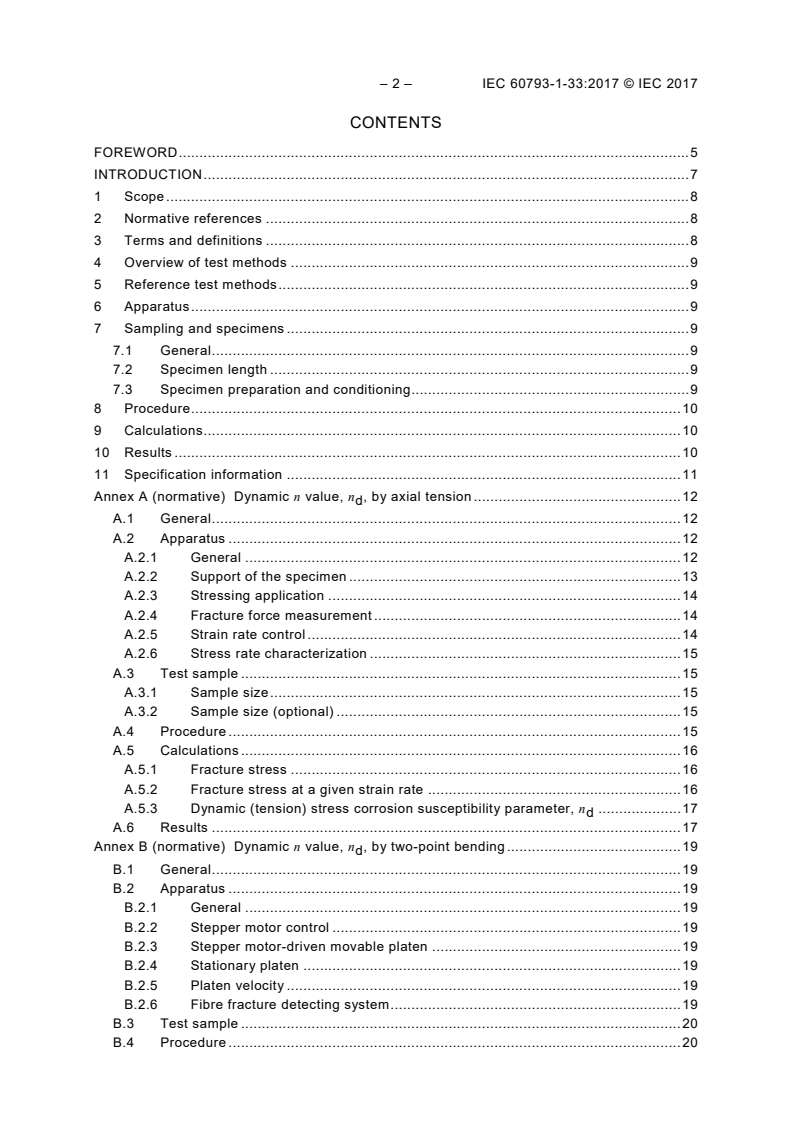
CONTENTS
FOREWORD . 5
INTRODUCTION . 7
1 Scope . 8
2 Normative references . 8
3 Terms and definitions . 8
4 Overview of test methods . 9
5 Reference test methods . 9
6 Apparatus . 9
7 Sampling and specimens . 9
7.1 General . 9
7.2 Specimen length . 9
7.3 Specimen preparation and conditioning . 9
8 Procedure . 10
9 Calculations . 10
10 Results . 10
11 Specification information . 11
Annex A (normative) Dynamic n value, n , by axial tension . 12
d
A.1 General . 12
A.2 Apparatus . 12
A.2.1 General . 12
A.2.2 Support of the specimen . 13
A.2.3 Stressing application . 14
A.2.4 Fracture force measurement . 14
A.2.5 Strain rate control . 14
A.2.6 Stress rate characterization . 15
A.3 Test sample . 15
A.3.1 Sample size . 15
A.3.2 Sample size (optional) . 15
A.4 Procedure . 15
A.5 Calculations . 16
A.5.1 Fracture stress . 16
A.5.2 Fracture stress at a given strain rate . 16
A.5.3 Dynamic (tension) stress corrosion susceptibility parameter, n . 17
d
A.6 Results . 17
Annex B (normative) Dynamic n value, n , by two-point bending . 19
d
B.1 General . 19
B.2 Apparatus . 19
B.2.1 General . 19
B.2.2 Stepper motor control . 19
B.2.3 Stepper motor-driven movable platen . 19
B.2.4 Stationary platen . 19
B.2.5 Platen velocity . 19
B.2.6 Fibre fracture detecting system . 19
B.3 Test sample . 20
B.4 Procedure . 20
B.5 Calculations . 21
B.5.1 Fracture stress . 21
B.5.2 Dynamic (two-point bending) stress corrosion susceptibility parameter,
n . 21
d
B.5.3 Results . 22
Annex C (normative) Static n value, n , by axial tension . 24
s
C.1 General . 24
C.2 Apparatus . 24
C.2.1 General . 24
C.2.2 Gripping the fibre at both ends. 24
C.2.3 Stressing the fibre . 24
C.2.4 Measuring time to fracture . 24
C.3 Test sample . 24
C.4 Procedure . 24
C.5 Calculations . 25
C.5.1 Fracture stress . 25
C.5.2 Static (tension) stress corrosion susceptibility parameter, n . 25
s
C.5.3 Simple median . 25
C.6 Results . 25
Annex D (normative) Static n value, n , by two-point bending . 27
s
D.1 General . 27
D.2 Apparatus . 27
D.2.1 Test equipment . 27
D.2.2 Fibre fracture detection . 27
D.3 Test sample . 27
D.4 Procedure . 27
D.5 Calculations . 27
D.5.1 Fracture stress . 27
D.5.2 Static (two-point bending) stress corrosion susceptibility parameter, n . 28
s
D.6 Results . 28
Annex E (normative) Static n value, n , by uniform bending . 29
s
E.1 General . 29
E.2 Apparatus . 29
E.2.1 General . 29
E.2.2 Support of the sample . 29
E.2.3 Stressing the fibre . 29
E.2.4 Measuring time to fracture . 29
E.3 Test sample . 29
E.4 Procedure . 29
E.5 Calculations . 30
E.5.1 Fracture stress . 30
E.5.2 Static (uniform bending) stress corrosion susceptibility parameter, n . 30
s
E.6 Results . 30
Annex F (informative) Considerations for dynamic stress corrosion susceptibility
parameter calculations . 31
F.1 Specimen size and sample size . 31
F.1.1 Specimen size . 31
F.1.2 Sample size . 31
– 4 – IEC 60793-1-33:2017 © IEC 2017
F.2 Numeric algorithm for calculation of dynamic stress corrosion susceptibility
parameter, n . 32
d
F.3 Complete method to calculate fracture stress . 33
Annex G (informative) Considerations for static stress corrosion susceptibility
parameter calculations . 35
G.1 Homologous method . 35
G.2 Maximum likelihood estimate . 35
Annex H (informative) Considerations on stress corrosion susceptibility parameter test
methods . 36
H.1 General . 36
H.2 Crack growth . 36
H.3 Types of stress corrosion susceptibility test methods . 37
H.4 Comparison of n value obtained with different methods . 37
H.5 Conclusion . 38
Bibliography . 40
Figure A.1 – Schematic of translation test apparatus . 12
Figure A.2 – Schematic of rotational test apparatus . 13
Figure A.3 – Schematic of rotational test apparatus with load cell . 13
Figure A.4 – Representation of dynamic fatigue graph . 18
Figure B.1 – Schematic of two-point bending unit. 22
Figure B.2 – Schematic of possible dynamic fatigue (two-point bending) apparatus . 23
Figure B.3 – Schematic of dynamic fatigue data . 23
Figure C.1 – Schematic of possible static fatigue (tension) apparatus . 26
Figure D.1 – Possible test equipment schematic . 28
Figure E.1 – Schematic of possible static fatigue (uniform bending) apparatus . 30
Figure H.1 – COST 218 round robin results of fracture strength versus "effective" time-
to-fracture for dynamic and static axial tension, dynamic and static two-point bending
and static mandrel test methods . 38
Figure H.2 – COST 218 round robin results of fracture strength versus "effective" time-
to-fracture for dynamic and static axial tension, dynamic and static two-point bending
and static mandrel test methods . 39
Table F.1 – 95 % confidence interval for n . 32
d
INTERNATIONAL ELECTROTECHNICAL COMMISSION
____________
OPTICAL FIBRES –
Part 1-33: Measurement methods and test procedures –
Stress corrosion susceptibility
FOREWORD
1) The International Electrotechnical Commission (IEC) is a worldwide organization for standardization comprising
all national electrotechnical committees (IEC National Committees). The object of IEC is to promote
international co-operation on all questions concerning standardization in the electrical and electronic fields. To
this end and in addition to other activities, IEC publishes International Standards, Technical Specifications,
Technical Reports, Publicly Available Specifications (PAS) and Guides (hereafter referred to as “IEC
Publication(s)”). Their preparation is entrusted to technical committees; any IEC National Committee interested
in the subject dealt with may participate in this preparatory work. International, governmental and non-
governmental organizations liaising with the IEC also participate in this preparation. IEC collaborates closely
with the International Organization for Standardization (ISO) in accordance with conditions determined by
agreement between the two organizations.
2) The formal decisions or agreements of IEC on technical matters express, as nearly as possible, an international
consensus of opinion on the relevant subjects since each technical committee has representation from all
interested IEC National Committees.
3) IEC Publications have the form of recommendations for international use and are accepted by IEC National
Committees in that sense. While all reasonable efforts are made to ensure that the technical content of IEC
Publications is accurate, IEC cannot be held responsible for the way in which they are used or for any
misinterpretation by any end user.
4) In order to promote international uniformity, IEC National Committees undertake to apply IEC Publications
transparently to the maximum extent possible in their national and regional publications. Any divergence
between any IEC Publication and the corresponding national or regional publication shall be clearly indicated in
the latter.
5) IEC itself does not provide any attestation of conformity. Independent certification bodies provide conformity
assessment services and, in some areas, access to IEC marks of conformity. IEC is not responsible for any
services carried out by independent certification bodies.
6) All users should ensure that they have the latest edition of this publication.
7) No liability shall attach to IEC or its directors, employees, servants or agents including individual experts and
members of its technical committees and IEC National Committees for any personal injury, property damage or
other damage of any nature whatsoever, whether direct or indirect, or for costs (including legal fees) and
expenses arising out of the publication, use of, or reliance upon, this IEC Publication or any other IEC
Publications.
8) Attention is drawn to the Normative references cited in this publication. Use of the referenced publications is
indispensable for the correct application of this publication.
9) Attention is drawn to the possibility that some of the elements of this IEC Publication may be the subject of
patent rights. IEC shall not be held responsible for identifying any or all such patent rights.
International Standard IEC 60793-1-33 has been prepared by subcommittee 86A: Fibres and
cables, of IEC technical committee 86: Fibre optics.
This second edition cancels and replaces the first edition published in 2001. It constitutes a
technical revision.
This edition includes the following significant technical changes with respect to the previous
edition:
a) removal of RTM;
b) changes to scope.
– 6 – IEC 60793-1-33:2017 © IEC 2017
The text of this International Standard is based on the following documents:
FDIS Report on voting
86A/1803/FDIS 86A/1824/RVD
Full information on the voting for the approval of this International Standard can be found in
the report on voting indicated in the above table.
This document has been drafted in accordance with the ISO/IEC Directives, Part 2.
A list of all parts of the IEC 60793 series, published under the general title Optical fibres, can
be found on the IEC website.
The committee has decided that the contents of this document will remain unchanged until the
stability date indicated on the IEC website under "http://webstore.iec.ch" in the data related to
the specific document. At this date, the document will be
• reconfirmed,
• withdrawn,
• replaced by a revised edition, or
• amended.
IMPORTANT – The 'colour inside' logo on the cover page of this publication indicates
that it contains colours which are considered to be useful for the correct
understanding of its contents. Users should therefore print this document using a
colour printer.
INTRODUCTION
Annexes A, B, C, D, and E form an integral part of this document.
Annexes F, G, and H are for information only.
– 8 – IEC 60793-1-33:2017 © IEC 2017
OPTICAL FIBRES –
Part 1-33: Measurement methods and test procedures –
Stress corrosion susceptibility
1 Scope
This part of IEC 60793 contains descriptions of the five main test methods for the
determination of stress corrosion susceptibility parameters.
The object of this document is to establish uniform requirements for the mechanical
characteristic of stress corrosion susceptibility for silica-based fibres. Dynamic fatigue and
static fatigue tests are used to determine the (dynamic) n value and (static) n value of stress
d s
corrosion susceptibility parameters. Currently, only the n -value is assessed against
d
specification. Measured values greater than 18 per this procedure reflect the n -value of
d
silica, which is approximately 20. Higher values will not translate to demonstrable enhanced
fatigue resistance.
Silica fibre mechanical tests determine the fracture stress and fatigue properties under
conditions that model the practical applications as closely as possible. The following test
methods are used for determining stress corrosion susceptibility:
– A: Dynamic n value by axial tension;
d
– B: Dynamic n value by two-point bending;
d
– C: Static n value by axial tension;
s
– D: Static n value by two-point bending;
s
– E: Static n value by uniform bending.
s
These methods are appropriate for category A1, A2 and A3 multimode, class B single-mode
fibres and class C intraconnecting single-mode fibres.
These tests provide values of the stress corrosion parameter, n, that can be used for reliability
calculations according to IEC TR 62048 [18] .
Information common to all methods is contained in Clauses 1 to 10, and information pertaining
to each individual test method appears in Annexes A, B, C, D, and E.
Annexes F and G offer considerations for dynamic and static stress corrosion susceptibility
parameter calculations, respectively; Annex H offers considerations on the different stress
corrosion susceptibility parameter test methods.
2 Normative references
There are no normative references in this document.
3 Terms and definitions
No terms and definitions are listed in this document.
___________
Numbers in square brackets refer to the Bibliography.
ISO and IEC maintain terminological databases for use in standardization at the following
addresses:
• IEC Electropedia: available at http://www.electropedia.org/
• ISO Online browsing platform: available at http://www.iso.org/obp
4 Overview of test methods
The following test methods are available:
– Dynamic n value by axial tension, see Annex A.
d
– Dynamic n value by two-point bending, see Annex B.
d
– Static n value by axial tension, see Annex C.
s
– Static n value by two-point bending, see Annex D.
s
– Static n value by uniform bending, see Annex E.
s
5 Reference test methods
At the time of this revision, no agreement could be reached in maintaining method A only as
RTM in using it with some fibres equipped with modern coatings. Method A or B should be
used to resolve disputes because they may be completed in a duration practical for dispute
resolution.
6 Apparatus
See Annexes A, B, C, D, and E for each of the layout drawings and other equipment
requirements for each of the methods.
7 Sampling and specimens
7.1 General
These measurements are statistical in nature. A number of specimens or samples from a
common population are tested, each under several conditions.
Failure stress or time statistics for various sampling groups are used to calculate the stress
corrosion susceptibility parameters.
7.2 Specimen length
Specimen length is contingent on the test procedure used. See Annexes A, B, C, D, and E for
the length required for each test method. For tensile tests, the length ranges from 0,5 m to at
most 5 m. For two-point bending tests, the actual length tested is less than 1 cm and for
uniform bending tests, about 1 m.
7.3 Specimen preparation and conditioning
All of the test methods shall be performed under constant environmental conditions. Unless
otherwise specified in the detail specification, the nominal temperature shall be in the range of
20 °C to 23 °C with a tolerance of ±2 °C for the duration of the test. Unless otherwise
specified in the detail specification, the nominal relative humidity (RH) shall be in the range of
40 % to 60 % with a tolerance of ±5 % for the duration of the test.
Unless otherwise specified, all specimens shall be pre-conditioned in the test environment for
a minimum period of 12 h.
– 10 – IEC 60793-1-33:2017 © IEC 2017
A method for extrapolating such stress corrosion susceptibility parameters to service
environments different from the default environment specified above has not been developed.
It has been observed that the value of n produced by these tests can change after even brief
exposure of the fibre to elevated temperature and humidity. A guide for the use of these
methods is documented in IEC TR 62048 [18].
The observed value of stress corrosion susceptibility parameter, n, may differ between fatigue
test methods, if not performed in the same effective measuring time and effective glass area
under test (see Annex H). Care should be taken in the choice of test method. This should be
agreed between the customer and supplier.
8 Procedure
See Annexes A, B, C, D, and E for the individual test methods.
Each of several samples (consisting of a number of specimens) is exposed to one of a
number of stress conditions. For static fatigue tests, a constant stress is applied from sample
to sample and time to failure is measured. For dynamic fatigue tests, the stress rate is varied
from sample to sample, and the failure stress is measured.
The following is an overview of the procedures common to all methods:
– complete pre-conditioning;
– divide the specimens into sample groups;
– apply the specified stress conditions to each sample group;
– measure time or stress at failure;
– complete calculations.
9 Calculations
The calculations for each individual test method are found in Annexes A, B, C, D, and E.
10 Results
The following information shall be reported with each test:
– fibre identification;
– test date;
– stress corrosion susceptibility parameter;
– test method.
The following information shall be provided upon request:
– specific information as required by the test method;
– relative humidity and ambient temperature;
– any special pre-conditioning.
Clauses A.5, B.5, C.5, D.5, and E.5 have results that apply to each specific method.
11 Specification information
The detail specification shall specify the following information:
– information to be reported;
– any deviations to the procedure that apply;
– failure or acceptance criteria.
– 12 – IEC 60793-1-33:2017 © IEC 2017
Annex A
(normative)
Dynamic n value, n , by axial tension
d
A.1 General
This method is designed for determining the dynamic stress corrosion susceptibility parameter
(dynamic n value, n ) of optical silica-based fibre at specified constant strain rates.
d
This method is intended only to be used for those optical fibres of which the median fracture
stress is greater than 3 GPa at the highest specified strain rate. For fibres with median
fracture stress less than 3 GPa, the conditions herein have not demonstrated sufficient
precision.
This method is intended to test fatigue behaviour of fibres by varying the strain rate. The test
is applicable to fibres and strain rates for which the logarithm of fracture stress versus the
logarithm of strain rate behaviour is linear.
A.2 Apparatus
A.2.1 General
Clause A.2 describes the fundamental requirements of the equipment used for dynamic
fracture stress testing. There are several configurations that meet these requirements.
Examples are presented in Figures A.1 to A.3. Unless otherwise specified in the detail
specification, use a gauge length of 500 mm for tensile test specimens.
To load cell
Load cell
Capstan diameter
(50 mm minimum)
Fibre holders
(capstans)
Fibre
Speed-control
device
Variable drive
Motor
To cross head
IEC
Figure A.1 – Schematic of translation test apparatus
Gauge length
(50 mm minimum)
Fibre
Non-rotating capstan
Rotating capstan with rotating sensor
IEC
Figure A.2 – Schematic of rotational test apparatus
Load cell
Fibre
Vertical non-rotating
capstan
Rotating capstan
IEC
Figure A.3 – Schematic of rotational test apparatus with load cell
A.2.2 Support of the specimen
Grip the fibre length to be tested at both ends and subject the fibre to tension until fracture
occurs in the gauge length section of the fibre. Minimize the fibre fracture at the grip – a
sensitive aspect of this method – by providing a surface friction that prevents excessive
slippage.
Do not include breaks that occur at the grip in the sample or use them in the calculations.
Use a capstan, optionally covered with an elastomeric sheath, to grip the fibre. Wrap a
section of the fibre that will not be tested around the capstan several times and secure it at
the end with, for example, an elastic band or masking tape. Apply sufficient fibre length at the
grip in order to avoid slippage inside the coating (coating type depending aspect [19]). Wrap
the fibre with no crossovers. The gauge length is the length of fibre between the axes of the
gripping capstans before it is stretched.
– 14 – IEC 60793-1-33:2017 © IEC 2017
Use a capstan and pulley diameter so that the fibre is not subjected to a bending stress that
causes the fibre to break on the capstan. For typical silica-based fibres, the bending stresses
shall not exceed 175 MPa when the fibre is wrapped as shown in Figures A.1 to A.3 or
traverses a pulley. For example in case of 125 µm cladding diameter silica fibre (200 µm and
250 µm coating diameter), the minimum capstan diameter is then 50 mm. Provide a capstan
surface tough enough that the fibre does not cut into it when fully loaded. This condition can
be determined by pre-testing.
A.2.3 Stressing application
Elongate the fibre at a fixed strain rate until it breaks. The rate of elongation is expressed as
percentage per minute, relative to the gauge length. Two examples are given:
a) increase the separation between the gripping capstans by moving one or both of the
capstans at a fixed rate of speed, with the starting separation equal to the gauge length
(Figure A.1); or
b) rotate one or both of the gripping capstans, to take up the fibre under test (see
Figures A.2 and A.3).
The strain rate is the change in length between the two locations, in per cent, divided by the
time.
If method b) is used, ensure that the fibre on the capstan does not cross over itself as it is
wrapped.
If fibres are tested simultaneously, protect each fibre from adjacent fibres so that whiplash at
fracture does not damage other fibres under test.
A.2.4 Fracture force measurement
Measure the tensile stress during the test and at fracture for each test fibre by a load cell,
calibrated to within 0,5 % (0,005) of the fracture or maximum load, for each range of fracture
stress. Calibrate the load cell while oriented in the same manner as when testing the fibre
under load. For method b), use a light, low-friction pulley (or pulleys) in place of the non-
rotating capstan (see Figure A.2), or the rotating capstan (see Figure A.3), when calibrating
load cells with a string and calibration weight.
Use a string, attached at one end to the load-measuring device (or its capstan), to duplicate
the direction of an actual test fibre with a thickness or diameter comparable to that of a test
fibre. A minimum of three calibration weights are recommended for load cell calibration which
bracket the typical fracture or maximum load (50 % below maximum, maximum and 50 %
above maximum).
The response time of the load-measuring system shall be sufficient to report the fracture
stress within 1 % of the actual value.
NOTE Frictional effects from the pulleys can lead to substantial errors in the load cell calibration of rotating
capstan testers for horizontally mounted fibre.
A.2.5 Strain rate control
Determine the setting for the speed control unit by trial in order to meet the specified strain
rates. Express the strain rate as a percentage of gauge length per unit time. Unless otherwise
specified in the detail specification, the maximum strain rate shall be equal to or less than
100 %/min. Select the actual maximum strain rate by taking into account aspects of the test
method such as equipment considerations and material properties of the samples. In addition
to the maximum rate, use three additional strain rates, each reduced sequentially by roughly a
power of 10 from the maximum.
It is possible to minimize test duration by using a faster strain rate in conjunction with a
reduced load. For example, if a strain rate of 0,025 %/min is specified, test some specimens
at the next fastest rate (0,25 %/min) to establish a range of fracture stress. Then pre-load to a
level equal to or less than 80 % of the lowest fracture stress found for the initial trial
specimens at the next fastest rate.
A.2.6 Stress rate characterization
The stress rate may vary with fibre type, equipment, breaking stress, fibre slippage, and strain
rate. Characterize the stress rate, , at each strain rate used in the fatigue calculation
σ
a
according to:
0,2 × σ
f
σ = (A.1)
a
t(σ ) − t(0,8 × σ )
f f
where
σ is the fracture stress;
f
t(σ ) is the time to fracture;
f
t(0,8 x σ ) is the time at 80 % of the fracture stress.
f
A.3 Test sample
A.3.1 Sample size
Because of the variability of test results, test a minimum of 15 specimens for each strain rate,
and drop the lowest breaking fracture stress data point for each strain rate. Alternatively, if
the standard error of estimate of slope σ vs. is 0,0017 or greater (as explained in
σ
f a
Clause F.2), test a minimum of 30 specimens for each strain rate and drop the lowest two
breaking fracture stress data points for each strain rate.
A.3.2 Sample size (optional)
As explained in A.3.1, additional specimens may be required for some applications in which
the confidence interval on the estimate of the dynamic (tension) stress corrosion susceptibility
parameter, n , needs to be known. Refer to Table F.1 for various sample sizes, depending
d
upon the expected dynamic Weibull slope, m . Appropriate use of the algorithm in Clause F.2
d
is restricted to tests in which the same sample size is specified for each strain rate.
A.4 Procedure
This procedure describes how to obtain fibre fracture stress on a given sample set tested at a
given strain rate. Calculations of population statistics are presented in Clause F.2.
1) Set and record the gauge length (see A.2.3).
2) Set and record the strain rate (see A.2.5).
3) If method a) of A.2.3 is used, return the gripping capstans to the gauge length separation.
4) Load the test specimen in the grips, one end at a time. The tangent point of the fibre shall
be in the same location as that for the load calibrations. Guide each specimen so that the
fibre makes at least the required number of turns around the capstan without crossing
over itself.
5) If necessary, re-set the load-measuring system.
6) Start the motor to stress the fibre. Record the stress vs. time until the fibre breaks. Stop
the motor.
7) Repeat steps 3) through 6) for all fibres in the sample set.
– 16 – IEC 60793-1-33:2017 © IEC 2017
σ , for each break. Use Equation (A.2).
8) Calculate the fibre fracture stress,
f
9) Calculate the stress rate, . Use Equation (A.1).
σ
a
10) Complete the required population statistic calculations. Use Equations (A.3) to (A.6).
A.5 Calculations
A.5.1 Fracture stress
The following method can be used to calculate the fracture stress, σ , when the coating
f
contribution is negligible (less than 5 %), such as on common 125 µm diameter fibre with a
coated diameter of 250 µm (polymer coating):
σ = T / A (A.2)
f g
where
T is the force (tension) experienced by the composite specimen at fracture;
A is the nominal cross-sectional area of the glass fibre.
g
A more complete method is given in Clause F.3 for use when the coating contribution is
important.
A.5.2 Fracture stress at a given strain rate
The following steps are required to form a Weibull plot characterizing the population.
a) Sort the fracture stresses from minimum to maximum. Assign a rank, k, to each. Rank is
the order, for example first is the weakest, second is the next weakest, etc. Assign a
different rank to each break, even if several breaks have the same fracture stress.
b) Calculate the cumulative probability of failure, F , for each break:
k
F = (k – 0,5)/N, k = 1, 2, . N (A.3)
k
where
N is the sample size.
c) Graph ln [–ln (1 – F )] vs ln (σ ) to form the Weibull plot.
k f
d) Label the plot with
...