

IEC PAS 63693:2026
(Main)Industrial networks - Fieldbus specifications - WiTSnet
General Information
- Abstract
IEC PAS 63693:2026 provides the common elements for basic time-critical messaging communications between devices in an automation environment and user programs with a means to access the fieldbus communication environment.
The term “time-critical” is used to represent the presence of a time-window, within which one or more specified actions are required to be completed with some defined level of certainty. Failure to complete specified actions within the time window risks failure of the applications requesting the actions, with attendant risk to equipment, plant and possibly human life.
This document defines in an abstract way:
a) The externally visible services provided by the WiTSnet in terms of:
1) an abstract model for defining application resources (objects) capable of being manipulated by users via the use of the FAL services;
2) the primitive actions and events of the services;
3) the parameters associated with each primitive action and event, and the form which they take;
4) the interrelationship between these actions and events, and their valid sequences.
b) The externally visible behavior provided by the WiTSnet in terms of:
1) the abstract syntax defining the data-link layer and application layer protocol data units conveyed between communicating data-link and application entities;
2) the transfer syntax defining encoding rules that are applied to the data-link layer and the application layer protocol data units;
3) the data-link and the application context state machines defining the data-link and the application service behaviors visible between communicating data-link and application entities; and
4) the data-link and the application relationship state machines defining the data-link and the application service behaviors visible between communicating data-link and application entities.
The purpose of this document is to define the services provided to:
c) the WiTSnet fieldbus application layer at the boundary between the application and data-link layers of the Fieldbus Reference Model;
d) systems management at the boundary between the data-link layer and systems management of the Fieldbus Reference Model;
e) the FAL user at the boundary between the user and the application layer of the Fieldbus Reference Model, and
f) systems management at the boundary between the application layer and systems management of the Fieldbus Reference Model.
The purpose of this document is to define the protocol provided to:
g) define the wire-representation of the service primitives defined in clause 7; and
h) define the externally visible behavior associated with their transfer.
- Status
- Published
- Publication Date
- 02-Jun-2026
- Technical Committee
- SC 65C - Industrial networks
- Current Stage
- PPUB - Publication issued
- Start Date
- 03-Jun-2026
- Completion Date
- 19-Jun-2026
Overview
IEC PAS 63693:2026 is an International Electrotechnical Commission (IEC) Publicly Available Specification titled Industrial networks - Fieldbus specifications - WiTSnet. This standard focuses on defining the foundational elements of time-critical communications in industrial automation, particularly within fieldbus-like network environments. WiTSnet supports reliable, deterministic messaging between devices, controllers, and user applications essential for manufacturing processes, plant automation, and systems where precise communication timing is critical to safety and system integrity.
Time-critical communication, as covered by this standard, involves actions or messaging that must be completed within strict time windows to ensure proper operation, avoid operational failures, and protect equipment, plant systems, and potentially human safety. IEC PAS 63693:2026 specifies abstract models for resources, services, events, and behaviors central to WiTSnet fieldbus systems, with a clear separation of application and data-link layer protocols.
Key Topics
- Time-Critical Messaging: Provides models and definitions for messaging that must be executed within defined time constraints, reducing operational risk in automation environments.
- Abstract Service Model: Outlines abstract objects, primitive actions and their associated parameters, enabling user programs to access and control resources over WiTSnet.
- Protocol Behaviors: Defines the visible behaviors and state machines at both the data-link and application layers, supporting predictable and interoperable communication.
- Data Syntax and Encoding: Standardizes the structures and encoding rules for protocol data units, ensuring consistent representation and transmission of information.
- Layered Architecture: Describes the relationship between application, data-link, and system management layers as per the Fieldbus Reference Model.
- System Boundaries: Specifies interfaces and expected services at key boundary points - between user, application, data-link, and system management.
Applications
IEC PAS 63693:2026 is instrumental in industrial automation sectors where deterministic, secure fieldbus communication is essential. Practical applications include:
- Manufacturing Automation: Enabling real-time control and feedback between distributed sensors, actuators, and controllers on a factory floor.
- Process Industries: Supporting reliable communication in continuous process plants (e.g., chemical or petrochemical), where timing of control messages is safety-critical.
- Safety Systems: Facilitating time-bound signaling in industrial safety interlocks, emergency shutdowns, and other protective measures.
- Plant Equipment Integration: Standardizing communication between diverse field devices and legacy systems through a common industrial network stack.
- Systems Management: Enhancing remote diagnostics, configuration, and system updates by defining clear management interfaces at multiple network layers.
- Interoperability: Promoting multi-vendor compatibility in industrial networks by specifying abstract models and standardized protocol rules.
Related Standards
WiTSnet and its communication models build upon and complement several established international standards, including:
- ISO/IEC 7498-1 (OSI Model): Foundation for layered communication architectures referenced throughout IEC PAS 63693.
- ISO/IEC 9545: Application Layer structure and service elements in fieldbus environments.
- ISO/IEC 10731: Definitions critical for industrial communication protocols.
- IEC 61158: General fieldbus standards for industrial communications.
- IEC 61784: Profiles and guidance for industrial network use cases and interoperability.
Adopting IEC PAS 63693:2026 enables organizations to achieve reliable and standardized time-critical communications within industrial networks, supporting safety, efficiency, and future-proof automation system development.
Get Certified
Connect with accredited certification bodies for this standard

DVS-ZERT GmbH
German welding certification society.
CARES (UK Certification Authority for Reinforcing Steels)
UK certification for reinforcing steels and construction.
EWF/IIW (European/International Welding Federation)
International welding personnel certification.
Sponsored listings
Frequently Asked Questions
IEC PAS 63693:2026 is a technical specification published by the International Electrotechnical Commission (IEC). Its full title is "Industrial networks - Fieldbus specifications - WiTSnet". This standard covers: IEC PAS 63693:2026 provides the common elements for basic time-critical messaging communications between devices in an automation environment and user programs with a means to access the fieldbus communication environment. The term “time-critical” is used to represent the presence of a time-window, within which one or more specified actions are required to be completed with some defined level of certainty. Failure to complete specified actions within the time window risks failure of the applications requesting the actions, with attendant risk to equipment, plant and possibly human life. This document defines in an abstract way: a) The externally visible services provided by the WiTSnet in terms of: 1) an abstract model for defining application resources (objects) capable of being manipulated by users via the use of the FAL services; 2) the primitive actions and events of the services; 3) the parameters associated with each primitive action and event, and the form which they take; 4) the interrelationship between these actions and events, and their valid sequences. b) The externally visible behavior provided by the WiTSnet in terms of: 1) the abstract syntax defining the data-link layer and application layer protocol data units conveyed between communicating data-link and application entities; 2) the transfer syntax defining encoding rules that are applied to the data-link layer and the application layer protocol data units; 3) the data-link and the application context state machines defining the data-link and the application service behaviors visible between communicating data-link and application entities; and 4) the data-link and the application relationship state machines defining the data-link and the application service behaviors visible between communicating data-link and application entities. The purpose of this document is to define the services provided to: c) the WiTSnet fieldbus application layer at the boundary between the application and data-link layers of the Fieldbus Reference Model; d) systems management at the boundary between the data-link layer and systems management of the Fieldbus Reference Model; e) the FAL user at the boundary between the user and the application layer of the Fieldbus Reference Model, and f) systems management at the boundary between the application layer and systems management of the Fieldbus Reference Model. The purpose of this document is to define the protocol provided to: g) define the wire-representation of the service primitives defined in clause 7; and h) define the externally visible behavior associated with their transfer.
IEC PAS 63693:2026 provides the common elements for basic time-critical messaging communications between devices in an automation environment and user programs with a means to access the fieldbus communication environment. The term “time-critical” is used to represent the presence of a time-window, within which one or more specified actions are required to be completed with some defined level of certainty. Failure to complete specified actions within the time window risks failure of the applications requesting the actions, with attendant risk to equipment, plant and possibly human life. This document defines in an abstract way: a) The externally visible services provided by the WiTSnet in terms of: 1) an abstract model for defining application resources (objects) capable of being manipulated by users via the use of the FAL services; 2) the primitive actions and events of the services; 3) the parameters associated with each primitive action and event, and the form which they take; 4) the interrelationship between these actions and events, and their valid sequences. b) The externally visible behavior provided by the WiTSnet in terms of: 1) the abstract syntax defining the data-link layer and application layer protocol data units conveyed between communicating data-link and application entities; 2) the transfer syntax defining encoding rules that are applied to the data-link layer and the application layer protocol data units; 3) the data-link and the application context state machines defining the data-link and the application service behaviors visible between communicating data-link and application entities; and 4) the data-link and the application relationship state machines defining the data-link and the application service behaviors visible between communicating data-link and application entities. The purpose of this document is to define the services provided to: c) the WiTSnet fieldbus application layer at the boundary between the application and data-link layers of the Fieldbus Reference Model; d) systems management at the boundary between the data-link layer and systems management of the Fieldbus Reference Model; e) the FAL user at the boundary between the user and the application layer of the Fieldbus Reference Model, and f) systems management at the boundary between the application layer and systems management of the Fieldbus Reference Model. The purpose of this document is to define the protocol provided to: g) define the wire-representation of the service primitives defined in clause 7; and h) define the externally visible behavior associated with their transfer.
IEC PAS 63693:2026 is classified under the following ICS (International Classification for Standards) categories: 25.040.40 - Industrial process measurement and control. The ICS classification helps identify the subject area and facilitates finding related standards.
IEC PAS 63693:2026 is available in PDF format for immediate download after purchase. The document can be added to your cart and obtained through the secure checkout process. Digital delivery ensures instant access to the complete standard document.
Standards Content (Sample)
IEC PAS 63693 ®
Edition 1.0 2026-06
PUBLICLY AVAILABLE
SPECIFICATION
Industrial networks - Fieldbus specifications - WiTSnet
ICS 25.040.40 ISBN 978-2-8327-1252-8
All rights reserved. Unless otherwise specified, no part of this publication may be reproduced or utilized in any form or
by any means, electronic or mechanical, including photocopying and microfilm, without permission in writing from either
IEC or IEC's member National Committee in the country of the requester. If you have any questions about IEC copyright
or have an enquiry about obtaining additional rights to this publication, please contact the address below or your local
IEC member National Committee for further information.
IEC Secretariat Tel.: +41 22 919 02 11
3, rue de Varembé info@iec.ch
CH-1211 Geneva 20 www.iec.ch
Switzerland
About the IEC
The International Electrotechnical Commission (IEC) is the leading global organization that prepares and publishes
International Standards for all electrical, electronic and related technologies.
About IEC publications
The technical content of IEC publications is kept under constant review by the IEC. Please make sure that you have the
latest edition, a corrigendum or an amendment might have been published.
IEC publications search - IEC Products & Services Portal - products.iec.ch
webstore.iec.ch/advsearchform Discover our powerful search engine and read freely all the
The advanced search enables to find IEC publications by a publications previews, graphical symbols and the glossary.
variety of criteria (reference number, text, technical With a subscription you will always have access to up to date
committee, …). It also gives information on projects, content tailored to your needs.
replaced and withdrawn publications.
Electropedia - www.electropedia.org
The world's leading online dictionary on electrotechnology,
IEC Just Published - webstore.iec.ch/justpublished
Stay up to date on all new IEC publications. Just Published containing more than 22 500 terminological entries in English
details all new publications released. Available online and and French, with equivalent terms in 25 additional languages.
once a month by email. Also known as the International Electrotechnical Vocabulary
(IEV) online.
IEC Customer Service Centre - webstore.iec.ch/csc
If you wish to give us your feedback on this publication or
need further assistance, please contact the Customer
Service Centre: sales@iec.ch.
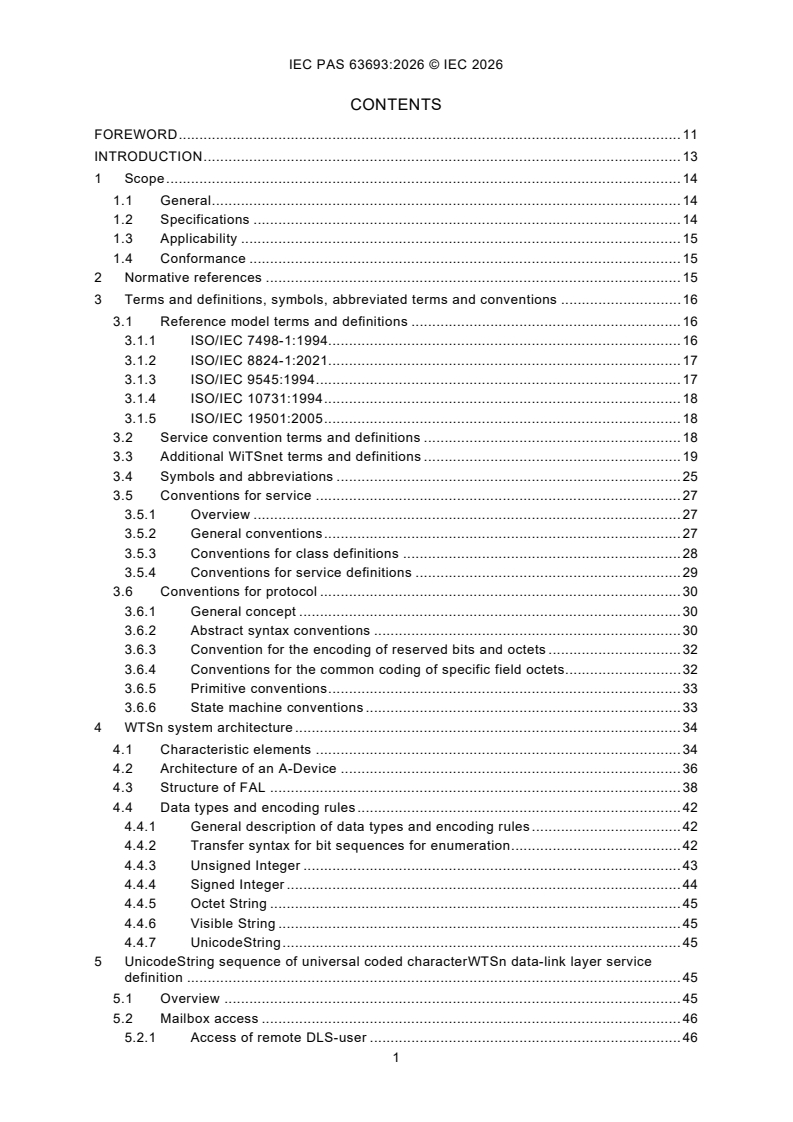
CONTENTS
FOREWORD . 11
INTRODUCTION . 13
1 Scope . 14
1.1 General . 14
1.2 Specifications . 14
1.3 Applicability . 15
1.4 Conformance . 15
2 Normative references . 15
3 Terms and definitions, symbols, abbreviated terms and conventions . 16
3.1 Reference model terms and definitions . 16
3.1.1 ISO/IEC 7498-1:1994. 16
3.1.2 ISO/IEC 8824-1:2021. 17
3.1.3 ISO/IEC 9545:1994 . 17
3.1.4 ISO/IEC 10731:1994 . 18
3.1.5 ISO/IEC 19501:2005 . 18
3.2 Service convention terms and definitions . 18
3.3 Additional WiTSnet terms and definitions . 19
3.4 Symbols and abbreviations . 25
3.5 Conventions for service . 27
3.5.1 Overview . 27
3.5.2 General conventions . 27
3.5.3 Conventions for class definitions . 28
3.5.4 Conventions for service definitions . 29
3.6 Conventions for protocol . 30
3.6.1 General concept . 30
3.6.2 Abstract syntax conventions . 30
3.6.3 Convention for the encoding of reserved bits and octets . 32
3.6.4 Conventions for the common coding of specific field octets. 32
3.6.5 Primitive conventions . 33
3.6.6 State machine conventions . 33
4 WTSn system architecture . 34
4.1 Characteristic elements . 34
4.2 Architecture of an A-Device . 36
4.3 Structure of FAL . 38
4.4 Data types and encoding rules . 42
4.4.1 General description of data types and encoding rules . 42
4.4.2 Transfer syntax for bit sequences for enumeration . 42
4.4.3 Unsigned Integer . 43
4.4.4 Signed Integer . 44
4.4.5 Octet String . 45
4.4.6 Visible String . 45
4.4.7 UnicodeString . 45
5 UnicodeString sequence of universal coded characterWTSn data-link layer service
definition . 45
5.1 Overview . 45
5.2 Mailbox access . 46
5.2.1 Access of remote DLS-user . 46
5.2.2 Access of local DLS-user . 48
5.3 Buffer access . 50
5.3.1 Access of remote DLS-user . 50
5.3.2 Access of local DLS-user . 52
5.4 Extended Buffer access . 53
5.4.1 Access of remote DLS-user . 53
5.4.2 Access of local DLS-user . 55
5.5 Queue access . 57
5.5.1 Access of remote DLS-user . 57
5.5.2 Access of local DLS-user . 59
5.6 Open Queue access . 60
5.6.1 General model of open Queue (OQUE) . 60
5.6.2 Access of remote DLS-user . 60
5.6.3 Access of local DLS-user . 62
5.7 Attribute access . 63
5.7.1 Special Conditions of the Attribute Access . 63
5.7.2 Access of remote DLS-user . 63
5.7.3 Access of local DLS-user . 65
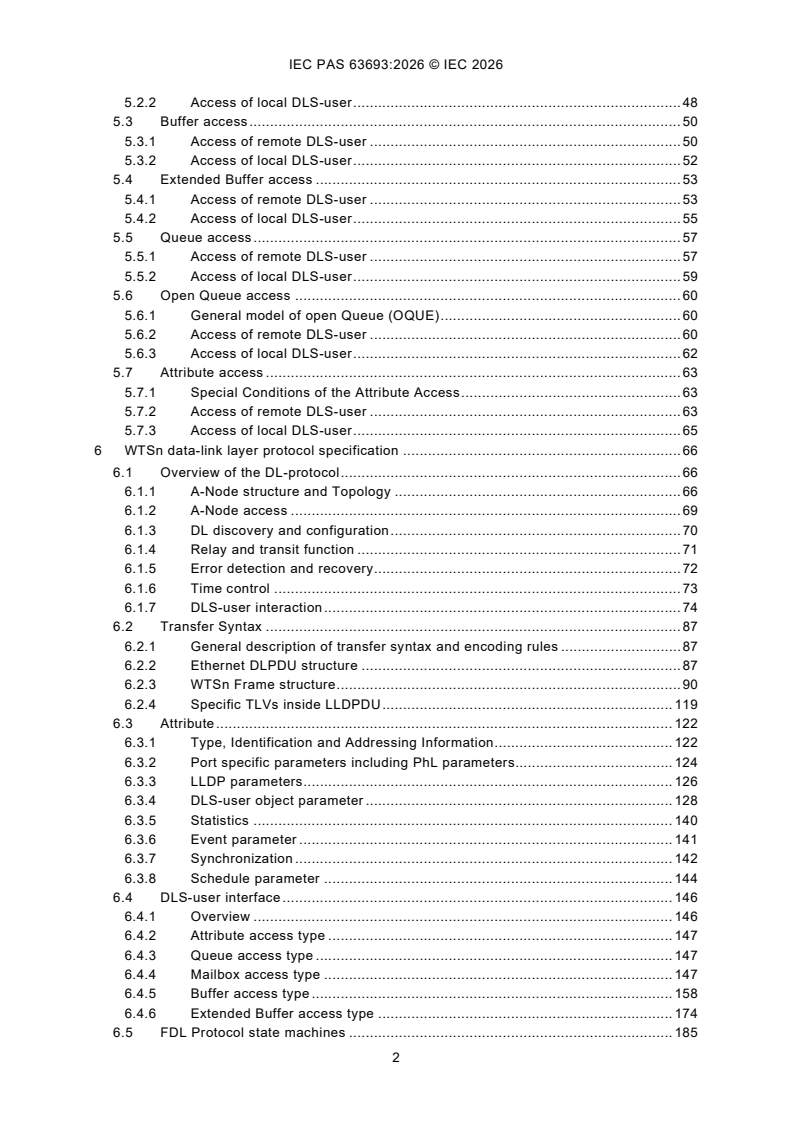
6 WTSn data-link layer protocol specification . 66
6.1 Overview of the DL-protocol . 66
6.1.1 A-Node structure and Topology . 66
6.1.2 A-Node access . 69
6.1.3 DL discovery and configuration . 70
6.1.4 Relay and transit function . 71
6.1.5 Error detection and recovery . 72
6.1.6 Time control . 73
6.1.7 DLS-user interaction . 74
6.2 Transfer Syntax . 87
6.2.1 General description of transfer syntax and encoding rules . 87
6.2.2 Ethernet DLPDU structure . 87
6.2.3 WTSn Frame structure . 90
6.2.4 Specific TLVs inside LLDPDU . 119
6.3 Attribute . 122
6.3.1 Type, Identification and Addressing Information . 122
6.3.2 Port specific parameters including PhL parameters. 124
6.3.3 LLDP parameters . 126
6.3.4 DLS-user object parameter . 128
6.3.5 Statistics . 140
6.3.6 Event parameter . 141
6.3.7 Synchronization . 142
6.3.8 Schedule parameter . 144
6.4 DLS-user interface . 146
6.4.1 Overview . 146
6.4.2 Attribute access type . 147
6.4.3 Queue access type . 147
6.4.4 Mailbox access type . 147
6.4.5 Buffer access type . 158
6.4.6 Extended Buffer access type . 174
6.5 FDL Protocol state machines . 185
6.5.1 Overview of A-Node DL state machines . 185
6.5.2 General definitions for an Ethernet link segment operation . 185
6.5.3 Implementation option with a single Port . 186
6.5.4 Port Receive state machines (PRM) . 186
6.5.5 Relay, transit and scheduling state machines (RTSM) . 186
6.5.6 Port Transmit state machines (PTM) . 207
6.5.7 Subframe processing state machine (SFPM) . 209
6.5.8 Discovery state machines . 212
6.5.9 Synchronization . 222
7 WTSn application layer service definition. 229
7.1 Overview . 229
7.2 Data type ASE . 230
7.2.1 General . 230
7.2.2 Formal definition of data type objects . 230
7.2.3 FAL defined data types . 230
7.2.4 Data type ASE service specification. 236
7.3 Communication model specification . 236
7.3.1 Concepts . 236
7.3.2 Modular device ASE . 237
7.3.3 AR ASE . 252
7.3.4 Discovery ASE . 258
8 WTSn application layer protocol specification . 267
8.1 Coding of PDU elements . 267
8.1.1 APDU structure. 267
8.1.2 Common APDU elements . 267
8.1.3 Transfer Data . 271
8.1.4 Variable Attributes and Definition . 273
8.1.5 Discovery . 276
8.1.6 Exchange of Process Elements . 277
8.1.7 AR Control APDU . 278
8.1.8 IPv4Encapsulation . 281
8.2 AR handling . 282
8.2.1 General . 282
8.2.2 Primitive definitions . 284
8.2.3 AR State Machine . 286
8.3 Special elements in the data transmission . 293
8.3.1 General Rules for data allocation in packets . 293
8.3.2 Fragmentation . 294
8.3.3 Isochronous Interaction . 303
8.4 Modelling of management functions . 306
8.4.1 Overview . 306
8.4.2 Synchronization management . 306
8.4.3 Identification . 307
8.4.4 Topology Management . 308
8.4.5 Scheduling . 310
8.4.6 Event Monitoring . 313
8.5 Open protocol transmission. 314
8.5.1 Principles of Operation . 314
8.5.2 Using MAC Address Transfer . 314
8.5.3 Identification and assignment of TNA . 315
8.5.4 Actions on the edge of WTSn networks . 317
8.5.5 Relationship to management . 317
8.5.6 Access to object model . 318
8.6 SHIM . 318
8.6.1 General . 318
8.6.2 Handling . 318
8.7 Multiple A-Controller or A-Device instances in an A-Node . 319
8.7.1 General . 319
8.7.2 Multiple A-Controllers . 319
8.7.3 Multiple A-Devices with separate Ports . 319
8.7.4 Multiple A-Devices without separate Ports . 319
Bibliography . 320
Figure 1 – Common structure of specific fields . 32
Figure 2 – Structure of an A-Device/A-Node . 37
Figure 3 – AL structure of an A-Device . 42
Figure 4 – Set of 2 port A-Devices connected to an A-Controller . 67
Figure 5 – Structure of A-Nodes with transit ports within a network . 67
Figure 6 – Structure with subsection ring and loops . 68
Figure 7 – Structure with redundant A-Controller connection . 69
Figure 8 – Loopback and One-way method . 70
Figure 9 – Mailbox interactions . 78
Figure 10 – Mailbox unidirectional interactions . 79
Figure 11 – Buffer interaction from A-Controller to A-Device . 80
Figure 12 – Buffer interaction from A-Device to A-Controller . 81
Figure 13 – Input XBUF with successful previous transaction . 82
Figure 14 – Input XBUF with previous transaction failed . 83
Figure 15 – Output XBUF with successful previous transaction . 84
Figure 16 – Output XBUF with previous transaction failed . 85
Figure 17 – Aggregation of DL objects into a single Command Execution List . 86
Figure 18 – WTSn elements in an Ethernet packet . 87
Figure 19 – RTM components . 187
Figure 20 – Structure of an interval . 204
Figure 21 – PTM components . 208
Figure 22 – Structure of a single transmit queue . 208
Figure 23 – TNA incremental assignment . 213
Figure 24 – Model of clock synchronization . 224
Figure 25 – Measurement of the link delay . 225
Figure 26 – Determination of the Neighbor Frequency Difference . 226
Figure 27 – Distribution of startup parameters . 228
Figure 28 – Sequence of AR state interaction . 283
Figure 29 – AR state diagram . 286
Figure 30 – Example mapping steps of process elements . 293
Figure 31 – APDU types . 294
Figure 32 – Sequence of MBX interaction with request fragmentation . 295
Figure 33 – Sequence of MBX interaction with response fragmentation . 296
Figure 34 – Sequence of XBUF interaction with fragmentation . 297
Figure 35 – FRSM States . 297
Figure 36 – Isochronous Interactions . 304
Figure 37 – Interaction structure . 305
Figure 38 – Identification of a WTSn network . 308
Figure 39 – SHIM example . 318
Table 1 – PDU element description example . 31
Table 2 – Example attribute description . 32
Table 3 – State machine layout . 34
Table 4 – Description of state machine elements . 34
Table 5 – Characteristic features of WTSn DL protocol . 35
Table 6 – Transfer syntax for bit sequences . 43
Table 7 – Transfer syntax for Unsigned data types . 44
Table 8 – Transfer syntax for Integer data types . 45
Table 9 – DL-MBXwrite . 46
Table 10 – DL-MBXread. 47
Table 11 – DL-MBXset . 48
Table 12 – DL-MBXget . 49
Table 13 – DL-BUFwrite . 50
Table 14 – DL-BUFread . 51
Table 15 – DL-BUFset . 52
Table 16 – DL-BUFget . 52
Table 17 – DL-XBUFwrite . 53
Table 18 – DL-XBUFread . 54
Table 19 – DL-XBUFset . 55
Table 20 – DL-XBUFget . 56
Table 21 – DL-QUEwrite . 57
Table 22 – DL-QUEread. 58
Table 23 – DL-QUEset . 59
Table 24 – DL-QUEget . 59
Table 25 – DL-OQUEtransfer . 61
Table 26 – DL-OQUEset . 62
Table 27 – DL-OQUEget . 62
Table 28 – DL-REGwrite . 63
Table 29 – DL-REGread. 64
Table 30 – DL-ATTset . 65
Table 31 – DL-ATTget. 66
Table 32 – Types of Communication Relationship (CR) . 75
Table 33 – Command Execution List (CEL) description . 86
Table 34 – Command Execution List in an A-Node . 86
Table 35 – WTSn frame inside an Ethernet packet . 87
Table 36 – WTSn frame inside a UDP PDU . 88
Table 37 – LLDP frame inside an Ethernet frame . 89
Table 38 – FCS octets of an erroneous Packet . 90
Table 39 – WTSn Frame common header structure . 91
Table 40 – TNA Definition . 92
Table 41 – WTSn FrameA structure containing WTSn PDU . 93
Table 42 – Buffer Read (BFRD) . 94
Table 43 – Buffer Write (BFWT) . 95
Table 44 – Buffer multiple Write (BFmW) . 97
Table 45 – Buffer Read and multiple Write (BFRmW) . 98
Table 46 – Buffer Read Write (BFRW) . 100
Table 47 – Extended Buffer Read (XBRD) . 101
Table 48 – Extended Buffer Write (XBWT) . 103
Table 49 – Mailbox Read (MBRD) . 105
Table 50 – Mailbox Write (MBWT). 106
Table 51 – Queue Read (QURD). 108
Table 52 – Queue Write (QUWT) . 109
Table 53 – Command Execution List (CEL) . 111
Table 54 – Register Read (RGRD) . 112
Table 55 – Register Write (RGWT). 114
Table 56 – Register multiple Write (RGmW) . 115
Table 57 – Register Read and multiple Write (RGRmW) . 116
Table 58 – Register Mask Write (RGmsWT) . 118
Table 59 – TLV elements . 119
Table 60 – WTSn identification and TNA setup . 120
Table 61 – WTSn topology subtree . 121
Table 62 – Node information . 123
Table 63 – Link control/status . 125
Table 64 – LLDP attributes . 126
Table 65 – CR-bundle attributes . 129
Table 66 – Mailbox attributes . 131
Table 67 – Buffer attributes. 132
Table 68 – XBuffer attributes . 135
Table 69 – Queue attributes . 137
Table 70 – CEL attributes . 139
Table 71 – Multicast attributes . 140
Table 72 – TX/RX counters . 140
Table 73 – Additional counters . 141
Table 74 – Event structure . 141
Table 75 – Link local measurement . 143
Table 76 – Clock parameter . 144
Table 77 – Interval layout . 145
Table 78 – Interval specification . 145
Table 79 – Scheduler packet list attributes . 146
Table 80 – Primitives issued by SFPM to MBX . 148
Table 81 – Primitives issued by MBX to SFPM . 148
Table 82 – Primitives issued by DLS-user to MBX . 149
Table 83 – Primitives issued by MBX to DLS-user . 149
Table 84 – Parameters of the primitives . 149
Table 85 – MBX Variables . 150
Table 86 – MBX state table . 150
Table 87 – MBXr Variables . 154
Table 88 – MBXr state table . 155
Table 89 – Primitives issued by SFPM to OBUF . 159
Table 90 – Primitive issued by OBUF to SFPM . 159
Table 91 – Primitive issued by DLS-user to OBUF . 159
Table 92 – Primitive issued by OBUF to DLS-user . 159
Table 93 – Parameters of the primitives . 160
Table 94 – OBUF Variables . 160
Table 95 – Transfer of Output Buffers overview . 160
Table 96 – OBUF state table . 161
Table 97 – Primitives issued by SFPM to OBUFr . 163
Table 98 – Primitives issued by OBUFr to SFPM . 163
Table 99 – Primitives issued by DLS-user to OBUFr . 163
Table 100 – Primitives issued by OBUFr to DLS-user . 163
Table 101 – OBUFr Variables and Functions . 164
Table 102 – Transfer of redundant Output Buffers overview . 164
Table 103 – OBUFr state table . 165
Table 104 – Primitives issued by SFPM to IBUF . 167
Table 105 – Primitive issued by IBUF to SFPM . 167
Table 106 – Primitive issued by DLS-user to IBUF . 168
Table 107 – Primitive issued by IBUF to DLS-user . 168
Table 108 – Parameters of the primitives . 168
Table 109 – IBUF Variables . 169
Table 110 – Transfer of Input Buffers overview . 169
Table 111 – IBUF state table . 170
Table 112 – Primitives issued by SFPM to IBUFr . 171
Table 113 – Primitives issued by IBUFr to SFPM . 172
Table 114 – IBUFr Variables and Functions . 172
Table 115 – Transfer of redundant Input Buffers overview . 173
Table 116 – IBUFr state table . 173
Table 117 – Primitives issued by SFPM to OXBUF . 175
Table 118 – Primitive issued by OXBUF to SFPM . 175
Table 119 – Primitive issued by DLS-user to OXBUF . 176
Table 120 – Primitive issued by OXBUF to DLS-user . 176
Table 121 – Parameters of the primitives . 176
Table 122 – OXBUF Variables . 177
Table 123 – OXBUF state table. 177
Table 124 – Primitives issued by SFPM to IXBUF . 180
Table 125 – Primitive issued by IXBUF to SFPM . 180
Table 126 – Primitive issued by DLS-user to IXBUF . 180
Table 127 – Primitive issued by IXBUF to DLS-user . 181
Table 128 – Parameters of the primitives . 181
Table 129 – IXBUF Variables . 181
Table 130 – IXBUF state table . 182
Table 131 – Primitives issued by PRM to Parser . 188
Table 132 – Primitives between Parser and DelayFifo . 188
Table 133 – Primitives between Parser and TNA Handler . 188
Table 134 – Primitive between Parser and SFPM . 188
Table 135 – Primitive between Parser and Frame Conversion . 189
Table 136 – Primitive between SFPM and OutboundFifo . 189
Table 137 – Primitive between Frame Conversion and OutboundFifo . 189
Table 138 – Parameters of the primitives . 189
Table 139 – Parser Variables . 190
Table 140 – Parser decision list of Ethernet Packet structure . 191
Table 141 – WTSn Frame common elements decision list . 193
Table 142 – Parameter and Functions . 196
Table 143 – WTSn SubFrame decision list . 196
Table 144 – Determination of the target port . 198
Table 145 – Redundant Transmission Variables and Functions . 199
Table 146 – Determination of the target port with redundancy . 200
Table 147 – Parameter of an interval specification . 204
Table 148 – Example Interval layout . 206
Table 149 – Example parameter set of an interval specification . 207
Table 150 – Default multicast setting . 209
Table 151 – Functions for checking subframe information . 209
Table 152 – Checking Subfram
...