


IEC TS 62271-210:2013
(Main)High-voltage switchgear and controlgear - Part 210: Seismic qualification for metal enclosed and solid-insulation enclosed switchgear and controlgear assemblies for rated voltages above 1 kV and up to and including 52 kV
General Information
- Abstract
IEC/TS 62271-210:2013 applies to metal enclosed switchgear and controlgear assemblies complying with IEC 62271-200 for metal enclosed and IEC 62271-201 for solid-insulation enclosed, ground or floor mounted, intended to be used under seismic conditions.
- Status
- Replaced
- Publication Date
- 05-Feb-2013
- Technical Committee
- SC 17C - Assemblies
- Drafting Committee
- WG 26 - TC 17/SC 17C/WG 26
- Current Stage
- DELPUB - Deleted Publication
- Start Date
- 09-Nov-2023
- Completion Date
- 28-Aug-2026
Buy Documents
IEC TS 62271-210:2013 - High-voltage switchgear and controlgear - Part 210: Seismic qualification for metal enclosed and solid-insulation enclosed switchgear and controlgear assemblies for rated voltages above 1 kV and up to and including 52 kV
IEC TS 62271-210:2013 - High-voltage switchgear and controlgear - Part 210: Seismic qualification for metal enclosed and solid-insulation enclosed switchgear and controlgear assemblies for rated voltages above 1 kV and up to and including 52 kV Released:2/6/2013
Relations
- Effective Date
- 17-Nov-2023
Buy Documents
IEC TS 62271-210:2013 - High-voltage switchgear and controlgear - Part 210: Seismic qualification for metal enclosed and solid-insulation enclosed switchgear and controlgear assemblies for rated voltages above 1 kV and up to and including 52 kV
IEC TS 62271-210:2013 - High-voltage switchgear and controlgear - Part 210: Seismic qualification for metal enclosed and solid-insulation enclosed switchgear and controlgear assemblies for rated voltages above 1 kV and up to and including 52 kV Released:2/6/2013
Get Certified
Connect with accredited certification bodies for this standard

IMQ S.p.A. (Certification)
Italian electrical product certification.

SLG Prüf- und Zertifizierungs GmbH
German testing and certification body.

UL Solutions
Global safety science company with testing, inspection and certification.
Sponsored listings
Frequently Asked Questions
IEC TS 62271-210:2013 is a technical specification published by the International Electrotechnical Commission (IEC). Its full title is "High-voltage switchgear and controlgear - Part 210: Seismic qualification for metal enclosed and solid-insulation enclosed switchgear and controlgear assemblies for rated voltages above 1 kV and up to and including 52 kV". This standard covers: IEC/TS 62271-210:2013 applies to metal enclosed switchgear and controlgear assemblies complying with IEC 62271-200 for metal enclosed and IEC 62271-201 for solid-insulation enclosed, ground or floor mounted, intended to be used under seismic conditions.
IEC/TS 62271-210:2013 applies to metal enclosed switchgear and controlgear assemblies complying with IEC 62271-200 for metal enclosed and IEC 62271-201 for solid-insulation enclosed, ground or floor mounted, intended to be used under seismic conditions.
IEC TS 62271-210:2013 is classified under the following ICS (International Classification for Standards) categories: 29.130.10 - High voltage switchgear and controlgear. The ICS classification helps identify the subject area and facilitates finding related standards.
IEC TS 62271-210:2013 has the following relationships with other standards: It is inter standard links to IEC 62271-207:2023. Understanding these relationships helps ensure you are using the most current and applicable version of the standard.
IEC TS 62271-210:2013 is available in PDF format for immediate download after purchase. The document can be added to your cart and obtained through the secure checkout process. Digital delivery ensures instant access to the complete standard document.
Standards Content (Sample)
IEC/TS 62271-210 ®
Edition 1.0 2013-02
TECHNICAL
SPECIFICATION
SPÉCIFICATION
TECHNIQUE
High-voltage switchgear and controlgear –
Part 210: Seismic qualification for metal enclosed and solid-insulation enclosed
switchgear and controlgear assemblies for rated voltages above 1 kV and up to
and including 52 kV
Appareillage à haute tension –
Partie 210: Qualification sismique pour ensembles d'appareillage sous
enveloppe métallique pour tensions assignées supérieures à 1 kV et inférieures
ou égales à 52 kV
IEC/TS 62271-210:2013
All rights reserved. Unless otherwise specified, no part of this publication may be reproduced or utilized in any form
or by any means, electronic or mechanical, including photocopying and microfilm, without permission in writing from
either IEC or IEC's member National Committee in the country of the requester.
If you have any questions about IEC copyright or have an enquiry about obtaining additional rights to this publication,
please contact the address below or your local IEC member National Committee for further information.
Droits de reproduction réservés. Sauf indication contraire, aucune partie de cette publication ne peut être reproduite ni
utilisée sous quelque forme que ce soit et par aucun procédé, électronique ou mécanique, y compris la photocopie et les
microfilms, sans l'accord écrit de la CEI ou du Comité national de la CEI du pays du demandeur.
Si vous avez des questions sur le copyright de la CEI ou si vous désirez obtenir des droits supplémentaires sur cette
publication, utilisez les coordonnées ci-après ou contactez le Comité national de la CEI de votre pays de résidence.
IEC Central Office Tel.: +41 22 919 02 11
3, rue de Varembé Fax: +41 22 919 03 00
CH-1211 Geneva 20 info@iec.ch
Switzerland www.iec.ch
About the IEC
The International Electrotechnical Commission (IEC) is the leading global organization that prepares and publishes
International Standards for all electrical, electronic and related technologies.
About IEC publications
The technical content of IEC publications is kept under constant review by the IEC. Please make sure that you have the
latest edition, a corrigenda or an amendment might have been published.
Useful links:
IEC publications search - www.iec.ch/searchpub Electropedia - www.electropedia.org
The advanced search enables you to find IEC publications The world's leading online dictionary of electronic and
by a variety of criteria (reference number, text, technical electrical terms containing more than 30 000 terms and
committee,…). definitions in English and French, with equivalent terms in
It also gives information on projects, replaced and additional languages. Also known as the International
withdrawn publications. Electrotechnical Vocabulary (IEV) on-line.
IEC Just Published - webstore.iec.ch/justpublished Customer Service Centre - webstore.iec.ch/csc
Stay up to date on all new IEC publications. Just Published If you wish to give us your feedback on this publication
details all new publications released. Available on-line and or need further assistance, please contact the
also once a month by email. Customer Service Centre: csc@iec.ch.
A propos de la CEI
La Commission Electrotechnique Internationale (CEI) est la première organisation mondiale qui élabore et publie des
Normes internationales pour tout ce qui a trait à l'électricité, à l'électronique et aux technologies apparentées.
A propos des publications CEI
Le contenu technique des publications de la CEI est constamment revu. Veuillez vous assurer que vous possédez
l’édition la plus récente, un corrigendum ou amendement peut avoir été publié.
Liens utiles:
Recherche de publications CEI - www.iec.ch/searchpub Electropedia - www.electropedia.org
La recherche avancée vous permet de trouver des Le premier dictionnaire en ligne au monde de termes
publications CEI en utilisant différents critères (numéro de électroniques et électriques. Il contient plus de 30 000
référence, texte, comité d’études,…). termes et définitions en anglais et en français, ainsi que
Elle donne aussi des informations sur les projets et les les termes équivalents dans les langues additionnelles.
publications remplacées ou retirées. Egalement appelé Vocabulaire Electrotechnique
International (VEI) en ligne.
Just Published CEI - webstore.iec.ch/justpublished
Service Clients - webstore.iec.ch/csc
Restez informé sur les nouvelles publications de la CEI.
Just Published détaille les nouvelles publications parues. Si vous désirez nous donner des commentaires sur
Disponible en ligne et aussi une fois par mois par email. cette publication ou si vous avez des questions
contactez-nous: csc@iec.ch.
IEC/TS 62271-210 ®
Edition 1.0 2013-02
TECHNICAL
SPECIFICATION
SPÉCIFICATION
TECHNIQUE
High-voltage switchgear and controlgear –
Part 210: Seismic qualification for metal enclosed and solid-insulation enclosed
switchgear and controlgear assemblies for rated voltages above 1 kV and up to
and including 52 kV
Appareillage à haute tension –
Partie 210: Qualification sismique pour ensembles d'appareillage sous
enveloppe métallique pour tensions assignées supérieures à 1 kV et inférieures
ou égales à 52 kV
INTERNATIONAL
ELECTROTECHNICAL
COMMISSION
COMMISSION
ELECTROTECHNIQUE
PRICE CODE
INTERNATIONALE
CODE PRIX U
ICS 29.130.10 ISBN 978-2-83220-615-7
– 2 – TS 62271-210 © IEC:2013
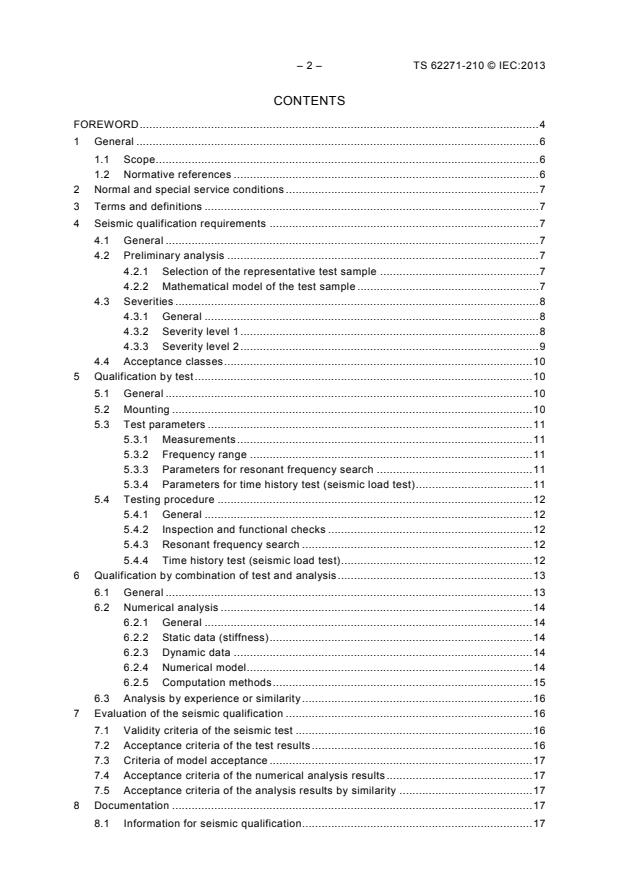
CONTENTS
FOREWORD . 4
1 General . 6
1.1 Scope . 6
1.2 Normative references . 6
2 Normal and special service conditions . 7
3 Terms and definitions . 7
4 Seismic qualification requirements . 7
4.1 General . 7
4.2 Preliminary analysis . 7
4.2.1 Selection of the representative test sample . 7
4.2.2 Mathematical model of the test sample . 7
4.3 Severities . 8
4.3.1 General . 8
4.3.2 Severity level 1 . 8
4.3.3 Severity level 2 . 9
4.4 Acceptance classes . 10
5 Qualification by test . 10
5.1 General . 10
5.2 Mounting . 10
5.3 Test parameters . 11
5.3.1 Measurements . 11
5.3.2 Frequency range . 11
5.3.3 Parameters for resonant frequency search . 11
5.3.4 Parameters for time history test (seismic load test) . 11
5.4 Testing procedure . 12
5.4.1 General . 12
5.4.2 Inspection and functional checks . 12
5.4.3 Resonant frequency search . 12
5.4.4 Time history test (seismic load test) . 12
6 Qualification by combination of test and analysis . 13
6.1 General . 13
6.2 Numerical analysis . 14
6.2.1 General . 14
6.2.2 Static data (stiffness) . 14
6.2.3 Dynamic data . 14
6.2.4 Numerical model . 14
6.2.5 Computation methods . 15
6.3 Analysis by experience or similarity . 16
7 Evaluation of the seismic qualification . 16
7.1 Validity criteria of the seismic test . 16
7.2 Acceptance criteria of the test results . 16
7.3 Criteria of model acceptance . 17
7.4 Acceptance criteria of the numerical analysis results . 17
7.5 Acceptance criteria of the analysis results by similarity . 17
8 Documentation . 17
8.1 Information for seismic qualification . 17
TS 62271-210 © IEC:2013 – 3 –
8.2 Test report . 17
8.3 Analysis report when analysis is a numerical analysis . 18
8.4 Analysis report when analysis is performed by similarity . 18
Annex A (normative) Characterization of the test sample for analysis . 20
Annex B (informative) Criteria for seismic adequacy of enclosed switchgear and
controlgear assemblies . 21
Annex C (informative) Dynamic analysis methods . 24
Annex D (informative) Expected peak ground accelerations for different earthquake
scales . 27
Annex E (informative) Qualification process flowchart . 28
Bibliography . 29
Figure 1 – Severity level 1 (horizontal) – Zero period acceleration (ZPA) = 0,5 g . 9
Figure 2 – Severity level 2 (horizontal) − Zero period acceleration (ZPA) = 1 g . 10
Table D.1 – Earthquake zones with earthquake intensity and magnitude scale . 27
– 4 – TS 62271-210 © IEC:2013
INTERNATIONAL ELECTROTECHNICAL COMMISSION
______________
HIGH-VOLTAGE SWITCHGEAR AND CONTROLGEAR –
Part 210: Seismic qualification for metal enclosed and
solid-insulation enclosed switchgear and controlgear assemblies
for rated voltages above 1 kV and up to and including 52 kV
FOREWORD
1) The International Electrotechnical Commission (IEC) is a worldwide organization for standardization comprising
all national electrotechnical committees (IEC National Committees). The object of IEC is to promote
international co-operation on all questions concerning standardization in the electrical and electronic fields. To
this end and in addition to other activities, IEC publishes International Standards, Technical Specifications,
Technical Reports, Publicly Available Specifications (PAS) and Guides (hereafter referred to as “IEC
Publication(s)”). Their preparation is entrusted to technical committees; any IEC National Committee interested
in the subject dealt with may participate in this preparatory work. International, governmental and non-
governmental organizations liaising with the IEC also participate in this preparation. IEC collaborates closely
with the International Organization for Standardization (ISO) in accordance with conditions determined by
agreement between the two organizations.
2) The formal decisions or agreements of IEC on technical matters express, as nearly as possible, an international
consensus of opinion on the relevant subjects since each technical committee has representation from all
interested IEC National Committees.
3) IEC Publications have the form of recommendations for international use and are accepted by IEC National
Committees in that sense. While all reasonable efforts are made to ensure that the technical content of IEC
Publications is accurate, IEC cannot be held responsible for the way in which they are used or for any
misinterpretation by any end user.
4) In order to promote international uniformity, IEC National Committees undertake to apply IEC Publications
transparently to the maximum extent possible in their national and regional publications. Any divergence
between any IEC Publication and the corresponding national or regional publication shall be clearly indicated in
the latter.
5) IEC itself does not provide any attestation of conformity. Independent certification bodies provide conformity
assessment services and, in some areas, access to IEC marks of conformity. IEC is not responsible for any
services carried out by independent certification bodies.
6) All users should ensure that they have the latest edition of this publication.
7) No liability shall attach to IEC or its directors, employees, servants or agents including individual experts and
members of its technical committees and IEC National Committees for any personal injury, property damage or
other damage of any nature whatsoever, whether direct or indirect, or for costs (including legal fees) and
expenses arising out of the publication, use of, or reliance upon, this IEC Publication or any other IEC
Publications.
8) Attention is drawn to the Normative references cited in this publication. Use of the referenced publications is
indispensable for the correct application of this publication.
9) Attention is drawn to the possibility that some of the elements of this IEC Publication may be the subject of
patent rights. IEC shall not be held responsible for identifying any or all such patent rights.
The main task of IEC technical committees is to prepare International Standards. In
exceptional circumstances, a technical committee may propose the publication of a technical
specification when
• the required support cannot be obtained for the publication of an International Standard,
despite repeated efforts, or
• the subject is still under technical development or where, for any other reason, there is the
future but no immediate possibility of an agreement on an International Standard.
Technical specifications are subject to review within three years of publication to decide
whether they can be transformed into International Standards.
IEC 62271-210, which is a technical specification, has been prepared by subcommittee 17C:
High-voltage switchgear and controlgear assemblies, of IEC technical committee 17:
Switchgear and controlgear.
TS 62271-210 © IEC:2013 – 5 –
The text of this technical specification is based on the following documents:
Enquiry draft Report on voting
17C/515/DTS 17C/548/RVC
Full information on the voting for the approval of this technical specification can be found in
the report on voting indicated in the above table.
This publication has been drafted in accordance with the ISO/IEC Directives, Part 2.
A list of all the parts in the IEC 62271 series, under the general title High-voltage switchgear
and controlgear, can be found on the IEC website.
The committee has decided that the contents of this publication will remain unchanged until
the stability date indicated on the IEC web site under "http://webstore.iec.ch" in the data
related to the specific publication. At this date, the publication will be
• transformed into an International standard,
• reconfirmed,
• withdrawn,
• replaced by a revised edition, or
• amended.
– 6 – TS 62271-210 © IEC:2013
HIGH-VOLTAGE SWITCHGEAR AND CONTROLGEAR –
Part 210: Seismic qualification for metal enclosed and
solid-insulation enclosed switchgear and controlgear assemblies
for rated voltages above 1 kV and up to and including 52 kV
1 General
1.1 Scope
This part of IEC 62271 applies to metal enclosed switchgear and controlgear assemblies
complying with IEC 62271-200 for metal enclosed and IEC 62271-201 for solid-insulation
enclosed, ground or floor mounted, intended to be used under seismic conditions.
The seismic qualification of the switchgear and controlgear assemblies takes into account any
auxiliary and the control equipment mounted directly on the assembly.
It will specify seismic severity levels, acceptance levels, and give a choice of methods that
may be applied to demonstrate the performance of high-voltage switchgear and controlgear
assemblies for which seismic qualification is required.
The seismic qualification of the switchgear and controlgear assemblies is only performed
upon request.
1.2 Normative references
The following documents, in whole or in part, are normatively referenced in this document and
are indispensable for its application. For dated references, only the edition cited applies. For
undated references, the latest edition of the referenced document (including any
amendments) applies.
IEC 60068-2-6, Environmental testing – Part 2-6: Tests – Test Fc: Vibration (sinusoidal)
IEC 60068-2-57:1999, Environmental testing – Part 2-57: Tests – Test Ff: Vibration – Time-
history method
IEC 60068-2-64, Environmental testing – Part 2-64: Tests – Test Fh: Vibration, broadband
random and guidance
IEC 60068-3-3:1991, Environmental testing – Part 3: Guidance – Seismic test methods for
equipment
IEC 62271-1:2007, High-voltage switchgear and controlgear – Part 1: Common specifications
IEC 62271-200, High-voltage switchgear and controlgear – Part 200: AC metal-enclosed
switchgear and controlgear for rated voltages above 1 kV and up to and including 52 kV
IEC 62271-201, High-voltage switchgear and controlgear – Part 201: AC insulation-enclosed
switchgear and controlgear for rated voltages above 1 kV and up to and including 52 kV
ISO 2041, Mechanical vibration, shock and condition monitoring – Vocabulary
TS 62271-210 © IEC:2013 – 7 –
2 Normal and special service conditions
(void)
3 Terms and definitions
For the purposes of this document, the terms and definitions given in IEC 60068-3-3,
IEC 62271-1, IEC 62271-200, IEC 62271-201 and ISO 2041 apply.
4 Seismic qualification requirements
4.1 General
The seismic qualification shall demonstrate the ability of the switchgear and controlgear
assemblies to withstand seismic stresses.
Basis of seismic qualification is the test, because only that allows a verification of functionality
of the equipment during and after the seismic events. The test is also a necessary input for
setup of numerical model used for analysis.
A combination of test and analysis is needed because not each type of switchgear
arrangement can be tested.
4.2 Preliminary analysis
4.2.1 Selection of the representative test sample
Due to practical reasons concerned with the available experimental facilities, the seismic
qualification of switchgear and controlgear assemblies requires the choice of proper test
samples which reasonably represent the whole system for the purpose of structural and
functional checks.
Such test samples shall include the switching devices with their relevant operating mechanism
and control equipment, and their electrical and mechanical interfaces.
These test samples shall demonstrate the worst cases, such as those with heaviest mass and
highest centre of gravity. In case of functional units with different masses, the heaviest panel
shall be placed at one end of the test arrangement. Simulation can be used to determine the
test sample, which satisfies the above criteria.
4.2.2 Mathematical model of the test sample
If qualification by combined test and numerical analysis, according to Clause 6, is foreseen, a
three-dimensional mathematical model of the test sample shall be created on the basis of
technical information concerning the design characteristics.
Such a model shall take into consideration the presence of switching and control devices,
compartments and of their supporting structures, and shall have sufficient sensitivity to
describe the dynamic behaviour of the test sample in the frequency range being studied.
The validity of the model shall be established by comparison between simulation results and
actual tests results, as stated in 7.3.
– 8 – TS 62271-210 © IEC:2013
4.3 Severities
4.3.1 General
In earthquake zone 4 (risk of very strong earthquakes) the measured peak ground
acceleration in many cases is approximately 0,5 g. In a few cases the measured peak ground
acceleration is around 1 g (see also Annex D).
Due to the wide range of ground motions, site conditions, switchgear installations in buildings,
two severity levels are defined for seismic qualification in order to avoid designing or testing
always to the highest levels.
The shape of the Required Response Spectra (RRS) (severity levels 1 and 2) is a broadband
response spectrum to cover many site conditions (magnitude, depth and distance to epicentre,
rock or soft soil) and super elevation due to the floor level installation.
For qualification, one of the following severity levels shall be chosen:
The severity level 1 is recommended for peak ground / floor accelerations up to 0,5 g.
The severity level 2 is recommended for peak ground / floor accelerations up to 1,0 g.
The Required Response Spectra are given in Figures 1 and 2 for the different seismic
qualification levels. The curves relate to 2 %, 5 % and 10 % damping ratio of the switchgear
and controlgear assemblies. For testing and if the exact damping behaviour is unknown 5 %
damping ratio is recommended.
Severity Level 1 is recommended for equipments mounted at the ground level for zones 0 to 4
or at upper floor levels combined with earthquake zones 0 to 3 (see Annex D). For Zone 0, it
is not necessary to perform any seismic qualification.
Severity Level 2 is only recommended for equipments mounted at upper floor levels combined
with earthquake zone 4 (see Annex D).
If site-specific conditions are known the user may develop a site-specific response spectrum
which envelops the shape of the severity level 1 and/or severity level 2.
NOTE The severity level 1 is equivalent to the moderate performance level according to IEEE 693:2005.
The severity level 2 is equivalent to the high performance level according to IEEE 693:2005.
4.3.2 Severity level 1
The RRS is described by the following equations:
Horizontal spectral accelerations S (m/s²) for frequencies f (Hz):
a
• S = 1,144 × β × f × g for 0,0 ≤ f ≤ 1,1
a
• S = 1,250 × β × g for 1,1 ≤ f ≤ 8,0
a
• S = 2 × ((6,62 × β – 2,64) / f – 0,2 × β + 0,33)) × g for 8,0 ≤ f ≤ 33
a
• S = 0,5 × g for f ≥ 33
a
β = (3,21 – 0,68 ln (d)) / 2,115 6, where d is the percent damping (2, 5, 10 etc.) and d ≤ 20 %.
g = 10 m/s
For qualification the RRS is limited to a frequency range starting at 1,0 Hz (see 5.3.2).
TS 62271-210 © IEC:2013 – 9 –
For vertical spectral accelerations the conversion factor is 0,8.
NOTE The conversion factor is 0,8 in order to harmonize the values settle by IEEE and IEC standards.
Severity Level 1 (hor.):
RRS (hor.) ZPA 0.5g d= 2% (level 1)
RRS (hor.) ZPA 0.5g d= 5% (level 1)
RRS (hor.) ZPA 0.5g d=10% (level 1)
1 10 100
Frequency [Hz]
IEC 245/13
SOURCE: Reproduced from IEEE Std 693:2005, IEEE Recommended Practice For Seismic Design of Substations
with the permission of IEEE.
Figure 1 – Severity level 1 (horizontal) – Zero period acceleration (ZPA) = 0,5 g
4.3.3 Severity level 2
The RRS is described by the following equations:
Horizontal spectral accelerations S (m/s²) for frequencies f (Hz):
a
• S = 2,288 × β × f × g for 0,0 ≤ f ≤ 1,1
a
• S = 2,5 × β × g for 1,1 ≤ f ≤ 8,0
a
• S = 2 × ((13,2 × β – 5,28)/ f – 0,4 × β+0,66)) × g for 8,0 ≤ f ≤ 33
a
• S = 1 × g for f ≥ 33
a
β = (3,21 – 0,68 ln (d)) / 2,115 6, where d is the percent damping (2, 5, 10 etc.) and d ≤ 20 %.
g = 10 m/s
For qualification the RRS is limited to a frequency range starting at 1,0 Hz (see 5.3.2).
For vertical spectral accelerations the conversion factor is 0,8.
NOTE The conversion factor is 0,8 in order to harmonize the values settle by IEEE and IEC standards.
Horizontal Acceleration
[m/s ]
– 10 – TS 62271-210 © IEC:2013
Severity Level 2 (hor.):
RRS (hor.) ZPA 1g d= 2% (level 2)
RRS (hor.) ZPA 1g d= 5% (level 2)
RRS (hor.) ZPA 1g d=10% (level 2)
1 10 100
Frequency [Hz]
IEC 246/13
SOURCE: Reproduced from IEEE Std 693:2005, IEEE Recommended Practice For Seismic Design of Substations
with the permission of IEEE.
Figure 2 – Severity level 2 (horizontal) − Zero period acceleration (ZPA) = 1 g
4.4 Acceptance classes
Two acceptance classes for equipment are defined:
For class 1, the equipment has to maintain its functionality during and after the earthquake.
After the seismic event maintenance and partial replacement might be necessary to ensure
long term operation.
For class 2, the equipment has to maintain its functionality during and after the earthquake.
After the seismic event no maintenance is required.
5 Qualification by test
5.1 General
The test procedure shall be in accordance with IEC 60068-3-3 with the modification that the
time history test method in accordance with IEC 60068-2-57 shall be applied. The time history
test method more closely simulates actual conditions, because the behaviour of the test
sample is always not linear.
The seismic test should demonstrate the ability of the switchgear and controlgear assemblies
to perform its required functions during and after seismic loads in form of Test Response
Spectrum (TRS) that envelopes the RRS. The demonstration shall be performed as it is
settled in 5.4.1 and 5.4.3.
If a test sample cannot be tested with its supporting structure (e.g., due to its size), the
dynamic contribution of the structure shall be determined by analysis and accounted for in the
test.
5.2 Mounting
The test sample shall be mounted as in service condition including dampers (if any).
Horizontal Acceleration
[m/s ]
TS 62271-210 © IEC:2013 – 11 –
If exact service conditions are unknown, a rigid base frame shall be used between the
equipment and the shaking table.
The horizontal orientation of the test sample shall be in the direction of excitation acting along
its two main orthogonal axes.
Any fixtures or connections required only for testing shall not affect the dynamic behaviour of
the test sample.
The method of mounting of the test sample shall be documented and shall include a
description of any interposing fixtures and connections (see IEC 60068-2-47).
5.3 Test parameters
5.3.1 Measurements
The measurements should be in accordance with 5.2 of IEC 60068-3-3:1991.
At least the following signals shall be recorded:
• acceleration at the shake-table;
• acceleration at significant places within the test object:
– at least one measurement point, directly connected to the main structure
(usually on top of switchgear),
– near to the centre of gravity (if accessible),
– at critical components (e.g. heavy masses).
5.3.2 Frequency range
The frequency range shall be from 1 Hz to at least 35 Hz in accordance with the Annex B of
IEC 60068-2-57:1999 because in earthquakes the predominant frequencies are in between
this range. The frequency range is applied to the resonant frequency search test and the
generation of artificial earthquake wave.
The first resonant frequency for a typical test setup in horizontal directions is in the range of 5
Hz to 10 Hz, therefore test frequencies below 1 Hz are not relevant.
Due to the limitation of some shake-tables it is not required to envelop the RRS below
frequencies of 70 % of the lowest resonant frequency of the equipment.
5.3.3 Parameters for resonant frequency search
The resonant frequency search test shall be carried out according to 10.1 of
IEC 60068-3-3:1991.
The recommended acceleration during the resonant frequency search is 0,1 g. The search
shall be conducted successively by sine sweeps in the three main axes at a maximum rate of
1 octave/min.
5.3.4 Parameters for time history test (seismic load test)
The test directions shall be chosen according to IEC 60068-3-3:1991, Clause 15.
Tri-axial testing is recommended.
The severity level shall be chosen according to 4.3.
– 12 – TS 62271-210 © IEC:2013
The total duration of the time-history shall be 30 s at least and the strong part duration shall
be not less than 20 s.
5.4 Testing procedure
5.4.1 General
The test sequence shall be as follows:
• functional checks before testing;
• resonant frequency search (required to determine critical frequencies and damping ratios
and/or for analysis);
• time-history test (seismic load test);
• resonant-frequency search;
• functional checks after testing.
5.4.2 Inspection and functional checks
Before and after the tests, the following operating characteristics or settings shall be recorded
or evaluated (when applicable) at the rated supply voltage and operating pressure:
a) visual inspection;
b) operation of any switching device;
c) closing time of any fast-closing switching device;
d) opening time of any fast-opening switching device;
e) operation of any withdrawable or removable part;
f) gas and/or liquid tightness where relevant;
g) resistance measurement of the main circuit;
h) power-frequency withstand voltage test as condition check of the main circuit (all switching
devices in closed position) phase to phase and phase to earth, according 6.2.11 of
IEC 62271-1:2007;
i) power-frequency withstand voltage test as condition check of the switching devices in
opened position, according 6.2.11 of IEC 62271-1:2007.
These functional tests can be performed at the laboratory of the manufacturer.
5.4.3 Resonant frequency search
The resonant frequency search test shall be carried out according to 10.1 of
IEC 60068-3-3:1991.
5.4.4 Time history test (seismic load test)
The time history test shall be performed once according to IEC 60068-2-57 with the
parameters as defined in 5.3.4.
During the seismic test the following parameters shall be recorded in addition to 5.3.1:
• electrical continuity of the main circuit (if applicable);
• electrical continuity of the auxiliary and control circuit (representative NO/NC contacts).
During the test the control circuits shall be energized at the rated voltage.
TS 62271-210 © IEC:2013 – 13 –
One test run is required, at the beginning all switching devices shall be in closed position; the
test condition depends on the switching devices and their ability to perform operations during
the strong motion part of the time history:
• during this operational test each circuit-breaker shall perform at least one operating
sequence (recommendation: O-5s-C-5s-O within the middle of total test duration and
therefore within the strong part of motion);
• other switching devices shall operate as specified (e.g. open operation for load break
switches);
• switching devices unable to operate during seismic loads shall perform the test in closed
position without operation.
NOTE 1 Circuit-breakers ensure the switching capability even during seismic events. Other switching devices give
evidence only for the functionality specified by the manufacturer.
NOTE 2 A further test run can be performed optionally, with all switching devices in closed position without
operation. This leads to a qualification valid for this standard and for the IEEE 693.
Criteria for assessing the test validity and the test results are provided in 7.1 and 7.2.
If the test is intended to be used as a basis for numerical analysis, then further recordings
shall be performed in order to provide relevant data. Further test parameters are:
• deflection of components where significant displacements are expected;
• strains on critical elements (e.g. bushings, flanges, enclosures and support structures);
• acceleration on relevant locations on the test sample.
6 Qualification by combination of test and analysis
6.1 General
Analysis alone cannot be applied because metal-enclosed switchgear and controlgear
assemblies are complex devices and functional operability can not be verified by analysis
techniques alone.
Analysis may be used:
• in validating switchgear and controlgear assemblies already tested in the same
configuration under different seismic conditions;
• in validating switchgear and controlgear assemblies similar to the ones already tested
under the same seismic conditions but which include modifications influencing the dynamic
behaviour (e.g. change in the arrangement of the switchgear and controlgear assemblies,
or in the mass of components);
• in validating switchgear and controlgear assemblies which cannot be qualified by testing
alone (e.g. because of their size and/or complexity).
The methodology comprises the analysis of the structural part and the testing of the
functionality separately.
The structural part consists principally of the structure including braces, frames, struts and
attachments that transmit all seismic loads between the equipment and the floor. The dynamic
behaviour of the equipment or assembly depends on the structural part.
Two or more assemblies can be considered structurally similar when they have the same
structural scheme and the same connections types; they can be different by the mass
distribution and/or the dimensions.
– 14 – TS 62271-210 © IEC:2013
The functional part consists of components which are considered as logical sub-grouping of
equipment functions typically organized and arranged as physical devices, modules or
subassemblies that can be detached from the equipment and can be mounted to a test fixture
using the same mechanical and electrical interfaces and tested as standalone units.
Two methods may be used to perform the mechanical validation:
• numerical analysis,
• analysis based on similarity.
6.2 Numerical analysis
6.2.1 General
Numerical analysis shall only be used to demonstrate the structural integrity. Additional
accelerations at the fixing points of equipment may be calculated.
The functional operability shall be demonstrated from experience data (see 6.3).
Numerical analysis is performed with a numerical model which shall be calibrated by using
static and / or dynamic data following the numerical method adopted (see Annex C).
6.2.2 Static data (stiffness)
The stiffness of the structure in horizontal direction could be obtained by applying a static
force at the top of it.
If the structure is not axial-symmetric, at least two different orthogonal static forces shall be
required.
6.2.3 Dynamic data
Dynamic data (damping ratios, critical frequencies, modal shapes, responses in acceleration
on different points of the structure) for numerical analysis shall be obtained by a dynamic test
of a similar test sample (see Annex A).
If during the test a nonlinear behaviour of the structure is detected, the analysis shall be
reassessed taking into account the test results by using equivalent elastic stiffness and
damping.
NOTE The nonlinearity is mainly on the damping, which can be quite different and higher than that measured at
low levels, and on the stiffness, which can change with increasing loads, and consequently can change the
resonant frequencies.
6.2.4 Numerical model
The general procedure is as follows:
a) set up of the finite element (FE) model by identifying the parts which act as structure (and
therefore shall be modelled using structural FE) and the parts which act as masses (and
therefore can be modelled using inertial FE);
b) calibration of the FE model by using experimental data in 6.2.2 and / or in 6.2.3 according
to the computed method used;
c) considering the modularity of switchgear and controlgear assemblies, the numerical model
calibrated for the test sample can be extended to a complete set of assemblies, all having
the similar structure;
d) determination of the response, in the frequency range stated in 5.3.2, using the methods
described in the following subclauses (see 6.2.5);
TS 62271-210 © IEC:2013 – 15 –
e) conclusion on the seismic mechanical behaviour according to the acceptance criteria
given in subclause 7.4.
6.2.5 Computation methods
6.2.5.1 Static coefficient analysis
This method is based on the assumption that the complete assembly is subjected to the same
acceleration. It allows a simpler technique to estimate the structural integrity with higher
conservatism.
It should be used only when the accelerations on the components or on their anchorage
points are expected to be equal or lower in comparison with the corresponding measured
values on the tested assembly.
If the first natural frequency is unknown, the acceleration to take into account shall be the
peak of the required response spectrum at a damping of 5 % (in case of unknown damping
value).
If the first natural frequency is known, the acceleration to take into account shall be the
spectral acceleration at this frequency and for a damping of 5 % (in case of unknown damping
value).
In the both cases a coefficient of 1,5 shall be applied to take into account the effect of higher
frequency modes.
Therefore, the seismic forces on each component of the switchgear and controlgear
assemblies are obtained by multiplying the values of its mass, concentrated at its centre of
gravity, by this acceleration.
6.2.5.2 Response spectrum dynamic analysis
For equipment having the first natural frequency below 35 Hz, the response spectrum
dynamic analysis is recommended.
In comparison with the static coefficient analysis (see 6.2.5.1), this method allows the
computation of the distribution of the maximal acceleration on the assembly.
In comparison with the time history analysis (see 6.2.5.3), this method allows to use directly
the required response spectrum.
The response of interest, deflection, stress or acceleration, is determined by combining each
modal response considering all significant modes (see Annex C for recommended
combination procedure).
6.2.5.3 Time history dynamic analysis
Time history dynamic analysis is the most careful dynamic computation technique, involving
time-step simulation of dynamic phenomena. It is based on a proper definition of the time
histories which shall comply with the required response spectrum. In this case, the method
can give the most detailed results. But it is not recommended because for the seismic
qualification these levels of detail are not necessary.
The procedure of the time history dynamic analysis is described in Annex C.
– 16 – TS 62271-210 © IEC:2013
6.3 Analysis by experience or similarity
In addition to the numerical analysis, analysis by experience may be another way to achieve
the seismic qualification. It requires data from equipments of similar design that has
successfully operated under previous qualification tests.
Each structural modification, which proves that the stiffness is not deteriorated, is acceptable.
In these conditions, analysis by experience has to demonstrate that modifications do not
generate stresses higher than obtained during the qualification test on the similar equipment.
For example: a mass moved from the top to the bottom produces a decrease of the bending
moment on the anchorage points of the base.
If there is equivalence between the components to be qualified and the components
previously tested the functionality shall be demonstrated. This means there is a high degree
of similarity of the components and the local severity on the component shall be equal or less
severe than this encountered during the qualification tests.
If there is no equivalence or in case of new components, the functionality shall be
demonstrated with dynamic tests representative of the local environmental conditions and
severity on the component.
7 Evaluation of the seismic qualification
7.1 Validity criteria of the seismic test
The seismic simulation waveform shall produce a test response spectrum which envelopes
the required response spectrum (calculated at the same damping ratio) and have a peak
acceleration equal to or greater than the zero period acceleration. Details on the validity
criteria for the seismic tests are given in IEC 60068-2-57.
7.2 Acceptance criteria of the test results
For acceptance class 1, it shall be checked that:
a) the dielectric strength, switching capability and current carrying capability of the
switchgear shall not be impaired, evidence is given by comparison of the functional check
recordings before and after the test (according to 5.4.1). No significant change shall occur;
all measured values shall be within the relevant tolerances given by the manufacturer;
b) during a seismic test run without mechanical operation of switching devices the main
contacts shall remain in open or closed position;
c) during a seismic test run with mechanical operation of switching devices the main contacts
shall reach the intended position
...
IEC/TS 62271-210 ®
Edition 1.0 2013-02
TECHNICAL
SPECIFICATION
SPÉCIFICATION
TECHNIQUE
High-voltage switchgear and controlgear –
Part 210: Seismic qualification for metal enclosed and solid-insulation enclosed
switchgear and controlgear assemblies for rated voltages above 1 kV and up to
and including 52 kV
Appareillage à haute tension –
Partie 210: Qualification sismique pour ensembles d'appareillage sous
enveloppe métallique pour tensions assignées supérieures à 1 kV et inférieures
ou égales à 52 kV
IEC/TS 62271-210:2013
All rights reserved. Unless otherwise specified, no part of this publication may be reproduced or utilized in any form
or by any means, electronic or mechanical, including photocopying and microfilm, without permission in writing from
either IEC or IEC's member National Committee in the country of the requester.
If you have any questions about IEC copyright or have an enquiry about obtaining additional rights to this publication,
please contact the address below or your local IEC member National Committee for further information.
Droits de reproduction réservés. Sauf indication contraire, aucune partie de cette publication ne peut être reproduite ni
utilisée sous quelque forme que ce soit et par aucun procédé, électronique ou mécanique, y compris la photocopie et les
microfilms, sans l'accord écrit de la CEI ou du Comité national de la CEI du pays du demandeur.
Si vous avez des questions sur le copyright de la CEI ou si vous désirez obtenir des droits supplémentaires sur cette
publication, utilisez les coordonnées ci-après ou contactez le Comité national de la CEI de votre pays de résidence.
IEC Central Office Tel.: +41 22 919 02 11
3, rue de Varembé Fax: +41 22 919 03 00
CH-1211 Geneva 20 info@iec.ch
Switzerland www.iec.ch
About the IEC
The International Electrotechnical Commission (IEC) is the leading global organization that prepares and publishes
International Standards for all electrical, electronic and related technologies.
About IEC publications
The technical content of IEC publications is kept under constant review by the IEC. Please make sure that you have the
latest edition, a corrigenda or an amendment might have been published.
Useful links:
IEC publications search - www.iec.ch/searchpub Electropedia - www.electropedia.org
The advanced search enables you to find IEC publications The world's leading online dictionary of electronic and
by a variety of criteria (reference number, text, technical electrical terms containing more than 30 000 terms and
committee,…). definitions in English and French, with equivalent terms in
It also gives information on projects, replaced and additional languages. Also known as the International
withdrawn publications. Electrotechnical Vocabulary (IEV) on-line.
IEC Just Published - webstore.iec.ch/justpublished Customer Service Centre - webstore.iec.ch/csc
Stay up to date on all new IEC publications. Just Published If you wish to give us your feedback on this publication
details all new publications released. Available on-line and or need further assistance, please contact the
also once a month by email. Customer Service Centre: csc@iec.ch.
A propos de la CEI
La Commission Electrotechnique Internationale (CEI) est la première organisation mondiale qui élabore et publie des
Normes internationales pour tout ce qui a trait à l'électricité, à l'électronique et aux technologies apparentées.
A propos des publications CEI
Le contenu technique des publications de la CEI est constamment revu. Veuillez vous assurer que vous possédez
l’édition la plus récente, un corrigendum ou amendement peut avoir été publié.
Liens utiles:
Recherche de publications CEI - www.iec.ch/searchpub Electropedia - www.electropedia.org
La recherche avancée vous permet de trouver des Le premier dictionnaire en ligne au monde de termes
publications CEI en utilisant différents critères (numéro de électroniques et électriques. Il contient plus de 30 000
référence, texte, comité d’études,…). termes et définitions en anglais et en français, ainsi que
Elle donne aussi des informations sur les projets et les les termes équivalents dans les langues additionnelles.
publications remplacées ou retirées. Egalement appelé Vocabulaire Electrotechnique
International (VEI) en ligne.
Just Published CEI - webstore.iec.ch/justpublished
Service Clients - webstore.iec.ch/csc
Restez informé sur les nouvelles publications de la CEI.
Just Published détaille les nouvelles publications parues. Si vous désirez nous donner des commentaires sur
Disponible en ligne et aussi une fois par mois par email. cette publication ou si vous avez des questions
contactez-nous: csc@iec.ch.
IEC/TS 62271-210 ®
Edition 1.0 2013-02
TECHNICAL
SPECIFICATION
SPÉCIFICATION
TECHNIQUE
High-voltage switchgear and controlgear –
Part 210: Seismic qualification for metal enclosed and solid-insulation enclosed
switchgear and controlgear assemblies for rated voltages above 1 kV and up to
and including 52 kV
Appareillage à haute tension –
Partie 210: Qualification sismique pour ensembles d'appareillage sous
enveloppe métallique pour tensions assignées supérieures à 1 kV et inférieures
ou égales à 52 kV
INTERNATIONAL
ELECTROTECHNICAL
COMMISSION
COMMISSION
ELECTROTECHNIQUE
PRICE CODE
INTERNATIONALE
CODE PRIX U
ICS 29.130.10 ISBN 978-2-83220-615-7
– 2 – TS 62271-210 © IEC:2013
CONTENTS
FOREWORD . 4
1 General . 6
1.1 Scope . 6
1.2 Normative references . 6
2 Normal and special service conditions . 7
3 Terms and definitions . 7
4 Seismic qualification requirements . 7
4.1 General . 7
4.2 Preliminary analysis . 7
4.2.1 Selection of the representative test sample . 7
4.2.2 Mathematical model of the test sample . 7
4.3 Severities . 8
4.3.1 General . 8
4.3.2 Severity level 1 . 8
4.3.3 Severity level 2 . 9
4.4 Acceptance classes . 10
5 Qualification by test . 10
5.1 General . 10
5.2 Mounting . 10
5.3 Test parameters . 11
5.3.1 Measurements . 11
5.3.2 Frequency range . 11
5.3.3 Parameters for resonant frequency search . 11
5.3.4 Parameters for time history test (seismic load test) . 11
5.4 Testing procedure . 12
5.4.1 General . 12
5.4.2 Inspection and functional checks . 12
5.4.3 Resonant frequency search . 12
5.4.4 Time history test (seismic load test) . 12
6 Qualification by combination of test and analysis . 13
6.1 General . 13
6.2 Numerical analysis . 14
6.2.1 General . 14
6.2.2 Static data (stiffness) . 14
6.2.3 Dynamic data . 14
6.2.4 Numerical model . 14
6.2.5 Computation methods . 15
6.3 Analysis by experience or similarity . 16
7 Evaluation of the seismic qualification . 16
7.1 Validity criteria of the seismic test . 16
7.2 Acceptance criteria of the test results . 16
7.3 Criteria of model acceptance . 17
7.4 Acceptance criteria of the numerical analysis results . 17
7.5 Acceptance criteria of the analysis results by similarity . 17
8 Documentation . 17
8.1 Information for seismic qualification . 17
TS 62271-210 © IEC:2013 – 3 –
8.2 Test report . 17
8.3 Analysis report when analysis is a numerical analysis . 18
8.4 Analysis report when analysis is performed by similarity . 18
Annex A (normative) Characterization of the test sample for analysis . 20
Annex B (informative) Criteria for seismic adequacy of enclosed switchgear and
controlgear assemblies . 21
Annex C (informative) Dynamic analysis methods . 24
Annex D (informative) Expected peak ground accelerations for different earthquake
scales . 27
Annex E (informative) Qualification process flowchart . 28
Bibliography . 29
Figure 1 – Severity level 1 (horizontal) – Zero period acceleration (ZPA) = 0,5 g . 9
Figure 2 – Severity level 2 (horizontal) − Zero period acceleration (ZPA) = 1 g . 10
Table D.1 – Earthquake zones with earthquake intensity and magnitude scale . 27
– 4 – TS 62271-210 © IEC:2013
INTERNATIONAL ELECTROTECHNICAL COMMISSION
______________
HIGH-VOLTAGE SWITCHGEAR AND CONTROLGEAR –
Part 210: Seismic qualification for metal enclosed and
solid-insulation enclosed switchgear and controlgear assemblies
for rated voltages above 1 kV and up to and including 52 kV
FOREWORD
1) The International Electrotechnical Commission (IEC) is a worldwide organization for standardization comprising
all national electrotechnical committees (IEC National Committees). The object of IEC is to promote
international co-operation on all questions concerning standardization in the electrical and electronic fields. To
this end and in addition to other activities, IEC publishes International Standards, Technical Specifications,
Technical Reports, Publicly Available Specifications (PAS) and Guides (hereafter referred to as “IEC
Publication(s)”). Their preparation is entrusted to technical committees; any IEC National Committee interested
in the subject dealt with may participate in this preparatory work. International, governmental and non-
governmental organizations liaising with the IEC also participate in this preparation. IEC collaborates closely
with the International Organization for Standardization (ISO) in accordance with conditions determined by
agreement between the two organizations.
2) The formal decisions or agreements of IEC on technical matters express, as nearly as possible, an international
consensus of opinion on the relevant subjects since each technical committee has representation from all
interested IEC National Committees.
3) IEC Publications have the form of recommendations for international use and are accepted by IEC National
Committees in that sense. While all reasonable efforts are made to ensure that the technical content of IEC
Publications is accurate, IEC cannot be held responsible for the way in which they are used or for any
misinterpretation by any end user.
4) In order to promote international uniformity, IEC National Committees undertake to apply IEC Publications
transparently to the maximum extent possible in their national and regional publications. Any divergence
between any IEC Publication and the corresponding national or regional publication shall be clearly indicated in
the latter.
5) IEC itself does not provide any attestation of conformity. Independent certification bodies provide conformity
assessment services and, in some areas, access to IEC marks of conformity. IEC is not responsible for any
services carried out by independent certification bodies.
6) All users should ensure that they have the latest edition of this publication.
7) No liability shall attach to IEC or its directors, employees, servants or agents including individual experts and
members of its technical committees and IEC National Committees for any personal injury, property damage or
other damage of any nature whatsoever, whether direct or indirect, or for costs (including legal fees) and
expenses arising out of the publication, use of, or reliance upon, this IEC Publication or any other IEC
Publications.
8) Attention is drawn to the Normative references cited in this publication. Use of the referenced publications is
indispensable for the correct application of this publication.
9) Attention is drawn to the possibility that some of the elements of this IEC Publication may be the subject of
patent rights. IEC shall not be held responsible for identifying any or all such patent rights.
The main task of IEC technical committees is to prepare International Standards. In
exceptional circumstances, a technical committee may propose the publication of a technical
specification when
• the required support cannot be obtained for the publication of an International Standard,
despite repeated efforts, or
• the subject is still under technical development or where, for any other reason, there is the
future but no immediate possibility of an agreement on an International Standard.
Technical specifications are subject to review within three years of publication to decide
whether they can be transformed into International Standards.
IEC 62271-210, which is a technical specification, has been prepared by subcommittee 17C:
High-voltage switchgear and controlgear assemblies, of IEC technical committee 17:
Switchgear and controlgear.
TS 62271-210 © IEC:2013 – 5 –
The text of this technical specification is based on the following documents:
Enquiry draft Report on voting
17C/515/DTS 17C/548/RVC
Full information on the voting for the approval of this technical specification can be found in
the report on voting indicated in the above table.
This publication has been drafted in accordance with the ISO/IEC Directives, Part 2.
A list of all the parts in the IEC 62271 series, under the general title High-voltage switchgear
and controlgear, can be found on the IEC website.
The committee has decided that the contents of this publication will remain unchanged until
the stability date indicated on the IEC web site under "http://webstore.iec.ch" in the data
related to the specific publication. At this date, the publication will be
• transformed into an International standard,
• reconfirmed,
• withdrawn,
• replaced by a revised edition, or
• amended.
– 6 – TS 62271-210 © IEC:2013
HIGH-VOLTAGE SWITCHGEAR AND CONTROLGEAR –
Part 210: Seismic qualification for metal enclosed and
solid-insulation enclosed switchgear and controlgear assemblies
for rated voltages above 1 kV and up to and including 52 kV
1 General
1.1 Scope
This part of IEC 62271 applies to metal enclosed switchgear and controlgear assemblies
complying with IEC 62271-200 for metal enclosed and IEC 62271-201 for solid-insulation
enclosed, ground or floor mounted, intended to be used under seismic conditions.
The seismic qualification of the switchgear and controlgear assemblies takes into account any
auxiliary and the control equipment mounted directly on the assembly.
It will specify seismic severity levels, acceptance levels, and give a choice of methods that
may be applied to demonstrate the performance of high-voltage switchgear and controlgear
assemblies for which seismic qualification is required.
The seismic qualification of the switchgear and controlgear assemblies is only performed
upon request.
1.2 Normative references
The following documents, in whole or in part, are normatively referenced in this document and
are indispensable for its application. For dated references, only the edition cited applies. For
undated references, the latest edition of the referenced document (including any
amendments) applies.
IEC 60068-2-6, Environmental testing – Part 2-6: Tests – Test Fc: Vibration (sinusoidal)
IEC 60068-2-57:1999, Environmental testing – Part 2-57: Tests – Test Ff: Vibration – Time-
history method
IEC 60068-2-64, Environmental testing – Part 2-64: Tests – Test Fh: Vibration, broadband
random and guidance
IEC 60068-3-3:1991, Environmental testing – Part 3: Guidance – Seismic test methods for
equipment
IEC 62271-1:2007, High-voltage switchgear and controlgear – Part 1: Common specifications
IEC 62271-200, High-voltage switchgear and controlgear – Part 200: AC metal-enclosed
switchgear and controlgear for rated voltages above 1 kV and up to and including 52 kV
IEC 62271-201, High-voltage switchgear and controlgear – Part 201: AC insulation-enclosed
switchgear and controlgear for rated voltages above 1 kV and up to and including 52 kV
ISO 2041, Mechanical vibration, shock and condition monitoring – Vocabulary
TS 62271-210 © IEC:2013 – 7 –
2 Normal and special service conditions
(void)
3 Terms and definitions
For the purposes of this document, the terms and definitions given in IEC 60068-3-3,
IEC 62271-1, IEC 62271-200, IEC 62271-201 and ISO 2041 apply.
4 Seismic qualification requirements
4.1 General
The seismic qualification shall demonstrate the ability of the switchgear and controlgear
assemblies to withstand seismic stresses.
Basis of seismic qualification is the test, because only that allows a verification of functionality
of the equipment during and after the seismic events. The test is also a necessary input for
setup of numerical model used for analysis.
A combination of test and analysis is needed because not each type of switchgear
arrangement can be tested.
4.2 Preliminary analysis
4.2.1 Selection of the representative test sample
Due to practical reasons concerned with the available experimental facilities, the seismic
qualification of switchgear and controlgear assemblies requires the choice of proper test
samples which reasonably represent the whole system for the purpose of structural and
functional checks.
Such test samples shall include the switching devices with their relevant operating mechanism
and control equipment, and their electrical and mechanical interfaces.
These test samples shall demonstrate the worst cases, such as those with heaviest mass and
highest centre of gravity. In case of functional units with different masses, the heaviest panel
shall be placed at one end of the test arrangement. Simulation can be used to determine the
test sample, which satisfies the above criteria.
4.2.2 Mathematical model of the test sample
If qualification by combined test and numerical analysis, according to Clause 6, is foreseen, a
three-dimensional mathematical model of the test sample shall be created on the basis of
technical information concerning the design characteristics.
Such a model shall take into consideration the presence of switching and control devices,
compartments and of their supporting structures, and shall have sufficient sensitivity to
describe the dynamic behaviour of the test sample in the frequency range being studied.
The validity of the model shall be established by comparison between simulation results and
actual tests results, as stated in 7.3.
– 8 – TS 62271-210 © IEC:2013
4.3 Severities
4.3.1 General
In earthquake zone 4 (risk of very strong earthquakes) the measured peak ground
acceleration in many cases is approximately 0,5 g. In a few cases the measured peak ground
acceleration is around 1 g (see also Annex D).
Due to the wide range of ground motions, site conditions, switchgear installations in buildings,
two severity levels are defined for seismic qualification in order to avoid designing or testing
always to the highest levels.
The shape of the Required Response Spectra (RRS) (severity levels 1 and 2) is a broadband
response spectrum to cover many site conditions (magnitude, depth and distance to epicentre,
rock or soft soil) and super elevation due to the floor level installation.
For qualification, one of the following severity levels shall be chosen:
The severity level 1 is recommended for peak ground / floor accelerations up to 0,5 g.
The severity level 2 is recommended for peak ground / floor accelerations up to 1,0 g.
The Required Response Spectra are given in Figures 1 and 2 for the different seismic
qualification levels. The curves relate to 2 %, 5 % and 10 % damping ratio of the switchgear
and controlgear assemblies. For testing and if the exact damping behaviour is unknown 5 %
damping ratio is recommended.
Severity Level 1 is recommended for equipments mounted at the ground level for zones 0 to 4
or at upper floor levels combined with earthquake zones 0 to 3 (see Annex D). For Zone 0, it
is not necessary to perform any seismic qualification.
Severity Level 2 is only recommended for equipments mounted at upper floor levels combined
with earthquake zone 4 (see Annex D).
If site-specific conditions are known the user may develop a site-specific response spectrum
which envelops the shape of the severity level 1 and/or severity level 2.
NOTE The severity level 1 is equivalent to the moderate performance level according to IEEE 693:2005.
The severity level 2 is equivalent to the high performance level according to IEEE 693:2005.
4.3.2 Severity level 1
The RRS is described by the following equations:
Horizontal spectral accelerations S (m/s²) for frequencies f (Hz):
a
• S = 1,144 × β × f × g for 0,0 ≤ f ≤ 1,1
a
• S = 1,250 × β × g for 1,1 ≤ f ≤ 8,0
a
• S = 2 × ((6,62 × β – 2,64) / f – 0,2 × β + 0,33)) × g for 8,0 ≤ f ≤ 33
a
• S = 0,5 × g for f ≥ 33
a
β = (3,21 – 0,68 ln (d)) / 2,115 6, where d is the percent damping (2, 5, 10 etc.) and d ≤ 20 %.
g = 10 m/s
For qualification the RRS is limited to a frequency range starting at 1,0 Hz (see 5.3.2).
TS 62271-210 © IEC:2013 – 9 –
For vertical spectral accelerations the conversion factor is 0,8.
NOTE The conversion factor is 0,8 in order to harmonize the values settle by IEEE and IEC standards.
Severity Level 1 (hor.):
RRS (hor.) ZPA 0.5g d= 2% (level 1)
RRS (hor.) ZPA 0.5g d= 5% (level 1)
RRS (hor.) ZPA 0.5g d=10% (level 1)
1 10 100
Frequency [Hz]
IEC 245/13
SOURCE: Reproduced from IEEE Std 693:2005, IEEE Recommended Practice For Seismic Design of Substations
with the permission of IEEE.
Figure 1 – Severity level 1 (horizontal) – Zero period acceleration (ZPA) = 0,5 g
4.3.3 Severity level 2
The RRS is described by the following equations:
Horizontal spectral accelerations S (m/s²) for frequencies f (Hz):
a
• S = 2,288 × β × f × g for 0,0 ≤ f ≤ 1,1
a
• S = 2,5 × β × g for 1,1 ≤ f ≤ 8,0
a
• S = 2 × ((13,2 × β – 5,28)/ f – 0,4 × β+0,66)) × g for 8,0 ≤ f ≤ 33
a
• S = 1 × g for f ≥ 33
a
β = (3,21 – 0,68 ln (d)) / 2,115 6, where d is the percent damping (2, 5, 10 etc.) and d ≤ 20 %.
g = 10 m/s
For qualification the RRS is limited to a frequency range starting at 1,0 Hz (see 5.3.2).
For vertical spectral accelerations the conversion factor is 0,8.
NOTE The conversion factor is 0,8 in order to harmonize the values settle by IEEE and IEC standards.
Horizontal Acceleration
[m/s ]
– 10 – TS 62271-210 © IEC:2013
Severity Level 2 (hor.):
RRS (hor.) ZPA 1g d= 2% (level 2)
RRS (hor.) ZPA 1g d= 5% (level 2)
RRS (hor.) ZPA 1g d=10% (level 2)
1 10 100
Frequency [Hz]
IEC 246/13
SOURCE: Reproduced from IEEE Std 693:2005, IEEE Recommended Practice For Seismic Design of Substations
with the permission of IEEE.
Figure 2 – Severity level 2 (horizontal) − Zero period acceleration (ZPA) = 1 g
4.4 Acceptance classes
Two acceptance classes for equipment are defined:
For class 1, the equipment has to maintain its functionality during and after the earthquake.
After the seismic event maintenance and partial replacement might be necessary to ensure
long term operation.
For class 2, the equipment has to maintain its functionality during and after the earthquake.
After the seismic event no maintenance is required.
5 Qualification by test
5.1 General
The test procedure shall be in accordance with IEC 60068-3-3 with the modification that the
time history test method in accordance with IEC 60068-2-57 shall be applied. The time history
test method more closely simulates actual conditions, because the behaviour of the test
sample is always not linear.
The seismic test should demonstrate the ability of the switchgear and controlgear assemblies
to perform its required functions during and after seismic loads in form of Test Response
Spectrum (TRS) that envelopes the RRS. The demonstration shall be performed as it is
settled in 5.4.1 and 5.4.3.
If a test sample cannot be tested with its supporting structure (e.g., due to its size), the
dynamic contribution of the structure shall be determined by analysis and accounted for in the
test.
5.2 Mounting
The test sample shall be mounted as in service condition including dampers (if any).
Horizontal Acceleration
[m/s ]
TS 62271-210 © IEC:2013 – 11 –
If exact service conditions are unknown, a rigid base frame shall be used between the
equipment and the shaking table.
The horizontal orientation of the test sample shall be in the direction of excitation acting along
its two main orthogonal axes.
Any fixtures or connections required only for testing shall not affect the dynamic behaviour of
the test sample.
The method of mounting of the test sample shall be documented and shall include a
description of any interposing fixtures and connections (see IEC 60068-2-47).
5.3 Test parameters
5.3.1 Measurements
The measurements should be in accordance with 5.2 of IEC 60068-3-3:1991.
At least the following signals shall be recorded:
• acceleration at the shake-table;
• acceleration at significant places within the test object:
– at least one measurement point, directly connected to the main structure
(usually on top of switchgear),
– near to the centre of gravity (if accessible),
– at critical components (e.g. heavy masses).
5.3.2 Frequency range
The frequency range shall be from 1 Hz to at least 35 Hz in accordance with the Annex B of
IEC 60068-2-57:1999 because in earthquakes the predominant frequencies are in between
this range. The frequency range is applied to the resonant frequency search test and the
generation of artificial earthquake wave.
The first resonant frequency for a typical test setup in horizontal directions is in the range of 5
Hz to 10 Hz, therefore test frequencies below 1 Hz are not relevant.
Due to the limitation of some shake-tables it is not required to envelop the RRS below
frequencies of 70 % of the lowest resonant frequency of the equipment.
5.3.3 Parameters for resonant frequency search
The resonant frequency search test shall be carried out according to 10.1 of
IEC 60068-3-3:1991.
The recommended acceleration during the resonant frequency search is 0,1 g. The search
shall be conducted successively by sine sweeps in the three main axes at a maximum rate of
1 octave/min.
5.3.4 Parameters for time history test (seismic load test)
The test directions shall be chosen according to IEC 60068-3-3:1991, Clause 15.
Tri-axial testing is recommended.
The severity level shall be chosen according to 4.3.
– 12 – TS 62271-210 © IEC:2013
The total duration of the time-history shall be 30 s at least and the strong part duration shall
be not less than 20 s.
5.4 Testing procedure
5.4.1 General
The test sequence shall be as follows:
• functional checks before testing;
• resonant frequency search (required to determine critical frequencies and damping ratios
and/or for analysis);
• time-history test (seismic load test);
• resonant-frequency search;
• functional checks after testing.
5.4.2 Inspection and functional checks
Before and after the tests, the following operating characteristics or settings shall be recorded
or evaluated (when applicable) at the rated supply voltage and operating pressure:
a) visual inspection;
b) operation of any switching device;
c) closing time of any fast-closing switching device;
d) opening time of any fast-opening switching device;
e) operation of any withdrawable or removable part;
f) gas and/or liquid tightness where relevant;
g) resistance measurement of the main circuit;
h) power-frequency withstand voltage test as condition check of the main circuit (all switching
devices in closed position) phase to phase and phase to earth, according 6.2.11 of
IEC 62271-1:2007;
i) power-frequency withstand voltage test as condition check of the switching devices in
opened position, according 6.2.11 of IEC 62271-1:2007.
These functional tests can be performed at the laboratory of the manufacturer.
5.4.3 Resonant frequency search
The resonant frequency search test shall be carried out according to 10.1 of
IEC 60068-3-3:1991.
5.4.4 Time history test (seismic load test)
The time history test shall be performed once according to IEC 60068-2-57 with the
parameters as defined in 5.3.4.
During the seismic test the following parameters shall be recorded in addition to 5.3.1:
• electrical continuity of the main circuit (if applicable);
• electrical continuity of the auxiliary and control circuit (representative NO/NC contacts).
During the test the control circuits shall be energized at the rated voltage.
TS 62271-210 © IEC:2013 – 13 –
One test run is required, at the beginning all switching devices shall be in closed position; the
test condition depends on the switching devices and their ability to perform operations during
the strong motion part of the time history:
• during this operational test each circuit-breaker shall perform at least one operating
sequence (recommendation: O-5s-C-5s-O within the middle of total test duration and
therefore within the strong part of motion);
• other switching devices shall operate as specified (e.g. open operation for load break
switches);
• switching devices unable to operate during seismic loads shall perform the test in closed
position without operation.
NOTE 1 Circuit-breakers ensure the switching capability even during seismic events. Other switching devices give
evidence only for the functionality specified by the manufacturer.
NOTE 2 A further test run can be performed optionally, with all switching devices in closed position without
operation. This leads to a qualification valid for this standard and for the IEEE 693.
Criteria for assessing the test validity and the test results are provided in 7.1 and 7.2.
If the test is intended to be used as a basis for numerical analysis, then further recordings
shall be performed in order to provide relevant data. Further test parameters are:
• deflection of components where significant displacements are expected;
• strains on critical elements (e.g. bushings, flanges, enclosures and support structures);
• acceleration on relevant locations on the test sample.
6 Qualification by combination of test and analysis
6.1 General
Analysis alone cannot be applied because metal-enclosed switchgear and controlgear
assemblies are complex devices and functional operability can not be verified by analysis
techniques alone.
Analysis may be used:
• in validating switchgear and controlgear assemblies already tested in the same
configuration under different seismic conditions;
• in validating switchgear and controlgear assemblies similar to the ones already tested
under the same seismic conditions but which include modifications influencing the dynamic
behaviour (e.g. change in the arrangement of the switchgear and controlgear assemblies,
or in the mass of components);
• in validating switchgear and controlgear assemblies which cannot be qualified by testing
alone (e.g. because of their size and/or complexity).
The methodology comprises the analysis of the structural part and the testing of the
functionality separately.
The structural part consists principally of the structure including braces, frames, struts and
attachments that transmit all seismic loads between the equipment and the floor. The dynamic
behaviour of the equipment or assembly depends on the structural part.
Two or more assemblies can be considered structurally similar when they have the same
structural scheme and the same connections types; they can be different by the mass
distribution and/or the dimensions.
– 14 – TS 62271-210 © IEC:2013
The functional part consists of components which are considered as logical sub-grouping of
equipment functions typically organized and arranged as physical devices, modules or
subassemblies that can be detached from the equipment and can be mounted to a test fixture
using the same mechanical and electrical interfaces and tested as standalone units.
Two methods may be used to perform the mechanical validation:
• numerical analysis,
• analysis based on similarity.
6.2 Numerical analysis
6.2.1 General
Numerical analysis shall only be used to demonstrate the structural integrity. Additional
accelerations at the fixing points of equipment may be calculated.
The functional operability shall be demonstrated from experience data (see 6.3).
Numerical analysis is performed with a numerical model which shall be calibrated by using
static and / or dynamic data following the numerical method adopted (see Annex C).
6.2.2 Static data (stiffness)
The stiffness of the structure in horizontal direction could be obtained by applying a static
force at the top of it.
If the structure is not axial-symmetric, at least two different orthogonal static forces shall be
required.
6.2.3 Dynamic data
Dynamic data (damping ratios, critical frequencies, modal shapes, responses in acceleration
on different points of the structure) for numerical analysis shall be obtained by a dynamic test
of a similar test sample (see Annex A).
If during the test a nonlinear behaviour of the structure is detected, the analysis shall be
reassessed taking into account the test results by using equivalent elastic stiffness and
damping.
NOTE The nonlinearity is mainly on the damping, which can be quite different and higher than that measured at
low levels, and on the stiffness, which can change with increasing loads, and consequently can change the
resonant frequencies.
6.2.4 Numerical model
The general procedure is as follows:
a) set up of the finite element (FE) model by identifying the parts which act as structure (and
therefore shall be modelled using structural FE) and the parts which act as masses (and
therefore can be modelled using inertial FE);
b) calibration of the FE model by using experimental data in 6.2.2 and / or in 6.2.3 according
to the computed method used;
c) considering the modularity of switchgear and controlgear assemblies, the numerical model
calibrated for the test sample can be extended to a complete set of assemblies, all having
the similar structure;
d) determination of the response, in the frequency range stated in 5.3.2, using the methods
described in the following subclauses (see 6.2.5);
TS 62271-210 © IEC:2013 – 15 –
e) conclusion on the seismic mechanical behaviour according to the acceptance criteria
given in subclause 7.4.
6.2.5 Computation methods
6.2.5.1 Static coefficient analysis
This method is based on the assumption that the complete assembly is subjected to the same
acceleration. It allows a simpler technique to estimate the structural integrity with higher
conservatism.
It should be used only when the accelerations on the components or on their anchorage
points are expected to be equal or lower in comparison with the corresponding measured
values on the tested assembly.
If the first natural frequency is unknown, the acceleration to take into account shall be the
peak of the required response spectrum at a damping of 5 % (in case of unknown damping
value).
If the first natural frequency is known, the acceleration to take into account shall be the
spectral acceleration at this frequency and for a damping of 5 % (in case of unknown damping
value).
In the both cases a coefficient of 1,5 shall be applied to take into account the effect of higher
frequency modes.
Therefore, the seismic forces on each component of the switchgear and controlgear
assemblies are obtained by multiplying the values of its mass, concentrated at its centre of
gravity, by this acceleration.
6.2.5.2 Response spectrum dynamic analysis
For equipment having the first natural frequency below 35 Hz, the response spectrum
dynamic analysis is recommended.
In comparison with the static coefficient analysis (see 6.2.5.1), this method allows the
computation of the distribution of the maximal acceleration on the assembly.
In comparison with the time history analysis (see 6.2.5.3), this method allows to use directly
the required response spectrum.
The response of interest, deflection, stress or acceleration, is determined by combining each
modal response considering all significant modes (see Annex C for recommended
combination procedure).
6.2.5.3 Time history dynamic analysis
Time history dynamic analysis is the most careful dynamic computation technique, involving
time-step simulation of dynamic phenomena. It is based on a proper definition of the time
histories which shall comply with the required response spectrum. In this case, the method
can give the most detailed results. But it is not recommended because for the seismic
qualification these levels of detail are not necessary.
The procedure of the time history dynamic analysis is described in Annex C.
– 16 – TS 62271-210 © IEC:2013
6.3 Analysis by experience or similarity
In addition to the numerical analysis, analysis by experience may be another way to achieve
the seismic qualification. It requires data from equipments of similar design that has
successfully operated under previous qualification tests.
Each structural modification, which proves that the stiffness is not deteriorated, is acceptable.
In these conditions, analysis by experience has to demonstrate that modifications do not
generate stresses higher than obtained during the qualification test on the similar equipment.
For example: a mass moved from the top to the bottom produces a decrease of the bending
moment on the anchorage points of the base.
If there is equivalence between the components to be qualified and the components
previously tested the functionality shall be demonstrated. This means there is a high degree
of similarity of the components and the local severity on the component shall be equal or less
severe than this encountered during the qualification tests.
If there is no equivalence or in case of new components, the functionality shall be
demonstrated with dynamic tests representative of the local environmental conditions and
severity on the component.
7 Evaluation of the seismic qualification
7.1 Validity criteria of the seismic test
The seismic simulation waveform shall produce a test response spectrum which envelopes
the required response spectrum (calculated at the same damping ratio) and have a peak
acceleration equal to or greater than the zero period acceleration. Details on the validity
criteria for the seismic tests are given in IEC 60068-2-57.
7.2 Acceptance criteria of the test results
For acceptance class 1, it shall be checked that:
a) the dielectric strength, switching capability and current carrying capability of the
switchgear shall not be impaired, evidence is given by compari
...