

CISPR 15:2005
(Main)Limits and methods of measurement of radio disturbance characteristics of electrical lighting and similar equipment
General Information
- Abstract
This standard applies to the emission (radiated and conducted) of radiofrequency disturbances from: - all lighting equipment with a primary function of generating and/or distributing light intended for illumination purposes, and intended either for connection to the low voltage electricity supply or for battery operation; - the lighting part of multi-function equipment where one of the primary functions of this is illumination; - independent auxiliaries exclusively for use with lighting equipment; - UV and IR radiation equipment; - neon advertising signs; - street/flood lighting intended for outdoor use; - transport lighting (installed in buses and trains). The frequency range covered is 9 kHz to 400 GHz. Multi-function equipment which is subjected simultaneously to different clauses of this standard and/or other standards shall meet the provisions of each clause/standard with the relevant functions in operation. The limits in this standard have been determined on a probabilistic basis to keep the suppression of disturbances within economically reasonable limits while still achieving an adequate level of radio protection and electromagnetic compatibility. In exceptional cases, additional provisions may be required. The contents of the interpretation sheet 1 and 2 of February 2013 have been included in this copy.
- Status
- Published
- Publication Date
- 11-Jan-2009
- Current Stage
- DELPUB - Deleted Publication
- Start Date
- 08-May-2013
- Completion Date
- 28-Aug-2026
Buy Documents
CISPR 15:2005 - Limits and methods of measurement of radio disturbance characteristics of electrical lighting and similar equipment Released:11/11/2005
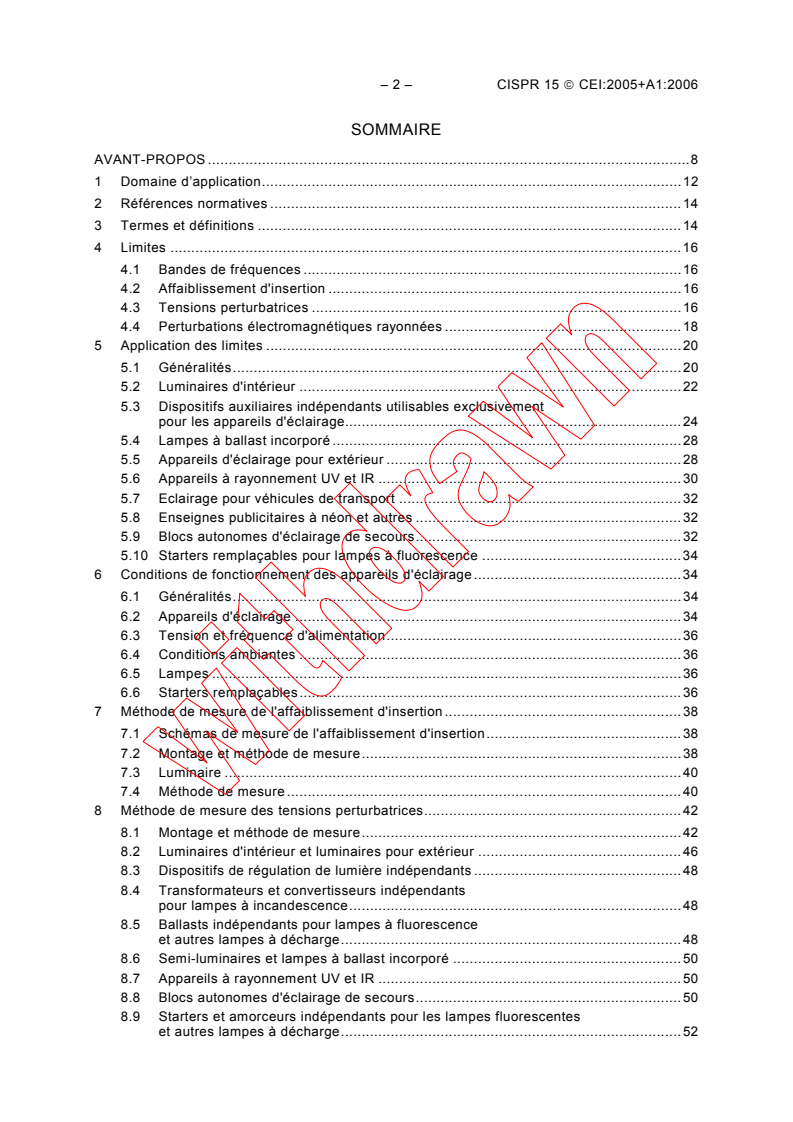
CISPR 15:2005+AMD1:2006 CSV - Limits and methods of measurement of radio disturbance characteristics of electrical lighting and similar equipment Released:1/17/2007
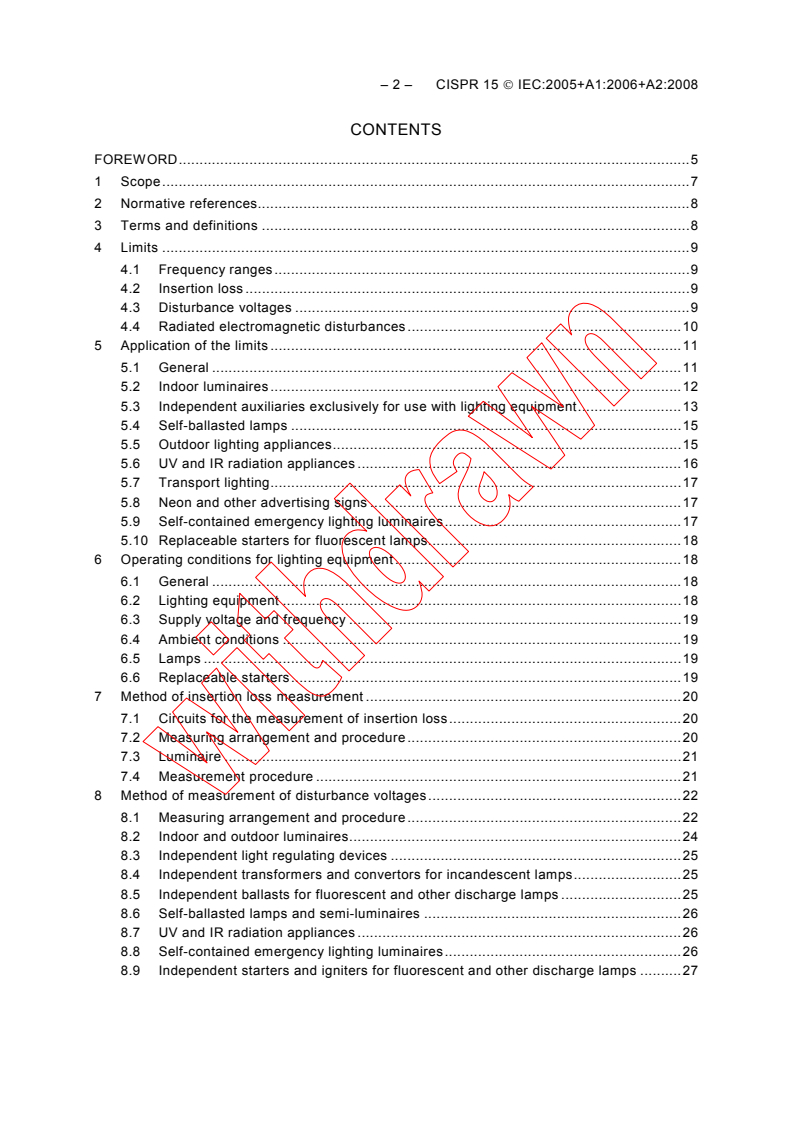
CISPR 15:2005+AMD1:2006+AMD2:2008 CSV - Limits and methods of measurement of radio disturbance characteristics of electrical lighting and similar equipment Released:1/12/2009
Overview
CISPR 15:2005, published by the International Electrotechnical Commission (IEC), defines limits and measurement methods for radio disturbance characteristics of electrical lighting and similar equipment. This standard addresses the emission of radiofrequency disturbances-both radiated and conducted-across a wide frequency range from 9 kHz to 400 GHz. It applies to:
- Lighting equipment primarily designed for illumination, powered by low voltage supply or batteries
- Lighting components in multifunctional devices with illumination as a main function
- Independent auxiliaries used exclusively with lighting equipment
- Ultraviolet (UV) and infrared (IR) radiation devices
- Neon advertising signs
- Outdoor street and flood lighting
- Transportation lighting installed in buses and trains
The standard establishes emission limits based on probabilistic assessments that aim to balance effective electromagnetic compatibility (EMC) with economically reasonable disturbance suppression. It is critical for manufacturers, testing laboratories, and compliance authorities involved with lighting and related equipment.
Key Topics
- Frequency Coverage: 9 kHz to 400 GHz, addressing a broad spectrum of potential radio disturbances.
- Emission Types: Both conducted disturbances (through power and control lines) and radiated disturbances (emissions into the environment) are governed.
- Measurement Methods: Detailed procedures for measuring insertion loss, disturbance voltages at various terminals (mains, load, control), and radiated disturbances using standardized test setups.
- Application Scope: Different sections specify limits and test methods for indoor luminaires, outdoor lighting, self-ballasted lamps, transport lighting, neon signs, UV/IR appliances, and emergency lighting units.
- Operating Conditions: Defines conditions such as supply voltage, ambient parameters, and lamp types under which measurements should be taken to ensure repeatability and reliability.
- Statistical Evaluation: Use of probabilistic and statistical methods to interpret emission test results, supporting decisions on compliance or need for additional measures.
- Auxiliary Devices: Includes testing criteria for independent lighting components such as ballasts, starters, and transformors to ensure overall device EMC compliance.
Applications
CISPR 15:2005 is essential for:
- Manufacturers developing lighting systems to ensure their products meet international EMC standards before market release.
- Compliance testing laboratories performing standardized tests for radio disturbance emissions to certify lighting equipment.
- Regulatory authorities enforcing EMC regulations linked to electromagnetic disturbance emissions in lighting devices.
- Design engineers incorporating EMC considerations early in product development to minimize costly redesigns.
- Product certifiers and quality assurance teams verifying ongoing compliance with international and regional EMC legislation.
- Multifunction equipment developers ensuring that the lighting functionality complies with specific clauses of CISPR 15 alongside other relevant standards.
Adherence to CISPR 15 limits reduces the risk of lighting equipment causing interference with communication systems or other electronic devices, enhancing overall electromagnetic compatibility in residential, industrial, commercial, and transportation environments.
Related Standards
To achieve comprehensive EMC compliance in lighting and related applications, CISPR 15:2005 should be used in conjunction with other standards:
- CISPR 22 / CISPR 32: Standards addressing electromagnetic disturbance limits for information technology equipment, relevant when lighting is integrated into multifunctional devices.
- IEC 61000 series: General EMC standards covering immunity and emission requirements across electrical and electronic product categories.
- IEC 62301: Pertains to energy efficiency measurements, often considered alongside EMC standards for lighting products.
- Regional EMC directives: Such as the European EMC Directive (2014/30/EU), which requires compliance with standards like CISPR 15 for market access.
- IEC 60598 series: Focuses on luminaire safety but often overlaps with EMC requirements from CISPR 15.
- Standards for transport lighting: Including those specified by vehicle manufacturers or transport safety bodies.
By following these harmonized standards, stakeholders can ensure lighting equipment operates effectively without compromising radio communication or other services, while meeting safety, performance, and regulatory requirements worldwide.
Keywords: CISPR 15:2005, IEC lighting standard, radio disturbance limits, electromagnetic compatibility, EMC lighting equipment, lighting emission measurement, lighting EMC compliance, radiated disturbance, conducted disturbance, lighting equipment standards, UV and IR radiation devices, neon signs EMC, transport lighting EMC, IEC standards lighting, electromagnetic interference lighting
Relations
- Effective Date
- 05-Sep-2023
- Effective Date
- 05-Sep-2023
- Effective Date
- 05-Sep-2023
- Effective Date
- 05-Sep-2023
- Effective Date
- 05-Sep-2023
- Effective Date
- 05-Sep-2023
- Effective Date
- 05-Sep-2023
- Effective Date
- 05-Sep-2023
Buy Documents
CISPR 15:2005 - Limits and methods of measurement of radio disturbance characteristics of electrical lighting and similar equipment Released:11/11/2005
CISPR 15:2005+AMD1:2006 CSV - Limits and methods of measurement of radio disturbance characteristics of electrical lighting and similar equipment Released:1/17/2007
CISPR 15:2005+AMD1:2006+AMD2:2008 CSV - Limits and methods of measurement of radio disturbance characteristics of electrical lighting and similar equipment Released:1/12/2009
Get Certified
Connect with accredited certification bodies for this standard

ANCE
Mexican certification and testing association.

Intertek Slovenia
Intertek testing, inspection, and certification services in Slovenia.

LNE (Laboratoire National de Métrologie et d'Essais)
French national laboratory for metrology and testing.
Sponsored listings
Frequently Asked Questions
CISPR 15:2005 is a standard published by the International Electrotechnical Commission (IEC). Its full title is "Limits and methods of measurement of radio disturbance characteristics of electrical lighting and similar equipment". This standard covers: This standard applies to the emission (radiated and conducted) of radiofrequency disturbances from: - all lighting equipment with a primary function of generating and/or distributing light intended for illumination purposes, and intended either for connection to the low voltage electricity supply or for battery operation; - the lighting part of multi-function equipment where one of the primary functions of this is illumination; - independent auxiliaries exclusively for use with lighting equipment; - UV and IR radiation equipment; - neon advertising signs; - street/flood lighting intended for outdoor use; - transport lighting (installed in buses and trains). The frequency range covered is 9 kHz to 400 GHz. Multi-function equipment which is subjected simultaneously to different clauses of this standard and/or other standards shall meet the provisions of each clause/standard with the relevant functions in operation. The limits in this standard have been determined on a probabilistic basis to keep the suppression of disturbances within economically reasonable limits while still achieving an adequate level of radio protection and electromagnetic compatibility. In exceptional cases, additional provisions may be required. The contents of the interpretation sheet 1 and 2 of February 2013 have been included in this copy.
This standard applies to the emission (radiated and conducted) of radiofrequency disturbances from: - all lighting equipment with a primary function of generating and/or distributing light intended for illumination purposes, and intended either for connection to the low voltage electricity supply or for battery operation; - the lighting part of multi-function equipment where one of the primary functions of this is illumination; - independent auxiliaries exclusively for use with lighting equipment; - UV and IR radiation equipment; - neon advertising signs; - street/flood lighting intended for outdoor use; - transport lighting (installed in buses and trains). The frequency range covered is 9 kHz to 400 GHz. Multi-function equipment which is subjected simultaneously to different clauses of this standard and/or other standards shall meet the provisions of each clause/standard with the relevant functions in operation. The limits in this standard have been determined on a probabilistic basis to keep the suppression of disturbances within economically reasonable limits while still achieving an adequate level of radio protection and electromagnetic compatibility. In exceptional cases, additional provisions may be required. The contents of the interpretation sheet 1 and 2 of February 2013 have been included in this copy.
CISPR 15:2005 is classified under the following ICS (International Classification for Standards) categories: 33.100.10 - Emission. The ICS classification helps identify the subject area and facilitates finding related standards.
CISPR 15:2005 has the following relationships with other standards: It is inter standard links to CISPR 15:2005/AMD1:2006, CISPR 15:2005/AMD2:2008, CISPR 15:2005/ISH1:2013, CISPR 15:2005/ISH2:2013, CISPR 15:2013, CISPR 15:2000/AMD1:2001, CISPR 15:2000, CISPR 15:2000/AMD2:2002. Understanding these relationships helps ensure you are using the most current and applicable version of the standard.
CISPR 15:2005 is available in PDF format for immediate download after purchase. The document can be added to your cart and obtained through the secure checkout process. Digital delivery ensures instant access to the complete standard document.
Standards Content (Sample)
COMMISSION
CISPR
ÉLECTROTECHNIQUE
INTERNATIONALE
INTERNATIONAL
Septième édition
ELECTROTECHNICAL
Seventh edition
2005-11
COMMISSION
COMITÉ INTERNATIONAL SPÉCIAL DES PERTURBATIONS RADIOÉLECTRIQUES
INTERNATIONAL SPECIAL COMMITTEE ON RADIO INTERFERENCE
Limites et méthodes de mesure des perturbations
radioélectriques produites par les appareils
électriques d'éclairage et les appareils analogues
Limits and methods of measurement of radio
disturbance characteristics of electrical lighting
and similar equipment
Numéro de référence
Reference number
Numérotation des publications Publication numbering
Depuis le 1er janvier 1997, les publications de la CEI As from 1 January 1997 all IEC publications are
sont numérotées à partir de 60000. Ainsi, la CEI 34-1 issued with a designation in the 60000 series. For
devient la CEI 60034-1. example, IEC 34-1 is now referred to as IEC 60034-1.
Editions consolidées Consolidated editions
Les versions consolidées de certaines publications de la The IEC is now publishing consolidated versions of its
CEI incorporant les amendements sont disponibles. Par publications. For example, edition numbers 1.0, 1.1
exemple, les numéros d’édition 1.0, 1.1 et 1.2 indiquent and 1.2 refer, respectively, to the base publication,
respectivement la publication de base, la publication de the base publication incorporating amendment 1 and
base incorporant l’amendement 1, et la publication de the base publication incorporating amendments 1
base incorporant les amendements 1 et 2. and 2.
Informations supplémentaires Further information on IEC publications
sur les publications de la CEI
Le contenu technique des publications de la CEI est The technical content of IEC publications is kept
constamment revu par la CEI afin qu'il reflète l'état under constant review by the IEC, thus ensuring that
actuel de la technique. Des renseignements relatifs à the content reflects current technology. Information
cette publication, y compris sa validité, sont dispo- relating to this publication, including its validity, is
nibles dans le Catalogue des publications de la CEI available in the IEC Catalogue of publications
(voir ci-dessous) en plus des nouvelles éditions, (see below) in addition to new editions, amendments
amendements et corrigenda. Des informations sur les and corrigenda. Information on the subjects under
sujets à l’étude et l’avancement des travaux entrepris consideration and work in progress undertaken by the
par le comité d’études qui a élaboré cette publication, technical committee which has prepared this
ainsi que la liste des publications parues, sont publication, as well as the list of publications issued,
également disponibles par l’intermédiaire de: is also available from the following:
• Site web de la CEI (www.iec.ch) • IEC Web Site (www.iec.ch)
• Catalogue des publications de la CEI • Catalogue of IEC publications
Le catalogue en ligne sur le site web de la CEI The on-line catalogue on the IEC web site
(www.iec.ch/searchpub) vous permet de faire des (www.iec.ch/searchpub) enables you to search by a
recherches en utilisant de nombreux critères, variety of criteria including text searches,
comprenant des recherches textuelles, par comité technical committees and date of publication. On-
d’études ou date de publication. Des informations en line information is also available on recently
ligne sont également disponibles sur les nouvelles issued publications, withdrawn and replaced
publications, les publications remplacées ou retirées, publications, as well as corrigenda.
ainsi que sur les corrigenda.
• IEC Just Published • IEC Just Published
Ce résumé des dernières publications parues This summary of recently issued publications
(www.iec.ch/online_news/justpub) est aussi dispo- (www.iec.ch/online_news/justpub) is also available
nible par courrier électronique. Veuillez prendre by email. Please contact the Customer Service
contact avec le Service client (voir ci-dessous) Centre (see below) for further information.
pour plus d’informations.
• Service clients • Customer Service Centre
Si vous avez des questions au sujet de cette If you have any questions regarding this
publication ou avez besoin de renseignements publication or need further assistance, please
supplémentaires, prenez contact avec le Service contact the Customer Service Centre:
clients:
Email: custserv@iec.ch Email: custserv@iec.ch
Tél: +41 22 919 02 11 Tel: +41 22 919 02 11
Fax: +41 22 919 03 00 Fax: +41 22 919 03 00
.
COMMISSION
CISPR
ÉLECTROTECHNIQUE
INTERNATIONALE
INTERNATIONAL
Septième édition
ELECTROTECHNICAL
Seventh edition
2005-11
COMMISSION
COMITÉ INTERNATIONAL SPÉCIAL DES PERTURBATIONS RADIOÉLECTRIQUES
INTERNATIONAL SPECIAL COMMITTEE ON RADIO INTERFERENCE
Limites et méthodes de mesure des perturbations
radioélectriques produites par les appareils
électriques d'éclairage et les appareils analogues
Limits and methods of measurement of radio
disturbance characteristics of electrical lighting
and similar equipment
IEC 2005 Droits de reproduction réservés Copyright - all rights reserved
Aucune partie de cette publication ne peut être reproduite ni No part of this publication may be reproduced or utilized in any
utilisée sous quelque forme que ce soit et par aucun procédé, form or by any means, electronic or mechanical, including
électronique ou mécanique, y compris la photocopie et les photocopying and microfilm, without permission in writing from
microfilms, sans l'accord écrit de l'éditeur. the publisher.
International Electrotechnical Commission, 3, rue de Varembé, PO Box 131, CH-1211 Geneva 20, Switzerland
Telephone: +41 22 919 02 11 Telefax: +41 22 919 03 00 E-mail: inmail@iec.ch Web: www.iec.ch
CODE PRIX
X
Commission Electrotechnique Internationale
PRICE CODE
International Electrotechnical Commission
МеждународнаяЭлектротехническаяКомиссия
Pour prix, voir catalogue en vigueur
For price, see current catalogue
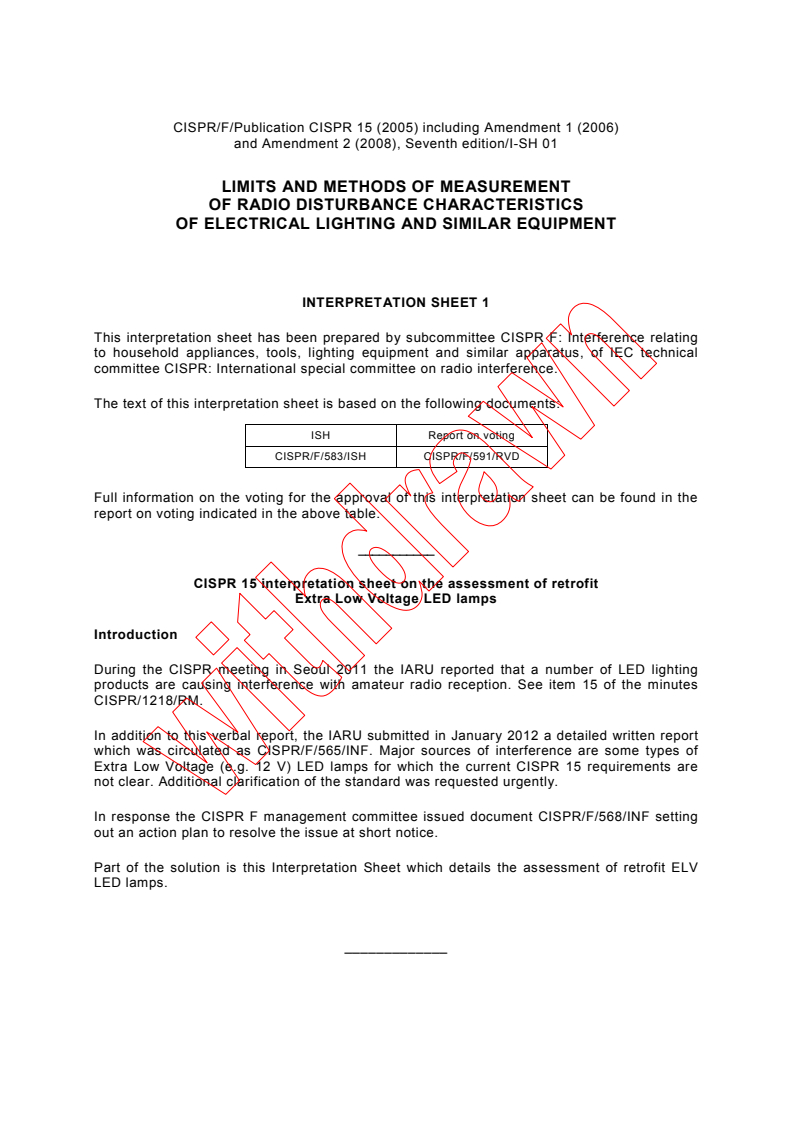
CISPR/F/Publication CISPR 15 (2005) including Amendment 1 (2006)
and Amendment 2 (2008), Seventh edition/I-SH 01
LIMITS AND METHODS OF MEASUREMENT
OF RADIO DISTURBANCE CHARACTERISTICS
OF ELECTRICAL LIGHTING AND SIMILAR EQUIPMENT
INTERPRETATION SHEET 1
This interpretation sheet has been prepared by subcommittee CISPR F: Interference relating
to household appliances, tools, lighting equipment and similar apparatus, of IEC technical
committee CISPR: International special committee on radio interference.
The text of this interpretation sheet is based on the following documents:
ISH Report on voting
CISPR/F/583/ISH CISPR/F/591/RVD
Full information on the voting for the approval of this interpretation sheet can be found in the
report on voting indicated in the above table.
___________
CISPR 15 interpretation sheet on the assessment of retrofit
Extra Low Voltage LED lamps
Introduction
During the CISPR meeting in Seoul 2011 the IARU reported that a number of LED lighting
products are causing interference with amateur radio reception. See item 15 of the minutes
CISPR/1218/RM.
In addition to this verbal report, the IARU submitted in January 2012 a detailed written report
which was circulated as CISPR/F/565/INF. Major sources of interference are some types of
Extra Low Voltage (e.g. 12 V) LED lamps for which the current CISPR 15 requirements are
not clear. Additional clarification of the standard was requested urgently.
In response the CISPR F management committee issued document CISPR/F/568/INF setting
out an action plan to resolve the issue at short notice.
Part of the solution is this Interpretation Sheet which details the assessment of retrofit ELV
LED lamps.
_____________
Question: How are the requirements of CISPR 15 applied to retrofit Extra Low
Voltage (ELV) LED lamps?
Interpretation: When assessing retrofit ELV LED lamps against the requirements of
CISPR 15 the following procedure shall be applied.
ELV LED lamps without active switching electronic components are considered to fulfil the
requirements of CISPR 15 without test.
All other types of retrofit ELV LED lamps shall be tested in conjunction with a wire wound 50
or 60 Hz ring-core transformer. The use of such a transformer is considered to be the worst-
case condition and shall be used unless it is clearly stated in the manufacturer’s instructions
that the lamp is unsuitable for use with such a transformer. In this case measurements shall
be performed in combination with a typical compliant electronic transformer for halogen
lamps.
The combination of transformer and ELV LED lamp shall comply with the mains disturbance
voltage limits of Table 2a and the radiated disturbance limits of Tables 3a and 3b.
During the disturbance voltage measurement, the ELV LED lamp is mounted in a conical
metal housing as described in Figure 7. The ELV LED lamp is then connected to the
transformer by a flexible 3-core cable consisting of two ELV supply conductors and the earth
connection to the conical housing. The length of this cable shall be as short as possible. The
metal conical housing shall be positioned with its cable entrance close to the transformer.
The combination of transformer and conical metal housing shall be tested as a luminaire in
accordance with the requirements of 8.2.
When performing the radiated disturbance measurements in accordance with Clause 9, the
conical metal housing shall not be used.
References are to CISPR 15:2005, including Amendment 1 (2006) and Amendment 2 (2008).
_____________
February 2013 ICS 33.100.10
CISPR/F/Publication CISPR 15 (2005) incluant l'Amendement 1 (2006)
et l'Amendement 2 (2008), Septième édition/I-SH 01
LIMITES ET MÉTHODES DE MESURE DES PERTURBATIONS
RADIOÉLECTRIQUES PRODUITES PAR LES APPAREILS ÉLECTRIQUES
D'ÉCLAIRAGE ET LES APPAREILS ANALOGUES
FEUILLE D'INTERPRÉTATION 1
La présente feuille d'interprétation a été établie par le sous-comité CISPR F: Perturbations
relatives aux appareils domestiques, aux outils, aux appareils d'éclairage et aux appareils
analogues, du comité d'études CISPR de la CEI : Comité international spécial des
perturbations radioélectriques.
Le texte de la présente feuille d'interprétation est issu des documents suivants:
ISH Rapport de vote
CISPR/F/583/ISH CISPR/F/591/RVD
Le rapport de vote indiqué dans le tableau ci-dessus donne toute information sur le vote ayant
abouti à l'approbation de cette feuille d'interprétation.
___________
CISPR 15 feuille d'interprétation sur l'évaluation des lampes LED retrofit (ou
améliorées) à très basse tension
Introduction
Au cours de la réunion CISPR de Séoul en 2011, l'Union internationale des radioamateurs
(IARU) a signalé qu'un certain nombre de produits d'éclairage LED provoquaient des
perturbations pour la réception radioamateur. Se reporter au point 15 du procès-verbal
CISPR/1218/RM.
Outre ce rapport verbal, l'IARU a soumis en janvier 2012 un rapport écrit détaillé diffusé sous
la désignation CISPR/F/565/INF. Des sources majeures de perturbations proviennent de
certains types de lampes LED à Très Basse Tension (comme par ex.12 V) pour lesquelles les
exigences de la CISPR 15 actuelle ne sont pas claires. Il a été demandé en urgence un
éclaircissement supplémentaire de la norme.
En réponse, le comité de gestion CISPR F a publié le document CISPR/F/568/INF établissant
un plan d'action pour résoudre cette question à court terme.
Une partie de la solution figure dans la Feuille d'Interprétation précisant l'évaluation des
lampes LED TBT de remplacement (installées à la place de lampes conventionnelles).
_____________
Question: Quelles sont les exigences de la CISPR 15 appliquées aux lampes
LED de remplacement à très basse tension (TBT)?
Interprétation: Lors de l'évaluation des lampes LED de remplacement TBT selon les
exigences de la CISPR 15 la procédure suivante doit être appliquée.
Les lampes TBT LED dénuées de composants électroniques de commutation actifs sont
considérées comme remplissant les exigences de la CISPR 15 sans essai.
Tous les autres types de lampes TBT LED de remplacement doivent être soumis à essai
conjointement à un transformateur toroïdal 50 ou 60 Hz bobiné. L'utilisation d'un tel
transformateur est considérée comme étant la condition la plus défavorable et il doit être
utilisé à moins qu'il ne soit clairement indiqué dans les instructions du fabricant que la lampe
ne convient pas pour l'utilisation avec un tel transformateur. Dans ce cas les mesures doivent
être réalisées en association avec un transformateur électronique conforme typique pour les
lampes halogène.
La combinaison du transformateur et de la lampe LED TBT doit être conforme aux limites de
la tension perturbatrice d'alimentation figurant au Tableau 2a et aux limites des perturbations
rayonnées des Tableaux 3a et 3b.
Au cours de la mesure de la tension perturbatrice, la lampe LED TBT est montée dans un
boîtier métallique conique décrit à la Figure 7. La lampe LED TBT est ensuite raccordée au
transformateur par un câble souple à trois conducteurs constitué de deux conducteurs
d'alimentation TBT et de la connexion de terre au boîtier conique. La longueur de ce câble
doit être aussi courte que possible. Le boîtier conique en métal doit être mis en position de
sorte que son entrée de câble soit à proximité du transformateur.
La combinaison du transformateur et du boîtier conique en métal doit être soumise à essai
comme un luminaire conformément aux exigences du 8.2.
En réalisant les mesures des perturbations rayonnées selon l'Article 9, le boîtier conique en
métal en doit pas être utilisé.
Les références figurent par rapport à la CISPR 15:2005, y compris l'Amendement 1 (2006) et
l'Amendement 2 (2008).
_____________
Février 2013 ICS 33.100.10
CISPR/F/Publication CISPR 15 (2005) including Amendment 1 (2006)
and Amendment 2 (2008), Seventh edition/I-SH 02
LIMITS AND METHODS OF MEASUREMENT
OF RADIO DISTURBANCE CHARACTERISTICS
OF ELECTRICAL LIGHTING AND SIMILAR EQUIPMENT
INTERPRETATION SHEET 2
This interpretation sheet has been prepared by subcommittee CISPR F: Interference relating
to household appliances, tools, lighting equipment and similar apparatus, of IEC technical
committee CISPR: International special committee on radio interference.
The text of this interpretation sheet is based on the following documents:
ISH Report on voting
CISPR/F/584/ISH CISPR/F/592/RVD
Full information on the voting for the approval of this interpretation sheet can be found in the
report on voting indicated in the above table.
___________
CISPR 15 interpretation sheet on: Test conditions for wall dimmers
Introduction
More and more incandescent lamps are replaced by energy saving lamps (fluorescent and
LED). Some types are dimmable by phase control of the supply voltage. New wall dimmers
are developed to improve the dim performance when the dimmer is loaded with energy saving
lamps. CISPR 15 is not clear on how to test these types of wall dimmers.
This interpretation sheet has been prepared by the Joint 17B-23B-34A-77A IEC Forum on the
dimming of electronic self-ballasted lamps and was finalized during the CISPR/F/WG2
meeting in Bangkok.
Question: How to test a wall dimmer which is suitable for energy saving lamps?
Relevant text CISPR 15:
Clause 8 of CISPR 15 specifies the ‘Method of measurement of disturbance voltages’.
8.3.1 ‘Directly operating devices’ specifies the test arrangement of independent directly
operating light regulating devices such as wall dimmers.
The second paragraph reads:
‘Unless otherwise specified by the manufacturer, the regulating device shall be measured with
the maximum allowed load consisting of incandescent lamps as specified by the
manufacturer.’
Answer:
1) Independent directly operating light regulating devices (e.g. wall dimmers) which are
suitable for incandescent lamps and other types of lighting equipment (e.g. self-
ballasted lamps) shall be tested with incandescent lamps.
2) Independent directly operating light regulating devices which are only suitable for
lighting equipment other than incandescent lamps shall be tested with the appropriate
lighting equipment as provided by the manufacturer.
th
The above will be included in the full revision of CISPR 15, following the 8 edition.
_____________
February 2013 ICS 33.100.10
CISPR/F/Publication CISPR 15 (2005) incluant l'Amendement 1 (2006)
et l'Amendement 2 (2008), Septième édition/I-SH 02
LIMITES ET MÉTHODES DE MESURE DES PERTURBATIONS
RADIOÉLECTRIQUES PRODUITES PAR LES APPAREILS ÉLECTRIQUES
D'ÉCLAIRAGE ET LES APPAREILS ANALOGUES
FEUILLE D'INTERPRÉTATION 2
La présente feuille d'interprétation a été établie par le sous-comité CISPR F: Perturbations
relatives aux appareils domestiques, aux outils, aux appareils d'éclairage et aux appareils
analogues, du comité d'études CISPR de la CEI: Comité international spécial des
perturbations radioélectriques.
Le texte de la présente feuille d'interprétation est issu des documents suivants:
ISH Rapport de vote
CISPR/F/584/ISH CISPR/F/592/RVD
Le rapport de vote indiqué dans le tableau ci-dessus donne toute information sur le vote ayant
abouti à l'approbation de cette feuille d'interprétation.
___________
CISPR 15 feuille d'interprétation sur: Conditions d'essais pour les variateurs muraux
Introduction
De plus en plus de lampes à incandescence sont remplacées par des lampes à basse
consommation d'énergie (fluorescentes et LED). Certains types permettent la gradation de
lumière au moyen de la commande de phase de la tension d'alimentation. De nouveaux
variateurs muraux sont mis au point, en vue d'améliorer la performance de la gradation de
l'intensité lumineuse lorsque le variateur est chargé en lampes à basse consommation
d'énergie. La CISPR 15 n'apporte pas d'éclaircissements quant à la façon de soumettre à
essai ces types de variateurs muraux.
Cette feuille d'interprétation a été établie par le Forum CEI commun 17B-23B-34A-77A (Joint
17B-23B-34A-77A IEC Forum) sur le thème de la gradation des lampes électroniques à
ballast intégré et il a été finalisé au cours de la réunion du CISPR/F/GT2 à Bangkok.
Question: Comment procéder aux essais d'un variateur mural qui convient aux lampes
à basse consommation d'énergie?
Texte pertinent de la CISPR 15:
L'Article 8 de la CISPR 15 spécifie la ‘Méthode de mesure des tensions perturbatrices’.
Le 8.3.1 ‘Dispositifs à action directe’ spécifie le montage d'essai des dispositifs de
régulation de lumière indépendants à action directe, tels que les variateurs muraux.
Le deuxième alinéa indique:
‘Sauf spécification contraire du fabricant, on doit mesurer le dispositif de régulation avec la
charge maximale autorisée par le fabricant, cette charge étant constituée de lampes à
incandescence.’
Réponse:
1) Les dispositifs de régulation de lumière indépendants à action directe (comme les
variateurs muraux) qui conviennent pour les lampes à incandescence et autres types
d'appareils d'éclairage (comme les lampes à ballast intégré) doivent être soumis à
essai avec des lampes à incandescence.
2) Les dispositifs de régulation de lumière indépendants à action directe qui conviennent
uniquement pour les appareils d'éclairage autres que les lampes à incandescence
doivent être soumis à essai avec l'appareil d'éclairage approprié tel que fourni par le
fabricant.
ème
Le texte qui précède sera inclus dans la révision de la CISPR 15, à la suite de la 8 édition.
_____________
Février 2013 ICS 33.100.10
– 2 – CISPR 15 CEI:2005
SOMMAIRE
AVANT-PROPOS .8
1 Domaine d’application.12
2 Références normatives.14
3 Termes et définitions .14
4 Limites.16
4.1 Bandes de fréquences .16
4.2 Affaiblissement d'insertion .16
4.3 Tensions perturbatrices.16
4.4 Perturbations électromagnétiques rayonnées .18
5 Application des limites .20
5.1 Généralités.20
5.2 Luminaires d'intérieur .20
5.3 Dispositifs auxiliaires indépendants utilisables exclusivement pour les
appareils d'éclairage.22
5.4 Lampes à ballast incorporé .26
5.5 Appareils d'éclairage pour extérieur .26
5.6 Appareils à rayonnement UV et IR .28
5.7 Eclairage pour véhicules de transport .30
5.8 Enseignes publicitaires à néon et autres .32
5.9 Blocs autonomes d'éclairage de secours.32
5.10 Starters remplaçables pour lampes à fluorescence .32
6 Conditions de fonctionnement des appareils d'éclairage .34
6.1 Généralités.34
6.2 Appareils d'éclairage .34
6.3 Tension et fréquence d'alimentation.34
6.4 Conditions ambiantes .34
6.5 Lampes.34
6.6 Starters remplaçables.36
7 Méthode de mesure de l'affaiblissement d'insertion .36
7.1 Schémas de mesure de l'affaiblissement d'insertion.36
7.2 Montage et méthode de mesure.38
7.3 Luminaire .38
7.4 Méthode de mesure .40
8 Méthode de mesure des tensions perturbatrices.42
8.1 Montage et méthode de mesure.42
8.2 Luminaires d'intérieur et luminaires pour extérieur .44
8.3 Dispositifs de régulation de lumière indépendants .46
8.4 Transformateurs et convertisseurs indépendants pour lampes à
incandescence.46
8.5 Ballasts indépendants pour lampes à fluorescence et autres lampes à
décharge .48
8.6 Semi-luminaires et lampes à ballast incorporé .48
8.7 Appareils à rayonnement UV et IR .50
8.8 Blocs autonomes d'éclairage de secours.50
8.9 Starters et amorceurs indépendants pour les lampes fluorescentes et autres
lampes à décharge .50
CISPR 15 IEC:2005 – 3 –
CONTENTS
FOREWORD.9
1 Scope.13
2 Normative references.15
3 Terms and definitions .15
4 Limits.17
4.1 Frequency ranges.17
4.2 Insertion loss .17
4.3 Disturbance voltages .17
4.4 Radiated electromagnetic disturbances.19
5 Application of the limits .21
5.1 General.21
5.2 Indoor luminaires.21
5.3 Independent auxiliaries exclusively for use with lighting equipment.23
5.4 Self-ballasted lamps .27
5.5 Outdoor lighting appliances.27
5.6 UV and IR radiation appliances .29
5.7 Transport lighting.31
5.8 Neon and other advertising signs .33
5.9 Self-contained emergency lighting luminaires.33
5.10 Replaceable starters for fluorescent lamps.33
6 Operating conditions for lighting equipment.35
6.1 General.35
6.2 Lighting equipment .35
6.3 Supply voltage and frequency .35
6.4 Ambient conditions .35
6.5 Lamps.35
6.6 Replaceable starters.37
7 Method of insertion loss measurement .37
7.1 Circuits for the measurement of insertion loss.37
7.2 Measuring arrangement and procedure.39
7.3 Luminaire .39
7.4 Measurement procedure.41
8 Method of measurement of disturbance voltages.43
8.1 Measuring arrangement and procedure.43
8.2 Indoor and outdoor luminaires.45
8.3 Independent light regulating devices .47
8.4 Independent transformers and convertors for incandescent lamps.47
8.5 Independent ballasts for fluorescent and other discharge lamps .49
8.6 Self-ballasted lamps and semi-luminaires .49
8.7 UV and IR radiation appliances .51
8.8 Self-contained emergency lighting luminaires.51
8.9 Independent starters and igniters for fluorescent and other discharge lamps .51
– 4 – CISPR 15 CEI:2005
9 Méthode de mesure des perturbations électromagnétiques rayonnées.50
9.1 Montage et méthode de mesure.50
9.2 Luminaires d'intérieur et luminaires pour extérieur .52
9.3 Convertisseurs indépendants pour lampes à incandescence .52
9.4 Ballasts indépendants pour lampes à fluorescence et autres lampes à
décharge .52
9.5 Semi-luminaires et lampes à ballast incorporé .52
9.6 Appareils à rayonnement UV et IR .52
9.7 Blocs autonomes d'éclairage de secours.52
10 Interprétation des limites des perturbations radioélectriques spécifiées par le
CISPR .52
10.1 Signification d'une limite spécifiée par le CISPR.52
10.2 Essais.54
10.3 Méthode statistique d'évaluation .54
10.4 Interdiction de vente .56
Annexe A (normative) Exigences électriques et de construction applicables au
transformateur asymétrique-symétrique à faible capacité.82
Figure 1 – Mesure de l'affaiblissement d'insertion des luminaires à lampes à
fluorescence droites et de type U .58
Figure 2 – Mesure de l'affaiblissement d'insertion des luminaires à lampes à
fluorescence circulaires.60
Figure 3 – Mesure de l'affaiblissement d'insertion de luminaires à lampes à
fluorescence à culot unique avec starter incorporé .62
Figure 4a – Schéma de la lampe fictive droite et de type U .64
Figure 4b – Schéma de la lampe fictive circulaire .66
Figure 4c – Lampe fictive pour lampes à fluorescence de 15 mm .68
Figure 4d – Lampe fictive pour lampes à fluorescence de 15 mm à culot unique .70
Figure 4e – Lampe fictive pour lampes à fluorescence à culot unique, droites, à double
tube, tube de 12 mm de diamètre .72
Figure 4f – Lampe fictive pour lampes à fluorescence à culot unique, droites, à tube
quadruple, tube de 12 mm de diamètre.74
Figure 5 – Montages de mesure pour un dispositif de régulation de lumière, un
transformateur ou un convertisseur indépendant .76
Figure 6 – Montages de mesure d’un luminaire (Figure 6a), d’un ballast indépendant
(Figure 6b) et d’une lampe à ballast incorporé (Figure 6c) .78
Figure 7 – Support métallique conique pour lampes à fluorescence à ballast incorporé .80
Figure A.1 – Configuration pour mesurer l'isolation.84
Figure A.2a – Diagramme du transformateur asymétrique-symétrique.86
Figure A.2b – Détails de construction du noyau du transformateur .88
Figure A.2c – Détails de construction du noyau du transformateur .88
Figure A.2d – Construction du transformateur.90
CISPR 15 IEC:2005 – 5 –
9 Method of measurement of radiated electromagnetic disturbances .51
9.1 Measuring arrangement and procedure.51
9.2 Indoor and outdoor luminaires.53
9.3 Independent convertors for incandescent lamps.53
9.4 Independent ballasts for fluorescent and other discharge lamps .53
9.5 Self-ballasted lamps and semi-luminaires .53
9.6 UV and IR radiation appliances .53
9.7 Self-contained emergency lighting luminaires.53
10 Interpretation of CISPR radio disturbance limits .53
10.1 Significance of a CISPR limit .53
10.2 Tests.55
10.3 Statistical method of evaluation.55
10.4 Banning of sales .57
Annex A (normative) Electrical and constructional requirements for
the low-capacitance balance-to-unbalance transformer.83
Figure 1 – Insertion loss measurement on linear and U-type fluorescent lamp luminaires .59
Figure 2 – Insertion loss measurement on circular fluorescent lamp luminaires.61
Figure 3 – Insertion loss measurement on luminaires for single-capped fluorescent
lamps with integrated starter .63
Figure 4a – Configuration of linear and U-type dummy lamps.65
Figure 4b – Configuration of circular dummy lamps.67
Figure 4c – Dummy lamp for 15 mm fluorescent lamps .69
Figure 4d – Dummy lamp for 15 mm single-capped fluorescent lamps .71
Figure 4e – Dummy lamp for single-capped fluorescent lamps, linear-shaped,
twin tube, tube diameter 12 mm.73
Figure 4f – Dummy lamp for single-capped fluorescent lamps, linear-shaped,
quad tube, diameter 12 mm.75
Figure 5 – Measuring arrangements for an independent light regulating device,
transformer or convertor.77
Figure 6 – Measuring arrangements for measuring a luminaire (Figure 6a),
an independent ballast (Figure 6b) and a self-ballasted lamp (Figure 6c) .79
Figure 7 – Conical metal housing for self-ballasted fluorescent lamps.81
Figure A.1 – Isolation test configuration.85
Figure A.2a – Balance-to-unbalance transformer circuit .87
Figure A.2b – Details of transformer core construction.89
Figure A.2c – Details of transformer core construction.89
Figure A.2d – Construction of transformer .91
– 6 – CISPR 15 CEI:2005
Tableau 1 – Limites de l'affaiblissement d'insertion.16
Tableau 2a – Limites de la tension perturbatrice aux bornes d'alimentation.16
Tableau 2b – Limites de la tension perturbatrice aux bornes de la charge .18
Tableau 2c – Limites de la tension perturbatrice aux bornes de commande .18
Tableau 3 – Limites des perturbations électromagnétiques rayonnées .20
Tableau 4 – Taille d'échantillonnage et facteur k correspondant dans une distribution de
t non centrale.54
CISPR 15 IEC:2005 – 7 –
Table 1 – Minimum values of insertion loss.17
Table 2a – Disturbance voltage limits at mains terminals .17
Table 2b – Disturbance voltage limits at load terminals.19
Table 2c – Disturbance voltage limits at control terminals .19
Table 3 – Radiated electromagnetic disturbance limits.21
Table 4 – Sample size and corresponding k factor in a non-central t-distribution .55
– 8 – CISPR 15 CEI:2005
COMMISSION ÉLECTROTECHNIQUE INTERNATIONALE
COMITÉ INTERNATIONAL SPÉCIAL DES PERTURBATIONS RADIOÉLECTRIQUES
–––––––––––
LIMITES ET MÉTHODES DE MESURE DES PERTURBATIONS
RADIOÉLECTRIQUES PRODUITES PAR LES APPAREILS ÉLECTRIQUES
D'ÉCLAIRAGE ET LES APPAREILS ANALOGUES
AVANT-PROPOS
1) La Commission Electrotechnique Internationale (CEI) est une organisation mondiale de normalisation composée
de l'ensemble des comités électrotechniques nationaux (Comités nationaux de la CEI). La CEI a pour objet de
favoriser la coopération internationale pour toutes les questions de normalisation dans les domaines de
l'électricité et de l'électronique. A cet effet, la CEI – entre autres activités – publie des Normes internationales,
des Spécifications techniques, des Rapports techniques, des Spécifications accessibles au public (PAS) et des
Guides (ci-après dénommés "Publication(s) de la CEI"). Leur élaboration est confiée à des comités d'études,
aux travaux desquels tout Comité national intéressé par le sujet traité peut participer. Les organisations
internationales, gouvernementales et non gouvernementales, en liaison avec la CEI, participent également aux
travaux. La CEI collabore étroitement avec l'Organisation Internationale de Normalisation (ISO), selon des
conditions fixées par accord entre les deux organisations.
2) Les décisions ou accords officiels de la CEI concernant les questions techniques représentent, dans la mesure
du possible, un accord international sur les sujets étudiés, étant donné que les Comités nationaux de la CEI
intéressés sont représentés dans chaque comité d’études.
3) Les Publications de la CEI se présentent sous la forme de recommandations internationales et sont agréées
comme telles par les Comités nationaux de la CEI. Tous les efforts raisonnables sont entrepris afin que la CEI
s'assure de l'exactitude du contenu technique de ses publications; la CEI ne peut pas être tenue responsable de
l'éventuelle mauvaise utilisation ou interprétation qui en est faite par un quelconque utilisateur final.
4) Dans le but d'encourager l'uniformité internationale, les Comités nationaux de la CEI s'engagent, dans toute la
mesure possible, à appliquer de façon transparente les Publications de la CEI dans leurs publications
nationales et régionales. Toutes divergences entre toutes Publications de la CEI et toutes publications
nationales ou régionales correspondantes doivent être indiquées en termes clairs dans ces dernières.
5) La CEI n’a prévu aucune procédure de marquage valant indication d’approbation et n'engage pas sa
responsabilité pour les équipements déclarés conformes à une de ses Publications.
6) Tous les utilisateurs doivent s'assurer qu'ils sont en possession de la dernière édition de cette publication.
7) Aucune responsabilité ne doit être imputée à la CEI, à ses administrateurs, employés, auxiliaires ou
mandataires, y compris ses experts particuliers et les membres de ses comités d'études et des Comités
nationaux de la CEI, pour tout préjudice causé en cas de dommages corporels et matériels, ou de tout autre
dommage de quelque nature que ce soit, directe ou indirecte, ou pour supporter les coûts (y compris les frais
de justice) et les dépenses découlant de la publication ou de l'utilisation de cette Publication de la CEI ou de
toute autre Publication de la CEI, ou au crédit qui lui est accordé.
8) L'attention est attirée sur les références normatives citées dans cette publication. L'utilisation de publications
référencées est obligatoire pour une application correcte de la présente publication.
9) L’attention est attirée sur le fait que certains des éléments de la présente Publication de la CEI peuvent faire
l’objet de droits de propriété intellectuelle ou de droits analogues. La CEI ne saurait être tenue pour
responsable de ne pas avoir identifié de tels droits de propriété et de ne pas avoir signalé leur existence.
La Norme int
...
CISPR 15
Edition 7.1 2007-01
INTERNATIONAL
STANDARD
NORME
INTERNATIONALE
INTERNATIONAL SPECIAL COMMITTEE ON RADIO INTERFERENCE
COMITÉ INTERNATIONAL SPÉCIAL DES PERTURBATIONS RADIOÉLECTRIQUES
Limits and methods of measurement of radio disturbance characteristics of
electrical lighting and similar equipment
Limites et méthodes de mesure des perturbations radioélectriques produites
par les appareils électriques d'éclairage et les appareils analogues
All rights reserved. Unless otherwise specified, no part of this publication may be reproduced or utilized in any form or by
any means, electronic or mechanical, including photocopying and microfilm, without permission in writing from either IEC or
IEC's member National Committee in the country of the requester.
If you have any questions about IEC copyright or have an enquiry about obtaining additional rights to this publication,
please contact the address below or your local IEC member National Committee for further information.
Droits de reproduction réservés. Sauf indication contraire, aucune partie de cette publication ne peut être reproduite
ni utilisée sous quelque forme que ce soit et par aucun procédé, électronique ou mécanique, y compris la photocopie
et les microfilms, sans l'accord écrit de la CEI ou du Comité national de la CEI du pays du demandeur.
Si vous avez des questions sur le copyright de la CEI ou si vous désirez obtenir des droits supplémentaires sur cette
publication, utilisez les coordonnées ci-après ou contactez le Comité national de la CEI de votre pays de résidence.
IEC Central Office
3, rue de Varembé
CH-1211 Geneva 20
Switzerland
Email: inmail@iec.ch
Web: www.iec.ch
About the IEC
The International Electrotechnical Commission (IEC) is the leading global organization that prepares and publishes
International Standards for all electrical, electronic and related technologies.
About IEC publications
The technical content of IEC publications is kept under constant review by the IEC. Please make sure that you have the
latest edition, a corrigenda or an amendment might have been published.
ƒ Catalogue of IEC publications: www.iec.ch/searchpub
The IEC on-line Catalogue enables you to search by a variety of criteria (reference number, text, technical committee,…).
It also gives information on projects, withdrawn and replaced publications.
ƒ IEC Just Published: www.iec.ch/online_news/justpub
Stay up to date on all new IEC publications. Just Published details twice a month all new publications released. Available
on-line and also by email.
ƒ Electropedia: www.electropedia.org
The world's leading online dictionary of electronic and electrical terms containing more than 20 000 terms and definitions
in English and French, with equivalent terms in additional languages. Also known as the International Electrotechnical
Vocabulary online.
ƒ Customer Service Centre: www.iec.ch/webstore/custserv
If you wish to give us your feedback on this publication or need further assistance, please visit the Customer Service
Centre FAQ or contact us:
Email: csc@iec.ch
Tel.: +41 22 919 02 11
Fax: +41 22 919 03 00
A propos de la CEI
La Commission Electrotechnique Internationale (CEI) est la première organisation mondiale qui élabore et publie des
normes internationales pour tout ce qui a trait à l'électricité, à l'électronique et aux technologies apparentées.
A propos des publications CEI
Le contenu technique des publications de la CEI est constamment revu. Veuillez vous assurer que vous possédez
l’édition la plus récente, un corrigendum ou amendement peut avoir été publié.
ƒ Catalogue des publications de la CEI: www.iec.ch/searchpub/cur_fut-f.htm
Le Catalogue en-ligne de la CEI vous permet d’effectuer des recherches en utilisant différents critères (numéro de référence,
texte, comité d’études,…). Il donne aussi des informations sur les projets et les publications retirées ou remplacées.
ƒ Just Published CEI: www.iec.ch/online_news/justpub
Restez informé sur les nouvelles publications de la CEI. Just Published détaille deux fois par mois les nouvelles
publications parues. Disponible en-ligne et aussi par email.
ƒ Electropedia: www.electropedia.org
Le premier dictionnaire en ligne au monde de termes électroniques et électriques. Il contient plus de 20 000 termes et
définitions en anglais et en français, ainsi que les termes équivalents dans les langues additionnelles. Egalement appelé
Vocabulaire Electrotechnique International en ligne.
ƒ Service Clients: www.iec.ch/webstore/custserv/custserv_entry-f.htm
Si vous désirez nous donner des commentaires sur cette publication ou si vous avez des questions, visitez le FAQ du
Service clients ou contactez-nous:
Email: csc@iec.ch
Tél.: +41 22 919 02 11
Fax: +41 22 919 03 00
CISPR 15
Edition 7.1 2007-01
INTERNATIONAL
STANDARD
NORME
INTERNATIONALE
INTERNATIONAL SPECIAL COMMITTEE ON RADIO INTERFERENCE
COMITÉ INTERNATIONAL SPÉCIAL DES PERTURBATIONS RADIOÉLECTRIQUES
Limits and methods of measurement of radio disturbance characteristics of
electrical lighting and similar equipment
Limites et méthodes de mesure des perturbations radioélectriques produites
par les appareils électriques d'éclairage et les appareils analogues
INTERNATIONAL
ELECTROTECHNICAL
COMMISSION
COMMISSION
ELECTROTECHNIQUE
PRICE CODE
INTERNATIONALE
CP
CODE PRIX
ICS 33.100.10 ISBN 2-8318-8917-0
– 2 – CISPR 15 © CEI:2005+A1:2006
SOMMAIRE
AVANT-PROPOS .8
1 Domaine d’application.12
2 Références normatives.14
3 Termes et définitions .14
4 Limites.16
4.1 Bandes de fréquences .16
4.2 Affaiblissement d'insertion .16
4.3 Tensions perturbatrices.16
4.4 Perturbations électromagnétiques rayonnées .18
5 Application des limites .20
5.1 Généralités.20
5.2 Luminaires d'intérieur .22
5.3 Dispositifs auxiliaires indépendants utilisables exclusivement
pour les appareils d'éclairage.24
5.4 Lampes à ballast incorporé .28
5.5 Appareils d'éclairage pour extérieur .28
5.6 Appareils à rayonnement UV et IR .30
5.7 Eclairage pour véhicules de transport .32
5.8 Enseignes publicitaires à néon et autres .32
5.9 Blocs autonomes d'éclairage de secours.32
5.10 Starters remplaçables pour lampes à fluorescence .34
6 Conditions de fonctionnement des appareils d'éclairage .34
6.1 Généralités.34
6.2 Appareils d'éclairage .34
6.3 Tension et fréquence d'alimentation.36
6.4 Conditions ambiantes .36
6.5 Lampes.36
6.6 Starters remplaçables.36
7 Méthode de mesure de l'affaiblissement d'insertion .38
7.1 Schémas de mesure de l'affaiblissement d'insertion.38
7.2 Montage et méthode de mesure.38
7.3 Luminaire .40
7.4 Méthode de mesure .40
8 Méthode de mesure des tensions perturbatrices.42
8.1 Montage et méthode de mesure.42
8.2 Luminaires d'intérieur et luminaires pour extérieur .46
8.3 Dispositifs de régulation de lumière indépendants .48
8.4 Transformateurs et convertisseurs indépendants
pour lampes à incandescence.48
8.5 Ballasts indépendants pour lampes à fluorescence
et autres lampes à décharge.48
8.6 Semi-luminaires et lampes à ballast incorporé .50
8.7 Appareils à rayonnement UV et IR .50
8.8 Blocs autonomes d'éclairage de secours.50
8.9 Starters et amorceurs indépendants pour les lampes fluorescentes
et autres lampes à décharge.52
CISPR 15 © IEC:2005+A1:2006 – 3 –
CONTENTS
FOREWORD.9
1 Scope.13
2 Normative references.15
3 Terms and definitions .15
4 Limits .17
4.1 Frequency ranges.17
4.2 Insertion loss .17
4.3 Disturbance voltages .17
4.4 Radiated electromagnetic disturbances.19
5 Application of the limits .21
5.1 General .21
5.2 Indoor luminaires.23
5.3 Independent auxiliaries exclusively for use with lighting equipment.25
5.4 Self-ballasted lamps .29
5.5 Outdoor lighting appliances.29
5.6 UV and IR radiation appliances .31
5.7 Transport lighting.33
5.8 Neon and other advertising signs .33
5.9 Self-contained emergency lighting luminaires.33
5.10 Replaceable starters for fluorescent lamps.35
6 Operating conditions for lighting equipment.35
6.1 General .35
6.2 Lighting equipment .35
6.3 Supply voltage and frequency .37
6.4 Ambient conditions .37
6.5 Lamps .37
6.6 Replaceable starters.37
7 Method of insertion loss measurement .39
7.1 Circuits for the measurement of insertion loss.39
7.2 Measuring arrangement and procedure.39
7.3 Luminaire .41
7.4 Measurement procedure .41
8 Method of measurement of disturbance voltages.43
8.1 Measuring arrangement and procedure.43
8.2 Indoor and outdoor luminaires.47
8.3 Independent light regulating devices .49
8.4 Independent transformers and convertors for incandescent lamps.49
8.5 Independent ballasts for fluorescent and other discharge lamps .49
8.6 Self-ballasted lamps and semi-luminaires .51
8.7 UV and IR radiation appliances .51
8.8 Self-contained emergency lighting luminaires.51
8.9 Independent starters and igniters for fluorescent and other discharge lamps .53
– 4 – CISPR 15 © CEI:2005+A1:2006
9 Méthode de mesure des perturbations électromagnétiques rayonnées.52
9.1 Montage et méthode de mesure liés au Paragraphe 4.4.1 .52
9.2 Montage et méthode de mesure liés au Paragraphe 4.4.2 .52
9.3 Luminaires d'intérieur et luminaires pour extérieur .54
9.4 Convertisseurs indépendants pour lampes à incandescence .54
9.5 Ballasts indépendants pour lampes à fluorescence
et autres lampes à décharge.54
9.6 Semi-luminaires et lampes à ballast incorporé .54
9.7 Appareils à rayonnement UV et IR .54
9.8 Blocs autonomes d'éclairage de secours.54
10 Interprétation des limites des perturbations radioélectriques spécifiées
par le CISPR .54
10.1 Signification d'une limite spécifiée par le CISPR.54
10.2 Essais.54
10.3 Méthode statistique d'évaluation .56
10.4 Interdiction de vente .56
Annexe A (normative) Exigences électriques et de construction applicables
au transformateur asymétrique-symétrique à faible capacité .82
Annexe B (normative) Méthode indépendante de mesure des perturbations rayonnées.92
Annexe C (normative) Exemples de dispositions d’essai au cours de la mesure
de la perturbation rayonnée de la CISPR 22 .98
Figure 1 – Mesure de l'affaiblissement d'insertion des luminaires à lampes
à fluorescence droites et de type U.58
Figure 2 – Mesure de l'affaiblissement d'insertion des luminaires à lampes
à fluorescence circulaires.60
Figure 3 – Mesure de l'affaiblissement d'insertion de luminaires à lampes
à fluorescence à culot unique avec starter incorporé.62
Figure 4a – Schéma de la lampe fictive droite et de type U .64
Figure 4b – Schéma de la lampe fictive circulaire .66
Figure 4c – Lampe fictive pour lampes à fluorescence de 15 mm .68
Figure 4d – Lampe fictive pour lampes à fluorescence de 15 mm à culot unique .70
Figure 4e – Lampe fictive pour lampes à fluorescence à culot unique, droites,
à double tube, tube de 12 mm de diamètre .72
Figure 4f – Lampe fictive pour lampes à fluorescence à culot unique, droites,
à tube quadruple, tube de 12 mm de diamètre .74
Figure 5 – Montages de mesure pour un dispositif de régulation de lumière,
un transformateur ou un convertisseur indépendant.76
Figure 6 – Montages de mesure d’un luminaire (Figure 6a), d’un ballast indépendant
(Figure 6b) et d’une lampe à ballast incorporé (Figure 6c) .78
Figure 7 – Support métallique conique pour lampes à fluorescence à ballast incorporé .80
Figure A.1 – Configuration pour mesurer l'isolation.84
Figure A.2a – Diagramme du transformateur asymétrique-symétrique.86
Figure A.2b – Détails de construction du noyau du transformateur .88
Figure A.2c – Détails de construction du noyau du transformateur .88
Figure A.2d – Construction du transformateur.90
CISPR 15 © IEC:2005+A1:2006 – 5 –
9 Method of measurement of radiated electromagnetic disturbances .53
9.1 Measuring arrangement and procedure related to Subclause 4.4.1.53
9.2 Measuring arrangement and procedure related to Subclause 4.4.2.53
9.3 Indoor and outdoor luminaires.55
9.4 Independent convertors for incandescent lamps.55
9.5 Independent ballasts for fluorescent and other discharge lamps .55
9.6 Self-ballasted lamps and semi-luminaires .55
9.7 UV and IR radiation appliances .55
9.8 Self-contained emergency lighting luminaires.55
10 Interpretation of CISPR radio disturbance limits .55
10.1 Significance of a CISPR limit .55
10.2 Tests.55
10.3 Statistical method of evaluation.57
10.4 Banning of sales .57
Annex A (normative) Electrical and constructional requirements
for the low-capacitance balance-to-unbalance transformer.83
Annex B (normative) Independent method of measurement of radiated disturbances .93
Annex C (normative) Example test arrangements during CISPR 22
radiated disturbance measurement.99
Figure 1 – Insertion loss measurement on linear and U-type fluorescent lamp luminaires .59
Figure 2 – Insertion loss measurement on circular fluorescent lamp luminaires.61
Figure 3 – Insertion loss measurement on luminaires for single-capped fluorescent
lamps with integrated starter .63
Figure 4a – Configuration of linear and U-type dummy lamps.65
Figure 4b – Configuration of circular dummy lamps.67
Figure 4c – Dummy lamp for 15 mm fluorescent lamps .69
Figure 4d – Dummy lamp for 15 mm single-capped fluorescent lamps .71
Figure 4e – Dummy lamp for single-capped fluorescent lamps, linear-shaped,
twin tube, tube diameter 12 mm.73
Figure 4f – Dummy lamp for single-capped fluorescent lamps, linear-shaped,
quad tube, diameter 12 mm.75
Figure 5 – Measuring arrangements for an independent light regulating device,
transformer or convertor.77
Figure 6 – Measuring arrangements for measuring a luminaire (Figure 6a),
an independent ballast (Figure 6b) and a self-ballasted lamp (Figure 6c) .79
Figure 7 – Conical metal housing for self-ballasted fluorescent lamps.81
Figure A.1 – Isolation test configuration.85
Figure A.2a – Balance-to-unbalance transformer circuit .87
Figure A.2b – Details of transformer core construction.89
Figure A.2c – Details of transformer core construction.89
Figure A.2d – Construction of transformer .91
– 6 – CISPR 15 © CEI:2005+A1:2006
Figure B.1 – Montage d’essai pour la méthode RCD .94
Figure B.2 – Montage d’étalonnage pour la détermination du facteur
de division en tension du RCD.96
Tableau 1 – Limites de l'affaiblissement d'insertion.16
Tableau 2a – Limites de la tension perturbatrice aux bornes d'alimentation.16
Tableau 2b – Limites de la tension perturbatrice aux bornes de la charge .18
Tableau 2c – Limites de la tension perturbatrice aux bornes de commande .18
Tableau 3a – Limites des perturbations rayonnées dans la plage de fréquences
comprises entre 9 kHz et 30 MHz .20
Tableau 3b – Limites des perturbations rayonnées dans la plage de fréquences
30 MHz à 300 MHz à une distance de mesure de 10 m .20
Tableau 4 – Taille d'échantillonnage et facteur k correspondant dans une distribution
de t non centrale .56
Tableau B.1 – Limites de la tension de mode commun aux bornes, méthode RCD .94
Tableau C.1 – Disposition de luminaires typiques au cours de la mesure
de rayonnement de la CISPR 22.98
CISPR 15 © IEC:2005+A1:2006 – 7 –
Figure B.1 – Test set-up for CDN method .95
Figure B.2 – Calibration set-up for determining CDN voltage division factor .97
Table 1 – Minimum values of insertion loss.17
Table 2a – Disturbance voltage limits at mains terminals .17
Table 2b – Disturbance voltage limits at load terminals.19
Table 2c – Disturbance voltage limits at control terminals .19
Table 3a – Radiated disturbance limits in the frequency range 9 kHz to 30 MHz.21
Table 3b – Radiated disturbance limits in the frequency range 30 MHz to 300 MHz at a
measuring distance of 10 m .21
Table 4 – Sample size and corresponding k factor in a non-central t-distribution .57
Table B.1 – Common mode terminal voltage limits, CDN method .95
Table C.1 – Arrangement of typical luminaires during the CISPR 22 radiated
disturbance measurement .99
– 8 – CISPR 15 © CEI:2005+A1:2006
COMMISSION ÉLECTROTECHNIQUE INTERNATIONALE
COMITÉ INTERNATIONAL SPÉCIAL DES PERTURBATIONS RADIOÉLECTRIQUES
–––––––––––
LIMITES ET MÉTHODES DE MESURE DES PERTURBATIONS
RADIOÉLECTRIQUES PRODUITES PAR LES APPAREILS ÉLECTRIQUES
D'ÉCLAIRAGE ET LES APPAREILS ANALOGUES
AVANT-PROPOS
1) La Commission Electrotechnique Internationale (CEI) est une organisation mondiale de normalisation composée
de l'ensemble des comités électrotechniques nationaux (Comités nationaux de la CEI). La CEI a pour objet de
favoriser la coopération internationale pour toutes les questions de normalisation dans les domaines de
l'électricité et de l'électronique. A cet effet, la CEI – entre autres activités – publie des Normes internationales,
des Spécifications techniques, des Rapports techniques, des Spécifications accessibles au public (PAS) et des
Guides (ci-après dénommés "Publication(s) de la CEI"). Leur élaboration est confiée à des comités d'études,
aux travaux desquels tout Comité national intéressé par le sujet traité peut participer. Les organisations
internationales, gouvernementales et non gouvernementales, en liaison avec la CEI, participent également aux
travaux. La CEI collabore étroitement avec l'Organisation Internationale de Normalisation (ISO), selon des
conditions fixées par accord entre les deux organisations.
2) Les décisions ou accords officiels de la CEI concernant les questions techniques représentent, dans la mesure
du possible, un accord international sur les sujets étudiés, étant donné que les Comités nationaux de la CEI
intéressés sont représentés dans chaque comité d’études.
3) Les Publications de la CEI se présentent sous la forme de recommandations internationales et sont agréées
comme telles par les Comités nationaux de la CEI. Tous les efforts raisonnables sont entrepris afin que la CEI
s'assure de l'exactitude du contenu technique de ses publications; la CEI ne peut pas être tenue responsable de
l'éventuelle mauvaise utilisation ou interprétation qui en est faite par un quelconque utilisateur final.
4) Dans le but d'encourager l'uniformité internationale, les Comités nationaux de la CEI s'engagent, dans toute la
mesure possible, à appliquer de façon transparente les Publications de la CEI dans leurs publications
nationales et régionales. Toutes divergences entre toutes Publications de la CEI et toutes publications
nationales ou régionales correspondantes doivent être indiquées en termes clairs dans ces dernières.
5) La CEI n’a prévu aucune procédure de marquage valant indication d’approbation et n'engage pas sa
responsabilité pour les équipements déclarés conformes à une de ses Publications.
6) Tous les utilisateurs doivent s'assurer qu'ils sont en possession de la dernière édition de cette publication.
7) Aucune responsabilité ne doit être imputée à la CEI, à ses administrateurs, employés, auxiliaires ou
mandataires, y compris ses experts particuliers et les membres de ses comités d'études et des Comités
nationaux de la CEI, pour tout préjudice causé en cas de dommages corporels et matériels, ou de tout autre
dommage de quelque nature que ce soit, directe ou indirecte, ou pour supporter les coûts (y compris les frais
de justice) et les dépenses découlant de la publication ou de l'utilisation de cette Publication de la CEI ou de
toute autre Publication de la CEI, ou au crédit qui lui est accordé.
8) L'attention est attirée sur les références normatives citées dans cette publication. L'utilisation de publications
référencées est obligatoire pour une application correcte de la présente publication.
9) L’attention est attirée sur le fait que certains des éléments de la présente Publication de la CEI peuvent faire
l’objet de droits de propriété intellectuelle ou de droits analogues. La CEI ne saurait être tenue pour
responsable de ne pas avoir identifié de tels droits de propriété et de ne pas avoir signalé leur existence.
La Norme internationale CISPR 15 a été établie par le sous-comité F du CISPR: Perturbations
relatives aux appareils domestiques, aux outils, aux appareils d’éclairage et aux appareils
analogues.
La présente version consolidée de la CISPR 15 comprend la septième édition (2005)
[documents CISPR/F/402/FDIS et CISPR/F/410/RVD] et son amendement 1 (2006) [documents
CISPR/F/434/FDIS et CISPR/F/439/RVD].
Le contenu technique de cette version consolidée est donc identique à celui de l'édition de
base et à son amendement; cette version a été préparée par commodité pour l'utilisateur.
Elle porte le numéro d'édition 7.1.
Une ligne verticale dans la marge indique où la publication de base a été modifiée par
l'amendement 1.
CISPR 15 © IEC:2005+A1:2006 – 9 –
INTERNATIONAL ELECTROTECHNICAL COMMISSION
INTERNATIONAL SPECIAL COMMITTEE ON RADIO INTERFERENCE
–––––––––––
LIMITS AND METHODS OF MEASUREMENT OF
RADIO DISTURBANCE CHARACTERISTICS OF ELECTRICAL LIGHTING
AND SIMILAR EQUIPMENT
FOREWORD
1) The International Electrotechnical Commission (IEC) is a worldwide organization for standardization comprising
all national electrotechnical committees (IEC National Committees). The object of IEC is to promote
international co-operation on all questions concerning standardization in the electrical and electronic fields. To
this end and in addition to other activities, IEC publishes International Standards, Technical Specifications,
Technical Reports, Publicly Available Specifications (PAS) and Guides (hereafter referred to as “IEC
Publication(s)”). Their preparation is entrusted to technical committees; any IEC National Committee interested
in the subject dealt with may participate in this preparatory work. International, governmental and non-
governmental organizations liaising with the IEC also participate in this preparation. IEC collaborates closely
with the International Organization for Standardization (ISO) in accordance with conditions determined by
agreement between the two organizations.
2) The formal decisions or agreements of IEC on technical matters express, as nearly as possible, an international
consensus of opinion on the relevant subjects since each technical committee has representation from all
interested IEC National Committees.
3) IEC Publications have the form of recommendations for international use and are accepted by IEC National
Committees in that sense. While all reasonable efforts are made to ensure that the technical content of IEC
Publications is accurate, IEC cannot be held responsible for the way in which they are used or for any
misinterpretation by any end user.
4) In order to promote international uniformity, IEC National Committees undertake to apply IEC Publications
transparently to the maximum extent possible in their national and regional publications. Any divergence
between any IEC Publication and the corresponding national or regional publication shall be clearly indicated in
the latter.
5) IEC provides no marking procedure to indicate its approval and cannot be rendered responsible for any
equipment declared to be in conformity with an IEC Publication.
6) All users should ensure that they have the latest edition of this publication.
7) No liability shall attach to IEC or its directors, employees, servants or agents including individual experts and
members of its technical committees and IEC National Committees for any personal injury, property damage or
other damage of any nature whatsoever, whether direct or indirect, or for costs (including legal fees) and
expenses arising out of the publication, use of, or reliance upon, this IEC Publication or any other IEC
Publications.
8) Attention is drawn to the Normative references cited in this publication. Use of the referenced publications is
indispensable for the correct application of this publication.
9) Attention is drawn to the possibility that some of the elements of this IEC Publication may be the subject of
patent rights. IEC shall not be held responsible for identifying any or all such patent rights.
International Standard CISPR 15 has been prepared by CISPR subcommittee F: Interference
relating to household appliances, tools, lighting equipment and similar apparatus.
This consolidated version of CISPR 15 consists of the seventh edition (2005) [documents
CISPR/F/402/FDIS and CISPR/F/410/RVD] and its amendment 1 (2006) [documents
CISPR/F/434/FDIS and CISPR/F/439/RVD].
The technical content is therefore identical to the base edition and its amendment and has
been prepared for user convenience.
It bears the edition number 7.1.
A vertical line in the margin shows where the base publication has been modified by
amendment 1.
– 10 – CISPR 15 © CEI:2005+A1:2006
Cette publication a été rédigée selon les Directives ISO/CEI, Partie 2.
Le comité a décidé que le contenu de la publication de base et de ses amendements ne sera
pas modifié avant la date de maintenance indiquée sur le site web de la CEI sous
"http://webstore.iec.ch" dans les données relatives à la publication recherchée. A cette date,
la publication sera
• reconduite,
• supprimée,
• remplacée par une édition révisée, ou
• amendée.
CISPR 15 © IEC:2005+A1:2006 – 11 –
This publication has been drafted in accordance with the ISO/IEC Directives, Part 2.
The committee has decided that the contents of the base publication and its amendments will
remain unchanged until the maintenance result date indicated on the IEC web site under
"http://webstore.iec.ch" in the data related to the specific publication. At this date,
the publication will be
• reconfirmed,
• withdrawn,
• replaced by a revised edition, or
• amended.
– 12 – CISPR 15 © CEI:2005+A1:2006
LIMITES ET MÉTHODES DE MESURE DES PERTURBATIONS
RADIOÉLECTRIQUES PRODUITES PAR LES APPAREILS ÉLECTRIQUES
D'ÉCLAIRAGE ET LES APPAREILS ANALOGUES
1 Domaine d’application
La présente norme concerne l'émission (rayonnée et conduite) des perturbations radio-
électriques:
– de tous les appareils d'éclairage dont la fonction principale est de produire et/ou de
distribuer la lumière, qui sont prévus à des fins d'éclairement lumineux et destinés à être
raccordés au réseau d'alimentation électrique à basse tension ou à fonctionner sur piles;
– de la partie des appareils à fonctions multiples destinée à l'éclairage lorsqu'une des
principales fonctions de ces appareils est l'éclairement lumineux;
– des appareils auxiliaires indépendants exclusivement destinés à être utilisés avec les
appareils d'éclairage;
– des appareils à rayonnement ultraviolet et infrarouge;
– des enseignes publicitaires au néon;
– des appareils d'éclairage public/éclairage d'ambiance uniquement destinés à l'utilisation
extérieure;
– des appareils d'éclairage des moyens de transport (installés dans les bus et les trains).
Les appareils suivants sont exclus du domaine d'application de la présente norme:
– les dispositifs d’éclairage fonctionnant dans les bandes de fréquences ISM (telles que
définies dans la résolution 63 (1979) du Règlement des radiocommunications de l’UIT);
– les dispositifs d'éclairage pour avions et pour aéroports;
– les appareils pour lesquels les exigences relatives à la compatibilité électromagnétique
dans la gamme des radiofréquences sont formulées de manière explicite dans d'autres
normes CEI ou CISPR.
NOTE Des exemples sont donnés ci-dessous:
– les dispositifs d'éclairage intégrés à d'autres appareils, par exemple l'éclairage d'une échelle graduée ou les
indicateurs au néon;
– les photocopieurs;
– les projecteurs de diapositives;
– les dispositifs d'éclairage pour les véhicules routiers.
La bande des fréquences couvertes s'étend de 9 kHz à 400 GHz.
Les appareils à fonctions multiples qui sont simultanément couverts par différents articles de la
présente norme et/ou d'autres normes doivent être conformes aux spécifications de chaque
article/norme, les fonctions concernées étant en fonctionnement.
Les limites spécifiées dans la présente norme ont été déterminées sur une base probabiliste,
afin de maintenir la suppression des perturbations dans des limites raisonnables d'un point de
vue économique, tout en assurant une protection radioélectrique et un niveau de compatibilité
électromagnétique adéquats. Dans des cas exceptionnels, des dispositions supplémentaires
peuvent être nécessaires.
CISPR 15 © IEC:2005+A1:2006 – 13 –
LIMITS AND METHODS OF MEASUREMENT OF
RADIO DISTURBANCE CHARACTERISTICS OF ELECTRICAL LIGHTING
AND SIMILAR EQUIPMENT
1 Scope
This standard applies to the emission (radiated and conducted) of radiofrequency disturbances
from:
– all lighting equipment with a primary function of generating and/or distributing light intended
for illumination purposes, and intended either for connection to the low voltage electricity
supply or for battery operation;
– the lighting part of multi-function equipment where one of the primary functions of this is
illumination;
– independent auxiliaries exclusively for use with lighting equipment;
– UV and IR radiation equipment;
– neon advertising signs;
– street/flood lighting intended for outdoor use;
– transport lighting (installed in buses and trains).
Excluded from the scope of this standard are:
– lighting equipment operating in the ISM frequency bands (as defined in Resolution 63
(1979) of the ITU Radio Regulation);
– lighting equipment for aircraft and airports;
– apparatus for which the electromagnetic compatibility requirements in the radio-frequency
range are explicitly formulated in other IEC or CISPR standards.
NOTE Examples are:
– built-in lighting devices in other equipment, for example scale illumination or neon devices;
– photocopiers;
– slide projectors;
– lighting equipment for road vehicles.
The frequency range covered is 9 kHz to 400 GHz.
Multi-function equipment which is subjected simultaneously to different clauses of this standard
and/or other standards shall meet the provisions of each clause/standard with the relevant
functions in operation.
The limits in this standard have been determined on a probabilistic basis to keep the
suppression of disturbances within economically reasonable limits while still achieving an
adequate level of radio protection and electromagnetic compatibility. In exceptional cases,
additional provisions may be required.
– 14 – CISPR 15 © CEI:2005+A1:2006
2 Références normatives
Les documents de référence suivants sont indispensables pour l'application du présent
document. Pour les références datées, seule l’édition citée s’applique. Pour les références non
datées, la dernière édition du document de référence (y compris les éventuels amendements)
s'applique.
CEI 60050(161):1990, Vocabulaire Electrotechnique International (VEI) – Chapitre 161:
Compatibilité électromagnétique
CEI 60155:1993, Interrupteurs d'amorçage à lueur pour lampes à fluorescence (starters)
CEI 60598-1:2003, Luminaires – Partie 1: Prescriptions générales et essais
CEI 61000-4-6:2003, Compatibilité électromagnétique (CEM) – Partie 4-6: Techniques d’essai
et de mesure – Immunité aux perturbations conduites, induites par les champs radioélectriques
CISPR 11:2003, Appareils industriels, scientifiques et médicaux (ISM) à fréquence
radioélectrique – Caractéristiques de perturbations électromagnétiques – Limites et méthodes
de mesure
CISPR 16-1-1:2003, Spécifications des méthodes et des appareils de mesure des
perturbations radioélectriques et de l'immunité aux perturbations radioélectriques – Partie 1-1:
Appareils de mesure des perturbations radioélectriques et de l’immunité aux perturbations
radioélectriques – Appareils de mesure
CISPR 16-1-2:2003, Spécifications des méthodes et des appareils de mesure des
perturbations radioélectriques et de l'immunité aux perturbations radioélectriques – Partie 1-2:
Appareils de mesure des perturbations radioélectriques et de l'immunité aux perturbations
radioélectriques
...
CISPR 15 ®
Edition 7.2 2009-01
INTERNATIONAL
STANDARD
NORME
INTERNATIONALE
INTERNATIONAL SPECIAL COMMITTEE ON RADIO INTERFERENCE
COMITÉ INTERNATIONAL SPÉCIAL DES PERTURBATIONS RADIOÉLECTRIQUES
Limits and methods of measurement of radio disturbance characteristics of
electrical lighting and similar equipment
Limites et méthodes de mesure des perturbations radioélectriques produites par
les appareils électriques d'éclairage et les appareils analogues
All rights reserved. Unless otherwise specified, no part of this publication may be reproduced or utilized in any form or by
any means, electronic or mechanical, including photocopying and microfilm, without permission in writing from either IEC or
IEC's member National Committee in the country of the requester.
If you have any questions about IEC copyright or have an enquiry about obtaining additional rights to this publication,
please contact the address below or your local IEC member National Committee for further information.
Droits de reproduction réservés. Sauf indication contraire, aucune partie de cette publication ne peut être reproduite
ni utilisée sous quelque forme que ce soit et par aucun procédé, électronique ou mécanique, y compris la photocopie
et les microfilms, sans l'accord écrit de la CEI ou du Comité national de la CEI du pays du demandeur.
Si vous avez des questions sur le copyright de la CEI ou si vous désirez obtenir des droits supplémentaires sur cette
publication, utilisez les coordonnées ci-après ou contactez le Comité national de la CEI de votre pays de résidence.
IEC Central Office
3, rue de Varembé
CH-1211 Geneva 20
Switzerland
Email: inmail@iec.ch
Web: www.iec.ch
About the IEC
The International Electrotechnical Commission (IEC) is the leading global organization that prepares and publishes
International Standards for all electrical, electronic and related technologies.
About IEC publications
The technical content of IEC publications is kept under constant review by the IEC. Please make sure that you have the
latest edition, a corrigenda or an amendment might have been published.
ƒ Catalogue of IEC publications: www.iec.ch/searchpub
The IEC on-line Catalogue enables you to search by a variety of criteria (reference number, text, technical committee,…).
It also gives information on projects, withdrawn and replaced publications.
ƒ IEC Just Published: www.iec.ch/online_news/justpub
Stay up to date on all new IEC publications. Just Published details twice a month all new publications released. Available
on-line and also by email.
ƒ Electropedia: www.electropedia.org
The world's leading online dictionary of electronic and electrical terms containing more than 20 000 terms and definitions
in English and French, with equivalent terms in additional languages. Also known as the International Electrotechnical
Vocabulary online.
ƒ Customer Service Centre: www.iec.ch/webstore/custserv
If you wish to give us your feedback on this publication or need further assistance, please visit the Customer Service
Centre FAQ or contact us:
Email: csc@iec.ch
Tel.: +41 22 919 02 11
Fax: +41 22 919 03 00
A propos de la CEI
La Commission Electrotechnique Internationale (CEI) est la première organisation mondiale qui élabore et publie des
normes internationales pour tout ce qui a trait à l'électricité, à l'électronique et aux technologies apparentées.
A propos des publications CEI
Le contenu technique des publications de la CEI est constamment revu. Veuillez vous assurer que vous possédez
l’édition la plus récente, un corrigendum ou amendement peut avoir été publié.
ƒ Catalogue des publications de la CEI: www.iec.ch/searchpub/cur_fut-f.htm
Le Catalogue en-ligne de la CEI vous permet d’effectuer des recherches en utilisant différents critères (numéro de référence,
texte, comité d’études,…). Il donne aussi des informations sur les projets et les publications retirées ou remplacées.
ƒ Just Published CEI: www.iec.ch/online_news/justpub
Restez informé sur les nouvelles publications de la CEI. Just Published détaille deux fois par mois les nouvelles
publications parues. Disponible en-ligne et aussi par email.
ƒ Electropedia: www.electropedia.org
Le premier dictionnaire en ligne au monde de termes électroniques et électriques. Il contient plus de 20 000 termes et
définitions en anglais et en français, ainsi que les termes équivalents dans les langues additionnelles. Egalement appelé
Vocabulaire Electrotechnique International en ligne.
ƒ Service Clients: www.iec.ch/webstore/custserv/custserv_entry-f.htm
Si vous désirez nous donner des commentaires sur cette publication ou si vous avez des questions, visitez le FAQ du
Service clients ou contactez-nous:
Email: csc@iec.ch
Tél.: +41 22 919 02 11
Fax: +41 22 919 03 00
CISPR 15 ®
Edition 7.2 2009-01
INTERNATIONAL
STANDARD
NORME
INTERNATIONALE
INTERNATIONAL SPECIAL COMMITTEE ON RADIO INTERFERENCE
COMITÉ INTERNATIONAL SPÉCIAL DES PERTURBATIONS RADIOÉLECTRIQUES
Limits and methods of measurement of radio disturbance characteristics of
electrical lighting and similar equipment
Limites et méthodes de mesure des perturbations radioélectriques produites
par les appareils électriques d'éclairage et les appareils analogues
INTERNATIONAL
ELECTROTECHNICAL
COMMISSION
COMMISSION
ELECTROTECHNIQUE
PRICE CODE
INTERNATIONALE
CQ
CODE PRIX
ICS 33.100.10 ISBN 978-2-88910-009-5
– 2 – CISPR 15 © IEC:2005+A1:2006+A2:2008
CONTENTS
FOREWORD.5
1 Scope.7
2 Normative references.8
3 Terms and definitions .8
4 Limits .9
4.1 Frequency ranges.9
4.2 Insertion loss .9
4.3 Disturbance voltages .9
4.4 Radiated electromagnetic disturbances.10
5 Application of the limits .11
5.1 General .11
5.2 Indoor luminaires.12
5.3 Independent auxiliaries exclusively for use with lighting equipment.13
5.4 Self-ballasted lamps .15
5.5 Outdoor lighting appliances.15
5.6 UV and IR radiation appliances .16
5.7 Transport lighting.17
5.8 Neon and other advertising signs .17
5.9 Self-contained emergency lighting luminaires.17
5.10 Replaceable starters for fluorescent lamps.18
6 Operating conditions for lighting equipment.18
6.1 General .18
6.2 Lighting equipment .18
6.3 Supply voltage and frequency .19
6.4 Ambient conditions .19
6.5 Lamps .19
6.6 Replaceable starters.19
7 Method of insertion loss measurement .20
7.1 Circuits for the measurement of insertion loss.20
7.2 Measuring arrangement and procedure.20
7.3 Luminaire .21
7.4 Measurement procedure .21
8 Method of measurement of disturbance voltages.22
8.1 Measuring arrangement and procedure.22
8.2 Indoor and outdoor luminaires.24
8.3 Independent light regulating devices .25
8.4 Independent transformers and convertors for incandescent lamps.25
8.5 Independent ballasts for fluorescent and other discharge lamps .25
8.6 Self-ballasted lamps and semi-luminaires .26
8.7 UV and IR radiation appliances .26
8.8 Self-contained emergency lighting luminaires.26
8.9 Independent starters and igniters for fluorescent and other discharge lamps .27
CISPR 15 © IEC:2005+A1:2006+A2:2008 – 3 –
9 Method of measurement of radiated electromagnetic disturbances .27
9.1 Measuring arrangement and procedure related to Subclause 4.4.1.27
9.2 Measuring arrangement and procedure related to Subclause 4.4.2.27
9.3 Indoor and outdoor luminaires.28
9.4 Independent convertors for incandescent lamps.28
9.5 Independent ballasts for fluorescent and other discharge lamps .28
9.6 Self-ballasted lamps and semi-luminaires .28
9.7 UV and IR radiation appliances .28
9.8 Self-contained emergency lighting luminaires.28
10 Interpretation of CISPR radio disturbance limits .28
10.1 Significance of a CISPR limit .28
10.2 Tests.28
10.3 Statistical method of evaluation.29
10.4 Non-compliance.29
11 Measurement uncertainty.30
Annex A (normative) Electrical and constructional requirements for the low-
capacitance balance-to-unbalance transformer.43
Annex B (normative) Independent method of measurement of radiated disturbances .48
Annex C (normative) Example test arrangements during CISPR 22 radiated
disturbance measurement .51
Figure 1 – Insertion loss measurement on linear and U-type fluorescent lamp luminaires .31
Figure 2 – Insertion loss measurement on circular fluorescent lamp luminaires.32
Figure 3 – Insertion loss measurement on luminaires for single-capped fluorescent
lamps with integrated starter .33
Figure 4a – Configuration of linear and U-type dummy lamps.34
Figure 4b – Configuration of circular dummy lamps.35
Figure 4c – Dummy lamp for 15 mm fluorescent lamps .36
Figure 4d – Dummy lamp for 15 mm single-capped fluorescent lamps .37
Figure 4e – Dummy lamp for single-capped fluorescent lamps, linear-shaped,
twin tube, tube diameter 12 mm.38
Figure 4f – Dummy lamp for single-capped fluorescent lamps, linear-shaped,
quad tube, diameter 12 mm.39
Figure 5 – Measuring arrangements for an independent light regulating device,
transformer or convertor.40
Figure 6 – Measuring arrangements for measuring a luminaire (Figure 6a),
an independent ballast (Figure 6b) and a self-ballasted lamp (Figure 6c) .41
Figure 7 – Conical metal housing for self-ballasted fluorescent lamps.42
Figure A.1 – Isolation test configuration.44
Figure A.2a – Balance-to-unbalance transformer circuit .45
Figure A.2b – Details of transformer core construction.46
Figure A.2c – Details of transformer core construction.46
Figure A.2d – Construction of transformer .47
– 4 – CISPR 15 © IEC:2005+A1:2006+A2:2008
Figure B.1 – Test set-up for CDN method .49
Figure B.2 – Calibration set-up for determining CDN voltage division factor .50
Table 1 – Minimum values of insertion loss.9
Table 2a – Disturbance voltage limits at mains terminals .9
Table 2b – Disturbance voltage limits at load terminals.10
Table 2c – Disturbance voltage limits at control terminals .10
Table 3a – Radiated disturbance limits in the frequency range 9 kHz to 30 MHz.11
Table 3b – Radiated disturbance limits in the frequency range 30 MHz to 300 MHz at a
measuring distance of 10 m .11
Table 4 – Sample size and corresponding k factor in a non-central t-distribution .29
Table B.1 – Common mode terminal voltage limits, CDN method .49
Table C.1 – Arrangement of typical luminaires during the CISPR 22 radiated
disturbance measurement .51
CISPR 15 © IEC:2005+A1:2006+A2:2008 – 5 –
INTERNATIONAL ELECTROTECHNICAL COMMISSION
INTERNATIONAL SPECIAL COMMITTEE ON RADIO INTERFERENCE
–––––––––––
LIMITS AND METHODS OF MEASUREMENT OF
RADIO DISTURBANCE CHARACTERISTICS OF ELECTRICAL LIGHTING
AND SIMILAR EQUIPMENT
FOREWORD
1) The International Electrotechnical Commission (IEC) is a worldwide organization for standardization comprising
all national electrotechnical committees (IEC National Committees). The object of IEC is to promote
international co-operation on all questions concerning standardization in the electrical and electronic fields. To
this end and in addition to other activities, IEC publishes International Standards, Technical Specifications,
Technical Reports, Publicly Available Specifications (PAS) and Guides (hereafter referred to as “IEC
Publication(s)”). Their preparation is entrusted to technical committees; any IEC National Committee interested
in the subject dealt with may participate in this preparatory work. International, governmental and non-
governmental organizations liaising with the IEC also participate in this preparation. IEC collaborates closely
with the International Organization for Standardization (ISO) in accordance with conditions determined by
agreement between the two organizations.
2) The formal decisions or agreements of IEC on technical matters express, as nearly as possible, an international
consensus of opinion on the relevant subjects since each technical committee has representation from all
interested IEC National Committees.
3) IEC Publications have the form of recommendations for international use and are accepted by IEC National
Committees in that sense. While all reasonable efforts are made to ensure that the technical content of IEC
Publications is accurate, IEC cannot be held responsible for the way in which they are used or for any
misinterpretation by any end user.
4) In order to promote international uniformity, IEC National Committees undertake to apply IEC Publications
transparently to the maximum extent possible in their national and regional publications. Any divergence
between any IEC Publication and the corresponding national or regional publication shall be clearly indicated in
the latter.
5) IEC provides no marking procedure to indicate its approval and cannot be rendered responsible for any
equipment declared to be in conformity with an IEC Publication.
6) All users should ensure that they have the latest edition of this publication.
7) No liability shall attach to IEC or its directors, employees, servants or agents including individual experts and
members of its technical committees and IEC National Committees for any personal injury, property damage or
other damage of any nature whatsoever, whether direct or indirect, or for costs (including legal fees) and
expenses arising out of the publication, use of, or reliance upon, this IEC Publication or any other IEC
Publications.
8) Attention is drawn to the Normative references cited in this publication. Use of the referenced publications is
indispensable for the correct application of this publication.
9) Attention is drawn to the possibility that some of the elements of this IEC Publication may be the subject of
patent rights. IEC shall not be held responsible for identifying any or all such patent rights.
International Standard CISPR 15 has been prepared by CISPR subcommittee F: Interference
relating to household appliances, tools, lighting equipment and similar apparatus.
This consolidated version of CISPR 15 consists of the seventh edition (2005) [documents
CISPR/F/402/FDIS and CISPR/F/410/RVD], its amendment 1 (2006) [documents
CISPR/F/434/FDIS and CISPR/F/439/RVD] and its amendment 2 (2008) [documents
CISPR/F/489/FDIS and CISPR/F/493/RVD].
The technical content is therefore identical to the base edition and its amendments and has
been prepared for user convenience.
It bears the edition number 7.2.
A vertical line in the margin shows where the base publication has been modified by
amendments 1 and 2.
– 6 – CISPR 15 © IEC:2005+A1:2006+A2:2008
This publication has been drafted in accordance with the ISO/IEC Directives, Part 2.
The committee has decided that the contents of the base publication and its amendments will
remain unchanged until the maintenance result date indicated on the IEC web site under
"http://webstore.iec.ch" in the data related to the specific publication. At this date,
the publication will be
• reconfirmed,
• withdrawn,
• replaced by a revised edition, or
• amended.
CISPR 15 © IEC:2005+A1:2006+A2:2008 – 7 –
LIMITS AND METHODS OF MEASUREMENT OF
RADIO DISTURBANCE CHARACTERISTICS OF ELECTRICAL LIGHTING
AND SIMILAR EQUIPMENT
1 Scope
This standard applies to the emission (radiated and conducted) of radiofrequency disturbances
from:
– all lighting equipment with a primary function of generating and/or distributing light intended
for illumination purposes, and intended either for connection to the low voltage electricity
supply or for battery operation;
– the lighting part of multi-function equipment where one of the primary functions of this is
illumination;
– independent auxiliaries exclusively for use with lighting equipment;
– UV and IR radiation equipment;
– neon advertising signs;
– street/flood lighting intended for outdoor use;
– transport lighting (installed in buses and trains).
Excluded from the scope of this standard are:
– lighting equipment operating in the ISM frequency bands (as defined in Resolution 63
(1979) of the ITU Radio Regulation);
– lighting equipment for aircraft and airports;
– apparatus for which the electromagnetic compatibility requirements in the radio-frequency
range are explicitly formulated in other IEC or CISPR standards.
NOTE Examples are:
– built-in lighting devices in other equipment, for example scale illumination or neon devices;
– photocopiers;
– slide projectors;
– lighting equipment for road vehicles.
The frequency range covered is 9 kHz to 400 GHz.
Multi-function equipment which is subjected simultaneously to different clauses of this standard
and/or other standards shall meet the provisions of each clause/standard with the relevant
functions in operation.
The limits in this standard have been determined on a probabilistic basis to keep the
suppression of disturbances within economically reasonable limits while still achieving an
adequate level of radio protection and electromagnetic compatibility. In exceptional cases,
additional provisions may be required.
– 8 – CISPR 15 © IEC:2005+A1:2006+A2:2008
2 Normative references
The following referenced documents are indispensable for the application of this document. For
dated references, only the edition cited applies. For undated references, the latest edition of
the referenced document (including any amendments) applies.
IEC 60050(161):1990, International Electrotechnical Vocabulary (IEV) – Chapter 161:
Electromagnetic compatibility
IEC 60155:1993, Glow-starters for fluorescent lamps
IEC 60598-1:2003, Luminaires – Part 1: General requirements and tests
IEC 61000-4-6:2003, Electromagnetic compatibility (EMC) – Part 4-6: Testing and
measurement techniques – Immunity to conducted disturbances, induced by radio-frequency
fields
CISPR 11:2003, Industrial, scientific and medical (ISM) radio-frequency equipment – Electro-
magnetic disturbance characteristics – Limits and methods of measurement
CISPR 16-1-1:2003, Specification for radio disturbance and immunity measuring apparatus and
methods – Part 1-1: Radio disturbance and immunity measuring apparatus – Measuring
apparatus
CISPR 16-1-2:2003, Specification for radio disturbance and immunity measuring apparatus and
methods – Part 1-2: Radio disturbance and immunity measuring apparatus – Ancillary
equipment – Conducted disturbances
CISPR 16-1-4:2003, Specification for radio disturbance and immunity measuring apparatus and
methods – Part 1-4: Radio disturbance and immunity measuring apparatus – Ancillary
equipment - Radiated disturbances
CISPR 16-2-1:2003, Specification for radio disturbance and immunity measuring apparatus and
methods – Part 2-1: Methods of measurement of disturbances and immunity – Conducted
disturbance measurements
CISPR 16-4-2:2003, Specification for radio disturbance and immunity measuring apparatus and
methods – Part 4-2: Uncertainties, statistics and limit modelling – Uncertainty in EMC
measurements
CISPR 22:2005, Information technology equipment – Radio disturbance characteristics – Limits
and methods of measurement
3 Terms and definitions
For the purposes of this document, the terms and definitions contained in IEC 60050(161)
apply.
Continuous disturbance may be either broadband, for instance caused by the switching
operations or by unstable gas-discharges in the lamp electrode region, or may be narrowband,
for instance caused by electronic control devices operating at dedicated frequencies.
NOTE Instead of the concept of "broadband" and "narrowband", a distinction is made in this standard between two
related kinds of disturbance, defined by the type of the applied detector. For this purpose, limits have been defined
with respect to the measurement with the quasi-peak detector and with the average detector. By using this
approach, a combination of broadband and narrowband disturbances can also be assessed.
CISPR 15 © IEC:2005+A1:2006+A2:2008 – 9 –
4 Limits
4.1 Frequency ranges
In 4.2, 4.3 and 4.4, limits are given as a function of frequency range. No measurements need
to be performed at frequencies where no limits are specified.
NOTE The World Administrative Radiocommunications Conference (WARC) has in 1979 reduced the lower
frequency limit in region 1 to 148,5 kHz; for applications falling within the scope of this standard, tests at 150 kHz
are considered adequate, since 148,5 kHz falls within the receiver bandwidth.
4.2 Insertion loss
The minimum values of the insertion loss for the frequency range 150 kHz to 1 605 kHz are
given in Table 1.
Table 1 – Minimum values of insertion loss
Frequency range Minimum values
kHz dB
150 to 160 28
a
160 to 1 400 28 to 20
1 400 to 1 605 20
a
Decreasing linearly with the logarithm of frequency.
4.3 Disturbance voltages
4.3.1 Mains terminals
The limits of the mains terminal disturbance voltages for the frequency range 9 kHz to 30 MHz
are given in Table 2a.
Table 2a – Disturbance voltage limits at mains terminals
Limits
a
Frequency range dB(μV)
Quasi-peak Average
9 kHz to 50 kHz 110 –
b
50 kHz to 150 kHz 90 to 80 –
b b
150 kHz to 0,5 MHz 66 to 56 56 to 46
c c
0,5 MHz to 5,0 MHz 56 46
5 MHz to 30 MHz 60 50
a
At the transition frequency, the lower limit applies.
b
The limit decreases linearly with the logarithm of the frequency in the ranges 50 kHz to 150 kHz and 150 kHz
to 0,5 MHz.
c
For electrodeless lamps and luminaires, the limit in the frequency range of 2,51 MHz to 3,0 MHz is 73 dB(μV)
quasi-peak and 63 dB(μV) average.
NOTE In Japan, the limits in the frequency range 9 kHz to 150 kHz do not apply.
– 10 – CISPR 15 © IEC:2005+A1:2006+A2:2008
4.3.2 Load terminals
The limits of the load terminal disturbance voltage for the frequency range 150 kHz to 30 MHz
are given in Table 2b.
Table 2b – Disturbance voltage limits at load terminals
Limits
a
Frequency range
dB(μV)
MHz Quasi-peak Average
0,15 to 0,50 80 70
0,50 to 30 74 64
a
At the transition frequency, the lower limit applies.
4.3.3 Control terminals
The limits of the control terminal disturbance voltage for the frequency range 150 kHz to
30 MHz are given in Table 2c.
Table 2c – Disturbance voltage limits at control terminals
Limits
Frequency range
dB(μV)
MHz
Quasi-peak Average
0,15 to 0,50 84 to 74 74 to 64
0,50 to 30 74 64
NOTE 1 The limits decrease linearly with the logarithm of the frequency in the range 0,15 MHz to 0,5 MHz.
NOTE 2 The voltage disturbance limits are derived for use with an impedance stabilization network (ISN) which
presents a common mode (asymmetric mode) impedance of 150 Ω to the control terminal.
4.4 Radiated electromagnetic disturbances
4.4.1 Frequency range 9 kHz to 30 MHz
The quasi-peak limits of the magnetic component of the radiated disturbance field strength in
the frequency range 9 kHz to 30 MHz, measured as a current in 2 m, 3 m or 4 m loop antennas
around the lighting equipment, are given in Table 3a.
The limits for the 2 m loop diameter apply to equipment not exceeding a length of 1,6 m,
those for the 3 m loop diameter for equipment having a length in between 1,6 m and 2,6 m and
those for the 4 m loop diameter for equipment having a length in between 2,6 m and 3,6 m.
CISPR 15 © IEC:2005+A1:2006+A2:2008 – 11 –
Table 3a – Radiated disturbance limits in the frequency range 9 kHz to 30 MHz
Frequency range Limits for loop diameter
a
dB(μA)
MHz 2 m 3 m 4 m
9 kHz to 70 kHz 88 81 75
b b b
70 kHz to 150 kHz 88 to 58 81 to 51 75 to 45
b b b
150 kHz to 3,0 MHz 58 to 22 51 to 15 45 to 9
c c
3,0 MHz to 30 MHz 22 15 to 16 9 to 12
a
At the transition frequency, the lower limit applies.
b
Decreasing linearly with the logarithm of the frequency. For electrodeless lamps and luminaires, the limit in
the frequency range of 2,2 MHz to 3,0 MHz is 58 dB(μA) for 2 m, 51 dB(μA) for 3 m and 45 dB(μA) for 4 m
loop diameter.
c
Increasing linearly with the logarithm of the frequency.
NOTE In Japan, the limits for frequencies 9 kHz to 150 kHz do not apply.
4.4.2 Frequency range 30 MHz to 300 MHz
The quasi-peak limits of the electric component of the radiated disturbance field strength in the
frequency range 30 MHz to 300 MHz, measured in accordance with the method specified in
Clause 10 of CISPR 22, are given in Table 3b.
NOTE For reasons of repeatability is it advised to terminate the mains supply cable with a CDN positioned on the
ground plane and terminated with a 50 Ω impedance.
Table 3b – Radiated disturbance limits in the frequency range 30 MHz to 300 MHz
at a measuring distance of 10 m
Quasi-peak limits
Frequency range
*
MHz
dB(µV/m)
30 to 230 30
230 to 300 37
*
At the transition frequency, the lower limit applies.
Tests in the frequency range 30 MHz to 300 MHz may be conducted by the test specified in
Annex B with the limits of Table B.1. If the lighting equipment complies with the requirements
of Annex B, it is deemed to comply with the limits of this subclause.
5 Application of the limits
5.1 General
Applications of the limits for the various kinds of lighting equipment as mentioned in the scope
of this standard are given in 5.2 to 5.10.
No emission requirements apply to lamps other than self-ballasted lamps nor to auxiliaries
incorporated in luminaires, in self-ballasted lamps or in semi-luminaires. (See, however, note 2
of 5.3.1 in this respect.)
– 12 – CISPR 15 © IEC:2005+A1:2006+A2:2008
The disturbance caused by manual or automatic operation of a switch (external or included in
equipment) to connect or disconnect the mains shall be disregarded. This includes manual
on/off switches or, for example, switches activated by sensors or ripple control receivers.
However, switches which will be repeatedly operated (e.g. such as those of advertising signs)
are not included in this exception.
5.2 Indoor luminaires
5.2.1 General
The following conditions apply to all kinds of indoor luminaires irrespective of the environment
in which they are used.
5.2.2 Incandescent lamp luminaires
Incandescent lamp luminaires where the lamps are a.c. mains or d.c. operated, or which do not
incorporate a light regulating device or electronic switch, are not expected to produce
electromagnetic disturbances. Therefore, they are deemed to fulfil all relevant requirements of
this standard without further testing.
NOTE Where, in this standard, the term "incandescent lamp" is used, all types of incandescent lamps including
halogen lamps are meant.
5.2.3 Fluorescent lamp luminaires
The minimum values of insertion loss of Table 1 shall apply where a fluorescent lamp luminaire
is a starter switch operated type and designed for one of the following lamp types:
– linear fluorescent lamps with a nominal diameter of 15 mm, 25 mm or 38 mm;
– circular fluorescent lamps with a nominal diameter of 28 mm or 32 mm;
– U-type fluorescent lamps with a nominal diameter of 15 mm, 25 mm or 38 mm;
– single-capped fluorescent lamps, without integrated starter and with a nominal diameter of
15 mm;
– single-capped fluorescent lamps, linear shaped, twin and quad tube, with integrated starter
and having a nominal tube diameter of 12 mm.
5.2.4 Other luminaires
Indoor luminaires other than described in 5.2.2 or 5.2.3 shall comply with the mains terminal
voltage limits given in Table 2a.
Where the luminaire supplies the lamp(s) with a current having an operation frequency in excess
of 100 Hz, it shall comply with the radiated disturbance limits given in Tables 3a and 3b.
Where the light output of the luminaire is regulated by an external device with separate control
lines, the disturbance voltage at the control terminals shall comply with the requirements of 4.3.3.
CISPR 15 © IEC:2005+A1:2006+A2:2008 – 13 –
5.3 Independent auxiliaries exclusively for use with lighting equipment
5.3.1 General
Independent auxiliaries are electric or electronic devices designed to be applied external to a
luminaire and to be used to control the current or voltage of a discharge or incandescent lamp.
Examples are dimmers, transformers and convertors for lamps, ballasts for discharge lamps
(including fluorescent lamps) and semi-luminaires for compact fluorescent lamps and for
incandescent lamps.
NOTE 1 The requirements described in this subclause (5.3) are for the sole purpose of checking the
electromagnetic emission characteristics of the auxiliary itself. Due to the variety of wiring circuits, it is impossible
to describe requirements for the installation. In this respect, it is recommended that the manufacturer give
guidelines for the proper use of the auxiliary.
NOTE 2 The requirements of this subclause (5.3) may be used for testing auxiliaries intended to be built into a
luminaire. However, there is no obligation for such testing. Moreover, even when the auxiliary complies with the
requirements of this subclause, the luminaire will always be tested.
5.3.2 Independent light regulating devices
5.3.2.1 Types of devices
There are two types of light regulating devices: those like dimmers which directly regulate the
lamps, and those which have a remote control function to regulate the light output via a ballast
or convertor.
5.3.2.2 Independent directly operating light regulating devices
Where such devices incorporate semiconductors, they shall comply with the terminal voltage
limits given in Tables 2a and 2b, otherwise no limits apply.
When several light regulating devices are contained in one product or enclosure, and when
each individual device consists of an entirely self-contained regulating circuit (including all
suppression components) and operates independently of the others (i.e. does not control,
either by design or fortuitously, any load controlled by another individual regulator), then each
device is tested separately.
5.3.2.3 Independent remote control devices
Where such devices generate a d.c. or low-frequency (<500 Hz) control signal, no limits apply.
For radiofrequency or infrared operating devices, this standard does not apply. Other
independent remote control devices shall comply with the requirements of 4.3.1 and 4.3.3.
5.3.3 Independent transformers and convertors for incandescent lamps
5.3.3.1 General
Transformers for incandescent lamps change only the voltage and do not convert the mains
frequency, whereas convertors also convert the frequency. Both kinds of devices can
incorporate means for regulating the light output of the lamps.
– 14 – CISPR 15 © IEC:2005+A1:2006+A2:2008
5.3.3.2 Independent transformers
For voltage transformers for incandescent lamps which do not regulate the voltage by means of
active electronic components, the condition of 5.2.2 applies. Other independent transformers
for incandescent lamps shall comply with the terminal voltage limits given in Tables 2a and 2b.
5.3.3.3 Independent convertors
Independent electronic convertors for incandescent lamps shall either:
a) comply with the terminal voltage limits given in Tables 2a and 2b; or,
b) where the convertor has a non-detachable load supply cable, or where the manufacturer
gives strict installation instructions which define the position, type and maximum length of
cable(s) to be connected to the lamp(s), then the convertor shall comply with the terminal
voltage limits given in Table 2a and with the radiated disturbance limits given in Tables 3a
and 3b, under these conditions.
5.3.4 Independent ballasts for fluorescent and other discharge lamps
5.3.4.1 Independent ballasts designed for a type of fluorescent lamp as mentioned in 5.2.3
and operated with starter shall comply with the minimum values of insertion loss given in
Table 1.
5.3.4.2 Other independent ballasts shall comply with the mains terminal voltage limits given in
Table 2a.
Where the ballast supplies the lamp with a current having a frequency in excess of 100 Hz, it
shall comply with the radiated disturbance limits given in Tables 3a and 3b.
Where the light is regulated by an external device with separate control lines, the disturbance
voltage at the control terminals shall comply with the requirements of 4.3.3.
5.3.5 Semi-luminaires
Semi-luminaires for compact fluorescent lamps and for incandescent lamps, sometimes called
adaptors, are devices equipped, on the one side, with an Edison screw or bayonet cap to allow
mounting in a standard incandescent lampholder and, on the other side, with a lampholder to
allow the insertion of a replaceable light source.
Semi-luminaires shall comply with the terminal voltage limits given in Table 2a.
Where the light source is operated at a frequency exceeding 100 Hz, the unit shall comply with
the radiated disturbance limits given in Tables 3a and 3b.
5.3.6 Independent starters and igniters
Independent starters and igniters for fluorescent and other discharge lamps are tested in a
circuit as described in 8.9. They shall comply with the terminal voltage limits given in Table 2a.
CISPR 15 © IEC:2005+A1:2006+A2:2008 – 15 –
5.4 Self-ballasted lamps
For self-ballasted lamps, the ballasting and starting arrangements are encapsulated with the
lamp into one single unit. These lamps are fitted with Edison screw or bayonet caps and can be
inserted directly into an appropriate holder.
Self-ballasted lamps shall comply with the terminal voltage limits given in Table 2a.
Where the light source is operated at a frequency exceeding 100 Hz, the unit shall comply with
the radiated disturbance limits given in Tables 3a and 3b.
5.5 Outdoor lighting appliances
5.5.1 General
For the purpose of this standard, the term "outdoor lighting" is used for the general lighting of
public areas such as streets, walkways, cycle paths, motorways, tunnels, car parks, service
stations and outdoor sports and recreational areas, for security and floodlighting of buildings
and the like. Moreover, requirements described in this subclause (5.5) apply to the (outdoor)
lighting appliances on private grounds, industrial estates and the like.
However, such lighting equipment may be subject to specific emission requirements which are
not covered by this standard, for example airport lighting.
This subclause (5.5) does not apply to neon and other advertising signs.
5.5.2 Mounting system
Generally, an outdoor lighting appliance is built up of a support and one or more luminaires.
The support could be:
– a pipe (bracket) or the like;
– a mast (column) arm;
– a post top;
– a span or suspension wires;
– a wall or ceiling.
Unless otherwise stated, the emission requirements described in this subclause (5.5) apply to
the luminaire (including the lamp) and no requirements apply to the luminaire support.
5.5.3 Integrated switching devices
Disturbances caused by the operation of integrated switching devices such as ripple control
receivers shall be disregarded.
5.5.4 Incandescent lamp luminaires
The condition of 5.2.2 applies.
– 16 – CISPR 15 © IEC:2005+A1:2006+A2:2008
5.5.5 Fluorescent lamp luminaires
Luminaires using a type of fluorescent lamp as mentioned in 5.2.3 and operating with a starter
shall comply with the minimum values of insertion loss given in Table 1.
5.5.6 Other luminaires
Outdoor luminaires other than described in 5.5.4 or 5.5.5 shall comply with the mains terminal
voltage limits given in Table 2a.
Where the lamp(s) in the luminaire is (are) supplied with a current having a frequency in
excess of 100 Hz, the electronic ballast shall be incorporated in the luminaire. The luminaire
shall comply with the radiated disturbance limits given in Tables 3a and 3b.
5.6 UV and IR radiation appliances
5.6.1 General
Ultraviolet and infrared radiation appliances are appliances used for medical and cosmetic
care, for industrial purposes and for instant zone heating.
This subclause (5.6) applies to appliances which are mainly used in the residential environ-
ment. For other appliances, CISPR 11 applies.
5.6.2 IR radiation appliances
For appliances which only contain mains frequency operated incandescent radiation sources
(infrared emitters) and which do not include any active electronic components, the condition of
5.2.2 applies.
5.6.3 UV fluorescent lamp appliances
UV appliances using UV lamps identical to those types of fluorescent lamp mentioned in 5.2.3
and operating with a replaceable starter shall comply with the minimum values of insertion loss
given in Table 1.
5.6.4 Other UV and/or IR appliances
UV and IR appliances other than described in 5.6.2 or 5.6.3 shall comply with the mains
terminal voltage limits given in Table 2a.
Appliances supplying the radiation source(s) with a current having a (modulating) frequency in
excess of 100 Hz shall comply with the radiated disturbance limits given in Tables 3a and 3b.
Where the radiation of the appliance is regulated by an external device with separate control
lines, the disturbance voltage at the control terminals shall comply with the requirements of 4.3.3.
CISPR 15 © IEC:2005+A1:2006+A2:2008 – 17 –
5.7 Transport lighting
5.7.1 General
Light sources are used in transport vehicles for:
– external lighting and signalling purposes;
– lighting of on-board instruments;
– lighting of interior cabins and rooms.
This subclause (5.7) sets requirements for lighting equipment used on board ships and rail
vehicles. Lighting equipment used in/on aircraft is subject to special conditions and falls
outside the scope of this standard.
NOTE Requirements for lighting equipment used in roa
...