

IEC 60335-2-50:2000
(Main)Safety of household and similar electrical appliances - Part 2-50: Particular requirements for commercial electric bains-marie
General Information
- Abstract
Deals with the safety of electrical bains-marie. These are not intended for household-use. As examples, they are used in restaurants, canteens, and hospitals. Their rated voltage is not more than 250 V for single-phase appliances and 480 V for other appliances. The electrical part of appliances using other energy heat sources is covered.
- Status
- Published
- Publication Date
- 15-Mar-2000
- Technical Committee
- TC 61 - Safety of household and similar electrical appliances
- Current Stage
- DELPUB - Deleted Publication
- Start Date
- 28-Nov-2002
- Completion Date
- 28-Aug-2026
Overview
IEC 60335-2-50:2000 is the IEC safety standard that specifies particular requirements for commercial electric bains-marie (not intended for household use). It is a Part 2 standard that supplements IEC 60335-1 (general safety requirements for household and similar electrical appliances). The standard covers electrically operated bains-marie used in restaurants, canteens, hospitals and similar commercial environments, and also addresses the electrical parts of appliances that use other heat sources.
Key scope points:
- Rated voltages: up to 250 V for single-phase (phase to neutral) and 480 V for other appliances.
- Applies to open-well, wet-heat and dry-heat bains-marie.
- Excludes appliances designed exclusively for industrial processes, hazardous atmospheres, vehicles/ships/aircraft (which may need extra requirements), and continuous process mass-production equipment.
Key Topics and Requirements
The standard focuses on practical safety aspects for commercial electric bains-marie and includes, among others:
- Definitions and appliance types: open-well, wet-heat, dry-heat, indicated liquid level.
- General safety requirements: supplements IEC 60335-1 for bains-marie-specific hazards.
- Electrical classification: appliances shall normally be Class I (protective earthing).
- Marking and instructions: must include installation/maintenance directions, water pressure ratings for water-supply models, and equipotentiality marking where relevant.
- Normal-operation testing: defined procedures (e.g., water level filling, topping up, control settings) to simulate worst‑case use; motors tested under severe conditions.
- Enclosures and ingress protection: provisions for appliances fixed to installation walls or placed in banks, to ensure protection against electric shock and water ingress.
- Leakage current & protective devices: guidance on leakage current limits and recommendation to specify earth leakage protection where leakage may exceed 10 mA.
- Mechanical, thermal and moisture resistance: requirements covering heating systems, moisture resistance, stability, mechanical strength, and component selection.
- Installation considerations: combined appliance testing, connection terminals, and earthing/protective bonding requirements.
Applications
IEC 60335-2-50 is applied to ensure the safe design, testing, installation and use of commercial bains-marie in:
- Restaurants and catering kitchens
- Institutional canteens and cafeterias
- Hospitals and healthcare food service areas
- Commercial foodservice equipment manufacturers and test labs
Who Uses This Standard
- Equipment designers and manufacturers of commercial bains-marie
- Product safety and compliance engineers
- Test laboratories and certification bodies
- Facility managers, installers and procurement teams specifying commercial catering equipment
- Regulatory and health authorities assessing equipment safety
Related Standards
- IEC 60335-1 (general safety requirements for household and similar electrical appliances)
- IEC 60050, IEC 60027, IEC 60417, IEC 60617 (terminology, symbols and graphical markings referenced)
Using IEC 60335-2-50 helps manufacturers and stakeholders reduce electrical, thermal and mechanical hazards associated with commercial electric bains-marie and supports regulatory compliance and safer food‑service environments.
Relations
- Effective Date
- 05-Sep-2023
- Effective Date
- 05-Sep-2023
Frequently Asked Questions
IEC 60335-2-50:2000 is a standard published by the International Electrotechnical Commission (IEC). Its full title is "Safety of household and similar electrical appliances - Part 2-50: Particular requirements for commercial electric bains-marie". This standard covers: Deals with the safety of electrical bains-marie. These are not intended for household-use. As examples, they are used in restaurants, canteens, and hospitals. Their rated voltage is not more than 250 V for single-phase appliances and 480 V for other appliances. The electrical part of appliances using other energy heat sources is covered.
Deals with the safety of electrical bains-marie. These are not intended for household-use. As examples, they are used in restaurants, canteens, and hospitals. Their rated voltage is not more than 250 V for single-phase appliances and 480 V for other appliances. The electrical part of appliances using other energy heat sources is covered.
IEC 60335-2-50:2000 is classified under the following ICS (International Classification for Standards) categories: 97.040.50 - Small kitchen appliances. The ICS classification helps identify the subject area and facilitates finding related standards.
IEC 60335-2-50:2000 has the following relationships with other standards: It is inter standard links to IEC 60335-2-50:1995/AMD2:1998, IEC 60335-2-50:2002. Understanding these relationships helps ensure you are using the most current and applicable version of the standard.
IEC 60335-2-50:2000 is available in PDF format for immediate download after purchase. The document can be added to your cart and obtained through the secure checkout process. Digital delivery ensures instant access to the complete standard document.
Standards Content (Sample)
INTERNATIONAL IEC
STANDARD
60335-2-50
Third edition
2000-03
Safety of household and
similar electrical appliances –
Part 2-50:
Particular requirements for
commercial electric bains-marie
Sécurité des appareils électrodomestiques et analogues –
Partie 2-50:
Règles particulières pour les bains-marie électriques
à usage collectif
Reference number
Numbering
As from 1 January 1997 all IEC publications are issued with a designation in the
60000 series.
Consolidated publications
Consolidated versions of some IEC publications including amendments are
available. For example, edition numbers 1.0, 1.1 and 1.2 refer, respectively, to the
base publication, the base publication incorporating amendment 1 and the base
publication incorporating amendments 1 and 2.
Validity of this publication
The technical content of IEC publications is kept under constant review by the IEC,
thus ensuring that the content reflects current technology.
Information relating to the date of the reconfirmation of the publication is available
in the IEC catalogue.
Information on the subjects under consideration and work in progress undertaken
by the technical committee which has prepared this publication, as well as the list
of publications issued, is to be found at the following IEC sources:
• IEC web site*
•
Catalogue of IEC publications
Published yearly with regular updates
(On-line catalogue)*
• IEC Bulletin
Available both at the IEC web site* and as a printed periodical
Terminology, graphical and letter symbols
For general terminology, readers are referred to IEC 60050: International
Electrotechnical Vocabulary (IEV).
For graphical symbols, and letter symbols and signs approved by the IEC for
general use, readers are referred to publications IEC 60027: Letter symbols to be
used in electrical technology, IEC 60417: Graphical symbols for use on equipment.
Index, survey and compilation of the single sheets and IEC 60617: Graphical symbols
for diagrams.
* See web site address on title page.
INTERNATIONAL IEC
STANDARD
60335-2-50
Third edition
2000-03
Safety of household and
similar electrical appliances –
Part 2-50:
Particular requirements for
commercial electric bains-marie
Sécurité des appareils électrodomestiques et analogues –
Partie 2-50:
Règles particulières pour les bains-marie électriques
à usage collectif
IEC 2000 Copyright - all rights reserved
No part of this publication may be reproduced or utilized in any form or by any means, electronic or
mechanical, including photocopying and microfilm, without permission in writing from the publisher.
International Electrotechnical Commission 3, rue de Varembé Geneva, Switzerland
Telefax: +41 22 919 0300 e-mail: inmail@iec.ch IEC web site http://www.iec.ch
Commission Electrotechnique Internationale
PRICE CODE
R
International Electrotechnical Commission
For price, see current catalogue
– 2 – 60335-2-50 IEC:2000(E)
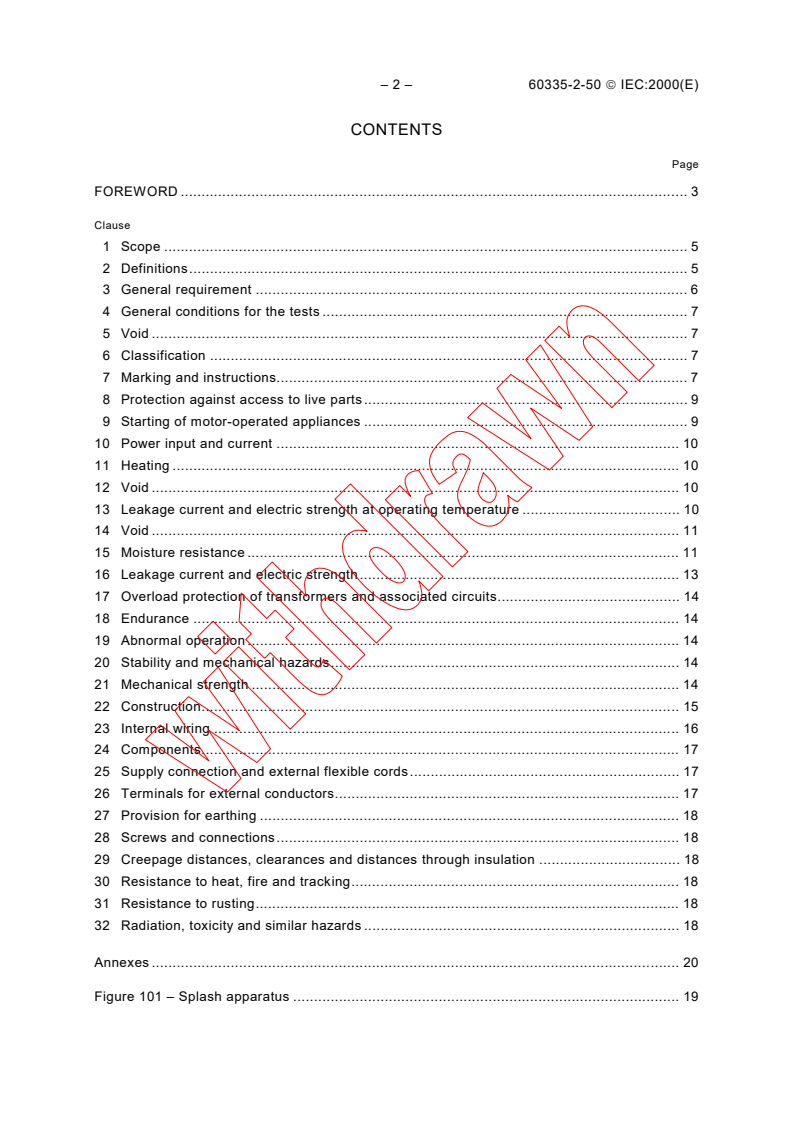
CONTENTS
Page
FOREWORD . 3
Clause
1 Scope . 5
2 Definitions. 5
3 General requirement . 6
4 General conditions for the tests . 7
5 Void . 7
6 Classification . 7
7 Marking and instructions. 7
8 Protection against access to live parts. 9
9 Starting of motor-operated appliances . 9
10 Power input and current . 10
11 Heating . 10
12 Void . 10
13 Leakage current and electric strength at operating temperature . 10
14 Void . 11
15 Moisture resistance . 11
16 Leakage current and electric strength. 13
17 Overload protection of transformers and associated circuits. 14
18 Endurance .14
19 Abnormal operation . 14
20 Stability and mechanical hazards. 14
21 Mechanical strength . 14
22 Construction. 15
23 Internal wiring . 16
24 Components. 17
25 Supply connection and external flexible cords. 17
26 Terminals for external conductors. 17
27 Provision for earthing . 18
28 Screws and connections. 18
29 Creepage distances, clearances and distances through insulation . 18
30 Resistance to heat, fire and tracking. 18
31 Resistance to rusting. 18
32 Radiation, toxicity and similar hazards . 18
Annexes . 20
Figure 101 – Splash apparatus . 19
60335-2-50 IEC:2000(E) − 3 −
INTERNATIONAL ELECTROTECHNICAL COMMISSION
____________
SAFETY OF HOUSEHOLD AND SIMILAR ELECTRICAL APPLIANCES –
Part 2-50: Particular requirements for commercial electric bains-marie
FOREWORD
1) The IEC (International Electrotechnical Commission) is a worldwide organization for standardization comprising
all national electrotechnical committees (IEC National Committees). The object of the IEC is to promote
international co-operation on all questions concerning standardization in the electrical and electronic fields. To
this end and in addition to other activities, the IEC publishes International Standards. Their preparation is
entrusted to technical committees; any IEC National Committee interested in the subject dealt with may
participate in this preparatory work. International, governmental and non-governmental organizations liaising
with the IEC also participate in this preparation. The IEC collaborates closely with the International Organization
for Standardization (ISO) in accordance with conditions determined by agreement between the two
organizations.
2) The formal decisions or agreements of the IEC on technical matters express, as nearly as possible, an
international consensus of opinion on the relevant subjects since each technical committee has representation
from all interested National Committees.
3) The documents produced have the form of recommendations for international use and are published in the form
of standards, technical specifications, technical reports or guides and they are accepted by the National
Committees in that sense.
4) In order to promote international unification, IEC National Committees undertake to apply IEC International
Standards transparently to the maximum extent possible in their national and regional standards. Any
divergence between the IEC Standard and the corresponding national or regional standard shall be clearly
indicated in the latter.
5) The IEC provides no marking procedure to indicate its approval and cannot be rendered responsible for any
equipment declared to be in conformity with one of its standards.
6) Attention is drawn to the possibility that some of the elements of this International Standard may be the subject
of patent rights. The IEC shall not be held responsible for identifying any or all such patent rights.
International Standard IEC 60335-2-50 has been prepared by subcommittee 61E: Safety of
electrical commercial catering equipment, of IEC technical committee 61: Safety of household
and similar electrical appliances.
It forms the third edition of IEC 60335-2-50 and replaces the second edition, published in 1995,
its amendment 1 (1996) and amendment 2 (1998).
The text of this standard is based on the second edition, amendments 1 and 2 and the
following documents:
FDIS Report on voting
61E/351/FDIS 61E/364/RVD
Full information on the voting for the approval of this standard can be found in the report on
voting indicated in the above table.
– 4 – 60335-2-50 IEC:2000(E)
This part 2 is to be used in conjunction with the latest edition of IEC 60335-1 and its
amendments. It was established on the basis of the third edition (1991) of that standard.
This part 2 supplements or modifies the corresponding clauses in IEC 60335-1, so as to
convert it into the IEC standard: Safety requirements for commercial electric bains-marie.
Where a particular subclause of part 1 is not mentioned in this part 2, that subclause applies
as far as is reasonable. Where this standard states "addition", "modification" or "replacement",
the relevant text in part 1 is to be adapted accordingly.
NOTE 1 The following print types are used:
– requirements: in roman type;
– test specifications: in italic type;
– notes: in small roman type;
Words in bold in the text are defined in clause 2.
NOTE 2 Subclauses, figures and notes which are additional to those in part 1 are numbered starting from 101.
A bilingual version of this standard may be issued at a later date.
60335-2-50 IEC:2000(E) − 5 −
SAFETY OF HOUSEHOLD AND SIMILAR ELECTRICAL APPLIANCES –
Part 2-50: Particular requirements for commercial electric bains-marie
1 Scope
This clause of part 1 is replaced by:
This standard deals with the safety of electrically operated bains-marie not intended for
household use, their rated voltage being not more than 250 V for single-phase appliances
connected between one phase and neutral, and 480 V for other appliances.
NOTE 1 These appliances are used, for example, in restaurants, canteens, hospitals and similar commercial
enterprises.
The electrical part of appliances making use of other forms of energy is also within the scope
of this standard.
So far as is practicable, this standard deals with the common hazards presented by these types
of appliances.
NOTE 2 Attention is drawn to the fact that
− for appliances intended to be used in vehicles or on board ships or aircraft, additional requirements may be
necessary;
− for appliances intended to be used in tropical countries, special requirements may be necessary;
− in many countries additional requirements are specified by the national health authorities, the national
authorities responsible for the protection of labour, the national water supply authorities and similar authorities;
− for appliances intended to be used outdoors, additional requirements may be necessary.
This standard does not apply to
− appliances designed exclusively for industrial purposes;
− appliances intended to be used in locations where special conditions prevail, such as the
presence of a corrosive or explosive atmosphere (dust, vapour or gas);
− continuous process appliances for the mass production of food.
2 Definitions
This clause of part 1 is applicable except as follows.
2.2.4 Addition:
NOTE The rated power input is the sum of the power inputs of all the individual elements in the appliance which
can be on at one time; where there are several such combinations possible, that giving the highest power input is
used in determining the rated power input.
– 6 – 60335-2-50 IEC:2000(E)
2.2.9 Replacement:
normal operation: Operation of the appliance under the following conditions:
Open-well and wet-heat-type bains-marie are filled with water to the indicated level and
topped up during the test in accordance with the manufacturer's instructions. The appliance is
operated with any control intended to be operated by the user set at maximum. If the water
boils, the control is then adjusted to the lowest setting that maintains simmering. No covers or
containers are fitted.
Dry-heat-type bains-marie are operated with any controls set at the maximum. Empty food
containers are placed in the well but with the container covers removed.
Combined-type appliances are operated under the most unfavourable conditions.
Motors incorporated in the appliance are operated in the intended manner under the most
severe conditions which can be expected in normal use taking into account the manufacturer's
instructions.
2.2.101
bain-marie
an appliance with a well which is used for the storage of hot food in containers prior to serving.
The containers are indirectly heated by hot air, steam or water in the well
2.2.102
open-well-type bain-marie
an appliance where the food containers rest in water in a heated well
2.2.103
wet-heat-type bain-marie
an appliance where the fitted food containers are heated by steam generated within the
appliance. The pressure in the well or steam generator does not differ significantly from
atmospheric pressure
2.2.104
dry-heat-type bain-marie
an appliance where the fitted food containers are heated by warm air generated within the
appliance
2.2.105
indicated level
a mark on the appliance to indicate the maximum liquid level for correct operation
2.2.106
installation wall
a special fixed construction containing supply facilities for appliances installed in conjunction
with it
3 General requirement
This clause of part 1 is applicable except as follows.
Addition:
NOTE 101 The d.c. component in the appliance neutral is limited (Australia).
60335-2-50 IEC:2000(E) − 7 −
4 General conditions for the tests
This clause of part 1 is applicable except as follows.
4.10 Addition:
Appliances intended for installation in a bank of other appliances and appliances intended to be
fixed to an installation wall are enclosed to obtain protection against electric shock and
harmful ingress of water equivalent to that obtained when installed in accordance with the
instructions provided with the appliance.
NOTE Appropriate enclosures or additional appliances may be needed for test purposes.
4.101 Appliances are tested as heating appliances, even if they incorporate a motor.
4.102 Appliances, when assembled in combination with, or incorporating, other appliances,
are tested in accordance with the requirements of this standard. The other appliances are
operated simultaneously in accordance with the requirements of the relevant standards.
If a part of the appliance or the whole appliance is intended to be used for different functions
covered by different standards, the relevant standard is applied to each function separately, so
far as is reasonable.
5 Void
6 Classification
This clause of part 1 is applicable except as follows.
6.1 Replacement:
Appliances shall be of class I with respect to protection against electric shock.
Compliance is checked by inspection and by the relevant tests.
NOTE Class 0I appliances are allowed (Japan).
6.2 Addition:
NOTE 101 For appliances intended to be installed in a kitchen, an appropriate degree of protection against
harmful ingress of water is required according to their height of installation (France).
7 Marking and instructions
This clause of part 1 is applicable except as follows.
7.1 Addition:
In addition, appliances shall be marked with
− the water pressure or range of pressures, in kilopascals (kPa), for appliances intended to
be connected to a water supply, unless this is indicated in the instruction sheet.
– 8 – 60335-2-50 IEC:2000(E)
7.6 Addition:
Add the following symbol:
*
equipotentiality (IEC 60417-5021-a)
7.12.1 Replacement:
The appliance shall be accompanied by an instruction sheet detailing any special precautions
necessary for installation. For appliances intended for installation in a bank of other appliances
and appliances intended to be fixed to an installation wall, details of how to ensure
appropriate protection against electric shock and harmful ingress of water shall be supplied. If
the controls of more than one appliance are combined in a separate enclosure, detailed
installation instructions shall be supplied. Instructions for user maintenance, for example
cleaning, shall also be given.
Appliances which are provided with an appliance inlet and are intended to be partially or
completely immersed in water for cleaning shall be accompanied by an instruction sheet stating
that the connector shall be removed before the appliance is cleaned and that the appliance
inlet shall be dried before the appliance is used again.
The instruction sheet of appliances other than stationary and appliances with detachable
electrical parts, which are not intended to be partially or completely immersed in water for
cleaning, shall state that the appliance or part must not be immersed.
For appliances which are permanently connected to fixed wiring and for which leakage currents
may exceed 10 mA, particularly if disconnected or not used for long periods, or during initial
installation, the instruction sheet shall give recommendations regarding the rating of protective
devices, i.e. earth leakage relays to be installed.
If the appliance is constructed so that it is not protected against water jets, clear and detailed
instructions for the user shall be delivered together with the appliance. It shall be stated in the
instructions that this appliance shall not be cleaned with a water jet.
Compliance is checked by inspection.
7.12.4 Addition:
The instructions for built-in appliances having a separate control panel for several appliances
shall state that the control panel is only to be connected to the specified appliances in order to
avoid a possible hazard.
7.15 Addition:
When it is not practical to place the marking of fixed appliances so that it is visible after the
appliance has been installed, the relevant information shall also be included in the instructions
for use or on an additional label which can be fixed near the appliance after installation.
NOTE An example of such a fixed appliance is a built-in appliance.
___________
*
See IEC 60417-1:1998, Graphical symbols for use on equipment – Part 1: Overview and application, and
IEC 60417-2:1998, Graphical symbols for use on equipment – Part 2: Symbol originals.
60335-2-50 IEC:2000(E) − 9 −
7.101 Equipotential bonding terminals shall be indicated by the equipotentiality symbol
(see 7.6).
These indications shall not be placed on screws, removable washers or other parts which can
be removed when conductors are being connected.
Compliance is checked by inspection.
7.102 Appliances or the detachable electrical parts of appliances intended to be partially
immersed in water for cleaning shall be marked with a line which clearly indicates the
maximum depth of immersion, together with the substance of the following warning:
Do not immerse beyond this line
If there is any seam or seal that causes the appliance or part not to withstand the treatment
specified in 15.102, the line indicating the maximum depth of immersion shall be at least
50 mm below any such seam or seal when the appliance or the part is in the position in which it
is to be cleaned.
Compliance is checked by inspection and measurement.
7.103 Appliances intended to be filled by hand or a manually operated tap shall be marked
with an indicated level.
Compliance is checked by inspection.
8 Protection against access to live parts
This clause of part 1 is applicable.
9 Starting of motor-operated appliances
9.1 Fan motors providing a cooling effect in order to comply with the requirements of
clause 11 shall start under all voltage conditions which may occur in use.
Compliance is checked by starting the motor three times at a voltage equal to 0,85 times rated
voltage, the motor being at room temperature at the beginning of the test.
The motor is started each time under the conditions occurring at the beginning of normal
operation or, for automatic appliances, at the beginning of the normal cycle of operation, the
motor being allowed to come to rest between successive starts. For appliances provided with
motors having other than centrifugal starting switches, this test is repeated at a voltage equal
to 1,06 times rated voltage.
In all cases, the motor shall start and it shall function in such a way that safety is not affected,
and the overload protective devices of the motor shall not operate.
NOTE The supply source is such that during the test the drop in voltage does not exceed 1 %.
– 10 – 60335-2-50 IEC:2000(E)
10 Power input and current
This clause of part 1 is applicable except as follows.
10.1 Addition:
NOTE 101 For appliances having more than one heating unit, the total power input may be determined by
measuring the power input of each heating unit separately (see also 2.2.4).
11 Heating
This clause of part 1 is applicable except
...