

IEC 61400-12-3:2022
(Main)Wind energy generation systems - Part 12-3: Power performance - Measurement based site calibration
General Information
- Abstract
IEC 61400-12-3:2022 specifies a measurement and analysis procedure for deriving the wind speed correction due to terrain effects and applies to the performance testing of wind turbines of all types and sizes connected to the electrical power network as described in IEC 61400‑12‑1. The procedure applies to the performance evaluation of specific wind turbines at specific locations. The purpose of this part of IEC 61400 is to provide a uniform methodology that will ensure consistency, accuracy and reproducibility in the measurement and analysis of a site calibration for use in the determination of the power performance of wind turbines. This document provides guidance in the measurement, analysis, and reporting of the site calibration for subsequent use in power performance testing for wind turbines.
This first edition of IEC 61400-12-3 is part of a structural revision that cancels and replaces the performance standards IEC 61400-12-1:2017 and IEC 61400-12-2:2013. The structural revision contains no technical changes with respect to IEC 61400-12-1:2017 and IEC 61400‑12‑2:2013, but the parts that relate to wind measurements, measurement of site calibration and assessment of obstacle and terrain have been extracted into separate standards.
The content of the corrigendum 1 (2025-04) has been included in this copy.
- Status
- Published
- Publication Date
- 28-Aug-2022
- Technical Committee
- TC 88 - Wind energy generation systems
- Drafting Committee
- MT 12-1 - TC 88/MT 12-1
- Current Stage
- PPUB - Publication issued
- Start Date
- 29-Aug-2022
- Completion Date
- 26-Sep-2022

Overview
IEC 61400-12-3:2022 is an international standard published by the International Electrotechnical Commission (IEC) that focuses on wind energy generation systems. Specifically, this part of the IEC 61400 series targets power performance measurement using site calibration based on actual measurements. It provides detailed procedures for identifying and correcting wind speed variations caused by terrain effects at specific wind turbine sites.
This standard is essential for the performance testing of wind turbines of all types and sizes connected to electrical power networks, following the framework set by IEC 61400-12-1. IEC 61400-12-3:2022 replaces earlier parts IEC 61400-12-1:2017 and IEC 61400-12-2:2013 by extracting and consolidating content related to wind measurements, site calibration, and terrain assessment into a standalone document without technical changes.
Key Topics
Scope and Purpose
Describes a uniform and reproducible method for site calibration to ensure consistent, accurate determination of wind turbine power performance, accounting for terrain-induced wind speed corrections.Measurement and Analysis Procedure
Provides guidance on the setup of tests, including location selection for meteorological masts and instrumentation requirements. Details data acquisition, rejection criteria, and sophisticated analysis methods.Wind Shear Assessment
Emphasizes evaluating and quantifying wind shear influence on wind speed measurements through characterization plots, wind direction bins, and correlation analysis between turbine and meteorological mast locations.Site Calibration Uncertainty Quantification
Breaks down uncertainties into categories, including anemometer pre- and post-calibration, mounting effects, data acquisition processes, and combined measurement uncertainties due to flow distortion.Quality Control and Validation
Includes procedures for convergence checks, correlation assessments, and methods to identify seasonal variability and changes between adjacent wind direction bins.Informative Annexes
Offers practical verification of results and detailed site calibration examples, illustrating step-by-step application of the methodology for different terrain and site conditions.
Applications
Wind Turbine Power Performance Testing
Ensures accurate power curve determination by correcting measured wind speeds with site-specific calibration factors, improving the reliability of energy yield predictions.Wind Resource Assessment for Project Development
Helps developers and engineers assess terrain effects on wind measurements, enabling better turbine placement and optimized energy capture.Certification and Compliance
Provides wind turbine manufacturers and certification bodies with a standard methodology to validate the power performance of turbine models under realistic site conditions.Operational Performance Monitoring
Assists operators in comparing actual turbine output against expected performance by applying calibrated site corrections.
Related Standards
IEC 61400-12-1
General standard for power performance measurements of electricity-producing wind turbines. IEC 61400-12-3 builds upon this foundational standard by focusing on site-specific calibration.IEC 61400-12-2
Previously covered terrain and obstacle assessments for power performance testing-now replaced and integrated into IEC 61400-12-3.Other IEC 61400 Parts
Address various aspects of wind turbine design, safety, and testing including design requirements (Part 1), noise measurement (Part 11), and electrical aspects (Part 21).
By adopting IEC 61400-12-3:2022, stakeholders in the wind energy sector can achieve greater accuracy in power performance measurement, account comprehensively for terrain-based wind speed influences, and ensure consistent results across different sites and turbine types. This supports improved project planning, certification, and operational assessment, driving greater confidence in wind energy production forecasts and turbine reliability.
Relations
- Effective Date
- 05-Sep-2023
- Effective Date
- 05-Sep-2023
- Effective Date
- 26-Oct-2025
Get Certified
Connect with accredited certification bodies for this standard

DNV
DNV is an independent assurance and risk management provider.

Lloyd's Register
Lloyd's Register is a global professional services organisation specialising in engineering and technology.
DNV Energy Systems
Energy and renewable energy certification.
Sponsored listings
Frequently Asked Questions
IEC 61400-12-3:2022 is a standard published by the International Electrotechnical Commission (IEC). Its full title is "Wind energy generation systems - Part 12-3: Power performance - Measurement based site calibration". This standard covers: IEC 61400-12-3:2022 specifies a measurement and analysis procedure for deriving the wind speed correction due to terrain effects and applies to the performance testing of wind turbines of all types and sizes connected to the electrical power network as described in IEC 61400‑12‑1. The procedure applies to the performance evaluation of specific wind turbines at specific locations. The purpose of this part of IEC 61400 is to provide a uniform methodology that will ensure consistency, accuracy and reproducibility in the measurement and analysis of a site calibration for use in the determination of the power performance of wind turbines. This document provides guidance in the measurement, analysis, and reporting of the site calibration for subsequent use in power performance testing for wind turbines. This first edition of IEC 61400-12-3 is part of a structural revision that cancels and replaces the performance standards IEC 61400-12-1:2017 and IEC 61400-12-2:2013. The structural revision contains no technical changes with respect to IEC 61400-12-1:2017 and IEC 61400‑12‑2:2013, but the parts that relate to wind measurements, measurement of site calibration and assessment of obstacle and terrain have been extracted into separate standards. The content of the corrigendum 1 (2025-04) has been included in this copy.
IEC 61400-12-3:2022 specifies a measurement and analysis procedure for deriving the wind speed correction due to terrain effects and applies to the performance testing of wind turbines of all types and sizes connected to the electrical power network as described in IEC 61400‑12‑1. The procedure applies to the performance evaluation of specific wind turbines at specific locations. The purpose of this part of IEC 61400 is to provide a uniform methodology that will ensure consistency, accuracy and reproducibility in the measurement and analysis of a site calibration for use in the determination of the power performance of wind turbines. This document provides guidance in the measurement, analysis, and reporting of the site calibration for subsequent use in power performance testing for wind turbines. This first edition of IEC 61400-12-3 is part of a structural revision that cancels and replaces the performance standards IEC 61400-12-1:2017 and IEC 61400-12-2:2013. The structural revision contains no technical changes with respect to IEC 61400-12-1:2017 and IEC 61400‑12‑2:2013, but the parts that relate to wind measurements, measurement of site calibration and assessment of obstacle and terrain have been extracted into separate standards. The content of the corrigendum 1 (2025-04) has been included in this copy.
IEC 61400-12-3:2022 is classified under the following ICS (International Classification for Standards) categories: 27.180 - Wind turbine energy systems. The ICS classification helps identify the subject area and facilitates finding related standards.
IEC 61400-12-3:2022 has the following relationships with other standards: It is inter standard links to IEC 61400-12-1:2017, IEC 61400-12-2:2013, IEC 61400-12-3:2022/COR1:2025. Understanding these relationships helps ensure you are using the most current and applicable version of the standard.
IEC 61400-12-3:2022 is available in PDF format for immediate download after purchase. The document can be added to your cart and obtained through the secure checkout process. Digital delivery ensures instant access to the complete standard document.
Standards Content (Sample)
IEC 61400-12-3 ®
Edition 1.0 2022-08
INTERNATIONAL
STANDARD
NORME
INTERNATIONALE
colour
inside
Wind energy generation systems –
Part 12-3: Power performance – Measurement based site calibration
Systèmes de génération d'énergie éolienne –
Partie 12-3: Performance de puissance – Étalonnage du site fondé sur le
mesurage
All rights reserved. Unless otherwise specified, no part of this publication may be reproduced or utilized in any form
or by any means, electronic or mechanical, including photocopying and microfilm, without permission in writing from
either IEC or IEC's member National Committee in the country of the requester. If you have any questions about IEC
copyright or have an enquiry about obtaining additional rights to this publication, please contact the address below or
your local IEC member National Committee for further information.
Droits de reproduction réservés. Sauf indication contraire, aucune partie de cette publication ne peut être reproduite
ni utilisée sous quelque forme que ce soit et par aucun procédé, électronique ou mécanique, y compris la photocopie
et les microfilms, sans l'accord écrit de l'IEC ou du Comité national de l'IEC du pays du demandeur. Si vous avez des
questions sur le copyright de l'IEC ou si vous désirez obtenir des droits supplémentaires sur cette publication, utilisez
les coordonnées ci-après ou contactez le Comité national de l'IEC de votre pays de résidence.
IEC Secretariat Tel.: +41 22 919 02 11
3, rue de Varembé info@iec.ch
CH-1211 Geneva 20 www.iec.ch
Switzerland
About the IEC
The International Electrotechnical Commission (IEC) is the leading global organization that prepares and publishes
International Standards for all electrical, electronic and related technologies.
About IEC publications
The technical content of IEC publications is kept under constant review by the IEC. Please make sure that you have the
latest edition, a corrigendum or an amendment might have been published.
IEC publications search - webstore.iec.ch/advsearchform IEC Products & Services Portal - products.iec.ch
The advanced search enables to find IEC publications by a Discover our powerful search engine and read freely all the
variety of criteria (reference number, text, technical publications previews. With a subscription you will always
committee, …). It also gives information on projects, replaced have access to up to date content tailored to your needs.
and withdrawn publications.
Electropedia - www.electropedia.org
IEC Just Published - webstore.iec.ch/justpublished
The world's leading online dictionary on electrotechnology,
Stay up to date on all new IEC publications. Just Published
containing more than 22 300 terminological entries in English
details all new publications released. Available online and
and French, with equivalent terms in 19 additional languages.
once a month by email.
Also known as the International Electrotechnical Vocabulary
(IEV) online.
IEC Customer Service Centre - webstore.iec.ch/csc
If you wish to give us your feedback on this publication or
need further assistance, please contact the Customer Service
Centre: sales@iec.ch.
A propos de l'IEC
La Commission Electrotechnique Internationale (IEC) est la première organisation mondiale qui élabore et publie des
Normes internationales pour tout ce qui a trait à l'électricité, à l'électronique et aux technologies apparentées.
A propos des publications IEC
Le contenu technique des publications IEC est constamment revu. Veuillez vous assurer que vous possédez l’édition la
plus récente, un corrigendum ou amendement peut avoir été publié.
Recherche de publications IEC - IEC Products & Services Portal - products.iec.ch
webstore.iec.ch/advsearchform Découvrez notre puissant moteur de recherche et consultez
La recherche avancée permet de trouver des publications IEC gratuitement tous les aperçus des publications. Avec un
en utilisant différents critères (numéro de référence, texte, abonnement, vous aurez toujours accès à un contenu à jour
comité d’études, …). Elle donne aussi des informations sur adapté à vos besoins.
les projets et les publications remplacées ou retirées.
Electropedia - www.electropedia.org
IEC Just Published - webstore.iec.ch/justpublished
Le premier dictionnaire d'électrotechnologie en ligne au
Restez informé sur les nouvelles publications IEC. Just
monde, avec plus de 22 300 articles terminologiques en
Published détaille les nouvelles publications parues.
anglais et en français, ainsi que les termes équivalents dans
Disponible en ligne et une fois par mois par email.
19 langues additionnelles. Egalement appelé Vocabulaire
Electrotechnique International (IEV) en ligne.
Service Clients - webstore.iec.ch/csc
Si vous désirez nous donner des commentaires sur cette
publication ou si vous avez des questions contactez-nous:
sales@iec.ch.
IEC 61400-12-3 ®
Edition 1.0 2022-08
INTERNATIONAL
STANDARD
NORME
INTERNATIONALE
colour
inside
Wind energy generation systems –
Part 12-3: Power performance – Measurement based site calibration
Systèmes de génération d'énergie éolienne –
Partie 12-3: Performance de puissance – Étalonnage du site fondé sur le
mesurage
INTERNATIONAL
ELECTROTECHNICAL
COMMISSION
COMMISSION
ELECTROTECHNIQUE
INTERNATIONALE
ICS 27.180 ISBN 978-2-8322-5596-4
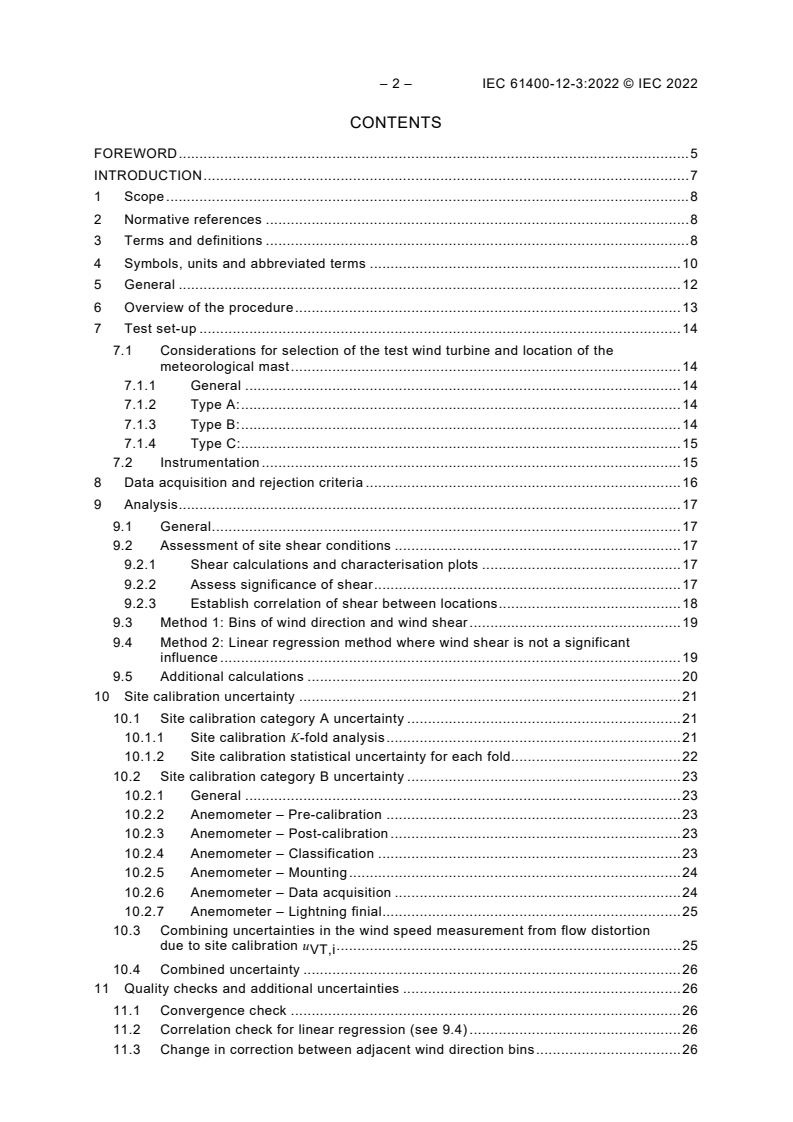
– 2 – IEC 61400-12-3:2022 © IEC 2022
CONTENTS
FOREWORD . 5
INTRODUCTION . 7
1 Scope . 8
2 Normative references . 8
3 Terms and definitions . 8
4 Symbols, units and abbreviated terms . 10
5 General . 12
6 Overview of the procedure . 13
7 Test set-up . 14
7.1 Considerations for selection of the test wind turbine and location of the
meteorological mast . 14
7.1.1 General . 14
7.1.2 Type A: . 14
7.1.3 Type B: . 14
7.1.4 Type C:. 15
7.2 Instrumentation . 15
8 Data acquisition and rejection criteria . 16
9 Analysis . 17
9.1 General . 17
9.2 Assessment of site shear conditions . 17
9.2.1 Shear calculations and characterisation plots . 17
9.2.2 Assess significance of shear . 17
9.2.3 Establish correlation of shear between locations . 18
9.3 Method 1: Bins of wind direction and wind shear . 19
9.4 Method 2: Linear regression method where wind shear is not a significant
influence . 19
9.5 Additional calculations . 20
10 Site calibration uncertainty . 21
10.1 Site calibration category A uncertainty . 21
10.1.1 Site calibration K-fold analysis . 21
10.1.2 Site calibration statistical uncertainty for each fold. 22
10.2 Site calibration category B uncertainty . 23
10.2.1 General . 23
10.2.2 Anemometer – Pre-calibration . 23
10.2.3 Anemometer – Post-calibration . 23
10.2.4 Anemometer – Classification . 23
10.2.5 Anemometer – Mounting . 24
10.2.6 Anemometer – Data acquisition . 24
10.2.7 Anemometer – Lightning finial. 25
10.3 Combining uncertainties in the wind speed measurement from flow distortion
due to site calibration u . 25
VT,i
10.4 Combined uncertainty . 26
11 Quality checks and additional uncertainties . 26
11.1 Convergence check . 26
11.2 Correlation check for linear regression (see 9.4) . 26
11.3 Change in correction between adjacent wind direction bins . 26
11.3.1 General . 26
11.3.2 Removal of the wind direction sensor between site calibration and
power performance test . 27
11.4 Site calibration and power performance measurements in different seasons . 28
Annex A (informative) Verification of results . 29
Annex B (informative) Site calibration examples . 31
B.1 Example A . 31
B.1.1 Site description: . 31
B.1.2 Site calibration setup: . 31
B.1.3 Site calibration evaluation: . 31
B.1.4 Step 1: Check the significance of wind shear at the site according to
9.2.2: . 31
B.1.5 Step 2: Verify correlation of wind shear at wind turbine and reference
meteorological mast locations – Example A . 32
B.1.6 Step 3: Calculate results according to 9.2.3 . 33
B.1.7 Step 4: Quality checks and additional uncertainties . 33
B.2 Example B . 35
B.2.1 Site description: . 35
B.2.2 Site calibration setup: . 35
B.2.3 Step 1: Check the significance of wind shear at the site:. 36
B.2.4 Step 2A: Verify correlation of wind shear at wind turbine and reference
meteorological mast locations, example B . 36
B.2.5 Step 2B: Attempt to remove non-correlating wind shear data . 38
B.2.6 Step 3: Calculate results . 39
B.2.7 Step 4: Additional uncertainties: . 39
B.3 Example C . 41
B.3.1 Site description: . 41
B.3.2 Site calibration setup: . 41
B.3.3 Step 1: Check the significance of wind shear at the site:. 42
B.3.4 Step 2: Verify correlation of wind shear at wind turbine and reference
meteorological mast locations, example C . 42
B.3.5 Step 3: Calculate results . 42
B.3.6 Step 4: Quality checks and uncertainty . 42
B.3.7 Anemometer operational uncertainty: . 42
B.3.8 Convergence check: . 42
B.3.9 Change in magnitude of correction between bins: . 43
B.3.10 Wind vane adjustment: . 43
B.3.11 Seasonal uncertainty adjustment: . 43
Bibliography . 44
Figure 1 – Site calibration flow chart . 13
Figure 2 – Terrain types . 15
Figure A.1 – Example of the results of a verification test . 30
Figure B.1 – Wind shear exponent vs. time of day, Example A . 32
Figure B.2 – Wind shear exponents at wind turbine location vs. reference
meteorological mast, example A where the colour axis = wind speed (m/s) . 32
Figure B.3 – Wind speed ratios and number of data points vs. wind shear exponent
and wind direction bin – wind speed ratios (full lines), number of data points (dotted
lines) . 33
– 4 – IEC 61400-12-3:2022 © IEC 2022
Figure B.4 – Data convergence check for 190° bin . 35
Figure B.5 – Wind shear exponent vs. time of day, example B . 36
Figure B.6 – Wind shear exponents at wind turbine location vs. reference
meteorological mast, example B . 36
Figure B.7 – Linear regression of wind turbine location vs. reference meteorological
mast hub height wind speeds for 330° bin . 37
Figure B.8 – Wind speed ratios vs. wind speed for the 330° bin . 37
Figure B.9 – Wind speed ratios vs. wind shear for the 330° bin . 38
Figure B.10 – Wind shear exponents at wind turbine location vs. reference
meteorological mast post-filtering . 38
Figure B.11 – Linear regression of wind turbine location vs. reference meteorological
mast hub height wind speeds for 330° bin, post-filtering . 39
Figure B.12 – Wind speed ratios vs. wind speed for the 330° bin, post-filtering . 39
Figure B.13 – Data convergence check for 330° bin . 40
Figure B.14 – Site calibration wind shear vs. power curve test wind shear . 41
Figure B.15 – Convergence check for 270° bin . 43
Table B.1 – Site calibration flow corrections (wind speed ratio) . 34
Table B.2 – Site calibration data count . 34
Table B.3 – r values for each wind direction bin . 40
Table B.4 – Additional uncertainty due to change in bins for example B . 40
Table B.5 – Additional uncertainty due to change in bins for example C . 43
INTERNATIONAL ELECTROTECHNICAL COMMISSION
____________
WIND ENERGY GENERATION SYSTEMS –
Part 12-3: Power performance –
Measurement based site calibration
FOREWORD
1) The International Electrotechnical Commission (IEC) is a worldwide organization for standardization comprising
all national electrotechnical committees (IEC National Committees). The object of IEC is to promote international
co-operation on all questions concerning standardization in the electrical and electronic fields. To this end and
in addition to other activities, IEC publishes International Standards, Technical Specifications, Technical Reports,
Publicly Available Specifications (PAS) and Guides (hereafter referred to as “IEC Publication(s)”). Their
preparation is entrusted to technical committees; any IEC National Committee interested in the subject dealt with
may participate in this preparatory work. International, governmental and non-governmental organizations liaising
with the IEC also participate in this preparation. IEC collaborates closely with the International Organization for
Standardization (ISO) in accordance with conditions determined by agreement between the two organizations.
2) The formal decisions or agreements of IEC on technical matters express, as nearly as possible, an international
consensus of opinion on the relevant subjects since each technical committee has representation from all
interested IEC National Committees.
3) IEC Publications have the form of recommendations for international use and are accepted by IEC National
Committees in that sense. While all reasonable efforts are made to ensure that the technical content of IEC
Publications is accurate, IEC cannot be held responsible for the way in which they are used or for any
misinterpretation by any end user.
4) In order to promote international uniformity, IEC National Committees undertake to apply IEC Publications
transparently to the maximum extent possible in their national and regional publications. Any divergence between
any IEC Publication and the corresponding national or regional publication shall be clearly indicated in the latter.
5) IEC itself does not provide any attestation of conformity. Independent certification bodies provide conformity
assessment services and, in some areas, access to IEC marks of conformity. IEC is not responsible for any
services carried out by independent certification bodies.
6) All users should ensure that they have the latest edition of this publication.
7) No liability shall attach to IEC or its directors, employees, servants or agents including individual experts and
members of its technical committees and IEC National Committees for any personal injury, property damage or
other damage of any nature whatsoever, whether direct or indirect, or for costs (including legal fees) and
expenses arising out of the publication, use of, or reliance upon, this IEC Publication or any other IEC
Publications.
8) Attention is drawn to the Normative references cited in this publication. Use of the referenced publications is
indispensable for the correct application of this publication.
9) Attention is drawn to the possibility that some of the elements of this IEC Publication may be the subject of patent
rights. IEC shall not be held responsible for identifying any or all such patent rights.
IEC 61400-12-3 has been prepared by IEC technical committee 88: Wind energy generation
systems. It is an International Standard.
This first edition of IEC 61400-12-3 is part of a structural revision that cancels and replaces the
performance standards IEC 61400-12-1:2017 and IEC 61400-12-2:2013. The structural revision
contains no technical changes with respect to IEC 61400-12-1:2017 and IEC 61400-12-2:2013,
but the parts that relate to wind measurements, measurement of site calibration and assessment
of obstacle and terrain have been extracted into separate standards.
The purpose of the re-structure was to allow the future management and revision of the power
performance standards to be carried out more efficiently in terms of time and cost and to provide
a more logical division of the wind measurement requirements into a series of separate
standards which could be referred to by other use case standards in the IEC 61400 series and
subsequently maintained and developed by appropriate experts.
– 6 – IEC 61400-12-3:2022 © IEC 2022
The text of this International Standard is based on the following documents:
Draft Report on voting
88/824/CDV 88/869/RVC
Full information on the voting for its approval can be found in the report on voting indicated in
the above table.
The language used for the development of this International Standard is English.
This document was drafted in accordance with ISO/IEC Directives, Part 2, and developed in
accordance with ISO/IEC Directives, Part 1 and ISO/IEC Directives, IEC Supplement, available
at www.iec.ch/members_experts/refdocs. The main document types developed by IEC are
described in greater detail at www.iec.ch/standardsdev/publications.
A list of all parts in the IEC 61400 series, published under the general title Wind energy
generation systems, can be found on the IEC website.
The committee has decided that the contents of this document will remain unchanged until the
stability date indicated on the IEC website under webstore.iec.ch in the data related to the
specific document. At this date, the document will be
• reconfirmed,
• withdrawn,
• replaced by a revised edition, or
• amended.
IMPORTANT – The 'colour inside' logo on the cover page of this publication indicates that it
contains colours which are considered to be useful for the correct understanding of its
contents. Users should therefore print this document using a colour printer.
INTRODUCTION
The purpose of this part of IEC 61400 is to provide a uniform methodology that will ensure
consistency, accuracy and reproducibility in the measurement and analysis of a site calibration
for use in the determination of the power performance of wind turbines. This document has
been prepared with the anticipation that it would be applied by:
a) a wind turbine manufacturer striving to meet well-defined power performance requirements
and/or a possible declaration system;
b) a wind turbine purchaser in specifying such performance requirements;
c) a wind turbine operator who may be required to verify that stated, or required, power
performance specifications are met for new or refurbished units;
d) a wind turbine planner or regulator who will need to be able to accurately and fairly define
power performance characteristics of wind turbines in response to regulations or permit
requirements for new or modified installations.
This document provides guidance in the measurement, analysis, and reporting of the site
calibration for subsequent use in power performance testing for wind turbines. This document
will benefit those parties involved in the manufacture, installation planning and permitting,
operation, utilization, and regulation of wind turbines. The technically accurate measurement
and analysis techniques recommended in this document should be applied by all parties to
ensure that continuing development and operation of wind turbines is carried out in an
atmosphere of consistent and accurate communication relative to wind turbine performance.
This document presents measurement and reporting procedures expected to provide accurate
results that can be replicated by others. Meanwhile, a user of this document should be aware
of differences that arise from large variations in wind shear and turbulence. Therefore, a user
should consider the influence of these differences and the data selection criteria in relation to
the purpose of the test before contracting the power performance measurements.
The committee recognizes that the restructuring of the IEC 61400-12 series represents a
significant increase in complexity and perhaps greater difficulty to implement. However, it
represents the committee’s best attempt to address issues introduced by larger wind turbines
operating in significant wind shear and complex terrain. The committee recommends that the
new techniques introduced be validated immediately by test laboratories through inter-lab
proficiency testing. The committee recommends a Maintenance Cycle Report be written within
three years of the publication of this document which includes recommendations, clarifications
and simplifications that will improve the practical implementation of this document. If necessary
a revision should be proposed at the same time to incorporate these recommendations,
clarifications and simplifications.
– 8 – IEC 61400-12-3:2022 © IEC 2022
WIND ENERGY GENERATION SYSTEMS –
Part 12-3: Power performance –
Measurement based site calibration
1 Scope
This part of IEC 61400 specifies a measurement and analysis procedure for deriving the wind
speed correction due to terrain effects and applies to the performance testing of wind turbines
of all types and sizes connected to the electrical power network as described in IEC 61400-12-1.
The procedure applies to the performance evaluation of specific wind turbines at specific
locations.
2 Normative references
The following documents are referred to in the text in such a way that some or all of their content
constitutes requirements of this document. For dated references, only the edition cited applies.
For undated references, the latest edition of the referenced document (including any
amendments) applies.
IEC 61400-12-1, Wind energy generation systems – Part 12-1: Power performance
measurements of electricity producing wind turbines
IEC 61400-12-5, Wind energy generation systems – Part 12-5: Power performance –
Assessment of obstacles and terrain
IEC 61400-50-1, Wind energy generation systems – Part 50-1: Wind measurement –
Application of meteorological mast, nacelle and spinner mounted instruments
ISO/IEC GUIDE 98-3:2008, Uncertainty of measurement – Part 3: Guide to the expression of
uncertainty in measurement (GUM:1995)
3 Terms and definitions
For the purposes of this document, the following terms and definitions apply.
ISO and IEC maintain terminological databases for use in standardization at the following
addresses:
• IEC Electropedia: available at http://www.electropedia.org/
• ISO Online browsing platform: available at http://www.iso.org/obp
3.1
accuracy
closeness of the agreement between the result of a measurement and a true value of the
measurand
3.2
atmospheric stability
measure of tendency of the wind to encourage or suppress vertical mixing
Note 1 to entry: Stable atmosphere is characterized by a high temperature gradient with altitude, high wind shear,
possible wind veer and low turbulence relative to unstable conditions. A neutral and unstable atmosphere generally
results in lower temperature gradients and low wind shear.
3.3
complex terrain
terrain surrounding the test site that features significant variations in topography and terrain
obstacles that may cause flow distortion
Note 1 to entry: For the assessment of obstacles and terrain, see IEC 61400-12-5.
3.4
data set
collection of data sampled over a continuous period
3.5
distance constant
indication of the response time of an anemometer, defined as the length of air that shall pass
through the instrument for it to indicate 63 % of the final value for a step input in wind speed
3.6
flow distortion
change in air flow caused by obstacles, topographical variations, or other wind turbines that
results in the wind speed at the measurement location to be different from the wind speed at
the wind turbine location
3.7
hub height
height of the centre of the swept area of the wind turbine rotor above the ground
at the tower
Note 1 to entry: For a vertical axis wind turbine the hub height is defined as the height of the centroid of the swept
area of the rotor above the ground at the tower.
3.8
measured power curve
table and graph that represent the measured, corrected and normalized net power output of a
wind turbine as a function of measured wind speed, measured under a well-defined
measurement procedure
3.9
measurement sector
sector of wind directions from which data are selected for the measured power curve
Note 1 to entry: See IEC 61400-12-5 for determination of measurement sector.
3.10
method of bins
data reduction procedure that groups test data for a certain parameter into intervals (bins)
Note 1 to entry: For each bin, the number of data sets or samples and their sum are recorded, and the average
parameter value within each bin is calculated.
3.11
power performance
measure of the capability of a wind turbine to produce electric power and energy
3.12
rotor equivalent wind speed
wind speed corresponding to the kinetic energy flux through the swept rotor area when
accounting for the variation of the wind speed with height
– 10 – IEC 61400-12-3:2022 © IEC 2022
3.13
standard uncertainty
uncertainty of the result of a measurement expressed as a standard deviation
3.14
test site
location of the wind turbine under test and its surroundings
3.15
uncertainty in measurement
parameter, associated with the result of a measurement, which characterizes the dispersion of
the values that could reasonably be attributed to the measurand
3.16
wind measurement equipment
meteorological mast or remote sensing device
3.17
wind shear
change of wind speed with height across the wind turbine rotor
3.18
wind shear exponent
exponent α of the power law defining the variation of wind speed with height
Note 1 to entry: This parameter is used as a measure of the magnitude of wind shear for site calibration and may
be otherwise useful. The power law equation is
α
z
i
(1)
v = v
zhi
H
where
v is the hub height wind speed;
h
H is the hub height (m);
v is the wind speed at height z ;
zi i
α is the wind shear exponent.
3.19
wind veer
change of wind direction with height across the wind turbine rotor
4 Symbols, units and abbreviated terms
Symbol or Description Unit
abbreviated term
BinSize bin size of wind direction bin
d residual in the j-th 10 min period of fold k [W]
j,k
d standard deviation of site calibration residuals in fold k [W]
std,k
mean value of the residuals in fold k [W]
d
k
F(WD,α) site calibration flow correction determined in 9.2
f number of degrees of freedom of the site calibration
H hub height of wind turbine [m]
k
folds in k-fold cross validation
Symbol or Description Unit
abbreviated term
L
distance between the wind turbine and the wind measurement equipment [m]
N number of data sets in fold k
k
R Rotor radius [m]
Residual site calibration residual [m/s]
RSD remote sensing device
r
correlation coefficient
s category A standard uncertainty of site calibration [m/s]
VT
s
category A standard uncertainty of site calibration in bin i [m/s]
VT,i
s category A standard uncertainty of site calibration of fold k site calibration [m/s]
VT,k
consistency parameter for wind direction bin j
sccp site calibration consistency parameter for wind direction bin j using the site [°]
j,j-1
calibration correction in bin j-1
sccp site calibration consistency parameter for wind direction bin j using the site [°]
j,j+1
calibration correction in bin j+1
s category A standard uncertainty of the site calibration
VT
u category B standard uncertainty for data acquisition [m/s]
dVT,i
u uncertainty related to the data acquisition of the wind speed signal
dVT,i,j
u category B standard uncertainty for anemometer operational characteristics [m/s]
VT,class,i
u uncertainty related to the classification of the sensors
VT,class,i,j
u category B standard uncertainty for change in correction to wind direction bin [°]
VT,coc,i,j
j
u uncertainty from the site calibration
VT,i,j
u uncertainty related to the lightning finial [m/s]
VT,lgt,i
u category B standard uncertainty for anemometer mounting effects [m/s]
VT,mnti
u
uncertainty related to the mounting of the sensors
VT,mnt,i,j
u category B standard uncertainty for anemometer calibration [m/s]
VT,precal,i
u uncertainty related to the calibration of the anemometers
VT,precal,i,j
u uncertainty related to the post calibration or in-situ calibration of the
VT,postcal,i,j
anemometers
u
category B standard uncertainty for removal of wind direction sensor between [°]
VT,rmv,i,j
site calibration and power performance test
u uncertainty component related to seasonal variation
VT,sv,i
u uncertainty related to the seasonal variation between site calibration and
VT,sv,i,j
power performance test
u category B standard uncertainty for the wind direction sensor [°]
w,i
V reference meteorological mast wind speed [m/s]
PM
V measured wind turbine location wind speed [m/s]
Turb_measured
V predicted wind turbine location wind speed [m/s]
Turb_predicted
v
hub height wind speed [m/s]
h
v wind speed at height z
zi i
WD wind direction bin
[°]
WME wind measurement equipment
α wind shear exponent from power law
– 12 – IEC 61400-12-3:2022 © IEC 2022
5 General
Generally, the wind speed measured upwind of a wind turbine can be assumed to be the same
as that at the turbine location if the turbine were not there. This assumption does not hold when
terrain effects are present. Furthermore, atmospheric conditions may also introduce wind speed
effects. For a power performance measurement carried out according to IEC 61400-12-1, the
wind speed is measured at a reference location 2 to 4 rotor diameters from the turbine under
test whereas the wind speed actually required is that which would be experienced at the turbine
location were the turbine not there. In complex terrain, the wind speed at the reference and
turbine locations can be somewhat different due to the influence of the terrain. Therefore, a site
calibration quantifies and potentially reduces the effects of terrain on the wind speed
measurement. Terrain may cause a systematic difference in wind speed measurement between
the position on the reference meteorological mast where an anemometer is mounted and
another anemometer mounted at the equivalent height above ground at the centre of the wind
turbine rotor at the turbine position. In addition, the relationship between the reference
meteorological mast wind speed and the wind speed at the turbine position may also be affected
by changes in atmospheric stability and/or the shear profile. Wind shear, which is the change
in wind speed with height above the ground, may also be an influential parameter on this
relationship as different shear profiles may cause a different relationship between the
measurement points, especially if the turbine and meteorological mast are at different
elevations.
Seasonal considerations: atmospheric stability, turbulence and wind shear can be related to
different seasonal conditions. There are also concerns as to the effects of changes in roughness
due to changes in the vegetation in the testing area or other roughness changes directly caused
by different seasonal surface characteristics (water/land vs. ice/land, snow, crops, etc.). In light
of these considerations, the site calibration and power curve measurement should be conducted
during the same season or seasons. If the measurements are conducted in different seasons,
additional uncertainty shall be applied as discussed in 11.4.
The outputs of the site calibration are:
a) a table of flow corrections for all wind directions within the measurement sector(s) as defined
in IEC 61400-12-1 and
b) an estimate of the standard uncertainty of these flow corrections which shall be determined
in accordance with the principles of ISO/IEC Guide 98-3:2008.
There are two distinct methods in which the site calibration may be evaluated. Only one method
is required and the method is chosen by evaluating the data to assess shear as discussed in
9.2. The output for each method is:
– Subclause 9.3, Site calibration with shear influence: The flow corrections consist of a matrix
of wind direction bins and wind shear bins where a single wind speed ratio correction factor
is calculated for each point in the matrix.
– Subclause 9.4, Site calibration where shear is not a significant influence: The flow
corrections consist of a slope and an intercept value for each wind direction bin. The
coefficient of determination, r , value for the regression shall also be reported.
This procedure is given for the wind speed defined as the hub height wind speed. This is so
that the procedure does not mandate upper tip height meteorological masts, which are
expensive and may be impractical, as it is possible that remote sensing devices will not be
suitable for measurements in complex terrain. However, where a power curve is to be derived
for the REWS definition of wind speed, then the procedure is repeated for each pair of
measurement heights rather than just for the hub height.
A key element of power performance testing is the measurement of wind speed. This document
requires the use of cup or sonic anemometers or remote sensing devices (RSD) in conjunction
with anemometers to measure wind. Even though suitable procedures for calibration/validation
and classification are adhered to, the nature of the measurement principle of these devices may
potentially cause them to perform differently. These instruments are robust and have been
regarded as suitable for this kind of test with the limitation of some of them to certain classes
of terrain.
6 Overview of the procedure
Prior to the installation of the wind turbine (or after the removal of it if already existing) two
meteorological masts shall be erected. One meteorological mast is the reference meteorological
mast, which is also used for the power performance test. The second meteorological mast is a
meteorological mast at the wind turbine position.
This procedure intends to characterise the correlation of the wind speeds between the two
positions. Further recommendations for the selection of these positions are provided in 7.1.
The flowchart in Figure 1 provides a general overview of the preparation and analysis process.
Figure 1 – Site calibration flow chart
– 14 – IEC 61400-12-3:2022 © IEC 2022
7 Test set-up
7.1 Considerations for selection of the test wind turbine and location of the
meteorological mast
7.1.1 General
The reference meteorological mast shall be the same meteorological mast that is used for the
power curve measurement. The wind turbine meteorological mast shall be located as close as
possible to the position where the test wind turbine will be or was located and shall be no more
than 0,2 H from the centreline of the wind turbine where H is the wind turbine hub height. It is
recommended that the wind turbine and reference meteorological masts be of the same type
and have the same boom geometry so as to have similar mounting effects on the wind
measurement equipment (WME).
There are a number of factors that can affect site calibration. The most notable of these are
terrain, meteorological mast location, and atmospheric conditions including wind shear,
turbulence and stability. These factors can vary significantly from one location to another but
are often correlated with each other.
The test wind turbine location should be selected to optimise valid data collection and provide
a good correlation between the reference and wind turbine meteorological masts. The purpose
of site calibration is to measure the change in the boundary layer as the wind follows the
orography of the terrain, which is generally attached flow, whereas obstacles have more
turbulent wakes associated with them, which are affected by sharp edges and vertical surfaces
that may trigger flow separation. Additionally, certain terrain features such as cliffs or steep
hills may also cause the flow to separate, resulting in a poor correlation. As a guide, the terrain
type should be taken into consideration when selecting the test wind turbine and the reference
meteorological mast location. The terrain types discussed in this document are informative,
qualitative descriptions to aid selection of the test wind turbine and reference meteorological
mast locations and to provide insight on what to expect when conducting measurements in
these terrain types. Examples of these terrain types are illustrated in Figure 2.
7.1.2 Type A:
Type A terrain is the least complex terrain type. Type A terrain typically does not have significant
changes in elevation relative to
...