


IEC 63147:2017
(Main)Criteria for accident monitoring instrumentation for nuclear power generating stations
Criteria for accident monitoring instrumentation for nuclear power generating stations
IEC 63147:2017(E) contains the functional and design criteria for accident monitoring instrumentation for new plant designs and nuclear power generating stations desiring to perform design modifications. The purpose of this standard is to establish selection, design, performance, qualification, and display criteria for accident monitoring instrumentation for anticipated operational occurrences, design basis events, and severe accidents.
This standard applies to accident monitoring instrumentation intended for use during the following operations:
- As required for planned operator action related to accident mitigation,
- For assessing plant conditions, safety system performance, and making decisions related to plant response to abnormal events,
- For achieving and maintaining safe shutdown following an accident
This standard does not apply to the following:
- Accident monitoring instrumentation that is intended solely for historical recording or solely for maintenance purposes
- Other instrumentation that may be available during accident conditions.
This standard is an adoption of IEEE 497-2016 by IEC.
When applied in an IAEA / IEC environment this standard is to be used in conjunction with IEC TR 63123.
General Information
- Status
- Published
- Publication Date
- 13-Dec-2017
- Current Stage
- PPUB - Publication issued
- Start Date
- 14-Dec-2017
- Completion Date
- 12-Dec-2017
Overview
IEC 63147:2017 - Criteria for accident monitoring instrumentation for nuclear power generating stations establishes functional and design criteria for accident monitoring instrumentation used in new plant designs or when modifying existing nuclear power plants. Adopted from IEEE 497-2016, the standard defines selection, performance, qualification and display requirements for instrumentation used during anticipated operational occurrences, design-basis events and severe accidents. It applies to instrumentation needed for planned operator actions, assessing plant conditions and safety system performance, and for achieving and maintaining safe shutdown. It does not cover instruments intended solely for historical recording or maintenance.
Key topics and technical requirements
IEC 63147 organizes technical requirements into clear subject areas (see table of contents) that form the core of compliant implementations:
- Selection criteria - classification of monitoring variables (Type A through F) and documentation of selection rationale.
- Performance criteria - required range, accuracy, response time, operating time and reliability expectations for monitoring channels.
- Design criteria - requirements for single-failure tolerance, common-cause failure mitigation, independence/physical separation, isolation, calibration, testability, power supply resilience, and maintenance considerations.
- Qualification criteria - environmental and operational qualification levels for different variable types and portable instruments, plus operating time requirements.
- Display criteria - human factors and information presentation: display characteristics, trend/rate information, identification, location, ambiguity avoidance and recording/validation of digital signals.
- Quality assurance - lifecycle documentation and QA practices to support regulatory and safety cases.
The standard also includes informative annexes with accuracy guidance, example displays, operational state diagrams and references.
Practical applications and users
IEC 63147 is used by:
- Nuclear plant designers and OEMs specifying accident monitoring systems for new builds or design modifications.
- Reactor operators and plant safety engineers defining instrumentation requirements for emergency response and severe-accident management.
- Systems integrators, control-room designers and human factors engineers implementing displays and validation logic.
- Regulatory bodies and licensing reviewers evaluating instrumentation adequacy for safety cases.
Practical uses include selecting sensor types and channels for emergency monitoring, defining qualification tests, designing fault-tolerant signal paths, and specifying control-room displays for operator decision-making during abnormal events.
Related standards
- IEEE 497-2016 (original source document)
- IEC TR 63123 - to be used jointly in IAEA / IEC environments for international application and implementation guidance
Keywords: IEC 63147, accident monitoring instrumentation, nuclear power, design criteria, qualification criteria, display criteria, IEEE 497.
Get Certified
Connect with accredited certification bodies for this standard

DNV
DNV is an independent assurance and risk management provider.

Lloyd's Register
Lloyd's Register is a global professional services organisation specialising in engineering and technology.
DNV Energy Systems
Energy and renewable energy certification.
Sponsored listings
Frequently Asked Questions
IEC 63147:2017 is a standard published by the International Electrotechnical Commission (IEC). Its full title is "Criteria for accident monitoring instrumentation for nuclear power generating stations". This standard covers: IEC 63147:2017(E) contains the functional and design criteria for accident monitoring instrumentation for new plant designs and nuclear power generating stations desiring to perform design modifications. The purpose of this standard is to establish selection, design, performance, qualification, and display criteria for accident monitoring instrumentation for anticipated operational occurrences, design basis events, and severe accidents. This standard applies to accident monitoring instrumentation intended for use during the following operations: - As required for planned operator action related to accident mitigation, - For assessing plant conditions, safety system performance, and making decisions related to plant response to abnormal events, - For achieving and maintaining safe shutdown following an accident This standard does not apply to the following: - Accident monitoring instrumentation that is intended solely for historical recording or solely for maintenance purposes - Other instrumentation that may be available during accident conditions. This standard is an adoption of IEEE 497-2016 by IEC. When applied in an IAEA / IEC environment this standard is to be used in conjunction with IEC TR 63123.
IEC 63147:2017(E) contains the functional and design criteria for accident monitoring instrumentation for new plant designs and nuclear power generating stations desiring to perform design modifications. The purpose of this standard is to establish selection, design, performance, qualification, and display criteria for accident monitoring instrumentation for anticipated operational occurrences, design basis events, and severe accidents. This standard applies to accident monitoring instrumentation intended for use during the following operations: - As required for planned operator action related to accident mitigation, - For assessing plant conditions, safety system performance, and making decisions related to plant response to abnormal events, - For achieving and maintaining safe shutdown following an accident This standard does not apply to the following: - Accident monitoring instrumentation that is intended solely for historical recording or solely for maintenance purposes - Other instrumentation that may be available during accident conditions. This standard is an adoption of IEEE 497-2016 by IEC. When applied in an IAEA / IEC environment this standard is to be used in conjunction with IEC TR 63123.
IEC 63147:2017 is classified under the following ICS (International Classification for Standards) categories: 27.120.20 - Nuclear power plants. Safety. The ICS classification helps identify the subject area and facilitates finding related standards.
IEC 63147:2017 is available in PDF format for immediate download after purchase. The document can be added to your cart and obtained through the secure checkout process. Digital delivery ensures instant access to the complete standard document.
Standards Content (Sample)
IEC 63147 ®
Edition 1.0 2017-12
™
IEEE Std 497
INTERNATIONAL
STANDARD
Criteria for accident monitoring instrumentation for nuclear power generating
stations
All rights reserved. IEEE is a registered trademark in the U.S. Patent & Trademark Office, owned by the Institute of
Electrical and Electronics Engineers, Inc. Unless otherwise specified, no part of this publication may be reproduced
or utilized in any form or by any means, electronic or mechanical, including photocopying and microfilm, without
permission in writing from the IEC Central Office. Any questions about IEEE copyright should be addressed to the
IEEE. Enquiries about obtaining additional rights to this publication and other information requests should be
addressed to the IEC or your local IEC member National Committee.
IEC Central Office Institute of Electrical and Electronics Engineers, Inc.
3, rue de Varembé 3 Park Avenue
CH-1211 Geneva 20 New York, NY 10016-5997
Switzerland United States of America
Tel.: +41 22 919 02 11 stds.info@ieee.org
Fax: +41 22 919 03 00 www.ieee.org
info@iec.ch
www.iec.ch
About the IEC
The International Electrotechnical Commission (IEC) is the leading global organization that prepares and publishes
International Standards for all electrical, electronic and related technologies.
About IEC publications
The technical content of IEC publications is kept under constant review by the IEC. Please make sure that you have the
latest edition, a corrigenda or an amendment might have been published.
IEC Catalogue - webstore.iec.ch/catalogue Electropedia - www.electropedia.org
The stand-alone application for consulting the entire The world's leading online dictionary of electronic and
bibliographical information on IEC International Standards, electrical terms containing 20 000 terms and definitions in
Technical Specifications, Technical Reports and other English and French, with equivalent terms in 16 additional
documents. Available for PC, Mac OS, Android Tablets and languages. Also known as the International Electrotechnical
iPad. Vocabulary (IEV) online.
IEC publications search - www.iec.ch/searchpub IEC Glossary - std.iec.ch/glossary
The advanced search enables to find IEC publications by a 65 000 electrotechnical terminology entries in English and
variety of criteria (reference number, text, technical French extracted from the Terms and Definitions clause of
committee,…). It also gives information on projects, replaced IEC publications issued since 2002. Some entries have been
and withdrawn publications. collected from earlier publications of IEC TC 37, 77, 86 and
CISPR.
IEC Just Published - webstore.iec.ch/justpublished
Stay up to date on all new IEC publications. Just Published IEC Customer Service Centre - webstore.iec.ch/csc
details all new publications released. Available online and If you wish to give us your feedback on this publication or
also once a month by email. need further assistance, please contact the Customer Service
Centre: csc@iec.ch.
IEC 63147 ®
Edition 1.0 2017-12
IEEE Std 497™
INTERNATIONAL
STANDARD
Criteria for accident monitoring instrumentation for nuclear power generating
stations
INTERNATIONAL
ELECTROTECHNICAL
COMMISSION
ICS 27.120.20 ISBN 978-2-8322-5031-0
IEEE Std 497-2016
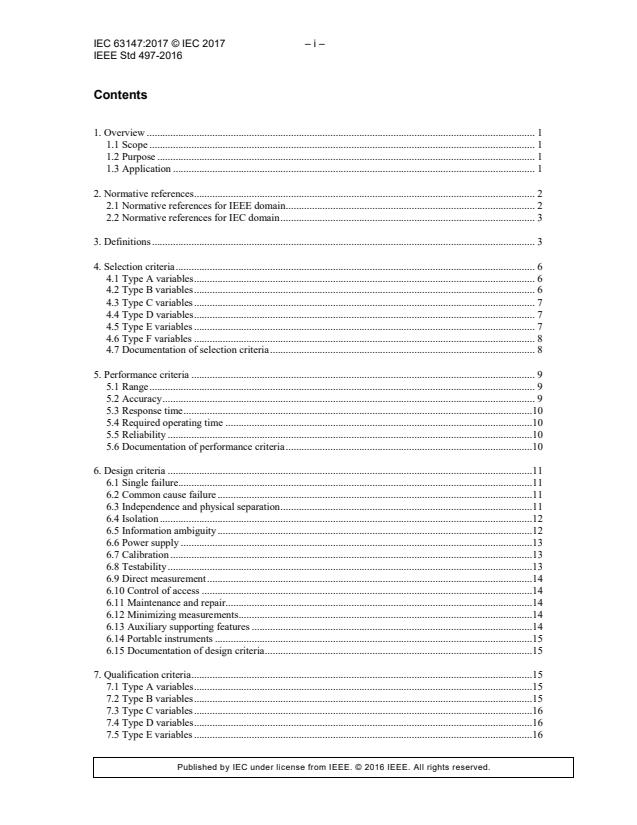
Contents
1. Overview . 1
1.1 Scope . 1
1.2 Purpose . 1
1.3 Application . 1
2. Normative references . 2
2.1 Normative references for IEEE domain . 2
2.2 Normative references for IEC domain . 3
3. Definitions . 3
4. Selection criteria . 6
4.1 Type A variables . 6
4.2 Type B variables . 6
4.3 Type C variables . 7
4.4 Type D variables . 7
4.5 Type E variables . 7
4.6 Type F variables . 8
4.7 Documentation of selection criteria . 8
5. Performance criteria . 9
5.1 Range . 9
5.2 Accuracy . 9
5.3 Response time .10
5.4 Required operating time .10
5.5 Reliability .10
5.6 Documentation of performance criteria .10
6. Design criteria .11
6.1 Single failure.11
6.2 Common cause failure .11
6.3 Independence and physical separation .11
6.4 Isolation .12
6.5 Information ambiguity .12
6.6 Power supply .13
6.7 Calibration .13
6.8 Testability .13
6.9 Direct measurement .14
6.10 Control of access .14
6.11 Maintenance and repair .14
6.12 Minimizing measurements .14
6.13 Auxiliary supporting features .14
6.14 Portable instruments .15
6.15 Documentation of design criteria .15
7. Qualification criteria .15
7.1 Type A variables .15
7.2 Type B variables .15
7.3 Type C variables .16
7.4 Type D variables .16
7.5 Type E variables .16
Published by IEC under license from IEEE. © 2016 IEEE. All rights reserved.
– ii – IEC 63147:2017 © IEC 2017
IEEE Std 497-2016
7.6 Type F variables .16
7.7 Portable instruments .17
7.8 Operating time .17
7.9 Documentation of qualification criteria .17
8. Display criteria .17
8.1 Display characteristics .17
8.2 Trend or rate information .18
8.3 Display identification.18
8.4 Type of monitoring channel display .18
8.5 Display location .18
8.6 Information ambiguity .19
8.7 Recording .19
8.8 Digital display signal validation .19
8.9 Documentation of display criteria .19
9. Quality assurance.19
Annex A (informative) Accident monitoring instrument channel accuracy .20
A.1 Introduction .20
A.2 Accuracy requirement groupings according to usage .20
A.3 Typical accuracy requirements .20
Annex B (informative) Examples of monitoring channel displays.21
Annex C (informative) Operational state diagram .23
Annex D (informative) Bibliography .24
Annex E (informative) IEEE list of participants .25
Published by IEC under license from IEEE. © 2016 IEEE. All rights reserved.
IEEE Std 497-2016
CRITERIA FOR ACCIDENT MONITORING INSTRUMENTATION
FOR NUCLEAR POWER GENERATING STATIONS
FOREWORD
1) The International Electrotechnical Commission (IEC) is a worldwide organization for standardization
comprising all national electrotechnical committees (IEC National Committees). The object of IEC is to
promote international co-operation on all questions concerning standardization in the electrical and
electronic fields. To this end and in addition to other activities, IEC publishes International Standards,
Technical Specifications, Technical Reports, Publicly Available Specifications (PAS) and Guides
(hereafter referred to as “IEC Publication(s)”). Their preparation is entrusted to technical committees; any
IEC National Committee interested in the subject dealt with may participate in this preparatory work.
International, governmental and non-governmental organizations liaising with the IEC also participate in
this preparation.
IEEE Standards documents are developed within IEEE Societies and Standards Coordinating Committees
of the IEEE Standards Association (IEEE-SA) Standards Board. IEEE develops its standards through a
consensus development process, which brings together volunteers representing varied viewpoints and
interests to achieve the final product. Volunteers are not necessarily members of IEEE and serve without
compensation. While IEEE administers the process and establishes rules to promote fairness in the
consensus development process, IEEE does not independently evaluate, test, or verify the accuracy of
any of the information contained in its standards. Use of IEEE Standards documents is wholly voluntary.
IEEE documents are made available for use subject to important notices and legal disclaimers (see
http://standards.ieee.org/IPR/disclaimers.html for more information).
IEC collaborates closely with IEEE in accordance with conditions determined by agreement between the
two organizations.
2) The formal decisions of IEC on technical matters express, as nearly as possible, an international
consensus of opinion on the relevant subjects since each technical committee has representation from all
interested IEC National Committees. The formal decisions of IEEE on technical matters, once consensus
within IEEE Societies and Standards Coordinating Committees has been reached, is determined by a
balanced ballot of materially interested parties who indicate interest in reviewing the proposed standard.
Final approval of the IEEE standards document is given by the IEEE Standards Association (IEEE-SA)
Standards Board.
3) IEC/IEEE Publications have the form of recommendations for international use and are accepted by IEC
National Committees/IEEE Societies in that sense. While all reasonable efforts are made to ensure that
the technical content of IEC/IEEE Publications is accurate, IEC or IEEE cannot be held responsible for the
way in which they are used or for any misinterpretation by any end user.
4) In order to promote international uniformity, IEC National Committees undertake to apply IEC Publications
(including IEC/IEEE Publications) transparently to the maximum extent possible in their national and
regional publications. Any divergence between any IEC/IEEE Publication and the corresponding national
or regional publication shall be clearly indicated in the latter.
5) IEC and IEEE do not provide any attestation of conformity. Independent certification bodies provide
conformity assessment services and, in some areas, access to IEC marks of conformity. IEC and IEEE
are not responsible for any services carried out by independent certification bodies.
6) All users should ensure that they have the latest edition of this publication.
7) No liability shall attach to IEC or IEEE or their directors, employees, servants or agents including
individual experts and members of technical committees and IEC National Committees, or volunteers of
IEEE Societies and the Standards Coordinating Committees of the IEEE Standards Association (IEEE-SA)
Standards Board, for any personal injury, property damage or other damage of any nature whatsoever,
whether direct or indirect, or for costs (including legal fees) and expenses arising out of the publication,
use of, or reliance upon, this IEC/IEEE Publication or any other IEC or IEEE Publications.
8) Attention is drawn to the normative references cited in this publication. Use of the referenced publications
is indispensable for the correct application of this publication.
9) Attention is drawn to the possibility that implementation of this IEC/IEEE Publication may require use of
material covered by patent rights. By publication of this standard, no position is taken with respect to the
existence or validity of any patent rights in connection therewith. IEC or IEEE shall not be held
responsible for identifying Essential Patent Claims for which a license may be required, for conducting
inquiries into the legal validity or scope of Patent Claims or determining whether any licensing terms or
conditions provided in connection with submission of a Letter of Assurance, if any, or in any licensing
agreements are reasonable or non-discriminatory. Users of this standard are expressly advised that
determination of the validity of any patent rights, and the risk of infringement of such rights, is entirely
their own responsibility.
Published by IEC under license from IEEE. © 2016 IEEE. All rights reserved.
– iv – IEC 63147:2017 © IEC 2017
IEEE Std 497-2016
International Standard IEC 61347/IEEE Std 497™-2016 has been processed through IEC
subcommittee 45A: Instrumentation, control and electrical power systems of nuclear
facilities, under the IEC/IEEE Dual Logo Agreement.
The text of this standard is based on the following documents:
IEEE Std FDIS Report on voting
IEEE Std 497™-2016 45A/1167/FDIS 45A/1170/RVD
Full information on the voting for the approval of this standard can be found in the report
on voting indicated in the above table.
When applied in an IEC / IAEA environment this standard is to be used in conjunction
with IEC TR 63123:2017, Nuclear power plants – Instrumentation, control and electrical
power systems – Guidance for the application of IEC 63147:2017 / IEEE 497-2016 in the
IEC / IAEA framework.
The IEC Technical Committee and IEEE Technical Committee have decided that the
contents of this publication will remain unchanged until the stability date indicated on the
IEC web site under "http://webstore.iec.ch" in the data related to the specific publication.
At this date, the publication will be
• reconfirmed,
• withdrawn,
• replaced by a revised edition, or
• amended.
Published by IEC under license from IEEE. © 2016 IEEE. All rights reserved.
IEEE Std 497-2016
IEEE Standard Criteria for Accident
Monitoring Instrumentation for Nuclear
Power Generating Stations
Sponsor
Nuclear Power Engineering Committee
of the
IEEE Power and Energy Society
Approved 15 May 2016
IEEE-SA Standards Board
Published by IEC under license from IEEE. © 2016 IEEE. All rights reserved.
– vi – IEC 63147:2017 © IEC 2017
IEEE Std 497-2016
Abstract: Established in this standard are criteria for variable selection, performance, design,
and qualification of accident monitoring instrumentation for anticipated operational, design basis
events and severe accidents.
Keywords: accident monitoring, design criteria, display criteria, IEEE 497™, performance
criteria, selection criteria, severe accidents, type variables
Published by IEC under license from IEEE. © 2016 IEEE. All rights reserved.
IEEE Std 497-2016
Important Notices and Disclaimers Concerning IEEE Standards Documents
IEEE documents are made available for use subject to important notices and legal disclaimers. These
notices and disclaimers, or a reference to this page, appear in all standards and may be found under the
heading “Important Notice” or “Important Notices and Disclaimers Concerning IEEE Standards
Documents.”
Notice and Disclaimer of Liability Concerning the Use of IEEE Standards
Documents
IEEE Standards documents (standards, recommended practices, and guides), both full-use and trial-use, are
developed within IEEE Societies and the Standards Coordinating Committees of the IEEE Standards
Association (“IEEE-SA”) Standards Board. IEEE (“the Institute”) develops its standards through a
consensus development process, approved by the American National Standards Institute (“ANSI”), which
brings together volunteers representing varied viewpoints and interests to achieve the final product.
Volunteers are not necessarily members of the Institute and participate without compensation from IEEE.
While IEEE administers the process and establishes rules to promote fairness in the consensus development
process, IEEE does not independently evaluate, test, or verify the accuracy of any of the information or the
soundness of any judgments contained in its standards.
IEEE does not warrant or represent the accuracy or content of the material contained in its standards, and
expressly disclaims all warranties (express, implied and statutory) not included in this or any other
document relating to the standard, including, but not limited to, the warranties of: merchantability; fitness
for a particular purpose; non-infringement; and quality, accuracy, effectiveness, currency, or completeness
of material. In addition, IEEE disclaims any and all conditions relating to: results; and workmanlike effort.
IEEE standards documents are supplied “AS IS” and “WITH ALL FAULTS.”
Use of an IEEE standard is wholly voluntary. The existence of an IEEE standard does not imply that there
are no other ways to produce, test, measure, purchase, market, or provide other goods and services related
to the scope of the IEEE standard. Furthermore, the viewpoint expressed at the time a standard is approved
and issued is subject to change brought about through developments in the state of the art and comments
received from users of the standard.
In publishing and making its standards available, IEEE is not suggesting or rendering professional or other
services for, or on behalf of, any person or entity nor is IEEE undertaking to perform any duty owed by any
other person or entity to another. Any person utilizing any IEEE Standards document, should rely upon his
or her own independent judgment in the exercise of reasonable care in any given circumstances or, as
appropriate, seek the advice of a competent professional in determining the appropriateness of a given
IEEE standard.
IN NO EVENT SHALL IEEE BE LIABLE FOR ANY DIRECT, INDIRECT, INCIDENTAL, SPECIAL,
EXEMPLARY, OR CONSEQUENTIAL DAMAGES (INCLUDING, BUT NOT LIMITED TO:
PROCUREMENT OF SUBSTITUTE GOODS OR SERVICES; LOSS OF USE, DATA, OR PROFITS;
OR BUSINESS INTERRUPTION) HOWEVER CAUSED AND ON ANY THEORY OF LIABILITY,
WHETHER IN CONTRACT, STRICT LIABILITY, OR TORT (INCLUDING NEGLIGENCE OR
OTHERWISE) ARISING IN ANY WAY OUT OF THE PUBLICATION, USE OF, OR RELIANCE
UPON ANY STANDARD, EVEN IF ADVISED OF THE POSSIBILITY OF SUCH DAMAGE AND
REGARDLESS OF WHETHER SUCH DAMAGE WAS FORESEEABLE.
Translations
The IEEE consensus development process involves the review of documents in English only. In the event
that an IEEE standard is translated, only the English version published by IEEE should be considered the
approved IEEE standard.
Published by IEC under license from IEEE. © 2016 IEEE. All rights reserved.
– viii – IEC 63147:2017 © IEC 2017
IEEE Std 497-2016
Official statements
A statement, written or oral, that is not processed in accordance with the IEEE-SA Standards Board
Operations Manual shall not be considered or inferred to be the official position of IEEE or any of its
committees and shall not be considered to be, or be relied upon as, a formal position of IEEE. At lectures,
symposia, seminars, or educational courses, an individual presenting information on IEEE standards shall
make it clear that his or her views should be considered the personal views of that individual rather than the
formal position of IEEE.
Comments on standards
Comments for revision of IEEE Standards documents are welcome from any interested party, regardless of
membership affiliation with IEEE. However, IEEE does not provide consulting information or advice
pertaining to IEEE Standards documents. Suggestions for changes in documents should be in the form of a
proposed change of text, together with appropriate supporting comments. Since IEEE standards represent a
consensus of concerned interests, it is important that any responses to comments and questions also receive
the concurrence of a balance of interests. For this reason, IEEE and the members of its societies and
Standards Coordinating Committees are not able to provide an instant response to comments or questions
except in those cases where the matter has previously been addressed. For the same reason, IEEE does not
respond to interpretation requests. Any person who would like to participate in revisions to an IEEE
standard is welcome to join the relevant IEEE working group.
Comments on standards should be submitted to the following address:
Secretary, IEEE-SA Standards Board
445 Hoes Lane
Piscataway, NJ 08854 USA
Laws and regulations
Users of IEEE Standards documents should consult all applicable laws and regulations. Compliance with
the provisions of any IEEE Standards document does not imply compliance to any applicable regulatory
requirements. Implementers of the standard are responsible for observing or referring to the applicable
regulatory requirements. IEEE does not, by the publication of its standards, intend to urge action that is not
in compliance with applicable laws, and these documents may not be construed as doing so.
Copyrights
IEEE draft and approved standards are copyrighted by IEEE under U.S. and international copyright laws.
They are made available by IEEE and are adopted for a wide variety of both public and private uses. These
include both use, by reference, in laws and regulations, and use in private self-regulation, standardization,
and the promotion of engineering practices and methods. By making these documents available for use and
adoption by public authorities and private users, IEEE does not waive any rights in copyright to the
documents.
Photocopies
Subject to payment of the appropriate fee, IEEE will grant users a limited, non-exclusive license to
photocopy portions of any individual standard for company or organizational internal use or individual,
non-commercial use only. To arrange for payment of licensing fees, please contact Copyright Clearance
Center, Customer Service, 222 Rosewood Drive, Danvers, MA 01923 USA; +1 978 750 8400. Permission
to photocopy portions of any individual standard for educational classroom use can also be obtained
through the Copyright Clearance Center.
Published by IEC under license from IEEE. © 2016 IEEE. All rights reserved.
IEEE Std 497-2016
Updating of IEEE Standards documents
Users of IEEE Standards documents should be aware that these documents may be superseded at any time
by the issuance of new editions or may be amended from time to time through the issuance of amendments,
corrigenda, or errata. An official IEEE document at any point in time consists of the current edition of the
document together with any amendments, corrigenda, or errata then in effect.
Every IEEE standard is subjected to review at least every ten years. When a document is more than ten
years old and has not undergone a revision process, it is reasonable to conclude that its contents, although
still of some value, do not wholly reflect the present state of the art. Users are cautioned to check to
determine that they have the latest edition of any IEEE standard.
In order to determine whether a given document is the current edition and whether it has been amended
through the issuance of amendments, corrigenda, or errata, visit the IEEE-SA Website at
http://ieeexplore.ieee.org/Xplore/home.jsp or contact IEEE at the address listed previously. For more
information about the IEEE SA or IEEE’s standards development process, visit the IEEE-SA Website at
http://standards.ieee.org.
Errata
Errata, if any, for all IEEE standards can be accessed on the IEEE-SA Website at the following URL:
http://standards.ieee.org/findstds/errata/index.html. Users are encouraged to check this URL for errata
periodically.
Patents
Attention is called to the possibility that implementation of this standard may require use of subject matter
covered by patent rights. By publication of this standard, no position is taken by the IEEE with respect to
the existence or validity of any patent rights in connection therewith. If a patent holder or patent applicant
has filed a statement of assurance via an Accepted Letter of Assurance, then the statement is listed on the
IEEE-SA Website at http://standards.ieee.org/about/sasb/patcom/patents.html. Letters of Assurance may
indicate whether the Submitter is willing or unwilling to grant licenses under patent rights without
compensation or under reasonable rates, with reasonable terms and conditions that are demonstrably free of
any unfair discrimination to applicants desiring to obtain such licenses.
Essential Patent Claims may exist for which a Letter of Assurance has not been received. The IEEE is not
responsible for identifying Essential Patent Claims for which a license may be required, for conducting
inquiries into the legal validity or scope of Patents Claims, or determining whether any licensing terms or
conditions provided in connection with submission of a Letter of Assurance, if any, or in any licensing
agreements are reasonable or non-discriminatory. Users of this standard are expressly advised that
determination of the validity of any patent rights, and the risk of infringement of such rights, is entirely
their own responsibility. Further information may be obtained from the IEEE Standards Association.
Published by IEC under license from IEEE. © 2016 IEEE. All rights reserved.
– x – IEC 63147:2017 © IEC 2017
IEEE Std 497-2016
IEEE Introduction
This introduction is not part of IEEE Std 497™-2016, IEEE Standard Criteria for Accident Monitoring Instrumentation
for Nuclear Power Generating Stations.
History
This standard evolved from IEEE Std 497™-2010 [B4] . It represents a continued effort by IEEE to
support the specification, design, and implementation of accident monitoring instrumentation of nuclear
power generating stations.
IEEE Std 497-2010 [B4] was developed to provide criteria for advanced instrumentation system designs
and design modifications based on modern digital technology. It marked a clear path forward for the
application of new technology. Though still maintaining applicability to existing systems, this version of
IEEE Std 497 provides more current guidance based on historically related standards and guidance.
It was the working group’s intention that the criteria of this standard address the variety of possible
accident monitoring channel configurations that current technology affords. It was also the working group’s
intention to address the display of information using computer generated displays and calculated values.
The criteria presented in this standard provide guidance in this area without limiting the types of displays
that can be made available to accident management personnel.
Although written primarily for new plant designs, existing plants may also use the guidance and applicable
criteria in this standard. The use of applicable plant procedures to determine the requirements of the
accident monitoring instrumentation provides the necessary flexibility for useful design criteria. This
standard can be used to help address the necessary changes to the plant configuration that occur over the
operating life of any plant.
Historically the standard addressed accident monitoring instrumentation used for anticipated operating
occurrences (AOOs) and design basis events (DBEs). To address lessons learned from various industry
events, the scope of this standard has evolved to now include severe accidents. This evolution was intended
to provide a broader applicability to cover both preventative and mitigative phases of potential plant events.
A broader applicability of the standard was also achieved by moving to a more international, technology
neutral approach to the standard. This approach was achieved by changing to International Atomic Energy
Agency (IAEA) definitions of terms, where applicable; the removal, where appropriate, of U.S. specific
references; and involvement in the working group of members of other standards organizations.
Furthermore, the corresponding International Electrotechnical Commission (IEC) counterparts to the IEEE
standards referenced were investigated and introduced as a second set of normative references. This opens
the possibility to apply this standard in the IEC domain. The individual IEEE and IEC reference sets in
whole are individually appropriate for use in the application of the standard, but inclusion of the IEEE and
IEC references does not imply equivalency between the individual references of the two sets.
Intended use
The standard applies to instrumentation intended for use during anticipated operational occurrences (AOO),
design basis events (DBE), and design extension conditions (DEC) including severe accidents.
This standard defines severe accidents as a subset of design extension conditions during which fuel damage
has occurred. Operationally, severe accidents and design extension conditions without fuel damage are
___________
The numbers in brackets correspond to those of the bibliography in Annex D.
Published by IEC under license from IEEE. © 2016 IEEE. All rights reserved.
IEEE Std 497-2016
distinguished by the procedures and guidelines used to manage the event, with emergency operating
procedures (EOP) used for design extension conditions without fuel damage and severe accident mitigation
guidelines (SAMG) used for severe accidents (see Annex C).
The standard is to be applied to instruments designated for severe accidents (Type F variables); however,
use of non-designated instruments during a severe accident is not precluded if these instruments are
available and can aid in the accident mitigation. Design extension conditions that are not severe accidents
are not covered by this standard.
This standard is intended to be used for both new plant designs and major modifications or upgrades of
existing nuclear power generating stations. The standard can be applied to various reactor types used for
power generation; however, development of the standard focused on light water reactors and application of
the standard to reactor technologies beyond light water reactors should be evaluated prior to initial use.
Revision summary
Since IEEE Std 497 was approved in 2010, industry events have occurred that highlighted the need for the
standard to address not just design basis events but severe accidents as well. The working group has
considered and incorporated appropriate changes related to the following significant items:
Lessons learned from industry events including Fukushima (earthquake and tsunami), Browns
Ferry (tornado), Salem (loss of RPS due to CCF), and North Anna (earthquake)
Accident monitoring instrument requirements based on emergency procedures and guidelines
(EOPs and SAMGs)
Reactor technology neutral approach
International usability
User feedback
Requirements for severe accidents instrumentation
IAEA definitions
Other minor editorial improvements throughout the standard were also incorporated.
Future work
As the use of digital technology in the nuclear plant is a dynamic area of design, the working group intends
to keep this area as an ongoing future task.
Since no counterpart to this standard exists in the IEC domain, this standard was identified as a potential
candidate for a dual-logo standard to be applied in both the IEEE and the IEC domain early in the course of
this revision. A joint group of both organizations identified topics and aspects to be harmonized and
recommended to proceed. Thus the recent revision was performed with the intent and the spirit to prepare
and facilitate the application for the IEC domain. Formal involvement of the IEC was delayed. This
revision of the standard is, therefore, still an IEEE standard, but may be further modified in the future after
closer investigation by and discussion with IEC experts on its potential as a dual-logo standard.
Another area that the working group believes should be considered in a future revision to the standard is
how to adopt risk-informed techniques into accident monitoring criteria.
Published by IEC under license from IEEE. © 2016 IEEE. All rights reserved.
– xii – IEC 63147:2017 © IEC 2017
IEEE Std 497-2016
Additionally, user feedback related to the implementation of the standard on non-light water reactors and
implementation of Type F variables will be reviewed and considered for a future revision.
Published by IEC under license from IEEE. © 2016 IEEE. All rights reserved.
IEEE Std 497-2016
Standard Criteria for Accident
Monitoring Instrumentation for Nuclear
Power Generating Stations
IMPORTANT NOTICE: IEEE Standards documents are not intended to ensure safety, security, health,
or environmental protection, or ensure against interference with or from other devices or networks.
Implementers of IEEE Standards documents are responsible for determining and complying with all
appropriate safety, security, environmental, health, and interference protection practices and all
applicable laws and regulations.
This IEEE document is made available for use subject to important notices and legal disclaimers.
These notices and disclaimers appear in all publications containing this document and may
be found under the heading “Important Notice” or “Important Notices and Disclaimers
Concerning IEEE Documents.” They can also be obtained on request from IEEE or viewed at
http://standards.ieee.org/IPR/disclaimers.html.
1. Overview
1.1 Scope
This standard contains the functional and design criteria for accident monitoring instrumentation for new
plant designs and nuclear power generating stations desiring to perform design modifications.
1.2 Purpose
The purpose of this standard is to establish selection, design, performance, qualification, and display
criteria for accident monitoring instrumentation for anticipated operational occurrences, design basis
events, and severe accidents.
1.3 Application
This standard applies to accident monitoring instrumentation intended for use during the following
operations:
As required for planned operator action related to accident mitigation
Published by IEC under license from IEEE. © 2016 IEEE. All rights reserved.
– 2 – IEC 63147:2017 © IEC 2017
IEEE Std 497-2016
For assessing plant conditions, safety system performance, and making decisions related to plant
response to abnormal events
For achieving and maintaining safe shutdown following an accident
This standard does not apply to the following:
Accident monitoring instrumentation that is intended solely for historical recording or solely for
maintenance purposes
Other instrumentation that may be available during accident conditions
2. Normative references
The following referenced documents are indispensable for the application of this document (i.e., they must
be understood and used, so each referenced document is cited in text and its relationship to this document is
explained). For dated references, only the edition cited applies. For undated references, the latest edition of
the referenced document (including any amendments or corrigenda) applies.
2.1 Normative references for IEEE domain
ASME NQA-1-2008, Quality Assurance Requirements for Nuclear Facility Applications.
IEEE Std 7-4.3.2™-2016, IEEE Standard Criteria for Programmable Digital Devices in Safety Systems of
3,4
Nuclear Power Generating Stations.
IEEE Std 308™-2012, IEEE Standard Criteria for Class 1E Power Systems for Nuclear Power Generating
Stations.
IEEE Std 323™-2003, IEEE Standard for Qualifying Class 1E Equipment for Nuclear Power Generating
Stations.
IEEE Std 344™-2013, IEEE Standard for Seismic Qualification of Class 1E Equipment for Nuclear Power
Generating Stations.
IEEE Std 352™-1987, IEEE Guide for General Principles of Reliability Analysis of Nuclear Power
Stations.
IEEE Std 379™-2014, IEEE Standard Application of the Single-Failure Criterion to Nuclear Power
Generating Station Safety Systems.
IEEE Std 384™-2008, IEEE Standard Criteria for Independence of Class 1E Equipment and Circuits.
IEEE Std 577™-2012, IEEE Standard Requirements for Reliability Analysis in the Design and Operation
of Safety Systems for Nuclear Power Generating Stations.
IEEE Std 603™-2009, IEEE Standard Criteria for Safety Systems for Nuclear Power Generating Stations.
___________
ASME publications are available from the American Society of Mechanical Engineers, 22 Law Drive, Fairfield, NJ 07007, USA.
The IEEE standards or products referenced in Clause 2 are trademarks owned by The I
...
Questions, Comments and Discussion
Ask us and Technical Secretary will try to provide an answer. You can facilitate discussion about the standard in here.
Loading comments...