

ISO 80601-2-70:2020
(Main)Medical electrical equipment - Part 2-70: Particular requirements for the basic safety and essential performance of sleep apnoea breathing therapy equipment
General Information
- Abstract
This document is applicable to the basic safety and essential performance of sleep apnoea breathing therapy equipment, hereafter referred to as ME equipment, intended to alleviate the symptoms of patients who suffer from obstructive sleep apnoea by delivering a therapeutic breathing pressure to the respiratory tract of the patient. Sleep apnoea breathing therapy equipment is intended for use in the home healthcare environment by lay operators as well as in professional healthcare institutions. * Sleep apnoea breathing therapy equipment is not considered to utilize a physiologic closed-loop-control system unless it uses a physiological patient variable to adjust the therapy settings. This document excludes sleep apnoea breathing therapy equipment intended for use with neonates. This document is applicable to ME equipment or an ME system intended for those patients who are not dependent on mechanical ventilation. This document is not applicable to ME equipment or an ME system intended for those patients who are dependent on mechanical ventilation such as patients with central sleep apnoea. This document is also applicable to those accessories intended by their manufacturer to be connected to sleep apnoea breathing therapy equipment, where the characteristics of those accessories can affect the basic safety or essential performance of the sleep apnoea breathing therapy equipment. Masks and application accessories intended for use during sleep apnoea breathing therapy are additionally addressed by ISO 17510. Refer to Figure AA.1 for items covered further under this document. If a clause or subclause is specifically intended to be applicable to ME equipment only, or to ME systems only, the title and content of that clause or subclause will say so. If that is not the case, the clause or subclause applies both to ME equipment and to ME systems, as relevant. Hazards inherent in the intended physiological function of ME equipment or ME systems within the scope of this document are not covered by specific requirements in this document except in 7.2.13 and 8.4.1 of the general standard. NOTE See also 4.2 of the general standard. This document is not applicable to high-frequency jet ventilators (HFJVs) or high-frequency oscillatory ventilators (HFOVs), which are given in ISO 80601-2-87[13]. This document does not specify the requirements for ventilators or accessories intended for critical care ventilators for ventilator-dependent patients, which are given in ISO 80601‑2‑12. This document does not specify the requirements for ventilators or accessories intended for anaesthetic applications, which are given in ISO 80601-2-13[8]. This document does not specify the requirements for ventilators or accessories intended for home care ventilators for ventilator-dependent patients, which are given in ISO 80601-2-72[9]. This document does not specify the requirements for ventilators or accessories intended for emergency and transport, which are given in ISO 80601-2-84[12]. This document does not specify the requirements for ventilators or accessories intended for home-care ventilatory support, which are given in ISO 80601-2-79[10] and ISO 80601‑2‑80[11].
- Status
- Published
- Publication Date
- 19-Nov-2020
- Technical Committee
- SC 62D - Particular medical equipment, software, and systems
- Drafting Committee
- JWG 12 - TC 62/SC 62D/JWG 12
Overview
ISO 80601-2-70:2020 - Medical electrical equipment - Particular requirements for the basic safety and essential performance of sleep apnoea breathing therapy equipment - is a joint ISO/IEC standard that defines safety, performance and testing requirements for devices intended to treat obstructive sleep apnoea (OSA). It applies to medical electrical (ME) equipment and ME systems that deliver therapeutic breathing pressure (for example CPAP and bi‑level devices) in both professional and home healthcare environments. The standard excludes devices for neonates, ventilator‑dependent patients (e.g., critical‑care ventilators), and specific high‑frequency ventilators.
Key topics and technical requirements
The standard supplements general IEC/ISO ME equipment requirements with device‑specific provisions, including:
- Essential performance and safety requirements for sleep apnoea therapy devices and their accessories (masks, tubing, filters), plus guidance where clauses apply to ME equipment vs ME systems.
- Airway pressure accuracy and stability tests: static and dynamic accuracy for CPAP and bi‑level modes, and checks of long‑term and short‑term pressure stability.
- Maximum flowrate and hazardous‑output protection, including measurement and protection against excessive airway pressure and CO rebreathing concerns.
- Breathing gas pathway and connectors: ports, labels, humidification, breathing system filters and functional connections.
- Biocompatibility, cleaning/disinfection and protective packaging for patient‑contacting parts.
- Electromagnetic compatibility (EMC) and electrical safety for home and clinical environments.
- Usability, labelling and instructions for use tailored to lay operators in home healthcare as well as clinicians.
- Programmable electrical medical systems (PEMS), hazards/fault conditions, and testing procedures.
- Informative annexes covering marking, symbols, data interfaces, usability and traceability to essential principles.
(See also ISO 17510 for masks and application accessories.)
Practical applications and who uses it
ISO 80601-2-70 is used by:
- Manufacturers and OEMs designing CPAP/bi‑level therapy devices and accessories to meet safety and performance requirements.
- Test laboratories and quality teams performing compliance and type testing (pressure accuracy, EMC, biocompatibility, functional tests).
- Regulatory and clinical engineers preparing technical documentation for market access, conformity assessment and risk management.
- Procurement and healthcare providers evaluating device safety for home and institutional use.
Benefits include reduced patient risk, consistent device performance, clearer labeling and streamlined regulatory clearance.
Related standards
- ISO 80601 series (general ME equipment requirements)
- ISO 17510 (masks and application accessories)
- ISO 80601‑2‑12, ‑2‑13, ‑2‑72, ‑2‑79, ‑2‑80, ‑2‑84, ‑2‑87 (ventilator and specialised device standards)
Keywords: ISO 80601-2-70, sleep apnoea breathing therapy equipment, CPAP, bi‑level, medical electrical equipment, airway pressure accuracy, EMC, biocompatibility, home healthcare compliance.
Relations
- Effective Date
- 08-Mar-2024
- Effective Date
- 05-Sep-2023
Get Certified
Connect with accredited certification bodies for this standard

BSI Group
BSI (British Standards Institution) is the business standards company that helps organizations make excellence a habit.

TÜV Rheinland
TÜV Rheinland is a leading international provider of technical services.

TÜV SÜD
TÜV SÜD is a trusted partner of choice for safety, security and sustainability solutions.
Sponsored listings
Frequently Asked Questions
ISO 80601-2-70:2020 is a standard published by the International Electrotechnical Commission (IEC). Its full title is "Medical electrical equipment - Part 2-70: Particular requirements for the basic safety and essential performance of sleep apnoea breathing therapy equipment". This standard covers: This document is applicable to the basic safety and essential performance of sleep apnoea breathing therapy equipment, hereafter referred to as ME equipment, intended to alleviate the symptoms of patients who suffer from obstructive sleep apnoea by delivering a therapeutic breathing pressure to the respiratory tract of the patient. Sleep apnoea breathing therapy equipment is intended for use in the home healthcare environment by lay operators as well as in professional healthcare institutions. * Sleep apnoea breathing therapy equipment is not considered to utilize a physiologic closed-loop-control system unless it uses a physiological patient variable to adjust the therapy settings. This document excludes sleep apnoea breathing therapy equipment intended for use with neonates. This document is applicable to ME equipment or an ME system intended for those patients who are not dependent on mechanical ventilation. This document is not applicable to ME equipment or an ME system intended for those patients who are dependent on mechanical ventilation such as patients with central sleep apnoea. This document is also applicable to those accessories intended by their manufacturer to be connected to sleep apnoea breathing therapy equipment, where the characteristics of those accessories can affect the basic safety or essential performance of the sleep apnoea breathing therapy equipment. Masks and application accessories intended for use during sleep apnoea breathing therapy are additionally addressed by ISO 17510. Refer to Figure AA.1 for items covered further under this document. If a clause or subclause is specifically intended to be applicable to ME equipment only, or to ME systems only, the title and content of that clause or subclause will say so. If that is not the case, the clause or subclause applies both to ME equipment and to ME systems, as relevant. Hazards inherent in the intended physiological function of ME equipment or ME systems within the scope of this document are not covered by specific requirements in this document except in 7.2.13 and 8.4.1 of the general standard. NOTE See also 4.2 of the general standard. This document is not applicable to high-frequency jet ventilators (HFJVs) or high-frequency oscillatory ventilators (HFOVs), which are given in ISO 80601-2-87[13]. This document does not specify the requirements for ventilators or accessories intended for critical care ventilators for ventilator-dependent patients, which are given in ISO 80601‑2‑12. This document does not specify the requirements for ventilators or accessories intended for anaesthetic applications, which are given in ISO 80601-2-13[8]. This document does not specify the requirements for ventilators or accessories intended for home care ventilators for ventilator-dependent patients, which are given in ISO 80601-2-72[9]. This document does not specify the requirements for ventilators or accessories intended for emergency and transport, which are given in ISO 80601-2-84[12]. This document does not specify the requirements for ventilators or accessories intended for home-care ventilatory support, which are given in ISO 80601-2-79[10] and ISO 80601‑2‑80[11].
This document is applicable to the basic safety and essential performance of sleep apnoea breathing therapy equipment, hereafter referred to as ME equipment, intended to alleviate the symptoms of patients who suffer from obstructive sleep apnoea by delivering a therapeutic breathing pressure to the respiratory tract of the patient. Sleep apnoea breathing therapy equipment is intended for use in the home healthcare environment by lay operators as well as in professional healthcare institutions. * Sleep apnoea breathing therapy equipment is not considered to utilize a physiologic closed-loop-control system unless it uses a physiological patient variable to adjust the therapy settings. This document excludes sleep apnoea breathing therapy equipment intended for use with neonates. This document is applicable to ME equipment or an ME system intended for those patients who are not dependent on mechanical ventilation. This document is not applicable to ME equipment or an ME system intended for those patients who are dependent on mechanical ventilation such as patients with central sleep apnoea. This document is also applicable to those accessories intended by their manufacturer to be connected to sleep apnoea breathing therapy equipment, where the characteristics of those accessories can affect the basic safety or essential performance of the sleep apnoea breathing therapy equipment. Masks and application accessories intended for use during sleep apnoea breathing therapy are additionally addressed by ISO 17510. Refer to Figure AA.1 for items covered further under this document. If a clause or subclause is specifically intended to be applicable to ME equipment only, or to ME systems only, the title and content of that clause or subclause will say so. If that is not the case, the clause or subclause applies both to ME equipment and to ME systems, as relevant. Hazards inherent in the intended physiological function of ME equipment or ME systems within the scope of this document are not covered by specific requirements in this document except in 7.2.13 and 8.4.1 of the general standard. NOTE See also 4.2 of the general standard. This document is not applicable to high-frequency jet ventilators (HFJVs) or high-frequency oscillatory ventilators (HFOVs), which are given in ISO 80601-2-87[13]. This document does not specify the requirements for ventilators or accessories intended for critical care ventilators for ventilator-dependent patients, which are given in ISO 80601‑2‑12. This document does not specify the requirements for ventilators or accessories intended for anaesthetic applications, which are given in ISO 80601-2-13[8]. This document does not specify the requirements for ventilators or accessories intended for home care ventilators for ventilator-dependent patients, which are given in ISO 80601-2-72[9]. This document does not specify the requirements for ventilators or accessories intended for emergency and transport, which are given in ISO 80601-2-84[12]. This document does not specify the requirements for ventilators or accessories intended for home-care ventilatory support, which are given in ISO 80601-2-79[10] and ISO 80601‑2‑80[11].
ISO 80601-2-70:2020 is classified under the following ICS (International Classification for Standards) categories: 11.040.10 - Anaesthetic, respiratory and reanimation equipment. The ICS classification helps identify the subject area and facilitates finding related standards.
ISO 80601-2-70:2020 has the following relationships with other standards: It is inter standard links to ISO 80601-2-70:2025, ISO 80601-2-70:2015. Understanding these relationships helps ensure you are using the most current and applicable version of the standard.
ISO 80601-2-70:2020 is available in PDF format for immediate download after purchase. The document can be added to your cart and obtained through the secure checkout process. Digital delivery ensures instant access to the complete standard document.
Standards Content (Sample)
INTERNATIONAL ISO
STANDARD 80601-2-70
Second edition
2020-11
Medical electrical equipment —
Part 2-70:
Particular requirements for the basic
safety and essential performance
of sleep apnoea breathing therapy
equipment
Appareils électromédicaux —
Partie 2-70: Exigences particulières pour la sécurité de base et les
performances essentielles de l'équipement de thérapie respiratoire
pour l'apnée du sommeil
Reference number
©
ISO 2020
© ISO 2020
All rights reserved. Unless otherwise specified, or required in the context of its implementation, no part of this publication may
be reproduced or utilized otherwise in any form or by any means, electronic or mechanical, including photocopying, or posting
on the internet or an intranet, without prior written permission. Permission can be requested from either ISO at the address
below or ISO’s member body in the country of the requester.
ISO copyright office
CP 401 • Ch. de Blandonnet 8
CH-1214 Vernier, Geneva
Phone: +41 22 749 01 11
Email: copyright@iso.org
Website: www.iso.org
Published in Switzerland
ii © ISO 2020 – All rights reserved
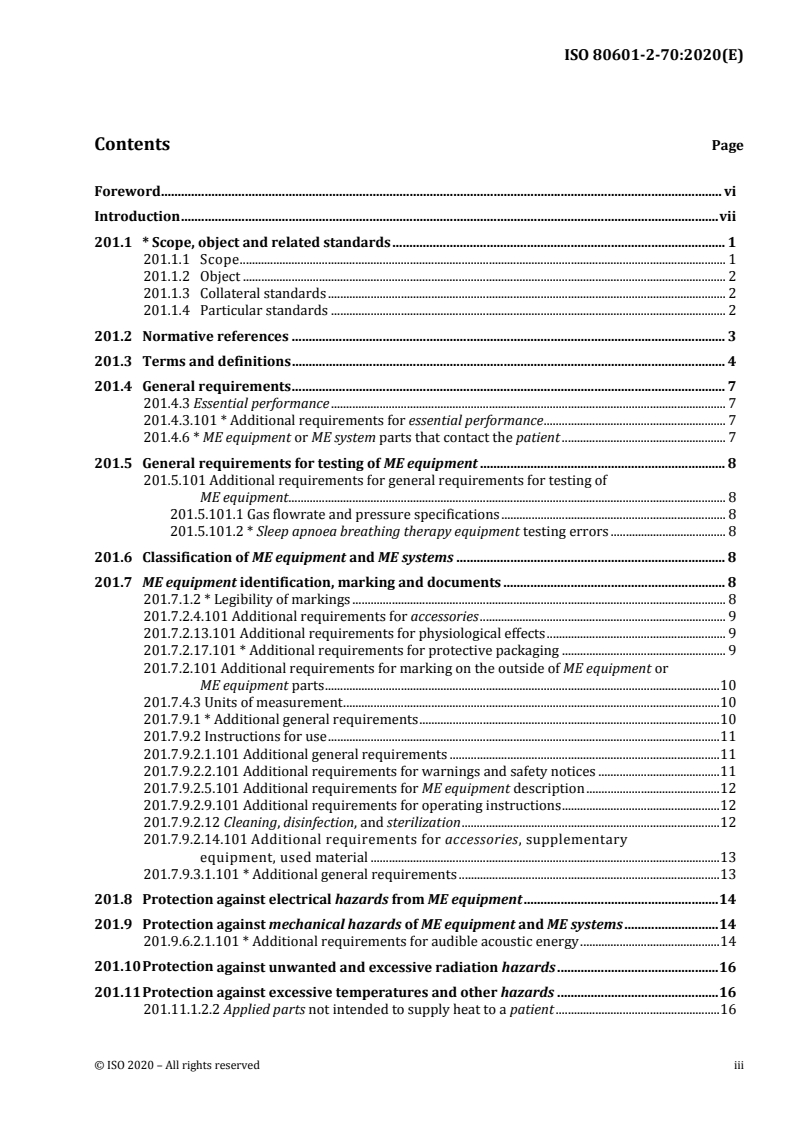
Contents Page
Foreword . vi
Introduction . vii
201.1 * Scope, object and related standards . 1
201.1.1 Scope . 1
201.1.2 Object . 2
201.1.3 Collateral standards . 2
201.1.4 Particular standards . 2
201.2 Normative references . 3
201.3 Terms and definitions . 4
201.4 General requirements . 7
201.4.3 Essential performance . 7
201.4.3.101 * Additional requirements for essential performance. 7
201.4.6 * ME equipment or ME system parts that contact the patient . 7
201.5 General requirements for testing of ME equipment . 8
201.5.101 Additional requirements for general requirements for testing of
ME equipment. 8
201.5.101.1 Gas flowrate and pressure specifications . 8
201.5.101.2 * Sleep apnoea breathing therapy equipment testing errors . 8
201.6 Classification of ME equipment and ME systems . 8
201.7 ME equipment identification, marking and documents . 8
201.7.1.2 * Legibility of markings . 8
201.7.2.4.101 Additional requirements for accessories . 9
201.7.2.13.101 Additional requirements for physiological effects . 9
201.7.2.17.101 * Additional requirements for protective packaging . 9
201.7.2.101 Additional requirements for marking on the outside of ME equipment or
ME equipment parts . 10
201.7.4.3 Units of measurement . 10
201.7.9.1 * Additional general requirements . 10
201.7.9.2 Instructions for use . 11
201.7.9.2.1.101 Additional general requirements . 11
201.7.9.2.2.101 Additional requirements for warnings and safety notices . 11
201.7.9.2.5.101 Additional requirements for ME equipment description . 12
201.7.9.2.9.101 Additional requirements for operating instructions . 12
201.7.9.2.12 Cleaning, disinfection, and sterilization . 12
201.7.9.2.14.101 Additional requirements for accessories, supplementary
equipment, used material . 13
201.7.9.3.1.101 * Additional general requirements . 13
201.8 Protection against electrical hazards from ME equipment . 14
201.9 Protection against mechanical hazards of ME equipment and ME systems . 14
201.9.6.2.1.101 * Additional requirements for audible acoustic energy . 14
201.10 Protection against unwanted and excessive radiation hazards . 16
201.11 Protection against excessive temperatures and other hazards . 16
201.11.1.2.2 Applied parts not intended to supply heat to a patient . 16
© ISO 2020 – All rights reserved iii
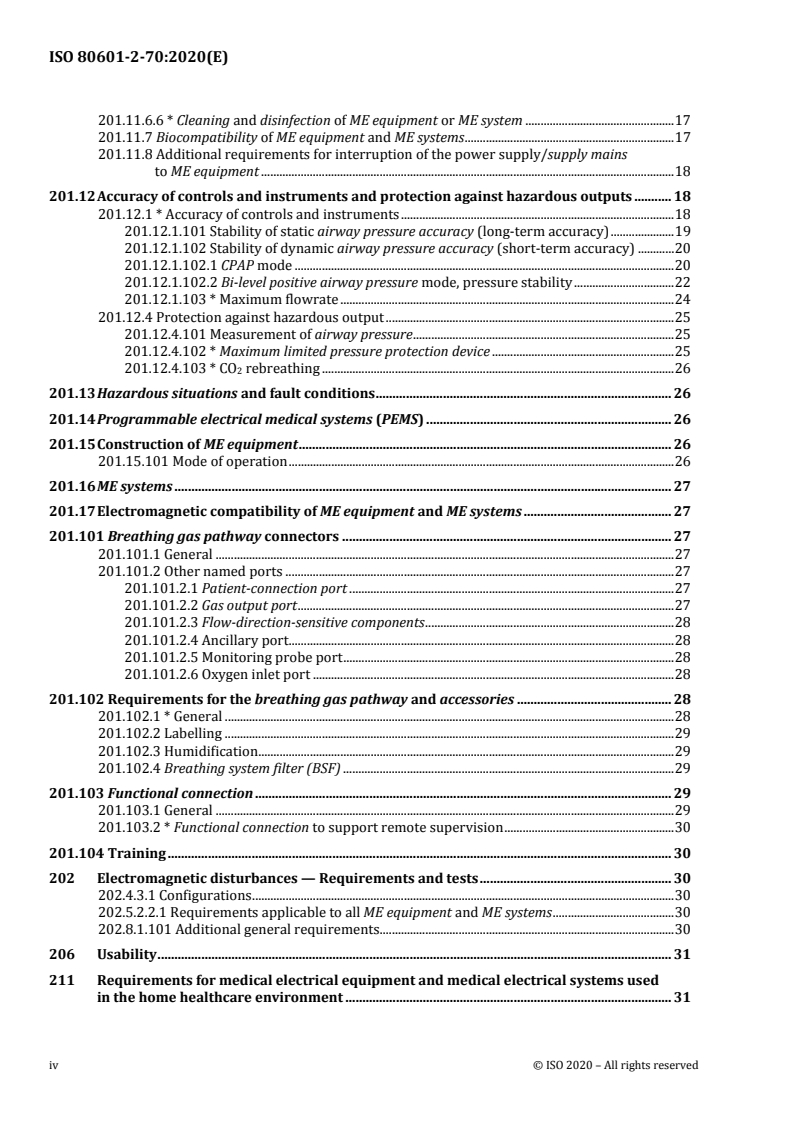
201.11.6.6 * Cleaning and disinfection of ME equipment or ME system . 17
201.11.7 Biocompatibility of ME equipment and ME systems . 17
201.11.8 Additional requirements for interruption of the power supply/supply mains
to ME equipment . 18
201.12 Accuracy of controls and instruments and protection against hazardous outputs . 18
201.12.1 * Accuracy of controls and instruments . 18
201.12.1.101 Stability of static airway pressure accuracy (long‐term accuracy) . 19
201.12.1.102 Stability of dynamic airway pressure accuracy (short‐term accuracy) . 20
201.12.1.102.1 CPAP mode . 20
201.12.1.102.2 Bi-level positive airway pressure mode, pressure stability . 22
201.12.1.103 * Maximum flowrate . 24
201.12.4 Protection against hazardous output . 25
201.12.4.101 Measurement of airway pressure . 25
201.12.4.102 * Maximum limited pressure protection device . 25
201.12.4.103 * CO rebreathing . 26
201.13 Hazardous situations and fault conditions . 26
201.14 Programmable electrical medical systems (PEMS) . 26
201.15 Construction of ME equipment . 26
201.15.101 Mode of operation . 26
201.16 ME systems . 27
201.17 Electromagnetic compatibility of ME equipment and ME systems . 27
201.101 Breathing gas pathway connectors . 27
201.101.1 General . 27
201.101.2 Other named ports . 27
201.101.2.1 Patient-connection port . 27
201.101.2.2 Gas output port . 27
201.101.2.3 Flow-direction-sensitive components . 28
201.101.2.4 Ancillary port . 28
201.101.2.5 Monitoring probe port . 28
201.101.2.6 Oxygen inlet port . 28
201.102 Requirements for the breathing gas pathway and accessories . 28
201.102.1 * General . 28
201.102.2 Labelling . 29
201.102.3 Humidification . 29
201.102.4 Breathing system filter (BSF) . 29
201.103 Functional connection . 29
201.103.1 General . 29
201.103.2 * Functional connection to support remote supervision . 30
201.104 Training . 30
202 Electromagnetic disturbances — Requirements and tests . 30
202.4.3.1 Configurations . 30
202.5.2.2.1 Requirements applicable to all ME equipment and ME systems . 30
202.8.1.101 Additional general requirements . 30
206 Usability . 31
211 Requirements for medical electrical equipment and medical electrical systems used
in the home healthcare environment . 31
iv © ISO 2020 – All rights reserved
211.4.2.3.1 Continuous operating conditions . 31
Annex C (informative) Guide to marking and labelling requirements for ME equipment and
ME systems . 33
Annex D (informative) Symbols on marking . 38
Annex AA (informative) Particular guidance and rationale . 39
Annex BB (informative) Data interface requirements . 48
Annex CC (informative) Reference to the IMDRF essential principles and labelling guidances . 52
Annex DD (informative) Reference to the essential principles . 56
Annex EE (informative) Reference to the general safety and performance requirements . 59
Annex FF (informative) Terminology — alphabetized index of defined terms . 63
Bibliography . 66
© ISO 2020 – All rights reserved v
Foreword
ISO (the International Organization for Standardization) is a worldwide federation of national
standards bodies (ISO member bodies). The work of preparing International Standards is normally
carried out through ISO technical committees. Each member body interested in a subject for which a
technical committee has been established has the right to be represented on that committee.
International organizations, governmental and non‐governmental, in liaison with ISO, also take part in
the work. ISO collaborates closely with the International Electrotechnical Commission (IEC) on all
matters of electrotechnical standardization.
The procedures used to develop this document and those intended for its further maintenance are
described in the ISO/IEC Directives, Part 1. In particular, the different approval criteria needed for the
different types of ISO documents should be noted. This document was drafted in accordance with the
editorial rules of the ISO/IEC Directives, Part 2 (see www.iso.org/directives).
Attention is drawn to the possibility that some of the elements of this document may be the subject of
patent rights. ISO shall not be held responsible for identifying any or all such patent rights. Details of
any patent rights identified during the development of the document will be in the Introduction and/or
on the ISO list of patent declarations received (see www.iso.org/patents).
Any trade name used in this document is information given for the convenience of users and does not
constitute an endorsement.
For an explanation of the voluntary nature of standards, the meaning of ISO specific terms and
expressions related to conformity assessment, as well as information about ISO's adherence to the
World Trade Organization (WTO) principles in the Technical Barriers to Trade (TBT),
see www.iso.org/iso/foreword.html.
This document was prepared jointly by Technical Committee ISO/TC 121, Anaesthetic and respiratory
equipment, Subcommittee SC 3, Respiratory devices and related equipment used for patient care, and
Technical Committee IEC/TC 62, Electrical equipment in medical practice, Subcommittee SC D,
Electromedical equipment, in collaboration with the European Committee for Standardization (CEN)
Technical Committee CEN/TC 215, Respiratory and anaesthetic equipment, in accordance with the
Agreement on technical cooperation between ISO and CEN (Vienna Agreement).
This second edition cancels and replaces the first edition (ISO 80601‐2‐70:2015), which has been
technically revised.
The main changes compared to the previous edition are as follows:
— modification of the bi‐level positive airway pressure mode stability test method;
— modification of the biocompatibility requirements;
— reformatting to provide a unique identifier for each requirement;
— harmonization with the ‘A2 project’ of the general standard.
A list of all parts in the ISO 80601 series and the IEC 80601 series can be found on the ISO website.
Any feedback or questions on this document should be directed to the user’s national standards body. A
complete listing of these bodies can be found at www.iso.org/members.html.
vi © ISO 2020 – All rights reserved
Introduction
Sleep apnoea is a chronic medical condition where the patient repeatedly stops breathing during sleep.
These episodes typically last 10 s or more and cause the oxygen levels in the blood to drop. It can be
caused by obstruction of the upper airway (obstructive sleep apnoea or OSA) or by a failure of the brain
to initiate a breath (central sleep apnoea).
NOTE Sleep apnoea breathing therapy equipment is intended for the treatment of obstructive sleep apnoea
and not central sleep apnoea.
Sleep apnoea, if untreated, can cause and worsen other medical conditions, including hypertension,
[22]
heart failure and diabetes .
Hypopnoea refers to a transient reduction of airflow, often while the patient is asleep, that lasts for at
least 10 s, shallow breathing. It also results in arousal or can cause oxygen saturation to drop.
[20]
Hypopnoea is less severe than apnoea. It is commonly due to partial obstruction of the upper airway .
Awareness of the risks associated with obstructive sleep apnoea has grown significantly. As a result, the
use of sleep apnoea breathing therapy equipment to treat obstructive sleep apnoea has become common.
This document covers basic safety and essential performance requirements needed to protect patients in
the use of this ME equipment.
This document covers sleep apnoea breathing therapy equipment for patient use. ISO 17510 applies to
masks and accessories used to connect sleep apnoea breathing therapy equipment to the patient.
Figure AA.1 shows this diagrammatically.
In this document, the following print types are used:
— Requirements and definitions: roman type
— Test specifications and terms defined in clause 3 of the general standard, in this document or as noted:
italic type;
— Informative material appearing outside of tables, such as notes, examples and references: in smaller type. Normative text
of tables is also in a smaller type;
In referring to the structure of this document, the term.
— “clause” means one of the four numbered divisions within the table of contents, inclusive of all
subdivisions (e.g. Clause 201 includes subclauses 201.1, 201.2, etc.);
— “subclause” means a numbered subdivision of a clause (e.g. 201.101, 201.102 and 201.102.1 are all
subclauses of Clause 201).
References to clauses within this document are preceded by the term “Clause” followed by the clause
number. References to subclauses within this document are by number only.
In this document, the conjunctive “or” is used as an “inclusive or” so a statement is true if any
combination of the conditions is true.
For the purposes of this document, the auxiliary verb:
© ISO 2020 – All rights reserved vii
– “shall” means that conformance with a requirement or a test is mandatory for conformance with
this document;
– “should” means that conformance with a requirement or a test is recommended but is not
mandatory for conformance with this document;
– “may” is used to describe a permission (e.g. a permissible way to achieve conformance with a
requirement or test);
– "can" is used to describe a possibility or capability; and
– "must" is used to express an external constraint.
Annex C contains a guide to the marking and labelling requirements in this document.
Annex D contains a summary of the symbols referenced in this document.
An asterisk (*) as the first character of a title or at the beginning of a paragraph or table title indicates
that there is guidance or rationale related to that item in Annex AA.
viii © ISO 2020 – All rights reserved
INTERNATIONAL STANDARD ISO 80601-2-70:2020(E)
Medical electrical equipment —
Part 2‐70:
Particular requirements for the basic safety and essential
performance of sleep apnoea breathing therapy equipment
201.1 * Scope, object and related standards
IEC 60601‐1:2005+AMD1:2012+AMD2:2020, Clause 1 applies, except as follows:
NOTE The general standard is IEC 60601‐1:2005+AMD1:2012+AMD2:2020.
201.1.1 Scope
IEC 60601‐1:2005+Amendment 1:2012, 1.1 is replaced by:
This document is applicable to the basic safety and essential performance of sleep apnoea breathing
therapy equipment, hereafter referred to as ME equipment, intended to alleviate the symptoms of
patients who suffer from obstructive sleep apnoea by delivering a therapeutic breathing pressure to the
respiratory tract of the patient. Sleep apnoea breathing therapy equipment is intended for use in the
home healthcare environment by lay operators as well as in professional healthcare institutions.
* Sleep apnoea breathing therapy equipment is not considered to utilize a physiologic closed-loop-control
system unless it uses a physiological patient variable to adjust the therapy settings.
This document excludes sleep apnoea breathing therapy equipment intended for use with neonates.
This document is applicable to ME equipment or an ME system intended for those patients who are not
dependent on mechanical ventilation.
This document is not applicable to ME equipment or an ME system intended for those patients who are
dependent on mechanical ventilation such as patients with central sleep apnoea.
This document is also applicable to those accessories intended by their manufacturer to be connected to
sleep apnoea breathing therapy equipment, where the characteristics of those accessories can affect the
basic safety or essential performance of the sleep apnoea breathing therapy equipment.
Masks and application accessories intended for use during sleep apnoea breathing therapy are
additionally addressed by ISO 17510. Refer to Figure AA.1 for items covered further under this
document.
If a clause or subclause is specifically intended to be applicable to ME equipment only, or to ME systems
only, the title and content of that clause or subclause will say so. If that is not the case, the clause or
subclause applies both to ME equipment and to ME systems, as relevant.
© ISO 2020 – All rights reserved
Hazards inherent in the intended physiological function of ME equipment or ME systems within the
scope of this document are not covered by specific requirements in this document except in 7.2.13 and
8.4.1 of the general standard.
NOTE See also 4.2 of the general standard.
This document is not applicable to high‐frequency jet ventilators (HFJVs) or high‐frequency oscillatory
[13]
ventilators (HFOVs), which are given in ISO 80601‐2‐87 .
This document does not specify the requirements for ventilators or accessories intended for critical care
ventilators for ventilator‐dependent patients, which are given in ISO 80601‐2‐12.
This document does not specify the requirements for ventilators or accessories intended for anaesthetic
[8]
applications, which are given in ISO 80601‐2‐13 .
This document does not specify the requirements for ventilators or accessories intended for home care
[9]
ventilators for ventilator‐dependent patients, which are given in ISO 80601‐2‐72 .
This document does not specify the requirements for ventilators or accessories intended for emergency
[12]
and transport, which are given in ISO 80601‐2‐84 .
This document does not specify the requirements for ventilators or accessories intended for home‐care
[10] [11]
ventilatory support, which are given in ISO 80601‐2‐79 and ISO 80601‐2‐80 .
201.1.2 Object
IEC 60601‐1:2005, 1.2 is replaced by:
The object of this document is to establish particular basic safety and essential performance
requirements for sleep apnoea breathing therapy equipment (as defined in 201.3.215).
[17] [18]
NOTE 1 This document has been prepared to address the relevant essential principles and labelling guidances of the
International Medical Devices Regulators Forum (IMDRF) as indicated in Annex CC.
NOTE 2 This document has been prepared to address the relevant essential principles of safety and performance of
ISO 16142‐1:2016 as indicated in Annex DD.
NOTE 3 This document has been prepared to address the relevant general safety and performance requirements of
[16]
European regulation (EU) 2017/745 as indicated in Annex EE.
201.1.3 Collateral standards
IEC 60601‐1:2005+AMD1:2012+AMD2:2020, 1.3 applies with the following addition:
IEC 60601‐1‐2:2014+AMD1:2020 and IEC 60601‐1‐6:2010+AMD1:2013+AMD2:2020 apply as modified
in Clauses 202 and 206 respectively. IEC 60601‐1‐3:2008+AMD1:2013 does not apply. All other
published collateral standards in the IEC 60601‐1 series apply as published.
201.1.4 Particular standards
Replacement:
© ISO 2020 – All rights reserved
In the IEC 60601 series, particular standards define basic safety and essential performance
requirements, and may modify, replace or delete requirements contained in the general standard and
collateral standards as appropriate for the particular ME equipment under consideration.
A requirement of a particular standard takes priority over the general standard.
For brevity, IEC 60601‐1+AMD1:2012+AMD2:2020 is referred to in this document as the general
standard. Collateral standards are referred to by their document number.
The numbering of clauses and subclauses of this document corresponds to that of the general standard
with the prefix “201” (e.g. 201.1 in this document addresses the content of Clause 1 of the general
standard) or applicable collateral standard with the prefix “20x”, where x is the final digit(s) of the
collateral standard document number (e.g. 202.4 in this document addresses the content of Clause 4 of
the IEC 60601‐1‐2 collateral standard, 203.4 in this document addresses the content of Clause 4 of the
IEC 60601‐1‐3 collateral standard, etc.). The changes to the text of the general standard are specified by
the use of the following words:
"Replacement" means that the clause or subclause of the general standard or applicable collateral
standard is replaced completely by the text of this document.
"Addition" means that the text of this document is additional to the requirements of the general
standard or applicable collateral standard.
"Amendment" means that the clause or subclause of the general standard or applicable collateral
standard is amended as indicated by the text of this document.
Subclauses, figures or tables which are additional to those of the general standard are numbered
starting from 201.101. However, due to the fact that definitions in the general standard are numbered
3.1 through 3.139, additional definitions in this document are numbered beginning from 201.3.201.
Additional annexes are lettered AA, BB, etc., and additional items aa), bb), etc.
Subclauses, figures or tables which are additional to those of a collateral standard are numbered
starting from 20x, where “x” is the number of the collateral standard, e.g. 202 for IEC 60601‐1‐2, 211 for
IEC 60601‐1‐11, etc.
The term "this document" is used to make reference to the general standard, any applicable collateral
standards and this document taken together.
Where there is no corresponding clause or subclause in this document, the clause or subclause of the
general standard or applicable collateral standard, although possibly not relevant, applies without
modification; where it is intended that any part of the general standard or applicable collateral
standard, although possibly relevant, is not to be applied, a statement to that effect is given in this
document.
201.2 Normative references
The following documents are referred to in the text in such a way that some or all of their content
constitutes requirements of this document. For dated references, only the edition cited applies. For
undated references, the latest edition of the referenced document (including any amendments) applies.
IEC 60601‐1:2005+AMD1:2012+AMD2:2020, Clause 2 applies, except as follows:
Replacement:
© ISO 2020 – All rights reserved
ISO 7010:2019, Graphical symbols — Safety colours and safety signs — Registered safety signs
Addition:
ISO 3744:2010, Acoustics — Determination of sound power levels and sound energy levels of noise sources
using sound pressure — Engineering methods for an essentially free field over a reflecting plane
ISO 5356‐1:2015, Anaesthetic and respiratory equipment — Conical connectors — Cones and sockets
ISO 14937:2009, Sterilization of health care products — General requirements for characterization of a
sterilizing agent and the development, validation and routine control of a sterilization process for medical
devices
ISO 16142‐1:2016, Medical devices — Recognized essential principles of safety and performance of
medical devices — Part 1: General essential principles and additional specific essential principles for all
non-IVD medical devices and guidance on the selection of standards
ISO 17510:2015, Medical devices — Sleep apnoea breathing therapy — Masks and application accessories
ISO 17664:2017, Processing of health care products — Information to be provided by the medical device
manufacturer for the processing of medical devices
ISO 18562‐1:2017, Biocompatibility evaluation of breathing gas pathways in healthcare applications —
Part 1: Evaluation and testing within a risk management process
ISO 19223:2019, Lung ventilators and related equipment — Vocabulary and semantics
ISO 23328‐1:2003, Breathing system filters for anaesthetic and respiratory use — Part 1: Salt test method
to assess filtration performance
ISO 23328‐2:2002, Breathing system filters for anaesthetic and respiratory use — Part 2: Non-filtration
aspects
ISO 80369‐1:2018, Small-bore connectors for liquids and gases in healthcare applications —
Part 1: General requirements
ISO 80601‐2‐12:2020, Medical electrical equipment — Part 2-12: Particular requirements for basic safety
and essential performance of critical care ventilators
ISO 80601‐2‐74:2017, Medical electrical equipment — Part 2-74: Particular requirements for basic safety
and essential performance of respiratory humidifying equipment
IEC 60601‐1:2005+AMD1:2012+AMD2:2020, Medical electrical equipment — Part 1: General
requirements for basic safety and essential performance
IEC 62366‐1:2015+AMD1:2020, Medical devices — Application of usability engineering to medical
devices
201.3 Terms and definitions
For the purposes of this document, the terms and definitions given in ISO 3744:2010,
ISO 16142‐1:2016, ISO 17510:2015, ISO 17664:2017, ISO 18562‐1:2017,
ISO 19223:2019, ISO 23328‐2:2002, ISO 80601‐2‐12:2020 ISO 80601‐2‐74:2017,
© ISO 2020 – All rights reserved
IEC 60601‐1:2005+AMD1:2012+AMD2:2020, IEC 60601‐1‐2:2014+AMD1:2020,
IEC 60601‐1‐6:2010+AMD1:2013+AMD2:2020, IEC 60601‐1‐8:2006+AMD1:2012+AMD2:2020,
IEC 60601‐1‐10:2007+AMD2:2020, IEC 60601‐1‐11:2015, IEC 62366‐1:2015+AMD1:2020 and the
following apply.
ISO and IEC maintain terminological databases for use in standardization at the following addresses:
— ISO Online browsing platform: available at https://www.iso.org/obp
— IEC Electropedia: available at http://www.electropedia.org/
NOTE An index of defined terms is found in Annex FF.
Addition:
201.3.201
airway pressure accuracy
degree of correspondence between the pressure set on the sleep apnoea breathing therapy equipment
and the actual (true) airway pressure
201.3.202
* auto CPAP
operating mode in which the sleep apnoea breathing therapy equipment automatically adjusts the
applied gas pressure level within a clinically predetermined range to prevent disturbances of the
patient’s breathing at the lowest necessary pressure
Note 1 to entry: These disturbances are typically obstructive apnoea (cessation of air flow) or hypopnoea (shallow breathing)
events.
Note 2 to entry: An auto CPAP mode may be bi‐level.
201.3.203
* automatic start/stop function
feature by which the sleep apnoea breathing therapy equipment automatically starts or stops the
therapy based on whether the patient is connected or disconnected from the equipment
Note 1 to entry: Sleep apnoea breathing therapy equipment may provide an automatic start function, an automatic stop
function, or both.
201.3.204
breathing gas pathway
gas pathways through which gas flows at respiratory pressures between the intake and the patient-
connection port
201.3.205
breathing tube
non‐rigid tube used to convey gases between components of a breathing system
201.3.206
diagnostic apnoea
A
d
decrease in airway flow greater than ≥90 % of pre‐event baseline for at least 10 s
© ISO 2020 – All rights reserved
Note 1 to entry: Airflow is typically measured by oronasal thermal airflow sensor or nasal pressure transducer normally
determined using full polysomnography in an attended sleep study or home sleep test.
Note 2 to entry: Reference [19] was used to determine this definition.
201.3.207
diagnostic apnoea-hypopnoea index
AHI
d
average number of diagnostic apnoea events and diagnostic hypopnoea events occurring per hour of
sleep
AH60
dd
AHI
d
ts
where
A is the total number of diagnostic apnoea events
d
H is the total number of diagnostic hypopnoea events
d
t is the total sleep time in minutes
s
Note 1 to entry: A diagnostic apnoea-hypopnoea index is normally determined using full polysomnography in an attended sleep
study or home sleep test.
201.3.208
diagnostic hypopnoea
H
d
decrease in airway flow of at least 30 % of the pre‐event baseline for at least 10 s; and at least 3 %
oxygen desaturation from pre‐event baseline or an arousal event, excluding diagnostic apnoea
Note 1 to entry: For monitoring oxygen saturation, a pulse oximeter should have a maximum signal averaging time of ≤3 s.
Note 2 to entry: An oxygen desaturation of 4 % from pre‐event baseline is also used.
Note 3 to entry: Airflow is typically measured by oronasal thermal airflow sensor or nasal pressure transducer normally
determined using full polysomnography in an attended sleep study or home sleep test.
Note 4 to entry: Reference [19] was used to determine this definition.
201.3.209
equipment apnoea
A
flow
diagnostic apnoea as estimated by sleep apnoea breathing therapy equipment
201.3.210
equipment apnoea-hypopnoea index
AHI
flow
average number of residual equipment apnoea and equipment hypopnoea events occurring per hour of
the therapy session
Note 1 to entry: References [19] and [23] were used to determine this definition.
© ISO 2020 – All rights reserved
201.3.211
equipment hypopnoea
H
flow
diagnostic hypopnoea as estimated by sleep apnoea breathing therapy equipment
Note 1 to entry: Sleep apnoea breathing therapy equipment without oximetry cannot monitor oxygen saturation. Therefore,
sleep apnoea breathing therapy equipment without the oxygen saturation information, can only provide an estimate of
hypopnoea events.
201.3.212
flow-direction-sensitive component
component or accessory through which gas flow is in one direction only for proper functioning or
patient safety
[1]
[SOURCE: ISO 4135:— , definition 3.1.7, modified — Added ‘or accessory’ and replaced ‘must be’ with
‘is’.]
201.3.213
gas output port
port through which gas is delivered at respiratory pressures through a tube to the patient-connection
port
201.3.214
* ramp mode
operating mode in which the sleep apnoea breathing therapy equipment automatically increases the
applied pressure level from an initial level to the clinically predetermined therapeutic level in a
predetermined profile, or decreases the applied pressure level from the therapeutic level to a lower
level in a predetermined profile
201.3.215
sleep apnoea breathing therapy equipment
ME equipment delivering a therapeutic breathing pressure to the patient intended to treat obstructive
sleep apnoea by keeping the upper airways open
Note 1 to entry: Sleep apnoea breathing therapy equipment is primarily used in the home healthcare environment by a lay
operator without direct professional supervision.
201.4 General requirements
IEC 60601‐1:2005+AMD1:2012, Clause 4 applies, except as follows:
201.4.3 Essential performance
IEC 60601‐1:2005+AMD1:2012, 4.3 applies, except as follows:
Additional subclause:
201.4.3.101 * Additional requirements for essential performance
For the purposes of this document, sleep apnoea breathing therapy equipment is considered to not have
essential performance.
© ISO 2020 – All rights reserved
a) Notwithstanding this fact, when this document refers to essential performance as acceptance
criteria, the static pressure shall be evaluated.
b) The method of 202.8.1.101 may be used to evaluate static pressure as an acceptance criterion
following specific tests required by this document.
201.4.6 * ME equipment or ME system parts that contact the patient
Amendment (add at end of 4.6 prior to the compliance check):
aa) The sleep apnoea breathing therapy equipment parts or accessories that can come into contact with
the patient shall be subject to the requirements for applied parts according to this subclause (i.e., 4.6
of the general standard).
NOTE See ISO 17510:2015 for additional requirements for accessories that can come into contact with the patient.
201.5 General requirements for testing of ME equipment
IEC 60601‐1:2005+AMD1:2012+AMD2:2020, Clause 5 applies, except as follows:
Addition:
201.5.101 Additional requirements for general requirements for testing of
ME equipment
201.5.101.1 Gas flowrate and pressure specifications
In this document, requirements for the flowrate and pressure are expressed as if tested under STPD
(standard temperature and pressure dry) conditions.
NOTE For the purposes of this document, STPD is 101,3 kPa at an operating temperature of 20 °C, dry.
Correct all test measurements to STPD, as appropriate.
201.5.101.2 * Sleep apnoea breathing therapy equipment testing errors
For the purposes of this document, tolerances declared in the accompanying documents shall include the
uncertainty of the measurement used to determine the specification.
201.6 Classification of ME equipment and ME systems
IEC 60601‐1:2005+AMD1:2012+AMD2:2020, Clause 6 applies.
201.7 ME equipment identification, marking and documents
IEC 60601‐1:2005+AMD1:2012+AMD2:2020, Clause 7 applies, except as follows:
© ISO 2020 – All rights reserved
201.7.1.2 * Legibility of markings
IEC 60601‐1:2005+AMD1:2012+AMD2:2020, 7.1.2 applies, except as follows:
Replacement (at the end of the second sentence of the second paragraph of the compliance check):
Replace ‘1 m’ with ‘0,4 m’
Additional subclauses:
201.7.2.4.101 Additional requirements for accessories
a) Accessories supplied separately shall:
1) fulfil the requirements of 201.102;
2) fulfil the requirements of 201.201.7.2.101; and
3) be marked with an indication of any limitations or adverse effects of the accessory on the basic
safety of the sleep apnoea breathing therapy equipment, if applicable.
b) If marking the accessory is not practicable, this information may be placed in the instructions for
use.
Check conformance by inspection and inspection of the risk management file for any limitations or adverse
effects of the accessory.
201.7.2.13.101 Additional requirements for physiological effects
a) Any natural rubber latex‐containing components in the gas pathways or accessories shall be marked
as containing latex.
b) Such marking shall be clearly legible.
c) The symbol ISO 7000‐2725 or symbol 5.4.5 from ISO 15223‐1:— (Table 201.D.1.101, symbol 4) may
be used.
d) The instructions for use shall disclose all natural rubber latex‐containing components.
Check conformance by inspection.
201.7.2.17.101 * Additional requirements for protective packaging
a) * The indication of single use shall be consistent for a model or type reference.
b) The packaging for a model or type reference that is for single use shall be marked accordingly.
c) Packages shall be clearly legible and shall be marked as follows:
1) with a description of the contents;
2) with an identification reference to the batch, type or serial number;
i) Symbol ISO 7000‐2492 or symbol 5.1.5 from ISO 15223‐1:— (Table 201.D.1.101, symbol 1)
may be used for batch.
ii) Symbol ISO 7000‐2493 or symbol 5.1.6 from ISO 15223‐1:— (Table 201.D.1.101, symbol 2)
may be used for batch.
© ISO 2020 – All rights reserved
iii) Symbol ISO 7000‐2498 or symbol 5.1.7 from ISO 15223‐1:— (Table 201.D.1.101, symbol 3)
may be used for batch.
3) with, for packages containing natural rubber latex,
i) the word "LATEX", or
ii) the symbol ISO 7000‐2725 or symbol 5.4.5 from ISO 15223‐1:— (Table 201.D.1.101,
symbol 4).
Check conformance by inspection.
201.7.2.101 Additional requirements for marking on the outside of ME equipment or
ME equipment parts
a) The marking of sleep apnoea breathing therapy equipment, its parts or accessories shall be clearly
legible.
b) The marking of sleep apnoea breathing therapy equipment, its parts or accessories shall include the
following:
1) any particular storage, handling and operating instructions; and
2) any particular warnings and precautions relevant to the immediate operation of the sleep
...