


IEC 62530:2021
(Main)SystemVerilog - Unified Hardware Design, Specification, and Verification Language
SystemVerilog - Unified Hardware Design, Specification, and Verification Language
IEC 62530:2021(E) provides the definition of the language syntax and semantics for the IEEE 1800™ SystemVerilog language, which is a unified hardware design, specification, and verification language. The standard includes support for behavioral, register transfer level (RTL), and gate-level hardware descriptions; testbench, coverage, assertion, object-oriented, and constrained random constructs; and also provides application programming interfaces (APIs) to foreign programming languages.
This edition corrects errors and clarifies aspects of the language definition in IEEE Std 1800-2012.1 This revision also provides enhanced features that ease design, improve verification, and enhance cross-language interactions.
This publication has the status of a double logo IEEE/IEC standard.
General Information
- Status
- Published
- Publication Date
- 25-Jul-2021
- Technical Committee
- TC 91 - Electronics assembly technology
- Current Stage
- PPUB - Publication issued
- Start Date
- 26-Jul-2021
- Completion Date
- 04-Jun-2021
Relations
- Revises
IEC 62530:2011 - SystemVerilog - Unified Hardware Design, Specification, and Verification Language - Effective Date
- 05-Sep-2023
Overview
IEC 62530:2021 (IEEE Std 1800-2017) defines the syntax and semantics of SystemVerilog, the unified hardware design, specification, and verification language. This international, double‑logo IEEE/IEC standard covers language constructs for behavioral, RTL, and gate‑level modeling and clarifies and corrects prior language definitions (IEEE Std 1800‑2012.1). The 2021 edition includes enhanced features to ease design, improve verification, and strengthen cross‑language interactions via APIs.
Key topics
The standard provides normative definitions and technical detail for:
- Language syntax and semantics - lexical conventions, tokens, and parsing rules.
- Design descriptions - constructs for behavioral, register‑transfer level (RTL), and gate‑level modeling (modules, interfaces, primitives).
- Verification constructs - testbench components, assertions, functional coverage, and constrained‑random features.
- Object‑oriented features - classes, inheritance, methods, constructors, and encapsulation.
- Data and aggregate types - nets, variables, vectors, arrays (packed, unpacked, dynamic, associative, queues), structures, unions, and enumerations.
- Scheduling and simulation semantics - event simulation, stratified scheduling, determinism considerations, and race conditions.
- Interoperability and APIs - provision for application programming interfaces to foreign programming languages to support co‑simulation and tool integration.
- Normative guidance and examples - compilation/elaboration, scoping, time units/precision, and many illustrative examples.
Practical applications
IEC 62530:2021 is the authoritative reference for:
- Creating synthesizable RTL and gate‑level hardware descriptions.
- Writing robust verification environments and testbenches using assertions, coverage, and constrained random stimulus.
- Implementing object‑oriented verification components and modular testbench architectures.
- Integrating SystemVerilog with external C/C++ or other language models through APIs for co‑simulation and DPI-style interfaces.
- Ensuring tool vendors and EDA flows conform to a consistent language definition for simulation, synthesis, linting, and formal verification.
Who should use this standard
- Hardware designers producing RTL and gate-level models.
- Verification engineers building testbenches, assertions, and coverage-driven tests.
- EDA tool developers implementing SystemVerilog parsers, simulators, and language interfaces.
- System architects and integrators needing reliable cross‑language co‑simulation.
- Academic and training organizations teaching contemporary hardware design and verification practices.
Related standards
- IEEE Std 1800 (SystemVerilog) - IEC 62530 is aligned with and publishes the IEEE SystemVerilog language definition (double‑logo standard).
- Conformance and interoperability guidance from IEC/IEEE publications and vendor documentation may complement this standard.
Keywords: IEC 62530, SystemVerilog standard, IEEE 1800, RTL design, hardware verification, testbench, assertions, constrained random, hardware description language, simulation semantics, EDA tools.


Frequently Asked Questions
IEC 62530:2021 is a standard published by the International Electrotechnical Commission (IEC). Its full title is "SystemVerilog - Unified Hardware Design, Specification, and Verification Language". This standard covers: IEC 62530:2021(E) provides the definition of the language syntax and semantics for the IEEE 1800™ SystemVerilog language, which is a unified hardware design, specification, and verification language. The standard includes support for behavioral, register transfer level (RTL), and gate-level hardware descriptions; testbench, coverage, assertion, object-oriented, and constrained random constructs; and also provides application programming interfaces (APIs) to foreign programming languages. This edition corrects errors and clarifies aspects of the language definition in IEEE Std 1800-2012.1 This revision also provides enhanced features that ease design, improve verification, and enhance cross-language interactions. This publication has the status of a double logo IEEE/IEC standard.
IEC 62530:2021(E) provides the definition of the language syntax and semantics for the IEEE 1800™ SystemVerilog language, which is a unified hardware design, specification, and verification language. The standard includes support for behavioral, register transfer level (RTL), and gate-level hardware descriptions; testbench, coverage, assertion, object-oriented, and constrained random constructs; and also provides application programming interfaces (APIs) to foreign programming languages. This edition corrects errors and clarifies aspects of the language definition in IEEE Std 1800-2012.1 This revision also provides enhanced features that ease design, improve verification, and enhance cross-language interactions. This publication has the status of a double logo IEEE/IEC standard.
IEC 62530:2021 is classified under the following ICS (International Classification for Standards) categories: 25.040.01 - Industrial automation systems in general; 35.060 - Languages used in information technology. The ICS classification helps identify the subject area and facilitates finding related standards.
IEC 62530:2021 has the following relationships with other standards: It is inter standard links to IEC 62530:2011. Understanding these relationships helps ensure you are using the most current and applicable version of the standard.
IEC 62530:2021 is available in PDF format for immediate download after purchase. The document can be added to your cart and obtained through the secure checkout process. Digital delivery ensures instant access to the complete standard document.
Standards Content (Sample)
IEC 62530 ®
Edition 3.0 2021-07
™
IEEE Std 1800
INTERNATIONAL
STANDARD
SystemVerilog – Unified Hardware Design, Specification, and Verification
Language
All rights reserved. IEEE is a registered trademark in the U.S. Patent & Trademark Office, owned by the Institute of
Electrical and Electronics Engineers, Inc. Unless otherwise specified, no part of this publication may be reproduced
or utilized in any form or by any means, electronic or mechanical, including photocopying and microfilm, without
permission in writing from the IEC Central Office. Any questions about IEEE copyright should be addressed to the
IEEE. Enquiri es about obtaining additional rights to this publication and other information requests should be
addressed to the IEC or your local IEC member National Committee.
IEC Central Office Institute of Electrical and Electronics Engineers, Inc.
3, rue de Varembé 3 Park Avenue
CH-1211 Geneva 20 New York, NY 10016-5997
Switzerland United States of America
Tel.: +41 22 919 02 11 stds.info@ieee.org
info@iec.ch www.ieee.org
www.iec.ch
About the IEC
The International Electrotechnical Commission (IEC) is the leading global organization that prepares and publishes
International Standards for all electrical, electronic and related technologies.
About IEC publications
The technical content of IEC publications is kept under constant review by the IEC. Please make sure that you have the
latest edition, a corrigendum or an amendment might have been published.
IEC publications search - webstore.iec.ch/advsearchform IEC online collection - oc.iec.ch
The advanced search enables to find IEC publications by a
Discover our powerful search engine and read freely all the
variety of criteria (reference number, text, technical publications previews. With a subscription you will always
committee, …). It also gives information on projects, replaced have access to up to date content tailored to your needs.
and withdrawn publications.
Electropedia - www.electropedia.org
IEC Just Published - webstore.iec.ch/justpublished
The world's leading online dictionary on electrotechnology,
Stay up to date on all new IEC publications. Just Published
containing more than 22 000 terminological entries in English
details all new publications released. Available online and
and French, with equivalent terms in 18 additional languages.
once a month by email.
Also known as the International Electrotechnical Vocabulary
(IEV) online.
IEC Customer Service Centre - webstore.iec.ch/csc
If you wish to give us your feedback on this publication or
need further assistance, please contact the Customer Service
Centre: sales@iec.ch.
IEC 62530 ®
Edition 3.0 2021-07
IEEE Std 1800™
INTERNATIONAL
STANDARD
SystemVerilog – Unified Hardware Design, Specification, and Verification
Language
INTERNATIONAL
ELECTROTECHNICAL
COMMISSION
ICS 25.040.01; 35.060 ISBN 978-2-8322-9977-7
IEEE Std 1800 ™-2017
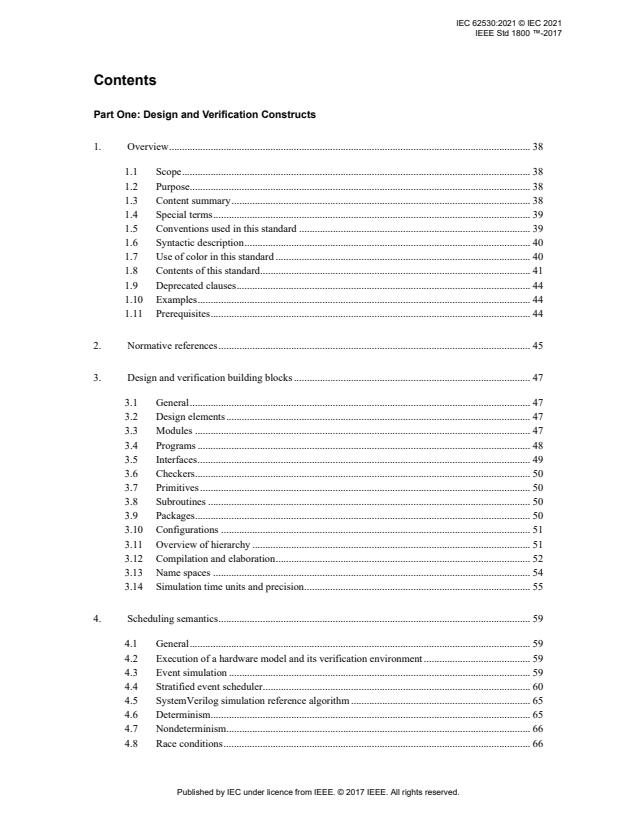
Contents
Part One: Design and Verification Constructs
1. Overview. 38
1.1 Scope. 38
1.2 Purpose. 38
1.3 Content summary. 38
1.4 Special terms. 39
1.5 Conventions used in this standard . 39
1.6 Syntactic description. 40
1.7 Use of color in this standard . 40
1.8 Contents of this standard. 41
1.9 Deprecated clauses. 44
1.10 Examples. 44
1.11 Prerequisites. 44
2. Normative references. 45
3. Design and verification building blocks . 47
3.1 General. 47
3.2 Design elements. 47
3.3 Modules . 47
3.4 Programs . 48
3.5 Interfaces. 49
3.6 Checkers. 50
3.7 Primitives . 50
3.8 Subroutines . 50
3.9 Packages. 50
3.10 Configurations . 51
3.11 Overview of hierarchy . 51
3.12 Compilation and elaboration. 52
3.13 Name spaces . 54
3.14 Simulation time units and precision. 55
4. Scheduling semantics. 59
4.1 General. 59
4.2 Execution of a hardware model and its verification environment . 59
4.3 Event simulation . 59
4.4 Stratified event scheduler. 60
4.5 SystemVerilog simulation reference algorithm . 65
4.6 Determinism. 65
4.7 Nondeterminism. 66
4.8 Race conditions. 66
This is a copyrighted Published by IEC under licence IEEE Standard. For personal from IEEE. © 2017 IEEE. or standards development All rights reserved.use only.
IEEE Std 1800 ™-2017
4.9 Scheduling implication of assignments . 66
4.10 PLI callback control points . 68
5. Lexical conventions . 69
5.1 General. 69
5.2 Lexical tokens . 69
5.3 White space. 69
5.4 Comments . 69
5.5 Operators. 69
5.6 Identifiers, keywords, and system names . 70
5.7 Numbers. 71
5.8 Time literals . 76
5.9 String literals. 76
5.10 Structure literals. 78
5.11 Array literals . 79
5.12 Attributes . 79
5.13 Built-in methods . 81
6. Data types . 83
6.1 General. 83
6.2 Data types and data objects. 83
6.3 Value set . 83
6.4 Singular and aggregate types . 84
6.5 Nets and variables. 85
6.6 Net types . 86
6.7 Net declarations . 97
6.8 Variable declarations . 100
6.9 Vector declarations . 102
6.10 Implicit declarations . 103
6.11 Integer data types . 104
6.12 Real, shortreal, and realtime data types . 105
6.13 Void data type. 105
6.14 Chandle data type. 105
6.15 Class. 106
6.16 String data type . 106
6.17 Event data type. 112
6.18 User-defined types . 112
6.19 Enumerations . 114
6.20 Constants. 119
6.21 Scope and lifetime . 126
6.22 Type compatibility. 128
6.23 Type operator. 131
6.24 Casting . 132
6.25 Parameterized data types . 137
This is a copyrighted Published by IEC under licence IEEE Standard. For personal from IEEE. © 2017 IEEE. or standards development All rights reserved.use only.
IEEE Std 1800 ™-2017
7. Aggregate data types. 139
7.1 General. 139
7.2 Structures . 139
7.3 Unions. 141
7.4 Packed and unpacked arrays . 145
7.5 Dynamic arrays . 149
7.6 Array assignments. 152
7.7 Arrays as arguments to subroutines . 153
7.8 Associative arrays . 155
7.9 Associative array methods .157
7.10 Queues . 161
7.11 Array querying functions . 165
7.12 Array manipulation methods . 165
8. Classes . 170
8.1 General. 170
8.2 Overview. 170
8.3 Syntax . 171
8.4 Objects (class instance). 172
8.5 Object properties and object parameter data. 173
8.6 Object methods . 174
8.7 Constructors . 174
8.8 Typed constructor calls. 176
8.9 Static class properties. 177
8.10 Static methods. 177
8.11 This . 177
8.12 Assignment, renaming, and copying. 178
8.13 Inheritance and subclasses . 180
8.14 Overridden members. 180
8.15 Super . 181
8.16 Casting . 182
8.17 Chaining constructors . 182
8.18 Data hiding and encapsulation. 183
8.19 Constant class properties . 184
8.20 Virtual methods. 184
8.21 Abstract classes and pure virtual methods. 186
8.22 Polymorphism: dynamic method lookup. 187
8.23 Class scope resolution operator :: . 187
8.24 Out-of-block declarations . 189
8.25 Parameterized classes . 191
8.26 Interface classes . 194
8.27 Typedef class . 203
8.28 Classes and structures . 203
8.29 Memory management .204
This is a copyrighted Published by IEC under licence IEEE Standard. For personal from IEEE. © 2017 IEEE. or standards development All rights reserved.use only.
IEEE Std 1800 ™-2017
9. Processes. 205
9.1 General. 205
9.2 Structured procedures . 205
9.3 Block statements . 209
9.4 Procedural timing controls. 215
9.5 Process execution threads . 224
9.6 Process control. 225
9.7 Fine-grain process control . 229
10. Assignment statements . 232
10.1 General. 232
10.2 Overview. 232
10.3 Continuous assignments . 233
10.4 Procedural assignments. 236
10.5 Variable declaration assignment (variable initialization) . 241
10.6 Procedural continuous assignments . 241
10.7 Assignment extension and truncation . 243
10.8 Assignment-like contexts. 244
10.9 Assignment patterns. 245
10.10 Unpacked array concatenation. 249
10.11 Net aliasing . 252
11. Operators and expressions . 254
11.1 General. 254
11.2 Overview. 254
11.3 Operators. 255
11.4 Operator descriptions. 259
11.5 Operands . 279
11.6 Expression bit lengths. 282
11.7 Signed expressions. 285
11.8 Expression evaluation rules . 286
11.9 Tagged union expressions and member access. 287
11.10 String literal expressions. 288
11.11 Minimum, typical, and maximum delay expressions . 290
11.12 Let construct . 291
12. Procedural programming statements . 298
12.1 General. 298
12.2 Overview. 298
12.3 Syntax . 298
12.4 Conditional if–else statement. 299
12.5 Case statement . 304
12.6 Pattern matching conditional statements . 309
12.7 Loop statements . 313
12.8 Jump statements. 317
This is a copyrighted Published by IEC under licence IEEE Standard. For personal from IEEE. © 2017 IEEE. or standards development All rights reserved.use only.
IEEE Std 1800 ™-2017
13. Tasks and functions (subroutines) . 319
13.1 General. 319
13.2 Overview. 319
13.3 Tasks . 319
13.4 Functions. 323
13.5 Subroutine calls and argument passing. 329
13.6 Import and export functions. 334
13.7 Task and function names . 334
13.8 Parameterized tasks and functions. 334
14. Clocking blocks . 336
14.1 General. 336
14.2 Overview. 336
14.3 Clocking block declaration . 336
14.4 Input and output skews . 338
14.5 Hierarchical expressions . 339
14.6 Signals in multiple clocking blocks . 340
14.7 Clocking block scope and lifetime. 340
14.8 Multiple clocking blocks example. 340
14.9 Interfaces and clocking blocks.341
14.10 Clocking block events. 342
14.11 Cycle delay: ## . 342
14.12 Default clocking. 343
14.13 Input sampling . 344
14.14 Global clocking. 345
14.15 Synchronous events . 349
14.16 Synchronous drives. 349
15. Interprocess synchronization and communication. 354
15.1 General. 354
15.2 Overview. 354
15.3 Semaphores. 354
15.4 Mailboxes. 356
15.5 Named events. 359
16. Assertions. 364
16.1 General. 364
16.2 Overview. 364
16.3 Immediate assertions. 364
16.4 Deferred assertions . 367
16.5 Concurrent assertions overview. 374
16.6 Boolean expressions . 377
16.7 Sequences. 378
16.8 Declaring sequences . 382
16.9 Sequence operations . 390
This is a copyrighted Published by IEC under licence IEEE Standard. For personal from IEEE. © 2017 IEEE. or standards development All rights reserved.use only.
IEEE Std 1800 ™-2017
16.10 Local variables. 413
16.11 Calling subroutines on match of a sequence. 419
16.12 Declaring properties. 420
16.13 Multiclock support. 446
16.14 Concurrent assertions. 456
16.15 Disable iff resolution . 473
16.16 Clock resolution. 475
16.17 Expect statement . 481
16.18 Clocking blocks and concurrent assertions. 482
17. Checkers. 484
17.1 Overview. 484
17.2 Checker declaration . 484
17.3 Checker instantiation . 487
17.4 Context inference. 490
17.5 Checker procedures. 491
17.6 Covergroups in checkers. 493
17.7 Checker variables. 494
17.8 Functions in checkers. 500
17.9 Complex checker example. 501
18. Constrained random value generation . 503
18.1 General. 503
18.2 Overview. 503
18.3 Concepts and usage. 503
18.4 Random variables . 506
18.5 Constraint blocks . 509
18.6 Randomization methods .528
18.7 In-line constraints—randomize() with. 530
18.8 Disabling random variables with rand_mode() . 532
18.9 Controlling constraints with constraint_mode() . 534
18.10 Dynamic constraint modification. 535
18.11 In-line random variable control .535
18.12 Randomization of scope variables—std::randomize(). 536
18.13 Random number system functions and methods . 538
18.14 Random stability . 540
18.15 Manually seeding randomize . 542
18.16 Random weighted case—randcase . 543
18.17 Random sequence generation—randsequence. 544
19. Functional coverage. 553
19.1 General. 553
19.2 Overview. 553
19.3 Defining the coverage model: covergroup. 554
19.4 Using covergroup in classes .556
19.5 Defining coverage points . 558
This is a copyrighted Published by IEC under licence IEEE Standard. For personal from IEEE. © 2017 IEEE. or standards development All rights reserved.use only.
IEEE Std 1800 ™-2017
19.6 Defining cross coverage. 569
19.7 Specifying coverage options.578
19.8 Predefined coverage methods . 582
19.9 Predefined coverage system tasks and system functions. 585
19.10 Organization of option and type_option members . 585
19.11 Coverage computation . 586
20. Utility system tasks and system functions . 591
20.1 General. 591
20.2 Simulation control system tasks . 592
20.3 Simulation time system functions. 592
20.4 Timescale system tasks. 594
20.5 Conversion functions . 597
20.6 Data query functions. 598
20.7 Array query functions . 600
20.8 Math functions . 603
20.9 Bit vector system functions. 604
20.10 Severity tasks . 605
20.11 Elaboration system tasks. 606
20.12 Assertion control system tasks. 608
20.13 Sampled value system functions. 614
20.14 Coverage system functions . 615
20.15 Probabilistic distribution functions.615
20.16 Stochastic analysis tasks and functions . 617
20.17 Programmable logic array modeling system tasks . 619
20.18 Miscellaneous tasks and functions. 623
21. Input/output system tasks and system functions.624
21.1 General. 624
21.2 Display system tasks. 624
21.3 File input/output system tasks and system functions. 635
21.4 Loading memory array data from a file . 645
21.5 Writing memory array data to a file. 649
21.6 Command line input. 650
21.7 Value change dump (VCD) files . 653
22. Compiler directives. 674
22.1 General. 674
22.2 Overview . 67
...
Questions, Comments and Discussion
Ask us and Technical Secretary will try to provide an answer. You can facilitate discussion about the standard in here.
Loading comments...