


IEC 60034-18-41:2014/AMD1:2019
(Amendment)Amendment 1 - Rotating electrical machines - Part 18-41: Partial discharge free electrical insulation systems (Type I) used in electrical rotating machines fed from voltage converters - Qualification and quality control tests
Amendment 1 - Rotating electrical machines - Part 18-41: Partial discharge free electrical insulation systems (Type I) used in electrical rotating machines fed from voltage converters - Qualification and quality control tests
The contents of the corrigendum of December 2020 have been included in this copy.
Amendement 1 - Machines électriques tournantes - Partie 18-41: Systèmes d’isolation électrique sans décharge partielle (Type I) utilisés dans des machines électriques tournantes alimentées par des convertisseurs de tension - Essais de qualification et de contrôle qualité
Le contenu du corrigendum de décembre 2020 a été pris en considération dans cet exemplaire.
General Information
- Status
- Published
- Publication Date
- 24-Jun-2019
- Technical Committee
- TC 2 - Rotating machinery
- Drafting Committee
- MT 10 - TC 2/MT 10
- Current Stage
- PPUB - Publication issued
- Start Date
- 25-Jun-2019
- Completion Date
- 31-May-2019
Relations
- Effective Date
- 05-Sep-2023
- Effective Date
- 05-Sep-2023
Overview
IEC 60034-18-41:2014/AMD1:2019 is an amendment to the international standard that addresses partial discharge free electrical insulation systems (Type I) used in rotating electrical machines fed from voltage converters. Developed by the International Electrotechnical Commission (IEC) Technical Committee 2 on rotating machinery, this amendment provides updated qualification and quality control tests to ensure reliable operation of insulation systems under converter-fed conditions.
This document incorporates the December 2020 corrigendum and refines requirements related to test voltages, insulation classes, routine testing procedures, and environmental factors impacting partial discharge (PD) behavior. It reflects the latest industry consensus on insulation system performance to enhance the durability and safety of electric motors and generators used with modern power electronics.
Key Topics
Impulse Voltage Insulation Class (IVIC): Defines peak-to-peak voltage classes (A, B, C, D, S) for Type I insulation systems, assigned based on the machine’s rated voltage and converter feed. The IVIC guides the allowable terminal voltages and test voltages to ensure reliable insulation performance under converter-induced stress.
Partial Discharge (PD) Testing: Emphasizes the importance of routine PD tests during manufacturing. PD detection helps identify early insulation defects to prevent premature failure. The amendment recommends agreement between manufacturer and customer on PD test protocols and documentation.
Routine Withstand Voltage Tests: Sets mandatory minimum withstand voltage tests for all machines, with increased voltage levels for converter-fed machines according to their IVIC rating. Includes updated test voltage factors (TVF) and examples for 500 V rated machines, facilitating consistent quality control.
Environmental Factors Impacting PD Inception: Recognizes the effects of relative humidity and altitude (air density) on PD inception voltage (PDIV). Suggests applying enhancement factors during testing to account for real-world operating conditions and ensure insulation reliability.
New Terminology and Classifications: Introduces definitions for maximum allowable terminal voltage (UIVIC) and test voltage factor (TVF), clarifying voltage stress limits and testing parameters for converter-fed rotating machines.
Applications
IEC 60034-18-41:2014/AMD1:2019 is essential for:
Manufacturers of rotating electrical machines such as motors and generators designed for variable frequency drive (VFD) or voltage converter supply systems.
Quality control engineers involved in routine testing and acceptance of converter-fed machines, ensuring insulation integrity and compliance with IEC standards.
Design engineers developing electrical insulation systems that must withstand the increased electrical stresses imposed by modern power electronics.
Maintenance and testing professionals aiming to detect partial discharges early during production or in-service inspections to maximize machine lifespan.
Users and specifiers of rotating electrical machines seeking assurance of performance and reliability of insulation systems under converter-fed voltage conditions.
Related Standards
IEC 60034-1: Rotating electrical machines - Part 1: Rating and performance - Provides baseline test voltages and performance criteria for rotating machines, referenced for routine withstand voltage testing.
IEC 60034 series: General standards for rotating electrical machines, covering various insulation types, testing methods, and machine performance.
Electropedia and IEC Glossary: Authoritative sources for electrotechnical terminology aligning with terms defined in this amendment, supporting standard consistent usage.
Practical Benefits
Enhanced Insulation Reliability: By formalizing PD-free insulation system requirements and associated testing, the amendment supports machines that are more durable and robust against converter-induced electrical stress.
Improved Testing Consistency: Clear procedures for routine PD and withstand voltage tests with defined voltage classes and enhancement factors promote uniform quality control.
Adaptation to Modern Drives: Addresses the unique voltage stresses from power converters rather than traditional line-fed machines, enabling safer and optimized machine designs.
Environmental Adaptability: Incorporation of humidity and altitude effects in testing ensures machines operate reliably in diverse on-site environments worldwide.
IEC 60034-18-41:2014/AMD1:2019 is a critical resource for advancing the quality, safety, and performance of insulation systems in modern rotating electrical machines, particularly those integrated with variable-speed drives and converter technologies.
IEC 60034-18-41:2014/AMD1:2019 - Amendment 1 - Rotating electrical machines - Part 18-41: Partial discharge free electrical insulation systems (Type I) used in electrical rotating machines fed from voltage converters - Qualification and quality control tests
Frequently Asked Questions
IEC 60034-18-41:2014/AMD1:2019 is a standard published by the International Electrotechnical Commission (IEC). Its full title is "Amendment 1 - Rotating electrical machines - Part 18-41: Partial discharge free electrical insulation systems (Type I) used in electrical rotating machines fed from voltage converters - Qualification and quality control tests". This standard covers: The contents of the corrigendum of December 2020 have been included in this copy.
The contents of the corrigendum of December 2020 have been included in this copy.
IEC 60034-18-41:2014/AMD1:2019 is classified under the following ICS (International Classification for Standards) categories: 29.160.01 - Rotating machinery in general. The ICS classification helps identify the subject area and facilitates finding related standards.
IEC 60034-18-41:2014/AMD1:2019 has the following relationships with other standards: It is inter standard links to IEC 60034-18-41:2014, IEC 60034-18-41:2014/AMD1:2019/COR1:2020. Understanding these relationships helps ensure you are using the most current and applicable version of the standard.
You can purchase IEC 60034-18-41:2014/AMD1:2019 directly from iTeh Standards. The document is available in PDF format and is delivered instantly after payment. Add the standard to your cart and complete the secure checkout process. iTeh Standards is an authorized distributor of IEC standards.
Standards Content (Sample)
IEC 60034-18-41 ®
Edition 1.0 2019-06
INTERNATIONAL
STANDARD
NORME
INTERNATIONALE
A MENDMENT 1
AM ENDEMENT 1
Rotating electrical machines –
Part 18-41: Partial discharge free electrical insulation systems (Type I) used in
rotating electrical machines fed from voltage converters – Qualification and
quality control tests
Machines électriques tournantes –
Partie 18-41: Systèmes d’isolation électrique sans décharge partielle (Type I)
utilisés dans des machines électriques tournantes alimentées par des
convertisseurs de tension – Essais de qualification et de contrôle qualité
IEC 60034-18-41:2014-03/AMD1:2019-06(en-fr)
All rights reserved. Unless otherwise specified, no part of this publication may be reproduced or utilized in any form
or by any means, electronic or mechanical, including photocopying and microfilm, without permission in writing from
either IEC or IEC's member National Committee in the country of the requester. If you have any questions about IEC
copyright or have an enquiry about obtaining additional rights to this publication, please contact the address below or
your local IEC member National Committee for further information.
Droits de reproduction réservés. Sauf indication contraire, aucune partie de cette publication ne peut être reproduite
ni utilisée sous quelque forme que ce soit et par aucun procédé, électronique ou mécanique, y compris la photocopie
et les microfilms, sans l'accord écrit de l'IEC ou du Comité national de l'IEC du pays du demandeur. Si vous avez des
questions sur le copyright de l'IEC ou si vous désirez obtenir des droits supplémentaires sur cette publication, utilisez
les coordonnées ci-après ou contactez le Comité national de l'IEC de votre pays de résidence.
IEC Central Office Tel.: +41 22 919 02 11
3, rue de Varembé info@iec.ch
CH-1211 Geneva 20 www.iec.ch
Switzerland
About the IEC
The International Electrotechnical Commission (IEC) is the leading global organization that prepares and publishes
International Standards for all electrical, electronic and related technologies.
About IEC publications
The technical content of IEC publications is kept under constant review by the IEC. Please make sure that you have the
latest edition, a corrigendum or an amendment might have been published.
IEC publications search - webstore.iec.ch/advsearchform Electropedia - www.electropedia.org
The advanced search enables to find IEC publications by a The world's leading online dictionary on electrotechnology,
variety of criteria (reference number, text, technical containing more than 22 000 terminological entries in English
committee,…). It also gives information on projects, replaced and French, with equivalent terms in 16 additional languages.
and withdrawn publications. Also known as the International Electrotechnical Vocabulary
(IEV) online.
IEC Just Published - webstore.iec.ch/justpublished
Stay up to date on all new IEC publications. Just Published IEC Glossary - std.iec.ch/glossary
details all new publications released. Available online and 67 000 electrotechnical terminology entries in English and
once a month by email. French extracted from the Terms and Definitions clause of
IEC publications issued since 2002. Some entries have been
IEC Customer Service Centre - webstore.iec.ch/csc collected from earlier publications of IEC TC 37, 77, 86 and
If you wish to give us your feedback on this publication or CISPR.
need further assistance, please contact the Customer Service
Centre: sales@iec.ch.
A propos de l'IEC
La Commission Electrotechnique Internationale (IEC) est la première organisation mondiale qui élabore et publie des
Normes internationales pour tout ce qui a trait à l'électricité, à l'électronique et aux technologies apparentées.
A propos des publications IEC
Le contenu technique des publications IEC est constamment revu. Veuillez vous assurer que vous possédez l’édition la
plus récente, un corrigendum ou amendement peut avoir été publié.
Recherche de publications IEC - Electropedia - www.electropedia.org
webstore.iec.ch/advsearchform Le premier dictionnaire d'électrotechnologie en ligne au
La recherche avancée permet de trouver des publications IEC monde, avec plus de 22 000 articles terminologiques en
en utilisant différents critères (numéro de référence, texte, anglais et en français, ainsi que les termes équivalents dans
comité d’études,…). Elle donne aussi des informations sur les 16 langues additionnelles. Egalement appelé Vocabulaire
projets et les publications remplacées ou retirées. Electrotechnique International (IEV) en ligne.
IEC Just Published - webstore.iec.ch/justpublished Glossaire IEC - std.iec.ch/glossary
Restez informé sur les nouvelles publications IEC. Just 67 000 entrées terminologiques électrotechniques, en anglais
Published détaille les nouvelles publications parues. et en français, extraites des articles Termes et Définitions des
Disponible en ligne et une fois par mois par email. publications IEC parues depuis 2002. Plus certaines entrées
antérieures extraites des publications des CE 37, 77, 86 et
Service Clients - webstore.iec.ch/csc CISPR de l'IEC.
Si vous désirez nous donner des commentaires sur cette
publication ou si vous avez des questions contactez-nous:
sales@iec.ch.
IEC 60034-18-41 ®
Edition 1.0 2019-06
INTERNATIONAL
STANDARD
NORME
INTERNATIONALE
A MENDMENT 1
AM ENDEMENT 1
Rotating electrical machines –
Part 18-41: Partial discharge free electrical insulation systems (Type I) used in
rotating electrical machines fed from voltage converters – Qualification and
quality control tests
Machines électriques tournantes –
Partie 18-41: Systèmes d’isolation électrique sans décharge partielle (Type I)
utilisés dans des machines électriques tournantes alimentées par des
convertisseurs de tension – Essais de qualification et de contrôle qualité
INTERNATIONAL
ELECTROTECHNICAL
COMMISSION
COMMISSION
ELECTROTECHNIQUE
INTERNATIONALE
ICS 29.160.01 ISBN 978-2-8322-6886-5
– 2 – IEC 60034-18-41:2014/AMD1:2019
© IEC 2019
FOREWORD
This amendment has been prepared by IEC Technical Committee 2: Rotating machinery.
The text of this amendment is based on the following documents:
FDIS Report on voting
2/1949/FDIS 2/1957/RVD
Full information on the voting for the approval of this amendment can be found in the report on
voting indicated in the above table.
The committee has decided that the contents of this amendment and the base publication will
remain unchanged until the stability date indicated on the IEC website under
"http://webstore.iec.ch" in the data related to the specific publication. At this date, the
publication will be
• reconfirmed,
• withdrawn,
• replaced by a revised edition, or
• amended.
_____________
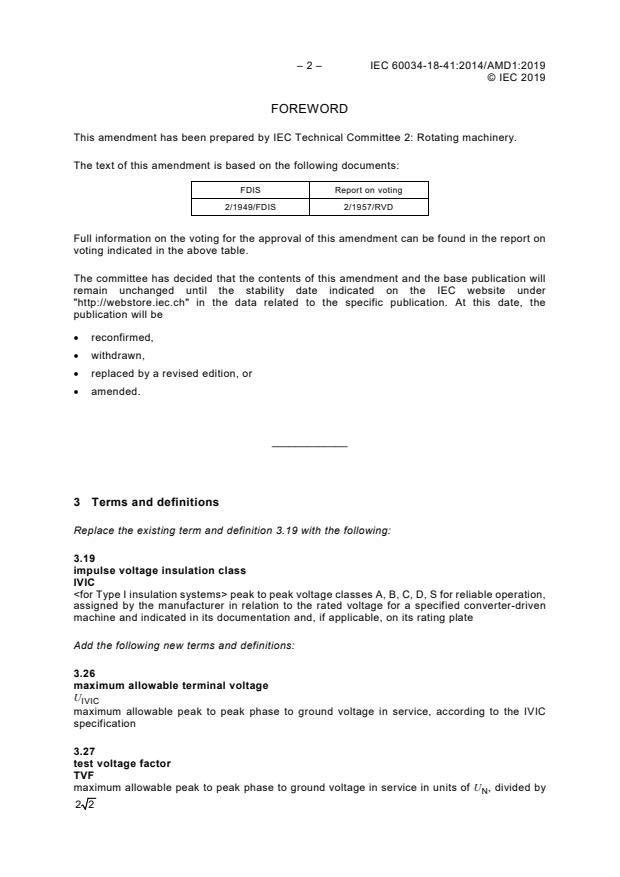
3 Terms and definitions
Replace the existing term and definition 3.19 with the following:
3.19
impulse voltage insulation class
IVIC
peak to peak voltage classes A, B, C, D, S for reliable operation,
assigned by the manufacturer in relation to the rated voltage for a specified converter-driven
machine and indicated in its documentation and, if applicable, on its rating plate
Add the following new terms and definitions:
3.26
maximum allowable terminal voltage
U
IVIC
maximum allowable peak to peak phase to ground voltage in service, according to the IVIC
specification
3.27
test voltage factor
TVF
maximum allowable peak to peak phase to ground voltage in service in units of U , divided by
N
© IEC 2019
12 Routine tests
Replace the existing text of this clause with the following:
12.1 Optional PD test
It is good practice to perform a routine test on each winding. For this purpose, it is recommended
that the PD tests described in 11.2 and 11.3 are performed in agreement between the
manufacturer and customer on each machine produced. The passing of this PD routine test,
that has been performed according to this document and to the IVIC specified, shall be entered
into the documentation for the machine, if required, or stored in the relevant database of the
manufacturer.
12.2 Routine withstand voltage test
A mandatory minimum withstand voltage test for all machines with or without IVIC is described
in IEC 60034-1. This withstand voltage test may be required at an increased voltage level for
converter-fed machines, according to the specified IVIC, as described in Annex D. The
derivation of test voltage factors (TVF) for the routine withstand voltage test of Type I converter-
fed rotating electrical machines and an example of routine withstand test voltages for a 500 V
rated rotating machine fed from a converter are given in Annex D.
The passing of this test with the withstand voltage level according to this document and to the
specified IVIC, shall be entered into the documentation for the machine, if required, or stored
in the relevant database of the manufacturer.
During the routine testing of quantity produced machines up to 200 kW (or kVA) and rated for
U ≤ 1 kV, the 1 min test may be replaced by a test of 1 s (see IEC 60034-1) at 120 % of the
N
test voltage specified in Table D.1, for example S – (manufacturer specified):
· U + 1 kV ) · 1,2.
(B/ 2
N
For very small sized machines or windings, produced in large quantity, for example with a rated
power of < 1 kW, a test level of 120 % for the 1s-withstand-test may be excessive in case of
IVIC C or D specified machines. In this case an IVIC-specified test level of 100 % can be used
instead, but at least to the test level defined in IEC 60034-1.
Annex B
B.3 Enhancement factors for PD tests
At the end of Clause B.3, after Table B.2, add the following new text:
It is known and well documented in the relevant literature, that relative humidity (environmental
on-site conditions) and density of air (altitude) may affect the PD inception voltage during testing
and in service to a similar extent as the temperature. Results reported in literature suggest, that
the relative and absolute humidity during test and in service will influence the actual
PDIV/RPDIV in both directions. For this reason, a further enhancement factor could be applied
to correct PDIV/RPDIV results.
The influence of the altitude on the RPDIV can become quite high, according to the strongly
reduced air-pressure resulting in reduced PDIV/RPDIV. Depending on the design of the
insulation system and the expected maximum altitude in service, this should be reflected by an
additional enhancement factor.
– 4 – IEC 60034-18-41:2014/AMD1:2019
© IEC 2019
B.6 Calculation of test voltages
Replace the first paragraph with the following:
As an example, the peak/peak PD-test voltages for phase/phase and phase/ground insulation
in a 500 V rated rotating machine fed from a 2-level converter are calculated as in Clause B.5
but without the additional factor of 1,1 (arising from line voltage variations) and multiplied by
the relevant total enhancement factor shown in Table B.2. This applies whether the test voltage
is sinewave or impulse. It is generally expected that the total enhancement factor will be 1,25.
The resulting test voltages for the example shown in Table B.4 are given in Table B.5.
Replace Table B.5 with the following:
Table B.5 – Examples of maximum peak/peak PD-test voltage
for a 500 V rated winding fed, e.g. from a 2-level converter, according
to the stress categories of Table 4 and with EF 1,25
Stress category Examples of maximum peak to
or impulse peak PD-test voltage
voltage insulation
Phase to Phase to
class (IVIC)
phase ground
V V
A (Benign) 1 857 1 300
B (Moderate) 2 532 1 773
C (Severe) 3 375 2 364
D (Extreme) 4 219 2 955
S (manufacturer To be decided To be decided
specified)
According to Clause C.2, an IVIC S may be assigned by the manufacturer which defines the
maximum allowable peak to peak voltages and the resulting PD test voltages.
C.1 Impulse voltage insulation class (IVIC) of the machine
Replace the third paragraph with the following:
The maximum allowable voltages assigned to the impulse insulation classes in Table C.1 have
been derived using Formulae (1) and (2) together with the arbitrarily chosen stress category
overshoot factors in Table 4. They are given in units of U (i.e. the voltages in Table B.4 divided
N
by 500) in order to have them independent from various rated machine voltages. While these
voltage limit steps have been derived from operating voltages experienced in service, they pose
arbitrary classes in nature. In many cases, intermediate steps for these voltage limits and
independency of the limits for phase-phase and phase-ground voltages may be required
(see Clause C.2).
© IEC 2019
Add the following new Annex D:
Annex D
(informative)
Derivation of routine withstand test voltages and
an example for a 500 V rated machine
Table D.1 shows the test voltage factors (TVF) for Type I converter-fed rotating machines, which
have been qualified with an IVIC classification, and the resulting routine withstand test voltages
for a 500 V rated machine as an example. The test v
...
Questions, Comments and Discussion
Ask us and Technical Secretary will try to provide an answer. You can facilitate discussion about the standard in here.
Loading comments...