

IEC TR 60977:2008
(Main)Medical electrical equipment - Medical electron accelerators - Guidelines for functional performance characteristics
General Information
- Abstract
IEC/TR 60977:2008 applies to medical electron accelerators when used, for therapy purposes, in human medical practice. This technical report applies to medical electron accelerators which deliver a radiation beam of either X-radiation or electron radiation with nominal energies in the range 1 MeV to 50 MeV at maximum absorbed dose rates between 0,001 Gy s-1 and 1 Gy s-1 at 1 m from the radiation source and at normal treatment distances between 50 cm and 200 cm from the radiation source. This second edition cancels and replaces the first edition published in 1989 and its Amendment 1 (2000). It constitutes a technical revision. This second edition likewise follows on the issue of a second edition to the disclosure standard IEC 60976 in 2007. It includes the addition of performance guidelines relating to several relatively new technologies introduced within the last few years, including dynamic beam delivery techniques, such as moving beam radiotherapy, intensity modulated radiation therapy (IMRT), image guided radiotherapy (IGRT), and programmable wedge fields (PWF). Also included are stereotactic radiotherapy (SRT)/stereotactic radiosurgery (SRS) and the use of certain electronic imaging devices (EIDs).
- Status
- Published
- Publication Date
- 08-Jul-2008
- Drafting Committee
- WG 1 - TC 62/SC 62C/WG 1
- Current Stage
- PPUB - Publication issued
- Start Date
- 09-Jul-2008
- Completion Date
- 31-Aug-2008
Overview
IEC TR 60977:2008 is an international technical report published by the International Electrotechnical Commission (IEC) that provides guidelines for the functional performance characteristics of medical electron accelerators. This standard specifically applies to medical electron accelerators used in human medical therapy delivering radiation beams of X-radiation or electron radiation, with nominal energies ranging from 1 MeV to 50 MeV. It covers equipment delivering absorbed dose rates between 0.001 Gy/s and 1 Gy/s at typical treatment distances from 50 cm to 200 cm.
This second edition updates and replaces the first edition (1989) and its amendment (2000) to reflect advances in radiotherapy technologies. It integrates new performance guidelines for dynamic beam delivery and modern techniques such as Intensity Modulated Radiation Therapy (IMRT), Image Guided Radiotherapy (IGRT), stereotactic radiosurgery (SRS), and programmable wedge fields (PWF) as well as the use of electronic imaging devices (EIDs).
Key Topics
- Functional Performance Values: Recommends precise functional performance values tailored to the needs of radiotherapy, building on the disclosure standard IEC 60976 to ensure reliability and clinical safety.
- Acceptance Testing: Provides guidance for conducting acceptance (commissioning) tests on medical electron accelerators at the users’ sites to confirm compliance with manufacturer-declared performance characteristics.
- Periodic Testing: Suggests standardized periodic tests throughout the machine’s operational lifetime to maintain performance quality and patient safety, including frequency recommendations.
- Dynamic and Advanced Beam Delivery Techniques: Includes guidelines for modern radiotherapy technologies such as:
- Moving beam radiotherapy
- IMRT (Intensity Modulated Radiation Therapy)
- IGRT (Image Guided Radiotherapy)
- Use of programmable wedge fields (PWF)
- Stereotactic Radiotherapy and Radiosurgery: Addresses performance criteria for stereotactic techniques used for precise and targeted treatments.
- Electronic Imaging Devices (EIDs): Discusses the incorporation and related performance requirements for electronic imaging used in conjunction with medical electron accelerators.
Applications
IEC TR 60977:2008 serves as an essential reference for stakeholders involved in the manufacture, acceptance, and operation of medical electron accelerators used in clinical settings. Its practical applications include:
- Manufacturers: Guidance on designing electron accelerators with appropriate functional performance characteristics that meet user needs and regulatory expectations.
- Medical Physicists and Hospital Technicians: Framework for acceptance testing and routine periodic checks to verify and maintain the therapeutic beam quality, ensuring safe and effective radiation therapy delivery.
- Regulatory Bodies and Standardization Committees: Reference to help harmonize safety and performance criteria internationally, improving quality assurance in radiotherapy.
- Healthcare Providers: Assurance of reliable operation and functionality of radiotherapy equipment to uphold patient safety and treatment efficacy in cancer care.
Related Standards
- IEC 60601-1: General safety standard for medical electrical equipment, ensuring baseline electrical safety requirements.
- IEC 60601-2-1: Particular safety requirements specific to medical electron accelerators, complementing IEC 60601-1.
- IEC 60976: Disclosure standard prescribing test methods and declaration formats for functional performance characteristics of medical electron accelerators.
- IEC 60977 (First Edition and Amendment 1): Earlier versions of the technical report, replaced by this updated edition reflecting technological progress and new radiotherapy modalities.
By following IEC TR 60977:2008, medical centers worldwide can ensure that their electron accelerator equipment meets internationally recognized guidelines, optimizing treatment performance and safety in therapeutic radiology. This standard remains a cornerstone reference for the evolving landscape of medical radiotherapy technology.
Relations
- Effective Date
- 05-Sep-2023
Get Certified
Connect with accredited certification bodies for this standard

BSI Group
BSI (British Standards Institution) is the business standards company that helps organizations make excellence a habit.

TÜV Rheinland
TÜV Rheinland is a leading international provider of technical services.

TÜV SÜD
TÜV SÜD is a trusted partner of choice for safety, security and sustainability solutions.
Sponsored listings
Frequently Asked Questions
IEC TR 60977:2008 is a technical report published by the International Electrotechnical Commission (IEC). Its full title is "Medical electrical equipment - Medical electron accelerators - Guidelines for functional performance characteristics". This standard covers: IEC/TR 60977:2008 applies to medical electron accelerators when used, for therapy purposes, in human medical practice. This technical report applies to medical electron accelerators which deliver a radiation beam of either X-radiation or electron radiation with nominal energies in the range 1 MeV to 50 MeV at maximum absorbed dose rates between 0,001 Gy s-1 and 1 Gy s-1 at 1 m from the radiation source and at normal treatment distances between 50 cm and 200 cm from the radiation source. This second edition cancels and replaces the first edition published in 1989 and its Amendment 1 (2000). It constitutes a technical revision. This second edition likewise follows on the issue of a second edition to the disclosure standard IEC 60976 in 2007. It includes the addition of performance guidelines relating to several relatively new technologies introduced within the last few years, including dynamic beam delivery techniques, such as moving beam radiotherapy, intensity modulated radiation therapy (IMRT), image guided radiotherapy (IGRT), and programmable wedge fields (PWF). Also included are stereotactic radiotherapy (SRT)/stereotactic radiosurgery (SRS) and the use of certain electronic imaging devices (EIDs).
IEC/TR 60977:2008 applies to medical electron accelerators when used, for therapy purposes, in human medical practice. This technical report applies to medical electron accelerators which deliver a radiation beam of either X-radiation or electron radiation with nominal energies in the range 1 MeV to 50 MeV at maximum absorbed dose rates between 0,001 Gy s-1 and 1 Gy s-1 at 1 m from the radiation source and at normal treatment distances between 50 cm and 200 cm from the radiation source. This second edition cancels and replaces the first edition published in 1989 and its Amendment 1 (2000). It constitutes a technical revision. This second edition likewise follows on the issue of a second edition to the disclosure standard IEC 60976 in 2007. It includes the addition of performance guidelines relating to several relatively new technologies introduced within the last few years, including dynamic beam delivery techniques, such as moving beam radiotherapy, intensity modulated radiation therapy (IMRT), image guided radiotherapy (IGRT), and programmable wedge fields (PWF). Also included are stereotactic radiotherapy (SRT)/stereotactic radiosurgery (SRS) and the use of certain electronic imaging devices (EIDs).
IEC TR 60977:2008 is classified under the following ICS (International Classification for Standards) categories: 11.040.50 - Radiographic equipment. The ICS classification helps identify the subject area and facilitates finding related standards.
IEC TR 60977:2008 has the following relationships with other standards: It is inter standard links to IEC TR 60977:1989/AMD1:2000. Understanding these relationships helps ensure you are using the most current and applicable version of the standard.
IEC TR 60977:2008 is available in PDF format for immediate download after purchase. The document can be added to your cart and obtained through the secure checkout process. Digital delivery ensures instant access to the complete standard document.
Standards Content (Sample)
IEC/TR 60977
Edition 2.0 2008-07
TECHNICAL
REPORT
RAPPORT
TECHNIQUE
Medical electrical equipment – Medical electron accelerators – Guidelines for
functional performance characteristics
Appareils électromédicaux – Accélérateurs médicaux d’électrons – Lignes
directrices pour les caractéristiques des performances fonctionnelles
IEC/TR 60977:2008
All rights reserved. Unless otherwise specified, no part of this publication may be reproduced or utilized in any form or by
any means, electronic or mechanical, including photocopying and microfilm, without permission in writing from either IEC or
IEC's member National Committee in the country of the requester.
If you have any questions about IEC copyright or have an enquiry about obtaining additional rights to this publication,
please contact the address below or your local IEC member National Committee for further information.
Droits de reproduction réservés. Sauf indication contraire, aucune partie de cette publication ne peut être reproduite
ni utilisée sous quelque forme que ce soit et par aucun procédé, électronique ou mécanique, y compris la photocopie
et les microfilms, sans l'accord écrit de la CEI ou du Comité national de la CEI du pays du demandeur.
Si vous avez des questions sur le copyright de la CEI ou si vous désirez obtenir des droits supplémentaires sur cette
publication, utilisez les coordonnées ci-après ou contactez le Comité national de la CEI de votre pays de résidence.
IEC Central Office
3, rue de Varembé
CH-1211 Geneva 20
Switzerland
Email: inmail@iec.ch
Web: www.iec.ch
About the IEC
The International Electrotechnical Commission (IEC) is the leading global organization that prepares and publishes
International Standards for all electrical, electronic and related technologies.
About IEC publications
The technical content of IEC publications is kept under constant review by the IEC. Please make sure that you have the
latest edition, a corrigenda or an amendment might have been published.
ƒ Catalogue of IEC publications: www.iec.ch/searchpub
The IEC on-line Catalogue enables you to search by a variety of criteria (reference number, text, technical committee,…).
It also gives information on projects, withdrawn and replaced publications.
ƒ IEC Just Published: www.iec.ch/online_news/justpub
Stay up to date on all new IEC publications. Just Published details twice a month all new publications released. Available
on-line and also by email.
ƒ Electropedia: www.electropedia.org
The world's leading online dictionary of electronic and electrical terms containing more than 20 000 terms and definitions
in English and French, with equivalent terms in additional languages. Also known as the International Electrotechnical
Vocabulary online.
ƒ Customer Service Centre: www.iec.ch/webstore/custserv
If you wish to give us your feedback on this publication or need further assistance, please visit the Customer Service
Centre FAQ or contact us:
Email: csc@iec.ch
Tel.: +41 22 919 02 11
Fax: +41 22 919 03 00
A propos de la CEI
La Commission Electrotechnique Internationale (CEI) est la première organisation mondiale qui élabore et publie des
normes internationales pour tout ce qui a trait à l'électricité, à l'électronique et aux technologies apparentées.
A propos des publications CEI
Le contenu technique des publications de la CEI est constamment revu. Veuillez vous assurer que vous possédez
l’édition la plus récente, un corrigendum ou amendement peut avoir été publié.
ƒ Catalogue des publications de la CEI: www.iec.ch/searchpub/cur_fut-f.htm
Le Catalogue en-ligne de la CEI vous permet d’effectuer des recherches en utilisant différents critères (numéro de référence,
texte, comité d’études,…). Il donne aussi des informations sur les projets et les publications retirées ou remplacées.
ƒ Just Published CEI: www.iec.ch/online_news/justpub
Restez informé sur les nouvelles publications de la CEI. Just Published détaille deux fois par mois les nouvelles
publications parues. Disponible en-ligne et aussi par email.
ƒ Electropedia: www.electropedia.org
Le premier dictionnaire en ligne au monde de termes électroniques et électriques. Il contient plus de 20 000 termes et
définitions en anglais et en français, ainsi que les termes équivalents dans les langues additionnelles. Egalement appelé
Vocabulaire Electrotechnique International en ligne.
ƒ Service Clients: www.iec.ch/webstore/custserv/custserv_entry-f.htm
Si vous désirez nous donner des commentaires sur cette publication ou si vous avez des questions, visitez le FAQ du
Service clients ou contactez-nous:
Email: csc@iec.ch
Tél.: +41 22 919 02 11
Fax: +41 22 919 03 00
IEC/TR 60977
Edition 2.0 2008-07
TECHNICAL
REPORT
RAPPORT
TECHNIQUE
Medical electrical equipment – Medical electron accelerators – Guidelines for
functional performance characteristics
Appareils électromédicaux – Accélérateurs médicaux d’électrons – Lignes
directrices pour les caractéristiques des performances fonctionnelles
INTERNATIONAL
ELECTROTECHNICAL
COMMISSION
COMMISSION
ELECTROTECHNIQUE
PRICE CODE
INTERNATIONALE
XB
CODE PRIX
ICS 11.040.50 ISBN 2-8318-9893-5
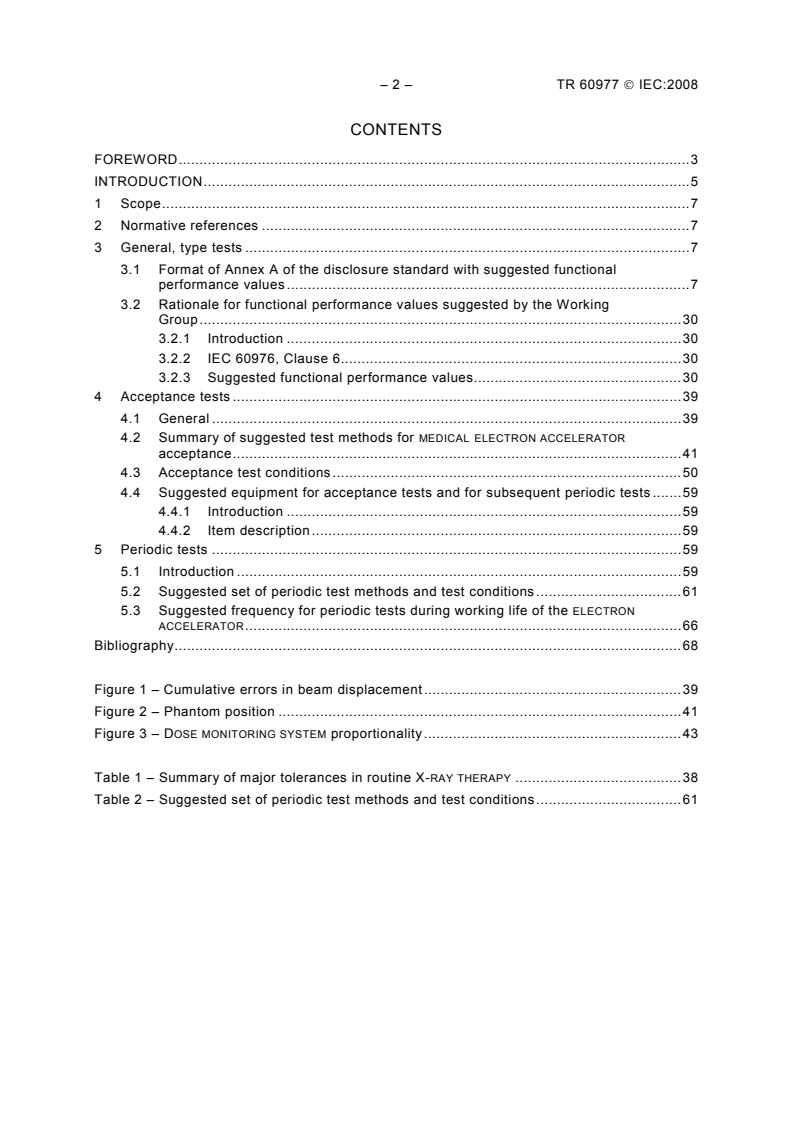
– 2 – TR 60977 © IEC:2008
CONTENTS
FOREWORD.3
INTRODUCTION.5
1 Scope.7
2 Normative references .7
3 General, type tests .7
3.1 Format of Annex A of the disclosure standard with suggested functional
performance values.7
3.2 Rationale for functional performance values suggested by the Working
Group.30
3.2.1 Introduction .30
3.2.2 IEC 60976, Clause 6.30
3.2.3 Suggested functional performance values.30
4 Acceptance tests .39
4.1 General .39
4.2 Summary of suggested test methods for MEDICAL ELECTRON ACCELERATOR
acceptance.41
4.3 Acceptance test conditions.50
4.4 Suggested equipment for acceptance tests and for subsequent periodic tests .59
4.4.1 Introduction .59
4.4.2 Item description.59
5 Periodic tests .59
5.1 Introduction .59
5.2 Suggested set of periodic test methods and test conditions.61
5.3 Suggested frequency for periodic tests during working life of the ELECTRON
ACCELERATOR.66
Bibliography.68
Figure 1 – Cumulative errors in beam displacement.39
Figure 2 – Phantom position .41
Figure 3 – DOSE MONITORING SYSTEM proportionality.43
Table 1 – Summary of major tolerances in routine X-RAY THERAPY .38
Table 2 – Suggested set of periodic test methods and test conditions.61
TR 60977 © IEC:2008 – 3 –
INTERNATIONAL ELECTROTECHNICAL COMMISSION
____________
MEDICAL ELECTRICAL EQUIPMENT –
MEDICAL ELECTRON ACCELERATORS –
GUIDELINES FOR FUNCTIONAL PERFORMANCE
CHARACTERISTICS
FOREWORD
1) The International Electrotechnical Commission (IEC) is a worldwide organization for standardization comprising
all national electrotechnical committees (IEC National Committees). The object of IEC is to promote
international co-operation on all questions concerning standardization in the electrical and electronic fields. To
this end and in addition to other activities, IEC publishes International Standards, Technical Specifications,
Technical Reports, Publicly Available Specifications (PAS) and Guides (hereafter referred to as “IEC
Publication(s)”). Their preparation is entrusted to technical committees; any IEC National Committee interested
in the subject dealt with may participate in this preparatory work. International, governmental and non-
governmental organizations liaising with the IEC also participate in this preparation. IEC collaborates closely
with the International Organization for Standardization (ISO) in accordance with conditions determined by
agreement between the two organizations.
2) The formal decisions or agreements of IEC on technical matters express, as nearly as possible, an international
consensus of opinion on the relevant subjects since each technical committee has representation from all
interested IEC National Committees.
3) IEC Publications have the form of recommendations for international use and are accepted by IEC National
Committees in that sense. While all reasonable efforts are made to ensure that the technical content of IEC
Publications is accurate, IEC cannot be held responsible for the way in which they are used or for any
misinterpretation by any end user.
4) In order to promote international uniformity, IEC National Committees undertake to apply IEC Publications
transparently to the maximum extent possible in their national and regional publications. Any divergence
between any IEC Publication and the corresponding national or regional publication shall be clearly indicated in
the latter.
5) IEC provides no marking procedure to indicate its approval and cannot be rendered responsible for any
equipment declared to be in conformity with an IEC Publication.
6) All users should ensure that they have the latest edition of this publication.
7) No liability shall attach to IEC or its directors, employees, servants or agents including individual experts and
members of its technical committees and IEC National Committees for any personal injury, property damage or
other damage of any nature whatsoever, whether direct or indirect, or for costs (including legal fees) and
expenses arising out of the publication, use of, or reliance upon, this IEC Publication or any other IEC
Publications.
8) Attention is drawn to the Normative references cited in this publication. Use of the referenced publications is
indispensable for the correct application of this publication.
9) Attention is drawn to the possibility that some of the elements of this IEC Publication may be the subject of
patent rights. IEC shall not be held responsible for identifying any or all such patent rights.
The main task of IEC technical committees is to prepare International Standards. However, a
technical committee may propose the publication of a technical report when it has collected
data of a different kind from that which is normally published as an International Standard, for
example "state of the art".
IEC 60977, which is a technical report, has been prepared by subcommittee 62C: Equipment
for radiotherapy, nuclear medicine and radiation dosimetry, of IEC technical committee 62:
Electrical equipment in medical practice.
This second edition cancels and replaces the first edition published in 1989 and its
Amendment 1 (2000). It constitutes a technical revision.
This second edition likewise follows on the issue of a second edition to the disclosure
standard IEC 60976 in 2007. It includes the addition of performance guidelines relating to
several relatively new technologies introduced within the last few years, including dynamic
beam delivery techniques, such as moving beam radiotherapy, INTENSITY MODULATED
RADIATION THERAPY (IMRT), IMAGE GUIDED RADIOTHERAPY (IGRT), and PROGRAMMABLE WEDGE
– 4 – TR 60977 © IEC:2008
FIELDS (PWF). Also included are STEREOTACTIC RADIOTHERAPY (SRT)/STEREOTACTIC
RADIOSURGERY (SRS) and the use of certain ELECTRONIC IMAGING DEVICES (EIDs).
The text of this technical report is based on the following documents:
Enquiry draft Report on voting
62C/424/DTR 62C/439/RVC
Full information on the voting for the approval of this technical report can be found in the
report on voting indicated in the above table.
This publication has been drafted in accordance with the ISO/IEC Directives, Part 2.
The committee has decided that the contents of this publication will remain unchanged until
the maintenance result date indicated on the IEC web site under "http://webstore.iec.ch" in
the data related to the specific publication. At this date, the publication will be
• reconfirmed,
• withdrawn,
• replaced by a revised edition, or
• amended.
TR 60977 © IEC:2008 – 5 –
INTRODUCTION
The guidelines given in this report are recommendations both to manufacturers and to USERS.
They provide guidance to MANUFACTURERS on the needs of USERS in respect of the
performance of ELECTRON ACCELERATORS and they provide guidance to USERS wishing to
check the manufacturer's declared performance characteristics, to carry out acceptance tests
and to check periodically the performance throughout the life of the equipment.
1)
IEC 60601-1 is a general standard for the safety of medical electrical equipment. It is
supplemented by IEC 60601-2-1, a standard which lays down particular requirements for
MEDICAL ELECTRON ACCELERATORS in the range of 1 MeV to 50 MeV. In addition, IEC 60976
second edition has been issued as a disclosure standard. It standardizes methods of
declaring the MEDICAL ELECTRON ACCELERATOR functional performance characteristics. It
standardizes the type test conditions and type test methods to which manufacturers' declared
values of functional performance relate.
A format for the presentation of functional performance values is contained in IEC 60976. It is
repeated herein as 3.1, with the addition of a set of suggested values which reflects the need
for precision in RADIOTHERAPY and the knowledge of what is reliably achievable technically. A
corresponding rationale for the suggested values is presented in 3.2.
In order to check whether each individual machine at the time of installation performs in a
manner consistent with the set of functional performance values declared by the manufacturer
based upon his type test data, it is customary to perform a series of acceptance tests at the
USER's site before the machine is put into full medical use. Because of limitations of time and
test equipment, this series of acceptance tests is usually less extensive than the type tests
specified in the disclosure standard, IEC 60976.
Subclause 4.2 contains a summary of suggested test methods for machine acceptance. These
are consistent with the test methods of IEC 60976 but have been presented in a form which
may be more suitable for use in hospitals. For reasons of economy and time, the USER may
prefer to have a more limited but still standardized test performed at the time of installation of
the equipment.
Subclause 4.3 contains a set of suggested acceptance (commissioning) test conditions. It
should be emphasized that these test conditions are presented only as examples and that a
quite different set of test conditions may still be needed for the purpose of displaying the
functional performance characteristics of the individual machine.
During the working life of the MEDICAL ELECTRON ACCELERATOR, periodic tests are usually
conducted by the USER to check whether the functional performance of the machine is
satisfactory. Because the available machine time is limited, a highly abbreviated set of test
conditions is essential. Individual tests should not be repeated any more or less frequently
than can be justified by experience with the particular machine or machine type. A set of
suggested periodic test methods is presented in 5.2 and a list of suggested periodic tests
during the working life of the MEDICAL ELECTRON ACCELERATOR and suggested intervals
between such tests is presented in 5.3. The manufacturer may recommend different intervals
or additional or different tests, depending on the special requirements of the MEDICAL
ELECTRON ACCELERATOR in question.
Since the issue in 1989 of IEC 60977, a first amendment was published in 2000 to address
the introduction and increasing use of multi-element BEAM LIMITING DEVICES (multi-element
BLDs) for determining the shape of the RADIATION FIELD, with or without the use of back-up
BLDs. This publication followed from the issue of the corresponding amendment to the
disclosure standard itself, IEC 60976:1989, in 2000. The performance issues addressed in
these first amendments were mainly associated with the applications of multi-element BLDs to
___________
1)
See Bibliography.
– 6 – TR 60977 © IEC:2008
static RADIATION FIELDS. This second edition likewise follows on the issue of a second edition
to the disclosure standard IEC 60976 in 2007. It includes the addition of performance
guidelines relating to several relatively new technologies introduced within the last few years,
including dynamic beam delivery techniques, such as moving beam radiotherapy, INTENSITY
MODULATED RADIATION THERAPY (IMRT), IMAGE GUIDED RADIOTHERAPY (IGRT), and
PROGRAMMABLE WEDGE FIELDS (PWF). Also included are STEREOTACTIC RADIOTHERAPY
(SRT)/STEREOTACTIC RADIOSURGERY (SRS) and the use of certain ELECTRONIC IMAGING DEVICES
(EIDs).
In recognition of the diversity of equipment produced by manufacturers in each of these
technologies, this second edition, as with the first, has specified performance guidelines that
are as basic and generic as possible.
TR 60977 © IEC:2008 – 7 –
MEDICAL ELECTRICAL EQUIPMENT –
MEDICAL ELECTRON ACCELERATORS –
GUIDELINES FOR FUNCTIONAL PERFORMANCE
CHARACTERISTICS
1 Scope
This technical report applies to medical ELECTRON ACCELERATORS when used, for therapy
purposes, in human medical practice.
This technical report applies to medical ELECTRON ACCELERATORS which deliver a RADIATION
BEAM of either X-RADIATION or ELECTRON RADIATION with NOMINAL ENERGIES in the range 1 MeV
–1 –1
to 50 MeV at maximum ABSORBED DOSE RATES between 0,001 Gy s and 1 Gy s at 1 m from
the RADIATION SOURCE and at NORMAL TREATMENT DISTANCES between 50 cm and 200 cm from
the RADIATION SOURCE.
2 Normative references
The following referenced documents are indispensable for the application of this document.
For dated references, only the edition cited applies. For undated references, the latest edition
of the referenced document (including any amendments) applies.
IEC 60601-2-1:1998, Medical electrical equipment – Part 2-1: Particular requirements for the
safety of electron accelerators in the range 1 MeV to 50 MeV
Amendment 1 (2002)
IEC 60976:2007, Medical electrical equipment – Medical electron accelerators – Functional
performance characteristics
3 General, type tests
3.1 Format of Annex A of the disclosure standard with suggested functional
performance values
The purpose of this subclause is to provide a suggested format for the presentation of
functional performance values corresponding to the standardized statements of functional
performance in the disclosure standard, IEC 60976:2007. USERS of MEDICAL ELECTRON
ACCELERATORS may find this format useful in getting information from the manufacturer on the
expected performance, in recording acceptance test values measured at the time of
installation and in periodic testing of performance during the working life of the machine.
Manufacturers may find it useful in declaring the functional performance values for their
particular types of MEDICAL ELECTRON ACCELERATORS in response to IEC 60976. Although the
manufacturer may use his own set of type test methods in developing functional performance
data, he should make sure that the functional performance values which he declares would be
met if the test methods of IEC 60976 were used. It is not suggested that a manufacturer
should provide information to USERS from his type test in any greater detail than a simple
declaration of these functional performance values.
As a result of extensive deliberations by Working Group 1 of IEC subcommittee 62C, a set of
suggested values of functional performance was agreed upon with respect to the standardized
statements of IEC 60976:2007. These suggested values are shown in parentheses for each
relevant clause. For Clauses 7 and 8, the suggested tolerance values are given only for
NOMINAL ENERGIES in the range from 3 MeV to 50 MeV, since this range covers most of the
practice with MEDICAL ELECTRON ACCELERATORS.
– 8 – TR 60977 © IEC:2008
Tolerances are designated "+/-" where they represent permissible deviations in more than one
direction from a desired point or value. The "+/-" designation is not used where the tolerance
represents permissible deviation in any one direction between two points or values. The
abbreviations "maxi" and "mini" are used for "maximum" and "minimum", respectively.
Where a functional performance value is required for a square RADIATION FIELD of specified
dimensions, and the equipment is unable to provide these dimensions, then the required
performance information may be provided for a square RADIATION FIELD nearest in size to that
prescribed.
TR 60977 IEC:2008 – 9 –
©
FORMAT FOR PRESENTATION OF FUNCTIONAL PERFORMANCES VALUES
Manufacturer ____________________________________________________________________________________________________________
MEDICAL ELECTRON ACCELERATOR type designation ______________________________________________________________________________
Date __________________________ Location ______________________________________________________________________________
Clause Abbreviation of statement in disclosure standard
5.2 Available NOMINAL ENERGIES and ABSORBED DOSE RATES
X-radiation mode*:
____ ____ ____ ____ ____ ____ ____ ____
NOMINAL ENERGY MV Gy/min, 10 cm × 10 cm RADIATION FIELD
____ ____ ____ ____ ____ ____ ____ ____
NOMINAL ENERGY MV Gy/min, 10 cm × 10 cm RADIATION FIELD
____ ____ ____ ____ ____ ____ ____ ____
NOMINAL ENERGY MV Gy/min, 10 cm × 10 cm RADIATION FIELD
____ ____ ____ ____ ____ ____ ____ ____
NOMINAL ENERGY MV Gy/min, maximum RADIATION FIELD
____ ____ ____ ____ ____ ____ ____ ____
NOMINAL ENERGY MV Gy/min, maximum RADIATION FIELD
____ ____ ____ ____ ____ ____ ____ ____
NOMINAL ENERGY MV Gy/min, maximum RADIATION FIELD
* Where SRT/SRS modes are available, the following information shall also be provided for the applicable NOMINAL ENERGIES and X-RADIATION FIELDS
– 10 – TR 60977 © IEC:2008
Clause Abbreviation of statement in disclosure standard Values declared (suggested)
ELECTRON RADIATION mode:
____ ____ ____ ____ ____ ____ ____ ____
NOMINAL ENERGY MeV Gy/min**
____ ____ ____ ____ ____ ____ ____ ____
NOMINAL ENERGY MeV Gy/min**
____ ____ ____ ____ ____ ____ ____ ____
NOMINAL ENERGY MeV Gy/min**
____ ____ ____ ____ ____ ____ ____ ____
NOMINAL ENERGY MeV Gy/min**
____ ____ ____ ____ ____ ____ ____ ____
NOMINAL ENERGY MeV Gy/min**
____ ____ ____ ____ ____ ____ ____ ____
NOMINAL ENERGY MeV Gy/min**
____ ____ ____ ____ ____ ____ ____ ____
NOMINAL ENERGY MeV Gy/min**
** The same ABSORBED DOSE RATE applies for both 10 cm × 10 cm and maximum RADIATION FIELD in ELECTRON RADIATION mode.
5.3 Available RADIATION FIELDS (at NORMAL TREATMENT DISTANCE)
X-RADIATION mode:
______ ______
Minimum square cm × cm
______ ______
Maximum square cm × cm (Fully flattened RADIATION FIELD, square corners)
______ ______ ______ ______
Maximum with clipped comers cm × cm Diagonals cm × cm
If SRT/SRS is provided, available RADIATION FIELD sizes shall be given
ELECTRON RADIATION mode:
______ ______
Minimum square cm × cm
______ ______
Maximum square cm × cm
______ ______ ______ ______ ______ ______
Other rectangular cm × cm, cm × cm,. cm × cm,
______ ______ ______ ______ ______ ______
cm × cm, cm × cm,. cm × cm,
______ ______
cm × cm,
Adjustable RADIATION
______ ______ ______ ______
FIELD range cm × cm to cm × cm
TR 60977 IEC:2008 – 11 –
©
Clause Abbreviation of statement in disclosure standard Values declared (suggested)
Unless otherwise stated, all functional performance values, related to the selection of specific RADIATION FIELD sizes, are to be the
result of selection of RADIATION FIELD size by the adjustable BLD system (jaws). Unless otherwise stated, all RADIATION FIELDS are
symmetrically placed about the REFERENCE AXIS.
For a multi-element BLD, the following information shall be provided.
X-RADIATION mode:
Adjustable RADIATION FIELD range:
square corners from:____ cm × ____ cm to: ____ cm × ____ cm
maximum with clipped corners ____ cm × ____ cm diagonals: ____ cm × ____ cm
Maximum offset of centre of RADIATION FIELD in relation to the REFERENCE AXIS: ____ mm
ELECTRON RADIATION mode (if applicable):
Adjustable RADIATION FIELD range:
square corners from:____ cm × ____ cm to: ____ cm × ____ cm
maximum with clipped corners ____ cm × ____ cm diagonals: ____ cm × ____ cm
Maximum offset of centre of RADIATION FIELD in relation to the REFERENCE AXIS: ____ mm
5.4 NORMAL TREATMENT DISTANCE
______
X-RADIATION mode: cm
______
ELECTRON RADIATION mode: cm
5.5 Available wedge X-ray fields:
Designation NOMINAL ENERGY Maximum RADIATION FIELD WEDGE ANGLE Related isodose value WEDGE FILTER FACTOR
________ ________ ____ ____ __________ __________ __________
MV cm × cm ° %
________ ________ ____ ____ __________ __________ __________
MV cm × cm ° %
________ ________ ____ ____ __________ __________ __________
MV cm × cm ° %
________ ________ ____ ____ __________ __________ __________
MV cm × cm ° %
________ ________ ____ ____ __________ __________ __________
MV cm × cm ° %
________ ________ ____ ____ __________ __________ __________
MV cm × cm ° %
– 12 – TR 60977 © IEC:2008
Clause Abbreviation of statement in disclosure standard Values declared (suggested)
5.6 Available FLATTENING FILTERS
X-RAY FIELD FLATTENING FILTERS:
Designation NOMINAL ENERGY Maximum square RADIATION FIELD (square corners)
–––––––––– –––––––––––––––––––– MV –––––– cm × –––––– cm
–––––––––– –––––––––––––––––––– MV –––––– cm × –––––– cm
–––––––––– –––––––––––––––––––– MV –––––– cm × –––––– cm
ELECTRON FIELD-FLATTENING FILTERS:
Designation NOMINAL ENERGY Maximum square RADIATION FIELD (square corners)
–––––––––– ––––– MeV to –––––– MeV –––––– cm × –––––– cm
–––––––––– ––––– MeV to –––––– MeV –––––– cm × –––––– cm
__________ ______ ______
––––– MeV to –––––– MeV cm × cm
__________ ______ ______
––––– MeV to –––––– MeV cm × cm
5.7 Availability
______
Time necessary to reach the READY STATE from the STAND-BY STATE min
5.8 Influencing quantities
Environmental conditions:
______ ______
Ambient temperature °C to °C
______ ______
Relative humidity % to %
______ ______
Atmospheric pressure Pa to Pa
Maximum period of continuous operation: ______min
(possibly influencing the functional performance characteristics)
5.11 Dimensions, clearances, within the RADIATION HEAD, and in the region RADIATION
HEAD to ISOCENTRE, of BEAM LIMITING DEVICES
Equipment layout drawing
TR 60977 IEC:2008 – 13 –
©
Clause Abbreviation of statement in disclosure standard Values declared (suggested)
5.12 IMRT
______
Smallest number of DOSE MONITOR UNITS
______
Largest number of DOSE MONITOR UNITS
7 DOSE MONITORING SYSTEM
______ ______
Range of ABSORBED DOSE over which the standard is met. to Gy
______ ______
Range of ABSORBED DOSE RATES over which the standard is met. to Gy/min
7.2 Reproducibility
Maximum coefficients of variation of ratio R of
______
a) the number of DOSE MONITOR UNITS and ABSORBED DOSE for X-RADIATION % (0,5)
b) the number of DOSE MONITOR UNITS and ABSORBED DOSE for ELECTRON RADIATION ______ % (0,5)
7.3 Proportionality
Maximum deviation of the measured ABSORBED DOSE from the value given by multiplying the
measured value U of DOSE MONITOR UNITS by the proportionality factor S over the following ranges
of ABSORBED DOSE and ABSORBED DOSE RATES:
______ ______ ______
X-RADIATION NOMINAL ENERGY MV
______ ______ ______ ______
of Gy to Gy at Gy/min to Gy/min.
______ ______ ______
Declared deviation ± ± ± % (2)
______ ______ ______ ______ ______ ______ ______
E
LECTRON RADIATION NOMINAL ENERGY MeV
______ ______ ______ ______
of Gy to Gy at Gy/min to Gy/min.
______ ______ ______ ______ ______ ______ ______
Declared deviation ± ± ± ± ± ± ± % (2)
7.4 Dependence on angular positions
Maximum difference between the maximum and minimum values of R over the full angular ranges of the GANTRY
and BEAM LIMITING SYSTEM.
– 14 – TR 60977 © IEC:2008
Clause Abbreviation of statement in disclosure standard Values declared (suggested)
X-RADIATION
______
Declared maximum difference. % (3)
ELECTRON RADIATION
_______ %
Declared maximum difference… (3)
7.5 Dependence on GANTRY rotation
As the GANTRY moves, the maximum deviation of R from the arithmetic mean of the maximum and
minimum values of R determined in 6.2
X-RADIATION
______
Declared maximum deviation. % (3)
ELECTRON RADIATION
______
Declared maximum deviation. % (2)
7.6 Dependence on the shape of the RADIATION FIELD
Maximum difference of R between 5 cm × 20 cm and 20 cm × 5 cm fields (or maximum if less than 20 cm).
X-RADIATION
______
Declared maximum difference. %
ELECTRON RADIATION
______
Declared maximum difference. %
7.7 Stability of calibration
7.7.1 Stability after high ABSORBED DOSE delivered
X-RADIATION
Maximum difference of R between beginning and end of.
______
a) IRRADIATION of 100 Gy at NORMAL TREATMENT DISTANCE. % (2)
______
b) or a period of 30 min at maximum nominal ABSORBED DOSE RATE, whichever results in the shorter period. % (2)
ELECTRON RADIATION
TR 60977 IEC:2008 – 15 –
©
Clause Abbreviation of statement in disclosure standard Values declared (suggested)
Maximum difference of R between beginning and end of.
______
a) IRRADIATION of 100 Gy at NORMAL TREATMENT DISTANCE. % (2)
______
b) or a period of 30 min at maximum nominal ABSORBED DOSE RATE, whichever results in the shorter period. % (2)
7.7.2 Stability throughout the day
Maximum difference of R between beginning and end of 8 h of successive 4 Gy IRRADIATIONS followed
by 10 min without IRRADIATION.
______
X-RADIATION % (2)
______
ELECTRON RADIATION % (2)
7.7.3 Stability throughout the week
Maximum difference between the highest and lowest values of R measured immediately following switch-on
on 5 consecutive days.
______
X-RADIATION % (2)
______
ELECTRON RADIATION % (2)
7.8 Stability in MOVING BEAM RADIOTHERAPY
X-RADIATION
Where GANTRY angular range TERMINATES IRRADIATION the maximum difference between the reading of DOSE
MONITOR UNITS and the value calculated by multiplying preset DOSE MONITOR UNITS per unit angle by preset
______
angular range of GANTRY rotation. % (5)
Where the DOSE MONITOR SYSTEM TERMINATES IRRADIATION the maximum difference in degrees between the
GANTRY rotation angular range traversed and the angular range calculated by dividing preset DOSE MONITOR
______
UNITS by the value of preset DOSE MONITOR UNITS per unit angle. ° (3)
ELECTRON RADIATION
– 16 – TR 60977 © IEC:2008
Clause Abbreviation of statement in disclosure standard Values declared (suggested)
Where GANTRY angular range TERMINATES IRRADIATION, the maximum difference between the reading of DOSE
MONITOR UNITS and the value calculated by multiplying preset DOSE MONITOR UNITS per unit angle by preset
______
angular range of GANTRY rotation. % (5)
Where the DOSE MONITOR SYSTEM TERMINATES IRRADIATION, the maximum difference in degrees between the
GANTRY rotation angular range traversed and the angular range calculated by dividing preset DOSE MONITOR
______
UNITS by the value of preset DOSE MONITOR UNITS per unit angle. ° (3)
8 Depth ABSORBED DOSE characteristics
8.1 X-RADIATION
______ ______ ______
NOMINAL X-RAY ENERGY (of electrons striking the X-RAY TARGET) MV
______ ______ ______
DEPTH OF DOSE MAXIMUM for 10 cm × 10 cm RADIATION FIELD. cm
______ ______ ______
DEPTH OF DOSE MAXIMUM for maximum RADIATION FIELD. cm
______ ______ ______
PENETRATIVE QUALITY (10 cm × 10 cm RADIATION FIELD). cm
______ ______ ______
Maximum deviation of actual value from declared value of PENETRATIVE QUALITY. % (3)
______ ______ ______
mm (3)
______ ______ ______
QUALITY INDEX
8.1.1 Depth dose charts
8.1.2 SURFACE DOSE
______ ______ ______
RELATIVE SURFACE DOSE for 10 cm × 10 cm RADIATION FIELD. %
______ ______ ______
RELATIVE SURFACE DOSE for maximum RADIATION FIELD. %
8.1.4 STEREOTACTIC RADIOTHERAPY (SRT) or STEREOTACTIC RADIOSURGERY (SRS)
For SRT/SRS modes, repeat the information required in 8.1 and 8.1.2 above for the maximum SRT/SRS FIELD size available
And for either a 1 cm diameter X-RAY RADIATION FIELD or as close as can be achieved to a 1 cm x 1cm square RADIATION FIELD.
TR 60977 IEC:2008 – 17 –
©
Clause Abbreviation of statement in disclosure standard Values declared (suggested)
8.2 ELECTRON RADIATION
8.2.1 DEPTH DOSE charts
and
8.2.3 SURFACE DOSE
_____ _____ _____ _____ _____ _____ _____
NOMINAL ENERGY of electrons MeV
_____ _____ _____ _____ _____ _____ _____
DEPTH OF DOSE MAXIMUM (10 cm × 10 cm RADIATION FIELD), cm
minimum (0,1)
_____ _____ _____ _____ _____ _____ _____
DEPTH OF DOSE MAXIMUM (maximum RADIATION FIELD), cm
minimum (0,1)
_____ _____ _____ _____ _____ _____ _____
Ratio of PRACTICAL RANGE to depth of 80 % ABSORBED DOSE
(for 10 cm × 10 cm RADIATION FIELD), maximum (1,6)
_____ _____ _____ _____ _____ _____ _____
Ratio of PRACTICAL RANGE to depth of 80 % ABSORBED DOSE
(for maximum RADIATION FIELD), maximum (1,6)
_____ _____ _____ _____ _____ _____ _____
PRACTICAL RANGE. (10 cm × 10 cm RADIATION FIELD) cm
_____ _____ _____ _____ _____ _____ _____
PENETRATIVE QUALITY. (10 cm × 10 cm RADIATION FIELD) cm
_____ _____ _____ _____ _____ _____ _____
Maximum deviation of actual value from declared value of % (3)
_____ _____ _____ _____ _____ _____ _____
PENETRATIVE QUALITY mm (2)
_____ _____ _____ _____ _____ _____ _____
RELATIVE SURFACE DOSE (10 cm × 10 cm RADIATION FIELD), %
maximum (100)
_____ _____ _____ _____ _____ _____ _____
RELATIVE SURFACE DOSE (maximum RADIATION FIELD), %
maximum (100)
8.2.2 Stability of PENETRATIVE QUALITY
Maximum variation of PENETRATIVE QUALITY of ELECTRON RADIATION with angular position of
______
the GANTRY and usable range of nominal ABSORBED DOSE RATES. mm (2)
______
% (1)
– 18 – TR 60977 © IEC:2008
Clause Abbreviation of statement in disclosure standard Values declared (suggested)
9 Uniformity of RADIATION FIELDS (see Figure 5 of IEC 60976 for flattened area)
9.1 X-RADIATION
9.1.1 Flatness of square X-RAY FIELDS
______ ______ ______
NOMINAL ENERGY MV
Maximum ratio of maximum ABSORBED DOSE anywhere in the RADIATION FIELD to minimum
ABSORBED DOSE in flattened area of RADIATION FIELD both at STANDARD MEASUREMENT DEPTH.
______ ______ ______
5 cm × 5 cm to 30 cm × 30 cm ENERGY. % (106)
______ ______ ______
greater than 30 cm × 30 cm to maximum square ENERGY. % (110)
9.1.2 Deviation of dose distribution of square X-RAY FIELDS with angular positions
Maximum variation in the ratio of ABSORBED DOSE at a point in the flattened area to ABSORBED DOSE on
the RADIATION BEAM AXIS both at STANDARD MEASUREMENT DEPTH for all angular positions of the GANTRY
and BEAM LIMITING SYSTEM.
NOMINAL ENERGY less than 30 MV. –––––– % (3)
NOMINAL ENERGY 30 MV and above. –––––– % (4)
9.1.3 Symmetry of square X-RAY FIELDS
Maximum ratio of ABSORBED DOSES at points symmetrically displaced from the AXIS OF THE BEAM
and within the MEASUREMENT DEPTH flattened area at STANDARD MEASUREMENT DEPTH –––––– % (103)
9.1.4 Maximum ratio of ABSORBED DOSE
NOMINAL ENERGY –––––– –––––– –––––– MV
Maximum ratio of ABSORBED DOSE in the RADIATION FIELD to ABSORBED DOSE on
the RADIATION BEAM AXIS in the plane at the DEPTH OF DOSE MAXIMUM.
up to and including 30 cm × 30 cm. –––––– –––––– –––––– % (107)
greater than 30 cm × 30 cm to maximum square. –––––– –––––– –––––– % (109)
TR 60977 IEC:2008 – 19 –
©
Clause Abbreviation of statement in disclosure standard Values declared (suggested)
9.1.5 Wedge X-RAY FIELDS
______ ______ ______
NOMINAL ENERGY MV
______ ______ ______ %
Maximum deviation of WEDGE FACTOR. (2)
______ ______ ______
Maximum deviation of WEDGE ANGLE. deg (2)
9.1.6 X-RAY FIELDS with IMRT
Where applicable the tests in subclauses 7.2 to 7.5, 7.8, 8.1.1 (Quality index only) and 9.1.1 to 9.1.4, shall be undertaken for the
smallest number of DOSE MONITOR UNITS specified in subclause 5.12. Where applicable the tests in subclauses 7.2 to 7.5, 7.8, 8.1
(QUALITY INDEX only) and 9.1.1 to 9.1.4, shall be undertaken for the final 2 % of the largest number of the DOSE MONITOR UNITS
specified in Clause 5.12.
These values shall be declared where applicable. The suggested tolerances in those subclauses apply.
9.2 Electron radiation
9.2.1 Flatness of ELECTRON FIELDS
Maximum distance between 80 % isodose contours and edge of GEOMETRICAL FIELD projection at BASE DEPTH.
______
along major axes. mm (15)
Maximum distance between 90 % isodose contours and edge of GEOMETRICAL FIELD projection at STANDARD
MEASUREMENT DEPTH.
______
along major axes. mm (10)
______
along bisectors of corners. mm (20)
Ratio of the highest ABSORBED DOSE anywhere in the RADIATION FIELD at STANDARD MEASUREMENT
______
DEPTH to the ABSORBED DOSE on the RADIATION BEAM AXIS at the DEPTH OF DOSE MAXIMUM. %
– 20 – TR 60977 © IEC:2008
Clause Abbreviation of statement in disclosure standard Values declared (suggested)
9.2.2 Deviation of dose distribution of ELECTRON FIELDS with angular positions
Maximum variation in the ratio of ABSORBED DOSE at any point in the flattened area confined by
the line 1 cm inside the 90 % isodose contour at STANDARD MEASUREMENT DEPTH to the ABSORBED
DOSE on the RADIATION BEAM AXIS at the same depth for all angular positions of the GANTRY and
______
BEAM LIMITING SYSTEM % (3)
9.2.3 Symmetry of ELECTRON FIELDS
Maximum ratio of ABSORBED DOSES at points symmetrically displaced from the RADIATION BEAM
______
AXIS and more than 1 cm inside the 90 % isodose contour at STANDARD MEASUREMENT DEPTH % (105)
9.2.4 Maximum ratio of ABSORBED DOSE
Maximum ratio of ABSORBED DOSE in the RADIATION FIELD at 0,5 mm depth to ABSORBED DOSE on
______
the RADIATION BEAM AXIS at DEPTH OF DOSE MAXIMUM % (109)
9.3 Penumbra of RADIATION FIELDS
Maximum distance along major axes between points of 80 % and 20 % of the ABSORBED DOSE on the RADIATION BEAM
AXIS, all measurements being in the plane at STANDARD MEASUREMENT DEPTH
RADIATION FIELD 5 cm × 5 cm 10 cm × 10 cm Maximum
square field
______ ______ ______
X-RADIATION. mm
______ ______ ______
ELECTRON RADIATION mm
For RADIATION FIELDS shaped by a multi-element BLD, the required information
shall be provided as follows:
10 cm × 10 cm Maximum
(square or rectangular)
X-RADIATION: ____ ____ mm
ELECTRON RADIATION (if applicable): ____ ____ mm
TR 60977 IEC:2008 – 21 –
©
Clause Abbreviation of statement in disclosure standard Values declared (suggested)
10 Indication of RADIATION FIELDS
10.1 X-RADIATION
10.1.1 Numerical field-indication
Maximum difference between the numerical RADIATION FIELD-indication and the dimensions of the RADIATION FIELD
at NORMAL TREATMENT DISTANCE.
______
5 cm × 5 cm to 20 cm × 20 cm. mm (3)
______
% (1,5)
______
Greater than 20 cm × 20 cm to maximum square. mm (5)
______
% (1,5)
For a multi-element BLD, the information required shall be provided as follows.
Maximum differences are measured between the numerical indication of the RAD
...