

IEC 60974-10:2014
(Main)Arc welding equipment - Part 10: Electromagnetic compatibility (EMC) requirements
General Information
- Abstract
IEC 60974-10:2014 specifies
a) applicable standards and test methods for radio-frequency (RF) emissions;
b) applicable standards and test methods for harmonic current emission, voltage fluctuations and flicker;
c) immunity requirements and test methods for continuous and transient, conducted and radiated disturbances including electrostatic discharges.
This standard is applicable to equipment for arc welding and allied processes, including power sources and ancillary equipment, for example wire feeders, liquid cooling systems and arc striking and stabilizing devices. This third edition cancels and replaces the second edition published in 2007 and constitutes a technical revision. This edition includes the following significant technical changes with respect to the previous edition:
- inclusion of optional use of a decoupling network and a load outside the test chamber;
- inclusion of an alternative test setup for portable equipment;
- inclusion of test conditions for complex controls, liquid cooling systems and arc striking and stabilizing devices;
- update of the applicable limits related to the updated reference to CISPR 11;
- exclusion of the use of narrow band relaxations for RF emission limits;
- update of the applicable limits for harmonics and flicker and inclusion of flow-charts related to the updated reference to IEC 61000-3-11 and IEC 61000-3-12;
- update of the requirements for voltage dips related to the updated reference to IEC 61000-4-11 and IEC 61000-4-34;
- update of the informative annex for installation and use;
- inclusion of symbols to indicate the RF equipment class and restrictions for use.
- Status
- Published
- Publication Date
- 18-Jun-2015
- Technical Committee
- TC 26 - Electric welding
- Drafting Committee
- WG 1 - TC 26/WG 1
- Current Stage
- DELPUB - Deleted Publication
- Start Date
- 15-Apr-2020
- Completion Date
- 12-Jan-2018
Buy Documents
IEC 60974-10:2014 - Arc welding equipment - Part 10: Electromagnetic compatibility (EMC) requirements Released:2/6/2014

IEC 60974-10:2014+AMD1:2015 CSV - Arc welding equipment - Part 10: Electromagnetic compatibility (EMC)requirements Released:6/19/2015
Overview
IEC 60974-10:2014 is an international standard established by the International Electrotechnical Commission (IEC) that defines electromagnetic compatibility (EMC) requirements for arc welding equipment. This third edition provides comprehensive guidelines on emission and immunity testing to ensure that arc welding machines and associated ancillary devices operate without causing or suffering from electromagnetic disturbances. The standard applies to power sources, wire feeders, liquid cooling systems, and arc stabilizing devices used in arc welding and allied processes.
This 2014 edition updates and replaces the 2007 version, incorporating advances in test methods and updated references to related standards such as CISPR 11, IEC 61000 series, and others. It is essential for manufacturers, testers, and users of arc welding equipment to adhere to this standard to guarantee reliable operation and compliance with EMC regulations.
Key Topics
EMC Emission Requirements
The standard outlines the measurement and limits for radio-frequency (RF) emissions, harmonic current emissions, voltage fluctuations, and flicker from arc welding equipment. It differentiates equipment into RF emission classes (Class A and Class B) based on their operational environments.Immunity Testing
Immunity test procedures ensure arc welding equipment maintains operational stability in the presence of continuous and transient electromagnetic disturbances. These include electrostatic discharges, conducted and radiated disturbances, with defined performance criteria (A, B, and C) to categorize acceptable levels of operational impact.Test Setups and Conditions
IEC 60974-10 presents specific setups for testing emission and immunity, including arrangements for portable equipment and the optional use of decoupling networks and external loads. Test conditions cover complex controls, ancillary devices, and various environmental influences.Documentation and Symbols
The standard requires manufacturers to provide clear documentation for purchasers and users regarding EMC considerations, including symbols indicating RF equipment class and usage restrictions, to facilitate correct installation and operation.Mitigation Measures
Informative annexes provide guidance on installation, area assessment, mitigation techniques such as equipotential bonding, grounding of workpieces, shielding, and welding cable maintenance to control EMC in practical settings.
Applications
IEC 60974-10:2014 is critical for:
Manufacturers of Arc Welding Equipment
Ensuring products meet global EMC requirements, improving market acceptance, and reducing costly electromagnetic interference (EMI) issues.Certification and Test Laboratories
Providing standardized test methods and criteria for emissions and immunity, enabling consistent compliance verification.Industrial and Safety Engineers
Advising on welding system integration into complex electrical environments with minimal interference to sensitive equipment.End Users in Manufacturing and Construction
Operating arc welding equipment reliably near communication and control systems, minimizing operational disruptions due to EMC problems.
Related Standards
IEC 60974 Series
Other parts specify electrical safety, performance, and environmental aspects of arc welding equipment.CISPR 11
Defines limits and methods for industrial, scientific, and medical equipment electromagnetic emissions, referenced for RF emission limits in IEC 60974-10.IEC 61000 Series
Includes standards like IEC 61000-3-11, IEC 61000-3-12 for harmonic and flicker limits, and IEC 61000-4-11 and IEC 61000-4-34 for immunity testing procedures.Electromagnetic Compatibility Standards
Complementary international standards for EMC testing methodologies relevant to electrical and electronic equipment.
Keywords: IEC 60974-10, arc welding equipment, electromagnetic compatibility, EMC requirements, RF emissions, harmonic current emission, immunity tests, welding power sources, ancillary welding equipment, electromagnetic interference, IEC standard, IEC 60974 series, CISPR 11, IEC 61000 series, welding safety, emission limits, immunity performance criteria.
Relations
- Effective Date
- 05-Sep-2023
- Effective Date
- 05-Sep-2023
- Effective Date
- 05-Sep-2023
- Effective Date
- 05-Sep-2023
Buy Documents
IEC 60974-10:2014 - Arc welding equipment - Part 10: Electromagnetic compatibility (EMC) requirements Released:2/6/2014
IEC 60974-10:2014+AMD1:2015 CSV - Arc welding equipment - Part 10: Electromagnetic compatibility (EMC)requirements Released:6/19/2015
Get Certified
Connect with accredited certification bodies for this standard

DVS-ZERT GmbH
German welding certification society.
CARES (UK Certification Authority for Reinforcing Steels)
UK certification for reinforcing steels and construction.
EWF/IIW (European/International Welding Federation)
International welding personnel certification.
Sponsored listings
Frequently Asked Questions
IEC 60974-10:2014 is a standard published by the International Electrotechnical Commission (IEC). Its full title is "Arc welding equipment - Part 10: Electromagnetic compatibility (EMC) requirements". This standard covers: IEC 60974-10:2014 specifies a) applicable standards and test methods for radio-frequency (RF) emissions; b) applicable standards and test methods for harmonic current emission, voltage fluctuations and flicker; c) immunity requirements and test methods for continuous and transient, conducted and radiated disturbances including electrostatic discharges. This standard is applicable to equipment for arc welding and allied processes, including power sources and ancillary equipment, for example wire feeders, liquid cooling systems and arc striking and stabilizing devices. This third edition cancels and replaces the second edition published in 2007 and constitutes a technical revision. This edition includes the following significant technical changes with respect to the previous edition: - inclusion of optional use of a decoupling network and a load outside the test chamber; - inclusion of an alternative test setup for portable equipment; - inclusion of test conditions for complex controls, liquid cooling systems and arc striking and stabilizing devices; - update of the applicable limits related to the updated reference to CISPR 11; - exclusion of the use of narrow band relaxations for RF emission limits; - update of the applicable limits for harmonics and flicker and inclusion of flow-charts related to the updated reference to IEC 61000-3-11 and IEC 61000-3-12; - update of the requirements for voltage dips related to the updated reference to IEC 61000-4-11 and IEC 61000-4-34; - update of the informative annex for installation and use; - inclusion of symbols to indicate the RF equipment class and restrictions for use.
IEC 60974-10:2014 specifies a) applicable standards and test methods for radio-frequency (RF) emissions; b) applicable standards and test methods for harmonic current emission, voltage fluctuations and flicker; c) immunity requirements and test methods for continuous and transient, conducted and radiated disturbances including electrostatic discharges. This standard is applicable to equipment for arc welding and allied processes, including power sources and ancillary equipment, for example wire feeders, liquid cooling systems and arc striking and stabilizing devices. This third edition cancels and replaces the second edition published in 2007 and constitutes a technical revision. This edition includes the following significant technical changes with respect to the previous edition: - inclusion of optional use of a decoupling network and a load outside the test chamber; - inclusion of an alternative test setup for portable equipment; - inclusion of test conditions for complex controls, liquid cooling systems and arc striking and stabilizing devices; - update of the applicable limits related to the updated reference to CISPR 11; - exclusion of the use of narrow band relaxations for RF emission limits; - update of the applicable limits for harmonics and flicker and inclusion of flow-charts related to the updated reference to IEC 61000-3-11 and IEC 61000-3-12; - update of the requirements for voltage dips related to the updated reference to IEC 61000-4-11 and IEC 61000-4-34; - update of the informative annex for installation and use; - inclusion of symbols to indicate the RF equipment class and restrictions for use.
IEC 60974-10:2014 is classified under the following ICS (International Classification for Standards) categories: 25.160.30 - Welding equipment. The ICS classification helps identify the subject area and facilitates finding related standards.
IEC 60974-10:2014 has the following relationships with other standards: It is inter standard links to IEC 60974-10:2014/AMD1:2015, IEC 60974-10:2007/COR1:2011, IEC 60974-10:2020, IEC 60974-10:2007. Understanding these relationships helps ensure you are using the most current and applicable version of the standard.
IEC 60974-10:2014 is available in PDF format for immediate download after purchase. The document can be added to your cart and obtained through the secure checkout process. Digital delivery ensures instant access to the complete standard document.
Standards Content (Sample)
IEC 60974-10 ®
Edition 3.0 2014-02
INTERNATIONAL
STANDARD
NORME
INTERNATIONALE
Arc welding equipment –
Part 10: Electromagnetic compatibility (EMC) requirements
Matériel de soudage à l’arc –
Partie 10: Exigences de compatibilité électromagnétique (CEM)
All rights reserved. Unless otherwise specified, no part of this publication may be reproduced or utilized in any form
or by any means, electronic or mechanical, including photocopying and microfilm, without permission in writing from
either IEC or IEC's member National Committee in the country of the requester. If you have any questions about IEC
copyright or have an enquiry about obtaining additional rights to this publication, please contact the address below or
your local IEC member National Committee for further information.
Droits de reproduction réservés. Sauf indication contraire, aucune partie de cette publication ne peut être reproduite
ni utilisée sous quelque forme que ce soit et par aucun procédé, électronique ou mécanique, y compris la photocopie
et les microfilms, sans l'accord écrit de l'IEC ou du Comité national de l'IEC du pays du demandeur. Si vous avez des
questions sur le copyright de l'IEC ou si vous désirez obtenir des droits supplémentaires sur cette publication, utilisez
les coordonnées ci-après ou contactez le Comité national de l'IEC de votre pays de résidence.
IEC Central Office Tel.: +41 22 919 02 11
3, rue de Varembé Fax: +41 22 919 03 00
CH-1211 Geneva 20 info@iec.ch
Switzerland www.iec.ch
About the IEC
The International Electrotechnical Commission (IEC) is the leading global organization that prepares and publishes
International Standards for all electrical, electronic and related technologies.
About IEC publications
The technical content of IEC publications is kept under constant review by the IEC. Please make sure that you have the
latest edition, a corrigenda or an amendment might have been published.
IEC Catalogue - webstore.iec.ch/catalogue Electropedia - www.electropedia.org
The stand-alone application for consulting the entire The world's leading online dictionary of electronic and
bibliographical information on IEC International Standards, electrical terms containing more than 30 000 terms and
Technical Specifications, Technical Reports and other definitions in English and French, with equivalent terms in 14
documents. Available for PC, Mac OS, Android Tablets and additional languages. Also known as the International
iPad. Electrotechnical Vocabulary (IEV) online.
IEC publications search - www.iec.ch/searchpub IEC Glossary - std.iec.ch/glossary
The advanced search enables to find IEC publications by a More than 55 000 electrotechnical terminology entries in
variety of criteria (reference number, text, technical English and French extracted from the Terms and Definitions
committee,…). It also gives information on projects, replaced clause of IEC publications issued since 2002. Some entries
and withdrawn publications. have been collected from earlier publications of IEC TC 37,
77, 86 and CISPR.
IEC Just Published - webstore.iec.ch/justpublished
Stay up to date on all new IEC publications. Just Published IEC Customer Service Centre - webstore.iec.ch/csc
details all new publications released. Available online and If you wish to give us your feedback on this publication or
also once a month by email. need further assistance, please contact the Customer Service
Centre: csc@iec.ch.
A propos de l'IEC
La Commission Electrotechnique Internationale (IEC) est la première organisation mondiale qui élabore et publie des
Normes internationales pour tout ce qui a trait à l'électricité, à l'électronique et aux technologies apparentées.
A propos des publications IEC
Le contenu technique des publications IEC est constamment revu. Veuillez vous assurer que vous possédez l’édition la
plus récente, un corrigendum ou amendement peut avoir été publié.
Catalogue IEC - webstore.iec.ch/catalogue Electropedia - www.electropedia.org
Application autonome pour consulter tous les renseignements
Le premier dictionnaire en ligne de termes électroniques et
bibliographiques sur les Normes internationales,
électriques. Il contient plus de 30 000 termes et définitions en
Spécifications techniques, Rapports techniques et autres
anglais et en français, ainsi que les termes équivalents dans
documents de l'IEC. Disponible pour PC, Mac OS, tablettes
14 langues additionnelles. Egalement appelé Vocabulaire
Android et iPad.
Electrotechnique International (IEV) en ligne.
Recherche de publications IEC - www.iec.ch/searchpub
Glossaire IEC - std.iec.ch/glossary
Plus de 55 000 entrées terminologiques électrotechniques, en
La recherche avancée permet de trouver des publications IEC
en utilisant différents critères (numéro de référence, texte, anglais et en français, extraites des articles Termes et
comité d’études,…). Elle donne aussi des informations sur les Définitions des publications IEC parues depuis 2002. Plus
projets et les publications remplacées ou retirées. certaines entrées antérieures extraites des publications des
CE 37, 77, 86 et CISPR de l'IEC.
IEC Just Published - webstore.iec.ch/justpublished
Service Clients - webstore.iec.ch/csc
Restez informé sur les nouvelles publications IEC. Just
Published détaille les nouvelles publications parues. Si vous désirez nous donner des commentaires sur cette
Disponible en ligne et aussi une fois par mois par email. publication ou si vous avez des questions contactez-nous:
csc@iec.ch.
IEC 60974-10 ®
Edition 3.0 2014-02
INTERNATIONAL
STANDARD
NORME
INTERNATIONALE
Arc welding equipment –
Part 10: Electromagnetic compatibility (EMC) requirements
Matériel de soudage à l’arc –
Partie 10: Exigences de compatibilité électromagnétique (CEM)
INTERNATIONAL
ELECTROTECHNICAL
COMMISSION
COMMISSION
ELECTROTECHNIQUE
PRICE CODE
INTERNATIONALE
CODE PRIX V
ICS 25.160 ISBN 978-2-8322-1387-2
– 2 – 60974-10 © IEC:2014
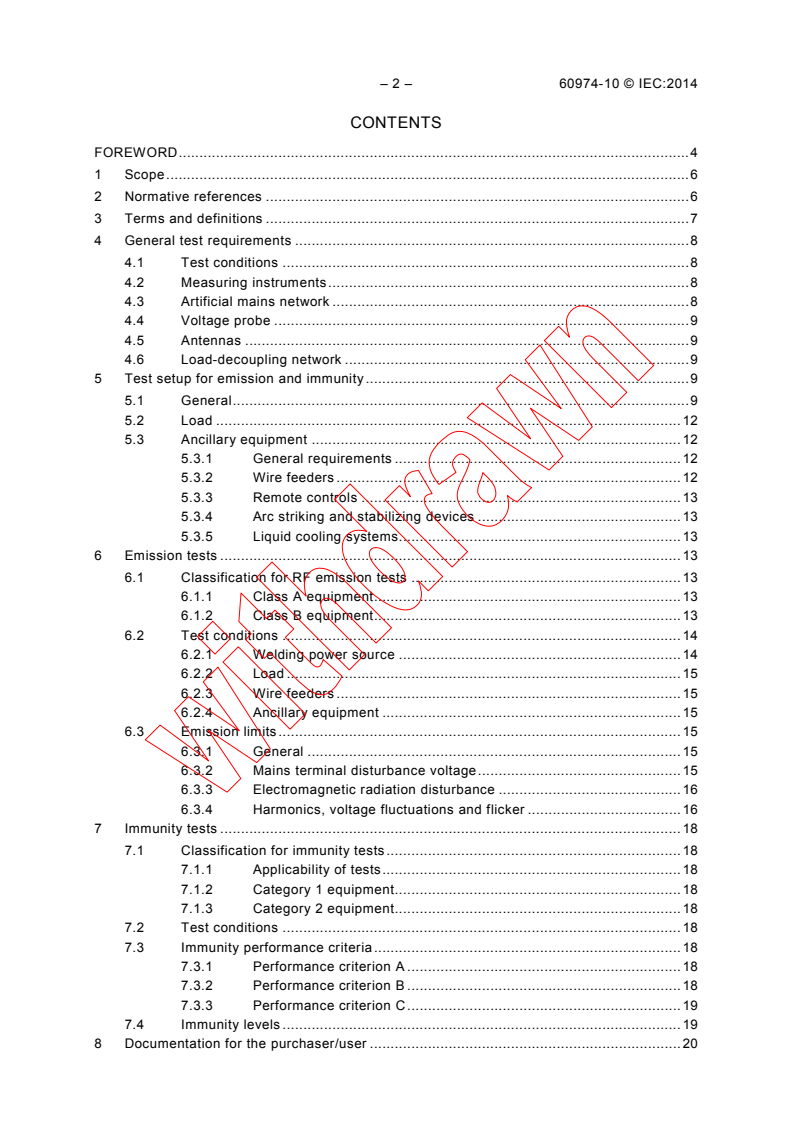
CONTENTS
FOREWORD . 4
1 Scope . 6
2 Normative references . 6
3 Terms and definitions . 7
4 General test requirements . 8
4.1 Test conditions . 8
4.2 Measuring instruments . 8
4.3 Artificial mains network . 8
4.4 Voltage probe . 9
4.5 Antennas . 9
4.6 Load-decoupling network . 9
5 Test setup for emission and immunity . 9
5.1 General . 9
5.2 Load . 12
5.3 Ancillary equipment . 12
5.3.1 General requirements . 12
5.3.2 Wire feeders . 12
5.3.3 Remote controls . 13
5.3.4 Arc striking and stabilizing devices . 13
5.3.5 Liquid cooling systems . 13
6 Emission tests . 13
6.1 Classification for RF emission tests . 13
6.1.1 Class A equipment . 13
6.1.2 Class B equipment . 13
6.2 Test conditions . 14
6.2.1 Welding power source . 14
6.2.2 Load . 15
6.2.3 Wire feeders . 15
6.2.4 Ancillary equipment . 15
6.3 Emission limits . 15
6.3.1 General . 15
6.3.2 Mains terminal disturbance voltage . 15
6.3.3 Electromagnetic radiation disturbance . 16
6.3.4 Harmonics, voltage fluctuations and flicker . 16
7 Immunity tests . 18
7.1 Classification for immunity tests . 18
7.1.1 Applicability of tests . 18
7.1.2 Category 1 equipment. 18
7.1.3 Category 2 equipment. 18
7.2 Test conditions . 18
7.3 Immunity performance criteria . 18
7.3.1 Performance criterion A . 18
7.3.2 Performance criterion B . 18
7.3.3 Performance criterion C . 19
7.4 Immunity levels . 19
8 Documentation for the purchaser/user . 20
60974-10 © IEC:2014 – 3 –
Annex A (informative) Installation and use . 22
A.1 General . 22
A.2 Assessment of area . 22
A.3 Assessment of welding installation . 22
A.4 Mitigation measures . 23
A.4.1 Public supply system . 23
A.4.2 Maintenance of the arc welding equipment . 23
A.4.3 Welding cables . 23
A.4.4 Equipotential bonding . 23
A.4.5 Earthing of the workpiece . 23
A.4.6 Screening and shielding . 23
Annex B (informative) Limits . 24
B.1 General . 24
B.2 Mains terminal disturbance voltage limits . 24
B.3 Electromagnetic radiation disturbance limits . 25
B.4 Harmonic current limits . 26
B.5 Limits for voltage fluctuations and flicker . 28
Annex C (informative) Symbols . 29
Bibliography . 30
Figure 1 – Test set-up 1 for arc welding equipment . 10
Figure 2 – Test set-up 2 for portable arc welding equipment . 11
Figure 3 – Top view of test setup as shown in Figure 1 . 11
Figure 4 – Overview of harmonic requirements for supply current up to 75 A . 17
Figure 5 – Overview of flicker requirements . 17
Table 1 – Immunity levels – Enclosure . 19
Table 2 – Immunity levels – AC input power port. 19
Table 3 – Immunity levels – Ports for measurement and control . 20
Table B.1 – Mains terminal disturbance voltage limits, idle state . 24
Table B.2 – Mains terminal disturbance voltage limits, load conditions . 24
Table B.3 – Electromagnetic radiation disturbance limits, idle state . 25
Table B.4 – Electromagnetic radiation disturbance limits, load conditions . 25
Table B.5 – Maximum permissible harmonic current for equipment for non-professional
use with input current I ≤ 16 A . 26
1max
Table B.6 – Current emission limits for equipment with I ≤ 75 A other than
1max
balanced three-phase equipment . 26
Table B.7 – Current emission limits for balanced three-phase equipment with I ≤
1max
75 A 27
Table B.8 – Current emission limits for balanced three-phase equipment with I ≤
1max
75 A under specified conditions (a, b, c) . 27
Table B.9 – Current emission limits for balanced three-phase equipment with I ≤
1max
75 A under specified conditions (d, e, f) . 27
Table B.10 – Limits for arc welding equipment with I ≤ 75 A . 28
1max
Table C.1 – Symbols to describe EMC properties . 29
– 4 – 60974-10 © IEC:2014
INTERNATIONAL ELECTROTECHNICAL COMMISSION
____________
ARC WELDING EQUIPMENT –
Part 10: Electromagnetic compatibility (EMC) requirements
FOREWORD
1) The International Electrotechnical Commission (IEC) is a worldwide organization for standardization comprising
all national electrotechnical committees (IEC National Committees). The object of IEC is to promote
international co-operation on all questions concerning standardization in the electrical and electronic fields. To
this end and in addition to other activities, IEC publishes International Standards, Technical Specifications,
Technical Reports, Publicly Available Specifications (PAS) and Guides (hereafter referred to as “IEC
Publication(s)”). Their preparation is entrusted to technical committees; any IEC National Committee interested
in the subject dealt with may participate in this preparatory work. International, governmental and non-
governmental organizations liaising with the IEC also participate in this preparation. IEC collaborates closely
with the International Organization for Standardization (ISO) in accordance with conditions determined by
agreement between the two organizations.
2) The formal decisions or agreements of IEC on technical matters express, as nearly as possible, an international
consensus of opinion on the relevant subjects since each technical committee has representation from all
interested IEC National Committees.
3) IEC Publications have the form of recommendations for international use and are accepted by IEC National
Committees in that sense. While all reasonable efforts are made to ensure that the technical content of IEC
Publications is accurate, IEC cannot be held responsible for the way in which they are used or for any
misinterpretation by any end user.
4) In order to promote international uniformity, IEC National Committees undertake to apply IEC Publications
transparently to the maximum extent possible in their national and regional publications. Any divergence
between any IEC Publication and the corresponding national or regional publication shall be clearly indicated in
the latter.
5) IEC itself does not provide any attestation of conformity. Independent certification bodies provide conformity
assessment services and, in some areas, access to IEC marks of conformity. IEC is not responsible for any
services carried out by independent certification bodies.
6) All users should ensure that they have the latest edition of this publication.
7) No liability shall attach to IEC or its directors, employees, servants or agents including individual experts and
members of its technical committees and IEC National Committees for any personal injury, property damage or
other damage of any nature whatsoever, whether direct or indirect, or for costs (including legal fees) and
expenses arising out of the publication, use of, or reliance upon, this IEC Publication or any other IEC
Publications.
8) Attention is drawn to the Normative references cited in this publication. Use of the referenced publications is
indispensable for the correct application of this publication.
9) Attention is drawn to the possibility that some of the elements of this IEC Publication may be the subject of
patent rights. IEC shall not be held responsible for identifying any or all such patent rights.
International Standard IEC 60974-10 has been prepared by IEC technical committee 26:
Electric welding.
This third edition cancels and replaces the second edition published in 2007 and constitutes a
technical revision.
This edition includes the following significant technical changes with respect to the previous
edition:
• inclusion of optional use of a decoupling network and a load outside the test chamber;
• inclusion of an alternative test setup for portable equipment;
• inclusion of test conditions for complex controls, liquid cooling systems and arc striking
and stabilizing devices;
• update of the applicable limits related to the updated reference to CISPR 11;
• exclusion of the use of narrow band relaxations for RF emission limits;
60974-10 © IEC:2014 – 5 –
• update of the applicable limits for harmonics and flicker and inclusion of flow-charts
related to the updated reference to IEC 61000-3-11 and IEC 61000-3-12;
• update of the requirements for voltage dips related to the updated reference to
IEC 61000-4-11 and IEC 61000-4-34;
• update of the informative annex for installation and use;
• inclusion of symbols to indicate the RF equipment class and restrictions for use.
The text of this standard is based on the following documents:
FDIS Report on voting
26/519/FDIS 26/526/RVD
Full information on the voting for the approval of this standard can be found in the report on
voting indicated in the above table.
This publication has been drafted in accordance with the ISO/IEC Directives, Part 2.
The list of all the parts of the IEC 60974 series, under the general title Arc welding equipment,
can be found on the IEC web site.
The committee has decided that the contents of this publication will remain unchanged until
the stability date indicated on the IEC web site under "http://webstore.iec.ch" in the data
related to the specific publication. At this date, the publication will be
• reconfirmed,
• withdrawn,
• replaced by a revised edition, or
• amended.
– 6 – 60974-10 © IEC:2014
ARC WELDING EQUIPMENT –
Part 10: Electromagnetic compatibility (EMC) requirements
1 Scope
This part of IEC 60974 specifies
a) applicable standards and test methods for radio-frequency (RF) emissions;
b) applicable standards and test methods for harmonic current emission, voltage fluctuations
and flicker;
c) immunity requirements and test methods for continuous and transient, conducted and
radiated disturbances including electrostatic discharges.
This standard is applicable to equipment for arc welding and allied processes, including power
sources and ancillary equipment, for example wire feeders, liquid cooling systems and arc
striking and stabilizing devices.
NOTE 1 Allied processes are, for example, plasma cutting and arc stud welding.
NOTE 2 This standard does not specify basic safety requirements for arc welding equipment such as protection
against electric shock, unsafe operation, insulation coordination and related dielectric tests.
Arc welding equipment type tested in accordance with, and which has met the requirements
of, this standard is considered to be in compliance for all applications.
2 Normative references
The following documents, in whole or in part, are normatively referenced in this document and
are indispensable for its application. For dated references, only the edition cited applies. For
undated references, the latest edition of the referenced document (including any
amendments) applies.
IEC 60050 (all parts), International Electrotechnical Vocabulary (available at
)
IEC 60974-1, Arc welding equipment – Part 1: Welding power sources
IEC 60974-6, Arc welding equipment – Part 6: Limited duty equipment
IEC 61000-3-2:2005, Electromagnetic compatibility (EMC) – Part 3-2: Limits – Limits for
harmonic current emissions (equipment input current ≤ 16 A per phase)
Amendment 1:2008
Amendment 2:2009
IEC 61000-3-3:2013, Electromagnetic compatibility (EMC) – Part 3-3: Limits – Limitation of
voltage changes, voltage fluctuations and flicker in public low-voltage supply systems, for
equipment with rated current ≤ 16 A per phase and not subject to conditional connection
IEC 61000-3-11:2000, Electromagnetic compatibility (EMC) – Part 3-11: Limits – Limitation of
voltage changes, voltage fluctuations and flicker in public low-voltage supply systems –
Equipment with rated current ≤ 75 A and subject to conditional connection
60974-10 © IEC:2014 – 7 –
IEC 61000-3-12:2011, Electromagnetic compatibility (EMC) – Part 3-12: Limits for harmonic
currents produced by equipment connected to public low-voltage systems with input current >
16 A and ≥ 75 A per phase
IEC 61000-4-2, Electromagnetic compatibility (EMC) – Part 4-2: Testing and measurement
techniques – Electrostatic discharge immunity test
IEC 61000-4-3, Electromagnetic compatibility (EMC) – Part 4-3: Testing and measurement
techniques – Radiated, radio-frequency, electromagnetic field immunity test
IEC 61000-4-4, Electromagnetic compatibility (EMC) – Part 4-4: Testing and measurement
techniques – Electrical fast transient/burst immunity test
IEC 61000-4-5, Electromagnetic compatibility (EMC) – Part 4-5: Testing and measurement
techniques – Surge immunity test
IEC 61000-4-6, Electromagnetic compatibility (EMC) – Part 4-6: Testing and measurement
techniques – Immunity to conducted disturbances, induced by radio-frequency fields
IEC 61000-4-11, Electromagnetic compatibility (EMC) – Part 4-11: Testing and measurement
techniques – Voltage dips, short interruptions and voltage variations immunity tests
IEC 61000-4-34, Electromagnetic compatibility (EMC) – Part 4-34: Testing and measurement
techniques – Voltage dips, short interruptions and voltage variations immunity tests for
equipment with input current more than 16 A per phase
CISPR 11:2009, Industrial, scientific and medical equipment – Radio-frequency disturbance
characteristics – Limits and methods of measurement
Amendment 1:2010
CISPR 16-1-1, Specification for radio disturbance and immunity measuring apparatus and
methods – Part 1-1: Radio disturbance and immunity measuring apparatus – Measuring
apparatus
CISPR 16-1-2, Specification for radio disturbance and immunity measuring apparatus and
methods – Part 1-2: Radio disturbance and immunity measuring apparatus – Ancillary
equipment – Conducted disturbances
CISPR 16-1-4, Specification for radio disturbance and immunity measuring apparatus and
methods – Part 1-4: Radio disturbance and immunity measuring apparatus – Antennas and
test sites for radiated disturbance measurements
3 Terms and definitions
For the purposes of this document, the terms and definitions given in IEC 60050-161
concerning EMC and the relevant phenomena, given in IEC 60050-851 on arc welding
equipment and in IEC 60974-1, as well as the following, apply.
3.1
click
disturbance which exceeds the limit of continuous disturbance no longer than 200 ms and
which is separated from a subsequent disturbance by at least 200 ms
Note 1 to entry: Both intervals are related to the level of the limit of continuous disturbance.
———————
There exists a consolidated edition 5.1 (2010) that includes Edition 5 and its Amendment 1.
– 8 – 60974-10 © IEC:2014
Note 2 to entry: A click may contain a number of impulses, in which case the relevant time is that from the
beginning of the first to the end of the last impulse.
3.2
CDN
coupling/decoupling network
3.3
EUT
equipment under test
3.4
idle state
operating state in which the power is switched on and the welding circuit is not energized
Note 1 to entry: For some types of equipment there is no idle state, but an operating state preceding arc striking,
when the welding circuit is energized.
Note 2 to entry: Idle state is different from standby mode, when the power is switched off.
3.5
portable, adj
capable to be carried by one person
Note 1 to entry: Portability is typically specified by the equipment manufacturer based on the intended use, the
equipment design and/or local regulation.
[SOURCE: IEC 60050-151:2001, 151-16-47, modified – update of the note]
3.6
small equipment
equipment, either positioned on a table top or standing on the floor which, including its cables
fits in a cylindrical test volume of 1,2 m in diameter and 1,5 m above the ground plane
[SOURCE: CISPR 11:2009, Amendment 1:2010, 3.10]
4 General test requirements
4.1 Test conditions
Tests shall be carried out on completely assembled equipment representative of the series
production. Tests shall be performed within the specified operating conditions given in
IEC 60974-1 or IEC 60974-6, and at the rated supply voltage and frequency. Results obtained
for RF emission and immunity at 50 Hz are valid for the same model operating at 60 Hz and
vice versa.
4.2 Measuring instruments
The measuring equipment shall comply with the requirements of CISPR 16-1-1 and the
standards referred to in Tables 1, 2 and 3 as applicable.
4.3 Artificial mains network
Measurement of the mains terminal disturbance voltage shall be made using an artificial
mains network, if commercially available, consisting of 50 Ω/50 μH V-network as specified in
CISPR 16-1-2.
The artificial network is required to provide a defined impedance at RF across the mains
supply at the point of measurement and also to provide for isolation of the equipment under
test from ambient noise on the power lines.
60974-10 © IEC:2014 – 9 –
4.4 Voltage probe
A voltage probe as specified in CISPR 16-1-2 shall be used when the artificial mains network
cannot be used. The probe is connected sequentially between each line and the reference
earth. The probe shall consist of a blocking capacitor and a resistor such that the total
resistance between the line and earth is at least 1 500 Ω. The effect on the accuracy of
measurement of the capacitor or any other device which may be used to protect the
measuring receiver against dangerous currents shall be either less than 1 dB or allowed for in
calibration.
4.5 Antennas
In the frequency range from 30 MHz to 1 GHz, the antenna(s) used shall be as specified in
CISPR 16-1-4. Measurements shall be made for both horizontal and vertical polarization. The
nearest point of the antenna(s) to the ground shall be not less than 0,2 m.
4.6 Load-decoupling network
If a shielded chamber is required and the load is situated outside the shielded chamber, a
load-decoupling network connected to the outside load via suitable RF filters shall be used
inside the chamber. A 150 Ω CDN AF 2, as specified in IEC 61000-4-6, suitable for the
respective load current and voltage, shall be used. The RF port of the CDN shall be
terminated with 50 Ω.
5 Test setup for emission and immunity
5.1 General
Emission and immunity testing of equipment that is not portable shall be carried out on
equipment configured in accordance with Figure 1. For portable equipment, either the test
setup given in Figure 1 or the test setup given in Figure 2 shall be used. Arc welding
equipment tested in one of these configurations shall be considered to have met the
necessary requirements of this standard.
In any situation where it is necessary to re-test the equipment to show compliance with this
standard the test setup originally chosen shall be used in order to guarantee consistency of
the results, unless it is agreed by the manufacturer to do otherwise.
For RF emission, EM field immunity, common mode immunity, and fast transient immunity
tests the following dimensions apply:
In Figure 1, a shall be 1 m
In Figures 1 and 2, b shall be 0,4 m or less
In Figure 2, h shall be 0,8 m
Dimensions a, b and h are undefined for all other tests.
– 10 – 60974-10 © IEC:2014
IEC 0233/14
Key
1 Welding power source 7 Welding cable (bundled)
2 Liquid cooling system 8 Input supply cable (bundled)
3 Wire feeder 9 Insulation
4 Remote control 10 Reference ground plane
5 Interconnection cable (bundled) 11 Conventional load
or load decoupling network
6 Remote control cable (bundled)
a Distance between power source and load or load decoupling network
b Cable bundle length
NOTE 1 Items 2, 3, and 4 are ancillary equipment, as applicable, and are typically positioned as specified
by the equipment manufacturer.
NOTE 2 Insulation (item 9) is placed between items 1 and 3 if specified by the manufacturer.
Figure 1 – Test set-up 1 for arc welding equipment
If due to the design of the arc welding equipment, these tests cannot be carried out as
described, the manufacturer’s recommendations (for example, temporary bypassing or
disablement of control circuits) should be followed in order to match these test objectives. Any
temporary changes to the arc welding equipment shall be documented.
If ancillary equipment can be connected to the welding power source, then the welding power
source shall be tested with the minimum configuration of ancillary equipment necessary to
exercise the ports. If the welding power source has a large number of similar ports or ports
with many similar connections, then a sufficient number shall be selected to simulate actual
operating conditions and to ensure that all the different types of termination are covered.
For mains terminal voltage disturbance tests the welding power source shall be connected to
the electricity supply using the V-network specified in 4.3 whenever possible. The V-network
shall be located so that its closest surface is no less than 0,8 m from the nearest boundary of
the equipment under test. The input cable shall have a minimum length of 2 m.
60974-10 © IEC:2014 – 11 –
IEC 0234/14
Key
1 Arc welding equipment 6 Insulation
2 Remote control (under the table) 7 Reference ground plane
3 Welding cable (bundled) 8 Non-conductive table
4 Remote control cable (bundled) 9 Conventional load or load decoupling network
(under the table)
5 Input supply cable (bundled)
b Cable bundle length
h Non-conductive table height
NOTE Item 2 is ancillary equipment, as applicable.
Figure 2 – Test set-up 2 for portable arc welding equipment
IEC 0235/14
Key
1 Arc welding equipment 3 Test antenna (horizontal polarization shown)
2 Welding cables (bundled) 4 Conventional load or load decoupling network
Distance between the equipment under test and the radiation center of the antenna
e
Distance between the equipment under test and nearest point of the antenna
i
Figure 3 – Top view of test setup as shown in Figure 1
– 12 – 60974-10 © IEC:2014
The welding power source shall be connected to the conventional load by welding cables of
suitable cross-section for the welding current, or the appropriate torch or electrode holder with
adapter. The welding cables shall have a minimum length of 2 m.
If a load situated outside the shielded chamber is used, a load-decoupling network as defined
in 4.6 shall be placed inside the shielded chamber. The load-decoupling network shall be
terminated to the reference ground and connected to the outside load via suitable filters.
For RF emission tests using the test setup given in Figure 1, the welding power source shall
be insulated by an insulating mat (or blocks) not greater than 12 mm thick or insulated by its
own under-gear if appropriate.
For electromagnetic radiation disturbance and EM field immunity tests using the test setup as
given in Figure 1, the welding power source and conventional load (or, if applicable, the load-
decoupling network) shall be at one stationary position with respect to the test antenna as
shown in Figure 3. The separation distance e in Figure 3 is defined in Clause 6 of
CISPR 11:2009. The separation distance i in Figure 3 is defined in IEC 61000-4-3.
The cables shall be allowed to fall naturally to the ground plane. Excess cable length shall be
folded to form separate bundles not exceeding 0,4 m in length, as far as practicable.
Specific test set-up geometries for immunity tests can be found in the basic standards
referenced in Tables 1, 2 and 3.
The configuration of the equipment under test shall be noted in the test report.
5.2 Load
During the tests, the arc welding operation is simulated by loading the equipment with a
conventional load as specified in IEC 60974-1. For RF emission tests that do not use a CDN,
the conventional load shall be insulated by an insulating mat (or blocks) not greater than
12 mm thick or insulated by its own under-gear if appropriate.
5.3 Ancillary equipment
5.3.1 General requirements
Ancillary equipment shall be tested in conjunction with a welding power source. It shall be
connected, installed and configured as recommended by the manufacturer.
Specific requirements for the operation of ancillary equipment are given below.
5.3.2 Wire feeders
Wire feeders shall be positioned on/by a welding power source as designed. Wire feeders,
which can be located both inside or outside the welding power source enclosure, shall be
placed outside. For RF emission tests, wire feeders designed to be placed on the floor shall
be insulated from it, by an insulating mat (or blocks) not greater than 12 mm thick or insulated
by its own under-gear, if appropriate.
The welding cable connecting the wire feeder to the welding power source shall be 2 m in
length or longer, if required, to make the connection and be of suitable current rating. If a
welding cable in excess of 2 m is provided by the manufacturer, the excess cable length shall
be folded to form a bundle not exceeding 0,4 m in length, as far as practicable. A welding
cable connection less than 2 m long shall be permitted if this is supplied with the equipment.
60974-10 © IEC:2014 – 13 –
The interconnection cable(s) between the wire feeder and the welding power source shall be
of the type and length recommended by the manufacturer. Excess cable length shall be folded
to form a bundle not exceeding 0,4 m in length, as far as practicable.
A welding torch, as recommended by the manufacturer, may be used instead of a welding
cable to make the connection from the wire feeder to the conventional load.
5.3.3 Remote controls
If a welding power source is capable of operating with a remote control, it shall be tested with
the remote control connected, which is expected to give the highest emissions and/or lowest
immunity. The remote control shall be placed on, and insulated from, the ground plane beside
the load, where possible. For RF emission tests, the insulation shall not be greater than
12 mm thick. Remote controls designed to be attached to the arc welding equipment during
use shall be placed as intended.
Excess cable length shall be folded to form a bundle not exceeding 0,4 m in length, as far as
practicable.
Complex controls that can be used independently from a dedicated power source may be
tested in conjunction with the power source or as a stand-alone unit, as specified by the
manufacturer.
5.3.4 Arc striking and stabilizing devices
Arc striking and stabilizing devices shall be disabled during all tests other than RF emission
tests to protect test equipment. For RF emission tests, measurements shall be started 5 s
after the equipment is in operation.
5.3.5 Liquid cooling systems
Liquid cooling systems shall be positioned on/by a welding power source as designed. Liquid
cooling systems, which can be located both inside or outside the welding power source
enclosure, shall be placed outside. For RF emission tests, liquid cooling systems designed to
be placed on the floor shall be insulated from it, by an insulating mat (or blocks) not greater
than 12 mm thick or insulated by its own under-gear, if appropriate.
The inlet and outlet may be connected by a hose, as recommended by the manufacturer, to
allow the flow of cooling liquid.
6 Emission tests
6.1 Classification for RF emission tests
6.1.1 Class A equipment
Class A equipment is intended for use in locations other than residential locations where the
electrical power is provided by the public low-voltage supply system.
Class A equipment shall meet Class A limits in accordance with 6.3.
Arc striking and stabilizing devices and arc stud welding equipment shall be classified as
Class A equipment.
6.1.2 Class B equipment
Class B equipment is suitable for use in all locations, including residential locations where the
electrical power is provided by the public low-voltage supply system.
– 14 – 60974-10 © IEC:2014
Class B equipment shall meet Class B limits in accordance with 6.3.
6.2 Test conditions
6.2.1 Welding power source
6.2.1.1 Test conditions for RF emission tests
The welding power source shall be tested at the conventional load voltages referenced in
6.2.2 under the following output conditions:
a) at rated minimum welding current;
b) at rated welding current at 100 % duty cycle.
Additionally, if there is an idle state, the welding power source shall be tested with the cables
disconnected at the load.
If the supply current is greater than 25 A at any of the output conditions given above, the
output may be reduced to give a supply current of 25 A. However, if a supply current of 25 A
or less cannot be achieved, the voltage probe, as specified in 4.4, may be used for tests in
accordance with 6.3.2 as an alternative to an artificial mains network.
Welding power sources capable of operating in both a.c. and d.c. modes shall be tested in
both modes.
Multi-process welding power sources shall be tested with the conventional load which gives
the highest load voltage for the set current. If a welding power source contains more than one
output circuit (for example, plasma cutting and manual arc welding), each circuit shall be
tested separately.
For power sources with an external wire feeder, only the MIG configuration shall be tested
with the MIG conventional load voltage.
6.2.1.2 Test conditions for harmonics
Welding power sources within the scope of IEC 60974-1 shall be tested at the conventional
load voltage according to the process as given in 6.2.2 at maximum rated welding current at
the rated duty cycle.
The arithmetic average value of 1,5 s smoothed r.m.s. supply current values (I as per
ref
IEC 61000-3-12) shall be measured when the welding power source is delivering its maximum
rated welding current I .
2max
For welding equipment within the scope of IEC 60974-1 with a rated maximum supply current
below 16 A, the reference current I for the definition of limits shall be 16 A.
ref
The maximum and arithmetic average values of 1,5 s smoothed r.m.s. harmonic current
values in each Discrete Fourier Transform (DFT) time window shall be determined over one
full thermal cycle of 10 min including the idle state period.
NOTE An idle state period of more than 10 % is not a stand-by mode as defined in IEC 61000-3-12, but an
operational mode of the welding equipment within its full thermal cycle.
Welding power sources capable of operating in both a.c. and d.c. modes shall be tested in
both modes.
Multi-process welding power sources shall be tested with the conventional load which gives
the highest conventional load voltage for the set current.
60974-10 © IEC:2014 – 15 –
Test conditions for welding power sources within the scope of IEC 60974-6 are given in
IEC 61000-3-2.
6.2.1.3 Test conditions for voltage fluctuations and flicker
Test conditions for welding power sources are given in IEC 61000-3-3.
6.2.2 Load
Conventional load voltages are given in IEC 60974-1 or IEC 60974-6.
6.2.3 Wire fee
...
IEC 60974-10 ®
Edition 3.1 2015-06
CONSOLIDATED VERSION
INTERNATIONAL
STANDARD
NORME
INTERNATIONALE
colour
inside
Arc welding equipment –
Part 10: Electromagnetic compatibility (EMC) requirements
Matériel de soudage à l’arc –
Partie 10: Exigences de compatibilité électromagnétique (CEM)
All rights reserved. Unless otherwise specified, no part of this publication may be reproduced or utilized in any form
or by any means, electronic or mechanical, including photocopying and microfilm, without permission in writing from
either IEC or IEC's member National Committee in the country of the requester. If you have any questions about IEC
copyright or have an enquiry about obtaining additional rights to this publication, please contact the address below or
your local IEC member National Committee for further information.
Droits de reproduction réservés. Sauf indication contraire, aucune partie de cette publication ne peut être reproduite
ni utilisée sous quelque forme que ce soit et par aucun procédé, électronique ou mécanique, y compris la photocopie
et les microfilms, sans l'accord écrit de l'IEC ou du Comité national de l'IEC du pays du demandeur. Si vous avez des
questions sur le copyright de l'IEC ou si vous désirez obtenir des droits supplémentaires sur cette publication, utilisez
les coordonnées ci-après ou contactez le Comité national de l'IEC de votre pays de résidence.
IEC Central Office Tel.: +41 22 919 02 11
3, rue de Varembé Fax: +41 22 919 03 00
CH-1211 Geneva 20 info@iec.ch
Switzerland www.iec.ch
About the IEC
The International Electrotechnical Commission (IEC) is the leading global organization that prepares and publishes
International Standards for all electrical, electronic and related technologies.
About IEC publications
The technical content of IEC publications is kept under constant review by the IEC. Please make sure that you have the
latest edition, a corrigenda or an amendment might have been published.
IEC Catalogue - webstore.iec.ch/catalogue Electropedia - www.electropedia.org
The stand-alone application for consulting the entire The world's leading online dictionary of electronic and
bibliographical information on IEC International Standards, electrical terms containing more than 30 000 terms and
Technical Specifications, Technical Reports and other definitions in English and French, with equivalent terms in 15
documents. Available for PC, Mac OS, Android Tablets and additional languages. Also known as the International
iPad. Electrotechnical Vocabulary (IEV) online.
IEC publications search - www.iec.ch/searchpub IEC Glossary - std.iec.ch/glossary
The advanced search enables to find IEC publications by a More than 60 000 electrotechnical terminology entries in
variety of criteria (reference number, text, technical English and French extracted from the Terms and Definitions
committee,…). It also gives information on projects, replaced clause of IEC publications issued since 2002. Some entries
and withdrawn publications. have been collected from earlier publications of IEC TC 37,
77, 86 and CISPR.
IEC Just Published - webstore.iec.ch/justpublished
Stay up to date on all new IEC publications. Just Published IEC Customer Service Centre - webstore.iec.ch/csc
details all new publications released. Available online and If you wish to give us your feedback on this publication or
also once a month by email. need further assistance, please contact the Customer Service
Centre: csc@iec.ch.
A propos de l'IEC
La Commission Electrotechnique Internationale (IEC) est la première organisation mondiale qui élabore et publie des
Normes internationales pour tout ce qui a trait à l'électricité, à l'électronique et aux technologies apparentées.
A propos des publications IEC
Le contenu technique des publications IEC est constamment revu. Veuillez vous assurer que vous possédez l’édition la
plus récente, un corrigendum ou amendement peut avoir été publié.
Catalogue IEC - webstore.iec.ch/catalogue Electropedia - www.electropedia.org
Application autonome pour consulter tous les renseignements
Le premier dictionnaire en ligne de termes électroniques et
bibliographiques sur les Normes internationales,
électriques. Il contient plus de 30 000 termes et définitions en
Spécifications techniques, Rapports techniques et autres
anglais et en français, ainsi que les termes équivalents dans
documents de l'IEC. Disponible pour PC, Mac OS, tablettes
15 langues additionnelles. Egalement appelé Vocabulaire
Android et iPad.
Electrotechnique International (IEV) en ligne.
Recherche de publications IEC - www.iec.ch/searchpub
Glossaire IEC - std.iec.ch/glossary
La recherche avancée permet de trouver des publications IEC Plus de 60 000 entrées terminologiques électrotechniques, en
en utilisant différents critères (numéro de référence, texte, anglais et en français, extraites des articles Termes et
comité d’études,…). Elle donne aussi des informations sur les Définitions des publications IEC parues depuis 2002. Plus
projets et les publications remplacées ou retirées. certaines entrées antérieures extraites des publications des
CE 37, 77, 86 et CISPR de l'IEC.
IEC Just Published - webstore.iec.ch/justpublished
Service Clients - webstore.iec.ch/csc
Restez informé sur les nouvelles publications IEC. Just
Published détaille les nouvelles publications parues. Si vous désirez nous donner des commentaires sur cette
Disponible en ligne et aussi une fois par mois par email. publication ou si vous avez des questions contactez-nous:
csc@iec.ch.
IEC 60974-10 ®
Edition 3.1 2015-06
CONSOLIDATED VERSION
INTERNATIONAL
STANDARD
NORME
INTERNATIONALE
colour
inside
Arc welding equipment –
Part 10: Electromagnetic compatibility (EMC) requirements
Matériel de soudage à l’arc –
Partie 10: Exigences de compatibilité électromagnétique (CEM)
INTERNATIONAL
ELECTROTECHNICAL
COMMISSION
COMMISSION
ELECTROTECHNIQUE
INTERNATIONALE
ICS 25.160 ISBN 978-2-8322-2764-0
IEC 60974-10 ®
Edition 3.1 2015-06
CONSOLIDATED VERSION
REDLINE VERSION
VERSION REDLINE
colour
inside
Arc welding equipment –
Part 10: Electromagnetic compatibility (EMC) requirements
Matériel de soudage à l’arc –
Partie 10: Exigences de compatibilité électromagnétique (CEM)
– 2 – IEC 60974-10:2014
+AMD1:2015 CSV © IEC 2015
CONTENTS
FOREWORD . 5
1 Scope . 7
2 Normative references . 7
3 Terms and definitions . 8
4 General test requirements . 9
4.1 Test conditions . 9
4.2 Measuring instruments . 9
4.3 Artificial mains network . 9
4.4 Voltage probe . 10
4.5 Antennas . 10
4.6 Load-decoupling network . 10
5 Test setup for emission and immunity . 10
5.1 General . 10
5.2 Load . 13
5.3 Ancillary equipment . 13
5.3.1 General requirements . 13
5.3.2 Wire feeders . 13
5.3.3 Remote controls . 14
5.3.4 Arc striking and stabilizing devices . 14
5.3.5 Liquid cooling systems . 14
6 Emission tests . 14
6.1 Classification for RF emission tests . 14
6.1.1 Class A equipment . 14
6.1.2 Class B equipment . 14
6.2 Test conditions . 15
6.2.1 Welding power source . 15
6.2.2 Load voltages . 16
6.2.3 Wire feeders . 16
6.2.4 Ancillary equipment . 16
6.3 Emission limits . 16
6.3.1 General . 16
6.3.2 Mains terminal disturbance voltage . 16
6.3.3 Electromagnetic radiation disturbance . 17
6.3.4 Harmonics, voltage fluctuations and flicker . 17
6.3.5 Output current ripple . 19
7 Immunity tests . 19
7.1 Classification for immunity tests . 19
7.1.1 Applicability of tests . 19
7.1.2 Category 1 equipment. 19
7.1.3 Category 2 equipment. 19
7.2 Test conditions . 19
7.3 Immunity performance criteria . 20
7.3.1 Performance criterion A . 20
7.3.2 Performance criterion B . 20
7.3.3 Performance criterion C . 20
+AMD1:2015 CSV © IEC 2015
7.4 Immunity levels . 20
8 Documentation for the purchaser/user . 22
Annex A (informative) Installation and use . 24
A.1 General . 24
A.2 Assessment of area . 24
A.3 Assessment of welding installation . 24
A.4 Mitigation measures . 25
A.4.1 Public supply system . 25
A.4.2 Maintenance of the arc welding equipment . 25
A.4.3 Welding cables . 25
A.4.4 Equipotential bonding . 25
A.4.5 Earthing of the workpiece . 25
A.4.6 Screening and shielding . 25
Annex B (informative) Limits . 26
B.1 General . 26
B.2 Mains terminal disturbance voltage limits . 26
B.3 Electromagnetic radiation disturbance limits . 27
B.4 Harmonic current limits . 28
B.5 Limits for voltage fluctuations and flicker . 30
Annex C (informative) Symbols . 31
Bibliography . 32
Figure 1 – Test set-up 1 for arc welding equipment . 11
Figure 2 – Test set-up 2 for portable arc welding equipment . 12
Figure 3 – Top view of test setup as shown in Figure 1 . 12
Figure 4 – Overview of harmonic requirements for supply current up to 75 A . 18
Figure 5 – Overview of flicker requirements . 18
Table 1 – Immunity levels – Enclosure . 21
Table 2 – Immunity levels – AC input power port. 21
Table 3 – Immunity levels – Ports for measurement and control . 22
Table 4 – Output current ripple limits for Class B arc welding power sources . 19
Table B.1 – Mains terminal disturbance voltage limits, idle state . 26
Table B.2 – Mains terminal disturbance voltage limits, load conditions . 26
Table B.3 – Electromagnetic radiation disturbance limits, idle state . 27
Table B.4 – Electromagnetic radiation disturbance limits, load conditions . 27
Table B.5 – Maximum permissible harmonic current for equipment for non-professional
use with input current I ≤ 16 A . 28
1max
Table B.6 – Current emission limits for equipment with I ≤ 75 A other than
1max
balanced three-phase equipment . 28
Table B.7 – Current emission limits for balanced three-phase equipment with I ≤
1max
75 A 29
Table B.8 – Current emission limits for balanced three-phase equipment with I ≤
1max
75 A under specified conditions (a, b, c) . 29
Table B.9 – Current emission limits for balanced three-phase equipment with I ≤
1max
75 A under specified conditions (d, e, f) . 29
– 4 – IEC 60974-10:2014
+AMD1:2015 CSV © IEC 2015
Table B.10 – Limits for arc welding equipment with I ≤ 75 A . 30
1max
Table C.1 – Symbols to describe EMC properties . 31
+AMD1:2015 CSV © IEC 2015
INTERNATIONAL ELECTROTECHNICAL COMMISSION
____________
ARC WELDING EQUIPMENT –
Part 10: Electromagnetic compatibility (EMC) requirements
FOREWORD
1) The International Electrotechnical Commission (IEC) is a worldwide organization for standardization comprising
all national electrotechnical committees (IEC National Committees). The object of IEC is to promote
international co-operation on all questions concerning standardization in the electrical and electronic fields. To
this end and in addition to other activities, IEC publishes International Standards, Technical Specifications,
Technical Reports, Publicly Available Specifications (PAS) and Guides (hereafter referred to as “IEC
Publication(s)”). Their preparation is entrusted to technical committees; any IEC National Committee interested
in the subject dealt with may participate in this preparatory work. International, governmental and non-
governmental organizations liaising with the IEC also participate in this preparation. IEC collaborates closely
with the International Organization for Standardization (ISO) in accordance with conditions determined by
agreement between the two organizations.
2) The formal decisions or agreements of IEC on technical matters express, as nearly as possible, an international
consensus of opinion on the relevant subjects since each technical committee has representation from all
interested IEC National Committees.
3) IEC Publications have the form of recommendations for international use and are accepted by IEC National
Committees in that sense. While all reasonable efforts are made to ensure that the technical content of IEC
Publications is accurate, IEC cannot be held responsible for the way in which they are used or for any
misinterpretation by any end user.
4) In order to promote international uniformity, IEC National Committees undertake to apply IEC Publications
transparently to the maximum extent possible in their national and regional publications. Any divergence
between any IEC Publication and the corresponding national or regional publication shall be clearly indicated in
the latter.
5) IEC itself does not provide any attestation of conformity. Independent certification bodies provide conformity
assessment services and, in some areas, access to IEC marks of conformity. IEC is not responsible for any
services carried out by independent certification bodies.
6) All users should ensure that they have the latest edition of this publication.
7) No liability shall attach to IEC or its directors, employees, servants or agents including individual experts and
members of its technical committees and IEC National Committees for any personal injury, property damage or
other damage of any nature whatsoever, whether direct or indirect, or for costs (including legal fees) and
expenses arising out of the publication, use of, or reliance upon, this IEC Publication or any other IEC
Publications.
8) Attention is drawn to the Normative references cited in this publication. Use of the referenced publications is
indispensable for the correct application of this publication.
9) Attention is drawn to the possibility that some of the elements of this IEC Publication may be the subject of
patent rights. IEC shall not be held responsible for identifying any or all such patent rights.
This consolidated version of the official IEC Standard and its amendment has been prepared
for user convenience.
IEC 60974-10 edition 3.1 contains the third edition (2014-02) [documents 26/519/FDIS and
26/526/RVD] and its amendment 1 (2015-06) [documents 26/549/CDV and 26/560/RVC].
In this Redline version, a vertical line in the margin shows where the technical content is
modified by amendment 1. Additions and deletions are displayed in red, with deletions being
struck through. A separate Final version with all changes accepted is available in this
publication.
– 6 – IEC 60974-10:2014
+AMD1:2015 CSV © IEC 2015
International Standard IEC 60974-10 has been prepared by IEC technical committee 26:
Electric welding.
This edition includes the following significant technical changes with respect to the previous
edition:
• inclusion of optional use of a decoupling network and a load outside the test chamber;
• inclusion of an alternative test setup for portable equipment;
• inclusion of test conditions for complex controls, liquid cooling systems and arc striking
and stabilizing devices;
• update of the applicable limits related to the updated reference to CISPR 11;
• exclusion of the use of narrow band relaxations for RF emission limits;
• update of the applicable limits for harmonics and flicker and inclusion of flow-charts
related to the updated reference to IEC 61000-3-11 and IEC 61000-3-12;
• update of the requirements for voltage dips related to the updated reference to
IEC 61000-4-11 and IEC 61000-4-34;
• update of the informative annex for installation and use;
• inclusion of symbols to indicate the RF equipment class and restrictions for use.
This publication has been drafted in accordance with the ISO/IEC Directives, Part 2.
The list of all the parts of the IEC 60974 series, under the general title Arc welding equipment,
can be found on the IEC web site.
The committee has decided that the contents of the base publication and its amendment will
remain unchanged until the stability date indicated on the IEC web site under
"http://webstore.iec.ch" in the data related to the specific publication. At this date, the
publication will be
• reconfirmed,
• withdrawn,
• replaced by a revised edition, or
• amended.
IMPORTANT – The 'colour inside' logo on the cover page of this publication indicates
that it contains colours which are considered to be useful for the correct
understanding of its contents. Users should therefore print this document using a
colour printer.
+AMD1:2015 CSV © IEC 2015
ARC WELDING EQUIPMENT –
Part 10: Electromagnetic compatibility (EMC) requirements
1 Scope
This part of IEC 60974 specifies
a) applicable standards and test methods for radio-frequency (RF) emissions;
b) applicable standards and test methods for harmonic current emission, voltage fluctuations
and flicker;
c) immunity requirements and test methods for continuous and transient, conducted and
radiated disturbances including electrostatic discharges.
This standard is applicable to equipment for arc welding and allied processes, including power
sources and ancillary equipment, for example wire feeders, liquid cooling systems and arc
striking and stabilizing devices.
NOTE 1 Allied processes are, for example, plasma cutting and arc stud welding.
NOTE 2 This standard does not specify basic safety requirements for arc welding equipment such as protection
against electric shock, unsafe operation, insulation coordination and related dielectric tests.
Arc welding equipment type tested in accordance with, and which has met the requirements
of, this standard is considered to be in compliance for all applications.
2 Normative references
The following documents, in whole or in part, are normatively referenced in this document and
are indispensable for its application. For dated references, only the edition cited applies. For
undated references, the latest edition of the referenced document (including any
amendments) applies.
IEC 60050 (all parts), International Electrotechnical Vocabulary (available at
)
IEC 60974-1, Arc welding equipment – Part 1: Welding power sources
IEC 60974-6, Arc welding equipment – Part 6: Limited duty equipment
IEC 61000-3-2:2005, Electromagnetic compatibility (EMC) – Part 3-2: Limits – Limits for
harmonic current emissions (equipment input current ≤ 16 A per phase)
Amendment 1:2008
Amendment 2:2009
IEC 61000-3-3:2013, Electromagnetic compatibility (EMC) – Part 3-3: Limits – Limitation of
voltage changes, voltage fluctuations and flicker in public low-voltage supply systems, for
≤ 16 A per phase and not subject to conditional connection
equipment with rated current
IEC 61000-3-11:2000, Electromagnetic compatibility (EMC) – Part 3-11: Limits – Limitation of
voltage changes, voltage fluctuations and flicker in public low-voltage supply systems –
Equipment with rated current ≤ 75 A and subject to conditional connection
– 8 – IEC 60974-10:2014
+AMD1:2015 CSV © IEC 2015
IEC 61000-3-12:2011, Electromagnetic compatibility (EMC) – Part 3-12: Limits for harmonic
currents produced by equipment connected to public low-voltage systems with input current >
16 A and ≥ 75 A per phase
IEC 61000-4-2, Electromagnetic compatibility (EMC) – Part 4-2: Testing and measurement
techniques – Electrostatic discharge immunity test
IEC 61000-4-3, Electromagnetic compatibility (EMC) – Part 4-3: Testing and measurement
techniques – Radiated, radio-frequency, electromagnetic field immunity test
IEC 61000-4-4, Electromagnetic compatibility (EMC) – Part 4-4: Testing and measurement
techniques – Electrical fast transient/burst immunity test
IEC 61000-4-5, Electromagnetic compatibility (EMC) – Part 4-5: Testing and measurement
techniques – Surge immunity test
IEC 61000-4-6, Electromagnetic compatibility (EMC) – Part 4-6: Testing and measurement
techniques – Immunity to conducted disturbances, induced by radio-frequency fields
IEC 61000-4-11, Electromagnetic compatibility (EMC) – Part 4-11: Testing and measurement
techniques – Voltage dips, short interruptions and voltage variations immunity tests
IEC 61000-4-34, Electromagnetic compatibility (EMC) – Part 4-34: Testing and measurement
techniques – Voltage dips, short interruptions and voltage variations immunity tests for
equipment with input current more than 16 A per phase
CISPR 11:2009, Industrial, scientific and medical equipment – Radio-frequency disturbance
characteristics – Limits and methods of measurement
Amendment 1:2010
CISPR 16-1-1, Specification for radio disturbance and immunity measuring apparatus and
methods – Part 1-1: Radio disturbance and immunity measuring apparatus – Measuring
apparatus
CISPR 16-1-2, Specification for radio disturbance and immunity measuring apparatus and
methods – Part 1-2: Radio disturbance and immunity measuring apparatus – Ancillary
equipment – Conducted disturbances
CISPR 16-1-4, Specification for radio disturbance and immunity measuring apparatus and
methods – Part 1-4: Radio disturbance and immunity measuring apparatus – Antennas and
test sites for radiated disturbance measurements
3 Terms and definitions
For the purposes of this document, the terms and definitions given in IEC 60050-161
concerning EMC and the relevant phenomena, given in IEC 60050-851 on arc welding
equipment and in IEC 60974-1, as well as the following, apply.
3.1
click
disturbance which exceeds the limit of continuous disturbance no longer than 200 ms and
which is separated from a subsequent disturbance by at least 200 ms
Note 1 to entry: Both intervals are related to the level of the limit of continuous disturbance.
———————
There exists a consolidated edition 5.1 (2010) that includes Edition 5 and its Amendment 1.
+AMD1:2015 CSV © IEC 2015
Note 2 to entry: A click may contain a number of impulses, in which case the relevant time is that from the
beginning of the first to the end of the last impulse.
3.2
CDN
coupling/decoupling network
3.3
EUT
equipment under test
3.4
idle state
operating state in which the power is switched on and the welding circuit is not energized
Note 1 to entry: For some types of equipment there is no idle state, but an operating state preceding arc striking,
when the welding circuit is energized.
Note 2 to entry: Idle state is different from standby mode, when the power is switched off.
3.5
portable, adj
capable to be carried by one person
Note 1 to entry: Portability is typically specified by the equipment manufacturer based on the intended use, the
equipment design and/or local regulation.
[SOURCE: IEC 60050-151:2001, 151-16-47, modified – update of the note]
3.6
small equipment
equipment, either positioned on a table top or standing on the floor which, including its cables
fits in a cylindrical test volume of 1,2 m in diameter and 1,5 m above the ground plane
[SOURCE: CISPR 11:2009, Amendment 1:2010, 3.10]
4 General test requirements
4.1 Test conditions
Tests shall be carried out on completely assembled equipment representative of the series
production. Tests shall be performed within the specified operating conditions given in
IEC 60974-1 or IEC 60974-6, and at the rated supply voltage and frequency. Results obtained
for RF emission and immunity at 50 Hz are valid for the same model operating at 60 Hz and
vice versa.
4.2 Measuring instruments
The measuring equipment shall comply with the requirements of CISPR 16-1-1 and the
standards referred to in Tables 1, 2 and 3 as applicable.
4.3 Artificial mains network
Measurement of the mains terminal disturbance voltage shall be made using an artificial
mains network, if commercially available, consisting of 50 Ω/50 µH V-network as specified in
CISPR 16-1-2.
The artificial network is required to provide a defined impedance at RF across the mains
supply at the point of measurement and also to provide for isolation of the equipment under
test from ambient noise on the power lines.
– 10 – IEC 60974-10:2014
+AMD1:2015 CSV © IEC 2015
4.4 Voltage probe
A voltage probe as specified in CISPR 16-1-2 shall be used when the artificial mains network
cannot be used. The probe is connected sequentially between each line and the reference
earth. The probe shall consist of a blocking capacitor and a resistor such that the total
resistance between the line and earth is at least 1 500 Ω. The effect on the accuracy of
measurement of the capacitor or any other device which may be used to protect the
measuring receiver against dangerous currents shall be either less than 1 dB or allowed for in
calibration.
4.5 Antennas
In the frequency range from 30 MHz to 1 GHz, the antenna(s) used shall be as specified in
CISPR 16-1-4. Measurements shall be made for both horizontal and vertical polarization. The
nearest point of the antenna(s) to the ground shall be not less than 0,2 m.
4.6 Load-decoupling network
If a shielded chamber is required and the load is situated outside the shielded chamber, a
load-decoupling network connected to the outside load via suitable RF filters shall be used
inside the chamber. A 150 Ω CDN AF 2, as specified in IEC 61000-4-6, suitable for the
respective load current and voltage, shall be used. The RF port of the CDN shall be
terminated with 50 Ω.
5 Test setup for emission and immunity
5.1 General
Emission and immunity testing of equipment that is not portable shall be carried out on
equipment configured in accordance with Figure 1. For portable equipment, either the test
setup given in Figure 1 or the test setup given in Figure 2 shall be used. Arc welding
equipment tested in one of these configurations shall be considered to have met the
necessary requirements of this standard.
For the measurement of the output current ripple, there are no specific requirements for the
equipment configuration.
In any situation where it is necessary to re-test the equipment to show compliance with this
standard the test setup originally chosen shall be used in order to guarantee consistency of
the results, unless it is agreed by the manufacturer to do otherwise.
For RF emission, EM field immunity, common mode immunity, and fast transient immunity
tests the following dimensions apply:
In Figure 1, a shall be 1 m
In Figures 1 and 2, b shall be 0,4 m or less
In Figure 2, h shall be 0,8 m
Dimensions a, b and h are undefined for all other tests.
+AMD1:2015 CSV © IEC 2015
IEC 0233/14
Key
1 Welding power source 7 Welding cable (bundled)
2 Liquid cooling system 8 Input supply cable (bundled)
3 Wire feeder 9 Insulation
4 Remote control 10 Reference ground plane
5 Interconnection cable (bundled) 11 Conventional load
or load decoupling network
6 Remote control cable (bundled)
a Distance between power source and load or load decoupling network
b Cable bundle length
NOTE 1 Items 2, 3, and 4 are ancillary equipment, as applicable, and are typically positioned as specified
by the equipment manufacturer.
NOTE 2 Insulation (item 9) is placed between items 1 and 3 if specified by the manufacturer.
Figure 1 – Test set-up 1 for arc welding equipment
If due to the design of the arc welding equipment, these tests cannot be carried out as
described, the manufacturer’s recommendations (for example, temporary bypassing or
disablement of control circuits) should be followed in order to match these test objectives. Any
temporary changes to the arc welding equipment shall be documented.
If ancillary equipment can be connected to the welding power source, then the welding power
source shall be tested with the minimum configuration of ancillary equipment necessary to
exercise the ports. If the welding power source has a large number of similar ports or ports
with many similar connections, then a sufficient number shall be selected to simulate actual
operating conditions and to ensure that all the different types of termination are covered.
For mains terminal voltage disturbance tests the welding power source shall be connected to
the electricity supply using the V-network specified in 4.3 whenever possible. The V-network
shall be located so that its closest surface is no less than 0,8 m from the nearest boundary of
the equipment under test. The input cable shall have a minimum length of 2 m.
– 12 – IEC 60974-10:2014
+AMD1:2015 CSV © IEC 2015
IEC 0234/14
Key
1 Arc welding equipment 6 Insulation
2 Remote control (under the table) 7 Reference ground plane
3 Welding cable (bundled) 8 Non-conductive table
4 Remote control cable (bundled) 9 Conventional load or load decoupling network
(under the table)
5 Input supply cable (bundled)
b Cable bundle length
h Non-conductive table height
NOTE Item 2 is ancillary equipment, as applicable.
Figure 2 – Test set-up 2 for portable arc welding equipment
IEC 0235/14
Key
1 Arc welding equipment 3 Test antenna (horizontal polarization shown)
2 Welding cables (bundled) 4 Conventional load or load decoupling network
Distance between the equipment under test and the radiation center of the antenna
e
Distance between the equipment under test and nearest point of the antenna
i
Figure 3 – Top view of test setup as shown in Figure 1
+AMD1:2015 CSV © IEC 2015
The welding power source shall be connected to the conventional load by welding cables of
suitable cross-section for the welding current, or the appropriate torch or electrode holder with
adapter. The welding cables shall have a minimum length of 2 m.
If a load situated outside the shielded chamber is used, a load-decoupling network as defined
in 4.6 shall be placed inside the shielded chamber. The load-decoupling network shall be
terminated to the reference ground and connected to the outside load via suitable filters.
For RF emission tests using the test setup given in Figure 1, the welding power source shall
be insulated by an insulating mat (or blocks) not greater than 12 mm thick or insulated by its
own under-gear if appropriate.
For electromagnetic radiation disturbance and EM field immunity tests using the test setup as
given in Figure 1, the welding power source and conventional load (or, if applicable, the load-
decoupling network) shall be at one stationary position with respect to the test antenna as
shown in Figure 3. The separation distance e in Figure 3 is defined in Clause 6 of
CISPR 11:2009. The separation distance i in Figure 3 is defined in IEC 61000-4-3.
The cables shall be allowed to fall naturally to the ground plane. Excess cable length shall be
folded to form separate bundles not exceeding 0,4 m in length, as far as practicable.
Specific test set-up geometries for immunity tests can be found in the basic standards
referenced in Tables 1, 2 and 3.
The configuration of the equipment under test shall be noted in the test report.
5.2 Load
During the tests, the arc welding operation is simulated by loading the equipment with a
conventional load as specified in IEC 60974-1. For RF emission tests that do not use a CDN,
the conventional load shall be insulated by an insulating mat (or blocks) not greater than
12 mm thick or insulated by its own under-gear if appropriate.
For the measurement of the output current ripple, the inductance of the load including welding
cables at the fundamental frequency shall be less than 10 µH per 100 mΩ total resistance.
5.3 Ancillary equipment
5.3.1 General requirements
Ancillary equipment shall be tested in conjunction with a welding power source. It shall be
connected, installed and configured as recommended by the manufacturer.
Specific requirements for the operation of ancillary equipment are given below.
5.3.2 Wire feeders
Wire feeders shall be positioned on/by a welding power source as designed. Wire feeders,
which can be located both inside or outside the welding power source enclosure, shall be
placed outside. For RF emission tests, wire feeders designed to be placed on the floor shall
be insulated from it, by an insulating mat (or blocks) not greater than 12 mm thick or insulated
by its own under-gear, if appropriate.
The welding cable connecting the wire feeder to the welding power source shall be 2 m in
length or longer, if required, to make the connection and be of suitable current rating. If a
welding cable in excess of 2 m is provided by the manufacturer, the excess cable length shall
be folded to form a bundle not exceeding 0,4 m in length, as far as practicable. A welding
cable connection less than 2 m long shall be permitted if this is supplied with the equipment.
– 14 – IEC 60974-10:2014
+AMD1:2015 CSV © IEC 2015
The interconnection cable(s) between the wire feeder and the welding power source shall be
of the type and length recommended by the manufacturer. Excess cable length shall be folded
to form a bundle not exceeding 0,4 m in length, as far as practicable.
A welding torch, as recommended by the manufacturer, may be used instead of a welding
cable to make the connection from the wire feeder to the conventional load.
5.3.3 Remote controls
If a welding power source is capable of operating with a remote control, it shall be tested with
the remote control connected, which is expected to give the highest emissions and/or lowest
immunity. The remote control shall be placed on, and insulated from, the ground plane beside
the load, where possible. For RF emission tests, the insulation shall not be greater than
12 mm thick. Remote controls designed to be attached to the arc welding equipment during
use shall be placed as intended.
Excess cable length shall be folded to form a bundle not exceeding 0,4 m in length, as far as
practicable.
Complex controls that can be used independently from a dedicated power source may be
tested in conjunction with the power source or as a stand-alone unit, as specified by the
manufacturer.
5.3.4 Arc striking and stabilizing devices
Arc striking and stabilizing devices shall be disabled during all tests other than RF emission
tests to protect test equipment. For RF emission tests, measurements shall be started 5 s
after the equipment is in operation.
5.3.5 Liquid cooling systems
Liquid cooling systems shall be positioned on/by a welding power source as designed. Liquid
cooling systems, which can be located both inside or outside the welding power source
enclosure, shall be placed outside. For RF emission tests, liquid cooling systems designed to
be placed on the floor shall be insulated from it, by an insulating mat (or blocks) not greater
than 12 mm thick or insulated by its own under-gear, if appropriate.
The inlet and outlet may be connected by a hose, as recommended by the manufacturer, to
allow the flow of cooling liquid.
6 Emission tests
6.1 Classification for RF emission tests
6.1.1 Class A equipment
Class A equipment is intended for use in locations other than residential locations where the
electrical power is provided by the public low-voltage supply system.
Class A equipment shall meet Class A limits in accordance with 6.3.
Arc striking and stabilizing devices and arc stud welding equipment shall be classified as
Class A equipment.
6.1.2 Class B equipment
Class B equipment is suitable for use in all locations, including residential locations where the
electrical power is provided by the public low-voltage supply system.
+AMD1:2015 CSV © IEC 2015
Class B equipment shall meet Class B limits in accordance with 6.3.
6.2 Test conditions
6.2.1 Welding power source
6.2.1.1 Test conditions for RF emission tests
The welding power source shall be tested at the conventional load voltages referenced in
6.2.2 under the following output conditions:
a) at rated minimum welding current;
b) at rated welding current at 100 % duty cycle. If no rated current is specified for 100 % duty
cycle, the test shall be carried out at 50 % of I .
2max
Additionally, if there is an idle state, the welding power source shall be tested with the cables
disconnected at the load.
If the supply current is greater than 25 A at any of the output conditions given above, the
output may be reduced to give a supply current of 25 A. However, if a supply current of 25 A
or less cannot be achieved, the voltage probe, as specified in 4.4, may be used for tests in
accordance with 6.3.2 as an alternative to an artificial mains network.
Welding power sources capable of operating in both a.c. and d.c. modes shall be tested in
both modes.
Multi-process welding power sources shall be tested with the conventional load which gives
the highest load voltage for the set current. If a welding power source contains more than one
output circuit (for example, plasma cutting and manual arc welding), each circuit shall be
tested separately.
For power sources with an external wire feeder, only the MIG configuration shall be tested
with the MIG conventional load voltage.
6.2.1.2 Test conditions for harmonics
Welding power sources within the scope of IEC 60974-1 shall be t
...