

IEC 60974-3:2019
(Main)Arc welding equipment - Part 3: Arc striking and stabilizing devices
General Information
- Abstract
IEC 60974-3:2019 specifies safety requirements for industrial and professional arc striking and arc stabilizing devices used in arc welding and allied processes.
This document is applicable to arc striking and stabilizing devices which are stand-alone (separate from the welding equipment) or built in (housed in a single enclosure with other arc welding equipment).
This fourth edition cancels and replaces the third edition published in 2013 and constitutes a technical revision.
This edition includes the following significant technical changes with respect to the previous edition:
- changes induced by the publication of IEC 60974-1:2017;
- reference to IEC 60974-1:2017/AMD1:2019 in Clause 2;
- Figure 2 is updated where a subtraction of the proportion of the no-load voltage is shown;
- requirement for safe operation of the arc striking and stabilising devices in the event of failure, in 11.5;
- requirements for the rating plate as in IEC 60974-1:2017, Clause 15.
- Status
- Published
- Publication Date
- 29-Jan-2019
- Technical Committee
- TC 26 - Electric welding
- Drafting Committee
- WG 1 - TC 26/WG 1
- Current Stage
- PPUB - Publication issued
- Start Date
- 30-Jan-2019
- Completion Date
- 22-Feb-2019
Overview
IEC 60974-3:2019 is an international standard specifying safety requirements for arc striking and stabilizing devices used in industrial and professional arc welding and allied processes. These devices may be either stand-alone units or integrated within welding equipment. This 2019 edition is the fourth revision, ensuring up-to-date guidance aligned with recent advancements and related standards, particularly reflecting changes from IEC 60974-1:2017.
The primary focus of IEC 60974-3:2019 is to ensure the safe operation of arc striking and stabilizing equipment, protecting users and enhancing welding reliability. The standard covers essential technical aspects including electrical safety, thermal requirements, failure resilience, and labeling protocols.
Key Topics
Safety Requirements: Defines protection against electric shock (both direct and indirect contacts), insulation standards, clearances, creepage distances, and dielectric strength measures, ensuring safe equipment operation under normal and fault conditions.
Electrical Output Characteristics: Specifies limits for rated peak voltage and impulse currents, providing measurements and testing methodologies to minimize shock risks while maintaining arc stability.
Thermal Management: Outlines thermal protection to prevent overheating, including tests for abnormal operation and thermal safeguards.
Failure Resilience: Introduces requirements for devices to operate safely even in the event of failures, thereby reducing hazard potential.
Testing Procedures: Includes type and routine tests for stand-alone and built-in units covering environmental conditions, electrical performance, and safety compliance.
Markings and Documentation: Mandates comprehensive rating plates and user instructions in accordance with IEC 60974-1:2017, ensuring clear identification of device characteristics and safe handling information.
Applications
IEC 60974-3:2019 is applicable to a wide range of arc welding processes where precise and reliable arc striking and stabilization are critical. Specific uses include:
Manual and automated arc welding operations in manufacturing and repair industries requiring stable arc initiation and maintenance.
Welding equipment manufacturers designing safety-compliant arc striking and stabilizing devices integrated into power sources or as separate modules.
Safety inspectors and certification bodies evaluating arc welding equipment conformity according to international standards.
Welding professionals seeking assurance on equipment safety features to prevent electrical hazards during arc welding operations.
By complying with IEC 60974-3:2019, manufacturers and users can significantly reduce risks related to electric shock, equipment failure, and operational hazards, promoting safer and more efficient welding environments worldwide.
Related Standards
IEC 60974-1:2017 – Arc welding equipment – Part 1: Welding power sources
Sets general safety and performance requirements for welding power sources, informing the design and testing of arc striking and stabilizing devices.IEC 60974 Series – Comprehensive standards for arc welding equipment that address various parts including power sources, welding torches, and control systems.
ISO/IEC Directives, Part 2 – Provides guidelines for the preparation and drafting of international standards ensuring consistency and clarity.
Additional normative references cited within IEC 60974-3:2019 serve as technical backbones for insulation, testing, and electrical safety concepts tailored for arc welding technology.
Adherence to IEC 60974-3:2019 establishes a solid foundation for the safe and effective use of arc welding equipment, reinforcing best practices in electrical and welding safety, and enhancing performance standards across global industrial applications.
Relations
- Effective Date
- 05-Sep-2023
Get Certified
Connect with accredited certification bodies for this standard

DVS-ZERT GmbH
German welding certification society.
CARES (UK Certification Authority for Reinforcing Steels)
UK certification for reinforcing steels and construction.
EWF/IIW (European/International Welding Federation)
International welding personnel certification.
Sponsored listings
Frequently Asked Questions
IEC 60974-3:2019 is a standard published by the International Electrotechnical Commission (IEC). Its full title is "Arc welding equipment - Part 3: Arc striking and stabilizing devices". This standard covers: IEC 60974-3:2019 specifies safety requirements for industrial and professional arc striking and arc stabilizing devices used in arc welding and allied processes. This document is applicable to arc striking and stabilizing devices which are stand-alone (separate from the welding equipment) or built in (housed in a single enclosure with other arc welding equipment). This fourth edition cancels and replaces the third edition published in 2013 and constitutes a technical revision. This edition includes the following significant technical changes with respect to the previous edition: - changes induced by the publication of IEC 60974-1:2017; - reference to IEC 60974-1:2017/AMD1:2019 in Clause 2; - Figure 2 is updated where a subtraction of the proportion of the no-load voltage is shown; - requirement for safe operation of the arc striking and stabilising devices in the event of failure, in 11.5; - requirements for the rating plate as in IEC 60974-1:2017, Clause 15.
IEC 60974-3:2019 specifies safety requirements for industrial and professional arc striking and arc stabilizing devices used in arc welding and allied processes. This document is applicable to arc striking and stabilizing devices which are stand-alone (separate from the welding equipment) or built in (housed in a single enclosure with other arc welding equipment). This fourth edition cancels and replaces the third edition published in 2013 and constitutes a technical revision. This edition includes the following significant technical changes with respect to the previous edition: - changes induced by the publication of IEC 60974-1:2017; - reference to IEC 60974-1:2017/AMD1:2019 in Clause 2; - Figure 2 is updated where a subtraction of the proportion of the no-load voltage is shown; - requirement for safe operation of the arc striking and stabilising devices in the event of failure, in 11.5; - requirements for the rating plate as in IEC 60974-1:2017, Clause 15.
IEC 60974-3:2019 is classified under the following ICS (International Classification for Standards) categories: 25.160.30 - Welding equipment. The ICS classification helps identify the subject area and facilitates finding related standards.
IEC 60974-3:2019 has the following relationships with other standards: It is inter standard links to IEC 60974-3:2013. Understanding these relationships helps ensure you are using the most current and applicable version of the standard.
IEC 60974-3:2019 is available in PDF format for immediate download after purchase. The document can be added to your cart and obtained through the secure checkout process. Digital delivery ensures instant access to the complete standard document.
Standards Content (Sample)
IEC 60974-3 ®
Edition 4.0 2019-01
INTERNATIONAL
STANDARD
NORME
INTERNATIONALE
Arc welding equipment –
Part 3: Arc striking and stabilizing devices
Matériel de soudage à l’arc –
Partie 3: Dispositifs d'amorçage et de stabilisation de l'arc
All rights reserved. Unless otherwise specified, no part of this publication may be reproduced or utilized in any form
or by any means, electronic or mechanical, including photocopying and microfilm, without permission in writing from
either IEC or IEC's member National Committee in the country of the requester. If you have any questions about IEC
copyright or have an enquiry about obtaining additional rights to this publication, please contact the address below or
your local IEC member National Committee for further information.
Droits de reproduction réservés. Sauf indication contraire, aucune partie de cette publication ne peut être reproduite
ni utilisée sous quelque forme que ce soit et par aucun procédé, électronique ou mécanique, y compris la photocopie
et les microfilms, sans l'accord écrit de l'IEC ou du Comité national de l'IEC du pays du demandeur. Si vous avez des
questions sur le copyright de l'IEC ou si vous désirez obtenir des droits supplémentaires sur cette publication, utilisez
les coordonnées ci-après ou contactez le Comité national de l'IEC de votre pays de résidence.
IEC Central Office Tel.: +41 22 919 02 11
3, rue de Varembé info@iec.ch
CH-1211 Geneva 20 www.iec.ch
Switzerland
About the IEC
The International Electrotechnical Commission (IEC) is the leading global organization that prepares and publishes
International Standards for all electrical, electronic and related technologies.
About IEC publications
The technical content of IEC publications is kept under constant review by the IEC. Please make sure that you have the
latest edition, a corrigendum or an amendment might have been published.
IEC publications search - webstore.iec.ch/advsearchform Electropedia - www.electropedia.org
The advanced search enables to find IEC publications by a The world's leading online dictionary on electrotechnology,
variety of criteria (reference number, text, technical containing more than 22 000 terminological entries in English
committee,…). It also gives information on projects, replaced and French, with equivalent terms in 16 additional languages.
and withdrawn publications. Also known as the International Electrotechnical Vocabulary
(IEV) online.
IEC Just Published - webstore.iec.ch/justpublished
Stay up to date on all new IEC publications. Just Published IEC Glossary - std.iec.ch/glossary
details all new publications released. Available online and 67 000 electrotechnical terminology entries in English and
once a month by email. French extracted from the Terms and Definitions clause of
IEC publications issued since 2002. Some entries have been
IEC Customer Service Centre - webstore.iec.ch/csc collected from earlier publications of IEC TC 37, 77, 86 and
If you wish to give us your feedback on this publication or CISPR.
need further assistance, please contact the Customer Service
Centre: sales@iec.ch.
A propos de l'IEC
La Commission Electrotechnique Internationale (IEC) est la première organisation mondiale qui élabore et publie des
Normes internationales pour tout ce qui a trait à l'électricité, à l'électronique et aux technologies apparentées.
A propos des publications IEC
Le contenu technique des publications IEC est constamment revu. Veuillez vous assurer que vous possédez l’édition la
plus récente, un corrigendum ou amendement peut avoir été publié.
Recherche de publications IEC - Electropedia - www.electropedia.org
webstore.iec.ch/advsearchform Le premier dictionnaire d'électrotechnologie en ligne au
La recherche avancée permet de trouver des publications IEC monde, avec plus de 22 000 articles terminologiques en
en utilisant différents critères (numéro de référence, texte, anglais et en français, ainsi que les termes équivalents dans
comité d’études,…). Elle donne aussi des informations sur les 16 langues additionnelles. Egalement appelé Vocabulaire
projets et les publications remplacées ou retirées. Electrotechnique International (IEV) en ligne.
IEC Just Published - webstore.iec.ch/justpublished Glossaire IEC - std.iec.ch/glossary
Restez informé sur les nouvelles publications IEC. Just 67 000 entrées terminologiques électrotechniques, en anglais
Published détaille les nouvelles publications parues. et en français, extraites des articles Termes et Définitions des
Disponible en ligne et une fois par mois par email. publications IEC parues depuis 2002. Plus certaines entrées
antérieures extraites des publications des CE 37, 77, 86 et
Service Clients - webstore.iec.ch/csc CISPR de l'IEC.
Si vous désirez nous donner des commentaires sur cette
publication ou si vous avez des questions contactez-nous:
sales@iec.ch.
IEC 60974-3 ®
Edition 4.0 2019-01
INTERNATIONAL
STANDARD
NORME
INTERNATIONALE
Arc welding equipment –
Part 3: Arc striking and stabilizing devices
Matériel de soudage à l’arc –
Partie 3: Dispositifs d'amorçage et de stabilisation de l'arc
INTERNATIONAL
ELECTROTECHNICAL
COMMISSION
COMMISSION
ELECTROTECHNIQUE
INTERNATIONALE
ICS 25.160.30 ISBN 978-2-8322-6498-0
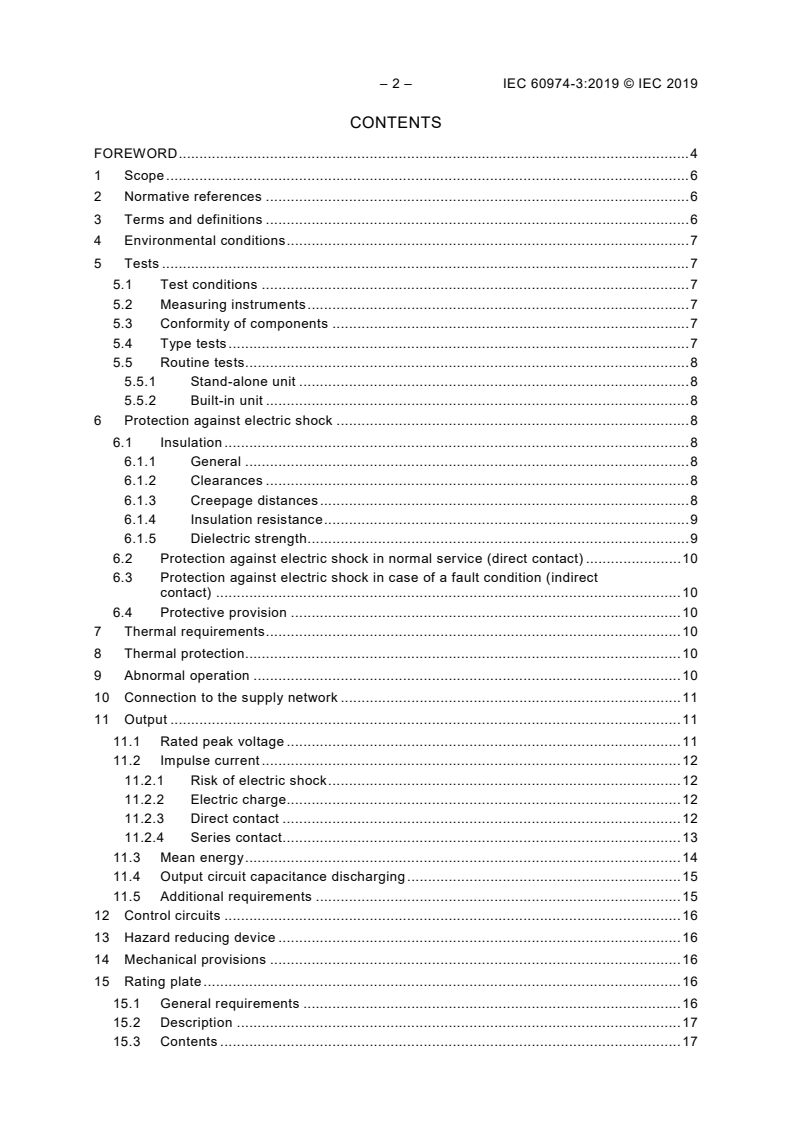
– 2 – IEC 60974-3:2019 © IEC 2019
CONTENTS
FOREWORD . 4
1 Scope . 6
2 Normative references . 6
3 Terms and definitions . 6
4 Environmental conditions . 7
5 Tests . 7
5.1 Test conditions . 7
5.2 Measuring instruments . 7
5.3 Conformity of components . 7
5.4 Type tests . 7
5.5 Routine tests. 8
5.5.1 Stand-alone unit . 8
5.5.2 Built-in unit . 8
6 Protection against electric shock . 8
6.1 Insulation . 8
6.1.1 General . 8
6.1.2 Clearances . 8
6.1.3 Creepage distances . 8
6.1.4 Insulation resistance . 9
6.1.5 Dielectric strength . 9
6.2 Protection against electric shock in normal service (direct contact) . 10
6.3 Protection against electric shock in case of a fault condition (indirect
contact) . 10
6.4 Protective provision . 10
7 Thermal requirements . 10
8 Thermal protection. 10
9 Abnormal operation . 10
10 Connection to the supply network . 11
11 Output . 11
11.1 Rated peak voltage . 11
11.2 Impulse current . 12
11.2.1 Risk of electric shock . 12
11.2.2 Electric charge. 12
11.2.3 Direct contact . 12
11.2.4 Series contact. 13
11.3 Mean energy . 14
11.4 Output circuit capacitance discharging . 15
11.5 Additional requirements . 15
12 Control circuits . 16
13 Hazard reducing device . 16
14 Mechanical provisions . 16
15 Rating plate . 16
15.1 General requirements . 16
15.2 Description . 17
15.3 Contents . 17
16 Adjustment of the output . 18
17 Instructions and markings . 18
17.1 Instructions . 18
17.2 Markings . 18
Annex A (informative) Examples of coupling systems for arc striking and stabilizing
devices . 19
Annex B (informative) Example of a rating plate . 20
Bibliography . 21
Figure 1 – Rated peak voltage . 11
Figure 2 – Measurement of electric charge of impulse current. 12
Figure 3 – Measuring circuit for direct contact . 13
Figure 4 – Measuring circuit for serial contact . 14
Figure 5 – Measurement of mean energy . 15
Figure 6 – Measuring circuit for capacitance discharging . 15
Figure 7 – Rating plate . 17
Figure A.1 – Examples of coupling systems for arc striking and stabilizing devices . 19
Figure B.1 – Stand-alone unit . 20
Table 1 – Minimum clearances and creepage distances for arc striking and stabilizing
circuits . 9
Table 2 – Maximum peak voltages . 11
– 4 – IEC 60974-3:2019 © IEC 2019
INTERNATIONAL ELECTROTECHNICAL COMMISSION
____________
ARC WELDING EQUIPMENT –
Part 3: Arc striking and stabilizing devices
FOREWORD
1) The International Electrotechnical Commission (IEC) is a worldwide organization for standardization comprising
all national electrotechnical committees (IEC National Committees). The object of IEC is to promote
international co-operation on all questions concerning standardization in the electrical and electronic fields. To
this end and in addition to other activities, IEC publishes International Standards, Technical Specifications,
Technical Reports, Publicly Available Specifications (PAS) and Guides (hereafter referred to as “IEC
Publication(s)”). Their preparation is entrusted to technical committees; any IEC National Committee interested
in the subject dealt with may participate in this preparatory work. International, governmental and non-
governmental organizations liaising with the IEC also participate in this preparation. IEC collaborates closely
with the International Organization for Standardization (ISO) in accordance with conditions determined by
agreement between the two organizations.
2) The formal decisions or agreements of IEC on technical matters express, as nearly as possible, an international
consensus of opinion on the relevant subjects since each technical committee has representation from all
interested IEC National Committees.
3) IEC Publications have the form of recommendations for international use and are accepted by IEC National
Committees in that sense. While all reasonable efforts are made to ensure that the technical content of IEC
Publications is accurate, IEC cannot be held responsible for the way in which they are used or for any
misinterpretation by any end user.
4) In order to promote international uniformity, IEC National Committees undertake to apply IEC Publications
transparently to the maximum extent possible in their national and regional publications. Any divergence
between any IEC Publication and the corresponding national or regional publication shall be clearly indicated in
the latter.
5) IEC itself does not provide any attestation of conformity. Independent certification bodies provide conformity
assessment services and, in some areas, access to IEC marks of conformity. IEC is not responsible for any
services carried out by independent certification bodies.
6) All users should ensure that they have the latest edition of this publication.
7) No liability shall attach to IEC or its directors, employees, servants or agents including individual experts and
members of its technical committees and IEC National Committees for any personal injury, property damage or
other damage of any nature whatsoever, whether direct or indirect, or for costs (including legal fees) and
expenses arising out of the publication, use of, or reliance upon, this IEC Publication or any other IEC
Publications.
8) Attention is drawn to the Normative references cited in this publication. Use of the referenced publications is
indispensable for the correct application of this publication.
9) Attention is drawn to the possibility that some of the elements of this IEC Publication may be the subject of
patent rights. IEC shall not be held responsible for identifying any or all such patent rights.
International Standard IEC 60974-3 has been prepared by IEC technical committee 26:
Electric welding.
This fourth edition cancels and replaces the third edition published in 2013 and constitutes a
technical revision.
This edition includes the following significant technical changes with respect to the previous
edition:
• changes induced by the publication of IEC 60974-1:2017;
• reference to IEC 60974-1:2017/AMD1:2019in Clause 2;
• Figure 2 is updated where a subtraction of the proportion of the no-load voltage is shown;
• requirement for safe operation of the arc striking and stabilising devices in the event of
failure, in 11.5;
• requirements for the rating plate as in IEC 60974-1:2017, Clause 15.
The text of this International Standard is based on the following documents:
FDIS Report on voting
26/671/FDIS 26/676/RVD
Full information on the voting for the approval of this International Standard can be found in
the report on voting indicated in the above table.
This document has been drafted in accordance with the ISO/IEC Directives, Part 2.
In this document, the following print types are used:
– conformity statements: in italic type.
– terms used throughout this document which have been defined in Clause 3: SMALL CAPITALS.
This International Standard is to be read in conjunction with IEC 60974-1:2017.
A list of all the parts in the IEC 60974 series, published under the general title Arc welding
equipment, can be found on the IEC website.
The committee has decided that the contents of this document will remain unchanged until the
stability date indicated on the IEC website under "http://webstore.iec.ch" in the data related to
the specific document. At this date, the document will be
• reconfirmed,
• withdrawn,
• replaced by a revised edition, or
• amended.
– 6 – IEC 60974-3:2019 © IEC 2019
ARC WELDING EQUIPMENT –
Part 3: Arc striking and stabilizing devices
1 Scope
This part of IEC 60974 specifies safety requirements for industrial and professional ARC
STRIKING and ARC STABILIZING DEVICES used in arc welding and allied processes.
This document is applicable to ARC STRIKING and STABILIZING DEVICES which are stand-alone
(separate from the welding equipment) or built in (housed in a single enclosure with other arc
welding equipment).
NOTE 1 Typical allied processes are, for example, plasma arc cutting and arc spraying.
NOTE 2 This document does not include electromagnetic compatibility (EMC) requirements.
2 Normative references
The following documents are referred to in the text in such a way that some or all of their
content constitutes requirements of this document. For dated references, only the edition
cited applies. For undated references, the latest edition of the referenced document (including
any amendments) applies.
IEC 60974-1:2017, Arc welding equipment – Part 1: Welding power sources
IEC 60974-1:2017/AMD1:2019
IEC 60974-7:2013, Arc welding equipment – Part 7: Torches
IEC 61140, Protection against electric shock – Common aspects for installation and
equipment
3 Terms and definitions
For the purposes of this document, the terms and definitions given in IEC 60974-1 and
IEC 60974-7 and the following apply.
ISO and IEC maintain terminological databases for use in standardization at the following
addresses:
• IEC Electropedia: available at http://www.electropedia.org/
• ISO Online browsing platform: available at http://www.iso.org/obp
3.1
arc striking device
device which superimposes a voltage on the welding circuit to ignite an arc
3.2
arc stabilizing device
device which superimposes a voltage on the welding circuit to maintain an arc
3.3
arc striking voltage
voltage superimposed on the no-load voltage to ignite an arc
3.4
arc stabilizing voltage
voltage superimposed on the arc voltage to maintain the arc
4 Environmental conditions
As specified in IEC 60974-1:2017, Clause 4.
5 Tests
5.1 Test conditions
As specified in 5.1 of IEC 60974-1:2017.
5.2 Measuring instruments
The accuracy of measuring instruments shall be as follows:
a) electrical measuring instruments: class 1 (±1 % of full-scale reading), except for the
measurement of insulation resistance and dielectric strength where the accuracy of the
measuring instruments is not specified, but shall be taken into account for the
measurement;
b) thermometer: ±2 K;
c) high-voltage probe: ±5 %.
5.3 Conformity of components
As specified in 5.3 of IEC 60974-1:2017/AMD1:2019.
5.4 Type tests
As a condition of conformity, the type tests given below shall be carried out on stand-alone
units in the following sequence with no drying time between f), g) and h):
a) visual inspection, as defined in 3.1.7 of IEC 60974-1:2017;
b) insulation resistance, as specified in 6.1.4 of IEC 60974-1:2017 (preliminary check);
c) enclosure, as specified in 14.2 of IEC 60974-1:2017;
d) handling means, as specified in 14.3 of IEC 60974-1:2017;
e) drop withstand, as specified in 14.4 of IEC 60974-1:2017;
f) protection provided by the enclosure, as specified in 6.2.1 of IEC 60974-1:2017;
g) insulation resistance, as specified in 6.1.4 of IEC 60974-1:2017;
h) dielectric strength, as specified in 6.1.5 of IEC 60974-1:2017;
i) visual inspection, as defined in 3.1.7 of IEC 60974-1:2017.
Rated arc striking and stabilizing peak voltage shall be measured in accordance with 11.1 in
any convenient sequence of type tests but before verifying mechanical provisions.
The other type tests included in this document and not listed here shall be carried out in any
convenient sequence.
– 8 – IEC 60974-3:2019 © IEC 2019
5.5 Routine tests
5.5.1 Stand-alone unit
All routine tests shall be carried out on each stand-alone unit in the following sequence:
a) visual inspection (as defined in 3.1.7 of IEC 60974-1:2017);
b) continuity of the protective circuit (as specified in Clause 10 and, if applicable, 10.5.1 of
IEC 60974-1:2017);
c) dielectric strength (as specified in 6.1.5 of IEC 60974-1:2017);
d) high-voltage circuit test: working voltage shall be applied to high-voltage circuits to
establish insulation integrity as specified by the manufacturer;
NOTE No-load voltage and connection of the return cable, either to the ground circuit or isolated, affects
working voltage.
e) visual inspection (as defined in 3.1.7 of IEC 60974-1:2017).
5.5.2 Built-in unit
The following routine test shall be carried out on each built-in unit in any convenient sequence
for the power source (as specified in 5.5 of IEC 60974-1:2017):
High-voltage circuit test: working voltage shall be applied to high-voltage circuits to
establish insulation integrity as specified by the manufacturer.
NOTE No-load voltage and connection of the return cable, either to the ground circuit or isolated, affects
working voltage.
6 Protection against electric shock
6.1 Insulation
6.1.1 General
Subclause 6.1.1 of IEC 60974-1:2017 applies.
6.1.2 Clearances
The minimum clearances for high-voltage components shall be in accordance with Table 1.
The minimum clearance for other components shall be in accordance with 6.1.2 of
IEC 60974-1:2017.
Conformity shall be checked by measurement and visual inspection.
6.1.3 Creepage distances
The minimum creepage distances for arc striking and stabilizing circuits shall be in
accordance with Table 1. The minimum creepage distances for other components shall be in
accordance with 6.1.3 of IEC 60974-1:2017.
Conformity shall be checked by measurement and visual inspection.
Table 1 – Minimum clearances and creepage distances
for arc striking and stabilizing circuits
a b b
Rated peak voltage Clearance Creepage distance
kV mm mm
3 3 6,3
6 5,5 10
8 8 12,5
10 11 16
12 14 20
15 18 25
18 25 30
20 30 35
NOTE These values apply to circuits which are designed in accordance with 11.3.
a
Rated peak voltage shall be measured in accordance with 11.1.
b
Interpolation is allowed.
6.1.4 Insulation resistance
Subclause 6.1.4 of IEC 60974-1:2017 applies.
6.1.5 Dielectric strength
The output circuit of ARC STRIKING AND STABILIZING DEVICES and the insulation of coupling
components (for example, coupling transformers or coupling capacitors) shall withstand an
arc striking test voltage 20 % higher than the rated peak ARC STRIKING VOLTAGE at the
maximum pulse repetition rate of the device.
Alternatively, an AC test voltage with the same peak value of approximately sine waveform at
50 Hz or 60 Hz may be used for coupling components only. The maximum permissible setting
of the tripping current shall be 100 mA. The high voltage transformer shall deliver the
prescribed voltage up to the tripping current. Tripping is regarded as a flashover or a
breakdown.
NOTE 1 For the operator's safety, the lowest setting of the tripping current (less than or equal to 10 mA) is
typical.
Conformity shall be checked by the following test.
Coupling components intended for use with ARC STRIKING AND STABILIZING VOLTAGES shall be
subjected to the arc striking test voltage or the AC test voltage for 60 s.
NOTE 2 Interference suppression capacitors are not coupling devices.
The output circuit shall be subjected to the arc striking test voltage for 60 s applied between
the point of connection to the welding electrode and
a) exposed conductive parts;
b) other isolated circuits.
Flashover or breakdown shall not occur. Any discharges unaccompanied by a voltage drop
(corona) are disregarded.
NOTE 3 Interference suppression capacitors are subjected to the test of the output circuit.
– 10 – IEC 60974-3:2019 © IEC 2019
6.2 Protection against electric shock in normal service (direct contact)
Subclause 6.2 of IEC 60974-1:2017 applies.
6.3 Protection against electric shock in case of a fault condition (indirect contact)
Stand-alone ARC STRIKING and STABILIZING DEVICES shall be class I or class II equipment in
accordance with IEC 61140, with the exception of the welding circuit.
The output circuit of the ARC STRIKING AND STABILIZING DEVICE shall be electrically isolated from
the public supply system by double or reinforced insulation in accordance with the maximum
rated input voltage. Annex A, Figure A.1 shows examples of coupling systems for ARC
STRIKING AND STABILIZING DEVICES.
Internal conductors and connections shall be secured or positioned as specified in 6.3.3 of
IEC 60974-1:2017.
For class I stand-alone ARC STRIKING AND STABILIZING DEVICE, weighted touch current in the
case of an external protective conductor failure or disconnection shall not exceed the value
specified in 6.3.6 of IEC 60974-1:2017 when energized and not providing the ARC STRIKING
AND STABILIZING VOLTAGE.
Conformity shall be checked by visual inspection and by measurement.
6.4 Protective provision
Connection of exposed conductive parts to the protective conductor is not required if the rated
supply voltage is supplied by the welding circuit or safety extra-low voltage (SELV).
7 Thermal requirements
Current-carrying components, incorporated in the ARC STRIKING AND STABILIZING DEVICE, shall
be capable of carrying the rated welding current as specified by the manufacturer without:
a) exceeding the temperature rating of the current-carrying components;
b) causing the surface temperatures specified in Table 7 of IEC 60974-1:2017 to be
exceeded.
For liquid-cooled apparatus, the test shall be carried out with the minimum flow and the
maximum temperature of the coolant, as recommended by the manufacturer.
Conformity shall be checked by measurement in accordance with 7.2 of IEC 60974-1:2017.
8 Thermal protection
If the ARC STRIKING and STABILIZING DEVICE is designed for use with or built in a specific
welding power source, the thermal protection tests shall be carried out with the welding power
source.
9 Abnormal operation
In the case of a stand-alone ARC STRIKING and STABILIZING DEVICE, the abnormal operation
tests defined in Clause 9 of IEC 60974-1:2017 shall be carried out as applicable.
If the ARC STRIKING and STABILIZING DEVICE is designed for use with a specific welding power
source, the abnormal operation tests shall be conducted with the ARC STRIKING and STABILIZING
DEVICE connected to that welding power source.
The ARC STABILIZING DEVICE shall be short circuited at the output, with neither a torch nor a
return cable connected, until equilibrium is achieved.
ARC STRIKING AND STABILIZING DEVICES protected internally, for example by automatic shut-off,
meet this requirement if the protection device operates before an unsafe condition occurs.
10 Connection to the supply network
Clause 10 of IEC 60974-1:2017 applies.
11 Output
11.1 Rated peak voltage
The rated peak voltage (U ) is obtained by subtraction of the no-load voltage (U ) from the
p 0
measured peak voltage (see Figure 1). To determine the peak, the voltage shall be measured
across a 220 pF capacitor with neither a torch nor a return cable connected.
When reported on the rating plate of ARC STRIKING AND STABILIZING DEVICES, the rated peak
voltage (U ) shall be equal to or greater than the measured peak voltage, but shall not exceed
p
the maximum values given in Table 2.
Figure 1 – Rated peak voltage
Table 2 – Maximum peak voltages
Type of torch Peak voltage
Manually guided 15 kV
Mechanically guided or plasma cutting 20 kV
Conformity shall be checked by measurement with an oscilloscope and a high-voltage probe
with sufficient bandwidth.
– 12 – IEC 60974-3:2019 © IEC 2019
11.2 Impulse current
11.2.1 Risk of electric shock
Depending on the design of an ARC STRIKING AND STABILIZING DEVICE, a risk of electric shock
due to an impulse current can occur under the following situations:
– the human body is in direct contact with the output of the ARC STRIKING AND STABILIZING
(as specified in 11.2.3);
DEVICE
– the human body is in series with the arc gap as part of the welding circuit (as specified in
11.2.4).
11.2.2 Electric charge
Under the conditions described in 11.2.3 and 11.2.4, the maximum electric charge in one
half-cycle of impulse current, regardless of polarity, shall not exceed (see Figure 2):
– 8 µC for equipment intended to be used with manually guided torches;
and
– 15 µC for equipment intended to be used with mechanically guided torches and plasma
cutting torches.
The maximum electric charge
The maximum electric charge
of impulse current
of impulse current
QµC
QµC
U / R
0 B
U / R
0 B
t (µs)
t (µs)
IEC
IEC
a) AC pulse b) DC pulse
Figure 2 – Measurement of electric charge of impulse current
Conformity shall be checked by measurement with an oscilloscope and a high-voltage probe
with sufficient bandwidth.
11.2.3 Direct contact
To simulate the torch capacitance, the value for C shall be:
T
– 220 pF for equipment intended to be used with torches or return cables up to 10 m length;
or
– 1 000 pF for equipment intended to be used with torches or return cables above 10 m
length.
To simulate the body resistance, the value of a non-inductive resistor R shall be:
B
– 1 kΩ for equipment intended to be used in environments without increased hazard of
electric shock or with a mechanically guided torch;
or
I (A)
I (A)
– 500 Ω for equipment intended to be used in environments with increased hazard of electric
shock.
The value of the impulse current is obtained by dividing the value of the measured voltage by
the value of the resistor R .
B
Conformity shall be checked by voltage measurement with an oscilloscope and a high-voltage
probe with sufficient bandwidth, in a circuit as given in Figure 3, with neither a torch nor a
return cable connected. The voltage is obtained by subtraction of the no-load voltage given in
Table 13 of IEC 60974-1:2017 (see Figure 5).
Key
1 Welding or cutting power source 4 High-voltage probe
2 Arc striking and stabilizing device 5 Load as compact, as possible
3 Oscilloscope a Connection lead, as short as possible
Figure 3 – Measuring circuit for direct contact
11.2.4 Series contact
The arc gap (6) (see Figure 4) shall be adjusted to the maximum distance at which flashover
consistently occurs.
To simulate the torch capacitance, the value for C shall be:
T
– 220 pF for equipment intended to be used with torches or return cables up to 10 m in
length;
or
– 1 000 pF for equipment intended to be used with torches or return cables above 10 m in
length.
To simulate the body resistance, the value of a non-inductive resistor R shall be
B
– 1 kΩ for equipment intended to be used in environments without increased hazard of
electric shock or with a mechanically guided torch;
or
– 500 Ω for equipment intended to be used in environments with increased hazard of electric
shock.
The value of the impulse current is obtained by dividing the value of the measured voltage by
.
the value of the resistor R
B
– 14 – IEC 60974-3:2019 © IEC 2019
Conformity shall be checked by voltage measurement with an oscilloscope and a high-voltage
probe with sufficient bandwidth, in a circuit as given in Figure 4, with neither a torch nor a
return cable connected. The voltage is obtained by subtraction of the no-load voltage given in
Table 13 of IEC 60974-1:2017 (see Figure 5).
Key
1 Welding or cutting power source 5 Load, as compact as possible
2 Arc striking and stabilizing device 6 Arc gap
3 Oscilloscope a Connection lead, as short as possible
4 High-voltage probe
Figure 4 – Measuring circuit for serial contact
11.3 Mean energy
The mean energy generated by ARC STRIKING and STABILIZING DEVICES in a non-inductive
resistor, simulating the body resistance shall not exceed during each period of 1 s:
– 4 J for equipment intended to be used with manually guided welding torches;
and
– 20 J for equipment intended to be used with mechanically guided and all plasma cutting
torches.
Conformity shall be checked by testing in accordance with 11.2.
ARC STRIKING AND STABILIZING DEVICES with a mean energy below 4 J are considered as energy
limited for all parts of IEC 60974.
The ARC STRIKING AND STABILIZING VOLTAGE is obtained by subtraction of the no-load voltage
given in Table 13 of IEC 60974-1:2017 (see Figure 5).
NOTE The value of the mean energy is obtained by dividing the squared value of the measured voltage by the
value of the resistor R and integrating the result over 1 s.
B
Figure 5 – Measurement of mean energy
11.4 Output circuit capacitance discharging
One second after the ARC STRIKING AND STABILIZING DEVICE output is cut off or disabled, the
output voltage shall not exceed 113 V DC.
Conformity shall be checked by measurement of the voltage in a circuit as indicated in
Figure 6 by an oscilloscope and a high-voltage probe.
Key
1 Welding or cutting power source 4 High-voltage probe
2 Arc striking and stabilizing device 5 Load, as compact as possible
3 Oscilloscope a Connection lead, as short as possible
Figure 6 – Measuring circuit for capacitance discharging
To simulate the torch capacitance, the value for C shall be:
T
– 220 pF for equipment intended to be used with torches or return cables up to 10 m in
length;
or
– 1 000 pF for equipment intended to be used with torches or return cables above 10 m in
length.
11.5 Additional requirements
ARC STRIKING AND STABILIZING DEVICES shall be designed to ensure that the output limits as
specified in 11.1 through 11.4 are not exceeded in the event of failure of any component.
– 16 – IEC 60974-3:2019 © IEC 2019
The following conditions are considered and, if necessary, applied one at a time,
consequential faults being taken into consideration:
a) open-circuit at the terminal of any component;
b) short-circuit of capacitors, unless they comply with IEC 60384-14;
c) short-circuit of any two terminals of an electronic component, other than a monolithic
integrated circuit. This fault is not applied between the two circuits of an optocoupler;
d) failure of triacs in the diode mode;
e) failure of a monolithic integrated circuit or other circuits that cannot be assessed by the
fault conditions a) to d). In this case, the possible hazardous situations of the ARC STRIKING
and STABILIZING DEVICE are assessed to ensure that safety does not rely on the correct
functioning of such a component. All possible output signals are considered under fault
conditions within the integrated circuit. If it can be shown that a particular output signal is
unlikely to occur, then the relevant fault is not considered.
Components such as thyristors and triacs are not subjected to fault condition e).
Positive temperature coefficient resistors (PTCs) are not short-circuited if they are used within
their manufacturer’s declared specification.
The test is conducted until failure or until one of the following occurs:
– thermal equilibrium is achieved; or
– the test samples return to within 5 K of the ambient temperature; or
– a test period of 3 h has elapsed.
NOTE Examination of the welding power source and its circuit diagram will reveal the fault conditions which have
to be simulated through circuit analysis, so that testing can be limited to those cases which are expected to give
the most unfavourable result.
Conformity shall be checked by a fault simulation or by analysing the circuit diagram.
12 Control circuits
Clause 12 of IEC 60974-1:2017 applies.
13 Hazard reducing device
Not applicable.
14 Mechanical provisions
Only applicable for stand-alone units as specified in Clause 14 of IEC 60974-1:2017.
15 Rating plate
15.1 General requirements
Subclause 15.1 of IEC 60974 1:2017 applies.
15.2 Description
The rating plate shall be divided into three sections:
a) identification of the stand-alone ARC STRIKING AND STABILIZING DEVICE;
b) output of the ARC STRIKING AND STABILIZING DEVICE;
c) energy supply of the stand-alone ARC STRIKING AND STABILIZING DEVICE.
The arrangement and sequence of the data shall comply with the principle shown in Figure 7
(for an example, see Annex B).
The dimensions of the rating plate are not specified and may be chosen freely.
In the case of built-in ARC STRIKING AND STABILIZING DEVICE, box 5 of Figure 7 shall be added to
the rating plate of the welding power source, as specified in Clause 15 of IEC 60974-1:2017.
a) Identification
1) 2)
3) 4)
b) Output
5)
6a) 6b) 6c)
6)
X
7a) 7b) 7c)
7)
I
c) Energy supply
9) 10)
8)
11) 12)
Optional If applicable
IEC
Figure 7 – Rating plate
15.3 Contents
a) Identification
Box 1 Name and address of the manufacturer or distributor or importer and, optionally,
a trade mark and the country of origin, if required.
Box 2 Type (identification) as given by the manufacturer.
Box 3 Traceability of design and manufacturing data, for example, serial number.
Box 4 Reference to IEC 60974-3 confirming that the ARC STRIKING AND STABILIZING
DEVICE complies with its requirements.
b) Output of arc striking and stabilizing device
Box 5 U Rated peak voltage.
P
Box 6 X … % Duty cycle, if applicable.
Box 7 I Rated welding current, if applicable.
– 18 – IEC 60974-3:2019 © IEC 2019
c) Energy supply
Box 8 [IEC 60417-5939:2002-10] Energy supply symbol,
number of phases (for example, 1 or 3), symbol for
alternating current ~ and the rated frequency (for
example, 50 Hz or 60 Hz).
Box 9 U . V Rated supply voltage.
Box 10 I . A Rated maximum supply current.
1max
Box 11 IP Degree of protection, for example, IP 21 or IP 23.
Box 12 [IEC 60417-5172:2003-02] Symbol for class II
equipment, if applicable.
Conformity shall be checked by visual inspection and by checking the complete data.
16 Adjustment of the output
Clause 16 of IEC 60974-1:2017 applies.
17 Instructions and markings
17.1 Instructions
Subclause 17.1 of IEC 60974-1:2017 applies, with the addition of the following requirement.
The manufacturer shall state in the instructions:
– the rated peak voltage;
– if the ARC STRIKING AND STABILIZING DEVICE is designed for manual or mechanically guided
operation.
If the use of longer torch or return cables increases the risk of electric shock (limits are
specified in Clause 11) due to an impulse current, the manufacturer shall specify the
maximum length (in m) and torch type. The following warning shall be given:
Warning: Increasing the length of torch or return cables more than manufacturer maximum
specified length will increase the risk of electric shock.
17.2 Markings
Only applicable for stand-alone units; subclause 17.2 of IEC 60974-1:2017 applies.
Annex A
(informative)
Examples of coupling systems for
arc striking and stabilizing devices
Figure A.1 gives examples of coupling systems for ARC STRIKING and STABILIZING DEVICES.
a) b)
c) d)
Key
1 Welding or cutting power source 5 Voltage generator
2 Arc striking and stabilizing device 6 Choke
3 Output 7 Input coupling winding
4 Voltage supply 8 Blocking diode
Figure A.1 – Examples of coupling systems for
arc striking and stabilizing devices
– 20 – IEC 60974-3:2019 © IEC 2019
Annex B
(informative)
Example of a rating plate
Figure B.1 gives an example of a stand-alone unit.
a) Identification
1) 2)
Manufacturer Type
3) 4)
Serial number IEC 60974-3
b) Output
5)
U = 8,5 kV
p
6)
6a) 6b) 6c)
X
35 % 60 % 100 %
7)
7a) 7b) 7c)
I
2 300 A 220 A 180 A
c) Energy input
9) 10)
U = 230 V I = 0,5 A
1 1
11)
8)
10)
IP23
1 ~ 50 Hz
IEC
Figure B.1 – Stand-alone unit
Bibliography
IEC 60974 (all parts), Arc welding equipment
IEC TS 60479-2, Effects of current on human beings and livestock – Part 2: Special aspects
IEC 60384-14,
...