

IEC 61784-5-3:2007
(Main)Industrial communication networks - Profiles - Part 5-3: Installation of fieldbuses - Installation profiles for CPF 3
General Information
- Abstract
IEC 61784-5-3:2007 specifies the installation profiles for CPF 3 (PROFIBUS/PROFINET). The installation profiles are specified in the annexes. These annexes are read in conjunction with IEC 61918:2007. This bilingual version (2014-12) corresponds to the English version, published in 2007-12.
- Status
- Published
- Publication Date
- 13-Dec-2007
- Technical Committee
- SC 65C - Industrial networks
- Drafting Committee
- JWG 10 - TC 65/SC 65C/JWG 10
- Current Stage
- DELPUB - Deleted Publication
- Start Date
- 22-Jul-2010
- Completion Date
- 28-Aug-2026
Buy Documents


IEC 61784-5-3:2007 - Industrial communication networks - Profiles - Part 5-3: Installation of fieldbuses - Installation profiles for CPF 3 Released:12/14/2007


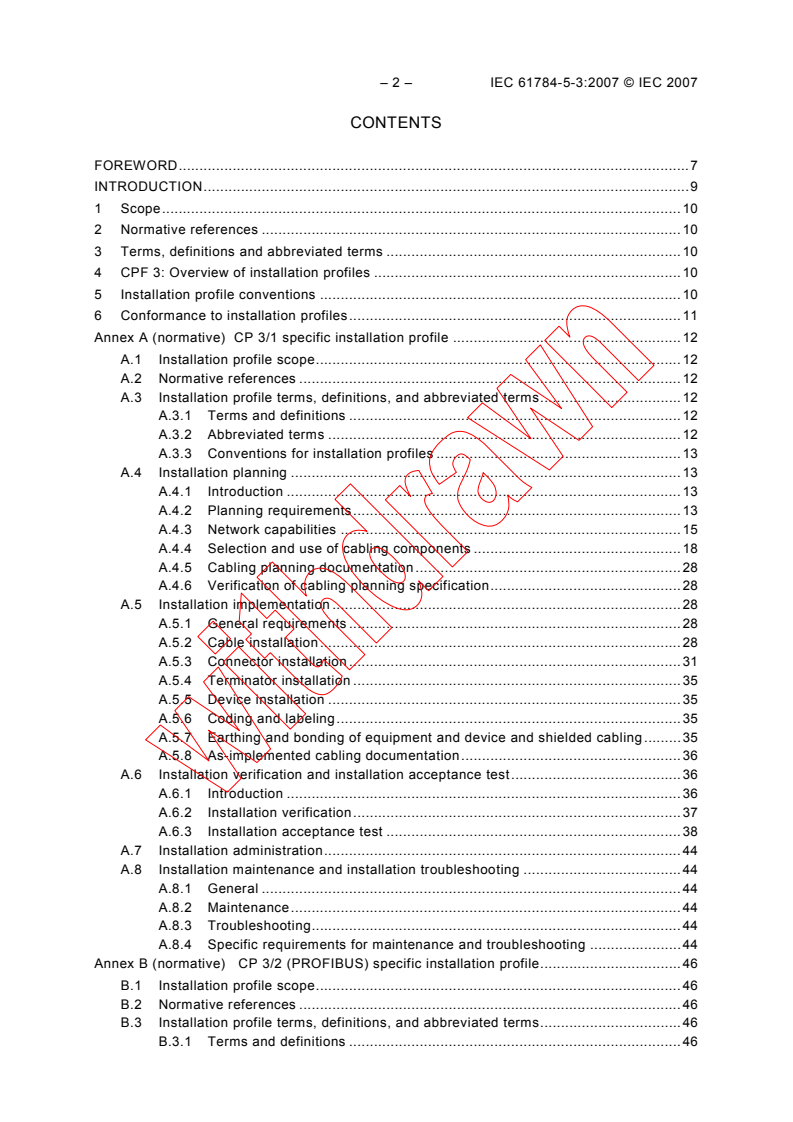
IEC 61784-5-3:2007 - Industrial communication networks - Profiles - Part 5-3: Installation of fieldbuses - Installation profiles for CPF 3 Released:12/14/2007
Overview
IEC 61784-5-3:2007 - "Industrial communication networks – Profiles – Part 5-3: Installation of fieldbuses – Installation profiles for CPF 3" specifies installation profiles for CPF 3 (PROFIBUS/PROFINET) fieldbuses. The standard defines normative annexes covering CP 3/1, CP 3/2 (PROFIBUS) and CP 3/3–3/6 (PROFINET) installation requirements and is intended to be read in conjunction with IEC 61918:2007. This bilingual (2014-12) release corresponds to the English edition published in 2007.
Key topics
- Installation planning: planning requirements, network capabilities, cabling strategies and documentation requirements for CPF 3 topologies.
- Cabling and components: selection and use of copper and optical fibre cables, connector types, splice/termination practices, and connector pin assignments.
- Installation implementation: cable routing, connector and terminator installation, device mounting, coding/labeling, and earthing & bonding of devices and shielded cabling.
- Verification and acceptance testing: installation verification procedures, acceptance tests and parameters to confirm conformance to CPF 3 profiles.
- Administration and maintenance: documentation of “as-implemented” cabling, installation administration, maintenance practices and troubleshooting guidance.
- Annexed detail and tables: normative annexes include tables with network characteristics, cable parameters (balanced and optical), connector assignments, maximum lengths, and environment/EMC guidance.
Practical applications
IEC 61784-5-3 provides actionable guidance for the physical installation of PROFIBUS and PROFINET fieldbuses in industrial automation systems. Typical applications include:
- Plant wiring design for process and discrete manufacturing lines.
- On-site installation and commissioning of PROFIBUS/PROFINET networks.
- Acceptance testing and verification of fieldbus cabling and terminations.
- Maintenance and troubleshooting of industrial communication links.
Who uses it:
- System integrators and control engineers
- Electrical and instrumentation contractors
- Cabling designers and facility engineers
- OEMs and device manufacturers implementing CPF 3 profiles
- Inspection, compliance, and certification bodies
Related standards
- IEC 61918:2007 (referenced for installation details)
- ISO/IEC standards for Ethernet cabling (e.g., ISO/IEC 8802-3) and other IEC 61784 parts (profiles) - useful for broader industrial communication network design and interoperability.
For precise test values, connector pinouts and parameter tables, consult the full IEC 61784-5-3 document and the latest IEC catalog to ensure compliance with current editions and corrigenda.
Relations
- Effective Date
- 05-Sep-2023
- Effective Date
- 05-Sep-2023
Buy Documents
IEC 61784-5-3:2007 - Industrial communication networks - Profiles - Part 5-3: Installation of fieldbuses - Installation profiles for CPF 3 Released:12/14/2007
IEC 61784-5-3:2007 - Industrial communication networks - Profiles - Part 5-3: Installation of fieldbuses - Installation profiles for CPF 3 Released:12/14/2007
Get Certified
Connect with accredited certification bodies for this standard

BSI Group
BSI (British Standards Institution) is the business standards company that helps organizations make excellence a habit.

DVS-ZERT GmbH
German welding certification society.
CARES (UK Certification Authority for Reinforcing Steels)
UK certification for reinforcing steels and construction.
Sponsored listings
Frequently Asked Questions
IEC 61784-5-3:2007 is a standard published by the International Electrotechnical Commission (IEC). Its full title is "Industrial communication networks - Profiles - Part 5-3: Installation of fieldbuses - Installation profiles for CPF 3". This standard covers: IEC 61784-5-3:2007 specifies the installation profiles for CPF 3 (PROFIBUS/PROFINET). The installation profiles are specified in the annexes. These annexes are read in conjunction with IEC 61918:2007. This bilingual version (2014-12) corresponds to the English version, published in 2007-12.
IEC 61784-5-3:2007 specifies the installation profiles for CPF 3 (PROFIBUS/PROFINET). The installation profiles are specified in the annexes. These annexes are read in conjunction with IEC 61918:2007. This bilingual version (2014-12) corresponds to the English version, published in 2007-12.
IEC 61784-5-3:2007 is classified under the following ICS (International Classification for Standards) categories: 25.040.40 - Industrial process measurement and control; 35.100.05 - Multilayer applications. The ICS classification helps identify the subject area and facilitates finding related standards.
IEC 61784-5-3:2007 has the following relationships with other standards: It is inter standard links to IEC 61784-5-3:2007/COR1:2009, IEC 61784-5-3:2010. Understanding these relationships helps ensure you are using the most current and applicable version of the standard.
IEC 61784-5-3:2007 is available in PDF format for immediate download after purchase. The document can be added to your cart and obtained through the secure checkout process. Digital delivery ensures instant access to the complete standard document.
Standards Content (Sample)
IEC 61784-5-3
Edition 1.0 2007-12
INTERNATIONAL
STANDARD
Industrial communication networks – Profiles –
Part 5-3: Installation of fieldbuses – Installation profiles for CPF 3
All rights reserved. Unless otherwise specified, no part of this publication may be reproduced or utilized in any form
or by any means, electronic or mechanical, including photocopying and microfilm, without permission in writing from
either IEC or IEC's member National Committee in the country of the requester.
If you have any questions about IEC copyright or have an enquiry about obtaining additional rights to this publication,
please contact the address below or your local IEC member National Committee for further information.
IEC Central Office
3, rue de Varembé
CH-1211 Geneva 20
Switzerland
Email: inmail@iec.ch
Web: www.iec.ch
About the IEC
The International Electrotechnical Commission (IEC) is the leading global organization that prepares and publishes
International Standards for all electrical, electronic and related technologies.
About IEC publications
The technical content of IEC publications is kept under constant review by the IEC. Please make sure that you have the
latest edition, a corrigenda or an amendment might have been published.
ƒ Catalogue of IEC publications: www.iec.ch/searchpub
The IEC on-line Catalogue enables you to search by a variety of criteria (reference number, text, technical committee,…).
It also gives information on projects, withdrawn and replaced publications.
ƒ IEC Just Published: www.iec.ch/online_news/justpub
Stay up to date on all new IEC publications. Just Published details twice a month all new publications released. Available
on-line and also by email.
ƒ Electropedia: www.electropedia.org
The world's leading online dictionary of electronic and electrical terms containing more than 20 000 terms and definitions
in English and French, with equivalent terms in additional languages. Also known as the International Electrotechnical
Vocabulary online.
ƒ Customer Service Centre: www.iec.ch/webstore/custserv
If you wish to give us your feedback on this publication or need further assistance, please visit the Customer Service
Centre FAQ or contact us:
Email: csc@iec.ch
Tel.: +41 22 919 02 11
Fax: +41 22 919 03 00
IEC 61784-5-3
Edition 1.0 2007-12
INTERNATIONAL
STANDARD
Industrial communication networks – Profiles –
Part 5-3: Installation of fieldbuses – Installation profiles for CPF 3
INTERNATIONAL
ELECTROTECHNICAL
COMMISSION
PRICE CODE
XE
ICS 35.100.05 25.040.40 ISBN 2-8318-9403-4
– 2 – 61784-5-3 © 2007:IEC(E)
CONTENTS
FOREWORD.7
INTRODUCTION.9
1 Scope.10
2 Normative references .10
3 Terms, definitions and abbreviated terms .10
4 CPF 3: Overview of installation profiles .10
5 Installation profile conventions .10
6 Conformance to installation profiles.11
Annex A (normative) CP 3/1 specific installation profile .12
A.1 Installation profile scope.12
A.2 Normative references .12
A.3 Installation profile terms, definitions, and abbreviated terms.12
A.3.1 Terms and definitions .12
A.3.2 Abbreviated terms .12
A.3.3 Conventions for installation profiles .13
A.4 Installation planning .13
A.4.1 Introduction .13
A.4.2 Planning requirements.13
A.4.3 Network capabilities .15
A.4.4 Selection and use of cabling components .18
A.4.5 Cabling planning documentation.28
A.4.6 Verification of cabling planning specification.28
A.5 Installation implementation .28
A.5.1 General requirements .28
A.5.2 Cable installation.28
A.5.3 Connector installation.31
A.5.4 Terminator installation .35
A.5.5 Device installation .35
A.5.6 Coding and labeling.35
A.5.7 Earthing and bonding of equipment and device and shielded cabling.35
A.5.8 As-implemented cabling documentation.36
A.6 Installation verification and installation acceptance test.36
A.6.1 Introduction .36
A.6.2 Installation verification.37
A.6.3 Installation acceptance test .38
A.7 Installation administration.44
A.8 Installation maintenance and installation troubleshooting .44
A.8.1 General .44
A.8.2 Maintenance.44
A.8.3 Troubleshooting.44
A.8.4 Specific requirements for maintenance and troubleshooting .44
Annex B (normative) CP 3/2 (PROFIBUS) specific installation profile.46
B.1 Installation profile scope.46
B.2 Normative references .46
B.3 Installation profile terms, definitions, and abbreviated terms.46
B.3.1 Terms and definitions .46
B.3.2 Abbreviated terms .47
61784-5-3 © 2007:IEC(E) – 3 –
B.3.3 Conventions for installation profiles .47
B.4 Installation planning .48
B.4.1 Introduction .48
B.4.2 Planning requirements.49
B.4.3 Network capabilities .57
B.4.4 Selection and use of cabling components .62
B.4.5 Cabling planning documentation.77
B.4.6 Verification of cabling planning specification.77
B.5 Installation implementation .77
B.5.1 General requirements .78
B.5.2 Cable installation.78
B.5.3 Connector installation.79
B.5.4 Terminator installation .80
B.5.5 Device installation .80
B.5.6 Coding and labelling .80
B.5.7 Earthing and bonding of equipment and device and shielded cabling.80
B.5.8 As-implemented cabling documentation.80
B.6 Installation verification and installation acceptance test.80
B.6.1 Introduction .80
B.6.2 Installation verification.80
B.6.3 Installation acceptance test .81
B.7 Installation administration.82
B.8 Installation maintenance and installation troubleshooting .82
Annex C (normative) CP 3/3, CP 3/4, CP 3/5, CP 3/6 (PROFINET) specific installation
profile.83
C.1 Installation profile scope.83
C.2 Normative references .83
C.3 Installation profile terms, definitions, and abbreviated terms.83
C.3.1 Terms and definitions .83
C.3.2 Abbreviated terms .83
C.3.3 Conventions for installation profiles .83
C.4 Installation planning .83
C.4.1 Introduction .83
C.4.2 Planing requirements.84
C.4.3 Network capabilities .84
C.4.4 Selection and use of cabling components .88
C.4.5 Cabling planning documentation. 101
C.4.6 Verification of cabling planning specification.101
C.5 Installation implementation .101
C.5.1 General requirements .101
C.5.2 Cable installation.101
C.5.3 Connector Installation.104
C.5.4 Terminator installation .105
C.5.5 Device installation .105
C.5.6 Coding and labeling.105
C.5.7 Earthing and bonding of equipment and device and shielded cabling.105
C.5.8 As-implemented cabling documentation. 106
C.6 Installation verification and installation acceptance test. 106
C.6.1 Introduction .106
C.6.2 Installation verification.106
– 4 – 61784-5-3 © 2007:IEC(E)
C.6.3 Installation acceptance test .108
C.7 Installation administration.109
C.8 Installation maintenance and installation troubleshooting . 109
Bibliography.110
Table A.1 – Excerpt of MICE definition.15
Table A.2 – Basic network characteristics for balanced cabling not based on Ethernet
(ISO/IEC 8802-3) .16
Table A.3 – Network characteristics for optical fibre cabling.17
Table A.4 – Information relevant to copper cable: fixed cables.19
Table A.5 – Information relevant to optical fibre cables .20
Table A.6 – Connectors for copper cabling CPs not based on Ethernet.21
Table A.7 – Optical fibre connecting hardware .21
Table A.8 – Parameters for balanced cables.29
Table A.9 – Parameters for silica optical fibre cables .29
Table A.10 – Parameters for POF optical fibre cables .29
Table A.11 – Parameters for hard cladded silica optical fibre cables .30
Table A.12 – Use of 9 pin Sub-D connector pins (RS 485) .32
Table A.13 – Use of 9 pin Sub-D connector pins (RS 485-IS).33
Table A.14 – Use of M12 connecotor pins (RS 485) .34
Table A.15 – Use of M12 connector pins (RS 485-IS) .35
Table A.16 – Maximum fibre channel attenuation for CP 3/1 (PROFIBUS) .44
Table B.1 – Valid parameter range of the FISCO model for use as EEx ib IIC / IIB.54
Table B.2 – Valid parameter range of the FISCO model for use as EEx ia IIC .54
Table B.3 – Power supply (operational values) .60
Table B.4 – Minimum line lengths which can be achieved .60
Table B.5 – Limit values for distortion, reflection and signal delay.61
Table B.6 – Recommended maximum cable lengths including spurs .61
Table B.7 – Recommended length of the spurs .62
Table B.8 – Maximum length of the splices .62
Table B.9 – Information relevant to copper cable: fixed cables.63
Table B.10 – Safety limit values for the fieldbus cable .64
Table B.11 – Connectors for copper cabling CPs not based on Ethernet.65
Table B.12 – Mixing devices from different categories .67
Table B.13 – Electrical characteristics of fieldbus interfaces .68
Table B.14 – Recommended data sheet specifications for CP 3/2 devices .69
Table B.15 – Parameters for balanced cables .78
Table B.16 – Contact assignments for the external connector for harsh industrial
environments .79
Table C.1 – General transmission media selection information .85
Table C.2 – Network characteristics for balanced cabling based on Ethernet
(ISO/IEC 8802-3) .86
Table C.3 – Network characteristics for optical fibre cabling .87
Table C.4 – Information relevant to copper cable: CP 3/3, CP 3/4, CP 3/5 and CP 3/6
type A fixed cables .88
61784-5-3 © 2007:IEC(E) – 5 –
Table C.5 – Information relevant to copper cable: CP 3/3, CP 3/4, CP 3/5 and CP 3/6
type B fixed cables .89
Table C.6 – Information relevant to copper cable: CP 3/3, CP 3/4, CP 3/5 and CP 3/6
type C fixed cables .89
Table C.7 – Information relevant to optical fibre cables.90
Table C.8 – Requirements for plastic and polymer cladded optical fibre cables.91
Table C.9 – Requirements for glass multimode optical fibre cables .92
Table C.10 – Requirements for glass singlemode optical fibre cables .93
Table C.11 – Information relevant to hybrid cables .94
Table C.12 – Connectors for balanced cabling CPs based on Ethernet .95
Table C.13 – Optical fibre connecting hardware .95
Table C.14 – typical fibre channels common for industrial applications. .98
Table C.15 – Parameters for balanced cables.102
Table C.16 – Parameters for silica optical fibre cables.102
Table C.17 – Parameters for POF optical fibre cables.102
Table C.18 – Parameters for hard cladded silica optical fibre cables. 103
Table C.19 – colour coding for CP 3/3, CP 3/4, CP 3/5 and CP 3/6 connectors . 104
Table C.20 – Maximum fibre channel attenuation for CP 3/3, CP 3/4, CP 3/5 and
CP 3/6 (PROFINET).108
Figure 1 – Standards relationships.9
Figure A.1 – Recommended combination of shielding and earthing for CP 3/1 networks
with RS 485-IS.26
Figure A.2 – Sub-D connector pin numberings .32
Figure A.3 – 5-pin M-12 female socket.33
Figure A.4 – 5 pins M-12 male plug for CP 3/1.34
Figure A.5 – Test circuit A - resistance measurement of data line B and shield.39
Figure A.6 – Test circuit B - resistance measurement of data line A and shield.39
Figure A.7 – Test circuit C - resistance measurement of data line A, data line B, and
shield.40
Figure A.8 – Test circuit D - resistance measurement between data line A and B .40
Figure A.9 – Resistance measurement without 9-pin Sub-D plug .40
Figure A.10 – Loop core resistance (cable type A) .41
Figure A.11 – Action and resolution tree for measurement 1 (RS 485 and RS 485-IS) .42
Figure A.12 – Action and resolution tree for measurement 2 (RS 485 and RS 485-IS) .43
Figure A.13 – Action and resolution tree for measurement 3 (RS 485 and RS 485-IS) .43
Figure B.1 – Connection of CP 3/1 networks.49
Figure B.2 – Typical fieldbus architecture .52
Figure B.3 – Fieldbus with stations supplied by auxiliary power sources .52
Figure B.4 – Fieldbus model .56
Figure B.5 – Current modulation (Manchester II code) .56
Figure B.6 – CP 3/2 topology .57
Figure B.7 – Bus topology.58
Figure B.8 – Combination of the tree topology and the bus topology .58
Figure B.9 – Fieldbus extension.59
Figure B.10 – Recommended combination of shielding and earthing.72
– 6 – 61784-5-3 © 2007:IEC(E)
Figure B.11 – Ideal combination of shielding and earthing .73
Figure B.12 – Capacitive grounding .74
Figure B.13 – Galvanic isolated field device.76
Figure B.14 – Pin assignment of the male and female connectors IEC 60947-5-2 (A-
coding) .80
Figure C.1 – End-to-end link without interconnections.96
Figure C.2 – Assembled end-to-end link .96
Figure C.3 – Connectionless optical fibre link .97
Figure C.4 – Assembled optical fibre link .97
Figure C.5 – Shielded connectors for CP 3/3, CP 3/4, CP 3/5 and CP 3/6 fieldbus
networks .104
Figure C.6 – Pin-assignment for a straight cable.104
61784-5-3 © 2007:IEC(E) – 7 –
INTERNATIONAL ELECTROTECHNICAL COMMISSION
____________
INDUSTRIAL COMMUNICATION NETWORKS – PROFILES
Part 5-3: Installation of fieldbuses – Installation profiles for CPF 3
FOREWORD
1) The International Electrotechnical Commission (IEC) is a worldwide organization for standardization comprising
all national electrotechnical committees (IEC National Committees). The object of IEC is to promote
international co-operation on all questions concerning standardization in the electrical and electronic fields. To
this end and in addition to other activities, IEC publishes International Standards, Technical Specifications,
Technical Reports, Publicly Available Specifications (PAS) and Guides (hereafter referred to as “IEC
Publication(s)”). Their preparation is entrusted to technical committees; any IEC National Committee interested
in the subject dealt with may participate in this preparatory work. International, governmental and non-
governmental organizations liaising with the IEC also participate in this preparation. IEC collaborates closely
with the International Organization for Standardization (ISO) in accordance with conditions determined by
agreement between the two organizations.
2) The formal decisions or agreements of IEC on technical matters express, as nearly as possible, an international
consensus of opinion on the relevant subjects since each technical committee has representation from all
interested IEC National Committees.
3) IEC Publications have the form of recommendations for international use and are accepted by IEC National
Committees in that sense. While all reasonable efforts are made to ensure that the technical content of IEC
Publications is accurate, IEC cannot be held responsible for the way in which they are used or for any
misinterpretation by any end user.
4) In order to promote international uniformity, IEC National Committees undertake to apply IEC Publications
transparently to the maximum extent possible in their national and regional publications. Any divergence
between any IEC Publication and the corresponding national or regional publication shall be clearly indicated in
the latter.
5) IEC provides no marking procedure to indicate its approval and cannot be rendered responsible for any
equipment declared to be in conformity with an IEC Publication.
6) All users should ensure that they have the latest edition of this publication.
7) No liability shall attach to IEC or its directors, employees, servants or agents including individual experts and
members of its technical committees and IEC National Committees for any personal injury, property damage or
other damage of any nature whatsoever, whether direct or indirect, or for costs (including legal fees) and
expenses arising out of the publication, use of, or reliance upon, this IEC Publication or any other IEC
Publications.
8) Attention is drawn to the Normative references cited in this publication. Use of the referenced publications is
indispensable for the correct application of this publication.
9) Attention is drawn to the possibility that some of the elements of this IEC Publication may be the subject of
patent rights. IEC shall not be held responsible for identifying any or all such patent rights.
International Standard IEC 61784-5-3 has been prepared by subcommittee 65C: Industrial
networks, of IEC technical committee 65: Industrial-process measurement, control and
automation.
This standard is to be used in conjunction with IEC 61918:2007.
The text of this standard is based on the following documents:
FDIS Report on voting
65C/471/FDIS 65C/482/RVD
Full information on the voting for the approval of this standard can be found in the report on
voting indicated in the above table.
This publication has been drafted in accordance with the ISO/IEC Directives, Part 2.
– 8 – 61784-5-3 © 2007:IEC(E)
A list of all parts of the IEC 61784-5 series, under the general title Industrial communication
networks – Profiles – Installation of fieldbuses, can be found on the IEC website.
The committee has decided that the contents of this publication will remain unchanged until
the maintenance result date indicated on the IEC web site under "http://webstore.iec.ch" in
the data related to the specific publication. At this date, the publication will be
• reconfirmed,
• withdrawn,
• replaced by a revised edition, or
• amended.
The contents of the corrigendum of February 2009 have been included in this copy.
61784-5-3 © 2007:IEC(E) – 9 –
INTRODUCTION
This International Standard is one of a series produced to facilitate the use of communication
networks in industrial control systems.
IEC 61918:2007 (Ed. 1.0) provides the common requirements for the installation of
communication networks in industrial control systems. This installation profile standard
provides the installation profiles of the communication profiles (CP) of a specific
communication profile family (CPF) by stating which requirements of IEC 61918 fully apply
and, where necessary, by supplementing, modifying, or replacing the other requirements (see
Figure 1).
For general background on fieldbuses, their profiles, and relationship between the installation
profiles specified in this standard, see IEC/TR 61158-1.
Each CP installation profile is specified in a separate annex of this standard. Each annex is
structured exactly as the reference standard IEC 61918 for the benefit of the persons
representing the roles in the fieldbus installation process as defined in IEC 61918 (planner,
installer, verification personnel, validation personnel, maintenance personnel, administration
personnel). By reading the installation profile in conjunction with IEC 61918, these persons
immediately know which requirements are common for the installation of all CPs and which
are modified or replaced. The conventions used to draft this standard are defined in Clause 5.
The provision of the installation profiles in one standard for each CPF (for example
IEC 61784-5-3 for CPF 3), allows readers to work with standards of a convenient size.
DEDEDEDESSSSIIIIGGGGNNNN PPLLAANNINNINGNG,, E ETTC.C.
GGEENENERIC RIC
OFOFFFIICCE PE PRREMEMISISESES
CACABBLLIINNGG
ISISOO/IE/IECC 1180111801
ISISOO/IE/IECC
14763-14763-22
BEBETWTWEEEENN
AUTAUTOOMMAATTIOIONN ISISOO/IE/IECC 2470224702
ISISLLAANDNDSS
BEBETWTWEEEENN
IEIEC 61784C 61784--5 5
AUTAUTOOMMAATTIOIONN
IEIEC 619C 6191818
ININDDUUSSTTRRIIAALL PR PREMEMISISESES IEC 6IEC 61158 1158
serseriesies
ISISLLAANDNDSS
serseriesies
InInststallatallatioionn
anandd
prprofofiilleess
((CoCommmmonon
WITWITHHININ
IEC 617IEC 61784-84-1,1, - -22 ((SSelelectectiion +on +
rreequiquirreemmeentntss))
AUTAUTOOMMAATTIOIONN
Add/Add/ReReplpl//MMod)od)
ISISLLAANDNDSS
CoCommmmon ston strruuctctururee
AAPPLPPLICICAATTIIOONN--SPSPECECIFIFICIC
CACABBLLIINNGG
Figure 1 – Standards relationships
– 10 – 61784-5-3 © 2007:IEC(E)
INDUSTRIAL COMMUNICATION NETWORKS – PROFILES
Part 5-3: Installation of fieldbuses – Installation profiles for CPF 3
1 Scope
This part of IEC 61784 specifies the installation profiles for CPF 3 (PROFIBUS/PROFINET) .
The installation profiles are specified in the annexes. These annexes are read in conjunction
with IEC 61918:2007.
2 Normative references
The following referenced documents are indispensable for the application of this document.
For dated references, only the edition cited applies. For undated references, the latest edition
of the referenced document (including any amendments) applies.
IEC 61918:2007, Industrial communication networks – Installation of communication networks
in industrial premises
The normative references of IEC 61918:2007, Clause 2, apply. For profile specific normative
A.2, B.2, and C.2.
references, see
3 Terms, definitions and abbreviated terms
For the purpose of this document, the terms, definitions and abbreviated terms of
IEC 61918:2007, Clause 3, apply. For profile specific terms, definitions and abbreviated terms
see A.3, B.3, and C.3.
4 CPF 3: Overview of installation profiles
CPF 3 consists of six CPs as specified in IEC 61784-1 and IEC 61784-2.
The installation requirements for CP 3/1 (PROFIBUS with physical layer according to RS 485,
RS 485-IS, and fibre) are specified in Annex A.
The installation requirements for CP 3/2 (PROFIBUS with physical layer according to MBP,
MBP-IS, MBP-LP) are specified in Annex B.
The installation requirements for CP 3/3, CP 3/4, CP 3/5, and CP 3/6 (PROFINET) are
specified in Annex C.
5 Installation profile conventions
The numbering of the clauses and subclauses in the annexes of this standard corresponds to
the numbering of IEC 61918:2007 main clauses and subclauses.
PROFIBUS and PROFINET are trade names of the non-profit organization PROFIBUS Nutzerorganisation e.V. (PNO). This
information is given for the convenience of users of this International Standard and does not constitute an endorsement by IEC
of the trade names holder or any of its products. Compliance to this profile does not require use of the trade names. Use of the
trade names PROFIBUS and PROFINET requires permission of the trade name holder.
61784-5-3 © 2007:IEC(E) – 11 –
The annex clauses and subclauses of this standard supplement, modify, or replace the
respective clauses and subclauses in IEC 61918:2007.
Where there is no corresponding subclause of IEC 61918:2007 in the normative annexes in
this standard, the subclause of IEC 61918:2007 applies without modification.
The annex heading letter represents the installation profile assigned in Clause 4. The annex
heading number shall represent the corresponding numbering of IEC 61918:2007.
EXAMPLE “Annex B.4.4” in IEC 61784-5-3 means that CP 3/2 specifies the Subclause 4.4 of IEC 61918:2007.
All main clauses of IEC 61918:2007 are cited and apply in full unless otherwise stated in each
normative installation profile annex.
If all subclauses of a (sub)clause are omitted, then the corresponding IEC 61918 (sub)clause
applies.
If in a (sub)clause it is written “Not applicable”, then the corresponding IEC 61918 (sub)clause
does not apply.
If in a (sub)clause it is written “Addition”, then the corresponding IEC 61918 (sub)clause
applies with the additions written in the profile.
If in a (sub)clause it is written “Replacement”, then the text provided in the profile replaces the
text of the corresponding IEC 61918 (sub)clause.
NOTE A replacement can also comprise additions.
If in a (sub)clause it is written “Modification”, then the corresponding IEC 61918 (sub)clause
applies with the modifications written in the profile.
If all (sub)clauses of a (sub)clause are omitted but in this (sub)clause it is written “(sub)clause
x has “Addition” (or “Replacement”) or is “Not applicable”, then (sub)clause x becomes valid
as declared and all the other corresponding IEC 61918 (sub)clauses apply.
6 Conformance to installation profiles
Each installation profile within this standard includes part of IEC 61918:2007. It may also
include defined additional specifications.
A statement of compliance to an installation profile of this standard shall be stated as either
Compliance to IEC 61784-5-3:2007 for CP 3/n or
Compliance to IEC 61784-5-3 (Ed.1.0) for CP 3/n
where the name within the angle brackets < > is optional and the angle brackets are not to be
included. The n within CP 3/n shall be replaced by the profile number 1 to 6.
NOTE The name may be the name of the profile, for example PROFIBUS or PROFINET.
If the name is a trade name then the permission of the trade name holder shall be required.
Product standards shall not include any conformity assessment aspects (including quality
management provisions), neither normative nor informative, other than provisions for product
testing (evaluation and examination).
In accordance with ISO/IEC Directives
The date should not be used when the edition number is used.
– 12 – 61784-5-3 © 2007:IEC(E)
Annex A
(normative)
CP 3/1 specific installation profile
A.1 Installation profile scope
Addition:
This standard specifies the installation profile for Communication Profile CP 3/1 (PROFIBUS
with a physical layer according to RS 485, RS 485-IS, and fibre). The CP 3/1 is specified in
IEC 61784-1.
A.2 Normative references
Addition:
IEC 61508 (all parts), Functional safety of electrical/electronic/programmable electronic
safety-related systems
ANSI TIA/EIA-485-A, Electrical Characteristics of Generators and Receivers for Use in
Balanced Digital Multipoint Systems
A.3 Installation profile terms, definitions, and abbreviated terms
A.3.1 Terms and definitions
Addition:
A.3.1.1
hazard
potential source of harm
NOTE The term includes danger to persons arising within a short time scale (for example fire and explosion) and
also those that have a long term effect on a person’s health (for example release of a toxic substance).
[IEC 61508-4:1998, 3.1.2]
A.3.1.2
intrinsic safety “i”
type of protection based on the restriction of electrical energy within apparatus and of
interconnecting wiring exposed to the potentially explosive atmosphere to a level below that
which can cause ignition by either sparking or heating effects
[IEC 60079-11:2006, 3.1.1]
NOTE No single device or wiring is intrinsically safe by itself (except for battery-operated self-contained
apparatus such as portable pagers, transceivers, gas detectors, etc., which are specifically designed as
intrinsically safe self-contained devices) but is intrinsically safe only when employed as part of a properly designed
intrinsically safe system.
A.3.2 Abbreviated terms
Addition:
61784-5-3 © 2007:IEC(E) – 13 –
AC Alternating current
MAU Medium attachment unit
PELV Protective Extra Low Voltage
PNO PROFIBUS Nutzer Organisation (a non profit user organisation)
RS 485 MAU according to ANSI TIA/EIA-485-A
RS 485-IS MAU according to ANSI TIA/EIA-485-A and applicable to IS
SELV Safety Extra Low Voltage
TN-S Coded type of system earthing according to IEC 60364-1, 312.2
A.3.3 Conventions for installation profiles
No profile specific conventions needed.
A.4 Installation planning
A.4.1 Introduction
A.4.1.1 Objective
A.4.1.2 Cabling in industrial premises
Addition:
Generic cabling in accordance with ISO/IEC 24702 is not suitable for the cabling of CP 3/1
networks.
CP 3/1 networks only can be connected to the generic cabling via converter/adapter as
specified in IEC 61918:2007, 4.1.2.
A.4.1.3 The planning process
A.4.1.4 Specific requirements for CPs
A.4.1.5 Specific requirements for generic cabling in accordance with ISO/IEC 24702
A.4.2 Planning requirements
A.4.2.1 Safety
A.4.2.1.1 General
A.4.2.1.2 Electrical Safety
A.4.2.1.3 Functional safety requirements
Addition:
NOTE Each and every device on CP 3/1 networks (standard and safety) should provide a test certificate issued by
PROFIBUS International (more information available by ) based on IEC 61158 or at least
provide a corresponding manufacturers declaration stating compliance with CP 3/1 specification.
Each and every safety device shall comply with IEC 61508 series and other related standards
if applicable.
The 24V power supplies in use shall be one-error proof and provide SELV/PELV only.
National regulations shall be considered.
EXAMPLE In the United States of America the power supplies provide a current limitation of 8A according
UL508C.
– 14 – 61784-5-3 © 2007:IEC(E)
No spurs or branch lines are permitted in a CP 3/1 network for safety applications.
Effective cable shielding especially after bending the cable or after changing connectors shall
be ensured. In case of doubt, a more flexible and robust cable type should be used.
Sub-D connectors shall have multi contact features at the connector housing in order to
provide an optimal contact between the cable shield, the cable connector and its counterpart
at the CP 3/1 device. Care shall be taken to achieve a good (low impedance) contact between
the cable shield and connector housing.
For connections of CP 3/1 devices with M12 interface only M12 connectors that guarantee a
good (low impedance) contact between cable shield and connector housing are permitted.
Cable shield shall not be connected to the connector pin 5.
A cabinet of protection class IP54 (dust, shower water) shall be used for safety devices such
as drives with integrated safety that are offering a lower protection class such as IP20.
Cabinets with a lower protection class may only be used if safety devices explicitly permit
other environments according to the manufacturer's information (for example heat problems).
A.4.2.1.4 Intrinsic safety
A.4.2.1.5 Safety of optical fibre communication systems (OFCS)
A.4.2.2 Security
A.4.2.3 Environmental considerations and EMC
A.4.2.3.1 Description methodology
Modification:
The MICE description methodology shown in IEC 61918:2007 is both a rather comprehensive
and complex approach but nevertheless does not describe all possible environments. Where
an environment exists that cannot be mapped in to the MICE tables, the user shall determine
suitability of the components for the targeted environment through agreements with the
component providers or additional mitigation techniques.
To make fieldbus installation work more easily for CP 3/1 fieldbus networks the MICE table is
condensed into the two basic environments inside and outside data cabinets.
NOTE CP 3/1 products should at least meet the MICE parameters of Table A.1.
61784-5-3 © 2007:IEC(E) – 15 –
Table A.1 – Excerpt of MICE definition
Inside enclosure Outside enclosure
Mechanical
a IEC 60512-4, test 6c IEC 60512-4, test 6c
Shock/bump
20 g / 11 ms 20 g / 11 ms
Peak acceleration
3 per axis in both directions 3 per axis in both directions
Vibration IEC 60512-4, test 6d IEC 60512-4, test 6d
10 Hz - 500 Hz 0,35 mm or 5g 0,35 mm or 5 g
Ingress
IP protection class IP20 IP65 / IP67
Particulate ingress (dia 12,5 mm 50 µm
min)
Immersion None intermittent liquid jet
≤12,5 l/min
≥ 6,5 mm jet
> 2,5 m distance
and immersion (≤1 m for ≤30 min)
Climatic and chemical
Ambient temperature 0 °C
...
IEC 61784-5-3 ®
Edition 1.0 2007-12
INTERNATIONAL
STANDARD
NORME
INTERNATIONALE
colour
inside
Industrial communication networks – Profiles –
Part 5-3: Installation of fieldbuses – Installation profiles for CPF 3
Réseaux de communication industriels – Profils –
Partie 5-3: Installation des bus de terrain – Profils d'installation pour CPF 3
All rights reserved. Unless otherwise specified, no part of this publication may be reproduced or utilized in any form
or by any means, electronic or mechanical, including photocopying and microfilm, without permission in writing from
either IEC or IEC's member National Committee in the country of the requester. If you have any questions about IEC
copyright or have an enquiry about obtaining additional rights to this publication, please contact the address below or
your local IEC member National Committee for further information.
Droits de reproduction réservés. Sauf indication contraire, aucune partie de cette publication ne peut être reproduite
ni utilisée sous quelque forme que ce soit et par aucun procédé, électronique ou mécanique, y compris la photocopie
et les microfilms, sans l'accord écrit de l'IEC ou du Comité national de l'IEC du pays du demandeur. Si vous avez des
questions sur le copyright de l'IEC ou si vous désirez obtenir des droits supplémentaires sur cette publication, utilisez
les coordonnées ci-après ou contactez le Comité national de l'IEC de votre pays de résidence.
IEC Central Office Tel.: +41 22 919 02 11
3, rue de Varembé Fax: +41 22 919 03 00
CH-1211 Geneva 20 info@iec.ch
Switzerland www.iec.ch
About the IEC
The International Electrotechnical Commission (IEC) is the leading global organization that prepares and publishes
International Standards for all electrical, electronic and related technologies.
About IEC publications
The technical content of IEC publications is kept under constant review by the IEC. Please make sure that you have the
latest edition, a corrigenda or an amendment might have been published.
IEC Catalogue - webstore.iec.ch/catalogue Electropedia - www.electropedia.org
The stand-alone application for consulting the entire The world's leading online dictionary of electronic and
bibliographical information on IEC International Standards, electrical terms containing more than 30 000 terms and
Technical Specifications, Technical Reports and other definitions in English and French, with equivalent terms in 15
documents. Available for PC, Mac OS, Android Tablets and additional languages. Also known as the International
iPad. Electrotechnical Vocabulary (IEV) online.
IEC publications search - www.iec.ch/searchpub IEC Glossary - std.iec.ch/glossary
The advanced search enables to find IEC publications by a More than 60 000 electrotechnical terminology entries in
variety of criteria (reference number, text, technical English and French extracted from the Terms and Definitions
committee,…). It also gives information on projects, replaced clause of IEC publications issued since 2002. Some entries
and withdrawn publications. have been collected from earlier publications of IEC TC 37,
77, 86 and CISPR.
IEC Just Published - webstore.iec.ch/justpublished
Stay up to date on all new IEC publications. Just Published IEC Customer Service Centre - webstore.iec.ch/csc
details all new publications released. Available online and If you wish to give us your feedback on this publication or
also once a month by email. need further assistance, please contact the Customer Service
Centre: csc@iec.ch.
A propos de l'IEC
La Commission Electrotechnique Internationale (IEC) est la première organisation mondiale qui élabore et publie des
Normes internationales pour tout ce qui a trait à l'électricité, à l'électronique et aux technologies apparentées.
A propos des publications IEC
Le contenu technique des publications IEC est constamment revu. Veuillez vous assurer que vous possédez l’édition la
plus récente, un corrigendum ou amendement peut avoir été publié.
Catalogue IEC - webstore.iec.ch/catalogue Electropedia - www.electropedia.org
Application autonome pour consulter tous les renseignements
Le premier dictionnaire en ligne de termes électroniques et
bibliographiques sur les Normes internationales,
électriques. Il contient plus de 30 000 termes et définitions en
Spécifications techniques, Rapports techniques et autres
anglais et en français, ainsi que les termes équivalents dans
documents de l'IEC. Disponible pour PC, Mac OS, tablettes
15 langues additionnelles. Egalement appelé Vocabulaire
Android et iPad.
Electrotechnique International (IEV) en ligne.
Recherche de publications IEC - www.iec.ch/searchpub
Glossaire IEC - std.iec.ch/glossary
Plus de 60 000 entrées terminologiques électrotechniques, en
La recherche avancée permet de trouver des publications IEC
en utilisant différents critères (numéro de référence, texte, anglais et en français, extraites des articles Termes et
comité d’études,…). Elle donne aussi des informations sur les Définitions des publications IEC parues depuis 2002. Plus
projets et les publications remplacées ou retirées. certaines entrées antérieures extraites des publications des
CE 37, 77, 86 et CISPR de l'IEC.
IEC Just Published - webstore.iec.ch/justpublished
Service Clients - webstore.iec.ch/csc
Restez informé sur les nouvelles publications IEC. Just
Published détaille les nouvelles publications parues. Si vous désirez nous donner des commentaires sur cette
Disponible en ligne et aussi une fois par mois par email. publication ou si vous avez des questions contactez-nous:
csc@iec.ch.
IEC 61784-5-3 ®
Edition 1.0 2007-12
INTERNATIONAL
STANDARD
NORME
INTERNATIONALE
colour
inside
Industrial communication networks – Profiles –
Part 5-3: Installation of fieldbuses – Installation profiles for CPF 3
Réseaux de communication industriels – Profils –
Partie 5-3: Installation des bus de terrain – Profils d'installation pour CPF 3
INTERNATIONAL
ELECTROTECHNICAL
COMMISSION
COMMISSION
ELECTROTECHNIQUE
INTERNATIONALE
ICS 25.040.40; 35.100.05 ISBN 978-2-8322-1996-6
– 2 – IEC 61784-5-3:2007 © IEC 2007
CONTENTS
FOREWORD . 7
INTRODUCTION . 9
1 Scope . 10
2 Normative references . 10
3 Terms, definitions and abbreviated terms . 10
4 CPF 3: Overview of installation profiles . 10
5 Installation profile conventions . 10
6 Conformance to installation profiles . 11
Annex A (normative) CP 3/1 specific installation profile . 12
A.1 Installation profile scope . 12
A.2 Normative references . 12
A.3 Installation profile terms, definitions, and abbreviated terms . 12
A.3.1 Terms and definitions . 12
A.3.2 Abbreviated terms . 12
A.3.3 Conventions for installation profiles . 13
A.4 Installation planning . 13
A.4.1 Introduction . 13
A.4.2 Planning requirements . 13
A.4.3 Network capabilities . 15
A.4.4 Selection and use of cabling components . 18
A.4.5 Cabling planning documentation . 28
A.4.6 Verification of cabling planning specification . 28
A.5 Installation implementation . 28
A.5.1 General requirements . 28
A.5.2 Cable installation . 28
A.5.3 Connector installation . 31
A.5.4 Terminator installation . 35
A.5.5 Device installation . 35
A.5.6 Coding and labeling . 35
A.5.7 Earthing and bonding of equipment and device and shielded cabling . 35
A.5.8 As-implemented cabling documentation . 36
A.6 Installation verification and installation acceptance test . 36
A.6.1 Introduction . 36
A.6.2 Installation verification . 37
A.6.3 Installation acceptance test . 38
A.7 Installation administration . 44
A.8 Installation maintenance and installation troubleshooting . 44
A.8.1 General . 44
A.8.2 Maintenance . 44
A.8.3 Troubleshooting . 44
A.8.4 Specific requirements for maintenance and troubleshooting . 44
Annex B (normative) CP 3/2 (PROFIBUS) specific installation profile . 46
B.1 Installation profile scope . 46
B.2 Normative references . 46
B.3 Installation profile terms, definitions, and abbreviated terms . 46
B.3.1 Terms and definitions . 46
B.3.2 Abbreviated terms . 47
B.3.3 Conventions for installation profiles . 47
B.4 Installation planning . 48
B.4.1 Introduction . 48
B.4.2 Planning requirements . 49
B.4.3 Network capabilities . 57
B.4.4 Selection and use of cabling components . 62
B.4.5 Cabling planning documentation . 77
B.4.6 Verification of cabling planning specification . 77
B.5 Installation implementation . 77
B.5.1 General requirements . 78
B.5.2 Cable installation . 78
B.5.3 Connector installation . 79
B.5.4 Terminator installation . 80
B.5.5 Device installation . 80
B.5.6 Coding and labelling . 80
B.5.7 Earthing and bonding of equipment and device and shielded cabling . 80
B.5.8 As-implemented cabling documentation . 80
B.6 Installation verification and installation acceptance test . 80
B.6.1 Introduction . 80
B.6.2 Installation verification . 80
B.6.3 Installation acceptance test . 81
B.7 Installation administration . 82
B.8 Installation maintenance and installation troubleshooting . 82
Annex C (normative) CP 3/3, CP 3/4, CP 3/5, CP 3/6 (PROFINET) specific installation
profile . 83
C.1 Installation profile scope . 83
C.2 Normative references . 83
C.3 Installation profile terms, definitions, and abbreviated terms . 83
C.3.1 Terms and definitions . 83
C.3.2 Abbreviated terms . 83
C.3.3 Conventions for installation profiles . 83
C.4 Installation planning . 83
C.4.1 Introduction . 83
C.4.2 Planing requirements . 84
C.4.3 Network capabilities . 84
C.4.4 Selection and use of cabling components . 88
C.4.5 Cabling planning documentation . 101
C.4.6 Verification of cabling planning specification . 101
C.5 Installation implementation . 101
C.5.1 General requirements . 101
C.5.2 Cable installation . 101
C.5.3 Connector Installation . 104
C.5.4 Terminator installation . 105
C.5.5 Device installation . 105
C.5.6 Coding and labeling . 105
C.5.7 Earthing and bonding of equipment and device and shielded cabling . 105
C.5.8 As-implemented cabling documentation . 106
C.6 Installation verification and installation acceptance test . 106
C.6.1 Introduction . 106
– 4 – IEC 61784-5-3:2007 © IEC 2007
C.6.2 Installation verification . 106
C.6.3 Installation acceptance test . 108
C.7 Installation administration . 109
C.8 Installation maintenance and installation troubleshooting . 109
Bibliography . 110
Table A.1 – Excerpt of MICE definition . 15
Table A.2 – Basic network characteristics for balanced cabling not based on Ethernet
(ISO/IEC 8802-3) . 16
Table A.3 – Network characteristics for optical fibre cabling . 17
Table A.4 – Information relevant to copper cable: fixed cables . 19
Table A.5 – Information relevant to optical fibre cables . 20
Table A.6 – Connectors for copper cabling CPs not based on Ethernet . 21
Table A.7 – Optical fibre connecting hardware . 21
Table A.8 – Parameters for balanced cables . 29
Table A.9 – Parameters for silica optical fibre cables . 29
Table A.10 – Parameters for POF optical fibre cables . 29
Table A.11 – Parameters for hard cladded silica optical fibre cables . 30
Table A.12 – Use of 9 pin Sub-D connector pins (RS 485) . 32
Table A.13 – Use of 9 pin Sub-D connector pins (RS 485-IS) . 33
Table A.14 – Use of M12 connecotor pins (RS 485) . 34
Table A.15 – Use of M12 connector pins (RS 485-IS) . 35
Table A.16 – Maximum fibre channel attenuation for CP 3/1 (PROFIBUS) . 44
Table B.1 – Valid parameter range of the FISCO model for use as EEx ib IIC / IIB . 54
Table B.2 – Valid parameter range of the FISCO model for use as EEx ia IIC . 54
Table B.3 – Power supply (operational values) . 60
Table B.4 – Minimum line lengths which can be achieved . 60
Table B.5 – Limit values for distortion, reflection and signal delay. 61
Table B.6 – Recommended maximum cable lengths including spurs . 61
Table B.7 – Recommended length of the spurs . 62
Table B.8 – Maximum length of the splices . 62
Table B.9 – Information relevant to copper cable: fixed cables . 63
Table B.10 – Safety limit values for the fieldbus cable . 64
Table B.11 – Connectors for copper cabling CPs not based on Ethernet . 65
Table B.12 – Mixing devices from different categories . 67
Table B.13 – Electrical characteristics of fieldbus interfaces . 68
Table B.14 – Recommended data sheet specifications for CP 3/2 devices . 69
Table B.15 – Parameters for balanced cables . 78
Table B.16 – Contact assignments for the external connector for harsh industrial
environments . 79
Table C.1 – General transmission media selection information . 85
Table C.2 – Network characteristics for balanced cabling based on Ethernet
(ISO/IEC 8802-3) . 86
Table C.3 – Network characteristics for optical fibre cabling . 87
Table C.4 – Information relevant to copper cable: CP 3/3, CP 3/4, CP 3/5 and CP 3/6
type A fixed cables . 88
Table C.5 – Information relevant to copper cable: CP 3/3, CP 3/4, CP 3/5 and CP 3/6
type B fixed cables . 89
Table C.6 – Information relevant to copper cable: CP 3/3, CP 3/4, CP 3/5 and CP 3/6
type C fixed cables . 89
Table C.7 – Information relevant to optical fibre cables . 90
Table C.8 – Requirements for plastic and polymer cladded optical fibre cables . 91
Table C.9 – Requirements for glass multimode optical fibre cables . 92
Table C.10 – Requirements for glass singlemode optical fibre cables . 93
Table C.11 – Information relevant to hybrid cables . 94
Table C.12 – Connectors for balanced cabling CPs based on Ethernet . 95
Table C.13 – Optical fibre connecting hardware . 95
Table C.14 – typical fibre channels common for industrial applications. . 98
Table C.15 – Parameters for balanced cables . 102
Table C.16 – Parameters for silica optical fibre cables . 102
Table C.17 – Parameters for POF optical fibre cables . 102
Table C.18 – Parameters for hard cladded silica optical fibre cables . 103
Table C.19 – colour coding for CP 3/3, CP 3/4, CP 3/5 and CP 3/6 connectors . 104
Table C.20 – Maximum fibre channel attenuation for CP 3/3, CP 3/4, CP 3/5 and
CP 3/6 (PROFINET) . 108
Figure 1 – Standards relationships . 9
Figure A.1 – Recommended combination of shielding and earthing for CP 3/1 networks
with RS 485-IS . 26
Figure A.2 – Sub-D connector pin numberings . 32
Figure A.3 – 5-pin M-12 female socket . 33
Figure A.4 – 5 pins M-12 male plug for CP 3/1 . 34
Figure A.5 – Test circuit A - resistance measurement of data line B and shield . 39
Figure A.6 – Test circuit B - resistance measurement of data line A and shield . 39
Figure A.7 – Test circuit C - resistance measurement of data line A, data line B, and
shield . 40
Figure A.8 – Test circuit D - resistance measurement between data line A and B . 40
Figure A.9 – Resistance measurement without 9-pin Sub-D plug . 40
Figure A.10 – Loop core resistance (cable type A) . 41
Figure A.11 – Action and resolution tree for measurement 1 (RS 485 and RS 485-IS) . 42
Figure A.12 – Action and resolution tree for measurement 2 (RS 485 and RS 485-IS) . 43
Figure A.13 – Action and resolution tree for measurement 3 (RS 485 and RS 485-IS) . 43
Figure B.1 – Connection of CP 3/1 networks . 49
Figure B.2 – Typical fieldbus architecture . 52
Figure B.3 – Fieldbus with stations supplied by auxiliary power sources . 52
Figure B.4 – Fieldbus model . 56
Figure B.5 – Current modulation (Manchester II code) . 56
Figure B.6 – CP 3/2 topology . 57
Figure B.7 – Bus topology . 58
Figure B.8 – Combination of the tree topology and the bus topology . 58
Figure B.9 – Fieldbus extension . 59
Figure B.10 – Recommended combination of shielding and earthing . 72
– 6 – IEC 61784-5-3:2007 © IEC 2007
Figure B.11 – Ideal combination of shielding and earthing . 73
Figure B.12 – Capacitive grounding . 74
Figure B.13 – Galvanic isolated field device . 76
Figure B.14 – Pin assignment of the male and female connectors IEC 60947-5-2 (A-
coding) . 80
Figure C.1 – End-to-end link without interconnections . 96
Figure C.2 – Assembled end-to-end link . 96
Figure C.3 – Connectionless optical fibre link . 97
Figure C.4 – Assembled optical fibre link . 97
Figure C.5 – Shielded connectors for CP 3/3, CP 3/4, CP 3/5 and CP 3/6 fieldbus
networks . 104
Figure C.6 – Pin-assignment for a straight cable . 104
INTERNATIONAL ELECTROTECHNICAL COMMISSION
____________
INDUSTRIAL COMMUNICATION NETWORKS – PROFILES
Part 5-3: Installation of fieldbuses – Installation profiles for CPF 3
FOREWORD
1) The International Electrotechnical Commission (IEC) is a worldwide organization for standardization comprising
all national electrotechnical committees (IEC National Committees). The object of IEC is to promote
international co-operation on all questions concerning standardization in the electrical and electronic fields. To
this end and in addition to other activities, IEC publishes International Standards, Technical Specifications,
Technical Reports, Publicly Available Specifications (PAS) and Guides (hereafter referred to as “IEC
Publication(s)”). Their preparation is entrusted to technical committees; any IEC National Committee interested
in the subject dealt with may participate in this preparatory work. International, governmental and non-
governmental organizations liaising with the IEC also participate in this preparation. IEC collaborates closely
with the International Organization for Standardization (ISO) in accordance with conditions determined by
agreement between the two organizations.
2) The formal decisions or agreements of IEC on technical matters express, as nearly as possible, an international
consensus of opinion on the relevant subjects since each technical committee has representation from all
interested IEC National Committees.
3) IEC Publications have the form of recommendations for international use and are accepted by IEC National
Committees in that sense. While all reasonable efforts are made to ensure that the technical content of IEC
Publications is accurate, IEC cannot be held responsible for the way in which they are used or for any
misinterpretation by any end user.
4) In order to promote international uniformity, IEC National Committees undertake to apply IEC Publications
transparently to the maximum extent possible in their national and regional publications. Any divergence
between any IEC Publication and the corresponding national or regional publication shall be clearly indicated in
the latter.
5) IEC provides no marking procedure to indicate its approval and cannot be rendered responsible for any
equipment declared to be in conformity with an IEC Publication.
6) All users should ensure that they have the latest edition of this publication.
7) No liability shall attach to IEC or its directors, employees, servants or agents including individual experts and
members of its technical committees and IEC National Committees for any personal injury, property damage or
other damage of any nature whatsoever, whether direct or indirect, or for costs (including legal fees) and
expenses arising out of the publication, use of, or reliance upon, this IEC Publication or any other IEC
Publications.
8) Attention is drawn to the Normative references cited in this publication. Use of the referenced publications is
indispensable for the correct application of this publication.
9) Attention is drawn to the possibility that some of the elements of this IEC Publication may be the subject of
patent rights. IEC shall not be held responsible for identifying any or all such patent rights.
International Standard IEC 61784-5-3 has been prepared by subcommittee 65C: Industrial
networks, of IEC technical committee 65: Industrial-process measurement, control and
automation.
This bilingual version (2015-01) corresponds to the English version, published in 2007-12.
This standard is to be used in conjunction with IEC 61918:2007.
The text of this standard is based on the following documents:
FDIS Report on voting
65C/471/FDIS 65C/482/RVD
Full information on the voting for the approval of this standard can be found in the report on
voting indicated in the above table.
The French version of this standard has not been voted upon.
– 8 – IEC 61784-5-3:2007 © IEC 2007
This publication has been drafted in accordance with the ISO/IEC Directives, Part 2.
A list of all parts of the IEC 61784-5 series, under the general title Industrial communication
networks – Profiles – Installation of fieldbuses, can be found on the IEC website.
The committee has decided that the contents of this publication will remain unchanged until
the maintenance result date indicated on the IEC web site under "http://webstore.iec.ch" in
the data related to the specific publication. At this date, the publication will be
• reconfirmed,
• withdrawn,
• replaced by a revised edition, or
• amended.
The contents of the corrigendum of February 2009 have been included in this copy.
IMPORTANT – The 'colour inside' logo on the cover page of this publication indicates
that it contains colours which are considered to be useful for the correct
understanding of its contents. Users should therefore print this document using a
colour printer.
INTRODUCTION
This International Standard is one of a series produced to facilitate the use of communication
networks in industrial control systems.
IEC 61918:2007 (Ed. 1.0) provides the common requirements for the installation of
communication networks in industrial control systems. This installation profile standard
provides the installation profiles of the communication profiles (CP) of a specific
communication profile family (CPF) by stating which requirements of IEC 61918 fully apply
and, where necessary, by supplementing, modifying, or replacing the other requirements (see
Figure 1).
For general background on fieldbuses, their profiles, and relationship between the installation
profiles specified in this standard, see IEC/TR 61158-1.
Each CP installation profile is specified in a separate annex of this standard. Each annex is
structured exactly as the reference standard IEC 61918 for the benefit of the persons
representing the roles in the fieldbus installation process as defined in IEC 61918 (planner,
installer, verification personnel, validation personnel, maintenance personnel, administration
personnel). By reading the installation profile in conjunction with IEC 61918, these persons
immediately know which requirements are common for the installation of all CPs and which
are modified or replaced. The conventions used to draft this standard are defined in Clause 5.
The provision of the installation profiles in one standard for each CPF (for example
IEC 61784-5-3 for CPF 3), allows readers to work with standards of a convenient size.
DDESIESIGGNN
DDESIESIGGNN PPLLAANNINNINGNG,, E ETTC.C.
GGEENENERIRIC C
OOFFFFIICCE PRE PREMEMIISESSES
CCAABLBLIINGNG
IISSOO//IIEECC 11801 11801
ISISOO/IE/IECC
1476314763--22
BBETETWWEENEEN
AAUUTTOMOMAATTIIONON IISSOO//IIEECC 24702 24702
IISSLLANANDDSS
BBETETWWEENEEN
IIEECC 61784 61784--5 5
AAUUTTOMOMAATTIIONON
IIEECC 61918 61918
IINDUSNDUSTTRIRIAALL P PREREMMIISSEESS IIEECC 61158 61158
serseriieses
IISSLLANANDDSS
serseriieses
IInnsstatallllaatitioonn
anandd
pprroofifilleess
((CCoommmmoonn
WWITITHHININ
IIEECC 61784 61784--1,1, --22 ((SSeellececttiionon + +
rreeqquuiirreemmeenntsts))
AAUUTTOMOMAATTIIONON
AAdd/dd/RReeplpl//MModod))
IISSLLANANDDSS
CComommmon son sttrruuccttururee
AAPPPPLLICICAATTIOIONN--SPESPECCIIFFIICC
CCAABLBLIINGNG
Figure 1 – Standards relationships
– 10 – IEC 61784-5-3:2007 © IEC 2007
INDUSTRIAL COMMUNICATION NETWORKS – PROFILES
Part 5-3: Installation of fieldbuses – Installation profiles for CPF 3
1 Scope
This part of IEC 61784 specifies the installation profiles for CPF 3 (PROFIBUS/PROFINET) .
The installation profiles are specified in the annexes. These annexes are read in conjunction
with IEC 61918:2007.
2 Normative references
The following referenced documents are indispensable for the application of this document.
For dated references, only the edition cited applies. For undated references, the latest edition
of the referenced document (including any amendments) applies.
IEC 61918:2007, Industrial communication networks – Installation of communication networks
in industrial premises
The normative references of IEC 61918:2007, Clause 2, apply. For profile specific normative
references, see A.2, B.2, and C.2.
3 Terms, definitions and abbreviated terms
For the purpose of this document, the terms, definitions and abbreviated terms of
IEC 61918:2007, Clause 3, apply. For profile specific terms, definitions and abbreviated terms
see A.3, B.3, and C.3.
4 CPF 3: Overview of installation profiles
CPF 3 consists of six CPs as specified in IEC 61784-1 and IEC 61784-2.
The installation requirements for CP 3/1 (PROFIBUS with physical layer according to RS 485,
RS 485-IS, and fibre) are specified in Annex A.
The installation requirements for CP 3/2 (PROFIBUS with physical layer according to MBP,
MBP-IS, MBP-LP) are specified in Annex B.
The installation requirements for CP 3/3, CP 3/4, CP 3/5, and CP 3/6 (PROFINET) are
specified in Annex C.
5 Installation profile conventions
The numbering of the clauses and subclauses in the annexes of this standard corresponds to
the numbering of IEC 61918:2007 main clauses and subclauses.
PROFIBUS and PROFINET are trade names of the non-profit organization PROFIBUS Nutzerorganisation e.V. (PNO). This
information is given for the convenience of users of this International Standard and does not constitute an endorsement by IEC
of the trade names holder or any of its products. Compliance to this profile does not require use of the trade names. Use of the
trade names PROFIBUS and PROFINET requires permission of the trade name holder.
The annex clauses and subclauses of this standard supplement, modify, or replace the
respective clauses and subclauses in IEC 61918:2007.
Where there is no corresponding subclause of IEC 61918:2007 in the normative annexes in
this standard, the subclause of IEC 61918:2007 applies without modification.
The annex heading letter represents the installation profile assigned in Clause 4. The annex
heading number shall represent the corresponding numbering of IEC 61918:2007.
EXAMPLE “Annex B.4.4” in IEC 61784-5-3 means that CP 3/2 specifies the Subclause 4.4 of IEC 61918:2007.
All main clauses of IEC 61918:2007 are cited and apply in full unless otherwise stated in each
normative installation profile annex.
If all subclauses of a (sub)clause are omitted, then the corresponding IEC 61918 (sub)clause
applies.
If in a (sub)clause it is written “Not applicable”, then the corresponding IEC 61918 (sub)clause
does not apply.
If in a (sub)clause it is written “Addition”, then the corresponding IEC 61918 (sub)clause
applies with the additions written in the profile.
If in a (sub)clause it is written “Replacement”, then the text provided in the profile replaces the
text of the corresponding IEC 61918 (sub)clause.
NOTE A replacement can also comprise additions.
If in a (sub)clause it is written “Modification”, then the corresponding IEC 61918 (sub)clause
applies with the modifications written in the profile.
If all (sub)clauses of a (sub)clause are omitted but in this (sub)clause it is written “(sub)clause
x has “Addition” (or “Replacement”) or is “Not applicable”, then (sub)clause x becomes valid
as declared and all the other corresponding IEC 61918 (sub)clauses apply.
6 Conformance to installation profiles
Each installation profile within this standard includes part of IEC 61918:2007. It may also
include defined additional specifications.
A statement of compliance to an installation profile of this standard shall be stated as either
Compliance to IEC 61784-5-3:2007 for CP 3/n or
Compliance to IEC 61784-5-3 (Ed.1.0) for CP 3/n
where the name within the angle brackets < > is optional and the angle brackets are not to be
included. The n within CP 3/n shall be replaced by the profile number 1 to 6.
NOTE The name may be the name of the profile, for example PROFIBUS or PROFINET.
If the name is a trade name then the permission of the trade name holder shall be required.
Product standards shall not include any conformity assessment aspects (including quality
management provisions), neither normative nor informative, other than provisions for product
testing (evaluation and examination).
In accordance with ISO/IEC Directives
The date should not be used when the edition number is used.
– 12 – IEC 61784-5-3:2007 © IEC 2007
Annex A
(normative)
CP 3/1 specific installation profile
A.1 Installation profile scope
Addition:
This standard specifies the installation profile for Communication Profile CP 3/1 (PROFIBUS
with a physical layer according to RS 485, RS 485-IS, and fibre). The CP 3/1 is specified in
IEC 61784-1.
A.2 Normative references
Addition:
IEC 61508 (all parts), Functional safety of electrical/electronic/programmable electronic
safety-related systems
ANSI TIA/EIA-485-A, Electrical Characteristics of Generators and Receivers for Use in
Balanced Digital Multipoint Systems
A.3 Installation profile terms, definitions, and abbreviated terms
A.3.1 Terms and definitions
Addition:
A.3.1.1
hazard
potential source of harm
NOTE The term includes danger to persons arising within a short time scale (for example fire and explosion) and
also those that have a long term effect on a person’s health (for example release of a toxic substance).
[IEC 61508-4:1998, 3.1.2]
A.3.1.2
intrinsic safety “i”
type of protection based on the restriction of electrical energy within apparatus and of
interconnecting wiring exposed to the potentially explosive atmosphere to a level below that
which can cause ignition by either sparking or heating effects
[IEC 60079-11:2006, 3.1.1]
NOTE No single device or wiring is intrinsically safe by itself (except for battery-operated self-contained
apparatus such as portable pagers, transceivers, gas detectors, etc., which are specifically designed as
intrinsically safe self-contained devices) but is intrinsically safe only when employed as part of a properly designed
intrinsically safe system.
A.3.2 Abbreviated terms
Addition:
AC Alternating current
MAU Medium attachment unit
PELV Protective Extra Low Voltage
PNO PROFIBUS Nutzer Organisation (a non profit user organisation)
RS 485 MAU according to ANSI TIA/EIA-485-A
RS 485-IS MAU according to ANSI TIA/EIA-485-A and applicable to IS
SELV Saf
...