

IEC TS 62989:2018
(Main)Primary optics for concentrator photovoltaic systems
General Information
- Abstract
IEC TS 62989:2018(E) encompasses key characteristics of primary optical elements (lenses and mirrors) and lens or mirror parquets for concentrator photovoltaics including: optical performance, mechanical geometry, mechanical strength, materials, and surface morphology. The document identifies the essential characteristics, the corresponding quantities of interest, and provides a method for measurement of each quantity.
- Status
- Published
- Publication Date
- 07-Mar-2018
- Technical Committee
- TC 82 - Solar photovoltaic energy systems
- Drafting Committee
- WG 7 - TC 82/WG 7
- Current Stage
- PPUB - Publication issued
- Start Date
- 08-Mar-2018
- Completion Date
- 20-Mar-2018
Overview
IEC TS 62989:2018 - Primary Optics for Concentrator Photovoltaic Systems is a technical specification developed by the International Electrotechnical Commission (IEC) under Technical Committee 82, focusing on solar photovoltaic energy systems. This specification outlines the essential characteristics and measurement methods for primary optical elements-such as lenses and mirrors-used in concentrator photovoltaic (CPV) systems. These elements play a critical role in directing and focusing sunlight onto photovoltaic cells to maximize energy conversion efficiency.
The document provides guidance on optical performance, mechanical geometry, mechanical strength, materials, and surface morphology. It supports manufacturers, system integrators, test labs, and stakeholders in specifying, evaluating, and comparing primary optics for CPV modules, ensuring consistent quality and facilitating the global adoption of high-performance solar technologies.
Key Topics
IEC TS 62989:2018 covers a comprehensive set of characteristics and parameters for primary optics in CPV modules:
Optical Performance
- Spectral transmittance and reflectance of materials
- Focusing characteristics such as focal length, optical efficiency, focal spot size, and uniformity
- Parquet efficiency and local/geometric concentration ratios
Mechanical Properties
- Mechanical geometry and minimum radius
- Surface hardness and dynamic impact resistance
Material Properties
- Material type and chemistry
- Manufacturing processes and physical properties, including thermal and moisture expansion
- Durability, UV stability, and compliance with environmental and safety directives
Surface and Visual Characteristics
- Surface morphology and roughness
- Imperfections, blemishes, haze, and color consistency
Testing and Measurement Protocols
- Standardized methods for measuring optical and mechanical properties
- Instrument calibration and specimen preparation guidelines
- Calculation methods for key metrics like solar-weighted transmittance and yellowness index
Applications
The practical value of IEC TS 62989:2018 is found in its wide range of applications across the solar energy industry:
Product Specification and Quality Control
- Enables manufacturers to benchmark and document the quality of lenses and mirrors against internationally standardized metrics.
Module Development and Integration
- Assists CPV module and system integrators in selecting and validating primary optics with optimized efficiency, durability, and performance.
Testing and Certification
- Provides test laboratories with precise procedures for evaluating the optical and mechanical properties of CPV primary optics, supporting reliable certification and comparison.
Procurement and Compliance
- Facilitates transparent communication of product characteristics between manufacturers, buyers, and regulatory authorities.
- Assists in compliance with related environmental, health, and safety requirements.
Innovation and R&D
- Supports research and development teams exploring new materials, coatings, or geometries for increased solar concentration and reliability.
Related Standards
IEC TS 62989:2018 makes reference to and is complemented by several key international standards:
- IEC 60050-845: International Electrotechnical Vocabulary – Lighting
- IEC 60904-3: Photovoltaic Devices – Measurement principles for terrestrial PV solar devices
- IEC 62108: CPV Modules and Assemblies – Design qualification and type approval
- IEC 62788-1-4: Measurement procedures for PV module encapsulants
- ISO 291: Plastics – Standard atmospheres for conditioning and testing
- ISO 10110 series: Optics and photonics – Preparation of drawings for optical elements
- ISO 11664 series: Colorimetry standards for defining color characteristics
- ISO 14782: Plastics – Determination of haze
By adhering to IEC TS 62989:2018 alongside these related standards, organizations ensure robustness in product development and quality assurance for concentrator photovoltaic systems, thereby contributing to the advancement of solar energy technologies worldwide.
Keywords: concentrator photovoltaic systems, CPV, primary optics, IEC TS 62989, lenses, mirrors, solar energy, optical performance, measurement methods, photovoltaic module testing, international standards.
Get Certified
Connect with accredited certification bodies for this standard

DNV
DNV is an independent assurance and risk management provider.

Lloyd's Register
Lloyd's Register is a global professional services organisation specialising in engineering and technology.
DNV Energy Systems
Energy and renewable energy certification.
Sponsored listings
Frequently Asked Questions
IEC TS 62989:2018 is a technical specification published by the International Electrotechnical Commission (IEC). Its full title is "Primary optics for concentrator photovoltaic systems". This standard covers: IEC TS 62989:2018(E) encompasses key characteristics of primary optical elements (lenses and mirrors) and lens or mirror parquets for concentrator photovoltaics including: optical performance, mechanical geometry, mechanical strength, materials, and surface morphology. The document identifies the essential characteristics, the corresponding quantities of interest, and provides a method for measurement of each quantity.
IEC TS 62989:2018(E) encompasses key characteristics of primary optical elements (lenses and mirrors) and lens or mirror parquets for concentrator photovoltaics including: optical performance, mechanical geometry, mechanical strength, materials, and surface morphology. The document identifies the essential characteristics, the corresponding quantities of interest, and provides a method for measurement of each quantity.
IEC TS 62989:2018 is classified under the following ICS (International Classification for Standards) categories: 27.160 - Solar energy engineering. The ICS classification helps identify the subject area and facilitates finding related standards.
IEC TS 62989:2018 is available in PDF format for immediate download after purchase. The document can be added to your cart and obtained through the secure checkout process. Digital delivery ensures instant access to the complete standard document.
Standards Content (Sample)
IEC TS 62989 ®
Edition 1.0 2018-03
TECHNICAL
SPECIFICATION
colour
inside
Primary optics for concentrator photovoltaic systems
All rights reserved. Unless otherwise specified, no part of this publication may be reproduced or utilized in any form
or by any means, electronic or mechanical, including photocopying and microfilm, without permission in writing from
either IEC or IEC's member National Committee in the country of the requester. If you have any questions about IEC
copyright or have an enquiry about obtaining additional rights to this publication, please contact the address below or
your local IEC member National Committee for further information.
IEC Central Office Tel.: +41 22 919 02 11
3, rue de Varembé info@iec.ch
CH-1211 Geneva 20 www.iec.ch
Switzerland
About the IEC
The International Electrotechnical Commission (IEC) is the leading global organization that prepares and publishes
International Standards for all electrical, electronic and related technologies.
About IEC publications
The technical content of IEC publications is kept under constant review by the IEC. Please make sure that you have the
latest edition, a corrigenda or an amendment might have been published.
IEC Catalogue - webstore.iec.ch/catalogue Electropedia - www.electropedia.org
The stand-alone application for consulting the entire The world's leading online dictionary of electronic and
bibliographical information on IEC International Standards, electrical terms containing 21 000 terms and definitions in
Technical Specifications, Technical Reports and other English and French, with equivalent terms in 16 additional
documents. Available for PC, Mac OS, Android Tablets and languages. Also known as the International Electrotechnical
iPad. Vocabulary (IEV) online.
IEC publications search - webstore.iec.ch/advsearchform IEC Glossary - std.iec.ch/glossary
The advanced search enables to find IEC publications by a 67 000 electrotechnical terminology entries in English and
variety of criteria (reference number, text, technical French extracted from the Terms and Definitions clause of
committee,…). It also gives information on projects, replaced IEC publications issued since 2002. Some entries have been
and withdrawn publications. collected from earlier publications of IEC TC 37, 77, 86 and
CISPR.
IEC Just Published - webstore.iec.ch/justpublished
Stay up to date on all new IEC publications. Just Published IEC Customer Service Centre - webstore.iec.ch/csc
details all new publications released. Available online and If you wish to give us your feedback on this publication or
also once a month by email. need further assistance, please contact the Customer Service
Centre: sales@iec.ch.
IEC TS 62989 ®
Edition 1.0 2018-03
TECHNICAL
SPECIFICATION
colour
inside
Primary optics for concentrator photovoltaic systems
INTERNATIONAL
ELECTROTECHNICAL
COMMISSION
ICS 27.160 ISBN 978-2-8322-5422-6
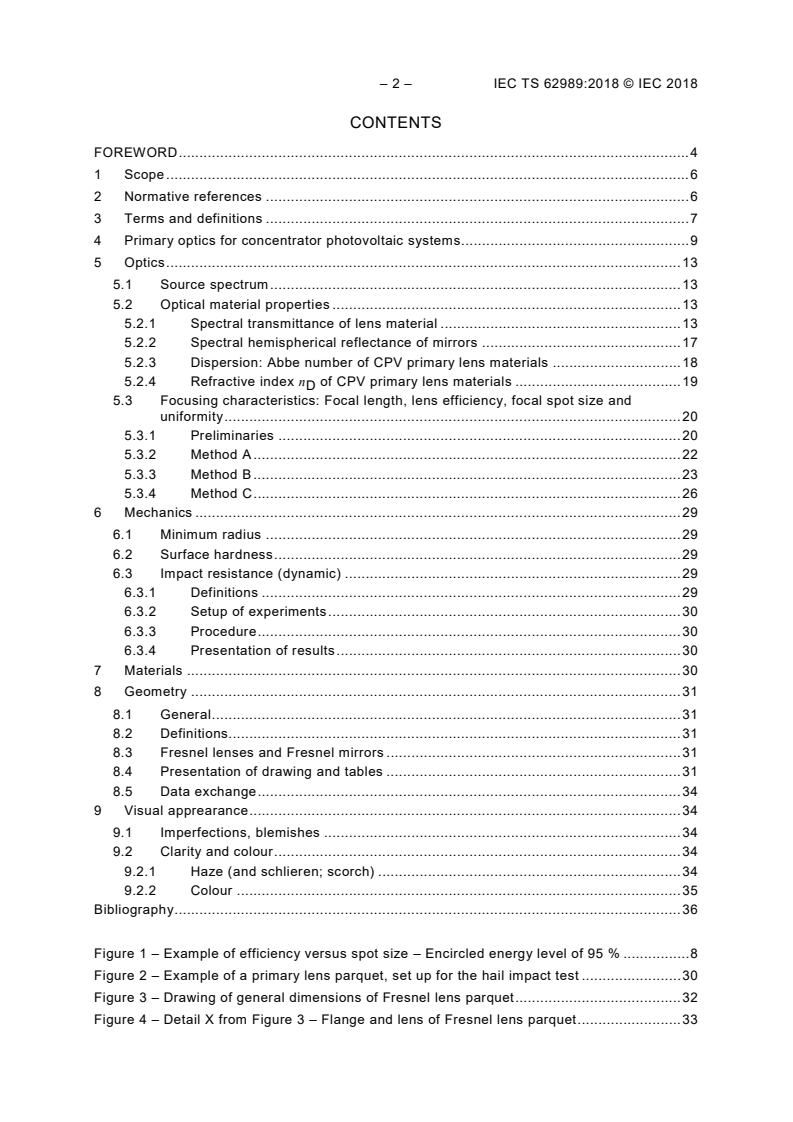
– 2 – IEC TS 62989:2018 © IEC 2018
CONTENTS
FOREWORD . 4
1 Scope . 6
2 Normative references . 6
3 Terms and definitions . 7
4 Primary optics for concentrator photovoltaic systems . 9
5 Optics . 13
5.1 Source spectrum . 13
5.2 Optical material properties . 13
5.2.1 Spectral transmittance of lens material . 13
5.2.2 Spectral hemispherical reflectance of mirrors . 17
5.2.3 Dispersion: Abbe number of CPV primary lens materials . 18
5.2.4 Refractive index n of CPV primary lens materials . 19
D
5.3 Focusing characteristics: Focal length, lens efficiency, focal spot size and
uniformity . 20
5.3.1 Preliminaries . 20
5.3.2 Method A . 22
5.3.3 Method B . 23
5.3.4 Method C . 26
6 Mechanics . 29
6.1 Minimum radius . 29
6.2 Surface hardness . 29
6.3 Impact resistance (dynamic) . 29
6.3.1 Definitions . 29
6.3.2 Setup of experiments . 30
6.3.3 Procedure . 30
6.3.4 Presentation of results . 30
7 Materials . 30
8 Geometry . 31
8.1 General . 31
8.2 Definitions. 31
8.3 Fresnel lenses and Fresnel mirrors . 31
8.4 Presentation of drawing and tables . 31
8.5 Data exchange . 34
9 Visual apprearance . 34
9.1 Imperfections, blemishes . 34
9.2 Clarity and colour . 34
9.2.1 Haze (and schlieren; scorch) . 34
9.2.2 Colour . 35
Bibliography . 36
Figure 1 – Example of efficiency versus spot size – Encircled energy level of 95 % . 8
Figure 2 – Example of a primary lens parquet, set up for the hail impact test . 30
Figure 3 – Drawing of general dimensions of Fresnel lens parquet . 32
Figure 4 – Detail X from Figure 3 – Flange and lens of Fresnel lens parquet . 33
Figure 5 – Detail Y from Figure 3 – Thickness of lens substrate (glass) and superstrate
(silicone) . 33
Figure 6 – Detail Z from Figure 5 – Drawing of prism with tip radius R and groove
t
radius R . 34
g
Table 1 – Characteristics: product identification . 9
Table 2 – Characteristics: optics . 10
Table 3 – Characteristics: mechanics . 11
Table 4 – Characteristics: materials . 11
Table 5 – Characteristics: geometry . 12
Table 6 – Characteristics: visual appearance . 12
Table 7 – Methods and results of the round robin for the focal characteristics of
Fresnel lenses . 21
– 4 – IEC TS 62989:2018 © IEC 2018
INTERNATIONAL ELECTROTECHNICAL COMMISSION
____________
PRIMARY OPTICS FOR CONCENTRATOR
PHOTOVOLTAIC SYSTEMS
FOREWORD
1) The International Electrotechnical Commission (IEC) is a worldwide organization for standardization comprising
all national electrotechnical committees (IEC National Committees). The object of IEC is to promote
international co-operation on all questions concerning standardization in the electrical and electronic fields. To
this end and in addition to other activities, IEC publishes International Standards, Technical Specifications,
Technical Reports, Publicly Available Specifications (PAS) and Guides (hereafter referred to as "IEC
Publication(s)"). Their preparation is entrusted to technical committees; any IEC National Committee interested
in the subject dealt with may participate in this preparatory work. International, governmental and non-
governmental organizations liaising with the IEC also participate in this preparation. IEC collaborates closely
with the International Organization for Standardization (ISO) in accordance with conditions determined by
agreement between the two organizations.
2) The formal decisions or agreements of IEC on technical matters express, as nearly as possible, an international
consensus of opinion on the relevant subjects since each technical committee has representation from all
interested IEC National Committees.
3) IEC Publications have the form of recommendations for international use and are accepted by IEC National
Committees in that sense. While all reasonable efforts are made to ensure that the technical content of IEC
Publications is accurate, IEC cannot be held responsible for the way in which they are used or for any
misinterpretation by any end user.
4) In order to promote international uniformity, IEC National Committees undertake to apply IEC Publications
transparently to the maximum extent possible in their national and regional publications. Any divergence
between any IEC Publication and the corresponding national or regional publication shall be clearly indicated in
the latter.
5) IEC itself does not provide any attestation of conformity. Independent certification bodies provide conformity
assessment services and, in some areas, access to IEC marks of conformity. IEC is not responsible for any
services carried out by independent certification bodies.
6) All users should ensure that they have the latest edition of this publication.
7) No liability shall attach to IEC or its directors, employees, servants or agents including individual experts and
members of its technical committees and IEC National Committees for any personal injury, property damage or
other damage of any nature whatsoever, whether direct or indirect, or for costs (including legal fees) and
expenses arising out of the publication, use of, or reliance upon, this IEC Publication or any other IEC
Publications.
8) Attention is drawn to the Normative references cited in this publication. Use of the referenced publications is
indispensable for the correct application of this publication.
9) Attention is drawn to the possibility that some of the elements of this IEC Publication may be the subject of
patent rights. IEC shall not be held responsible for identifying any or all such patent rights.
The main task of IEC technical committees is to prepare International Standards. In
exceptional circumstances, a technical committee may propose the publication of a technical
specification when
• the required support cannot be obtained for the publication of an International Standard,
despite repeated efforts, or
• the subject is still under technical development or where, for any other reason, there is the
future but no immediate possibility of an agreement on an International Standard.
Technical specifications are subject to review within three years of publication to decide
whether they can be transformed into International Standards.
IEC TS 62989, which is a technical specification, has been prepared by IEC technical
committee 82: Solar photovoltaic energy systems.
The text of this technical specification is based on the following documents:
Enquiry draft Report on voting
82/1281/DTS 82/1376/RVDTS
Full information on the voting for the approval of this technical specification can be found in
the report on voting indicated in the above table.
This document has been drafted in accordance with the ISO/IEC Directives, Part 2.
The committee has decided that the contents of this publication will remain unchanged until
the stability date indicated on the IEC website under "http://webstore.iec.ch" in the data
related to the specific publication. At this date, the publication will be
• transformed into an International Standard,
• reconfirmed,
• withdrawn,
• replaced by a revised edition, or
• amended.
A bilingual version of this publication may be issued at a later date.
IMPORTANT – The 'colour inside' logo on the cover page of this publication indicates
that it contains colours which are considered to be useful for the correct
understanding of its contents. Users should therefore print this document using a
colour printer.
– 6 – IEC TS 62989:2018 © IEC 2018
PRIMARY OPTICS FOR CONCENTRATOR
PHOTOVOLTAIC SYSTEMS
1 Scope
This document encompasses key characteristics of primary optical elements (lenses and
mirrors) and lens or mirror parquets for concentrator photovoltaics including: optical
performance, mechanical geometry, mechanical strength, materials, and surface morphology.
The document identifies the essential characteristics, the corresponding quantities of interest,
and provides a method for measurement of each quantity.
This document allows lens and mirror manufacturers, concentrator module manufacturers,
test laboratories and other interested parties to define lens/mirror qualities and inspect lenses
and mirrors. There are no pass/fail criteria associated with the document.
This document defines the test conditions rather than to specify the precise setup of a
measurement apparatus. For example, this enables laboratories to acquire reliable and
comparable measurement results irrespective of the existing large variety of experimental
setups for focal spot characterization. High priority is given to comparable and reproducible
measurements of the irradiance distribution in the focal plane and of the optical efficiency.
This requires trade-offs that reduce the similarities to outdoor conditions. Furthermore, it is
intended not to refer to properties of specific solar cells as this document is dedicated to
concentrator optics.
The terms for lenses are applicable for mirrors, unless otherwise specified.
2 Normative references
The following documents are referred to in the text in such a way that some or all of their
content constitutes requirements of this document. For dated references, only the edition
cited applies. For undated references, the latest edition of the referenced document (including
any amendments) applies.
IEC 60050-845, International Electrotechnical Vocabulary. Lighting
IEC 60904-3, Photovoltaic devices – Part 3: Measurement principles for terrestrial
photovoltaic (PV) solar devices with reference spectral irradiance data
IEC 62108:2007, Concentrator photovoltaic (CPV) modules and assemblies – Design
qualification and type approval
IEC 62788-1-4, Measurement procedures for materials used in photovoltaic modules –
Part 1-4: Encapsulants – Measurement of optical transmittance and calculation of the
solar-weighted photon transmittance, yellowness index, and UV cut-off wavelength
ISO 291, Plastics – Standard atmospheres for conditioning and testing
ISO 489:1999, Plastics – Determination of refractive index
ISO 10110-1:2006, Optics and photonics – Preparation of drawings for optical elements and
systems – Part 1: General
ISO 10110-7, Optics and photonics – Preparation of drawings for optical elements and
systems – Part 7: Surface imperfection tolerances
ISO 10110-8:2010, Optics and photonics – Preparation of drawings for optical elements and
systems – Part 8: Surface texture; roughness and waviness
ISO 10110-19:2015, Optics and photonics – Preparation of drawings for optical elements and
systems – Part 19: General description of surfaces and components
ISO 10303-21, Industrial automation systems and integration – Product data representation
and exchange – Part 21: Implementation methods: Clear text encoding of the exchange
structure
ISO 11664-1 (CIE S 014-1/E:2006), Colorimetry – Part 1: CIE standard colorimetric observers
ISO 11664-2 (CIE S 014-2/E:2006), Colorimetry – Part 2: CIE standard illuminants
ISO 11664-4 (CIE S 014-4/E:2007), Colorimetry – Part 4: CIE 1976 L*a*b* Colour space
ISO 14782, Plastics – Determination of haze for transparent materials
3 Terms and definitions
For the purposes of this document, the following terms and definitions apply.
ISO and IEC maintain terminological databases for use in standardization at the following
addresses:
• IEC Electropedia: available at http://www.electropedia.org/
• ISO Online browsing platform: available at http://www.iso.org/obp
3.1
entrance aperture
entrance aperture of the primary concentrator optics lies in a plane perpendicular to the
direction of irradiation and is defined as the smallest plane area bound by a simple, usually
convex, geometric shape that covers all optically concentrating parts of the concentrator
Note 1 to entry: An optically inactive part in the entrance aperture (e.g. draft facets of Fresnel lenses, secondary
mirrors of Cassegrain optics, wires and solar cells in the entrance aperture, mounting structures, rounded aperture
corners) may not be subtracted from the area of the entrance aperture if it is not part of an adjacent entrance
aperture and is smaller than 10 % of the total entrance aperture.
3.2
target area
plane area of simple geometric shape (e.g. square, rectangle, circle) that is located in
proximity of the focal spot of the primary concentrator optics
Note 1 to entry: The target area is centred on the barycentre (centre of mass) of the focal spot. The target area
shall have a maximum radius at least 2 times the intercept radius.
Note 2 to entry: In a measurement setup, the target area may be part of a larger detector if it is ensured that the
radiant flux impinging on the target area can be discriminated from the radiant flux impinging on the parts of the
detector lying outside the target area.
3.3
intercept radius
radius of a circular area that results in 95 % of the radiant flux incident on the entire target
area
Note 1 to entry: Intercept radius is expressed in millimetres.
– 8 – IEC TS 62989:2018 © IEC 2018
3.4
optical efficiency
ratio of radiant flux (Watts) on the target area within the intercept radius to the radiant flux on
the entrance aperture of the primary optics, expressed as percentage value
3.5
encircled energy
accumulated radiometric power in a circle on the target as a function of the radius of the
target area
Note 1 to entry: Encircled energy in shown in the encircled energy graph. The graph identifies the accumulated
power as a function of the radius of the target area. The intercept radius and the optical efficiency can directly be
read from the graph. The value for the encircled energy required to calculate the optical efficiency is 95 % of the
maximum (see Figure 1).
η
max
Use power within intercept radius
0,95 × η
max
to calculate optical efficiency
Minimum size for
the target area
r 2 × r
intercept intercept
Spot radius (mm)
IEC
Figure 1 – Example of efficiency versus spot size –
Encircled energy level of 95 %
3.6
parquet efficiency
arithmetic mean of the optical efficiencies of all optics in the parquet, all measured at the
same entrance aperture to target area distance
3.7
geometric concentration
ratio of the circle defined by the intercept radius to the size of the entrance aperture
(dimensionless)
3.8
local concentration
ratio of the irradiance (watts per square metre) at a point on the target area to the average
irradiance of the entrance aperture (dimensionless)
3.9
focal distance
distance between the entrance aperture (most exterior surface of the primary optics) and
target area that minimizes the intercept radius
3.10
solar-weighted transmittance of photon irradiance
proportion of the solar spectral photon irradiance optically transmitted (or reflected) through
the specimen, throughout the range of the terrestrial solar spectrum (280 nm to 2 500 nm)
Efficiency (%)
Note 1 to entry: Additional analysis, including representative solar weighted transmittance which may not include
wavelengths as low as 280 nm or as great as 2 500 nm may also be reported.
3.11
UV cut-off wavelength
λ
cUV
wavelength of light below which the sample is considered optically absorbing and above
which the material is considered transmitting (or reflecting)
Note 1 to entry: In this procedure, the absolute transmittance of 10 % (corresponding to the optical absorbance of
1) is considered as the threshold of the UV cut-off wavelength.
3.12
yellowness index
YI
calculated value identifying the yellowness of the test specimen perceived by a human
observer, as defined in ISO 17223
4 Primary optics for concentrator photovoltaic systems
All primary optics datasheets complying with this document shall provide, as part of their
product marking and documentation, the information specified below. See later clauses of this
document for further explanation of individual specifications. In addition to the information
indicated by the examples, it is required to include a technical drawing of the primary optics
and the indicated graphs. Some of the specifications are optional; however, if a manufacturer
of primary optics chooses to include optional information, it should be reported and measured
using the definitions provided in this document (see Tables 1 to 6).
Table 1 – Characteristics: product identification
Clause Characteristics Parameter
4 Product identification
4 Manufacturer
4 Model number
4 Type of primary optics
– 10 – IEC TS 62989:2018 © IEC 2018
Table 2 – Characteristics: optics
Clause Characteristics Symbol and unit of measure
5 OPTICS
5.1 Source definitions
Table 7 Angular size (termed collimation half-angle of source)
θ, deg
5.1 Source spectrum −, W/(m nm)
5.2 Optical material properties
5.2.1 Spectral transmittance of lens material, calculation of α,τ(λ, T,h, incidence angle) ,
yellowness index, calculation of UV-cutoff wavelength UV-cut-off, 1-nm increment (as ISO)
5.2.2 Spectral hemispherical reflectance of mirrors
ρ(λ)
5.2.3 Dispersion V
D
5.2.4 Refractive index
n(λ,T,h), −
5.3 Focusing characteristics (see Table 7 for description of
Methods A-C)
5.3 Focal length F(T ),
nom
df/dT
5.3 Lens/mirror efficiency
η, %
5.3 Parquet efficiency η, %
5.3 Focal spot size and uniformity 95 % in intercept radius
5.3 Deformation caused by differential thermal expansion; -, (T), I(λ,T,h), shape, materials,
irradiance distribution bonding technique; measured as
efficiency ∆η/K
Optional
Compliance to other standards and specifications,
including design qualification and type approval CPV
module (IEC 62108)
Optional
Coatings: mechanical and functional properties
Optional
Soiling
Table 3 – Characteristics: mechanics
Clause Characteristics Parameter
6 Mechanics
6.1 Minimum radius
6.2 Surface hardness (static)
6.3 Impact resistance (dynamic) -, f(T)
Optional Recommendations for transport/shipping, storage,
installation, operations, maintenance/cleaning, polishing,
recycling/disposal
Table 4 – Characteristics: materials
Clause Characteristics Parameter
7 Materials
7 Type and manufacturing process
7 Material type
7 Manufacturing process
7 Chemistry
7 Mass, grain size mol
7 Chemical composition
7 Permeability
7 Absorptivity %
−6
7 Thermal expansion 10 m/(m K)
−6
7 Moisture expansion 10 m/(m %)
7 Durability
7 UV-absorbants (optional)
7 Yellowness index CIE
7 Accelerators
7 Non-voluntary compliance RoHS, WEEE, OH&S, among
others
– 12 – IEC TS 62989:2018 © IEC 2018
Table 5 – Characteristics: geometry
Clause Characteristics Parameter
8 Geometry
8.1 General
8.2 Definitions
8.3 Fresnel lenses and Fresnel mirrors
8.4 Global dimensions ISO 10110-1:2006, ISO 10110-8:2010 mm
and ISO 10110-19:2015
8.4 Lens dimensions mm
8.4 Number of lenses n, -
8.4 Flatness mm/m
8.4 Prism geometry
8.4 Facet and step size mm
8.4 Facet shape
8.4 Tip and groove radii µm
°
8.4 Draft angle
8.4 Surface morphology
8.4 Roughness (RMS) R , nm
q
°
8.4 1
Surface energy (ASTM D7490 [1] )
8.5 Data exchange
Table 6 – Characteristics: visual appearance
Clause Characteristics Parameter
9 VISUAL APPEARANCE
9.1 Imperfections, blemishes (ISO 10110-7)
Scratches n, 1/m
Bubbles n, 1/m
Edge chips
9.2 Clarity and color
9.2.1 Haze (and schlieren; scorch)
9.2.2 Colour, ISO 11664-4:2008 -
___________
Numbers in square brackets refer to the Bibliography.
5 Optics
5.1 Source spectrum
A reference solar spectral irradiance distribution is specified for comparing the relative
performance of optical components or understanding their impact on photovoltaic devices.
The spectrum may be used for the purpose of analysis of the throughput of optical flux. The
spectrum is also defined as the benchmark for solar simulators and outdoor test conditions
used for the verification of performance, see IEC 60904-3.
–2 –1 –1
The spectral photon irradiance [E , m ·s ·nm , Formula (1)] accounts for the number of
pλ
incident photons rather than the raw energy. Photon irradiance is examined because one
photon can produce at most one electron-hole pair in a PV cell. Parameters in the formula
–2 –1
include: λ, the wavelength {m}; E , the spectral irradiance {W·m ·m }; h, Planck’s constant
λ
−34 2 8 –1
{6,626 × 10 W⋅s }; and c, the speed of light in a vacuum {2,998 × 10 m⋅s }.
λ
E [λ] = E [λ] (1)
pλ λ
hc
5.2 Optical material properties
5.2.1 Spectral transmittance of lens material
5.2.1.1 General
The measurement of the total luminous transmittance is specified for verification of the optical
performance of component materials used in the primary optical element (POE). The
standardized measurements here quantify the expected performance of the POE relative to
the component(s) that follow the POE in a CPV module. Subsequent calculation of
solar-weighted transmittance allows for comparison between different POE components
and/or materials.
In the case where reflectance is being measured, it may be measured and analysed similar to
the transmittance.
This measurement method can also be used to monitor the performance of POE materials
after weathering, to help assess their durability. Subsequent calculation of yellowness index
allows for quantification of durability and consideration of appearance. The change in
transmittance, yellowness index, and ultraviolet (UV) cut-off wavelength may be used by POE
or CPV module manufacturers to support comparing the durability of different materials.
5.2.1.2 Principle
The total spectral transmittance of representative specimens should be measured using a
spectrophotometer equipped with an integrating sphere. Solar-weighted transmittance,
yellowness index, and UV cut-off wavelength will be subsequently calculated from the optical
measurements.
NOTE The method does not attempt to account for variations in transmittance with the angle of incidence, which
can vary with time of day, sky conditions, geometry of the module, and the concentration of optical flux.
5.2.1.3 Apparatus
The test instrument should consist of a spectrophotometer equipped with a double beam. A
single beam spectrophotometer may be used if the port reflectance can be properly accounted
for, as in IEC 62788-1-4. Details regarding the construction and configurations of the test
instrument can be found in ISO 13468-2 [2] or ASTM E424-71 [3]. A measurement range of at
least 280 nm to 2 500 nm is required for calculation of the solar-weighted transmittance using
the AM1.5 direct spectrum as in IEC 60904-3. The minimum measurement increment of 1 nm
shall be used in measurements.
– 14 – IEC TS 62989:2018 © IEC 2018
5.2.1.4 Test specimens
5.2.1.4.1 Specimen size and geometry
Specimens shall consist of placard or discs composed of the POE material(s). The radius of
curvature for the specimens should be sufficiently large that the width of the transmitted (or
reflected) beam remains smaller than the aperture of the integrating sphere.
The specimens shall contain an examination region free from visible flaws including:
scratches, pits, sink marks, bubbles, or other imperfections. The examination region shall be
at least 50 % larger in diameter than the measurement area of the test instrument. A spot size
of 1 cm x 1 cm is common in many commercial spectrophotometer instruments. Use of
specimens at least 2 to 3 times this size will improve uniformity (resulting from fabrication)
and handling (during measurement). The size (length and width) should, however, be
adequate to allow the specimen to fit inside the test instrument.
The nominal thickness of the specimens shall be equal to the thickness intended for use in
CPV modules. When a laminate or composite material is used, the thickness of each of the
component layers shall be the same as intended for use in a CPV POE.
Specimens should be prepared according to the manufacturer’s specification and using a
process as similar as possible to the method used in the intended manufacturing process.
The thickness of the test specimen shall be measured after its preparation. The thickness
shall be taken as the average of three measurements obtained at different locations on the
test region of the specimen.
Both surfaces of the specimens shall not be faceted or intentionally textured.
5.2.1.4.2 Number of specimens
A minimum of 3 replicates shall be used for the determination of the transmittance or in
weathering studies. Optical characteristics, including transmittance, YI, and the UV cut-off
wavelength shall be subsequently calculated using the average of the three separate
specimens, with the range of the measurements indicated to identify their variability.
5.2.1.4.3 Conditioning of specimens
Specimens used for the purpose of datasheet reporting shall be maintained at (23 ± 2) °C,
(50 ± 10) % relative humidity for at least 24 h, or until the mass has stabilized to ± 10 %
(which can take on the order of 300 h for PMMA, if not force-dried), as recommended in
ISO 291 Class 2, prior to optical measurement.
5.2.1.5 Measurement procedure
5.2.1.5.1 Specimen preparation
Prior to measurement, specimens should be free of dust, grease, or other contaminants. The
specimens and instrument should be in thermal equilibrium prior to measurement.
5.2.1.5.2 Instrument calibration (baseline measurements)
Allow the instrument lamp to adequately equilibrate after it has been lighted, observing the
typical warm-up period, for example 15 min or as recommended by the instrument
manufacturer. Perform the correction scan(s) to compensate for the instrument baseline
signal.
The 100 % transmittance baseline measurement should be performed in air, with no specimen
present. The 100 % reflectance baseline measurement should be performed using a
calibrated standard similar to the reflector specimens, for example silvered glass for silvered
glass reflectors or Spectralon for general purposes. The 0 % transmittance baseline
measurement should also be performed, if possible. Periodic measurement of the baseline is
recommended to minimize instrument drift and ensure the measured values are accurate. The
instrument drift occurring over an extended measurement session may be instrument specific.
5.2.1.5.3 Specimen measurements
Perform the transmittance measurements for the test specimens over the wavelength range of
at least 280 nm to 2 500 nm using a 1 nm increment.
Linear interpolation to a 1 nm increment may be used when only a coarser measurement
increment (maximum of 5 nm) is available. The error associated with a coarser increment may
be more influential at shorter wavelengths (where YI and the UV cut-off wavelength are
determined) than at longer wavelengths (where only the solar-weighted transmittance is
affected). When applied, the use of linear interpolation should be noted in the test report. The
spectral bandwidth should be less than or equal to the increment of the measurement, i.e.
1 nm or 5 nm.
5.2.1.5.4 Reference measurements
Perform the transmittance measurements on a witness specimen at the beginning of each
measurement session to assure proper operation of the instrument and minimize the
measurement error. Perform the transmittance measurements of any witness specimens using
the same procedure applied to the test specimen(s). The witness specimens may include a
traceable standard specimen or laboratory working witness specimen.
5.2.1.6 Calculation and expression of results
5.2.1.6.1 Post-processing of data
The measurements obtained from three separate specimens shall be averaged at each
wavelength increment. The range (difference of the maximum and minimum) shall also be
determined at each wavelength increment. In this manner, the transmittance shall be reported
at each wavelength measured.
5.2.1.6.2 Calculation of weighted transmittance
The solar-weighted transmittance may be calculated with Formula (2):
τ [λ]E [λ]dλ
pλ
∫
τ =
sw (2)
E [λ]dλ
pλ
∫
where
τ is the solar-weighted transmittance (%);
sw
τ is the measured transmittance of the specimen (%);
λ is the wavelength of light (nm);
–2 –1 –1
E is the reference spectral photon irradiance (m ·s ·nm , as given in IEC 60904-3).
pλ
The solar-weighted transmittance should be calculated for the wavelength range of at least
280 nm to 2 500 nm. The solar-weighted transmittance (as well as YI) obtained from the
spectrophotometer measurements (1 nm interval) shall be calculated using a discretized sum.
For IEC 60904-3, the denominator of the solar-weighted transmittance equals
23 –2 –1
4,155 128 570 735 31 × 10 (m ·s ). Other weighted transmitted values may be additionally
calculated [similar to Formula (1)] from the tabulated transmittance data for other wavelength
ranges.
– 16 – IEC TS 62989:2018 © IEC 2018
5.2.1.6.3 Calculation of the yellowness index
YI may then be calculated according to the following procedure. First, calculate the tristimulus
values using the Formulas (3) to (5):
X = k τ [λ]SD65[λ]x[λ]dλ
∫
(3)
Y = k τ [λ]SD65[λ]y[λ]dλ
∫
(4)
Z = k τ [λ]SD65[λ]z[λ]dλ
∫
(5)
where
X, Y, and Z represent the three tristimulus coefficients (unitless);
k is the normalizing factor (unitless);
τ is the measured transmittance of the specimen (%);
λ is the wavelength of light (nm);
S is the relative spectral power of the illuminant (unitless, as in ISO 11664-2);
D65
x , y , and z are the relative colour-matching functions of the observer (unitless, as in
ISO 11664-1).
The CIE Standard D65 Illuminant (which represents the midday outdoor sun in northern
latitudes) shall be used in calculations as defined in ISO 11664-2. The CIE 1964 XYZ colour
space (which represents a human observer with a 10° field of view) shall be used in
calculations as defined in ISO 11664-1.
The normalizing factor should be determined from Formula (6):
(6)
k = SD65[λ]y[λ]dλ
∫
–3
For ISO 11664-1 and ISO 11664-2 (in 1 nm increments), k = 8,606 × 10 . The normalizing
factor is applied to all tristimulus coefficients, but is calculated specifically for the y
colour-matching function.
YI may then be calculated from Formula (7):
CXX − CZZ
(7)
YI =100
Y
The yellowness index is calculated using the tristimulus coefficients as well as the
coefficients, Cx = 1,301 3 (unitless) and Cz = 1,149 8 (unitless).
NOTE Additional details related to the YI can be found in ISO 17223.
5.2.1.6.4 Calculation of the UV cut-off wavelength
λ , shall be determined as the longest measured wavelength (to
The UV cut-off wavelength,
cUV
the nearest nm) in the UV range (where λ ≤ 400 nm) where the transmittance equals 10 % or
less.
In cases where the UV cut-off wavelength is known to be less than 280 nm, the range of
measurement should be extended below 280 nm to quantify its specific value.
5.2.1.7 Test report
A report of the tests shall be prepared by the test agency. The report shall contain the detail
specification for the specimens. Each certificate or test report shall include at least the
following information:
a) a title;
b) name and address of the test laboratory and location where the tests were carried out;
c) unique identification of the certification or report and of each page;
d) name and address of client, where appropriate;
e) description and identification of the item tested, including material type, specimen
thickness (and its range of variation), the specimen size (length and width or diameter);
f) characterization and condition of the test item, including the method and details of
specimen preparation (including curing, lamination, or similar processing, if applicable)
and preconditioning;
g) date of receipt of test item and date(s) of test, where appropriate;
h) identification of test method used, including the make and model of the test instrument
and the use (and make and model) of an integrating sphere;
i) reference to sampling procedure, where relevant;
j) any deviations from, additions to, or exclusions from, the test method and any other
information relevant to a specific test, such as environmental conditions; and the
procedure(s) and condition(s) used for weathering and any preconditioning conducted
prior to measurements;
k) measurements, examinations and derived results supported by tables, graphs, sketches
and photographs as appropriate including the complete set of the tabulated average
transmittance values and the corresponding range of the averaged values; the estimated
uncertainty of the transmittance measurement (instrument); the averaged solar-weighted
transmittance of photon irradiance and the corresponding range of the averaged values;
the UV cut-off wavelength and its uncertainty; and any failures observed;
l) the yellowness index and its uncertainty (which should be determined after each
weathering interval in addition to its original value in the case of weathering experiments);
m) a statement of the estimated uncertainty of the test results (where relevant);the
measurement of the witness specimen (if used) and its deviation from its witness values.
When applicable, the details of the witness specimen (such as its preparation,
composition, and thickness) shall be specified;
n) a signature and title, or equivalent identification of the person(s) accepting responsibility
for the content of the certificate or report, and the date of issue;
o) where relevant, a statement to the effect that the results relate only to the items tested;
p) a statement that the certificate or report shall not be reproduced except in full, without the
written approval of the laboratory.
5.2.2 Spectral hemispherical reflectance of mirrors
For additional considerations related to the measurement of the spectral hemispherical
reflectance of mirrors, refer to the document prepared and updated by the SolarPACES
organization [4].
– 18 – IEC TS 62989:2018 © IEC 2018
5.2.3 Dispersion: Abbe number of CPV primary lens materials
5.2.3.1 Definitions
The Abbe number ν is a common characterization of dispersion, i.e. the change of the
refractive index n with wavelength λ. Alternatively, ν , ν or ν can be determined, where
D d e
each Abbe number is calculated from a different set of three refractive indices:
ν = (n – 1) / (n – n )
D D F C
ν = (n – 1) / (n – n )
d d F C
ν = (n – 1) / (n – n )
e e F´ C´
where
n is the refractive index at 589,3 nm (mid point of the sodium spectral emission line
D
doublet that has lines at 589,0 and 589,6 nm);
n is the refractive index at 486,1 nm (spectral emission line of hydrogen);
F
is the refractive index at 656,3 nm (spectral emission line of hydrogen);
n
C
n is the refractive index at 587,6 nm (spectral emission line of helium);
d
is the refractive index at 480,0 nm (spectral emission line of cadmium);
n
F
n is the refractive index at 643,8 nm (spectral emission line of cadmium).
C
5.2.3.2 Setup of experiment
ISO 489 does not explicitly describe the measurement of n at wavelengths other than at
589 nm. Use an Abbe refractometer as described in the instructions on "Refractive index n of
D
CPV primary lens materials", which requires an Abbe refractometer accurate to 0,001
equipped with a temperature-controlling device for the specimens and prisms, set up in an
environment maintained at (23 ± 2) °C and (50 ± 5) % relative humidity. The instrument shall
provide monochromatic or nearly monochromatic illumination of the specimen with a spectral
distribution centered at one of the wavelengths shown above.
This may be accomplished, for example, by filtering a white light source with individual
bandpass interference filters or wit
...