


IEC 62489-2:2014
(Main)Electroacoustics - Audio-frequency induction loop systems for assisted hearing - Part 2: Methods of calculating and measuring the low-frequency magnetic field emissions from the loop for assessing conformity with guidelines on limits for human exposure
Electroacoustics - Audio-frequency induction loop systems for assisted hearing - Part 2: Methods of calculating and measuring the low-frequency magnetic field emissions from the loop for assessing conformity with guidelines on limits for human exposure
IEC 62489-2:2014 applies to audio-frequency induction-loop systems for assisted hearing. It may also be applied to such systems used for other purposes, as far as it is applicable. The standard is intended for assessment of human exposure to low-frequency magnetic fields produced by the system, by calculation and by in-situ testing. This standard does not deal with other aspects of safety, for which IEC 60065 applies, or with EMC. This second edition cancels and replaces the first edition published in 2011. This edition constitutes a technical revision which includes significant technical changes to reflect several updates to the ICNIRP Guide (Guidelines for limiting exposure to time-varying electric, magnetic, and electromagnetic fields) to which it makes frequent reference. The most significant change is that the underlying metric in the Guide has been changed from tissue current density to induced electric field. Keywords: hearing aid, accessibility, surdity, deafness
Electroacoustique - Systèmes de boucles d'induction audiofréquences pour améliorer l'audition - Partie 2: Méthodes de calcul et de mesure des émissions de champ magnétique basse fréquence à partir de la boucle pour l'évaluation de la conformité aux instructions sur les limites d'exposition humaine
L'IEC 62489-2:2014 s'applique aux systèmes de boucles d'induction audiofréquences pour améliorer l'audition. Elle peut également être appliquée à de tels systèmes utilisés à d'autres fins, si ladite application est possible. La norme est destinée à l'évaluation de l'exposition humaine à des champs magnétiques basse fréquence produits par le système, par le calcul et par l'essai in-situ. La présente norme ne traite pas d'autres aspects de la sécurité, pour laquelle l'IEC 60065 s'applique, ni de la CEM. Cette deuxième édition annule et remplace la première édition parue en 2011. Cette édition constitue une révision technique qui inclut les modifications techniques majeures afin de refleter plusieurs mises à jour du Guide ICNIRP (Guidelines for limiting exposure to time-varying electric, magnetic, and electromagnetic fields) auquel il est fait fréquemment référence. Le changement le plus significatif est que la grandeur de base dans le guide est passée d'une densité de courant dans les tissus à un champ électrique induit. Mots clé: accessibilité, sonotone, surdité
General Information
- Status
- Published
- Publication Date
- 23-Sep-2014
- Technical Committee
- TC 29 - Electroacoustics
- Drafting Committee
- WG 22 - TC 29/WG 22
- Current Stage
- PPUB - Publication issued
- Start Date
- 24-Sep-2014
- Completion Date
- 15-Oct-2014
Relations
- Effective Date
- 05-Sep-2023
Overview
IEC 62489-2:2014 is an international standard developed by the International Electrotechnical Commission (IEC) focused on audio-frequency induction loop systems (AFILS) used primarily for assisted hearing. This part 2 standard specifically defines the methods for calculating and measuring the low-frequency magnetic field emissions generated by these induction loops. The purpose is to assess compliance with existing guidelines and limits on human exposure to low-frequency magnetic fields, ensuring safety and accessibility for users, particularly those with hearing aids.
This latest edition updates the previous 2011 version by aligning with the 2010 ICNIRP guidelines, transitioning the primary exposure metric from tissue current density to induced electric field. Such updates reflect modern scientific understanding and improve both accuracy and applicability in evaluating human exposure risks.
Key Topics
Scope of Application
Applies to AFILS designed for assisted hearing and can extend to other uses where relevant. It addresses human exposure to low-frequency magnetic emissions through both calculation and in-situ measurement.Magnetic Field Emissions Assessment
Methods to quantify low-frequency magnetic fields emitted by audio-frequency loops, including configurations such as large-area loops, medium-area loops, small-area loops, and solenoid antennas.Compliance with Human Exposure Guidelines
Guidelines and basic restrictions from ICNIRP are referenced, focusing on limits to ensure safe exposure levels. Special emphasis is placed on the induced electric field metric for conformity assessment.Measurement and Calculation Techniques
Standardized procedures for measuring magnetic field emissions using suitable instruments and defining input signal characteristics. Calculations cover electromagnetic field estimations for typical loop structures.Exclusions
This standard does not address electrical safety aspects (covered under IEC 60065) nor electromagnetic compatibility (EMC).Technical Revisions
Incorporates significant changes reflecting the ICNIRP Guide update, improving the approach to evaluating exposure in accordance with international best practices.
Applications
IEC 62489-2:2014 is essential for manufacturers, installers, and regulators involved with hearing loop systems and associated technologies. Typical applications include:
Hearing Aid Accessibility
Ensuring hearing loop systems used in public spaces, auditoriums, places of worship, and transportation hubs operate within safe magnetic field exposure limits for individuals using hearing aids.Assessment for Safety Compliance
Verification of installation conformity through both theoretical calculations and on-site measurements, facilitating certification and maintenance of audio-frequency induction loop installations.Design and Optimization of Induction Loops
Provides guidance for engineers and designers to configure loops that balance effective assisted hearing functionality with compliance to exposure limits.Human Exposure Risk Management
Helps occupational health and safety professionals assess potential exposure in environments equipped with AFILS and evaluate the risk for vulnerable populations, such as people with surdity or deafness.
Related Standards
- IEC 60118-4: Addresses magnetic field strength requirements for induction loop systems specifically designed for hearing aids.
- IEC 60065: Covers general electrical safety requirements for audio, video, and similar electronic apparatus.
- ICNIRP Guidelines (2010): International recommendations on limits for time-varying electric, magnetic, and electromagnetic fields that underpin the restrictions referenced by IEC 62489-2.
- IEC 60268 series: General standards for sound system equipment, including terminology and measurement approaches relevant to electroacoustic systems.
- IEC 62311: Provides a broader framework on electromagnetic field evaluation of electronic devices, which complements the focused scope of IEC 62489-2.
Keywords: IEC 62489-2, audio-frequency induction loop systems, assisted hearing, low-frequency magnetic field, human exposure limits, ICNIRP guidelines, hearing aid, accessibility, electromagnetic safety, induction loop measurement, electroacoustics.
Buy Documents
IEC 62489-2:2014 - Electroacoustics - Audio-frequency induction loop systems for assisted hearing - Part 2: Methods of calculating and measuring the low-frequency magnetic field emissions from the loop for assessing conformity with guidelines on limits for human exposure Released:9/24/2014
Get Certified
Connect with accredited certification bodies for this standard

BSMI (Bureau of Standards, Metrology and Inspection)
Taiwan's standards and inspection authority.
Sponsored listings
Frequently Asked Questions
IEC 62489-2:2014 is a standard published by the International Electrotechnical Commission (IEC). Its full title is "Electroacoustics - Audio-frequency induction loop systems for assisted hearing - Part 2: Methods of calculating and measuring the low-frequency magnetic field emissions from the loop for assessing conformity with guidelines on limits for human exposure". This standard covers: IEC 62489-2:2014 applies to audio-frequency induction-loop systems for assisted hearing. It may also be applied to such systems used for other purposes, as far as it is applicable. The standard is intended for assessment of human exposure to low-frequency magnetic fields produced by the system, by calculation and by in-situ testing. This standard does not deal with other aspects of safety, for which IEC 60065 applies, or with EMC. This second edition cancels and replaces the first edition published in 2011. This edition constitutes a technical revision which includes significant technical changes to reflect several updates to the ICNIRP Guide (Guidelines for limiting exposure to time-varying electric, magnetic, and electromagnetic fields) to which it makes frequent reference. The most significant change is that the underlying metric in the Guide has been changed from tissue current density to induced electric field. Keywords: hearing aid, accessibility, surdity, deafness
IEC 62489-2:2014 applies to audio-frequency induction-loop systems for assisted hearing. It may also be applied to such systems used for other purposes, as far as it is applicable. The standard is intended for assessment of human exposure to low-frequency magnetic fields produced by the system, by calculation and by in-situ testing. This standard does not deal with other aspects of safety, for which IEC 60065 applies, or with EMC. This second edition cancels and replaces the first edition published in 2011. This edition constitutes a technical revision which includes significant technical changes to reflect several updates to the ICNIRP Guide (Guidelines for limiting exposure to time-varying electric, magnetic, and electromagnetic fields) to which it makes frequent reference. The most significant change is that the underlying metric in the Guide has been changed from tissue current density to induced electric field. Keywords: hearing aid, accessibility, surdity, deafness
IEC 62489-2:2014 is classified under the following ICS (International Classification for Standards) categories: 17.140.50 - Electroacoustics. The ICS classification helps identify the subject area and facilitates finding related standards.
IEC 62489-2:2014 has the following relationships with other standards: It is inter standard links to IEC 62489-2:2011. Understanding these relationships helps ensure you are using the most current and applicable version of the standard.
IEC 62489-2:2014 is available in PDF format for immediate download after purchase. The document can be added to your cart and obtained through the secure checkout process. Digital delivery ensures instant access to the complete standard document.
Standards Content (Sample)
IEC 62489-2 ®
Edition 2.0 2014-09
INTERNATIONAL
STANDARD
NORME
INTERNATIONALE
colour
inside
Electroacoustics – Audio-frequency induction loop systems for assisted
hearing –
Part 2: Methods of calculating and measuring the low-frequency magnetic field
emissions from the loop for assessing conformity with guidelines on limits for
human exposure
Électroacoustique – Systèmes de boucles d’induction audiofréquences pour
améliorer l'audition –
Partie 2: Méthodes de calcul et de mesure des émissions de champ magnétique
basse fréquence à partir de la boucle pour l’évaluation de la conformité aux
instructions sur les limites d’exposition humaine
All rights reserved. Unless otherwise specified, no part of this publication may be reproduced or utilized in any form
or by any means, electronic or mechanical, including photocopying and microfilm, without permission in writing from
either IEC or IEC's member National Committee in the country of the requester. If you have any questions about IEC
copyright or have an enquiry about obtaining additional rights to this publication, please contact the address below or
your local IEC member National Committee for further information.
Droits de reproduction réservés. Sauf indication contraire, aucune partie de cette publication ne peut être reproduite
ni utilisée sous quelque forme que ce soit et par aucun procédé, électronique ou mécanique, y compris la photocopie
et les microfilms, sans l'accord écrit de l'IEC ou du Comité national de l'IEC du pays du demandeur. Si vous avez des
questions sur le copyright de l'IEC ou si vous désirez obtenir des droits supplémentaires sur cette publication, utilisez
les coordonnées ci-après ou contactez le Comité national de l'IEC de votre pays de résidence.
IEC Central Office Tel.: +41 22 919 02 11
3, rue de Varembé Fax: +41 22 919 03 00
CH-1211 Geneva 20 info@iec.ch
Switzerland www.iec.ch
About the IEC
The International Electrotechnical Commission (IEC) is the leading global organization that prepares and publishes
International Standards for all electrical, electronic and related technologies.
About IEC publications
The technical content of IEC publications is kept under constant review by the IEC. Please make sure that you have the
latest edition, a corrigenda or an amendment might have been published.
IEC Catalogue - webstore.iec.ch/catalogue Electropedia - www.electropedia.org
The stand-alone application for consulting the entire The world's leading online dictionary of electronic and
bibliographical information on IEC International Standards, electrical terms containing more than 30 000 terms and
Technical Specifications, Technical Reports and other definitions in English and French, with equivalent terms in 14
documents. Available for PC, Mac OS, Android Tablets and additional languages. Also known as the International
iPad. Electrotechnical Vocabulary (IEV) online.
IEC publications search - www.iec.ch/searchpub IEC Glossary - std.iec.ch/glossary
The advanced search enables to find IEC publications by a More than 55 000 electrotechnical terminology entries in
variety of criteria (reference number, text, technical English and French extracted from the Terms and Definitions
committee,…). It also gives information on projects, replaced clause of IEC publications issued since 2002. Some entries
and withdrawn publications. have been collected from earlier publications of IEC TC 37,
77, 86 and CISPR.
IEC Just Published - webstore.iec.ch/justpublished
Stay up to date on all new IEC publications. Just Published IEC Customer Service Centre - webstore.iec.ch/csc
details all new publications released. Available online and If you wish to give us your feedback on this publication or
also once a month by email. need further assistance, please contact the Customer Service
Centre: csc@iec.ch.
A propos de l'IEC
La Commission Electrotechnique Internationale (IEC) est la première organisation mondiale qui élabore et publie des
Normes internationales pour tout ce qui a trait à l'électricité, à l'électronique et aux technologies apparentées.
A propos des publications IEC
Le contenu technique des publications IEC est constamment revu. Veuillez vous assurer que vous possédez l’édition la
plus récente, un corrigendum ou amendement peut avoir été publié.
Catalogue IEC - webstore.iec.ch/catalogue Electropedia - www.electropedia.org
Application autonome pour consulter tous les renseignements
Le premier dictionnaire en ligne de termes électroniques et
bibliographiques sur les Normes internationales,
électriques. Il contient plus de 30 000 termes et définitions en
Spécifications techniques, Rapports techniques et autres
anglais et en français, ainsi que les termes équivalents dans
documents de l'IEC. Disponible pour PC, Mac OS, tablettes
14 langues additionnelles. Egalement appelé Vocabulaire
Android et iPad.
Electrotechnique International (IEV) en ligne.
Recherche de publications IEC - www.iec.ch/searchpub
Glossaire IEC - std.iec.ch/glossary
Plus de 55 000 entrées terminologiques électrotechniques, en
La recherche avancée permet de trouver des publications IEC
en utilisant différents critères (numéro de référence, texte, anglais et en français, extraites des articles Termes et
comité d’études,…). Elle donne aussi des informations sur les Définitions des publications IEC parues depuis 2002. Plus
projets et les publications remplacées ou retirées. certaines entrées antérieures extraites des publications des
CE 37, 77, 86 et CISPR de l'IEC.
IEC Just Published - webstore.iec.ch/justpublished
Service Clients - webstore.iec.ch/csc
Restez informé sur les nouvelles publications IEC. Just
Published détaille les nouvelles publications parues. Si vous désirez nous donner des commentaires sur cette
Disponible en ligne et aussi une fois par mois par email. publication ou si vous avez des questions contactez-nous:
csc@iec.ch.
IEC 62489-2 ®
Edition 2.0 2014-09
INTERNATIONAL
STANDARD
NORME
INTERNATIONALE
colour
inside
Electroacoustics – Audio-frequency induction loop systems for assisted
hearing –
Part 2: Methods of calculating and measuring the low-frequency magnetic field
emissions from the loop for assessing conformity with guidelines on limits for
human exposure
Électroacoustique – Systèmes de boucles d’induction audiofréquences pour
améliorer l'audition –
Partie 2: Méthodes de calcul et de mesure des émissions de champ magnétique
basse fréquence à partir de la boucle pour l’évaluation de la conformité aux
instructions sur les limites d’exposition humaine
INTERNATIONAL
ELECTROTECHNICAL
COMMISSION
COMMISSION
ELECTROTECHNIQUE
PRICE CODE
INTERNATIONALE
CODE PRIX P
ICS 17.140.50 ISBN 978-2-8322-1860-0
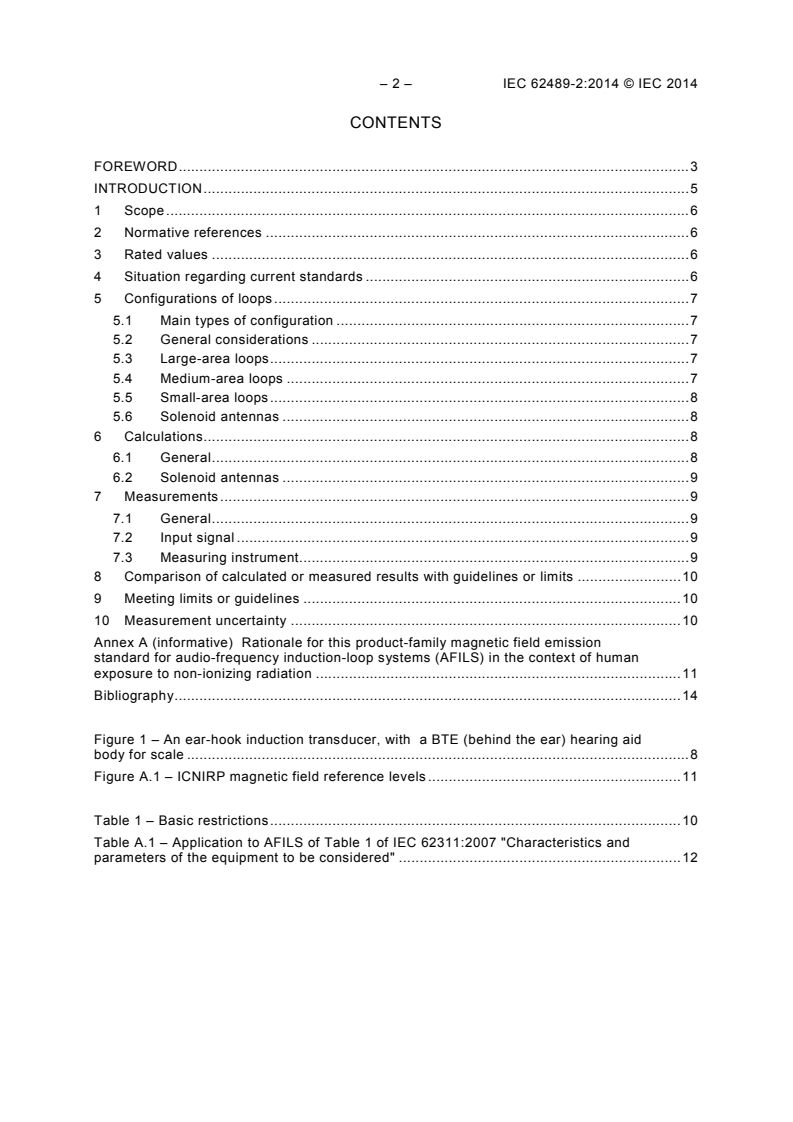
– 2 – IEC 62489-2:2014 © IEC 2014
CONTENTS
FOREWORD . 3
INTRODUCTION . 5
1 Scope . 6
2 Normative references . 6
3 Rated values . 6
4 Situation regarding current standards . 6
5 Configurations of loops . 7
5.1 Main types of configuration . 7
5.2 General considerations . 7
5.3 Large-area loops . 7
5.4 Medium-area loops . 7
5.5 Small-area loops . 8
5.6 Solenoid antennas . 8
6 Calculations . 8
6.1 General . 8
6.2 Solenoid antennas . 9
7 Measurements . 9
7.1 General . 9
7.2 Input signal . 9
7.3 Measuring instrument. 9
8 Comparison of calculated or measured results with guidelines or limits . 10
9 Meeting limits or guidelines . 10
10 Measurement uncertainty . 10
Annex A (informative) Rationale for this product-family magnetic field emission
standard for audio-frequency induction-loop systems (AFILS) in the context of human
exposure to non-ionizing radiation . 11
Bibliography . 14
Figure 1 – An ear-hook induction transducer, with a BTE (behind the ear) hearing aid
body for scale . 8
Figure A.1 – ICNIRP magnetic field reference levels . 11
Table 1 – Basic restrictions . 10
Table A.1 – Application to AFILS of Table 1 of IEC 62311:2007 "Characteristics and
parameters of the equipment to be considered" . 12
INTERNATIONAL ELECTROTECHNICAL COMMISSION
____________
ELECTROACOUSTICS –
AUDIO-FREQUENCY INDUCTION
LOOP SYSTEMS FOR ASSISTED HEARING –
Part 2: Methods of calculating and measuring the low-frequency
magnetic field emissions from the loop for assessing conformity
with guidelines on limits for human exposure
FOREWORD
1) The International Electrotechnical Commission (IEC) is a worldwide organization for standardization comprising
all national electrotechnical committees (IEC National Committees). The object of IEC is to promote
international co-operation on all questions concerning standardization in the electrical and electronic fields. To
this end and in addition to other activities, IEC publishes International Standards, Technical Specifications,
Technical Reports, Publicly Available Specifications (PAS) and Guides (hereafter referred to as “IEC
Publication(s)”). Their preparation is entrusted to technical committees; any IEC National Committee interested
in the subject dealt with may participate in this preparatory work. International, governmental and non-
governmental organizations liaising with the IEC also participate in this preparation. IEC collaborates closely
with the International Organization for Standardization (ISO) in accordance with conditions determined by
agreement between the two organizations.
2) The formal decisions or agreements of IEC on technical matters express, as nearly as possible, an international
consensus of opinion on the relevant subjects since each technical committee has representation from all
interested IEC National Committees.
3) IEC Publications have the form of recommendations for international use and are accepted by IEC National
Committees in that sense. While all reasonable efforts are made to ensure that the technical content of IEC
Publications is accurate, IEC cannot be held responsible for the way in which they are used or for any
misinterpretation by any end user.
4) In order to promote international uniformity, IEC National Committees undertake to apply IEC Publications
transparently to the maximum extent possible in their national and regional publications. Any divergence
between any IEC Publication and the corresponding national or regional publication shall be clearly indicated in
the latter.
5) IEC itself does not provide any attestation of conformity. Independent certification bodies provide conformity
assessment services and, in some areas, access to IEC marks of conformity. IEC is not responsible for any
services carried out by independent certification bodies.
6) All users should ensure that they have the latest edition of this publication.
7) No liability shall attach to IEC or its directors, employees, servants or agents including individual experts and
members of its technical committees and IEC National Committees for any personal injury, property damage or
other damage of any nature whatsoever, whether direct or indirect, or for costs (including legal fees) and
expenses arising out of the publication, use of, or reliance upon, this IEC Publication or any other IEC
Publications.
8) Attention is drawn to the Normative references cited in this publication. Use of the referenced publications is
indispensable for the correct application of this publication.
9) Attention is drawn to the possibility that some of the elements of this IEC Publication may be the subject of
patent rights. IEC shall not be held responsible for identifying any or all such patent rights.
International Standard IEC 62489-2 has been prepared by IEC technical committee 29:
Electroacoustics.
This second edition cancels and replaces the first edition published in 2011. This edition
constitutes a technical revision.
This edition includes the following significant technical changes with respect to the previous
edition: it reflects several updates to the ICNIRP Guide [1] to which it makes frequent
________________
Numbers in square brackets refer to the Bibliography.
– 4 – IEC 62489-2:2014 © IEC 2014
reference. The most significant change is that the underlying metric in the Guide has been
changed from tissue current density to induced electric field.
The text of this standard is based on the following documents:
FDIS Report on voting
29/847/FDIS 29/854/RVD
Full information on the voting for the approval of this standard can be found in the report on
voting indicated in the above table.
This publication has been drafted in accordance with the ISO/IEC Directives, Part 2.
A list of all parts of the IEC 62489 series, published under the general title Electroacoustics –
Audio-frequency induction loop systems for assisted hearing, can be found on the IEC
website.
The committee has decided that the contents of this publication will remain unchanged until
the stability date indicated on the IEC web site under "http://webstore.iec.ch" in the data
related to the specific publication. At this date, the publication will be
• reconfirmed,
• withdrawn,
• replaced by a revised edition, or
• amended.
IMPORTANT – The 'colour inside' logo on the cover page of this publication indicates
that it contains colours which are considered to be useful for the correct
understanding of its contents. Users should therefore print this document using a
colour printer.
INTRODUCTION
A revision of IEC 62489-2 is necessary because, while the standard does not call up any
particular set of exposure limits, it has numerous references to the ICNIRP Guide, which has
profoundly changed between the 1998 and 2010 editions. This has resulted in a change in the
physical quantity on which the basic restrictions are established, from tissue current density to
induced electric field, resulting in changes to the reference levels and a considerable
simplification of the application of the guidelines.
The recommendations of the new Guide have not yet been adopted at the regulatory level in
the European Union. However, since the references to the Guide in IEC 62489-2 are purely
informative, it does not appear that this revision should be unacceptable in Europe.
– 6 – IEC 62489-2:2014 © IEC 2014
ELECTROACOUSTICS –
AUDIO-FREQUENCY INDUCTION
LOOP SYSTEMS FOR ASSISTED HEARING –
Part 2: Methods of calculating and measuring the low-frequency
magnetic field emissions from the loop for assessing conformity
with guidelines on limits for human exposure
1 Scope
This part of IEC 62489 applies to audio-frequency induction-loop systems for assisted
hearing. It may also be applied to such systems used for other purposes, as far as it is
applicable. The standard is intended for assessment of human exposure to low-frequency
magnetic fields produced by the system, by calculation and by in-situ testing.
This standard does not deal with other aspects of safety, for which IEC 60065 applies, or with
EMC.
2 Normative references
The following documents, in whole or in part, are normatively referenced in this document and
are indispensable for its application. For dated references, only the edition cited applies. For
undated references, the latest edition of the referenced document (including any
amendments) applies.
IEC 60118-4:2006, Electroacoustics - Hearing aids - Part 4: Induction loop systems for
hearing aid purposes - Magnetic field strength
IEC 60268-1:1985, Sound system equipment – Part 1: General
IEC 60268-2:1987, Sound system equipment – Part 2: Explanation of general terms and
calculation methods
IEC 60268-10:1991, Sound system equipment – Part 10: Peak programme level meters
3 Rated values
The term "rated" means "the value stated by the manufacturer". Rated values are of two
kinds: rated conditions, which are fundamental values that cannot be verified by
measurement, and others that can be so verified. For a full explanation, see IEC 60268-2.
4 Situation regarding current standards
Current published and draft IEC standards on EMF exposure can be ambiguous in their
guidance on the approach that should be taken by product committees. The differences
between the signals that are of concern and those considered in depth in EMF exposure
standards are the following:
• wide relative bandwidth, i.e. the ratio of highest to lowest frequency present, 5 kHz and
100 Hz;
• no predominant frequency within the band;
• rapidly varying amplitude;
• high ratio of peak amplitude to average r.m.s. amplitude (at least 4).
5 Configurations of loops
5.1 Main types of configuration
There are four main types of configuration:
a) large area loops, with the smallest dimension larger than 1 m, usually installed at floor
level in a room;
b) medium-area loops, with dimensions of the order of 1 m, often oriented in a vertical plane,
installed at service desks and similar positions;
c) small area loops, with the largest dimension less than 1 m;
d) solenoid antennas, including the ear-hook.
NOTE Examples of small-area loops are portable systems, clipboards, neck loops, cushion loops (including those
for use in vehicles) and chair loops.
5.2 General considerations
All loops produce strong fields close to the loop conductor(s). This is shown by the
relationship between current I in a long, straight wire and the magnetic field strength H
produced at a distance R from the centre of the wire, where R is greater than the radius r of
the wire:
H = I/2πR (1)
NOTE 1 Within the wire, the field strength decreases linearly from I/2πr at the surface to zero at the centre.
NOTE 2 For n parallel conductors very close together (i.e. a multi-turn loop), the magnetic field strength is n times
that produced by a single conductor.
For calculations of field strengths in the high field strength regions, very close to the
conductor(s), the 'long, straight wire' approximation is almost always sufficiently accurate,
except for solenoids, which need a completely different treatment (see 6.2).
5.3 Large-area loops
The occupants of a room are likely to come close to the loop conductor only by stepping on
the floor at a point below which the conductor is installed. Such proximity is normally
transient. However, in places of worship, devotional postures can bring parts of the body
other than the feet into proximity. This can also apply in hospitals, treatment rooms and
gymnasia.
Maintenance staff might come into closer contact and for longer periods, but it is unlikely that
the system would then be operating.
5.4 Medium-area loops
For these, there are three considerations.
a) The hearing-aid user is normally at a distance from the loop comparable to its dimensions.
Thus the loop current required to produce a maximum r.m.s. field strength of 400 mA/m (in
compliance with IEC 60118-4) at the hearing-aid is much larger than the current required
to produce it at the centre of the plane of the loop.
b) Nevertheless, the separation ensures that the hearing-aid user is not exposed to the high
fields strengths near the loop conductor.
– 8 – IEC 62489-2:2014 © IEC 2014
c) However, staff can come into close proximity of the loop conductor while the system is
working unless steps are taken to maintain a minimum separation.
NOTE These loops often have more than one turn, so that the loop current can be kept reasonably small.
5.5 Small-area loops
For these, again, there are three considerations.
a) The separation for portable loops is very much greater than the loop dimensions, but for
other types, the separation distance can be small or very small unless steps are taken to
maintain a minimum separation.
b) The current apparently required is quite large, because of the large separation.
c) Both users and staff can come into close proximity of the loop, even that of a portable
system.
NOTE These loops usually have many turns, so that the actual current is not so large.
5.6 Solenoid antennas
One example that is commercially available is the ear-hook. This device is typically as shown
in Figure 1. A very small solenoid is incorporated in the stem of the device.
IEC
Figure 1 – An ear-hook induction transducer, with
a BTE (behind the ear) hearing aid body for scale
6 Calculations
6.1 General
Calculation of the field strength can be reliably made using Equation (1) in almost all cases,
except where the loop is very small or is a solenoid of length which is not very small
compared with its plan dimensions, such as for the ear-hook device. It is necessary to
calculate the current required in the loop to produce a field strength of 400 mA/m at the
hearing-aid position, taking into account the orientation of the pick-up coil in the hearing-aid
relative to the plane of the loop. In general, this calculation is not easy, but simple,
approximate methods give sufficiently accurate results when used with insight. Proprietary
calculation software, based on published mathematical analyses, exists. General-purpose
mathematics software can also be used.
Translating the calculated field strengths into a form comparable with exposure guidelines or
limits is considered in Clause 8.
6.2 Solenoid antennas
There is no simple expression for the field strength at a point outside a cylindrical solenoid. A
solenoid may be treated as a stack of loops, or as a magnetic dipole, or the field strength can
be calculated by means of a rather complex equation (see [2]).
7 Measurements
7.1 General
In the audio-frequency range, exposure time is irrelevant, because the predominant
physiological effect, if it occurs, is nerve stimulation, which operates over a time-scale of a
few milliseconds. It is therefore appropriate to use a quasi-peak measurement of field
strength. Furthermore, exposure limits and guidelines are given in r.m.s. values, so the quasi-
peak meter should be scaled to read r.m.s. values with a sinusoidal signal. This type of meter,
the peak programme meter (PPM), is further described in IEC 60118-4 and IEC 60268-10
(type II) already.
It is also necessary to consider the type of magnetic field pick-up coil or sensor. Sensors may
be single-axis, with just one coil, or three-axis, with three orthogonal coils. For use with a
PPM, the single-axis sensor is most convenient, and if it is properly constructed, it is not
difficult to orient it for maximum reading, especially as the likely direction of the field can
usually be predicted from text-book field patterns.
The first measurement that shall be made is that the field strength is correct at the point or
points where it is intended to be 400 mA/m (or the agreed lower value if adjusted to reduce
loudness, as specified in IEC 60118-4).
NOTE IEC 60118-4 specifies the use of either a PPM or an r.m.s. meter with a 125 ms integration time for the
measurement of magnetic field strength. However, for the purpose of this standard, the 125 ms integration time is
incompatible with the requirement to measure field strengths over times of the order of a few milliseconds.
The instrument specified for measurements on other equipment and systems, such as in IEC 62233 [3], has an
averaging time specified only as an upper limit of 1 s, which is also too slow for the assessment of fields due to
audio-frequency signals.
7.2 Input signal
The input signal for the amplifier shall be the simulated programme signal described in
IEC 60268-1, with additional filtering, –3 dB at 100 Hz and 5 kHz relative to the 1 kHz level,
with ultimate attenuation slopes of at least 12 dB/octave.
7.3 Measuring instrument
It is unlikely that a suitable complete instrument is commercially available at present, since
the application is extremely specialized. However, the design of an adapter for use with
widely-available audio test equipment, or that itself provides the PPM function, is not very
difficult. The elements are the following.
• The pick-up coil, which, because the field strengths of interest are high, needs few turns
and no magnetic core material. Because the fields are highly inhomogeneous, the coil
should be of small dimensions to minimize averaging. A coil covering four faces of a 1 cm
cube of insulating material is convenient.
• A frequency-response correction circuit, which produces a constant output from a
magnetic field that varies with frequency in the same way as the guidelines or limits, with
bandwidth control so as to discard out-of band interference signals.
• Amplification of the signal such that the maximum permissible field strength produces an
output voltage of 0,775 V for connection to the audio test equipment.
• Optionally, a quasi-peak detector substantially as specified in IEC 60268-10 (type II) and
means to display its output with a resolution of 1 dB.
– 10 – IEC 62489-2:2014 © IEC 2014
8 Comparison of calculated or measured results with guidelines or limits
The basic restrictions are based on the induced electric field. Table 1 gives the values for the
100 Hz to 5 kHz frequency range of audio-frequency induction-loop systems, where the head
is exposed to the magnetic field.
Table 1 – Basic restrictions
Frequency (f) Internal electric field strength
Hz mV/m
Occupational General public
100 to 400 2f –
100 to 1 000 – 0,4f
400 to 3 000 800 –
1 000 to 3 000 – 400
3 000 to 5 000 0,27f 0,135f
The reference levels for exposure to magnetic fields given in the ICNIRP Guide are based on
conversion factors between electric field strength and magnetic flux density established by
research. They are shown in Figure A.1.
9 Meeting limits or guidelines
The field strength near the loop conductor is fixed by the current, which in turn is fixed by the
field strength required at the hearing-aid position. It is clearly not possible to meet exposure
requirements by reducing the current. It is also obvious that any form of shielding is unlikely
to be practicable in most cases.
However, what can be done is to insert a physical barrier between the loop conductor and the
person who might otherwise come too close to it. This barrier can be of any non-magnetic,
non electrically conducting material.
10 Measurement uncertainty
The total measurement uncertainty includes sensor position and orientation, operating
conditions and, for in-situ measurements, magnetic background noise (although if the system
complies with IEC 60118-4, the effect of noise is negligible).
Annex A
(informative)
Rationale for this product-family magnetic field emission standard
for audio-frequency induction-loop systems (AFILS) in the context
of human exposure to non-ionizing radiation
Why is such a standard needed? Because the European Low Voltage Directive includes
"radiation" in its essential requirements, and although that was probably originally thought of
as "ionizing radiation" from cathode-ray tubes, it is now interpreted to include non-ionizing
radiation as well. There are also exposure limits in place in the USA and probably other
countries, or there will be in the foreseeable future. Consequently, the manufacturer of any
product that emits electric or magnetic fields or electromagnetic energy must be able to
demonstrate that its emissions are not hazardous. In practice, if there is any doubt, this is
very difficult to prove, and very costly, without a standard to apply. The CE mark may not
legally be applied to the product, and it may not be marketed in the EU, unless it satisfies all
the essential requirements of the low voltage directive.
In the case of AFILS, a person can be able to approach the loop conductor arbitrarily closely,
in fact this is inherent in the function of neck loops, looped cushions, pillow-pads and looped
chairs. But it can also occur with portable AFILS and floor-level area-coverage loops. The
magnetic field strength close to a loop conductor is always very high indeed. Table A.1 shows
the assessment of a typical AFILS in the context of IEC 62311 [4].
For complex reasons, the European exposure limits are included in a council
recommendation, and will be in future directives, rather than in harmonized standards. They
come from a published paper by the International Commission on Non-Ionizing Radiation
Protection (ICNIRP), the latest edition of which was published in 2010. The limits are of two
kinds: reference levels and basic restrictions. Reference levels are intended to simplify the
determination of compliance, but they may be exceeded if it can be shown that the basic
restrictions are met. For low-frequency magnetic fields, the reference levels for occupational
and general public are shown in the figure below.
Magnetic field strength
1 000
100 1 000 10 000
Frequency Hz
Occupational 2010 General public 2010
IEC
Figure A.1 – ICNIRP magnetic field reference levels
Field strength A/m
– 12 – IEC 62489-2:2014 © IEC 2014
Example
Where there are critical high field strength regions, the influence of the magnetic fields of
other conductors than the one nearest to the measuring point is normally negligible. The field
distribution can thus be assumed to be that of a single conductor, with a field strength falling
in inverse proportion to the radial distance from the centre of the conductor. This allows a vast
simplification of the assessment procedure.
The ICNIRP Guide indicates that a quasi-peak measurement, substantially in accordance with
the peak programme meter type II of IEC 60268-10, is appropriate and convenient.
For a neck loop, the current required to produce a magnetic field strength of 400 mA/m at the
hearing aid is very difficult to calculate and is best measured as described in IEC 60118-4.
This current need not normally be maintained at frequencies above 1,6 kHz, due to the shape
of the spectrum of speech signals. The reference level value of the magnetic field strength at
1,6 kHz for the general public is H = 40 A/m. For a maximum r.m.s. loop conductor current, I,
normally occurring for less than 5 s, of 0,5 A (this is the actual current multiplied by the
number of turns, which can be from 1 to approximately 30, depending on design), this value of
H is exceeded within a distance of
r=I/2πH
which is 2,0 mm in this case. Compliance with the reference level can therefore be achieved if
the diameter of the loop cable, over the insulation, exceeds the diameter of the loop
conductor bundle by at least 4,0 mm.
Table A.1 – Application to AFILS of Table 1 of IEC 62311:2007 "Characteristics
and parameters of the equipment to be considered"
Information Further detailed description Applied to AFILS
needed of the information needed
Frequency Frequency of emissions Nominally 100 Hz to 5 kHz
Waveform Waveform and other information such as duty Speech and music. Very complex: needs
factor for establishment of peak-and/or special attention.
average emission
Multiple frequency Does the equipment produce fields at more Yes
sources than one frequency or fields with a high
harmonic content?
Are the emissions simultaneous? Yes
Emission of Voltage differences and any coupling parts None
electric fields e.g. metallic surfaces charged at a voltage
potential
Emission of Current flow and any coupling parts e.g. The magnetic field is generated by a loop, in
magnetic fields coils, transducers or loops which the audio-frequency current flows.
Emission of Generation or transmission of high frequency Not significant (EMC considerations ensure
electromagnetic signals and any radiating parts e.g. that)
fields antennas, loops, transducers and external
cables
Contact currents Possibility of touching conducting surfaces No appreciable contact currents can be
when either the surface or the person is generated
exposed to electromagnetic fields?
Whole body Fields produced by equipment extend over In some cases
exposure region occupied by the whole body
Partial body Fields produced by equipment extend over In some cases
exposure only part of region occupied by the body, or
over region occupied by limbs
Information Further detailed description Applied to AFILS
needed of the information needed
Duration/time Duty cycle of emissions, on/off time of power Very variable; minutes to hours
variation used or emitted by equipment. Variation of
power use or emissions during production
process
Homogeneity Extent to which the strength of the fields Very great
varies over the body or region of the body
that is exposed. Shall be measured without
the presence of a body
Far/near field Are exposures in near field? Propagating Near field only
near field? Far field?
Pulsed/transient Are the emissions pulse-modulated or true No
fields pulses?
Are there occasional or periodic transients in Yes
the field?
Physical size Is the equipment so small that any significant In some cases
exposure will be to part of the body only?
In relation to the wavelength (operating Very small compared with the wavelength
frequency)
Is it so big that different parts will contribute In some cases
to exposures "independently"?
Power What is the emitted power? Very low indeed. The emission is a magnetic
induction field from a loop antenna much
smaller than the wavelength of the highest
frequency concerned, 5 kHz
What is the power consumption? Varies from a few Watts to several hundred
Watts. This power is dissipated in the
amplifier and the resistance of the loop
antenna conductor
If there is an antenna system, what is the Very low indeed: see above
effective radiated power?
Distance (source What is the spatial relationship between the Very variable, close contact to many metres
to user) equipment and the operator or user when it of separation
is used normally? The distance used for the
assessment shall be specified by the
manufacturer and be consistent with the
intended usage of the equipment
Intended usage How is the equipment commonly used? An audio-frequency magnetic field (speech or
music or both) is produced in a volume of
space in which users of hearing aids
equipped with telecoils can receive the audio
information
Operating conditions? See IEC 60118-4
Conditions of intended usage producing the Proximity of the user to the loop antenna.
highest emission or absorption? Hearing aids with telecoils typically fail to
reproduce signals from magnetic fields much
stronger than 1 A/m without unacceptable
distortion
How does the intended usage affect the Very variable, they can be very close or very
spatial relationship between the equipment distant
and the user?
Can the usage affect the emission Yes, if there are large metal objects in the
characteristics of the equipment? vicinity of a portable system
Can the equipment be part of a system? It IS a system
Interaction Do the emitted fields change if the equipment No
sources/user is close to the body?
Does the equipment couple to the body Yes
during use?
– 14 – IEC 62489-2:2014 © IEC 2014
Bibliography
[1] ICNIRP Guidelines for limiting exposure to time-varying electric, magnetic, and
electromagnetic fields (1 Hz - 100 kHz), International Commission on Non-Ionizing
Radiation Protection (ICNIRP), published in Health Physics 99(6);818-836; 2010
[2] GROVER, F.W., Inductance Calculations, New York, Dover Publications, re-published
[3] IEC 62233, Measurement methods for electromagnetic fields of household appliances
and similar apparatus with regard to human exposure
[4] IEC 62311:2007, Assessment of electronic and electrical equipment related to human
exposure restrictions for electromagnetic fields (0 Hz – 300 GHz)
____________
– 16 – IEC 62489-2:2014 © IEC 2014
SOMMAIRE
AVANT-PROPOS . 17
INTRODUCTION . 19
1 Domaine d’application . 20
2 Références normatives . 20
3 Valeurs assignées . 20
4 Situation concernant les normes actuelles . 20
5 Configurations des boucles . 21
5.1 Principaux types de configuration . 21
5.2 Considérations générales . 21
5.3 Boucles de grande surface . 21
5.4 Boucles de surface moyenne . 22
5.5 Boucles de petite surface . 22
5.6 Antennes solénoïdes. 22
6 Calculs . 23
6.1 Généralités . 23
6.2 Antennes solénoïdes. 23
7 Mesures . 23
7.1 Généralités . 23
7.2 Signal d’entrée . 24
7.3 Instrument de mesure . 24
8 Comparaison des résultats calculés ou mesurés avec les indications ou les
limites . 24
9 Respect des limites ou des indications . 24
10 Incertitude de mesure . 25
Annexe A (informative) Justifications pour cette norme de famille de produits relative
aux émissions de champ magnétique, concernant les systèmes de boucle d’induction
audiofréquences (AFILS) dans un contexte d’exposition humaine au rayonnement non
ionisant . 26
Bibliographie . 30
Figure 1 – Un transducteur d’induction auriculaire, avec un corps d'appareil de
correction auditive contour d’oreille pour fournir une échelle . 22
Figure A.1 – Niveaux de référence du champ magnétique ICNIRP . 27
Tableau 1 – Restrictions de base . 24
Tableau A.1 – Tableau 1 de l'IEC 62311:2007, "Caractéristiques et paramètres de
l’équipement à considérer", appliqués à l’AFILS . 28
COMMISSION ÉLECTROTECHNIQUE INTERNATIONALE
____________
ÉLECTROACOUSTIQUE –
SYSTÈMES DE BOUCLES D’INDUCTION
AUDIOFRÉQUENCES POUR AMÉLIORER L'AUDITION –
Partie 2: Méthodes de calcul et de mesure des émissions de champ
magnétique basse fréquence à partir de la boucle pour l’évaluation
de la conformité aux instructions sur les limites d’exposition humaine
AVANT-PROPOS
1) La Commission Electrotechnique Internationale (IEC) est une organisa
...
Questions, Comments and Discussion
Ask us and Technical Secretary will try to provide an answer. You can facilitate discussion about the standard in here.
Loading comments...