


IEC PAS 60044-5:2002
(Main)Instrument transformers - Part 5: Capacitor voltage transformers
General Information
- Abstract
This part of International Standard IEC 60044 applies to new single-phase capacitor voltage transformers connected between line and ground for system voltages Um ³ 72,5 kV at power frequencies from 15 Hz to 100 Hz. They are intended to supply a low voltage for measurement, control and protective functions. This publication has the status of a PAS. A PAS is a technical specification not fulfilling the requirements for a standard, but made available to the public. Following publication of this PAS, the technical committee or subcommittee concerned will investigate the possibility of transforming the PAS into an International Standard.
- Status
- Replaced
- Publication Date
- 21-Jul-2002
- Technical Committee
- TC 38 - Instrument Transformers
- Current Stage
- DELPUB - Deleted Publication
- Start Date
- 14-Apr-2004
- Completion Date
- 28-Aug-2026

Relations
- Effective Date
- 05-Sep-2023
Get Certified
Connect with accredited certification bodies for this standard

BSMI (Bureau of Standards, Metrology and Inspection)
Taiwan's standards and inspection authority.
Sponsored listings
Frequently Asked Questions
IEC PAS 60044-5:2002 is a technical specification published by the International Electrotechnical Commission (IEC). Its full title is "Instrument transformers - Part 5: Capacitor voltage transformers". This standard covers: This part of International Standard IEC 60044 applies to new single-phase capacitor voltage transformers connected between line and ground for system voltages Um ³ 72,5 kV at power frequencies from 15 Hz to 100 Hz. They are intended to supply a low voltage for measurement, control and protective functions. This publication has the status of a PAS. A PAS is a technical specification not fulfilling the requirements for a standard, but made available to the public. Following publication of this PAS, the technical committee or subcommittee concerned will investigate the possibility of transforming the PAS into an International Standard.
This part of International Standard IEC 60044 applies to new single-phase capacitor voltage transformers connected between line and ground for system voltages Um ³ 72,5 kV at power frequencies from 15 Hz to 100 Hz. They are intended to supply a low voltage for measurement, control and protective functions. This publication has the status of a PAS. A PAS is a technical specification not fulfilling the requirements for a standard, but made available to the public. Following publication of this PAS, the technical committee or subcommittee concerned will investigate the possibility of transforming the PAS into an International Standard.
IEC PAS 60044-5:2002 is classified under the following ICS (International Classification for Standards) categories: 17.220.20 - Measurement of electrical and magnetic quantities. The ICS classification helps identify the subject area and facilitates finding related standards.
IEC PAS 60044-5:2002 has the following relationships with other standards: It is inter standard links to IEC 60044-5:2004. Understanding these relationships helps ensure you are using the most current and applicable version of the standard.
IEC PAS 60044-5:2002 is available in PDF format for immediate download after purchase. The document can be added to your cart and obtained through the secure checkout process. Digital delivery ensures instant access to the complete standard document.
Standards Content (Sample)
IEC/PAS 60044-5
Edition 1.0
2002-07
Instrument transformers –
Part 5:
Capacitor voltage transformers
Transformateurs de mesure –
Partie 5:
Transformateurs condensateurs de tension
PUBLICLY AVAILABLE SPECIFICATION
INTERNATIONAL Reference number
ELECTROTECHNICAL
IEC/PAS 60044-5
COMMISSION
IEC/PAS 60044-5
Edition 1.0
2002-07
Instrument transformers –
Part 5:
Capacitor voltage transformers
Transformateurs de mesure –
Partie 5:
Transformateurs condensateurs de tension
PUBLICLY AVAILABLE SPECIFICATION
INTERNATIONAL Reference number
ELECTROTECHNICAL
IEC/PAS 60044-5
COMMISSION
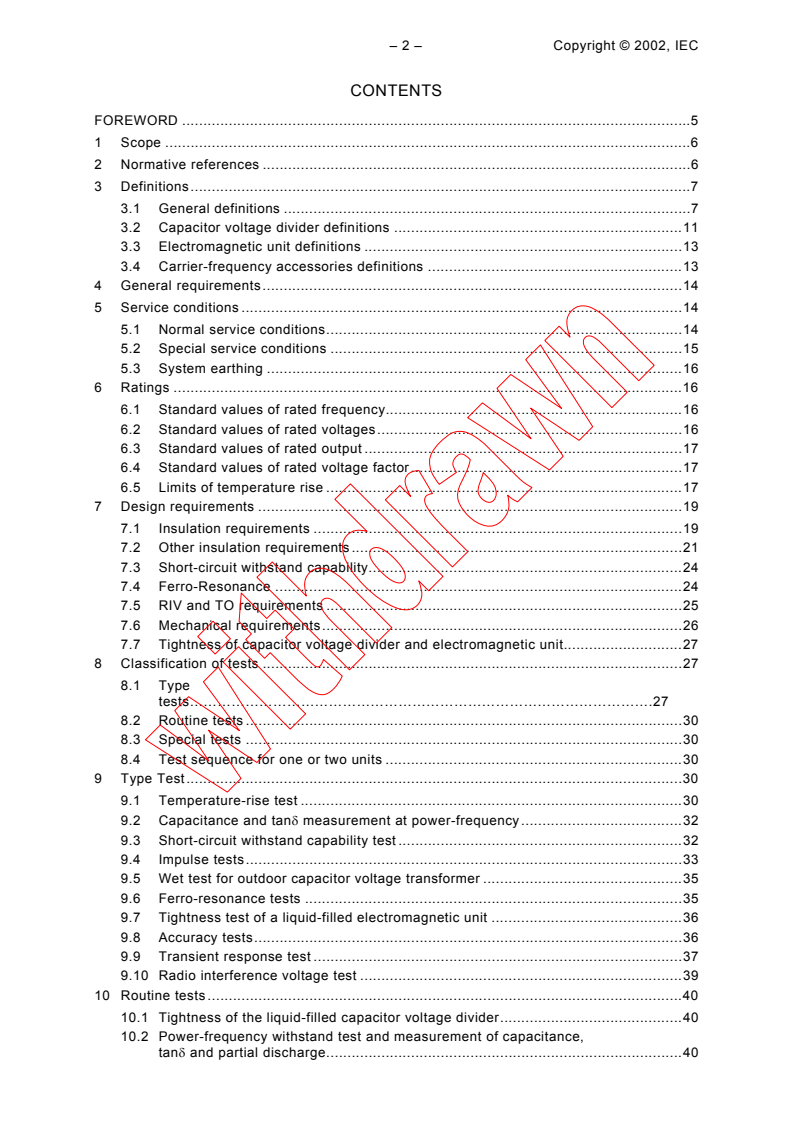
– 2 – Copyright © 2002, IEC
CONTENTS
FOREWORD .5
1 Scope .6
2 Normative references .6
3 Definitions.7
3.1 General definitions .7
3.2 Capacitor voltage divider definitions .11
3.3 Electromagnetic unit definitions .13
3.4 Carrier-frequency accessories definitions .13
4 General requirements.14
5 Service conditions .14
5.1 Normal service conditions.14
5.2 Special service conditions .15
5.3 System earthing .16
6 Ratings .16
6.1 Standard values of rated frequency.16
6.2 Standard values of rated voltages.16
6.3 Standard values of rated output .17
6.4 Standard values of rated voltage factor.17
6.5 Limits of temperature rise .17
7 Design requirements .19
7.1 Insulation requirements .19
7.2 Other insulation requirements.21
7.3 Short-circuit withstand capability.24
7.4 Ferro-Resonance .24
7.5 RIV and TO requirements .25
7.6 Mechanical requirements.26
7.7 Tightness of capacitor voltage divider and electromagnetic unit.27
8 Classification of tests .27
8.1 Type
tests……………………………………………………………………………………….27
8.2 Routine tests .30
8.3 Special tests .30
8.4 Test sequence for one or two units .30
9 Type Test.30
9.1 Temperature-rise test .30
9.2 Capacitance and tanδ measurement at power-frequency.32
9.3 Short-circuit withstand capability test .32
9.4 Impulse tests.33
9.5 Wet test for outdoor capacitor voltage transformer .35
9.6 Ferro-resonance tests .35
9.7 Tightness test of a liquid-filled electromagnetic unit .36
9.8 Accuracy tests.36
9.9 Transient response test .37
9.10 Radio interference voltage test .39
10 Routine tests .40
10.1 Tightness of the liquid-filled capacitor voltage divider.40
10.2 Power-frequency withstand test and measurement of capacitance,
tanδ and partial discharge.40
10.3 Verification of terminal markings.43
10.4 Power-frequency withstand tests on the electromagnetic unit .44
10.5 Ferro-resonance check.44
10.6 Accuracy check .44
11 Special Tests .46
11.1 Measurement of the transmission factor of high frequency overvoltages.46
11.2 Mechanical strength test.46
11.3 Determination of the temperature coefficient (T ) .47
C
11.4 Tightness design test of capacitor units .47
12 Marking of the capacitor units.47
12.1 General .47
12.2 Marking .47
13 Terminal markings.47
13.1 General .47
13.2 Markings .47
14 Additional requirements for measuring capacitor voltage transformer .49
14.1 Accuracy class designation.49
14.2 Standard reference range of frequency .49
14.3 Standard accuracy classes .49
14.4 Limits of voltage error and phase displacement.49
14.5 Tests for accuracy .50
15 Additional requirements for protective capacitor voltage transformers .50
15.1 Accuracy class designation.50
15.2 Standard reference range of frequency .50
15.3 Standard accuracy classes .50
15.4 Limits of voltage error and phase displacement.51
15.5 Transient response.51
15.6 Requirements for secondary windings intended to produce a residual voltage .52
16 Rating plate.55
16.1 Markings of the rating plate .55
16.2 Example of a typical rating plate .57
17 Requirements for carrier - frequency accessories .58
17.1 General .58
17.2 Drain coil and voltage limitation device .58
17.3 Type tests .59
17.4 Routine tests .59
17.5 Marking of the rating plate .59
Annex A (normative) Typical diagram of a capacitor voltage transformer .60
Annex B (informative) Transient response of capacitor voltage transformer under fault
conditions .61
Annex C (normative) High-frequency characteristics of capacitor voltage transformers .62
Bibliography .63
Figure 1 – Altitude correction factor for the insulation.15
Figure 2 – Altitude correction factor for the temperature rise .18
Figure 3 – Flow charts test sequence to be applied when performing the type test (figure 3a)
and routine test (figure 3b).29
Figure 4 – Diagram of a capacitor voltage transformer for the transient response test using
equivalent circuit method .38
– 4 – Copyright © 2002, IEC
Figure 5 – Series burden .39
Figure 6 – Pure resistance.39
Figure 7 – Test circuit.42
Figure 8 – Alternative circuit .42
Figure 9 – Example of balanced test circuit .42
Figure 10 – Example of calibration circuit.43
Figure 11 – Example of an error diagram of class 1 CVT for accuracy check with the
equivalent circuit .45
Figure 12 – Single-phase transformer with a neutral primary terminal
and a single secondary.48
Figure 13 – Single-phase transformer with a neutral
primary terminal and with two secondaries .48
Figure 14 – Single-phase transformer with a neutral primary terminal and with two tapped
secondaries.48
Figure 15 – Single-phase transformer with a neutral primary terminal,
with one residual voltage winding and a single secondary .48
Figure 16 – Error diagram of a capacitor voltage transformer for
accuracy classes 0,2, 0,5 and 1,0 .50
Figure 17 – Transient response of a capacitor voltage transformer .51
Figure A.1 – Example of a diagram for a capacitor voltage transformer.60
Figure A.2 – Example of a diagram for a capacitor voltage transformer with
carrier-frequency accessories .60
Table 1 – Rated ambient temperature categories .14
Table 2 – Standard values of rated voltage factors for accuracy and thermal requirements .17
Table 3 – Limits of temperature rise of windings.18
Table 4 – Standard insulation levels.20
Table 5 – Partial discharge test voltages and permissible levels.22
Table 6 – Creepage distance .24
Table 7a – Ferro-resonance requirements.25
Table 7b – Ferro-resonance requirements.25
Table 8 – Transmitted overvoltage requirements .26
Table 9 – Static withstand test loads .26
Table 10 – Test voltage for temperature rise test.31
Table 11 – Burden ranges for accuracy tests .37
Table 12 – Test voltages for units, stacks and complete capacitor voltage divider.41
Table 13 – Ferro resonance check .44
Table 14 – Accuracy check points (example).45
Table 15 – Modalities of application of the test loads to the line primary terminals .46
Table 16 – Limits of voltage error and phase displacement for measuring capacitor voltage
transformers .49
Table 17 – Limits of voltage error and phase displacement for protective capacitor voltage
transformers .51
Table 18 – Standard values .52
Table 19 – Rated secondary voltages for capacitor voltage transformers
to produce a residual voltage .53
Table 20 – Marking of the rating plate .55
INTERNATIONAL ELECTROTECHNICAL COMMISSION
______________
INSTRUMENT TRANSFORMERS –
Part 5: Capacitor voltage transformers
FOREWORD
A PAS is a technical specification not fulfilling the requirements for a standard, but made
available to the public.
IEC-PAS 60044-5 has been processed by IEC technical committee 38: Instrument trans-
formers.
The text of this PAS is based on the This PAS was approved for
following document: publication by the P-members of the
committee concerned as indicated in
the following document:
Draft PAS Report on voting
38/279/PAS 38/284/RVD
Following publication of this PAS, the technical committee or subcommittee concerned will
investigate the possibility of transforming the PAS into an International Standard.
1) The IEC (International Electrotechnical Commission) is a worldwide organization for standardization comprising
all national electrotechnical committees (IEC National Committees). The object of the IEC is to promote
international co-operation on all questions concerning standardization in the electrical and electronic fields. To
this end and in addition to other activities, the IEC publishes International Standards. Their preparation is
entrusted to technical committees; any IEC National Committee interested in the subject dealt with may
participate in this preparatory work. International, governmental and non-governmental organizations liaising
with the IEC also participate in this preparation. The IEC collaborates closely with the International
Organization for Standardization (ISO) in accordance with conditions determined by agreement between the
two organizations.
2) The formal decisions or agreements of the IEC on technical matters express, as nearly as possible, an
international consensus of opinion on the relevant subjects since each technical committee has representation
from all interested National Committees.
3) The documents produced have the form of recommendations for international use and are published in the
form of standards, technical specifications, technical reports or guides and they are accepted by the National
Committees in that sense.
4) In order to promote international unification, IEC National Committees undertake to apply IEC International
Standards transparently to the maximum extent possible in their national and regional standards. Any
divergence between the IEC Standard and the corresponding national or regional standard shall be clearly
indicated in the latter.
5) The IEC provides no marking procedure to indicate its approval and cannot be rendered responsible for any
equipment declared to be in conformity with one of its standards.
This PAS shall remain valid for an initial maximum period of 3 years starting from 2002-08.
The validity may be extended for a single 3-year period, following which it shall be revised to
become another type of normative document, or shall be withdrawn.
– 6 – Copyright © 2002, IEC
INSTRUMENT TRANSFORMERS –
Part 5: Capacitor voltage transformers
1 Scope
This PAS which is a part of International Standard IEC 60044 applies to new single-phase
capacitor voltage transformers connected between line and ground for system voltages Um ≥
72,5 kV at power frequencies from 15 Hz to 100 Hz. They are intended to supply a low
voltage for measurement, control and protective functions.
The capacitor voltage transformer can be equipped with or without carrier-frequency
accessories for power line carrier-frequency (PLC) application at carrier frequencies from
30 kHz to 500 kHz.
The future standard that should supersede the present PAS will replace the IEC 60186
regarding capacitor voltage transformers.
Three standards formed the basis for this IEC-PAS 60044-5:
− IEC 60044-2; concerning inductive voltage transformers;
− IEC 60358, concerning coupling capacitors and capacitor dividers;
− IEC 60481, concerning coupling devices for power line carrier (PLC) systems.
The application measurement function includes both indication measuring and revenue
measuring.
NOTE Diagrams of capacitor voltage transformer to which this document applies are given in figures A.1 and A.2.
2 Normative references
The following normative documents contain provisions which, through reference in this text,
constitute provisions of this document. For dated references, subsequent amendments to, or
revisions of, any of these publications do not apply. However parties to agreements based on
this document are encouraged to investigate the possibility of applying the most recent
editions of the normative documents indicated below. For undated references, the latest
edition of the normative document referred to applies. Members of ISO and IEC maintain
registers of currently valid International Standards.
IEC 60028:1925, International standard of resistance for copper
IEC 60038:1983, IEC standard voltages
IEC 60044-2:1997, Instrument transformers – Part 2: Inductive voltage transformers
IEC 60050-321:1986, International Electrotechnical Vocabulary – Chapter 321: Instrument
transformers
IEC 60050-436:1990, International Electrotechnical Vocabulary – Chapter 436: Power
capacitors
IEC 60050-601:1985, International Electrotechnical Vocabulary – Chapter 601: Generation,
transmission and distribution of electricity – General
IEC 60050-604:1987, International Electrotechnical Vocabulary – Chapter 604: Generation,
transmission and distribution of electricity – Operation
IEC 60060-1:1989, High-voltage test techniques – Part 1: General definitions and test
requirements
IEC 60071-1:1993, Insulation co-ordination – Part 1: Definitions, principles and rules
IEC 60085:1984, Thermal evaluation and classification of electrical insulation
IEC 60233:1974, Tests on hollow insulators for use in electrical equipment
IEC 60270:1981, Partial discharge measurements
IEC 60358:1990, Coupling capacitors and capacitor dividers
IEC 60481:1974, Coupling devices for power line carrier systems
IEC 60815:1986, Guide for the selection of insulators in respect of polluted conditions
CISPR 18-2:1986, Radio interference characteristics of overhead power lines and high-
voltage equipment – Part 2: Methods of measurement and procedure for determining limits
3 Definitions
For the purpose of this part of IEC 60044, the following definitions shall apply. Some of these
definitions are identical with or are similar to those of IEC 60050, Chapters 321, 436, 601
and 604. These are indicated by the relevant IEV reference number in brackets.
3.1 General definitions
3.1.1 capacitor voltage transformer (CVT)
a voltage transformer comprising a capacitor divider unit and an electromagnetic unit so
designed and interconnected that the secondary voltage of the electromagnetic unit is
substantially proportional to the primary voltage, and differs in phase from it by an angle
which is approximately zero for an appropriate direction of the connections and rated
frequency. [IEV 321-03-14 modified]
3.1.2 rated frequency of a capacitor voltage transformer (f )
R
the frequency for which the capacitor voltage transformer has been designed.
3.1.3 standard reference range of frequency
the range of frequency for which the rated accuracy is applicable.
3.1.4 rated primary voltage (U )
PR
the r.m.s. value of the primary voltage which appears in the designation of the capacitor
voltage transformer and on which its performance is based. [IEV 321-01-12 modified]
3.1.5 rated secondary voltage (U )
SR
the r.m.s. value of the secondary voltage which appears in the designation of the capacitor
voltage transformer and on which its performance is based. [IEV 321-01-16 modified]
– 8 – Copyright © 2002, IEC
3.1.6 secondary winding
the winding which supplies the voltage circuits of measuring instruments, meters, relays or
similar apparatus.
3.1.7 secondary circuit
the external circuit supplied by the secondary winding of a transformer.
3.1.8 actual transformation ratio
the ratio of the actual primary voltage to the actual secondary voltage. [IEV 321-01-18
modified]
3.1.9 rated transformation ratio (K )
R
the ratio of the rated primary voltage to the rated secondary voltage. [IEV 321-01-20
modified]
3.1.10 voltage error (ratio error) for steady state conditions (ε )
u
the error which a capacitor voltage transformer introduces into the measurement of a voltage
and which arises when the actual transformation ratio is not equal to the rated transformation
ratio K . [IEV 321-01-22 modified]
R
NOTE This definition is only related to components at rated frequency of both primary and secondary voltages,
and does not take into account direct voltage components and residual voltages.
K U − U
R S P
Voltage error ε = 100 %
U
U
P
where: K is the rated transformation ratio,
R
U is the actual primary voltage and
p
U is the actual secondary voltage when U is applied under the conditions of
s P
measurement.
3.1.11 phase displacement (ϕ )
U
the difference in phase between the primary and the secondary voltage phasors:
ϕ =(ϕ ϕ )
U S - P
The direction of the phasors being so chosen that the angle (ϕ ) is zero for a perfect
U
transformer. The phase displacement is said to be positive when the secondary voltage
phasor (ϕ ) leads the primary voltage phasor (ϕ ). It is usually expressed in minutes or
S P
centiradians. [IEV 321-01-23 modified]
NOTE This definition is strictly correct for sinusoidal voltages only.
3.1.12 accuracy class
designation assigned to a capacitor voltage transformer, the errors of which remain within
specified limits under prescribed conditions of use.
3.1.13 burden
admittance of the secondary circuit expressed in siemens and with an indication of the power
factor (lagging or leading).
NOTE The burden is usually expressed as the apparent power in volt-amperes, absorbed at a specified power
factor and at the rated secondary voltage.
3.1.14 rated burden
value of the burden on which the accuracy requirements of this document are based.
3.1.15 output
a) rated output
the value of the apparent power (in volt-amperes at a specified power factor), which the
capacitor voltage transformer is intended to supply to the secondary circuit at the rated
secondary voltage and with rated burden connected to it. [IEV 321-01-27 modified]
b) thermal limiting output
the value of the apparent power in volt-amperes referred to rated voltage which can be taken
from a secondary winding, at rated primary voltage applied, without exceeding the limits of
temperature rise of 6.5.
NOTE 1 In this condition the limits of error may be exceeded.
NOTE 2 In the case of more than one secondary winding, the thermal limiting output is to be given separately for
each winding.
NOTE 3 The simultaneous use of more than one secondary winding is not permitted unless there is an agreement
between the manufacturer and purchaser.
3.1.16 highest voltage for equipment (U )
m
the highest r.m.s. value of phase-to-phase voltage for which the equipment is designed and
may be used in respect of its insulation.
3.1.17 rated insulation level
the combination of voltage values which characterises the insulation of a transformer with
regard to its capability to withstand dielectric stresses.
3.1.18 isolated neutral system
a system where the neutral point is not intentionally connected to earth, except for high
impedance connections for protection or measurement purposes. [IEV 601-02-24]
3.1.19 solidly earthed neutral system
a system whose neutral point(s) is(are) earthed directly. [IEV 601-02-25]
3.1.20 impedance earthed (neutral) system
a system whose neutral point(s) is(are) earthed through impedances to limit earth fault
currents. [IEV 601-02-26]
3.1.21 resonant earthed (neutral) system
system in which one or more neutral points are connected to earth through reactances which
approximately compensate the capacitive component of a single-phase-to-earth fault current.
[IEV 601-02-27]
NOTE With resonant earthing of a system, the residual current in the fault is limited to such an extent that an
arcing fault in air is self-extinguishing.
3.1.22 earth fault factor
at a given location of a three-phase system, and for a given system configuration, the ratio of
the highest r.m.s. phase-to-earth power frequency voltage on a healthy phase during a fault
to earth affecting one or more phases at any point on the system to the r.m.s. phase-to-earth
power frequency voltage which would be obtained at the given location in the absence of any
such fault. [IEV 604-03-06]
3.1.23 earthed neutral system
system in which the neutral is connected to earth either solidly or through a resistance or
reactance of sufficiently low value to reduce transient oscillations and to give a current
sufficient for selective earth fault protection.
a) A three-phase system with effectively earthed neutral at a given location is a system
characterized by an earth fault factor at this point which does not exceed 1,4.
NOTE This condition is obtained approximately when, for all system configurations, the ratio of zero-sequence
reactance to the positive-sequence reactance is less than 3 and the ratio of zero-sequence resistance to positive-
sequence reactance is less than one.
– 10 – Copyright © 2002, IEC
b) A three-phase system with non-effectively earthed neutral at a given location is a system
characterized by an earth fault factor at this point that may exceed 1,4.
3.1.24 exposed installation
an installation in which the apparatus is subject to overvoltages of atmospheric origin.
NOTE Such installations are usually connected to overhead transmission lines either directly or through a short
length of cable.
3.1.25 non-exposed installation
an installation in which the apparatus is not subject to overvoltages of atmospheric origin.
NOTE Such installations are usually connected to underground cable networks.
3.1.26 measuring capacitor voltage transformer
a capacitor voltage transformer intended to supply indicating instruments, integrating meters
and similar apparatus.
3.1.27 protective capacitor voltage transformer
a capacitor voltage transformer intended to provide a supply to electrical protective relays.
3.1.28 residual voltage winding
the winding of a single-phase capacitor voltage transformer intended, in a set of three single-
phase transformers, for connection in broken delta for the purpose of producing a residual
voltage under earth-fault conditions.
3.1.29 rated voltage factor (F )
V
the multiplying factor to be applied to the rated primary voltage U to determine the
PR
maximum voltage at which a transformer must comply with relevant thermal requirements for
a specified time and with the relevant accuracy requirements.
3.1.30 rated temperature category of a capacitor voltage transformer
the range of temperature of the ambient air or of the cooling medium for which the capacitor
voltage transformer has been designed.
3.1.31 high voltage terminal
terminal intended for connection to a line conductor of a network. [IEV 436-03-01]
3.1.32 ferro-resonance
sustained resonance of a circuit consisting of a capacitance with a non-linear saturable
magnetic inductance.
NOTE The ferro-resonance can be initiated by switching operations on the primary side or secondary side.
3.1.33 transient response
the measured fidelity of the secondary-voltage waveform, compared with the voltage
waveform at the high-voltage terminal under transient conditions.
3.1.34 mechanical stress
the stresses on different parts of the capacitor voltage transformer as a function of four main
forces:
− forces on the terminals due to the line connections,
− forces due to the wind on the cross-section of the capacitor voltage transformer with and
without line trap mounted on the top of the coupling capacitor,
− seismic forces and
− electro dynamic forces due to short circuit current.
3.1.35 voltage-connected CVT
the CVT is voltage-connected when there is only one connection to the high voltage line.
NOTE Under normal conditions the top connection carries only the current of the capacitor voltage transformer.
3.1.36 current-connected CVT
the CVT is current-connected when there are two connections to the high voltage line.
NOTE The terminals and the top connection are designed to carry under normal conditions the line current.
3.1.37 line trap-connected CVT
the CVT is line trap-connected when it supports a line trap on its top. In this case, the two
connections to the line trap carry the HV line current and one connection from the line trap to
the CVT carries the CVT current.
NOTE The pedestal mounting line traps in two phases are generating additional forces during a short circuit in
more than one phase.
3.2 Capacitor voltage divider definitions
3.2.1 capacitor voltage divider
a capacitor stack forming an alternating voltage divider. [IEV 436-02-10]
3.2.2 capacitor element
a device consisting essentially of two electrodes separated by a dielectric. [IEV 436-01-03]
3.2.3 capacitor unit
an assembly of one or more capacitor elements in the same container with terminals brought
out. [IEV 436-01-04]
NOTE A common type of unit for coupling capacitors has a cylindrical housing of insulating material and metallic
flanges which serve as terminals.
3.2.4 capacitor stack
an assembly of capacitor units connected in series. [IEV 436-01-05]
NOTE The capacitor units are usually mounted in a vertical array.
3.2.5 capacitor
a general term used when it is not necessary to state whether reference is made to a
capacitor unit or to a capacitor stack.
3.2.6 rated capacitance of a capacitor (C )
R
the capacitance value for which the capacitor has been designed.
NOTE This definition applies:
• for a capacitor unit, to the capacitance between the terminals of the unit;
• for a capacitor stack, to the capacitance between line and low voltage terminals or between line and earth
terminals of the stack;
• for a capacitor divider, to the resultant capacitance: C =C C /(C + C ).
R 1 2 1 2
3.2.7 coupling capacitor
a capacitor used for the transmission of signals in a power system. [IEV 436-02-11]
3.2.8 high voltage capacitor (of a capacitor divider) (C )
the capacitor connected between the line terminal and the intermediate voltage terminal of a
capacitor divider. [IEV 436-02-12 modified]
3.2.9 intermediate voltage capacitor (of a capacitor divider) (C )
the capacitor connected between the intermediate voltage and the low voltage terminals of a
capacitor divider. [IEV 436-02-13]
3.2.10 intermediate voltage terminal of a capacitor divider
a terminal intended for connection to an intermediate circuit, such as the electromagnetic unit
of a capacitor voltage transformer. [IEV 436-03-03]
– 12 – Copyright © 2002, IEC
3.2.11 low voltage terminal of a capacitor divider
a terminal (N) intended for connection to earth either directly or via a drain coil of negligible
value of impedance, at rated frequency, for power line carrier (PLC) application. [IEV
436-03-04 modified]
3.2.12 capacitance tolerance
the permissible difference between the actual capacitance and the rated capacitance under
specified conditions. [IEV 436-04-01]
3.2.13 equivalent series resistance of a capacitor
virtual resistance which, if connected in series with an ideal capacitor of capacitance value
equal to that of the capacitor in question, would have a power loss equal to the active power
dissipated in that capacitor under specified operating conditions at a given high frequency.
3.2.14 high frequency capacitance
the effective capacitance at a given frequency resulting from the joint effect of the intrinsic
capacitance and the self-inductance of a capacitor. [IEV 436-04-03]
3.2.15 intermediate voltage of a capacitor divider (U )
C
the voltage between the intermediate voltage terminal of the capacitor divider and the low
voltage terminal, when the primary voltage is applied between the high and low voltage
terminals or high voltage terminal and earth terminal.
3.2.16 rated voltage ratio of a capacitor divider (K )
CR
the ratio of the voltage applied to the capacitor divider to the open-circuit intermediate
voltage. [IEV 436-04-05]
NOTE 1 This ratio corresponds to the sum of the capacitances of the high voltage and intermediate voltage
capacitors divided by the capacitance of the high voltage capacitor: (C + C ) / C = K .
CR
1 2 1
NOTE 2 C and C include the stray capacitances, which are generally negligible.
1 2
3.2.17 capacitor losses
the active power dissipated in the capacitor. [IEV 436-04-10]
3.2.18 tangent of the loss angle (tanδ) of a capacitor
the ratio between the active power P and the reactive power P : tanδ = P /P .
a r a r
3.2.19 temperature coefficient of capacitance (T )
C
the fractional change of the capacitance for a given change in temperature:
∆ C
∆T 1
T =
C
C K
°C
∆C represents the observed change in capacitance over the temperature interval ∆T
C represents the capacitance measured at 20 °C.
20°C
NOTE The term ∆C/∆T according to this definition is usable only if the capacitance is an approximate linear
function of the temperature in the range under consideration. If not, the temperature dependency of the
capacitance should be shown in a graph or a table.
3.2.20 stray capacitance of the low voltage terminal
the stray capacitance between the low voltage terminal and the earth terminal.
3.2.21 stray conductance of the low voltage terminal
the stray conductance between the low voltage terminal and the earth terminal.
3.2.22 dielectric of a capacitor
the insulating material between the electrodes.
3.3 Electromagnetic unit definitions
3.3.1 electromagnetic unit
the component of a capacitor voltage transformer, connected between the intermediate
voltage terminal and the earth terminal of the capacitor divider (or possibly directly connected
to earth when a carrier-frequency coupling device is used) which supplies the secondary
voltage.
NOTE An electromagnetic unit essentially comprises a transformer to reduce the intermediate voltage to the
required value of secondary voltage, and a compensating inductance approximately equal, at rated frequency to
the capacitive reactance of the two parts of the divider connected in parallel (C + C ). The compensating
1 2
inductance may be incorporated wholly or partially in the transformer.
3.3.2 intermediate transformer
a voltage transformer in which the secondary voltage, in normal conditions of use, is
substantially proportional to the primary voltage.
3.3.3 compensating inductance
an inductance which is usually connected between the intermediate terminal and the high
voltage terminal of the primary winding of the intermediate transformer or between earth
terminal and the earth-side terminal of the primary winding of the intermediate transformer or
incorporated in the primary and secondary windings of the intermediate transformer.
NOTE The design value L of the inductance is L=
(C +C )⋅(2πf )
1 2 R
3.3.4 damping device
devices incorporated in the electromagnetic unit for the purposes of:
a) limiting overvoltages which may appear across one or more components;
b) and/or to prevent sustained ferro-resonance;
c) and/or to achieve a higher performance of the transient response of the capacitor voltage
transformer.
3.4 Carrier-frequency accessories definitions
3.4.1 carrier-frequency accessories
circuit element intended to permit the injection of carrier frequency signal and which is
connected between the low voltage terminal of a capacitor divider unit and earth, having an
impedance which is insignificant at power frequency, but appreciable at the carrier frequency.
(see figure A.2)
3.4.2 drain coil
an inductance which is connected between the low voltage terminal of a capacitor divider and
earth. The impedance of the drain coil is insignificant at power frequency, but has a high
value at the carrier frequency.
3.4.3 voltage limitation element
an element connected across the drain coil or between low voltage terminal of the capacitor
voltage divider and earth to limit the overvoltages which appear across the drain coil:
a) at a short circuit between the high-voltage terminal and earth;
b) in the case where an impulse voltage is applied between the high voltage terminal and
earth.
3.4.4 carrier earthing switch
a switch for earthing, when necessary, of the low voltage terminal.
– 14 – Copyright © 2002, IEC
4 General requirements
All capacitor voltage transformers shall be suitable for measuring purposes, but, in addition,
certain types may be suitable for protection purposes. Capacitor voltage transformers for the
dual purpose of measurement and protection shall comply with all clauses of this document.
5 Service conditions
Detailed information concerning classification of environmental conditions is given in
IEC 60721 series.
5.1 Normal service conditions
5.1.1 Ambient air temperature
The capacitor voltage transformers are classified in three categories as given in table 1.
Table 1 – Rated ambient temperature categories
Category Minimum temperature Maximum temperature
°C °C
–5/40 –5 40
–25/40 –25 40
–40/40 –40 40
NOTE In the choice of the temperature category, storage and transportation conditions
should also be considered.
5.1.2 Altitude
The altitude does not exceed 1 000 m.
5.1.3 Vibrations or earth tremors
Vibrations due to causes external to the capacitor voltage transformer or earth tremors are
negligible.
5.1.4 Other service conditions for indoor capacitor voltage transformers
Other considered service conditions are the following:
a) the influence of solar radiation may be neglected;
b) the ambient air is not significantly polluted by dust, smoke, corrosive gases, vapours or
salt;
c) the conditions of humidity are as follows:
1) the average value of the relative humidity, measured during a period of 24 h, does not
exceed 95 %;
2) the average value of the water vapour pressure for a period of 24 h, does not exceed
2,2 kPa;
3) the average value of the relative humidity, for a period of one month, does not exceed
90 %; the average value of the water vapour pressure, for a period of one month, does
not exceed 1,8 kPa.
For these conditions, condensation may occasionally occur.
NOTE 1 Condensation be expected where sudden temperature changes occur in periods of high humidity.
NOTE 2 To withstand the effects of high humidity and condensation, such as breakdown of insulation or corrosion
of metallic parts, capacitor voltage transformers designed for such conditions should be used.
NOTE 3 Condensation may be prevented by special design of the housing, by suitable ventilation and heating or
by the use of dehumidifying equipment.
5.1.5 Other service conditions for outdoor capacitor voltage transformers
Other considered service conditions are the following:
a) average value of the ambient air temperature, measured over a period of 24 h, does not
exceed 35 °C;
b) solar radiation up to a level of 1 000 W/m (on a clear day at noon) should
...