


IEC TR 61850-90-7:2023
(Main)Communication networks and systems for power utility automation - Part 90-7: Object models for power converters in distributed energy resources (DER) systems
Communication networks and systems for power utility automation - Part 90-7: Object models for power converters in distributed energy resources (DER) systems
IEC TR 61850-90-7:2023, which is a Technical Report, describes functions for power converter-based distributed energy resources (DER) systems, focused on DC-to-AC and AC-to-AC conversions and including photovoltaic systems (PV), battery storage systems, electric vehicle (EV) charging systems, and any other DER systems with a controllable power converter. The functions defined in this document were used to help define the information models described in IEC 61850-7-420 and which can be used in the exchange of information between these power converter-based DER systems and the utilities, energy service providers (ESPs), or other entities which are tasked with managing the volt, var, and watt capabilities of these power converter-based systems. These power converter-based DER systems can range from very small grid-connected systems at residential customer sites, to medium-sized systems configured as microgrids on campuses or communities, to very large systems in utility-operated power plants, and to many other configurations and ownership models. They may or may not combine different types of DER systems behind the power converter, such as a power converter-based DER system and a battery that are connected at the DC level. This second edition cancels and replaces the first edition published in 2013. This edition is primarily an editorial revision in order to be consistent with the publication of Edition 2 of IEC 61850-7-420:2021. This edition includes the following significant changes with respect to the previous edition:
a) Clause 3 has been updated.
b) Clause 8 (IEC 61850 information models for power converter-based functions) has been deleted. This clause defined data models with the transitional namespace “(Tr) IEC 61850-90-7:2012”. The data models are now defined in IEC 61850-7-420.
General Information
- Status
- Published
- Publication Date
- 22-Aug-2023
- Technical Committee
- TC 57 - Power systems management and associated information exchange
- Drafting Committee
- WG 17 - TC 57/WG 17
- Current Stage
- PPUB - Publication issued
- Start Date
- 23-Aug-2023
- Completion Date
- 01-Sep-2023
Relations
- Effective Date
- 05-Sep-2023
Overview
IEC TR 61850-90-7:2023 is a Technical Report from the IEC that describes object models and functional descriptions for power converter–based distributed energy resources (DER). It focuses on DC-to-AC and AC-to-AC conversion systems - including photovoltaic (PV) arrays, battery energy storage systems (BESS), electric vehicle (EV) charging systems, and other DERs that use controllable power converters. Edition 2 (2023) is an editorial update to align with Edition 2 of IEC 61850-7-420:2021 and replaces the 2013 edition; data models formerly in clause 8 are now defined in IEC 61850-7-420.
Key topics and technical requirements
- Functional descriptions for power converters covering basic settings, control modes, schedules, immediate controls, and reporting.
- Standardized function set (examples cited): INV1 (connect/disconnect), INV2 (adjust max generation), INV3 (adjust power factor), INV4 (charge/discharge control), INV5 (pricing signals).
- Mode definitions for autonomous and coordinated behaviour:
- Volt‑var modes (VV11–VV14)
- Frequency‑watt modes (FW21, FW22)
- Voltage‑watt modes (VW51, VW52)
- Dynamic reactive current support (TV31)
- Low/High voltage ride‑through (L/HVRT), watt‑triggered modes, temperature and pricing modes
- Management constructs: nameplate vs. basic settings, ramp rates, hysteresis, time schedules, paired arrays and percent‑based parameters for size-neutral control.
- Operational contexts and architectures: Electrical Coupling Point (ECP), Point of Common Coupling (PCC), autonomous vs. loosely‑coupled vs. broadcast interactions.
- Information exchange and reporting: settings modification, event logging, status reporting and time synchronization requirements.
- Note: IEC 61850 information models for these functions are maintained in IEC 61850-7-420; TR 61850-90-7 documents the functional intent and object model descriptions.
Applications and practical value
- Enables interoperability between DERs and utilities, energy service providers (ESPs), microgrid controllers, and aggregation platforms.
- Supports grid services: volt/var control, frequency response, ride‑through, dispatchable generation/charging, and coordinated DER management across residential to utility‑scale installations.
- Useful for designing DER control firmware, communication interfaces, system integration, vendor interoperability testing, and grid code conformance.
Who should use this standard
- Utilities and distribution system operators (DSOs)
- DER manufacturers (inverters, BESS, EV chargers)
- System integrators and microgrid designers
- Energy service providers and aggregators
- Test laboratories and standards engineers implementing IEC 61850 device models
Related standards
- IEC 61850 series (notably IEC 61850-7-420:2021 for data models)
- Grid codes and interconnection standards for DER performance and ride‑through
Keywords: IEC TR 61850-90-7:2023, IEC 61850, DER object models, power converters, PV, battery storage, EV charging, volt-var, frequency-watt, microgrid, interoperability.
IEC TR 61850-90-7:2023 - Communication networks and systems for power utility automation - Part 90-7: Object models for power converters in distributed energy resources (DER) systems Released:8/23/2023 Isbn:9782832273371
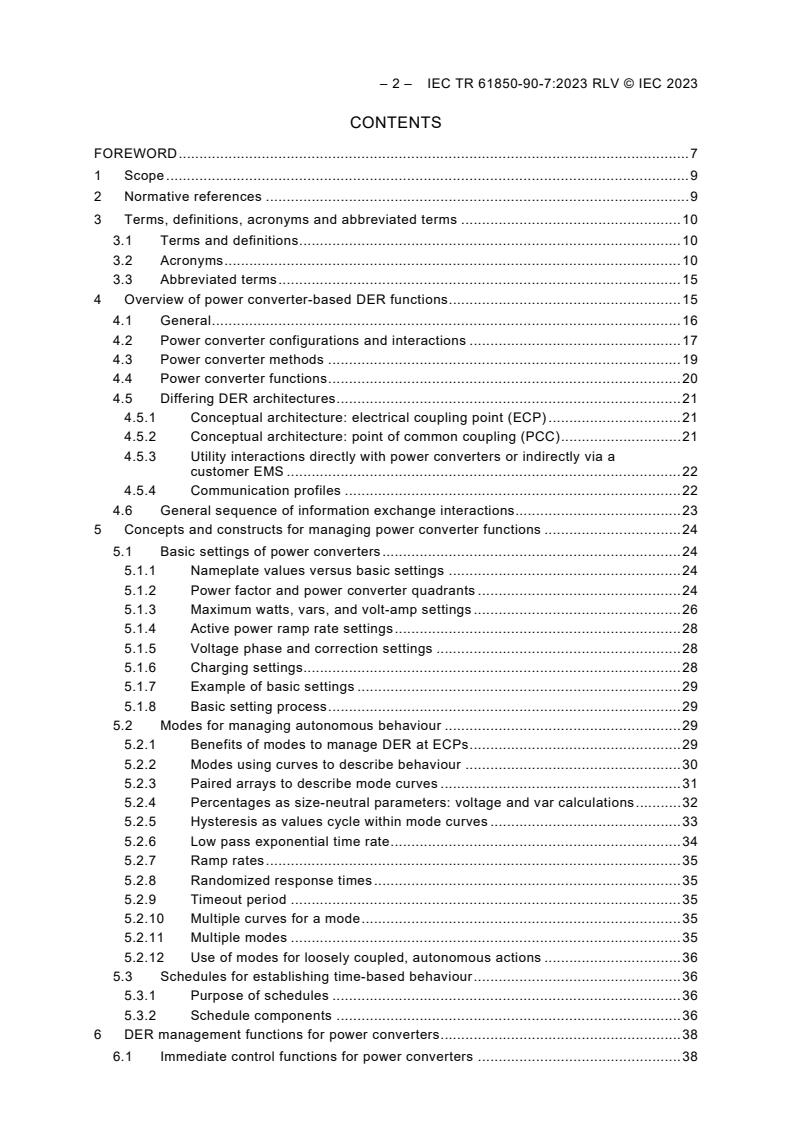
IEC TR 61850-90-7:2023 RLV - Communication networks and systems for power utility automation - Part 90-7: Object models for power converters in distributed energy resources (DER) systems Released:8/23/2023
Frequently Asked Questions
IEC TR 61850-90-7:2023 is a technical report published by the International Electrotechnical Commission (IEC). Its full title is "Communication networks and systems for power utility automation - Part 90-7: Object models for power converters in distributed energy resources (DER) systems". This standard covers: IEC TR 61850-90-7:2023, which is a Technical Report, describes functions for power converter-based distributed energy resources (DER) systems, focused on DC-to-AC and AC-to-AC conversions and including photovoltaic systems (PV), battery storage systems, electric vehicle (EV) charging systems, and any other DER systems with a controllable power converter. The functions defined in this document were used to help define the information models described in IEC 61850-7-420 and which can be used in the exchange of information between these power converter-based DER systems and the utilities, energy service providers (ESPs), or other entities which are tasked with managing the volt, var, and watt capabilities of these power converter-based systems. These power converter-based DER systems can range from very small grid-connected systems at residential customer sites, to medium-sized systems configured as microgrids on campuses or communities, to very large systems in utility-operated power plants, and to many other configurations and ownership models. They may or may not combine different types of DER systems behind the power converter, such as a power converter-based DER system and a battery that are connected at the DC level. This second edition cancels and replaces the first edition published in 2013. This edition is primarily an editorial revision in order to be consistent with the publication of Edition 2 of IEC 61850-7-420:2021. This edition includes the following significant changes with respect to the previous edition: a) Clause 3 has been updated. b) Clause 8 (IEC 61850 information models for power converter-based functions) has been deleted. This clause defined data models with the transitional namespace “(Tr) IEC 61850-90-7:2012”. The data models are now defined in IEC 61850-7-420.
IEC TR 61850-90-7:2023, which is a Technical Report, describes functions for power converter-based distributed energy resources (DER) systems, focused on DC-to-AC and AC-to-AC conversions and including photovoltaic systems (PV), battery storage systems, electric vehicle (EV) charging systems, and any other DER systems with a controllable power converter. The functions defined in this document were used to help define the information models described in IEC 61850-7-420 and which can be used in the exchange of information between these power converter-based DER systems and the utilities, energy service providers (ESPs), or other entities which are tasked with managing the volt, var, and watt capabilities of these power converter-based systems. These power converter-based DER systems can range from very small grid-connected systems at residential customer sites, to medium-sized systems configured as microgrids on campuses or communities, to very large systems in utility-operated power plants, and to many other configurations and ownership models. They may or may not combine different types of DER systems behind the power converter, such as a power converter-based DER system and a battery that are connected at the DC level. This second edition cancels and replaces the first edition published in 2013. This edition is primarily an editorial revision in order to be consistent with the publication of Edition 2 of IEC 61850-7-420:2021. This edition includes the following significant changes with respect to the previous edition: a) Clause 3 has been updated. b) Clause 8 (IEC 61850 information models for power converter-based functions) has been deleted. This clause defined data models with the transitional namespace “(Tr) IEC 61850-90-7:2012”. The data models are now defined in IEC 61850-7-420.
IEC TR 61850-90-7:2023 is classified under the following ICS (International Classification for Standards) categories: 33.200 - Telecontrol. Telemetering. The ICS classification helps identify the subject area and facilitates finding related standards.
IEC TR 61850-90-7:2023 has the following relationships with other standards: It is inter standard links to IEC TR 61850-90-7:2013. Understanding these relationships helps ensure you are using the most current and applicable version of the standard.
You can purchase IEC TR 61850-90-7:2023 directly from iTeh Standards. The document is available in PDF format and is delivered instantly after payment. Add the standard to your cart and complete the secure checkout process. iTeh Standards is an authorized distributor of IEC standards.
Standards Content (Sample)
IEC TR 61850-90-7 ®
Edition 2.0 2023-08
TECHNICAL
REPORT
colour
inside
Communication networks and systems for power utility automation –
Part 90-7: Object models for power converters in distributed energy resources
(DER) systems
All rights reserved. Unless otherwise specified, no part of this publication may be reproduced or utilized in any form
or by any means, electronic or mechanical, including photocopying and microfilm, without permission in writing from
either IEC or IEC's member National Committee in the country of the requester. If you have any questions about IEC
copyright or have an enquiry about obtaining additional rights to this publication, please contact the address below or
your local IEC member National Committee for further information.
IEC Secretariat Tel.: +41 22 919 02 11
3, rue de Varembé info@iec.ch
CH-1211 Geneva 20 www.iec.ch
Switzerland
About the IEC
The International Electrotechnical Commission (IEC) is the leading global organization that prepares and publishes
International Standards for all electrical, electronic and related technologies.
About IEC publications
The technical content of IEC publications is kept under constant review by the IEC. Please make sure that you have the
latest edition, a corrigendum or an amendment might have been published.
IEC publications search - webstore.iec.ch/advsearchform IEC Products & Services Portal - products.iec.ch
The advanced search enables to find IEC publications by a Discover our powerful search engine and read freely all the
variety of criteria (reference number, text, technical publications previews. With a subscription you will always have
committee, …). It also gives information on projects, replaced access to up to date content tailored to your needs.
and withdrawn publications.
Electropedia - www.electropedia.org
IEC Just Published - webstore.iec.ch/justpublished
The world's leading online dictionary on electrotechnology,
Stay up to date on all new IEC publications. Just Published
containing more than 22 300 terminological entries in English
details all new publications released. Available online and once
and French, with equivalent terms in 19 additional languages.
a month by email.
Also known as the International Electrotechnical Vocabulary
(IEV) online.
IEC Customer Service Centre - webstore.iec.ch/csc
If you wish to give us your feedback on this publication or need
further assistance, please contact the Customer Service
Centre: sales@iec.ch.
IEC TR 61850-90-7 ®
Edition 2.0 2023-08
TECHNICAL
REPORT
colour
inside
Communication networks and systems for power utility automation –
Part 90-7: Object models for power converters in distributed energy resources
(DER) systems
INTERNATIONAL
ELECTROTECHNICAL
COMMISSION
ICS 33.200 ISBN 978-2-8322-7337-1
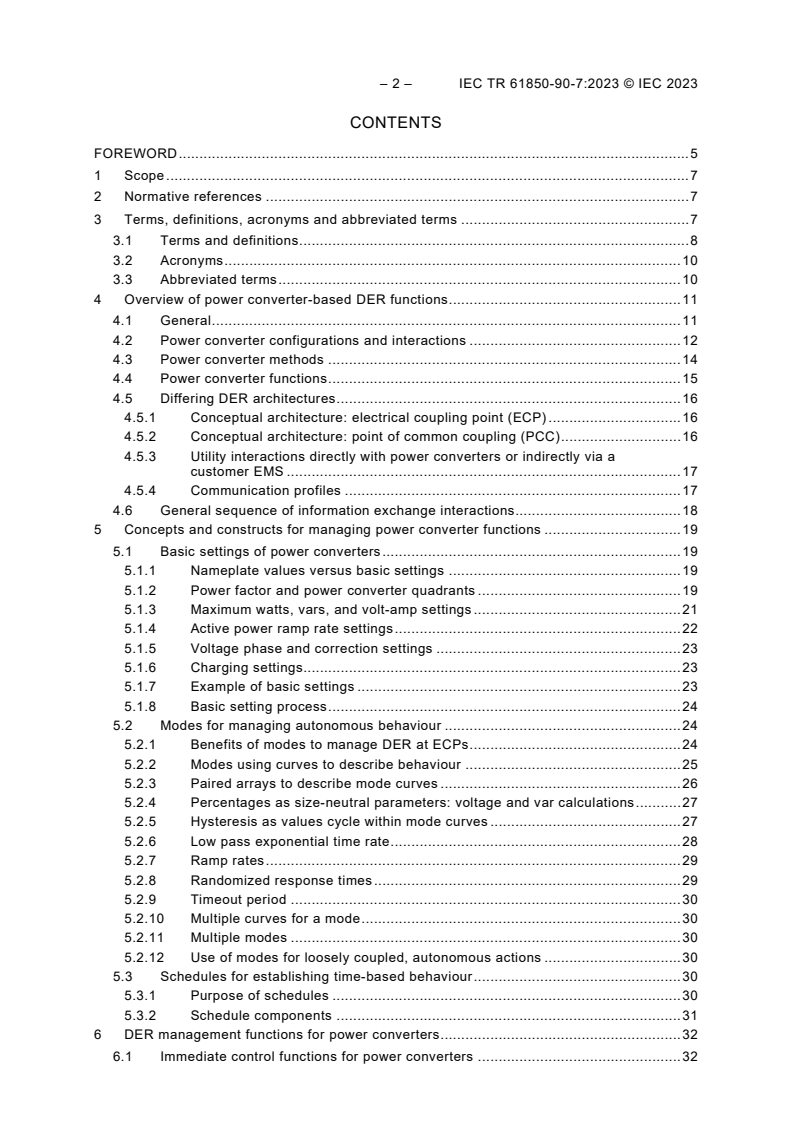
– 2 – IEC TR 61850-90-7:2023 © IEC 2023
CONTENTS
FOREWORD . 5
1 Scope . 7
2 Normative references . 7
3 Terms, definitions, acronyms and abbreviated terms . 7
3.1 Terms and definitions . 8
3.2 Acronyms . 10
3.3 Abbreviated terms . 10
4 Overview of power converter-based DER functions . 11
4.1 General . 11
4.2 Power converter configurations and interactions . 12
4.3 Power converter methods . 14
4.4 Power converter functions . 15
4.5 Differing DER architectures . 16
4.5.1 Conceptual architecture: electrical coupling point (ECP) . 16
4.5.2 Conceptual architecture: point of common coupling (PCC) . 16
4.5.3 Utility interactions directly with power converters or indirectly via a
customer EMS . 17
4.5.4 Communication profiles . 17
4.6 General sequence of information exchange interactions. 18
5 Concepts and constructs for managing power converter functions . 19
5.1 Basic settings of power converters . 19
5.1.1 Nameplate values versus basic settings . 19
5.1.2 Power factor and power converter quadrants . 19
5.1.3 Maximum watts, vars, and volt-amp settings . 21
5.1.4 Active power ramp rate settings . 22
5.1.5 Voltage phase and correction settings . 23
5.1.6 Charging settings. 23
5.1.7 Example of basic settings . 23
5.1.8 Basic setting process . 24
5.2 Modes for managing autonomous behaviour . 24
5.2.1 Benefits of modes to manage DER at ECPs . 24
5.2.2 Modes using curves to describe behaviour . 25
5.2.3 Paired arrays to describe mode curves . 26
5.2.4 Percentages as size-neutral parameters: voltage and var calculations . 27
5.2.5 Hysteresis as values cycle within mode curves . 27
5.2.6 Low pass exponential time rate . 28
5.2.7 Ramp rates . 29
5.2.8 Randomized response times . 29
5.2.9 Timeout period . 30
5.2.10 Multiple curves for a mode . 30
5.2.11 Multiple modes . 30
5.2.12 Use of modes for loosely coupled, autonomous actions . 30
5.3 Schedules for establishing time-based behaviour . 30
5.3.1 Purpose of schedules . 30
5.3.2 Schedule components . 31
6 DER management functions for power converters . 32
6.1 Immediate control functions for power converters . 32
6.1.1 General . 32
6.1.2 Function INV1: connect / disconnect from grid . 33
6.1.3 Function INV2: adjust maximum generation level up/down . 33
6.1.4 Function INV3: adjust power factor . 34
6.1.5 Function INV4: request active power (charge or discharge storage) . 34
6.1.6 Function INV5: pricing signal for charge/discharge action . 35
6.2 Modes for volt-var management . 36
6.2.1 VAr management modes using volt-var arrays . 36
6.2.2 Example setting volt-var mode VV11: available var support mode with
no impact on watts . 37
6.2.3 Example setting volt-var mode VV12: maximum var support mode
based on WMax . 38
6.2.4 Example setting volt-var mode VV13: static power converter mode
based on settings . 40
6.2.5 Example setting volt-var mode VV14: passive mode with no var support. 41
6.3 Modes for frequency-related behaviours . 41
6.3.1 Frequency management modes . 41
6.3.2 Frequency-watt mode FW21: high frequency reduces active power . 42
6.3.3 Frequency-watt mode FW22: constraining generating/charging by
frequency . 44
6.4 Dynamic reactive current support during abnormally high or low voltage
levels . 47
6.4.1 Purpose of dynamic reactive current support . 47
6.4.2 Dynamic reactive current support mode TV31: support during
abnormally high or low voltage levels . 47
6.5 Low/high voltage ride-through curves for “must disconnect” and “must
remain connected” zones . 51
6.5.1 Purpose of L/HVRT . 51
6.5.2 “Must disconnect” (MD) and “must remain connected” (MRC) curves . 51
6.6 Modes for watt-triggered behaviours . 53
6.6.1 Watt-power factor mode WP41: feed-in power controls power factor . 53
6.6.2 Alternative watt-power factor mode WP42: feed-in power controls power
factor . 53
6.7 Modes for voltage-watt management . 54
6.7.1 Voltage-watt mode VW51: voltage-watt management: generating by
voltage . 54
6.7.2 Voltage-watt mode VW52: voltage-watt management: charging by
voltage . 54
6.8 Modes for behaviours triggered by non-power parameters . 55
6.8.1 Temperature mode TMP . 55
6.8.2 Pricing signal mode PS . 55
6.9 Setting and reporting functions . 56
6.9.1 Purpose of setting and reporting functions . 56
6.9.2 Establishing settings DS91: modify power converter-based DER
settings . 56
6.9.3 Event logging DS92: log alarms and events, retrieve logs . 56
6.9.4 Reporting status DS93: selecting status points, establishing reporting
mechanisms . 60
Bibliography . 62
– 4 – IEC TR 61850-90-7:2023 © IEC 2023
Figure 1 – DER management hierarchical interactions: autonomous, loosely-coupled,
broadcast/multicast . 14
Figure 2 – Electrical Connection Points (ECP) and Point of Common Coupling (PCC) . 17
Figure 3 – Producer and Consumer Reference Frame conventions . 20
Figure 4 – EEI power factor sign convention . 21
Figure 5 – Working areas for different modes . 22
Figure 6 – Example of voltage offsets (VRefOfs) with respect to the reference voltage
(VRef) . 23
Figure 7 – Example of modes associated with different ECPs . 25
Figure 8 – Example of a volt-var mode curve . 26
Figure 9 – Example of hysteresis in volt-var curves. 28
Figure 10 – Example of deadband in volt-var curves . 28
Figure 11 – Local function block diagram . 29
Figure 12 – Time domain response of first order low pass filter . 29
Figure 13 – Interrelationships of schedule controllers, schedules, and schedule
references . 32
Figure 14 – Volt-var mode VV11 – available vars mode . 37
Figure 15 – Power converter mode VV12 – Maximum var support mode based on
WMax . 39
Figure 16 – Power converter mode VV13 – Example: static var support mode based on
VArMax . 40
Figure 17 – Frequency-watt mode curves. 42
Figure 18 – Frequency-based active power reduction . 43
Figure 19 – Frequency-based active power modification with the use of an array . 44
Figure 20 – Example of a basic frequency-watt mode configuration . 45
Figure 21 – Example array settings with hysteresis . 46
Figure 22 – Example of an asymmetrical hysteresis configuration . 46
Figure 23 – Example array configuration for absorbed watts vs. frequency . 47
Figure 24 – Basic concepts of the dynamic reactive current support function . 48
Figure 25 – Calculation of delta voltage over the filter time window . 48
Figure 26 – Activation zones for dynamic reactive current support . 49
Figure 27 – Alternative gradient behaviour, selected by ArGraMod . 50
Figure 28 – Settings to define a blocking zone . 50
Figure 29 – Must disconnect and must remain connected zones . 52
Figure 30 – Examples of “must remain connected” requirements for different regions . 52
Figure 31 – Power factor controlled by feed-in power . 53
Figure 32 – Example configuration curve for maximum watts vs. voltage . 54
Figure 33 – Example configuration curve for maximum watts absorbed vs. voltage . 55
Table 1 – Producer Reference Frame (PRF) conventions . 19
Table 2 – Example basic settings for a storage DER unit . 24
Table 3 – Events . 58
Table 4 – Examples of status points . 60
INTERNATIONAL ELECTROTECHNICAL COMMISSION
____________
COMMUNICATION NETWORKS AND SYSTEMS
FOR POWER UTILITY AUTOMATION –
Part 90-7: Object models for power converters
in distributed energy resources (DER) systems
FOREWORD
1) The International Electrotechnical Commission (IEC) is a worldwide organization for standardization comprising
all national electrotechnical committees (IEC National Committees). The object of IEC is to promote international
co-operation on all questions concerning standardization in the electrical and electronic fields. To this end and
in addition to other activities, IEC publishes International Standards, Technical Specifications, Technical Reports,
Publicly Available Specifications (PAS) and Guides (hereafter referred to as “IEC Publication(s)”). Their
preparation is entrusted to technical committees; any IEC National Committee interested in the subject dealt with
may participate in this preparatory work. International, governmental and non-governmental organizations liaising
with the IEC also participate in this preparation. IEC collaborates closely with the International Organization for
Standardization (ISO) in accordance with conditions determined by agreement between the two organizations.
2) The formal decisions or agreements of IEC on technical matters express, as nearly as possible, an international
consensus of opinion on the relevant subjects since each technical committee has representation from all
interested IEC National Committees.
3) IEC Publications have the form of recommendations for international use and are accepted by IEC National
Committees in that sense. While all reasonable efforts are made to ensure that the technical content of IEC
Publications is accurate, IEC cannot be held responsible for the way in which they are used or for any
misinterpretation by any end user.
4) In order to promote international uniformity, IEC National Committees undertake to apply IEC Publications
transparently to the maximum extent possible in their national and regional publications. Any divergence between
any IEC Publication and the corresponding national or regional publication shall be clearly indicated in the latter.
5) IEC itself does not provide any attestation of conformity. Independent certification bodies provide conformity
assessment services and, in some areas, access to IEC marks of conformity. IEC is not responsible for any
services carried out by independent certification bodies.
6) All users should ensure that they have the latest edition of this publication.
7) No liability shall attach to IEC or its directors, employees, servants or agents including individual experts and
members of its technical committees and IEC National Committees for any personal injury, property damage or
other damage of any nature whatsoever, whether direct or indirect, or for costs (including legal fees) and
expenses arising out of the publication, use of, or reliance upon, this IEC Publication or any other IEC
Publications.
8) Attention is drawn to the Normative references cited in this publication. Use of the referenced publications is
indispensable for the correct application of this publication.
9) Attention is drawn to the possibility that some of the elements of this IEC Publication may be the subject of patent
rights. IEC shall not be held responsible for identifying any or all such patent rights.
IEC TR 61850-90-7 has been prepared by IEC technical committee 57: Power systems
management and associated information exchange. It is a Technical Report.
This second edition cancels and replaces the first edition published in 2013. This edition is
primarily an editorial revision in order to be consistent with the publication of Edition 2 of
IEC 61850-7-420:2021.
This edition includes the following significant changes with respect to the previous edition:
a) Clause 3 has been updated.
b) Clause 8 (IEC 61850 information models for power converter-based functions) has been
deleted. This clause defined data models with the transitional namespace “(Tr) IEC 61850-
90-7:2012”. The data models are now defined in IEC 61850-7-420.
– 6 – IEC TR 61850-90-7:2023 © IEC 2023
The text of this Technical Report is based on the following documents:
Draft Report on voting
57/2558/DTR 57/2610/RVDTR
Full information on the voting for its approval can be found in the report on voting indicated in
the above table.
The language used for the development of this Technical Report is English.
This document was drafted in accordance with ISO/IEC Directives, Part 2, and developed in
accordance with ISO/IEC Directives, Part 1 and ISO/IEC Directives, IEC Supplement, available
at www.iec.ch/members_experts/refdocs. The main document types developed by IEC are
described in greater detail at www.iec.ch/publications.
A list of all parts of the IEC 61850 series, under the general title Communication networks and
systems for power utility automation, can be found on the IEC website.
The committee has decided that the contents of this document will remain unchanged until the
stability date indicated on the IEC website under webstore.iec.ch in the data related to the
specific document. At this date, the document will be
• reconfirmed,
• withdrawn,
• replaced by a revised edition, or
• amended.
IMPORTANT – The 'colour inside' logo on the cover page of this publication indicates that it
contains colours which are considered to be useful for the correct understanding of its
contents. Users should therefore print this document using a colour printer.
COMMUNICATION NETWORKS AND SYSTEMS
FOR POWER UTILITY AUTOMATION –
Part 90-7: Object models for power converters
in distributed energy resources (DER) systems
1 Scope
This part of IEC 61850, which is a Technical Report, describes functions for power converter-
based distributed energy resources (DER) systems, focused on DC-to-AC and AC-to-AC
conversions and including photovoltaic systems (PV), battery storage systems, electric vehicle
(EV) charging systems, and any other DER systems with a controllable power converter.
The functions defined in this document were used to help define the information models
described in IEC 61850-7-420 and which can be used in the exchange of information between
these power converter-based DER systems and the utilities, energy service providers (ESPs),
or other entities which are tasked with managing the volt, var, and watt capabilities of these
power converter-based systems.
These power converter-based DER systems can range from very small grid-connected systems
at residential customer sites, to medium-sized systems configured as microgrids on campuses
or communities, to very large systems in utility-operated power plants, and to many other
configurations and ownership models. They may or may not combine different types of DER
systems behind the power converter, such as a power converter-based DER system and a
battery that are connected at the DC level.
NOTE The term power converter is being used in place of “inverter” since it covers more types of conversion from
input to output power:
• AC to DC (rectifier)
• DC to AC (inverter)
• DC to DC (DC-to-DC converter)
• AC to AC (AC-to-AC converter)
2 Normative references
There are no normative references in this document.
3 Terms, definitions, acronyms and abbreviated terms
For the purposes of the present document, the following terms, definitions, acronyms and
abbreviated terms apply.
ISO and IEC maintain terminology databases for use in standardization at the following
addresses:
• IEC Electropedia: available at https://www.electropedia.org/
• ISO Online browsing platform: available at https://www.iso.org/obp
– 8 – IEC TR 61850-90-7:2023 © IEC 2023
3.1 Terms and definitions
3.1.1
autonomous
automatic operation
operating mode in which all functions of the control equipment are performed without action of
a human operator
[SOURCE: IEC 60050-351:2013, 351-55-03]
3.1.2
distributed energy resource
DER
energy resource comprised of generation and/or storage and/or controllable load connected at
the low or medium voltage distribution level
Note 1 to entry: DER may include associated protection, control, and monitoring capabilities, and may consist of
aggregated DER units.
Note 2 to entry: DER may interact with the area and/or local electric power systems (EPS) by providing energy
through the EPSs, by adapting their behaviour based on EPS conditions, and/or by providing other EPS-related
services for regulatory, contractual, or market reasons.
[SOURCE: IEC 61850-7-420:2021, 3.1.13]
3.1.3
electrical connection point
ECP
point of electrical connection between the DER and any electric power system (EPS)
Note 1 to entry: Each DER (generation or storage) unit has an ECP connecting it to its local power system; groups
of DER units have an ECP where they interconnect to the power system at a specific site or plant; a group of DER
units plus local loads have an ECP where they are interconnected to the utility power system.
Note 2 to entry: For those ECPs between a utility EPS and a plant or site EPS, this point is identical to the point of
common coupling (PCC) in the IEEE 1547, Standard for Interconnecting Distributed Resources with Electric Power
Systems.
[SOURCE: IEC 61850-7-420:2021, 3.1.17]
3.1.4
electric power system
EPS
composite, comprised of one or more generating sources, and connecting transmission and
distribution facilities, operated to supply electric energy
Note 1 to entry: A specific electric power system includes all installations and plant, within defined bounds, provided
for the purpose of generating, transmitting and distributing electric energy.
[SOURCE IEC 60050-692:2017, 692-01-02]
3.1.5
electric power system, area
area EPS
electric power system that serves multiple local electric power systems
Note 1 to entry: A typical area EPS is a MV/LV distribution network.
[SOURCE: IEEE 1547:2018, modified - addition of Note 1 to entry]
3.1.6
event
event information
monitored information on the change of state of operational equipment
Note 1 to entry: In power system operations, an event is typically state information and/or state transition (status,
alarm, or command) reflecting power system conditions.
[SOURCE: IEC 60050-371:1984, 371-02-04, modified – addition of term "event" and Note 1 to
entry]
3.1.7
process control function
function to work on process variable quantities, which is composed of basic functions of process
control, specific to particular functional units of the plant
[SOURCE: IEC 60050-351:2013, 351-55-16, modified - deletion of Note 1 to entry]
3.1.8
generator
energy transducer that transforms non-electric energy into electric energy
Note 1 to entry: The reverse conversion of electrical energy into mechanical energy is done by an electric motor,
and motors and generators have many similarities. The source of mechanical energy may be a reciprocating or
turbine steam engine, water falling through a hydropower turbine or waterwheel, an internal combustion engine, a
wind turbine, a hand crank, or any other source of mechanical energy.
[SOURCE: IEC 60050-151:2001, 151-13-35, modified - addition of Note 1 to entry]
3.1.9
inverter
electric energy converter that changes direct electric current to single-phase or polyphase
alternating currents
[SOURCE: IEC 60050-151:2001, 151-13-46]
3.1.10
monitor
acquire a quantity value continuously or sequentially in order to check whether it is within normal
operating limits and, where appropriate, to signal if it passes its tolerance boundaries
[SOURCE: IEC 60050-351:2013, 351-43-03]
3.1.11
point of common coupling
PCC
electrical connection point (ECP) in an electric power system, electrically nearest to a particular
load or generator, at which other loads or generators are, or may be, connected
Note 1 to entry: These loads can be either devices, equipment or systems, or distinct network users' installations.
Note 2 to entry: The point where a local EPS is connected to an area EPS [IEEE 1547]. The local EPS may include
distributed energy resources.
[SOURCE: IEC 61850-7-420:2021, modified – addition of "connection"]
– 10 – IEC TR 61850-90-7:2023 © IEC 2023
3.1.12
power converter
electronic equipment that converts:
• AC to DC (rectifier)
• DC to AC (inverter)
• DC to DC (DC-to-DC converter)
• AC to AC (AC-to-AC converter
3.2 Acronyms
DER: Distributed Energy Resource
ECP: Electrical Connection Point
EEI: Edison Electric Institute
EMS: Energy Management System
EPS: Electric Power System
ESP: Energy Service Provider
ISO: Independent System Operator
L/HRVT: Low/High Voltage Ride-Through
MMS: Manufacturing Message Specification
PCC: Point of Common Coupling
PF: Power Factor
PV: Photovoltaic
RTO: Regional Transmission Operator
TSO: Transmission System Operator
3.3 Abbreviated terms
Clause 4 of IEC 61850-7-4 defines abbreviated terms for building concatenated data names.
Additional abbreviated terms used in this document are:
Ar Amperes reactive
Array Array of …
Aval Available
Db Deadband
Dec Decrease
Del Delta
Dept Dependent
Dsct Disconnect
Gra Gradient
Hold Hold
Hys Hysteresis
Inc Increase
Rcnt Reconnect
Sag Sag
Snpt Snapshot
Swell Swell
4 Overview of power converter-based DER functions
4.1 General
The advent of decentralized electric power production is a reality in the majority of the power
systems of the world, driven by the need for new types of energy converters to mitigate the
heavy reliance on non-renewable fossil fuels, by the increased demand for electrical energy,
by the development of new technologies of small power production, by the deregulation of
energy markets, and by increasing environmental constraints.
The numbers of interconnected DER systems are increasing rapidly. The advent of
decentralized electric power production is a reality in the majority of power systems all over the
world, driven by many factors:
• The need for new sources of energy to mitigate the heavy reliance on externally-produced
fossil fuels.
• The requirements in many countries for renewable portfolios that have spurred the
movement toward renewable energy sources such as solar and wind, including tax breaks
and other incentives for utilities and their customers.
• The development of new technologies of small power production that have made, and are
continuing to improve, the cost-effectiveness of small energy devices.
• The trend in deregulation down to the retail level, thus incentivizing energy service providers
to combine load management with generation and energy storage management.
• The increased demand for electrical energy, particularly in developing countries, but also in
developed countries for new requirements such as Electric Vehicles (EVs).
• The constraints on building new transmission facilities and increasing environmental
concerns that make urban-based generation more attractive.
These pressures have greatly increased the demand for Distributed Energy Resource (DER)
systems that consist of both generation and energy storage systems which are interconnected
with the distribution power systems.
DER systems challenge traditional power system management. These increasing numbers of
DER systems are also leading to pockets of high penetrations of these variable and often
unmanaged sources of power which impact the stability, reliability, and efficiency of the power
grid. DER systems can be no longer viewed only as “negative load” and therefore insignificant
in power system planning and operations. Their unplanned locations, their variable sizes and
capabilities, and their fluctuating responses to both environmental and power situations make
them difficult to manage, particularly as greater efficiency and reliability of the power system is
being demanded.
At the same time, DER systems could become very powerful tools in managing the power
system for reliability and efficiency. The majority of DER systems use power converters to
convert their primary electrical form (often direct current (DC) or non-standard frequency) to the
utility power grid standard electrical interconnection requirements of 60 Hz or 50 Hz and
alternating current (AC). In addition to these basic conversions, power converters can readily
modify many of their electrical characteristics through software settings and commands, so long
as they remain within the capabilities of the DER system that they are managing and within the
standard requirements for interconnecting the DER to the power system.
DER systems are becoming quite “smart” and can perform “autonomously” most of the time
according to pre-established settings or “operating modes”, while still responding to occasional
commands to override or modify their autonomous actions by utilities and/or energy service
providers (ESPs). DER systems can “sense” local conditions of voltage levels, frequency
___________
Not controlled by others or by outside forces; independent. This word is used in the definition of “distributed
process computer system” as a ”set of spatial distributed process computer systems for the monitoring and
control of basically autonomous sub-processes” (IEC 60050-351:2006, 351-30-05).
– 12 – IEC TR 61850-90-7:2023 © IEC 2023
deviations, and temperature, and can receive emergency commands and pricing signals, which
allow them to modify their power and reactive power output. These autonomous settings can
be updated as needed. To better coordinate these DER autonomous capabilities while
minimizing the need for constant communications, utilities and ESPs can also send schedules
of modes and commands for the DER systems to follow on daily, weekly, and/or seasonal
timeframes.
Given these sophisticated capabilities, utilities and energy service providers (ESPs) are
increasingly desirous (and even mandated by some regulations) to make use of these
capabilities to improve power system reliability and efficiency. Several countries are using the
concept of "operating envelopes" that define upper and lower limits on the import or export
power in a given time interval for specific connection points. The DER systems are then
responsible for applying appropriate limits to individual energy resources.
None of the functions described in this document are necessarily “mandatory” from an
implementation perspective – actually requiring certain functions to be implemented is the
purview of regulators and of the purchasers of systems.
4.2 Power converter configurations and interactions
Bulk power generation is generally managed directly, one-on-one, by utilities. This approach is
not feasible for managing thousands if not millions of DER systems.
DER systems cannot and should not be managed in the same way as bulk power generation.
New methods for handling these dispersed sources of generation and storage must be
developed, including both new power system functions and new communication capabilities. In
particular, the “smart” capabilities of power converter-based DER systems must be utilized to
allow this power system management to take place at the lowest levels possible, while still
being coordinated from region-wide and system-wide utility perspectives.
This “dispersed, but coordinated intelligence” approach permits far greater efficiencies,
reliability, and safety through rapid, autonomous DER responses to local conditions, while still
allowing the necessary coordination as broader requirements can be addressed through
communications on an as-needed basis.
Communications, therefore, play an integral role in managing the power system, but are not
expected or capable of continuous monitoring and control. Therefore the role of communications
must be modified to reflect this reality.
Power converter-based DER functions range from the simple (turn on/off, limit maximum output)
to the quite sophisticated (volt-var control, frequency/watt control, and low-voltage ride-
through). They also can utilize varying degrees of autonomous capabilities to help cope with
the sophistication.
At least three levels of information exchanges are envisioned:
a) Autonomous DER behaviour responding to local conditions with controllers focused on
direct and rapid monitoring and control of the DER systems: This autonomous behaviour
would use one or more of the pre-set modes and/or schedules to direct their actions, thus
not needing remote communications except occasionally to modify which modes or
schedules to use.
– Autonomous behaviour is defined as DER systems utilizing pre-set modes and
schedules that respond to locally sensed conditions, such as voltage, frequency, and/or
temperature, or to broadcast information, such as pricing signals or requests for using
specific modes. These pre-settings are updated as needed (not in real-time), possibly
through the Internet or through other communication methods.
– The DER systems would utilize its detailed knowledge of the status and capabilities of
the DER equipment as well as the status of the local electric power grid, such as voltage
and frequency, to determine the output from the DER system.
– Common types of autonomous DER systems consist of the controllers that directly
manage one or more power converters, such as a small PV system, a battery storage
system, an electric vehicle service element (EVSE), and each of the individual DER
systems within an office building, a wind farm, or a microgrid.
– Interaction times are millisecond to seconds.
b) DER management system interactions with multiple DER systems in which the DER
management system has a more global vision of all the DER systems under its control. It
understands the overall capabilities of the DER systems under its management but may not
have (or need) detailed data.
– DER management systems can issue direct commands but they primarily establish the
autonomous settings for each DER system.
– On start-up, the DER management system may provide various possible autonomous
mode settings to each of the DER systems, and then over time modify which of these
autonomous mode settings are active, possibly in response to utility requests or pricing
signals.
– Common scenarios include a campus DER management system coordinating many DER
systems on different buildings or an energy service provider managing disparate DER
systems within a community.
– Additional scenarios include an ISO/RTO/TSO managing a large storage device through
Automatic Generation Control (AGC) or requesting a specific power factor at the PCC of
a wind farm.
– A microgrid scenario would include a microgrid management system managing the
intentional islanding of the microgrid and then coordinating the generation, storage, and
load elements to maintain microgrid stability through the combination of setting
autonomous modes for some DER systems and issuing direct commands to other DER
systems.
– Interaction frequency may be seconds to minutes, hours, or even weeks.
c) Broadcast/multicast consist essentially of one-way notifications without one-to-one
communications with large numbers of DER systems. These notifications could be
emergency signals, pricing signals, or requests for specific DER modes. Typically these
would come from utilities and/or Energy Service Provider (ESP).
– No direct responses from the DER systems would be expected. If there were power
system changes expected, these would be monitored elsewhere, such as on the feeder
or in a substation. If there were financial implications to the broadcast/multicast request,
the DER system responses would be determined during the billing and settlements
process.
– These broadcast or multicast requests may be to DER management systems or to
individual DER systems.
– These broadcast/multicast requests would be interpreted by the DER systems as
possible modifications of their current autonomous behaviour or could be direct
commands for response to emergency situations.
– Since broadcast/multicast can be used to request actions without necessarily knowing
which DER systems can or will respond, the expectation could be that only a certain
percentage will respond.
– Common scenarios include an energy service provider broadcasting a pricing signal,
which is then reacted to by the individual DER systems, or a utility multicasting a
reduction in generation to all DER systems on a constrained feeder that cannot handle
reverse power flows.
– Broadcast/multicast frequency may be hours, weeks, or seasons.
These hierarchical DER management interactions are shown in Figure 1.
– 14 – IEC TR 61850-90-7:2023 © IEC 2023
Figure 1 – DER management hierarchical interactions:
autonomous, loosely-coupled, broadcast/multicast
4.3 Power converter methods
DER power converters and their controllers can perform many autonomous functions, based on
their intrinsic capabilities, various parameter settings, and locally measured conditions, such
as voltage levels, frequency, rates of changes in voltage and frequency, temperature, and other
information.
The methods for power converters to manage their autonomous behaviour include the following:
a) “Modes” consist of pre-established groups of settings that can enable autonomous DER
behaviour, where the DER senses local conditions, and, using those mode settings,
responds appropriately. This approach minimizes the communications requirements and
permits more rapid responses. "Modes" can be established for volt-var control, f
...
IEC TR 61850-90-7 ®
Edition 2.0 2023-08
REDLINE VERSION
TECHNICAL
REPORT
colour
inside
Communication networks and systems for power utility automation –
Part 90-7: Object models for power converters in distributed energy resources
(DER) systems
All rights reserved. Unless otherwise specified, no part of this publication may be reproduced or utilized in any form
or by any means, electronic or mechanical, including photocopying and microfilm, without permission in writing from
either IEC or IEC's member National Committee in the country of the requester. If you have any questions about IEC
copyright or have an enquiry about obtaining additional rights to this publication, please contact the address below or
your local IEC member National Committee for further information.
IEC Secretariat Tel.: +41 22 919 02 11
3, rue de Varembé info@iec.ch
CH-1211 Geneva 20 www.iec.ch
Switzerland
About the IEC
The International Electrotechnical Commission (IEC) is the leading global organization that prepares and publishes
International Standards for all electrical, electronic and related technologies.
About IEC publications
The technical content of IEC publications is kept under constant review by the IEC. Please make sure that you have the
latest edition, a corrigendum or an amendment might have been published.
IEC publications search - webstore.iec.ch/advsearchform IEC Products & Services Portal - products.iec.ch
The advanced search enables to find IEC publications by a Discover our powerful search engine and read freely all the
variety of criteria (reference number, text, technical publications previews. With a subscription you will always have
committee, …). It also gives information on projects, replaced access to up to date content tailored to your needs.
and withdrawn publications.
Electropedia - www.electropedia.org
IEC Just Published - webstore.iec.ch/justpublished
The world's leading online dictionary on electrotechnology,
Stay up to date on all new IEC publications. Just Published
containing more than 22 300 terminological entries in English
details all new publications released. Available online and once
and French, with equivalent terms in 19 additional languages.
a month by email.
Also known as the International Electrotechnical Vocabulary
(IEV) online.
IEC Customer Service Centre - webstore.iec.ch/csc
If you wish to give us your feedback on this publication or need
further assistance, please contact the Customer Service
Centre: sales@iec.ch.
IEC TR 61850-90-7 ®
Edition 2.0 2023-08
REDLINE VERSION
TECHNICAL
REPORT
colour
inside
Communication networks and systems for power utility automation –
Part 90-7: Object models for power converters in distributed energy resources
(DER) systems
INTERNATIONAL
ELECTROTECHNICAL
COMMISSION
ICS 33.200 ISBN 978-2-8322-7452-1
– 2 – IEC TR 61850-90-7:2023 RLV © IEC 2023
CONTENTS
FOREWORD . 7
1 Scope . 9
2 Normative references . 9
3 Terms, definitions, acronyms and abbreviated terms . 10
3.1 Terms and definitions . 10
3.2 Acronyms . 10
3.3 Abbreviated terms . 15
4 Overview of power converter-based DER functions . 15
4.1 General . 16
4.2 Power converter configurations and interactions . 17
4.3 Power converter methods . 19
4.4 Power converter functions . 20
4.5 Differing DER architectures . 21
4.5.1 Conceptual architecture: electrical coupling point (ECP) . 21
4.5.2 Conceptual architecture: point of common coupling (PCC) . 21
4.5.3 Utility interactions directly with power converters or indirectly via a
customer EMS . 22
4.5.4 Communication profiles . 22
4.6 General sequence of information exchange interactions. 23
5 Concepts and constructs for managing power converter functions . 24
5.1 Basic settings of power converters . 24
5.1.1 Nameplate values versus basic settings . 24
5.1.2 Power factor and power converter quadrants . 24
5.1.3 Maximum watts, vars, and volt-amp settings . 26
5.1.4 Active power ramp rate settings . 28
5.1.5 Voltage phase and correction settings . 28
5.1.6 Charging settings. 28
5.1.7 Example of basic settings . 29
5.1.8 Basic setting process . 29
5.2 Modes for managing autonomous behaviour . 29
5.2.1 Benefits of modes to manage DER at ECPs . 29
5.2.2 Modes using curves to describe behaviour . 30
5.2.3 Paired arrays to describe mode curves . 31
5.2.4 Percentages as size-neutral parameters: voltage and var calculations . 32
5.2.5 Hysteresis as values cycle within mode curves . 33
5.2.6 Low pass exponential time rate . 34
5.2.7 Ramp rates . 35
5.2.8 Randomized response times . 35
5.2.9 Timeout period . 35
5.2.10 Multiple curves for a mode . 35
5.2.11 Multiple modes . 35
5.2.12 Use of modes for loosely coupled, autonomous actions . 36
5.3 Schedules for establishing time-based behaviour . 36
5.3.1 Purpose of schedules . 36
5.3.2 Schedule components . 36
6 DER management functions for power converters . 38
6.1 Immediate control functions for power converters . 38
6.1.1 General . 38
6.1.2 Function INV1: connect / disconnect from grid . 38
6.1.3 Function INV2: adjust maximum generation level up/down . 39
6.1.4 Function INV3: adjust power factor . 39
6.1.5 Function INV4: request active power (charge or discharge storage) . 40
6.1.6 Function INV5: pricing signal for charge/discharge action . 41
6.2 Modes for volt-var management . 41
6.2.1 VAr management modes using volt-var arrays . 41
6.2.2 Example setting volt-var mode VV11: available var support mode with
no impact on watts . 42
6.2.3 Example setting volt-var mode VV12: maximum var support mode
based on WMax . 44
6.2.4 Example setting volt-var mode VV13: static power converter mode
based on settings . 45
6.2.5 Example setting volt-var mode VV14: passive mode with no var support. 46
6.3 Modes for frequency-related behaviours . 47
6.3.1 Frequency management modes . 47
6.3.2 Frequency-watt mode FW21: high frequency reduces active power . 48
6.3.3 Frequency-watt mode FW22: constraining generating/charging by
frequency . 50
6.4 Dynamic reactive current support during abnormally high or low voltage
levels . 53
6.4.1 Purpose of dynamic reactive current support . 53
6.4.2 Dynamic reactive current support mode TV31: support during
abnormally high or low voltage levels . 53
6.5 Low/high voltage ride-through curves for “must disconnect” and “must
remain connected” zones . 57
6.5.1 Purpose of L/HVRT . 57
6.5.2 “Must disconnect” (MD) and “must remain connected” (MRC) curves . 57
6.6 Modes for watt-triggered behaviours . 59
6.6.1 Watt-power factor mode WP41: feed-in power controls power factor . 59
6.6.2 Alternative watt-power factor mode WP42: feed-in power controls power
factor . 59
6.7 Modes for voltage-watt management . 60
6.7.1 Voltage-watt mode VW51: voltage-watt management: generating by
voltage . 60
6.7.2 Voltage-watt mode VW52: voltage-watt management: charging by
voltage . 60
6.8 Modes for behaviours triggered by non-power parameters . 61
6.8.1 Temperature mode TMP . 61
6.8.2 Pricing signal mode PS . 61
6.9 Setting and reporting functions . 62
6.9.1 Purpose of setting and reporting functions . 62
6.9.2 Establishing settings DS91: modify power converter-based DER
settings . 62
6.9.3 Event logging DS92: log alarms and events, retrieve logs . 62
6.9.4 Reporting status DS93: selecting status points, establishing reporting
mechanisms . 66
7.9.5 Time synchronization DS94: time synchronization requirements .
8 IEC 61850 information models for power converter-based functions .
8.1 Overall structure of IEC 61850 .
– 4 – IEC TR 61850-90-7:2023 RLV © IEC 2023
8.2 IEC 61850 system logical nodes .
8.3 Key components of IEC 61850 information modelling of power converter-
based functions.
8.3.1 Subsets of 61850 models for power converter-based DER functions .
8.3.2 Types of interactions for settings, functions, and modes .
8.3.3 Key common data classes (CDCs) .
8.3.4 Messaging services .
8.3.5 Message errors .
8.4 Basic settings in IEC 61850 .
8.4.1 Logical nodes for basic settings .
8.4.2 IEC 61850 models for basic settings .
8.5 Mode settings in IEC 61850 .
8.5.1 Logical nodes for establishing and managing modes .
8.5.2 IEC 61850 models for modes .
8.6 Schedules in IEC 61850 .
8.6.1 Scheduling structures .
8.6.2 IEC 61850 models for schedules .
8.7 Immediate control functions in IEC 61850 .
8.7.1 IEC 61850 models for INV1: connect/disconnect .
8.7.2 IEC 61850 models for INV2: adjust maximum generation level up/down.
8.7.3 IEC 61850 models for INV3: adjust power factor .
8.7.4 IEC 61850 models for INV4: charge/discharge storage .
8.7.5 IEC 61850 models for INV5: pricing signal for charge/discharge of
storage .
8.8 Volt-var management modes in IEC 61850 .
8.8.1 IEC 61850 models for VV11 – VV12: volt-var curve settings .
8.8.2 IEC 61850 models for VV13 – VV14: volt-var parameter settings .
8.9 Frequency-related modes in IEC 61850 .
8.9.1 IEC 61850 for FW21: frequency-driven active power modification .
8.9.2 IEC 61850 for FW22: Frequency-watt mode FW22: generating/charging
by frequency .
8.10 Voltage management modes in IEC 61850 .
8.10.1 IEC 61850 for TV31: dynamic reactive current support .
8.10.2 IEC 61850 for “must disconnect” .
8.10.3 IEC 61850 for “must remain connected” .
8.11 Watt-triggered behaviour modes in IEC 61850 .
8.11.1 IEC 61850 for WP41 and WP42: feed-in watts control of power factor .
8.12 Voltage-watt management modes in IEC 61850 .
8.12.1 IEC 61850 for VW51: voltage-watt management in generation and
charging .
8.13 Non-power mode behaviours in IEC 61850 .
8.13.1 IEC 61850 models for temperature mode TMP .
8.13.2 IEC 61850 models for pricing signal mode PS .
8.14 IEC 61850 reporting commands .
8.14.1 IEC 61850 models for DS91: modify DER settings .
8.14.2 IEC 61850 models for DS92: event/history logging .
8.14.3 IEC 61850 models for DS93: status reporting .
Bibliography . 101
Figure 1 – DER management hierarchical interactions: autonomous, loosely-coupled,
broadcast/multicast . 19
Figure 2 – Electrical Connection Points (ECP) and Point of Common Coupling (PCC) . 22
Figure 3 – Producer and Consumer Reference Frame conventions . 25
Figure 4 – EEI power factor sign convention . 26
Figure 5 – Working areas for different modes . 27
Figure 6 – Example of voltage offsets (VRefOfs) with respect to the reference voltage
(VRef) . 28
Figure 7 – Example of modes associated with different ECPs . 30
Figure 8 – Example of a volt-var mode curve . 31
Figure 9 – Example of hysteresis in volt-var curves. 33
Figure 10 – Example of deadband in volt-var curves . 34
Figure 11 – Local function block diagram . 34
Figure 12 – Time domain response of first order low pass filter . 35
Figure 13 – Interrelationships of schedule controllers, schedules, and schedule
references . 37
Figure 14 – Volt-var mode VV11 – available vars mode . 43
Figure 15 – Power converter mode VV12 – Maximum var support mode based on
WMax . 44
Figure 16 – Power converter mode VV13 – Example: static var support mode based on
VArMax . 46
Figure 17 – Frequency-watt mode curves. 48
Figure 18 – Frequency-based active power reduction . 49
Figure 19 – Frequency-based active power modification with the use of an array . 50
Figure 20 – Example of a basic frequency-watt mode configuration . 51
Figure 21 – Example array settings with hysteresis . 52
Figure 22 – Example of an asymmetrical hysteresis configuration . 52
Figure 23 – Example array configuration for absorbed watts vs. frequency . 53
Figure 24 – Basic concepts of the dynamic reactive current support function . 54
Figure 25 – Calculation of delta voltage over the filter time window . 54
Figure 26 – Activation zones for dynamic reactive current support . 55
Figure 27 – Alternative gradient behaviour, selected by ArGraMod . 56
Figure 28 – Settings to define a blocking zone . 56
Figure 29 – Must disconnect and must remain connected zones . 58
Figure 30 – Examples of “must remain connected” requirements for different regions . 58
Figure 31 – Power factor controlled by feed-in power . 59
Figure 32 – Example configuration curve for maximum watts vs. voltage . 60
Figure 33 – Example configuration curve for maximum watts absorbed vs. voltage . 61
Figure 34 – Structure of the IEC 61850 Parts .
Figure 35 – Interrelationships of schedule controllers, schedules, and schedule
references .
Table 1 – Producer Reference Frame (PRF) conventions . 25
Table 2 – Example basic settings for a storage DER unit . 29
Table 3 – Events . 64
– 6 – IEC TR 61850-90-7:2023 RLV © IEC 2023
Table 4 – Examples of status points . 66
Table 5 – Interpretation of logical node tables .
Table 6 – LPHD class .
Table 7 – Common LN class .
Table 8 – LLN0 class .
Table 9 – CDC SPS .
Table 10 – CDC SPC .
Table 11 – CDC DPC .
Table 12 – CDC INC .
Table 13 – CDC ING .
Table 14 – CDC ASG .
Table 15 – CDC ORG .
Table 16 – CDC CSG .
Table 17 – Schedule (SCR) common data class specification .
Table 18 – Service error type definitions .
Table 19 – LN DRCT – DER controller characteristics .
Table 20 – LN FMAR – set mode array .
Table 21 – LN DGSM – issue mode command .
Table 22 – LN DOPM – operations .
Table 23 – INV1 – LN CSWI – issue and respond to control .
Table 24 – LN FWHZ – set power levels by frequency for FW21 .
Table 25 – LN RDGS – dynamic reactive current support for TV31 .
Table 26 – LN FPFW – set power factor by feed-in power for WP41 .
Table 27 – DS92 – IEC 61850 log structure .
Table 28 – LN DRCS – DER state for DS93 .
Table 29 – DS93 – Status, settings, and measurement points .
INTERNATIONAL ELECTROTECHNICAL COMMISSION
____________
COMMUNICATION NETWORKS AND SYSTEMS
FOR POWER UTILITY AUTOMATION –
Part 90-7: Object models for power converters
in distributed energy resources (DER) systems
FOREWORD
1) The International Electrotechnical Commission (IEC) is a worldwide organization for standardization comprising
all national electrotechnical committees (IEC National Committees). The object of IEC is to promote international
co-operation on all questions concerning standardization in the electrical and electronic fields. To this end and
in addition to other activities, IEC publishes International Standards, Technical Specifications, Technical Reports,
Publicly Available Specifications (PAS) and Guides (hereafter referred to as “IEC Publication(s)”). Their
preparation is entrusted to technical committees; any IEC National Committee interested in the subject dealt with
may participate in this preparatory work. International, governmental and non-governmental organizations liaising
with the IEC also participate in this preparation. IEC collaborates closely with the International Organization for
Standardization (ISO) in accordance with conditions determined by agreement between the two organizations.
2) The formal decisions or agreements of IEC on technical matters express, as nearly as possible, an international
consensus of opinion on the relevant subjects since each technical committee has representation from all
interested IEC National Committees.
3) IEC Publications have the form of recommendations for international use and are accepted by IEC National
Committees in that sense. While all reasonable efforts are made to ensure that the technical content of IEC
Publications is accurate, IEC cannot be held responsible for the way in which they are used or for any
misinterpretation by any end user.
4) In order to promote international uniformity, IEC National Committees undertake to apply IEC Publications
transparently to the maximum extent possible in their national and regional publications. Any divergence between
any IEC Publication and the corresponding national or regional publication shall be clearly indicated in the latter.
5) IEC itself does not provide any attestation of conformity. Independent certification bodies provide conformity
assessment services and, in some areas, access to IEC marks of conformity. IEC is not responsible for any
services carried out by independent certification bodies.
6) All users should ensure that they have the latest edition of this publication.
7) No liability shall attach to IEC or its directors, employees, servants or agents including individual experts and
members of its technical committees and IEC National Committees for any personal injury, property damage or
other damage of any nature whatsoever, whether direct or indirect, or for costs (including legal fees) and
expenses arising out of the publication, use of, or reliance upon, this IEC Publication or any other IEC
Publications.
8) Attention is drawn to the Normative references cited in this publication. Use of the referenced publications is
indispensable for the correct application of this publication.
9) Attention is drawn to the possibility that some of the elements of this IEC Publication may be the subject of patent
rights. IEC shall not be held responsible for identifying any or all such patent rights.
This redline version of the official IEC Standard allows the user to identify the changes
made to the previous edition IEC TR 61850-90-7:2013. A vertical bar appears in the margin
wherever a change has been made. Additions are in green text, deletions are in
strikethrough red text.
– 8 – IEC TR 61850-90-7:2023 RLV © IEC 2023
IEC TR 61850-90-7 has been prepared by IEC technical committee 57: Power systems
management and associated information exchange. It is a Technical Report.
This second edition cancels and replaces the first edition published in 2013. This edition is
primarily an editorial revision in order to be consistent with the publication of Edition 2 of
IEC 61850-7-420:2021.
This edition includes the following significant changes with respect to the previous edition:
a) Clause 3 has been updated.
b) Clause 8 (IEC 61850 information models for power converter-based functions) has been
deleted. This clause defined data models with the transitional namespace “(Tr) IEC 61850-
90-7:2012”. The data models are now defined in IEC 61850-7-420.
The text of this Technical Report is based on the following documents:
Draft Report on voting
57/2558/DTR 57/2610/RVDTR
Full information on the voting for its approval can be found in the report on voting indicated in
the above table.
The language used for the development of this Technical Report is English.
This document was drafted in accordance with ISO/IEC Directives, Part 2, and developed in
accordance with ISO/IEC Directives, Part 1 and ISO/IEC Directives, IEC Supplement, available
at www.iec.ch/members_experts/refdocs. The main document types developed by IEC are
described in greater detail at www.iec.ch/publications.
A list of all parts of the IEC 61850 series, under the general title Communication networks and
systems for power utility automation, can be found on the IEC website.
The committee has decided that the contents of this document will remain unchanged until the
stability date indicated on the IEC website under webstore.iec.ch in the data related to the
specific document. At this date, the document will be
• reconfirmed,
• withdrawn,
• replaced by a revised edition, or
• amended.
IMPORTANT – The 'colour inside' logo on the cover page of this publication indicates that it
contains colours which are considered to be useful for the correct understanding of its
contents. Users should therefore print this document using a colour printer.
COMMUNICATION NETWORKS AND SYSTEMS
FOR POWER UTILITY AUTOMATION –
Part 90-7: Object models for power converters
in distributed energy resources (DER) systems
1 Scope
This part of IEC 61850, which is a Technical Report, describes functions for power converter-
based distributed energy resources (DER) systems, focused on DC-to-AC and AC-to-AC
conversions and including photovoltaic systems (PV), battery storage systems, electric vehicle
(EV) charging systems, and any other DER systems with a controllable power converter.
The functions defined in this document were used to help define the IEC 61850 information
models to described in IEC 61850-7-420 and which can be used in the exchange of information
between these power converter-based DER systems and the utilities, energy service providers
(ESPs), or other entities which are tasked with managing the volt, var, and watt capabilities of
these power converter-based systems.
These power converter-based DER systems can range from very small grid-connected systems
at residential customer sites, to medium-sized systems configured as microgrids on campuses
or communities, to very large systems in utility-operated power plants, and to many other
configurations and ownership models. They may or may not combine different types of DER
systems behind the power converter, such as a power converter-based DER system and a
battery that are connected at the DC level.
The namespace of this document is:
“(Tr) IEC 61850-90-7:2012”
The namespace "IEC 61850-90-7" is considered as "transitional" since the models are expected
to be included in IEC 61850-7-420. Potential extensions/modifications may happen if/when the
models are moved to International Standard status.
Only the new data objects and CDCs which are represented in bold-italic font will be tagged
with this namespace name. The others should still refer to the namespace where they are
primarily defined.
NOTE The term power converter is being used in place of “inverter” since it covers more types of conversion from
input to output power:
• AC to DC (rectifier)
• DC to AC (inverter)
• DC to DC (DC-to-DC converter)
• AC to AC (AC-to-AC converter)
2 Normative references
The following documents, in whole or in part, are normatively referenced in this document and
are indispensable for its application. For dated references, only the edition cited applies. For
undated references, the latest edition of the referenced document (including any amendments)
applies.
– 10 – IEC TR 61850-90-7:2023 RLV © IEC 2023
IEC 61850-7-2, Communication networks and systems for power utility automation – Part 7-2:
Basic communication structure – Abstract communication service interface (ACSI)
IEC 61850-7-3, Communication networks and systems for power utility automation – Part 7-3:
Basic communication structure – Common data classes
IEC 61850-7-4, Communication networks and systems for power utility automation – Part 7-4:
Basic communication structure – Compatible logical node classes and data object classes
IEC 61850-7-410, Communication networks and systems for power utility automation –
Part 7-410: Hydroelectric power plants – Communication for monitoring and control
IEC 61850-7-420, Communication networks and systems for power utility automation –
Part 7-420: Basic communication structure – Distributed energy resources logical nodes
IEC 61850-8-1, Communication networks and systems for power utility automation –
Part 8-1: Specific communication service mapping (SCSM) – Mappings to MMS (ISO 9506-1
and ISO 9506-2) and to ISO/IEC 8802-3
ISO 4217, Codes for the representation of currencies and funds
th
EEI Handbook for Electricity Metering, 10 Edition (2002), Edison Electric Institute,
Washington, D.C.
There are no normative references in this document.
3 Terms, definitions, acronyms and abbreviated terms
For the purposes of the present document, the following terms, definitions, acronyms and
abbreviated terms apply.
ISO and IEC maintain terminology databases for use in standardization at the following
addresses:
• IEC Electropedia: available at https://www.electropedia.org/
• ISO Online browsing platform: available at https://www.iso.org/obp
3.1 Terms and definitions
autonomous
automatic operation
responding, reacting, or developing independently of the whole; not controlled by others or by
outside forces; independent
[SOURCE: Merriam-Webster dictionary]
operating mode in which all functions of the control equipment are performed without action of
a human operator
[SOURCE: IEC 60050-351:2013, 351-55-03]
common data class
CDC
classes of commonly used data structures which are mostly defined in IEC 61850-7-3, but are
sometimes initially defined in other IEC 61850 documents until they can be updated in
IEC 61850-7-3
device
material element or assembly of such elements intended to perform a required function
Note 1 to entry: A device may form part of a larger device.
[SOURCE: IEC 60050-151:2001, 151-11-20]
3.1.2
distributed energy resource
DER
energy resource comprised of generation and/or storage and/or controllable load connected at
the low or medium voltage distribution level
Note 1 to entry: DER may include associated protection, control, and monitoring capabilities, and may consist of
aggregated DER units.
Note 2 to entry: DER may interact with the area and/or local electric power systems (EPS) by providing energy
through the EPSs, by adapting their behaviour based on EPS conditions, and/or by providing other EPS-related
services for regulatory, contractual, or market reasons.
[SOURCE: IEC 61850-7-420:2021, 3.1.13]
3.1.3
electrical connection point
ECP
point of electrical connection between the DER source of energy (generation or storage) and
any electric power system (EPS)
Note 1 to entry: Each DER (generation or storage) unit has an ECP connecting it to its local power system; groups
of DER units have an ECP where they interconnect to the power system at a specific site or plant; a group of DER
units plus local loads have an ECP where they are interconnected to the utility power system.
Note 2 to entry: For those ECPs between a utility EPS and a plant or site EPS, this point is identical to the point of
common coupling (PCC) in the IEEE 1547, Standard for Interconnecting Distributed Resources with Electric Power
Systems.
[SOURCE: IEC 61850-7-420:2009, modified by transforming second paragraph into Note 1 to
entry 2021, 3.1.17]
3.1.4
electric power system
EPS
facilities that deliver electric power to a load
Note 1 to entry: This may include generation units.
[SOURCE: IEEE 1547:2003]
composite, comprised of one or more generating sources, and connecting transmission and
distribution facilities, operated to supply electric energy
Note 1 to entry: A specific electric power system includes all installations and plant, within defined bounds, provided
for the purpose of generating, transmitting and distributing electric energy.
[SOURCE IEC 60050-692:2017, 692-01-02]
electric power system, area
area EPS
electric power system (EPS) that serves Local EPSs
Note 1 to entry: Typically, an Area EPS has primary access to public rights-of-way, priority crossing of property
boundaries, etc. and is subject to regulatory oversight.
– 12 – IEC TR 61850-90-7:2023 RLV © IEC 2023
[SOURCE: IEEE 1547:2003]
electric power system that serves multiple local electric power systems
Note 1 to entry: A typical area EPS is a MV/LV distribution network.
[SOURCE: IEEE 1547:2018, modified - addition of Note 1 to entry]
electric power system, local
local EPS
EPS contained entirely within a single premises or group of premises
[SOURCE: IEEE 1547:2003]
3.1.8.1
event
event information
something that happens in time
Note 1 to entry: In power system operations, an event is typically state information and/or state transition (status,
alarm, or command) reflecting power system conditions.
[SOURCE: IEC 60050-113:2005, 113-01-04, modified by removal of "subspace … of space-
time" and alteration of Note 1 to entry]
3.1.6
event
event information
monitored information on the change of state of operational equipment
Note 1 to entry: In power system operations, an event is typically state information and/or state transition (status,
alarm, or command) reflecting power system conditions.
[SOURCE: IEC 60050-371:1984, 371-02-04, modified – addition of term "event" and Note 1 to
entry]
function
computer subroutine; specifically: one that performs a calculation with variables provided by a
program and supplies the program with a single result
Note 1 to entry: This term is very general and can often be used to mean different ideas in different contexts.
However, in the context of computer-based technologies, it is used to imply software or computer hardware tasks.
[SOURCE: Merriam-Webster dictionary]
3.1.7
process control function
function to work on process variable quantities, which is composed of basic functions of process
control, specific to particular functional units of the plant
[SOURCE: IEC 60050-351:2013, 351-55-16, modified - deletion of Note 1 to entry]
3.1.8
generator
energy transducer that transforms non-electric energy into electric energy
Note 1 to entry: The reverse conversion of electrical energy into mechanical energy is done by an electric motor,
and motors and generators have many similarities. The prime mover source of mechanical energy may be a
reciprocating or turbine steam engine, water falling through a hydropower turbine or waterwheel, an internal
combustion engine, a wind turbine, a hand crank, or any other source of mechanical energy.
[SOURCE: IEC 60050-151:2001, 151-13-35, modified - addition of Note 1 to entry]
3.1.10.2
generator
device that converts kinetic energy to electrical energy, generally using electromagnetic
induction.
Note 1 to entry: The reverse conversion of electrical energy into mechanical energy is done by an electric motor,
and motors and generators have many similarities. The prime mover source of mechanical energy may be a
reciprocating or turbine steam engine, water falling through a hydropower turbine or waterwheel, an internal
combustion engine, a wind turbine, a hand crank, or any other source of mechanical energy.
[SOURCE: Wikipedia 2007-12]
3.1.11.1
information
intelligence or knowledge capable of being represented in forms suitable for communication,
storage or processing
Note 1 to entry: Information may be represented for example by signs, symbols, pictures, or sounds.
[SOURCE: IEC 60050-701:1988,701-01-01]
3.1.11.2
information
knowledge concerning objects, such as facts, events, things, processes, or ideas, including
concepts, that within a certain context has a particular meaning
Note 1 to entry: Information may be represented for example by signs, symbols, pictures, or sounds.
[SOURCE: ISO/IEC 2382-1:1993, 01.01.01
...
Questions, Comments and Discussion
Ask us and Technical Secretary will try to provide an answer. You can facilitate discussion about the standard in here.
Loading comments...