


IEC 61215:2005
(Main)Crystalline silicon terrestrial photovoltaic (PV) modules - Design qualification and type approval
General Information
- Abstract
Lays down requirements for the design qualification and type approval of terrestrial photovoltaic modules suitable for long-term operation in general open-air climates, as defined in IEC 60721-2-1. Determines the electrical and thermal characteristics of the module and shows, as far as possible, that the module is capable of withstanding prolonged exposure in certain climates.
- Status
- Replaced
- Publication Date
- 26-Apr-2005
- Technical Committee
- TC 82 - Solar photovoltaic energy systems
- Drafting Committee
- WG 2 - TC 82/WG 2
- Current Stage
- DELPUB - Deleted Publication
- Start Date
- 09-Mar-2016
- Completion Date
- 28-Aug-2026
Buy Documents
IEC 61215:2005 - Crystalline silicon terrestrial photovoltaic (PV) modules - Design qualification and type approval Released:4/27/2005
IEC 61215:2005 - Modules photovoltaiques (PV) au silicium cristallin pour application terrestre - Qualification de la conception et homologation Released:4/27/2005
IEC 61215:2005 - Crystalline silicon terrestrial photovoltaic (PV) modules - Design qualification and type approval Released:4/27/2005
Relations
- Effective Date
- 05-Sep-2023
- Effective Date
- 05-Sep-2023
- Effective Date
- 05-Sep-2023
- Effective Date
- 10-Feb-2026
Buy Documents
IEC 61215:2005 - Crystalline silicon terrestrial photovoltaic (PV) modules - Design qualification and type approval Released:4/27/2005
IEC 61215:2005 - Modules photovoltaiques (PV) au silicium cristallin pour application terrestre - Qualification de la conception et homologation Released:4/27/2005
IEC 61215:2005 - Crystalline silicon terrestrial photovoltaic (PV) modules - Design qualification and type approval Released:4/27/2005
Get Certified
Connect with accredited certification bodies for this standard

DNV
DNV is an independent assurance and risk management provider.

Lloyd's Register
Lloyd's Register is a global professional services organisation specialising in engineering and technology.
DNV Energy Systems
Energy and renewable energy certification.
Sponsored listings
Frequently Asked Questions
IEC 61215:2005 is a standard published by the International Electrotechnical Commission (IEC). Its full title is "Crystalline silicon terrestrial photovoltaic (PV) modules - Design qualification and type approval". This standard covers: Lays down requirements for the design qualification and type approval of terrestrial photovoltaic modules suitable for long-term operation in general open-air climates, as defined in IEC 60721-2-1. Determines the electrical and thermal characteristics of the module and shows, as far as possible, that the module is capable of withstanding prolonged exposure in certain climates.
Lays down requirements for the design qualification and type approval of terrestrial photovoltaic modules suitable for long-term operation in general open-air climates, as defined in IEC 60721-2-1. Determines the electrical and thermal characteristics of the module and shows, as far as possible, that the module is capable of withstanding prolonged exposure in certain climates.
IEC 61215:2005 is classified under the following ICS (International Classification for Standards) categories: 27.160 - Solar energy engineering. The ICS classification helps identify the subject area and facilitates finding related standards.
IEC 61215:2005 has the following relationships with other standards: It is inter standard links to IEC 61215-2:2016, IEC 61215-1-1:2016, IEC 61215-1:2016, EN 50380:2017. Understanding these relationships helps ensure you are using the most current and applicable version of the standard.
IEC 61215:2005 is available in PDF format for immediate download after purchase. The document can be added to your cart and obtained through the secure checkout process. Digital delivery ensures instant access to the complete standard document.
Standards Content (Sample)
INTERNATIONAL IEC
STANDARD 61215
Second edition
2005-04
Crystalline silicon terrestrial
photovoltaic (PV) modules –
Design qualification and type approval
This English-language version is derived from the original
bilingual publication by leaving out all French-language
pages. Missing page numbers correspond to the French-
language pages.
Reference number
Publication numbering
As from 1 January 1997 all IEC publications are issued with a designation in the
60000 series. For example, IEC 34-1 is now referred to as IEC 60034-1.
Consolidated editions
The IEC is now publishing consolidated versions of its publications. For example,
edition numbers 1.0, 1.1 and 1.2 refer, respectively, to the base publication, the
base publication incorporating amendment 1 and the base publication incorporating
amendments 1 and 2.
Further information on IEC publications
The technical content of IEC publications is kept under constant review by the IEC,
thus ensuring that the content reflects current technology. Information relating to
this publication, including its validity, is available in the IEC Catalogue of
publications (see below) in addition to new editions, amendments and corrigenda.
Information on the subjects under consideration and work in progress undertaken
by the technical committee which has prepared this publication, as well as the list
of publications issued, is also available from the following:
• IEC Web Site (www.iec.ch)
• Catalogue of IEC publications
The on-line catalogue on the IEC web site (www.iec.ch/searchpub) enables you to
search by a variety of criteria including text searches, technical committees
and date of publication. On-line information is also available on recently issued
publications, withdrawn and replaced publications, as well as corrigenda.
• IEC Just Published
This summary of recently issued publications (www.iec.ch/online_news/ justpub)
is also available by email. Please contact the Customer Service Centre (see
below) for further information.
• Customer Service Centre
If you have any questions regarding this publication or need further assistance,
please contact the Customer Service Centre:
Email: custserv@iec.ch
Tel: +41 22 919 02 11
Fax: +41 22 919 03 00
INTERNATIONAL IEC
STANDARD 61215
Second edition
2005-04
Crystalline silicon terrestrial
photovoltaic (PV) modules –
Design qualification and type approval
IEC 2005 Copyright - all rights reserved
No part of this publication may be reproduced or utilized in any form or by any means, electronic or mechanical,
including photocopying and microfilm, without permission in writing from the publisher.
International Electrotechnical Commission, 3, rue de Varembé, PO Box 131, CH-1211 Geneva 20, Switzerland
Telephone: +41 22 919 02 11 Telefax: +41 22 919 03 00 E-mail: inmail@iec.ch Web: www.iec.ch
PRICE CODE
X
Commission Electrotechnique Internationale
International Electrotechnical Commission
МеждународнаяЭлектротехническаяКомиссия
For price, see current catalogue
61215 IEC:2005 – 3 –
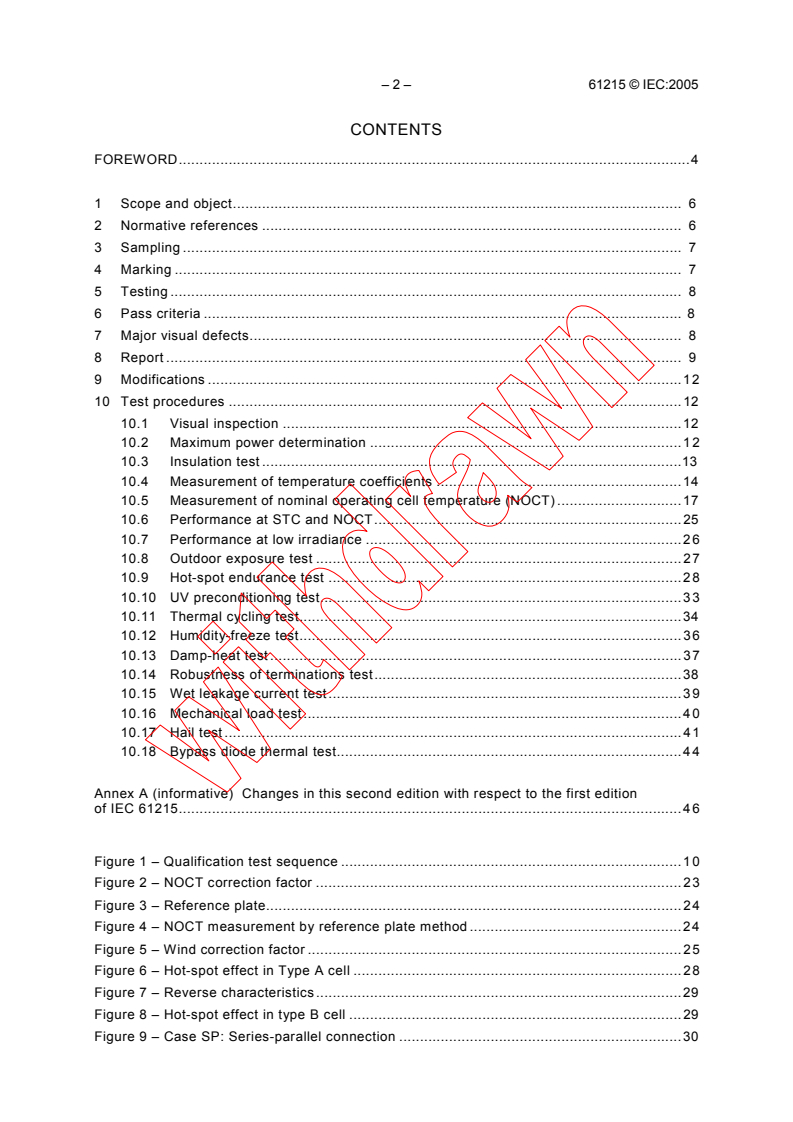
CONTENTS
FOREWORD.7
1 Scope and object.11
2 Normative references .11
3 Sampling .13
4 Marking .13
5 Testing .15
6 Pass criteria .15
7 Major visual defects.15
8 Report .17
9 Modifications .23
10 Test procedures .23
10.1 Visual inspection .23
10.2 Maximum power determination .23
10.3 Insulation test .25
10.4 Measurement of temperature coefficients .27
10.5 Measurement of nominal operating cell temperature (NOCT) .33
10.6 Performance at STC and NOCT.49
10.7 Performance at low irradiance .51
10.8 Outdoor exposure test .53
10.9 Hot-spot endurance test .55
10.10 UV preconditioning test.65
10.11 Thermal cycling test.67
10.12 Humidity-freeze test.71
10.13 Damp-heat test .73
10.14 Robustness of terminations test.75
10.15 Wet leakage current test.77
10.16 Mechanical load test.79
10.17 Hail test .81
10.18 Bypass diode thermal test.87
Annex A (informative) Changes in this second edition with respect to the first edition
of IEC 61215.91
Figure 1 – Qualification test sequence .19
Figure 2 – NOCT correction factor .45
Figure 3 – Reference plate.47
Figure 4 – NOCT measurement by reference plate method .47
Figure 5 – Wind correction factor .49
Figure 6 – Hot-spot effect in Type A cell .55
Figure 7 – Reverse characteristics.57
Figure 8 – Hot-spot effect in type B cell .57
Figure 9 – Case SP: Series-parallel connection .59
61215 IEC:2005 – 5 –
Figure 10 – Case SPS: series-parallel-series connection .61
Figure 11 – Thermal cycling test .69
Figure 12 – Humidity-freeze cycle.73
Figure 13 – Hail-test equipment .83
Figure 14 – Impact locations illustrated.87
Table 1 – Summary of test levels .21
Table 2 – Ice-ball masses and test velocities .83
Table 3 – Impact locations .85
61215 IEC:2005 – 7 –
INTERNATIONAL ELECTROTECHNICAL COMMISSION
____________
CRYSTALLINE SILICON TERRESTRIAL
PHOTOVOLTAIC (PV) MODULES –
DESIGN QUALIFICATION AND TYPE APPROVAL
FOREWORD
1) The International Electrotechnical Commission (IEC) is a worldwide organization for standardization comprising
all national electrotechnical committees (IEC National Committees). The object of IEC is to promote
international co-operation on all questions concerning standardization in the electrical and electronic fields. To
this end and in addition to other activities, IEC publishes International Standards, Technical Specifications,
Technical Reports, Publicly Available Specifications (PAS) and Guides (hereafter referred to as “IEC
Publication(s)”). Their preparation is entrusted to technical committees; any IEC National Committee interested
in the subject dealt with may participate in this preparatory work. International, governmental and non-
governmental organizations liaising with the IEC also participate in this preparation. IEC collaborates closely
with the International Organization for Standardization (ISO) in accordance with conditions determined by
agreement between the two organizations.
2) The formal decisions or agreements of IEC on technical matters express, as nearly as possible, an international
consensus of opinion on the relevant subjects since each technical committee has representation from all
interested IEC National Committees.
3) IEC Publications have the form of recommendations for international use and are accepted by IEC National
Committees in that sense. While all reasonable efforts are made to ensure that the technical content of IEC
Publications is accurate, IEC cannot be held responsible for the way in which they are used or for any
misinterpretation by any end user.
4) In order to promote international uniformity, IEC National Committees undertake to apply IEC Publications
transparently to the maximum extent possible in their national and regional publications. Any divergence
between any IEC Publication and the corresponding national or regional publication shall be clearly indicated in
the latter.
5) IEC provides no marking procedure to indicate its approval and cannot be rendered responsible for any
equipment declared to be in conformity with an IEC Publication.
6) All users should ensure that they have the latest edition of this publication.
7) No liability shall attach to IEC or its directors, employees, servants or agents including individual experts and
members of its technical committees and IEC National Committees for any personal injury, property damage or
other damage of any nature whatsoever, whether direct or indirect, or for costs (including legal fees) and
expenses arising out of the publication, use of, or reliance upon, this IEC Publication or any other IEC
Publications.
8) Attention is drawn to the Normative references cited in this publication. Use of the referenced publications is
indispensable for the correct application of this publication.
9) Attention is drawn to the possibility that some of the elements of this IEC Publication may be the subject of
patent rights. IEC shall not be held responsible for identifying any or all such patent rights.
International Standard IEC 61215 has been prepared by IEC technical committee 82: Solar
photovoltaic energy systems.
This second edition cancels and replaces thew first edition published in 1993 and constitutes
a technical revision.
The main changes with respect to the previous edition (published in 1993) are detailed in
Annex A.
61215 IEC:2005 – 9 –
The text of this standard is based on the following documents:
FDIS Report on voting
82/376/FDIS 82/382/RVD
Full information on the voting for the approval of this standard can be found in the report on
voting indicated in the above table.
This publication has been drafted in accordance with the ISO/IEC Directives, Part 2.
The committee has decided that the contents of this publication will remain unchanged until
the maintenance result date indicated on the IEC web site under "http://webstore.iec.ch" in
the data related to the specific publication. At this date, the publication will be
• reconfirmed,
• withdrawn,
• replaced by a revised edition, or
• amended.
61215 IEC:2005 – 11 –
CRYSTALLINE SILICON TERRESTRIAL
PHOTOVOLTAIC (PV) MODULES –
DESIGN QUALIFICATION AND TYPE APPROVAL
1 Scope and object
This International Standard lays down IEC requirements for the design qualification and type
approval of terrestrial photovoltaic modules suitable for long-term operation in general open-
air climates, as defined in IEC 60721-2-1. It applies only to crystalline silicon modules types.
A standard for thin-film modules has been published as IEC 61646.
This standard does not apply to modules used with concentrated sunlight.
The object of this test sequence is to determine the electrical and thermal characteristics of
the module and to show, as far as is possible within reasonable constraints of cost and
time, that the module is capable of withstanding prolonged exposure in climates described
in the scope. The actual lifetime expectancy of modules so qualified will depend on their
design, their environment and the conditions under which they are operated.
2 Normative references
The following referenced documents are indispensable for the application of this document.
For dated references, only the edition cited applies. For undated references, the latest edition
of the referenced document (including any amendments) applies.
IEC 60068-1:1988, Environmental testing – Part 1: General and guidance
IEC 60068-2-21:1999, Environmental testing – Part 2-21: Tests – Test U: Robustness of
terminations and integral mounting devices
IEC 60068-2-78:2001, Environmental testing – Part 2-78: Tests – Test Cab: Damp heat,
steady state
IEC 60410:1973, Sampling plans and procedures for inspection by attributes
IEC 60721-2-1:1982, Classification of environmental conditions – Part 2: Environmental
conditions appearing in nature – Temperature and humidity
IEC 60891:1987, Procedures for temperature and irradiance corrections to measured I-V
characteristics of crystalline silicon photovoltaic devices
Amendment 1 (1992)
IEC 60904-1:1987, Photovoltaic devices – Part 1: Measurements of photovoltaic current-
voltage characteristics
IEC 60904-2:1989, Photovoltaic devices – Part 2: Requirements for reference solar cells
IEC 60904-3:1989, Photovoltaic devices – Part 3: Measurement principles for terrestrial
photovoltaic (PV) solar devices with reference spectral irradiance data
61215 IEC:2005 – 13 –
IEC 60904-6:1994, Photovoltaic devices – Part 6: Requirements for reference solar modules
IEC 60904-7:1998, Photovoltaic devices – Part 7: Computation of spectral mismatch error
introduced in the testing of a photovoltaic device
IEC 60904-9:1995, Photovoltaic devices – Part 9: Solar simulator performance requirements
IEC 60904-10:1998, Photovoltaic devices – Part 10: Methods of linearity measurements
IEC 61853: Performance testing and energy rating of terrestrial photovoltaic (PV) modules
ISO/IEC 17025:1999, General requirements for competence of testing and calibration
laboratories.
3 Sampling
Eight modules for qualification testing (plus spares as desired) shall be taken at random from
a production batch or batches, in accordance with the procedure given in IEC 60410. The
modules shall have been manufactured from specified materials and components in
accordance with the relevant drawings and process sheets and have been subjected to the
manufacturer's normal inspection, quality control and production acceptance procedures. The
modules shall be complete in every detail and shall be accompanied by the manufacturer's
handling, mounting and connection instructions, including the maximum permissible system
voltage.
If the bypass diodes are not accessible in the standard modules, a special sample can be
prepared for the bypass diode thermal test (10.18). The bypass diode should be mounted
physically as it would be in a standard module, with a thermal sensor placed on the diode as
required in 10.18.2. This sample does not have to go through the other tests in the
sequence depicted in Figure 1.
When the modules to be tested are prototypes of a new design and not from production, this
fact shall be noted in the test report (see Clause 8).
4 Marking
Each module shall carry the following clear and indelible markings:
– name, monogram or symbol of manufacturer;
– type or model number;
– serial number;
– polarity of terminals or leads (colour coding is permissible);
– maximum system voltage for which the module is suitable.
The date and place of manufacture shall be marked on the module or be traceable from the
serial number.
___________
Under consideration.
61215 IEC:2005 – 15 –
5 Testing
Before beginning the testing, all modules, including the control, shall be exposed to sunlight
–2 –2
(either real or simulated) to an irradiation level of 5 kWh⋅m to 5,5 kWh⋅m while open-
circuited.
The modules shall be divided into groups and subjected to the qualification test sequences
in Figure 1, carried out in the order laid down. Each box refers to the corresponding
subclause in this standard. Test procedures and severities, including initial and final
measurements where necessary, are detailed in Clause 10.
NOTE 1 Where the final measurements for one test serve as the initial measurements for the next test in the
sequence, they need not be repeated. In these cases, the initial measurements are omitted from the test.
In carrying out the tests, the tester shall strictly observe the manufacturer's handling,
mounting and connection instructions. Tests given in 10.4, 10.5, 10.6 and 10.7 may be
omitted if future IEC 61853 has been or is scheduled to be run on this module type.
Test conditions are summarized in Table 1.
NOTE 2 The test levels in Table 1 are the minimum levels required for qualification. If the laboratory and the
module manufacturer agree, the tests may be performed with increased severities.
6 Pass criteria
A module design shall be judged to have passed the qualification tests, and therefore to be
IEC type approved, if each test sample meets all the following criteria:
a) the degradation of maximum output power does not exceed the prescribed limit after each
test nor 8 % after each test sequence;
b) no sample has exhibited any open circuit during the tests;
c) there is no visual evidence of a major defect, as defined in Clause 7;
d) the insulation test requirements are met after the tests;
e) the wet leakage current test requirements are met at the beginning and the end of each
sequence and after the damp heat test;
f) specific requirements of the individual tests are met.
If two or more modules do not meet these test criteria, the design shall be deemed not to
have met the qualification requirements. Should one module fail any test, another two
modules meeting the requirements of Clause 3 shall be subjected to the whole of the relevant
test sequence from the beginning. If one or both of these modules also fail, the design shall
be deemed not to have met the qualification requirements. If, however, both modules pass the
test sequence, the design shall be judged to have met the qualification requirements.
7 Major visual defects
For the purposes of design qualification and type approval, the following are considered to be
major visual defects:
a) broken, cracked, or torn external surfaces, including superstrates, substrates, frames and
junction boxes;
61215 IEC:2005 – 17 –
b) bent or misaligned external surfaces, including superstrates, substrates, frames and
junction boxes to the extent that the installation and/or operation of the module would be
impaired.
c) a crack in a cell the propagation of which could remove more than 10 % of that cell's area
from the electrical circuit of the module;
d) bubbles or delaminations forming a continuous path between any part of the electrical
circuit and the edge of the module;
e) loss of mechanical integrity, to the extent that the installation and/or operation of the
module would be impaired.
8 Report
Following type approval, a certified report of the qualification tests, with measured
performance characteristics and details of any failures and re-tests, shall be prepared by the
test agency in accordance with ISO/IEC 17025. The report shall contain the detail
specification for the module. Each certificate or test report shall include at least the following
information:
a) a title;
b) name and address of the test laboratory and location where the tests were carried out;
c) unique identification of the certification or report and of each page;
d) name and address of client, where appropriate;
e) description and identification of the item tested;
f) characterization and condition of the test item;
g) date of receipt of test item and date(s) of test, where appropriate;
h) identification of test method used;
i) reference to sampling procedure, where relevant;
j) any deviations from, additions to or exclusions from the test method, and any other
information relevant to a specific tests, such as environmental conditions;
k) measurements, examinations and derived results supported by tables, graphs, sketches
and photographs as appropriate including temperature coefficients of short-circuit current,
open-circuit voltage and peak power, NOCT, power at NOCT, STC and low irradiance,
spectrum of the lamp used for the UV pre-screening test, maximum power loss observed
after all of the tests, and any failures observed;
l) a statement of the estimated uncertainty of the test results (where relevant);
m) a signature and title, or equivalent identification of the person(s) accepting responsibility
for the content of the certificate or report, and the date of issue;
n) where relevant, a statement to the effect that the results relate only to the items tested;
o) a statement that the certificate or report shall not be reproduced except in full, without the
written approval of the laboratory.
A copy of this report shall be kept by the manufacturer for reference purposes.
61215 IEC:2005 – 19 –
8 Modules
Preconditioning
-2
5 kWh·m
10.1
Visual inspection
10.2
Maximum power
determination
10.3
Insulation test
10.15
Wet leakage current test
1 Module 1 Module 2 Modules 2 Modules 2 Modules
10.14 10.10 10.11
10.13
UV Preconditioning test
Measurement of Thermal cycling test
Damp heat test
-2
15 kWh·m
temperature coefficients 200 cycles 1000 h
(see note 1) -40 °C to + 85 °C
85 °C
85 % RH
10.11
10.5 Thermal cycling test
50 cycles
NOCT
10.15
-40 °C to + 85 °C
(see note 2)
Wet leakage current
test
10.6
10.12
Performance
Humidity freeze test
1 Module 1 Module
at STC and NOCT (1)
10 cycles
-40 °C to + 85°C
85 % RH
Control
10.7 10.16
10.17
Performance Mechanical
Hail test
at low irradiance (1) load test
1 Module
1 Module
10.8
Outdoor exposure test
10.14
-2
60 kWh·m
Robustness of
terminations test
10.18
Bypass diode
thermal test
(see note 3)
10.9
Hot-spot
endurance test
Repeat test
10.15
Wet leakage current test
IEC 584/05
NOTE 1 May be omitted if IEC 61853 has been performed.
NOTE 2 In the case of modules not designed for open-rack mounting, the NOCT may be replaced by the
equilibrium mean solar cell junction temperature in the standard
Figure 1 – Qualification test sequence
61215 IEC:2005 – 21 –
Table 1 – Summary of test levels
Test Title Test conditions
10.1 Visual inspection See detailed inspection list in 10.1.2
10.2 Maximum power determination See IEC 60904-1
10.3 Insulation test Dielectric withstand at 1 000 V d.c. + twice the maximum
systems voltage for 1 min.
For modules with an area of less than 0,1 m the insulation
resistance shall be not less than 400 MΩ. For modules with
2,
an area larger than 0,1 m the measured insulation
resistance times the area of the module shall be not less
than 40 MΩ⋅m measured at 500 V or maximum systems
voltage, whichever is greater
10.4 Measurement of temperature See details in 10.4
(see note 1)
coefficients
See IEC 60904-10 for guidance.
. –2
10.5 Measurement of NOCT Total solar irradiance: 800 W m
(see note 1)
Ambient temperature: 20 °C
. –1
s
Wind speed: 1 m
10.6 Performance at STC and NOCT Cell temperature: 25 °C and NOCT
(see note 1)
. –2
Irradiance: 1000 and 800 W m with IEC 60904-3 reference
solar spectral irradiance distribution
10.7 Performance at low irradiance Cell temperature: 25 °C
(see note 1)
. –2
Irradiance:200 W m with IEC 60904-3 reference
solar spectral irradiance distribution
. –2
10.8 Outdoor exposure test 60 kWh m total solar irradiation
. –2
10.9 Hot-spot endurance test Five-hour exposure to 1 000 W m irradiance in worst-case
hot-spot condition
-2
10.10 UV preconditioning
15 kWh⋅m total UV irradiation in the wavelength range from
–2
280 nm to 385 nm with 5 kWh⋅m UV irradiation in the
wavelength range from 280 nm to 320 nm
10.11 Thermal cycling test 50 and 200 cycles from –40 °C to + 85 °C with STC peak
power current during 200 cycles
10.12 Humidity freeze test 10 cycles from + 85 °C, 85 % RH to –40 °C
10.13 Damp heat test 1 000 h at + 85 °C, 85 % RH
10.14 Robustness of termination test As in IEC 60068-2-21
10.15 Wet leakage current test See details in 10.15
For modules with an area of less than 0,1 m the insulation
resistance shall be not less than 400 MΩ. For modules with
an area larger than 0,1 m the measured insulation
resistance times the area of the module shall be not less
than 40 MΩ⋅m to be measured at 500 V or maximum
systems voltage, whichever is greater
10.16 Mechanical load test Three cycles of 2 400 Pa uniform load, applied for 1 h to front
and back surfaces in turn.
Optional snow load of 5 400 Pa during last front cycle
–1
10.17 Hail test 25 mm diameter ice ball at 23,0 m⋅s , directed at 11 impact
locations
10.18 Bypass diode thermal test One hour at I and 75 °C
sc
One hour at 1,25 times I and 75 °C
sc
NOTE 1 These tests may be omitted if future IEC 61853 has been performed on this module type.
61215 IEC:2005 – 23 –
9 Modifications
Any change in the design, materials, components or processing of the module may require a
repetition of some or all of the qualification tests to maintain type approval.
10 Test procedures
10.1 Visual inspection
10.1.1 Purpose
To detect any visual defects in the module.
10.1.2 Procedure
Carefully inspect each module under an illumination of not less than 1 000 lux for the
following conditions:
– cracked, bent, misaligned or torn external surfaces;
– broken cells;
– cracked cells;
– faulty interconnections or joints;
– cells touching one another or the frame;
– failure of adhesive bonds;
– bubbles or delaminations forming a continuous path between a cell and the edge of the
module;
– tacky surfaces of plastic materials;
– faulty terminations, exposed live electrical parts;
– any other conditions which may affect performance.
Make note of and/or photograph the nature and position of any cracks, bubbles or
delaminations, etc. which may worsen and adversely affect the module performance in
subsequent tests.
10.1.3 Requirements
Visual conditions other than the major visual defects listed in Clause 7 are acceptable for the
purposes of type approval.
10.2 Maximum power determination
10.2.1 Purpose
To determine the maximum power of the module before and after the various environmental
tests. Repeatability of the test is the most important factor.
10.2.2 Apparatus
a) A radiant source (natural sunlight or a solar simulator class B or better in accordance with
IEC 60904-9).
61215 IEC:2005 – 25 –
b) A PV reference device in accordance with IEC 60904-2 or IEC 60904-6. If a class B
simulator is used the reference device shall be a reference module of the same size with
the same cell technology (to match spectral response) as the test specimen.
c) A suitable mount for supporting the test specimen and the reference device in a plane
normal to the radiant beam.
d) A means for monitoring the temperature of the test specimen and the reference device to
an accuracy of ±1 °C and repeatability of ±0,5 °C.
e) Equipment for measuring the current of the test specimen and reference device to an
accuracy of ±0,2 % of the reading;
f) Equipment for measuring the voltage of the test specimen and reference device to an
accuracy of ±0,2 % of the reading.
10.2.3 Procedure
Determine the current-voltage characteristic of the module in accordance with IEC 60904-1
at a specific set of irradiance and temperature conditions (a recommended range is a
–2
cell temperature between 25 °C and 50 °C and an irradiance between 700 W⋅m and
–2
1 100 W⋅m ) using natural sunlight or a class B or better simulator conforming to the
requirements of IEC 60904-9. In special circumstances when modules are designed for
operation under a different range of conditions, the current-voltage characteristics can be
measured using temperature and irradiance levels similar to the expected operating
conditions. Temperature and irradiance corrections can be made in accordance with
IEC 60891 in order to compare sets of measurements made on the same module before and
after environmental tests. However, every effort should be made to assure that peak power
measurements are made under similar operating conditions, that is minimize the magnitude of
the correction by making all peak power measurements on a particular module at
approximately the same temperature and irradiance. Repeatability of the maximum power
measurement must be better than ±1 %.
NOTE Use the control module as a check every time the test modules are measured.
10.3 Insulation test
10.3.1 Purpose
The purpose is to determine whether or not the module is sufficiently well-insulated between
current-carrying parts and the frame or the outside world.
10.3.2 Apparatus
a) DC voltage source, with current limitation, capable of applying 500 V or 1 000 V plus twice
the maximum system voltage of the module according to 10.3.4 c).
b) An instrument to measure the insulation resistance.
10.3.3 Test conditions
The test shall be made on modules at ambient temperature of the surrounding atmosphere
(see IEC 60068-1) and in a relative humidity not exceeding 75 %.
61215 IEC:2005 – 27 –
10.3.4 Procedure
a) Connect the shorted output terminals of the module to the positive terminal of a
d.c. insulation tester with a current limitation.
b) Connect the exposed metal parts of the module to the negative terminal of the tester.
If the module has no frame or if the frame is a poor electrical conductor, wrap a conductive
foil around the edges and over the back of the module. Connect the foil to the negative
terminal of the tester.
–1
c) Increase the voltage applied by the tester at a rate not exceeding 500 V⋅s to a maximum
equal to 1 000 V plus twice the maximum system voltage (i.e. the maximum system
voltage marked on the module by the manufacturer). If the maximum system voltage does
not exceed 50 V, the applied voltage shall be 500 V. Maintain the voltage at this level for
1 min.
d) Reduce the applied voltage to zero and short-circuit the terminals of the test equipment to
discharge the voltage build-up in the module.
e) Remove the short circuit.
–1
f) Increase the voltage applied by the test equipment at a rate not to exceed 500 V⋅s to
500 V or the maximum system voltage for the module, whichever is greater. Maintain the
voltage at this level for 2 min. Then determine the insulation resistance.
g) Reduce the applied voltage to zero and short-circuit the terminals of the test equipment to
discharge the voltage build-up in the module.
h) Remove the short circuit and disconnect the test equipment from the module.
NOTE If the module does not have a metal frame nor a glass superstrate, the insulation test should be repeated
with the metallic plate placed on the front of the module as in 10.3.4b).
10.3.5 Test requirements
The following requirements are necessary:
– no dielectric breakdown or surface tracking during step c);
– for modules with an area of less than 0,1 m the insulation resistance shall be not less
than 400 MΩ;
– for modules with an area larger than 0,1 m the measured insulation resistance times the
area of the module shall be not less than 40 MΩ⋅m .
10.4 Measurement of temperature coefficients
10.4.1 Purpose
The purpose is to determine the temperature coefficients of current (α), voltage (β) and peak
power (δ) from module measurements. The coefficients so determined are valid at the
irradiance at which the measurements were made. See IEC 60904-10 for evaluation of
module temperature coefficients at different irradiance levels.
10.4.2 Apparatus
The following apparatus is required to control and measure the test conditions:
a) a radiant source (natural sunlight or solar simulator, class B or better in accordance with
IEC 60904-9) of the type to be used in subsequent tests;
61215 IEC:2005 – 29 –
b) a PV reference device having a known short-circuit current versus irradiance characteristic
determined by calibrating against an absolute radiometer in accordance with IEC 60904-2
or IEC 60904-6;
c) any equipment necessary to change the temperature of the test specimen over the range
of interest;
d) a suitable mount for supporting the test specimen and the reference device in the same
plane normal to the radiant beam;
e) a means for monitoring the temperature of the test specimen and reference device to an
accuracy of ±1 °C, and repeatability of ±0,5 °C;
f) equipment for measuring the current of the test specimen and reference device to an
accuracy of ±0,2 % of the reading;
g) equipment for measuring the voltage of the test specimen and reference device to an
accuracy of ±0,2 % of the reading;
10.4.3 Procedure
There are two acceptable procedures for measuring the temperature coefficients.
10.4.3.1 Procedure in natural sunlight
a) Measurement in natural sunlight shall only be made when:
– the total irradiance is at least as high as the upper limit of the range of interest;
– the irradiance variation caused by short-term oscillations (clouds, haze, or smoke) is
less than ±2 % of the total irradiance as measured by the reference device;
–1
.
– the wind speed is less than 2 m⋅s
b) Mount the reference device co-planar with the test module so that both are normal to the
direct solar beam within ±5°. Connect to the necessary instrumentation.
NOTE The measurements described in the following subclauses should be made as expeditiously as possible
within a few hours on the same day to minimize the effect of changes in the spectral conditions. If not, spectral
corrections may be required.
c) If the test module and reference device are equipped with temperature controls, set the
controls at the desired level.
d) If temperature controls are not used, shade the specimen and the reference device from
the sun and wind until its temperature is uniform within ±1 °C of the ambient air
temperature, or allow the test specimen to equilibrate to its stabilized temperature, or cool
the test specimen to a point below the required test temperature and then let the module
warm up naturally. The reference device should also stabilize within ±1 °C of its
equilibrium temperature before proceeding.
e) Record the current-voltage characteristic and temperature of the specimen concurrently
with recording the short-circuit current and temperature of the reference device at the
desired temperatures. If necessary, make the measurements immediately after removing
the shade.
f) The irradiance G shall be calculated in accordance with IEC 60891 from the measured
o
current (I ) of the PV reference device, and its calibration value at STC (I ). A correction
rc
sc
should be applied to account for the temperature of the reference device T using the
m
specified temperature coefficient of the reference device α
rc.
61215 IEC:2005 – 31 –
−2
1000 Wm × I
sc
G = ×[]1 − α()T − 25°C
o rc m
I
rc
where α is the relative temperature coefficient [1/°C] at 25 °C and 1 000 W/m .
rc
g) Adjust the temperature by means of a controller or alternately exposing and shading the
test module as required to achieve and maintain the desired temperature. Alternately, the
test module may be allowed to warm-up naturally with the data recording procedure of
item d) performed periodically during the warm-up.
h) Ensure that the test module and reference device temperature are stabilized and remain
constant within ±1 °C and that the irradiance as measured by the reference device
remains constant within ±1 % during the recording period for each data set. All data must
–2
be taken at 1 000 W⋅m or be translated to that irradiance level.
i) Repeat steps d) through h). Module temperatures shall be such that the range of interest
is at least 30 °C and that it is spanned in at least four approximately equal increments.
A minimum of three measurements shall be made at each of the test conditions.
10.4.3.2 Procedure with a solar simulator
a) Determine the short-circuit current of the module at the desired irradiance at room
temperature, in accordance with IEC 60904-1.
b) Mount the test module in the equipment used to change the temperature. Mount the PV
reference device within the simulator beam. Connect to the instrumentation.
c) Set the irradiance so that the test module produces the short-circuit current determined in
item a). Use the PV reference device to maintain this irradiance setting throughout the
test.
d) Heat or cool the module to a temperature of interest. Once the module has reached the
desired temperature, measure I , V and peak power. Change the module temperature
sc oc
in steps of approximately 5 °C over a range of interest of at least 30 °C and repeat the
measurements of I , V and peak power.
sc oc
NOTE The complete current-voltage characteristic may be measured at each temperature to determine the
temperature change in voltage at peak power and current at peak power.
10.4.3.3 Calculation of temperature coefficients
a) Plot the values of I , V and P as functions of temperature and construct a least-
sc oc max
squares-fit curve through each set of data.
b) From the slopes of the least squares fit straight lines for current, voltage and P ,
max
calculate α, the temperature coefficient of short circuit current, β, the temperature
coefficient of open-circuit voltage, and δ, the temperature coefficient of P , for the
max
module.
NOTE 1 See IEC 60904-10 to determine if the test modules can be considered to be linear devices.
NOTE 2 The temperature coefficients measured in this procedure are only valid at the irradiance level at which
they were measured. Relative temperature coefficients expressed as percentages can be determined by dividing
the calculated α, β, and δ by the values of current, voltage and peak power at 25 °C.
NOTE 3 Because the fill factor of the module is a function of temperature, it is not sufficient to use the product of
α and β as the temperature coefficient of peak power.
61215 IEC:2005 – 33 –
10.5 Measurement of nominal operating cell temperature (NOCT)
10.5.1 Purpose
To determine the NOCT of the module.
10.5.2 Introduction
NOCT is defined as the equilibrium mean solar cell junction temperature within an open- rack
mounted module in the following standard reference environment (SRE):
– tilt angle: 45° from the horizontal
–2
– total irradiance: 800 W⋅m
– ambient temperature: 20 °C
–1
– wind speed: 1 m⋅s
– electrical load: nil (open circuit).
NOCT can be used by the system designer as a guide to the temperature at which a module
will operate in the field and it is therefore a useful parameter when comparing the
performance of different module designs. However, the actual operating temperature at any
particular time is affected by the mounting structure, irradiance, wind speed, ambient
temperature, sky temperature and reflections and emissions from the ground and nearby
objects. For accurate performance predictions, these factors shall be taken into account.
Two methods for determining NOCT are described.
The first, called "the primary method", is universally applicable to all PV modules. In the case
of modules not designed for open-rack mounting, the primary method may be used to
determine the equilibrium mean solar cell junction temperature in the SRE, with the module
mounted as recommended by the manufacturer.
The second, called "the reference-plate method", is faster but is applicable only to PV
modules of the type which respond to changes of ambient temperature (within restricted
ranges of wind speed and irradiance) in the same way as the reference plates used in the
measurement. Crystalline silicon modules with a glass front and plastic back are in this
category. The reference plates are calibrated using the same procedure as in the primary
method.
10.5.3 Primary method
10.5.3.1 Principle
This method is based on gathering actual measured cell temperature data under a range of
environmental conditions including the SRE. The data are presented in a way that allows
accurate and repeatable interpolation of the NOCT.
The temperature of the solar cell junction (T ) is primarily a function of the ambient
J
temperature (T ), the average wind speed (V) and the total solar irradiance (G) incident on
amb
the active surface of the module. The temperature difference (T – T ) is largely
J amb
independent of the ambient temperature and is essentially linearly proportional to the
–2
irradiance at levels above 400 W⋅m . The procedure calls for plotting (T – T ) against G
J amb
61215 IEC:2005 – 35 –
for a period when wind conditions are favorable. A preliminary NOCT value is then determined
–2
by adding 20 °C to the value of (T – T ) interpolated at the SRE irradiance of 800 W⋅m .
J amb
Finally, a correction factor, dependent on
...
NORME CEI
INTERNATIONALE 61215
Deuxième édition
2005-04
Modules photovoltaïques (PV) au silicium
cristallin pour application terrestre –
Qualification de la conception et homologation
Cette version française découle de la publication d’origine
bilingue dont les pages anglaises ont été supprimées.
Les numéros de page manquants sont ceux des pages
supprimées.
Numéro de référence
CEI 61215:2005(F)
Numérotation des publications
Depuis le 1er janvier 1997, les publications de la CEI sont numérotées à partir de
60000. Ainsi, la CEI 34-1 devient la CEI 60034-1.
Editions consolidées
Les versions consolidées de certaines publications de la CEI incorporant les
amendements sont disponibles. Par exemple, les numéros d’édition 1.0, 1.1 et 1.2
indiquent respectivement la publication de base, la publication de base incorporant
l’amendement 1, et la publication de base incorporant les amendements 1 et 2
Informations supplémentaires sur les publications de la CEI
Le contenu technique des publications de la CEI est constamment revu par la CEI
afin qu'il reflète l'état actuel de la technique. Des renseignements relatifs à cette
publication, y compris sa validité, sont disponibles dans le Catalogue des
publications de la CEI (voir ci-dessous) en plus des nouvelles éditions, amende-
ments et corrigenda. Des informations sur les sujets à l’étude et l’avancement des
travaux entrepris par le comité d’études qui a élaboré cette publication, ainsi que la
liste des publications parues, sont également disponibles par l’intermédiaire de:
• Site web de la CEI (www.iec.ch)
• Catalogue des publications de la CEI
Le catalogue en ligne sur le site web de la CEI (www.iec.ch/searchpub) vous permet
de faire des recherches en utilisant de nombreux critères, comprenant des
recherches textuelles, par comité d’études ou date de publication. Des informations
en ligne sont également disponibles sur les nouvelles publications, les publications
remplacées ou retirées, ainsi que sur les corrigenda.
• IEC Just Published
Ce résumé des dernières publications parues (www.iec.ch/online_news/justpub)
est aussi disponible par courrier électronique. Veuillez prendre contact avec le
Service client (voir ci-dessous) pour plus d’informations.
• Service clients
Si vous avez des questions au sujet de cette publication ou avez besoin de
renseignements supplémentaires, prenez contact avec le Service clients:
Email: custserv@iec.ch
Tél: +41 22 919 02 11
Fax: +41 22 919 03 00
NORME CEI
INTERNATIONALE 61215
Deuxième édition
2005-04
Modules photovoltaïques (PV) au silicium
cristallin pour application terrestre –
Qualification de la conception et homologation
© IEC 2005 Droits de reproduction réservés
Aucune partie de cette publication ne peut être reproduite ni utilisée sous quelque forme que ce soit et par aucun
procédé, électronique ou mécanique, y compris la photocopie et les microfilms, sans l'accord écrit de l'éditeur.
International Electrotechnical Commission, 3, rue de Varembé, PO Box 131, CH-1211 Geneva 20, Switzerland
Telephone: +41 22 919 02 11 Telefax: +41 22 919 03 00 E-mail: inmail@iec.ch Web: www.iec.ch
CODE PRIX
X
Commission Electrotechnique Internationale
International Electrotechnical Commission
МеждународнаяЭлектротехническаяКомиссия
Pour prix, voir catalogue en vigueur
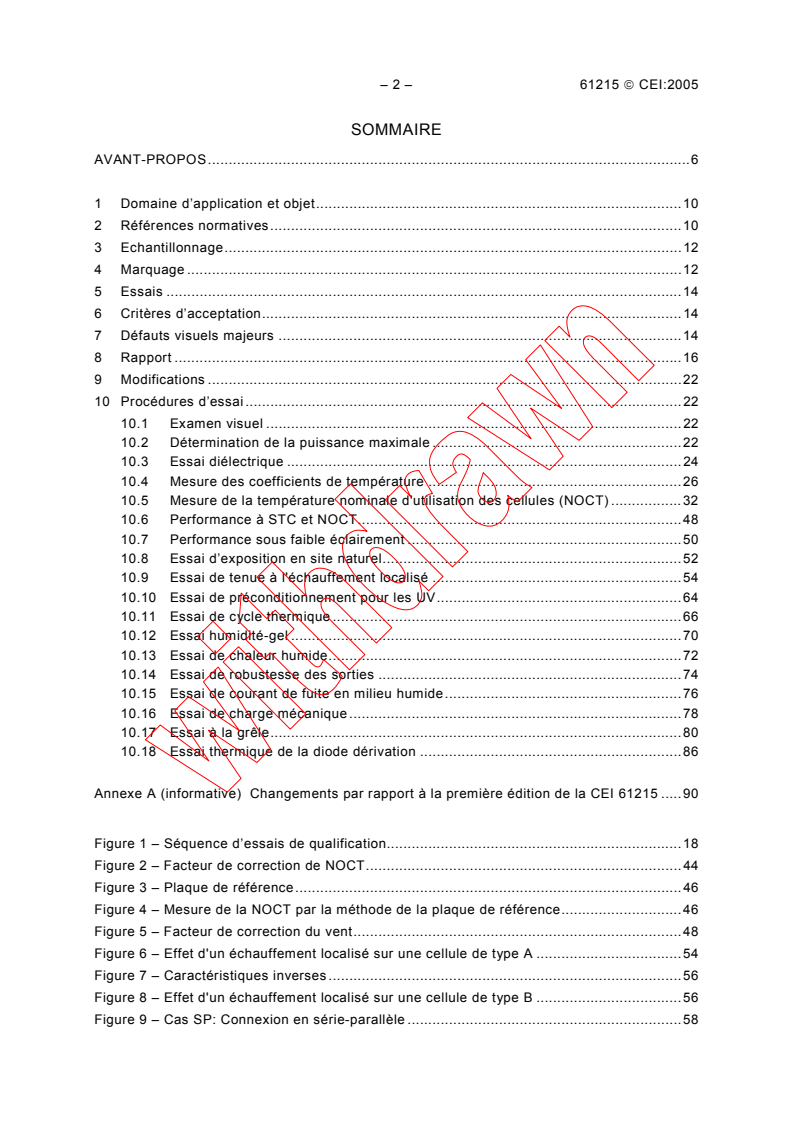
– 2 – 61215 CEI:2005
SOMMAIRE
AVANT-PROPOS.6
1 Domaine d’application et objet.10
2 Références normatives.10
3 Echantillonnage.12
4 Marquage .12
5 Essais .14
6 Critères d’acceptation.14
7 Défauts visuels majeurs .14
8 Rapport .16
9 Modifications .22
10 Procédures d’essai.22
10.1 Examen visuel .22
10.2 Détermination de la puissance maximale .22
10.3 Essai diélectrique .24
10.4 Mesure des coefficients de température .26
10.5 Mesure de la température nominale d'utilisation des cellules (NOCT) .32
10.6 Performance à STC et NOCT.48
10.7 Performance sous faible éclairement .50
10.8 Essai d’exposition en site naturel.52
10.9 Essai de tenue à l'échauffement localisé .54
10.10 Essai de préconditionnement pour les UV.64
10.11 Essai de cycle thermique .66
10.12 Essai humidité-gel .70
10.13 Essai de chaleur humide.72
10.14 Essai de robustesse des sorties .74
10.15 Essai de courant de fuite en milieu humide.76
10.16 Essai de charge mécanique .78
10.17 Essai à la grêle.80
10.18 Essai thermique de la diode dérivation .86
Annexe A (informative) Changements par rapport à la première édition de la CEI 61215 .90
Figure 1 – Séquence d’essais de qualification.18
Figure 2 – Facteur de correction de NOCT.44
Figure 3 – Plaque de référence.46
Figure 4 – Mesure de la NOCT par la méthode de la plaque de référence.46
Figure 5 – Facteur de correction du vent.48
Figure 6 – Effet d'un échauffement localisé sur une cellule de type A .54
Figure 7 – Caractéristiques inverses.56
Figure 8 – Effet d'un échauffement localisé sur une cellule de type B .56
Figure 9 – Cas SP: Connexion en série-parallèle .58
– 4 – 61215 CEI:2005
Figure 10 – Cas SPS: Connexion en série-parallèle-série .60
Figure 11 – Essai de cycle thermique .68
Figure 12 – Cycle humidité-gel .72
Figure 13 – Equipement pour l'essai à la grêle.82
Figure 14 – Localisation des points d'impact .86
Tableau 1 – Résumé des niveaux d'essai .20
Tableau 2 – Masses des billes de glace et vitesses d'essai .82
Tableau 3 – Localisation des impacts .84
– 6 – 61215 CEI:2005
COMMISSION ÉLECTROTECHNIQUE INTERNATIONALE
____________
MODULES PHOTOVOLTAÏQUES (PV) AU SILICIUM CRISTALLIN
POUR APPLICATION TERRESTRE –
QUALIFICATION DE LA CONCEPTION ET HOMOLOGATION
AVANT-PROPOS
1) La Commission Electrotechnique Internationale (CEI) est une organisation mondiale de normalisation
composée de l'ensemble des comités électrotechniques nationaux (Comités nationaux de la CEI). La CEI a
pour objet de favoriser la coopération internationale pour toutes les questions de normalisation dans les
domaines de l'électricité et de l'électronique. A cet effet, la CEI – entre autres activités – publie des Normes
internationales, des Spécifications techniques, des Rapports techniques, des Spécifications accessibles au
public (PAS) et des Guides (ci-après dénommés "Publication(s) de la CEI"). Leur élaboration est confiée à des
comités d'études, aux travaux desquels tout Comité national intéressé par le sujet traité peut participer. Les
organisations internationales, gouvernementales et non gouvernementales, en liaison avec la CEI, participent
également aux travaux. La CEI collabore étroitement avec l'Organisation Internationale de Normalisation (ISO),
selon des conditions fixées par accord entre les deux organisations.
2) Les décisions ou accords officiels de la CEI concernant les questions techniques représentent, dans la mesure
du possible, un accord international sur les sujets étudiés, étant donné que les Comités nationaux de la CEI
intéressés sont représentés dans chaque comité d’études.
3) Les Publications de la CEI se présentent sous la forme de recommandations internationales et sont agréées
comme telles par les Comités nationaux de la CEI. Tous les efforts raisonnables sont entrepris afin que la CEI
s'assure de l'exactitude du contenu technique de ses publications; la CEI ne peut pas être tenue responsable
de l'éventuelle mauvaise utilisation ou interprétation qui en est faite par un quelconque utilisateur final.
4) Dans le but d'encourager l'uniformité internationale, les Comités nationaux de la CEI s'engagent, dans toute la
mesure possible, à appliquer de façon transparente les Publications de la CEI dans leurs publications
nationales et régionales. Toutes divergences entre toutes Publications de la CEI et toutes publications
nationales ou régionales correspondantes doivent être indiquées en termes clairs dans ces dernières.
5) La CEI n’a prévu aucune procédure de marquage valant indication d’approbation et n'engage pas sa
responsabilité pour les équipements déclarés conformes à une de ses Publications.
6) Tous les utilisateurs doivent s'assurer qu'ils sont en possession de la dernière édition de cette publication.
7) Aucune responsabilité ne doit être imputée à la CEI, à ses administrateurs, employés, auxiliaires ou
mandataires, y compris ses experts particuliers et les membres de ses comités d'études et des Comités
nationaux de la CEI, pour tout préjudice causé en cas de dommages corporels et matériels, ou de tout autre
dommage de quelque nature que ce soit, directe ou indirecte, ou pour supporter les coûts (y compris les frais
de justice) et les dépenses découlant de la publication ou de l'utilisation de cette Publication de la CEI ou de
toute autre Publication de la CEI, ou au crédit qui lui est accordé.
8) L'attention est attirée sur les références normatives citées dans cette publication. L'utilisation de publications
référencées est obligatoire pour une application correcte de la présente publication.
9) L’attention est attirée sur le fait que certains des éléments de la présente Publication de la CEI peuvent faire
l’objet de droits de propriété intellectuelle ou de droits analogues. La CEI ne saurait être tenue pour
responsable de ne pas avoir identifié de tels droits de propriété et de ne pas avoir signalé leur existence.
La Norme internationale CEI 61215 a été établie par le comité d'études 82 de la CEI:
Systèmes de conversion photovoltaïque de l'énergie solaire.
Cette deuxième édition annule et remplace la première édition, parue en 1993, dont elle
constitue une révision technique.
Les principaux changements par rapport à la première édition (1993) sont donnés en
Annexe A.
– 8 – 61215 CEI:2005
Le texte de cette norme est issu des documents suivants:
FDIS Rapport de vote
82/376/FDIS 82/382/RVD
Le rapport de vote indiqué dans le tableau ci-dessus donne toute information sur le vote ayant
abouti à l'approbation de cette norme.
Cette publication a été rédigée selon les Directives ISO/CEI, Partie 2.
Le comité a décidé que le contenu de cette publication ne sera pas modifié avant la date de
maintenance indiquée sur le site web de la CEI sous "http://webstore.iec.ch" dans les
données relatives à la publication recherchée. A cette date, la publication sera
• reconduite,
• supprimée,
• remplacée par une édition révisée, ou
• amendée.
– 10 – 61215 CEI:2005
MODULES PHOTOVOLTAÏQUES (PV) AU SILICIUM CRISTALLIN
POUR APPLICATION TERRESTRE –
QUALIFICATION DE LA CONCEPTION ET HOMOLOGATION
1 Domaine d’application et objet
La présente Norme internationale donne les exigences de la CEI sur la qualification de la
conception et l'homologation de modules photovoltaïques pour application terrestre et pour
une utilisation de longue durée dans les climats généraux d'air libre, définis dans la
CEI 60721-2-1. Elle s'applique uniquement aux modules au silicium cristallin. Une norme pour
les modules à couche mince a été publiée sous la référence CEI 61646.
La présente norme ne s'applique pas aux modules utilisés avec un ensoleillement intense.
L'objet de cette séquence d'essais est de déterminer les caractéristiques électriques et
thermiques du module et de montrer autant que possible avec des contraintes de coût et de
temps raisonnables, que le module est apte à supporter une exposition prolongée aux climats
définis dans le domaine d'application. L'espérance de vie réelle des modules ainsi qualifiés
dépendra de leur conception ainsi que de l'environnement et des conditions dans lesquels ils
fonctionneront.
2 Références normatives
Les documents de référence suivants sont indispensables pour l'application du présent
document. Pour les références datées, seule l'édition citée s'applique. Pour les références
non datées, la dernière édition du document de référence s'applique (y compris les éventuels
amendements).
CEI 60068-1:1988, Essais d'environnement – Partie 1: Généralités et guide
CEI 60068-2-21:1999, Essais d'environnement – Partie 2-21: Essais – Essai U: Robustesse
des sorties et des dispositifs de fixation
CEI 60068-2-78:2001 Essais d'environnement – Partie 2-78: Essais – Essai Cab: Chaleur
humide, essai continu
CEI 60410:1973, Plans et règles d'échantillonnage pour les contrôles par attributs
CEI 60721-2-1:1982, Classification des conditions d'environnement – Partie 2: Conditions
d'environnement présentes dans la nature – Température et humidité
CEI 60891:1987, Procédures pour la correction en fonction de la température et de
l'éclairement à appliquer aux caractéristiques I-V mesurées des dispositifs photovoltaïques au
silicium cristallin
Amendement 1 (1992)
CEI 60904-1:1987, Dispositifs photovoltaïques – Partie 1: Mesures des caractéristiques
courant-tension des dispositifs photovoltaïques
CEI 60904-2:1989, Dispositifs photovoltaïques – Partie 2: Exigences relatives aux cellules
solaires de référence
CEI 60904-3:1989, Dispositifs photovoltaïques – Partie 3: Principes de mesure des dispositifs
solaires photovoltaïques (PV) à usage terrestre incluant les données de l'éclairement spectral
de référence
– 12 – 61215 CEI:2005
CEI 60904-6:1994, Dispositifs photovoltaïques – Partie 6: Exigences relatives aux modules
solaires de référence
CEI 60904-7:1998, Dispositifs photovoltaïques – Partie 7: Calcul de l’erreur de désadaptation
des réponses spectrales introduite dans les mesures de test d’un dispositif photovoltaïque
CEI 60904-9:1995, Dispositifs photovoltaïques – Partie 9: Exigences pour le fonctionnement
des simulateurs solaires
CEI 60904-10:1998, Dispositifs photovoltaïques – Partie 10: Méthodes de mesure de la
linéarité
CEI 61853: Evaluation de la puissance et de l’énergie des modules photovoltaïques (PV)
ISO/IEC 17025:1999, Prescriptions générales concernant la compétence des laboratoires
d’étalonnages et d’essais
3 Echantillonnage
Huit modules pour les essais de qualification (plus le nombre de modules de rechange désiré)
doivent être prélevés au hasard parmi un ou plusieurs lots de production, conformément à la
procédure indiquée dans la CEI 60410. Les modules doivent avoir été fabriqués à partir de
matériaux et de composants spécifiés, conformément aux schémas et aux procédures de
fabrication correspondants et doivent avoir été soumis à l'inspection normale du constructeur
et aux procédures du contrôle de la qualité et de l'acceptation de la production. Les modules
doivent être dans leur intégrité, jusqu'au moindre détail, et doivent être accompagnés des
instructions de manipulation, de montage et de raccordement fournies par le constructeur,
incluant la tension maximale permise du système.
Si les diodes de dérivation ne sont pas accessibles dans les modules standards, un
échantillonnage spécial peut être préparé pour l'essai thermique de la diode de dérivation
(voir 10.18). Il convient que la diode de dérivation soit physiquement montée comme elle le
serait sur un module standard, avec un capteur thermique placé sur la diode comme prescrit
dans en 10.18.2. L'échantillon ne doit pas subir d'autres essais dans la séquence décrite à la
Figure 1.
Si les modules en essai sont des prototypes d'une nouvelle conception mais non issus d'une
production, la mention doit en être faite dans le rapport d'essai (voir Article 8).
4 Marquage
Chaque module doit porter clairement et de manière indélébile les indications suivantes:
– nom, monogramme ou symbole du constructeur;
– type ou numéro du modèle;
– numéro de série;
– polarité des bornes de sorties ou des conducteurs (un code de couleur est autorisé);
– tension maximale de système pour laquelle le module est adéquat.
La date et le lieu de fabrication doivent être marqués sur le module ou déductibles à partir du
numéro de série.
———————
A l’étude.
– 14 – 61215 CEI:2005
5 Essais
Avant de réaliser les essais, tous les modules, y compris la commande, doivent être exposés
–2
à la lumière du soleil (réelle ou simulée) à un niveau d’éclairement de 5 kWh⋅m à
–2
5,5 kWh⋅m tout en étant en circuit ouvert.
Les modules doivent être répartis en groupes et soumis aux séquences d'essais de
qualification de la Figure 1, les essais étant effectués dans l'ordre établi. Chaque case fait
référence au paragraphe correspondant de cette norme. Les sévérités et la procédure de
l'essai en question incluant les mesures initiales et finales si nécessaires, sont détaillées à
l'Article 10.
NOTE 1 Quand les mesures finales d'un essai servent comme mesures initiales pour l'essai suivant dans la
séquence, elles n'ont pas besoin d'être répétées. Dans ces cas, les mesures initiales sont omises de l'essai.
En effectuant les essais, l'opérateur doit observer scrupuleusement les instructions de
manipulation, de montage et de raccordement préconisées par le constructeur. Les essais
donnés en 10.4, 10.5, 10.6 et 10.7 peuvent être omis si la future CEI 61853 a été ou est
programmée pour fonctionner sur ce type de module.
Les conditions des essais sont résumées au Tableau 1.
NOTE 2 Les niveaux d’essai du Tableau 1 sont les niveaux minimaux exigés pour la qualification. Si le laboratoire
et le constructeur du module se mettent d’accord, les essais peuvent être réalisés avec des sévérités augmentées.
6 Critères d’acceptation
Une conception de module doit être jugée comme satisfaisant aux essais de qualification et,
par conséquent, d'un type approuvé par la CEI si chaque échantillon en essai remplit tous les
critères suivants:
a) la dégradation de la puissance maximale fournie n'excède ni la limite prescrite après
chaque essai, ni 8 % après chaque séquence d'essais;
b) aucun échantillon n'a présenté de circuit ouvert pendant les essais;
c) il n'y a pas de défaut visuel majeur évident, comme ceux définis à l'Article 7;
d) les exigences de l'essai diélectrique sont remplies après les essais;
e) les exigences de l’essai de courant de fuite sont remplies au début et à la fin de chaque
séquence et après l’essai de chaleur humide;
f) les exigences spécifiques des essais individuels sont remplies.
Si deux modules ou plus ne remplissent pas ces critères, on doit considérer que la conception
ne répond pas aux exigences de la qualification. Si un seul module est défectueux au cours
d'un essai, deux autres modules remplissant les exigences de l'Article 3 doivent être soumis à
l'intégralité, depuis le début, de la séquence d'essais correspondante. Si un ou les deux
modules sont également défectueux, on doit considérer que la conception ne répond pas aux
exigences de la qualification. Si, cependant, les deux modules subissent avec succès la
séquence d'essais, on doit considérer que la conception répond aux exigences de la
qualification.
7 Défauts visuels majeurs
Pour l'appréciation de la qualification de la conception et l'homologation d'un type, chacun
des défauts suivants est considéré comme un défaut visuel majeur:
a) surfaces externes cassées, fêlées, ou déchirées, y compris les supersubstrats, les
substrats, les châssis et les boîtes de jonction;
– 16 – 61215 CEI:2005
b) surfaces externes pliées, désalignées y compris les supersubstrats, les substrats, les
châssis et les boîtes de jonction, entraînant une détérioration de l’installation et/ou du
fonctionnement du module;
c) dans une cellule, une fêlure dont la propagation peut isoler plus de 10 % de la surface de
la cellule du circuit électrique du module;
d) bulles ou délaminations formant un chemin continu entre toute partie du circuit électrique
et le bord du module;
e) perte de l'intégrité mécanique entraînant une détérioration de l’installation et/ou du
fonctionnement du module.
8 Rapport
Pour l'homologation de type, un rapport certifié des essais de qualification, incluant les
résultats de mesure des caractéristiques de performance ainsi que les détails de chaque
défaut et essai de reprise, doit être préparé par le laboratoire d'essais conformément à
l’ISO/CEI 17025. Le rapport doit contenir la spécification particulière pour le module. Chaque
certificat ou rapport d’essai doit inclure au moins les informations suivantes:
a) un titre;
b) nom et adresse du laboratoire d’essai et lieu où les essais ont été réalisés;
c) identification unique de la certification ou du rapport et de chaque page;
d) nom et adresse du client, s’il y a lieu;
e) description et identification de l’unité soumise aux essais;
f) caractérisation et condition de l’unité d’essai;
g) date de réception de l’unité d’essai et date(s) de l’essai, s’il y a lieu;
h) identification de la méthode d’essai utilisée;
i) référence à la procédure d’échantillonnage, s’il y a lieu;
j) tout écart par rapport à, tout complément à ou toute exclusion de la méthode d’essai, et
toute autre information correspondant à un essai spécifique, telles que les conditions
d’environnement;
k) mesures, examens et résultats dérivés appuyés par des tableaux, des graphiques, des
croquis et des photographies selon le cas, y compris les coefficients de température du
courant de court-circuit, de la tension en circuit ouvert et de la puissance de crête, la
NOCT, la puissance à NOCT, les STC, et le faible éclairement, le spectre de la lampe
utilisé pour l’essai de présélection des UV, la perte de puissance maximale observée
après l’ensemble des essais ainsi que tout défaut éventuellement observé;
l) une indication de l’incertitude estimée des résultats d’essai (s’il y a lieu);
m) une signature et un titre, ou une identification équivalente de la ou des personnes
acceptant d’être responsables du contenu du certificat ou du rapport, et la date d’édition;
n) s’il y a lieu, une indication doit être fournie selon laquelle les résultats ne se rapportent
qu’aux unités soumises aux essais;
o) une spécification indiquant que le certificat ou le rapport ne doivent pas être reproduits
sauf dans leur totalité, sans l’approbation écrite du laboratoire.
Une copie de ce rapport doit être destinée au constructeur pour être utilisée en tant que
référence.
– 18 – 61215 CEI:2005
8 Modules
Préconditionnement
-2
5 kWh·m
10.1
Examen visuel
10.2
Détermination de la
puissance maximale
10.3
Essai diélectrique
10.15
Essai de courant de fuite
en milieu humide
1 Module 1 Module 2 Modules 2 Modules 2 Modules
10.10
10.14 10.11
10.13
Mesure des coefficients Essai aux UV Essai de cycle thermique
Chaleur humide
-2
15 kWh·m
de température 200 cycles
1000 h
(voir note 1) -40 °C to + 85 °C
85 °C
85 % HR
10.11
Chaleur humide
10.5
NOCT 50 cycles
10.15
-40 °C to + 85 °C
(voir note 2)
Essai de courant de fuite
en milieu humide
10.6
10.12
Performance
Humidité-gel
1 Module 1 Module
à STC et NOCT (1)
10 cycles
-40 °C à + 85°C
Contrôle
85 % HR
10.7 10.16
10.17
Performance sous Essai de charge
Essai à la grêle
un éclairement faible (1) mécanique
1 Module
1 Module
10.8
Essai d’exposition en site
10.14
-2
naturel 60 kWh·m
Essai de robustesse
des sorties
10.18
Essai thermique de
la diode de dérivation
(voir note 3)
10.9
Tenue à l’échauffement
localisé
Répéter l’essai
10.15
Essai de courant de fuite
en milieu humide
IEC 584/05
NOTE 1 Peut être omis si la CEI 61853 a été réalisée.
NOTE 2 Dans le cas des modules non conçus pour être montés sur une structure dégagée, la NOCT peut être
remplacée par la température de jonction de la cellule solaire moyenne d’équilibre dans l’environnement de
référence normalisé, le module étant monté selon les recommandations du constructeur.
Figure 1 – Séquence d’essais de qualification
– 20 – 61215 CEI:2005
Tableau 1 – Résumé des niveaux d'essai
Essai Titre Conditions d'essai
10.1 Examen visuel Voir la liste de contrôle détaillée en 10.1.2
10.2 Détermination de la Voir la CEI 60904-1
puissance maximale
10.3 Essai diélectrique Tenue diélectrique à 1 000 V en courant continu + deux fois la tension
maximale des systèmes pendant 1 min.
Pour les modules dont la surface est inférieure à 0,1 m , la résistance
d’isolement ne doit pas être inférieure à 400 MΩ. Pour les modules dont la
surface est supérieure à 0,1 m , la résistance d’isolement mesurée fois la
surface du module ne doit pas être inférieure à 40 MΩ m . La mesure est
effectuée à 500 V ou à la tension maximale des systèmes, en prenant
celle des deux valeurs qui est la plus élevée
10.4 Mesure des coefficients de Voir détails en 10.4
température (Voir note 1)
Voir la CEI 60904-10 à titre informatif.
. -2
10.5 Mesure de la NOCT Eclairement solaire total: 800 W m
Température ambiante: 20 °C
(Voir note 1)
. -1
Vitesse du vent: 1 m s
10.6 Performance à STC et Température de cellule: 25 °C et NOCT
NOCT
. -2
Eclairement: 1 000 et 800 W m et une répartition d'éclairement spectral
(Voir note 1) solaire de référence selon la CEI 60904-3
10.7 Performance sous faible Température de cellule: 25 °C
éclairement
. -2
Eclairement: 200 W m et une répartition d'éclairement spectral solaire de
(Voir note 1) référence selon la CEI 60904-3
–2
10.8 Essai d’exposition en site Eclairement solaire total: 60 kWh⋅m
naturel
-2
10.9 Essai de tenue à Exposition pendant 5 h à un éclairement de 1 000 W⋅m dans les conditions
l'échauffement localisé de pire cas de l’échauffement localisé
–2
10.10 Préconditionnement pour
Eclairement total aux UV de 15 kWh⋅m dans la gamme de longueur d’onde
-2
les UV
comprise entre 280 nm et 385 nm avec un éclairement aux UV de 5 kWh⋅m
dans la gamme de longueur d’onde comprise entre 280 nm et 320 nm
10.11 Essai de cycle thermique 50 et 200 cycles de –40 °C à + 85 °C avec un courant de la puissance de
crête en STC pendant 200 cycles
10.12 Essai humidité-gel 10 cycles de + 85 °C, 85 % HR à –40 °C
10.13 Essai de chaleur humide 1 000 h à + 85 °C, 85 % HR
10.14 Essai de robustesse des Selon la CEI 60068-2-21
sorties
10.15 Essai de courant de fuite Voir détails en 10.15
en milieu humide
Pour les modules dont la surface est inférieure à 0,1 m , la résistance
d’isolement ne doit pas être inférieure à 400 MΩ. Pour les modules dont la
surface est supérieure à 0,1 m , la résistance d’isolement mesurée fois la
surface du module ne doit pas être inférieure à 40 MΩ m . A mesurer à
500 V ou à la tension maximale des systèmes, en prenant celle des deux
valeurs qui est la plus élevée
10.16 Essai de charge mécanique Trois cycles de charge uniforme de 2 400 Pa, appliqués pendant 1 h aux
surfaces avant et arrière successivement.
Charge de neige optionnelle de 5 400 Pa au cours du dernier cycle de
montée.
–1
10.17 Essai à la grêle Bille de glace de 25 mm de diamètre à 23,0 m⋅s , dirigée vers 11 points
d’impact
10.18 Essai thermique de la diode Une heure à I et 75 °C
sc
by-pass
Une heure à 1,25 fois I et 75 °C
sc
NOTE 1 Ces essais peuvent être omis si la future CEI 61853 a été établie selon ce type de module.
– 22 – 61215 CEI:2005
9 Modifications
Tout changement dans la conception, les matériaux, les composants ou la fabrication du
module peut nécessiter la répétition d'une partie ou de tous les essais de qualification afin de
conserver l'homologation du type.
10 Procédures d’essai
10.1 Examen visuel
10.1.1 Objet
L'objet de cette séquence d’essais est de détecter tout défaut visible du module.
10.1.2 Mode opératoire
Chaque module est examiné avec soin avec un éclairement supérieur ou égal à 1 000 lux
pour les conditions suivantes:
– surfaces externes fêlées, pliées, désalignées ou déchirées;
– cellules cassées;
– cellules fêlées;
– interconnexions ou jonctions défectueuses;
– cellules touchant d'autres cellules ou le châssis;
– défauts de collage;
– bulles ou délaminations formant un chemin continu entre une cellule et le bord du module;
– surfaces collantes au toucher des matériaux plastiques;
– connexions défectueuses, parties électriques actives exposées;
– toute autre condition qui pourrait affecter les performances.
Un relevé et/ou une photographie doivent être faits sur la nature ou la position des fêlures,
bulles ou délaminations, etc. qui peuvent s'aggraver et affecter défavorablement la perfor-
mance du module lors des essais qui suivent.
10.1.3 Exigences
Des conditions d'aspect autres que les défauts visuels majeurs décrits dans l'Article 7 sont
acceptables dans le but de l'homologation.
10.2 Détermination de la puissance maximale
10.2.1 Objet
L’objet de cet essai est de déterminer la puissance maximale du module avant et après les
divers essais d’environnement. La répétabilité de l’essai est le facteur le plus important.
10.2.2 Appareillage
a) Une source de rayonnement (ensoleillement naturel ou un simulateur solaire de classe
B ou mieux, conformément à la CEI 60904-9).
– 24 – 61215 CEI:2005
b) Un dispositif PV de référence conformément à la CEI 60904-2 ou à la CEI 60904-6. Si un
simulateur de classe B est utilisé, le dispositif de référence doit être un module de
référence de la même taille avec la même technologie de cellule pour correspondre à la
réponse spectrale.
c) Un support approprié pour maintenir l’éprouvette et le dispositif de référence dans un
plan perpendiculaire au rayon radiant.
d) Un moyen de contrôler la température de l’éprouvette et du dispositif de référence avec
une précision de ± 1 °C et une répétabilité de ± 0,5 °C.
e) Appareil pour mesurer le courant de l’éprouvette et du dispositif de référence avec une
précision de ± 0,2 % de la lecture.
f) Appareil pour mesurer la tension de l’éprouvette et du dispositif de référence avec une
précision de ±0,2 % de la lecture.
10.2.3 Mode opératoire
Déterminer la caractéristique courant-tension du module conformément à la CEI 60904-1 à un
ensemble spécifique de conditions d’éclairement et de température (une gamme
recommandée est une température de cellule comprise entre 25 °C et 50 °C et un éclairement
2 2
compris entre 700 W⋅m et 1 100 W⋅m ) en utilisant l’ensoleillement naturel ou un simulateur
de classe B ou mieux conformément aux prescriptions de la CEI 60904-9. Dans des
circonstances particulières, lorsque les modules sont conçus pour fonctionner dans une
gamme de conditions différente, les caractéristiques courant-tension peuvent être mesurées
en utilisant les niveaux de température et d’éclairement similaires aux conditions de
fonctionnement prévues. Les corrections de température et d’éclairement peuvent être faites
conformément à la CEI 60891 afin de comparer des ensembles de mesures réalisés sur le
même module avant et après les essais d’environnement. Cependant, il convient de s’efforcer
d’assurer que les mesures de la puissance de crête sont réalisées dans des conditions de
fonctionnement similaires, ce qui signifie minimiser l’amplitude de la correction en réalisant
toutes les mesures de la puissance de crête sur un module particulier approximativement à la
même température et au même éclairement. La répétabilité de la mesure de la puissance
maximale doit être supérieure à ±1 %.
NOTE Utiliser le module de commande comme vérification à chaque fois que les modules en essai sont mesurés.
10.3 Essai diélectrique
10.3.1 Objet
L’objet de cet essai est de déterminer si le module est ou non suffisamment isolé, entre les
éléments conducteurs et le châssis ou le monde extérieur.
10.3.2 Appareillage
a) Une source de tension à courant continu disposant d’un limiteur de courant pouvant
appliquer 500 V ou 1 000 V, à laquelle on ajoute deux fois la tension maximale du
système du module conformément à 10.3.4.c).
b) Un appareil pour mesurer la résistance d’isolement.
10.3.3 Conditions d'essai
L'essai doit être effectué sur les modules à la température ambiante de l'atmosphère environ-
nante (voir la CEI 60068-1) et à une humidité relative n'excédant pas 75 %.
– 26 – 61215 CEI:2005
10.3.4 Mode opératoire
a) Les connexions de sortie du module sont mises en court-circuit et connectées au pôle
positif d'un dispositif de mesure d'isolement à courant continu disposant d'un limiteur de
courant.
b) Le châssis du module est connecté au pôle négatif du dispositif de mesure. Si le module
n’a pas de châssis ou si le châssis est un faible conducteur électrique, placer une plaque
ou une feuille métallique autour des bords et sur l’arrière du module. La plaque est
connectée au pôle négatif du dispositif de mesure.
–1
c) La tension délivrée par le dispositif de mesure est augmentée à raison de 500 V⋅s au
maximum jusqu'à une tension égale à une valeur de 1 000 V, à laquelle on ajoute deux
fois la tension maximale du système (c'est-à-dire la tension maximale du système
marquée sur le module par le constructeur). Dans le cas où la tension maximale du
système n'excède pas 50 V, la tension appliquée doit être de 500 V. La tension est
maintenue à cette valeur pendant 1 min.
d) La tension appliquée est ramenée à zéro, puis le court-circuit des connexions de
l’équipement d’essai est effectué afin de décharger la tension produite dans le module.
e) Le court-circuit est enlevé.
–1
f) La tension délivrée par l’équipement d’essai est augmentée à raison de 500 V⋅s au
maximum jusqu’à une tension égale à 500 V ou la tension maximale du système pour le
module, en prenant celle des deux valeurs qui est la plus élevée. La tension est
maintenue à cette valeur pendant 2 min. La résistance d'isolement est ensuite mesurée.
g) La tension appliquée est ramenée à zéro, puis le court-circuit des connexions de
l’équipement d’essai est effectué afin de décharger la tension produite dans le module.
h) Le court-circuit est enlevé et l’équipement d’essai est déconnecté du module.
NOTE Si le module n’a pas de châssis métallique ni de supersubstrat en verre, il convient que l’essai diélectrique
soit répété avec la plaque métallique placée sur le devant du module comme dans le point b) du 10.3.4.
10.3.5 Exigences d'essai
Les exigences sont les suivantes:
– aucune rupture diélectrique ou claquage en surface pendant l’étape c);
– pour les modules dont la surface est inférieure à 0,1 m , la résistance d’isolement ne doit
pas être inférieure à 400 MΩ;
– pour les modules dont la surface est supérieure à 0,1 m , la résistance d’isolement
mesurée fois la surface du module ne doit pas être inférieure à 40 MΩ m .
10.4 Mesure des coefficients de température
10.4.1 Objet
L'objet de cet essai est de déterminer les coefficients de température du courant (α), de la
tension (β) et de la puissance de crête (δ) à partir de mesures effectuées sur un module. Les
coefficients ainsi déterminés sont valables pour l'éclairement sous lequel les mesures ont été
effectuées. Voir la CEI 60904-10 pour l’évaluation des coefficients de température du module
à différents niveaux d’éclairement.
10.4.2 Appareillage
L’équipement suivant est requis pour contrôler et mesurer les conditions d’essai:
a) une source de rayonnement (ensoleillement naturel ou simulateur solaire de classe B ou
mieux, conformément à la CEI 60904-9) du type à utiliser lors des essais qui suivent;
– 28 – 61215 CEI:2005
b) un dispositif PV de référence ayant un courant de court-circuit connu par rapport à la
caractéristique de rayonnement déterminée par l’étalonnage par rapport à un radiomètre
absolu conformément à la CEI 60904-2 ou à la CEI 60904-6;
c) tout matériel nécessaire pour modifier la température d’une cellule dans l’éprouvette dans
la gamme présentant un intérêt;
d) un support approprié pour maintenir l’éprouvette et le dispositif de référence dans le
même plan perpendiculaire au rayon radiant;
e) un moyen de contrôler la température d’une cellule dans l’éprouvette et le dispositif de
référence avec une précision de ±1 °C et une répétabilité de ±0,5 °C;
f) appareil pour mesurer le courant de l’éprouvette et du dispositif de référence avec une
précision de ±0,2 % de la lecture;
g) appareil pour mesurer la tension de l’éprouvette et du dispositif de référence avec une
précision de ±0,2 % de la lecture.
10.4.3 Mode opératoire
Il y a deux procédures acceptables pour mesurer les coefficients de température.
10.4.3.1 Mode opératoire en ensoleillement naturel
a) Les mesures en ensoleillement naturel doivent être réalisées uniquement si:
– l’éclairement total est au moins aussi élevé que la limite supérieure de la gamme
présentant un intérêt;
– la variation d’éclairement due à des oscillations à court terme (nuages, brume ou
fumée) est inférieure à ±2 % de l’éclairement total mesuré par le dispositif de
référence;
–1
.
– la vitesse du vent est inférieure à 2 m⋅s
b) Fixer le dispositif de référence dans le même plan que le module en essai de telle sorte
que tous les deux soient perpendiculaires au faisceau solaire direct à ±5°. Effectuer les
connexions à l'instrumentation nécessaire.
NOTE Il convient que les mesures décrites dans les paragraphes suivants soient faites aussi rapidement que
possible en quelques heures le même jour pour minimiser les effets des changements dans les conditions
spectrales. Si tel n’est pas le cas, des corrections spectrales peuvent être exigées.
c) Si le module en essai et le dispositif de référence sont équipés de dispositifs de
commande de la température, les dispositifs de commande doivent être ajustés au niveau
désiré.
d) Si les dispositifs de commande de la température ne sont pas utilisés, retirer le module en
essai et le dispositif de référence du soleil et du vent jusqu'à ce que leur température soit
uniforme à ±1 °C de la température de l’air ambiant, ou laisser le module en essai se
stabiliser à sa température d'équilibre ou encore refroidir le module en essai à une
température inférieure à celle requise pour l'essai et enfin laisser le module se réchauffer
naturellement. Il convient que le dispositif de référence se stabilise également à ±1 °C de
sa température d’équilibre avant de procéder à la mesure.
e) Enregistrer la caractéristique courant courant-tension et la température du module en
essai simultanément avec la température et le courant de court-circuit du dispositif de
référence aux températures requises. Si nécessaire faire les mesures immédiatement
après suppression de l'ombre.
f) L’éclairement G doit être calculé conformément à la CEI 60891 à partir du courant
o
) du dispositif PV de référence, et de sa valeur d’étalonnage à STC (I ).
mesuré (I
sc rc
Il convient qu’une correction soit appliquée pour prendre en compte la température du
dispositif de référence T en utilisant le coefficient de température spécifié du dispositif
m
de référence α .
rc
– 30 – 61215 CEI:2005
−2
1000 Wm × I
sc
G = ×[]1 − α()T − 25°C
o rc m
I
rc
2.
où α est le coefficient de température relative [1/°C] à 25 °C et 1 000 W/m
rc
g) Ajuster la température au moyen d’un contrôleur ou en exposant et en retirant
alternativement le module en essai comme exigé pour atteindre et maintenir la
température désirée. Sinon, le module en essai peut être autorisé à s’échauffer
naturellement avec la procédure d’enregistrement des données du point d) réalisée
périodiquement au cours de l’échauffement.
h) S’assurer que les températures du module en essai et du dispositif de référence sont
stabilisées et restent constantes à ±1 °C et que l’éclairement mesuré par le dispositif de
référence reste constant à ±1 % au cours des périodes d’enregistrement de données.
–2
Toutes les données doivent être relevées à 1 000 W⋅m ou être traduites à ce niveau
d’éclairement.
i) Répéter les étapes d) à h). Les températures du module doivent être telles que la gamme
présentant un intérêt soit d’au moins 30 °C et que cela s’étende à au moins quatre
incréments environ égaux. Un minimum de trois mesures doit être réalisé à chacune des
conditions d’essai.
10.4.3.2 Mode opératoire avec un simulateur solaire
a) Déterminer le courant de court-circuit du module pour l'éclairement désiré, à température
ambiante, conformément à la CEI 60904-1.
b) Installer le module en essai dans l’étuve
...
IEC 61215
Edition 2.0 2005-04
INTERNATIONAL
STANDARD
NORME
INTERNATIONALE
Crystalline silicon terrestrial photovoltaic (PV) modules – Design qualification
and type approval
Modules photovoltaïques (PV) au silicium cristallin pour application terrestre –
Qualification de la conception et homologation
All rights reserved. Unless otherwise specified, no part of this publication may be reproduced or utilized in any form or by
any means, electronic or mechanical, including photocopying and microfilm, without permission in writing from either IEC or
IEC's member National Committee in the country of the requester.
If you have any questions about IEC copyright or have an enquiry about obtaining additional rights to this publication,
please contact the address below or your local IEC member National Committee for further information.
Droits de reproduction réservés. Sauf indication contraire, aucune partie de cette publication ne peut être reproduite
ni utilisée sous quelque forme que ce soit et par aucun procédé, électronique ou mécanique, y compris la photocopie
et les microfilms, sans l'accord écrit de la CEI ou du Comité national de la CEI du pays du demandeur.
Si vous avez des questions sur le copyright de la CEI ou si vous désirez obtenir des droits supplémentaires sur cette
publication, utilisez les coordonnées ci-après ou contactez le Comité national de la CEI de votre pays de résidence.
IEC Central Office
3, rue de Varembé
CH-1211 Geneva 20
Switzerland
Email: inmail@iec.ch
Web: www.iec.ch
About the IEC
The International Electrotechnical Commission (IEC) is the leading global organization that prepares and publishes
International Standards for all electrical, electronic and related technologies.
About IEC publications
The technical content of IEC publications is kept under constant review by the IEC. Please make sure that you have the
latest edition, a corrigenda or an amendment might have been published.
ƒ Catalogue of IEC publications: www.iec.ch/searchpub
The IEC on-line Catalogue enables you to search by a variety of criteria (reference number, text, technical committee,…).
It also gives information on projects, withdrawn and replaced publications.
ƒ IEC Just Published: www.iec.ch/online_news/justpub
Stay up to date on all new IEC publications. Just Published details twice a month all new publications released. Available
on-line and also by email.
ƒ Electropedia: www.electropedia.org
The world's leading online dictionary of electronic and electrical terms containing more than 20 000 terms and definitions
in English and French, with equivalent terms in additional languages. Also known as the International Electrotechnical
Vocabulary online.
ƒ Customer Service Centre: www.iec.ch/webstore/custserv
If you wish to give us your feedback on this publication or need further assistance, please visit the Customer Service
Centre FAQ or contact us:
Email: csc@iec.ch
Tel.: +41 22 919 02 11
Fax: +41 22 919 03 00
A propos de la CEI
La Commission Electrotechnique Internationale (CEI) est la première organisation mondiale qui élabore et publie des
normes internationales pour tout ce qui a trait à l'électricité, à l'électronique et aux technologies apparentées.
A propos des publications CEI
Le contenu technique des publications de la CEI est constamment revu. Veuillez vous assurer que vous possédez
l’édition la plus récente, un corrigendum ou amendement peut avoir été publié.
ƒ Catalogue des publications de la CEI: www.iec.ch/searchpub/cur_fut-f.htm
Le Catalogue en-ligne de la CEI vous permet d’effectuer des recherches en utilisant différents critères (numéro de référence,
texte, comité d’études,…). Il donne aussi des informations sur les projets et les publications retirées ou remplacées.
ƒ Just Published CEI: www.iec.ch/online_news/justpub
Restez informé sur les nouvelles publications de la CEI. Just Published détaille deux fois par mois les nouvelles
publications parues. Disponible en-ligne et aussi par email.
ƒ Electropedia: www.electropedia.org
Le premier dictionnaire en ligne au monde de termes électroniques et électriques. Il contient plus de 20 000 termes et
définitions en anglais et en français, ainsi que les termes équivalents dans les langues additionnelles. Egalement appelé
Vocabulaire Electrotechnique International en ligne.
ƒ Service Clients: www.iec.ch/webstore/custserv/custserv_entry-f.htm
Si vous désirez nous donner des commentaires sur cette publication ou si vous avez des questions, visitez le FAQ du
Service clients ou contactez-nous:
Email: csc@iec.ch
Tél.: +41 22 919 02 11
Fax: +41 22 919 03 00
IEC 61215
Edition 2.0 2005-04
INTERNATIONAL
STANDARD
NORME
INTERNATIONALE
Crystalline silicon terrestrial photovoltaic (PV) modules – Design qualification
and type approval
Modules photovoltaïques (PV) au silicium cristallin pour application terrestre –
Qualification de la conception et homologation
INTERNATIONAL
ELECTROTECHNICAL
COMMISSION
COMMISSION
ELECTROTECHNIQUE
PRICE CODE
INTERNATIONALE
X
CODE PRIX
ICS 27.160 ISBN 2-8318-7963-9
61215 IEC:2005 –– 2 – 3 – 61215 © IEC:2005
CONTENTS
FOREWORD.4
1 Scope and object. 6
2 Normative references . 6
3 Sampling . 7
4 Marking . 7
5 Testing . 8
6 Pass criteria . 8
7 Major visual defects. 8
8 Report . 9
9 Modifications .12
10 Test procedures .12
10.1 Visual inspection .12
10.2 Maximum power determination .12
10.3 Insulation test .13
10.4 Measurement of temperature coefficients .14
10.5 Measurement of nominal operating cell temperature (NOCT) .17
10.6 Performance at STC and NOCT.25
10.7 Performance at low irradiance .26
10.8 Outdoor exposure test .27
10.9 Hot-spot endurance test .28
10.10 UV preconditioning test.33
10.11 Thermal cycling test.34
10.12 Humidity-freeze test.36
10.13 Damp-heat test .37
10.14 Robustness of terminations test.38
10.15 Wet leakage current test.39
10.16 Mechanical load test.40
10.17 Hail test .41
10.18 Bypass diode thermal test.44
Annex A (informative) Changes in this second edition with respect to the first edition
of IEC 61215.46
Figure 1 – Qualification test sequence .10
Figure 2 – NOCT correction factor .23
Figure 3 – Reference plate.24
Figure 4 – NOCT measurement by reference plate method .24
Figure 5 – Wind correction factor .25
Figure 6 – Hot-spot effect in Type A cell .28
Figure 7 – Reverse characteristics.29
Figure 8 – Hot-spot effect in type B cell .29
Figure 9 – Case SP: Series-parallel connection .30
61215 © IEC:200561215 IEC:2005 –– 3 – 5 –
Figure 10 – Case SPS: series-parallel-series connection .31
Figure 11 – Thermal cycling test .35
Figure 12 – Humidity-freeze cycle.37
Figure 13 – Hail-test equipment .42
Figure 14 – Impact locations illustrated.44
Table 1 – Summary of test levels .11
Table 2 – Ice-ball masses and test velocities .42
Table 3 – Impact locations .43
61215 IEC:2005 –– 4 – 7 – 61215 © IEC:2005
INTERNATIONAL ELECTROTECHNICAL COMMISSION
____________
CRYSTALLINE SILICON TERRESTRIAL
PHOTOVOLTAIC (PV) MODULES –
DESIGN QUALIFICATION AND TYPE APPROVAL
FOREWORD
1) The International Electrotechnical Commission (IEC) is a worldwide organization for standardization comprising
all national electrotechnical committees (IEC National Committees). The object of IEC is to promote
international co-operation on all questions concerning standardization in the electrical and electronic fields. To
this end and in addition to other activities, IEC publishes International Standards, Technical Specifications,
Technical Reports, Publicly Available Specifications (PAS) and Guides (hereafter referred to as “IEC
Publication(s)”). Their preparation is entrusted to technical committees; any IEC National Committee interested
in the subject dealt with may participate in this preparatory work. International, governmental and non-
governmental organizations liaising with the IEC also participate in this preparation. IEC collaborates closely
with the International Organization for Standardization (ISO) in accordance with conditions determined by
agreement between the two organizations.
2) The formal decisions or agreements of IEC on technical matters express, as nearly as possible, an international
consensus of opinion on the relevant subjects since each technical committee has representation from all
interested IEC National Committees.
3) IEC Publications have the form of recommendations for international use and are accepted by IEC National
Committees in that sense. While all reasonable efforts are made to ensure that the technical content of IEC
Publications is accurate, IEC cannot be held responsible for the way in which they are used or for any
misinterpretation by any end user.
4) In order to promote international uniformity, IEC National Committees undertake to apply IEC Publications
transparently to the maximum extent possible in their national and regional publications. Any divergence
between any IEC Publication and the corresponding national or regional publication shall be clearly indicated in
the latter.
5) IEC provides no marking procedure to indicate its approval and cannot be rendered responsible for any
equipment declared to be in conformity with an IEC Publication.
6) All users should ensure that they have the latest edition of this publication.
7) No liability shall attach to IEC or its directors, employees, servants or agents including individual experts and
members of its technical committees and IEC National Committees for any personal injury, property damage or
other damage of any nature whatsoever, whether direct or indirect, or for costs (including legal fees) and
expenses arising out of the publication, use of, or reliance upon, this IEC Publication or any other IEC
Publications.
8) Attention is drawn to the Normative references cited in this publication. Use of the referenced publications is
indispensable for the correct application of this publication.
9) Attention is drawn to the possibility that some of the elements of this IEC Publication may be the subject of
patent rights. IEC shall not be held responsible for identifying any or all such patent rights.
International Standard IEC 61215 has been prepared by IEC technical committee 82: Solar
photovoltaic energy systems.
This second edition cancels and replaces thew first edition published in 1993 and constitutes
a technical revision.
The main changes with respect to the previous edition (published in 1993) are detailed in
Annex A.
61215 © IEC:200561215 IEC:2005 –– 5 – 9 –
The text of this standard is based on the following documents:
FDIS Report on voting
82/376/FDIS 82/382/RVD
Full information on the voting for the approval of this standard can be found in the report on
voting indicated in the above table.
This publication has been drafted in accordance with the ISO/IEC Directives, Part 2.
The committee has decided that the contents of this publication will remain unchanged until
the maintenance result date indicated on the IEC web site under "http://webstore.iec.ch" in
the data related to the specific publication. At this date, the publication will be
• reconfirmed,
• withdrawn,
• replaced by a revised edition, or
• amended.
61215 IEC:2005 –– 6 – 11 – 61215 © IEC:2005
CRYSTALLINE SILICON TERRESTRIAL
PHOTOVOLTAIC (PV) MODULES –
DESIGN QUALIFICATION AND TYPE APPROVAL
1 Scope and object
This International Standard lays down IEC requirements for the design qualification and type
approval of terrestrial photovoltaic modules suitable for long-term operation in general open-
air climates, as defined in IEC 60721-2-1. It applies only to crystalline silicon modules types.
A standard for thin-film modules has been published as IEC 61646.
This standard does not apply to modules used with concentrated sunlight.
The object of this test sequence is to determine the electrical and thermal characteristics of
the module and to show, as far as is possible within reasonable constraints of cost and
time, that the module is capable of withstanding prolonged exposure in climates described
in the scope. The actual lifetime expectancy of modules so qualified will depend on their
design, their environment and the conditions under which they are operated.
2 Normative references
The following referenced documents are indispensable for the application of this document.
For dated references, only the edition cited applies. For undated references, the latest edition
of the referenced document (including any amendments) applies.
IEC 60068-1:1988, Environmental testing – Part 1: General and guidance
IEC 60068-2-21:1999, Environmental testing – Part 2-21: Tests – Test U: Robustness of
terminations and integral mounting devices
IEC 60068-2-78:2001, Environmental testing – Part 2-78: Tests – Test Cab: Damp heat,
steady state
IEC 60410:1973, Sampling plans and procedures for inspection by attributes
IEC 60721-2-1:1982, Classification of environmental conditions – Part 2: Environmental
conditions appearing in nature – Temperature and humidity
IEC 60891:1987, Procedures for temperature and irradiance corrections to measured I-V
characteristics of crystalline silicon photovoltaic devices
Amendment 1 (1992)
IEC 60904-1:1987, Photovoltaic devices – Part 1: Measurements of photovoltaic current-
voltage characteristics
IEC 60904-2:1989, Photovoltaic devices – Part 2: Requirements for reference solar cells
IEC 60904-3:1989, Photovoltaic devices – Part 3: Measurement principles for terrestrial
photovoltaic (PV) solar devices with reference spectral irradiance data
61215 © IEC:200561215 IEC:2005 –– 7 – 13 –
IEC 60904-6:1994, Photovoltaic devices – Part 6: Requirements for reference solar modules
IEC 60904-7:1998, Photovoltaic devices – Part 7: Computation of spectral mismatch error
introduced in the testing of a photovoltaic device
IEC 60904-9:1995, Photovoltaic devices – Part 9: Solar simulator performance requirements
IEC 60904-10:1998, Photovoltaic devices – Part 10: Methods of linearity measurements
IEC 61853: Performance testing and energy rating of terrestrial photovoltaic (PV) modules
ISO/IEC 17025:1999, General requirements for competence of testing and calibration
laboratories.
3 Sampling
Eight modules for qualification testing (plus spares as desired) shall be taken at random from
a production batch or batches, in accordance with the procedure given in IEC 60410. The
modules shall have been manufactured from specified materials and components in
accordance with the relevant drawings and process sheets and have been subjected to the
manufacturer's normal inspection, quality control and production acceptance procedures. The
modules shall be complete in every detail and shall be accompanied by the manufacturer's
handling, mounting and connection instructions, including the maximum permissible system
voltage.
If the bypass diodes are not accessible in the standard modules, a special sample can be
prepared for the bypass diode thermal test (10.18). The bypass diode should be mounted
physically as it would be in a standard module, with a thermal sensor placed on the diode as
required in 10.18.2. This sample does not have to go through the other tests in the
sequence depicted in Figure 1.
When the modules to be tested are prototypes of a new design and not from production, this
fact shall be noted in the test report (see Clause 8).
4 Marking
Each module shall carry the following clear and indelible markings:
– name, monogram or symbol of manufacturer;
– type or model number;
– serial number;
– polarity of terminals or leads (colour coding is permissible);
– maximum system voltage for which the module is suitable.
The date and place of manufacture shall be marked on the module or be traceable from the
serial number.
___________
Under consideration.
61215 IEC:2005 –– 8 – 15 – 61215 © IEC:2005
5 Testing
Before beginning the testing, all modules, including the control, shall be exposed to sunlight
–2 –2
(either real or simulated) to an irradiation level of 5 kWh⋅m to 5,5 kWh⋅m while open-
circuited.
The modules shall be divided into groups and subjected to the qualification test sequences
in Figure 1, carried out in the order laid down. Each box refers to the corresponding
subclause in this standard. Test procedures and severities, including initial and final
measurements where necessary, are detailed in Clause 10.
NOTE 1 Where the final measurements for one test serve as the initial measurements for the next test in the
sequence, they need not be repeated. In these cases, the initial measurements are omitted from the test.
In carrying out the tests, the tester shall strictly observe the manufacturer's handling,
mounting and connection instructions. Tests given in 10.4, 10.5, 10.6 and 10.7 may be
omitted if future IEC 61853 has been or is scheduled to be run on this module type.
Test conditions are summarized in Table 1.
NOTE 2 The test levels in Table 1 are the minimum levels required for qualification. If the laboratory and the
module manufacturer agree, the tests may be performed with increased severities.
6 Pass criteria
A module design shall be judged to have passed the qualification tests, and therefore to be
IEC type approved, if each test sample meets all the following criteria:
a) the degradation of maximum output power does not exceed the prescribed limit after each
test nor 8 % after each test sequence;
b) no sample has exhibited any open circuit during the tests;
c) there is no visual evidence of a major defect, as defined in Clause 7;
d) the insulation test requirements are met after the tests;
e) the wet leakage current test requirements are met at the beginning and the end of each
sequence and after the damp heat test;
f) specific requirements of the individual tests are met.
If two or more modules do not meet these test criteria, the design shall be deemed not to
have met the qualification requirements. Should one module fail any test, another two
modules meeting the requirements of Clause 3 shall be subjected to the whole of the relevant
test sequence from the beginning. If one or both of these modules also fail, the design shall
be deemed not to have met the qualification requirements. If, however, both modules pass the
test sequence, the design shall be judged to have met the qualification requirements.
7 Major visual defects
For the purposes of design qualification and type approval, the following are considered to be
major visual defects:
a) broken, cracked, or torn external surfaces, including superstrates, substrates, frames and
junction boxes;
61215 © IEC:200561215 IEC:2005 –– 9 – 17 –
b) bent or misaligned external surfaces, including superstrates, substrates, frames and
junction boxes to the extent that the installation and/or operation of the module would be
impaired.
c) a crack in a cell the propagation of which could remove more than 10 % of that cell's area
from the electrical circuit of the module;
d) bubbles or delaminations forming a continuous path between any part of the electrical
circuit and the edge of the module;
e) loss of mechanical integrity, to the extent that the installation and/or operation of the
module would be impaired.
8 Report
Following type approval, a certified report of the qualification tests, with measured
performance characteristics and details of any failures and re-tests, shall be prepared by the
test agency in accordance with ISO/IEC 17025. The report shall contain the detail
specification for the module. Each certificate or test report shall include at least the following
information:
a) a title;
b) name and address of the test laboratory and location where the tests were carried out;
c) unique identification of the certification or report and of each page;
d) name and address of client, where appropriate;
e) description and identification of the item tested;
f) characterization and condition of the test item;
g) date of receipt of test item and date(s) of test, where appropriate;
h) identification of test method used;
i) reference to sampling procedure, where relevant;
j) any deviations from, additions to or exclusions from the test method, and any other
information relevant to a specific tests, such as environmental conditions;
k) measurements, examinations and derived results supported by tables, graphs, sketches
and photographs as appropriate including temperature coefficients of short-circuit current,
open-circuit voltage and peak power, NOCT, power at NOCT, STC and low irradiance,
spectrum of the lamp used for the UV pre-screening test, maximum power loss observed
after all of the tests, and any failures observed;
l) a statement of the estimated uncertainty of the test results (where relevant);
m) a signature and title, or equivalent identification of the person(s) accepting responsibility
for the content of the certificate or report, and the date of issue;
n) where relevant, a statement to the effect that the results relate only to the items tested;
o) a statement that the certificate or report shall not be reproduced except in full, without the
written approval of the laboratory.
A copy of this report shall be kept by the manufacturer for reference purposes.
61215 IEC:2005 –– 10 – 19 – 61215 © IEC:2005
8 Modules
Preconditioning
-2
5 kWh·m
10.1
Visual inspection
10.2
Maximum power
determination
10.3
Insulation test
10.15
Wet leakage current test
1 Module 1 Module 2 Modules 2 Modules 2 Modules
10.14 10.10 10.11
10.13
UV Preconditioning test
Measurement of Thermal cycling test
Damp heat test
-2
15 kWh·m
temperature coefficients 200 cycles 1000 h
(see note 1) -40 °C to + 85 °C
85 °C
85 % RH
10.11
10.5 Thermal cycling test
50 cycles
NOCT
10.15
-40 °C to + 85 °C
(see note 2)
Wet leakage current
test
10.6
10.12
Performance
Humidity freeze test
1 Module 1 Module
at STC and NOCT (1)
10 cycles
-40 °C to + 85°C
85 % RH
Control
10.7 10.16
10.17
Performance Mechanical
Hail test
at low irradiance (1) load test
1 Module
1 Module
10.8
Outdoor exposure test
10.14
-2
60 kWh·m
Robustness of
terminations test
10.18
Bypass diode
thermal test
(see note 3)
10.9
Hot-spot
endurance test
Repeat test
10.15
Wet leakage current test
IEC 584/05
NOTE 1 May be omitted if IEC 61853 has been performed.
NOTE 2 In the case of modules not designed for open-rack mounting, the NOCT may be replaced by the
equilibrium mean solar cell junction temperature in the standard
Figure 1 – Qualification test sequence
61215 © IEC:200561215 IEC:2005 –– 11 – 21 –
Table 1 – Summary of test levels
Test Title Test conditions
10.1 Visual inspection See detailed inspection list in 10.1.2
10.2 Maximum power determination See IEC 60904-1
10.3 Insulation test Dielectric withstand at 1 000 V d.c. + twice the maximum
systems voltage for 1 min.
For modules with an area of less than 0,1 m the insulation
resistance shall be not less than 400 MΩ. For modules with
2,
an area larger than 0,1 m the measured insulation
resistance times the area of the module shall be not less
than 40 MΩ⋅m measured at 500 V or maximum systems
voltage, whichever is greater
10.4 Measurement of temperature See details in 10.4
(see note 1)
coefficients
See IEC 60904-10 for guidance.
. –2
10.5 Measurement of NOCT Total solar irradiance: 800 W m
(see note 1)
Ambient temperature: 20 °C
. –1
s
Wind speed: 1 m
10.6 Performance at STC and NOCT Cell temperature: 25 °C and NOCT
(see note 1)
. –2
Irradiance: 1000 and 800 W m with IEC 60904-3 reference
solar spectral irradiance distribution
10.7 Performance at low irradiance Cell temperature: 25 °C
(see note 1)
. –2
Irradiance:200 W m with IEC 60904-3 reference
solar spectral irradiance distribution
. –2
10.8 Outdoor exposure test 60 kWh m total solar irradiation
. –2
10.9 Hot-spot endurance test Five-hour exposure to 1 000 W m irradiance in worst-case
hot-spot condition
-2
10.10 UV preconditioning
15 kWh⋅m total UV irradiation in the wavelength range from
–2
280 nm to 385 nm with 5 kWh⋅m UV irradiation in the
wavelength range from 280 nm to 320 nm
10.11 Thermal cycling test 50 and 200 cycles from –40 °C to + 85 °C with STC peak
power current during 200 cycles
10.12 Humidity freeze test 10 cycles from + 85 °C, 85 % RH to –40 °C
10.13 Damp heat test 1 000 h at + 85 °C, 85 % RH
10.14 Robustness of termination test As in IEC 60068-2-21
10.15 Wet leakage current test See details in 10.15
For modules with an area of less than 0,1 m the insulation
resistance shall be not less than 400 MΩ. For modules with
an area larger than 0,1 m the measured insulation
resistance times the area of the module shall be not less
than 40 MΩ⋅m to be measured at 500 V or maximum
systems voltage, whichever is greater
10.16 Mechanical load test Three cycles of 2 400 Pa uniform load, applied for 1 h to front
and back surfaces in turn.
Optional snow load of 5 400 Pa during last front cycle
–1
10.17 Hail test 25 mm diameter ice ball at 23,0 m⋅s , directed at 11 impact
locations
10.18 Bypass diode thermal test One hour at I and 75 °C
sc
One hour at 1,25 times I and 75 °C
sc
NOTE 1 These tests may be omitted if future IEC 61853 has been performed on this module type.
61215 IEC:2005 –– 12 – 23 – 61215 © IEC:2005
9 Modifications
Any change in the design, materials, components or processing of the module may require a
repetition of some or all of the qualification tests to maintain type approval.
10 Test procedures
10.1 Visual inspection
10.1.1 Purpose
To detect any visual defects in the module.
10.1.2 Procedure
Carefully inspect each module under an illumination of not less than 1 000 lux for the
following conditions:
– cracked, bent, misaligned or torn external surfaces;
– broken cells;
– cracked cells;
– faulty interconnections or joints;
– cells touching one another or the frame;
– failure of adhesive bonds;
– bubbles or delaminations forming a continuous path between a cell and the edge of the
module;
– tacky surfaces of plastic materials;
– faulty terminations, exposed live electrical parts;
– any other conditions which may affect performance.
Make note of and/or photograph the nature and position of any cracks, bubbles or
delaminations, etc. which may worsen and adversely affect the module performance in
subsequent tests.
10.1.3 Requirements
Visual conditions other than the major visual defects listed in Clause 7 are acceptable for the
purposes of type approval.
10.2 Maximum power determination
10.2.1 Purpose
To determine the maximum power of the module before and after the various environmental
tests. Repeatability of the test is the most important factor.
10.2.2 Apparatus
a) A radiant source (natural sunlight or a solar simulator class B or better in accordance with
IEC 60904-9).
61215 © IEC:200561215 IEC:2005 –– 13 – 25 –
b) A PV reference device in accordance with IEC 60904-2 or IEC 60904-6. If a class B
simulator is used the reference device shall be a reference module of the same size with
the same cell technology (to match spectral response) as the test specimen.
c) A suitable mount for supporting the test specimen and the reference device in a plane
normal to the radiant beam.
d) A means for monitoring the temperature of the test specimen and the reference device to
an accuracy of ±1 °C and repeatability of ±0,5 °C.
e) Equipment for measuring the current of the test specimen and reference device to an
accuracy of ±0,2 % of the reading;
f) Equipment for measuring the voltage of the test specimen and reference device to an
accuracy of ±0,2 % of the reading.
10.2.3 Procedure
Determine the current-voltage characteristic of the module in accordance with IEC 60904-1
at a specific set of irradiance and temperature conditions (a recommended range is a
–2
cell temperature between 25 °C and 50 °C and an irradiance between 700 W⋅m and
–2
1 100 W⋅m ) using natural sunlight or a class B or better simulator conforming to the
requirements of IEC 60904-9. In special circumstances when modules are designed for
operation under a different range of conditions, the current-voltage characteristics can be
measured using temperature and irradiance levels similar to the expected operating
conditions. Temperature and irradiance corrections can be made in accordance with
IEC 60891 in order to compare sets of measurements made on the same module before and
after environmental tests. However, every effort should be made to assure that peak power
measurements are made under similar operating conditions, that is minimize the magnitude of
the correction by making all peak power measurements on a particular module at
approximately the same temperature and irradiance. Repeatability of the maximum power
measurement must be better than ±1 %.
NOTE Use the control module as a check every time the test modules are measured.
10.3 Insulation test
10.3.1 Purpose
The purpose is to determine whether or not the module is sufficiently well-insulated between
current-carrying parts and the frame or the outside world.
10.3.2 Apparatus
a) DC voltage source, with current limitation, capable of applying 500 V or 1 000 V plus twice
the maximum system voltage of the module according to 10.3.4 c).
b) An instrument to measure the insulation resistance.
10.3.3 Test conditions
The test shall be made on modules at ambient temperature of the surrounding atmosphere
(see IEC 60068-1) and in a relative humidity not exceeding 75 %.
61215 IEC:2005 –– 14 – 27 – 61215 © IEC:2005
10.3.4 Procedure
a) Connect the shorted output terminals of the module to the positive terminal of a
d.c. insulation tester with a current limitation.
b) Connect the exposed metal parts of the module to the negative terminal of the tester.
If the module has no frame or if the frame is a poor electrical conductor, wrap a conductive
foil around the edges and over the back of the module. Connect the foil to the negative
terminal of the tester.
–1
c) Increase the voltage applied by the tester at a rate not exceeding 500 V⋅s to a maximum
equal to 1 000 V plus twice the maximum system voltage (i.e. the maximum system
voltage marked on the module by the manufacturer). If the maximum system voltage does
not exceed 50 V, the applied voltage shall be 500 V. Maintain the voltage at this level for
1 min.
d) Reduce the applied voltage to zero and short-circuit the terminals of the test equipment to
discharge the voltage build-up in the module.
e) Remove the short circuit.
–1
f) Increase the voltage applied by the test equipment at a rate not to exceed 500 V⋅s to
500 V or the maximum system voltage for the module, whichever is greater. Maintain the
voltage at this level for 2 min. Then determine the insulation resistance.
g) Reduce the applied voltage to zero and short-circuit the terminals of the test equipment to
discharge the voltage build-up in the module.
h) Remove the short circuit and disconnect the test equipment from the module.
NOTE If the module does not have a metal frame nor a glass superstrate, the insulation test should be repeated
with the metallic plate placed on the front of the module as in 10.3.4b).
10.3.5 Test requirements
The following requirements are necessary:
– no dielectric breakdown or surface tracking during step c);
– for modules with an area of less than 0,1 m the insulation resistance shall be not less
than 400 MΩ;
– for modules with an area larger than 0,1 m the measured insulation resistance times the
area of the module shall be not less than 40 MΩ⋅m .
10.4 Measurement of temperature coefficients
10.4.1 Purpose
The purpose is to determine the temperature coefficients of current (α), voltage (β) and peak
power (δ) from module measurements. The coefficients so determined are valid at the
irradiance at which the measurements were made. See IEC 60904-10 for evaluation of
module temperature coefficients at different irradiance levels.
10.4.2 Apparatus
The following apparatus is required to control and measure the test conditions:
a) a radiant source (natural sunlight or solar simulator, class B or better in accordance with
IEC 60904-9) of the type to be used in subsequent tests;
61215 © IEC:200561215 IEC:2005 –– 15 – 29 –
b) a PV reference device having a known short-circuit current versus irradiance characteristic
determined by calibrating against an absolute radiometer in accordance with IEC 60904-2
or IEC 60904-6;
c) any equipment necessary to change the temperature of the test specimen over the range
of interest;
d) a suitable mount for supporting the test specimen and the reference device in the same
plane normal to the radiant beam;
e) a means for monitoring the temperature of the test specimen and reference device to an
accuracy of ±1 °C, and repeatability of ±0,5 °C;
f) equipment for measuring the current of the test specimen and reference device to an
accuracy of ±0,2 % of the reading;
g) equipment for measuring the voltage of the test specimen and reference device to an
accuracy of ±0,2 % of the reading;
10.4.3 Procedure
There are two acceptable procedures for measuring the temperature coefficients.
10.4.3.1 Procedure in natural sunlight
a) Measurement in natural sunlight shall only be made when:
– the total irradiance is at least as high as the upper limit of the range of interest;
– the irradiance variation caused by short-term oscillations (clouds, haze, or smoke) is
less than ±2 % of the total irradiance as measured by the reference device;
–1
.
– the wind speed is less than 2 m⋅s
b) Mount the reference device co-planar with the test module so that both are normal to the
direct solar beam within ±5°. Connect to the necessary instrumentation.
NOTE The measurements described in the following subclauses should be made as expeditiously as possible
within a few hours on the same day to minimize the effect of changes in the spectral conditions. If not, spectral
corrections may be required.
c) If the test module and reference device are equipped with temperature controls, set the
controls at the desired level.
d) If temperature controls are not used, shade the specimen and the reference device from
the sun and wind until its temperature is uniform within ±1 °C of the ambient air
temperature, or allow the test specimen to equilibrate to its stabilized temperature, or cool
the test specimen to a point below the required test temperature and then let the module
warm up naturally. The reference device should also stabilize within ±1 °C of its
equilibrium temperature before proceeding.
e) Record the current-voltage characteristic and temperature of the specimen concurrently
with recording the short-circuit current and temperature of the reference device at the
desired temperatures. If necessary, make the measurements immediately after removing
the shade.
f) The irradiance G shall be calculated in accordance with IEC 60891 from the measured
o
current (I ) of the PV reference device, and its calibration value at STC (I ). A correction
rc
sc
should be applied to account for the temperature of the reference device T using the
m
specified temperature coefficient of the reference device α
rc.
61215 IEC:2005 –– 16 – 31 – 61215 © IEC:2005
−2
1000 Wm × I
sc
G = ×[]1 − α()T − 25°C
o rc m
I
rc
where α is the relative temperature coefficient [1/°C] at 25 °C and 1 000 W/m .
rc
g) Adjust the temperature by means of a controller or alternately exposing and shading the
test module as required to achieve and maintain the desired temperature. Alternately, the
test module may be allowed to warm-up naturally with the data recording procedure of
item d) performed periodically during the warm-up.
h) Ensure that the test module and reference device temperature are stabilized and remain
constant within ±1 °C and that the irradiance as measured by the reference device
remains constant within ±1 % during the recording period for each data set. All data must
–2
be taken at 1 000 W⋅m or be translated to that irradiance level.
i) Repeat steps d) through h). Module temperatures shall be such that the range of interest
is at least 30 °C and that it is spanned in at least four approximately equal increments.
A minimum of three measurements shall be made at each of the test conditions.
10.4.3.2 Procedure with a solar simulator
a) Determine the short-circuit current of the module at the desired irradiance at room
temperature, in accordance with IEC 60904-1.
b) Mount the test module in the equipment used to change the temperature. Mount the PV
reference device within the simulator beam. Connect to the instrumentation.
c) Set the irradiance so that the test module produces the short-circuit current determined in
item a). Use the PV reference device to maintain this irradiance setting throughout the
test.
d) Heat or cool the module to a temperature of interest. Once the module has reached the
desired temperature, measure I , V and peak power. Change the module temperature
sc oc
in steps of approximately 5 °C over a range of interest of at least 30 °C and repeat the
measurements of I , V and peak power.
sc oc
NOTE The complete current-voltage characteristic may be measured at each temperature to determine the
temperature change in voltage at peak power and current at peak power.
10.4.3.3 Calculation of temperature coefficients
a) Plot the values of I , V and P as functions of temperature and construct a least-
sc oc max
squares-fit curve through each set of data.
b) From the slopes of the least squares fit straight lines for current, voltage and P ,
max
calculate α, the temperature coefficient of short circuit current, β, the temperature
coefficient of open-circuit voltage, and δ, the temperature coefficient of P , for the
max
module.
NOTE 1 See IEC 60904-10 to determine if the test modules can be considered to be linear devices.
NOTE 2 The temperature coefficients measured in this procedure are only valid at the irradiance level at which
they were measured. Relative temperature coefficients expressed as percentages can be determined by dividing
the calculated α, β, and δ by the values of current, voltage and peak power at 25 °C.
NOTE 3 Because the fill factor of the module is a function of temperature, it is not sufficient to use the product of
α and β as the temperature coefficient of peak power.
61215 © IEC:200561215 IEC:2005 –– 17 – 33 –
10.5 Measurement of nominal operating cell temperature (NOCT)
10.5.1 Purpose
To determine the NOCT of the module.
10.5.2 Introduction
NOCT is defined as the equilibrium mean solar cell junction temperature within an open- rack
mounted module in the following standard reference environment (SRE):
– tilt angle: 45° from the horizontal
–2
– total irradiance: 800 W⋅m
– ambient temperature: 20 °C
–1
– wind speed: 1 m⋅s
– electrical load: nil (open circuit).
NOCT can be used by the system designer as a guide to the temperature at which a module
will operate in the field and it is therefore a useful parameter when comparing the
performance of different module designs. However, the actual operating temperature at any
particular time is affected by the mounting structure, irradiance, wind speed, ambient
temperature, sky temperature and reflections and emissions fr
...