


IEC PAS 62001:2004
(Main)Guide to the specification and design evaluation of a.c. filters for HVDC systems
General Information
- Abstract
This document is a Guide to the specification and design evaluation of a.c. side harmonic performance and a.c. side filters for HVDC schemes. It is intended to be primarily for the use of the utilities and consultants who are responsible for issuing the Technical Specifications for new HVDC projects and evaluating designs proposed by prospective suppliers.
- Status
- Replaced
- Publication Date
- 19-Jul-2004
- Current Stage
- DELPUB - Deleted Publication
- Start Date
- 14-Oct-2009
- Completion Date
- 28-Aug-2026
Relations
- Effective Date
- 05-Sep-2023
Get Certified
Connect with accredited certification bodies for this standard

IMQ S.p.A. (Certification)
Italian electrical product certification.

SLG Prüf- und Zertifizierungs GmbH
German testing and certification body.

UL Solutions
Global safety science company with testing, inspection and certification.
Sponsored listings
Frequently Asked Questions
IEC PAS 62001:2004 is a technical specification published by the International Electrotechnical Commission (IEC). Its full title is "Guide to the specification and design evaluation of a.c. filters for HVDC systems". This standard covers: This document is a Guide to the specification and design evaluation of a.c. side harmonic performance and a.c. side filters for HVDC schemes. It is intended to be primarily for the use of the utilities and consultants who are responsible for issuing the Technical Specifications for new HVDC projects and evaluating designs proposed by prospective suppliers.
This document is a Guide to the specification and design evaluation of a.c. side harmonic performance and a.c. side filters for HVDC schemes. It is intended to be primarily for the use of the utilities and consultants who are responsible for issuing the Technical Specifications for new HVDC projects and evaluating designs proposed by prospective suppliers.
IEC PAS 62001:2004 is classified under the following ICS (International Classification for Standards) categories: 29.200 - Rectifiers. Convertors. Stabilized power supply. The ICS classification helps identify the subject area and facilitates finding related standards.
IEC PAS 62001:2004 has the following relationships with other standards: It is inter standard links to IEC TR 62001:2009. Understanding these relationships helps ensure you are using the most current and applicable version of the standard.
IEC PAS 62001:2004 is available in PDF format for immediate download after purchase. The document can be added to your cart and obtained through the secure checkout process. Digital delivery ensures instant access to the complete standard document.
Standards Content (Sample)
PUBLICLY
IEC
AVAILABLE
PAS 62001
SPECIFICATION
First edition
Pre-Standard
2004-07
Guide to the specification
and design evaluation of a.c. filters
for HVDC systems
Reference number
IEC/PAS 62001:2004(E)
Publication numbering
As from 1 January 1997 all IEC publications are issued with a designation in the
60000 series. For example, IEC 34-1 is now referred to as IEC 60034-1.
Consolidated editions
The IEC is now publishing consolidated versions of its publications. For example,
edition numbers 1.0, 1.1 and 1.2 refer, respectively, to the base publication, the
base publication incorporating amendment 1 and the base publication incorporating
amendments 1 and 2.
Further information on IEC publications
The technical content of IEC publications is kept under constant review by the IEC,
thus ensuring that the content reflects current technology. Information relating to
this publication, including its validity, is available in the IEC Catalogue of
publications (see below) in addition to new editions, amendments and corrigenda.
Information on the subjects under consideration and work in progress undertaken
by the technical committee which has prepared this publication, as well as the list
of publications issued, is also available from the following:
• IEC Web Site (www.iec.ch)
• Catalogue of IEC publications
The on-line catalogue on the IEC web site (www.iec.ch/searchpub) enables you to
search by a variety of criteria including text searches, technical committees
and date of publication. On-line information is also available on recently issued
publications, withdrawn and replaced publications, as well as corrigenda.
• IEC Just Published
This summary of recently issued publications (www.iec.ch/online_news/ justpub)
is also available by email. Please contact the Customer Service Centre (see
below) for further information.
• Customer Service Centre
If you have any questions regarding this publication or need further assistance,
please contact the Customer Service Centre:
Email: custserv@iec.ch
Tel: +41 22 919 02 11
Fax: +41 22 919 03 00
PUBLICLY
IEC
AVAILABLE
PAS 62001
SPECIFICATION
First edition
Pre-Standard
2004-07
Guide to the specification
and design evaluation of a.c. filters
for HVDC systems
© IEC 2004 – Copyright - all rights reserved
No part of this publication may be reproduced or utilized in any form or by any means, electronic or
mechanical, including photocopying and microfilm, without permission in writing from the publisher.
International Electrotechnical Commission, 3, rue de Varembé, PO Box 131, CH-1211 Geneva 20, Switzerland
Telephone: +41 22 919 02 11 Telefax: +41 22 919 03 00 E-mail: inmail@iec.ch Web: www.iec.ch
PRICE CODE
Commission Electrotechnique Internationale
XH
International Electrotechnical Commission
Международная Электротехническая Комиссия
For price, see current catalogue
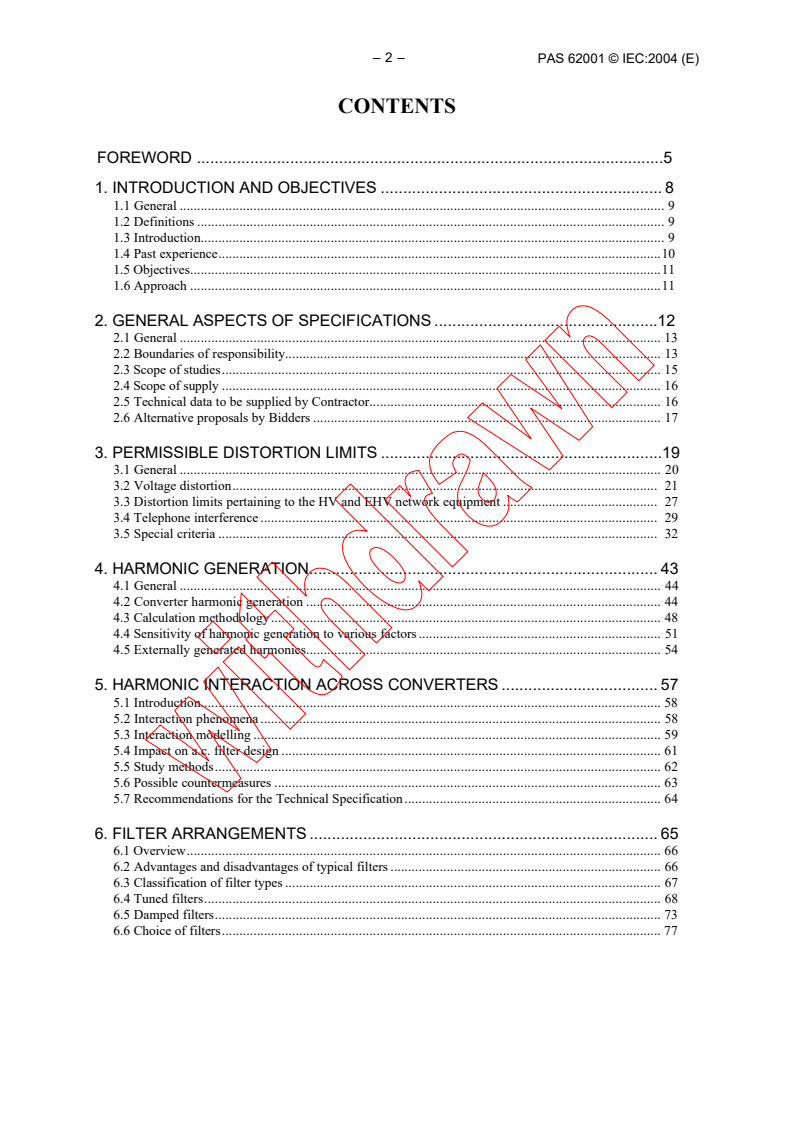
– 2 –
PAS 62001 © IEC:2004 (E)
CONTENTS
FOREWORD .5
1. INTRODUCTION AND OBJECTIVES . 8
1.1 General . 9
1.2 Definitions . 9
1.3 Introduction. 9
1.4 Past experience.10
1.5 Objectives.11
1.6 Approach .11
2. GENERAL ASPECTS OF SPECIFICATIONS .12
2.1 General . 13
2.2 Boundaries of responsibility. 13
2.3 Scope of studies. 15
2.4 Scope of supply . 16
2.5 Technical data to be supplied by Contractor. 16
2.6 Alternative proposals by Bidders . 17
3. PERMISSIBLE DISTORTION LIMITS .19
3.1 General . 20
3.2 Voltage distortion. 21
3.3 Distortion limits pertaining to the HV and EHV network equipment . 27
3.4 Telephone interference . 29
3.5 Special criteria . 32
4. HARMONIC GENERATION. 43
4.1 General . 44
4.2 Converter harmonic generation . 44
4.3 Calculation methodology. 48
4.4 Sensitivity of harmonic generation to various factors . 51
4.5 Externally generated harmonics. 54
5. HARMONIC INTERACTION ACROSS CONVERTERS . 57
5.1 Introduction. 58
5.2 Interaction phenomena . 58
5.3 Interaction modelling . 59
5.4 Impact on a.c. filter design . 61
5.5 Study methods. 62
5.6 Possible countermeasures . 63
5.7 Recommendations for the Technical Specification. 64
6. FILTER ARRANGEMENTS . 65
6.1 Overview. 66
6.2 Advantages and disadvantages of typical filters . 66
6.3 Classification of filter types . 67
6.4 Tuned filters. 68
6.5 Damped filters. 73
6.6 Choice of filters. 77
ii
– 3 –
PAS 62001 © IEC:2004 (E)
7. FILTER PERFORMANCE CALCULATION . 78
7.1 Calculation procedure . 79
7.2 Detuning and tolerances. 82
7.3 Network impedance for performance calculations. 85
7.4 Outages of filter banks / sub-banks. 91
7.5 Considerations of probability. 92
7.6 Flexibility regarding compliance. 94
8. FILTER SWITCHING AND REACTIVE POWER MANAGEMENT. 96
8.1 Introduction . 97
8.2 Reactive power interchange with a.c. network. 97
8.3 HVDC converter reactive power capability. 98
8.4 Bank / sub-bank definitions and sizing. 99
8.5 Hysteresis in switching points .102
8.6 Converter Q-V control near switching points .103
8.7 Operation at increased converter control angles.103
8.8 Filter switching sequence and harmonic performance.103
8.9 Demarcation of responsibilities .105
9. STEADY STATE RATING.111
9.1 Introduction .112
9.2 Calculation method.112
9.3 A.C. network conditions.118
9.4 De-tuning effects.118
9.5 Network impedance for rating calculations.119
9.6 Outages.119
10. TRANSIENT STRESSES AND RATING .120
10.1 General . 121
10.2 Switching impulse studies . 121
10.3 Fast fronted waveform studies . 125
10.4 Insulation co-ordination . 125
11. LOSSES. 128
11.1 Background. 129
11.2 A.C. filter component losses. 129
11.3 Filter reactor losses . 131
11.4 Criteria for loss evaluation . 132
12. DESIGN ISSUES AND SPECIAL APPLICATIONS . 137
12.1 Introduction . 138
12.2 Performance aspects. 138
12.3 Rating aspects . 141
12.4 Filters for special purposes . 144
12.5 Impact of new HVDC station in vicinity of an existing station. 149
12.6 Redundancy issues and spares . 150
13. PROTECTION. 153
13.1 Introduction . 154
13.2 General . 154
13.3 Bank and sub-bank overall protection. 156
13.4 Protection of individual filter components . 158
13.5 Personnel protection. 162
iii
– 4 –
PAS 62001 © IEC:2004 (E)
14. SEISMIC REQUIREMENTS .165
14.1 General .166
14.2 Load specification.166
14.3 Method of qualification .167
14.4 Examples of improvements in the mechanical design .170
15. AUDIBLE NOISE . 172
15.1 General .173
15.2 Sound active components of a.c. filters .173
15.3 Sound requirements.174
15.4 Noise reduction .175
16. CUSTOMER SPECIFIED PARAMETERS AND REQUIREMENTS. 178
16.1 Introduction.179
16.2 A.C. system parameters . 179
16.3 Harmonic distortion requirements. 182
16.4 Environmental conditions. 182
16.5 Electrical environment . 184
16.6 Requirements for filter arrangements and components. 184
16.7 Protection of filters . 185
16.8 Loss evaluation. 185
16.9 Field measurements and verifications . 185
16.10 General requirements . 185
17. EQUIPMENT DESIGN AND TEST REQUIREMENTS . 186
17.1 General .187
17.2 Capacitors . 190
17.3 Reactors . 193
17.4 Resistors. 196
17.5 Arresters. 199
17.6 Instrument transformers . 202
17.7 Filter switching equipment . 204
18. FIELD MEASUREMENTS AND VERIFICATION. 209
18.1 Introduction. 210
18.2 Equipment and subsystem tests. 210
18.3 System tests.211
18.4 In-service measurements. 215
18.5 Measurements of pre-existing harmonic levels for design purposes. 215
19. FUTURE DEVELOPMENTS. 217
19.1 Introduction.218
19.2 New filter technology . 218
19.3 New converter technology. 225
19.4 Changing external environment. 229
20. REFERENCES . 231
iv
– 5 –
PAS 62001 © IEC:2004 (E)
INTERNATIONAL ELECTROTECHNICAL COMMISSION
____________
GUIDE TO THE SPECIFICATION AND DESIGN EVALUATION
OF AC FILTERS FOR HVDC SYSTEMS
FOREWORD
1) The International Electrotechnical Commission (IEC) is a worldwide organization for standardization comprising
all national electrotechnical committees (IEC National Committees). The object of IEC is to promote
international co-operation on all questions concerning standardization in the electrical and electronic fields. To
this end and in addition to other activities, IEC publishes International Standards, Technical Specifications,
Technical Reports, Publicly Available Specifications (PAS) and Guides (hereafter referred to as “IEC
Publication(s)”). Their preparation is entrusted to technical committees; any IEC National Committee interested
in the subject dealt with may participate in this preparatory work. International, governmental and non-
governmental organizations liaising with the IEC also participate in this preparation. IEC collaborates closely
with the International Organization for Standardization (ISO) in accordance with conditions determined by
agreement between the two organizations.
2) The formal decisions or agreements of IEC on technical matters express, as nearly as possible, an international
consensus of opinion on the relevant subjects since each technical committee has representation from all
interested IEC National Committees.
3) IEC Publications have the form of recommendations for international use and are accepted by IEC National
Committees in that sense. While all reasonable efforts are made to ensure that the technical content of IEC
Publications is accurate, IEC cannot be held responsible for the way in which they are used or for any
misinterpretation by any end user.
4) In order to promote international uniformity, IEC National Committees undertake to apply IEC Publications
transparently to the maximum extent possible in their national and regional publications. Any divergence
between any IEC Publication and the corresponding national or regional publication shall be clearly indicated in
the latter.
5) IEC provides no marking procedure to indicate its approval and cannot be rendered responsible for any
equipment declared to be in conformity with an IEC Publication.
6) All users should ensure that they have the latest edition of this publication.
7) No liability shall attach to IEC or its directors, employees, servants or agents including individual experts and
members of its technical committees and IEC National Committees for any personal injury, property damage or
other damage of any nature whatsoever, whether direct or indirect, or for costs (including legal fees) and
expenses arising out of the publication, use of, or reliance upon, this IEC Publication or any other IEC
Publications.
8) Attention is drawn to the Normative references cited in this publication. Use of the referenced publications is
indispensable for the correct application of this publication.
9) Attention is drawn to the possibility that some of the elements of this IEC Publication may be the subject of
patent rights. IEC shall not be held responsible for identifying any or all such patent rights.
A PAS is a technical specification not fulfilling the requirements for a standard but made
available to the public .
IEC-PAS 62001 was submitted by the CIGRÉ (International Council on Large Electric
Systems) and has been processed by subcommittee 22F: Power electronics for electrical
transmission and distribution systems, of IEC technical committee 22: Power electronic systems
and equipment.
The text of this PAS is based on the This PAS was approved for
following document: publication by the P-members of the
committee concerned as indicated in
the following document
Draft PAS Report on voting
22F/97/NP 22F/102/RVN
Following publication of this PAS, which is a pre-standard publication, the technical committee
or subcommittee concerned will transform it into an International Standard.
An IEC-PAS licence of copyright and assignment of copyright has been signed by the IEC and
CIGRÉ and is recorded at the Central Office.
This PAS shall remain valid for an initial maximum period of three years starting from
2004-07. The validity may be extended for a single three-year period, following which it shall
be revised to become another type of normative document or shall be withdrawn.
– 6 –
PAS 62001 © IEC:2004 (E)
HOW TO USE THIS GUIDE
The principal purpose of this document is to give guidance to those responsible for:
• preparing the a.c. filtering aspects of Technical Specifications for HVDC projects,
• evaluating the proposed designs, and
• monitoring the subsequent project.
The main objective is to enable informed judgements to be made and future Technical Specifications to be
written, such that the resulting a.c. filters are effective yet economical, and are not under- or over-designed.
The Guide has been written by a diverse group including engineers from various manufacturers, utilities
and consultants, and the recommendations respect the interests of all parties.
This Guide can be used in different ways by different readers:
• The Guide provides sufficient instructional material so that it can be used as an introduction by
those involved in HVDC technology for the first time. An initial reader can omit certain
sections and concentrate on core aspects.
• An engineer preparing a Technical Specification can find the key points, which must be
considered, highlighted throughout the Guide, and summarised in Section 16.
• The Guide emphasises aspects where the specified requirements can, perhaps unintentionally,
have a significant impact on filter design and costs. A user issuing a Technical Specification
should consider how these aspects apply to that Specification.
• For evaluating proposed designs and technically monitoring the project, a deeper understanding
of many aspects will be required. This document contains guidance reflecting the accumulated
knowledge of many HVDC projects, and so will be of value even to highly experienced users. It
should help Customers to understand the reasons for differences among filter designs offered by
Bidders.
• While making specific recommendations, it has also been necessary to provide a considerable
amount of background material. Much of this information has never been brought together
under one cover before, and so the Guide will provide a valuable source of reference.
• Additionally, the Guide also contains material which will be of relevance in power industry
applications other than HVDC, for example in industrial filtering, switched capacitor
applications and general power quality issues.
The Guide has been clearly set-out in sections, each covering specific aspects of a.c. filter design. For
guidance on any particular subject, each section may be read individually. Cross-references to other sections
are made where necessary.
The brief description below of the contents of each section is intended to assist the reader to use the Guide
in the most appropriate way.
• For any reader, it is recommended to start with the short introductory Sections 1 and 2, which
explain the justification for the production of this document and also discuss what a Technical
Specification must attempt to achieve and the optional approaches regarding what should be
included.
v
– 7 –
PAS 62001 © IEC:2004 (E)
• Section 3 tackles the difficult and controversial problem of defining what harmonic distortion
limits should be specified. This is a complex subject and one where it is difficult to make
unambiguous recommendations, due to the vastly different local circumstances applying to
different HVDC projects. The options and implications are covered in detail. However, a non-
specialised reader need not go too deeply into this section before proceeding.
• In Section 4, various aspects of converter harmonic generation are discussed, concentrating on
those points which could be defined in the Technical Specification, and making
recommendations intended to avoid difficulties encountered in previous projects. This section
contains essential introductory material.
• In Section 5, the impact of harmonic interaction across the converter is discussed.
Recommendations are made as to how this phenomenon should be treated in the practical
context of an HVDC project design.
• A brief review of many different a.c. filter configurations is given in Section 6, along with lists
of advantages and disadvantages. As well as being of value as a reference, this information may
be used in the evaluation of proposed filter solutions.
• The central question of how to calculate a.c. filter performance is treated in Section 7, which
brings together various strands from other sections. The definition of a.c. system harmonic
impedance is of crucial importance to the filter design, and this section shows the various
options available and discusses the relative merits of each.
• The specification and design of a.c. filtering equipment is closely linked to the other main
function of a.c. filters, which is to provide reactive compensation. The specified requirements
on reactive compensation, and how these will influence the cost and complexity of the filter
design, are covered in Section 8.
• Sections 9, 10 and 11 define how the steady-state rating, the transient rating, and the losses of
a.c. filters are to be calculated, and what should be specified in this respect.
• Numerous aspects of valuable practical experience are brought together in Section 12, which
discusses special areas of design not covered elsewhere in the document and what influence
these aspects could have on a Specification. This section will be of value particularly to those
with an in-depth knowledge of the subject
• Section 13 covers aspects of a.c. filter protection, providing sufficient information to enable an
evaluation to be made of particular proposed protection schemes
• Sections 14 and 15 deal with the specialised areas of seismic design and audible noise, which in
some instances can have a significant impact on the physical design, cost and layout of an a.c.
filter installation.
• A summary of all the important parameters and requirements which must be specified by the
Customer in a Technical Specification, is given in Section 16. This summary lists the key
points which have been discussed in depth elsewhere in the Guide, and makes suitable cross-
references.
• Section 17 contains a detailed description of what should be specified regarding the detailed
design and testing of each item of filter equipment.
• Field measurements, and verification that the specified performance is achieved in service, are
discussed in Section 18, which concentrates on those aspects which need to be clearly defined
in the Technical Specification in order to avoid subsequent contractual conflict.
• Finally, the expected impacts of new technologies in the fields of HVDC converters and a.c.
filters are discussed in Section 19.
In some sections, detailed background material and equations have been set aside in small Appendices.
A substantial list of references is included, in Section 20.
vi
– 8 –
PAS 62001 © IEC:2004 (E)
1. INTRODUCTION AND OBJECTIVES
1. INTRODUCTION AND OBJECTIVES. 8
1.1 General. 9
1.2 Definitions . 9
1.3 Introduction. 9
1.4 Past experience.10
1.5 Objectives. 11
1.6 Approach. 11
1-1
– 9 –
PAS 62001 © IEC:2004 (E)
1.1 General
This document is a Guide to the specification and design evaluation of a.c. side harmonic performance and
a.c. side filters for HVDC schemes. It is intended to be primarily for the use of the utilities and consultants
who are responsible for issuing the Technical Specifications for new HVDC projects and evaluating designs
proposed by prospective suppliers.
1.2 Definitions
The term “Technical Specification” or “Specification” used in this Guide is taken to mean the document
which defines the overall system requirements for the a.c. filters and the a.c. system environment in which
they have to operate. Such a document is normally issued by utilities to the prospective HVDC
manufacturers. It also ensures the uniformity of proposals and sets guidelines for the evaluation of bids. The
term as used here does not refer to the detailed engineering specifications relating to individual items of
equipment, which are prepared by the HVDC manufacturer as a result of the filter design process.
The Technical Specification defines the technical basis for a contract between two parties, who in this Guide
will be referred to as the “Customer” and the “Contractor”.
• The “Customer” is the organisation which is purchasing the HVDC converter station, including
the a.c. filters. The term “Customer” is taken to cover similar terms which may be used in
specifications, such as Owner, Client, Buyer, Utility, User, Employer and Purchaser, and also
covers a Consultant representing the Customer.
• The “Contractor” has the overall responsibility for delivery of the HVDC converter station,
including the a.c. filters, as a system, and may in turn contract one or more sub-suppliers of
individual items of equipment. The term “Contractor” is taken to cover similar terms which
may be used in specifications, such as Manufacturer, or Supplier.
Where the context clearly refers to the pre-contract stage of a project, the word “Bidder” has been used
instead of “Contractor”, to indicate a prospective Contractor, or Tenderer.
1.3 Introduction
When installing an HVDC converter station in an a.c. system, the way in which it may affect the quality of
power supply in that system is always an important issue. One of the main power quality topics is that of
harmonic performance.
The a.c. side current of an HVDC converter has a highly non-sinusoidal waveform, and, if allowed to flow
in the connected a.c. system, might produce unacceptable levels of distortion. A.C. side filters are therefore
required as part of the total HVDC converter station, in order to reduce the harmonic distortion of the a.c.
side current and voltage to acceptably low levels.
HVDC converters also consume substantial reactive power, a large proportion of which must normally be
supplied locally within the converter station. Shunt connected a.c. filters appear as capacitive sources of
reactive power at fundamental frequency, and normally in conventional HVDC schemes the a.c. filters are
used to compensate most or all of the reactive consumption of the converter. Additional shunt capacitors
and reactors may also be used to ensure that the desired reactive balance is maintained within specified
limits under defined operational conditions.
The design of the a.c. filters therefore normally has to satisfy these two requirements of harmonic filtering
and reactive power compensation, for various operational states and load levels. Optimisation of this design
is the task of the a.c. filter designer, and the constraints under which the design is made are defined in the
Technical Specification.
The a.c. filters form a substantial part of a conventional HVDC converter station. The fundamental reactive
power rating of the a.c. filters (including shunt capacitors where applicable) at each converter station has
1-2
– 10 – PAS 62001 © IEC:2004 (E)
typically been in the range of 50% - 60% of the active power rating of the scheme. Together with the
required switchyard equipment, the a.c. filters can occupy over half of the total land requirements of an
HVDC scheme. The cost of manufacture, installation and commissioning of the a.c. filter equipment is
significant, being typically in the approximate range of 10% of the total station costs. In addition, the filter
design studies can be extensive and may have an impact on many other aspects of station design [Ref. 1-1,
1-2] and on the total project schedule. Once in operation, the a.c. filters will continue to have a major
importance due to requirements for switching, maintenance, component spares, and reliability.
It is therefore important that the way in which the requirements for the a.c. filters are specified is such as to
allow the design to be optimised in terms of all the above factors, while fulfilling the essential functions of
disturbance mitigation and reactive power compensation.
The scope of this Guide covers a.c. side filtering for the frequency range of interest in terms of harmonic
distortion and audible frequency disturbances. It excludes filters designed to be effective in the PLC and
radio interference spectra.
1.4 Past experience
In practice, there have been few problems of harmonic disturbance from HVDC schemes and few problems
relating to a.c. filter equipment in operation. Section 12 discusses some application problems, while
analyses of some filter reactor failures may be found in Ref. 1-3. Further information on experience with
existing a.c. filter schemes is available through the “HVDC Users’ Group”.
This past experience indicates that designs in general have been at least adequate. However, it is not
obvious to what extent this satisfactory experience might indicate that a.c. filters in some instances may
have been over-designed, and that a more economical design might have been possible.
One of the fundamental problems in specifying a.c. filters is that some of the essential design data is not
readily available. The harmonic impedance of the a.c. system is of paramount importance to the design, and
yet is difficult to measure or calculate for all operational conditions, both at present and during the future
operational life of the scheme. The level of existing harmonic distortion to be considered is another factor
which is difficult to measure or predict, as is the extent to which existing or future telecommunication
systems may be affected by harmonic currents flowing in the a.c. network. The tolerance to harmonics of
existing and future equipment such as motors and electronic loads, connected to the power system itself, is
also difficult to evaluate.
Other factors affecting the filter design have, in the past, been difficult to calculate accurately with the
available tools. Most prominent of these is the effect of the harmonic interaction between the a.c. and d.c.
sides of the converter which, while well understood in theory, has been difficult to incorporate consistently
into the design process.
One important aspect of the filtering scheme is the eventual ease of operation. Complex switching schemes
with several different types and sizes of a.c. filter bank may fulfil rigorous requirements on performance and
reactive power exchange, but the practical consequences and costs of lifetime operation should also be
considered.
Historically, there has been a wide variation in the content and requirements of Technical Specifications of
a.c. filters for different HVDC projects. There have developed several near-standard types of specification,
associated with certain utilities and consultants, but even these are adapted to suit individual projects.
1-3
– 11 –
PAS 62001 © IEC:2004 (E)
1.5 Objectives
In preparing this Guide, CIGRÉ Working Group 14.30 has attempted to:
• examine previous a.c. filter specifications and consider relative merits,
• consider field experience and draw conclusions,
• review results of previous and current CIGRÉ work on voltage and current limits, on a.c.
system modelling, and on a.c./d.c. harmonic interaction and consider how the recommendations
resulting from this work can usefully be incorporated in future specifications for HVDC
projects,
• take note of other relevant work in CIGRÉ and the IEEE,
• examine how particular aspects of specification can have a significant influence on the design
and costs,
• look forward to the likely impact of new technologies, both in the HVDC field and in related
areas such as telephone technology,
• make recommendations based on all of the above,
• provide information to facilitate reasoned decisions in the preparation of future Technical
Specifications and the evaluation of prospective designs.
In doing so, the Working Group sought to bring together the experience, and consider the interests, of all
sectors of the HVDC community and to produce a Guide which, while primarily intended for the use of
utilities and consultants, will be of interest to all parties.
1.6 Approach
The Guide attempts to review all possible aspects to be covered in a specification and the subsequent design
evaluation, and to give a more detailed analysis of critical or contentious points.
The technical background to each subject area is described briefly, and reference made to further sources of
information, in order to provide the background and context for the decisions to be made.
Where it is possible to make clear recommendations, these are given in the Guide. In other instances, where
there may be different ways to approach some aspect, then the different approaches and their consequences
are described. The intention in such instances is to enhance awareness of the implications of different
possible approaches.
The Guide gives a comprehensive treatment of most aspects of the subject. This does not imply that a
Technical Specification needs to mention all the aspects included in this Guide. In some circumstances a
simple and open Specification may be preferable. However, while preparing any Specification, those
responsible should at least be aware of, and consider, all the points discussed in this Guide. In the eventual
design evaluation phase, most of the material included in this Guide will be of relevance.
New technologies which are currently being introduced into HVDC systems will, where applied,
substantially alter many aspects of a.c. filter design. Foremost of these are the series compensated converter,
the automatically continuously tuned reactor, and active filters.
To introduce throughout this Guide the radically different approaches which such new technologies require,
would have led to a clumsy presentation. Instead, the bulk of the Guide concentrates on the “conventional”
a.c. filter technology and current-source line-commutated HVDC converters. Discussion of the changes
entailed by new technologies is treated exclusively in Section 19. Other unusual applications, such as series
filters, which use conven
...