

IEC 62788-7-3:2022
(Main)Measurement procedures for materials used in photovoltaic modules - Part 7-3: Accelerated stress tests - Methods of abrasion of PV module external surfaces
General Information
- Abstract
IEC 62788-7-3:2022 defines the test methods that can be used for evaluating the abrasion of materials and coatings in photovoltaic modules or other solar devices. This document may be applied to components on the incident surface (including coatings, frontsheet, and glass) as well as the back surface (including backsheets or back glass). This document is intended to address abrasion of PV module surfaces and any coatings present using representative specimens (e.g. which can be centimetres in size); the methods and apparatus used here can also be used on PV module specimens (e.g. meters in size).
- Status
- Published
- Publication Date
- 30-Jul-2024
- Technical Committee
- TC 82 - Solar photovoltaic energy systems
- Drafting Committee
- WG 2 - TC 82/WG 2
- Current Stage
- PPUB - Publication issued
- Start Date
- 22-Feb-2022
- Completion Date
- 18-Mar-2022
Buy Documents
IEC 62788-7-3:2022+AMD1:2024 CSV - Measurement procedures for materials used in photovoltaic modules - Part 7-3: Accelerated stress tests - Methods of abrasion of PV module external surfaces Released:7/31/2024
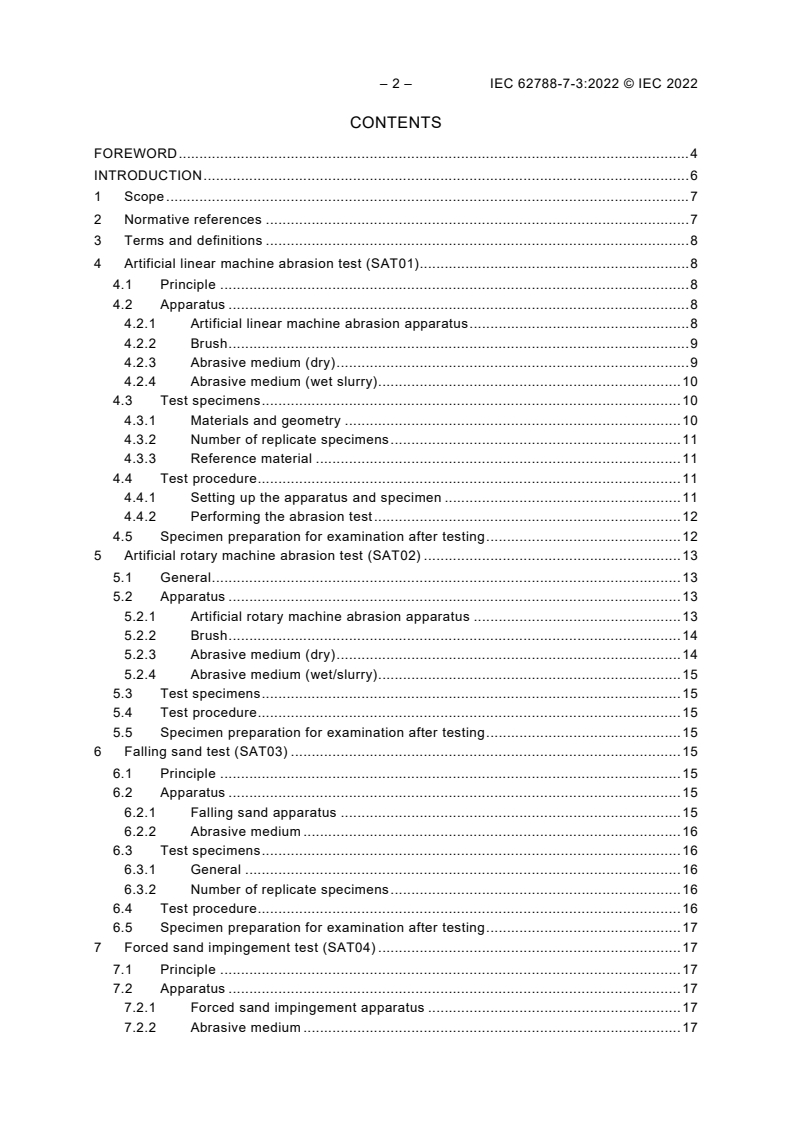
IEC 62788-7-3:2022 - Measurement procedures for materials used in photovoltaic modules - Part 7-3: Accelerated stress tests - Methods of abrasion of PV module external surfaces Released:2/22/2022
Overview
IEC 62788-7-3:2022 specifies accelerated abrasion test methods for evaluating the durability of materials and coatings used in photovoltaic (PV) modules and other solar devices. The standard covers abrasion of both the incident (front) surface - including glass, frontsheets and coatings - and the back surface (backsheets or back glass). It defines apparatus, specimen requirements and test procedures that can be applied to representative specimens (from centimetre-scale samples up to full-module specimens).
Key topics and requirements
- Scope of testing: Methods target abrasion arising from routine cleaning, environmental particulates and severe weather. Tests are not intended to produce identical results across methods but to simulate different real-world wear modes.
- Four principal abrasion methods (identified in the standard):
- SAT01 - Artificial linear machine abrasion (linear brush) to emulate perpendicular cleaning/scratching actions.
- SAT02 - Artificial rotary machine abrasion (rotary brush) to emulate swiping/robotic cleaning actions.
- SAT03 - Falling sand test to emulate particle impact from common meteorological events.
- SAT04 - Forced sand impingement for high-energy particle impact representative of severe weather or harsh sites.
- Test elements defined: apparatus descriptions, brush design, abrasive media (dry and wet/slurry), specimen geometry, number of replicates, test setup and execution, and specimen preparation for post-test examination.
- Reference and verification: The standard identifies working reference materials and recommends regular verification of apparatus performance (interlaboratory precision study referenced for future values).
- Reporting: Test report requirements and documentation of test conditions and results are specified.
Applications and users
IEC 62788-7-3 is intended for organizations involved in PV materials performance and durability, including:
- PV module manufacturers assessing frontsheet, glass and backsheet abrasion resistance.
- Materials and coatings developers evaluating formulations for scratch and particle resistance.
- Independent test laboratories and certification bodies performing accelerated stress testing.
- R&D teams and quality engineers comparing cleaning methods (manual vs robotic) and site-specific abrasion risks.
- Use cases include product development, material selection, comparative performance testing and evidence for warranty claims.
Related standards
- IEC 62788 series (measurement procedures for materials used in PV modules)
- IEC 60068-2-68 (environmental testing - sand and dust) - referenced for comparison
- DIN 53778-2, ASTM D2486, DIN 52348 - used as points of comparison for application-specific modifications
By following IEC 62788-7-3, stakeholders can systematically evaluate PV module surface abrasion, generate reproducible data for design and procurement decisions, and better predict field durability under cleaning and environmental stress.
Relations
- Effective Date
- 05-Sep-2023
Buy Documents
IEC 62788-7-3:2022+AMD1:2024 CSV - Measurement procedures for materials used in photovoltaic modules - Part 7-3: Accelerated stress tests - Methods of abrasion of PV module external surfaces Released:7/31/2024
IEC 62788-7-3:2022 - Measurement procedures for materials used in photovoltaic modules - Part 7-3: Accelerated stress tests - Methods of abrasion of PV module external surfaces Released:2/22/2022
Get Certified
Connect with accredited certification bodies for this standard

DNV
DNV is an independent assurance and risk management provider.

Lloyd's Register
Lloyd's Register is a global professional services organisation specialising in engineering and technology.
DNV Energy Systems
Energy and renewable energy certification.
Sponsored listings
Frequently Asked Questions
IEC 62788-7-3:2022 is a standard published by the International Electrotechnical Commission (IEC). Its full title is "Measurement procedures for materials used in photovoltaic modules - Part 7-3: Accelerated stress tests - Methods of abrasion of PV module external surfaces". This standard covers: IEC 62788-7-3:2022 defines the test methods that can be used for evaluating the abrasion of materials and coatings in photovoltaic modules or other solar devices. This document may be applied to components on the incident surface (including coatings, frontsheet, and glass) as well as the back surface (including backsheets or back glass). This document is intended to address abrasion of PV module surfaces and any coatings present using representative specimens (e.g. which can be centimetres in size); the methods and apparatus used here can also be used on PV module specimens (e.g. meters in size).
IEC 62788-7-3:2022 defines the test methods that can be used for evaluating the abrasion of materials and coatings in photovoltaic modules or other solar devices. This document may be applied to components on the incident surface (including coatings, frontsheet, and glass) as well as the back surface (including backsheets or back glass). This document is intended to address abrasion of PV module surfaces and any coatings present using representative specimens (e.g. which can be centimetres in size); the methods and apparatus used here can also be used on PV module specimens (e.g. meters in size).
IEC 62788-7-3:2022 is classified under the following ICS (International Classification for Standards) categories: 27.160 - Solar energy engineering. The ICS classification helps identify the subject area and facilitates finding related standards.
IEC 62788-7-3:2022 has the following relationships with other standards: It is inter standard links to IEC 62788-7-3:2022/AMD1:2024. Understanding these relationships helps ensure you are using the most current and applicable version of the standard.
IEC 62788-7-3:2022 is available in PDF format for immediate download after purchase. The document can be added to your cart and obtained through the secure checkout process. Digital delivery ensures instant access to the complete standard document.
Standards Content (Sample)
IEC 62788-7-3 ®
Edition 1.1 2024-07
CONSOLIDATED VERSION
INTERNATIONAL
STANDARD
colour
inside
Measurement procedures for materials used in photovoltaic modules –
Part 7-3: Accelerated stress tests – Methods of abrasion of PV module external
Surfaces
All rights reserved. Unless otherwise specified, no part of this publication may be reproduced or utilized in any form
or by any means, electronic or mechanical, including photocopying and microfilm, without permission in writing from
either IEC or IEC's member National Committee in the country of the requester. If you have any questions about IEC
copyright or have an enquiry about obtaining additional rights to this publication, please contact the address below or
your local IEC member National Committee for further information.
IEC Secretariat Tel.: +41 22 919 02 11
3, rue de Varembé info@iec.ch
CH-1211 Geneva 20 www.iec.ch
Switzerland
About the IEC
The International Electrotechnical Commission (IEC) is the leading global organization that prepares and publishes
International Standards for all electrical, electronic and related technologies.
About IEC publications
The technical content of IEC publications is kept under constant review by the IEC. Please make sure that you have the
latest edition, a corrigendum or an amendment might have been published.
IEC publications search - webstore.iec.ch/advsearchform IEC Products & Services Portal - products.iec.ch
The advanced search enables to find IEC publications by a Discover our powerful search engine and read freely all the
variety of criteria (reference number, text, technical publications previews, graphical symbols and the glossary.
committee, …). It also gives information on projects, replaced With a subscription you will always have access to up to date
and withdrawn publications. content tailored to your needs.
IEC Just Published - webstore.iec.ch/justpublished
Electropedia - www.electropedia.org
Stay up to date on all new IEC publications. Just Published
The world's leading online dictionary on electrotechnology,
details all new publications released. Available online and once
containing more than 22 500 terminological entries in English
a month by email.
and French, with equivalent terms in 25 additional languages.
Also known as the International Electrotechnical Vocabulary
IEC Customer Service Centre - webstore.iec.ch/csc
(IEV) online.
If you wish to give us your feedback on this publication or need
further assistance, please contact the Customer Service
Centre: sales@iec.ch.
IEC 62788-7-3 ®
Edition 1.1 2024-07
CONSOLIDATED VERSION
INTERNATIONAL
STANDARD
colour
inside
Measurement procedures for materials used in photovoltaic modules –
Part 7-3: Accelerated stress tests – Methods of abrasion of PV module external
Surfaces
INTERNATIONAL
ELECTROTECHNICAL
COMMISSION
ICS 27.160 ISBN 978-2-8322-9506-9
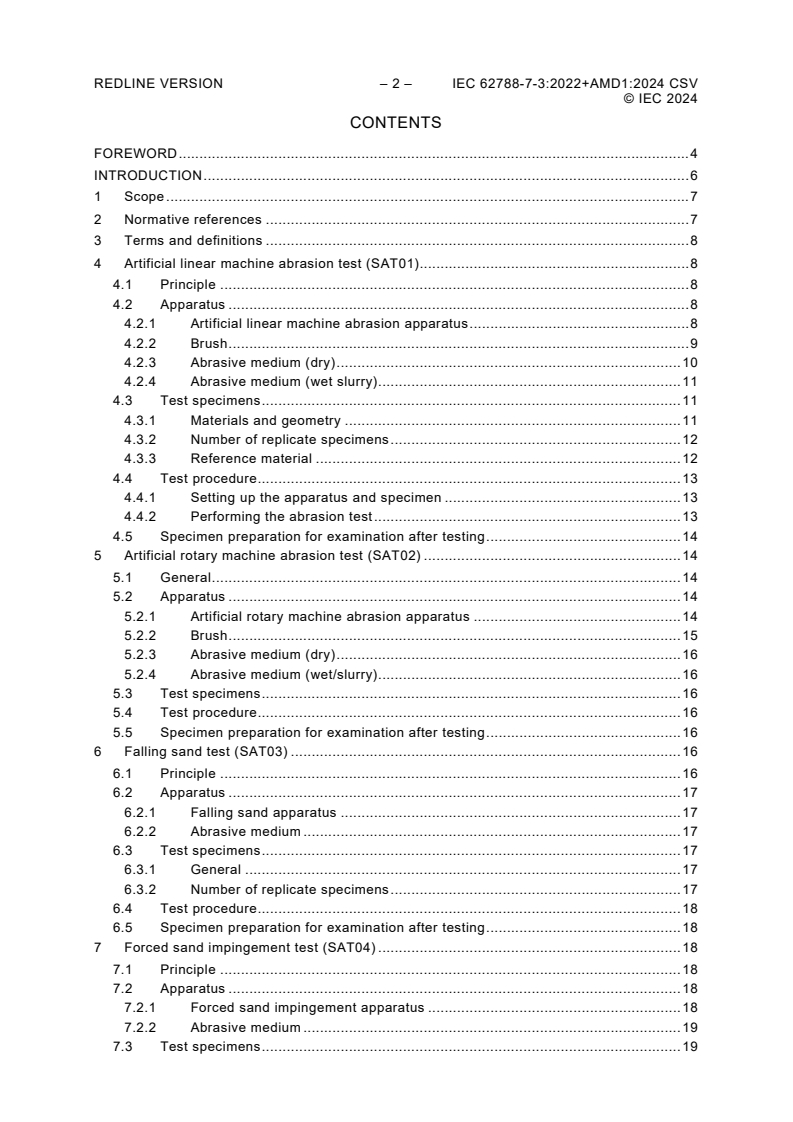
REDLINE VERSION – 2 – IEC 62788-7-3:2022+AMD1:2024 CSV
© IEC 2024
CONTENTS
FOREWORD . 4
INTRODUCTION . 6
1 Scope . 7
2 Normative references . 7
3 Terms and definitions . 8
4 Artificial linear machine abrasion test (SAT01). 8
4.1 Principle . 8
4.2 Apparatus . 8
4.2.1 Artificial linear machine abrasion apparatus . 8
4.2.2 Brush . 9
4.2.3 Abrasive medium (dry) . 10
4.2.4 Abrasive medium (wet slurry) . 11
4.3 Test specimens . 11
4.3.1 Materials and geometry . 11
4.3.2 Number of replicate specimens . 12
4.3.3 Reference material . 12
4.4 Test procedure . 13
4.4.1 Setting up the apparatus and specimen . 13
4.4.2 Performing the abrasion test . 13
4.5 Specimen preparation for examination after testing . 14
5 Artificial rotary machine abrasion test (SAT02) . 14
5.1 General . 14
5.2 Apparatus . 14
5.2.1 Artificial rotary machine abrasion apparatus . 14
5.2.2 Brush . 15
5.2.3 Abrasive medium (dry) . 16
5.2.4 Abrasive medium (wet/slurry) . 16
5.3 Test specimens . 16
5.4 Test procedure . 16
5.5 Specimen preparation for examination after testing . 16
6 Falling sand test (SAT03) . 16
6.1 Principle . 16
6.2 Apparatus . 17
6.2.1 Falling sand apparatus . 17
6.2.2 Abrasive medium . 17
6.3 Test specimens . 17
6.3.1 General . 17
6.3.2 Number of replicate specimens . 17
6.4 Test procedure . 18
6.5 Specimen preparation for examination after testing . 18
7 Forced sand impingement test (SAT04) . 18
7.1 Principle . 18
7.2 Apparatus . 18
7.2.1 Forced sand impingement apparatus . 18
7.2.2 Abrasive medium . 19
7.3 Test specimens . 19
© IEC 2024
7.4 Procedure . 19
7.5 Specimen preparation for examination after testing . 20
8 Test report . 20
Annex A (informative) References describing the durability of materials to linear
abrasion. 21
Bibliography . 22
Figure 1 – Schematics showing the arrangement of bristle tufts on the linear brush . 10
Figure 12 – Schematic showing the arrangement of bristle tufts on the rotary brush . 16
Table 1 – Examples of suitable reference materials . 13
REDLINE VERSION – 4 – IEC 62788-7-3:2022+AMD1:2024 CSV
© IEC 2024
INTERNATIONAL ELECTROTECHNICAL COMMISSION
____________
MEASUREMENT PROCEDURES FOR MATERIALS
USED IN PHOTOVOLTAIC MODULES –
Part 7-3: Accelerated stress tests –
Methods of abrasion of PV module external surfaces
FOREWORD
1) The International Electrotechnical Commission (IEC) is a worldwide organization for standardization comprising
all national electrotechnical committees (IEC National Committees). The object of IEC is to promote international
co-operation on all questions concerning standardization in the electrical and electronic fields. To this end and
in addition to other activities, IEC publishes International Standards, Technical Specifications, Technical Reports,
Publicly Available Specifications (PAS) and Guides (hereafter referred to as “IEC Publication(s)”). Their
preparation is entrusted to technical committees; any IEC National Committee interested in the subject dealt with
may participate in this preparatory work. International, governmental and non-governmental organizations liaising
with the IEC also participate in this preparation. IEC collaborates closely with the International Organization for
Standardization (ISO) in accordance with conditions determined by agreement between the two organizations.
2) The formal decisions or agreements of IEC on technical matters express, as nearly as possible, an international
consensus of opinion on the relevant subjects since each technical committee has representation from all
interested IEC National Committees.
3) IEC Publications have the form of recommendations for international use and are accepted by IEC National
Committees in that sense. While all reasonable efforts are made to ensure that the technical content of IEC
Publications is accurate, IEC cannot be held responsible for the way in which they are used or for any
misinterpretation by any end user.
4) In order to promote international uniformity, IEC National Committees undertake to apply IEC Publications
transparently to the maximum extent possible in their national and regional publications. Any divergence between
any IEC Publication and the corresponding national or regional publication shall be clearly indicated in the latter.
5) IEC itself does not provide any attestation of conformity. Independent certification bodies provide conformity
assessment services and, in some areas, access to IEC marks of conformity. IEC is not responsible for any
services carried out by independent certification bodies.
6) All users should ensure that they have the latest edition of this publication.
7) No liability shall attach to IEC or its directors, employees, servants or agents including individual experts and
members of its technical committees and IEC National Committees for any personal injury, property damage or
other damage of any nature whatsoever, whether direct or indirect, or for costs (including legal fees) and
expenses arising out of the publication, use of, or reliance upon, this IEC Publication or any other IEC
Publications.
8) Attention is drawn to the Normative references cited in this publication. Use of the referenced publications is
indispensable for the correct application of this publication.
9) IEC draws attention to the possibility that the implementation of this document may involve the use of (a)
patent(s). IEC takes no position concerning the evidence, validity or applicability of any claimed patent rights in
respect thereof. As of the date of publication of this document, IEC had not received notice of (a) patent(s), which
may be required to implement this document. However, implementers are cautioned that this may not represent
the latest information, which may be obtained from the patent database available at https://patents.iec.ch. IEC
shall not be held responsible for identifying any or all such patent rights.
This consolidated version of the official IEC Standard and its amendment has been
prepared for user convenience.
IEC 62788-7-3 edition 1.1 contains the first edition (2022-02) [documents 82/1987/FDIS
and 82/2009/RVD] and its amendment 1 (2024-07) [documents 82/2259/FDIS and
82/2277/RVD].
In this Redline version, a vertical line in the margin shows where the technical content is
modified by amendment 1. Additions are in green text, deletions are in strikethrough red
text. A separate Final version with all changes accepted is available in this publication.
© IEC 2024
IEC 62788-7-3 has been prepared by IEC technical committee 82: Solar photovoltaic energy
systems. It is an International Standard.
The language used for the development of this International Standard is English.
This document was drafted in accordance with ISO/IEC Directives, Part 2, and developed in
accordance with ISO/IEC Directives, Part 1 and ISO/IEC Directives, IEC Supplement, available
at www.iec.ch/members_experts/refdocs. The main document types developed by IEC are
described in greater detail at www.iec.ch/standardsdev/publications.
A list of all parts in the IEC 62788 series, published under the general title Measurement
procedures for materials used in photovoltaic modules, can be found on the IEC website.
The committee has decided that the contents of this document and its amendment will remain
unchanged until the stability date indicated on the IEC website under webstore.iec.ch in the
data related to the specific document. At this date, the document will be
• reconfirmed,
• withdrawn, or
• revised.
IMPORTANT – The 'colour inside' logo on the cover page of this publication indicates
that it contains colours which are considered to be useful for the correct understanding
of its contents. Users should therefore print this document using a colour printer.
REDLINE VERSION – 6 – IEC 62788-7-3:2022+AMD1:2024 CSV
© IEC 2024
INTRODUCTION
There is a need for abrasion test methods in the PV industry, particularly for the front and back
surfaces of PV modules. This document defines a set of test methods to be used for evaluating
the abrasion of materials and coatings in photovoltaic modules or other solar devices. Linear
and rotary machine abrasion methods are specified that can be used to address durability to
abrasion with respect to the cleaning of solar devices. Linear abrasion is intended to emulate
traditional manual methods of cleaning, where the cleaning equipment typically acts
perpendicular to the surface, giving a scratching motion. Rotary abrasion is intended to emulate
popular robotic methods of cleaning, where the cleaning element often may act along the
surface in a swiping motion. Relative to DIN 53778-2 and ASTM D2486, application specific
modifications for the machine abrasion tests include the longer bristle length, use of abrasive
(test dust) of the size encountered in PV, the use of dry or wet abrasive as may be encountered
during cleaning modules, and the number of test cycles relative to the maintenance of PV
systems. A falling sand method is specified that can be used to address durability to abrasion
with respect to damage from ordinary use in the application environment, i.e., typically
meteorological events. Relative to DIN 52348, modifications include the quantity of test sand,
which is intended for examination of PV surfaces and coatings. A forced sand impingement
method is specified that can be used to address durability to abrasion from severe weather
events and/or the most challenging locations of use. Relative to IEC 60068-2-68, modifications
include the composition of test sand that may be compared to the PV application and the falling
sand test in this document as well as the specified carrier velocities based on the PV
application. The methods in this document can be used to aid performance analysis and/or for
the purpose of material design/selection. Comparing the linear brush, rotary brush, falling sand,
and forced impingement methods, different rates of abrasion and/or damage morphology can
occur between the different test methods – they are not expected to produce the same result.
Formal working reference materials are identified in this document. The purpose of the working
reference is to verify the apparatus is installed and working correctly. The characteristic(s) of
interest can be verified on a regular basis (monthly, weekly, etc.). The characteristic(s) of
interest and their values (with acceptance limits for precision) will be given in a referencing
document or future version of this document, based on the results of an interlaboratory precision
study.
© IEC 2024
MEASUREMENT PROCEDURES FOR MATERIALS
USED IN PHOTOVOLTAIC MODULES –
Part 7-3: Accelerated stress tests –
Methods of abrasion of PV module external surfaces
1 Scope
This part of IEC 62788 defines the test methods that can be used for evaluating the abrasion
of materials and coatings in photovoltaic modules or other solar devices. This document may
be applied to components on the incident surface (including coatings, frontsheet, and glass) as
well as the back surface (including backsheets or back glass). This document is intended to
address abrasion of PV module surfaces and any coatings present using representative
specimens (e.g. which can be centimetres in size); the methods and apparatus used here can
also be used on PV module specimens (e.g. meters in size). A suite of tests and their methods
are identified in this document, including falling sand, forced sand impingement, and machine
(brush) abrasion. Materials and coatings can have different intended design purposes and
design lifetimes and therefore no specific pass/fail criteria are defined in this document. The
results of the testing can, however, be used to identify relative durability of coatings for various
outdoor environments and cleaning practices. The methods can be used for the purpose of
relative comparison, e.g. for the purpose of material or coating selection. The quantitative
correlation between artificial abrasion and field erosion (which will depend on factors including
climate or location of use as well as application, e.g., use of a tracker, rack-mount, roof-mount,
building integrated, or vehicle integrated PV) can be established for each specific material or
coating, which is beyond the scope of this document.
The correlation between the rates of degradation from the different test methods (linear brush,
rotary brush, falling sand, and forced impingement) is beyond the scope of this document and
may be covered in referencing documents. The correlation between the rates of degradation for
unaged and aged specimens is also beyond the scope of this document and may be covered in
referencing documents.
The methods related to the characterization of abraded specimens (which might include optical
transmittance, optical reflectance, surface roughness, and surface energy) are not defined in
this document; characterization methods from other standards (including optical transmittance,
optical reflectance, electrical performance, surface roughness, and surface energy) can be
applied to specimens abraded using the methods defined in this document. Methods for
examining the contamination of specimens, including artificial soiling, are not examined in this
document. Additional specimen conditioning can be applied prior to the methods in this
document. The abrasion tests in this document can be referenced and/or applied in conjunction
with an accelerated test or test sequence in other standards.
2 Normative references
The following documents are referred to in the text in such a way that some or all of their content
constitutes requirements of this document. For dated references, only the edition cited applies.
For undated references, the latest edition of the referenced document (including any
amendments) applies.
IEC 60068-2-68, Environmental testing – Part 2-68: Tests – Test L: Dust and sand
IEC TS 61836, Solar photovoltaic energy systems – Terms, definitions and symbols
ISO 291, Plastics – Standard atmospheres for conditioning and testing
REDLINE VERSION – 8 – IEC 62788-7-3:2022+AMD1:2024 CSV
© IEC 2024
ISO 12103-1, Road vehicles – Test contaminants for filter evaluation – Part 1: Arizona test dust
ASTM D2486, Standard test methods for scrub resistance of wall paints
DIN 52348:1985-02, Testing of glass and plastics; abrasion test; sand trickling method
DIN 53778-2:1983-08, Emulsion paints for interior use; evaluation of cleanability and of wash
and scrub resistance of coatings
MIL-STD-810G, Environmental engineering considerations and laboratory tests
VDI 3956, Evaluation of the soiling properties of surfaces – Test method for the dust soiling
behaviour of solar energy systems
3 Terms and definitions
For the purposes of this document, the terms and definitions given in IEC TS 61836 and the
following apply.
ISO and IEC maintain terminological databases for use in standardization at the following
addresses:
• IEC Electropedia: available at http://www.electropedia.org/
• ISO Online browsing platform: available at http://www.iso.org/obp
3.1
artificial abrasion
wear resulting from the cleaning of a PV device, including manual or robotic cleaning
3.2
natural erosion
wear resulting from the ordinary terrestrial use of a PV device
Note 1 to entry: Sources of erosion may include particulate impingement, particulate transport (from wind or water),
or autonomous scraping (from snow or ice by gravity).
4 Artificial linear machine abrasion test (SAT01)
4.1 Principle
The machine abrasion methods are specified that can be used to address durability to abrasion
with respect to the cleaning of solar devices. Linear abrasion is intended to emulate traditional
manual methods of cleaning, where the cleaning equipment typically acts perpendicular to the
surface, giving a scratching motion. The test is typically applied to the irradiance incident
surface of a PV module. Because either dry or wet cleaning may be used to clean a PV module,
both dry and wet (slurry) abrasives may be used in this test. The test may simulate the cleaning
of fixed, tracked, or vehicle integrated PV.
4.2 Apparatus
4.2.1 Artificial linear machine abrasion apparatus
A linear abrasion apparatus fulfilling the requirements of ASTM D2486 or DIN 53778-2 shall be
used. Essential components of the apparatus include: a linear abrasion mechanism, a brush,
an abrasive dispenser (slurry or dry abrasive), and an enclosure (if applicable). An enclosure
is recommended for the apparatus to prevent spilling or spraying of abrasive (dry or wet slurry
abrasives) or the possibility of silicosis (with ventilation, for dry abrasive). Additional equipment
and containers for the management of waste abrasive and its disposal after the test is advised.
© IEC 2024
The abrasion mechanism shall provide a brush stroke length of at least 14,5 cm. The brush may
operate at either a constant or varied velocity through each stroke. The brush velocity of
−1
30 ± 3 cm⋅s shall be used for the through the central 7,5 cm test region on the specimen
during machine abrasion testing. Other test rates may be used for the purposes of research
and development.
−1
NOTE For example, the brush velocity of 30 cm⋅s , when used with a stroke length of 25,4 cm corresponds to a
test rate of 37± 1 cycles per minute.
Specimens shall be rigidly mounted relative to the apparatus using mechanical springs or
clamps, tape or other means.
To ensure repeatability of results (i.e., avoid temperature-related effects related to the abrasion
process or abrasive) the apparatus shall be maintained, in a laboratory maintained at
(23 ± 2) °C, (50 ± 10) % RH, as specified per Class 2 in ISO 291.
The dispenser for dry dust shall be separated from the specimen surface by at least 10 cm to
provide clearance for the motion of the brush (in both linear and rotary configurations) and also
aid dispensing to the designated test area of the specimen.
The dispenser for wet slurry shall be separated from the specimen surface by at least 5 cm to
aid dispensing to the designated test area of the specimen.
4.2.2 Brush
The brush block shall be (3538 ± 1) mm × (8589 ± 1) mm in area and (13 ± 1) mm in thickness.
The brush bristles shall consist of polyamide 612, poly(hexamethylene dodecanediamide) with
a 50:50 molar ratio of monomer types, (0,23 ± 0,03) mm in diameter that extend (38 ± 2) mm
from the brush block. Brushes with bristles shorter than 35 mm in length shall be replaced. The
bristle profile shall be round, with no taper or other change in geometry along their length. The
lateral repeat space of 6,4 mm shall be used for the bristle tuft rows across the width of the
brush and 12,7 mm shall be used for the bristle tuft columns along the length of the brush, with
a. For the staggered bristles, an offset space of 4 3,2 mm between adjacent rows and lateral
offset space of 6,4 mm between adjacent bristle columns. The bristle tufts shall be staggered
in a 5-4-5-4-. pattern along the brush, with total of 59 tufts. The bristle count shall be (158 ±
−1
6) tips⋅tuft . See Figure 1.
A 325 g external weight shall be used with the brush, as in ASTM D2486. The nominal brush
weight of 125 g includes the dry weight of brush block and bristles. The nominal brush net
weight (including 5 g attachment bolt) shall be 455 ± 10 g, including the dry weight of brush
block, bristles, external weight, fasteners, and holder. The nominal contact force of 4,46 N shall
result from the self-weight of the components; no spring or other external force shall be used.
REDLINE VERSION – 10 – IEC 62788-7-3:2022+AMD1:2024 CSV
© IEC 2024
Dimensions in millimetres
Figure 1 – Schematics showing the arrangement of bristle tufts on the linear brush
4.2.3 Abrasive medium (dry)
The dry abrasive medium shall consist of A3 (medium) AZ test dust, as specified in
−2 −1
ISO 12103-1. The nominal abrasive concentration of (0,7) mg⋅cm ⋅cycle shall be used during
the test. To ensure repeatability, the test dust shall not be reused after testing. Other abrasive
materials or quantities of abrasive may be used for the purposes of research and development.
−1
NOTE The abrasive concentration of (20 ± 5) mg⋅cycle when applied to the nominal area of the linear brush
−2 −2⋅ −1
(29,75) cm provides the nominal abrasive concentration of (0,7) mg⋅cm cycle .
Dry abrasive shall be maintained at (23 ± 2) °C and (50 ± 10) % RH for at least 24 h, as specified
per Class 2 in ISO 291, prior to use in the linear abrasion test.
For the dry abrasive test, the brush bristles shall be maintained at (23 ± 2) °C and (50 ± 10) %
RH for at least 24 h, as specified per Class 2 in ISO 291, prior to use in the linear abrasion test.
© IEC 2024
Other dry abrasives may be used for the purposes of research and development. Dry abrasive
may be used in conjunction with an artificial soiling method for the purposes of research and
development. Alternative abrasives include the “Middle East” (ME) test dust as specified in VDI
3956, and “quartz free” AZ test dust (similar to ISO 12103-1, but using corundum instead of
silica to avoid safety issues related to respiration). Both particle size and particle composition
can affect the rate of abrasion. The aforementioned alternative abrasives have not been widely
studied relative to ISO 12103-1 AZ test dust.
4.2.4 Abrasive medium (wet slurry)
The wet abrasive medium shall consist of A3 (medium) AZ test dust, as specified in
−1
ISO 12103-1. The abrasive concentration of (5,0 ± 0,2) g⋅l in deionized water shall be used
−1
during the test. The slurry shall be flowed at the rate of (5,0 ± 0,2) l⋅h during the test. To
ensure repeatability, the test dust shall not be reused after testing. Other abrasive materials or
quantities of abrasive may be used for the purposes of research and development.
−1 −1
NOTE The abrasive concentration of (5,0 ± 0,2) g⋅l when flowed at the rate of (5,0 ± 0,2) l⋅h to the nominal area
−2 −2⋅ −1
of the linear brush (29,75) cm provides the nominal abrasive concentration of (0,4) mg⋅cm cycle for the nominal
−1
brush travel distance (25,4 cm) and operating speed (30 ± 3 cm⋅s ).
Deionized water at (23 ± 2) °C shall be used during the test to avoid temperature-related effects
related to the abrasion process or abrasive.
For the wet slurry abrasive test, the brush bristles shall be conditioned using water for 24 h
before the start of the test. Methods of brush conditioning include soaking the bristles in a
container of water, completely immersing the brush in a container of water, and/or the use of
water flow (where the water or brush may be adjusted to provide regular conditioning). Brushes
that are in frequent use may be stored in water.
A stirring apparatus shall be used with the slurry to improve the uniformity of concentration of
dust in the slurry as well as to facilitate uniform concentration through the duration of testing.
In addition to the stirring/mixing of the slurry, the apparatus and its plumbing should produce
good uniformity of deposition slurry on the sample.
Other wet slurry abrasives may be used for the purposes of research and development.
4.3 Test specimens
4.3.1 Materials and geometry
Specimens may consist of representative coupons. The specimens shall be composed of a base
material (or substrate), where a coating (if applicable) may be present on the test surface.
Representative coupons shall be at least (7,5 ± 0,2) cm × (7,5 ± 0,2) cm in size. Module
specimens or glass specimens (for tempered glass, where cutting is impossible) may also be
used, if they may be accommodated in the apparatus. In the case of modules, the specimens
shall contain at least three test regions 7,5 cm × 7,5 cm in length and width, separated at least
37,5 cm. In the case of unaged specimens, or specimens with no previous test-history, the test
region(s) shall be representative of that used in the PV application, being free from visible
damage, delamination, or other defects. In the case of weathered specimens or specimens with
a previous test-history, the specimen shall be used in its received condition. In the case of
polymeric material specimens such as backsheets or frontsheets, both principal directions
should be tested, including the machine extrusion direction and the traverse direction.
Some coatings can have limitations regarding the specimen size that can be used to fabricate
a representative sample. For example the glass might need to be tempered as part of the
manufacturing process, where a 50 cm × 50 cm minimum glass size is required. In such cases,
a larger coupon size or a module specimen can be used.
REDLINE VERSION – 12 – IEC 62788-7-3:2022+AMD1:2024 CSV
© IEC 2024
Commercial abrasion test equipment fulfilling the requirements of the test apparatus may be
used to test region(s) within a module, if the test apparatus is located and fixtured relative to
the test surface of the module. A custom apparatus with equivalent characteristics to a
commercial tester may be used for large coupon or module specimens.
4.3.2 Number of replicate specimens
In the case of representative coupons, at least three replicates shall be used. If the apparatus
has adequate space or number of brushes, the replicates may be tested together,
simultaneously. The use of glass blanks (where the size may be smaller than 7,5 cm) at the
sides of the test specimens is recommended to avoid a discontinuous loading of the brush along
its path during testing, i.e., the surfaces in PV modules are typically longer than 7,5 cm.
In the case of a PV module at least three replicate modules or three separate regions on the
same module shall be used. Test regions on the same PV module shall be separated at least
37,5 cm. The test areas may be marked prior to testing to aid subsequent examination.
In the case of unaged specimens, or specimens with no previous test-history, the specimen
may be cleaned prior to testing. A mild detergent (e.g., a non-perfumed liquid soap as
recommended by the manufacturer) may be used with deionized water as a cleaning solvent. A
fresh cloth wipe may be used to facilitate cleaning. After cleaning, specimens may be dried in
the ambient or dried using a jet of clean dry air.
There are no specimen conditioning requirements for this test. Specimens subject to the slurry
test do not need to be soaked in water prior to testing.
4.3.3 Reference material
B 270 “Superwite” crown glass (Schott AG) should be used as a default reference material in
other abrasion-related standards. “Borofloat” glass (Schott AG) may be used as a reference
material, as in the case of a silica thin film or monolithic silica substrate or superstrate. “Acrylite
0Z023” poly(methyl methacrylate) (Evonik Industries AG) may be used as a reference material,
as in the case of a polymer substrate or superstrate. Addition coupons of a reference material
should be tested alongside the test specimens in the abrasion test.
NOTE The reference materials are given for the convenience of users of this document and do not constitute an
endorsement by IEC of these products.
An informal working reference specimen may be used for the purposes of process- and
manufacturing-control or research and development. In the case of coupon specimens, a
substrate with no coating may be used as an informal working reference specimen. In the case
of module specimens, a module or mini-module with no coating may be used as an informal
working reference. The details of use of an informal working reference, including: the frequency
of use; the characteristic(s) of interest; and acceptance limits may be specified by the user.
A reference material, which may be used to compare universally relative to the apparatus
manufacturer or between laboratories, shall be used to verify proper operation of the abrasion
tester, including the abrasive, abrasion apparatus, and the brush. The reference material shall
be used before specimens are tested, including after instrument installation or setup and
between test sessions. A reference material similar to the test specimen(s) is recommended
and should be used through the same measurement session. See Table 1.
© IEC 2024
Table 1 – Examples of suitable reference materials
Use Description Material Manufacturer
Default reference material, Super-white modified soda-lime glass
glass substrate or superstrate (DIN 52348) B 270 "Superwite" Schott AG
Hard thin film, monolithic silica
substrate or superstrate Technical glass Borofloat 33 Schott AG
UV durable, solar grade
Polymer substrate or superstrate bulk poly(methyl methacrylate) Acrylite 0Z023 Röhm AG
Working reference materials, with similar characteristics as the suitable reference materials,
may be used for internal purposes. Additional coupons of a suitable reference or working
reference material should be tested alongside the test specimens (as blanks at the ends) during
the abrasion test.
4.4 Test procedure
4.4.1 Setting up the apparatus and specimen
The apparatus shall be cleaned of residual abrasive, remaining from previous testing (if
applicable).
The abrasive and apparatus (brush) shall be conditioned as designated prior to testing.
• Attach the specimen to the apparatus.
• Activate the abrasive dispenser.
• Activate the abrasion mechanism.
4.4.2 Performing the abrasion test
The following methods are given to standardize the test procedure, e.g., to facilitate comparison
between laboratories or materials. The durability of the specimen(s) to abrasion may, however,
be known from previous experience or anticipated based on the prescribed cleaning. Therefore
additional methods may be used for the abrasion test. Additional readpoints (more than 5) may
also be used with the test.
Method (A): For coatings anticipated to have a low cleaning severity (infrequent cleaning), a
20 cycle increment should be used between readpoints, with readpoints up to 100 cycles.
Method (B): For coatings anticipated to have a moderate cleaning severity (intermediate
cleaning), a 100 cycle increment should be used between readpoints, with readpoints up to
500 cycles.
Method (C): For coatings anticipated to have a high cleaning severity (frequent cleaning), a
2 000 cycle increment should be used between readpoints, with readpoints up to 10 000 cycles.
A stroke in the forward and then reverse direction shall be considered complete cycle.
If the coating is observed to be destroyed (during characterization, according to characterization
method(s) specified outside of this document), the test may be terminated with no additional
readpoints.
NOTE Some examples of the durability of materials to linear abrasion (including roughened surfaces, chemically
functionalized surfaces, porous silica coatings – including coatings deposited using a so-gel or other means, thin
polymer film, and hard dielectric coatings) can be found in Annex A.
REDLINE VERSION – 14 – IEC 62788-7-3:2022+AMD1:2024 CSV
© IEC 2024
4.5 Specimen preparation for examination after testing
The specimen shall be cleaned to remove residual test sand using a deionized water rinse or
deionized water spray. No detergent should be used if the surface energy is to be characterized,
e.g., using liquid contact angle or liquid roll-off angle measurements. A cleaning solvent (rinse
or spray) may be used before or intermediate-to deionized water for cleaning. A clean dry air
spray or nitrogen spray shall then be used to dry the sample. Additional drying methods may
be specified in other referencing standards, e.g., use of elevated temperature, an applied
irradiance, or a desiccator chamber after abrasion and before specimen characterization.
For some characterization methods it is preferred to avoid contact cleaning of the specimens,
because inadvertent abrasion damage may affect the results. For some characterization
methods, however, contact cleaning (e.g. with a lens tissue) may be required to remove
particulate matter from the specimen surface (e.g. to obtain valid spectral transmittance
measurements). The use of noncontact or contact cleaning may be specified in the referencing
document.
Perform specimen characterizations as specified elsewhere, i.e., in standards referencing
IEC 62788-7-3.
5 Artificial rotary machine abrasion test (SAT02)
5.1 General
The machine abrasion methods are specified that can be used to address durability to abrasion
with respect to the cleaning of solar devices. Rotary abrasion is intended to emulate popular
robotic methods of cleaning, where the cleaning element often may act along the surface in a
swiping motion. The test is typically applied to the irradiance incident surface of a PV module.
Because either dry or wet cleaning may be used to clean a PV module, both dry and wet (slurry)
abrasives may be used in this test. The test may simulate the cleaning of fixed or vehicle
integrated PV. Cleaning of fixed PV may be performed with rotation, combined with a linear
direction of motion. Cleaning of vehicle integrated PV may used equipment from the automotive
industry.
5.2 Apparatus
5.2.1 Artificial rotary machine abrasion apparatus
There is no existing commercial test equipment for the rotary abrasion test fulfilling the
specifications identified below, therefore custom equipment may be used. Essential
components of the apparatus include: a linear actuation mechanism, a rotary abrasion
mechanism, a brush, an abrasive dispenser (slurry or dry abrasive), and an enclosure (if
applicable). An enclosure is recommended for the apparatus to prevent spilling or spraying of
abrasive (dry or wet slurry abrasives) or the possibility of silicosis (with ventilation, for dry
abrasive). Additional equipment and containers for the management of waste abrasive and its
disposal after the test is advised.
The linear actuation mechanism shall provide a brush stroke length of at least 14,5 cm. The
brush may operate at either a constant or varied velocity through each stroke. The brush
−1
velocity of 30 ± 3 cm⋅s shall be used for the through the central 7,5 cm test region on the
specimen during machine abrasion testing. Other test rates may be used for the purposes of
research and development.
−1
NOTE 1 For example, the brush velocity of 30 cm⋅s , when used with a stroke length of 25,4 cm corresponds to a
test rate of 37± 1 cycles per minute.
The rotary brush mechanism shall provide a constant brush rotation rate of (120 ± 5) rpm. Other
rotation rates may be used for the purposes of research and development.
© IEC 2024
Specimens shall be rigidly mounted relative to the apparatus using mechanical springs or
clamps, tape or other means.
To ensure repeatability of results (i.e., avoid temperature-related effects related to the abrasion
process or abrasive) the apparatus shall be maintained, in a laboratory maintained at
(23 ± 2) °C, (50 ± 10) % RH, as specified per Class 2 in ISO 291.
The same dispensing apparatus may be used for dry dust in the rotary machine abrasion test
−1 −1
as used in the linear machine abrasion test. A representative mass⋅area ⋅cycle concentration
is given for dry dust in 4.2.3.
The same dispensing apparatus may be used for wet slurry in the rotary machine abrasion test
−1 −1
as used in the linear machine abrasion test. A representative mass⋅area ⋅cycle concentration
is given for slurry in 4.2.4.
NOTE 2 The rate of rotation for the bru
...
IEC 62788-7-3 ®
Edition 1.0 2022-02
INTERNATIONAL
STANDARD
NORME
INTERNATIONALE
Measurement procedures for materials used in photovoltaic modules –
Part 7-3: Accelerated stress tests – Methods of abrasion of PV module external
surfaces
Procédures de mesure des matériaux utilisés dans les modules
photovoltaïques –
Partie 7-3: Essais sous contraintes accélérés – Méthodes d’abrasion des
surfaces externes des modules photovoltaïques
All rights reserved. Unless otherwise specified, no part of this publication may be reproduced or utilized in any form
or by any means, electronic or mechanical, including photocopying and microfilm, without permission in writing from
either IEC or IEC's member National Committee in the country of the requester. If you have any questions about IEC
copyright or have an enquiry about obtaining additional rights to this publication, please contact the address below or
your local IEC member National Committee for further information.
Droits de reproduction réservés. Sauf indication contraire, aucune partie de cette publication ne peut être reproduite
ni utilisée sous quelque forme que ce soit et par aucun procédé, électronique ou mécanique, y compris la photocopie
et les microfilms, sans l'accord écrit de l'IEC ou du Comité national de l'IEC du pays du demandeur. Si vous avez des
questions sur le copyright de l'IEC ou si vous désirez obtenir des droits supplémentaires sur cette publication, utilisez
les coordonnées ci-après ou contactez le Comité national de l'IEC de votre pays de résidence.
IEC Secretariat Tel.: +41 22 919 02 11
3, rue de Varembé info@iec.ch
CH-1211 Geneva 20 www.iec.ch
Switzerland
About the IEC
The International Electrotechnical Commission (IEC) is the leading global organization that prepares and publishes
International Standards for all electrical, electronic and related technologies.
About IEC publications
The technical content of IEC publications is kept under constant review by the IEC. Please make sure that you have the
latest edition, a corrigendum or an amendment might have been published.
IEC publications search - webstore.iec.ch/advsearchform IEC Products & Services Portal - products.iec.ch
The advanced search enables to find IEC publications by a Discover our powerful search engine and read freely all the
variety of criteria (reference number, text, technical publications previews. With a subscription you will always
committee, …). It also gives information on projects, replaced have access to up to date content tailored to your needs.
and withdrawn publications.
Electropedia - www.electropedia.org
IEC Just Published - webstore.iec.ch/justpublished
The world's leading online dictionary on electrotechnology,
Stay up to date on all new IEC publications. Just Published
containing more than 22 300 terminological entries in English
details all new publications released. Available online and
and French, with equivalent terms in 19 additional languages.
once a month by email.
Also known as the International Electrotechnical Vocabulary
(IEV) online.
IEC Customer Service Centre - webstore.iec.ch/csc
If you wish to give us your feedback on this publication or
need further assistance, please contact the Customer Service
Centre: sales@iec.ch.
A propos de l'IEC
La Commission Electrotechnique Internationale (IEC) est la première organisation mondiale qui élabore et publie des
Normes internationales pour tout ce qui a trait à l'électricité, à l'électronique et aux technologies apparentées.
A propos des publications IEC
Le contenu technique des publications IEC est constamment revu. Veuillez vous assurer que vous possédez l’édition la
plus récente, un corrigendum ou amendement peut avoir été publié.
Recherche de publications IEC - IEC Products & Services Portal - products.iec.ch
webstore.iec.ch/advsearchform Découvrez notre puissant moteur de recherche et consultez
La recherche avancée permet de trouver des publications IEC gratuitement tous les aperçus des publications. Avec un
en utilisant différents critères (numéro de référence, texte, abonnement, vous aurez toujours accès à un contenu à jour
comité d’études, …). Elle donne aussi des informations sur adapté à vos besoins.
les projets et les publications remplacées ou retirées.
Electropedia - www.electropedia.org
IEC Just Published - webstore.iec.ch/justpublished
Le premier dictionnaire d'électrotechnologie en ligne au
Restez informé sur les nouvelles publications IEC. Just
monde, avec plus de 22 300 articles terminologiques en
Published détaille les nouvelles publications parues.
anglais et en français, ainsi que les termes équivalents dans
Disponible en ligne et une fois par mois par email.
19 langues additionnelles. Egalement appelé Vocabulaire
Electrotechnique International (IEV) en ligne.
Service Clients - webstore.iec.ch/csc
Si vous désirez nous donner des commentaires sur cette
publication ou si vous avez des questions contactez-nous:
sales@iec.ch.
IEC 62788-7-3 ®
Edition 1.0 2022-02
INTERNATIONAL
STANDARD
NORME
INTERNATIONALE
Measurement procedures for materials used in photovoltaic modules –
Part 7-3: Accelerated stress tests – Methods of abrasion of PV module external
surfaces
Procédures de mesure des matériaux utilisés dans les modules
photovoltaïques –
Partie 7-3: Essais sous contraintes accélérés – Méthodes d’abrasion des
surfaces externes des modules photovoltaïques
INTERNATIONAL
ELECTROTECHNICAL
COMMISSION
COMMISSION
ELECTROTECHNIQUE
INTERNATIONALE
ICS 27.160 ISBN 978-2-8322-1081-5
– 2 – IEC 62788-7-3:2022 © IEC 2022
CONTENTS
FOREWORD . 4
INTRODUCTION . 6
1 Scope . 7
2 Normative references . 7
3 Terms and definitions . 8
4 Artificial linear machine abrasion test (SAT01). 8
4.1 Principle . 8
4.2 Apparatus . 8
4.2.1 Artificial linear machine abrasion apparatus . 8
4.2.2 Brush . 9
4.2.3 Abrasive medium (dry) . 9
4.2.4 Abrasive medium (wet slurry) . 10
4.3 Test specimens . 10
4.3.1 Materials and geometry . 10
4.3.2 Number of replicate specimens . 11
4.3.3 Reference material . 11
4.4 Test procedure . 11
4.4.1 Setting up the apparatus and specimen . 11
4.4.2 Performing the abrasion test . 12
4.5 Specimen preparation for examination after testing . 12
5 Artificial rotary machine abrasion test (SAT02) . 13
5.1 General . 13
5.2 Apparatus . 13
5.2.1 Artificial rotary machine abrasion apparatus . 13
5.2.2 Brush . 14
5.2.3 Abrasive medium (dry) . 14
5.2.4 Abrasive medium (wet/slurry) . 15
5.3 Test specimens . 15
5.4 Test procedure . 15
5.5 Specimen preparation for examination after testing . 15
6 Falling sand test (SAT03) . 15
6.1 Principle . 15
6.2 Apparatus . 15
6.2.1 Falling sand apparatus . 15
6.2.2 Abrasive medium . 16
6.3 Test specimens . 16
6.3.1 General . 16
6.3.2 Number of replicate specimens . 16
6.4 Test procedure . 16
6.5 Specimen preparation for examination after testing . 17
7 Forced sand impingement test (SAT04) . 17
7.1 Principle . 17
7.2 Apparatus . 17
7.2.1 Forced sand impingement apparatus . 17
7.2.2 Abrasive medium . 17
7.3 Test specimens . 18
7.4 Procedure . 18
7.5 Specimen preparation for examination after testing . 18
8 Test report . 18
Annex A (informative) References describing the durability of materials to linear
abrasion. 20
Bibliography . 21
Figure 1 – Schematic showing the arrangement of bristle tufts on the rotary brush . 14
– 4 – IEC 62788-7-3:2022 © IEC 2022
INTERNATIONAL ELECTROTECHNICAL COMMISSION
____________
MEASUREMENT PROCEDURES FOR MATERIALS
USED IN PHOTOVOLTAIC MODULES –
Part 7-3: Accelerated stress tests –
Methods of abrasion of PV module external surfaces
FOREWORD
1) The International Electrotechnical Commission (IEC) is a worldwide organization for standardization comprising
all national electrotechnical committees (IEC National Committees). The object of IEC is to promote international
co-operation on all questions concerning standardization in the electrical and electronic fields. To this end and
in addition to other activities, IEC publishes International Standards, Technical Specifications, Technical Reports,
Publicly Available Specifications (PAS) and Guides (hereafter referred to as “IEC Publication(s)”). Their
preparation is entrusted to technical committees; any IEC National Committee interested in the subject dealt with
may participate in this preparatory work. International, governmental and non-governmental organizations liaising
with the IEC also participate in this preparation. IEC collaborates closely with the International Organization for
Standardization (ISO) in accordance with conditions determined by agreement between the two organizations.
2) The formal decisions or agreements of IEC on technical matters express, as nearly as possible, an international
consensus of opinion on the relevant subjects since each technical committee has representation from all
interested IEC National Committees.
3) IEC Publications have the form of recommendations for international use and are accepted by IEC National
Committees in that sense. While all reasonable efforts are made to ensure that the technical content of IEC
Publications is accurate, IEC cannot be held responsible for the way in which they are used or for any
misinterpretation by any end user.
4) In order to promote international uniformity, IEC National Committees undertake to apply IEC Publications
transparently to the maximum extent possible in their national and regional publications. Any divergence between
any IEC Publication and the corresponding national or regional publication shall be clearly indicated in the latter.
5) IEC itself does not provide any attestation of conformity. Independent certification bodies provide conformity
assessment services and, in some areas, access to IEC marks of conformity. IEC is not responsible for any
services carried out by independent certification bodies.
6) All users should ensure that they have the latest edition of this publication.
7) No liability shall attach to IEC or its directors, employees, servants or agents including individual experts and
members of its technical committees and IEC National Committees for any personal injury, property damage or
other damage of any nature whatsoever, whether direct or indirect, or for costs (including legal fees) and
expenses arising out of the publication, use of, or reliance upon, this IEC Publication or any other IEC
Publications.
8) Attention is drawn to the Normative references cited in this publication. Use of the referenced publications is
indispensable for the correct application of this publication.
9) Attention is drawn to the possibility that some of the elements of this IEC Publication may be the subject of patent
rights. IEC shall not be held responsible for identifying any or all such patent rights.
IEC 62788-7-3 has been prepared by IEC technical committee 82:Solar photovoltaic energy
systems. It is an International Standard.
The text of this International Standard is based on the following documents:
Draft Report on voting
82/1987/FDIS 82/2009/RVD
Full information on the voting for its approval can be found in the report on voting indicated in
the above table.
The language used for the development of this International Standard is English.
This document was drafted in accordance with ISO/IEC Directives, Part 2, and developed in
accordance with ISO/IEC Directives, Part 1 and ISO/IEC Directives, IEC Supplement, available
at www.iec.ch/members_experts/refdocs. The main document types developed by IEC are
described in greater detail at www.iec.ch/standardsdev/publications.
A list of all parts in the IEC 62788 series, published under the general title Measurement
procedures for materials used in photovoltaic modules, can be found on the IEC website.
The committee has decided that the contents of this document will remain unchanged until the
stability date indicated on the IEC website under webstore.iec.ch in the data related to the
specific document. At this date, the document will be
• reconfirmed,
• withdrawn,
• replaced by a revised edition, or
• amended.
– 6 – IEC 62788-7-3:2022 © IEC 2022
INTRODUCTION
There is a need for abrasion test methods in the PV industry, particularly for the front and back
surfaces of PV modules. This document defines a set of test methods to be used for evaluating
the abrasion of materials and coatings in photovoltaic modules or other solar devices. Linear
and rotary machine abrasion methods are specified that can be used to address durability to
abrasion with respect to the cleaning of solar devices. Linear abrasion is intended to emulate
traditional manual methods of cleaning, where the cleaning equipment typically acts
perpendicular to the surface, giving a scratching motion. Rotary abrasion is intended to emulate
popular robotic methods of cleaning, where the cleaning element often may act along the
surface in a swiping motion. Relative to DIN 53778-2 and ASTM D2486, application specific
modifications for the machine abrasion tests include the longer bristle length, use of abrasive
(test dust) of the size encountered in PV, the use of dry or wet abrasive as may be encountered
during cleaning modules, and the number of test cycles relative to the maintenance of PV
systems. A falling sand method is specified that can be used to address durability to abrasion
with respect to damage from ordinary use in the application environment, i.e., typically
meteorological events. Relative to DIN 52348, modifications include the quantity of test sand,
which is intended for examination of PV surfaces and coatings. A forced sand impingement
method is specified that can be used to address durability to abrasion from severe weather
events and/or the most challenging locations of use. Relative to IEC 60068-2-68, modifications
include the composition of test sand that may be compared to the PV application and the falling
sand test in this document as well as the specified carrier velocities based on the PV
application. The methods in this document can be used to aid performance analysis and/or for
the purpose of material design/selection. Comparing the linear brush, rotary brush, falling sand,
and forced impingement methods, different rates of abrasion and/or damage morphology can
occur between the different test methods – they are not expected to produce the same result.
Formal working reference materials are identified in this document. The purpose of the working
reference is to verify the apparatus is installed and working correctly. The characteristic(s) of
interest can be verified on a regular basis (monthly, weekly, etc.). The characteristic(s) of
interest and their values (with acceptance limits for precision) will be given in a referencing
document or future version of this document, based on the results of an interlaboratory precision
study.
MEASUREMENT PROCEDURES FOR MATERIALS
USED IN PHOTOVOLTAIC MODULES –
Part 7-3: Accelerated stress tests –
Methods of abrasion of PV module external surfaces
1 Scope
This part of IEC 62788 defines the test methods that can be used for evaluating the abrasion
of materials and coatings in photovoltaic modules or other solar devices. This document may
be applied to components on the incident surface (including coatings, frontsheet, and glass) as
well as the back surface (including backsheets or back glass). This document is intended to
address abrasion of PV module surfaces and any coatings present using representative
specimens (e.g. which can be centimetres in size); the methods and apparatus used here can
also be used on PV module specimens (e.g. meters in size). A suite of tests and their methods
are identified in this document, including falling sand, forced sand impingement, and machine
(brush) abrasion. Materials and coatings can have different intended design purposes and
design lifetimes and therefore no specific pass/fail criteria are defined in this document. The
results of the testing can, however, be used to identify relative durability of coatings for various
outdoor environments and cleaning practices. The methods can be used for the purpose of
relative comparison, e.g. for the purpose of material or coating selection. The quantitative
correlation between artificial abrasion and field erosion (which will depend on factors including
climate or location of use as well as application, e.g., use of a tracker, rack-mount, roof-mount,
building integrated, or vehicle integrated PV) can be established for each specific material or
coating, which is beyond the scope of this document.
The correlation between the rates of degradation from the different test methods (linear brush,
rotary brush, falling sand, and forced impingement) is beyond the scope of this document and
may be covered in referencing documents. The correlation between the rates of degradation for
unaged and aged specimens is also beyond the scope of this document and may be covered in
referencing documents.
The methods related to the characterization of abraded specimens (which might include optical
transmittance, optical reflectance, surface roughness, and surface energy) are not defined in
this document; characterization methods from other standards (including optical transmittance,
optical reflectance, electrical performance, surface roughness, and surface energy) can be
applied to specimens abraded using the methods defined in this document. Methods for
examining the contamination of specimens, including artificial soiling, are not examined in this
document. Additional specimen conditioning can be applied prior to the methods in this
document. The abrasion tests in this document can be referenced and/or applied in conjunction
with an accelerated test or test sequence in other standards.
2 Normative references
The following documents are referred to in the text in such a way that some or all of their content
constitutes requirements of this document. For dated references, only the edition cited applies.
For undated references, the latest edition of the referenced document (including any
amendments) applies.
IEC 60068-2-68, Environmental testing – Part 2-68: Tests – Test L: Dust and sand
IEC TS 61836, Solar photovoltaic energy systems – Terms, definitions and symbols
ISO 291, Plastics – Standard atmospheres for conditioning and testing
– 8 – IEC 62788-7-3:2022 © IEC 2022
ISO 12103-1, Road vehicles – Test contaminants for filter evaluation – Part 1: Arizona test dust
ASTM D2486, Standard test methods for scrub resistance of wall paints
DIN 52348:1985-02, Testing of glass and plastics; abrasion test; sand trickling method
DIN 53778-2:1983-08, Emulsion paints for interior use; evaluation of cleanability and of wash
and scrub resistance of coatings
MIL-STD-810G, Environmental engineering considerations and laboratory tests
VDI 3956, Evaluation of the soiling properties of surfaces – Test method for the dust soiling
behaviour of solar energy systems
3 Terms and definitions
For the purposes of this document, the terms and definitions given in IEC TS 61836 and the
following apply.
ISO and IEC maintain terminological databases for use in standardization at the following
addresses:
• IEC Electropedia: available at http://www.electropedia.org/
• ISO Online browsing platform: available at http://www.iso.org/obp
3.1
artificial abrasion
wear resulting from the cleaning of a PV device, including manual or robotic cleaning
3.2
natural erosion
wear resulting from the ordinary terrestrial use of a PV device
Note 1 to entry: Sources of erosion may include particulate impingement, particulate transport (from wind or water),
or autonomous scraping (from snow or ice by gravity).
4 Artificial linear machine abrasion test (SAT01)
4.1 Principle
The machine abrasion methods are specified that can be used to address durability to abrasion
with respect to the cleaning of solar devices. Linear abrasion is intended to emulate traditional
manual methods of cleaning, where the cleaning equipment typically acts perpendicular to the
surface, giving a scratching motion. The test is typically applied to the irradiance incident
surface of a PV module. Because either dry or wet cleaning may be used to clean a PV module,
both dry and wet (slurry) abrasives may be used in this test. The test may simulate the cleaning
of fixed, tracked, or vehicle integrated PV.
4.2 Apparatus
4.2.1 Artificial linear machine abrasion apparatus
A linear abrasion apparatus fulfilling the requirements of ASTM D2486 or DIN 53778-2 shall be
used. Essential components of the apparatus include: a linear abrasion mechanism, a brush,
an abrasive dispenser (slurry or dry abrasive), and an enclosure (if applicable). An enclosure
is recommended for the apparatus to prevent spilling or spraying of abrasive (dry or wet slurry
abrasives) or the possibility of silicosis (with ventilation, for dry abrasive). Additional equipment
and containers for the management of waste abrasive and its disposal after the test is advised.
The abrasion mechanism shall provide a brush stroke length of at least 14,5 cm. The brush may
operate at either a constant or varied velocity through each stroke. The brush velocity of
−1
30 ± 3 cm⋅s shall be used for the through the central 7,5 cm test region on the specimen
during machine abrasion testing. Other test rates may be used for the purposes of research
and development.
−1
NOTE For example, the brush velocity of 30 cm⋅s , when used with a stroke length of 25,4 cm corresponds to a
test rate of 37± 1 cycles per minute.
Specimens shall be rigidly mounted relative to the apparatus using mechanical springs or
clamps, tape or other means.
To ensure repeatability of results (i.e., avoid temperature-related effects related to the abrasion
process or abrasive) the apparatus shall be maintained, in a laboratory maintained at
(23 ± 2) °C, (50 ± 10) % RH, as specified per Class 2 in ISO 291.
The dispenser for dry dust shall be separated from the specimen surface by at least 10 cm to
provide clearance for the motion of the brush (in both linear and rotary configurations) and also
aid dispensing to the designated test area of the specimen.
The dispenser for wet slurry shall be separated from the specimen surface by at least 5 cm to
aid dispensing to the designated test area of the specimen.
4.2.2 Brush
The brush block shall be (35 ± 1) mm × (85± 1) mm in area and (13 ± 1) mm in thickness.
The brush bristles shall consist of polyamide 612, (0,23 ± 0,03) mm in diameter that extend
(38 ± 2) mm from the brush block. Brushes with bristles shorter than 35 mm in length shall be
replaced. The bristle profile shall be round, with no taper or other change in geometry along
their length. The lateral space of 12 mm shall be used for the bristle tuft columns along the
length of the brush, with a offset space of 4 mm between rows and lateral offset space of 6 mm
between adjacent bristle columns. The bristle tufts shall be staggered in a 5-4-5-4-. pattern
−1
.
along the brush, with total of 59 tufts. The bristle count shall be (158 ± 6) tips⋅tuft
A 325 g external weight shall be used with the brush, as in ASTM D2486. The nominal brush
weight of 125 g includes the dry weight of brush block and bristles. The nominal brush net
weight (including 5 g attachment bolt) shall be 455 ± 10 g, including the dry weight of brush
block, bristles, external weight, fasteners, and holder. The nominal contact force of 4,46 N shall
result from the self-weight of the components; no spring or other external force shall be used.
4.2.3 Abrasive medium (dry)
The dry abrasive medium shall consist of A3 (medium) AZ test dust, as specified in
−2 −1
ISO 12103-1. The nominal abrasive concentration of (0,7) mg⋅cm ⋅cycle shall be used during
the test. To ensure repeatability, the test dust shall not be reused after testing. Other abrasive
materials or quantities of abrasive may be used for the purposes of research and development.
−1
NOTE The abrasive concentration of (20 ± 5) mg⋅cycle when applied to the nominal area of the linear brush
−2 −2⋅ −1
(29,75) cm provides the nominal abrasive concentration of (0,7) mg⋅cm cycle .
Dry abrasive shall be maintained at (23 ± 2) °C and (50 ± 10) % RH for at least 24 h, as specified
per Class 2 in ISO 291, prior to use in the linear abrasion test.
For the dry abrasive test, the brush bristles shall be maintained at (23 ± 2) °C and (50 ± 10) %
RH for at least 24 h, as specified per Class 2 in ISO 291, prior to use in the linear abrasion test.
– 10 – IEC 62788-7-3:2022 © IEC 2022
Other dry abrasives may be used for the purposes of research and development. Dry abrasive
may be used in conjunction with an artificial soiling method for the purposes of research and
development. Alternative abrasives include the “Middle East” (ME) test dust as specified in VDI
3956, and “quartz free” AZ test dust (similar to ISO 12103-1, but using corundum instead of
silica to avoid safety issues related to respiration). Both particle size and particle composition
can affect the rate of abrasion. The aforementioned alternative abrasives have not been widely
studied relative to ISO 12103-1 AZ test dust.
4.2.4 Abrasive medium (wet slurry)
The wet abrasive medium shall consist of A3 (medium) AZ test dust, as specified in
−1
ISO 12103-1. The abrasive concentration of (5,0 ± 0,2) g⋅l in deionized water shall be used
−1
during the test. The slurry shall be flowed at the rate of (5,0 ± 0,2) l⋅h during the test. To
ensure repeatability, the test dust shall not be reused after testing. Other abrasive materials or
quantities of abrasive may be used for the purposes of research and development.
−1 −1
NOTE The abrasive concentration of (5,0 ± 0,2) g⋅l when flowed at the rate of (5,0 ± 0,2) l⋅h to the nominal area
−2 −2⋅ −1
of the linear brush (29,75) cm provides the nominal abrasive concentration of (0,4) mg⋅cm cycle for the nominal
−1
brush travel distance (25,4 cm) and operating speed (30 ± 3 cm⋅s ).
Deionized water at (23 ± 2) °C shall be used during the test to avoid temperature-related effects
related to the abrasion process or abrasive.
For the wet slurry abrasive test, the brush bristles shall be conditioned using water for 24 h
before the start of the test. Methods of brush conditioning include soaking the bristles in a
container of water, completely immersing the brush in a container of water, and/or the use of
water flow (where the water or brush may be adjusted to provide regular conditioning). Brushes
that are in frequent use may be stored in water.
A stirring apparatus shall be used with the slurry to improve the uniformity of concentration of
dust in the slurry as well as to facilitate uniform concentration through the duration of testing.
In addition to the stirring/mixing of the slurry, the apparatus and its plumbing should produce
good uniformity of deposition slurry on the sample.
Other wet slurry abrasives may be used for the purposes of research and development.
4.3 Test specimens
4.3.1 Materials and geometry
Specimens may consist of representative coupons. The specimens shall be composed of a base
material (or substrate), where a coating (if applicable) may be present on the test surface.
Representative coupons shall be at least (7,5 ± 0,2) cm × (7,5 ± 0,2) cm in size. Module
specimens or glass specimens (for tempered glass, where cutting is impossible) may also be
used, if they may be accommodated in the apparatus. In the case of modules, the specimens
shall contain at least three test regions 7,5 cm × 7,5 cm in length and width, separated at least
37,5 cm. In the case of unaged specimens, or specimens with no previous test-history, the test
region(s) shall be representative of that used in the PV application, being free from visible
damage, delamination, or other defects. In the case of weathered specimens or specimens with
a previous test-history, the specimen shall be used in its received condition. In the case of
polymeric material specimens such as backsheets or frontsheets, both principal directions
should be tested, including the machine extrusion direction and the traverse direction.
Some coatings can have limitations regarding the specimen size that can be used to fabricate
a representative sample. For example the glass might need to be tempered as part of the
manufacturing process, where a 50 cm × 50 cm minimum glass size is required. In such cases,
a larger coupon size or a module specimen can be used.
Commercial abrasion test equipment fulfilling the requirements of the test apparatus may be
used to test region(s) within a module, if the test apparatus is located and fixtured relative to
the test surface of the module. A custom apparatus with equivalent characteristics to a
commercial tester may be used for large coupon or module specimens.
4.3.2 Number of replicate specimens
In the case of representative coupons, at least three replicates shall be used. If the apparatus
has adequate space or number of brushes, the replicates may be tested together,
simultaneously. The use of glass blanks (where the size may be smaller than 7,5 cm) at the
sides of the test specimens is recommended to avoid a discontinuous loading of the brush along
its path during testing, i.e., the surfaces in PV modules are typically longer than 7,5 cm.
In the case of a PV module at least three replicate modules or three separate regions on the
same module shall be used. Test regions on the same PV module shall be separated at least
37,5 cm. The test areas may be marked prior to testing to aid subsequent examination.
In the case of unaged specimens, or specimens with no previous test-history, the specimen
may be cleaned prior to testing. A mild detergent (e.g., a non-perfumed liquid soap as
recommended by the manufacturer) may be used with deionized water as a cleaning solvent. A
fresh cloth wipe may be used to facilitate cleaning. After cleaning, specimens may be dried in
the ambient or dried using a jet of clean dry air.
There are no specimen conditioning requirements for this test. Specimens subject to the slurry
test do not need to be soaked in water prior to testing.
4.3.3 Reference material
B 270 “Superwite” crown glass (Schott AG) should be used as a default reference material in
other abrasion-related standards. “Borofloat” glass (Schott AG) may be used as a reference
material, as in the case of a silica thin film or monolithic silica substrate or superstrate. “Acrylite
0Z023” poly(methyl methacrylate) (Evonik Industries AG) may be used as a reference material,
as in the case of a polymer substrate or superstrate. Addition coupons of a reference material
should be tested alongside the test specimens in the abrasion test.
NOTE The reference materials are given for the convenience of users of this document and do not constitute an
endorsement by IEC of these products.
An informal working reference specimen may be used for the purposes of process- and
manufacturing-control or research and development. In the case of coupon specimens, a
substrate with no coating may be used as an informal working reference specimen. In the case
of module specimens, a module or mini-module with no coating may be used as an informal
working reference. The details of use of an informal working reference, including: the frequency
of use; the characteristic(s) of interest; and acceptance limits may be specified by the user.
4.4 Test procedure
4.4.1 Setting up the apparatus and specimen
The apparatus shall be cleaned of residual abrasive, remaining from previous testing (if
applicable).
The abrasive and apparatus (brush) shall be conditioned as designated prior to testing.
• Attach the specimen to the apparatus.
• Activate the abrasive dispenser.
• Activate the abrasion mechanism.
– 12 – IEC 62788-7-3:2022 © IEC 2022
4.4.2 Performing the abrasion test
The following methods are given to standardize the test procedure, e.g., to facilitate comparison
between laboratories or materials. The durability of the specimen(s) to abrasion may, however,
be known from previous experience or anticipated based on the prescribed cleaning. Therefore
additional methods may be used for the abrasion test. Additional readpoints (more than 5) may
also be used with the test.
Method (A): For coatings anticipated to have a low cleaning severity (infrequent cleaning), a
20 cycle increment should be used between readpoints, with readpoints up to 100 cycles.
Method (B): For coatings anticipated to have a moderate cleaning severity (intermediate
cleaning), a 100 cycle increment should be used between readpoints, with readpoints up to
500 cycles.
Method (C): For coatings anticipated to have a high cleaning severity (frequent cleaning), a
2 000 cycle increment should be used between readpoints, with readpoints up to 10 000 cycles.
A stroke in the forward and then reverse direction shall be considered complete cycle.
If the coating is observed to be destroyed (during characterization, according to characterization
method(s) specified outside of this document), the test may be terminated with no additional
readpoints.
NOTE Some examples of the durability of materials to linear abrasion (including roughened surfaces, chemically
functionalized surfaces, porous silica coatings – including coatings deposited using a so-gel or other means, thin
polymer film, and hard dielectric coatings) can be found in Annex A.
4.5 Specimen preparation for examination after testing
The specimen shall be cleaned to remove residual test sand using a deionized water rinse or
deionized water spray. No detergent should be used if the surface energy is to be characterized,
e.g., using liquid contact angle or liquid roll-off angle measurements. A cleaning solvent (rinse
or spray) may be used before or intermediate-to deionized water for cleaning. A clean dry air
spray or nitrogen spray shall then be used to dry the sample. Additional drying methods may
be specified in other referencing standards, e.g., use of elevated temperature, an applied
irradiance, or a desiccator chamber after abrasion and before specimen characterization.
For some characterization methods it is preferred to avoid contact cleaning of the specimens,
because inadvertent abrasion damage may affect the results. For some characterization
methods, however, contact cleaning (e.g. with a lens tissue) may be required to remove
particulate matter from the specimen surface (e.g. to obtain valid spectral transmittance
measurements). The use of noncontact or contact cleaning may be specified in the referencing
document.
Perform specimen characterizations as specified elsewhere, i.e., in standards referencing
IEC 62788-7-3.
5 Artificial rotary machine abrasion test (SAT02)
5.1 General
The machine abrasion methods are specified that can be used to address durability to abrasion
with respect to the cleaning of solar devices. Rotary abrasion is intended to emulate popular
robotic methods of cleaning, where the cleaning element often may act along the surface in a
swiping motion. The test is typically applied to the irradiance incident surface of a PV module.
Because either dry or wet cleaning may be used to clean a PV module, both dry and wet (slurry)
abrasives may be used in this test. The test may simulate the cleaning of fixed or vehicle
integrated PV. Cleaning of fixed PV may be performed with rotation, combined with a linear
direction of motion. Cleaning of vehicle integrated PV may used equipment from the automotive
industry.
5.2 Apparatus
5.2.1 Artificial rotary machine abrasion apparatus
There is no existing commercial test equipment for the rotary abrasion test fulfilling the
specifications identified below, therefore custom equipment may be used. Essential
components of the apparatus include: a linear actuation mechanism, a rotary abrasion
mechanism, a brush, an abrasive dispenser (slurry or dry abrasive), and an enclosure (if
applicable). An enclosure is recommended for the apparatus to prevent spilling or spraying of
abrasive (dry or wet slurry abrasives) or the possibility of silicosis (with ventilation, for dry
abrasive). Additional equipment and containers for the management of waste abrasive and its
disposal after the test is advised.
The linear actuation mechanism shall provide a brush stroke length of at least 14,5 cm. The
brush may operate at either a constant or varied velocity through each stroke. The brush
−1
velocity of 30 ± 3 cm⋅s shall be used for the through the central 7,5 cm test region on the
specimen during machine abrasion testing. Other test rates may be used for the purposes of
research and development.
−1
NOTE 1 For example, the brush velocity of 30 cm⋅s , when used with a stroke length of 25,4 cm corresponds to a
test rate of 37± 1 cycles per minute.
The rotary brush mechanism shall provide a constant brush rotation rate of (120 ± 5) rpm. Other
rotation rates may be used for the purposes of research and development.
Specimens shall be rigidly mounted relative to the apparatus using mechanical springs or
clamps, tape or other means.
To ensure repeatability of results (i.e., avoid temperature-related effects related to the abrasion
process or abrasive) the apparatus shall be maintained, in a laboratory maintained at
(23 ± 2) °C, (50 ± 10) % RH, as specified per Class 2 in ISO 291.
The same dispensing apparatus may be used for dry dust in the rotary machine abrasion test
−1 −1
as used in the linear machine abrasion test. A representative mass⋅area ⋅cycle concentration
is given for dry dust in 4.2.3.
The same dispensing apparatus may be used for wet slurry in the rotary machine abrasion test
−1 −1
as used in the linear machine abrasion test. A representative mass⋅area ⋅cycle concentration
is given for slurry in 4.2.4.
NOTE 2 The rate of rotation for the brush is chosen to give a rate that is representative for some cleaning equipment
used in the PV industry. The tangential velocity of the brush tips during use will vary with the rate of rotation of the
brush.
– 14 – IEC 62788-7-3:2022 © IEC 2022
The dispenser for dry dust shall be separated from the specimen surface by at least 10 cm to
provide clearance for the motion of the brush (in both linear and rotary configurations) and to
aid dispensing to the design
...