

IEC 60335-2-72:2002
(Main)Household and similar electrical appliances - Safety - Part 2-72: Particular requirements for automatic machines for floor treatment for commercial and industrial use
General Information
- Abstract
Deals with the safety of mains or battery supplied portable combined machines, with or without a built-in battery charger, having a chassis with or without traction drive, intended for commercial and industrial use indoors or outdoors for dry or wet treatment of hard floors or of floors with carpeting, their rated voltage being not more than 250 V for single-phase appliances and 480 V for other appliances.
- Status
- Published
- Publication Date
- 22-Jul-2002
- Technical Committee
- SC 61J - Safety of electrical motor-operated cleaning appliances for commercial use
- Drafting Committee
- MT 1 - TC 61/SC 61J/MT 1
- Current Stage
- DELPUB - Deleted Publication
- Start Date
- 29-Mar-2012
- Completion Date
- 28-Aug-2026
Buy Documents
IEC 60335-2-72:2002 - Household and similar electrical appliances - Safety - Part 2-72: Particular requirements for automatic machines for floor treatment for commercial and industrial use Released:7/23/2002
IEC 60335-2-72:2002 - Household and similar electrical appliances - Safety - Part 2-72: Particular requirements for automatic machines for floor treatment for commercial and industrial use Released:7/23/2002
Overview
IEC 60335-2-72:2002 is the IEC safety standard that defines particular requirements for automatic machines for floor treatment for commercial and industrial use. It applies to portable, mains- or battery‑supplied combined machines (with or without built‑in chargers), with or without traction drive, intended for indoor or outdoor wet or dry treatment of hard floors or carpet. Rated voltage limits are ≤ 250 V for single‑phase appliances and ≤ 480 V for other appliances. This Part 2 standard is to be used together with IEC 60335-1 (general safety requirements).
Key topics and technical requirements
The standard supplements IEC 60335-1 with specific requirements tailored to floor‑treatment machines. Major technical topics covered include:
- Scope and definitions specific to floor treatment (scrubbing, polishing, shampooing, wet/dry pick‑up).
- Classification, marking and instructions for safe use, transport and maintenance.
- Protection against access to live parts and safe starting/controls for motor‑operated appliances.
- Electrical requirements: power input, current, heating, leakage current and electric strength at operating temperature.
- Environmental tests: moisture resistance, transient overvoltage, dust and water exposure relevant to wet/dry machines.
- Mechanical and stability requirements: mechanical strength, stability under load, operator simulation (75 kg mass where applicable) and mechanical hazards.
- Endurance and abnormal operation testing to verify safe behavior during extended use and fault conditions.
- Construction and components: internal wiring, terminals, earthing provisions, clearances/creepage, resistance to heat, fire and corrosion.
- Test references and annexes: normative references include IEC 60312, IEC 60335-2-69 and ISO 3411; Annexes supply additional test details (e.g., concrete flag surface for scrubbing tests).
Practical applications and who uses this standard
IEC 60335-2-72 is essential for:
- Manufacturers of commercial floor scrubbers, polishers, shampooers, sweepers and wet/dry pick‑up machines to design and demonstrate safety compliance.
- Test laboratories and certification bodies performing type and routine testing for market entry and safety certification.
- Compliance and safety engineers responsible for CE marking, safety assessments and risk mitigation of cleaning equipment.
- Procurement and facility managers specifying safe floor‑treatment equipment for hotels, hospitals, airports, factories and catering operations.
Practical benefits include improved operator safety, reduced electrical and mechanical hazards, and clearer guidance for testing of machines used in demanding commercial and industrial environments.
Related standards
- IEC 60335-1 (General requirements for household and similar electrical appliances)
- IEC 60335-2-69 (Wet and dry vacuum cleaners for commercial and industrial use)
- IEC 60312 (Vacuum cleaner performance measurement)
- ISO 3411 (Operator dimensions for mobile machinery)
For the full normative text and official purchasing, consult the IEC catalogue or the IEC website.
Relations
- Effective Date
- 10-Feb-2026
- Effective Date
- 05-Sep-2023
- Effective Date
- 05-Sep-2023
- Effective Date
- 05-Sep-2023
Buy Documents
IEC 60335-2-72:2002 - Household and similar electrical appliances - Safety - Part 2-72: Particular requirements for automatic machines for floor treatment for commercial and industrial use Released:7/23/2002
IEC 60335-2-72:2002 - Household and similar electrical appliances - Safety - Part 2-72: Particular requirements for automatic machines for floor treatment for commercial and industrial use Released:7/23/2002
Frequently Asked Questions
IEC 60335-2-72:2002 is a standard published by the International Electrotechnical Commission (IEC). Its full title is "Household and similar electrical appliances - Safety - Part 2-72: Particular requirements for automatic machines for floor treatment for commercial and industrial use". This standard covers: Deals with the safety of mains or battery supplied portable combined machines, with or without a built-in battery charger, having a chassis with or without traction drive, intended for commercial and industrial use indoors or outdoors for dry or wet treatment of hard floors or of floors with carpeting, their rated voltage being not more than 250 V for single-phase appliances and 480 V for other appliances.
Deals with the safety of mains or battery supplied portable combined machines, with or without a built-in battery charger, having a chassis with or without traction drive, intended for commercial and industrial use indoors or outdoors for dry or wet treatment of hard floors or of floors with carpeting, their rated voltage being not more than 250 V for single-phase appliances and 480 V for other appliances.
IEC 60335-2-72:2002 is classified under the following ICS (International Classification for Standards) categories: 97.080 - Cleaning appliances. The ICS classification helps identify the subject area and facilitates finding related standards.
IEC 60335-2-72:2002 has the following relationships with other standards: It is inter standard links to EN 60335-2-69:2003, IEC 60335-2-72:2002/AMD1:2005, IEC 60335-2-72:2012, IEC 60335-2-72:1995/AMD1:2000. Understanding these relationships helps ensure you are using the most current and applicable version of the standard.
IEC 60335-2-72:2002 is available in PDF format for immediate download after purchase. The document can be added to your cart and obtained through the secure checkout process. Digital delivery ensures instant access to the complete standard document.
Standards Content (Sample)
INTERNATIONAL IEC
STANDARD
60335-2-72
Second edition
2002-07
Household and similar electrical appliances –
Safety –
Part 2-72:
Particular requirements for automatic
machines for floor treatment for commercial
and industrial use
Appareils électrodomestiques et analogues –
Sécurité –
Partie 2-72:
Règles particulières pour les machines automatiques
de traitement des sols à usage industriel et commercial
Reference number
Publication numbering
As from 1 January 1997 all IEC publications are issued with a designation in the
60000 series. For example, IEC 34-1 is now referred to as IEC 60034-1.
Consolidated editions
The IEC is now publishing consolidated versions of its publications. For example,
edition numbers 1.0, 1.1 and 1.2 refer, respectively, to the base publication, the
base publication incorporating amendment 1 and the base publication incorporating
amendments 1 and 2.
Further information on IEC publications
The technical content of IEC publications is kept under constant review by the IEC,
thus ensuring that the content reflects current technology. Information relating to
this publication, including its validity, is available in the IEC Catalogue of
publications (see below) in addition to new editions, amendments and corrigenda.
Information on the subjects under consideration and work in progress undertaken
by the technical committee which has prepared this publication, as well as the list
of publications issued, is also available from the following:
• IEC Web Site (www.iec.ch)
• Catalogue of IEC publications
The on-line catalogue on the IEC web site (www.iec.ch/catlg-e.htm) enables
you to search by a variety of criteria including text searches, technical
committees and date of publication. On-line information is also available on
recently issued publications, withdrawn and replaced publications, as well as
corrigenda.
• IEC Just Published
This summary of recently issued publications (www.iec.ch/JP.htm) is also
available by email. Please contact the Customer Service Centre (see below) for
further information.
• Customer Service Centre
If you have any questions regarding this publication or need further assistance,
please contact the Customer Service Centre:
Email: custserv@iec.ch
Tel: +41 22 919 02 11
Fax: +41 22 919 03 00
INTERNATIONAL IEC
STANDARD
60335-2-72
Second edition
2002-07
Household and similar electrical appliances –
Safety –
Part 2-72:
Particular requirements for automatic
machines for floor treatment for commercial
and industrial use
Appareils électrodomestiques et analogues –
Sécurité –
Partie 2-72:
Règles particulières pour les machines automatiques
de traitement des sols à usage industriel et commercial
IEC 2002 Copyright - all rights reserved
No part of this publication may be reproduced or utilized in any form or by any means, electronic or
mechanical, including photocopying and microfilm, without permission in writing from the publisher.
International Electrotechnical Commission, 3, rue de Varembé, PO Box 131, CH-1211 Geneva 20, Switzerland
Telephone: +41 22 919 02 11 Telefax: +41 22 919 03 00 E-mail: inmail@iec.ch Web: www.iec.ch
PRICE CODE
Commission Electrotechnique Internationale
T
International Electrotechnical Commission
Международная Электротехническая Комиссия
For price, see current catalogue
– 2 – 60335-2-72 IEC:2002(E)
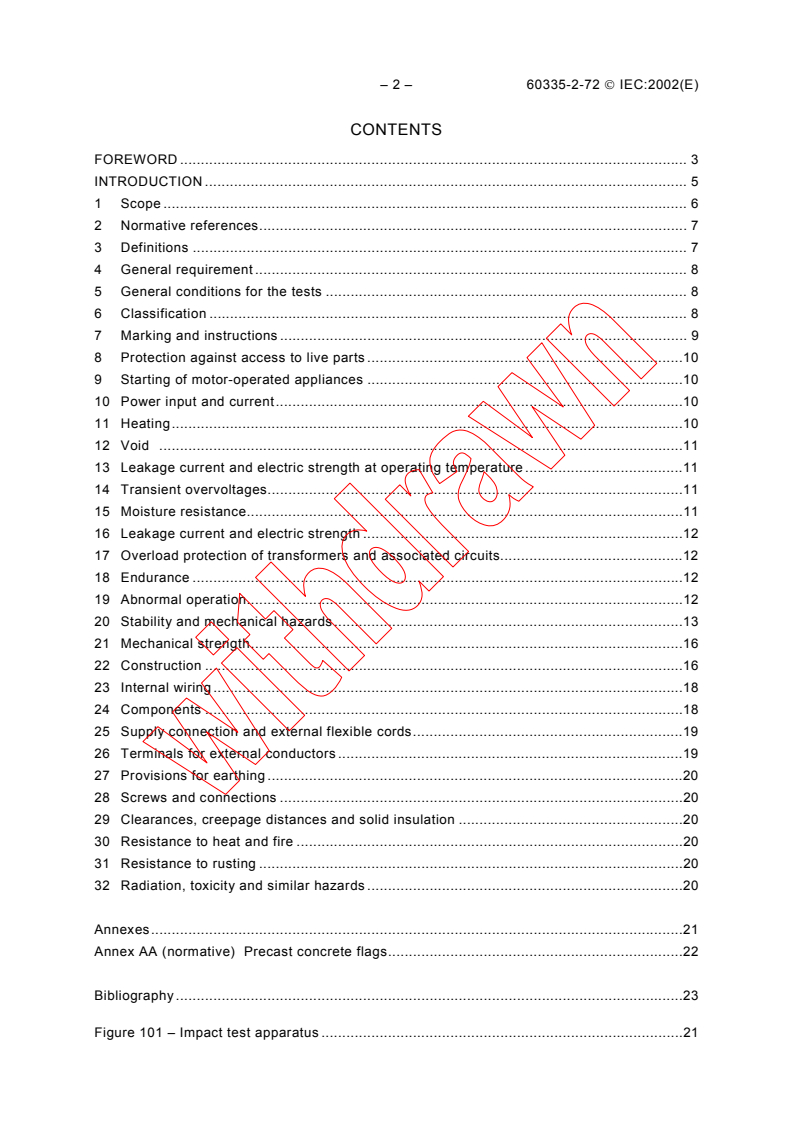
CONTENTS
FOREWORD . 3
INTRODUCTION .5
1 Scope . 6
2 Normative references. 7
3 Definitions . 7
4 General requirement . 8
5 General conditions for the tests . 8
6 Classification . 8
7 Marking and instructions . 9
8 Protection against access to live parts .10
9 Starting of motor-operated appliances .10
10 Power input and current.10
11 Heating.10
12 Void .11
13 Leakage current and electric strength at operating temperature .11
14 Transient overvoltages.11
15 Moisture resistance.11
16 Leakage current and electric strength .12
17 Overload protection of transformers and associated circuits.12
18 Endurance .12
19 Abnormal operation.12
20 Stability and mechanical hazards.13
21 Mechanical strength.16
22 Construction .16
23 Internal wiring.18
24 Components .18
25 Supply connection and external flexible cords.19
26 Terminals for external conductors .19
27 Provisions for earthing .20
28 Screws and connections .20
29 Clearances, creepage distances and solid insulation .20
30 Resistance to heat and fire .20
31 Resistance to rusting .20
32 Radiation, toxicity and similar hazards .20
Annexes.21
Annex AA (normative) Precast concrete flags.22
Bibliography.23
Figure 101 – Impact test apparatus .21
60335-2-72 IEC:2002(E) – 3 –
INTERNATIONAL ELECTROTECHNICAL COMMISSION
____________
HOUSEHOLD AND SIMILAR ELECTRICAL APPLIANCES –
SAFETY –
Part 2-72: Particular requirements for automatic machines
for floor treatment for commercial and industrial use
FOREWORD
1) The IEC (International Electrotechnical Commission) is a worldwide organization for standardization comprising
all national electrotechnical committees (IEC National Committees). The object of the IEC is to promote
international co-operation on all questions concerning standardization in the electrical and electronic fields. To
this end and in addition to other activities, the IEC publishes International Standards. Their preparation is
entrusted to technical committees; any IEC National Committee interested in the subject dealt with may
participate in this preparatory work. International, governmental and non-governmental organizations liaising
with the IEC also participate in this preparation. The IEC collaborates closely with the International
Organization for Standardization (ISO) in accordance with conditions determined by agreement between the
two organizations.
2) The formal decisions or agreements of the IEC on technical matters express, as nearly as possible, an
international consensus of opinion on the relevant subjects since each technical committee has representation
from all interested National Committees.
3) The documents produced have the form of recommendations for international use and are published in the form
of standards, technical specifications, technical reports or guides and they are accepted by the National
Committees in that sense.
4) In order to promote international unification, IEC National Committees undertake to apply IEC International
Standards transparently to the maximum extent possible in their national and regional standards. Any
divergence between the IEC Standard and the corresponding national or regional standard shall be clearly
indicated in the latter.
5) The IEC provides no marking procedure to indicate its approval and cannot be rendered responsible for any
equipment declared to be in conformity with one of its standards.
6) Attention is drawn to the possibility that some of the elements of this International Standard may be the subject
of patent rights. The IEC shall not be held responsible for identifying any or all such patent rights.
This part of International Standard IEC 60335 has been prepared by sub-committee 61J:
Electrical motor-operated cleaning appliances for industrial use, of IEC technical committee
61: Safety of household and similar electrical appliances.
This second edition cancels and replaces the first edition published in 1995 and its
amendment 1 (2000). It constitutes a technical revision.
The text of this standard is based on the following documents:
FDIS Report on voting
61J/130/FDIS 61J/135/RVD
Full information on the voting for the approval of this standard can be found in the report on
voting indicated in the above table.
This part 2 is to be used in conjunction with the latest edition of IEC 60335-1 and its amend-
ments. It was established on the basis of the fourth edition (2001) of that standard.
NOTE 1 When “Part 1” is mentioned in this standard, it refers to IEC 60335-1.
This part 2 supplements or modifies the corresponding clauses in IEC 60335-1, so as to
convert that publication into the IEC standard: Safety requirements for automatic machines for
floor treatment for industrial and commercial use.
– 4 – 60335-2-72 IEC:2002(E)
When a particular subclause of part 1 is not mentioned in this part 2, that subclause applies
as far as is reasonable. When this standard states “addition”, “modification” or “replacement”,
the relevant text in Part 1 is to be adapted accordingly.
NOTE 2 The following numbering system is used:
– subclauses, tables and figures that are numbered starting from 101 are additional to those in Part 1;
– unless notes are in a new subclause or involve notes in Part 1, they are numbered starting from 101, including
those in a replaced clause or subclause;
– additional annexes are lettered AA, BB, etc.
NOTE 3 The following print types are used:
– requirements: in roman type;
– test specifications: in italic type;
– notes: in small roman type.
Words in bold in the text are defined in Clause 3. When a definition concerns an adjective, the adjective and the
associated noun are also in bold.
The committee has decided that the contents of this publication will remain unchanged until
2004. At this date, the publication will be
• reconfirmed;
• withdrawn;
• replaced by a revised edition, or
• amended.
60335-2-72 IEC:2002(E) – 5 –
INTRODUCTION
It has been assumed in the drafting of this International Standard that the execution of its
provisions is entrusted to appropriately qualified and experienced persons.
This standard recognizes the internationally accepted level of protection against hazards such
as electrical, mechanical, thermal, fire and radiation of appliances when operated as in
normal use taking into account the manufacturer's instructions. It also covers abnormal
situations that can be expected in practice.
This standard takes into account the requirements of IEC 60364 as far as possible so that
there is compatibility with the wiring rules when the appliance is connected to the supply
mains. However, national wiring rules may differ.
If an appliance within the scope of this standard also incorporates functions that are covered
by another part 2 of IEC 60335, the relevant part 2 is applied to each function separately, as
far as is reasonable. If applicable, the influence of one function on the other is taken into
account.
This standard is a product family standard dealing with the safety of appliances and takes
precedence over horizontal and generic standards covering the same subject.
An appliance that complies with the text of this standard will not necessarily be considered to
comply with the safety principles of the standard if, when examined and tested, it is found to
have other features that impair the level of safety covered by these requirements.
An appliance employing materials or having forms of construction differing from those detailed
in the requirements of this standard may be examined and tested according to the intent of
the requirements and, if found to be substantially equivalent, may be considered to comply
with the standard.
– 6 – 60335-2-72 IEC:2002(E)
HOUSEHOLD AND SIMILAR ELECTRICAL APPLIANCES –
SAFETY –
Part 2-72: Particular requirements for automatic machines
for floor treatment for commercial and industrial use
1 Scope
This clause of Part 1 is replaced by the following.
This International Standard deals with the safety of mains or battery supplied portable
combined machines, with or without a built-in battery charger, having a chassis with or without
traction drive, intended for commercial and industrial use indoors or outdoors for dry or wet
treatment of hard floors or of floors with carpeting, their rated voltage being not more than
250 V for single-phase appliances and 480 V for other appliances.
NOTE 101 Examples of such appliances are catering equipment, cleaning appliances for industrial and
commercial use, and appliances for hairdressers.
NOTE 102 Mobile equipment is defined as portable by part 1.
NOTE 103 Treatment within the meaning of this standard denotes for example
– scrubbing;
– wet or dry pick-up;
– polishing;
– application of wax and sealing products;
– shampooing.
It is also applicable to appliances making use of other forms of energy for the motor; but it is
necessary that their influence is taken into consideration.
For machines denoted to handle hazardous dust in normal use, additional requirements are
specified in Annex AA of IEC 60335-2-69.
NOTE 104 Attention is drawn to the fact that
– for appliances intended to be used in vehicles or on board ships or aircraft, additional requirements may be
necessary;
– in many countries additional requirements are specified by the national health authorities, the national
authorities responsible for the protection of labour, the national water supply authorities and similar
authorities.
– for machines denoted for operation or transport in public areas additional requirements may be specified by
the national authorities responsible for road traffic licensing regulations.
NOTE 105 This standard does not apply to
– appliances intended exclusively for industrial purposes;
– appliances intended to be used in locations where special conditions prevail, such as the presence of a
corrosive or explosive atmosphere (dust, vapour or gas);
– audio, video and similar electronic apparatus (IEC 60065);
– appliances for medical purposes (IEC 60601);
– hand-held motor-operated electric tools (IEC 60745);
– personal computers and similar equipment (IEC 60950);
– transportable motor-operated electric tools (IEC 61029).
– floor treatment machines for commercial and industrial use (IEC 60335-2-67).
– spray extraction appliances for commercial and industrial use (IEC 60335-2-68).
– wet and dry vacuum cleaners for commercial and industrial use (IEC 60335-2-69).
60335-2-72 IEC:2002(E) – 7 –
2 Normative references
This clause of Part 1 is applicable except as follows.
Addition:
IEC 60312, Vacuum cleaners for household use – Methods of measuring the performance
IEC 60335-2-69, Household and similar electrical appliances – Safety – Part 2-69: Particular
requirements for wet and dry vacuum cleaners, including power brush, for industrial and
commercial use
NOTE Annex AA contains particular requirements for vacuum cleaners, suction sweeping machines and dust
extractors for the collection of dusts hazardous to health.
ISO 3411, Earth moving machinery – Human physical dimensions of operators and minimum
operator space envelope
3 Definitions
This clause of Part 1 is applicable except as follows.
3.1.9 Replacement:
normal operation
the load corresponding to the rated input or the highest obtainable load of all the particular
loads of the various functions that can be operated at the same time in accordance with the
manufacturer's instructions. For machines provided with a seat or an operator platform, a
mass of 75 kg secured in position at the appropriate height is used to simulate the operator in
the most unfavourable position.
Operational functions denote all treatment and driving functions.
The normal operation related to the operational functions is specified as follows:
3.1.9.101 Scrubbing and sweeping machines are operated on a surface of hydraulically
pressed concrete paving slabs (see Annex AA) intermittently in accordance with the
manufacturer's instructions, at least 30 min switched on, and for a period of 5 min switched
off.
An alternative is a smooth concrete area of a surface consistency comparable with
hydraulically pressed concrete paving slabs.
3.1.9.102 Dry and wet pick-up machines are operated according to IEC 60335-2-69.
3.1.9.103 Polishing and dry buffing machines are operated as follows.
PVC-surfaces are considered to be suitable for establishing normal operation. The peak of
input occurring during the drying process of the chemical applied to treat the surface shall not
be taken as normal operation but shall be averaged by extending measurements over a period
of at least 10 min.
3.1.9.104 Carpet shampooers are operated on a test surface consisting of a carpet, in
accordance with IEC 60312, the carpet being fastened to the floor. The brush of the
shampooing machine has, prior to testing, to be conditioned by operating it for 15 min on a
clean, dry concrete surface. After running on the concrete surface the brush has to be
immersed in a shampoo solution for at least 30 min.
– 8 – 60335-2-72 IEC:2002(E)
The operation has to be carried out over a period of 10 min where the solution tank has to be
filled when starting the operation.
3.101
wet cleaning machines
machines for scrubbing and sucking up cleaning liquids on large surfaces indoors or outdoors,
for example scrubbing machines. They may be designed also for combination of dry or wet
cleaning and floor treatment with attachments for polishing, buffing, etc., and for sucking-up of
dry dirt
3.102
walk-behind machines
machines with or without a traction drive that are guided or moved by the operator. They may
be equipped with a sulky attachment with a seat for the operator, however they will be
considered for the application as walk-behind machines also
3.103
ride-on machines with an operator platform
machines with a traction drive on which the operator is standing during operation
3.104
ride-on machines with an operator seat
machines with a traction drive on which the operator is sitting during the operation
3.105
sulky
device to enable the operation of machines in a sitting or standing position. They are also
called trailers
3.106
instructed person
an individual adequately advised or supervised by a skilled person to enable that individual to
avoid hazards that electricity can create
4 General requirement
This clause of Part 1 is applicable.
5 General conditions for the tests
This clause of Part 1 is applicable except as follows.
5.101 In appliances for wet scrubbing and shampooing the liquid containers are filled to the
highest level indicated by the manufacturer.
5.102 If additional weights are delivered with the appliance, these are inserted before
normal operation.
6 Classification
This clause of Part 1 is applicable except as follows.
6.1 Replacement:
60335-2-72 IEC:2002(E) – 9 –
Appliances shall be of class I, class II or class III with respect to the protection against
electric shock.
Compliance is checked by inspection and by the relevant tests.
6.2 Addition:
Mains supplied and battery powered machines for indoor use intended for dry cleaning only,
shall be at least IPX0. Other machines shall be at least IPX3.
7 Marking and instructions
This clause of Part 1 is applicable except as follows.
7.1 Addition:
Machines shall be marked in addition with:
– serial number indicating (for example, in the form of a code), the year of manufacture, if
this is not directly marked;
– gross weight of the machine as ready for use in kilograms, if higher than 100 kg;
– reference to the capability of picking up hazardous dust, in accordance with Annex AA to
IEC 60335-2-69;
– substance of the statement "Suitable for picking up hazardous dust", if the machine is
capable of doing this;
– substance of the statement "Suitable for use only on surfaces with a gradient not
exceeding 2 %" if the machine is not designed to be operated on higher gradients.
7.12 Addition:
The instructions shall contain, if applicable, the substance of the following warnings:
– CAUTION: The machine is not suitable for picking up hazardous dust;
– CAUTION: The machine shall not be used on surfaces with a gradient exceeding 2 %.
The instructions shall include the following regarding preparation for use, operation,
maintenance and service, as far as relevant:
– the machine shall be used only by instructed and authorised persons;
– when cleaning, servicing or maintaining the machine, replacing parts or converting to
another function the power source shall be switched off. Mains operated machines shall
be disconnected by removing the power plug, and battery operated machines shall be
disconnected by removing the key of the power switch, or any other effective means;
– before use all covers and doors shall be put in the position specified in the instructions for
use.
For mains supplied machines:
– to avoid hazards that may occur when rotating brushes touch or cross the supply cord;
– to take care not to damage or impair the supply cord by stroking, crushing, stretching, etc.;
– to inspect regularly the supply cord for signs of damage or aging;
– to stop using the machine, if the condition of the supply cord is not satisfactory;
– the machine shall be fitted with only those types of supply cords or detachable cords that
are specified by the manufacturer of the machine;
– 10 – 60335-2-72 IEC:2002(E)
– to ensure the required protection against moisture when replacing cable couplers of the
supply cord.
For machines with a traction drive and a mass exceeding 100 kg:
– in order to prevent unauthorised use of the machine the power source shall be switched
off or locked, for example, by removing the key of the power switch;
– machines left unattended shall be secured against unintentional movement;
– during operation attention shall be paid to other persons, especially children.
8 Protection against access to live parts
This clause of Part 1 is applicable except as follows.
8.1 Addition:
Parts working with a nominal battery voltage up to 48 V are not considered to be live parts.
NOTE 101 Water and water-borne cleaning agents are treated as conductive.
8.1.4 Addition:
Isolated battery systems of 18 to 24 cells of either acid or alkaline electrochemistry, including
gel batteries, shall be regarded as class III provided that
– the maximum voltage per cell on charge does not exceed 2,7 V;
– there are no earthed parts;
– conductive parts cannot fall on to and thereby bridge live parts of opposite polarity.
9 Starting of motor-operated appliances
This clause of Part 1 is not applicable.
10 Power input and current
This clause of Part 1 is applicable.
11 Heating
This clause of Part 1 is applicable except as follows.
11.3 Addition:
If it is necessary to disassemble the machine for fitting thermo-couples or other wiring, the
input shall be measured before and after fitting at the lowest possible load, for example, with
closed suction openings, with brushes not in contact with the floor, with declutched drive, etc.,
to check if the assembling has been accomplished properly.
11.5 Addition:
The normal operation may be simulated by applying an appropriate braking equipment.
For battery supplied machines the test is carried out commencing with a fully charged battery.
60335-2-72 IEC:2002(E) – 11 –
11.7 Addition:
Appliances are operated until steady conditions are established.
12 Void
13 Leakage current and electric strength at operating temperature
This clause of Part 1 is applicable except as follows.
13.2 Addition:
For class I appliances where several motors operate at the same time, the leakage current
shall not exceed 3,5 mA
14 Transient overvoltages
This clause of Part 1 is applicable.
15 Moisture resistance
This clause of Part 1 is applicable except as follows.
15.1 Modification:
Replace the first sentence by the following:
The enclosure of the appliance shall provide the degree of protection against moisture in
accordance with the classification of the appliance, except for batteries.
Addition:
For mains supplied machines for outdoor use the tests of 15.1.1 shall be carried out with fans
operating.
15.2 Addition:
For these tests detachable cords are removed. The machine is turned over until it falls into a
stable position on a horizontal surface.
After these tests:
– wet cleaning machines, except machines for
...
IEC 60335-2-72
Edition 2.0 2002-07
INTERNATIONAL
STANDARD
NORME
INTERNATIONALE
Household and similar electrical appliances – Safety –
Part 2-72: Particular requirements for automatic machines for floor treatment for
commercial and industrial use
Appareils électrodomestiques et analogues – Sécurité –
Partie 2-72: Règles particulières pour les machines automatiques de traitements
des sols à usage industriel et commercial
All rights reserved. Unless otherwise specified, no part of this publication may be reproduced or utilized in any form or by
any means, electronic or mechanical, including photocopying and microfilm, without permission in writing from either IEC or
IEC's member National Committee in the country of the requester.
If you have any questions about IEC copyright or have an enquiry about obtaining additional rights to this publication,
please contact the address below or your local IEC member National Committee for further information.
Droits de reproduction réservés. Sauf indication contraire, aucune partie de cette publication ne peut être reproduite
ni utilisée sous quelque forme que ce soit et par aucun procédé, électronique ou mécanique, y compris la photocopie
et les microfilms, sans l'accord écrit de la CEI ou du Comité national de la CEI du pays du demandeur.
Si vous avez des questions sur le copyright de la CEI ou si vous désirez obtenir des droits supplémentaires sur cette
publication, utilisez les coordonnées ci-après ou contactez le Comité national de la CEI de votre pays de résidence.
IEC Central Office
3, rue de Varembé
CH-1211 Geneva 20
Switzerland
Email: inmail@iec.ch
Web: www.iec.ch
About the IEC
The International Electrotechnical Commission (IEC) is the leading global organization that prepares and publishes
International Standards for all electrical, electronic and related technologies.
About IEC publications
The technical content of IEC publications is kept under constant review by the IEC. Please make sure that you have the
latest edition, a corrigenda or an amendment might have been published.
ƒ Catalogue of IEC publications: www.iec.ch/searchpub
The IEC on-line Catalogue enables you to search by a variety of criteria (reference number, text, technical committee,…).
It also gives information on projects, withdrawn and replaced publications.
ƒ IEC Just Published: www.iec.ch/online_news/justpub
Stay up to date on all new IEC publications. Just Published details twice a month all new publications released. Available
on-line and also by email.
ƒ Electropedia: www.electropedia.org
The world's leading online dictionary of electronic and electrical terms containing more than 20 000 terms and definitions
in English and French, with equivalent terms in additional languages. Also known as the International Electrotechnical
Vocabulary online.
ƒ Customer Service Centre: www.iec.ch/webstore/custserv
If you wish to give us your feedback on this publication or need further assistance, please visit the Customer Service
Centre FAQ or contact us:
Email: csc@iec.ch
Tel.: +41 22 919 02 11
Fax: +41 22 919 03 00
A propos de la CEI
La Commission Electrotechnique Internationale (CEI) est la première organisation mondiale qui élabore et publie des
normes internationales pour tout ce qui a trait à l'électricité, à l'électronique et aux technologies apparentées.
A propos des publications CEI
Le contenu technique des publications de la CEI est constamment revu. Veuillez vous assurer que vous possédez
l’édition la plus récente, un corrigendum ou amendement peut avoir été publié.
ƒ Catalogue des publications de la CEI: www.iec.ch/searchpub/cur_fut-f.htm
Le Catalogue en-ligne de la CEI vous permet d’effectuer des recherches en utilisant différents critères (numéro de référence,
texte, comité d’études,…). Il donne aussi des informations sur les projets et les publications retirées ou remplacées.
ƒ Just Published CEI: www.iec.ch/online_news/justpub
Restez informé sur les nouvelles publications de la CEI. Just Published détaille deux fois par mois les nouvelles
publications parues. Disponible en-ligne et aussi par email.
ƒ Electropedia: www.electropedia.org
Le premier dictionnaire en ligne au monde de termes électroniques et électriques. Il contient plus de 20 000 termes et
définitions en anglais et en français, ainsi que les termes équivalents dans les langues additionnelles. Egalement appelé
Vocabulaire Electrotechnique International en ligne.
ƒ Service Clients: www.iec.ch/webstore/custserv/custserv_entry-f.htm
Si vous désirez nous donner des commentaires sur cette publication ou si vous avez des questions, visitez le FAQ du
Service clients ou contactez-nous:
Email: csc@iec.ch
Tél.: +41 22 919 02 11
Fax: +41 22 919 03 00
IEC 60335-2-72
Edition 2.0 2002-07
INTERNATIONAL
STANDARD
NORME
INTERNATIONALE
Household and similar electrical appliances – Safety –
Part 2-72: Particular requirements for automatic machines for floor treatment for
commercial and industrial use
Appareils électrodomestiques et analogues – Sécurité –
Partie 2-72: Règles particulières pour les machines automatiques de traitements
des sols à usage industriel et commercial
INTERNATIONAL
ELECTROTECHNICAL
COMMISSION
COMMISSION
ELECTROTECHNIQUE
PRICE CODE
INTERNATIONALE
T
CODE PRIX
ICS 97.080 ISBN 2-8318-8008-4
– 2 – 60335-2-72 © CEI: 2002
SOMMAIRE
AVANT-PROPOS.4
INTRODUCTION.8
1 Domaine d’application .10
2 Références normatives.12
3 Définitions .12
4 Prescriptions générales .16
5 Conditions générales d’essais .16
6 Classification.16
7 Marquage et indications .16
8 Protection contre l’accès aux parties actives .18
9 Démarrage des appareils à moteur.20
10 Puissance et courant .20
11 Echauffements .20
12 Vacant.20
13 Courant de fuite et rigidité diélectrique à la température de régime .20
14 Surtensions transitoires.22
15 Résistance à l’humidité.22
16 Courant de fuite et rigidité diélectrique .22
17 Protection contre la surcharge des transformateurs et des circuits associés.24
18 Endurance.24
19 Fonctionnement anormal .24
20 Stabilité et dangers mécaniques .26
21 Résistance mécanique .32
22 Construction .34
23 Conducteurs internes .36
24 Composants .38
25 Raccordement au réseau et câbles souples extérieurs .38
26 Bornes pour conducteurs externes .40
27 Dispositions en vue de la mise à la terre .40
28 Vis et connexions .40
29 Distances dans l'air, lignes de fuite et isolation solide .40
30 Résistance à la chaleur et au feu.42
31 Protection contre la rouille.42
32 Rayonnement, toxicité et dangers analogues.42
Annexes .46
Annexe AA (normative) Dalles en béton.46
Bibliographie.48
Figure 101 – Appareil d’essai d’impacts.44
60335-2-72 © IEC:2002 – 3 –
CONTENTS
FOREWORD.5
INTRODUCTION.9
1 Scope.11
2 Normative references .13
3 Definitions .13
4 General requirement.17
5 General conditions for the tests .17
6 Classification.17
7 Marking and instructions.17
8 Protection against access to live parts.19
9 Starting of motor-operated appliances .21
10 Power input and current .21
11 Heating .21
12 Void.21
13 Leakage current and electric strength at operating temperature.21
14 Transient overvoltages .23
15 Moisture resistance .23
16 Leakage current and electric strength.23
17 Overload protection of transformers and associated circuits .25
18 Endurance.25
19 Abnormal operation .25
20 Stability and mechanical hazards .27
21 Mechanical strength .33
22 Construction .35
23 Internal wiring.37
24 Components .39
25 Supply connection and external flexible cords .39
26 Terminals for external conductors.41
27 Provisions for earthing.41
28 Screws and connections .41
29 Clearances, creepage distances and solid insulation .41
30 Resistance to heat and fire.43
31 Resistance to rusting.43
32 Radiation, toxicity and similar hazards.43
Annexes .47
Annex AA (normative) Precast concrete flags .47
Bibliography.49
Figure 101 – Impact test apparatus.45
– 4 – 60335-2-72 © CEI: 2002
COMMISSION ÉLECTROTECHNIQUE INTERNATIONALE
____________
APPAREILS ÉLECTRODOMESTIQUES ET ANALOGUES –
SÉCURITÉ –
Partie 2-72: Règles particulières pour les machines
automatiques de traitements des sols
à usage industriel et commercial
AVANT-PROPOS
1) La Commission Electrotechnique Internationale (CEI) est une organisation mondiale de normalisation
composée de l'ensemble des comités électrotechniques nationaux (Comités nationaux de la CEI). La CEI a
pour objet de favoriser la coopération internationale pour toutes les questions de normalisation dans les
domaines de l'électricité et de l'électronique. A cet effet, la CEI – entre autres activités – publie des Normes
internationales, des Spécifications techniques, des Rapports techniques, des Spécifications accessibles au
public (PAS) et des Guides (ci-après dénommés "Publication(s) de la CEI"). Leur élaboration est confiée à des
comités d'études, aux travaux desquels tout Comité national intéressé par le sujet traité peut participer. Les
organisations internationales, gouvernementales et non gouvernementales, en liaison avec la CEI, participent
également aux travaux. La CEI collabore étroitement avec l'Organisation Internationale de Normalisation (ISO),
selon des conditions fixées par accord entre les deux organisations.
2) Les décisions ou accords officiels de la CEI concernant les questions techniques représentent, dans la mesure
du possible, un accord international sur les sujets étudiés, étant donné que les Comités nationaux de la CEI
intéressés sont représentés dans chaque comité d’études.
3) Les Publications de la CEI se présentent sous la forme de recommandations internationales et sont agréées
comme telles par les Comités nationaux de la CEI. Tous les efforts raisonnables sont entrepris afin que la CEI
s'assure de l'exactitude du contenu technique de ses publications; la CEI ne peut pas être tenue responsable
de l'éventuelle mauvaise utilisation ou interprétation qui en est faite par un quelconque utilisateur final.
4) Dans le but d'encourager l'uniformité internationale, les Comités nationaux de la CEI s'engagent, dans toute la
mesure possible, à appliquer de façon transparente les Publications de la CEI dans leurs publications
nationales et régionales. Toutes divergences entre toutes Publications de la CEI et toutes publications
nationales ou régionales correspondantes doivent être indiquées en termes clairs dans ces dernières.
5) La CEI n’a prévu aucune procédure de marquage valant indication d’approbation et n'engage pas sa
responsabilité pour les équipements déclarés conformes à une de ses Publications.
6) Tous les utilisateurs doivent s'assurer qu'ils sont en possession de la dernière édition de cette publication.
7) Aucune responsabilité ne doit être imputée à la CEI, à ses administrateurs, employés, auxiliaires ou
mandataires, y compris ses experts particuliers et les membres de ses comités d'études et des Comités
nationaux de la CEI, pour tout préjudice causé en cas de dommages corporels et matériels, ou de tout autre
dommage de quelque nature que ce soit, directe ou indirecte, ou pour supporter les coûts (y compris les frais
de justice) et les dépenses découlant de la publication ou de l'utilisation de cette Publication de la CEI ou de
toute autre Publication de la CEI, ou au crédit qui lui est accordé.
8) L'attention est attirée sur les références normatives citées dans cette publication. L'utilisation de publications
référencées est obligatoire pour une application correcte de la présente publication.
9) L’attention est attirée sur le fait que certains des éléments de la présente Publication de la CEI peuvent faire
l’objet de droits de propriété intellectuelle ou de droits analogues. La CEI ne saurait être tenue pour
responsable de ne pas avoir identifié de tels droits de propriété et de ne pas avoir signalé leur existence.
Cette partie de la Norme internationale CEI 60335 a été établie par le sous-comité 61J:
Appareils électriques à moteur de nettoyage pour usage industriel, du comité d'études 61 de
la CEI: Sécurité des appareils électrodomestiques et analogues.
Cette seconde édition annule et remplace la première édition publiée en 1995 et son
amendement 1 (2000). Elle constitue une révision technique.
Cette version bilingue, publiée en 2005-06, correspond à la version anglaise.
Le texte anglais de cette norme est issu des documents 61J/130/FDIS et 61J/135 /RVD. Le
rapport de vote 61J/135/RVD donne toute information sur le vote ayant abouti à l’approbation
de cette norme.
60335-2-72 © IEC:2002 – 5 –
INTERNATIONAL ELECTROTECHNICAL COMMISSION
____________
HOUSEHOLD AND SIMILAR ELECTRICAL APPLIANCES –
SAFETY –
Part 2-72: Particular requirements for automatic machines
for floor treatment for commercial and industrial use
FOREWORD
1) The International Electrotechnical Commission (IEC) is a worldwide organization for standardization comprising
all national electrotechnical committees (IEC National Committees). The object of IEC is to promote
international co-operation on all questions concerning standardization in the electrical and electronic fields. To
this end and in addition to other activities, IEC publishes International Standards, Technical Specifications,
Technical Reports, Publicly Available Specifications (PAS) and Guides (hereafter referred to as “IEC
Publication(s)”). Their preparation is entrusted to technical committees; any IEC National Committee interested
in the subject dealt with may participate in this preparatory work. International, governmental and non-
governmental organizations liaising with the IEC also participate in this preparation. IEC collaborates closely
with the International Organization for Standardization (ISO) in accordance with conditions determined by
agreement between the two organizations.
2) The formal decisions or agreements of IEC on technical matters express, as nearly as possible, an international
consensus of opinion on the relevant subjects since each technical committee has representation from all
interested IEC National Committees.
3) IEC Publications have the form of recommendations for international use and are accepted by IEC National
Committees in that sense. While all reasonable efforts are made to ensure that the technical content of IEC
Publications is accurate, IEC cannot be held responsible for the way in which they are used or for any
misinterpretation by any end user.
4) In order to promote international uniformity, IEC National Committees undertake to apply IEC Publications
transparently to the maximum extent possible in their national and regional publications. Any divergence
between any IEC Publication and the corresponding national or regional publication shall be clearly indicated in
the latter.
5) IEC provides no marking procedure to indicate its approval and cannot be rendered responsible for any
equipment declared to be in conformity with an IEC Publication.
6) All users should ensure that they have the latest edition of this publication.
7) No liability shall attach to IEC or its directors, employees, servants or agents including individual experts and
members of its technical committees and IEC National Committees for any personal injury, property damage or
other damage of any nature whatsoever, whether direct or indirect, or for costs (including legal fees) and
expenses arising out of the publication, use of, or reliance upon, this IEC Publication or any other IEC
Publications.
8) Attention is drawn to the Normative references cited in this publication. Use of the referenced publications is
indispensable for the correct application of this publication.
9) Attention is drawn to the possibility that some of the elements of this IEC Publication may be the subject of
patent rights. IEC shall not be held responsible for identifying any or all such patent rights.
This part of International Standard IEC 60335 has been prepared by sub-committee 61J:
Electrical motor-operated cleaning appliances for industrial use, of IEC technical committee
61: Safety of household and similar electrical appliances.
This second edition cancels and replaces the first edition published in 1995 and its
amendment 1 (2000). It constitutes a technical revision.
This bilingual version, published in 2005-06, corresponds to the English version.
The text of this standard is based on the following documents:
FDIS Report on voting
61J/130/FDIS 61J/135/RVD
Full information on the voting for the approval of this standard can be found in the report on
voting indicated in the above table.
– 6 – 60335-2-72 © CEI: 2002
La version française de cette norme n’a pas été soumise au vote.
La présente partie 2 doit être utilisée conjointement avec la dernière édition de la CEI 60335-
1 et ses amendements. Elle a été établie sur la base de la quatrième édition (2001) de cette
norme.
NOTE 1 L’expression «Partie 1» utilisée dans la présente norme fait référence à la CEI 60335-1.
La présente partie 2 complète ou modifie les articles correspondants de la CEI 60335-1 de
façon à transformer cette publication en norme CEI: Règles de sécurité pour les machines
automatiques de traitements des sols à usage industriel et commercial
Lorsqu'un paragraphe particulier de la Partie 1 n'est pas mentionné dans cette partie 2, ce
paragraphe s'applique pour autant qu’il est raisonnable. Lorsque la présente norme spécifie
“addition”, “modification” ou “remplacement”, le texte correspondant de la Partie 1 doit être
adapté en conséquence.
NOTE 2 Le système de numérotation suivant est utilisé:
– les paragraphes, les tableaux et figures qui sont numérotés à partir de 101 viennent en supplément de ceux de
la Partie 1;
– notes: à l’exception de celles qui sont dans un nouveau paragraphe ou de celles qui concernent des notes de
la Partie 1, les notes sont numérotées à partir de 101, y compris celles des articles ou paragraphes qui sont
remplacés;
– des annexes complémentaires sont désignées AA, BB, etc.
NOTE 3 Les caractères d'imprimerie suivants sont utilisés:
– exigences: caractères romains;
– modalités d'essais: caractères italiques;
– notes: petits caractères romains
Les mots en gras dans le texte sont définis à l'Article 3. Lorsqu'une définition concerne un adjectif, l'adjectif et le
nom associé figurent également en gras.
Le comité a décidé que le contenu de cette publication ne sera pas modifié avant la date de
maintenance indiquée sur le site web de la CEI sous «http://webstore.iec.ch» dans les
données relatives à la publication recherchée. A cette date, la publication sera
• reconduite;
• supprimée;
• remplacée par une édition révisée, ou
• amendée.
60335-2-72 © IEC:2002 – 7 –
The French version of this standard has not been voted upon.
This part 2 is to be used in conjunction with the latest edition of IEC 60335-1 and its amend-
ments. It was established on the basis of the fourth edition (2001) of that standard.
NOTE 1 When “Part 1” is mentioned in this standard, it refers to IEC 60335-1.
This part 2 supplements or modifies the corresponding clauses in IEC 60335-1, so as to
convert that publication into the IEC standard: Safety requirements for automatic machines for
floor treatment for industrial and commercial use.
When a particular subclause of part 1 is not mentioned in this part 2, that subclause applies
as far as is reasonable. When this standard states “addition”, “modification” or “replacement”,
the relevant text in Part 1 is to be adapted accordingly.
NOTE 2 The following numbering system is used:
– subclauses, tables and figures that are numbered starting from 101 are additional to those in Part 1;
– unless notes are in a new subclause or involve notes in Part 1, they are numbered starting from 101, including
those in a replaced clause or subclause;
– additional annexes are lettered AA, BB, etc.
NOTE 3 The following print types are used:
– requirements: in roman type;
– test specifications: in italic type;
– notes: in small roman type.
Words in bold in the text are defined in Clause 3. When a definition concerns an adjective, the adjective and the
associated noun are also in bold.
The committee has decided that the contents of this publication will remain unchanged until
the maintenance result date indicated on the IEC web site under "http://webstore.iec.ch" in
the data related to the specific publication. At this date, the publication will be
• reconfirmed;
• withdrawn;
• replaced by a revised edition, or
• amended.
– 8 – 60335-2-72 © CEI: 2002
INTRODUCTION
Il a été considéré en établissant la présente norme internationale que l'exécution de ses
dispositions était confiée à des personnes expérimentées et ayant une qualification
appropriée.
Cette norme reconnaît le niveau de protection internationalement accepté contre les risques
électriques, mécaniques, thermiques, liés au feu et au rayonnement des appareils, lorsqu'ils
fonctionnent comme en utilisation normale en tenant compte des instructions du fabricant.
Elle couvre également les situations anormales auxquelles on peut s'attendre dans la
pratique.
Cette norme tient compte autant que possible des exigences de la CEI 60364, de façon à
rester compatible avec les règles d'installation quand l’appareil est raccordé au réseau
d’alimentation. Cependant, des règles nationales d'installation peuvent être différentes.
Si un appareil compris dans le domaine d’application de cette norme comporte également des
fonctions qui sont couvertes par une autre partie 2 de la CEI 60335, la partie 2
correspondante est appliquée à chaque fonction séparément, dans la limite du raisonnable. Si
cela est applicable, on tient compte de l’influence d’une fonction sur les autres fonctions.
Cette norme est une norme de famille de produits traitant de la sécurité d’appareils et a
préséance sur les normes horizontales et génériques couvrant le même sujet.
Un appareil conforme au texte de la présente norme ne sera pas nécessairement jugé
conforme aux principes de sécurité de la norme si, lorsqu'il est examiné et soumis aux essais,
il apparaît qu'il présente d'autres caractéristiques qui compromettent le niveau de sécurité
visé par ces exigences.
Un appareil utilisant des matériaux ou présentant des modes de construction différents de
ceux décrits dans les exigences de cette norme peut être examiné et essayé en fonction de
l'objectif poursuivi par ces exigences et, s'il est jugé pratiquement équivalent, il peut être
estimé conforme aux principes de sécurité de la norme.
60335-2-72 © IEC:2002 – 9 –
INTRODUCTION
It has been assumed in the drafting of this International Standard that the execution of its
provisions is entrusted to appropriately qualified and experienced persons.
This standard recognizes the internationally accepted level of protection against hazards such
as electrical, mechanical, thermal, fire and radiation of appliances when operated as in
normal use taking into account the manufacturer's instructions. It also covers abnormal
situations that can be expected in practice.
This standard takes into account the requirements of IEC 60364 as far as possible so that
there is compatibility with the wiring rules when the appliance is connected to the supply
mains. However, national wiring rules may differ.
If an appliance within the scope of this standard also incorporates functions that are covered
by another part 2 of IEC 60335, the relevant part 2 is applied to each function separately, as
far as is reasonable. If applicable, the influence of one function on the other is taken into
account.
This standard is a product family standard dealing with the safety of appliances and takes
precedence over horizontal and generic standards covering the same subject.
An appliance that complies with the text of this standard will not necessarily be considered to
comply with the safety principles of the standard if, when examined and tested, it is found to
have other features that impair the level of safety covered by these requirements.
An appliance employing materials or having forms of construction differing from those detailed
in the requirements of this standard may be examined and tested according to the intent of
the requirements and, if found to be substantially equivalent, may be considered to comply
with the standard.
– 10 – 60335-2-72 © CEI: 2002
APPAREILS ÉLECTRODOMESTIQUES ET ANALOGUES –
SÉCURITÉ –
Partie 2-72: Règles particulières pour les machines
automatiques de traitements des sols
à usage industriel et commercial
1 Domaine d’application
L’article de la Partie 1 est remplacé par l’article ci-après.
La présente Norme internationale traite de la sécurité des machines mobiles combinées
fonctionnant sur le réseau ou sur batteries, avec ou sans chargeur de batterie incorporé,
ayant un châssis avec ou sans commande de dispositif de déplacement, destinées à un
usage industriel et commercial, à l’intérieur ou à l’extérieur, pour le traitement à sec ou
humide des sols durs ou des sols recouverts de moquette, leur tension assignée étant
inférieure ou égale à 250 V pour ce qui concerne les appareils monophasés, et à 480 V pour
les autres appareils.
NOTE 101 A titre d’exemple de tels appareils, on peut citer l’équipement de restauration, les appareils de
nettoyage à usage industriel et commercial, et les appareils utilisés par les coiffeurs.
NOTE 102 Le matériel mobile est défini dans la Partie 1.
NOTE 103 Dans le cadre de la présente norme, le traitement est par exemple:
– le brossage;
– le ramassage à sec ou en présence d’eau;
– le polissage;
– l’application de cire et de produits d’étanchéité;
– le nettoyage par shampouineuse.
Elle est également applicable aux appareils utilisant d'autres formes d'énergie pour le moteur;
dans ce cas, il sera toutefois nécessaire de prendre en compte l’influence que cela peut avoir.
Pour les machines destinées à traiter les poussières dangereuses en utilisation normale, les
exigences additionnelles sont spécifiées dans l’Annexe AA de la CEI 60335-2-69.
NOTE 104 L’attention est attirée sur le fait que
– pour les appareils destinés à être utilisés dans des véhicules ou à bord de navires ou d'avions, des exigences
supplémentaires peuvent être nécessaires;
– dans de nombreux pays, des exigences supplémentaires sont spécifiées par les organismes nationaux de la
santé, par les organismes nationaux responsables de la protection des travailleurs, par les organismes
nationaux responsables de l'alimentation en eau et par des organismes similaires.
– pour les machines destinées à fonctionner ou à se déplacer dans les lieux publics, des exigences
supplémentaires peuvent être spécifiées par les organismes nationaux responsables de la réglementation pour
la circulation routière.
NOTE 105 La présente norme ne s’applique pas:
– aux appareils destinés exclusivement aux usages industriels;
– aux appareils destinés à être utilisés dans des locaux présentant des conditions particulières comme par
exemple la présence d'une atmosphère corrosive ou explosive (poussières, vapeur ou gaz);
– aux appareils audio, vidéo et appareils électroniques analogues (CEI 60065);
– aux appareils destinés à des usages médicaux (CEI 60601);
– aux outils électroportatifs à moteur (CEI 60745);
60335-2-72 © IEC:2002 – 11 –
HOUSEHOLD AND SIMILAR ELECTRICAL APPLIANCES –
SAFETY –
Part 2-72: Particular requirements for automatic machines
for floor treatment for commercial and industrial use
1 Scope
This clause of Part 1 is replaced by the following.
This International Standard deals with the safety of mains or battery supplied portable
combined machines, with or without a built-in battery charger, having a chassis with or without
traction drive, intended for commercial and industrial use indoors or outdoors for dry or wet
treatment of hard floors or of floors with carpeting, their rated voltage being not more than
250 V for single-phase appliances and 480 V for other appliances.
NOTE 101 Examples of such appliances are catering equipment, cleaning appliances for industrial and
commercial use, and appliances for hairdressers.
NOTE 102 Mobile equipment is defined as portable by part 1.
NOTE 103 Treatment within the meaning of this standard denotes for example
– scrubbing;
– wet or dry pick-up;
– polishing;
– application of wax and sealing products;
– shampooing.
It is also applicable to appliances making use of other forms of energy for the motor; but it is
necessary that their influence is taken into consideration.
For machines denoted to handle hazardous dust in normal use, additional requirements are
specified in Annex AA of IEC 60335-2-69.
NOTE 104 Attention is drawn to the fact that
– for appliances intended to be used in vehicles or on board ships or aircraft, additional requirements may be
necessary;
– in many countries additional requirements are specified by the national health authorities, the national
authorities responsible for the protection of labour, the national water supply authorities and similar
authorities.
– for machines denoted for operation or transport in public areas additional requirements may be specified by
the national authorities responsible for road traffic licensing regulations.
NOTE 105 This standard does not apply to
– appliances intended exclusively for industrial purposes;
– appliances intended to be used in locations where special conditions prevail, such as the presence of a
corrosive or explosive atmosphere (dust, vapour or gas);
– audio, video and similar electronic apparatus (IEC 60065);
– appliances for medical purposes (IEC 60601);
– hand-held motor-operated electric tools (IEC 60745);
– 12 – 60335-2-72 © CEI: 2002
– aux ordinateurs domestiques et équipements analogues (CEI 60950);
– aux machines outils électriques semi-fixes (CEI 61029);
– aux machines de traitement et de nettoyage des sols, à usage industriel et commercial (CEI 60335-2-67).
– aux appareils de nettoyage par pulvérisation et aspiration à usage industriel et commercial (CEI 60335-2-68).
– aux aspirateurs fonctionnant en présence d’eau ou à sec à usage industriel et commercial (CEI 60335-2-69).
2 Références normatives
L’article de la Partie 1 est applicable avec les exceptions suivantes.
Addition:
CEI 60312, Aspirateurs de poussière à usage domestique – Méthodes de mesure de l'aptitude
à la fonction
CEI 60335-2-69, Appareils électrodomestiques et analogues – Sécurité – Partie 2-69: Règles
particulières pour les aspirateurs fonctionnant en présence d'eau ou à sec, y compris les
brosses motorisées, à usage industriel et commercial
NOTE L’Annexe AA de la CEI 60335-2-69 contient des exigences particulières applicables aux aspirateurs, aux machines
de balayage à aspiration et aux dépoussiéreurs, relatives au ramassage des poussières dangereuses pour la santé.
ISO 3411, Engins de terrassement – Dimensions ergonomiques des opérateurs et espace
enveloppe minimal des postes de travail
3 Définitions
L’article de la Partie 1 est applicable avec les exceptions suivantes.
3.1.9 Remplacement:
conditions de fonctionnement normal
charge correspondant à la puissance assignée ou charge la plus élevée susceptible de se
présenter, en prenant toutes les charges particulières résultant des différentes fonctions qui
peuvent être appliquées simultanément, conformément aux instructions du fabricant. Pour les
machines munies d’un siège ou d’une plate-forme pour le conducteur, le conducteur est
simulé par une masse de 75 kg, solidement maintenue en place à la hauteur appropriée, dans
la position la plus défavorable.
Les fonctions opérationnelles comprennent toutes les fonctions de traitement et de conduite.
Les conditions de fonctionnement normal relatives aux fonctions opérationnelles sont
spécifiées de la façon suivante:
3.1.9.101 Les machines de brossage et de balayage sont disposées sur une surface pavée
de dalles en béton précontraint hydraulique (voir Annexe AA) et elles sont mises en
fonctionnement par intermittence conformément aux instructions du fabricant, avec 30 min de
marche au moins, suivies de 5 min d'arrêt.
En variante, on peut utiliser une surface en béton lisse d’une consistance comparable à celle
des dalles en béton précontraint hydraulique.
3.1.9.102 Les machines de ramassage à sec et en présence d'eau sont mises en
fonctionnement conformément à la CEI 60335-2-69.
60335-2-72 © IEC:2002 – 13 –
– personal computers and similar equipment (IEC 60950);
– transportable motor-operated electric tools (IEC 61029).
– floor treatment machines for commercial and industrial use (IEC 60335-2-67).
– spray extraction appliances for commercial and industrial use (IEC 60335-2-68).
– wet and dry vacuum cleaners for commercial and industrial use (IEC 60335-2-69).
2 Normative references
This clause of Part 1 is applicable except as follows.
Addition:
IEC 60312, Vacuum cleaners for household use – Methods of measuring the performance
IEC 60335-2-69, Household and similar electrical appliances – Safety – Part 2-69: Particular
requirements for wet and dry vacuum cleaners, including power brush, for industrial and
commercial use
NOTE Annex AA contains particular requirements for vacuum cleaners, suction sweeping machines and dust
extractors for the collection of dusts hazardous to health.
ISO 3411, Earth moving machinery – Human physical dimensions of operators and minimum
operator space envelope
3 Definitions
This clause of Part 1 is applicable except as follows.
3.1.9 Replacement:
normal operation
the load corresponding to the rated input or the highest obtainable load of all the particular
loads of the various functions that can be operated at the same time in accordance with the
manufacturer's instructions. For machines provided with a seat or an operator platform, a
mass of 75 kg secured in position at the appropriate height is used to simulate the operator in
the most unfavourable position.
Operational functions denote all treatment and driving functions.
The normal operation related to the operational functions is specified as follows:
3.1.9.101 Scrubbing and sweeping machines are operated on a surface of hydraulically
pressed concrete paving slabs (see Annex AA) intermittently in accordance with the
manufacturer's instructions, at least 30 min switched on, and for a period of 5 min switched
off.
An alternative is a smooth concrete area of a surface consistency comparable with
hydraulically pressed concrete paving slabs.
3.1.9.102 Dry and wet pick-up machines are operated according to IEC 60335-2-69.
– 14 – 60335-2-72 © CEI: 2002
3.1.9.103 Les machines de polissage et de lustrage à sec sont mises en fonctionnement de
façon suivante.
Les surfaces en PVC sont considérées comme appropriées pour établir les conditions de
fonctionnement normal. La pointe de puissance absorbée au cours du processus de
séchage du produit chimique utilisé pour traiter la surface ne doit pas être considérée comme
condition de fonctionnement normal, mais on doit prendre la valeur moyenne en
prolongeant les mesures pendant au moins 10 min.
3.1.9.104 Les shampouineuses pour tapis sont mis en fonctionnement sur une surface
d'essai constituée d'un tapis, conformément à la CEI 60312, en fixant le tapis au sol. Avant
l'essai, la brosse de la machine doit être conditionnée en étant mise en fonctionnement
pendant 15 min sur une surface en béton propre et sèche. Après avoir été passée sur la
surface en béton, la brosse doit être immergée dans une solution de shampoing pendant au
moins 30 min.
L'essai doit être effectué pendant une durée de 10 min et le réservoir à shampooing doit être
plein au début de l'essai.
3.101
machines de nettoyage fonctionnant en présence d'eau
machines prévues pour brosser les sols humides et aspirer les liquides de nettoyage sur des
grandes surfaces intérieures ou extérieures, par exemple machines de brossage. Elles
peuvent également être conçues pour combiner le nettoyage à sec ou en présence d'eau et le
traitement des sols avec des accessoires pour le polissage, le lustrage, etc., ainsi que pour
l'aspiration de poussière sèche
3.102
machines à conducteur à pied
machines avec ou sans commande du dispositif de déplacement, guidées ou déplacées par le
conducteur. Elles peuvent être équipées d'un sulky avec siège pour le conducteur, mais sont
toutefois considérées pour l'application de la présente norme comme des machines à
conducteur à pied
3.103
machines à conducteu
...