


IEC 62341-2-1:2015
(Main)Organic light emitting diode (OLED) displays - Part 2-1: Essential ratings and characteristics of OLED display modules
General Information
- Abstract
IEC 62341-2-1:2015(E) describes the essential ratings and characteristics of organic light emitting diode (OLED) display modules.
- Status
- Published
- Publication Date
- 26-May-2015
- Technical Committee
- TC 110 - Electronic displays
- Drafting Committee
- WG 5 - TC 110/WG 5
- Current Stage
- PPUB - Publication issued
- Start Date
- 27-May-2015
- Completion Date
- 15-Jun-2015
Overview
IEC 62341-2-1:2015 defines the essential ratings and characteristics of OLED display modules. It is part of the IEC 62341 series on organic light emitting diode (OLED) displays and sets out the parameters manufacturers and users should specify for OLED modules - including limiting values, electrical and optical characteristics, mechanical outlines and supplementary handling and testing information. The standard guides consistent datasheet content and test-condition description for passive and active matrix OLED modules (monochrome and colour).
Key topics and requirements
- Types and structure: covers passive-matrix monochrome, passive-matrix colour and active-matrix colour OLED display modules; describes panel, circuit and bezel composition.
- Modes of operation: addressing modes (passive, active) and optical modes (top-/bottom-emission, number of colours/grey scales).
- Outline and connections: material/mechanical descriptions, connector types (connectors, flex cables, pins), outline drawings, active area and bezel dimensions.
- Limiting values (absolute maximum ratings): operating and storage temperature and humidity ranges, and supply and input signal voltage limits - specified as required fields for module specifications.
- Electrical characteristics: supply voltages for logic and EL drives, input signal voltage levels, operating and frame frequencies, supply currents and input currents.
- Optical characteristics: luminance, luminance uniformity, dark-room and ambient contrast ratios, viewing angle definitions, chromaticity (white, R/G/B), reflectance, and half-luminance lifetime (T50).
- Performance and reliability items: image sticking, power consumption and lifetime metrics.
- Supplementary information: timing characteristics, voltage sequencing, temperature-dependant operating ranges, handling/ESD precautions, installation and safety guidance, and reflectance characterization.
Applications and who uses it
- OLED module manufacturers use IEC 62341-2-1 to produce consistent datasheets and to define module acceptance criteria.
- Product designers and system integrators (OEMs) reference the standard when selecting modules to ensure compatibility and to specify environmental and electrical requirements.
- Test laboratories and quality assurance teams use the listed characteristics to design measurements and report test results consistently.
- Procurement and compliance engineers rely on the defined parameters when comparing suppliers and validating performance claims.
Practical uses include defining supplier datasheets, specifying test conditions for qualification, and ensuring interoperability between displays and host electronics.
Related standards
- IEC 62341-1-1: Generic specifications (series overview)
- IEC 62341-1-2: Terminology and letter symbols
- IEC 62341-5 / 5-2 / 5-3: Environmental and mechanical endurance testing
- IEC 62341-6-1 / 6-2 / 6-3: Measurement methods for optical, visual and image-quality parameters
Keywords: IEC 62341-2-1, OLED display modules, essential ratings, limiting values, electrical and optical characteristics, luminance, contrast ratio, chromaticity, T50 lifetime.
Frequently Asked Questions
IEC 62341-2-1:2015 is a standard published by the International Electrotechnical Commission (IEC). Its full title is "Organic light emitting diode (OLED) displays - Part 2-1: Essential ratings and characteristics of OLED display modules". This standard covers: IEC 62341-2-1:2015(E) describes the essential ratings and characteristics of organic light emitting diode (OLED) display modules.
IEC 62341-2-1:2015(E) describes the essential ratings and characteristics of organic light emitting diode (OLED) display modules.
IEC 62341-2-1:2015 is classified under the following ICS (International Classification for Standards) categories: 31.260 - Optoelectronics. Laser equipment. The ICS classification helps identify the subject area and facilitates finding related standards.
IEC 62341-2-1:2015 is available in PDF format for immediate download after purchase. The document can be added to your cart and obtained through the secure checkout process. Digital delivery ensures instant access to the complete standard document.
Standards Content (Sample)
IEC 62341-2-1 ®
Edition 1.0 2015-05
INTERNATIONAL
STANDARD
Organic light emitting diode (OLED) displays –
Part 2-1: Essential ratings and characteristics of OLED display modules
All rights reserved. Unless otherwise specified, no part of this publication may be reproduced or utilized in any form
or by any means, electronic or mechanical, including photocopying and microfilm, without permission in writing from
either IEC or IEC's member National Committee in the country of the requester. If you have any questions about IEC
copyright or have an enquiry about obtaining additional rights to this publication, please contact the address below or
your local IEC member National Committee for further information.
IEC Central Office Tel.: +41 22 919 02 11
3, rue de Varembé Fax: +41 22 919 03 00
CH-1211 Geneva 20 info@iec.ch
Switzerland www.iec.ch
About the IEC
The International Electrotechnical Commission (IEC) is the leading global organization that prepares and publishes
International Standards for all electrical, electronic and related technologies.
About IEC publications
The technical content of IEC publications is kept under constant review by the IEC. Please make sure that you have the
latest edition, a corrigenda or an amendment might have been published.
IEC Catalogue - webstore.iec.ch/catalogue Electropedia - www.electropedia.org
The stand-alone application for consulting the entire The world's leading online dictionary of electronic and
bibliographical information on IEC International Standards, electrical terms containing more than 30 000 terms and
Technical Specifications, Technical Reports and other definitions in English and French, with equivalent terms in 15
documents. Available for PC, Mac OS, Android Tablets and additional languages. Also known as the International
iPad. Electrotechnical Vocabulary (IEV) online.
IEC publications search - www.iec.ch/searchpub IEC Glossary - std.iec.ch/glossary
The advanced search enables to find IEC publications by a More than 60 000 electrotechnical terminology entries in
variety of criteria (reference number, text, technical English and French extracted from the Terms and Definitions
committee,…). It also gives information on projects, replaced clause of IEC publications issued since 2002. Some entries
and withdrawn publications. have been collected from earlier publications of IEC TC 37,
77, 86 and CISPR.
IEC Just Published - webstore.iec.ch/justpublished
Stay up to date on all new IEC publications. Just Published IEC Customer Service Centre - webstore.iec.ch/csc
details all new publications released. Available online and If you wish to give us your feedback on this publication or
also once a month by email. need further assistance, please contact the Customer Service
Centre: csc@iec.ch.
IEC 62341-2-1 ®
Edition 1.0 2015-05
INTERNATIONAL
STANDARD
Organic light emitting diode (OLED) displays –
Part 2-1: Essential ratings and characteristics of OLED display modules
INTERNATIONAL
ELECTROTECHNICAL
COMMISSION
ICS 31.260 ISBN 978-2-8322-2697-1
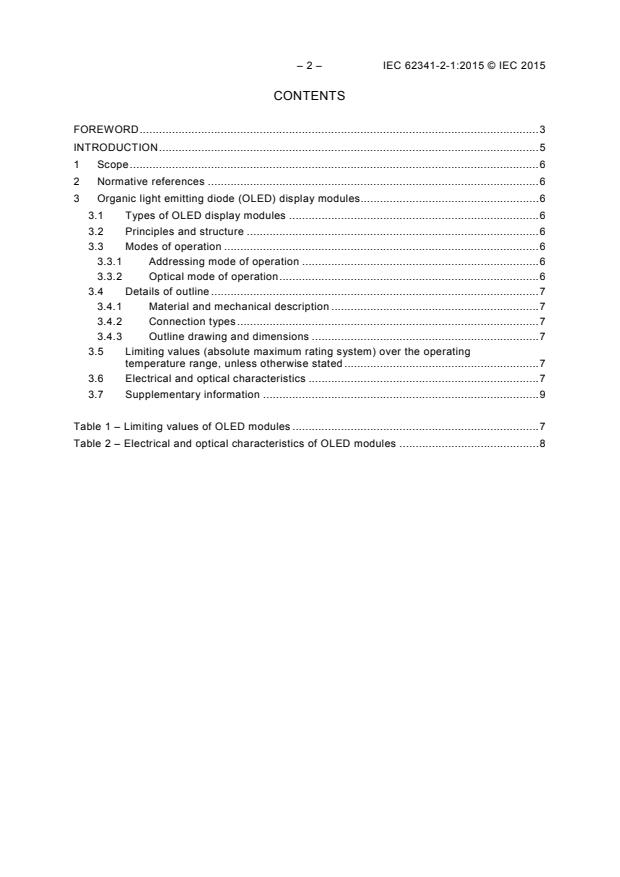
– 2 – IEC 62341-2-1:2015 © IEC 2015
CONTENTS
FOREWORD . 3
INTRODUCTION . 5
1 Scope . 6
2 Normative references . 6
3 Organic light emitting diode (OLED) display modules. 6
3.1 Types of OLED display modules . 6
3.2 Principles and structure . 6
3.3 Modes of operation . 6
3.3.1 Addressing mode of operation . 6
3.3.2 Optical mode of operation . 6
3.4 Details of outline . 7
3.4.1 Material and mechanical description . 7
3.4.2 Connection types . 7
3.4.3 Outline drawing and dimensions . 7
3.5 Limiting values (absolute maximum rating system) over the operating
temperature range, unless otherwise stated . 7
3.6 Electrical and optical characteristics . 7
3.7 Supplementary information . 9
Table 1 – Limiting values of OLED modules . 7
Table 2 – Electrical and optical characteristics of OLED modules . 8
INTERNATIONAL ELECTROTECHNICAL COMMISSION
____________
ORGANIC LIGHT EMITTING DIODE (OLED) DISPLAYS –
Part 2-1: Essential ratings and characteristics of OLED display modules
FOREWORD
1) The International Electrotechnical Commission (IEC) is a worldwide organization for standardization comprising
all national electrotechnical committees (IEC National Committees). The object of IEC is to promote
international co-operation on all questions concerning standardization in the electrical and electronic fields. To
this end and in addition to other activities, IEC publishes International Standards, Technical Specifications,
Technical Reports, Publicly Available Specifications (PAS) and Guides (hereafter referred to as “IEC
Publication(s)”). Their preparation is entrusted to technical committees; any IEC National Committee interested
in the subject dealt with may participate in this preparatory work. International, governmental and non-
governmental organizations liaising with the IEC also participate in this preparation. IEC collaborates closely
with the International Organization for Standardization (ISO) in accordance with conditions determined by
agreement between the two organizations.
2) The formal decisions or agreements of IEC on technical matters express, as nearly as possible, an international
consensus of opinion on the relevant subjects since each technical committee has representation from all
interested IEC National Committees.
3) IEC Publications have the form of recommendations for international use and are accepted by IEC National
Committees in that sense. While all reasonable efforts are made to ensure that the technical content of IEC
Publications is accurate, IEC cannot be held responsible for the way in which they are used or for any
misinterpretation by any end user.
4) In order to promote international uniformity, IEC National Committees undertake to apply IEC Publications
transparently to the maximum extent possible in their national and regional publications. Any divergence
between any IEC Publication and the corresponding national or regional publication shall be clearly indicated in
the latter.
5) IEC itself does not provide any attestation of conformity. Independent certification bodies provide conformity
assessment services and, in some areas, access to IEC marks of conformity. IEC is not responsible for any
services carried out by independent certification bodies.
6) All users should ensure that they have the latest edition of this publication.
7) No liability shall attach to IEC or its directors, employees, servants or agents including individual experts and
members of its technical committees and IEC National Commit
...